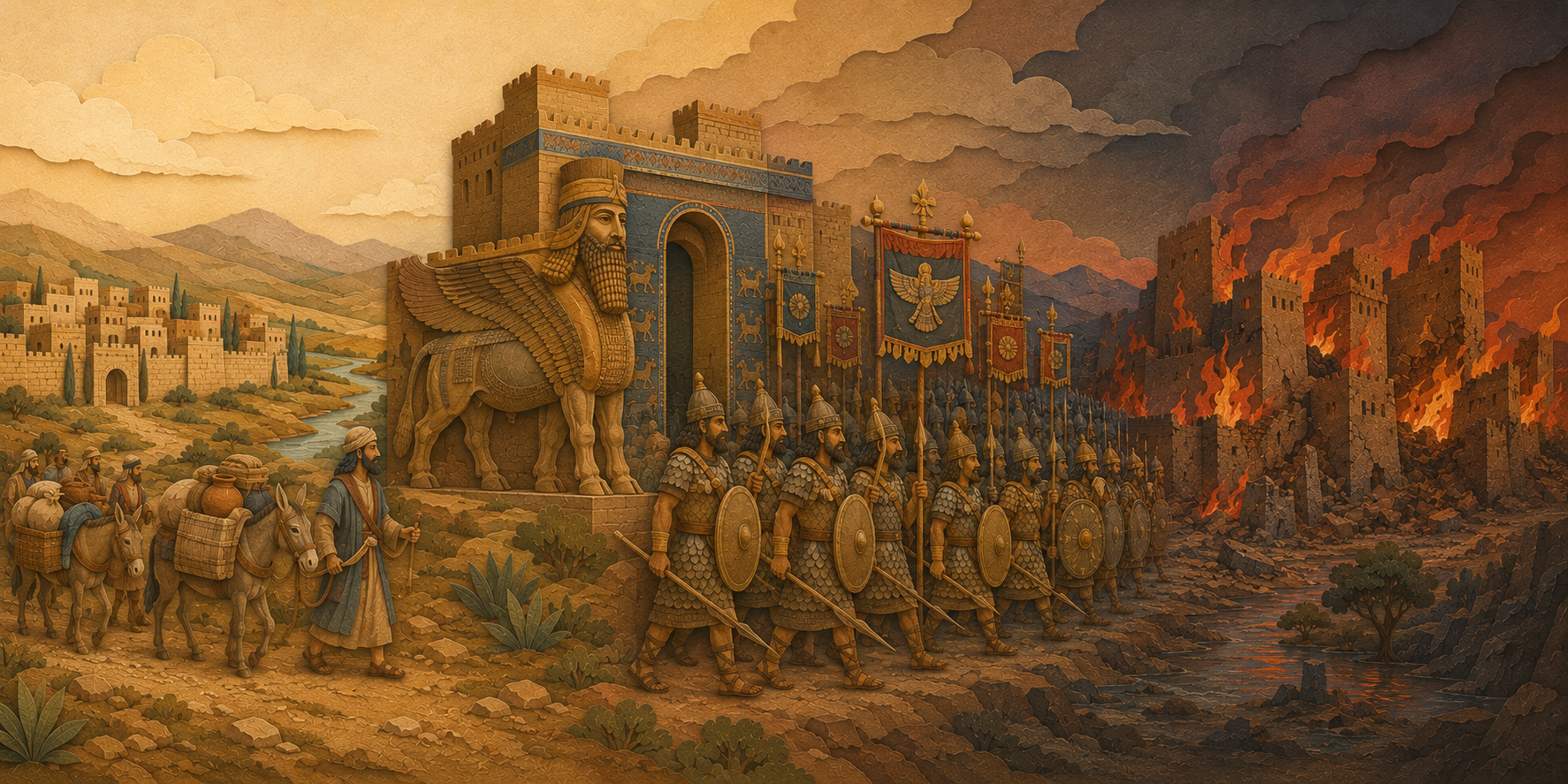
Timeline & the Rise of Empire
Two thousand years in the making, and gone in a single generation
Assyria is one of the oldest names in the record of civilization. The city of Ashur was already a going concern when Abraham’s world was young — a merchant town trading tin and textiles across the Anatolian plateau. That was centuries before it had an empire, or an army worth fearing. Yet the Assyria that scripture knows — the terror that Isaiah, Hosea, Amos, Jonah, and Nahum wrestle with — belongs almost entirely to a single furious stretch: the roughly three centuries of the Neo-Assyrian Empire (911–609 BC). It was the first state in history to rule from the Persian mountains to the Nile. And then, having swallowed the world, it vanished — so completely and so fast that within a few generations, travelers could walk over the ruins of Nineveh and not know a city had ever stood there.
This page traces that long arc in four movements: the merchant city, the first surge, the world empire, and the sudden fall. Along the way, it marks the moments where Assyrian kings step by name into the Bible’s own pages. Dates before the first millennium BC are approximate and debated. From the ninth century onward, though, the Assyrians kept meticulous records — annals, eponym lists (year-by-year registers, each named for a high official), even a recorded solar eclipse (763 BC) — that let us fix many events to the year.
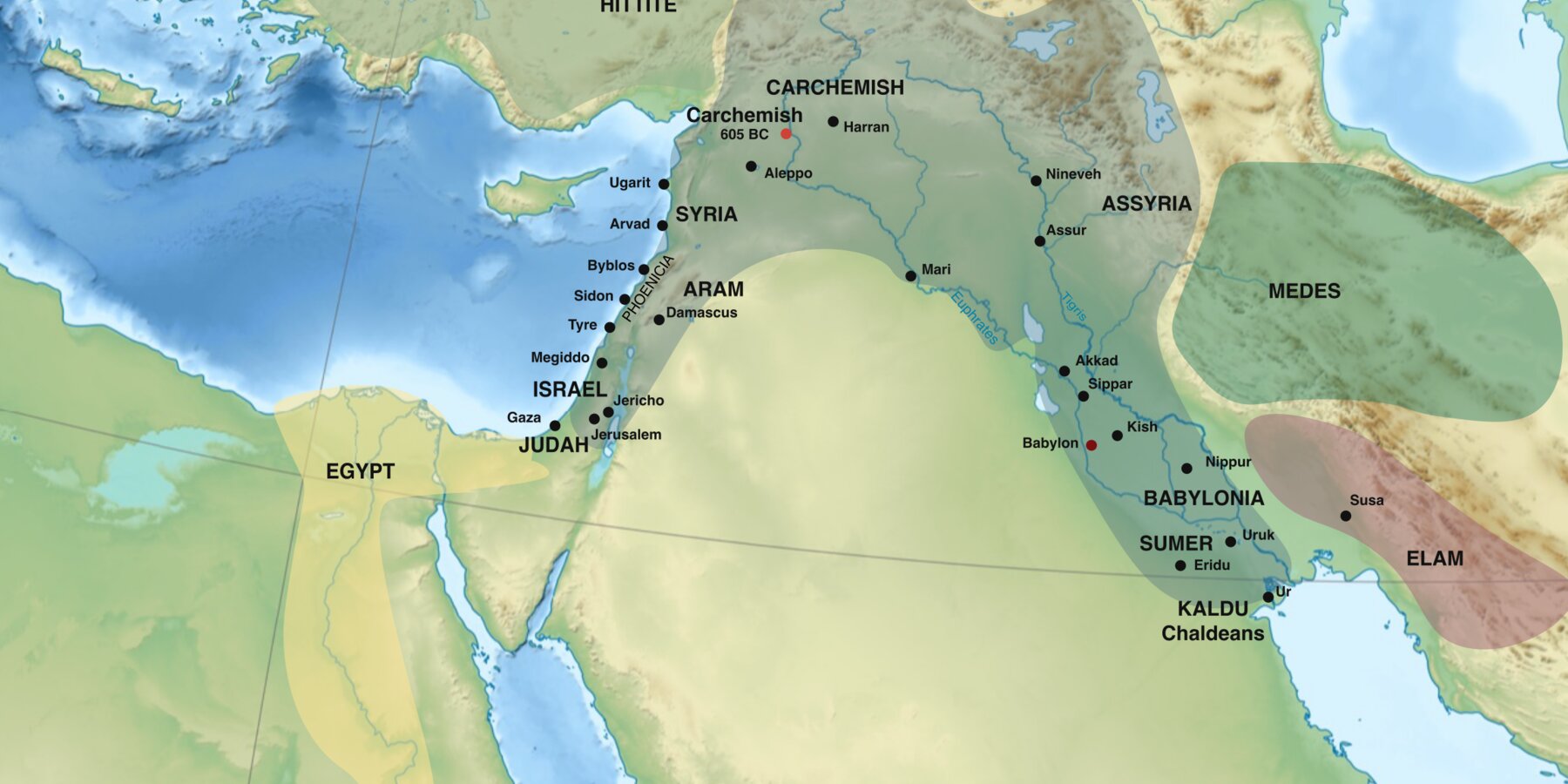
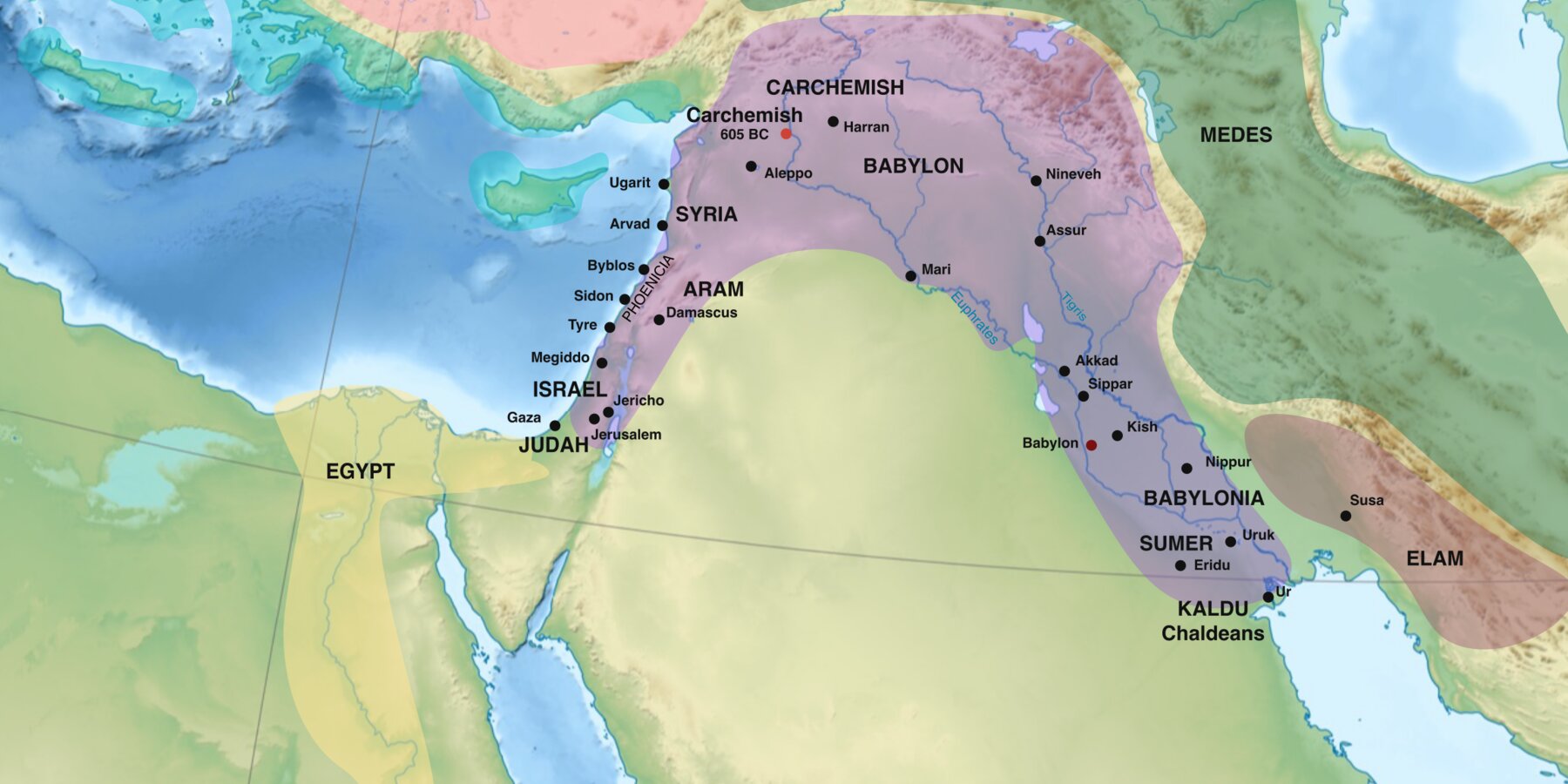
Drag the slider to watch the Near East change — set to 700 BC, the Neo-Assyrian Empire at its height, when Samaria had fallen and Sennacherib stood at the walls of Jerusalem.
Periods at a Glance
| Period | Approximate Dates | Biblical Connection |
|---|---|---|
| Old Assyrian Period | c. 2000–1750 BC | The patriarchal era — Ashur is a merchant city-state; the trading colonies of Kanesh, no empire in sight |
| Middle Assyrian Kingdom | c. 1363–1050 BC | Exodus through the Judges — the first surge under Tukulti-Ninurta I and Tiglath-Pileser I, then a long eclipse |
| Neo-Assyrian Empire | 911–609 BC | The divided kingdom’s nightmare — Pul, Tiglath-Pileser, Shalmaneser, Sargon, Sennacherib; Samaria falls, Jerusalem is spared |
| The Height & the Collapse | 681–609 BC | Egypt conquered, then ruin — Esarhaddon and Ashurbanipal at the summit; Nineveh falls, the fall Nahum foresaw |
Visual Timeline: From the Merchant City to the Fall of Nineveh
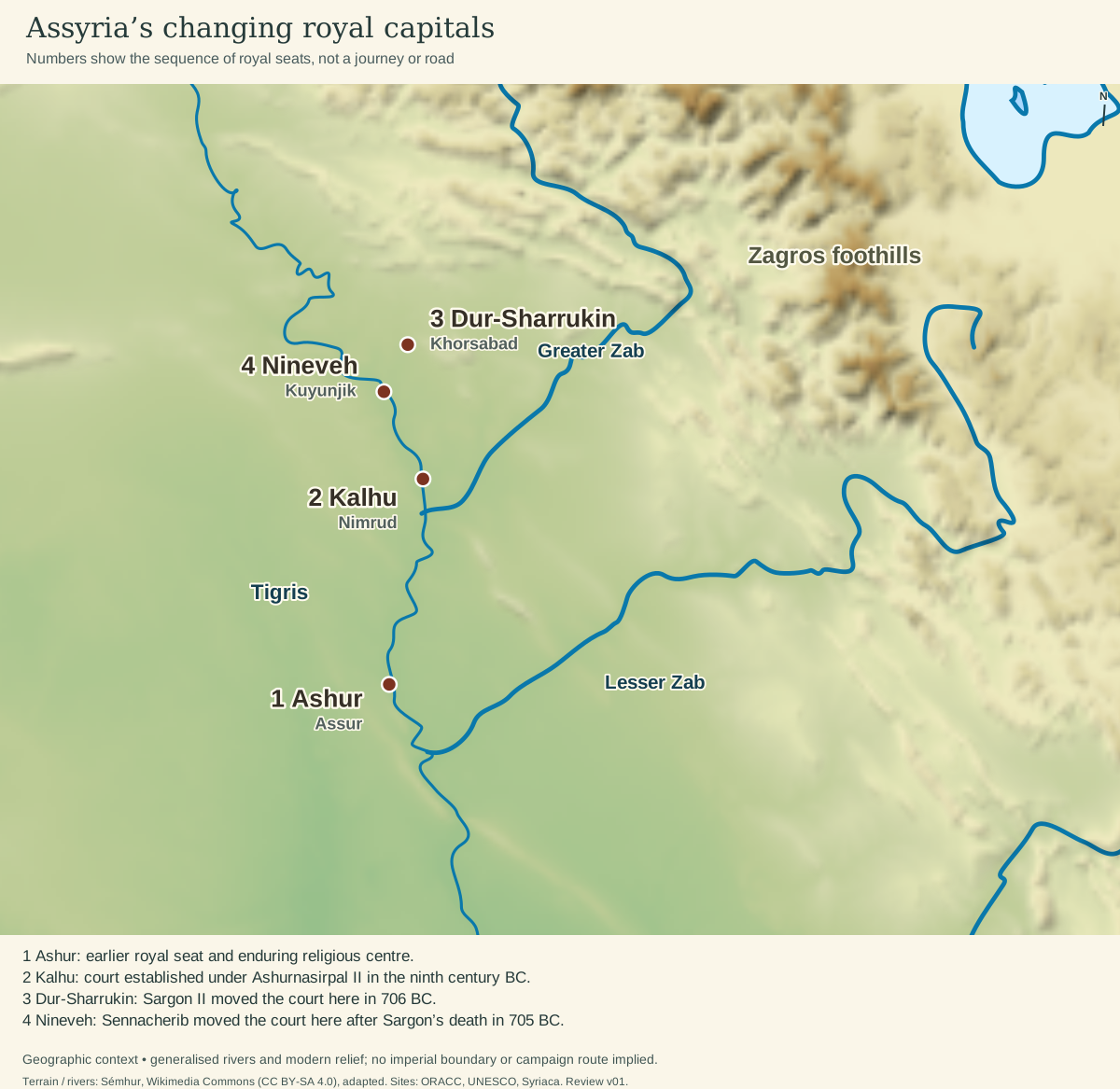
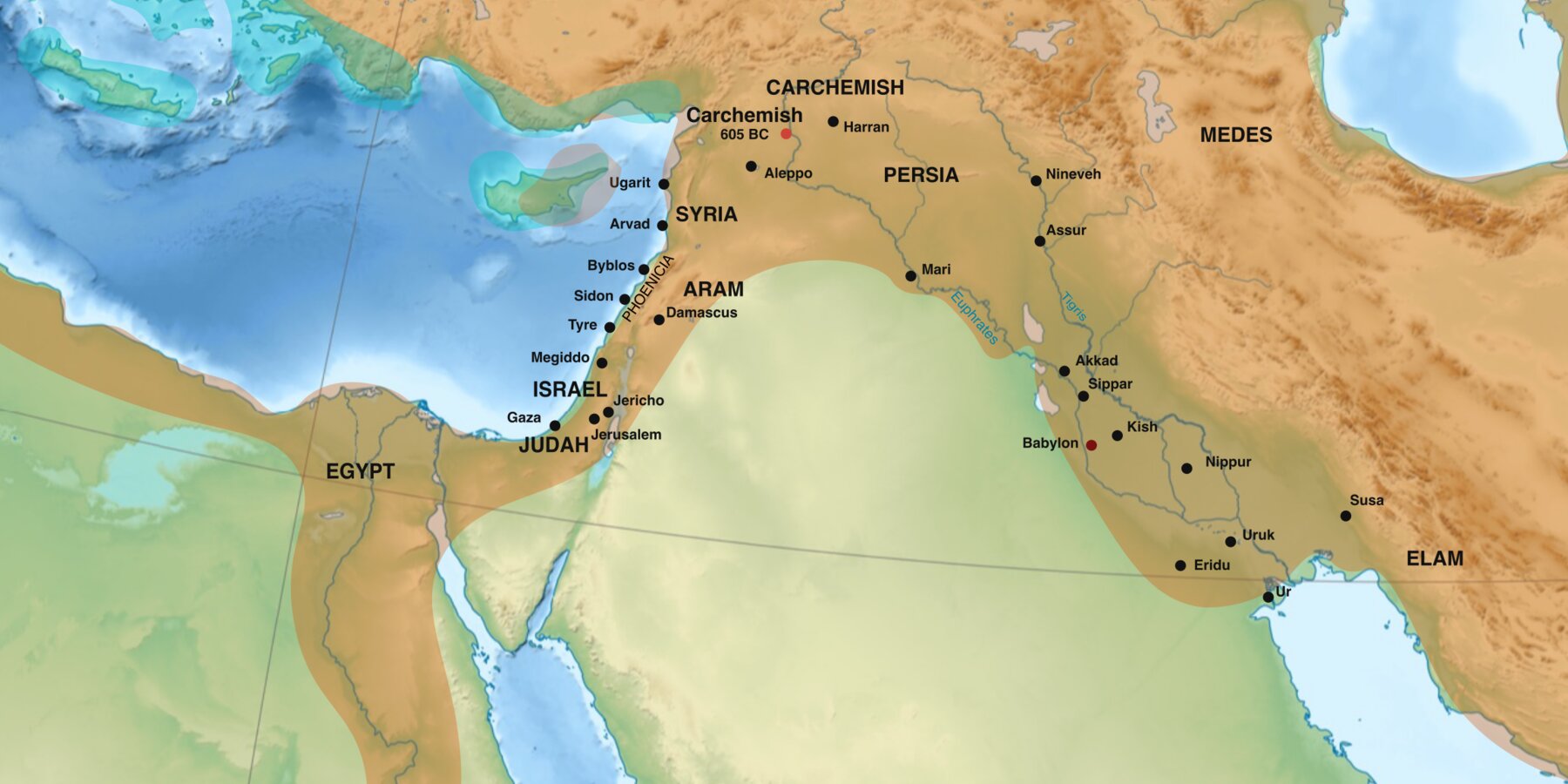
Adapted from Sémhur’s terrain and river map, CC BY-SA 4.0; cropped and relabeled. Modern relief and generalized rivers; exact ancient banks are not reconstructed. Coordinates: ORACC: Dur-Sharrukin, Nineveh, Kalhu, UNESCO: Ashur. Chronology: Sargon’s new capital and Eleanor Robson, Ancient Knowledge Networks.

The Merchant City: Ashur Before the Army (c. 2000–1750 BC)
Assyria did not begin as a military state. It first appears in history as a trading city: Ashur, perched on a rocky bluff over the Tigris. Its merchants ran one of the earliest long-distance commercial networks we can document. From colonies planted hundreds of miles away in central Anatolia — the largest at Kanesh — Assyrian families shipped tin and fine woolen textiles by donkey caravan, and shipped back silver and gold. Tens of thousands of their letters, contracts, and account tablets survive. They read astonishingly like the paperwork of any modern firm: partnerships, interest rates, insurance against bandits, exasperated notes from wives at home to husbands away too long on the road.
Politically, this Old Assyrian Ashur was a compact city-state. Its assembly and hereditary ruler answered, in theory, to the god Ashur himself — the deity who was, uniquely, identical with the city. There was as yet no empire, no standing army, no ambition beyond the next caravan. This is the Assyria contemporary with the patriarchs — a world away from the war machine that would later bear its name. For a few decades the conqueror Shamshi-Adad I stitched together a short-lived kingdom across northern Mesopotamia. But it dissolved at his death, and Ashur settled back into a comfortable, mercantile obscurity that lasted for centuries.
The First Surge — and a Long Eclipse (c. 1363–911 BC)
Assyria’s transformation into a territorial power came in the Late Bronze Age. Under Ashur-uballit I (c. 1363–1328 BC) the city stepped onto the international stage, trading letters with the pharaohs of Egypt as one great king to another. A century later Tukulti-Ninurta I (c. 1243–1207 BC) became the first Assyrian ruler to conquer Babylon, hauling off its sacred statue of Marduk. He was a king so formidable that some scholars suspect his memory lies behind the biblical Nimrod — the “mighty hunter before the LORD” out of whose kingdom, Genesis says, came Nineveh and Calah (Genesis 10:11–12).
A final Bronze Age peak came under Tiglath-Pileser I (c. 1114–1076 BC), whose campaigns reached the Mediterranean. But then the Bronze Age world collapsed. Drought, famine, and the great migrations of Aramean peoples into Mesopotamia pressed Assyria back almost to its heartland for the better part of two centuries. For Israel, the timing was providential. While the great powers of the north lay weakened, a window opened — and that window is precisely when the judges led, and when David and Solomon built a united kingdom that would have been unthinkable a few generations earlier or later. When Assyria at last recovered its strength, that window slammed shut.
The World Empire (911–705 BC)
The Neo-Assyrian Empire is the Assyria the prophets knew. Beginning around 911 BC, a line of aggressive kings rebuilt Assyrian power and then pushed it far beyond anything before. And they did it with a new and deliberate brutality, boasting in their own inscriptions of flayed rebels and cities turned to rubble. Ashurnasirpal II (883–859 BC) moved the capital to a rebuilt Kalhu — the Calah of Genesis 10, modern Nimrud. He lined its palace walls with the carved reliefs that first showed the world Assyria’s calculated use of terror as policy (the subject of The War Machine).
His son Shalmaneser III (859–824 BC) turned that army west, into Israel’s neighborhood — and here Assyrian stone and biblical history touch for the first time. At the Battle of Qarqar in 853 BC, Shalmaneser fought a coalition of Syrian and Palestinian kings. His victory stele (a tall inscribed stone), the Kurkh Monolith, lists among his opponents “Ahab the Israelite” fielding two thousand chariots. The Bible never mentions this battle at all. Yet here is Ahab, king of Israel, named in an enemy’s war record — the earliest reference to an Israelite monarch anywhere outside scripture. A dozen years later the same Shalmaneser left an even more striking monument: the Black Obelisk, where an Israelite king appears in the picture itself.
Jehu on the Black Obelisk: Shalmaneser III’s Black Obelisk, now in the British Museum, carries the earliest surviving picture of a named Israelite. A caption identifies the figure bowing to the ground before the Assyrian king as “Jehu, son of Omri” — the very Jehu of 2 Kings 9–10, though scholars debate whether the kneeling figure is the king in person or his envoy. The figure brings silver, gold, and vessels as tribute around 841 BC. (The Assyrians called Israel “the house of Omri” long after Omri’s dynasty had fallen.) It is a humbling image for anyone who has read Kings: the reforming, blood-soaked usurper of the northern throne, face to the dust before the empire that would one day carry his people away.
After a lull, the empire found its greatest organizer in Tiglath-Pileser III (745–727 BC). He rebuilt the army, professionalized the provinces, and made mass deportation a systematic tool of statecraft. He is also the first Assyrian king the Bible names in the thick of Israel’s affairs — and it names him twice over, under two names. Scripture calls him “Pul” when Menahem of Israel buys him off: “And Pul the king of Assyria came against the land: and Menahem gave Pul a thousand talents of silver” (2 Kings 15:19). A single verse in Chronicles proves the two names are one man, listing “Pul king of Assyria” and “Tilgath-pilneser king of Assyria” in a single breath (1 Chronicles 5:26). The Babylonian king-lists confirm it: there, Tiglath-Pileser III appears under his throne-name Pulu. Later, King Ahaz of Judah invited him into the region (2 Kings 16:7) — and the same Assyrian king tore the northern kingdom apart: “came Tiglath-pileser king of Assyria, and took Ijon, and Abel-beth-maachah… and Gilead, and Galilee, all the land of Naphtali, and carried them captive to Assyria” (2 Kings 15:29). The deportations that would empty Israel had begun.
They finished under his successors. Shalmaneser V (727–722 BC) laid the final siege to Samaria, and either he or his successor Sargon II (722–705 BC) took it. The Bible attributes the capture to an unnamed “king of Assyria,” Sargon’s own inscriptions claim it, and the timing straddles the change of reign. Either way the result was the same and it was final: “the king of Assyria took Samaria, and carried Israel away into Assyria” (2 Kings 17:6). The northern kingdom of Israel, ten tribes strong, ceased to exist in 722 BC — the story told in full in The Fall of the North & the Lost Tribes.
Sargon, the king who wasn’t there: for generations, skeptics treated the mighty Sargon II as a biblical error. He is named in scripture exactly once — “when Sargon the king of Assyria sent” his commander against Ashdod (Isaiah 20:1) — and he appeared in no other ancient record at all. Then in 1843 Paul-Émile Botta’s excavations at Khorsabad uncovered Sargon’s own vast palace, its walls covered with his annals. A king known from a single Bible verse turned out to have built one of the largest palaces in the ancient world. It is a parable, often repeated, of how Assyriology has treated the Old Testament’s incidental details.
The Empires in Sequence
Slide from Assyria’s height through its fall to the powers that replaced it — Babylon, then Persia.
The Summit and the Sudden Fall (705–609 BC)
Under Sargon’s son Sennacherib (705–681 BC), Assyria stood at Jerusalem’s wall. His campaign of 701 BC devastated Judah — “Sennacherib king of Assyria come up against all the fenced cities of Judah, and took them” (2 Kings 18:13) — and his own prism boasts of shutting up Hezekiah “like a bird in a cage.” But Jerusalem did not fall. The siege broke, in the deliverance recounted in 2 Kings 19:35, and Sennacherib “departed, and went and returned, and dwelt at Nineveh.” That single night — the whole subject of Sennacherib & Hezekiah — planted a conviction in Judah that Zion could never be taken.
The empire kept growing after Jerusalem was spared. Sennacherib’s son Esarhaddon (681–669 BC) did what no Mesopotamian king had ever managed: he conquered Egypt, taking Memphis in 671 BC. His son Ashurbanipal (669–c. 631 BC) pushed on to sack Thebes itself in 663 BC. Then, at the height of his power, he turned to assembling the great library of Nineveh, sending scribes across the empire to copy every text worth keeping. When the mounds of Nineveh were opened in the 1850s, it was Ashurbanipal’s library that gave the modern world the Epic of Gilgamesh and its startlingly familiar flood story (see Writing & the Great Library).
And then it ended, with a speed that still astonishes historians. Ashurbanipal died around 631 BC. Within a generation, the empire that ruled from the Nile to Persia simply came apart — civil war among his heirs, revolt in Babylonia under Nabopolassar (a Babylonian general who founded the empire that would replace Assyria), and the rise of the Medes on the eastern frontier. The two powers made common cause. In 614 BC the Medes stormed Ashur, the old holy city. In 612 BC the allied armies took Nineveh itself, the “bloody city” of Nahum’s vision, and burned it — the fall the prophet had sung of in advance: “Nineveh is laid waste: who will bemoan her?” (Nahum 3:7). A last Assyrian claimant held out at Harran until 609 BC. Then the name that had terrified the ancient world for three centuries was simply gone. When Xenophon, the Greek soldier-writer, marched his Greek mercenaries past the ruins two hundred years later, no one could even tell him what city had once stood there.
The rod and the woodcutter: the prophets never saw Assyria as merely a military problem. Isaiah calls the empire “the rod of mine anger” (Isaiah 10:5) — a tool in God’s hand to discipline his people. Then, in the same breath, he warns that the rod would itself be broken for its arrogance — as if an axe should boast against the one who swings it. Assyria’s whole arc, from the trading city to the world empire to the ash of Nineveh, became for Israel a case study in exactly that: a nation used, and then a nation judged, on a timescale a prophet could announce before it happened. The empire that seemed eternal from beneath its walls lasted, as a world power, barely three hundred years — and as the master of Israel’s fate, barely one.
Sources and Further Reading
- Eckart Frahm, Assyria: The Rise and Fall of the World’s First Empire (Basic Books, 2023) — The current standard narrative history, from the merchant city to the fall of Nineveh.
- Karen Radner, Ancient Assyria: A Very Short Introduction (Oxford University Press, 2015) — The best brief overview of the whole arc.
- Marc Van De Mieroop, A History of the Ancient Near East, ca. 3000–323 BC (Wiley-Blackwell, 3rd ed. 2016) — Framework and chronology for every period on this page.
- A. K. Grayson, Assyrian Rulers of the Early First Millennium BC (Royal Inscriptions of Mesopotamia / RIMA 2–3; University of Toronto Press, 1991–96) — The royal inscriptions of Ashurnasirpal II and Shalmaneser III in translation, including the Kurkh Monolith and Black Obelisk texts.
- A. K. Grayson, Assyrian and Babylonian Chronicles (J. J. Augustin, 1975) — The chronicle sources for the fall of Ashur and Nineveh.
- Mordechai Cogan & Hayim Tadmor, II Kings (Anchor Bible; Doubleday, 1988) — The Assyrian kings and campaigns of 2 Kings 15–19 set against the cuneiform evidence.
- Bustenay Oded, Mass Deportations and Deportees in the Neo-Assyrian Empire (Reichert, 1979) — The deportation system that emptied Israel.
Online Resources:
- WHE — Assyria (CC BY-NC-SA 4.0)
- Livius.org — Assyria — Jona Lendering’s well-sourced articles, with royal inscriptions and king-lists in translation.
- Oracc / State Archives of Assyria Online — the annals and royal correspondence, searchable.
- British Museum — the Black Obelisk of Shalmaneser III, showing Jehu’s tribute.