| Church Manuals | |
| Come Follow Me Manual — Week 45 | View |
| Scripture Helps: Old Testament | View |
| OT Seminary Teacher Manual | View |
| OT Institute Manual (1Ki–Mal) | View |
| Pearl of Great Price Manual | View |
| Scripture Reference | |
| Bible Dictionary | View |
| Topical Guide | View |
| Guide to the Scriptures | View |
| Church Media & Library | |
| Gospel for Kids (YouTube) | View |
| Bible Videos: Life of Jesus Christ | View |
| Church Magazines | View |
| Gospel Library | View |

Week 45
A New Spirit Will I Put within You
Ezekiel 1–3; 33–34; 36–37; 47
November 2–8, 2026
Weekly Resources: Week 45
Ezekiel 1–3; 33–34; 36–37; 47 — Overview
November 2–8, 2026
“A New Spirit Will I Put within You”
Official Church Resources
OFFICIAL CHURCH RESOURCES▶
CHURCH MEDIA FOR FAMILIES▶
▶ Video Commentary
VIDEO COMMENTARY (10 videos · 2 weekly videos pending)
▼
 i
Finding Christ (John Hilton III)
 i
Ezekiel — Dr. Matthew Grey — Full Episode

 i
Scripture Insights
 i
Talking Scripture


Specialized Audiences
WOMEN'S PERSPECTIVES (1 video · 1 weekly video pending)
▼


FAMILY & CHILDREN'S RESOURCES (3 videos, 1 resource link · 3 weekly videos pending)
▼


Reference & Study Materials
Scripture Central
Week 45 Study Hub
Interpreter
Week 45 Articles
Bible Project
This week’s book overviews


BIBLE PROJECT (2 book overviews · 3 selected themes · 11 more library videos)
▶
This week’s book overviews open from the Bible Project card above. Selected themes are highlighted below; the rest of the standing library remains available.
SELECTED FOR THIS WEEK — themes and word studies

 i
TempleEzekiel 47
BibleProject library — standing collection, not chosen for this week (11 videos)
 BibleProject — Covenants
Watch on BibleProject →
Optional thematic resource
 i
Sacrifice & Atonement
 i
Holiness
 i
Image of God
 i
The Messiah
 i
Tree of Life
 i
YHWH / LORD
 i
Shalom / Peace
 i
Khesed / Loyal Love
 i
Nephesh / Soul
 i
Ruakh / Spirit
ACADEMIC & SCHOLARLY SITES▶
MAPS & BIBLICAL LOCATIONS▶
JEWISH & SCHOLARLY RESOURCES▶
First, a Word About Where We Are
▶︎
Last week ended in the ruins of Jerusalem. Lamentations opens on an empty city, "How doth the city sit solitary, that was full of people!" (Lamentations 1:1), and yet in the middle of its grief it says, "his compassions fail not. They are new every morning: great is thy faithfulness" (Lamentations 3:22–23).
This week we hear from the other side of that disaster. Ezekiel was one of the people already carried away to Babylon, years before the city fell. A psalm remembers that captivity: "By the rivers of Babylon, there we sat down, yea, we wept, when we remembered Zion" (Psalm 137:1). Ezekiel lived by one of those rivers. His book is what the Lord said to people who were sitting down and weeping.
The reading jumps around (chapters 1–3, then 33–34, 36–37, and 47), but the Overview walks all forty-eight chapters in order, so you can see what happens in between.
In Case You Missed These Study Companions
▶︎
Several resources added over the past few weeks can enrich this week’s reading:
- Babylon: The Empire and the Exile. Particularly helpful for Ezekiel, this field guide introduces the land, rulers and exile experience behind his ministry. It helps us picture the world in which Ezekiel received his visions and taught a people far from home.
- Assyria: The Rod of the North. This companion guide provides the earlier background to Israel’s scattering and the empires that shaped the prophets’ world.
- Roots, Branches, and Light. Our three-part Tree & Menorah series explores Hebrew roots and verb patterns alongside the imagery of trees, light and sacred teaching. The interactive menorah model lets you explore those language patterns visually.
God Came to Where They Were
▶︎
The book does not open in Jerusalem. It opens in exile. The Lord does not wait for His people to return to the temple to meet Him there. His glory appears to them "among the captives by the river of Chebar" (Ezekiel 1:1), in a foreign land, far from the temple where most of them believed He was to be found. His prophet's first act matches it: before saying a word, Ezekiel sits among the exiles for seven days (Ezekiel 3:15). The Overview opens with that scene.
If you have ever been in a hard place and assumed God was somewhere else, Ezekiel begins where you are.
The Questions This Week Raises — and Where Each One Is Answered
▶︎
| The question | Where it is taken up |
|---|---|
| Is "son of man" a title of Christ here? | Word Studies, study 1, and Key Passages, passage 1. It is not; it is the Lord's name for a mortal prophet |
| What are the creatures and wheels of chapter 1? | Key Passages, passage 1, and Jewish Perspective, section 5: their full meaning has not been revealed, and the glory is the point |
| If the watchman must warn, am I responsible for other people's choices? | Key Passages, passage 2, and Teaching Applications, section 4 |
| Who is "my servant David"? | Key Passages, passage 3: the promised descendant of David, Jesus Christ |
| Do I make a new heart, or does God give one? | Key Passages, passage 4, and Word Studies, study 3 |
| Are the dry bones about Israel or about the Resurrection? | Key Passages, passage 5, and Jewish Perspective, section 3: both |
| What were the "sticks"? | Historical & Cultural Context, section 7, and Key Passages, passage 6 |
| Why does it matter that the river reaches the Dead Sea? | Historical & Cultural Context, section 8, and Key Passages, passage 7 |
You are not expected to settle all of these. Some have clear answers; some are better held with reverence.
"How Should We Then Live?"
▶︎
At the turning point of the book, the exiles finally say what they feel: their sins are upon them, they "pine away in them," and they ask, "how should we then live?" (Ezekiel 33:10).
It is the question of anyone who has made mistakes they cannot undo and has started to believe the mistakes are the whole story. Notice that the Lord does not scold the question. He answers it with an oath, "As I live," and with His own heart: He has "no pleasure in the death of the wicked," and He pleads, "turn ye, turn ye… for why will ye die?" (Ezekiel 33:11).
Then He makes a promise about the past that is easy to miss: when a person turns, "None of his sins that he hath committed shall be mentioned unto him" (Ezekiel 33:16). Modern revelation says the same: "I, the Lord, remember them no more" (Doctrine and Covenants 58:42). Key Passages, passage 2, quotes the verses and reads the chapter closely.
So it is worth asking this week: where have I been pining away, when the Lord is asking me only to turn?
The Shepherd Who Goes Looking
▶︎
Chapter 34 begins with leaders who failed their people. They fed themselves and not the flock, and they did not strengthen the weak, heal the sick, bind up the broken, bring back the driven away, or seek the lost (Ezekiel 34:2–4).
Then the Lord says something remarkable. He does not appoint a better committee. He comes Himself: "I, even I, will both search my sheep" (Ezekiel 34:11). And He takes the failed shepherds' list and promises to do every item Himself: seek the lost, bring back the driven away, bind up the broken, strengthen the sick (Ezekiel 34:16).
The Come, Follow Me manual asks readers to notice the difference between a sheep that is lost and one that is driven away. A lost sheep wandered. A driven-away sheep was pushed. The Lord goes after both. Centuries later the Savior said, "I am the good shepherd, and know my sheep, and am known of mine" (John 10:14). Key Passages, passage 3, quotes the shepherd verses and reads the chapter with John 10.
If you have ever felt rejected, neglected, or abandoned by a person or institution you looked to for guidance or care, this promise offers comfort and hope. Human failure does not change the Savior’s love for His sheep or His knowledge of them.
When the arm of the flesh fails, we can turn to the arm of the Lord. Through His Atonement, He understands our pain personally and completely. He has descended below all things (Doctrine and Covenants 88:6) and knows how to succor His people in their suffering (Alma 7:11–12). He invites us to take His hand and accept His help. We can bring Him our hurt and resentment, asking Him to soften our hearts and help us receive His comfort.
A Heart That Can Be Moved
▶︎
The title of this week comes from Ezekiel 36:26: "A new heart also will I give you, and a new spirit will I put within you: and I will take away the stony heart out of your flesh, and I will give you an heart of flesh."
A stone does not respond. You can press it, speak to it, or warm it, and it stays the same. Flesh is alive. It feels, heals and changes. In Hebrew the heart is not only where we feel; it is also where we think and choose (Word Studies, study 3). So the promise is not just new feelings. It is a new inner life that can be moved, shaped, and transformed by God.
Earlier in the book the Lord had commanded a new heart (Ezekiel 18:31); here He promises to give one. Key Passages, passage 4, takes up how the two fit together. The Book of Mormon calls the change "a mighty change in us, or in our hearts" (Mosiah 5:2).
"O Lord GOD, Thou Knowest"
▶︎
When the Lord sets Ezekiel down in the valley of dry bones and asks, "Son of man, can these bones live?", Ezekiel does not say yes and he does not say no. He says, "O Lord GOD, thou knowest" (Ezekiel 37:3).
That may be the most useful prayer in the book. There are situations in every life that may sometimes look like that valley: a marriage, a circumstance, a faith, a hope that seems impossible, "very dry" (Ezekiel 37:2). We cannot honestly say we know it will live and be viable. We can honestly give the question back to the One who does know.
Then watch what happens. The bones come together, but "there was no breath in them" (Ezekiel 37:8), until the Lord's breath comes. In Hebrew, breath, wind and spirit in this chapter are all one word (Word Studies, study 4). Life comes when His Spirit enters. And the vision ends with a promise spoken straight to people who had said "our hope is lost" (Ezekiel 37:11): "I will open your graves… And shall put my spirit in you, and ye shall live" (Ezekiel 37:12–14).
Where the River Goes
▶︎
The last assigned chapter shows water coming out from under the door of the Lord's house (Ezekiel 47:1). It starts as a trickle and keeps growing, though Ezekiel mentions no other stream joining it: ankle-deep, knee-deep, waist-deep, then "a river that I could not pass over" (Ezekiel 47:5).
Then notice where it goes. It flows straight into the Dead Sea, the one place in the land so salty that, as the manual notes, fish and plants cannot live in it (Historical & Cultural Context, section 8). The river does not go around the dead place. It goes into it, and "the waters shall be healed" (Ezekiel 47:8). "Every thing shall live whither the river cometh" (Ezekiel 47:9). Trees grow on its banks, "and the leaf thereof for medicine" (Ezekiel 47:12).
My husband and I recently attended the funeral of Bishop J.D. Banasky, one of the bishops who served in the young single adult stake where we met. We both loved J.D. and looked up to him so much. He was one of our matchmakers and blessed our lives in so many ways.
J.D. was constantly giving. His home was open to students at all hours of the day and night. He was always cooking and kept his kitchen stocked for hungry college students. Those meals often came with warm, wise counsel.
A few weeks before our wedding, J.D.’s wife passed away unexpectedly, just days after giving birth to their daughter. She had fallen asleep with their newborn on her chest and did not wake up. My husband spent his “bachelor’s party” with J.D., rocking the baby so J.D. could get some rest.
J.D. continued to give through his grief. At his memorial, his children recounted memory after memory of his daily acts of service. Even while living in a care center and facing debilitating health issues, he kept finding ways to care for others.
The opening song at the funeral was “Give, Said the Little Stream.” I had never heard that song sung at a funeral before, but it captured the way J.D. had lived. He kept giving, even when it might have seemed there was nothing more to give. His generosity became living water to so many people, and giving seemed to sustain him too.
As I read Ezekiel’s vision this week, I thought about J.D. and how I could better follow his example. Through his love and generosity, I learned to recognize more clearly the love and generosity of my Savior. J.D.’s life helps me picture what it can mean for the Lord’s living water to reach others through us.
Imagine if each of us, as recipients of God’s generosity, lived more like J.D.—continually sharing the living water we have received. As that kindness passes from one person to another, imagine how far it could reach: a growing river of generosity, bringing comfort, hope and healing wherever it flows and gathers.
One Verse to Take With You
▶︎
The book of Ezekiel begins with the glory of the Lord appearing among exiles and ends with the name of a city:
"And the name of the city from that day shall be, The LORD is there." — Ezekiel 48:35
A people who thought God had left them are promised a home whose very name says He has not. Wherever you are sitting this week, by whatever river, that is the promise: The LORD is there.
This week's Study Guide begins with the Overview.
Week 45
Ezekiel 1–3; 33–34; 36–37; 47 — Overview
"A New Spirit Will I Put within You"
November 2–8, 2026
1. Week 45: Overview
Before Ezekiel says a word to anyone, he sits down.
He has just seen the most overwhelming vision in the Old Testament, the glory of God appearing by a river in Babylon. He has been told to speak to people who will not want to listen. And then he goes to the exiles at a place called Tel-abib and does something no one expects of a prophet: "I sat where they sat, and remained there astonished among them seven days" (3:15).
That is the right place to begin this week. Ezekiel was one of the captives. He had been carried away from Jerusalem with his king, and he lived the rest of his life hundreds of miles from the temple where he had expected to serve as a priest. His book was written for people who felt they had lost everything that made them God's people: their land, their king, their temple, and their hope. Their own words, near the end of the week's reading, are "Our bones are dried, and our hope is lost" (37:11). This week's title is the Lord's reply: "a new spirit will I put within you" (36:26).
That answer is the heart of the book. He promises to gather the scattered, to search for the lost sheep Himself, to give a new heart and a new spirit, to breathe life into a valley of dry bones, and to send a river out of His house that heals whatever it touches. The Come, Follow Me manual puts the turn simply: "And yet there's something hopeful about Ezekiel's message."
Three questions to carry into any chapter this week
- Where is the Lord in this chapter: far away, coming near, or already present?
- What is dead, broken or lost here, and what does He promise to do about it?
- What would it mean for me to "hear the word of the LORD" (37:4) in my own dry places?
Four easy misreadings, named once
- "Son of man" in Ezekiel is the Lord's name for Ezekiel himself, a mortal man standing before God. It appears 93 times in the book. It is not the title the Savior later uses of Himself (Word Studies, study 1).
- "My servant David" (34:23; 34:24; 37:25) is not King David come back to life. David had been dead for centuries. It is the promised ruler from David's line, whom Latter-day Saints recognize as Jesus Christ (Key Passages, passage 3).
- The living creatures and wheels of chapter 1 are not a puzzle to decode. The Church's own study helps say their full meaning has not been revealed. What the chapter wants you to see is the glory on the throne (Key Passages, passage 1).
- The two sticks of chapter 37 are both a reunited kingdom and two records. It is not one or the other (Key Passages, passage 6).
Assigned chapters are in bold. This week walks through the whole book, all forty-eight chapters, in order, so the assigned chapters make sense where they sit. The book falls into four parts (the Bible Dictionary's divisions): judgment on Jerusalem (1–24), oracles against the nations (25–32), hope after the fall (33–39), and a vision of a renewed temple and land (40–48).
22 rows — click to collapse
| Chapter | What happens | Assigned |
|---|---|---|
| 1 | The glory of God appears by the river Chebar | Yes |
| 2 | "Son of man, stand upon thy feet": the call | Yes |
| 3 | The scroll as sweet as honey; seven days among the captives; the watchman | Yes |
| 4–5 | The siege acted out; the hair divided in thirds | — |
| 6–7 | Against the high places; "An end is come" | — |
| 8–11 | In vision to Jerusalem: what the elders did in the dark, and the glory leaving | — |
| 12 | The exile's baggage carried through the wall | — |
| 13–14 | False prophets and their untempered mortar; Noah, Daniel and Job | — |
| 15–17 | The useless vine; Jerusalem the foundling; two eagles and a cedar | — |
| 18 | "The soul that sinneth, it shall die": each person answers for their own choices | — |
| 19–23 | Laments for the princes; Israel's history retold; the sword; two sisters | — |
| 24 | The siege begins; Ezekiel's wife dies | — |
| 25–32 | Oracles against Ammon, Moab, Edom, Philistia, Tyre, Sidon and Egypt | — |
| 33 | The watchman again; the city has fallen; "How should we then live?" | Yes |
| 34 | False shepherds and the Good Shepherd | Yes |
| 35 | Against Mount Seir | — |
| 36 | A new heart and a new spirit | Yes |
| 37 | The valley of dry bones; the two sticks | Yes |
| 38–39 | Gog of Magog | — |
| 40–46 | The vision of a temple, measured; the glory returns | — |
| 47 | The river from the house of the Lord | Yes |
| 48 | The land divided; "The LORD is there" | — |
The book is unusually precise about time. Ezekiel dates his visions by the years of King Jehoiachin's captivity, and those dates let us follow him: the first vision comes in "the fifth year of king Jehoiachin's captivity" (1:2), and the news that Jerusalem has fallen reaches him in "the twelfth year of our captivity" (33:21). Everything before that news is warning. Almost everything after it is hope. The Historical & Cultural Context, sections 1 and 4, sets out who was taken to Babylon and when the city fell.
Ezekiel 1 — The Glory by the River — assigned
The book opens "among the captives by the river of Chebar," where "the heavens were opened, and I saw visions of God" (1:1). A storm comes out of the north, and in it are four living creatures, each with four faces and four wings, and beside them wheels "as it were a wheel in the middle of a wheel" (1:16), "full of eyes" (1:18), moving wherever the spirit goes. Above them is a firmament, above that a throne like sapphire, and on the throne "the likeness as the appearance of a man" (1:26).
Ezekiel piles up careful, hedged words: likeness, appearance, as it were. He is describing something he knows he cannot fully describe, and he ends with the line that names it: "This was the appearance of the likeness of the glory of the LORD" (1:28). Then he falls on his face. The detail of the creatures is not the point. The point is where this happens: by a river in Babylon, among exiles far from the temple where most of their people believed God's presence was to be found. Key Passages, passage 1, reads the vision and the call that follows.
Ezekiel 2 — "Stand upon Thy Feet" — assigned
The voice from the throne speaks: "Son of man, stand upon thy feet, and I will speak unto thee" (2:1). Ezekiel cannot even do that on his own. "The spirit entered into me when he spake unto me, and set me upon my feet" (2:2). The Lord sends him to "a rebellious nation" (2:3) and gives him a measure of success that does not depend on results: "whether they will hear, or whether they will forbear… yet shall know that there hath been a prophet among them" (2:5). Then a hand holds out a scroll, written on both sides with "lamentations, and mourning, and woe" (2:10).
Ezekiel 3 — The Sweet Scroll and the Seven Days — assigned
He is told to eat the scroll, and he does: "it was in my mouth as honey for sweetness" (3:3). The message is full of mourning, yet it tastes sweet, because it is the word of the Lord and he has taken all of it in. Jeremiah had said something similar (Jeremiah 15:16), and John will see it again (Revelation 10:10).
Then come two of the book's most important scenes. First, the seven silent days at Tel-abib (3:15). Second, at the end of those days, a new name for his calling: "Son of man, I have made thee a watchman unto the house of Israel" (3:17). A watchman who sees danger and says nothing shares the blame; one who warns has done his part, whatever the hearers choose (3:18–21). The chapter ends strangely: the Lord makes Ezekiel's tongue "cleave to the roof of thy mouth, that thou shalt be dumb" (3:26), except when the Lord Himself opens his mouth to speak. That silence will last until the news of chapter 33. Key Passages, passage 2, reads the watchman in both chapters together.
Ezekiel 4 and 5 — The Siege Acted Out — not assigned
Ezekiel becomes a living sign. He draws Jerusalem on a clay tile and builds a toy siege around it: "This shall be a sign to the house of Israel" (4:3). He lies on one side for 390 days and on the other for 40, eats rationed bread and drinks water by measure. In chapter 5 he shaves his head and beard, divides the hair into thirds, and burns, strikes and scatters it, a picture of what the siege will do to the city. The Lord explains: "This is Jerusalem: I have set it in the midst of the nations" (5:5). Even here, a few hairs are bound up in his garment (5:3): some will be kept.
Ezekiel 6 and 7 — "An End Is Come" — not assigned
The prophet turns to the mountains of Israel, where the high places of idol worship stood, and announces their fall. But he also promises a remnant who "shall remember me among the nations whither they shall be carried captives" (6:9). Chapter 7 rings like a bell: "An end, the end is come" (7:2). Here, too, a phrase begins that runs through the whole book, "ye shall know that I am the LORD" (7:4). Some form of "know that I am the LORD" appears in 72 verses of Ezekiel. Whatever happens, judgment or rescue, its purpose is that people will come to know who God is.
Ezekiel 8 to 11 — The Glory Leaves the Temple — not assigned
These four chapters are one vision, and they explain why the exile happened. Ezekiel is sitting in his house with the elders of Judah (8:1) when he is carried in vision to Jerusalem. In the temple courts he is shown idolatry in stages: an image at the gate, seventy elders burning incense in a dark room, women weeping for Tammuz (a Babylonian god; see Bible Dictionary, "Tammuz"), and men with their backs to the temple worshipping the sun (8:5–16). The elders' excuse is chilling: "The LORD seeth us not" (8:12).
Then something terrible happens slowly. The glory of the Lord rises from above the cherubim, moves to the threshold (10:4), goes out to the east gate (10:18–19), and finally leaves the city to the mountain on its east side (11:23). In the middle of this, Ezekiel learns that the creatures he saw by the river were cherubim: "I knew that they were the cherubims" (10:20).
And in the middle of the judgment comes one of the most tender promises in the book. To the exiles, whom the people still in Jerusalem had written off, the Lord says, "yet will I be to them as a little sanctuary in the countries where they shall come" (11:16), and "I will put a new spirit within you; and I will take the stony heart out of their flesh, and will give them an heart of flesh" (11:19). The title promise of this week is first planted here, years before chapter 36 (Key Passages, passage 4). The Historical & Cultural Context, section 3, explains why the glory leaving mattered so much.
Ezekiel 12 — Baggage for Exile — not assigned
Ezekiel packs a bag in broad daylight, digs through a wall at dusk, and carries his belongings out with his face covered. When people ask what he is doing, he answers, "I am your sign" (12:11): the prince in Jerusalem will try to escape the same way (12:12). The chapter ends by answering two proverbs that said the visions would never come true, or not for a long time: "There shall none of my words be prolonged any more" (12:28).
Ezekiel 13 and 14 — Whitewashed Walls and Idols in the Heart — not assigned
False prophets have been telling the people what they want to hear, "saying, Peace; and there was no peace" (13:10), the same complaint Jeremiah made (Jeremiah 6:14). Ezekiel pictures them as men daubing a weak wall with "untempered mortar" (13:10), plaster that hides cracks but cannot hold in a storm. In chapter 14 the elders come to ask the Lord's will, but they "have set up their idols in their heart" (14:3). The Lord's word is plain: "Repent, and turn yourselves from your idols" (14:6). He adds that even three famously righteous men, "Noah, Daniel, and Job" (14:14), could save only themselves.
Ezekiel 15 to 17 — A Vine, a Foundling, and a Cedar — not assigned
A grapevine is good for fruit and good for nothing else; its wood cannot even make a peg (15:3). Jerusalem has stopped bearing fruit. Chapter 16 tells Jerusalem's history as the story of an abandoned newborn whom the Lord found and saved, saying "Live" (16:6), raised, married and adorned, and who then betrayed Him. It is told in very frank language and is not a chapter for reading aloud with children. It ends, though, on a promise: "I will remember my covenant with thee in the days of thy youth, and I will establish unto thee an everlasting covenant" (16:60). Chapter 17 is a riddle of two eagles and a vine about Judah's last kings, and it closes with the Lord Himself planting a tender twig "upon an high mountain" (17:22) that becomes a great cedar.
Ezekiel 18 — Each Soul Answers for Itself — not assigned
The exiles had a saying: "The fathers have eaten sour grapes, and the children's teeth are set on edge" (18:2). In other words, we are paying for our parents' sins. The Lord forbids the proverb. "The soul that sinneth, it shall die. The son shall not bear the iniquity of the father" (18:20). A son who sees his father's sins and chooses differently "shall surely live" (18:17). A person who turns from wrongdoing finds that past sins "shall not be mentioned unto him" (18:22). And under all of it is the Lord's own heart: "Have I any pleasure at all that the wicked should die?… and not that he should return from his ways, and live?" (18:23). The chapter ends with an invitation the Lord will later turn into a promise: "make you a new heart and a new spirit: for why will ye die, O house of Israel?" (18:31). Much of this chapter returns in chapter 33, which Key Passages reads (passage 2).
Ezekiel 19 to 23 — Laments, History, and a Sword — not assigned
Chapter 19 is a funeral song for Judah's princes, pictured as young lions caught in nets. In chapter 20 the Lord retells Israel's history from Egypt onward as a long pattern of rebellion and mercy. Again and again He holds back judgment "for my name's sake" (20:9). He reminds them of the Sabbath, given "to be a sign between me and them, that they might know that I am the LORD that sanctify them" (20:12). Chapter 21 is a song of a sharpened sword, with the king of Babylon at a fork in the road deciding which city to attack. In chapter 22 the Lord searches for someone to "stand in the gap before me for the land" (22:30) and finds no one. Chapter 23, like 16, tells the story of Samaria and Jerusalem as two unfaithful sisters, again in frank language.
Ezekiel 24 — The Siege Begins, and a Private Grief — not assigned
The date is written down because the day matters: "the king of Babylon set himself against Jerusalem this same day" (24:2). Then comes the hardest sign Ezekiel is asked to give. The Lord tells him that "the desire of thine eyes" (24:16) will be taken, and that he must not mourn in the usual ways. "So I spake unto the people in the morning: and at even my wife died" (24:18). When the people ask what it means, he tells them that the temple, the desire of their eyes, will be taken too. The chapter ends with a promise: when a survivor arrives with the news, "thy mouth be opened… and be no more dumb" (24:27). Read this chapter slowly; the man who was asked to be a sign also lost his wife.
Ezekiel 25 to 32 — The Nations — not assigned
These eight chapters turn from Judah to her neighbors: Ammon, Moab, Edom and Philistia (25); then Tyre, the great sea-trading city, at length (26–28); then Sidon; and then Egypt (29–32). Chapter 27 is a magnificent lament that pictures Tyre as a splendid ship, built of the finest timber and sailed by the best crews, that sinks in deep water. The prince of Tyre is told, "thou art a man, and not God" (28:2), and Pharaoh claims the Nile as his own: "My river is mine own, and I have made it for myself" (29:3). He is shown he made nothing. Pride is the common thread. Tucked into the oracles is a short promise for Israel: "they shall dwell with confidence" (28:26).
Ezekiel 33 — The News Arrives — assigned
This is the turning point of the book. The watchman charge of chapter 3 is repeated (33:1–9). Then the exiles say what they actually feel: "how should we then live?" (33:10). The Lord's answer is the gentlest sentence in the book: He has "no pleasure in the death of the wicked" and pleads with them to turn and live (33:11).
Then the date: "in the twelfth year of our captivity, in the tenth month, in the fifth day of the month, that one that had escaped out of Jerusalem came unto me, saying, The city is smitten" (33:21). The evening before, Ezekiel's mouth was opened, "and I was no more dumb" (33:22). The silence that began in chapter 3 ends the night before the worst news. From here on, the book is mostly hope.
The chapter closes with a portrait that may sting. People now flock to hear Ezekiel, but "thou art unto them as a very lovely song of one that hath a pleasant voice… for they hear thy words, but they do them not" (33:32). Key Passages, passage 2, reads 33:1–11; the Historical & Cultural Context, section 4, explains the news.
Ezekiel 34 — The Shepherds — assigned
The Lord turns on Israel's leaders: "Woe be to the shepherds of Israel that do feed themselves! should not the shepherds feed the flocks?" (34:2). They ate the fat, wore the wool, and left the weak to fend for themselves (34:3–4). So the Lord says He will do the shepherding Himself, "I, even I" (34:11), and promises to do every task the shepherds neglected (34:16). He promises "one shepherd… even my servant David" (34:23), a "covenant of peace" (34:25), and "showers of blessing" (34:26). The last verse is quiet and personal: "ye my flock, the flock of my pasture, are men, and I am your God" (34:31). Key Passages, passage 3, reads the chapter with the Savior's words in John 10.
Ezekiel 35 — Mount Seir — not assigned
A short oracle against Edom, the neighbor that rejoiced at Judah's fall and said, "These two nations and these two countries shall be mine" (35:10). It sets up chapter 36: the mountains Edom wanted for itself will be given back to Israel.
Ezekiel 36 — A New Heart — assigned
The Lord speaks to the land itself. The mountains of Israel, mocked and stripped, will "shoot forth your branches, and yield your fruit to my people of Israel" (36:8). Then He explains why He will act: "I do not this for your sakes, O house of Israel, but for mine holy name's sake" (36:22). The scattered people had made His name look powerless among the nations, and He will show who He is by what He does for them.
What He does gives this week its title: He will cleanse them, give them "a new heart" and "a new spirit," take away "the stony heart," and put His own spirit within them (36:25–27). The chapter ends with the ruined land become "like the garden of Eden" (36:35). Key Passages, passage 4, reads the promise beside chapter 18's command to make a new heart (18:31); Word Studies, studies 3 and 4, look at heart and spirit in Hebrew.
Ezekiel 37 — Bones and Sticks — assigned
The hand of the Lord sets Ezekiel down in a valley full of bones, "very dry" (37:2). The question comes: "Son of man, can these bones live?" Ezekiel's answer is a model of honest faith: he gives the question back to the Lord (37:3). He prophesies, and the bones come together with a rattling, then sinews and flesh and skin, "but there was no breath in them" (37:8). He prophesies again, to the wind, "and the breath came into them, and they lived, and stood up upon their feet, an exceeding great army" (37:10). Then the Lord explains: "these bones are the whole house of Israel" (37:11), and promises to open their graves and "put my spirit in you, and ye shall live" (37:14). Latter-day Saints read the vision as a promise both of Israel's restoration and of the Resurrection.
Then a second sign: two sticks, one written "For Judah" and one "For Joseph, the stick of Ephraim" (37:16), joined so they "become one in thine hand" (37:17). The Lord explains it first as the reuniting of the divided kingdoms under one king and one shepherd, with a "covenant of peace" that is "an everlasting covenant" (37:26). Latter-day Saints also see in it the Bible and the Book of Mormon. Key Passages, passages 5 and 6, read both signs; Word Studies, study 4, shows that one Hebrew word runs through the whole bones vision.
Ezekiel 38 and 39 — Gog of Magog — not assigned
A great army from the north, led by "Gog, the land of Magog" (38:2), comes against a gathered, peaceful Israel and is defeated by the Lord Himself, "that the heathen may know me" (38:16). The Church's Seminary manual reads Gog symbolically: Ezekiel used Gog "to represent a wicked leader or leaders who will seek to destroy God's people in the last days," before the Second Coming. The chapter's last line matters most: "Neither will I hide my face any more from them: for I have poured out my spirit upon the house of Israel" (39:29).
Ezekiel 40 to 46 — A Temple Measured, and the Glory Returns — not assigned
Twenty-five years into the captivity (40:1), Ezekiel is taken in vision to a very high mountain and shown a temple. A man with a measuring reed walks him through gates, courts and chambers, measuring everything. "Set thine heart upon all that I shall shew thee" (40:4). These chapters are full of cubits and are easy to skim, but they build to a moment the whole book has been waiting for. The glory that left by the east gate in chapter 10 now comes back the same way: "the glory of the God of Israel came from the way of the east… and the earth shined with his glory" (43:2). The gate it entered is then shut, "because the LORD, the God of Israel, hath entered in by it" (44:2). The rest of these chapters order the priests, the offerings and the feasts. Their purpose is in one line: the priests "shall teach my people the difference between the holy and profane" (44:23).
Ezekiel 47 — The River — assigned
At the door of the house, water trickles out from under the threshold and flows east (47:1). The man with the measuring line measures as they walk (47:3): ankle-deep, then knee-deep, then waist-deep, then "a river that I could not pass over" (47:5). It runs down to the Dead Sea, and "the waters shall be healed. And it shall come to pass, that every thing that liveth… shall live" (47:8–9). Fishermen will line the shore "from En-gedi even unto En-eglaim" (47:10), and trees on both banks will bear fruit every month, "and the leaf thereof for medicine" (47:12). The chapter then begins dividing the land, and it includes the stranger: foreigners who live among Israel "shall have inheritance with you" (47:22). Key Passages, passage 7, reads the river; the Historical & Cultural Context, section 8, explains the Dead Sea.
Ezekiel 48 — "The LORD Is There" — not assigned
The tribes receive their portions, and the city receives twelve gates named for the twelve tribes. Then the book ends on its last word: "and the name of the city from that day shall be, The LORD is there" (48:35). A book that began with God's glory appearing among the exiles, and then leaving Jerusalem, ends with a city whose very name says He is present.
If you follow only one thread through Ezekiel, follow the glory of the Lord.
| Where | What the glory does |
|---|---|
| 1:28 | appears to the captives by the river Chebar, far from Jerusalem |
| 3:23 | appears again on the plain where Ezekiel waits |
| 10:4; 10:18–19 | rises from the cherubim, pauses at the threshold, moves to the east gate |
| 11:23 | leaves the city for the mountain on its east side |
| 43:2–5 | returns from the east and fills the house |
| 48:35 | gives the city its name, the last words of the book |
Read in order, it is the story of the whole book. The Lord did not abandon His people when they abandoned Him. He went with them into exile, and He promised to come home.
| Part | Chapters | What it does | Connections in Restoration scripture |
|---|---|---|---|
| The call | 1–3 | the glory in exile; the watchman | Doctrine and Covenants 88:81: "it becometh every man who hath been warned to warn his neighbor" |
| Judgment on Jerusalem | 4–24 | signs, visions, the glory's departure, personal responsibility | Doctrine and Covenants 58:42, sins remembered no more (compare 18:22) |
| The nations | 25–32 | pride brought low | — |
| Hope after the fall | 33–39 | watchman, shepherd, new heart, dry bones, two sticks | 2 Nephi 3:12 and Doctrine and Covenants 27:5 (the stick of Ephraim) |
| The renewed house and land | 40–48 | the glory returns; the river; the city's new name | Revelation 22:1–2, the river and the tree of life (New Testament) |
Ezekiel wrote for people who believed their story was over. The temple had burned, the king was a prisoner, and the people were scattered. Their own description of themselves was a pile of dry bones.
The book does not argue them out of their grief. It shows them a God who comes to where they are, by a river in Babylon. He sends a watchman to warn and a shepherd to search. He promises to do for them what they cannot do for themselves: give a new heart, put His own spirit in them, and open their graves. When a reader of any age says "our hope is lost," Ezekiel's answer is not try harder. It is "Behold, O my people, I will open your graves" (37:12).
| File | What you will find |
|---|---|
| Historical & Cultural Context | the exile, Tel-abib, the glory leaving, the fall of the city, watchmen and shepherds, writing on sticks, the Dead Sea, and where the places are on the map |
| Key Passages | seven close readings: the call, the watchman, the shepherds, the new heart, the dry bones, the two sticks, the river |
| Word Studies | son of man, watchman, heart, spirit / breath / wind |
| Jewish Perspective | how the rabbis read the stony heart, the clean water, the dry bones and the river, and why chapter 1 was handled with care |
| Teaching Applications | activities for families, Primary, youth and adults |
| Study Questions | questions from simple to searching |
2. Historical & Cultural Context
Ezekiel's book begins with a date that is really a wound: "the fifth year of king Jehoiachin's captivity" (1:2). Jehoiachin was the young king of Judah who surrendered to Nebuchadnezzar of Babylon. The Bible records what happened next: Nebuchadnezzar "carried away all Jerusalem, and all the princes, and all the mighty men of valour, even ten thousand captives, and all the craftsmen and smiths" (2 Kings 24:14), and with them "Jehoiachin to Babylon, and the king's mother, and the king's wives" (2 Kings 24:15).
Ezekiel was among those captives. The Bible Dictionary calls him "a priest of the family of Zadok, and one of the captives carried away by Nebuchadnezzar along with Jehoiachin" (Bible Dictionary, "Ezekiel"). Scripture Helps dates that deportation to "about 597 BC" and Ezekiel's prophecies to "about 592 to 570 BC" (Scripture Helps: Old Testament, Ezekiel 1–3; 33–34; 36–37; 47).
That means something important for reading the book. The first deportation took the leaders, the skilled workers and some of the priests, Ezekiel among them, and left a reduced Jerusalem still standing for another decade. For about eleven years, Ezekiel's community lived in Babylon while the city, the temple and a king (Zedekiah) still existed back home. Many of them expected to return soon. Much of chapters 4–24 is the Lord telling them, through Ezekiel, that the city would fall.
He was not the only prophet of that generation. Scripture Helps notes that Jeremiah was warning the people still in Judah, Daniel was prophesying in the royal courts of Babylon, and Lehi was commanded to leave Jerusalem. Lehi's call came "in the commencement of the first year of the reign of Zedekiah" (1 Nephi 1:4), the king Babylon set on the throne when it took Jehoiachin away (2 Kings 24:17). Lehi began to preach in Jerusalem in the very years Ezekiel was carried off to Babylon. Section 9 below returns to that overlap.
Where did the captives live? Ezekiel names the place: "Then I came to them of the captivity at Tel-abib, that dwelt by the river of Chebar" (3:15). The Bible Dictionary repeats it: "He settled at Tel Abib on the Chebar." The book calls the region "the land of the Chaldeans" (1:3); the Chaldeans were the people who ruled Babylon.
The exiles were not prisoners in cells. Jeremiah's letter to the same community, written from Jerusalem, tells them to settle in: "Build ye houses, and dwell in them; and plant gardens, and eat the fruit of them" (Jeremiah 29:5), and even to "seek the peace of the city whither I have caused you to be carried away captives, and pray unto the LORD for it" (Jeremiah 29:7). They had homes, families and gardens. What they did not have was the temple, the land of promise, or their king on his throne.
That is the setting of Ezekiel's first vision. He says "the heavens were opened, and I saw visions of God" (1:1) by that river, far from the only place where most of his people believed God could be found. Scripture Helps draws the lesson plainly: the vision "provided assurance that the Lord could still be with the people, even though they had been exiled to Babylon."
For an Israelite, and above all for a priest, the temple in Jerusalem was the place the Lord had chosen to put His name and His presence. That is why the vision of chapters 8–11 is so devastating. Ezekiel is shown the idolatry going on inside that temple, and then he watches the glory of the Lord leave it, a step at a time (10:4; 10:18–19), until it stands on "the mountain which is on the east side of the city" (11:23).
The Come, Follow Me manual puts it directly: "The wickedness in Jerusalem, he learned, had become so severe that God's presence was no longer there" (Come, Follow Me, November 2–8). The people still in Jerusalem thought the building would protect them. Ezekiel learned that it would not, because the One who made it holy had gone.
But the vision that shows the glory leaving also shows where it goes: out toward the exiles. In the same chapters the Lord promises the captives, "yet will I be to them as a little sanctuary in the countries where they shall come" (11:16). The book's last chapters reverse the departure: the glory returns "from the way of the east" (43:2). The Week Overview, "One Thread to Follow," lists every step.
The Heavenly Throne, Eden, and Returning to God
A throne theophany is a vision of God upon His throne, often accompanied by heavenly beings and a prophetic calling. Ezekiel’s opening vision belongs to this pattern: the heavens open, he sees the Lord’s glory above the living creatures, and he is commissioned to speak. Isaiah, Lehi and John also describe throne visions. Reading these accounts together helps us recognize a shared scriptural pattern of encountering God’s presence, receiving revelation and carrying His word to others.1
The scene draws on imagery familiar in the temples and royal courts of the ancient Near East. In Israel’s scriptures, cherubim guard Eden and overshadow the mercy seat in the tabernacle; Ezekiel’s later temple vision brings cherubim and palm trees together. Eden’s guarded eastern entrance and Judah’s exile to the east invite comparison: both bring separation from a sacred home into view, while restoration opens the hope of return. The sanctuary’s progression through increasingly holy spaces gives that approach to God a visible form.2
Ezekiel’s vision also became a central text for later Jewish reflection on the heavenly throne. Merkabah, Hebrew for “chariot,” names traditions exploring this vision and the approach to God’s presence. Related writings describe heavenly palaces, angelic worship and heavenly ascent. Kabbalah, another stream of Jewish mystical thought, emerged much later in medieval Europe. These traditions show how questions about revelation and divine presence continued to unfold in different Jewish communities over many centuries.3
An Egyptian comparison: light, darkness, and returning to God. Ancient Egyptians used the sun’s journey through day and night to picture death and renewed life. In his discussion of Facsimile 2, Kerry Muhlestein describes a cosmic journey that begins with God and returns to Him. For Latter-day Saint readers, this offers a meaningful comparison with the temple’s journey of return: through Christ, darkness and death give way to light, renewal, and life in God’s presence.4
These are rich but demanding fields of study. Their symbols can become confusing or misleading when separated from their language, time and religious setting. Begin with scripture, then use reliable scholarship to ask who wrote a text, when, and for whom. Keep ancient teachings, later interpretations and modern comparisons clearly identified. This lets us explore meaningful connections while treating each tradition with care.
Notes and References
1. Throne visions and prophetic calls. Compare Ezekiel 1:26–28 and 2:1–7, Isaiah 6, 1 Nephi 1:8–14 and Revelation 4. See Blake T. Ostler, “The Throne-Theophany and Prophetic Commission in 1 Nephi”, and Stephen O. Smoot, “The Divine Council in the Hebrew Bible and the Book of Mormon”. Return to the text.
2. Eden and temple imagery. Genesis 3:24; Exodus 25:17–22; Ezekiel 41:18–20. See Jacob Rennaker, “Approaching Holiness: Sacred Space in Ezekiel’s Temple Vision”, on Eden, temple imagery and the movement toward holiness. Return to the text.
3. Later Jewish interpretation. Peter Schäfer, The Origins of Jewish Mysticism, introduction, especially pp. 27 and 32; Mishnah Chagigah 2:1. Merkabah and Kabbalah belong to later Jewish reception of biblical texts; they are not labels for a single unchanged system spanning all these periods. Return to the text.
4. The Egyptian comparison. See Stephen O. Smoot, John Gee, Kerry Muhlestein and John S. Thompson, “The Purpose and Function of the Egyptian Hypocephalus”, BYU Studies Quarterly 61, no. 4 (2022), 234–235; and Kerry Muhlestein, “Encircling Astronomy and the Egyptians: An Approach to Abraham 3”, Religious Educator 10, no. 1 (2009), 33–50. The cosmic-journey comparison also draws on Muhlestein’s September 13, 2025 afternoon lecture in Springville, Utah, recorded in the author’s conference notes. His comparison of the traced route to an infinity sign was presented as a modern teaching illustration. See also the Egypt field guide’s discussion of the cosmic journey and temple parallels. Return to the comparison.
Jerusalem was besieged "unto the eleventh year of king Zedekiah" (2 Kings 25:2). In the fifth month, the captain of the Babylonian guard "burnt the house of the LORD, and the king's house, and all the houses of Jerusalem" (2 Kings 25:9).
News traveled at the speed of a person walking. Ezekiel records the day it reached him: "in the twelfth year of our captivity, in the tenth month, in the fifth day of the month, that one that had escaped out of Jerusalem came unto me, saying, The city is smitten" (33:21). The evening before, the Lord had opened Ezekiel's mouth, "and I was no more dumb" (33:22). His long silence, imposed in 3:26 and promised to end in 24:27, ended with the news.
This is why the book divides where it does. Before chapter 33, the exiles hoped the city would stand, and Ezekiel's task was to tell them it would not. After it, the city was gone, and his task became telling them that the Lord had not left them.
Again and again the book shows the leaders of the exiles coming to Ezekiel's house to hear from the Lord. "I sat in mine house, and the elders of Judah sat before me" (8:1). "Then came certain of the elders of Israel unto me, and sat before me" (14:1). "Certain of the elders of Israel came to inquire of the LORD, and sat before me" (20:1).
With no temple to go to, the exiles gathered around a prophet in a home. Late in the week's reading the Lord describes that same scene with gentle irony: people come and "sit before thee as my people, and they hear thy words, but they will not do them" (33:31). The setting raises a question for every reader. Coming to hear the word is a good start; the Lord wants the word to be done.
Two images carry this week's assigned chapters, and both came from ordinary life.
Watchmen. Scripture Helps explains: "Ancient watchmen stood on a wall or in a tower so they could see threats coming from afar." The Old Testament shows them at work. When David waited for news of his son's battle, "the watchman went up to the roof over the gate unto the wall, and lifted up his eyes, and looked" (2 Samuel 18:24). Isaiah heard the Lord say, "I have set watchmen upon thy walls, O Jerusalem" (Isaiah 62:6). Ezekiel's own description in 33:2–6 assumes everyone knew how it worked: the watchman sees the sword coming and blows the trumpet, and the people who hear are responsible for what they do next.
Shepherds. Israel's greatest king had been a shepherd boy. A psalm says the Lord took David "from following the ewes great with young… to feed Jacob his people" (Psalm 78:71), and "he fed them according to the integrity of his heart" (Psalm 78:72). When Ezekiel condemns "the shepherds of Israel" (34:2), Scripture Helps notes that he was likely speaking "not only to Israel's spiritual leaders but also to its kings, who were often compared to shepherds in ancient Near Eastern culture." Jeremiah had made the same promise a few years earlier: "I will set up shepherds over them which shall feed them" (Jeremiah 23:4). Key Passages, passages 2 and 3, read both images closely.
In chapter 37 Ezekiel is told to "take thee one stick, and write upon it" (37:16). What would that have looked like?
The Hebrew word is the ordinary word for wood or a piece of wood. Elder Boyd K. Packer explained in 1982: "The sticks, of course, are records or books. In ancient Israel records were written upon tablets of wood or scrolls rolled upon sticks" (Boyd K. Packer, "Scriptures," October 1982).
The Come, Follow Me manual adds that "many scholars interpret" the sticks "as wooden writing boards joined by a hinge." Keith H. Meservy, then an associate professor of ancient scripture at Brigham Young University, set out the evidence for that reading in the Ensign. In 1953 archaeologists found a set of sixteen hinged writing boards, filled with wax to write on, at the Assyrian city of Calah (Nimrud); an inscription on the cover showed it had belonged to the Assyrian king Sargon. Meservy argued that scribes in Ezekiel's world still wrote on such boards, joining them together to protect the writing, and concluded that Ezekiel "most likely was writing on wax writing boards," while granting that the evidence alone "is insufficient to show" it for certain (Keith H. Meservy, "Ezekiel's Sticks and the Gathering of Israel," Ensign, February 1987).
Either way, Ezekiel's audience would have understood the sign: two written objects, held together as one. Key Passages, passage 6, reads what the Lord said it means.
The river of chapter 47 flows east from the temple, "down into the desert, and go into the sea" (47:8). Ezekiel does not name the sea, but Scripture Helps notes that "scholars agree that the sea mentioned is the Dead Sea." It explains why that matters: "Because the Dead Sea has no outlet and loses water through evaporation, salt builds up as much as 25 percent, making it so salty that fish can't survive." The Come, Follow Me manual says the same in a sentence: "the Dead Sea is so salty that fish and plants can't live in it."
Now read the promise again. Into the one body of water in the land where nothing could live, the river brings so much life that "there shall be a very great multitude of fish" (47:9), and fishermen stand along the shore "from En-gedi even unto En-eglaim" (47:10). The Bible Dictionary describes En-gedi, "Fountain of the kid," as "a place on the western shore of the Dead Sea"; it is where David hid from Saul in "strong holds" (1 Samuel 23:29). Ezekiel even notes the exception: "the miry places thereof and the marshes thereof shall not be healed; they shall be given to salt" (47:11).
Ezekiel, Jeremiah and Lehi lived through the same crisis. Elder D. Todd Christofferson noted that "the prophet Ezekiel was born about two decades before Lehi and his family left Jerusalem" (D. Todd Christofferson, "The Voice of Warning," April 2017).
The Lord sent each of them to a different place. Jeremiah stayed in Jerusalem and warned it to the end. Ezekiel went with the captives and taught them to hope. Lehi was led away from the city altogether, and his family carried a record of their own, the record that would become part of the Book of Mormon. Ezekiel's prophecy of two sticks joined in one hand (37:15–17) brings those two lines of the story, Judah's and Joseph's, back together.
The Church's Bible Maps show most of the places in this week's reading.
| Place | Where it appears | Where to find it |
|---|---|---|
| Jerusalem | 33:21, where the news of its fall arrives | Map 6, "The New Babylonian Empire and the Kingdom of Egypt", which covers 600–587 B.C. |
| Babylon, "the land of the Chaldeans" | 1:3; 12:13 | Map 6, on the Euphrates |
| Tel-abib, by the river Chebar | 1:1; 3:15 | Not marked on the Church's maps. The Bible Dictionary places Ezekiel "at Tel Abib on the Chebar" (section 2 above) |
| The Dead Sea (the Salt Sea) | 47:8, "the sea" | Map 10, "Canaan in Old Testament Times", and Map 14, "Holy Land Elevations", which gives its surface as 1,302 feet below sea level |
| En-gedi | 47:10 | Map 10, on the Dead Sea's western shore |
Of all the elevations Map 14 gives, the Dead Sea's are the lowest. Ezekiel's river flows down into that low place and heals it.
- Come, Follow Me—For Home and Church: Old Testament 2026, "November 2–8"
- Scripture Helps: Old Testament, "Ezekiel 1–3; 33–34; 36–37; 47"
- Bible Dictionary, "Ezekiel" and "En-gedi"
- Keith H. Meservy, "Ezekiel's Sticks and the Gathering of Israel," Ensign, February 1987
- Boyd K. Packer, "Scriptures," October 1982 general conference
- D. Todd Christofferson, "The Voice of Warning," April 2017 general conference
3. Week 45: Key Passages
The Text
"And above the firmament that was over their heads was the likeness of a throne, as the appearance of a sapphire stone: and upon the likeness of the throne was the likeness as the appearance of a man above upon it." (Ezekiel 1:26)
"This was the appearance of the likeness of the glory of the LORD. And when I saw it, I fell upon my face, and I heard a voice of one that spake. And he said unto me, Son of man, stand upon thy feet, and I will speak unto thee. And the spirit entered into me when he spake unto me, and set me upon my feet, that I heard him that spake unto me." (Ezekiel 1:28; Ezekiel 2:1–2)
How the Passage Works
Start with where Ezekiel is: "among the captives by the river of Chebar" (1:1), in Babylon. Everything that follows happens there, far from Jerusalem. The Historical & Cultural Context, section 2, describes the place.
Ezekiel describes the vision with remarkable care. In this vision, he sees "the appearance of the likeness of the glory of the LORD" (Ezekiel 1:28). His repeated words appearance and likeness help him put an extraordinary encounter into human language. The throne, fire, glory and cherubim also draw on imagery familiar from the temple, the Eden account and other prophetic visions.1
Scripture and historical records offer perspectives that can deepen our understanding of these images. PaRDeS—a Jewish approach to exploring a text’s plain sense, scriptural echoes, teachings and deeper spiritual meanings—can help us organize that study. These connections reward patient reading and careful comparison; a fuller exploration belongs in further study.
For this lesson, they bring us back to the heart of the passage: the Lord’s glory reaches Ezekiel in exile. The God whose presence hallowed the temple can meet His people far from Jerusalem, and the Spirit strengthens Ezekiel to answer His call.
Ezekiel's response is to fall on his face. Then a voice calls him "Son of man," the name used for him 93 times in the book. Scripture Helps notes that the Hebrew "can also be translated as 'son of a human,'" emphasizing "Ezekiel's mortality in contrast to the divine, eternal nature of God," and it quotes the footnote to 2:1 in the Church's edition of the Bible: "It is not to be confused with the title 'Son of Man,' which refers to Christ." The man on the ground is a mortal before the throne (Word Studies, study 1).
He is told to stand, and he cannot do it alone: "the spirit entered into me… and set me upon my feet" (2:2). Before he is given a single word to say, he is given the strength to stand. Then the call: go to "a rebellious nation" (2:3), "whether they will hear, or whether they will forbear" (2:5). His success will not be measured by whether people listen. It will be that "they… shall know that there hath been a prophet among them" (2:5).
Last, the scroll. It is written "within and without" with "lamentations, and mourning, and woe" (2:10), and he is told to eat it (3:1). He does, "and it was in my mouth as honey for sweetness" (3:3). Scripture Helps reads the act as "Ezekiel accepting and internalizing the Lord's message." The message is hard; taking in the Lord's word is still sweet.
Latter-day Saint Connections
- Lehi and the book (a similar pattern, not a quotation). In Jerusalem in the same years, Lehi saw a messenger who "gave unto him a book, and bade him that he should read" (1 Nephi 1:11). Two prophets of one generation receive their message as a written book from heaven.
- Elder Merrill J. Bateman, "A Pattern for All" (October 2005), a brief direct reference to 2:9–10. He observed that "at the beginning of most dispensations, a book is given to the newly called prophet," and named Moses, Lehi, Ezekiel and John. Ezekiel, he said, "was given 'a roll of a book'… containing the Lord's message for the house of Judah in his day" (churchofjesuschrist.org).
- John's little book (an echo). John is told to eat a book that will be "in thy mouth sweet as honey" (Revelation 10:9). Like Ezekiel's, its message is bitter even though the word itself is sweet.
- Jeremiah (an echo). "Thy words were found, and I did eat them; and thy word was unto me the joy and rejoicing of mine heart" (Jeremiah 15:16). Week 43 read that verse.
- The creatures around the throne. Ezekiel 10:20 identifies the living creatures as cherubim. John also sees living creatures around God’s throne (Revelation 4:6–8). Doctrine and Covenants 77:2–4 explains the creatures in John’s vision, including their eyes as symbols of light and knowledge and their wings as symbols of power. Reading these accounts together helps us recognize a shared language of heavenly life, knowledge and power, enriching our study of God’s presence and glory.
Study Questions
- Ezekiel saw the glory of the Lord in Babylon, not in Jerusalem. Where have you felt the Lord's presence somewhere you did not expect it?
- The Spirit set Ezekiel on his feet before he was given a message (2:2). Why might strength need to come before instructions?
- The scroll was full of mourning and woe, yet it tasted sweet (2:10; 3:3). How can a hard message from the Lord still be sweet?
Notes and References
1. The vision’s meaning and its scriptural setting. Scripture Helps: Old Testament observes that "the full meaning of Ezekiel’s vision has not been revealed to us by the Lord." Scripture and historical comparisons offer perspectives for study. PaRDeS is used here as a later Jewish study framework. For further reading, see Blake T. Ostler, “The Throne-Theophany and Prophetic Commission in 1 Nephi”; Stephen O. Smoot, “The Divine Council in the Hebrew Bible and the Book of Mormon”, Interpreter 27 (2017), 155–180; Kevin L. Tolley, “To See and Hear”, Interpreter 18 (2016), 139–158; and Jacob Rennaker, “Approaching Holiness: Sacred Space in Ezekiel’s Temple Vision”. Return to the passage.
The Text
"Son of man, I have made thee a watchman unto the house of Israel: therefore hear the word at my mouth, and give them warning from me." (Ezekiel 3:17)
"Therefore, O thou son of man, speak unto the house of Israel; Thus ye speak, saying, If our transgressions and our sins be upon us, and we pine away in them, how should we then live? Say unto them, As I live, saith the Lord GOD, I have no pleasure in the death of the wicked; but that the wicked turn from his way and live: turn ye, turn ye from your evil ways; for why will ye die, O house of Israel?" (Ezekiel 33:10–11)
How the Passage Works
The watchman charge appears twice: at Ezekiel's call (3:16–21) and again at the turning point of the book (33:1–9). The repetition is deliberate. The first time, it frames his whole ministry. The second time comes just before the news that Jerusalem has fallen (33:21), when his warnings have come true.
A watchman stood on a wall or a tower to see danger coming (Historical & Cultural Context, section 6). Read 33:2–6 and the logic is simple: the watchman's job is to see and to sound the trumpet. "He that taketh warning shall deliver his soul" (33:5). If the watchman stays silent, the Lord holds him responsible: "his blood will I require at the watchman's hand" (33:6). If he warns and the people do not listen, "thou hast delivered thy soul" (33:9). The watchman is responsible for the warning. Each hearer is responsible for what they do with it.
Then the passage changes tone completely. The exiles speak, and what they say in 33:10, quoted above, is not defiance but despair. Scripture Helps describes them as people "who felt that their sins were causing them to waste away without hope." They believe it is too late.
The Lord answers in 33:11, also quoted above, first with an oath and then with His own heart. He takes no pleasure in anyone's death (compare 18:32); He repeats the invitation to turn; and He ends with a question that is really a plea. The warning the watchman sounds is not the Lord looking for a reason to punish. It is the Lord looking for a way to save.
The verses that follow (33:12–20) make two balancing points that Ezekiel had already taught in chapter 18. Past goodness is not a deposit to draw on while doing wrong: if a righteous person "trust to his own righteousness, and commit iniquity, all his righteousnesses shall not be remembered" (33:13). And past sin is not a life sentence: when someone turns, "none of his sins that he hath committed shall be mentioned unto him" (33:16). Scripture Helps sums it up: "past righteousness does not excuse present sin, just as past wickedness will not condemn those who repent."
Latter-day Saint Connections
- Elder D. Todd Christofferson, "The Voice of Warning" (April 2017), a direct treatment of 33. He quotes Ezekiel's watchman verses at length and comments: "Far from being anxious to condemn, our Heavenly Father and our Savior seek our happiness and plead with us to repent." He also teaches that the motivation for warning "is love—love of God and love of fellowman" (churchofjesuschrist.org).
- Elder Neil L. Andersen, "The Prophet of God" (April 2018), a direct application. He quotes 3:17 and teaches: "A prophet is a watchman on the tower, protecting us from spiritual dangers we may not see" (churchofjesuschrist.org).
- The watchman's duty is shared. "It becometh every man who hath been warned to warn his neighbor" (Doctrine and Covenants 88:81).
- Sins remembered no more. "He who has repented of his sins, the same is forgiven, and I, the Lord, remember them no more" (Doctrine and Covenants 58:42), the same promise as 33:16.
- What we become (an application the Seminary manual pairs with these verses). Elder Dallin H. Oaks taught that the Final Judgment "is not just an evaluation of a sum total of good and evil acts—what we have done. It is an acknowledgment of the final effect of our acts and thoughts—what we have become" ("The Challenge to Become," October 2000, churchofjesuschrist.org).
Study Questions
- In 33:2–9, what is the watchman responsible for, and what is each hearer responsible for? Why does the Lord separate the two?
- The exiles ask, "how should we then live?" (33:10). What in the Lord's answer (33:11) speaks to someone who feels it is too late?
- 33:13 and 33:16 make opposite points. Why might both be needed to understand repentance?
The Text
"Woe be to the shepherds of Israel that do feed themselves! should not the shepherds feed the flocks?" (Ezekiel 34:2)
"For thus saith the Lord GOD; Behold, I, even I, will both search my sheep, and seek them out… I will seek that which was lost, and bring again that which was driven away, and will bind up that which was broken, and will strengthen that which was sick." (Ezekiel 34:11; Ezekiel 34:16)
"And I will set up one shepherd over them, and he shall feed them, even my servant David; he shall feed them, and he shall be their shepherd." (Ezekiel 34:23)
How the Passage Works
The chapter opens with an accusation against Israel's leaders, and Scripture Helps notes that it likely includes Israel's kings as well as its spiritual leaders (Historical & Cultural Context, section 6). Their failure is listed in 34:4 as five things left undone: the diseased not strengthened, the sick not healed, the broken not bound up, the driven away not brought back, the lost not sought. "But with force and with cruelty have ye ruled them." The result is a scattered flock, and "none did search or seek after them" (34:6).
Now read 34:16, quoted above, beside 34:4. The Lord takes the same list and does every item Himself. The failed shepherds' list becomes the Lord's list of promises. Notice too the strong "I, even I" of 34:11: He does not send someone else to find the sheep. He comes Himself.
The chapter also holds the flock to account. Some sheep push the weak aside and foul the water others must drink (34:18–21), and the Lord promises to "judge between cattle and cattle" (34:17; 34:22), that is, between one sheep and another. Caring for the scattered is not only a leader's job.
Then the promise of 34:23: "one shepherd… even my servant David." This is one of the week's easy misreadings. Scripture Helps is clear: it "does not refer to King David, who died about four centuries before Ezekiel's ministry. Rather, it is a reference to Jesus Christ, the Good Shepherd, who was a descendant of David." The chapter ends with "a covenant of peace" (34:25), "showers of blessing" (34:26), and a final line spoken to every sheep: "ye my flock, the flock of my pasture, are men, and I am your God" (34:31).
Latter-day Saint Connections
- The Savior's own words (a direct claim to the role). "I am the good shepherd, and know my sheep, and am known of mine" (John 10:14), and "other sheep I have, which are not of this fold… and there shall be one fold, and one shepherd" (John 10:16). Compare "one shepherd" in 34:23. Scripture Helps points readers to John 10:1–18.
- The parable of the lost sheep (the same seeking). "What man of you, having an hundred sheep, if he lose one of them, doth not leave the ninety and nine in the wilderness, and go after that which is lost, until he find it?" (Luke 15:4).
- Alma (the same image). "The good shepherd doth call you; yea, and in his own name he doth call you, which is the name of Christ" (Alma 5:38).
- Elder Gerrit W. Gong, "Ministering" (April 2023), a direct application of 34:16. The Come, Follow Me manual points to this talk. He invites ward councils, elders quorums and Relief Societies to help the Good Shepherd do the four tasks of 34:16 (churchofjesuschrist.org); Teaching Applications, section 5, quotes his invitation.
Study Questions
- Lay 34:4 and 34:16 side by side. What does the Lord's list teach about how He cares for people?
- The manual asks: "What's the difference between a sheep who is 'lost' and one who is 'driven away'?" Who might be each in your ward, family or circle?
- Why might it matter that the Lord says "I, even I" (34:11) instead of sending someone else?
The Text
"Then will I sprinkle clean water upon you, and ye shall be clean: from all your filthiness, and from all your idols, will I cleanse you. A new heart also will I give you, and a new spirit will I put within you: and I will take away the stony heart out of your flesh, and I will give you an heart of flesh. And I will put my spirit within you, and cause you to walk in my statutes, and ye shall keep my judgments, and do them." (Ezekiel 36:25–27)
How the Passage Works
Begin with the reason the Lord gives, because it is surprising: "I do not this for your sakes, O house of Israel, but for mine holy name's sake, which ye have profaned among the heathen" (36:22). Scripture Helps explains that when the nations saw Israel scattered, many "assumed that the Lord had abandoned or failed them." The exile made the Lord look weak. So He will restore His people in a way that shows who He is: "the heathen shall know that I am the LORD… when I shall be sanctified in you before their eyes" (36:23). This is not cold. It means the rescue does not depend on Israel deserving it. It rests on the Lord's own character.
Then come three gifts, in order. Cleansing: "Then will I sprinkle clean water upon you, and ye shall be clean" (36:25). A new heart and spirit: the "stony heart" is taken out and "an heart of flesh" put in (36:26). A stone heart cannot feel and cannot change; a heart of flesh is alive and responsive. His own Spirit: "I will put my spirit within you, and cause you to walk in my statutes" (36:27). The obedience He wants is not forced from outside. It grows from a changed heart and His Spirit within.
Compare this with chapter 18, where the Lord commanded, "make you a new heart and a new spirit" (18:31). Both are true. We are invited to turn, and the change itself is a gift. The same promise had been made to the exiles before the city fell (11:19); here it is renewed for a people who have lost everything.
The chapter then moves outward, from hearts to land. "This land that was desolate is become like the garden of Eden" (36:35). Inner renewal and restored land belong together. Word Studies, studies 3 and 4, look at the Hebrew words for heart and spirit.
Latter-day Saint Connections
- A mighty change (the same experience in Book of Mormon words). King Benjamin's people testified that the Spirit "has wrought a mighty change in us, or in our hearts" (Mosiah 5:2). Alma later asks, "Have ye experienced this mighty change in your hearts?" (Alma 5:14).
- Born again. The Come, Follow Me manual pairs 36:26–27 with Alma 7:14–16: "ye must repent, and be born again" (Alma 7:14).
- The new covenant (a New Testament echo). "I will put my laws into their mind, and write them in their hearts" (Hebrews 8:10), quoting Jeremiah 31, the passage Week 44 read.
- Elder Shayne M. Bowen, "Because I Live, Ye Shall Live Also" (October 2012) (a personal witness, thematic). After his infant son's death, he prayed for his heart to change and testified, "Through very personal sacred experiences, the Lord gave me a new heart" (churchofjesuschrist.org).
Study Questions
- Why might it comfort the exiles that the Lord acts "for mine holy name's sake" (36:22) rather than because they had earned it?
- What is the difference between a "stony heart" and "an heart of flesh" (36:26)? What might each look like in daily life?
- Chapter 18 says "make you a new heart"; chapter 36 says "a new heart also will I give you." How do the two fit together in your experience of repentance?
The Text
"And he said unto me, Son of man, can these bones live? And I answered, O Lord GOD, thou knowest." (Ezekiel 37:3)
"Then he said unto me, Son of man, these bones are the whole house of Israel: behold, they say, Our bones are dried, and our hope is lost: we are cut off for our parts. Therefore prophesy and say unto them, Thus saith the Lord GOD; Behold, O my people, I will open your graves, and cause you to come up out of your graves, and bring you into the land of Israel." (Ezekiel 37:11–12)
How the Passage Works
The scene is meant to look hopeless. The valley is "full of bones," there are "very many," and they are "very dry" (37:1–2). Not recently dead. Long dead.
Then the question, "Son of man, can these bones live?" Ezekiel's answer, quoted above (37:3), is worth learning by heart. He does not say yes, which would claim too much, or no, which would be unbelief. He gives the question back to the only One who can answer it.
The restoration comes in two stages, and the order matters. First Ezekiel prophesies to the bones, and they come together "bone to his bone"; sinews, flesh and skin cover them, "but there was no breath in them" (37:7–8). The bodies are rebuilt, and they are still dead. Then he prophesies "unto the wind" (37:9), "and the breath came into them, and they lived, and stood up upon their feet, an exceeding great army" (37:10). Bodies alone are not life. Life comes when breath enters. The Word Studies, study 4, shows that wind, breath and spirit in this chapter are one Hebrew word, so in Hebrew the reader hears the same word over and over: spirit-breath-wind.
Then the Lord explains the vision in His own words. "These bones are the whole house of Israel" (37:11). The Lord is quoting the exiles' own words: "Our bones are dried, and our hope is lost." The vision answers that despair. "I will open your graves… and shall put my spirit in you, and ye shall live, and I shall place you in your own land" (37:12–14).
Latter-day Saints read the passage in two ways at once, and both are right. Scripture Helps explains that the bones "represented the house of Israel in their lost and hopeless state" and that their new life "can represent the house of Israel being restored to a new spiritual life," and adds that "Ezekiel's vision can also be understood as a prophecy of the Resurrection of the dead."
Latter-day Saint Connections
- The Resurrection, in Ezekiel's own words (a direct verbal echo). President Joseph F. Smith's vision of the dead describes the Resurrection with this chapter's language: "Their sleeping dust was to be restored unto its perfect frame, bone to his bone, and the sinews and the flesh upon them" (Doctrine and Covenants 138:17). Compare 37:7–8.
- Amulek (the same doctrine). "The spirit and the body shall be reunited again in its perfect form; both limb and joint shall be restored to its proper frame" (Alma 11:43).
- The gathering on both sides (the manual's application). The Come, Follow Me manual invites readers to ponder what the vision "suggests to you about gathering Israel" (compare 36:24–30).
- Elder Shayne M. Bowen (a testimony of the Resurrection, thematic). Speaking to parents who have lost a child, he quoted the Savior, "because I live, ye shall live also" (John 14:19), and testified that "this life is not the end" (churchofjesuschrist.org).
Study Questions
- Ezekiel answered "thou knowest" (37:3). When is that the most faithful answer we can give?
- The bodies were whole but had "no breath in them" (37:8). What might it look like for something in our lives to be rebuilt but not yet alive?
- The Lord explained the vision as an answer to the people's words, "our hope is lost" (37:11). What would you say to someone who feels that way?
The Text
"Moreover, thou son of man, take thee one stick, and write upon it, For Judah, and for the children of Israel his companions: then take another stick, and write upon it, For Joseph, the stick of Ephraim, and for all the house of Israel his companions: And join them one to another into one stick; and they shall become one in thine hand." (Ezekiel 37:16–17)
How the Passage Works
Ezekiel takes two pieces of wood and writes on each. The Historical & Cultural Context, section 7, explains what the "sticks" probably were: written records, likely wooden writing boards. He joins them so they "become one in thine hand." When the people ask what it means (37:18), the Lord gives the first meaning plainly: "I will make them one nation in the land… and they shall be no more two nations, neither shall they be divided into two kingdoms any more at all" (37:22). The northern kingdom (Joseph, Ephraim) and the southern kingdom (Judah) had been divided since the days of Solomon's son. The Lord promises one people again, with "one king" (37:22) and "one shepherd" (37:24), "David my servant" (37:24), the same promised ruler as 34:23 (Passage 3).
The promise does not stop at politics. It ends with cleansing ("I… will cleanse them: so shall they be my people, and I will be their God," 37:23), with "a covenant of peace" that is "an everlasting covenant" (37:26), and with the Lord's own presence: "I… will set my sanctuary in the midst of them for evermore" (37:26).
Latter-day Saints also see a second, latter-day fulfillment. Scripture Helps: "The 'sticks' can also represent written records. A latter-day fulfillment of Ezekiel's prophecy is seen in the coming forth of the Bible and the Book of Mormon." It explains that the stick of Judah, the Bible, is "the record preserved primarily by the Jews," and the stick of Joseph, the Book of Mormon, is "the record kept by Lehi and his descendants, who were descendants of Joseph." Both readings are true at once: the reunited people and the joined records belong to the same gathering.
Latter-day Saint Connections
- Lehi's prophecy of the two records (a direct parallel in the Book of Mormon). "The fruit of thy loins shall write; and the fruit of the loins of Judah shall write; and that which shall be written… shall grow together" (2 Nephi 3:12).
- The stick of Ephraim, by name, in modern revelation. The Lord speaks of "Moroni, whom I have sent unto you to reveal the Book of Mormon… to whom I have committed the keys of the record of the stick of Ephraim" (Doctrine and Covenants 27:5).
- The records establish each other. "These last records… shall establish the truth of the first" (1 Nephi 13:40).
- Elder Boyd K. Packer, "Scriptures" (October 1982), a direct treatment. Describing the Latter-day Saint editions of the scriptures, cross-referenced to one another, he taught that the two records "are now woven together in such a way that as you pore over one you are drawn to the other… They are indeed one in our hands" (churchofjesuschrist.org).
- Elder Russell M. Nelson, "Scriptural Witnesses" (October 2007), a direct application. "Today, Saints living in many nations of the earth gratefully hold the Bible (the stick of Judah) and the Book of Mormon (the stick of Ephraim) bound as one in their hands" (churchofjesuschrist.org).
Study Questions
- The Lord's first explanation of the sticks is a reunited people (37:21–22). Why might it matter that the sign is about people as well as books?
- Lehi prophesied that the two records would "grow together" (2 Nephi 3:12). Think of a time the Bible and the Book of Mormon did that for you. What did one help you see in the other?
- The passage ends with "my sanctuary in the midst of them for evermore" (37:26). What is the gathering finally for?
The Text
"Afterward he brought me again unto the door of the house; and, behold, waters issued out from under the threshold of the house eastward." (Ezekiel 47:1)
"Then said he unto me, These waters issue out toward the east country, and go down into the desert, and go into the sea: which being brought forth into the sea, the waters shall be healed. And it shall come to pass, that every thing that liveth, which moveth, whithersoever the rivers shall come, shall live." (Ezekiel 47:8–9)
How the Passage Works
This is the vision of a temple that fills chapters 40–48. At its door, water seeps out from under the threshold, a trickle, and flows east (47:1–2). The man guiding Ezekiel measures as they go: a thousand cubits, ankle-deep; another thousand, knee-deep; another, to the loins; another, and "it was a river that I could not pass over" (47:3–5). Ezekiel mentions no other stream joining it; as Elder Renlund noticed (below), it simply grows.
Then follow where it goes: "down into the desert, and go into the sea" (47:8), the Dead Sea, where the Come, Follow Me manual notes that fish and plants cannot live (see the Historical & Cultural Context, section 8). The river does not avoid the dead place. It goes straight into it, and "the waters shall be healed." The verb is the language of healing a sick person. Wherever the river reaches, "every thing shall live" (47:9): fish in multitudes, fishermen along the shore (47:10), and trees on both banks whose fruit never fails and whose "leaf thereof" is "for medicine" (47:12). The reason is given in the same verse: "because their waters they issued out of the sanctuary." The life comes from the Lord's house, from His presence.
Notice one honest detail: "the miry places thereof and the marshes thereof shall not be healed; they shall be given to salt" (47:11). Healing reaches what the river reaches.
Latter-day Saint Connections
- The river and the tree in Revelation (a direct New Testament echo). John sees "a pure river of water of life… proceeding out of the throne of God and of the Lamb," with the tree of life on either side, whose "leaves… were for the healing of the nations" (Revelation 22:1–2). The Come, Follow Me manual points readers to Revelation 22:1.
- Other prophets saw the same water (echoes within the Old Testament). "A fountain shall come forth of the house of the LORD" (Joel 3:18); "living waters shall go out from Jerusalem" (Zechariah 14:8).
- The Savior's living water (an application of the image). "He that believeth on me, as the scripture hath said, out of his belly shall flow rivers of living water" (John 7:38). Week 43 followed "the fountain of living waters" in Jeremiah (Jeremiah 2:13).
- The Prophet Joseph Smith (a prophecy of fulfillment, as quoted in Scripture Helps). "Judah must return, Jerusalem must be rebuilt, and the temple, and water come out from under the temple, and the waters of the Dead Sea be healed" (Teachings of Presidents of the Church: Joseph Smith [2007], 252).
- Elder Dale G. Renlund, "Family History and Temple Work: Sealing and Healing" (April 2018), a direct treatment of 47:8–9. The manual points to this talk. He noted two things about the water: "First, though the small stream had no tributaries, it grew into a mighty river, becoming wider and deeper the farther it flowed." And: "Second, the river renewed everything that it touched" (churchofjesuschrist.org).
Study Questions
- Ezekiel mentions no other stream joining the river, yet it grew (47:3–5). What in your life has grown from a small beginning in the Lord?
- The river went into the dead sea rather than around it (47:8). What does that suggest about where the Lord's healing is willing to go?
- The water's power came "because their waters they issued out of the sanctuary" (47:12). What does that teach about the source of healing?
4. Week 45: Word Studies
Four words carry this week's chapters, and each one does something the King James translation cannot fully show. No Hebrew is needed. Every study starts with the English text, then shows what the Hebrew adds, then looks at what two ancient translations did with the word.
Three names are worth knowing once. The Septuagint is the Greek translation of the Old Testament made by Jewish scholars before the time of Christ; it is the version the New Testament writers most often quote. Swete is the scholar whose printed edition of that Greek text is quoted here. The Vulgate is the Latin translation associated with Jerome, which Western Christians read for centuries.
One practical note: Swete's Greek text starts chapter 2 one sentence earlier than English Bibles do. The sentence the King James places at the end of Ezekiel 1:28 ("This was the appearance of the likeness of the glory of the LORD…") opens chapter 2 in Swete. So a Greek 2:1 includes a little of the English 1:28.
The first thing the voice from the throne says to Ezekiel is a name:
"And he said unto me, Son of man, stand upon thy feet, and I will speak unto thee." (Ezekiel 2:1)
In Hebrew it is two ordinary words. bēn (בֵּן) is son, and ʾāḏām (אָדָם) is man, mankind, human being, the same word as the name Adam. Put together, ben-ʾāḏām means "a human being," "one of humankind." Scripture Helps notes that the phrase "can also be translated as 'son of a human,'" and that it seems to be "emphasizing Ezekiel's mortality in contrast to the divine, eternal nature of God."
Counted in the King James text, son of man occurs 93 times in Ezekiel, and every time it is addressed to Ezekiel, usually by the Lord and twice by the man who guides him through the vision of the temple (40:4; 47:6). The prophet who has just seen the throne is reminded, over and over, that he is a mortal. That is not a put-down. It is the setting for everything else: a mortal man is the one the Spirit lifts to his feet (2:2), the one sent as a watchman (3:17), and the one asked, "Son of man, can these bones live?" (37:3).
Keep two titles apart. Scripture Helps quotes the footnote to 2:1 in the Church's edition of the Bible: "It is not to be confused with the title 'Son of Man,' which refers to Christ." When the Savior calls Himself the Son of Man in the Gospels, He is using a title with a different background and meaning. In Ezekiel, the phrase points to the prophet's humanity.
One sound worth hearing. In 37:14, "I shall place you in your own land," the word for land is ʾăḏāmâ (אֲדָמָה), ground, which sounds very like ʾāḏām. The mortal "son of man" is told that the Lord will put His people back on their own ground.
What the translations did. Swete's Greek renders the phrase word for word: huie anthrōpou (Υἱὲ ἀνθρώπου), "son of a human" (Swete, Ezekiel 2). The Vulgate does the same in Latin: fili hominis (Vulgate, Ezekiel 2). Neither tries to soften or explain it.
Try this: each time you read "son of man" this week, say "mortal man" in your mind. Then read 2:1–2 again: what does it mean that the Lord speaks to a mortal standing on his feet only by the Spirit's help?
Cross-Language Connections
| Language | Term | Source |
|---|---|---|
| Hebrew | bēn (בֵּן) — son; ʾāḏām (אָדָם) — man, mankind; as son of man, 93 times in Ezekiel, first at 2:1 | BLB H1121 · BLB H120 · Ezekiel 2:1 |
| Greek (LXX) | huie anthrōpou (Υἱὲ ἀνθρώπου) — son of a human, a word-for-word rendering | Swete, Ezekiel 2 · BLB G5207 · BLB G444 |
| Latin (Vulgate) | fili hominis — son of a human being | Vulgate, Ezekiel 2 · Logeion: homo |
| English | son of man — read here as "mortal man"; not the Savior's title | man (1828) · Etymonline: man |
"Son of man, I have made thee a watchman unto the house of Israel: therefore hear the word at my mouth, and give them warning from me." (Ezekiel 3:17)
The word is a verb used as a noun. ṣāp̄â (צָפָה) means to look out, keep watch, observe. The form in 3:17, ṣōpeh, is "one who keeps watch," a lookout. In Ezekiel the word appears in four verses, all in the two watchman passages: 3:17, 33:2, 33:6 and 33:7. Measured in the Hebrew text, that is every use in the book.
Notice what a lookout is for. A ṣōpeh does not fight the enemy and does not govern the city. His whole work is to see far and speak in time. He stands high on a wall or a tower to see danger coming (Historical & Cultural Context, section 6). But Ezekiel's call joins two actions in one verse: "hear the word at my mouth, and give them warning from me" (3:17). This lookout does not see the danger with his own eyes. He learns of it by hearing what the Lord tells him.
What the translations did. Swete's Greek uses skopos (σκοπός, "a watcher, a lookout") in all four of those verses, as σκοπόν in 3:17 and 33:7 (Swete, Ezekiel 3). The Vulgate uses speculator (speculatorem dedi te, "I have given you as a lookout") (Vulgate, Ezekiel 3).
Try this: read 33:2–9 and underline every verb the watchman does. Then underline every verb the people do. Who is responsible for what?
Cross-Language Connections
| Language | Term | Source |
|---|---|---|
| Hebrew | ṣāp̄â (צָפָה) — to look out, keep watch; ṣōpeh, watchman, at 3:17; 33:2; 33:6; 33:7 | BLB H6822 · Ezekiel 33:2–7 |
| Greek (LXX) | skopos (σκοπός) — a watcher, lookout | Swete, Ezekiel 3 · BLB G4649 |
| Latin (Vulgate) | speculator — a lookout, scout | Vulgate, Ezekiel 3 · Logeion: speculator |
| English | watchman — one who keeps watch | watchman (1828) · Etymonline: watch |
"A new heart also will I give you, and a new spirit will I put within you: and I will take away the stony heart out of your flesh, and I will give you an heart of flesh." (Ezekiel 36:26)
In English, the heart is mostly where we feel. In Hebrew, it is also where we think and choose. lēḇ (לֵב) names the whole inner person: the mind and the will as well as the feelings. A Hebrew speaker who heard "a new heart" would not think only of new feelings. They would think of a new inner life: new thoughts, new desires and a new will.
That changes how 36:26 reads. The word lēḇ appears three times in the one verse: a new heart, the stony heart, an heart of flesh. A "stony heart" is not just a cold feeling. It is a mind and will that can no longer be moved. An "heart of flesh" is a living one that can respond to God. And the next verse says what the new heart is for: "cause you to walk in my statutes" (36:27).
The promise grows across the book. The same phrase "I will take the stony heart out of their flesh, and will give them an heart of flesh" first appears in 11:19, before Jerusalem fell. In 18:31 the Lord commands, "make you a new heart." In 36:26 He promises to give it. Follow lēḇ through those three verses and you watch a command become a gift.
What the translations did. Swete's Greek uses kardia (καρδία) every time: kardian kainēn, a new heart; tēn kardian tēn lithinēn, the stony heart; kardian sarkinēn, a heart of flesh (Swete, Ezekiel 36). The word for new is kainos (καινός). The Vulgate reads cor novum, cor lapideum, cor carneum (Vulgate, Ezekiel 36). In Latin, lapideum is "of stone" and carneum "of flesh."
Try this: read 11:19, 18:31 and 36:26 in order. What changes between them, and what stays the same?
Cross-Language Connections
| Language | Term | Source |
|---|---|---|
| Hebrew | lēḇ (לֵב) — heart, mind, will, understanding; three times in 36:26; also 11:19; 18:31 | BLB H3820 · Ezekiel 36:26 |
| Greek (LXX) | kardia (καρδία) — heart; kainos (καινός) — new | Swete, Ezekiel 36 · BLB G2588 |
| Latin (Vulgate) | cor novum, cor lapideum, cor carneum — a new heart, a heart of stone, a heart of flesh | Vulgate, Ezekiel 36 · Logeion: cor |
| English | heart — in English mostly feeling; in Hebrew also mind and will | heart (1828) · Etymonline: heart |
"Then said he unto me, Prophesy unto the wind, prophesy, son of man, and say to the wind, Thus saith the Lord GOD; Come from the four winds, O breath, and breathe upon these slain, that they may live." (Ezekiel 37:9)
One Hebrew word, three English words. Read 37:1–14 in the King James and you meet spirit, breath and wind. In Hebrew they are all one word, rûaḥ (רוּחַ), which can mean wind, breath, or spirit. Counted in the Hebrew text, rûaḥ appears 10 times in these fourteen verses. The King James renders it:
- "spirit" twice: the Lord carries Ezekiel "in the spirit of the LORD" (37:1) and promises "shall put my spirit in you" (37:14);
- "breath" five times (37:5, 37:6, 37:8, 37:9, 37:10);
- "wind" or "winds" three times, all in 37:9.
Hear it the way a Hebrew reader would. The chapter begins with Ezekiel carried by the rûaḥ of the Lord. In the middle, the bodies lie whole but without rûaḥ. He prophesies to the rûaḥ, and it comes from the four rûaḥs. And at the end the Lord promises, "shall put my spirit in you, and ye shall live" (37:14): rûaḥ once more. The wind that blows, the breath that makes a body live, and the Spirit of God are, in this vision, one word. That is the point. The life the dry bones receive is the Lord's own Spirit.
The same word opens the week's title verse: "a new spirit will I put within you" (36:26), and "I will put my spirit within you" (36:27). Chapter 36 promises it; chapter 37 shows it happening.
What the translations did. Swete's Greek keeps one word throughout, pneuma (πνεῦμα), even for the four winds (tessarōn pneumatōn). In 37:5 it reads pneuma zōēs, "a spirit of life" (Swete, Ezekiel 37). The Vulgate also keeps one word, spiritus, in every place but one: for the four winds it switches to ventis, "winds" (Vulgate, Ezekiel 37). Greek and Latin readers could hear what the English hides.
Try this: read 37:1–14 aloud and say spirit-breath every time you see spirit, breath or wind. What do you notice about where the life comes from?
Cross-Language Connections
| Language | Term | Source |
|---|---|---|
| Hebrew | rûaḥ (רוּחַ) — wind, breath, spirit; 10 times in 37:1–14; also 36:26; 36:27 | BLB H7307 · Ezekiel 37:1–14 |
| Greek (LXX) | pneuma (πνεῦμα) — one word throughout, including pneuma zōēs (spirit of life) at 37:5 | Swete, Ezekiel 37 · BLB G4151 |
| Latin (Vulgate) | spiritus — spirit, breath; ventis only for "the four winds" | Vulgate, Ezekiel 37 · Logeion: spiritus |
| English | spirit, breath, wind — three English words for one Hebrew word | spirit (1828) · Etymonline: spirit |
- Son of man: the Lord speaks to mortals, and lifts them by His Spirit.
- Watchman: see what the Lord shows you, and say it in time.
- Heart: the change He offers reaches mind and will, not only feeling.
- Spirit-breath-wind: the life He gives is His own Spirit.
5. Week 45: Jewish Perspective
This section listens in on Jewish teachers reading Ezekiel. Every passage comes from the Talmud, the great collection of rabbinic discussion about scripture, law and life, compiled over several centuries after the time of Christ. The Talmud is written as a conversation: one rabbi asks about a verse, another answers, and often a teaching is given in the name of an earlier teacher. Sometimes it quotes a Mishnah, the older core text the later discussion is built on.
These are interpretations, not scripture, and they are not the only way Jewish readers have understood Ezekiel. They are worth reading because they notice things in verses we know well, and sometimes, as in section 3, they openly disagree with one another.
English quotations are from the William Davidson Edition - English of the Talmud on Sefaria: "English from The William Davidson digital edition of the Koren Noé Talmud, with commentary by Rabbi Adin Even-Israel Steinsaltz." It is used under the CC BY-NC licence (Creative Commons Attribution-NonCommercial 4.0). The edition adds short explanations to the translation, and an ellipsis (…) marks where a quotation here is shortened. The rabbis' translations of the verses they quote differ slightly from the King James Bible. Each attribution links to the passage so you can read it in context.
The Talmud has a passage about the inclination to do evil, which the rabbis called the yetzer hara. It lists the names different prophets gave it, and Ezekiel's is the one from this week's title verse:
"Ezekiel called it stone, as it is stated: 'And I will take away the stony heart out of your flesh, and I will give you a heart of flesh' (Ezekiel 36:26)."
In the same list, "Isaiah called it a stumbling block" and "Joel called it hidden one." Read this way, the "stony heart" of Ezekiel 36:26 is not only stubbornness. It is the pull toward wrongdoing itself, hard and heavy inside a person, and God promises to take it out. The same discussion, on the next page, also says what a person can do now. The school of Rabbi Yishmael taught, "If this scoundrel, the evil inclination, accosted you, seeking to tempt you to sin, drag it to the study hall and study Torah. If it is like a stone, it will be dissolved by the Torah." And Rabbi Shimon ben Lakish taught that "if not for the Holy One, Blessed be He, Who assists him with the good inclination, he would not overcome it" (Talmud, Sukkah 52b). This one discussion holds all three together: a person's own effort, God's help, and God's promise to remove the stone.
LDS Connection
The Book of Mormon describes the same change from the inside. After King Benjamin's sermon the people said the Spirit "has wrought a mighty change in us, or in our hearts, that we have no more disposition to do evil, but to do good continually" (Mosiah 5:2). "No more disposition to do evil" is very close to the rabbis' reading of the stone removed. If some pull in your own life feels as heavy as stone, you might pray this week for that same mighty change, and notice what your own part in it can be. Key Passages, passage 4, reads the new heart in its setting.
At the end of the Talmud's discussion of the Day of Atonement, Rabbi Akiva gives a short, joyful teaching that joins this week's chapter to Week 43's Jeremiah:
"How fortunate are you, Israel; before Whom are you purified, and Who purifies you? It is your Father in Heaven, as it is stated: 'And I will sprinkle purifying water upon you, and you shall be purified' (Ezekiel 36:25). And it says: 'The ritual bath of Israel is God' (Jeremiah 17:13). Just as a ritual bath purifies the impure, so too, the Holy One, Blessed be He, purifies Israel."
Two details are worth noticing. First, Akiva's answer to "who purifies you?" is not the high priest or the ritual. It is God, "your Father in Heaven." Second, he reads Jeremiah's verse with a pun. The Hebrew word the King James translates "hope" in Jeremiah 17:13 ("O LORD, the hope of Israel") is miqveh. The same word names "the gathering together of the waters" at creation (Genesis 1:10), and in later Jewish life it became the word for a ritual bath. Akiva hears it that way: God Himself is the cleansing water.
The passage around it is just as important. The Talmud teaches there that the Day of Atonement atones for wrongs against God, but "for transgressions between a person and another, Yom Kippur does not atone until he appeases the other person" (Yoma 85b). Cleansing from God does not cancel the duty to make things right with others.
LDS Connection
Latter-day Saints hear in Akiva's question the answer every repentant person learns: we cannot clean ourselves. "there is no other way or means whereby man can be saved, only in and through Christ" (Alma 38:9). And the Savior taught the same order Yoma teaches: first "be reconciled to thy brother, and then come and offer thy gift" (Matthew 5:24). Before you next take the sacrament, is there someone you need to make things right with first?
The Talmud does not give one answer about the valley of dry bones. It records a debate, and it is worth seeing the whole range:
"Rabbi Eliezer says: The dead that Ezekiel revived stood on their feet and recited song to God and died… Rabbi Yehuda says: Ezekiel's depiction of the dry bones that came to life was truth and it was a parable."
Another rabbi asks how it can be both, and answers, "In truth, it was a parable." Still another insists the opposite: "Not only was it not a parable, the dead that Ezekiel revived ascended to Eretz Yisrael and married wives and fathered sons and daughters."
Then the teachers ask who the people in the valley were. One answer reads Ezekiel's own explanation closely:
"These dead that Ezekiel revived were people who denied the resurrection of the dead, as it is stated: 'Then He said to me: Son of man, these bones are the whole house of Israel; behold, they say: Our bones are dried and our hope is lost; we are cut off' (Ezekiel 37:11). God tells Ezekiel that these were people who had lost hope for resurrection."
The disagreement is the point to carry away. Some of the rabbis read the vision as a literal event, some as a parable, and one as both. Notice too where the Talmud places the whole debate: in its discussion of the resurrection of the dead.
LDS Connection
Latter-day Saints also read the vision in more than one way, and hold both together. Scripture Helps says the bones receiving new life "can represent the house of Israel being restored to a new spiritual life," and that "Ezekiel's vision can also be understood as a prophecy of the Resurrection of the dead" (Scripture Helps: Old Testament). Modern revelation describes the Resurrection in Ezekiel's own words, "bone to his bone, and the sinews and the flesh upon them" (Doctrine and Covenants 138:17). Think of something in your life or family that feels as dry as that valley, and ask which promise speaks to it this week: new life now, or the Resurrection to come. Key Passages, passage 5, reads the vision.
The Talmud also imagines the river of Ezekiel 47. Rabbi Yirmeya, sitting before Rabbi Zeira, said:
"The Holy One, Blessed be He, will cause a river to emerge from the Holy of Holies, and alongside it all sorts of delicacies will grow, as it is stated: 'And the river upon its bank, on this side and on that side shall grow every tree for food, whose leaf shall not wither, neither shall its fruit fall… and its fruit shall be for food and its leaf for medicine' (Ezekiel 47:12)."
The rabbi reads the river as a promise about the future, a time when the place of God's presence pours out life and healing. That is the same direction the vision points: the river's power is "because their waters they issued out of the sanctuary" (Ezekiel 47:12).
LDS Connection
John saw the same river at the end of the Bible: "a pure river of water of life… proceeding out of the throne of God and of the Lamb," with a tree whose "leaves… were for the healing of the nations" (Revelation 22:1–2). Ezekiel, the rabbis and John all place the source of healing in the presence of God. When you need healing this week, try going first to wherever you feel His presence most, in prayer, in the scriptures or with the Saints, and watch what begins to grow from there. Key Passages, passage 7, reads the river.
Some readers are surprised to learn that the ancient rabbis limited how Ezekiel 1 could be taught. The Mishnah says:
"Nor may one expound by oneself the Design of the Divine Chariot, a mystical teaching with regard to the ways God conducts the world, unless he is wise and understands most matters on his own."
"The Design of the Divine Chariot" is the rabbis' name for the vision of Ezekiel 1: the creatures, the wheels and the throne. The restriction concerned expounding it, teaching it as a mystical account of how God conducts the world. The Mishnah keeps that for a student who is wise and understands on his own. Later Jewish mystical writings developed it much further, but that is a separate tradition, and it is not what Ezekiel's book itself does.
LDS Connection
The Church's own guidance on chapter 1 lands in a similar place by a different road. Scripture Helps notes that "while some have attempted to explain what these figures represent, the full meaning of Ezekiel's vision has not been revealed to us by the Lord." Both traditions treat the chapter with reverence and restraint. What it plainly shows, the glory of God appearing among the exiles, is enough to build on. When you read the chapter, you might let the puzzles rest and ask one question: what does it mean to you that His glory came to people far from home? Key Passages, passage 1, reads it that way.
- The rabbis heard the "stony heart" as the pull toward sin. The same discussion teaches that a person resists it with God's help, and the verse promises that God will remove it.
- Rabbi Akiva's answer to "who purifies you?" is your Father in Heaven, and the Talmud adds that we must still make things right with others.
- The dry bones were debated, as literal, parable, or both, in the Talmud's discussion of the resurrection of the dead.
- The river from the holy place was read as life and healing flowing from God's presence.
- Chapter 1 was approached with restraint, much as Latter-day Saint study helps advise today.
6. Week 45: Teaching Applications
These activities begin with scripture and connect Ezekiel’s message with family, classroom and personal study. Further background is available in Historical & Cultural Context, Key Passages and Word Studies.
The Come, Follow Me manual suggests acting out Ezekiel 3:17 with young children. Read the verse slowly and have them point to their eyes at "watchman," their ears at "hear," and their mouths at "my mouth."
Then take a short "hike" around the room or the yard. As you walk, warn them about pretend things on the trail: a river to jump over, a branch to duck under, a puddle to step around. Ask: How did the warnings help you? What if no one had told you? Explain that the Lord gave Ezekiel the job of a watchman, someone who stood high on a wall to see danger coming and warn the people (Historical & Cultural Context, section 6). Our living prophet does the same for us, warning us of dangers we cannot see yet. The manual also suggests the Church video "Watchman on the Tower."
The activity presents prophetic warnings as an expression of the Lord’s care.
Read Ezekiel 37:15–23 together. Find two sticks (or two pencils), and, as the manual suggests, write on one For Judah (Bible) and on the other For Joseph (Book of Mormon). Hold them together so they become "one in thine hand" (37:17).
Take turns sharing one story or verse from each book that helps you feel closer to the Savior. Then read 37:23: "so shall they be my people, and I will be their God." Ask: Why is it good to have both books of scripture? What does one help you see in the other?
Hand each person a small stone and something soft (a ball of clay, playdough, or a piece of fruit). Read Ezekiel 36:26. Ask them to press a thumb into each. Which one takes an impression? Which one can be shaped?
Explain that in Hebrew the heart is not only where we feel but also where we think and choose (Word Studies, study 3). A "stony heart" cannot be moved; an "heart of flesh" can respond to God. Then read 18:31 ("make you a new heart") beside 36:26 ("a new heart also will I give you"). Ask: What is our part in a changed heart, and what is the Lord's?
The comparison highlights the Lord’s gift: He offers to change our hearts in ways we cannot accomplish alone.
Read Ezekiel 33:10–16 aloud. Notice that the exiles' question, "how should we then live?" (33:10), is not rebellion. It is despair.
Ask the group to find the Lord's answer in 33:11 and the two balancing truths in 33:13 and 33:16 (Key Passages, passage 2). Then read Elder D. Todd Christofferson's comment on these verses: "Far from being anxious to condemn, our Heavenly Father and our Savior seek our happiness and plead with us to repent" ("The Voice of Warning," April 2017). Discuss: What helps a person who feels it is too late believe that the Lord has "no pleasure in the death of the wicked"?
The watchman’s responsibility. Ezekiel 3:18–21 and 33:6 describe the responsibility to warn faithfully. Each hearer is responsible for how they respond (33:4–5).
Read Ezekiel 34:4 and 34:16 side by side. Make a list of the five things the false shepherds failed to do, and notice that the Lord promises to do every one (Key Passages, passage 3).
Elder Gerrit W. Gong invited ward councils, elders quorums and Relief Societies to "hearken to the Good Shepherd and help Him 'seek that which was lost, … bring again that which was driven away, … bind up that which was broken, … strengthen that which was sick'" ("Ministering," April 2023). The manual's question about the difference between a lost sheep and a driven-away one (Key Passages, passage 3) works well here. Ask: Who might the Lord be asking you to seek this week, and which of the five does that person need?
Chapters 16 and 23 describe Jerusalem and Samaria as unfaithful wives, in frank and sometimes graphic language. The marriage imagery portrays a broken covenant. Chapter 16 also points toward renewal: "I will establish unto thee an everlasting covenant" (16:60).
Chapter 24 records the death of Ezekiel’s wife (24:16–18). The chapter does not describe her death as a punishment of Ezekiel. His restricted public mourning serves as a prophetic sign of Jerusalem’s coming loss (24:21–24), part of his particular prophetic assignment.
Read Ezekiel 47:1–12 slowly, and draw what you read as you go: the trickle at the threshold, the water rising to the ankles, the knees, the waist, and then a river too deep to cross (47:3–5). Then draw where it goes: into the desert and into the Dead Sea, the one place in the land where, the manual explains, fish and plants cannot live (Historical & Cultural Context, section 8). Finish with the trees on its banks and their "leaf thereof for medicine" (47:12).
Then write a short answer: What in my life feels like the Dead Sea, and what would it mean for the Lord's healing to reach it? Read Revelation 22:1–2 as a companion; John saw the same river.
7. Week 45: Study Questions
These twenty questions move from what the text says to what it might mean for you. Choose a few that fit your study. Personal questions are invitations, not assumptions about anyone's faith, family or circumstances. Fuller explanations are in Key Passages, Word Studies and Historical & Cultural Context.
- Read Ezekiel 1:1–3. Where is Ezekiel when the heavens open, and in what year of the captivity?
- In Ezekiel 2:1–2, what is Ezekiel told to do, and how is he able to do it?
- Read Ezekiel 3:15–17. What does Ezekiel do for seven days before he speaks, and what new role does the Lord give him at the end of them?
- In Ezekiel 33:21–22, what news arrives, and what happens to Ezekiel's mouth the evening before?
- Read Ezekiel 34:2–4. List what the shepherds of Israel did, and what they failed to do.
- Compare Ezekiel 34:4 with 34:16. How does the Lord's promise answer the shepherds' failure, item by item?
- Read Ezekiel 18:31 and 36:26. One commands a new heart; the other promises to give it. How do the two fit together?
- With Word Studies, study 4, read Ezekiel 37:1–14 and say spirit-breath wherever you see spirit, breath or wind. What does the vision teach about where life comes from?
- In Ezekiel 37:7–10, the bones are rebuilt in two stages. What is missing after the first stage, and what does that suggest?
- Follow the glory of the Lord from 10:18–19 and 11:23 to 43:2–5. What story do those verses tell when read in order?
- The exiles asked, "how should we then live?" (33:10). How would you answer someone who feels their past mistakes have made it too late?
- Ezekiel "sat where they sat" for seven days before he spoke (3:15). When has someone done that for you, or when could you do it for someone else?
- In 34:16, which of the five things the Lord promises would mean the most to someone you know right now? How could you help?
- The people loved to hear Ezekiel, "but they do them not" (33:32). What helps you move from hearing the word to doing it?
- Ezekiel's answer to "can these bones live?" was "O Lord GOD, thou knowest" (37:3). Is there a situation in your life where that is the most honest prayer you can offer?
- Read Ezekiel 37:15–17 with 2 Nephi 3:12. Lehi said the two records would "grow together." How have they grown together in your understanding of Jesus Christ?
- Compare Ezekiel 34:23 with John 10:14–16. Why does it matter that the promised shepherd is a descendant of David and not David himself (Key Passages, passage 3)?
- Read Ezekiel 37:7–8 beside Doctrine and Covenants 138:17. What does modern revelation's use of Ezekiel's words add to your hope in the Resurrection?
- Compare the river of Ezekiel 47:1–12 with Revelation 22:1–2. What do both visions say about where healing comes from?
- The book ends with a city named "The LORD is there" (48:35). Looking back over the week, where have you seen the Lord choose to be present with people who thought He had left?
Babylon Field Guide
Explore the empire, the exile, and the world in which Ezekiel prophesied.
Assyria Field Guide
Understand the empire that shaped Israel and Judah before the Babylonian exile.
Hebrew Roots Article Series
Read Roots, Branches, and Light and explore the connections between Hebrew roots, trees, and the menorah.
Interactive Menorah Model
See how recurring Hebrew verb patterns change the meaning of a root.
Explore Our Hebrew Language Journey →
Lessons, interactive charts, and tools for learning biblical Hebrew
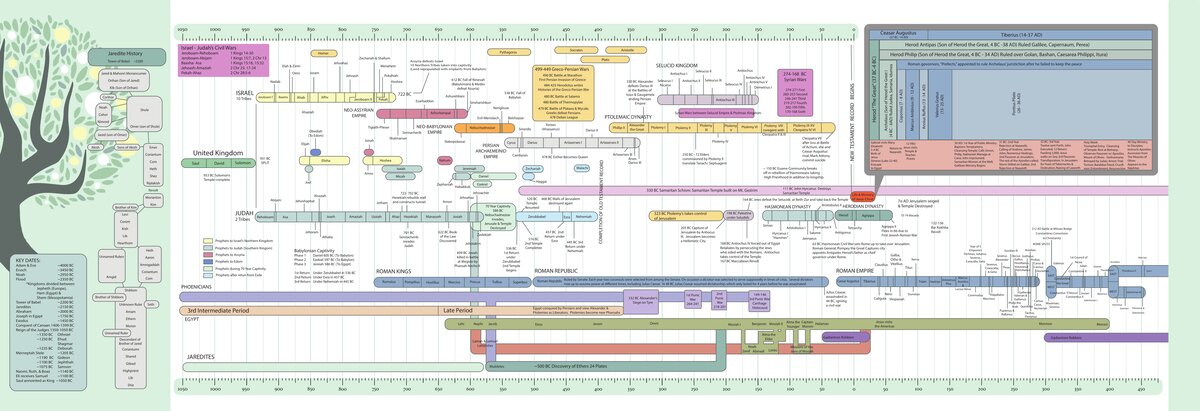
Tap to expand
Old Testament Timeline
From Creation through the Persian Period — tap the image to zoom, or download the full PDF.
Tap anywhere to close · Pinch to zoom