Isaiah 50 — a voice speaks, and the chapter does not say whose — assigned
The chapter opens with God answering a charge nobody has written down, which tells you what the people had been saying. "Where is the bill of your mother's divorcement?" — produce it, if there was one. "Which of my creditors is it to whom I have sold you?" — name him. The questions are rhetorical, and the answer is that no such document and no such creditor exists. Then the real answer: "for your iniquities have ye sold yourselves" (50:1). Nobody took them. There was no transaction to undo.
And then, without introduction, somebody else starts speaking.
"The Lord GOD hath given me the tongue of the learned, that I should know how to speak a word in season to him that is weary." (50:4)
Read what the gift is for. He is given a trained tongue — and the stated purpose is not to win an argument or deliver a verdict. It is "to speak a word in season to him that is weary." The whole equipment of the Servant, in the first line we hear from him, is pointed at one tired person. He is woken early to be taught, "morning by morning", and the teaching is so that he will know what to say.
Two verses later the same voice says what that costs.
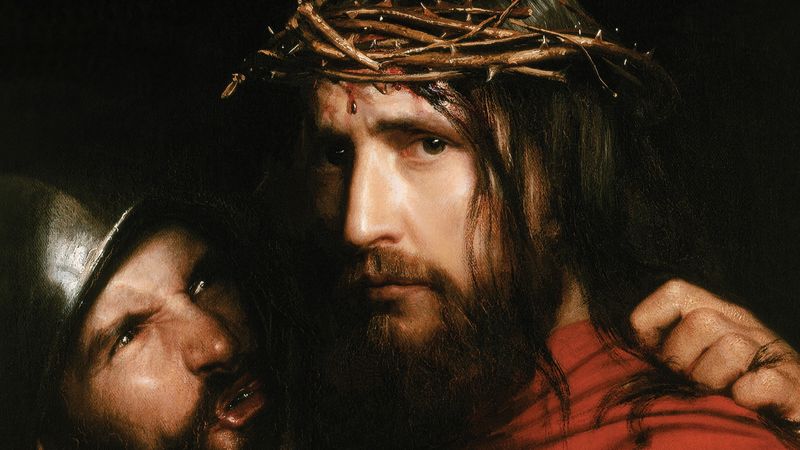
"I gave my back to the smiters, and my cheeks to them that plucked off the hair: I hid not my face from shame and spitting." (50:6)
The verbs are the point. Not they took — I gave. Not I could not escape — I hid not. This is not a report of helplessness; it is a description of somebody not defending himself who plainly could have. And the verse after it is not a cry for rescue but a statement of confidence: "therefore have I set my face like a flint, and I know that I shall not be ashamed" (50:7).
Then the speech stops, and the chapter still has not said who was talking. Servant appears at 50:10, once, in someone else's sentence — "that obeyeth the voice of his servant" — and it is the only time the word occurs in the chapter. Key Passages, Passage 1, follows that observation through the chapter.
Jacob read this chapter aloud to his people (2 Nephi 7), to a group far from the land they had left. He picked the chapter that opens by denying there was ever a divorce.
Isaiah 51 — look at the rock you were cut from — assigned
If chapter 50 denies that God let them go, chapter 51 deals with the fear underneath it: there are not enough of us left for this to matter.
"Look unto the rock whence ye are hewn… Look unto Abraham your father, and unto Sarah that bare you: for I called him alone, and blessed him, and increased him." (51:1–2)
The rock is a person. The image sounds geological until the next line names it: the quarry they were cut out of is a couple — and God's argument is that He started this with one man and one woman and no visible prospects. I called him alone. To people who can count how few they are, that is not sentiment; it is arithmetic pointed the other way.
Then the chapter does something a reader can miss at speed. Somebody calls on God to wake up.
"Awake, awake, put on strength, O arm of the LORD… Art thou not it that hath cut Rahab… Art thou not it which hath dried the sea…?" (51:9–10)
That is the voice of the people, remembering the Exodus and asking for it again — do what you did at the sea. It is a prayer with an edge on it, and Isaiah puts it in the book without softening it.
Rahab and “the dragon” recall the Lord’s power to make a way through overwhelming danger. Isaiah immediately connects these images to deliverance through the sea. This Rahab differs from Rahab of Jericho; Historical & Cultural Context, “Rahab: Remembering the God Who Made a Way” explains the names and the ancient imagery.
God answers their plea with reassurance. "I, even I, am he that comforteth you: who art thou, that thou shouldest be afraid of a man that shall die?" (Isaiah 51:12). They have called upon Him to awaken; He reminds them that He is already their comforter. The question redirects their attention from the mortal powers threatening them to the God who sustains them. Those threats are real, but they are not greater than He is.
And then, at 51:17, the call changes direction: "Awake, awake, stand up, O Jerusalem." Earlier, the people called upon the Lord's arm to awaken and deliver them as He had delivered their ancestors. Now Jerusalem herself is called to rise.
The chapter pictures her staggering under suffering and divine judgment, like someone who has drunk more than she can bear. This is the "cup of trembling": not ordinary wine, but an image of devastation that has left her overwhelmed and unable to stand. The call to awaken is therefore more than an instruction to try harder. It accompanies the Lord's promise to change her circumstances.
He takes the cup from her hand and places it in the hands of those who afflicted her. The Lord who judged His people now pleads their cause. Jerusalem is called to stand because the suffering that brought her low will not have the final word. (Isaiah 51:21–23)
Isaiah 52 — Zion is told to put on the strength she asked God for — assigned
This is the payoff of the exchange, and it turns on four words. At 51:9 the people said to God: "put on strength, O arm of the LORD." At 52:1 God says to Zion:
"Awake, awake; put on thy strength, O Zion."
The same phrase, given back. They asked Him to put on strength; He tells them to put on theirs. Compare the two verses side by side: the repeated words connect the people's prayer with the Lord's answer. Jerusalem is told to put on beautiful garments, shake herself from the dust, and loosen the captive bonds around her neck (52:1–2). These are images of restored dignity: the woman brought low is called to rise and take her place again.
This restoration leads toward the redemption of the bride. Here Jerusalem is the captive daughter of Zion; in chapter 54, the covenant relationship becomes an explicit marriage image, with her Maker named as her husband and Redeemer. Read together, the chapters portray more than release from captivity. They promise renewed belonging and a relationship sustained by the Lord's mercy. (Isaiah 54:5–8)
For a Christian reader, the scene can also recall Jesus taking Jairus's daughter by the hand and calling her to arise. His command accompanies the power that restores her to life. It is a devotional parallel that helps us hear Jerusalem's summons: she is not left to find strength alone; the Lord announces the deliverance that makes rising possible. (Mark 5:41–42)
Then the economics of it, in one line: "Ye have sold yourselves for nought; and ye shall be redeemed without money" (52:3). They got nothing for themselves, and it will cost them nothing to get back. Three chapters later that same arithmetic becomes an invitation — "buy… without money and without price" (55:1).
The best-known line in the chapter is a pair of feet.
"How beautiful upon the mountains are the feet of him that bringeth good tidings, that publisheth peace." (52:7)
Someone is running down out of the hills toward a city that does not yet know the war is over. It is the feet that are called beautiful — filthy, probably bleeding — because of what they are carrying.
And this is the verse a priest of King Noah used as a trap. In Mosiah 12:19–21 the priests question Abinadi "that they might cross him", and the question they choose is what do these words mean — then they quote Isaiah 52:7. The answer he gives them runs on for chapters and arrives at Isaiah 53, quoted in full in Mosiah 14. We will come back to that.
Two more things before the chapter turns. The departure is not a flight. "Depart ye, depart ye, go ye out from thence… For ye shall not go out with haste, nor go by flight" (52:11–12) — and that is deliberately unlike the first exodus, where the Passover was eaten "in haste", shoes on, staff in hand (Exodus 12:11). The first time they ran. This time they walk, with God at the front and the back of the column.
And then, at 52:13, the unnamed figure from chapter 50 returns — this time described from outside, by God: "Behold, my servant shall deal prudently, he shall be exalted." The exaltation is announced first, before a word about suffering. Then the suffering, and it is disfiguring: "his visage was so marred more than any man" (52:14). And the result is silence in high places — "the kings shall shut their mouths at him: for that which had not been told them shall they see" (52:15).
The chapter break here is a later convenience, not a division in the poem. Isaiah 52:13 begins the passage that chapter 53 finishes, and reading 53 without these three verses starts the story in the middle.
Isaiah 53 — the suffering Servant the chapter will not name — assigned
The first thing to notice is who is talking. Chapter 53 is spoken by a we — and what that we has to say is a confession.
"Who hath believed our report? … he hath no form nor comeliness; and when we shall see him, there is no beauty that we should desire him." (53:1–2)
They are not describing a stranger. They are describing someone they looked at and did not want. "We hid as it were our faces from him; he was despised, and we esteemed him not" (53:3).
And then comes the line the whole chapter turns on — which is, of all things, a sentence about how they read him wrong.
"Surely he hath borne our griefs, and carried our sorrows: yet we did esteem him stricken, smitten of God, and afflicted." (53:4)
Read what they admit. They saw a man suffering and concluded that God was against him. They mistook His affliction for evidence of divine rejection. But the next verse reverses their understanding: "But he was wounded for our transgressions, he was bruised for our iniquities" (Isaiah 53:5). The suffering they took as evidence against Him was being carried on their behalf. They had seen His pain without understanding His love.
That is worth sitting with, because it is a mistake people still make—about others, and about themselves. We see illness, loss, poverty, or a life that has come apart, and we can begin to imagine that the circumstances reveal someone's standing with God. Sometimes we turn that judgment inward: If God loved me, would this be happening? Have I done something to deserve it?
A hard life is not a verdict. Suffering alone cannot tell us whether someone is faithful, loved, or accepted by God. Isaiah's speakers discover that the person they had judged was the very one bearing their griefs. Their confession asks us to reconsider not only how we understand the Servant, but how readily we pass judgment on anyone whose suffering we do not understand.
Read in light of Jesus Christ, the passage offers another reassurance: the Savior's suffering does not reveal the absence of God's love, but the depth of it. When we suffer, we need not interpret our pain as proof that He has turned against us. The One who carried our sorrows knows what they weigh.
Then the sound goes out of it. "He was oppressed, and he was afflicted, yet he opened not his mouth: he is brought as a lamb to the slaughter, and as a sheep before her shearers is dumb" (53:7). Twice in one verse: he did not answer. And then, plainly, "he was cut off out of the land of the living" (53:8).
And then the chapter does something a funeral does not do. It turns forward.
"He shall see of the travail of his soul, and shall be satisfied… Therefore will I divide him a portion with the great, and he shall divide the spoil with the strong; because he hath poured out his soul unto death." (53:11–12)
He shall see. He shall be satisfied. The verbs go future after the death, and nobody in the chapter explains how.
And it never says who he is
Fifty-three chapters in, the most detailed description of a person in the book is attached to no name at all. That is not an oversight a reader has to work around — it is the chapter as written, and it is why this passage has been argued over for as long as it has existed.
And scripture itself records somebody asking. An Ethiopian official, reading this chapter on the road, put to Philip the question it provokes:
"I pray thee, of whom speaketh the prophet this? of himself, or of some other man?" (Acts 8:34)
That is the honest question, asked in the text, by a man with the scroll open in front of him.
Latter-day Saints answer it with Jesus Christ, and so does the New Testament — but notice how carefully it does so. At the Last Supper the Savior takes one line of this chapter and applies it to Himself: "this that is written must yet be accomplished in me, And he was reckoned among the transgressors" (Luke 22:37, quoting 53:12). He names the verse and He names Himself. The other quotations of this chapter in the New Testament are made by Paul, by Peter, by Matthew and John writing narration — and one by a man in a chariot who was still asking. (Which is which is set out in the chapter map above, and the settings in Key Passages.)
And the earliest full treatment of this chapter in the Book of Mormon is a man on trial for his life. Abinadi quotes all twelve verses to King Noah's priests — the priests who had opened by quoting Isaiah 52:7 at him to trip him up — and then spends the following chapter explaining what he has just read them (Mosiah 14; Mosiah 15). They asked him a question about a messenger's feet. He answered with the chapter about the man nobody wanted to look at.
(Jewish tradition reads the Servant of this chapter differently, and Jewish Perspective sets out what it says in its own terms. It is not our reading and is not offered as one.)
Isaiah 54 — build for children you do not have — assigned
After chapter 53, the next thing that happens is singing — and it is addressed to the last person you would ask to sing.
"Sing, O barren, thou that didst not bear… for more are the children of the desolate than the children of the married wife." (54:1)
Then the instruction gets practical, and slightly absurd: "Enlarge the place of thy tent… spare not, lengthen thy cords, and strengthen thy stakes" (54:2). She is told to make the house bigger before there is anybody to put in it. That is what the chapter asks of a people who can count how few they are: build for the family you have been promised, not the one you can see.
Then the chapter admits what it is up against.
"For a small moment have I forsaken thee; but with great mercies will I gather thee. In a little wrath I hid my face from thee for a moment; but with everlasting kindness will I have mercy on thee." (54:7–8)
Notice that it does not deny the forsaking. It measures it. A small moment against everlasting kindness — and the two halves of that comparison are not the same size, which is the whole point. It is not a claim that the loss was small. It is a claim about proportion, made to people for whom the moment had lasted their whole lives.
And then the chapter does something remarkable: it stakes the promise on an oath the reader already knows.
"For this is as the waters of Noah unto me: for as I have sworn that the waters of Noah should no more go over the earth; so have I sworn that I would not be wroth with thee." (54:9)
That is the promise God made after the flood, with the rainbow as its token (Genesis 9:11–15). Isaiah invokes that familiar covenant to reassure people who fear they have been abandoned: the Lord's promise of mercy is dependable. Then he reaches for something that seems immovable: "the mountains shall depart, and the hills be removed; but my kindness shall not depart from thee" (54:10). Even the landscape is less enduring than His covenant love. Their world may have changed beyond recognition, but His commitment to them has not.
The chapter ends with the line people carry: "No weapon that is formed against thee shall prosper" (54:17) — spoken, in its own setting, to a community that had lost a war.
Two people carried this chapter forward. The Savior quotes verse 13 in the Bread of Life discourse — "It is written in the prophets, And they shall be all taught of God" (John 6:45) — and in 3 Nephi 22 He reads the whole chapter aloud to the Nephites, a people who could hear it as their own case, broken off and left small.
Isaiah 55 — an invitation with no price on it — assigned
The invitation is shouted, like a trader calling across a market.
"Ho, every one that thirsteth, come ye to the waters, and he that hath no money; come ye, buy, and eat; yea, come, buy wine and milk without money and without price." (55:1)
The invitation includes the person who has nothing to pay with. Water, wine, and milk stand before the thirsty and hungry, but lack of money does not exclude them. The Lord's invitation is not come back when you can afford it, but come and receive. This carries forward the promise of redemption without money in Isaiah 52:3, now pictured as nourishment freely offered.
Then comes the question: if the Lord offers what sustains us, why spend ourselves on what leaves us hungry?
"Wherefore do ye spend money for that which is not bread? and your labour for that which satisfieth not?" (55:2)
It is not addressed to people with nothing. It is addressed to people who are spending. Money is going out and labour is being spent, and the return on both is not bread. That is a question worth putting to an ordinary week.
The verse that is almost always quoted out of its own argument
Everyone knows "my thoughts are not your thoughts." Fewer people read the sentence immediately before it, and it changes what the line is doing.
"Let the wicked forsake his way, and the unrighteous man his thoughts: and let him return unto the LORD… for he will abundantly pardon. For my thoughts are not your thoughts, neither are your ways my ways, saith the LORD." (55:7–8)
That little word for ties them together. The reason God pardons abundantly — beyond what the returning man would think reasonable — is that His thoughts are not ours. The verse is usually quoted to explain why hard things happen and God's reasons are hidden. In its own paragraph it is doing something warmer and more specific: it is explaining the size of His mercy, to somebody who has just been told to come back and is privately certain the welcome will be smaller than promised.
(Verse 7 makes the link deliberately: the unrighteous man is told to forsake his thoughts, and the next verse tells him whose thoughts are higher.)
After the invitation to receive freely and the assurance that the Lord will abundantly pardon, the chapter grounds its promise in something familiar:
"For as the rain cometh down, and the snow from heaven… and maketh it bring forth and bud, that it may give seed to the sower, and bread to the eater: So shall my word be that goeth forth out of my mouth… it shall accomplish that which I please." (Isaiah 55:10–11)
The rain becomes bread. It falls into the earth, nourishes the seed, and brings forth grain that will feed someone. What first appears as weather becomes sustenance. Its work takes time, and much of it happens out of sight, but the harvest reveals what the water has been doing.
That is Isaiah's image for God's word. Chapter 54 assures us that His covenant love endures; chapter 55 shows that His word accomplishes what He promises. We may not immediately see how His promises are taking root. The image invites patience and confidence: what begins as rain becomes something we can live on.
And the chapter ends by sending them home singing, with the countryside joining in: "the mountains and the hills shall break forth before you into singing, and all the trees of the field shall clap their hands" (55:12).
Isaiah 56 — hope for two people who feared they did not belong — assigned
Isaiah 56 opens with a promise: "Keep ye judgment, and do justice: for my salvation is near to come, and my righteousness to be revealed" (56:1). It is a message of hope before it becomes an instruction. Then it addresses two people who had good reason to fear they did not quite belong.
"Neither let the son of the stranger, that hath joined himself to the LORD, speak, saying, The LORD hath utterly separated me from his people: neither let the eunuch say, Behold, I am a dry tree." (56:3)
Both sentences are things a person says about himself. The foreigner has concluded he is outside. The eunuch has concluded he is finished — a dry tree is one that will not fruit. Isaiah does not treat either conclusion as shameful, foolish, or a denial of real circumstances. He answers each fear with God’s approaching salvation and with a promise of belonging that those circumstances cannot cancel. (The law of Moses had rulings that bore on both men; Historical & Cultural Context, section 1, sets them out.)
What is offered in exchange is specific, and it is worth reading slowly:
"Even unto them will I give in mine house and within my walls a place and a name better than of sons and of daughters: I will give them an everlasting name, that shall not be cut off." (56:5)
A man with no descendants is promised a name that outlasts descendants.
And the terms are not lowered to let him in. The door is wide; it is not a different door. (What verse 6 actually asks, and how it stands against the law's older graded system, is in Historical & Cultural Context, section 2.)
(The Ethiopian official of Acts 8 is a eunuch reading Isaiah 53. His welcome into the gospel echoes Isaiah’s promise of belonging; his story is told in Historical & Cultural Context, section 1.)
Then the line the whole chapter has been building toward:
"mine house shall be called an house of prayer for all people." (56:7)
The Savior quoted that verse in the temple, and three Gospels record it — Matthew 21:13, Mark 11:17, Luke 19:46. Only Mark keeps the words of all nations. The clause carrying Isaiah 56's whole point — that the house is for the outsider — survives in exactly one of the three. (Reading the three side by side takes a minute, and Key Passages sets it up as an exercise at Passage 9.)
And one more thing this chapter quietly does. Three chapters earlier the Servant was "cut off out of the land of the living" (53:8). Here the eunuch is promised a name "that shall not be cut off." The King James gives them the same words; the Hebrew uses two different verbs — nigzar (נִגְזַר) in 53:8 and yikkārēṯ (יִכָּרֵת) in 56:5 — both passive, both meaning to be cut off. So the echo is real without being a word-play: near-synonyms, not the same word. What the Servant loses, this man is promised he will keep.
Isaiah 57 — where God says He lives — assigned
The chapter opens on a grief most people have felt and few have seen named in scripture:
"The righteous perisheth, and no man layeth it to heart: and merciful men are taken away, none considering that the righteous is taken away from the evil to come." (57:1)
Good people die and nobody notices. That is the complaint, and Isaiah does not soften it. He adds only that the one taken has been spared something — "He shall enter into peace: they shall rest in their beds" (57:2).
The middle of the chapter exposes a world in which human life has been treated as expendable. Righteous people die without anyone taking their loss to heart; children are sacrificed in the valleys amid idolatrous worship. These are not simply descriptions of false religious practices. They reveal the suffering of people whose lives others have failed to cherish. (Isaiah 57:1–5)
Against that background, God says where He lives: in the high and holy place, and with the contrite and humble in spirit, to revive them.
"For thus saith the high and lofty One that inhabiteth eternity, whose name is Holy; I dwell in the high and holy place, with him also that is of a contrite and humble spirit, to revive the spirit of the humble, and to revive the heart of the contrite ones." (57:15)
We might imagine that closeness to God belongs to those whose lives look secure, respected, and unmistakably blessed. Isaiah directs our attention elsewhere—to the humble and contrite, including those whose suffering has left them feeling overlooked or abandoned. Being disregarded by others does not mean being forgotten by God.
He does not describe their brokenness as a reason to keep His distance. He names their need for renewal as a reason to dwell with them. Not visiting. Dwelling. The Holy One who inhabits eternity makes room for the person who feels there is no room for them anywhere. (Marking the two dwellings for yourself is set up in Key Passages, Passage 10.)
The chapter closes by speaking peace "to him that is far off, and to him that is near" (57:19) — the same widening the eunuch and the foreigner were promised one chapter earlier. And then, unsoftened: "There is no peace, saith my God, to the wicked" (57:21). The invitation is wide open and it is not unconditional. Both halves are in the same chapter, and a lesson that keeps only one of them is not teaching Isaiah 57.