| Church Manuals | |
| Come Follow Me Manual — Week 38 | View |
| Scripture Helps: Old Testament | View |
| OT Seminary Teacher Manual | View |
| OT Institute Manual (1Ki–Mal) | View |
| Pearl of Great Price Manual | View |
| Scripture Reference | |
| Bible Dictionary | View |
| Topical Guide | View |
| Guide to the Scriptures | View |
| Church Media & Library | |
| Gospel for Kids (YouTube) | View |
| Bible Videos: Life of Jesus Christ | View |
| Church Magazines | View |
| Gospel Library | View |
Week 38
God Is My Salvation
Isaiah 1–12
September 14–20, 2026
Official Church Resources
OFFICIAL CHURCH RESOURCES▶
CHURCH MEDIA FOR FAMILIES▶
▶ Video Commentary
VIDEO COMMENTARY (10 videos)
▼
 i
iFinding Christ (John Hilton III)
 i
iLynne Hilton Wilson
 i
iFollow Him - Full Episode
 i
iScripture Insights
 i
iTalking Scripture
 i
iTeaching With Power
 i
iThe Scriptures Are Real - Full Lesson
 i
iThe Scriptures Are Real - Short Tutoring
 i
iUnshaken
 i
iDon't Miss This
Specialized Audiences
WOMEN’S PERSPECTIVES (2 videos, 1 resource link)
▶
FAMILY & CHILDREN’S RESOURCES (4 videos, 1 resource link)
▶
 i
iLatter Day Kids
 i
iLine Upon Line
 i
iScripture Explorers
 i
iThumb Follow Me
Reference & Study Materials
Scripture Central
Week 38 Study Hub
Interpreter
Week 38 Articles
Bible Project
14 Book Overviews & Library Videos
BIBLE PROJECT (2 book overviews · 3 selected themes · 9 more library videos)
▶
The book overviews follow this week’s reading. Selected themes are highlighted below; the rest of the standing library remains available.
THIS WEEK’S BOOKS
 i
iBook of Isaiah Summary: Part 1
 i
iBook of Isaiah Summary: Part 2
SELECTED FOR THIS WEEK — themes and word studies
 i
iHoliness
 i
iSacrifice & Atonement
 i
iShalom / Peace
MORE FROM THE STANDING LIBRARY
 i
iTemple
 i
iImage of God
 i
iThe Messiah
 i
iTree of Life
 i
iYHWH / LORD
 i
iKhesed / Loyal Love
 i
iNephesh / Soul
 i
iRuakh / Spirit
ACADEMIC & SCHOLARLY SITES▶
MAPS & BIBLICAL LOCATIONS▶
JEWISH & SCHOLARLY RESOURCES▶
First, a Word About Where We Are
▶︎
Last week ended with a man who had tried everything — pleasure, building, learning, wealth — and came back with "fear God, and keep his commandments." Proverbs and Ecclesiastes had spent the whole week on one question: how should a person live?
This week the question changes. Isaiah is not mainly asking how to live. He is asking who God is, and what it does to you to see Him.
That is a different kind of reading, and it is worth knowing before you start. Wisdom literature leans on what you can test against your own experience — try it and see whether it holds. Isaiah leans the other way. He puts you in a courtroom in chapter 1 and a throne room in chapter 6, and the weight falls less on whether the counsel works than on who is speaking. Both books ask both questions; the emphasis is what shifts.
Before You Start
▶︎
Isaiah has a reputation for being hard, and the reputation is earned. The King James is difficult here in a way it is not in Genesis. The chapters jump. A verse about a virgin sits next to a verse about butter and honey, and neither seems to know the other is there.
Here is something to do before you open the first chapter. Read these four lines and see how many of them you have met before: "They shall beat their swords into plowshares." "Though your sins be as scarlet." "Unto us a child is born." "Wonderful, Counsellor, The mighty God." Every one of them is in this week's twelve chapters. Most of us have met these lines on their own — on a plaque, in a hymn, at Christmas — and a line lifted out of Isaiah usually loses the situation it was answering. "Swords into plowshares" sits in a chapter that ends with people throwing their idols to the bats; "unto us a child is born" has a war on one side of it. So read the verses either side of each one, and expect the surroundings to be rougher than the quotation led you to believe. That roughness is the point of them.
If the size of the book is what daunts you, start with its shape. Isaiah runs to sixty-six chapters; this week covers the first twelve. BibleProject's two-part animated overview — Isaiah 1–39 and Isaiah 40–66 — lays that shape out in about sixteen minutes between them, and is an unusually good place to begin. Chapters 1–39 move back and forth between judgment and hope; 40–66 develop the restoration that follows.
One connection from that overview is worth carrying into this week's reading. At the end of Isaiah 6, after the vision and the coal, the prophet is told the land will be emptied like a tree cut down — and that a "holy seed" remains in what is left standing (6:13). Five chapters later that stump puts out a shoot: "there shall come forth a rod out of the stem of Jesse" (11:1), the coming King. The felled tree and the seed left in it are one image, carried across the week. (That reading of the tree and the seed is BibleProject's synthesis of the book's structure. It is offered as an accessible starting point — not a substitute for the text, and not an official Church interpretation.)
Nephi said the difficult part out loud, and then said what closes the gap. He grants plainly that "Isaiah spake many things which were hard for many of my people to understand; for they know not concerning the manner of prophesying among the Jews" (2 Nephi 25:1). He had an advantage his people did not — "I came out from Jerusalem, and mine eyes hath beheld the things of the Jews" (2 Nephi 25:5). But he does not make that a qualification a reader has to earn first. What he offers instead is this: the words of Isaiah "are plain unto all those that are filled with the spirit of prophecy" (2 Nephi 25:4). And the simplest of the reasons he gives for copying so much Isaiah at all is that Isaiah had seen what he had seen — "for he verily saw my Redeemer, even as I have seen him" (2 Nephi 11:2). (His other stated reasons, and Jacob's, are set out in Historical & Cultural Context, section 6.)
And the tools for this were built over the last several weeks. Wisdom literature trained the habit of reading an image that means more than it says. The Psalms trained the ear for the paired line, where the second half answers the first. Isaiah is made of both, and the week's Historical & Cultural Context supplies the third thing these chapters ask for — the world they were spoken into. None of that is a prerequisite. It just means a reader coming from those weeks is not starting cold.
The Overview walks all twelve chapters in order, and the Historical & Cultural Context explains the empire pressing on Isaiah's world while he preached. What follows is not a summary of either. It is a handful of things in these chapters worth slowing down for.
What's in This Week's Materials
▶︎
- Overview: all twelve chapters in order — every one of them is assigned this week — with the argument that runs through them.
- Historical & Cultural Context: Isaiah the man and the four kings he served; the Assyrian crisis; what actually happened to the northern tribes and what it did to Jerusalem; and why a single prophecy can be fulfilled more than once.
- Key Passages: eight close readings, including the coal, the sign given to a king who refused one, the four names, and the root the week's title shares with the name of Jesus.
- Word Studies: the Hebrew behind purged, the one-letter puns of Isaiah 5, and the vocabulary of the throne room.
- Jewish Perspective, Teaching Applications, Study Questions: how these chapters have been read and prayed for two and a half millennia, and what to do with them at home and in a class.
He Was Cleansed Before He Volunteered
▶︎
This is the detail in Isaiah 6 that is easiest to read straight past.
Isaiah sees the Lord. His first words are not "send me." They are "Woe is me! for I am undone; because I am a man of unclean lips" (6:5). Then a seraph takes a coal from the altar and touches his mouth, and only after that does the Lord ask "whom shall I send?" — and only then does Isaiah say "Here am I; send me" (6:8).
The order is the point. He is not cleansed because he volunteered. He volunteers because he has been cleansed.
The instinct runs the other way. Earn the standing first — get the habit fixed, the doubt settled, the record respectable — and then offer to serve. Isaiah's account puts it the other way round: the offer follows something done to him that he could not do for himself.
(The verb is kāp̄ar (כָּפַר) — the atonement word, and it is passive here. Worked through in Key Passages, passage 4.)*
Be careful what that does and does not mean. It is not a reason to stop repenting — the confession is the first thing Isaiah does, and repentance is how anyone comes to the coal rather than something the coal replaces. What it removes is the waiting. The order in this chapter is confession, then a cleansing he could not perform on himself, then the call — so the thing to stop is the attempt to make yourself adequate under your own power before you offer to serve. Repent, yes. Rely on Christ to do the cleansing, rather than on your own record to make it unnecessary — and do not wait to be asked until you feel finished.
The Question That Is Actually Hard
▶︎
Isaiah 5 is a love song about a vineyard, and it is a searching one. The owner does everything right and gets wild grapes. Then the song turns and asks the listeners to judge the case — and only afterwards tells them whose vineyard it is.
The hard question is not whether we deserve the verdict. It is the one the song asks out loud: "What could have been done more to my vineyard, that I have not done in it?" (5:4).
Sit with that as a real question rather than a rhetorical one. It is God asking what else He could possibly have given. Try to answer it. The difficulty of finding an answer is the point.
A Prophecy Can Be True More Than Once, and This Bothers People
▶︎
Isaiah 7:14 had a first home, and it had a clock in it. A terrified king, two armies marching on him, and a sign: a child would be born, and "before the child shall know to refuse the evil, and choose the good, the land that thou abhorrest shall be forsaken of both her kings" (7:16). Before one child could tell right from wrong, the crisis would be over. That was a real promise to a real king, and it came true in his lifetime.
And the butter and honey of 7:15 belong to that same sign — the verse that looked as though it had wandered in from somewhere else. The chapter explains the food itself a few verses later. When the land is ruined, a man will keep "a young cow, and two sheep" and live on what they give, "for butter and honey shall every one eat that is left in the land" (7:21–22), while the vineyards go to "briers and thorns" (7:23). So it is not a luxury. It is what is left to eat when the farms are gone — and the child of the sign grows up eating it, on the far side of the invasion the sign announces. (Readers do differ: some take the food as a picture of plenty rather than of ruin. Isaiah 7:21–25 is why this guide reads it the other way.)
Then Matthew. Writing about the birth of Jesus Christ, he says "all this was done, that it might be fulfilled which was spoken of the Lord by the prophet" (Matthew 1:22), and quotes Isaiah 7:14. Note whose voice that is — Matthew's own narration, not words the Savior quoted. And note what it does to the first fulfilment: nothing. The sign given to Ahaz was not used up when Ahaz's crisis passed.
That is what makes this ask for more care rather than less. If finding one fulfilment does not close a passage, no reading is finished just because an answer fits. But the opposite mistake is nearer to hand: a passage that can mean more than one thing looks, to a reader in a hurry, like a passage that can mean anything. Both errors live in the same verse — stopping too early, and running too far.
What keeps the second reading honest is not ingenuity. Matthew does not offer his as a clever discovery; he says it was "spoken of the Lord," and he writes under the same Spirit that spoke it. That is the safeguard Elder Dallin H. Oaks names in "Scripture Reading and Revelation" (Ensign, January 1995): because these prophecies can carry more than one meaning, it "underscores the importance of our seeking revelation." Not our cleverness. Revelation.
Which makes the work ordinary and the help promised. Read the passage in its own setting first — who is speaking, to whom, about what — and then ask. That is a relief rather than a burden: the reading is not a puzzle anyone has to be clever enough to solve alone. (The fuller Oaks passage and the pattern behind it are in Historical & Cultural Context, section 4.)
Moroni Quoted Chapter 11 to a Seventeen-Year-Old
▶︎
On the night of 21 September 1823, Moroni "quoted the eleventh chapter of Isaiah, saying that it was about to be fulfilled" (Joseph Smith—History 1:40). Joseph was seventeen — born in December 1805, three years past the First Vision and four years from the plates.
Read Isaiah 11 knowing that. "There shall come forth a rod out of the stem of Jesse, and a Branch shall grow out of his roots" — growth from a cut-back stock rather than from a tree at its height. Out of it comes someone who judges the poor with righteousness. Then the wolf and the lamb. Then, in verse 11, the Lord setting His hand "the second time" to recover the remnant of His people, gathered from every direction.
That image — life kept in something that looks finished — turns up in more than one place in scripture, and the Lord Himself answered a direct question about what this particular stem is. (Set out in full in Key Passages, passage 7.)
That is our doctrine of the gathering, in a chapter written while an empire was carrying Isaiah's neighbours away. It was not a comfortable thing to say. It was said anyway, to people watching the worst thing they knew of happen to the family next door.
And Then Chapter 12, Which Is Six Verses Long
▶︎
After eleven chapters of arraignment, woe, invasion and stumps, the whole thing resolves into a song — and the line the week is named for: "Behold, God is my salvation; I will trust, and not be afraid" (12:2).
That sentence is built on a familiar root, and Word Studies, study 5 takes it apart properly. The word for salvation here is yᵊšûʿâ, and the name Jesus — Yēšûaʿ — is built from the same Hebrew root, the verb yāšaʿ, to save.
And so is the prophet's own name. Isaiah is Yᵊšaʿyāhû, which means "the LORD saves."
So the hymn that closes these twelve chapters says, in a sentence, what the prophet's name says in a word — God is my salvation. Whether Isaiah noticed that or arranged it, the text does not tell
us. What it does show is that the song closing these twelve chapters and the prophet's own name make the same claim. *(Chapter 12 ends this opening section of Isaiah, not the book —
there are sixty-six chapters in all.)*
Keep the claim the right size. This is a shared root, the way save, saviour and salvation share one in English — not a hidden second translation of the verse, and not the name Jesus concealed in Isaiah 12:2. The verse says what it says. What the root adds is that the words for rescue, the prophet's name, and the Saviour's name all grow from the same three letters.
The Invitation
▶︎
If you read nothing else this week, read Isaiah 6 slowly, and notice the order — the seeing, the undoing, the coal, and only then the sending.
And then try this. Take a line from these chapters that you have heard before and read the whole chapter around it. "Unto us a child is born" is the easiest one to test, because it is usually met in December, on its own. Read Isaiah 9:1 through 9:21 straight through.
Why bother, when you already know verse 6? Because the verse has a war on one side of it and, from verse 8, a people who answer their own ruin by planning a grander rebuild. On its own the promise sounds like the end of the trouble. In place, it arrives in the middle of it — which is the more useful thing to know about a promise. (The chapter's three units are walked through in the Overview, at Isaiah 9.)
These twelve chapters turn on two things that are hard to hold at once: God is holy, and God comes close.
Here is why they pull against each other. Holy carries goodness, but it carries more than
that: it is the language of what is set apart, of the sanctuary and what may come near it. That is the sense doing the work in chapter 6 — the seraphim say the word three times, the doorposts
shake, and Isaiah's first reaction to seeing God is not joy but "Woe is me! for I am undone." He does not expect to survive being that close. He says it because he has just seen the difference
between what God is and what he is.
And the week answers that twice.
The coal. The distance is real, and it is closed from God's side — something is carried to Isaiah
from the altar, and the very part of him he had just confessed was unclean is the part that is
touched. He does not become worthier and then approach. He is made able to stay.
The Child. The names in 9:6 put "the mighty God" and a born infant in one sentence, and the
sign of 7:14 is Immanuel — God with us. The same problem answered from the other direction: not
a man made fit for the throne room, but God arriving inside the human situation.
Latter-day Saints read both as pointing to Jesus Christ — the altar that made Isaiah able to
stay, and the Child who came all the way in. *(That is what the gospel makes of these chapters; it is
not a claim that the coal or the Hebrew words name Him outright.) It is why a stretch of scripture this severe can end with somebody singing. (Chapter 12 closes this opening unit, not the book;
Isaiah runs on to 66.)*
Continue to the Study Guide, or open the Weekly Resources tab above for this week's videos and study links.
Week 38
Isaiah 1–12 — Overview
"God Is My Salvation"
1. Week 38: Overview
There is a particular kind of discouragement that comes to faithful people. Not doubt exactly, and not rebellion. You attend. You serve. You take the sacrament, you pay your tithing, you say the prayers. And somewhere underneath it a quiet question forms: is any of this landing?
Isaiah opens by answering that question, and the answer is not a reassurance.
God's complaint against Judah is not that they had stopped worshipping. They had not stopped. The temple was busy, the calendar was full, the offerings were coming in. That is exactly the problem. "To what purpose is the multitude of your sacrifices unto me?" (1:11). Four verses later it gets harder: "when ye make many prayers, I will not hear" (1:15).
And He says why, in the same breath — it is not a mystery. "Your hands are full of blood… cease to do evil; learn to do well; seek judgment, relieve the oppressed, judge the fatherless, plead for the widow" (1:15–17). The worship was not refused because worship is worthless. It was refused because of what these worshippers were doing to people the rest of the week.
And that is a specific charge. Isaiah is speaking to a society whose courts had stopped protecting the widow and the orphan. If your worship feels thin, this chapter is not telling you there is blood on your hands. What it does say is that God cares what happens between Sundays — and that is worth knowing whether the answer in your case is repentance or simply patience.
And then, seven verses on, without warning, the tone breaks open: "Come now, and let us reason together, saith the LORD: though your sins be as scarlet, they shall be as white as snow" (1:18).
That is the whole book in miniature — the hardest thing anyone has said to these people, and the kindest, in the same breath and from the same mouth. The week takes its title from the far end of that sentence, eleven chapters later, when this opening stretch of the book arrives at a song: "Behold, God is my salvation; I will trust, and not be afraid" (12:2).
Lines from these twelve chapters turn up everywhere. "Though your sins be as scarlet." "Holy, holy, holy." "Unto us a child is born." "They shall beat their swords into plowshares." "Here am I; send me." They turn up on walls, in hymns, at Christmas and in talks far more often than in their own chapters. This week you get to read them where they live, and several of them are startling in place.
A note on Isaiah being hard. He has a reputation, and it is half earned. Isaiah writes poetry, he moves without warning between his own century and ours, and he assumes you know the politics of 700 BC. None of that is in your way this week. Who Isaiah was, which kings he served, what Assyria was doing on the northern border, and why one prophecy can be fulfilled more than once — all of that is in Historical & Cultural Context, and you can read these chapters without it. The Savior's own instruction was simply "Search these things diligently; for great are the words of Isaiah" (3 Nephi 23:1).
Here is a question this week rewards, and it is easy to read past.
Isaiah's call — the vision of the Lord in the temple, the seraphim, the burning coal, "Here am I; send me" — is in chapter 6. Not chapter 1.
Jeremiah's call is in his chapter 1. Ezekiel's opens his book, with the sending at 2:3. Isaiah's is in chapter 6 — five chapters of accusation stand in front of it. This is about where the book puts the call, not about when Isaiah became a prophet. Isaiah 1:1 dates his vision to four kings' reigns; the book is arranged, not a diary. So a reader is made to sit through the accusation first — the ruined vineyard, the pointless sacrifices, the six woes — and only then meets the man who has to carry it.
And when we meet him, something happens that is easy to read past. For five chapters the book has pronounced woe on other people. Then he sees the King, and the first word out of his mouth is a woe on himself: "Woe is me! for I am undone; because I am a man of unclean lips, and I dwell in the midst of a people of unclean lips" (6:5).
And it is worth being exact about which word that is, because the King James prints one English word for two Hebrew ones. Isaiah 6:5 is not the woe of chapter 5's six oracles — that is hôy (הוֹי), the cry a prophet aims at somebody. It is the same word as chapter 3's "Woe unto their soul" and "Woe unto the wicked" — ʾôy (אוֹי), the cry of distress itself. Same word, same construction; only the object moves, and it moves onto him. (Key Passages, passage 4 sets the three occurrences side by side.)
He does not say he is better than them. He says he is one of them.
He is not exempted, and he is not merely excused. Something is done to him, and only afterwards is he asked to go — and he is sent straight back to the people the book has spent five chapters arraigning: "Go, and tell this people" (6:9). (The scene itself is walked through at Isaiah 6 below, and the Hebrew behind purged is in Key Passages, passage 4.)
Here is what surprises people who go looking: the woes do not stop after chapter 6. Read on and they resume — chapter 10 opens with another one, and four verses later there is another. The refrain that first lands in chapter 5, "For all this his anger is not turned away, but his hand is stretched out still," comes back three times in chapter 9 and once more in chapter 10.
As the book is arranged, the message does not change at the call. What changes is how we are made to see the messenger.
That is worth carrying through the whole week, because it is also the invitation. You do not get to read Isaiah 1–5 from outside. The man appointed to carry the indictment is shown to be under it, is cleansed by something he could not have reached for, and is sent back in among the people it names. If that is how it went for the prophet, it is worth asking where the same order shows up in our own experience.
All twelve chapters are assigned this week. The manual groups them as 1; 3–5 (warning and hope), 2; 4; 11–12 (the latter-day work), 6 (the prophet's call), and 7–9 (Immanuel). The walkthrough below follows them in order instead, so the reading has no gaps.
The second column gives the name tradition has attached to a chapter, where there is one. A dash means the chapter has no traditional name.
The third column answers a question worth having in front of you all week: which of these chapters Nephi copied onto the plates, and where to find them. Isaiah 2 through 12 are quoted almost entire as 2 Nephi 12 through 22 — a steady offset of ten, so Isaiah 6 is 2 Nephi 16, and Isaiah 11 is 2 Nephi 21. Isaiah 1 is the exception: it is not in that block (2 Nephi 11 is Nephi's own words, explaining why he is about to quote so much Isaiah).
And the two texts are not word for word, which is the whole reason to lay them side by side. Isaiah 5:1's "Now will I sing to my wellbeloved" is "And then will I sing" at 2 Nephi 15:1; Isaiah 8:1's "the LORD said unto me" is "the word of the Lord said unto me" at 2 Nephi 18:1. Read a chapter in both and the differences are where you slow down.
The fourth column marks where a chapter is carried into the New Testament — and says every time which of three different things is happening, because they are not the same and they are constantly confused:
- He quotes it — the Savior's own words
- Someone else quotes it — Paul, Peter, or another writer
- The narrative applies it — a fulfilment formula, or a scene that fulfils it with nobody quoting
12 rows — click to collapse
| Chapter | Also known as | In the Book of Mormon | Carried into the New Testament | What it is — and why it matters |
|---|---|---|---|---|
| Isaiah 1 | ḥāzôn (חָזוֹן) — "The Vision," from its first word; 1:1–27 is read in synagogues on the Sabbath before the fast of the Ninth of Av | — (not in the 2 Nephi block) | Rom 9:29 ← 1:9, Paul | The great arraignment. God says the sacrifices are unwanted and the prayers unheard — then, in the same breath, "though your sins be as scarlet, they shall be as white as snow" (1:18). |
| Isaiah 2 | "The Mountain of the Lord's House" (2:2–4); the same oracle stands in Micah 4 | 2 Nephi 12 | — | Swords beaten into plowshares, and the house of the Lord established in the top of the mountains. The verse behind the hymn "High on the Mountain Top." |
| Isaiah 3 | — | 2 Nephi 13 | — | The collapse of leadership: "I will give children to be their princes." A society whose competent people are gone, and a long, unsparing description of luxury under judgment. |
| Isaiah 4 | — | 2 Nephi 14 | — | One verse of ruin, then "the branch of the LORD" at verse 2 — the first appearance of a title the prophets return to again and again. A cloud by day and fire by night over Zion, as at Sinai. |
| Isaiah 5 | The Song of the Vineyard (5:1–7) | 2 Nephi 15 | — | A love song that turns into a lawsuit, and six woes. The vineyard was planted with every advantage and produced wild grapes. Its last line is a pun the King James does not carry — see Word Studies. |
| Isaiah 6 | The Call of Isaiah; 6:3 is carried in the Kedushah (קְדֻשָּׁה) of Jewish congregational prayer and opens the Sanctus in Christian liturgy — "Holy, holy, holy" | 2 Nephi 16 | Matt 13:14–15 ← 6:9–10, He quotes it Mark 4:12 · Luke 8:10 ← 6:9–10, He quotes it Acts 28:26–27 ← 6:9–10, Paul, to the leaders at Rome John 12:39–40 ← 6:9–10, narration — John's own comment John 12:41 ← the vision, narration | The throne, the seraphim, the coal, "Here am I; send me." The most quoted chapter of the week, and the one place the Savior quotes Isaiah 1–12 in His own voice. |
| Isaiah 7 | The Immanuel Prophecy (7:14) | 2 Nephi 17 | Matt 1:22–23 ← 7:14, narration — Matthew's fulfilment formula | A terrified king, a prophet sent to meet him at the end of an aqueduct with his young son in tow, and a sign given to a man who did not want one: "a virgin shall conceive." |
| Isaiah 8 | — | 2 Nephi 18 | Rom 9:33 ← 8:14, Paul 1 Pet 2:8 ← 8:14, Peter 1 Pet 3:14–15 ← 8:12–13, Peter Heb 2:13 ← 8:17–18, the writer to the Hebrews | A child with the longest name in scripture, a warning not to call things a conspiracy, and the Lord Himself as both sanctuary and stone of stumbling — the same stone, depending on what you do with it. |
| Isaiah 9 | "Unto Us a Child Is Born" (9:6) — the text of Handel's Messiah | 2 Nephi 19 | Matt 4:14–16 ← 9:1–2, narration — Matthew's fulfilment formula | "The people that walked in darkness have seen a great light." Then the names: Wonderful, Counsellor, The mighty God, The everlasting Father, The Prince of Peace. Then, from verse 8, a separate oracle to the northern kingdom — and the refrain of chapter 5, three times. |
| Isaiah 10 | — | 2 Nephi 20 | Rom 9:27–28 ← 10:22–23, Paul | Two more woes, on the far side of the call. And a striking argument: Assyria is God's instrument and does not know it — "shall the axe boast itself against him that heweth therewith?" |
| Isaiah 11 | The Peaceable Kingdom; "the Rod of Jesse," source of the Jesse Tree | 2 Nephi 21 | Rom 15:12 ← 11:10, Paul | The stem of Jesse, the Spirit resting on Him, and a kingdom where the wolf lies down with the lamb and a child plays over the adder's den. Quoted to Joseph Smith by Moroni (Joseph Smith—History 1:40). |
| Isaiah 12 | Traditionally linked to the water-drawing rejoicing at the Feast of Tabernacles, from 12:3 | 2 Nephi 22 | — | Six verses of pure song, and the week's title: "Behold, God is my salvation." Everything these twelve chapters have been shouting resolves into a hymn a person can sing. |
Whose voice is it? A skill worth keeping.
Two of the most beloved verses in this week are not quoted by the Savior. "A virgin shall conceive" (7:14) and "the people that walked in darkness" (9:1–2) are both Matthew's own fulfilment formula — "that it might be fulfilled which was spoken by the prophet." They are true, they are about Christ, and Matthew is the one saying so.
And one of the least comfortable verses in this week is His. "Hear ye indeed, but understand not" (6:9–10) is quoted by the Savior Himself, in all three of Matthew, Mark and Luke, to explain why He taught in parables.
This matters for a plain reason: saying the Savior said something He did not is putting words in His mouth, even kindly, even about Himself. Reading Isaiah with the question who is speaking? is a habit that will serve you for the rest of the Old Testament — and it is the same question Isaiah 6 asks about Isaiah.
Isaiah 1 — the arraignment, and the offer
The book opens in a courtroom with heaven and earth called as witnesses, and the charge is not idolatry or neglect. It is ingratitude so basic that animals do better: "The ox knoweth his owner, and the ass his master's crib: but Israel doth not know" (1:3).
Then the section that stops people. God lists their worship — burnt offerings, incense, new moons, appointed feasts, spread hands, many prayers — and rejects all of it. "I am full of the burnt offerings of rams" (1:11). "Bring no more vain oblations" (1:13). This is not a God who wants more religion. The reason is the one stated in the opening above — verses 15–17, the blood on the hands and the widow with nobody to plead for her. What is worth noticing here is the placement: the charge is not saved for a climax. It arrives in the first chapter, before the throne-room scene of chapter 6.
And then, "Come now, and let us reason together" (1:18). The Hebrew behind reason together is yāḵaḥ (יָכַח) — a legal word, and it belongs in the courtroom the chapter opened in. God, having proved His case, invites the defendant to talk it over.
Notice what has already happened, in chapter one, before the throne room of chapter 6: the accusation and the mercy are already both here. Neither is a phase.
Isaiah 2 — the mountain, and the swords
Chapter 2 opens onto something so far from chapter 1 that readers sometimes check whether they have lost their place: "it shall come to pass in the last days, that the mountain of the LORD'S house shall be established in the top of the mountains… and all nations shall flow unto it" (2:2).
This is one of the most quoted passages in Latter-day Saint history. It is the text behind "High on the Mountain Top." It was read as describing what was being built in the Salt Lake Valley, and it is read now as describing temples going up across the world. The manual asks you to look for the future-tense verbs here and try reading them in the present.
Then 2:4, whose words have been set on public monuments — among them the wall facing the United Nations headquarters in New York: "they shall beat their swords into plowshares, and their spears into pruninghooks: nation shall not lift up sword against nation, neither shall they learn war any more."
Note where this sits: chapter two. Four chapters before Isaiah is called, and three before the vineyard is torn down. Hope is not what Isaiah gets to after the judgment. It is braided through it from the start.
The rest of the chapter turns hard again — the day of the Lord against everything lifted up, the cedars of Lebanon, the high towers, the ships, and people throwing their idols to the moles and bats. The two moods sit side by side without transition, and that is how Isaiah works.
Isaiah 3 — when the competent people are gone
A society loses its judges, its soldiers, its prophets, its craftsmen — and what is left cannot hold: "I will give children to be their princes" (3:4), and "the people shall be oppressed, every one by another" (3:5).
Then a long, unsparing passage on the daughters of Zion and their finery — the anklets, the veils, the changeable suits of apparel — closing on the loss of what the ornaments were for: "thy men shall fall by the sword" (3:25). It reads harshly. Read as a whole it is not really about jewellery; the chapter's charge is stated flatly in 3:15: "What mean ye that ye beat my people to pieces, and grind the faces of the poor?" The luxury is evidence, not the crime.
Two woes stand in this chapter — "Woe unto their soul!" (3:9) and "Woe unto the wicked!" (3:11). Hold on to them. They will matter in chapter 6.
Isaiah 4 — the branch, and the covering
One verse of aftermath — seven women grasping at one man — and then the turn: "In that day shall the branch of the LORD be beautiful and glorious" (4:2). A title is being introduced here that will run through Jeremiah and Zechariah and land on Christ.
The chapter ends with an image a Latter-day Saint reader will recognise immediately — "a cloud and smoke by day, and the shining of a flaming fire by night" over the dwellings of Zion (4:5). That is the pillar of cloud and fire from Exodus, which went ahead of Israel through the wilderness and marked where God was while they had no country. Here it is not moving. It is settled over houses, over "every dwelling place of mount Zion" — the God who travelled with a homeless people, staying put over their homes.
Isaiah 5 — the vineyard, and the six woes
Isaiah does something unexpected: he sings. "Now will I sing to my wellbeloved a song of my beloved touching his vineyard" (5:1). It opens like a love song, and the crowd would have leaned in.
The owner does everything right — the best hill, the stones cleared, the choicest vine, a tower, a winepress cut out of the rock. Nothing is missing. And it yields wild grapes. Then the song turns to its hearers: "judge, I pray you, betwixt me and my vineyard" (5:3). The question is put to them before they are told the vineyard is their own (5:7). Nathan did something similar to David — though David answered out loud, and Isaiah 5 never records what the crowd said.
Verse 7 names it, and in Hebrew the naming is a pun the King James does not carry: the word for judgement and the word for bloodshed differ by a single letter in the unpointed spelling, and so do righteousness and a cry. The distance between what God planted the vineyard for and what it produced is one letter wide, twice. (All four words, with the Hebrew set out side by side, are in Word Studies, study 3.)
Then six woes in a row (5:8, 11, 18, 20, 21, 22) — against those who join house to house until no one else has anywhere to live, against those who start drinking early, and the one that has outlived its century: "Woe unto them that call evil good, and good evil" (5:20).
Then comes the line that will return like a drumbeat — its first appearance of several: "For all this his anger is not turned away, but his hand is stretched out still" (5:25).
Isaiah 6 — the year that king Uzziah died
"In the year that king Uzziah died I saw also the Lord sitting upon a throne, high and lifted up, and his train filled the temple" (6:1).
The king had reigned fifty-two years — long enough that most people in Judah had known no other. In the year the fixed point disappeared, Isaiah saw who had actually been on the throne the entire time.
The seraphim call "Holy, holy, holy" — Hebrew's strongest way of intensifying, applied to God — and the posts of the door shake. And Isaiah's response is not awe. It is dread: "Woe is me! for I am undone."
And it is chapter 3's word, now pointed at the prophet himself — the ʾôy set out above. Key Passages, passage 4 puts the three occurrences in a table.
And the reason he gives is a confession of membership, not of superiority: "I am a man of unclean lips, and I dwell in the midst of a people of unclean lips."
Then the coal. A seraph takes it from off the altar — from the place of sacrifice — and touches his mouth: "thine iniquity is taken away, and thy sin purged" (6:7). Isaiah does not cleanse himself and does not ask to be cleansed. It is brought to him, from the altar, by someone else. Only after that does he hear the question: "Whom shall I send, and who will go for us?"
And his answer is one a Latter-day Saint reader has met before. "Here am I; send me" (6:8) — the same words spoken in the council before the world was, by One who volunteered: "And one answered like unto the Son of Man: Here am I, send me" (Abraham 3:27). Isaiah answers the call in the words the Savior used.
The commission itself is bleak — "Hear ye indeed, but understand not" (6:9) — and it is the passage the Savior would quote centuries later to explain why He taught in parables. Isaiah asks how long. The answer is: until the cities are empty. And then the last line of the chapter, almost buried: even when the tree is felled, "the holy seed shall be the substance thereof" (6:13). A stump is not nothing. Remember it — chapter 11 comes back for it.
And John tells us what Isaiah was looking at. Of this vision, John writes: "These things said Esaias, when he saw his glory, and spake of him" (John 12:41) — his meaning Christ's. The One high and lifted up on the throne, whom the seraphim called thrice holy, was the Lord Jesus Christ.
Isaiah 7 — a frightened king at the end of an aqueduct
Two northern kings march on Jerusalem, and King Ahaz's heart "was moved, and the heart of his people… as the trees of the wood are moved with the wind" (7:2). God sends Isaiah to meet him — and tells him to bring his son, a boy whose name means a remnant shall return. A walking sermon standing beside his father.
Isaiah tells him not to be afraid of "the two tails of these smoking firebrands" (7:4) — kings so nearly burnt out they are only smoke. Then God offers Ahaz a sign, anything, as deep or as high as he likes. Ahaz refuses, in language so pious it is hard to argue with: "I will not ask, neither will I tempt the LORD" (7:12). He had already decided to buy Assyria's protection instead.
And he is given a sign anyway: "Behold, a virgin shall conceive, and bear a son, and shall call his name Immanuel" (7:14) — God with us. A sign pressed on a king who did not want one, in the middle of a political crisis he intended to solve himself.
Matthew quotes it at the birth of Christ (Matthew 1:22–23) — and note that this is Matthew's application, his fulfilment formula, not a saying of Jesus. That takes nothing from it. Matthew is telling us what the sign was finally for.
Isaiah 8 — the longest name in scripture, and the stone
Isaiah is told to write on a great scroll, in front of witnesses, Maher-shalal-hash-baz — "swift to the spoil, hasten to the prey" — and then to give the name to his newborn son (8:1–4). The prophet's children are the prophecy. As he says himself: "I and the children whom the LORD hath given me are for signs and for wonders in Israel" (8:18).
Then a warning that lands strangely well in our own century: "Say ye not, A confederacy, to all them to whom this people shall say, A confederacy; neither fear ye their fear" (8:12). Do not catch their panic. Do not take up the conspiracy everyone is passing round. Peter quotes this line to a frightened church (1 Peter 3:14–15).
And then the image the New Testament could not leave alone: the Lord "shall be for a sanctuary; but for a stone of stumbling and for a rock of offence" (8:14). The same stone. A refuge to those who take shelter in Him, and something to trip over for those who will not. Paul quotes it (Romans 9:33); so does Peter (1 Peter 2:8).
The chapter ends with people consulting mediums, and Isaiah's flat reply: "should not a people seek unto their God?" (8:19), and the standard he sets against every voice — "To the law and to the testimony" (8:20).
Isaiah 9 — the light, the names, and the refrain that will not stop
"The people that walked in darkness have seen a great light" (9:2). Isaiah names the region that will see it first — Zebulun and Naphtali, the northern country that Assyria took first and that everyone had written off. The place that was hit first is named as the place the light comes to first. Matthew notes that this is where Jesus began His ministry (Matthew 4:14–16).
Then the names, in a single verse that has been sung in every generation since Handel set it: "For unto us a child is born, unto us a son is given: and the government shall be upon his shoulder: and his name shall be called Wonderful, Counsellor, The mighty God, The everlasting Father, The Prince of Peace" (9:6).
And then, at verse 8, the chapter turns to something else entirely — and it is worth seeing that it is a new piece rather than a mood swing. Verses 1–7 are addressed to a people in darkness and end in the throne of David. Verse 8 begins a separate oracle, and it names a different audience: "The Lord sent a word into Jacob… and all the people shall know, even Ephraim and the inhabitant of Samaria" (9:8–9) — the northern kingdom, the very place verse 1 said the light would reach.
What that oracle charges them with is refusing to read their own ruins. "The bricks are fallen down, but we will build with hewn stones: the sycomores are cut down, but we will change them into cedars" (9:10). That is not repentance; it is a building programme — we will come back grander. And the verse that names the failure says so plainly: "the people turneth not unto him that smiteth them" (9:13). Then the refrain from chapter 5, three times (9:12, 9:17, 9:21).
So the promise and the warning are not fighting over one paragraph. They are two units, side by side, in one chapter — and the order matters: the light is promised to the north first, and then the north is told why it is still in the dark. This is the strongest evidence in the week for what we noticed at the start: the Immanuel chapters are not the section where Isaiah cheers up.
Isaiah 10 — the axe that thinks it is the woodsman
Two more woes — "Woe unto them that decree unrighteous decrees" (10:1) and "O Assyrian, the rod of mine anger" (10:5) — and in Hebrew both open with the same word, hôy (הוֹי), the prophets' cry of woe. Four chapters after the call, and the accusation is still running. The refrain lands one last time at 10:4.
Then one of the most penetrating arguments in the prophets. Assyria is God's instrument — and has no idea. "Howbeit he meaneth not so, neither doth his heart think so" (10:7). He thinks he is conquering for himself. And so God asks: "Shall the axe boast itself against him that heweth therewith?" (10:15).
An empire can be doing exactly what it intends and be a tool in a hand it cannot see. And being an instrument does not make Assyria innocent — the same chapter says God will punish "the fruit of the stout heart of the king of Assyria" (10:12). Both are true at once.
The chapter closes with the forest cut down and Lebanon falling. Everything tall is gone. Which is exactly the ground chapter 11 needs.
Isaiah 11 — out of a stump
"And there shall come forth a rod out of the stem of Jesse, and a Branch shall grow out of his roots" (11:1).
The word rendered stem is gezaʿ (גֶּזַע) — the stock or trunk of a tree. Chapter 10 has just felled the forest, and chapter 6 kept a seed in what was left; read in that setting the stock is plainly a cut-back one, which is why many modern translations print stump. Here is the stock, and something is growing out of it.
And the name is Jesse, not David — not the royal line at its height but the farmer from Bethlehem it started with. The monarchy is taken back to the root and begun again.
Then the Spirit resting on Him in a sevenfold description, and a King who "shall not judge after the sight of his eyes, neither reprove after the hearing of his ears" (11:3) — who does not judge by appearances or hearsay. And a kingdom that no one who has kept livestock can read without stopping: the wolf with the lamb, the leopard with the kid, the calf and the young lion together, "and a little child shall lead them" (11:6). A nursing infant playing over a cobra's hole.
Verse 9 gives the reason, and it is not that the animals were retrained: "for the earth shall be full of the knowledge of the LORD, as the waters cover the sea."
Moroni quoted this chapter to Joseph Smith on the night of 21 September 1823, saying it was about to be fulfilled (Joseph Smith—History 1:40). And 11:11–12 — the Lord setting His hand "the second time" to recover His people, and an ensign lifted for the nations — is one of the central texts of the Restoration.
Isaiah 12 — six verses, and a song
After eleven chapters of courtroom, vineyard, coal, war and stump, Isaiah 12 is a hymn — six verses that begin in the first person and then turn outward. Verses 1–2 are singular — I will praise thee… God is my salvation — which a reader can hear as one saved person speaking, though the same chapter addresses Zion with a singular thou at verse 6, so the number alone does not settle who is speaking. From verse 3 the song widens to the congregation — ye shall draw water, ye shall say, thou inhabitant of Zion. Read that way it starts as one voice and ends as a crowd — a way of hearing the poem, not a fact the grammar settles.
"And in that day thou shalt say, O LORD, I will praise thee: though thou wast angry with me, thine anger is turned away" (12:1). The refrain that would not turn away through chapters 5, 9 and 10 — turns.
Then the week's title: "Behold, God is my salvation; I will trust, and not be afraid: for the LORD JEHOVAH is my strength and my song; he also is become my salvation" (12:2). The word behind my salvation here is yᵊšûʿâ (יְשׁוּעָה) — the verse itself reads yᵊšûʿāṯî, the noun with the possessive ending — and the name Yēšûaʿ, Jesus, is built from the same root. The verse says God is my salvation; hearing the Saviour's name inside that word is a reading Latter-day Saints are right to make, and it is a devotional connection rather than a second translation.
And 12:3: "Therefore with joy shall ye draw water out of the wells of salvation." Jewish tradition attached this verse to the water-drawing rejoicing at the Feast of Tabernacles — and it was at that feast, on the last and greatest day, that Jesus stood and cried, "If any man thirst, let him come unto me, and drink" (John 7:37).
The book that opened with God saying He would not hear their prayers ends this section with a prayer He put in their mouths.
"Woe is me! for I am undone; because I am a man of unclean lips, and I dwell in the midst of a people of unclean lips." — Isaiah 6:5
Everything said in chapters 1 through 5 was right. The vineyard really had failed. The woes were deserved, and nothing in chapter 6 says otherwise.
And the answer, when it comes, is not an argument. It is a coal, carried to him from the altar — the place of sacrifice, by someone else, before he is asked to go anywhere. That is the shape of the whole book in one scene.
"And there shall come forth a rod out of the stem of Jesse." — Isaiah 11:1
The stump is the point. Chapter 10 ends with every tall thing cut down; chapter 11 begins in the wreckage. God's habit in this book is not to preserve what is standing. It is to start again from what is left, and the thing He grows there is better than what was cut.
- The case is opened. Heaven and earth are called as witnesses; the worship is rejected and the reason given — "your hands are full of blood." And immediately, the offer: "though your sins be as scarlet."
- The far horizon appears early. The mountain of the Lord's house, the nations flowing to it, swords into plowshares — in chapter 2, before anything is resolved.
- The vineyard fails, and the woes fall. Six of them, and a pun that turns justice into bloodshed by one Hebrew letter.
- A king dies, and a prophet sees the real throne. The seraphim, the thrice-holy, the shaking doorposts.
- The prophet says woe over himself — "Woe is me" — and is cleansed by a coal he did not fetch.
- He volunteers in the words the Savior used before the world was, and is sent back to the same people.
- The message continues, unchanged. More woes in chapter 10; the refrain three more times in chapter 9.
- Immanuel is promised to a king who did not want a sign, and a child is born who is called the mighty God.
- The forest is felled — and a branch comes out of the stump, the earth full of the knowledge of the Lord.
- The book teaches the people to sing: "God is my salvation; I will trust, and not be afraid."
Because the accusation includes you, and that turns out to be mercy. The most uncomfortable thing in these chapters is that God rejects sincere worship offered by people whose hands were full of blood. The most comforting thing is what He does about it. So the arrangement this week opened with does its work here: having read the charge before meeting the man, you are not standing outside it either. And the pattern in chapter 6 — see it, say it, be cleansed, be sent — is available to anyone, whatever brought them to it.
Because what Isaiah could not do for himself was done for him — and that is the shape of the Atonement of Jesus Christ, seven hundred years before Bethlehem. The practical form of it is this: if you are waiting to feel adequate before you offer to do anything, you are waiting for the wrong thing. Isaiah's usefulness began on the far side of being cleansed, not on the far side of being impressive.
Because promise and warning live together, and you can stop waiting for the hard part to end. Swords into plowshares is in chapter 2, and the anger is still stretched out in chapter 10. Isaiah does not put the comfort at the end where it would be tidy. He braids it in, all the way through, which is what real life does too. You do not have to be finished being corrected before you are allowed to be comforted.
Because these are the words Christ Himself reached for. He quoted Isaiah 6 to explain His own teaching. John says the throne Isaiah saw was His. Nephi copied Isaiah 2 through 14 — thirteen chapters, of which eleven are this week's — onto plates he had to make by hand, and said simply, "my soul delighteth in the words of Isaiah" (2 Nephi 25:5). When you read Isaiah 1–12 this week you are reading what the Savior read, in the book He said testified of Him.
And because of what you can do with it this week. Take one line you have heard before — "unto us a child is born" — and read all of Isaiah 9 around it, following the three units set out in the Isaiah 9 section of the walkthrough above. The Child is not announced into a tidy world, and reading the chapter whole is the quickest way to feel that. Then read Isaiah 5 aloud, agreeing with every woe, and then read 6:5. That is the week in about twenty minutes, and it will do more than any summary of it.
Continue to Historical & Cultural Context for Isaiah the man, the four kings he served, the Assyrian crisis, and why one prophecy can be fulfilled more than once.
2. Historical & Cultural Context
Isaiah tells us almost nothing about himself, and what he does tell us is in the first line: "The vision of Isaiah the son of Amoz, which he saw concerning Judah and Jerusalem in the days of Uzziah, Jotham, Ahaz, and Hezekiah, kings of Judah" (1:1).
Four kings. The manual dates his ministry between 740 and 701 BC — close to forty years, which means Isaiah was not a voice that arrived, delivered a message and left. He was a fixture. People grew up with him. A man who was a boy when Isaiah began was middle-aged when the Assyrian army camped outside the walls.
He was married; his wife is called "the prophetess" (8:3), a title the text gives her without explanation. And his two sons carry the message in their names, which is not a figure of speech — the text shows each name being used:
- Shear-jashub — a remnant shall return. God tells Isaiah to bring the boy along to the meeting with Ahaz (7:3). Say the name aloud in front of a frightened king and it delivers both halves of the message at once: only a remnant — and a remnant will come back.
- Maher-shalal-hash-baz — swift to the spoil, hasten to the prey, usually reckoned the longest personal name in the Bible. Isaiah writes it on a large scroll in front of witnesses first, and only afterwards is the child born and given it (8:1–3). Then the deadline: "before the child shall have knowledge to cry, My father, and my mother, the riches of Damascus and the spoil of Samaria shall be taken away" (8:4).
That second one is the clearest case of what the names are for. Read what the sign actually promises: not the end of the two kingdoms, but a plundering — "the riches of Damascus and the spoil of Samaria shall be taken away before the king of Assyria" — and soon, before a toddler can say father. It is a near-term warning with a short deadline on it, and the deadline is a child learning to talk. A family threatened by Damascus and Samaria did not need a date; they needed to know the relief was close. The boy in the room was the answer.
So when Isaiah says "I and the children whom the LORD hath given me are for signs and for wonders in Israel" (8:18), he is describing something the chapters have already shown us happening. The family is not an illustration of the prophecy. It is how the prophecy was delivered.
Isaiah 6 opens with a date, and readers usually take it as a timestamp. It is doing far more than that.
Uzziah reigned fifty-two years (2 Chronicles 26:3) — long enough that most people in Judah had known no other king. He had been extraordinarily successful — and then, says the record, "when he was strong, his heart was lifted up to his destruction" (2 Chronicles 26:16).
Burning incense at the altar was the priests' work, and only theirs. Uzziah went into the temple to do it himself. The record is careful about how far he got: he "went into the temple of the LORD to burn incense upon the altar of incense" (2 Chronicles 26:16), and eighty priests went in after him and told him to stop — "It appertaineth not unto thee, Uzziah, to burn incense unto the LORD" (2 Chronicles 26:18). He turned on them with the censer in his hand, and "while he was wroth with the priests, the leprosy even rose up in his forehead" (2 Chronicles 26:19). The text never says he completed the offering. It says he went in to make it, and was struck holding the censer. He was a leper for the rest of his life, and the detail that matters is this one: "he was cut off from the house of the LORD" (2 Chronicles 26:21).
Now read Isaiah 6:1 again. "In the year that king Uzziah died I saw also the Lord sitting upon a throne, high and lifted up, and his train filled the temple."
The king who went into the temple uninvited and was put out of it dies — and in that very year the prophet is shown the temple, and the One actually on the throne. Uzziah went to stand where he had no right to stand. Isaiah is brought in, sees the King, says "Woe is me," and is cleansed so that he can stay.
It is a real date — Isaiah is telling us when. But set beside 2 Chronicles 26 it is also doing a second thing: in the year the fixed point of everyone's life vanished, Isaiah saw who had been on the throne the whole time.
Isaiah preached into a political emergency, and these chapters make far more sense once you know who was in the room. Four players, and what each of them wanted.
Assyria was the empire, away to the north-east in what is now northern Iraq. It wanted two things: tribute — an annual payment — and obedience. Kingdoms that paid were mostly left alone. Kingdoms that refused, or paid and then stopped, were invaded.
Israel, the northern kingdom, and Syria, its neighbour further north, were two small states directly in Assyria's path. Both had decided to stop paying and fight. Neither was strong enough alone.
Judah was Isaiah's own country in the south — Jerusalem, the temple, and a king descended from David. Its king through this crisis was Ahaz, and Judah sat far enough south to still have a real choice.
What Assyria did to the people it conquered
This is worth understanding before anything else, because it is what everyone in these chapters is afraid of.
Assyria did not usually destroy a conquered nation. It took the nation apart and moved it. The people who mattered to a country's survival — leaders, soldiers, craftsmen and their families — were marched hundreds of miles and resettled among strangers, while other conquered peoples were moved into the land they had left.
The purpose was political, and it is not hard to see. Rebellion needs the things a settled people has — a home ground worth fighting for, neighbouring towns that can be called on, leaders in place, a sanctuary to rally at. Take a population off its land and set it down among strangers, and every one of those becomes harder to reach for. That was what the policy was for. Empires had moved populations before; what Assyria added was the scale and the record-keeping to do it as a matter of course.
That is what deportation means in this week's reading, and it is why the threat frightened people in a way that losing a battle would not have. A defeat is a defeat; this was the end of a country. Whether it also ended a people is a separate question, and the evidence later in this section says it did not do so quickly — two decades after the deportation there were still men in Assyria carrying the name of the LORD inside their own names.
The crisis that forced Ahaz to choose
Israel and Syria wanted Judah in their revolt, and when Ahaz would not join they moved to replace him. Isaiah reports their plan in their own words: "Let us go up against Judah, and vex it… and set a king in the midst of it, even the son of Tabeal" (7:6) — a king who would bring Judah into the alliance. So the two of them "went up toward Jerusalem to war against it, but could not prevail against it" (7:1). They did not want Judah destroyed. They wanted it compliant, under a king of their choosing.
"And it was told the house of David, saying, Syria is confederate with Ephraim. And his heart was moved, and the heart of his people, as the trees of the wood are moved with the wind" (7:2). A whole nation shaking like a forest.
A name to have ready: when Isaiah says "Ephraim," he means the northern kingdom. He makes the switch across these two verses and never mentions it. Verse 1 names the attacker "Pekah the son of Remaliah, king of Israel"; verse 2, reporting the same army, calls it "Ephraim." One kingdom, two names, one verse apart — Ephraim was the leading tribe of the north, and the prophets use its name for the whole. Isaiah does this constantly in chapters 7 to 9, so it is worth having ready before you meet it.
Isaiah is sent to meet Ahaz "at the end of the conduit of the upper pool" (7:3) — the water supply, exactly where a king would be inspecting his defences against a siege. God's messenger meets the king in the middle of his contingency planning, with a boy called a remnant shall return standing beside him.
What Ahaz did instead
God offers Ahaz any sign he wants. Ahaz refuses with a piece of piety — "I will not ask, neither will I tempt the LORD" (7:12) — and is given the sign of Immanuel anyway.
And then we learn from Kings what he had already decided.
"So Ahaz sent messengers to Tiglathpileser king of Assyria, saying, I am thy servant and thy son: come up, and save me" — and "Ahaz took the silver and gold that was found in the house of the LORD… and sent it for a present to the king of Assyria." (2 Kings 16:7–8)
He called himself Assyria's servant and son, and he paid for the protection with the temple's own treasure. Offered a sign from God for free, he bought a sign from an empire with God's gold.
"Servant" is the word an Assyrian vassal actually used — Assyrian treaties call a client king the emperor's servant, and the arrangement was a real bargain: tribute and obedience in exchange for the protection of the strongest army in the world. Vassals sometimes asked for it. "Son" is the surprise. It belongs to the older diplomatic language of the region rather than to any surviving Assyrian treaty, and putting the two together is Ahaz's own. He did not just submit. He offered to be family.
And Assyria's own tax records have him. In a list of tributary kings — Ashkelon, then Judah, then Edom — Tiglath-pileser's scribes wrote the name of Judah's king as Jehoahaz, the full form, with the divine element still in it. The Bible always shortens it to Ahaz. The empire kept the whole name of the man who emptied the LORD's house to pay them.
It worked, and it was a catastrophe. Judah survived as a vassal — and the empire Ahaz invited in would be at Jerusalem's gates within a generation.
The north did not fall in a day — it was taken in pieces
Samaria fell in 722 BC, and that is the date usually given for the end of the northern kingdom. The text describes something slower, and the difference matters.
The first deportation came about a decade earlier, and Kings names the towns: "In the days of Pekah king of Israel came Tiglathpileser king of Assyria, and took Ijon, and Abelbethmaachah, and Janoah, and Kedesh, and Hazor, and Gilead, and Galilee, all the land of Naphtali, and carried them captive to Assyria" (2 Kings 15:29). Galilee and the whole Transjordan went first. What was left was a rump state around the capital.
Then Hoshea, the last king, stopped paying and sent to Egypt for help — and the empire came for Samaria itself. The city held out three years (2 Kings 18:9–10). When the wall gave, the record reads like a shipping manifest: "carried Israel away into Assyria, and placed them in Halah and in Habor by the river of Gozan, and in the cities of the Medes" (2 Kings 17:6).
Those are real places, and they are hundreds of miles apart — northern Mesopotamia, and then the Iranian plateau. That was the policy, not an accident. Judah would later go into exile together in Babylonia and come home a people. The northern tribes were split up and planted among strangers at opposite ends of an empire. One of those exiles produced a return. The other was designed not to.
What it looked like on the ground — and what became of the ten tribes
The policy is described above. What the documents add is what it was like to be inside it, and the details are not what a reader expects.
Two letters survive in which an official writes to the king about a body of Aramean men — what they are to be issued for the road: "their food supplies, clothes, a waterskin, a pair of shoes and oil." Then, once they had arrived, the same correspondence turns to finding them wives. People travelled in family groups. Those who worked the land they were allotted and paid their taxes on it held it as their own. Shoes and oil, a marriage, a tax assessment — an uprooting conducted through the requisition system, item by item.
(Specialists disagree about those two letters: one leading reading takes the men to be deportees being resettled, another takes them for troops being equipped. This section follows the first. The detail is set out with the sources at the end of this chapter.)
Read carefully, though. That is the empire's own account of itself, written by the officials running the deportations and kept in the palace that ordered them. Scripture gives us the view from the other end — 2 Kings 17 is a lament for the northern tribes, and Psalm 137, written out of the later Babylonian exile, is what deportation sounds like from among the people it is done to. Both are true, and they are not answering the same question: one is a record of how it was administered, the other of how it was survived.
And the ten tribes did not vanish silently. They turn up in the empire's own files. A Samarian chariot unit kept its identity in the Assyrian army. At Gozan — one of the very towns 2 Kings 17:6 names — a legal document of about 700 BC records a man called Sama' the Samarian selling a bathhouse, and two of the witnesses carry names built on the name of the LORD. Roughly two decades after the deportation, in the place scripture says they were sent, men bearing their God's name were still signing legal documents. The document names the seller as a Samarian outright, so nothing has to be inferred about him.
Names built on the name of the LORD also turn up much later and much further away, at Dur-Katlimmu in 656 and 602 BC. Whether those particular families came from Samaria is a historian's judgement rather than something the documents state — it is considered possible, not established.
701 BC — and the boast Assyria could not make
Sennacherib came for Judah and took everything but the capital: "all the fenced cities of Judah, and took them" (2 Kings 18:13). In his own account he lists forty-six of them and says he shut Hezekiah up in Jerusalem "like a bird in a cage."
Then his record stops — at Jerusalem. About the rest of Judah he claims a great deal, including 200,150 people taken from the settlements he overran. About the capital, three of the claims his inscriptions normally make about a rebel capital are simply absent: no capture of the city, no king deposed, no deportation from it. The silence is about Jerusalem specifically, not about the country — and it is a reading of the evidence rather than a fact stated in it, though the missing claims are genuinely missing, and they are the ones Assyria usually made about a capital it had taken.
He decorated his throne room at Nineveh with an enormous carved panorama of one Judean victory: the siege of Lachish — a city scripture names repeatedly in this campaign (2 Kings 18:14, 17; 19:8; 2 Chronicles 32:9; Isaiah 36:2; 37:8) without ever narrating the siege itself. The annals claim forty-six fortified cities taken, so Lachish was not his only victory. It is the one he chose to put on his walls, and Jerusalem is not on them.
Scripture says what filled that silence: "the angel of the LORD went out, and smote in the camp of the Assyrians" (2 Kings 19:35). Historians have argued over it for a century and have not settled it.
None of that is why we believe the account in 2 Kings, and it is worth saying so plainly. Scripture is not waiting on an Assyrian inscription for permission. What the archaeology and the annals give us is not proof of the angel — they cannot give that — but a clear view of the situation the deliverance answered: a king who had taken every other fortified city in the country, camped outside the last one, and then went home. Sennacherib's inscriptions tell us what he claimed for himself, and they stop at the wall. Scripture tells us who turned him back.
What the crisis did to Jerusalem
Isaiah's city changed shape in his lifetime. Jerusalem had been a ridge of perhaps six hectares; by the end of the century the walled city covered something like sixty, spilling onto the western hill. (The figures are archaeologists' estimates, and the population numbers drawn from them are disputed.) Archaeologists still argue about the cause — refugees from the north, refugees from Judah's own ruined towns after 701, ordinary growth under Assyrian trade, or all three — and recent radiocarbon work suggests the westward spread had already begun before Samaria fell. The argument is about why. That it happened is not in question.
Two things from that generation are still visible. A defensive wall seven metres thick runs under the Jewish Quarter — and it was built straight over the foundations of demolished houses, which are still there beneath its outer edge. It was excavated in 1970 by Nahman Avigad, who read it against Isaiah 22:10; most excavators associate it with Hezekiah's preparations, though the identification is an interpretation rather than a dated inscription. Isaiah 22:10 says: "ye have numbered the houses of Jerusalem, and the houses have ye broken down to fortify the wall." And Hezekiah's tunnel still carries water 533 metres from the spring to the pool, cut by two teams working toward each other through solid rock (2 Kings 20:20).
The men who dug it left an inscription, and it is unlike every other text in this chapter. Assyrian monuments are kings boasting. This one never mentions the king, or God. It is the workmen: "the voice of a man was heard calling to his fellow… and on the day of the breakthrough the stonecutters struck, each toward his fellow, pick against pick."
And Babylon — not yet what you think
The name appears in this week's reading (Isaiah 11:11), and readers import everything they know about 586 BC into it. In Isaiah's lifetime Babylon was not yet the power that would take Jerusalem. It was an ancient, prestigious city that Assyria kept conquering and Chaldean princes kept seizing back — and it spent those decades fighting Assyria, not Judah. Assyrian kings took its throne themselves to borrow its legitimacy — which is why 2 Kings 15:19 calls Tiglath-pileser "Pul," the name he used as king of Babylon. Two names, one man.
Babylon shows up at the northern scattering from an angle nobody expects: when Assyria emptied Samaria, it filled the land with settlers, and the first place on the list is Babylon (2 Kings 17:24).
So when the envoys of Babylon arrive at Hezekiah's door and he shows them everything he owns (2 Kings 20:12–19; Isaiah 39), there is more going on than a proud man showing off his treasury. Historians who work on this period generally read the visit as diplomacy — Merodach-baladan was the Chaldean prince who kept seizing Babylon back from Assyria and spent his life looking for allies, and 2 Chronicles 32:31 says the envoys came "to enquire of the wonder that was done in the land." On that reading Hezekiah is being assessed by a possible partner against Assyria. Scripture does not say which it was, and Isaiah's answer does not turn on the motive: whatever Hezekiah thought he was doing, the prophet tells him where all of it is going.
And what happened to Babylon next is the part that turns the picture over. In 689 BC, within Isaiah's likely lifetime, Sennacherib destroyed it — burned it, tore it down and turned canal water over the ruins, boasting that he made it "like a meadow."
Now put the events in order, because the sequence is the point. The envoys come to Hezekiah first — the date is disputed, somewhere in 714–713 or 704–702 — and Isaiah tells him then that everything in his house "shall be carried to Babylon" (Isaiah 39:6). Sennacherib levels Babylon afterwards, in 689. Assyria's own capital, Nineveh, falls in 612 to a coalition of Babylonians and Medes. Jerusalem falls to Babylon in 586.
So the warning came first, and then the city it named was destroyed by somebody else. Isaiah told Hezekiah where his treasure was going, and within a generation the empire that was supposed to carry it off had been burned flat and flooded by the Assyrians. Read against the politics of Hezekiah's own day, the prophecy names the wrong empire. It names the right one only if you are looking a long way past anything in the room — a hundred and twenty-odd years past, to a Babylon that had to rise from its own ruins first.
Now set all of that beside chapter 10. When Isaiah says there that Assyria is the rod of God's anger and does not know it, he is not speaking abstractly. He is describing the army that had just carried his neighbours away and would shortly be outside his own wall — an army whose kings were presented, in their own royal language, as the earthly deputy of the god Ashur. Isaiah says that army is a tool in the hand of Another.
We sometimes say that history repeats itself. Scripture invites us to recognize something more: recurring patterns that teach us about Jesus Christ. A person, event, or ordinance can serve a purpose in its own setting while also pointing beyond itself. These are often called types and shadows. Adam's story helps Paul explain Christ's saving work (Romans 5:14–19); Noah's deliverance helps Peter explain baptism (1 Peter 3:20–21). The earlier account retains its meaning while the later connection reveals another dimension of it. Moses gives us a broader foundation for recognizing such witnesses: created things bear record of the Lord (Moses 6:63).
This helps us approach Isaiah without choosing between historical context and prophetic significance. We ask what his words meant to their first hearers, then examine how scripture connects those words and patterns to Christ and His continuing work. A passage's original historical purpose does not exhaust its spiritual meaning. Some prophecies can have more than one fulfilment; this does not mean that every prophecy must have three.
"The book of Isaiah contains numerous prophecies that seem to have multiple fulfillments. One seems to involve the people of Isaiah's day or the circumstances of the next generation. Another meaning, often symbolic, seems to refer to events in the meridian of time… Still another meaning or fulfillment of the same prophecy seems to relate to the events attending the Second Coming of the Savior. The fact that many of these prophecies can have multiple meanings underscores the importance of our seeking revelation from the Holy Ghost to help us interpret them."
— Elder Dallin H. Oaks, now President Oaks, "Scripture Reading and Revelation," Ensign, January 1995, 8. A direct treatment — the article is about how to read scripture by revelation, and Isaiah is his worked example.
Isaiah 7:14 is the clearest case. "A virgin shall conceive" was a sign to a specific frightened king about a specific crisis that would pass "before the child shall know to refuse the evil, and choose the good" (7:16). And Matthew says it is about the birth of Jesus Christ (Matthew 1:22–23). Both. The manual suggests making a chart with three columns — Isaiah's day, the Savior's mortal ministry, the latter days — and it is a genuinely good exercise for these twelve chapters.
Keep three kinds of connection clear. A type is a person, event, or ordinance that points beyond itself; a fulfilled prediction is an event that brings a prophetic promise or warning to pass; and a personal application is a lesson we draw for our own lives. These are related, but not interchangeable. Calling an account a type does not require treating it as merely metaphorical. We should explain the basis for each connection rather than assume that a resemblance proves a prediction. As Elder Oaks emphasizes, recognizing multiple meanings increases our need to seek revelation from the Holy Ghost.
Some of this week's chapters have long histories in Jewish and Christian worship. None of it is offered as a practice to adopt; it is here because knowing how a text has been used for two thousand years tells you what people have found in it.
- Isaiah 1 is ḥāzôn (חָזוֹן) — "The Vision," named from its first Hebrew word. Isaiah 1:1–27 is the haftarah (the reading from the prophets that follows the weekly Torah reading in synagogue) for the Sabbath before Tisha B'Av, the fast commemorating the destruction of both temples — the appointed reading stops four verses short of the chapter's end. That Sabbath is called Shabbat Ḥazon after this chapter. A community that has lost its temple twice reads Isaiah 1 on the way into mourning — the chapter about worship that failed.
- Isaiah 6:3 — "Holy, holy, holy" — is not only read. It is said aloud in worship. In Jewish worship the verse is carried inside the Kedushah (קְדֻשָּׁה), the sanctification in the standing prayer — the Kedushah quotes Isaiah 6:3 and draws on other scripture besides, and it belongs to communal worship, where the congregation says it with the reader. In Christian liturgy the same verse opens the Sanctus, sung in the communion service of most historic churches. Latter-day Saints have no direct equivalent, though the impulse is familiar: fixed words, said together, that a whole congregation knows by heart.
- Isaiah 12:3 — "with joy shall ye draw water out of the wells of salvation" — is traditionally linked to the Feast of Tabernacles (Sukkot), the autumn harvest festival of Leviticus 23:33–43, when Israel lived in booths for a week in memory of the wilderness.
Water was the feast's great image. In the later rabbinic description of it, a flask was filled at the pool of Siloam, carried up through the Water Gate, and poured out at the altar — a whole nation, at the end of a dry summer, asking God for rain and thanking Him for harvest. That is the setting Isaiah 12:3 was heard in: drawing water, with joy, as an act of worship.
And it is why John 7 lands the way it does. "In the last day, that great day of the feast, Jesus stood and cried, saying, If any man thirst, let him come unto me, and drink" (John 7:37). At the festival of water carried up and poured out, He offered Himself as the thing people were thirsty for.
One limit worth keeping. John names the day but does not describe what the crowd had just watched. So the setting is the feast and its imagery — not a rite we can say every listener had seen moments before He spoke.
(The Mishnah is the earliest rabbinic law code, written down about AD 200. A reference like "Sukkah 4:9" names the tractate, then chapter and paragraph. Three passages describe this festival and are worth reading in order: Sukkah 4:9, the water libation; Sukkah 5:2, the lamps set up in the Court of the Women; and Sukkah 5:4, the night-long rejoicing and the dawn procession. They read as stages of one festival account — enough to show what the feast looked like, and not by themselves enough to prove that Isaiah 12:3 is the verse behind it. A note on how these passages are translated is with the sources at the end of this chapter.)
- Isaiah 11 comes to Latter-day Saints through Moroni. On the night of 21 September 1823 he "quoted the eleventh chapter of Isaiah, saying that it was about to be fulfilled" (Joseph Smith—History 1:40).
Nephi quotes Isaiah 2–14 almost entire, in 2 Nephi 12–24 — and he did it by hand, on plates he had to make himself. That is an enormous expenditure of a scarce resource. He does not leave us guessing why. He gives his reasons, and there are four of them.
First, and the one he puts first: Isaiah had seen what Nephi had seen. "I, Nephi, write more of the words of Isaiah, for my soul delighteth in his words… for he verily saw my Redeemer, even as I have seen him" (2 Nephi 11:2). That is a claim about eyewitness, not about literary taste. Nephi is copying a fellow witness of Christ.
Second, to show his people where the covenant is going. He writes "that they may know the judgments of God, that they come upon all nations" (2 Nephi 25:3) — a people cut off from their homeland being shown, in a prophet's own words, that God still governs the nations that scattered them.
Third, because he knew the reading was hard and said so. "Isaiah spake many things which were hard for many of my people to understand; for they know not concerning the manner of prophesying among the Jews" (2 Nephi 25:1). He does not treat the difficulty as a reason to leave Isaiah out. He treats it as a reason to teach.
Fourth, and generously: "my soul delighteth in the words of Isaiah, for I came out from Jerusalem… and I know that the Jews do understand the things of the prophets" (2 Nephi 25:5).
And his brother Jacob, who read Isaiah aloud to the same people, states the purpose most plainly of all — this is Jacob speaking, not Nephi: "I have read these things that ye might know concerning the covenants of the Lord that he has covenanted with all the house of Israel", down to the time "when they shall be gathered home to the lands of their inheritance" (2 Nephi 9:1–3). That is why Isaiah matters to a scattered people: he is the prophet of the gathering, read aloud to a family who were themselves a long way from home. It is the same promise Isaiah 11:11–12 makes — the Lord's hand stretched out "the second time," and an ensign for the nations.
One practical consequence of all that copying: most of this week's reading exists in two versions you can lay side by side. Isaiah 2 is 2 Nephi 12; Isaiah 6 is 2 Nephi 16; Isaiah 11 is 2 Nephi 21. The differences are usually small and occasionally illuminating, and comparing them is one of the most rewarding things a Latter-day Saint reader can do with Isaiah.
And the Savior Himself gave the instruction: "Search these things diligently; for great are the words of Isaiah" (3 Nephi 23:1), adding that "all things that he spake have been and shall be" (3 Nephi 23:3).
| term | what it means |
|---|---|
| Ephraim | the northern kingdom of Israel, named for its most prominent tribe — used interchangeably with "Israel" in chapters 7–9 |
| Judah | the southern kingdom, Jerusalem and the temple. Isaiah's own country |
| Assyria | the empire to the north-east, and the great threat of Isaiah's lifetime |
| haftarah | the reading from the prophets that follows the Torah reading in synagogue |
| Tisha B'Av | the fast day mourning the destruction of both temples |
| Kedushah (קְדֻשָּׁה) / Sanctus | the congregational prayers that carry Isaiah 6:3 — "Holy, holy, holy" — in Jewish and Christian worship respectively |
| Sukkot | the Feast of Tabernacles (Leviticus 23:33–43), the autumn festival in John 7 and traditionally linked to Isaiah 12:3 |
| remnant | those left after judgement — Isaiah's persistent hope, and his son's name |
The inscriptions, letters and excavation details above are drawn from the primary editions and published scholarship, not from summary. They are cited here as scholarship — the work of historians and archaeologists — and not as doctrine.
- The Assyrian royal inscriptions are quoted from the Royal Inscriptions of the Neo-Assyrian Period (RINAP), the current standard scholarly edition, published openly by Oracc under CC BY-SA — Tadmor & Yamada for Tiglath-pileser III, Grayson & Novotny for Sennacherib, Frame for Sargon II. Older renderings come from D. D. Luckenbill, Ancient Records of Assyria and Babylonia (Chicago, 1926–27), public domain and a century old.
- The Assyrian letters are from the State Archives of Assyria series (SAA 19, Luukko 2012, published openly by Oracc). Their own subject is the equipping of Aramean troops; the deportee reading is Karen Radner's.
- Babylonian dates and events follow the Babylonian Chronicle and Ptolemy's Canon.
- Jerusalem's expansion, the Broad Wall and Hezekiah's tunnel rest on published excavation reports and are actively debated — the area growth is not in dispute; the population figures and the cause of the growth are.
- The Sukkot passages are the Mishnah, tractate Sukkah, linked to Sefaria above. One caution on the third of them: the Hebrew of Sukkah 5:4 does not name Siloam and does not describe bringing water back from it. The standard English edition supplies that connection as an explanatory gloss — it is the translator's help, not the Mishnah's own words. The water-drawing at Siloam is described at Sukkah 4:9; the link between the two passages is an editorial reading, and a reasonable one.
Where this chapter states something as certain, it is because the text or the object says so. Where it says scholars argue, they are still arguing.
Continue to Key Passages.
3. Week 38: Key Passages
The Text
"Wash you, make you clean; put away the evil of your doings from before mine eyes; cease to do evil; Learn to do well; seek judgment, relieve the oppressed, judge the fatherless, plead for the widow.
Come now, and let us reason together, saith the LORD: though your sins be as scarlet, they shall be as white as snow; though they be red like crimson, they shall be as wool."
How the Passage Works
Here is the situation these verses answer. The people of Judah are keeping the festivals and bringing sacrifices, and God says He will not accept any of it, because the same people are oppressing the poor and neglecting the widow and the orphan. His answer is not to ask for better worship. It is to tell them to stop doing wrong, to defend the people they have been failing — and then to offer to clean the record anyway.
Isaiah puts that in courtroom language. Heaven and earth are called as witnesses in verse 2, the charge is laid out, and by verse 18 the case is made. The surprise is what the Judge then says: not a sentence, but an offer to settle.
That is why reason together is stronger than it sounds in English. The Hebrew is wᵊnivvākᵊḥâ (וְנִוָּכְחָה), from yāḵaḥ (יָכַח), a legal verb — to argue a case and settle it. God is not changing the subject to be kind. He is still addressing guilty people about their guilt, and what He offers is that the guilt can be removed.
The next two verses show it is a real offer and not a general amnesty: "If ye be willing and obedient, ye shall eat the good of the land: but if ye refuse and rebel, ye shall be devoured with the sword" (1:19–20). Cleansing is held out, and it waits on an answer.
And then the colours, which are not decoration. Scarlet is šānî (שָׁנִי). Crimson is tôlāʿ (תּוֹלָע) — and the plain meaning of tôlāʿ is worm. The dye was made from a crushed insect, and it was prized for holding fast — a colour that stayed in the cloth. That is a large part of why it is the image here: God names a stain known for not coming out, and says it will go white.
Look at what He actually asks for. Verses 16–17 give nine commands — wash, make clean, put away, cease to do evil, learn to do well, seek judgment, relieve the oppressed, judge the fatherless, plead for the widow. The commands move from turning away from evil and seeking justice to protecting specific people: the oppressed, the fatherless and the widow. Chapter 1 had rejected their worship because "your hands are full of blood" (1:15), and the remedy addresses the harm they were doing to their neighbours.
This is not "clean yourself up and then God will talk." God is the one who opens the conversation, and He opens it with people who are still in the wrong. What the repentance He describes looks like, though, is not private feeling — it points outward, at the people being harmed.
Latter-day Saint Connections
- Restoration scripture takes up the same image and names the mechanism Isaiah leaves open. Alma says of those called to the holy order that "their garments were washed white through the blood of the Lamb" (Alma 13:11); Nephi saw the same — "their garments are made white in his blood" (1 Nephi 12:10). Isaiah promises the stain will go. The Book of Mormon says what does it.
- Compare Alma 5:14 — "have ye received his image in your countenances?" Both prophets refuse to let repentance stay abstract; both make it something visible in how a person then lives.
- President Dallin H. Oaks, "Cleansed by Repentance" (April 2019 general conference) treats this verse directly, citing Isaiah 1:18 alongside the Lord's promise to "remember them no more." His plain statement of the doctrine is "We are all sinners who can be cleansed by repentance," and on what repentance involves: "we must forsake our sins and confess them to the Lord and to His mortal judge where required." (churchofjesuschrist.org)
- The verb matters for how we teach repentance. Yāḵaḥ is not "let us have a chat"; it is "let us settle this." Isaiah is not describing a change of mood on God's part but a real settlement of real wrongdoing — which is what the Atonement of Jesus Christ accomplishes.
Study Questions
- God rejects their worship in verses 11–15, then asks for justice toward the widow and the fatherless in verses 16–17. Name one thing you do at church and one thing you do the rest of the week that the same standard would touch.
- Tôlāʿ was a dye known for holding fast. What is the stain you would name if God asked you to? Verse 18 was written about that one.
- God calls His people to turn from wrongdoing and defend the vulnerable. Who would benefit if you took verses 16–17 seriously this month?
The Text
"And it shall come to pass in the last days, that the mountain of the LORD'S house shall be established in the top of the mountains, and shall be exalted above the hills; and all nations shall flow unto it.
And many people shall go and say, Come ye, and let us go up to the mountain of the LORD, to the house of the God of Jacob; and he will teach us of his ways, and we will walk in his paths…
and they shall beat their swords into plowshares, and their spears into pruninghooks: nation shall not lift up sword against nation, neither shall they learn war any more."
How the Passage Works
Isaiah sees a day when the Lord's house — His temple — stands higher than anything else on earth, and people from every nation travel to it because they want to be taught: "He will teach us of his ways, and we will walk in his paths." They come for instruction and then live by it. And because He settles the disputes between them, they stop fighting each other and turn their weapons into farm tools.
Notice where this sits. It is chapter two — before the vineyard is destroyed, before Isaiah is called, before Immanuel. The hope is not something Isaiah reaches after the judgment; it stands in front of the judgment from the start.
One word is worth pausing on. Flow is nāhar (נָהַר), from the same root as nāhār (נָהָר), a river. So the nations are not pictured as a few travellers on a road; they are a stream, moving together and steadily, and moving up the mountain. What Isaiah promises is not a trick of water — it is the gathering itself: people converging on the place where God teaches, and going home able to live at peace.
Notice, too, who issues the invitation. It is not Israel calling the nations in. Verse 3 puts the words in the mouths of "many people" — the nations saying it to one another: "Come ye, and let us go up."
Then verse 4, whose words have been set on public monuments — among them the wall facing the United Nations headquarters in New York: swords into plowshares. A plowshare is the cutting blade of a plough; a pruninghook is the curved knife for trimming vines. Both are farm tools. The metal is not destroyed but re-forged for feeding people instead of killing them. Nothing is wasted. It is turned.
One honest note. The disarmament is a consequence, not the mechanism. It follows "he shall judge among the nations" — the peace comes because someone is finally judging rightly, not because everyone decided to be nice.
Latter-day Saint Connections
- This is one of the founding texts of Latter-day Saint self-understanding. "High on the Mountain Top" (Hymn 5) is built on it — Joel H. Johnson wrote the text in 1853, six years after the Saints reached the valley. Generations read the passage as describing what was being built there, and read it now as temples rising across the world.
- It appears twice in scripture you already have. Nephi copied it as 2 Nephi 12:2–4, and the same oracle stands in Micah 4:1–3 — two prophets, the same words.
- The manual asks you to look for the future-tense verbs here — shall be established, shall flow, shall go, shall beat — and to try reading them in the present tense instead. The point of the exercise is to ask how much of this is already under way.
Study Questions
- Isaiah puts this promise in chapter 2, with eight chapters of judgment still to come. When you are in a hard stretch, does knowing the outcome make the stretch easier or harder to sit through?
- The nations invite one another. Where have you seen someone come to the Lord's house because a friend said "come with me" rather than because they were preached at?
- Swords become plowshares — the same metal, a different use. What in your life needs re-forging rather than discarding?
The Text
"Now will I sing to my wellbeloved a song of my beloved touching his vineyard. My wellbeloved hath a vineyard in a very fruitful hill…
And now, O inhabitants of Jerusalem, and men of Judah, judge, I pray you, betwixt me and my vineyard. What could have been done more to my vineyard, that I have not done in it?…
For the vineyard of the LORD of hosts is the house of Israel, and the men of Judah his pleasant plant: and he looked for judgment, but behold oppression; for righteousness, but behold a cry."
How the Passage Works
The vineyard in this song is the Lord's own people. He planted them, protected them, and gave them everything they needed — and what grew was injustice. That is stated outright in verse 7, but Isaiah does not begin there. He does not preach this passage; he sings it, and he sings it as somebody else's love song: "a song of my beloved." The hearers are listening to a ballad about a farmer and his vines before they learn it is about them.
Everything is done right. The best hill, the stones cleared, the choicest vine, a tower, a winepress cut into the rock.
Then verse 3 turns the song on its hearers: "judge, I pray you, betwixt me and my vineyard." He asks the audience to settle the case — and not until verse 7 tells them that the vineyard is "the house of Israel."
The prophet Nathan used the same method on David. He told David a story about a rich man who stole a poor man's only lamb; David condemned the man in the story, and Nathan answered, "Thou art the man" (2 Samuel 12:5–7). David had sentenced himself. Isaiah 5 sets the same trap but never records an answer, so the question is still sitting there for whoever is reading.
Verse 4 asks the question the whole song exists for: "What could have been done more to my vineyard, that I have not done in it?" It is not rhetorical cover for a punishment already decided. It is the owner asking what else he could possibly have given — and the answer the song forces is nothing.
The pun in verse 7, which the King James does not carry
He looked for mišpāṭ (מִשְׁפָּט), judgement — and got miśpāḥ (מִשְׂפָּח), bloodshed. He looked for ṣᵊḏāqâ (צְדָקָה), righteousness — and got ṣᵊʿāqâ (צְעָקָה), a cry.
Each pair differs by a single letter in the unpointed spelling — the letters are set out in Word Studies, study 3. The first pair names the violence; the second names the cry it forces out of people.
One letter separates each pair. What God asked of His people and what they actually produced look almost identical on the page and are opposites in practice — which is exactly how injustice tends to present itself, as something close enough to justice to pass.
And then the six woes
The vineyard song describes a people who have failed to produce justice. Isaiah then gives six warnings of judgment, each beginning with woe, that spell out what has gone wrong:
- Greed that leaves no room for neighbours (Isaiah 5:8). Landowners keep adding houses and fields to their estates until others have no place left.
- Drunkenness and disregard for God (Isaiah 5:11–12). People devote themselves to drinking and feasting while ignoring the Lord's work.
- Clinging to sin and challenging God to act (Isaiah 5:18–19). They drag their sins along like a cart on a rope, then demand to see God carry out His warning.
- Calling evil good and good evil (Isaiah 5:20). They reverse moral standards, treating darkness as light and bitterness as sweetness.
- Being wise in their own eyes (Isaiah 5:21). They trust their own judgment as though it needs no correction.
- Boasting in drinking while corrupting justice (Isaiah 5:22–23). Those celebrated for their drinking accept bribes to acquit the guilty and deny the innocent their rights.
In Isaiah 6:5, the prophet turns from naming his people's sins to confessing his own unworthiness: "Woe is me!" Passage 4 follows that confession into the Lord's response of cleansing and calling.
Latter-day Saint Connections
- Jacob 5, the allegory of the olive tree, works a related image at much greater length — a master, a vineyard, everything possible done for it, and wild fruit. It is not presented as an expansion of Isaiah 5, but the two use the same picture for the same relationship, and reading them together shows how far the image can be carried.
- The Lord's own parable of the wicked husbandmen (Matthew 21:33–41) opens with Isaiah 5's furniture — vineyard, hedge, winepress, tower — and puts the same kind of question to its hearers. There the answer is on the record: they tell Him the owner "will miserably destroy those wicked men" (Matthew 21:41), and a few verses later "they perceived that he spake of them" (Matthew 21:45). Isaiah's chapter leaves its question open instead, which is worth noticing when the two are read together.
- Mišpāṭ and ṣᵊḏāqâ come back. At 9:7 the Child's throne is established with exactly these two words: the pair the vineyard could not grow is what the Messiah brings. (Passage 6 below; the full four-verse thread is in Word Studies, study 3.)
Study Questions
- Isaiah asks his hearers to judge the case, and only afterwards tells them whose vineyard it is. When has a story reached you in a way a direct rebuke would not have?
- The owner asks what more he could have done, and the answer is nothing. What has God already given you that you have not yet used?
- Six woes, and 5:20 is about calling evil good. Where does that pressure come at you now?
The Text
"In the year that king Uzziah died I saw also the Lord sitting upon a throne, high and lifted up, and his train filled the temple…
Then said I, Woe is me! for I am undone; because I am a man of unclean lips, and I dwell in the midst of a people of unclean lips: for mine eyes have seen the King, the LORD of hosts.
Then flew one of the seraphims unto me, having a live coal in his hand, which he had taken with the tongs from off the altar: And he laid it upon my mouth, and said, Lo, this hath touched thy lips; and thine iniquity is taken away, and thy sin purged.
Also I heard the voice of the Lord, saying, Whom shall I send, and who will go for us? Then said I, Here am I; send me."
How the Passage Works
A king has just died — Uzziah, who reigned in Judah for decades and who went into the temple to burn incense himself, was stopped by the priests, and lived out his life cut off from the house of the LORD. In that year Isaiah sees a vision of the Lord seated on a throne, the hem of His robe filling the temple.
Above the throne are seraphim — heavenly attendants, described here with six wings — calling to one another, "Holy, holy, holy, is the LORD of hosts," and the doorposts shake. Isaiah's response is not general awe. He says he is undone, and the reason he gives is his mouth: he is "a man of unclean lips," living among a people with the same trouble. One of the seraphim lifts a burning coal from the altar with tongs, brings it to him, and touches it to his lips. His guilt is gone. Only after that does he hear the Lord ask whom to send, and he volunteers. What he is volunteering for is a commission: to go and speak for God to this people.
So the passage runs: a death, a vision, a confession about speech, a cleansing carried to him by someone else, and a commission. The rest of this section is about why three of those steps are worded as they are. (On Uzziah's reign and why his death dates the vision, see Historical & Cultural Context, section 2; on why the call sits at chapter 6 rather than chapter 1, see Week Overview.)
The seraphim repeat holy three times. Repetition adds emphasis in Hebrew; here it emphasizes God's holiness.
Notice also what Isaiah confesses. His problem is his lips — and his life's work will be speaking God's words to people. He is about to be sent with a message to this people, and the part of him that is unclean is the part the calling depends on. That is why the coal is brought to his mouth and not anywhere else.
Isaiah turns the book's own word on himself
For five chapters the book has been pronouncing woe on other people. Here Isaiah pronounces one on himself, and he does not reach for a new word to do it.
| Hebrew | literally | who | |
|---|---|---|---|
| 3:9 | ʾôy lᵊnap̄šām (אוֹי לְנַפְשָׁם) | woe to their soul | outward |
| 3:11 | ʾôy lᵊrāšāʿ (אוֹי לְרָשָׁע) | woe to the wicked | outward |
| 6:5 | ʾôy lî (אוֹי לִי) | woe to me | himself |
The construction is the same all three times — the cry, then the preposition, then the person. Only the person changes, and at 6:5 it is Isaiah himself.
One caution if you go looking for the other woes, because the King James prints one English word for two Hebrew ones. The six woes of chapter 5 and the two of chapter 10 are hôy (הוֹי), the cry that opens an announcement against somebody. The word in the table is ʾôy (אוֹי), the cry of distress itself. That is why 6:5 belongs beside chapter 3 rather than chapter 5. At 6:5 we also know who is speaking — the verb is waʾōmar (וָאֹמַר), "and I said" — whereas chapter 3 never names its speaker.
Notice what he does not say. He does not confess to being worse than his neighbours; he confesses to being one of them: "I dwell in the midst of a people of unclean lips."
The word under "purged"
"and thy sin purged" — the Hebrew is tᵊḵuppār (תְּכֻפָּר), from kāp̄ar (כָּפַר).
Kāp̄ar is the atonement word, and the form here is passive — not he purged his sin, but his sin is atoned for: done to him, by another. (Its range, its place in Leviticus and the noun behind Yom Kippur are set out in Word Studies, study 1.)
Look at what Isaiah does here, and what he does not. He says one true sentence about himself. That is all. He does not fetch the coal, ask for it, or climb to the altar. A seraph takes fire from the altar — the place of sacrifice — carries it to him, and touches the exact part of him he had just named as unclean.
This is the Atonement of Jesus Christ, in one image, seven hundred years early: a confession, and then a cleansing brought from the altar by someone else.
Only then is the question asked. "Whom shall I send?" — and in this chapter it comes after the cleansing, not before. He is not cleansed instead of being sent. He is cleansed so that he can be.
Latter-day Saint Connections
- "Here am I; send me" is not the first time those words are spoken in scripture. In the council before the world was, "the Lord said: Whom shall I send? And one answered like unto the Son of Man: Here am I, send me" (Abraham 3:27). Isaiah answers his call in the words the Savior used.
- John tells us whom Isaiah saw. Of this vision: "These things said Esaias, when he saw his glory, and spake of him" (John 12:41) — the One on the throne was Jesus Christ. Nephi's version of this chapter is 2 Nephi 16.
- Nobody in this scene is called because they were adequate. The cleansing comes first, and it is brought to him rather than reached for. Isaiah 6 shows that order plainly — an invitation to look for it in your own experience, not a rule that every calling must run the same way.
Study Questions
- Isaiah's confession is "I dwell in the midst of" — not "I am better than." Read the woes of chapter 5 again as though they were addressed to you. Which one lands?
- Kāp̄ar is passive — his sin is atoned for by another, exactly as our sins are cleansed through the Atonement of Jesus Christ when we repent. What are you trying to fix by effort alone that He is offering to cleanse?
- The coal touched his lips — the exact instrument of his life's work. What would the coal touch in you?
The Text
"Therefore the Lord himself shall give you a sign; Behold, a virgin shall conceive, and bear a son, and shall call his name Immanuel." (7:14)
"For before the child shall know to refuse the evil, and choose the good, the land that thou abhorrest shall be forsaken of both her kings." (7:16)
Who is who, before anything else
Three kings, and the chapter makes no sense without them.
- Ahaz rules Judah, the southern kingdom, from Jerusalem. He is the man Isaiah is sent to.
- Rezin rules Aram, which the King James calls Syria, from Damascus.
- Pekah, son of Remaliah, rules Israel, the northern kingdom.
Rezin and Pekah have allied and marched on Jerusalem together to force Ahaz to join them. They "besieged Ahaz, but could not overcome him" (2 Kings 16:5; compare Isaiah 7:1). That two-king threat is what Ahaz is frightened of, and everything in the chapter is an answer to it.
How the Passage Works
Ahaz is offered a sign and refuses it. God offers him anything — "ask it either in the depth, or in the height above" (7:11) — and he declines in words that sound devout: "I will not ask, neither will I tempt the LORD" (7:12).
He had another plan. 2 Kings records that he appealed to Tiglath-pileser of Assyria — "I am thy servant and thy son: come up, and save me" — and paid for the help with silver and gold from the temple and the palace (2 Kings 16:7–8). (2 Kings reports the appeal and the payment; it does not tell us where they fall relative to this conversation.)
Verse 14 begins "Therefore." The sign is given anyway, over his refusal. ʿimmānûʾēl (עִמָּנוּאֵל) means God with us — said to a king arranging his own security as though God were not there.
The near outcome the sign actually promised
Verse 16 sets a clock, and it is a short one. Before the child is old enough to tell right from wrong — a few years, not a few centuries — "the land that thou abhorrest shall be forsaken of both her kings." The two kings frightening Ahaz will both be gone.
And that is what happened.
- Rezin. Assyria "went up against Damascus, and took it, and carried the people of it captive to Kir, and slew Rezin" (2 Kings 16:9).
- Pekah. "Hoshea the son of Elah made a conspiracy against Pekah… and smote him, and slew him, and reigned in his stead" (2 Kings 15:30).
Both kings were dead, and Kings records both deaths. What Kings does not do is date them against a child's age; it reports the events, not the clock. Connecting those two deaths to this sign is a reading of the passage — an old and well-supported one: it is how Rashi takes verse 16, pointing to these very passages. But it is an interpretation of how the promise was met, not a measurement the Bible itself performs.
Two things not to fold into that. This is not the later fall of Samaria and the end of the northern kingdom, which is a separate and later event. And the relief was not immunity: the very next verse warns that the LORD will bring on Ahaz and his people "the king of Assyria" (7:17). The ally Ahaz bought became the affliction he could not buy off. Removing the threat was never an endorsement of how he handled it.
Who the child was — and why that is disputed
The child is named in the verse — Immanuel. What the text does not do is identify unambiguously which mother and which child in Ahaz's own day are meant, and readers have filled that gap differently.
Rashi, the eleventh-century commentator, takes the young woman to be Isaiah's own wife, and links the sign to Isaiah 8:3, where the prophetess conceives and bears a son. He rules out Hezekiah on simple chronology: Hezekiah had already been born. That is his reading, not something the text states.
On verse 16 he identifies the two kings as Rezin and Pekah — the same reading given above, and a thousand years older than any modern discussion of it.
A modern example of the same emphasis: the treatment published by Jews for Judaism, credited to Rabbi Bentzion Kravitz, argues that the sign answered Ahaz's emergency and that the Hebrew says young woman rather than virgin, so on that reading the verse is not a prediction of a birth seven centuries later.
On the word translated "virgin"
The Hebrew is hāʿalmâ (הָעַלְמָה), and two things about it are worth knowing.
First, it carries the definite article — not a young woman but the young woman. Someone specific is meant.
Second, ʿalmâ means a young woman of marriageable age. The word that specifies virginity as such is bᵊṯûlâ (בְּתוּלָה). ʿAlmâ would ordinarily imply an unmarried young woman, but it is the less technical of the two — and bᵊṯûlâ is not a perfectly airtight technical term either.
So where does "virgin" come from? From the Greek. The Septuagint, the Jewish translation of the Hebrew scriptures made in the centuries before the Nativity, renders the word parthenos (παρθένος), the ordinary Greek word for a virgin, and keeps the article: ἰδοὺ ἡ παρθένος, "behold, THE virgin." That wording is older than Matthew, and it is the wording Matthew quotes.
That tells us how the verse was read in Greek before the Christian era. It does not tell us what the translators believed about a coming messiah, and parthenos is not airtight in any case — the same Septuagint uses it of Dinah in Genesis 34:3, in the verse just after she is violated. The Greek narrows the sense of the Hebrew without settling what the verse is finally about.
Who says this is about Christ
Matthew does, and it is worth being exact. Matthew 1:22–23 is Matthew's own fulfilment formula — "Now all this was done, that it might be fulfilled which was spoken of the Lord by the prophet" — not a saying of Jesus. The Savior is not recorded quoting Isaiah 7:14.
Latter-day Saint scripture bears its own witness to the birth. Nephi saw her: "the virgin whom thou seest is the mother of the Son of God, after the manner of the flesh" (1 Nephi 11:18). Alma named her: "he shall be born of Mary… she being a virgin, a precious and chosen vessel" (Alma 7:10). Both testify of Christ's birth of Mary; neither identifies the child born in Ahaz's day.
Does a fulfillment in Ahaz's lifetime rule out a later fulfillment in Christ? The Jewish interpretation described above understands the sign within Ahaz's immediate crisis, without identifying the child as Jesus. Matthew explicitly connects the passage to Jesus's birth (Matthew 1:22–23). For Latter-day Saints, these two historical settings need not compete: Isaiah's words could address the danger facing Judah and also point forward to Christ. That illustrates the multiple-fulfillment principle introduced earlier.
Latter-day Saint Connections
- 2 Nephi 17:14 is Nephi's copy of this verse.
- This is the week's clearest case of a prophecy working on more than one level — Isaiah's own day, and the birth of Christ — which is exactly the principle set out in Historical & Cultural Context, section 4.
Study Questions
- Ahaz refuses a sign with pious-sounding words while trusting an alliance he is paying for out of the temple. What does a polite refusal of God look like now?
- The sign is God with us — given to a man behaving as though God were not. What would change this week if you took that name seriously on a Tuesday?
- Isaiah promises the end of the two-king threat, but also warns that Assyria will bring trouble. Why might God answer a frightened man's real emergency, and still let him face the consequences of the bargain he made?
The Text
"For unto us a child is born, unto us a son is given: and the government shall be upon his shoulder: and his name shall be called Wonderful, Counsellor, The mighty God, The everlasting Father, The Prince of Peace.
Of the increase of his government and peace there shall be no end, upon the throne of David, and upon his kingdom, to order it, and to establish it with judgment and with justice from henceforth even for ever."
How the Passage Works
Chapter 8 ends in the dark: people consulting mediums, a land of distress, men who look upward and find only gloom. Chapter 9 opens against that background — the people who walked in darkness have seen a great light — and then gives the reason for the light. It is not an army or a treaty. It is a birth.
That is the situation these two verses land in. A child is announced to a frightened and badly governed people, and what is promised is not only rescue but government — just and peaceful rule that lasts. The four names describe the ruler; verse 7 describes the rule.
The names, in Hebrew: pele' yôʿēṣ (פֶּלֶא יוֹעֵץ — Wonderful, Counsellor) · 'ēl gibbôr (אֵל גִּבּוֹר — the Mighty God) · 'ăḇî ʿaḏ (אֲבִיעַד — the Everlasting Father) · śar šālôm (שַׂר שָׁלוֹם — the Prince of Peace).
Of the four, ʾēl gibbôr is the one worth slowing over. It is the ordinary phrase "Mighty God," and here it is applied to a child. Isaiah spends much of his book insisting there is one God and that the nations' idols are nothing whatever — which is what makes the phrase arresting in his mouth rather than merely ceremonial.
The tense is worth a pause. The verse says "Unto us a child is born," not shall be born. Hebrew can use a completed-action form for something still ahead, and readers of the prophets have long understood that as a way of saying the outcome is settled; the usual name for it is the prophetic perfect. That is a reading of the verb form rather than a proof, and translators handle it differently — but on that reading Isaiah writes as though the birth has already happened because, to him, it is as good as done.
The link back to the vineyard
This connects to something four chapters earlier, so here is that passage in brief.
Isaiah 5:1–7 is a song about a vineyard. A man clears the ground, plants the best vines, builds a tower and a winepress, and waits for good grapes — and gets bad ones. Then verse 7 tells us plainly what the song was about: "the vineyard of the LORD of hosts is the house of Israel, and the men of Judah his pleasant plant." The fruit he was looking for was never literal fruit. It was how the people treated each other. He "looked for judgment, but behold oppression; for righteousness, but behold a cry" — the cry being the sound people make when they are being wronged.
Now back to chapter 9. Verse 7 says the promised ruler's throne will be established "with judgment and with justice." The Hebrew words are mišpāṭ (מִשְׁפָּט) and ṣᵊḏāqâ (צְדָקָה) — the exact two words from Isaiah 5:7, the two things the vineyard was planted to produce and did not.
So the plain takeaway is this: the just and right dealing that Israel owed one another and failed to give is precisely what the promised ruler will establish and keep. Chapter 5 names the failure; chapter 9 names who finally makes it good.
And then, at verse 8, a different message begins
The names are in verse 6. Two verses later the chapter turns to something else entirely — "The Lord sent a word into Jacob" (9:8) — and begins what is usually called an oracle, meaning simply a prophetic message delivered as a unit.
The warning names the people it addresses. Verse 9 names "Ephraim and the inhabitant of Samaria." Ephraim was the leading tribe of the northern kingdom, and its name is often used for that whole kingdom; Samaria was its capital city. This is not Judah, the southern kingdom where Ahaz and Isaiah are. The message in verses 8 to 21 is aimed north.
What it charges them with is a particular kind of pride. They have been struck — and their answer is a building plan: "The bricks are fallen down, but we will build with hewn stones: the sycomores are cut down, but we will change them into cedars" (9:10). Mud brick replaced by dressed stone, common sycamore replaced by cedar: we will come back stronger than before.
The problem is not the rebuilding. Rebuilding after disaster is what people should do. The problem is named in the verse just before, which says they speak "in the pride and stoutness of heart" (9:9), and in verse 13: "the people turneth not unto him that smiteth them, neither do they seek the LORD of hosts" (9:13). They are treating the disaster as a construction problem rather than as something to turn back to God about. The bigger cedar is going up in place of repentance, not alongside it.
Three times the passage stops on the refrain first heard in chapter 5:
"For all this his anger is not turned away, but his hand is stretched out still." — 9:12, 9:17, 9:21
The refrain says the judgment is not over, and verse 13 says why: "the people turneth not unto him that smiteth them, neither do they seek the LORD of hosts." The hand in that line is a striking hand, not an open one — where it first appears, at Isaiah 5:25, the Lord has "stretched forth his hand against them, and hath smitten them." So stretched out still means the correction has not finished, because what it was meant to produce has not happened.
The Church's study footnote at 9:12 draws the application a step further, pointing the reader toward returning to the Lord — the thing the people in the passage have not done.
None of this withdraws the promise of verses 6 and 7. The chapter holds both: a ruler is coming who will establish the justice these people never managed, and these people have not yet turned around. (The chapter's three units are walked through in Week Overview at Isaiah 9.)
(And note again who is speaking: Matthew applies 9:1–2 to the beginning of the Savior's ministry (Matthew 4:14–16) — Matthew's fulfilment formula, not Christ's own words.)
Latter-day Saint Connections
- 2 Nephi 19:6 is Nephi's copy.
- "The Everlasting Father" is the name here most likely to stop a reader. Jesus Christ is the Son — a person distinct from Heavenly Father, to whom He prayed and whose will He came to do. So why is He called Father? Scripture gives more than one answer. He is Father as Creator: the heavens and the earth were made through Him, and the 1916 First Presidency and Quorum of the Twelve exposition The Father and the Son reads Isaiah's title that way. He also becomes Father to us. He bore our sins and paid the price of our redemption, and those who covenant with Him are called "the children of Christ," whom He has "spiritually begotten" (Mosiah 5:7). Abinadi calls those whose sins He has borne His seed (Mosiah 15:10–12). These are distinct relationships, not one person under two names. He is Son to His Father, and He becomes Father to us by redeeming us and making us His own.
- Handel set this verse, so many readers meet it as music long before they meet it as a chapter. Hearing it where Isaiah put it — two verses before a warning to the northern kingdom — is a different experience from hearing it in a concert hall.
Study Questions
- Four names, and each answers a different kind of need. Which one do you need this week?
- The northern kingdom answered being struck by planning a grander rebuild, without turning back to God. Where do you meet a setback by working harder at the repair and not at the trust?
- The vineyard failed to produce mišpāṭ and ṣᵊḏāqâ; the Child's throne is founded on them. Where do you most want just and right dealing — in your home, your work, or your community — and what would it look like there?
The Text
"And there shall come forth a rod out of the stem of Jesse, and a Branch shall grow out of his roots: And the spirit of the LORD shall rest upon him…
…he shall not judge after the sight of his eyes, neither reprove after the hearing of his ears: (v. 3)
But with righteousness shall he judge the poor… (v. 4)
The wolf also shall dwell with the lamb, and the leopard shall lie down with the kid… and a little child shall lead them…
for the earth shall be full of the knowledge of the LORD, as the waters cover the sea."
How the Passage Works
Start with something you can stand in front of.
I have just got back from a trip to Canada, where the forests are full of enormous trees. Several of them had been cut down to stumps — and on many of those stumps, a tree was growing. Seeing it in nature brought these verses to mind, and seeing how tall those trees can climb was humbling.

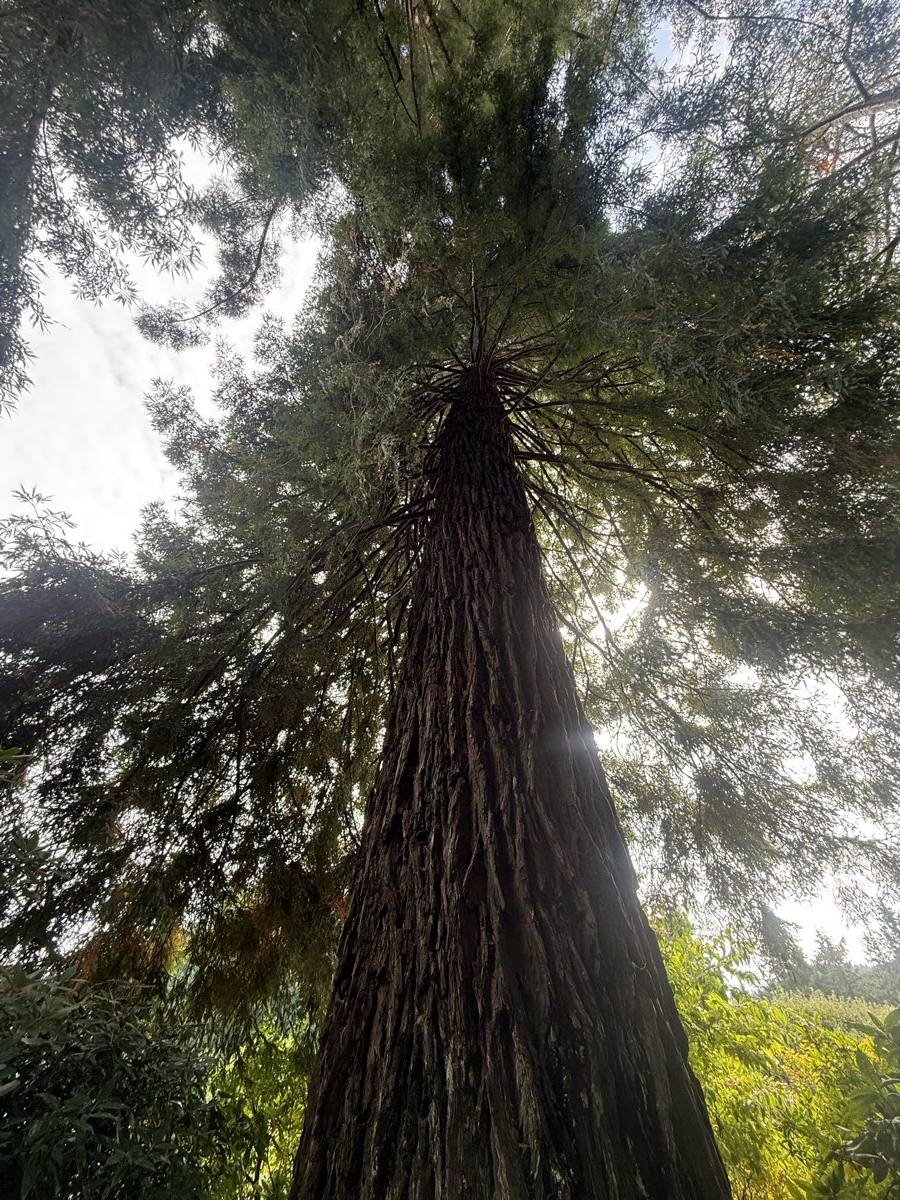
Isaiah's picture is more particular than mine, and the difference is worth a sentence. A young tree standing on an old stump may be a seedling that took root in the decaying wood — foresters call that a nurse stump (National Park Service) — rather than the cut tree sending up a shoot from its own base. What Isaiah promises is the second thing: a shoot out of the same stock and the same roots, Jesse's own line begun again. But the forest says the part that stops you either way: the cutting down was not the end.
The King James word is "stem" — gezaʿ (גֶּזַע), the stock or trunk of a tree. Read after chapter 10 it is plainly a cut-back stock rather than a tree in full leaf, which is why many modern translations print stump. Both are fair renderings of the same noun; the King James keeps the word that simply means the standing stock.
Read chapter 10 first and this lands properly. It ends with the forest felled and Lebanon falling — "he shall cut down the thickets of the forest with iron" (10:34). Everything tall is gone. And chapter 11 opens in that wreckage with a shoot coming out of a stump.
Chapter 6 had already promised exactly this: a tenth and a seed kept back in what was left (6:12–13). The promise was made at Isaiah's call, and here is the growth. (The trees named there, and two other places where scripture leaves something standing, are taken up at the end of this passage.)
And the name is Jesse, not David. Jesse was David's father, from Bethlehem. The name takes the reader back to David's family before he became king. The promise pictures a new beginning for that royal line, like a shoot growing from a cut-back tree.
(Two Hebrew words for the growth: ḥōṭer (חֹטֵר) — a shoot or twig — and nēṣer (נֵצֶר) — a sprout or branch.)
Then comes the kind of king he will be. "He shall not judge after the sight of his eyes, neither reprove after the hearing of his ears" (11:3) — he will not decide a case by how someone looks or by what he has been told about them. Verse 4 says what he judges by instead: righteousness, and particular care for the poor. A ruler who cannot be swayed by appearance or rumour is exactly what a people crushed by unjust courts would most need.
Then the peace itself: the wolf with the lamb, the leopard with the kid, an infant playing over a cobra's hole. Verse 9 gives the reason — "for the earth shall be full of the knowledge of the LORD, as the waters cover the sea." The danger ends because everyone finally knows God, and the whole creation is pictured as settled under the rule described above.
Latter-day Saint Connections
- Elder Russell M. Nelson, "The Gathering of Scattered Israel" (October 2006) is about the gathering this chapter promises, and cites Isaiah 11:11–12 among its supporting references. His framing: "We are part of a great movement—the gathering of scattered Israel," a promise "woven all through the fabric of the scriptures." (churchofjesuschrist.org)
- Moroni quoted this chapter to Joseph Smith on the night of 21 September 1823, "saying that it was about to be fulfilled" (Joseph Smith—History 1:40). Of all the scripture Moroni could have chosen, this is among what he chose.
- Verses 11–12 are central Restoration texts — the Lord setting His hand "the second time" to recover His people, and "an ensign for the nations."
- The Lord answered direct questions about this chapter. D&C 113 is set out as questions and answers on Isaiah 11, and it treats three of the chapter's images separately.
- The Stem of Jesse is Christ (113:2).
- The rod of verse 1 is "a servant in the hands of Christ, who is partly a descendant of Jesse as well as of Ephraim" (113:4).
- The root of Jesse of verse 10 is "a descendant of Jesse, as well as of Joseph, unto whom rightly belongs the priesthood, and the keys of the kingdom, for an ensign, and for the gathering" (113:6).
The revelation is sorting out which image applies to whom. It is not counting how many people the chapter describes.
Paul applies root of Jesse differently, and his subject is Christ. In Romans 15:8–12 he argues that Christ came to confirm the promises made to the fathers and so that the Gentiles might glorify God, and he stacks four scriptures behind that. The last of them is Isaiah 11:10: "There shall be a root of Jesse, and he that shall rise to reign over the Gentiles; in him shall the Gentiles trust" (Romans 15:12). Note the verse number — 11:10, not 11:1. Paul and D&C 113:6 are reading the same phrase and applying it to different figures.
So the same phrase carries more than one application, which in Isaiah is normal rather than contradictory. It is the multiple-fulfilment principle set out in Historical & Cultural Context, section 4, working on a single phrase: Paul applies the root to Christ and the Gentiles, and D&C 113:6 applies it to a servant in the latter-day gathering. Neither reading cancels the other, and neither names the man D&C 113:6 describes.
Keep all of that distinct from the picture itself. What Isaiah drew is a cut stock with a shoot coming out of it — the monarchy felled and begun again from the root. The revelation and the epistle are applications of that image rather than restatements of it, and few Old Testament chapters come with revealed commentary this direct.
- 2 Nephi 21 is Nephi's copy of the whole chapter.
- The cut-back stock is where Isaiah locates hope. Twice now the book has promised that after the felling something is kept: a holy seed in chapter 6, a shoot from Jesse's stump here. In both places what grows back is better than what was cut down.
What is left standing
Isaiah's stump is not an isolated image. Two other passages are worth setting beside it: one because it does the same thing, and one because it shares a word — and the shared word is the more striking of the two.
Isaiah's own chapter 6. When Isaiah asked how long the judgment would run, the answer was emptied cities and "a great forsaking in the midst of the land" (6:12). But it does not stop there. Verse 13 keeps a tenth back and names two trees — a teil tree, which is a terebinth, and an oak — and calls what survives the holy seed. The promise made at his call is the same promise the stump keeps in chapter 11.
Daniel 4. Nebuchadnezzar dreams of a great tree cut down, with an instruction attached: "leave the stump of his roots in the earth" (4:15). Daniel says plainly who the tree is — "It is thou, O king" (4:22) — and why the stump stays: "thy kingdom shall be sure unto thee, after that thou shalt have known that the heavens do rule" (4:26). The stump is the king's own restoration: he looks up and blesses God, his understanding returns, and he is established in his kingdom again (4:34–36). What it shares with Isaiah is the pattern: the tree comes down, and something is deliberately left.
The word that carries Daniel to the cross. This part of Daniel is written in Aramaic, and the verb behind "leave the stump" is shᵊbaq (שְׁבַק) — to leave, to let alone, or as the lexicon puts it, to quit, that is, to allow to remain.
That is the word the Savior used. The Gospels preserve His cry in His own language before translating it: "Eli, Eli, lama sabachthani?" (Matthew 27:46). Sabachthani is that same Aramaic verb carrying an ending that means "me" — thou hast left me. Matthew and Mark then tell their readers what it means, and the word they choose is forsaken (Mark 15:34). That translation stands, and the anguish in it is real.
Two languages are in play, and it helps to keep them apart: Psalm 22 uses the Hebrew verb ʿāzaḇ (עָזַב), to forsake — the root behind ʿăzûḇâ (עֲזוּבָה), the "forsaking" of Isaiah 6:12 — while Daniel and the cry from the cross use the Aramaic shᵊbaq. And the stump survives in Daniel 4 because the sentence says to leave it there, not because the verb is hiding a second meaning.
The comparison this study would draw. In Daniel, being left is not the end: the stump remains in the ground as a sign that the king's rule will be restored. The psalm the Savior quoted does not end at the cry either. It turns to "when he cried unto him, he heard" (22:24), widens to "all the kindreds of the nations" (22:27), and closes with "a seed shall serve him" — a generation not yet born who will be told "that he hath done this" (22:30–31).
Christ was not spared the forsaking. He was not ended by it either, and what grew out of it is a people who get told what God has done — echoing Isaiah's hope of life continuing beyond judgment. That is a comparison we are drawing here, not proof from a shared word that Daniel was predicting the Crucifixion; the study-library article The Savior's Sermon From the Cross follows the same thread at length.
One note on olives, since the image often gets attached here. Olive trees do regrow after their tops are killed; after a severe freeze an olive sends up new growth from the base (University of California Cooperative Extension). But that regrowth comes from living roots — a wholly dead tree does not sprout. What looks lifeless above ground need not be lifeless below it, and that is the entire comparison. Olives are long-lived, commonly for centuries, and radiocarbon work on the oldest individuals has produced estimates passing a thousand years; but a large hollow trunk cannot by itself certify an age, and no living tree should be identified with one Isaiah or the Gospels mention.
Whether we are looking at an olive, an oak, an almond branch, or a conifer, trees can help us reflect on life, loss, and renewal. In Christian reflection, the wood of the cross and the branching menorah can also direct our thoughts to Jesus Christ and the life and light He offers.
Study Questions
- The shoot comes out of a stump, not a healthy tree. Where in your life is there a stump you have written off?
- He judges neither by appearance nor by report. How much of your own judgement of others runs on exactly those two?
- Isaiah connects the promised peace with "the knowledge of the LORD." How can knowing the Lord change the way we treat one another?
The Text
"Behold, God is my salvation; I will trust, and not be afraid: for the LORD JEHOVAH is my strength and my song; he also is become my salvation.
Therefore with joy shall ye draw water out of the wells of salvation."
How the Passage Works
After eleven chapters of courtroom, vineyard, coal, empire and stump, chapter 12 is a song of thanksgiving. Its subject is stated in the first verse: God's anger has given way to comfort. "Though thou wast angry with me, thine anger is turned away, and thou comfortedst me." What follows is a people trusting Him and saying so out loud — I will trust, and not be afraid… he also is become my salvation — and then calling on everyone else to join in.
The song moves outward as it goes. Verses 1–2 are in the singular, I will praise thee; from verse 3 it is plural, ye shall draw water, and by verse 6 it addresses Zion as a whole. (The singular forms do not by themselves settle how many speakers are meant — verse 6 uses a singular thou of the whole city.)
And the refrain finally turns. Through chapters 5, 9 and 10 the line was "his anger is not turned away." Chapter 12 opens: "though thou wast angry with me, thine anger is turned away" (12:1). The sentence that would not resolve, resolves.
The root under the word
"God is my salvation" — the word behind my salvation is yᵊšûʿâ — appearing in the verse as yᵊšûʿāṯî (יְשׁוּעָתִי), the noun with a possessive ending, and again as lîšûʿâ (לִישׁוּעָה), and Isaiah uses it twice in this one verse.
The week's title verse says God is my salvation, and the name Jesus is built from that same root. The sentence then says it again: "he also is become my salvation." This is a connection rather than a translation: yᵊšûʿâ (יְשׁוּעָה) is the noun salvation, and Yēšûaʿ is a personal name formed from the same root. Isaiah is not writing the name. The two forms he actually uses here, and why neither is spelled like the dictionary word, are set out in Word Studies, study 5.
Verse 3 then turns it into an action: "with joy shall ye draw water out of the wells of salvation" — wells of yᵊšûʿâ (יְשׁוּעָה). Not a cistern you fill; a well you draw from, repeatedly, as often as you are thirsty.
Latter-day Saint Connections
- Jewish tradition attached verse 3 to the water-drawing rite at the Feast of Tabernacles — the feast at which Jesus stood and cried "If any man thirst, let him come unto me, and drink" (John 7:37), using this verse's own image of Himself. The ceremony itself is described in Historical & Cultural Context, section 5.
- 2 Nephi 22 is Nephi's copy of this chapter — six verses he thought worth the plates.
- The arc of the twelve chapters closes here — see the Overview's Central Insight for the distance it has travelled.
Study Questions
- The song puts thanksgiving into the first person: God is my salvation; I will trust, and not be afraid. Think of something you are facing right now. What would trusting the Lord actually look like in it this week?
- A well is something you go back to, not a container you fill once. What did you draw on this week that you will need to draw on again?
- Three times in chapter 9 the anger "is not turned away"; in 12:1 it finally is, and the people say so. What would it take for you to trust that God is not finished being good to you?
Continue to Word Studies.
4. Week 38: Word Studies
Five words carry this week. One of them is the reason chapter 6 is the centre of the book, one is said of God three times over — in Isaiah's vision and again in John's — and one shares its root with the name of Jesus.
The tables. Each study ends with a Cross-Language Connections table following the word through four languages. You need not read any of them — the point is to watch what each translation understood the Hebrew to mean.
| Row | What it is |
|---|---|
| Hebrew | The original. The number (H3722) is its Strong's number, a standard index to every word in the Hebrew Bible, so you can look one up without knowing the alphabet. |
| Greek (LXX) | The Septuagint, the Greek translation made about two centuries before Christ. LXX is its abbreviation — the Roman numeral seventy. This is the version most often quoted in the New Testament. |
| Latin | The Vulgate, Jerome's Latin Bible. Here for etymology — usually the road by which a Hebrew idea reached English — not as an authority on meaning. |
| English | Where our word came from, and what it used to mean. |
Isaiah 6:7 — "and thine iniquity is taken away, and thy sin purged"
וְסָר עֲוֺנֶךָ וְחַטָּאתְךָ תְּכֻפָּר
This is the most important word in the week, and it is worth taking in three steps.
First, what the word means. Purge is not a wrong translation — it carries a moral sense in English, and the King James uses it that way. The Hebrew is kāp̄ar (כָּפַר), whose range runs from to cover to to wipe away to to make atonement (BDB). What it adds to the English is not a hidden transaction but a setting: this is the vocabulary of the sanctuary and the sin offering, not of laundry.
Second, where the scene puts it. The coal that touches Isaiah's mouth is taken "from off the altar" — the place of sacrifice. The word and the furniture agree, and neither of them, on its own, names a price or a payer.
Third, what Latter-day Saints understand is behind it, which is a matter of doctrine rather than of lexicon: the altar pointed to the Atonement of Jesus Christ, and He is the one who paid. The Hebrew does not say so. Leviticus, and then the New Testament, do.
It is the verb behind "make an atonement" throughout Leviticus, and the noun from its root gives Yom Kippur, the Day of Atonement (Leviticus 16) — the holiest day in the Jewish year, the one day the high priest entered the Holy of Holies. When a seraph tells Isaiah his sin is purged, the word is the one Israel's entire sacrificial system is named after.
And the grammar is the sermon
The form is tᵊḵuppār (תְּכֻפָּר). Hebrew changes the shape of a verb to show who is acting and who is being acted upon, and this shape puts Isaiah on the receiving end. Grammarians call the form the Pual; the name matters far less than what it does. Not he purged his sin. His sin is atoned for — done to him, by someone else.
The scene says the same thing the grammar does. Isaiah confesses and does nothing else; the coal is brought to him from the altar by another, and only after that is he asked to go — the sequence is walked through in Key Passages, passage 4. What the word adds is that the grammar itself is passive: the text does not merely show him being cleansed, it says so in the shape of the verb.
The Greek translators heard it too. The Septuagint renders it περικαθαριεῖ — "shall cleanse thoroughly" — built on the root behind katharizō, the New Testament's word for cleansing from sin, and the root English took for catharsis.
Cross-Language Connections
| Language | Term | Source |
|---|---|---|
| Hebrew | kāp̄ar (כָּפַר) — to cover, to make atonement, to purge; the verb of Leviticus and the root of Yom Kippur. Here in the Pual: it is atoned for | BLB H3722 |
| Greek (LXX) | περικαθαριεῖ (perikathariei) — shall cleanse thoroughly; from the root of katharizō (καθαρίζω), the NT's verb for cleansing from sin | BLB G2511 |
| Latin | mundābitur — "shall be cleansed," from mundāre, to make clean; from mundus, clean | Logeion: mundo |
| English | purge — from Latin pūrgāre, to cleanse; in English from the 14th century. Both words reach the moral sense; the Latin and English line comes by way of cleansing, while the Hebrew comes by way of covering and atonement | Merriam-Webster · Etymonline · Webster's 1828 |
Isaiah 6:3 — "Holy, holy, holy, is the LORD of hosts"
קָדוֹשׁ קָדוֹשׁ קָדוֹשׁ יְהוָה צְבָאוֹת
Hebrew does have a word for very — mᵊʾōḏ (מְאֹד), the word in "and God saw every thing that he had made, and, behold, it was very good" (Genesis 1:31). But repetition is its other way of intensifying. It is not the same device as "holy of holies" or "song of songs" — those pair a word with its own plural to mean the most of something — the holiest of all holy places, the greatest of all songs. Saying the word itself again is the blunter instrument, and in Isaiah 6:3 the word comes three times over.
So doubling is emphatic. Tripling is rarer still.
The seraphim do not say God is very holy. They say the word three times — and what shakes is the building.
And qāḏôš is not simply a stronger word for "good." The root carries set apart, separate, other, and it is the vocabulary of the sanctuary — what may approach and what may not. God's goodness is never in question in this scene; what the seraphim are naming is His otherness, three times, and the doorposts shake.
Which is exactly why Isaiah's next word is "Woe." He has heard what God is, and he knows what he is. The confession in verse 5 is caused by the song in verse 3.
And the acclamation does not stay in this chapter. When John is shown a throne in Revelation 4:8, the four living creatures around it — "the four beasts," as the King James has it — are saying the same thing: "Holy, holy, holy, Lord God Almighty." Two visions of one throne, centuries apart, and the words match.
The Greek keeps the triple — Ἅγιος ἅγιος ἅγιος — and the Latin gives Western Christianity the Sanctus, sung in the communion service of most historic churches. Between the Sanctus and the Kedushah, the words Isaiah heard in the temple are said aloud today in congregations of both traditions — see Historical & Cultural Context, section 5.
Cross-Language Connections
| Language | Term | Source |
|---|---|---|
| Hebrew | qāḏôš (קָדוֹשׁ) — holy, set apart, separate; from q-d-sh, to be distinct from the common | BLB H6918 |
| Greek (LXX) | ἅγιος ἅγιος ἅγιος (hagios) — holy; the triple preserved. The NT's word for saints is its plural | BLB G40 |
| Latin | sanctus, sanctus, sanctus — from sancīre, to consecrate; the name of the liturgical Sanctus | Logeion: sanctus |
| English | holy — not from Latin at all, but Old English hālig, from the same root as whole and hale. English holy certainly means sacred and set apart today; what the etymology shows is that it arrived at that sense from a different direction — wholeness rather than separation | Merriam-Webster · Etymonline · Webster's 1828 |
Isaiah 5:7 — "he looked for judgment, but behold oppression; for righteousness, but behold a cry"
וַיְקַו לְמִשְׁפָּט וְהִנֵּה מִשְׂפָּח לִצְדָקָה וְהִנֵּה צְעָקָה
This is some of the sharpest wordplay in the Old Testament, and the King James does not carry it — nor do the versions compared below.
| He looked for | and got | |
|---|---|---|
| first pair | mišpāṭ (מִשְׁפָּט) — judgement | miśpāḥ (מִשְׂפָּח) — bloodshed |
| second pair | ṣᵊḏāqâ (צְדָקָה) — righteousness | ṣᵊʿāqâ (צְעָקָה) — a cry |
Hebrew was written with consonants only; the dots and dashes that mark the vowels — the pointing — were added by scribes much later. Strip them off, and each pair differs by exactly one written letter:
| consonants only | the letter that changes | |
|---|---|---|
| first pair | מ־ש־פ־ט → מ־ש־פ־ח | final ט (ṭet) becomes ח (ḥet) |
| second pair | צ־ד־ק־ה → צ־ע־ק־ה | second ד (dalet) becomes ע (ʿayin) |
The distance between what God planted the vineyard for and what it produced is one written letter wide, twice.
One honest qualification, because the eye and the ear do not agree here. In the first pair the letter ש is also read differently — sh in mišpāṭ, s in miśpāḥ — and that difference is carried by a dot which is itself part of the later pointing. So "one letter apart" is a count of what is written, not of what is heard — spoken aloud, the first pair differs twice over. The pun lands either way; it is the writing that is one letter wide. And the two results belong together: the first pair names the violence, the second names the sound it forces out of people. Bloodshed, and then the cry that follows it.
Mišpāṭ is more than courtroom procedure. It certainly covers deciding a case and the business of a court — that sense is right there in the lexicon — but it reaches past them to the whole activity of setting things right — what a good king does, what a good judge does, what God does. Paired with ṣᵊḏāqâ, righteousness, it is Israel's shorthand for a society working as it should.
And the pair is a thread you can follow through the whole week
These two words appear together four times in Isaiah 1–12, and they tell a story in order:
| 1:27 | Zion shall be redeemed with them |
| 5:7 | the vineyard was looked to for them and produced neither |
| 5:16 | God is sanctified in them |
| 9:7 | the Child's throne is established with them |
What Israel failed to grow is what the Messiah brings. The failure named in chapter 5 is answered, by the same two words, in chapter 9.
The Greek loses the pun and keeps the sense — κρίσιν (krisis, κρίσις), judgement, and δικαιοσύνην (dikaiosynē, δικαιοσύνη), righteousness, for what was looked for; ἀνομίαν (anomia, ἀνομία), lawlessness, and κραυγήν (kraugē, κραυγή), a cry, for what came instead.
Cross-Language Connections
| Language | Term | Source |
|---|---|---|
| Hebrew | mišpāṭ (מִשְׁפָּט) — judgement, justice, the setting-right of things; against miśpāḥ (מִשְׂפָּח), bloodshed | BLB H4941 |
| Greek (LXX) | κρίσις (krisis) — judgement, decision; the lexicon notes it renders mišpāṭ (מִשְׁפָּט) chiefly. English crisis is the same word | BLB G2920 |
| Latin | jūdicium — judgement, from jūdex, a judge (jūs + dīcere, to speak the law) | Logeion: judicium |
| English | judgement — from Old French jugement, from Latin jūdicāre. English keeps the wider senses too — forming an opinion, the capacity to judge well — but in ordinary use it leans toward the verdict, where the Hebrew leans toward the whole work of putting things right | Merriam-Webster · Etymonline · Webster's 1828 |
Isaiah 11:1 — "And there shall come forth a rod out of the stem of Jesse"
וְיָצָא חֹטֶר מִגֵּזַע יִשָׁי
"Stem" in modern English suggests a healthy plant. The Hebrew gezaʿ (גֶּזַע) means the stock or trunk of a tree — the standing part, whether or not anything has been cut from it.
The word matters because of where the verse sits. Chapter 10 has just felled the forest — "Lebanon shall fall by a mighty one" (10:34) — and chapter 6 had already promised that the felled tree would keep "the holy seed" in it (6:13). So 11:1 opens in wreckage, with something growing out of what was cut; and the name it grows from is Jesse, the farmer, not David, the king. Key Passages, passage 7 walks that sequence. The felling comes from the surrounding chapters rather than from this noun — which is why many modern translations print stump here, and why the King James stem is equally fair.
(The verse carries four plant words, not one: ḥōṭer (חֹטֵר), a shoot or twig, comes out of the gezaʿ; and nēṣer (נֵצֶר), a sprout, grows from šōreš (שֹׁרֶשׁ) — his roots. The second half of the verse says it again in different words.)
Cross-Language Connections
| Language | Term | Source |
|---|---|---|
| Hebrew | gezaʿ (גֶּזַע) — stem, trunk, stock of a tree; in Isaiah 11:1, read after the felling of chapter 10, a cut-back stock | BLB H1503 |
| Greek (LXX) | ῥίζα (rhiza) — root. The Hebrew is not short of a word for root — šōreš (שֹׁרֶשׁ) stands in the second half of this same verse. What the Greek does is use the one word rhiza for both, so gezaʿ, the felled stump, and šōreš, the living roots, arrive in Greek as the same image and the cut tree stops being visible at 11:1 | BLB G4491 · H8328 |
| Latin | rādīx — root; and virga, a rod or shoot. From rādīx English takes radical — literally of the root | Logeion: radix |
| English | stem — Old English stemn, the trunk of a tree. A fair translation of the wood and a poor one of the situation: our word does not say the tree was cut | Merriam-Webster · Etymonline · Webster's 1828 |
Isaiah 12:2 — "Behold, God is my salvation… he also is become my salvation"
הִנֵּה אֵל יְשׁוּעָתִי אֶבְטַח וְלֹא אֶפְחָד
The week takes its title from this verse, and the title shares its root with the name of Jesus.
Yᵊšûʿâ (יְשׁוּעָה) means salvation, deliverance, rescue — and the name Yēšûaʿ, which is what Mary and Joseph would have called Him, is built on the same saving root. Not on this noun: both the noun and the name stand on the verb, as the paragraphs below set out. The angel's instruction in Matthew 1:21 spells the connection out: "thou shalt call his name JESUS: for he shall save his people from their sins."
And the prophet had been carrying the same root the whole time. Isaiah is Yᵊšaʿyāhû (יְשַׁעְיָהוּ) — the LORD saves — built on the verb yāšaʿ (יָשַׁע), to save, to deliver, which is the root standing behind yᵊšûʿâ as well. The man announcing that God is salvation was named for it.
So Isaiah 12:2 says God is my salvation — and the name Jesus is formed from that same root. Isaiah says it twice in the one verse, in two different forms — yᵊšûʿāṯî (יְשׁוּעָתִי), "my salvation," with the possessive ending; and lîšûʿâ (לִישׁוּעָה), "unto salvation," with a prefix. The dictionary form is yᵊšûʿâ (יְשׁוּעָה); neither word in the verse is spelled that way. Keep the two apart: yᵊšûʿâ (יְשׁוּעָה) is the common noun; Yēšûaʿ is the name. The link is real and it is etymological, not a rendering of the verse.
And this is the word's third appearance in two verses. Twice in verse 2 — yᵊšûʿāṯî and lîšûʿâ — and then, in verse 3, as the name of the wells: "draw water out of the wells of salvation," yᵊšûʿâ (יְשׁוּעָה) again. Isaiah says the word three times in three lines, and on the third he makes it a place you can go. (What that image asks of a reader is taken up in Key Passages, passage 8.)
And it is the last word of the week's argument. The book opened with God saying He would not hear their prayers (1:15). It ends this section with a song He gives them to sing.
Cross-Language Connections
| Language | Term | Source |
|---|---|---|
| Hebrew | yᵊšûʿâ (יְשׁוּעָה) — salvation, deliverance; shares the verbal root yāšaʿ (H3467) with the name Yēšûaʿ, Jesus | BLB H3444 |
| Greek (LXX) | σωτηρία (sōtēria) and σωτήρ (sōtēr), saviour. The lexicon notes sōtēria renders yᵊšûʿâ (יְשׁוּעָה). English takes soteriology from it | BLB G4991 |
| Latin | salvātor and salūtem — saviour, salvation; from salvus, safe, whole | Logeion: salus |
| English | salvation — from Latin salvātiō; in English from the 13th century. Related to salute, salubrious and safe — all of them about being made whole | Merriam-Webster · Etymonline · Webster's 1828 |
Set them next to each other and they are not five separate curiosities.
Purged is the atonement word — the thing done to Isaiah that he could not do for himself. Holy is what God is, and what Isaiah did not expect to survive standing near. Judgement is what God looked for and did not find. A stock is the image Isaiah uses for David's house after the felling — and what the image depicts is a separate question from how it is applied, which D&C 113 and Romans 15 each take up in their own way; see Key Passages, passage 7. And salvation is the last word of the twelve chapters — "Behold, God is my salvation" — built on the same root as the name that would be given to a child seven centuries later.
That is not five word studies. It is one argument in five parts — and read together, Latter-day Saints will recognise whom it is about. The atonement word, the cleansing brought from the altar, and the salvation the last word names all point to Jesus Christ. That is a Christian reading of the five words, not a definition any of them carries on its own — the lexicon gives the meanings; the gospel supplies the name.
A word study is only worth the time if it sends you back to the verse. So take the one that struck you and go read it in place — Isaiah 6:7, or 11:1, or 12:2 — and see whether it reads differently now. It should. That is the whole point of learning what a word carried before the translators had to choose one English word for it.
Continue to Jewish Perspective.
5. Week 38: Jewish Perspective
What follows comes from rabbinic sources — the recorded discussions of Jewish teachers, written down between roughly the second and sixth centuries. Two collections appear below:
- The Talmud — the long record of debate. A citation like "Berakhot 4b" names the tractate (Berakhot, on blessings), the folio, and which side of the page. Every one links to Sefaria.
- Targum Jonathan — an ancient Aramaic translation-with-commentary of the prophets, read alongside the Hebrew in synagogues when Aramaic, not Hebrew, was the everyday language. Where it paraphrases rather than translates, it is telling you how these verses were being understood.
How these chapters are prayed — Shabbat Ḥazon, the Kedushah, the Sukkot water-drawing — is in Historical & Cultural Context, section 5, not here.
None of this is Latter-day Saint doctrine, and none of it is offered as a practice to adopt. It is here because Isaiah 1–12 is a text these readers lived inside for centuries, and they noticed things in it that we walk past. Where a reading is close to ours, that is worth seeing. Where it is not, that is worth seeing too.
Isaiah 6:6 says "then flew one of the seraphims unto me, having a live coal in his hand." A reader in a hurry reads "one of the seraphim" as some seraph. The rabbis read it as the one.
The Talmud works by a method called gezerah shavah (גְּזֵרָה שָׁוָה) — a verbal analogy. It is the name of a rabbinic method of interpretation rather than a biblical word, so it has no Strong's entry; you can watch it done in the Berakhot 4b passage quoted below, which says so in its own words — "derived through a verbal analogy between the words one and one." The same unusual word in two places is treated as linking them. Here the word is "one":
"Rabbi Elazar bar Avina said: What was said about the angel Michael is greater than what was said about the angel Gabriel. As about Michael, it is written: 'And one of the seraphim flew to me' (Isaiah 6:6)… Rabbi Yoḥanan said: This is derived through a verbal analogy between the words one and one. Here, it is written: 'And one of the seraphim flew to me,' and there, it is written: 'And behold, Michael, one of the chief ministers of the king, came to my aid' (Daniel 10:13)."
— Berakhot 4b, William Davidson Edition (Sefaria)
And the point they draw from it is about speed. Michael arrives in a single flight; Gabriel, in Daniel 9:21, is "caused to fly swiftly" — a doubled phrase the rabbis read as two flights. The seraph who carried fire to Isaiah's mouth did not take a second passage.
Latter-day Saint Connection
This lands somewhere a Latter-day Saint reader will not expect. In our scripture Michael is not an unfamiliar name:
"And also with Michael, or Adam, the father of all, the prince of all, the ancient of days"
We identify Michael as Adam. What that verse does not do is identify Michael as the seraph of Isaiah 6. No Latter-day Saint scripture makes that connection. Setting the two beside each other is this lesson's comparison, not a revealed identification — and it would be wrong to leave a reader thinking otherwise.
What is worth noticing is narrower, and it is about method. "One of the seraphim" is all the text says. The rabbis treated that indefiniteness as a question rather than a detail to skim, and followed a word — one — to an answer. Whether or not their answer is right, the habit of stopping at the odd word is the one thing here worth taking home.
"Though your sins be as scarlet, they shall be as white as snow" is quoted at Latter-day Saints constantly, and almost always as a lovely image. In Jewish tradition it became the proof text for a sign people are remembered as watching for once a year.
On Yom Kippur, the Day of Atonement, a strip of crimson wool was tied up while the scapegoat was led into the wilderness. If it turned white, the sacrifice was known to have been accepted.
Two things to keep straight before reading the passage. Leviticus 16 gives the Day of Atonement and the scapegoat, but it says nothing about a crimson thread — that belongs to the later tradition, not to the commandment. And the Talmud is a record about the Temple period rather than a report by people who were there: it was compiled generations after the Temple was destroyed. What follows is the tradition's own account of its past, which is worth reading closely and worth labelling honestly.
"At first they would tie this strip of crimson to the opening of the Entrance Hall of the Temple on the outside. If the strip turned white they would rejoice, as this indicated that their sins had been atoned for. If it did not turn white they would be sad and ashamed. When the Sages saw that people were overly distressed on Yom Kippur, they established that they should tie the strip of crimson to the opening of the Entrance Hall on the inside, since only a few could actually go in to see it. And they would still peek and see… Therefore, the Sages established that they should tie half of the strip to the rock and half of it between the goat's horns, so that the people would not know what happened to the strip until after the conclusion of Yom Kippur."
— Yoma 67a, William Davidson Edition (Sefaria)
Read what is happening there. The sign was public, and they had to keep hiding it — not because it stopped working, but because watching it was unbearable. Moved inside, and people peeked. Split between a rock and a goat, so nobody could know until the day was over.
A separate teaching in the same passage attaches Isaiah 1:18 to it directly. Rabbi Naḥum bar Pappa, in the name of Rabbi Elazar HaKappar:
"At first they would tie the strip of crimson to the opening of the Entrance Hall of the Temple on the inside, and when the goat reached the wilderness, the strip of crimson would turn white, and they knew that the mitzva was fulfilled. The verse alludes to the use of the strip of crimson, as it is stated: 'Though your sins be as scarlet, they will become white as snow'…"
— Yoma 67a, William Davidson Edition (Sefaria)
So the most-quoted comfort verse in Isaiah was, in the temple, the caption for a piece of wool people could not stop looking at.
And the two halves of this week's vocabulary meet here. The word behind "thy sin purged" in Isaiah 6:7 is kāp̄ar (כָּפַר) — the root behind Kippur (כִּפּוּר), the very day this thread was watched. See Word Studies, Word Study 1.
Latter-day Saint Connection
Leviticus 16 is ours too, and we read the scapegoat as pointing to Christ — the one who carries sin away from the camp.
But the detail worth taking is the anxiety, not the spectacle. These were people who had done the ordinance correctly and still stood outside straining to see whether it had been accepted — and who could not be talked out of looking. The Sages' solution was not to reassure them. It was to take the sign away.
We are given the opposite arrangement, and it is worth noticing how different it is. The sacrament is administered every week, in front of the congregation, with the promise attached in plain words — "that they may always have his Spirit to be with them" (D&C 20:77). Nothing has to turn white. The assurance is not withheld until the day is over, and it does not depend on a sign anyone has to crane to see.
Isaiah 6:3 is carried inside the Kedushah (קְדֻשָּׁה), the sanctification said standing when a Jewish congregation prays together, and inside the Sanctus of Christian liturgy. But the Talmud asks a stranger question: how many angels are speaking?
"Rav Ḥananel said that Rav said: Three groups of ministering angels recite a song every day… one says: 'Holy,' and another one says: 'Holy,' and another one says: 'Holy is the Lord of hosts…'"
— Chullin 91b, William Davidson Edition (Sefaria)
Not one choir repeating a word three times. Three groups, each given one.
And then the discussion takes that answer apart — which is worth watching, because it shows how the Talmud actually works. An objection is raised from another teaching: the angels "mention the name of God only after three words." But on the version just given, the third group says "Holy" once and then goes straight to the Name. The two statements cannot both stand.
So the passage corrects itself:
"Rather, Rav said that one group of ministering angels says: 'Holy,' and another one says: 'Holy, holy,' and another one says: 'Holy, holy, holy is the Lord of hosts.'" — ibid.
The revised picture is cumulative rather than divided. Each group takes up the cry and carries it further, and only the third reaches the Name — which is what the objection required. The first version is where the discussion starts; this is where it ends, and a reader meeting only the opening statement would be holding the part the Talmud itself set aside.
Now the comparison the passage is building toward:
"The Jewish people are more dear to the Holy One, Blessed be He, than the ministering angels, as the Jewish people may recite a song of praise to God at any time, but ministering angels recite a song of praise only one time per day…"
"And furthermore, the Jewish people mention the name of God after two words, as it is stated: 'Hear, Israel: The Lord our God, the Lord is one' (Deuteronomy 6:4). But the ministering angels mention the name of God only after three words… 'Holy, holy, holy is the Lord of hosts…'"
— ibid., Chullin 91b, William Davidson Edition (Sefaria)
Read that slowly. They have counted the words before the divine name in each — two for Israel, three for the seraphim — and concluded that human beings get to God's name faster than angels do.
Latter-day Saint Connection
This is not our doctrine and we should not pretend it is. But the instinct behind it — that human beings stand somewhere particular in God's regard — is one Latter-day Saints will recognise.
And it is worth being exact about what the passage does and does not claim, because the easy version of this comparison is wrong in both directions.
The rabbis are not saying the angels are outsiders to God's family. The same discussion cites Job 38:7 and reads "all the sons of God shouted for joy" as the angels — it calls them sons of God in the course of making its point. What it ranks is access and order: who may praise at any hour, and who reaches the divine Name first. It is an argument about nearness in worship, not about parentage.
Our scripture adds something to that picture rather than refuting it:
"there are no angels who minister to this earth but those who do belong or have belonged to it"
So the ministering angels are not a separate order of being at all — they belong to this earth, as we do. That does not settle the rabbis' question, and it need not: shared origin does not by itself mean identical roles, and the passage's interest was always in who stands where in the act of praise. What the Restoration adds is that the distance being measured is smaller than it looks.
And there is something worth keeping in their arithmetic anyway. The angels sing once a day and we may sing at any time. The privilege they are describing is access — and access is precisely what Isaiah 6 is about. A man with unclean lips is brought into the throne room, cleansed, and allowed to speak.
This is the most remarkable passage in this week's rabbinic material, because the verse is not being admired — it is being used.
Isaiah 11:2–3 says the Spirit will rest on the coming King. Then comes the phrase everything here turns on. The King James renders 11:3 "And shall make him of quick understanding in the fear of the LORD: and he shall not judge after the sight of his eyes, neither reprove after the hearing of his ears."
"Quick understanding" is the translators' rendering of a Hebrew word built on the root for smelling — the verb behind scent or catch the scent of. The King James takes it as a figure for rapid perception. One rabbi took it literally instead:
"Rava says that hariḥo teaches that the Messiah will smell and then judge on that basis, sensing who is right, as it is written: 'And he shall neither judge after the sight of his eyes, nor decide after the hearing of his ears.'" — Sanhedrin 93b, William Davidson Edition (Sefaria)
Then the passage tells what it says happened when someone claimed the title. Bar Kozeva — Bar Kokhba, who led the revolt against Rome in AD 132 —
"Bar Koziva, i.e., bar Kokheva, ruled for two and a half years. He said to the Sages: I am the Messiah. They said to him: With regard to the Messiah it is written that he is able to smell and judge, so let us see ourselves whether he, bar Kokheva, is able to smell and judge. Once they saw that he was not able to smell and judge, the gentiles killed him."
— Sanhedrin 93b, William Davidson Edition (Sefaria)
In this account they apply a verse from this week's chapter as a functional test. Read it as what it is: a rabbinic narrative written down long after the revolt, not an independently established record of how Bar Kokhba died — the historical circumstances of his death are not settled by this passage. What it does show, and shows plainly, is that for the teachers preserving it Isaiah 11 was a specification rather than a decoration.
Latter-day Saint Connection
We have a revealed answer to a question about this exact chapter, and it is unusually direct. Section 113 of the Doctrine and Covenants is framed as questions and answers on Isaiah 11:
"WHO is the Stem of Jesse spoken of in the 1st, 2d, 3d, 4th, and 5th verses of the 11th chapter of Isaiah? Verily thus saith the Lord: It is Christ."
The rabbis built a test from verse 3 and applied it to a claimant. We are simply told who the chapter is about. Both are taking the same verses with complete seriousness; the difference is that one tradition is still asking and the other has been answered.
And it is worth sitting with what the test was actually measuring. Not eloquence, not victory, not popularity — whether a man could judge without relying on what he saw and heard. That is a strange standard, and it is the one Isaiah set. The Savior met it in a way no one anticipated: not by a heightened sense, but by knowing what was in a man without being told (John 2:25).
There is a body of material this section has not used yet, and on one verse it is remarkable.
A targum is an Aramaic translation of the Hebrew scriptures, made for congregations who had stopped speaking Hebrew day to day. It was read aloud in synagogue beside the Hebrew. But a targum is rarely word-for-word — it paraphrases, and where it paraphrases you can see what the translator thought the verse meant. The one on the prophets is called Targum Jonathan, and its material is old, though how old is debated.
Here is its rendering of the verse we know as Isaiah 9:6. (A note before you look it up: in Hebrew Bibles and in the targum this is chapter 9, verse 5 — the numbering runs one behind the King James through this chapter.)
"The prophet said to the house of David, For unto us a child is born, unto us a son is given, and he has taken the law upon himself to keep it. His name is called from before Him who is wonderful in counsel, the mighty God who liveth to eternity — the Messiah whose peace shall be great upon us in his days."
Two things are happening at once, and it would be dishonest to report only one of them.
First: it names him the Messiah, outright. This is a Jewish text, translating for a Jewish congregation, and it reads the child of Isaiah 9 as the promised deliverer. That is a point of contact and it is worth knowing — the messianic reading of this verse is not a Christian invention imposed on the text from outside.
Second: it moves the great titles. In the King James the names land on the child — Wonderful, Counsellor, The mighty God, The everlasting Father, The Prince of Peace. In the targum, "wonderful in counsel" and "the mighty God who liveth to eternity" describe the One doing the naming, and what belongs to the Messiah is the peace. The Hebrew can be read either way; the translator chose.
We read it the other way, and we should say so plainly rather than pretending the difference is not there. Latter-day Saints, with the whole New Testament and the Restoration behind us, take the names as the child's own. A reader in a synagogue hearing this targum would not have. Both are readings of a genuinely compressed Hebrew line, and the disagreement is old, real, and not resolved by insisting.
Latter-day Saint Connection
Nephi adds a witness of his own — not because the interpreters above failed to ask what Isaiah was for, but because Nephi answers with something he had seen.
"my soul delighteth in the words of Isaiah, for I came out from Jerusalem, and mine eyes hath beheld the things of the Jews, and I know that the Jews do understand the things of the prophets."
Read that sentence slowly, because it is generous in a way we do not always notice. Nephi says the Jews understand the prophets — and he says it while going on to give a reading of Isaiah that is explicitly about Christ. He does not have to take the understanding away from them in order to have his own.
That is the posture this whole section is written in. The targum is not our reading. It is a window into how these words sounded to people who had them first, in a language closer to the one they were spoken in — and on this verse it turns out they were waiting for a Messiah too.
One last observation, and it is about method rather than any single verse.
Every passage above takes a phrase easily read past — "one of the seraphim," "as scarlet," "holy, holy, holy," a peculiar verb in 11:3 — and refuses to let it be decoration. The assumption underneath is that nothing in the text is accidental, so an odd word is a question rather than a stylistic flourish.
That assumption produced some readings we would not make. Counting the words before the divine name is not how we would establish anything. But it also produced the observation that the coal came in one flight, that a congregation watching for a sign of forgiveness could not be talked out of looking for it, and that a messianic claim could be tested against a verse rather than a mood.
Latter-day Saint Connection
The Savior gave us the same instruction about the same prophet, and He was emphatic:
"And now, behold, I say unto you, that ye ought to search these things. Yea, a commandment I give unto you that ye search these things diligently; for great are the words of Isaiah."
Search is not read. It is the word for going through something carefully, looking for what is there. The rabbis' habit of treating an odd word as a question is, whatever else one thinks of their conclusions, exactly the posture He asked for — and it is available to any reader with a Bible open and a willingness to slow down at the strange parts.
Continue to Teaching Applications.
6. Week 38: Teaching Applications
Seven settings, and you will not use them all. Take the one you are actually teaching in. Each gives you a way in, the passage it rests on, and something a class can do rather than only hear.
The spine of the week, in one line, because every application below leans on it: the accusation in Isaiah runs the whole width of chapters 1–12 and does not stop at chapter 6. As the book is arranged, what changes at the call is not the message but how we see the messenger — after five chapters of woe pronounced outward, the prophet says woe over himself, is cleansed by a coal he did not fetch, and is sent back to the same people. The King James prints one English word where the Hebrew has two, and which one stands at 6:5 is the discovery below.
Start with the coal, not the throne. Children remember fire and tongs.
Read Isaiah 6:5–8 aloud and stop after verse 5. Ask: what do you think happens next? If the guesses run to God reassuring Isaiah, or sending him away, neither is what the text does. Somebody brings him something.
- For younger children: Isaiah said the true thing about himself, and then help came to him. He didn't have to go get it.
- For older children: the coal comes from the altar — the place where sacrifices were offered. Ask them why that detail is in the verse. It is the whole answer.
A family activity. Give everyone a slip of paper and have them write, privately, one thing they wish were made right — not to be read aloud, not collected, not shown to anyone. Then have someone read Isaiah 6:6–7 while everyone holds their own slip, and put the slips away unopened. Say plainly what the object lesson is and is not: Isaiah's coal came from the altar of sacrifice, and what it points to is the Atonement of Jesus Christ — the slips are only a way of remembering that the cleansing was carried to him. Nothing here forgives anyone; that comes through Christ, through real repentance, and where it is needed through a bishop.
And the line children remember all week: "Here am I; send me." They are the words the Savior spoke in the council before the world was (Abraham 3:27).
The best forty minutes in this week turns on one question: why is Isaiah's call in chapter 6? (The answer is worked out in Week Overview; what follows is how to let a class find it themselves.)
Open by asking where a prophet's call story usually appears. Jeremiah 1; Ezekiel opens with his vision and is sent at 2:3. Then have someone find Isaiah's, and let the class say what they notice.
Then work the answer out loud. Read Isaiah 5:8–23 — the six woes — and ask the class to agree with each one. Woe to those who buy up all the houses. Woe to those who call evil good. Ask whether the woes are just. Then read 6:5.
In English he turns the same word on himself that he had been turning on them.
And there is a real discovery waiting for anyone who checks the Hebrew, so let the class find it rather than asserting the simple version. The King James prints woe in both places, but Isaiah 5's six woes are hôy (הוֹי) — the prophet's cry aimed outward — while 6:5 is ʾôy (אוֹי), the cry of distress itself — a sharper thing than the English shows. But do not let the class conclude that 6:5 invents a new word for the occasion: chapter 3 has already used ʾôy twice, at 3:9 and 3:11, aimed at other people. The vocabulary was already there. What moves at 6:5 is the target. (The full table of occurrences is below; note that chapter 3 does not say plainly who is speaking, and 6:5 does.)
Two things a class can verify in their own Bibles in five minutes:
| the woes do not stop at chapter 6 | find them at Isaiah 10:1 and Isaiah 10:5 |
| the refrain does not stop either | "his hand is stretched out still" — Isaiah 5:25, Isaiah 9:12, Isaiah 9:17, Isaiah 9:21, Isaiah 10:4 |
That is the discovery of the week and a class can make it themselves. The promise did not replace the warning. What moved was how the book has us see the prophet.
A second exercise, if you have the time — and it needs three readers.
Assign Isaiah 9 in three parts: verses 1–5, verses 6–7, verses 8–21.
Have each read their part aloud in turn, then put one question to the room:
Which of those three would you have guessed comes just before "unto us a child is born" — and which just after?
Let them answer before you say.
The chapter makes the point better than a teacher can, because almost everyone
has met verse 6 at Christmas on its own.
(The three units are set out in Week Overview at Isaiah 9.)
Isaiah 11:6 is the picture, and it does the teaching for you. The wolf and the lamb, the leopard and the young goat, the calf and the lion, "and a little child shall lead them."
Ask what is strange about the list. Every pair is an animal that eats and an animal that gets eaten. Then ask why a child is in charge.
And give them verse 9's reason, because children handle it better than adults expect: it is not that the animals were trained. It is that "the earth shall be full of the knowledge of the LORD." Things stop hurting each other because everyone finally knows Him.
Drawing works better than discussion here. Give them the verse and let them draw it. Ask them to put themselves in the picture somewhere. That is the application and it needs no explaining.
For the older Primary class, Isaiah 1:18 with something visible: a white cloth and a red one. Scarlet was a dye known for holding fast in the cloth — which is much of why the verse chose it.
The honest hook for a teenager is that Isaiah is not exempt from his own message.
He is the prophet. Chapters 1–5 are his indictment of his people, and it is a just one. And the first thing he says in God's presence is that he is one of them — "I dwell in the midst of a people of unclean lips."
Ask directly: has anyone here ever been right about something and used it as a reason not to look at yourself? That question is for the room. It is not a diagnosis of Isaiah — the text never says he had been avoiding it. What the text does is put five chapters of accusation in front of 6:5, so a class reading in order meets his confession only after hearing every charge. That order is what makes the verse land.
Then the part that matters most for this age: he is not disqualified by the confession. He is commissioned three verses later. The order in this chapter is —
5 the confession 7 the cleansing, brought to him 8 the call
In this chapter it does not run the other way round, and no step is skipped.
A youth activity with teeth. Have them read Isaiah 5:20 — "woe unto them that call evil good, and good evil" — and list, privately, three places they see that happening. Then ask whether any of the three includes them, and let the answers be whatever they are. That turn — from the list to the person making it — is the turn the book makes at 6:5.
This is the group that can handle the structural finding, and it is worth an hour.
Give them the data and let them draw the conclusion:
| what it is | where it stands | |
|---|---|---|
| hôy (הוֹי) | the prophet's woe, aimed outward | Isaiah 1:4 · Isaiah 1:24 · Isaiah 5:8 · Isaiah 5:11 · Isaiah 5:18 · Isaiah 5:20 · Isaiah 5:21 · Isaiah 5:22 · Isaiah 10:1 · Isaiah 10:5 |
| ʾôy (אוֹי) | the cry of distress itself | Isaiah 3:9 · Isaiah 3:11 · Isaiah 6:5 — on himself |
| the refrain | "his anger is not turned away, but his hand is stretched out still" | Isaiah 5:25 · Isaiah 9:12 · Isaiah 9:17 · Isaiah 9:21 · Isaiah 10:4 |
Ask what the pattern shows. The usual reading — indictment, then call, then comfort — does not survive the list. Both strands run the whole width.
Then the sharpest detail in the week. At 3:9 and 3:11 the text pronounces ʾôy outward. At 6:5 the identical word in the identical construction points at the speaker.
The vocabulary does not change. Only the direction does.
And a precision point worth making with this group, because it teaches a transferable habit: only 6:5 names its speaker — "Then said I." Chapter 3 never says who is pronouncing the woe. Say what the text says and no more.
For a second hour: the New Testament use. Isaiah 6:9–10 is quoted by the Savior (Matthew 13:14–15, Mark 4:12, Luke 8:10), by Paul (Acts 28:26–27), and applied in narration (John 12:39–40). Three different speakers, one passage. And John 12:41 says of Isaiah's vision: "these things said Esaias, when he saw his glory, and spake of him" — the One on the throne was Christ.
Isaiah 6 is the call narrative, and it corrects the two things missionaries most often get backwards.
First: the cleansing came before the call, and it came from outside him. Isaiah does not put himself right and then volunteer. He confesses, is cleansed by something brought to him, and is then asked. A missionary who feels unready is standing where the prophet stood in verse 5.
This is about where the power comes from, not about whether the standards apply. Isaiah confessed before he was cleansed, and the Church's preparation standards are the setting in which that same confession and repentance actually happen — with a bishop, honestly. The point is that no one assembles their own worthiness; it is given. That is a reason to go and talk to someone, not a reason to skip it.
Second: the message was not softened for the messenger. Isaiah's commission is bleak — "Hear ye indeed, but understand not" (6:9). He is told, before he goes, that it will largely not land. And he goes.
That is a usable thing to know before a mission, and better heard now than discovered in the field. The measure of the errand was never the response to it.
And Isaiah 8:12 for the companionship that has caught somebody else's alarm: "Say ye not, A confederacy… neither fear ye their fear." Do not take up the panic being passed around. Peter quotes it to a frightened church (1 Peter 3:14–15).
One experiment, and it takes ten minutes.
Read Isaiah 5:8–23 aloud — the six woes — agreeing with every one. They are just; that is why agreeing is easy.
Then read 6:5 aloud.
Here is what to watch for. Agreeing with the six woes is easy and it is correct — they are
just, and Isaiah means them. Then 6:5 puts the same kind of sentence in the mouth of the man who
has been pronouncing them, about himself.
If the second reading is harder than the first, that is the week working — the book
is arranged so that you agree with the indictment before you discover you are
standing inside it.
And a second, for a different day. Before you open Isaiah 9, write down what you expect to find on either side of "unto us a child is born." Then read the whole chapter and compare. Most of us have only ever met the verse in December, on its own, and the guess is worth having on paper before the chapter corrects it. (What the chapter actually holds is set out in Week Overview at Isaiah 9.)
Then Isaiah 12, six verses that move from singular to plural — a shift you can hear as one voice joined by a congregation — verses 1–2 are I will praise thee… God is my salvation, and from verse 3 it is ye and thou inhabitant of Zion. This week, in your own personal prayer, thank Heavenly Father for something He has done for you, and ask His help with whatever is weighing on you.
Continue to Study Questions.
7. Week 38: Study Questions
Seven questions. Two of them have no settled answer, and those are marked. They are meant for a person with a Bible open, not for a quiz.
1. Why is the call story in chapter 6?
Jeremiah's and Ezekiel's call stories open their books. Isaiah's is in chapter 6, behind five chapters of accusation — a fact about how the book is arranged, not about the order he lived it. It is the famous part: the throne, the seraphim, the coal, "Here am I; send me." You meet the ruined vineyard and the six woes first, and only then the man who has to carry them.
What does it cost a reader to hear the accusation before meeting the prophet? And what would be lost if the order were reversed?
2. The same word the book aims at others, Isaiah turns on himself. Does that change what it means?
At 3:9 and 3:11 the text pronounces ʾôy — woe — outward, at other people. At 6:5 Isaiah says ʾôy about himself. Identical word, identical construction. Only the object changes.
No new vocabulary appears at the moment he says it of himself. He takes up the word the book had been aiming outward. (Chapter 3 does not name its speaker; 6:5 is unmistakably Isaiah — "and I said.")
Is that humility, or is it accuracy? Nothing in chapters 1–5 is withdrawn, and nothing in chapter 6 says the indictment was wrong.
3. The woes do not stop after his call. What does that tell you?
Check it yourself — it takes two minutes. Hôy (הוֹי) — the prophet's woe, aimed outward, and a different word from the ʾôy of question 2 — appears at 10:1 and 10:5, four chapters after the call. The refrain "his anger is not turned away, but his hand is stretched out still" lands at 5:25, then again at 9:12, 9:17, 9:21 and 10:4.
So the message did not soften when the messenger was cleansed.
If the indictment was never what needed to change, what was?
4. The coal was brought to him. Why does that detail matter?
Isaiah confesses and does nothing else; the coal is brought to him, from the altar, by a seraph — and it touches his lips, the instrument of his entire vocation. And the Hebrew verb, kāp̄ar (כָּפַר), the atonement word, is passive: thy sin is atoned for — done to him, by another.
Where in your life are you trying to purge something that can only be brought to you? No settled answer, and it is the most personal question in the week.
5. Two of the most beloved verses in this week were not spoken by the Savior. Does that matter?
"A virgin shall conceive" (7:14) and "the people that walked in darkness" (9:1–2) come to us through Matthew's fulfilment formula — "that it might be fulfilled which was spoken by the prophet." Matthew, writing under inspiration, is the one telling us they are about Christ. They are not presented as sayings of Jesus.
Now the one He did quote, and what it actually says. Isaiah 6:9–10 is the bleak commission given at the call: "Go, and tell this people, Hear ye indeed, but understand not." The Savior took those words up to explain why He taught in parables (Matthew 13:13–16; also Mark 4:12, Luke 8:10).
And read Matthew 13:15 closely, because it says where the failure sits. The hearers are not described as people kept from understanding against their will. They hear the message and will not take it in: "this people's heart is waxed gross, and their ears are dull of hearing, and their eyes they have closed; lest at any time they should see with their eyes… and should be converted, and I should heal them." They closed them. And the next verse turns to the disciples with the opposite: "But blessed are your eyes, for they see" (13:16). The same teaching met two ways, and the difference is in the hearing.
So the least comfortable verse of the week is one the Savior spoke, and the two best-loved reach us through Matthew. All three are scripture and none of them is the weaker for it — Matthew writes under inspiration and tells us what the sign was for. No settled answer. Does knowing who is speaking change the weight you give a verse, or only your accuracy about it?
6. The shoot comes out of a stump. Why not a healthy tree?
"There shall come forth a rod out of the stem of Jesse" (11:1) — and "stem" translates a word that means the stock or trunk of a tree — and after chapter 10 ends with the forest cut down, that stock is plainly a cut-back one, which is why many modern translations print stump.
And the name is Jesse, not David. Not the monarchy at its height — the farmer from Bethlehem it started with. The line is taken back past every king it produced and begun again.
Is there something in your life you have written off as a stump? The chapter's claim is not that the tree was never cut. It is that being cut is not the end of the account.
7. What does it mean that the week's title shares a root with the name of Jesus?
"Behold, God is my salvation" (12:2). The word behind my salvation is yᵊšûʿâ (יְשׁוּעָה) — built on the same saving root, yāšaʿ (יָשַׁע), that stands behind the name Yēšûaʿ, Jesus — and Isaiah uses it twice in this one verse. The connection is etymological; it is not what the verse translates to.
Then verse 3 uses the word a third time: "with joy shall ye draw water out of the wells of salvation." It is salvation that repeats across the two verses, not the water — wells and water are Isaiah's picture for it, ordinary Hebrew words of their own. And the name Yēšûaʿ is not in either verse; it shares the root. Three separate things, worth keeping separate.
Which leaves an exercise rather than a claim: read 12:2 and 12:3 together and notice that the second verse turns the first one into something you go and do.
The book opened with God saying He would not hear their prayers (1:15). It ends this section with a prayer He put in their mouths. What happened in between?
Next: open the Weekly Insights tab above.
How Hebrew Poems Are Built: Reading the Architecture of the Psalms
Review parallelism, repeated phrases and other poetic patterns from the Psalms, then look for them as you read Isaiah.
Week 38 Hebrew and Greek Vocabulary
Review the five Hebrew word studies and their Greek counterparts, with definitions and vocabulary cards.
Explore Our Hebrew Language Journey →
Lessons, interactive charts, and tools for learning biblical Hebrew
Tap to expand
Old Testament Timeline
From Creation through the Persian Period — tap the image to zoom, or download the full PDF.
Tap anywhere to close · Pinch to zoom