| Church Manuals | |
| Come Follow Me Manual — Week 34 | View |
| Scripture Helps: Old Testament | View |
| OT Seminary Teacher Manual | View |
| OT Institute Manual (Gen–2Sam) | View |
| Pearl of Great Price Manual | View |
| Scripture Reference | |
| Bible Dictionary | View |
| Topical Guide | View |
| Guide to the Scriptures | View |
| Church Media & Library | |
| Gospel for Kids (YouTube) | View |
| Bible Videos: Life of Jesus Christ | View |
| Church Magazines | View |
| Gospel Library | View |
Week 34
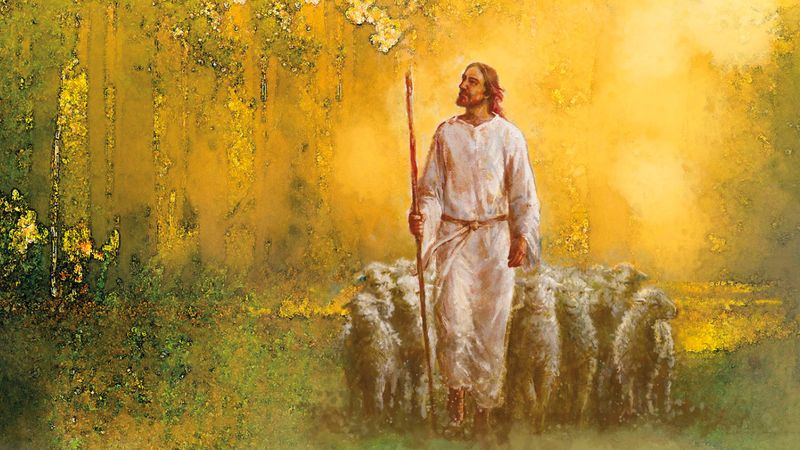
The Lord Is My Shepherd
Psalms 1–2; 8; 19–33; 40; 46
August 17–23, 2026
5-Minute Overview
Week 34 is a lesson in how to pray — because the Psalms are the prayer book Jesus Himself grew up praying. The study guide reads six key psalms (8, 19, 22, 23, 24, 46) with the voices of the prophets, traces four Hebrew words — torah (instruction), kavod (glory-as-weight), nephesh (the whole living self), and chesed (covenant lovingkindness that pursues us) — and reads the rabbis on David, the psalmist who rose at midnight to praise. A companion interactive piece, 'How Hebrew Poems Are Built,' maps the architecture of these psalms — parallelism, chiasm, inclusio, the acrostic, and wordplays that only live in the Hebrew. The Psalms give us words for every season of the heart, from soaring praise to raw lament, and teach that God is 'a very present help in trouble.'
Official Church Resources
OFFICIAL CHURCH RESOURCES▶
CHURCH MEDIA FOR FAMILIES▶
▶ Video Commentary
VIDEO COMMENTARY (10 videos)
▼
 i
iFinding Christ (John Hilton III)
 i
iLynne Hilton Wilson
 i
iFollow Him - Part 1
 i
iFollow Him - Part 2
 i
iScripture Gems
 i
iScripture Insights
 i
iTeaching With Power
 i
iUnshaken - Part 1
 i
iUnshaken - Part 2
 i
iDon't Miss This
Specialized Audiences
WOMEN’S PERSPECTIVES (2 videos)
▶
 i
iGrounded
 i
iOur Mothers Knew It
FAMILY & CHILDREN’S RESOURCES (3 videos)
▶
 i
iLatter Day Kids
 i
iScripture Explorers
 i
iThumb Follow Me
Reference & Study Materials
BIBLE PROJECT VIDEOS THIS WEEK (13 videos)
▶
Book overview + theme & word study videos relevant to this week’s reading.
 i
iPsalms
 i
iCovenant
 i
iTemple
 i
iSacrifice & Atonement
 i
iHoliness
 i
iImage of God
 i
iThe Messiah
 i
iTree of Life
 i
iYHWH / LORD
 i
iShalom / Peace
 i
iKhesed / Loyal Love
 i
iNephesh / Soul
 i
iRuakh / Spirit
ACADEMIC & SCHOLARLY SITES▶
MAPS & BIBLICAL LOCATIONS▶
JEWISH & SCHOLARLY RESOURCES▶
First, a Word About Where We Are
▶︎
Last week, Job asked the hardest question there is — why? — and never got an answer, only an encounter. He was given permission to bring God his grief unpolished, to say "though he slay me" and still be called right. This week we arrive at the book where the covenant people did exactly that, over and over, for a thousand years: the Psalms.
If Job teaches that we may bring God the whole raw truth of our hearts, the Psalms hand us the words. Here is the prayer that begins where Job's lament left off — "My God, my God, why hast thou forsaken me?" (Psalm 22:1) — and here, a page later, is its answer: "The Lord is my shepherd; I shall not want" (Psalm 23:1). The Psalms are the place the people of God went to praise, to plead, to repent, to remember. They are Israel's hymnbook and prayer book, and this week we read some of the most beloved poems ever written.
The Jewish name for the book says it all: Tehillim — "praises." Even though nearly half of them are laments, the whole collection is called Praises, because that is where the road leads.
A Letter to Fellow Students
▶︎
Reading the Psalms, a person raised on English poetry can feel lost at first. Where is the rhyme? Where is the beat? There isn't any — and that's not a flaw, it's a different kind of music. Hebrew poetry rhymes ideas, not sounds. Its lines echo, balance, contrast, and climb. One line says a thing; the next says it again from a new angle, or pushes it further, or turns it on its head. Once you learn to hear it, the Psalms open up — and this week's study guide includes an interactive companion, How Hebrew Poems Are Built, that maps this very music in the psalms we're reading.
The other thing to know going in is how wide the Psalms are. They run the entire range of the human heart before God. There are psalms of soaring praise (8, 19, 24, 29, 33) and psalms of raw grief (22). There are songs of quiet trust (23), of forgiveness (32), of patience (40), of stillness while the world shakes (46). Roughly a third of the Psalter is lament — honest complaint brought straight to God. That is part of the gift: the Psalms refuse to pretend that life is only sunshine, and so they have words ready for the days when we have none of our own.
And there is one more thing, the deepest thing. These were the prayers Jesus grew up praying. He quoted the Psalms more than any other book in the Old Testament, taught that they spoke of Him (Luke 24:44), and prayed them as He died. From the begotten Son of Psalm 2 to the pierced hands of Psalm 22 to the King of glory of Psalm 24, the Psalter is quietly full of Christ. To learn the Psalms is to learn the language of prayer from the Savior Himself.
What's in This Week's Materials
▶︎
In the Study Guide
▶︎
- The historical context explains what the Psalter is — 150 poems gathered after the exile into a book of five "books," each ending in praise — and how the Psalms were sung in the temple and prayed in the home.
- The key passages walk through six of the most-loved psalms — Psalm 8's "what is man," Psalm 19's two books of revelation, Psalm 22's cry from the cross, Psalm 23's shepherd, Psalm 24's "clean hands and a pure heart," and Psalm 46's "be still" — each with verified quotes from general conference.
- The word studies trace four great Hebrew words — torah (instruction, not just "law"), kavod (glory as weight), nephesh (the whole living self), and chesed (covenant love that pursues us).
- The Jewish Perspective brings in the Jewish teachers — the rabbis, whose collected discussions are called the Talmud — on David the poet, on Psalms 1–2 as a single doorway, and on the angels who once objected to our very creation.
To Explore Further
▶︎
- How Hebrew Poems Are Built — a plain-language, interactive guide to the architecture of biblical poetry (parallelism, chiasm, the frame, call-and-response), mapped onto this week's psalms.
How to Read a Psalm
▶︎
Start with the smallest, most useful skill, because it unlocks everything else. Hebrew poems are built out of paired lines that say related things. Sometimes the second line simply echoes the first — "The heavens declare the glory of God; and the firmament sheweth his handywork" (Psalm 19:1) — two ways of saying one truth, so it lands twice. Sometimes the second line contrasts the first — the way of the righteous, then the way of the wicked (Psalm 1:6). Sometimes it climbs, each line lifting higher than the last.
Once you're listening for that, you start to notice the psalmists doing something even more artful: building whole poems into shapes. Psalm 8 opens and closes with the very same line — "O Lord our Lord, how excellent is thy name in all the earth!" (Psalm 8:1, 9). That repeated frame is a device the Jewish teachers prized; it wraps everything inside it in a single thought. (They noticed the same frame around Psalms 1 and 2, which both begin and end with the Hebrew word ashrei, "happy" or "blessed," binding the two psalms into one great doorway into the book — Talmud, Berakhot 10a.)
Those two opening psalms are unusual in another way, and it is easy to miss: neither one carries a superscription. Nearly every psalm around them is labelled — of David, to the chief Musician, a Song — but Psalms 1 and 2 arrive with no author, no occasion, and no tune attached. They read less like somebody's particular song and more like a doorway built in front of the whole collection.
And Psalm 1 begins and ends on the same word. "Nor standeth in the way of sinners" at the top; "the way of the righteous… the way of the ungodly" at the bottom (Psalm 1:1, 6). Whatever else the psalm is doing, it has put you on a road by the first verse and is still asking which road you are on at the last.
And then there is the shape you cannot see at all.
Psalm 25 is an alphabetic acrostic. In the Hebrew, the first line begins with aleph, the next with bet, the next with gimel, and on down the whole alphabet — twenty-two letters, one to a line, running down the margin like a spine. No English translation can carry it. The moment the poem is translated the shape vanishes, so it stands there in every Hebrew Bible and is invisible in every English one.
Knowing it is there changes what you think the psalm is doing. An acrostic is built to be held — the alphabet is a handrail for the memory — and it is also a way of saying this covers everything, from aleph to tav, from A to Z. And Psalm 25 is a prayer for guidance: "Shew me thy ways, O Lord; teach me thy paths" (Psalm 25:4). The psalmist prays that request through the entire alphabet. Teach me everything. All of it. From one end to the other.
It is not a tidy alphabet, either. One letter is folded into its neighbour, one is skipped altogether, one is doubled, and after the last letter has come and gone an extra line is added at the close. The poem strains against its own frame — which may be the most honest thing about it. A prayer for guidance that will not sit neatly in its own rows.
None of this is decoration. The shape carries the meaning. And nowhere is that clearer than in the best-loved psalm of all, where a single change of one word turns the whole poem.
What Is Man?
▶︎
Psalm 8 puts you flat on your back under a night sky and asks the oldest question in the world: set against all of that — the moon, the stars, the sheer scale of the heavens — "what is man, that thou art mindful of him?" (Psalm 8:4).
The world's answer is nothing much — a speck on a speck. The psalm's answer is the exact opposite, and it's breathtaking: beside the stars, a human being is not shrunk but crowned — "a little lower than the angels, and… crowned with glory and honour" (Psalm 8:5). Both things are true at once. We are small enough to marvel that God notices us, and dignified enough that He has crowned us.
The Hebrew word for that "glory" is kavod, and it hides a surprise. Its root means heavy. To the Hebrew ear, glory is weight — substance, gravity, the sense that something is real and matters. So to be "crowned with glory and honour" is not to be handed shine; it's to be given genuine weight, real worth, by the God of weight Himself.
The Jewish teachers turned Psalm 8's question into the great debate of creation itself. In their retelling, when God announced He would make humankind, the angels objected — quoting this very verse back at Him: "What is man that You are mindful of him?… a creature such as this is not worth creating" (Talmud, Sanhedrin 38b). The Restoration answers the angels with a resounding yes, and tells us why the small creature was worth it: "this is my work and my glory — to bring to pass the immortality and eternal life of man" (Moses 1:39). President Dieter F. Uchtdorf drew the comfort straight from the psalm — that the God of the galaxies does not forget the small, for "the worth of souls is great in the sight of God" (Forget Me Not, October 2011; D&C 18:10).
Two Books
▶︎
Psalm 19 reads God's two great books, back to back. The first is creation: "The heavens declare the glory of God" (Psalm 19:1) — a sermon preached without a single word, "day unto day" and "night unto night," in a language every nation on earth can see.
But creation can only point. It can make you wonder; it cannot make you new. So halfway through, the psalm turns to God's second and clearer book — His word: "The law of the Lord is perfect, converting the soul" (Psalm 19:7). The stars show God's power; the scriptures show God's will — and they do what the stars cannot: they convert.
And here the Hebrew rewards a closer look. The word we translate "law" is torah, and its root means to point, to aim, to teach. It's closer to a loving parent's instruction — the finger that points a child the right way — than to a cold legal code. That's why the blessed man of Psalm 1 doesn't grit his teeth and obey the torah; he delights in it and meditates on it "day and night" (Psalm 1:2). You delight in guidance from someone who loves you; you only endure a rulebook. Read "the law of the Lord is perfect, converting the soul" with instruction in mind, and the verse breathes.
The Psalm of the Cross
▶︎
Then comes the deepest darkness in the whole Psalter — and, a thousand years early, a photograph of Calvary.
Psalm 22 is the cry of a righteous man who feels utterly abandoned by God, surrounded by enemies, his strength poured out like water. It opens with the line that would one day be spoken from a cross: "My God, my God, why hast thou forsaken me?" (Psalm 22:1; Matthew 27:46). And the Gospel writers watched the rest of it come true in front of them — the pierced hands and feet (Psalm 22:16), the soldiers dividing His garments and casting lots for His clothing (Psalm 22:18; John 19:23–24), the mockery of the crowd. It is the most-quoted psalm in the New Testament.
Two things are worth carrying out of Psalm 22. The first: the psalm does not end in the dark. At verse 22 it turns — "I will declare thy name unto my brethren" — from forsakenness to praise and deliverance. So the very prayer Jesus began in the words of abandonment was a prayer He, and every faithful Jew who knew it by heart, knew would end in triumph. Psalm 22 is the cross and the empty tomb in a single song. Elder Jeffrey R. Holland taught that on the cross the Savior "cries in ultimate loneliness, 'My God, my God, why hast thou forsaken me?'" — the Father withdrawing His comforting Spirit so that the Son could win the victory entirely alone (None Were with Him, April 2009).
The second: Psalm 22 lets a sufferer say "why hast thou forsaken me?" to God, not away from Him. That is the whole difference. It is a complaint aimed at heaven, which is a form of faith — and the Jewish teachers felt its reach so deeply that they placed the same words on the lips of Queen Esther in her most frightened moment before the king (Talmud, Megillah 15b). The psalm of the hidden face became the prayer of everyone who has ever felt God go quiet — and then heard, in the same psalm, that He had not gone at all.
The Lord Is My Shepherd
▶︎
And then, right on the heels of the darkest psalm, comes the most beloved poem in the world — and its power hides in a single word most readers walk right past.
Psalm 23 begins by talking about God: "He maketh me to lie down… he leadeth me… he restoreth my soul" (Psalm 23:2–3). God is being described, in the third person, from a comfortable distance. And then the psalmist steps into the valley of the shadow of death — and exactly there, at the center of the poem, at the point of greatest danger, the word changes: "for thou art with me" (Psalm 23:4). He stops describing God and starts talking to Him. That is the entire doctrine of the psalm, written into its grammar: the nearness of God is felt most in the dark. The shepherd who leads from up ahead becomes the companion who walks right beside you when the path drops into shadow.
Two Hebrew words deepen it. "He restoreth my nephesh" (Psalm 23:3) — and nephesh, usually translated "soul," is not some invisible part tucked inside you. It means the whole living self, body and breath and hunger and longing together. So "he restoreth my soul" means God revives me — my whole exhausted, embodied life — a wholeness the Latter-day Saint reading recovers exactly: "the spirit and the body are the soul of man" (D&C 88:15).
And the last promise: "Surely goodness and mercy shall follow me all the days of my life" (Psalm 23:6). The word for "mercy" is chesed — one of the towering words of the Old Testament: God's loyal, covenant love, the faithfulness that keeps its promises when the other side has failed. And "follow" is far stronger in Hebrew than in English — it means to pursue, chase after, hunt down. God's covenant love doesn't trail politely behind us. It comes after us. It pursues us all our days. That is the shepherd's last word, and the psalm's deepest one — and it is the same voice that would one day say, "I am the good shepherd: the good shepherd giveth his life for the sheep" (John 10:11). Elder Robert E. Wells drew the whole lesson to a point: the invitation of Psalm 23 is not merely to know about the Shepherd, but to know Him (Know the Shepherd, October 1980).
The Question at the Gate
▶︎
Psalm 24 does not argue. It chants — and you can hear the liturgy in it if you count.
It opens with a question asked twice over: "Who shall ascend into the hill of the Lord? or who shall stand in his holy place?" (Psalm 24:3). Then it answers itself, and the answer is not about pedigree or sacrifice but about the inside of a person: "He that hath clean hands, and a pure heart" (Psalm 24:4).
Then the poem turns, and becomes something you can almost hear performed at a door. Four times the gates are commanded to open — "Lift up your heads, O ye gates... and be ye lift up, ye everlasting doors" (Psalm 24:7, 9). And the question comes back, twice more, but it is no longer the same question: not who may go up? but "Who is this King of glory?" (Psalm 24:8, 10). Across those four closing verses the words King and glory sound five times each — count them — until the psalm has hammered its answer home: "The Lord of hosts, he is the King of glory" (Psalm 24:10).
That is the movement of the whole poem, and it is worth carrying into a sacrament meeting or a temple: it begins by asking who is worthy to come up the hill, and it ends by announcing who is coming in. The second question turns out to matter more than the first.
The Voice Over the Water
▶︎
Read Psalm 29 out loud and count.
Seven times it says the voice of the Lord. Over the waters. Breaking the cedars. Shaking the wilderness. Dividing the flames of fire. Seven peals of it, one after another, like thunder rolling in off the sea and up into the hills — and the psalm will not let you look away until every one has sounded.
Then look at how it opens and how it closes. It begins by asking us to give the Lord "glory and strength" (Psalm 29:1). It ends: "The Lord will give strength unto his people; the Lord will bless his people with peace" (Psalm 29:11). The storm rages all the way through the middle, and what the psalm finally does with all that power is give it away. The strength we were asked to ascribe to Him at the top comes back down to us at the bottom — and it arrives as peace.
Be Still, and Know
▶︎
This one is not David's. The heading over Psalm 46 assigns it "to the sons of Korah" — a family of Levite temple singers who "stood up to praise the Lord God of Israel with a loud voice on high" (2 Chronicles 20:19). A good many of the psalms come to us from them rather than from the king, and it is worth remembering as you read: the hymnbook was not written by one man but by a choir.
If Psalm 23 is for the valley, Psalm 46 is for the day the whole world seems to be coming apart — mountains sliding into the sea, waters roaring, nations raging (Psalm 46:2–6). Against all of it the psalm sets one steadying fact: "God is our refuge and strength, a very present help in trouble" (Psalm 46:1). Not a distant help. Not a help that finally shows up once the trouble is over. A present help — here, now, in the trouble itself.
And at the psalm's climax comes the command that has quieted anxious hearts for three thousand years: "Be still, and know that I am God" (Psalm 46:10). Notice it is a command, not a soothing suggestion. And the stillness it asks for isn't passivity or doing nothing — it is the deliberate act of stopping our frantic striving long enough to remember who actually runs the world. The antidote to a raging earth is not more effort. It is a stiller trust. President Boyd K. Packer taught that this is the very stillness in which heaven speaks — "'Be still, and know that I am God'" — reverence that invites revelation (Reverence Invites Revelation, October 1991). The Lord Himself later borrowed the line to steady a persecuted people: "be still and know that I am God" (D&C 101:16).
The Prayer Book Jesus Prayed
▶︎
How did all these different voices — praise and lament, David's and others' — become one book? The Jewish teachers gave a beautiful answer: David was not only a poet but the great collector of Israel's prayer. The Talmud says "David wrote the book of Psalms by means of ten elders," gathering up compositions reaching back through Moses and Abraham and Melchizedek all the way to "Adam the first man" (Talmud, Bava Batra 14b–15a). The Psalter, in this telling, is a chorus of many voices across the ages, gathered by one singing king — an image Latter-day Saints will find familiar, since Mormon did the same for the Nephite record, abridging the words of many prophets into one book "that ye might believe the gospel of Jesus Christ" (Mormon 7:9).
And the rabbis loved to picture when David composed. A lyre, they said, hung over his bed, and at midnight the north wind would stir its strings until it played on its own — and David would rise and give thanks until dawn (Talmud, Berakhot 3b). The Psalms were born, in this telling, of a heart so hungry to praise that it would not even wait for morning.
That is the point of the whole book. The Psalms became prayer — sung in the temple, recited at bedsides, leaned on in crisis. And the Savior did exactly what His people had always done: He prayed Psalm 22 from the cross, and Psalm 31 as He died — "Father, into thy hands I commend my spirit" (Luke 23:46; Psalm 31:5). When we open the Psalms, we are picking up the very words He prayed.
The Invitation
▶︎
The Psalms are the book for whatever this week has done to your heart.
If it has been a week of wonder, there is a psalm standing under the stars with you (8, 19). If it has been a week of fear, there is a psalm that says "be still" (46). If you are walking through a valley, there is a Shepherd who turns from he to thou right where the shadow falls (23). And if it has been a week of feeling utterly abandoned by God, there is a psalm for that too — the very one the Savior chose to pray in His darkest hour, the one that starts in forsakenness and ends in praise (22).
So this week's invitation is simple, and old, and exactly what the covenant people have always done: when you do not know how to pray, let the Psalms pray for you. Read one slowly. Let its paired lines land twice. Notice where it turns from talking about God to talking to Him — and follow it there. The God who wrote the sky also wrote these words and put them in your mouth, in praise and in the dark alike. "The Lord is my shepherd; I shall not want." He is still the God of weight, the very present help, the covenant love that pursues you all the days of your life.
Week 34
Psalms 1–2; 8; 19–33; 40; 46 — Overview
"The Lord Is My Shepherd"
1. Week 34: Overview
For a thousand years before Christ, when the covenant people wanted to praise, to plead, to repent, or to remember, they reached for the Psalms. The Psalter is Israel's hymnbook and prayer book — one hundred and fifty poems, roughly half of them tied to King David, gathered after the exile into a single book with a deliberate design. This week we read a sampling from its opening third: the gateway psalms (1–2), the great creation poems (8, 19), the suffering-and-shepherd sequence (22–24), and the psalm of stillness (46).
Coming to the Psalms, a reader raised on English poetry may feel lost — there is no rhyme, no regular meter. But Hebrew poetry works differently: it rhymes ideas, not sounds. Its music is made of lines that echo, balance, contrast, and climb. Learning to hear that music is the first skill of reading a psalm, and this week's study guide includes an interactive companion — How Hebrew Poems Are Built — that maps the forms in these very psalms.
The Psalter opens with two psalms that function as its front door. Psalm 1 sets the great choice: the way of the righteous, who delight in the law and are "like a tree planted by the rivers of water," against the way of the ungodly, which "shall perish" (1:3, 6). Psalm 2 lifts the eyes from the individual to the nations, and to the LORD's Anointed King — "Thou art my Son" (2:7) — the first of the Psalter's messianic psalms. Together they announce the two themes the whole book will hold: faithfulness to God's word, and hope in God's King.
Between those doors and the closing hallelujahs, the Psalms run the entire range of the human heart before God. There are psalms of soaring praise (8, 19, 24, 29, 33) and psalms of raw lament (22). There are songs of trust (23), of forgiveness (32), of patience (40), and of stillness under threat (46). The Psalms do not pretend life is only joyful; roughly a third of the Psalter is lament. That is part of their gift: they give us words for the days we have none of our own.
The assignment covers Psalms 1–2; 8; 19–33; 40; 46 — twenty psalms drawn out of the Psalter's opening forty-six. That means the reading skips more than it keeps, and what it skips is not filler: the psalms in the gaps include some of the most quoted lines in scripture. The map below walks all forty-six in order so you can see the shape of the whole. Bold rows are in this week's reading; the rest are marked Bridge — worth knowing, worth reading if you have time, and often the psalm sitting right beside one you are studying.
Two other things are marked. "Also known as" gives the name a psalm has carried in Jewish or Christian tradition, where it has one — many have none, and those are left blank rather than filled in with something invented. And where the Savior Himself quoted a psalm, the reference is noted at the end of its description; those six are gathered, with what He actually said, in the section just below the table.
| Psalm | In the reading? | Also known as | What it is — and why it matters |
|---|---|---|---|
| Psalm 1 | Yes | The preface to the Psalter | The first door. The two ways: the one who delights in the law is "like a tree planted by the rivers of water"; the ungodly are "like the chaff which the wind driveth away." |
| Psalm 2 | Yes | — | The second door. The nations rage, and God installs His King on Zion: "Thou art my Son; this day have I begotten thee." The Psalter's first messianic psalm. |
| Psalm 3 | Bridge | — | A morning prayer under pursuit — "many are they that rise up against me" — and yet "I laid me down and slept; I awaked; for the LORD sustained me." |
| Psalm 4 | Bridge | — | The evening companion to Psalm 3: "commune with your own heart upon your bed, and be still," ending in peaceful sleep. |
| Psalm 5 | Bridge | — | A morning prayer offered toward the temple, contrasting God's holiness with the deceit of the wicked. |
| Psalm 6 | Bridge | First of the seven Penitential Psalms | "I water my couch with my tears" — then the turn: "the LORD hath heard the voice of my weeping." Quoted by the Savior: Luke 13:27. |
| Psalm 7 | Bridge | — | A plea for vindication in which the wicked "made a pit, and digged it, and is fallen into the ditch which he made." |
| Psalm 8 | Yes | — | Flat on your back under the night sky: "What is man, that thou art mindful of him?" — and the answer, "crowned him with glory and honour." Opens and closes with the same line. Quoted by the Savior: Matthew 21:16. |
| Psalm 9 | Bridge | — | Praise for God's just judgment; "the LORD also will be a refuge for the oppressed." An acrostic that in Hebrew continues into Psalm 10. |
| Psalm 10 | Bridge | — | The other half of that acrostic, and its opposite mood: "Why standest thou afar off, O LORD? why hidest thou thyself in times of trouble?" |
| Psalm 11 | Bridge | — | Trust when friends counsel flight: "In the LORD put I my trust... The LORD is in his holy temple." |
| Psalm 12 | Bridge | — | Flattering lips and a double heart, set against "the words of the LORD" — "as silver tried in a furnace of earth, purified seven times." |
| Psalm 13 | Bridge | — | Four cries of "how long" — the shortest, sharpest lament in the collection — resolving in "I will sing unto the LORD." |
| Psalm 14 | Bridge | — | "The fool hath said in his heart, There is no God." Paul quotes it in Romans 3 to argue that none is righteous. |
| Psalm 15 | Bridge | — | An entrance liturgy: "LORD, who shall abide in thy tabernacle?" The direct companion to Psalm 24, which you are reading. |
| Psalm 16 | Bridge | — | "Thou wilt not leave my soul in hell; neither wilt thou suffer thine Holy One to see corruption" — Peter's Pentecost text for the Resurrection. |
| Psalm 17 | Bridge | — | "Keep me as the apple of the eye, hide me under the shadow of thy wings." |
| Psalm 18 | Bridge | — | A long royal thanksgiving with a storm theophany — "he rode upon a cherub, and did fly." Appears almost word for word as 2 Samuel 22. |
| Psalm 19 | Yes | — | God's two books read back to back: the heavens "declare the glory of God," then "the law of the LORD is perfect, converting the soul." |
| Psalm 20 | Yes | — | A prayer for the king before battle: "Some trust in chariots, and some in horses: but we will remember the name of the LORD our God." |
| Psalm 21 | Yes | — | Thanksgiving after the battle of Psalm 20 — "thou settest a crown of pure gold on his head." The two psalms are a matched pair. |
| Psalm 22 | Yes | The Psalm of the Cross; in Hebrew Ayelet HaShachar, "the hind of the dawn" | "My God, my God, why hast thou forsaken me?" — pierced hands and feet, garments parted by lot, and a turn at verse 22 from forsakenness into praise. Quoted by the Savior: Matthew 27:46; Mark 15:34. |
| Psalm 23 | Yes | The Shepherd Psalm | The best-loved poem in the world. Note where it stops speaking about God and starts speaking to Him: "for thou art with me," exactly in the valley. |
| Psalm 24 | Yes | The psalm of the first day of the week | "Who shall ascend into the hill of the LORD?" — clean hands and a pure heart — and the temple gates flung open for "the King of glory." |
| Psalm 25 | Yes | — | An acrostic prayer for guidance and pardon: "Remember not the sins of my youth." A good psalm on which to practice spotting the alphabet. |
| Psalm 26 | Yes | — | "Examine me, O LORD, and prove me" — a plea to be searched rather than spared, from one who loves "the habitation of thy house." |
| Psalm 27 | Yes | The Elul psalm — L'David Ori | "The LORD is my light and my salvation; whom shall I fear?" One thing desired above all others: to dwell in the house of the LORD. |
| Psalm 28 | Yes | — | A cry against God's silence — "be not silent to me" — answered: "The LORD is my strength and my shield." |
| Psalm 29 | Yes | Mizmor L'David — the Kabbalat Shabbat psalm | A thunderstorm crossing the land, with "the voice of the LORD" sounding seven times. It begins in glory and ends, unexpectedly, in peace. |
| Psalm 30 | Yes | The psalm of the dedication of the house | "Weeping may endure for a night, but joy cometh in the morning" — and God turns "mourning into dancing." |
| Psalm 31 | Yes | — | "Into thine hand I commit my spirit" — a psalm of trust under siege, whose fifth verse became the last words the Savior spoke from the cross. Quoted by the Savior: Luke 23:46. |
| Psalm 32 | Yes | Second of the Penitential Psalms | The psalm of confession: silence made the bones waste away; "I acknowledged my sin unto thee... and thou forgavest." |
| Psalm 33 | Yes | — | Praise with "a new song": "By the word of the LORD were the heavens made" — creation by speech, and a nation blessed for choosing Him. |
| Psalm 34 | Bridge | — | "O taste and see that the LORD is good." Also "he keepeth all his bones: not one of them is broken," which John saw fulfilled at the cross. |
| Psalm 35 | Bridge | — | A plea against false witnesses who "rewarded me evil for good." Quoted by the Savior: John 15:25. |
| Psalm 36 | Bridge | — | Human wickedness set beside God's mercy "in the heavens": "in thy light shall we see light." |
| Psalm 37 | Bridge | — | A wisdom acrostic and the closest cousin to Psalm 1: "Fret not thyself because of evildoers... the meek shall inherit the earth." |
| Psalm 38 | Bridge | Third of the Penitential Psalms | Sin as a weight — "as an heavy burden they are too heavy for me" — while friends "stand aloof from my sore." |
| Psalm 39 | Bridge | — | On human frailty: "make me to know mine end"; our days "as an handbreadth"; the psalmist "a stranger with thee, and a sojourner." |
| Psalm 40 | Yes | — | "I waited patiently for the LORD" — brought up "out of the miry clay" — and then the offering God actually wants: "Lo, I come... I delight to do thy will." |
| Psalm 41 | Bridge | — | A blessing on those who "consider the poor," and the betrayal Jesus applied to Judas: "mine own familiar friend... hath lifted up his heel against me." Quoted by the Savior: John 13:18. |
| Psalm 42 | Bridge | "As the hart" — one psalm with 43 in many manuscripts | Book II opens: "As the hart panteth after the water brooks, so panteth my soul after thee." Its refrain asks, "Why art thou cast down, O my soul?" |
| Psalm 43 | Bridge | — | Carries Psalm 42's refrain to its close — the two were very likely one poem: "O send out thy light and thy truth." |
| Psalm 44 | Bridge | — | A national lament that insists on its own innocence: "yet have we not forgotten thee" — "we are counted as sheep for the slaughter." |
| Psalm 45 | Bridge | Shoshannim — "lilies," from its superscription | A royal wedding song whose praise outgrows any earthly king: "Thy throne, O God, is for ever and ever" (quoted of Christ in Hebrews 1). |
| Psalm 46 | Yes | Luther's psalm — "A Mighty Fortress Is Our God" | The world comes apart — mountains into the sea, nations raging — and against all of it: "God is our refuge and strength, a very present help in trouble... Be still, and know that I am God." |
Read down the "Bridge" rows and a pattern appears: they are overwhelmingly laments. The reading keeps most of the praise and trust psalms and passes over much of the complaint. So the psalms that teach us how to pray when life is hard are largely the ones the assignment leaves out. If you have time for only a few of the bridge rows, read those.
After the Resurrection the Savior told the disciples that "all things must be fulfilled, which were written in the law of Moses, and in the prophets, and in the psalms, concerning me" (Luke 24:44) — naming the Psalms as one of the three divisions of scripture that testify of Him. He had been quoting them all along. Six of the forty-six psalms in the map above are on His lips in the Gospels — three of them in this week's reading, three in the bridge rows:
| Psalm | Where He quotes it | What He said |
|---|---|---|
| Psalm 6:8 | Luke 13:27 | "Depart from me, all ye workers of iniquity" — spoken of those shut out of the kingdom. Word for word in the King James. |
| Psalm 8:2 | Matthew 21:16 | To the priests indignant at children shouting in the temple: "Out of the mouth of babes and sucklings thou hast perfected praise." |
| Psalm 22:1 | Matthew 27:46; Mark 15:34 | From the cross, in Aramaic: Eli, Eli, lama sabachthani — "My God, my God, why hast thou forsaken me?" |
| Psalm 31:5 | Luke 23:46 | His last words: "Father, into thy hands I commend my spirit." |
| Psalm 35:19 | John 15:25 | Warning the disciples of the world's hatred: "They hated me without a cause." |
| Psalm 41:9 | John 13:18 | At the Last Supper, of Judas: "He that eateth bread with me hath lifted up his heel against me." |
Four details repay a second look — three of them in the table, and one that belongs beside it.
He quoted Psalm 8 in Greek, not Hebrew. Our Old Testament reads "hast thou ordained strength" (8:2); Matthew has "thou hast perfected praise." That is the Septuagint — the Greek translation of the Hebrew Bible in common use in the first century. It is not an error in either book; it is a window onto which Bible was being read aloud in that world.
He changed Psalm 41 as He quoted it. The psalm says "mine own familiar friend, in whom I trusted, which did eat of my bread." At the table, of Judas, the Savior left out in whom I trusted. He knew, as He says in that same verse, exactly whom He had chosen.
Psalm 35 has a twin. "They hated me without a cause" stands in both Psalm 35:19 and Psalm 69:4, and John does not tell us which He meant, so both are worth having.
And one that is not His. Psalm 91:11–12 — "he shall give his angels charge over thee" — is quoted in the Gospels, but by Satan, at the temptation, urging the Savior to throw Himself from the temple (Matthew 4:6). The Savior answered from Deuteronomy, not from the Psalms. A psalm can be quoted accurately and still be put to a wicked use — worth remembering whenever a verse is quoted at us out of its setting.
Beyond Psalm 46 the list grows considerably. Psalm 110:1 is the verse He used to silence the Pharisees (Matthew 22:44); Psalm 118 supplied both the rejected cornerstone (Matthew 21:42) and the blessing the crowds shouted on Palm Sunday, which He later told Jerusalem they would say again (Matthew 23:39); and Psalm 82:6, "Ye are gods," is the verse He turned on those about to stone Him (John 10:34). Those come in the weeks ahead.
(Two named collections also lie past this week's range. The Hallel — Psalms 113–118, sung at the festivals, and widely understood to be the hymn of the Last Supper — comes up again in Historical & Cultural Context and in Jewish Perspective. The Great Hallel is Psalm 136, whose refrain "for his mercy endureth for ever" runs in all twenty-six of its verses.)
- Creation speaks (Psalms 8, 19). Two of the Bible's greatest creation poems. Psalm 8 stands beneath the night sky and asks, "What is man, that thou art mindful of him?" (8:4) — and answers that God has "crowned him with glory and honour" (8:5). Psalm 19 hears the heavens "declare the glory of God" (19:1) and then turns to a second, clearer revelation: "The law of the LORD is perfect, converting the soul" (19:7).
- The suffering, the shepherd, the King (Psalms 22–24). These three sit together for a reason, and reading them in order is the most rewarding thing you can do with this week's assignment. Psalm 22 is the cry of forsakenness, with details the Gospels saw fulfilled at Calvary: pierced hands and feet, parted garments (22:16, 18). Psalm 23, the best-loved psalm in the world, answers it: "The LORD is my shepherd; I shall not want" (23:1). Psalm 24 lifts the eyes to the temple gates and the "King of glory" who enters them (24:7–10).
- Refuge and stillness (Psalm 46). "God is our refuge and strength, a very present help in trouble" (46:1) — and its center holds one of scripture's great commands for the anxious heart: "Be still, and know that I am God" (46:10).
The Psalms are the prayer book the Savior grew up praying, and the table above shows how far that went: He reached for them in the temple, at the table with His disciples, and from the cross. To read the Psalms is to learn the language of prayer from the people of God — and to find that many of the songs reach past David to David's Lord. Its second psalm crowns a King and its twenty-second cries out forsaken, and the New Testament reads both as pointing one direction.
If the Psalter is that full of Christ, it is just as full of us. Whatever the week has done to your heart — praise or grief, confidence or fear — there is a psalm for it. That is why we still open this book when we do not know how to pray.
2. Week 34: Historical & Cultural Context
The book of Psalms is, in the Bible Project's summary, "a collection of 150 ancient Hebrew poems, songs, and prayers" (Book of Psalms Summary, BibleProject). They were composed across centuries and, after the Babylonian exile, "intentionally arranged" into a book with a design of its own. That design is visible even in English: the Psalter is divided into five books (1–41, 42–72, 73–89, 90–106, 107–150), each closing with a burst of praise — a doxology — and the whole collection ends with five "hallelujah" psalms (BibleProject). The five-fold shape quietly echoes the five books of Moses: as the Torah is God's word to Israel, the Psalms are Israel's word back to God.
(A note for readers comparing Bibles: from Psalm 10 onward the numbering in Catholic and Orthodox Bibles — which follow the ancient Greek and Latin — runs one behind the Hebrew and Protestant numbering, because they count two of the psalms differently. The beloved shepherd psalm is "23" in most English Bibles but "22" in the Latin Vulgate.)
Not all psalms do the same thing, and naming the type helps you read one rightly. The Interpreter Foundation study aid lists the main kinds and even suggests sorting each psalm as you read: is it "one of praise, or petition, or prophecy, or worship, or gratitude, or testimony" (Jonn Claybaugh, Come, Follow Me… Study and Teaching Helps, Interpreter Foundation)? The great categories scholars use are:
- Hymns of praise — pure adoration of God as Creator and King (Psalms 8, 19, 29, 33).
- Laments — cries of grief, complaint, and plea, often turning to trust before they end (Psalm 22). Roughly a third of the Psalter is lament.
- Thanksgiving — gratitude for deliverance already given (Psalm 30).
- Royal / messianic — psalms of the king, which the tradition read as pointing to the Anointed One to come (Psalms 2, 24).
- Wisdom — reflection on the two ways of living (Psalm 1).
The Bible Project notes the two dominant moods and where they fall: lament "predominate[s]" in the earlier books, while praise poems outnumber lament toward the end, "culminating in the hallelujah conclusion." The Psalter is a journey from trouble to praise.
The superscriptions attribute many psalms to David — the Interpreter study aid notes he "is credited with having written about half of the psalms, many being pleas and praises to God which evidence David's repentant heart" (Claybaugh). Jewish tradition preserved a fuller picture.
(A word about the sources quoted below. The Talmud is the great collection of rabbinic discussion — debates over law, scripture, and practice, carried on for centuries after Christ and written down by about AD 500. It is not scripture in Judaism; it is the record of the conversation about scripture, and it remains the central text of Jewish study today. It is cited the way we cite chapter and verse, but by tractate and page: "Bava Batra 14b" means the tractate called Bava Batra, folio 14, side b. Every such citation in this guide links to Sefaria, a free online library where you can read the passage in Hebrew and English yourself.)
The Talmud teaches that David "wrote the book of Psalms by means of ten elders" — that the book gathers up compositions older than he was, reaching back through Moses and Abraham and Melchizedek as far as Adam (Bava Batra 14b–15a). On that reading David is less the sole author than the great collector and composer, taking the prayers of the ages into one book and adding his own.
It is worth noticing what that does to the question "who wrote this?" A hymnbook can be authored, compiled, and inherited all at once, and the tradition saw no difficulty in saying so. (The passage is quoted in full, with its list of the ten, in Jewish Perspective — along with the rabbis' much-loved picture of the lyre that hung over David's bed and woke him at midnight to write.)
The Psalms were not written to be read silently; they were sung, and they structured Israel's worship. The Levites sang a set psalm for each day of the week in the temple — Psalm 24 on the first day, and a different psalm for each day after (Rosh Hashanah 31a; Tamid 33b). One psalm in this reading — Psalm 24 — therefore had a fixed day, the way a hymn can belong to a season. (Why Psalm 24 was given to the first day is taken up in Jewish Perspective.)
Groups of psalms had fixed roles, and are still known by name. The Hallel — "praise," the root behind hallelujah — is Psalms 113–118, sung at the festivals; this is widely understood to be the "hymn" the Savior and His disciples sang at the end of the Last Supper before going out to Gethsemane (Matthew 26:30). The Ashrei, recited daily, is Psalm 145 with two verses set in front of it, and takes its name from the word those verses open with — ashrei (Psalm 84:4), which the KJV renders "Blessed are they" and which carries the sense "happy are they".
Even Psalm 23 had its place — some sang "The LORD is my shepherd" over the fourth cup of the Passover meal, "in appreciation of the food he ate" (Pesachim 118a).
Traces of the music survive in the text itself. The word Selah, which "occurs in 39 of the Psalms," is "thought to be an instruction related to reading or to music" (Claybaugh) — a pause, or a swell, whose exact meaning is now lost. Many psalms carry musical superscriptions ("To the chief Musician," "upon Gittith," "A Psalm of David"). We are reading the lyrics of songs whose tunes have faded but whose words the covenant people never stopped singing.
Of all the Old Testament, the Psalms left the deepest mark on the New: "of the almost 300 Old Testament quotes that are found in the New Testament, more than 100 come from Psalms" (Claybaugh). Jesus quoted the Psalms more than any other book, prayed them from the cross, and taught that they spoke of Him (Luke 24:44). This is the context that matters most for a Latter-day Saint reader: the Psalms are not only ancient Israel's hymns but the prayer book of the Savior Himself — and, from Psalm 2's begotten Son to Psalm 22's pierced hands to Psalm 24's King of glory, a book quietly full of Christ.
The tunes these poems were sung to are lost. The singing is not. Two of the psalms in this week's reading are still recited on a fixed schedule by millions of people — and in the Orthodox churches, all twenty are read every week. Knowing when, and why, changes how they read.
Two traditions come up below, and both may be unfamiliar. One is Judaism, which never stopped praying these psalms — the same poems, in the same language, in an unbroken line from the temple. The other is Orthodox Christianity: the ancient churches of the East — Greek, Russian, Serbian and others — which parted from Rome in 1054 and which kept the Psalms at the centre of daily worship far more than most Western churches did.
Neither tradition is ours, and nothing here is offered as a practice to adopt. But both have been reading these psalms continuously for a very long time, and where they put a psalm tells you something about the psalm. Unfamiliar terms are explained as they come, and gathered in a short list at the end of the section.
Psalm 29 — every Friday night, standing
Psalm 29 is part of Kabbalat Shabbat (ka-ba-LAHT sha-BAHT, "receiving the Sabbath") — the short service of psalms and hymns that welcomes the Sabbath on Friday evening, as the sun goes down. In many communities the congregation stands for Psalm 29 (My Jewish Learning; Siddur Ashkenaz, Kabbalat Shabbat, Psalm 29).
(Two terms in that citation: a siddur is simply the Jewish prayer book, the daily and Sabbath order of service. Ashkenaz refers to the customs of the Jews of central and eastern Europe — as distinct from Sephardi custom, which comes down from the Jews of Spain and the Middle East. Communities differ in wording and melody the way congregations differ anywhere; Psalm 29 is in this service across nearly all of them.)
The service itself is not ancient. It was assembled in the late sixteenth century by the kabbalists of Safed — a circle of Jewish mystics in a hill town in the Galilee, not far from where the Savior taught, whose devotional writing reshaped Jewish worship worldwide (Jewish Virtual Library).
But the reason Psalm 29 fits there is much older than the service. To see it you need one more term. The Amidah (ah-mee-DAH, "the standing") is the central prayer of Jewish worship, prayed silently and standing, three times a day — the closest equivalent in our own practice would be the sacrament prayers, in that the words are fixed, ancient, and said the same way every time. On weekdays the Amidah has nineteen blessings. On the Sabbath it has only seven.
The Talmud asks the obvious question — why seven? — and answers that the seven were instituted "corresponding to the seven 'voices' which David mentioned on the waters." That is, the seven times "the voice of the LORD" appears in Psalm 29 (Berakhot 29a, R. Ḥalafta ben Shaul).
You can check this yourself, in English, in about a minute. Read Psalm 29 and count the times it says "the voice of the LORD." It is there seven times — verses 3, 4 (twice), 5, 7, 8 and 9. That is the count the Talmud is pointing at.
The order of events is worth holding onto, because it runs opposite to what you might expect. The rabbis counted the seven voices and shaped the Sabbath prayer around that number centuries before anyone in Safed existed. The kabbalists then did something simpler: they put the psalm itself into the Friday evening service, so the number and the poem it comes from would be heard on the same night. The arithmetic came first; the placement came later.
So when a congregation stands for Psalm 29 on Friday night, the number that shaped their Sabbath prayer is one anyone can count — including you, this week, in your own Bible.
Psalm 27 — twice a day, right now
Elul (eh-LOOL) is the last month of the Jewish year — the month of preparation leading up to Rosh Hashanah, the New Year, and then Yom Kippur, the Day of Atonement described in Leviticus 16. It is a season of self-examination before a season of judgment: the nearest thing in our own calendar might be the weeks before a temple recommend interview, or the quiet preparation before the sacrament.
Through the whole of that month, Psalm 27 is added to the daily prayers twice a day — near a hundred recitations in a single season (My Jewish Learning). Communities differ on where the custom stops: some end at Yom Kippur, others carry it on to Hoshana Rabbah, the seventh day of the Feast of Tabernacles, when the judgment opened at the New Year is said to be finally sealed.
Unlike the psalm, the custom is young. My Jewish Learning calls it "relatively new, evidently some 200 years old"; other accounts trace it further back, to a printed mention in Sefer Shem Tov Katan (1706) and a tradition naming R. Eliyahu Baal Shem. Both datings are worth having, and neither reaches back to the temple — this is a practice that grew up in the last few centuries around a poem three thousand years old.
The timing is worth pausing over. Elul 5786 begins 14 August 2026 and runs to 11 September, the eve of Rosh Hashanah (Hebcal). That is this week — the first day of Elul is the day this lesson posts. While we are reading Psalm 27 on a page, it is being said aloud twice a day, in synagogues everywhere, as the season of return begins.
The whole Psalter, every week
The Orthodox churches divide the Psalter — their name for the book of Psalms as it is used in worship — into twenty kathismata (ka-THEEZ-ma-ta, singular kathisma). The word is Greek for sitting, and it is entirely practical: the readings are long, so the congregation was permitted to sit through them, in a tradition where worshippers otherwise stand. Each kathisma is divided again into three sections called stases.
These are read at the daily services — Vespers in the evening and Matins before dawn — which are held every day, not only on Sunday. Between the two, the entire book of Psalms is read through in a week. During Great Lent, the forty-day fast before Easter, the pace doubles and the whole Psalter is read twice a week (Orthodox Church in America; OrthodoxWiki).
This week's psalms are scattered across five of those sittings — Kathisma I (Psalms 1–2, 8), III through V (19–33), and VI (40, 46). A reader following the Orthodox cycle meets all twenty of our psalms within seven days, every week of their life.
(Working that out requires the numbering difference noted back in Section 1. The Orthodox books count by the Greek, which from Psalm 10 onward runs one behind ours — so our Psalm 46 is their 45, which is why it lands in Kathisma VI rather than VII. If you look up a kathisma yourself, subtract one.)
What this is for. Come, Follow Me moves through the standard works on a four-year cycle, so we reach the Psalms once every four years — and even then only a selection of them. The traditions above read the whole book on a repeating cycle: weekly, daily, seasonally. That is the setting these poems were built for. It is worth knowing, as you read Psalm 23 this week, that somewhere a congregation is reading it for the five-hundredth time — and will read it again next week.
The terms in this section, in one place
| Term | What it is |
|---|---|
| Talmud | The great collection of rabbinic discussion on law and scripture, written down by about AD 500. Not scripture in Judaism — the record of the conversation about it. Cited by tractate and page (Bava Batra 14b). |
| Siddur | The Jewish prayer book: the fixed order of daily and Sabbath prayers. |
| Amidah | "The standing" — the central prayer of Jewish worship, said silently and standing, three times daily. Nineteen blessings on weekdays, seven on the Sabbath. |
| Kabbalat Shabbat | "Receiving the Sabbath" — the Friday-evening service of psalms that welcomes the Sabbath at sundown. Psalm 29 belongs to it. |
| Ashkenaz / Sephardi | The two great streams of Jewish custom: Ashkenaz from central and eastern Europe, Sephardi from Spain and the Middle East. They differ in wording and melody, not in essentials. |
| Kabbalists / Safed | Jewish mystics; and the town in the Galilee that was their centre in the 1500s, from which much of modern Jewish worship comes. |
| Elul | The last month of the Jewish year — a month of self-examination before the New Year. In 2026 it begins 14 August. |
| Rosh Hashanah | "Head of the year" — the Jewish New Year, and the opening of a season of judgment. |
| Yom Kippur | The Day of Atonement, ten days later — the fast day commanded in Leviticus 16. |
| Hoshana Rabbah | The seventh day of the Feast of Tabernacles, when the judgment opened at the New Year is said to be sealed. |
| Orthodox Church | The ancient Christian churches of the East — Greek, Russian, Serbian and others — which parted from Rome in 1054. (The Coptic and other Oriental Orthodox churches separated earlier, in 451, and are a different family.) |
| Psalter | The book of Psalms considered as a book of worship, rather than as a book to be studied. |
| Kathisma (pl. kathismata) | "A sitting" — one of the twenty portions the Orthodox divide the Psalter into, long enough that the congregation may sit through it. |
| Vespers / Matins | The evening and pre-dawn daily services, held every day of the year, at which the Psalter is read. |
| Great Lent | The forty-day fast before Easter, during which the reading pace doubles. |
3. Week 34: Key Passages Study
The Text
"When I consider thy heavens, the work of thy fingers, the moon and the stars, which thou hast ordained; What is man, that thou art mindful of him? and the son of man, that thou visitest him? For thou hast made him a little lower than the angels, and hast crowned him with glory and honour." (8:3–5)
How the Poem Works
The frame — and how to spot one. Psalm 8 opens and closes with the identical line: "O LORD our Lord, how excellent is thy name in all the earth!" (8:1, 9). A repeated first-and-last line is called an inclusio, and it is the easiest Hebrew structure to find in English, because you need no Hebrew at all — read the first verse, read the last verse, and see whether they rhyme in sense. Whatever sits inside the frame is what the frame is about — so read the frame first, then read what it encloses.
Check it in the Hebrew and the frame gets tighter. In the Westminster Leningrad Codex — the standard scholarly edition of the Hebrew Bible, based on its oldest complete manuscript — Hebrew 8:2 and 8:10 open with the same five dictionary words in the same order — YHWH, adon ("Lord"), mah ("how"), addir ("excellent"), shem ("name"). Not a paraphrase: the same line.
Why the verse numbers do not match. English 8:1 is Hebrew 8:2, and English 8:9 is Hebrew 8:10. Hebrew counts the superscription — "To the chief Musician upon Gittith, A Psalm of David" — as verse 1. This is not a curiosity; it is a trap, and it is easy to fall into. If you go looking for a frame at "the first and last verse of the chapter" in a Hebrew text, you will miss this psalm entirely — because in Hebrew the frame sits at the second verse and the last. The frame is there; the counting hides it. Not finding something is not the same as it not being there.
A thread to follow. hashamayim, "the heavens," sounds three times across nine verses. Mark where, and see what the repetition is doing to the question in verse 4.
Latter-day Saint Connections
- Elder Boyd K. Packer, "The Pattern of Our Parentage" (October 1984): "What is man, that thou art mindful of him? and the son of man, that thou visitest him?' (Ps. 8:4; see also Heb. 2:5–7.)" — read as a witness of our divine parentage.
- President Thomas S. Monson, "You Make a Difference" (April 1988): quotes Psalm 8:1, 3–4 to teach each soul's worth to God.
- President Dieter F. Uchtdorf, "Forget Me Not" (October 2011): "hast crowned him with glory and honour" — God does not forget the small.
- Scripture: "the worth of souls is great in the sight of God" (D&C 18:10).
Study Questions
- Read only Psalm 8:1 and 8:9, then read what sits between them. What does the frame tell you the psalm is actually about?
- Find another psalm in this week's reading whose first and last verses echo. (Start with Psalm 1 — the word "way" is in both.) What does that frame enclose?
- The verse numbering differs between Hebrew and English because of the superscription. What else might you be missing in a psalm because your Bible does not print its title as verse 1?
The Text
"The heavens declare the glory of God; and the firmament sheweth his handywork." (19:1)
"The law of the LORD is perfect, converting the soul: the testimony of the LORD is sure, making wise the simple." (19:7)
How the Poem Works
The psalm has a seam, and the divine name marks it. Psalm 19 is two panels: creation (vv. 1–6) and torah (vv. 7–14). Readers have noticed the shift in subject for centuries — but there is a harder piece of evidence in the Hebrew that you can check for yourself with a lexicon.
In the creation panel, God is called El (אֵל) — the broad, ancient word for deity that any nation might use of its god. It appears once, in verse 1, and never again in the psalm. From verse 7 onward, the covenant name YHWH ("the LORD" in small capitals) takes over and sounds seven times. The poem moves from the God any human can infer from a night sky to the God who has a name and has spoken it to a people.
How to spot this yourself: in most English Bibles, "God" and "LORD" (small capitals) translate different Hebrew words. Wherever a psalm switches between them, ask whether the poem has changed its subject. In Psalm 19 it has.
The two panels are also built differently. The creation half describes with no direct address — the heavens declare, the firmament sheweth. The torah half is a chain of six parallel clauses (19:7–9), each naming God's word and each stating what it does to a person: converting, making wise, rejoicing, enlightening. Count them. Six parallel clauses in a row is a deliberate device in Hebrew verse, not padding — the question to ask is what the accumulation is for.
See Word Studies on torah — that entry explains why "law" is a thin translation.
Latter-day Saint Connections
- Elder Gordon B. Hinckley, "Be Not Faithless" (April 1978): "The heavens declare the glory of God… Day unto day uttereth speech" (Ps. 19:1–2).
- Elder Joseph B. Wirthlin, "Pure Testimony" (October 2000): "the law of the Lord is perfect, converting the soul: the testimony of the Lord is sure" (Psalm 19:7).
- Don Lind, astronaut, "The Heavens Declare the Glory of God" (October 1985): an astronaut's witness of Psalm 19:1.
- Scripture: "all things denote there is a God… all the planets which move in their regular form do witness that there is a Supreme Creator" (Alma 30:44).
Study Questions
- Read 19:1–6, then 19:7–14, and list what changes: the name for God, the subject, the sentence shape. What does the seam itself teach?
- Count the six things God's word does in verses 7–9. Which verb surprises you most?
- Where else in this week's reading does a psalm switch between "God" and "LORD"? What happens at the switch?
The Text
"My God, my God, why hast thou forsaken me? why art thou so far from helping me…?" (22:1)
"…they pierced my hands and my feet." (22:16)
"They part my garments among them, and cast lots upon my vesture." (22:18)
How the Poem Works
Find the hinge. A biblical lament usually turns, and the turn is locatable. In Psalm 22 it is at verse 22 — "I will declare thy name unto my brethren" — where the vocabulary flips from complaint to praise and stays there for the rest of the poem. Everything before it is addressed out of trouble; everything after is addressed out of rescue. You can find this in English without any Hebrew: read until the psalm stops asking to be rescued and starts speaking as though the rescue had already happened.
How to read a lament's shape. The pattern across the Psalter is roughly: address → complaint → petition → an expression of trust → praise. Psalm 22 runs the whole arc, which is why quoting only its first verse gives a false impression of it. When you meet a lament, mark where the turn is before deciding what the psalm is about.
A textual question, and it is worth understanding rather than skipping. Your Bible probably carries a footnote at verse 16. Here is what it is actually about.
The King James reads "they pierced my hands and my feet." Some translations and study notes mention a different reading — "like a lion" — and at first glance those two have nothing to do with each other. They come from one word, and the difference between them is about a millimetre of ink.
The word is ka'ari (כָּאֲרִי) if the last letter is a yod (י), which gives "like a lion." It is ka'aru (כָּאֲרוּ) if that letter is a vav (ו), from the verb karah, "to dig" or "to bore through" — which in this setting means to pierce. In Hebrew script yod and vav are the same stroke; the yod is simply shorter. A scribe's hand, or a worn manuscript, is the whole distance between them.
Two things make this more than a curiosity. The Greek translation of the Psalms, made roughly two centuries before Christ by Jewish scholars in Alexandria, renders it ὤρυξαν (ōryxan) — "they dug." So the piercing reading is ancient and Jewish, not a later Christian adjustment. And a manuscript found among the Dead Sea Scrolls carries the vav form as well.
So the footnote is not hedging about whether the verse matters. It is telling you, honestly, that one letter in one word has been read two ways for well over two thousand years — and that the reading behind "pierced" is the older witness, not the newer one. Shon D. Hopkin treats the evidence in detail in "'My God, My God, Why Hast Thou Forsaken Me?' Psalm 22 and the Mission of Christ" (BYU Studies Quarterly), and it is worth reading before teaching this verse.
A caution about verse numbers again. The turn we call verse 22 is verse 23 in the Hebrew, for the same superscription reason as Psalm 8. If you are comparing an English Bible with a Hebrew one, expect the offset.
Latter-day Saint Connections
- Elder Jeffrey R. Holland, "None Were with Him" (April 2009): "He cries in ultimate loneliness, 'My God, my God, why hast thou forsaken me?'"
- President Gordon B. Hinckley, "The Empty Tomb Bore Testimony" (April 1988): "He cried out, 'My God, my God, why hast thou forsaken me?' (Matt. 27:46)."
- Scripture: the Gospels apply Psalm 22 directly to Calvary (Matthew 27:35, 39, 46; John 19:24).
Study Questions
- Find the turn yourself: read Psalm 22 until the psalmist stops pleading for rescue and begins speaking as though it had already come. Which verse is it?
- Knowing the psalm ends in praise, how does that change what it means that Jesus began it aloud?
- Look at your Bible's footnote on verse 16. What is it actually telling you, and why would a translator flag it?
The Text
"The LORD is my shepherd; I shall not want… Yea, though I walk through the valley of the shadow of death, I will fear no evil: for thou art with me… Surely goodness and mercy shall follow me all the days of my life: and I will dwell in the house of the LORD for ever." (23:1, 4, 6)
How the Poem Works
Track the pronouns — this one works entirely in English. Take a pencil to the six verses and mark every word that refers to God.
- Verses 1–3: he, his — "He maketh me… he leadeth me… he restoreth my soul." God is described, in the third person, from a distance.
- Verses 4–5: thou, thy — "for thou art with me; thy rod and thy staff… thou preparest a table… thou anointest my head."
- Verse 6: back to speaking about the LORD, now from the far side.
The switch happens in the valley. That is the single most teachable structural fact in this week's reading, and a reader needs no Hebrew, no lexicon and no commentary to find it — only the willingness to notice which pronoun is on the page. This is the skill worth carrying to every psalm you read.
A caution about the shepherd metaphor. It is tempting to press the details — the rod, the staff, the oil, the table — into a system where each stands for something specific. Hebrew poetry rarely works that way. The images accumulate to make one impression (a life under competent care) rather than functioning as a code. Where a psalm wants an image decoded, it usually decodes it itself.
Where the Hebrew does add something: two words in this psalm carry more than English can hold — nephesh in verse 3 and chesed in verse 6. Both are in Word Studies, and the second explains why "follow me" is a weak rendering of a verb closer to pursue.
Structure maps for this psalm are in How Hebrew Poems Are Built.
Latter-day Saint Connections
- Elder Robert E. Wells, "Know the Shepherd" (October 1980): urges us to know the Shepherd, not merely know about Him.
- Elder Gerrit W. Gong, "Good Shepherd, Lamb of God" (April 2019): "With the shepherd boy who became a king, we declare: 'The LORD is my shepherd.'"
- Elder Richard G. Scott, "He Lives" (October 1999): quotes 23:1, 4.
- Scripture: "I am the good shepherd: the good shepherd giveth his life for the sheep" (John 10:11).
Study Questions
- Do the pencil exercise. At exactly which word does the psalm start speaking to God instead of about Him?
- Try the same pronoun test on Psalm 22 and Psalm 46. Does either one turn the same way?
- The psalm gives no explanation for the shift. Why might a poem show you something rather than tell you?
The Text
"Who shall ascend into the hill of the LORD? or who shall stand in his holy place? He that hath clean hands, and a pure heart…" (24:3–4)
"Lift up your heads, O ye gates… and the King of glory shall come in. Who is this King of glory? The LORD strong and mighty… the LORD of hosts, he is the King of glory." (24:7–8, 10)
How the Poem Works
A liturgy leaves fingerprints, and they are countable. Psalm 24 reads like something performed at a gate — a question asked, an answer given, the question asked again. In verses 7–10 the words King and glory each sound five times in four verses. You can count those in any English Bible and get the same number.
Now the useful complication — and this is the most transferable lesson in the week. Not every count survives translation.
| in the Hebrew | in the KJV | |
|---|---|---|
| melek, "king" | 5 | 5 ✓ |
| kavod, "glory" | 5 | 5 ✓ |
| nasa', "lift up" | 6 | 4 |
The Hebrew root nasa' appears six times, but only four are the gate command. The other two are a different sense earlier in the psalm — the worshipper who has not "lifted up his soul unto vanity" (24:4), and the blessing he shall "receive" (24:5). English uses different words for those, so an English reader counting "lift up" finds four and concludes the Hebrew count is wrong. It is not; they are counting a different thing.
The rule this gives you: a number is only worth printing if you say what was counted and in which language. When a study claims a word appears seven times, ask whether that is the English word, the Hebrew word, or the Hebrew root — because those are three different questions with three different answers. That is why this file gives you the counts and tells you which language they are in, rather than printing a bare number.
The shape underneath the counting. The psalm asks who four times, and the second pair is not the first repeated — "Who shall ascend?" becomes "Who is this King of glory?" The question changes direction: it begins by asking who may come up, and ends by announcing who is coming in.
Latter-day Saint Connections
- Elder David A. Bednar, "Clean Hands and a Pure Heart" (October 2007): "Who shall ascend into the hill of the Lord?… He that hath clean hands, and a pure heart" (Psalm 24:3–4).
- Elder Dallin H. Oaks, "Why Do We Serve?" (October 1984): "the high test expressed in the Twenty-fourth Psalm."
- Scripture: "let Zion rejoice, for this is Zion—THE PURE IN HEART" (D&C 97:21); "Blessed are the pure in heart: for they shall see God" (Matthew 5:8).
Study Questions
- Count "King" and "glory" in verses 7–10 of your own Bible. Do you get five each?
- Now count "lift up." You will find four, not six. Before reading the table above again — what could explain the gap?
- The psalm asks "who" twice at the start and twice at the end, but they are not the same question. What changed?
The Text
"Shew me thy ways, O LORD; teach me thy paths. Lead me in thy truth, and teach me: for thou art the God of my salvation; on thee do I wait all the day." (25:4–5)
"Remember not the sins of my youth, nor my transgressions: according to thy mercy remember thou me for thy goodness' sake, O LORD." (25:7)
How the Poem Works
Psalm 25 is an alphabetic acrostic, and it is the only claim in this week's poetry that is mechanically certain. Everything else we noticed is a judgement about whether a pattern is deliberate. An alphabet either runs down the margin or it does not.
How it was verified — you could repeat this. Take the Hebrew text, list the first letter of each of the twenty-two verses, and compare that list against the twenty-two letters of the alphabet in order. That is the whole method. Run that check against the Westminster Leningrad Codex and Psalm 25 gives:
- aleph → tav, one letter per verse, in order
- no vav — the he line (v. 5) is followed straight by zayin (v. 6)
- no qof — tsadi (v. 17) is followed straight by resh (v. 18)
- resh twice — verses 18 and 19 both begin with it
- an extra line — after tav closes the alphabet at verse 21, verse 22 begins with pe
Notice that the alphabet is not perfect — and that the imperfections are the proof, not a problem. If you checked this psalm expecting a tidy A-to-Z you would conclude the acrostic was broken. It is not; it is simply older and stranger than a tidy scheme, and every Hebrew manuscript preserves the same irregularities.
Why it is invisible to you. No translation can carry it. English words do not begin with Hebrew letters, and forcing an English alphabet onto the verses would destroy the sense. So the shape is present in every Hebrew Bible and absent from every English one.
Why a poet would use the form at all — what an alphabet does to a prayer — is taken up in the Weekly Insights essay. This file is only concerned with establishing that the form is there.
A companion fact for later in the Psalter. Psalm 145 is also an acrostic, and it is missing its nun line entirely — twenty-one verses where the alphabet needs twenty-two. The Septuagint preserves the missing line, and the Talmud discusses why it was left out (Berakhot 4b). We are not reading Psalm 145 this week, but it is the clearest case of an acrostic's gap carrying meaning.
Latter-day Saint Connections
- Scripture: "if ye will enter in by the way, and receive the Holy Ghost, it will show unto you all things what ye should do" (2 Nephi 32:5).
- Scripture: "Be thou humble; and the Lord thy God shall lead thee by the hand, and give thee answer to thy prayers" (D&C 112:10).
Study Questions
- Open Psalm 25 in an interlinear or a Hebrew Bible and check the first letters yourself. Can you find the missing vav?
- The acrostic is a claim to completeness — "everything, A to Z." What is the psalm asking for, comprehensively?
- What else might be true of a text that your translation cannot show you? How should that change how firmly you argue from an English wording?
The Text
"God is our refuge and strength, a very present help in trouble." (46:1)
"Be still, and know that I am God: I will be exalted among the heathen, I will be exalted in the earth." (46:10)
How the Poem Works
Start with the title, because it is data. Psalm 46's superscription reads "To the chief Musician for the sons of Korah, A Song upon Alamoth." Three facts sit in that one line:
- Not David's. It belongs to the sons of Korah, a family of Levite temple singers who "stood up to praise the LORD God of Israel with a loud voice on high" (2 Chronicles 20:19). A good part of the Psalter comes from singer-guilds rather than from the king.
- lamnatseach, "to the chief Musician" — a performance instruction. Eight of this week's twenty psalms carry it.
- al-alamoth — a musical direction whose exact sense is now lost. Saying so is more honest than inventing a meaning.
A word marks the psalm's boundaries. 'eretz, "earth," sounds five times: at the opening upheaval (v. 2), the nations melting (v. 6), the works of the LORD (v. 8), wars ceasing (v. 9), and the closing line (v. 10). Mark those five and watch where they fall: the word that carries the psalm's chaos in verse 2 — an earth being removed — is the same word standing in verse 10, inside the very line that says be still. The upheaval and the stillness happen in the same place.
Selah is structure, not decoration. The word appears three times (vv. 3, 7, 11), and the last two fall at the end of a repeated refrain: "The LORD of hosts is with us; the God of Jacob is our refuge" (vv. 7, 11). A refrain plus a marker is how a sung text signals its sections. Read the psalm in three movements and it holds together differently than read straight through.
How to use this yourself: before interpreting any psalm, read its superscription and look for a refrain. Those two habits will show you the poem's own divisions before any commentary tells you what they are.
Latter-day Saint Connections
- Elder Russell M. Nelson, "Blessed Are the Peacemakers" (October 2002): "God is our refuge and strength, a very present help in trouble."
- Elder Boyd K. Packer, "Reverence Invites Revelation" (October 1991): "'Be still, and know that I am God.' (Ps. 46:10.)"
- Scripture: "be still and know that I am God" (D&C 101:16).
Study Questions
- Read the superscription before verse 1. What three things does it tell you that the poem itself does not?
- Find the refrain in verses 7 and 11. Where would you put the section breaks?
- The word earth appears in verse 2, where it is being shaken, and again in verse 10, where God says He will be exalted in it. What does it do to "Be still" that the command sits in the same verse as the word for everything that was coming apart?
4. Week 34: Word Studies
Hebrew forms and glosses are from Blue Letter Bible's lexicon (Strong's numbering). Greek is the Septuagint (LXX) — the ancient Greek translation of the Old Testament — and Latin is the Vulgate, the Bible of the Latin-speaking Church for a thousand years. Both were checked at the verse itself. Counts below were made against the Westminster Leningrad Codex and are stated as Hebrew counts — on why that qualifier matters, see Key Passages.
A note on chapter numbers: the Greek and Latin number the Psalter one behind the Hebrew from Psalm 10 onward, which is why a table below may cite "Psalm 22:6" for what your Bible prints as Psalm 23:6. The Hebrew "Psalm 23" is "Psalm 22" in the Vulgate.
This file has two parts. Part One asks what a psalm actually is — the vocabulary the book uses for itself, which is where the English words psalm, psalter, hallelujah and ode all come from. Almost none of it survives translation, so it stays invisible unless someone points at it. Part Two returns to the four great words this week's psalms turn on.
We call the book "Psalms." Israel did not. The name we use came into English through Latin from Greek, and it describes how the poems were performed. The name Israel used describes what they are for. Both names are inside the book, and neither is visible in an English Bible.
Strong's H8416 — "praise, song or hymn of praise" (Blue Letter Bible), from the verb halal, to praise (Word Study 4). In Hebrew the book of Psalms is Sefer Tehillim (סֵפֶר תְּהִלִּים), "the Book of Praises."
Here is the surprise. Tehillah appears thirty times in the Psalter, but exactly one psalm is titled a tehillah: Psalm 145, which opens Tehillah le-David, "A Praise of David." The whole collection takes its name from a label only one of its hundred and fifty members actually wears.
A second oddity. Tehillah is a feminine noun, so its plural ought to be tehillot. The book is called Tehillim — an irregular masculine plural. The name of the book is a grammatical anomaly that stuck.
Worth sitting with: a book named "Praises" in which roughly a third of the poems are laments. The title is less a description of the contents than a claim about where the contents are headed.
Cross-Language Connections
| Language | Term | Sense | Source |
|---|---|---|---|
| Hebrew | tehillah (תְּהִלָּה) — H8416; pl. Tehillim (תְּהִלִּים) | praise, a song of praise; the book's Hebrew name | BLB H8416 |
| Greek (LXX) | αἴνεσις (ainesis) | "praise" — a good word, but not the one chosen for the book's title | BLB G133 |
| Latin (Vulgate) | laus, laudatio | praise; the root of English laud and applaud | Logeion: laus |
| English | praise | via Old French preisier, from Latin pretium, "price, worth" — to praise is to set a value on | Merriam-Webster · Webster's 1828 · Etymonline |
Divergence note. This is one of the largest naming divergences in the Bible, and almost nobody notices it. The Hebrew tradition named the book for what the poems do — they praise. The Greek tradition named it for how they were performed — on a plucked string (Word Study 2). Every English Bible follows the Greek. A Jewish reader opens Praises; a Christian reader opens Music. Same book, two different claims about what matters most in it.
Strong's H4210 — "melody, psalm" (Blue Letter Bible), from zamar, to make music (Word Study 3). This is the word your Bible renders "A Psalm" in the superscriptions.
It occurs fifty-seven times in the Psalter, and every one of them is in a superscription. Not once does mizmor appear inside a poem. It is not a word the psalmists used; it is a label attached above the poems — a filing term, like "Hymn" printed over a page number.
That is worth knowing before building anything on it: mizmor tells you how a poem was catalogued, not what its poet said.
Cross-Language Connections
| Language | Term | Sense | Source |
|---|---|---|---|
| Hebrew | mizmor (מִזְמוֹר) — H4210 | a song sung to instrumental accompaniment | BLB H4210 |
| Greek (LXX) | ψαλμός (psalmos) — G5568 | "a plucking"; a song sung to a harp — from ψάλλω (psallō), to pluck a string | BLB G5568 |
| Latin (Vulgate) | psalmus | as the Greek — "Psalmus David," Psalm 3:1 | Logeion: psalmus |
| English | psalm; psalter | Old English psealm, via Church Latin from the Greek | Merriam-Webster · Webster's 1828 · Etymonline |
Divergence note. The Greek psalmos first meant the pluck itself — the twang of a finger on a gut string — before it ever meant a song. The Septuagint translators reached for it to render mizmor, and it held so firmly that it became the name of the book in every European language.
Two things fall out of that. "Psalter" comes from ψαλτήριον (psaltērion), the name of an actual stringed instrument — so the Psalter is, etymologically, not a book but a harp. And the silent p in psalm is a fossil: English kept the Greek spelling and dropped the sound, nearly alone among European languages in doing so.
Where you can see all of it at once: Paul tells the Ephesians to speak to one another "in psalms and hymns and spiritual songs, singing and making melody in your heart to the Lord" (Ephesians 5:19). The Greek behind that line is ψαλμοῖς καὶ ὕμνοις καὶ ᾠδαῖς — psalmois, hymnois, ōdais — and "making melody" is ψάλλοντες, psallontes, plucking. Three of the Psalter's performance words and its root verb, in one sentence about congregational singing.
Strong's H2167 — "to sing praises, make music" (Blue Letter Bible). The verb underneath mizmor. Where halal is praise with the voice, zamar is praise with the hands — a word that assumes an instrument is present.
Psalm 147:1 sets both in a single line: "Praise ye the LORD: for it is good to sing praises unto our God." The first is halelu-Yah; "sing praises" is zamar. Voice and strings named side by side in a psalm's opening breath.
Cross-Language Connections
| Language | Term | Sense | Source |
|---|---|---|---|
| Hebrew | zamar (זָמַר) — H2167 | to make music, play, sing to accompaniment | BLB H2167 |
| Greek (LXX) | ψάλλω (psallō) — G5567 | to pluck, twang; to sing to a harp | BLB G5567 |
| Latin (Vulgate) | psallo, cano | to play; to sing | Logeion: psallo |
| English | "sing praises" (KJV); melody | melody from Greek melōidia — μέλος (tune) + ᾠδή (song) | Merriam-Webster · Webster's 1828 · Etymonline |
Divergence note. English has no single verb for this. "Sing praises" is two words doing the work of one, and it quietly drops the instrument — which is how an English reader can spend a lifetime in the Psalms without noticing how much of the book assumes a musician's hands and not only a singer's mouth.
Strong's H1984 — "to praise, boast, celebrate" (Blue Letter Bible). It occurs ninety-four times in the Psalter. Its root sense begins at to shine, moves through to make a show of, and arrives at to boast about — praise as something public, loud, and unembarrassed.
You already say this word. The plural imperative halelu, "praise ye," joined to Yah, the shortened covenant name, gives halelu-Yah — hallelujah. It is one of a small handful of Hebrew words that entered English untranslated rather than translated, because no one could improve on it. Where the KJV prints "Praise ye the LORD," the Hebrew underneath is the word we sing.
And tehillah, the name of the whole book (Word Study 1), is built from this root. The Psalter is, literally, the Book of Hallelujahs.
Cross-Language Connections
| Language | Term | Sense | Source |
|---|---|---|---|
| Hebrew | halal (הָלַל) — H1984; halelu-Yah (הַלְלוּ־יָהּ) | to praise, boast, celebrate; "praise ye Yah" | BLB H1984 |
| Greek (LXX) | αἰνέω (aineō); ἀλληλουϊά (allēlouia), carried into the New Testament untranslated | to praise — and the Hebrew itself carried across untranslated (Revelation 19:1–6) | BLB G239 |
| Latin (Vulgate) | laudate; alleluia | praise ye — and again the Hebrew left standing | Logeion: laudo |
| English | hallelujah, alleluia | borrowed, not translated | Merriam-Webster · Webster's 1828 · Etymonline |
Divergence note. Here the translators gave up — and that is the interesting part. Greek, Latin and English all had perfectly serviceable words for "praise," and all three used them elsewhere; but at halelu-Yah each tradition set the Hebrew down untranslated and let it stand. It is the sound of the thing, kept. Follow it and you have one unbroken word running from the temple, through the book of Revelation, to the hymn your ward sang last Sunday.
Strong's H5329 (natsach) — "to excel, be preeminent… be enduring" (Blue Letter Bible). In the superscriptions it appears as lamnatseach, which the KJV renders "To the chief Musician." It heads fifty-five psalms — eight of them in this week's reading.
This is the clearest case in the Psalter of translators disagreeing, and you can see the disagreement in print. The Hebrew root carries two senses: to oversee, to lead — hence a choirmaster — and to endure, to be perpetual — hence forever. A translator has to choose.
| reads lamnatseach as | so Psalm 4 opens | |
|---|---|---|
| Hebrew (WLC) | the one who directs | lamnatseach binginot |
| Greek (LXX) | "to the end" | Εἰς τὸ τέλος (eis to telos) |
| Latin (Vulgate) | "to the end" | In finem |
| English (KJV) | the choirmaster | "To the chief Musician" |
So for well over a thousand years the Latin-reading Church opened these psalms with the words unto the end, and read them as pointing toward final things. The King James translators went back to the Hebrew and heard a choir director instead — a practical note to the man running the music.
Both are defensible from the root. But the difference is not small, and it is a clean demonstration of how much a superscription can set a psalm's frame before the poem has said a word.
Cross-Language Connections
| Language | Term | Sense | Source |
|---|---|---|---|
| Hebrew | lamnatseach (לַמְנַצֵּחַ), from natsach (נָצַח) — H5329 | to oversee, direct; also to endure, be perpetual | BLB H5329 |
| Greek (LXX) | εἰς τὸ τέλος (eis to telos) | "unto the end" — the enduring sense chosen | BLB G5056 |
| Latin (Vulgate) | in finem | "unto the end," following the Greek | Logeion: finis |
| English | "To the chief Musician" (KJV) | the directing sense chosen, from the Hebrew | Merriam-Webster · Webster's 1828 |
Every one of these sits above a psalm rather than inside it. Counted in the Hebrew, across all one hundred and fifty:
| Term | Meaning | Psalms it heads |
|---|---|---|
| mizmor (מִזְמוֹר) | a psalm — a song with strings | 57 |
| lamnatseach (לַמְנַצֵּחַ) | to the chief Musician | 55 |
| shir (שִׁיר) | a song | 31 |
| maskil (מַשְׂכִּיל) | a contemplation, or an instruction | 13 |
| tefillah (תְּפִלָּה) | a prayer | 5 |
| tehillah (תְּהִלָּה) | a praise | 1 (Psalm 145) |
How to use this. Before reading any psalm, read its title line and ask what the collector thought he was filing. A tefillah asks for something. A maskil teaches something. A mizmor was played. And a book of a hundred and fifty poems calling itself Praises contains exactly one poem labelled a praise — which suggests the name was a hope for the whole rather than a description of the parts.
Two more terms are treated elsewhere this week: selah in Historical & Cultural Context and in Key Passages on Psalm 46. Others — shir hama'alot (the Songs of Ascents) and higgaion — arrive with the psalms that carry them, in the weeks ahead.
These four carry the weight of this week's reading, and the Weekly Insights essay draws on all of them. What follows is the evidence underneath — the glosses, the ancient translations, and what each word lost in transit. Insights is where these are put to work; this is where you can check them.
Strong's H8451 — "instruction, law" (Blue Letter Bible), from a root meaning to throw, to point, to aim — and so to point the way, to teach. The word we render "law," whose heart is a parent's or a teacher's instruction: the finger that points a child in the right direction.
That root matters in Psalm 1, where the blessed man does not merely keep the torah — he delights in it and "meditate[s]" on it "day and night" (1:2). Delight is an odd response to a legal code and an ordinary one to good teaching.
Cross-Language Connections
| Language | Term | Sense in the Psalms | Source |
|---|---|---|---|
| Hebrew | torah (תּוֹרָה) — H8451 | instruction, teaching, direction that points the way | BLB H8451 |
| Greek (LXX) | νόμος (nomos) — G3551 | "law" (Psalm 1:2) | BLB G3551 |
| Latin (Vulgate) | lex / lege | "law" (Psalm 1:2) | Logeion: lex |
| English | law | (KJV) | Merriam-Webster · Webster's 1828 |
Divergence note. Both ancient translations chose the word for statute — Greek nomos, Latin lex, the root of our "legal" — and the narrowing became permanent in English. Cross-reference: Psalm 19 sets the torah immediately beside the sun (19:4–7). Whatever the poem is claiming for God's instruction, it makes the claim in the same breath as daylight.
Strong's H3519 — "glory, honour… abundance… splendour… dignity, reputation" (Blue Letter Bible). The root behind kavod means to be heavy. God's kavod is His weightiness — the felt density of His presence rather than its brightness. So in "declare the glory of God" (19:1), "crowned with glory and honour" (8:5), and "the King of glory" (24:7), the word underneath is not shine but substance.
Cross-Language Connections
| Language | Term | Sense in the Psalms | Source |
|---|---|---|---|
| Hebrew | kavod (כָּבוֹד) — H3519 | weight, substance → glory, honour | BLB H3519 |
| Greek (LXX) | δόξα (doxa) — G1391 (+ τιμή timē) | "glory" (and "honour"), Psalm 8:5 | BLB G1391 |
| Latin (Vulgate) | gloria (+ honore) | "glory" and "honour," Psalm 8:5 | Logeion: gloria |
| English | glory, honour | Merriam-Webster · Webster's 1828 |
Divergence note. The Greek doxa originally meant opinion or reputation — how a person is regarded — before it was pressed into service for God's "glory," and Latin gloria leans the same way, toward renown. The Hebrew is more solid: not what others think of you, but the weight you actually carry. English "glory" inherited the Greek half rather than the Hebrew one.
Strong's H5315 — "soul, self, life, creature, person, appetite, mind, living being" (Blue Letter Bible); at root, that which breathes — the throat, the breath, the appetite, the whole living you.
Cross-Language Connections
| Language | Term | Sense in the Psalms | Source |
|---|---|---|---|
| Hebrew | nephesh (נֶפֶשׁ) — H5315 | the whole breathing, living self; life | BLB H5315 |
| Greek (LXX) | ψυχή (psychē) — G5590 | "soul" (Psalm 22:3 = KJV 23:3) | BLB G5590 |
| Latin (Vulgate) | anima | "soul" (Psalm 22:3 = KJV 23:3) | Logeion: anima |
| English | soul | Merriam-Webster · Webster's 1828 |
Divergence note. Here the translation carried in an entire philosophy. By the time the Septuagint and Vulgate were made, Greek psychē and Latin anima had come to suggest an immortal soul housed within — and separable from — a mortal body. Hebrew makes no such split: a person does not have a nephesh, a person is a living nephesh (Genesis 2:7).
So "he restoreth my soul" (23:3) is a larger claim than English lets on, and Latter-day Saint scripture lands exactly where the Hebrew does: "the spirit and the body are the soul of man" (D&C 88:15). Weekly Insights takes up what that does to the verse; the point here is simply that the English word is carrying Greek freight the Hebrew never asked it to.
Strong's H2617 — "goodness, kindness, faithfulness" (Blue Letter Bible). One of the towering words of the Old Testament: the loyal, steadfast, covenant love of God — love that has bound itself to another. Larger than "mercy," warmer than "duty."
Two things in Psalm 23:6 are worth checking yourself. The "mercy" that shall follow is chesed. And "follow" translates radaph, a verb used elsewhere in the Psalter for an enemy in pursuit. The line is far more active in Hebrew than in English.
Cross-Language Connections
| Language | Term | Sense at Psalm 23:6 | Source |
|---|---|---|---|
| Hebrew | chesed (חֶסֶד) — H2617 | loyal covenant love, steadfast faithfulness | BLB H2617 |
| Greek (LXX) | ἔλεος (eleos) — G1656 | "mercy" (Psalm 22:6 = KJV 23:6) | BLB G1656 |
| Latin (Vulgate) | misericordia | "mercy, compassion" (Psalm 22:6 = KJV 23:6) | Logeion: misericordia |
| English | mercy, lovingkindness, goodness | Merriam-Webster · Webster's 1828 |
Divergence note. Both ancient versions reached for mercy — Greek eleos, Latin misericordia — and mercy is true but partial. Mercy is what a judge extends to a guilty man; chesed is what a covenant partner owes a beloved one. The KJV translators felt the stretch themselves and rendered the same word "lovingkindness" elsewhere (Psalm 40:11) — as close as English got, and it took a coined compound to get there.
5. Week 34: Jewish Perspective
Who wrote the Psalms? The Talmud's answer is generous and surprising — David gathered the songs of the ages and made them a book:
"David wrote the book of Psalms by means of ten elders of previous generations… He included psalms authored by Adam the first man, by Melchizedek king of Salem, and by Abraham, and by Moses, and by Heman, and by Jeduthun, and by Asaph… and by the three sons of Korah."
— Babylonian Talmud, Bava Batra 14b–15a (Sefaria, CC BY-NC)
David is not, in this telling, merely the author of "his" psalms; he is the great editor of Israel's prayer, taking up compositions reaching back to Adam himself and forming them into one hymnbook. The Psalter is a chorus of many voices across the ages, gathered by one singing king.
Latter-day Saint Connection
The instinct that scripture is a collected record — many prophets' words gathered and preserved by an inspired compiler — is deeply familiar to Latter-day Saints. Mormon did for the Nephite record what the tradition says David did for Israel's praise: he abridged and arranged the words of many into one book, "that ye may believe the gospel of Jesus Christ" (Mormon 3:21). A hymnbook, like a scripture, is a community's memory made singable.
The rabbis loved to picture David composing — and they set the scene at midnight:
"A lyre hung over David's bed, and once midnight arrived, the northern midnight wind would come and cause the lyre to play on its own. David would immediately rise from his bed and study Torah until the first rays of dawn."
— Babylonian Talmud, Berakhot 3b (Sefaria, CC BY-NC)
David defends his own piety by this practice: "all of the kings of the East and the West sleep until the third hour of the day, but although I am a king like them, 'At midnight I rise to give thanks'" (Berakhot 4a, quoting Psalm 119:62). The image is of a king so hungry to praise that the night wind itself woke him to it.
Latter-day Saint Connection
David's midnight lyre is a picture of worship that will not wait for convenient hours. "I will sing with the spirit, and I will sing with the understanding also" (1 Corinthians 14:15); "Did I not speak peace to your mind concerning the matter?" (D&C 6:23) — the still hours are often where God is heard. The Psalms were born of a heart that rose in the dark to give thanks; they still teach us to seek God before the day's noise begins.
The rabbis noticed that Psalms 1 and 2 are bound together as a single unit, sealed at both ends by the same word:
"Every chapter that was dear to David, he began with 'happy is' and concluded with 'happy is.' He opened with 'happy is': 'Happy is the man who has not walked in the counsel of the wicked…' (Psalms 1:1). And he concluded with 'happy': '…Happy are those who take refuge in Him' (Psalms 2:12). We see that these two chapters actually constitute a single chapter."
— Babylonian Talmud, Berakhot 10a (Sefaria, CC BY-NC)
The Hebrew word is ashrei — "happy, blessed, fortunate." The rabbis heard Psalms 1–2 as one great gateway, framed front and back by blessedness: the psalm begins by blessing the one who delights in the law, and ends by blessing the one who trusts in God's Anointed. Torah and Messiah, held inside a single frame of joy.
Latter-day Saint Connection
The inclusio the rabbis heard — a unit framed at both ends by "blessed" — is the very form the Savior chose for the Sermon on the Mount, opening with the Beatitudes, the "blesseds" (Matthew 5:3–12; 3 Nephi 12:3–12). To begin and end with blessing is to say that the whole way between them — delighting in the word, trusting in the King — is the path of happiness. (On this framing device, see the interactive How Hebrew Poems Are Built.)
When Psalm 8 asks, "What is man, that thou art mindful of him?" (8:4), the rabbis heard in it an old heavenly argument. In their retelling, when God proposed to create humanity, the angels quoted this very verse in protest:
"The angels said before him: Master of the Universe: 'What is man that You are mindful of him? And the son of man that You think of him?' (Psalms 8:5), i.e., a creature such as this is not worth creating."
— Babylonian Talmud, Sanhedrin 38b (Sefaria, CC BY-NC)
In the parallel midrash the angels finally yield, closing with the psalm's own last line: "'Lord, our Master, how mighty is Your name throughout the world' (Psalms 8:10) – do what pleases You" (Genesis Rabbah 8:6). The rabbis turned the psalm's question into the great debate of creation: is this small creature worth it? — and let God's answer be the making of us.
Latter-day Saint Connection
The Restoration answers the angels' objection with a resounding yes — and reveals why. Humanity is worth creating because "this is my work and my glory — to bring to pass the immortality and eternal life of man" (Moses 1:39). The "son of man" the angels doubted is crowned "with glory and honour" (Psalm 8:5) precisely because he is a child of God with a divine destiny. What the angels questioned, the plan of salvation vindicates.
Psalm 24 was the temple's Sunday song. The Levites sang it as the psalm of the first day of the week — and the rabbis explained why:
"On the first day of the week… the psalm beginning with the phrase: 'The earth is the Lord's, and its fullness' (Psalms 24:1), in commemoration of the first day of Creation, because on that day He acquired the world and transferred it to man."
— Babylonian Talmud, Rosh Hashanah 31a (Sefaria, CC BY-NC)
Its command to the gates — "Lift up your heads, O ye gates… and the King of glory shall come in" (24:7) — generated a dramatic tradition about Solomon dedicating the temple: the gates would not open until, after reciting the psalm, he invoked the merit of his father David (Shabbat 30a). The psalm of entering God's holy hill became, in Jewish memory, the very words that opened the temple doors.
Latter-day Saint Connection
Psalm 24's entrance liturgy — who shall ascend the hill of the Lord? answered by he that hath clean hands, and a pure heart — is temple language Latter-day Saints still live. The house of the Lord still asks the same question at its door, and the same answer opens it. "The earth is the LORD's, and the fulness thereof" (24:1) is echoed in modern revelation: "the earth is full, and there is enough and to spare" (D&C 104:17) — the world belongs to God, entrusted to His covenant people.
Above all, the Psalms became Jewish prayer. The Talmud fixes the Hallel (Psalms 113–118) at the festivals and promises that whoever recites Tehillah le-David — "A Praise of David," Psalm 145 — "three times every day is assured of a place in the World-to-Come" (Berakhot 4b). And in a striking reading, the rabbis put Psalm 22 — "My God, my God, why hast thou forsaken me?" — on the lips of Queen Esther as she risked her life before the king and felt God's presence withdraw (Megillah 15b): the psalm of forsakenness became the prayer of every believer who has felt God's face hidden.
Latter-day Saint Connection
That the Psalms became the very words of prayer — recited daily, leaned on in crisis — points to their highest use. The Savior did the same: He prayed Psalm 22 from the cross and Psalm 31 as He died (Luke 23:46). When we do not know how to pray, the Psalms are still doing what they have always done — putting God's own words back into the mouths of His children, in praise and in the dark alike.
| Source | Citation | Link |
|---|---|---|
| Babylonian Talmud, Bava Batra 14b–15a | David wrote the Psalms "by means of ten elders" (Adam, Melchizedek, Abraham, Moses…) | Sefaria |
| Babylonian Talmud, Berakhot 3b–4a | David's midnight lyre; "At midnight I rise to give thanks" | Sefaria |
| Babylonian Talmud, Berakhot 10a | Psalms 1–2 are one chapter, framed by ashrei ("happy") | Sefaria |
| Babylonian Talmud, Sanhedrin 38b | The angels' objection from Psalm 8:5, "what is man" | Sefaria |
| Babylonian Talmud, Rosh Hashanah 31a; Shabbat 30a | Psalm 24 as the Sunday temple psalm; Solomon at the gates | Sefaria |
| Babylonian Talmud, Berakhot 4b; Megillah 15b | Ashrei and the World-to-Come; Psalm 22 on the lips of Esther | Sefaria |
All translations are Sefaria's (William Davidson Talmud; Sefaria Midrash Rabbah), CC BY-NC — attributed via the links above. Note: rabbinic tradition speaks richly on some of this week's psalms and hardly at all on others — Psalm 46, for instance, has no dedicated rabbinic treatment — so this section follows where the tradition speaks.
6. Week 34: Teaching Applications
The single most transformative thing a class can do with the Psalms is to start praying them. The Psalter is God's gift of words for the times we have none of our own — words for praise (Psalm 8), for trust (Psalm 23), for forgiveness (Psalm 32), for fear (Psalm 46). Application: invite class members to choose one psalm from this week and pray it slowly, in the first person, as their own prayer this week — even reading it aloud. Teach that this is exactly what Israel did, what the Savior did, and what the Saints have always done: "I will sing with the spirit, and I will sing with the understanding also" (1 Corinthians 14:15).
Roughly a third of the Psalms are laments, and they do something our culture rarely permits: they let a believer say "My God, my God, why hast thou forsaken me?" (Psalm 22:1) to God, honestly, without pretending. Application: ask whether anyone has felt that faith requires hiding pain from God. Show that the Savior Himself prayed a lament from the cross — and that Psalm 22 turns, ending in praise. Laments are not a failure of faith; they are faith bringing its whole broken heart to God and trusting Him to be there. This is powerful for anyone carrying a grief they've felt they must keep quiet.
Psalm 23 is prayed at more deathbeds and gravesides than any other passage in scripture, and for good reason: its center is God's presence in the valley — "for thou art with me" (23:4). Application: as a ministering tool, teach members to know the Shepherd, in Elder Robert E. Wells's phrase ("Know the Shepherd," October 1980), before the valley comes — so the psalm is already theirs when they need it. Consider committing Psalm 23 to memory as a family; it is a lamp you can carry into any dark passage, your own or another's.
Psalm 46:10 is not a platitude; it is a command. Key Passages shows how the poem is built around it — the word for "earth" runs from the shaking of verse 2 to the very line that says be still. Application: teach "be still" as an actual practice — a pause, a breath, a moment of quiet before prayer, in which we consciously hand the raging things back to God, "a very present help in trouble" (46:1). Elder Boyd K. Packer taught that reverent stillness is where revelation comes ("Reverence Invites Revelation," October 1991). Invite class members to build one still moment into each anxious day this week.
The Savior prayed the Psalms at the deepest moments of His life — the Week Overview gathers the six from this week's range that the Gospels put on His lips, with what He said and where, which is ready-made material for a class. Application: teach the class to read the Psalms Christologically — watching for where David's words reach beyond David. Trace the thread through this week's reading: the begotten Son of Psalm 2, the crowned "son of man" of Psalm 8, the pierced sufferer of Psalm 22, the shepherd-King of Psalms 23–24. Then read Luke 24:44, where the risen Lord says "all things must be fulfilled… in the psalms, concerning me." The Psalms are not only Israel's prayer book; they are a portrait of Christ drawn a thousand years early.
We are reading the lyrics of songs. The Psalms shaped Israel's worship in music, and many of our own hymns are Psalms set to melody — "The Lord Is My Shepherd" (Hymns, no. 108) is Psalm 23. Application: open or close with a hymn drawn from a psalm, and point out to the class that they are singing scripture. Discuss how music does something to a truth that reading alone cannot — how a psalm sung lodges in the heart and returns unbidden in hard hours. (For how the Hebrew poetry itself was built to be heard, see How Hebrew Poems Are Built.)
Psalm 1 draws the clearest line in scripture between two paths — the one that "delight[s]… in the law of the LORD" and flourishes "like a tree planted by the rivers of water," and the one that "shall perish" (1:2–3, 6). Application: with youth, make the tree concrete: what are the "rivers of water" that keep a life fed and green (scripture, prayer, Sabbath, covenant), and what happens to a tree cut off from water? Invite each person to name one "river" they will stay planted beside this week. Psalm 1 is the whole Psalter's front door — and a clear, hopeful map for a young life choosing its way.
7. Week 34: Study Questions
The Psalms reward slow, personal reading. Choose a few of these — and where a question asks you to pray or remember, actually do it, rather than only discussing it.
The Two Doors (Psalms 1–2)
- Psalm 1 pictures the faithful life as "a tree planted by the rivers of water" (1:3). What are the "rivers" that keep your own life fed and green — and are you staying planted beside them?
- Psalm 1 delights in "the law of the LORD" (1:2). Knowing the Hebrew torah means instruction more than legislation (see Word Studies), how might your relationship to the commandments change if you heard them as a loving Parent's teaching?
- Psalm 2 answers rebellion not with argument but with a King — "Thou art my Son" (2:7). Why do you think the Psalter puts the Messiah on its very first pages?
The Worth of a Soul (Psalm 8)
- Under the night sky, Psalm 8 asks, "What is man, that thou art mindful of him?" (8:4). When you feel small and unnoticed, does the vastness of creation make you feel less significant or more — and why?
- The psalm says God has "crowned him with glory and honour" (8:5). What would it look like to live this week as someone God has crowned, not merely made?
Two Books of Revelation (Psalm 19)
- Psalm 19 hears creation "declare the glory of God" (19:1) and then turns to the word that "convert[s] the soul" (19:7). Why can nature point to God but only His word change us?
- When did creation last testify of God to you? Did that wonder send you back to the scriptures, or did it stop at the view?
The Cross and the Shepherd (Psalms 22–24)
- Jesus prayed Psalm 22 — a psalm of forsakenness — from the cross. How does it comfort you (or unsettle you) that the Savior reached for words of abandonment in His last hour?
- Psalm 23 turns from speaking about God ("he leadeth me") to speaking to God ("thou art with me") exactly at the valley of the shadow (23:4). Have you found God's presence most real in your hardest passages? Why might that be?
- "Surely goodness and mercy shall follow me" (23:6) — but the Hebrew chesed means God's covenant love pursues you, all your days. How does it change your week to picture God's loyal love chasing you rather than trailing behind?
- Psalm 24 asks who may "ascend into the hill of the LORD" and answers, "clean hands, and a pure heart" (24:3–4) — the outward act and the inward motive. Which is harder for you to keep, and why does God ask for both?
Refuge and Stillness (Psalm 46)
- "Be still, and know that I am God" (46:10) is a command, not a suggestion. What is the frantic striving in your life that God may be asking you to stop long enough to know Him?
- Psalm 46 calls God "a very present help in trouble" (46:1) — help in it, not necessarily out of it. How is God's presence within a hard thing different from His removing it?
The Psalms as a Whole
- Roughly a third of the Psalms are laments. Why do you think God gave His people so many words for grief, complaint, and fear — and what does that permission mean for your own prayers?
- The Savior said "all things must be fulfilled… in the psalms, concerning me" (Luke 24:44). As you read this week, where did you see Christ in David's words?
- The Psalms were sung. Is there a hymn drawn from a psalm that has returned to you in a hard hour? What does music do to a truth that reading alone does not?
- Jewish tradition says David rose at midnight to praise (see Jewish Perspective). What would it take to build one deliberate moment of praise into your day, before the noise begins?
- If you could keep only one psalm from this week's reading to carry with you, which would it be — and what does that choice reveal about where your heart is right now?
How Hebrew Poems Are Built: Reading the Architecture of the Psalms
Hebrew poetry rhymes ideas, not sounds. A plain-language guide to the forms of biblical poetry — parallelism, chiasm, inclusio, staircase, call-and-response — with an interactive tool that maps them in the Psalms of this week's reading.
Understanding Your Old Testament: How Four Traditions Organize the Same Scriptures
The Jewish Tanakh, the Protestant Old Testament, the Catholic Bible, and the Latter-day Saint canon — same ancient texts, different arrangements, different stories. A guide to what you're holding when you open the scriptures.
The Thirteen Rules — How Ancient Rabbis Read Scripture (and Why It Matters for Latter-day Saints)
Rabbi Ishmael's thirteen hermeneutical principles — the rules Jesus used, Paul built his theology with, and Book of Mormon prophets employed without naming them.
Explore Our Hebrew Language Journey →
Lessons, interactive charts, and tools for learning biblical Hebrew
Tap to expand
Old Testament Timeline
From Creation through the Persian Period — tap the image to zoom, or download the full PDF.
Tap anywhere to close · Pinch to zoom