| Church Manuals | |
| Come Follow Me Manual — Week 33 | View |
| Scripture Helps: Old Testament | View |
| OT Seminary Teacher Manual | View |
| OT Institute Manual (Gen–2Sam) | View |
| Pearl of Great Price Manual | View |
| Scripture Reference | |
| Bible Dictionary | View |
| Topical Guide | View |
| Guide to the Scriptures | View |
| Church Media & Library | |
| Gospel for Kids (YouTube) | View |
| Bible Videos | View |
| Church Magazines | View |
| Gospel Library | View |

Week 33
For I Know That My Redeemer Liveth
Job 1–3; 12–14; 19; 21–24; 38–40; 42
August 10–16, 2026
5-Minute Overview
Week 33 is a lesson in faith for the seasons when God is silent. Job teaches that real faith is not a frozen calm — the wholehearted man of chapter 1 becomes the anguished, arguing man of the middle chapters, and God calls his honest cry right (Job 42:7). The study guide traces four Hebrew words — go'el (the kinsman-Redeemer of 19:25), ha-satan (the accuser), tam (blameless, not sinless), and nacham (the 'repent' of 42:6) — reads the rabbis on whether Job was history or parable and on 'a person is not held responsible for what he says when he is in distress' (Bava Batra 16b), and hears the whirlwind answer Job's 'why' not with an explanation but with an encounter. Job foresaw dimly what we have been given plainly: a living Redeemer who 'will take upon him the pains and the sicknesses of his people' (Alma 7:11).
Weekly Resources: Week 33
Week Overview
“Job 1–3; 12–14; 19; 21–24; 38–40; 42 | "For I Know That My Redeemer Liveth”
Official Church Resources
OFFICIAL CHURCH RESOURCES▶
CHURCH MEDIA FOR FAMILIES▶
▶ Video Commentary
VIDEO COMMENTARY (11 videos)
▼







Specialized Audiences
WOMEN’S PERSPECTIVES (2 videos)
▶


FAMILY & CHILDREN’S RESOURCES (2 videos)
▶


Reference & Study Materials
BIBLE PROJECT VIDEOS THIS WEEK (13 videos)
▶
Book overview + theme & word study videos relevant to this week’s reading.










ACADEMIC & SCHOLARLY SITES▶
MAPS & BIBLICAL LOCATIONS▶
First, a Word About Where We Are
▶︎
For weeks now the Old Testament has been telling the story of a people — kings and exiles, temples built and cities rebuilt, a nation carried off to Babylon and Persia and brought home again. This week the camera turns all the way around. Job is not the story of a nation. It is the story of one man, on one ash-heap, asking one question: why?
And the man is not even an Israelite. Job lives "in the land of Uz" (Job 1:1), somewhere east of Israel, outside the covenant nation, and the book never bothers to place him on Israel's map or in Israel's history. That is on purpose. The Bible Project's overview of the book notes that this placement is "intentional," so that we "focus simply on the story of Job and on the questions raised by his experience of suffering" (Book of Job Summary, BibleProject). Stripped of nation, temple, and law, Job stands for something bigger than any one people: the human being caught in undeserved pain — which is why his book has spoken to sufferers of every nation ever since.
The reading also changes shape. Up to now we have mostly read narrative — history told as story. Job belongs to what scholars call the Old Testament's "wisdom literature" (along with Proverbs and Ecclesiastes) — books that wrestle less with Israel's history and more with how life actually works. And Job wrestles with the hardest question wisdom ever faces: when a genuinely good person suffers terribly and undeservedly, what do we make of God?
A Letter to Fellow Students
▶︎
Job is one of the most honest books in all of scripture, because it refuses to give a cheap answer.
Most of us were handed a comfortable theory somewhere along the way: good people are blessed, bad people are punished, so if life falls apart, someone must have done something wrong. Job takes that theory, holds it up to the light of a good man's ruin, and breaks it in half. Job has not earned his suffering — the book tells us so from the first verse, and at the end God Himself says so (Job 42:7). And yet everything is taken from him anyway: his wealth, his ten children, his health, and very nearly his hope.
Watch the arc of the man across the reading. He begins on the summit of faith — "the Lord gave, and the Lord hath taken away; blessed be the name of the Lord" (Job 1:21). Then the same wholehearted man breaks open and curses the day he was born (Job 3). He argues, he complains, he insists he is innocent, he begs for a hearing before a God who feels absent — "Oh that I knew where I might find him!" (Job 23:3). And out of that very darkness, mid-argument and abandoned by his friends, comes the single most famous line in the book: "I know that my redeemer liveth" (Job 19:25). At the end, when God finally speaks, He does not explain a thing — and it turns out Job did not need an explanation. He needed a Person: "now mine eye seeth thee" (Job 42:5).
The book of Job does not answer why we suffer. It answers a deeper and better question: whether God can still be trusted when we do not know why. That is what we will sit with this week.
What's in This Week's Materials
▶︎
In the Study Guide
▶︎
The Study Guide reads the whole book and fills in its world:
- The historical context places Job in the land of Uz, explains what "wisdom literature" is, and carefully separates what the book itself says from the ancient debate over whether Job was history or parable.
- The poetry chart links to Reading Job as a Poem, a visual guide to how Hebrew parallelism, repetition, and the two-beat line carry Job's message. The interactive maps let you see Job's poetry instead of only being told that the book is poetic.
- The key passages walk through the book's great moments — "the Lord gave, and the Lord hath taken away," "I know that my redeemer liveth," "when he hath tried me, I shall come forth as gold," the voice from the whirlwind, and "now mine eye seeth thee" — each with verified quotes from general conference (Presidents Joseph Fielding Smith, Howard W. Hunter, and Henry B. Eyring, and others).
- The word studies trace four Hebrew words — go'el (kinsman-redeemer), satan (the accuser), tam (blameless, whole), and nacham (repent, or be comforted) — and what the ancient Greek and Latin translations kept and lost.
- The Jewish Perspective brings in the Jewish teachers, because no book of the Bible drew more searching Jewish debate than Job. (These teachers are called the rabbis, and their collected discussions, written down over centuries, are called the Talmud.)
The Question the Book Will Not Answer
▶︎
Here is the first thing to make peace with: Job never gets told why.
We, the readers, are let in on a secret Job never learns. The book opens by lifting a curtain on a scene in heaven — a kind of heavenly court where "the sons of God came to present themselves before the Lord" (Job 1:6). Among them comes a figure the Hebrew calls ha-satan — literally "the satan," with the word "the" attached. That little word matters. It tells us this is a title, not yet a personal name: it means "the accuser" or "the adversary," a prosecutor's role. In other words, Job is not first asking us to picture the later proper-name "Devil" of English interpretation; the Hebrew is showing us a court figure whose function is to accuse and test. The Bible Project overview renders it "the Accuser" or "the Prosecutor" (BibleProject).
And the accuser's challenge is not about Job's behavior but about his motive. Does Job "fear God for nought" (Job 1:9) — that is, for nothing, for no payoff? Take away the blessings, the accuser wagers, and the worship will vanish with them. So the hedge of protection comes down, and Job loses everything.
Now here is the thing to hold onto: Job never sees that opening scene. He never finds out about the wager, never learns there was a reason, never gets the explanation we were given on page one. He suffers in the dark. And that is deliberate, because it makes Job a mirror for us. We, too, live on the near side of a curtain. We rarely get to see the "why" of our hardest days. Job's whole book is written for people who are suffering without the backstory — which is to say, for all of us.
One caution the Latter-day Saint seminary manual adds is worth repeating, so we don't misread that heavenly scene: "the Lord does not really make agreements with Satan… the Lord has power over Satan and has no need to bargain with him" (Old Testament Seminary Teacher Manual, Lesson 107). The opening is a way of putting a real question into story form — is love of God possible for God's own sake? — not a report that God gambles with the devil.
It helps to remember what kind of figure is asking that question. Whatever else we say about the adversary, his role in this scene is a prosecutor's — and a prosecutor's whole job is to test motives: to press the case, to ask whether a person's faith is the real thing or just something the blessings paid for. And that testing is not a strange cruelty tacked onto life. It is very close to the point of life. This world is a proving ground — "we will prove them herewith, to see if they will do all things whatsoever the Lord their God shall command them" (Abraham 3:25). The plan of salvation is, in part, exactly this kind of test: a place to learn and to grow, and to show whether we can be trusted with what a loving Father longs to give His children — in the end, all that He has. Job's trial is that proving pressed to its very hardest point.
And the test runs in more than one direction. It asks whether God can trust us — and, just as much, whether we will learn to trust Him, and even to trust that our own devotion is real, once every visible reward has been stripped away. The adversary is real, but he is on a leash; nothing he does touches the faithful except by permission and for a purpose — and the purpose, in the end, is us.
"Though He Slay Me"
▶︎
Strip away the payoff, and what is left of faith? That is the accuser's experiment. And Job answers it with one of the boldest sentences a believer has ever spoken: "Though he slay me, yet will I trust in him" (Job 13:15).
Sit with how extreme that is. Job does not say, "I'll trust God because I'm sure He'll fix this." He says he will trust God even if the worst happens — even if God never rescues him at all. This is faith with the safety net cut away: not faith that God will remove the trial, but faith in God whether or not He does.
Read that way, Job becomes a beautiful type of Christ and His trust in the Father. The Son, too, enters the suffering He did not deserve, submits without demanding rescue, and places Himself wholly in the Father's hands.
The Jewish teachers saw exactly this in the line, and it became their highest praise of Job. They taught that Job "served the Holy One, Blessed be He, only out of love, as it is stated: 'Though He will slay me, still I will trust in Him'" (Babylonian Talmud, Sotah 31a, courtesy of Sefaria, CC BY-NC). Their point is a distinction worth keeping: you can serve God out of fear — because you dread the punishment — or out of love — because of who He is, no matter what He gives or withholds. Job, they said, served from love. And love is the kind of faith that survives when the blessings are gone, because it was never about the blessings.
President James E. Faust reached for this very verse to describe standing firm when everything is against you: "Said he, speaking of the Lord, 'Though he slay me, yet will I trust in him'" ("Where Do I Make My Stand?," October 2004). That is the question Job forces on each of us: is my devotion tied to God's gifts — or to God? What would be left of my worship if the gifts were taken away?
"I Know That My Redeemer Liveth"
▶︎
Everything in the book bends toward one sentence, and it comes from the bottom of the pit — not from the calm Job of chapter 1, but from the ruined Job of the ash-heap, mid-argument, deserted by his friends:
"For I know that my redeemer liveth, and that he shall stand at the latter day upon the earth: And though after my skin worms destroy this body, yet in my flesh shall I see God." (Job 19:25–26)
To feel the force of it, you have to know the word behind "redeemer." In Hebrew it is go'el — the kinsman-redeemer. In ancient Israel the go'el was a specific, concrete person: your nearest relative, the one whose family duty it was to buy you back if you fell into debt or slavery, to reclaim lost family land, or to defend you when you could not defend yourself. (It is the whole plot of the book of Ruth: Boaz is Ruth's go'el, the kinsman who steps in — "the LORD… hath not left thee this day without a kinsman," Ruth 4:14.)
Now hear Job again. He has lost every earthly advocate — his children dead, his wealth gone, his wife in despair, his friends turned prosecutors. He has no one left to step in for him. And into that total absence he reaches, past all of them, to a living go'el: a Kinsman-Redeemer who "liveth," who "shall stand at the latter day upon the earth," and who will bring Job through death itself — "in my flesh shall I see God." Out of the ash-heap comes a flash of resurrection hope: a living Redeemer, a body remade, God seen with Job's own eyes.
The Interpreter Foundation scholar Mack Stirling notes that the Hebrew hints at even more than the English shows — "that the Redeemer/Advocate will be God Himself" (Mack C. Stirling, "Job: An LDS Reading," Interpreter Foundation). The Kinsman Job longed for is the One whose empty tomb would answer his question forever. President Joseph Fielding Smith made Job's confession his own: "I feel to say with Job of old, whose knowledge came from the same source from which mine has come: 'For I know that my redeemer liveth, and that he shall stand at the latter day upon the earth,' and that 'in my flesh shall I see God'" ("I Know That My Redeemer Liveth," October 1971).
And this is why so many readers have seen the shape of Christ in Job himself. A blameless man, brought unjustly to the depths, who at the end will pray for the very friends who wounded him — Stirling writes that "many have rightly considered Job to be a type of Christ," his "bitter experiences" answering to Christ drinking the bitter cup, his "role as mediator for the friends" a picture of "Christ's as mediator for mankind" (Stirling, Interpreter Foundation). Job foresaw dimly what we have been given plainly: a living Redeemer who "will take upon him the pains and the sicknesses of his people… that he may know according to the flesh how to succor his people" (Alma 7:11–12). Job's Redeemer did not stay behind the curtain. He came down into the ash-heap Himself.
The Voice from the Whirlwind
▶︎
For thirty-five chapters, human beings argue about God. Then God finally speaks — "out of the whirlwind" (Job 38:1) — and here is the surprise: He never answers the question.
Instead, He asks questions of His own. Dozens of them, one after another, a sweeping tour of a universe far larger than Job's suffering: "Where wast thou when I laid the foundations of the earth?… When the morning stars sang together, and all the sons of God shouted for joy?" (Job 38:4, 7). Where were you when I set the sea its limits, when I taught the hawk to fly, when I fed the young lions? On and on, wonder after wonder.
At first this can sound like God dodging — changing the subject when a hurting man asks "why?" But look closer. God is not changing the subject; He is changing the scale. Job has been staring into the small, sealed room of his own pain until it filled his whole horizon. God flings open the windows onto a cosmos of unimaginable wisdom and beauty and asks, in effect, do you trust the One who runs all of this? The turning point in Job is not an answer; it is an enlargement. His question was never going to be settled by information. It is dissolved by encounter. President Gordon B. Hinckley pointed to this same whirlwind speech as a word for our anxious age ("The Dawning of a Brighter Day," April 2004).
And tucked inside verse 7 is a gift Latter-day Saint readers should not miss. "When the morning stars sang together, and all the sons of God shouted for joy" — before the earth was even founded, there was a joyful assembly. Jonn Claybaugh's Interpreter study aid reads it the way our doctrine does: "We all 'shouted for joy' at the prospect of mortality, when presented to us in the council in heaven (38:7)." Which means the mortal life that now feels unbearable to Job — the very life that has brought him such loss — is the estate the "sons of God" once shouted to receive (compare Abraham 3:22). We wanted this. We cheered for it. Not for the pain, but for the whole mortal journey that the pain is part of. Remembering that premortal "yes" does not erase a single grief, but it changes how we carry it.
"Now Mine Eye Seeth Thee"
▶︎
Job's last words are not an argument won. They are a Person met:
"I have heard of thee by the hearing of the ear: but now mine eye seeth thee." (Job 42:5)
His faith was real before — but it had been secondhand, a religion of report, of things he had been told. Now it is firsthand. The hearing of the ear has become the seeing of the eye. And this, it turns out, is often what suffering does when we let it drive us toward God instead of away: it turns a faith we were handed into a faith we have met.
Two details in the final chapter are easy to rush past, and both are worth slowing down for.
First, Job's next line — "wherefore I abhor myself, and repent in dust and ashes" (Job 42:6) — is not self-hatred, and it is not Job finally admitting his friends were right that he must have sinned. The seminary manual is careful here: "Job did not hate himself. Rather, he humbly acknowledged his weaknesses, sins, and limitations before the Lord" (Old Testament Seminary Teacher Manual, Lesson 109). It is simply the natural smallness a soul feels in the presence of God — the same "dust and ashes" with which Abraham once dared to speak to the Lord (Genesis 18:27).
Second, and more tender: Job's restoration begins the moment "he prayed for his friends" (Job 42:10) — the very men who had spent the whole book wounding him with their accusations. His own healing is bound up with forgiving them. And the "twice as much" that God then gives him is not a paycheck for good behavior, and it is not pretending that lost children can simply be replaced. The Bible Project overview calls the restoration "a generous gift, not a reward." Mack Stirling reads the epilogue as "a this-worldly analogue of eternal life" (Stirling, Interpreter Foundation): Job's renewed flocks, family, and long life become an earthly sign of something larger — the final restoration God promises to all who endure. President Henry B. Eyring saw the miracle in it plainly: "The story of Job ends with this miracle: 'So the Lord blessed the latter end of Job more than his beginning'" ("The Comforter," April 2015).
A Kindness the Jewish Teachers Saw
▶︎
Because the rabbis wrestled with Job so honestly, they left behind two insights that belong in any week spent with this book.
The first is a mercy. They noticed that Job, in his agony, says things that are wrong — bold, near-bitter complaints against God's justice. And instead of condemning him for it, they concluded: "a person is not held responsible for what he says when he is in distress… Although Job uttered certain words that were wrong and inappropriate, he was not punished for them because he said them at a time of pain and hardship" (Babylonian Talmud, Bava Batra 16b, courtesy of Sefaria, CC BY-NC). That is grace in a single sentence — and it is God's own verdict, for at the end He tells the friends that Job "hath spoken of me the thing that is right" (Job 42:7). The God who "descended below them all" (D&C 122:8) is not scandalized by the honest cry of the afflicted. Job gives us permission to bring God our grief unpolished.
The second is about the friends. For all their bad theology, the rabbis honored them for one thing: they came. They traveled great distances the moment they heard, and before they said a single unhelpful word they "sat down with him upon the ground seven days and seven nights, and none spake a word unto him" (Job 2:13). The rabbis coined a proverb from it: "Either a friend like the friends of Job or death" (Bava Batra 16b, Sefaria, CC BY-NC). And yet the same friends became "miserable comforters" (Job 16:2) the instant they opened their mouths to explain Job's pain and pin it on his sin. That is the whole ministering lesson in one story: their presence was a treasure; their explanations were a wound. To "mourn with those that mourn" (Mosiah 18:9) is a call to sit, not to solve.
"Thou Art Not Yet as Job"
▶︎
Latter-day Saints have a companion text to Job that no one else has. When Joseph Smith was suffering in a Missouri dungeon — cold, betrayed, his people driven out — the Lord comforted him with Job's own name: "Thou art not yet as Job; thy friends do not contend against thee… as they did Job" (D&C 121:10). And then came the promise that could stand as the moral of Job's entire book:
"all these things shall give thee experience, and shall be for thy good. The Son of Man hath descended below them all. Art thou greater than he?" (D&C 122:7–8)
There is the answer Job could only glimpse, spoken to us plainly. Why trust a God who does not always explain? Because that God has Himself gone lower than we will ever be asked to go. Job cried "I know that my redeemer liveth" into the dark, not yet knowing His name. We know His name. And we know that He did not stay above the suffering He allows — He "descended below them all," down into the deepest ash-heap there is, so that no grief we bring Him is one He has not already carried.
The Invitation
▶︎
Job is the book for a heaven that will not explain itself.
It is the book for everyone who has done their honest best, kept their covenants, loved God — and then watched their life come apart anyway, with no voice from above telling them why. Its answer is not a reason. Its answer is a Redeemer who lives, a God who can be trusted in the dark, and an encounter that turns out to be better than any explanation. So this week leaves us with a few honest questions:
Is my faith tied to God's blessings — or to God? Could I say, with Job, "though he slay me, yet will I trust in him"? When I cannot find God and cannot see the reason, can I still believe what Job believed — that "he knoweth the way that I take" (Job 23:10), even when I cannot find Him? Can I let my hardest days drive me toward God until a faith I was told becomes a faith I have met — "now mine eye seeth thee"? And when someone I love is on their own ash-heap, will I be the friend of the first seven days who simply sits — or the friend of the speeches who tries to explain the pain away?
Job never learned the reason. But he met the Redeemer. And at the end, the man who had lost everything could say the truest thing in the book: "I have heard of thee by the hearing of the ear: but now mine eye seeth thee." For I know that my Redeemer liveth — and He has descended below them all, that in our own flesh we too might one day see God.
1. Week 33: Week Overview
Every other week of the Old Testament tells the story of a people. This week tells the story of a person — and a person who may not even be an Israelite. Job lives "in the land of Uz" (Job 1:1), somewhere east, outside the covenant nation, and the book never troubles to place him on Israel's map or in Israel's history. That is deliberate. Stripped of nation, temple, and law, Job stands for something more universal than any one people: the human being caught in undeserved suffering, asking the oldest and hardest question there is — why?
The book of Job is honest enough not to give a cheap answer. It raises the question of innocent suffering and then, famously, declines to resolve it. God never tells Job about the scene in heaven that opened the book. Job never learns why. And yet the man who begins the week having lost everything ends it saying, "I know that my redeemer liveth" (Job 19:25) and "now mine eye seeth thee" (Job 42:5). The book does not answer why we suffer. It answers a deeper question: whether God can still be trusted when we do not know why.
Job is a long book — forty-two chapters — and this week's reading samples it: Job 1–3; 12–14; 19; 21–24; 38–40; 42. That can leave a reader feeling the book leaps from chapter 3 to 12 to 19 to 21 to 38 for no reason. It doesn't. Between the assigned passages run the friends' speeches and Job's replies — cycle after cycle — building the argument the whirlwind finally answers. Use this map to see the whole shape. Rows marked Yes are in this week's reading; the Bridge rows are the connecting chapters, summarized here for reference so the argument holds together.
A note on the poetry. Job is mostly Hebrew poetry, and this week's guide gives that its own treatment. An interactive Job 38 question-cascade map — in Key Passages → Passage 4: The Voice from the Whirlwind — lets you see the repeated questions and paired lines for yourself, and the companion article Reading Job as a Poem walks the book's poetic shape from start to finish.
| Job | In the reading? | What happens — and why it matters |
|---|---|---|
| 1–2 | Yes | Prose prologue: Job, the heavenly court, the accuser, and the first losses. Sets the book's question of motive — does Job serve God "for nought"? |
| 3 | Yes | Job curses the day of his birth. Faith becomes lament without ceasing to be faith — and the poetry begins here. |
| 4–11 | Bridge | The first cycle of the friends' speeches and Job's replies. The friends begin the false equation: suffering must mean guilt. |
| 12–14 | Yes | Job answers the friends and longs for a hearing with God. He refuses to lie about his experience — or about God. |
| 15–18 | Bridge | The second cycle intensifies the accusation. Comfort hardens into prosecution. |
| 19 | Yes | Estrangement — and "I know that my Redeemer liveth." The kinsman-Redeemer appears when every human tie has failed. |
| 20 | Bridge | Zophar repeats the fate of the wicked. The friends' theology grows more rigid. |
| 21–24 | Yes | Job challenges the prosperity-and-punishment formula. The wicked sometimes prosper; tidy justice does not match lived reality. |
| 25–27 | Bridge | A brief friend speech and Job's continued defense. The debate runs out of persuasive force. |
| 28 | Bridge | The wisdom poem: human beings cannot mine ultimate wisdom like silver or gold — only God knows the way to it. |
| 29–31 | Bridge | Job's final defense and oath of innocence — his fullest self-witness before God answers. |
| 32–37 | Bridge | Elihu's speeches. A younger voice reframes suffering and, in his way, prepares for the divine answer. |
| 38–40 | Yes | God answers out of the whirlwind — not a tidy explanation, but an encounter that enlarges Job's whole vision. |
| 41 | Bridge | Leviathan. The speech continues the theme of creaturely limits and untamable creation, held in God's hand. |
| 42 | Yes | Job sees God, prays for his friends, and is restored. God rebukes the friends' neat theology; the restoration is gift, not wage. |
Job 1–2 — The Wager Behind the Curtain. Job is introduced as "perfect and upright, and one that feared God, and eschewed evil" (Job 1:1) — not sinless, but wholehearted. Then the curtain lifts on a scene Job will never see: a heavenly council where "the Satan" (Hebrew ha-satan, "the accuser") challenges whether Job serves God for God, or only for the blessings. Given permission, the accuser strips Job of wealth, children, and health. Job's response is one of scripture's summits of faith: "the Lord gave, and the Lord hath taken away; blessed be the name of the Lord" (Job 1:21). Even when his wife urges him to "curse God, and die," he answers, "shall we receive good at the hand of God, and shall we not receive evil?" (Job 2:9–10).
Job 3 — The Lament. Then the wholehearted man breaks open. Chapter 3 is a raw curse on the day of his birth. This is important: Job's faith is not a frozen calm. He will spend the middle of the book in anguish, argument, and complaint — and God will still call his speech right (Job 42:7). The book makes room for the honest cry.
Job 12–14 — Answering the Friends. Three friends come to sit with Job, and for seven days they say nothing — the best thing they do. Then they begin to talk, and their theology is a tidy machine: suffering is punishment, so if Job suffers, Job must have sinned. Job refuses the equation, and he will not lie about God to protect God's reputation. He turns from arguing with them to pleading with God directly, and stakes everything on it: "Though he slay me, yet will I trust in him" (Job 13:15). In chapter 14 his hope reaches past the grave itself — "If a man die, shall he live again?... thou shalt call, and I will answer thee" (Job 14:14–15).
Job 21–24 — The Wicked Prosper, and the Hidden God. Then Job presses the hardest question of all: the wicked often prosper untroubled while the innocent suffer (Job 21), which topples his friends' tidy machine. He longs to bring his case straight before God — "Oh that I knew where I might find him!... I would order my cause before him" (Job 23:3–4) — even as God feels utterly absent (Job 23:8–9). And still he trusts the outcome of a trial he cannot yet see: "when he hath tried me, I shall come forth as gold" (Job 23:10).
Job 19 — The Redeemer. At the center of his darkness Job utters the words that would one day become a hymn and an oratorio: "For I know that my redeemer liveth, and that he shall stand at the latter day upon the earth: And though after my skin worms destroy this body, yet in my flesh shall I see God" (Job 19:25–26). Out of the ash-heap comes a flash of resurrection hope — a living Redeemer, a body remade, God seen with Job's own eyes.
Job 38–40 — The Voice from the Whirlwind. When God finally answers, He does not explain. He asks question after question — "Where wast thou when I laid the foundations of the earth?... when the morning stars sang together, and all the sons of God shouted for joy?" (Job 38:4, 7) — until the question itself changes shape, from why did this happen to me? to do I trust the One whose wisdom holds all of this? (Key Passages walks this speech in full, including its storm-shaped poetry and the interactive map.)
Job 42 — Seeing, and Restored. Job's answer is surrender, not defeat: "I have heard of thee by the hearing of the ear: but now mine eye seeth thee" (Job 42:5). His suffering has become an encounter. Then God rebukes the friends — whose neat theology was wrong — and asks Job to pray for them. And "the Lord blessed the latter end of Job more than his beginning" (Job 42:12). The restoration is not payment for good behavior; it is a gift, as gratuitous as the loss was undeserved.
Latter-day Saints have a unique companion text to Job: the Liberty Jail revelations. To Joseph Smith, suffering in a Missouri dungeon, the Lord said, "Thou art not yet as Job; thy friends do not contend against thee... as they did Job" (D&C 121:10) — and then, "all these things shall give thee experience, and shall be for thy good. The Son of Man hath descended below them all. Art thou greater than he?" (D&C 122:7–8). That is Job's whole book in miniature: the God who does not always explain, but who has Himself gone lower than we will ever go.
That is the answer Job could only glimpse, and that we have been given plainly. Job cried, "I know that my redeemer liveth"; we know His name — and we know that He "will take upon him the pains and the sicknesses of his people... that he may know according to the flesh how to succor his people" (Alma 7:11–12). Job's Redeemer did not stay behind the curtain; He came down into the ash-heap Himself.
Next file: 02_Historical_Cultural_Context.md
2. Week 33: Historical & Cultural Context
Job opens with a geographic note that is really a theological one: "There was a man in the land of Uz" (Job 1:1). Uz lies somewhere to the east, outside Israel — and Job, along with his three friends (Eliphaz the Temanite, Bildad the Shuhite, Zophar the Naamathite) and the younger Elihu, is never presented as an Israelite. The Bible Project's overview notes that this placement is "intentional," so that readers "focus simply on the story of Job and on the questions raised by his experience of suffering" (Book of Job Summary, BibleProject). The book is not about the covenant nation. It is about a righteous man, anywhere, meeting undeserved pain — which is why it has spoken to sufferers of every nation ever since.
Job belongs to the Old Testament's "wisdom literature" (with Proverbs and Ecclesiastes) — books that wrestle with how life actually works rather than narrating Israel's history. Its shape is distinctive: a prose frame (the narrative prologue of chapters 1–2 and the epilogue of 42:7–17) wraps a vast body of Hebrew poetry — the cycles of speeches between Job and his friends, and finally God's own answer (BibleProject overview). Latter-day Saint teaching materials describe it the same way: Job is "classic Hebrew poetic scripture" that "offers many eternal gospel truths" (Jonn Claybaugh, Come, Follow Me… Study and Teaching Helps, Interpreter Foundation).
That prose-and-poetry structure matters for reading. The calm, faithful Job of the famous lines ("blessed be the name of the Lord," 1:21) is the Job of the prose frame. The anguished, arguing, complaining Job — the one who curses the day of his birth (chapter 3) and demands an audience with God (chapter 23) — is the Job of the poetry. Both are Job. The book refuses to let us keep only the serene half.
The engine of the whole story is a scene in the divine council — the heavenly court where "the sons of God came to present themselves before the Lord" (Job 1:6). Among them comes a figure the Hebrew calls ha-satan — "the satan," with the definite article. It is a title, not yet a proper name: it means "the accuser" or "the adversary," a prosecuting role. The Bible Project overview renders it "the Accuser" or "the Prosecutor" (BibleProject); the Latter-day Saint seminary manual notes that "satan is a Hebrew word meaning 'adversary'... the form hassatan, meaning 'the adversary'" (Old Testament Seminary Teacher Manual, Lesson 107).
The accuser's challenge is not about Job's behavior but about Job's motive: does Job "fear God for nought" (Job 1:9)? Take away the blessings, he charges, and the worship will vanish with them. Here the English can mislead. A modern reader hears "Satan" as a proper name — the Devil — and pictures God striking a bargain with him over one man's life. The Hebrew is subtler: it is ha-satan, "the accuser," a courtroom title for an office, not yet a personal name. That grammatical fact matters — but it does not settle everything, because how much of the later figure of Satan is already present in this scene is a question readers have answered in very different ways across the centuries, from a member of the heavenly court whose task is simply to test, to an early glimpse of the adversary of Revelation. (The rabbis' own bold and complicated reading is traced in the Jewish Perspective section.) What the sources rule out is only the crudest version: the seminary manual is careful that "the Lord does not really make agreements with Satan... the Lord has power over Satan and has no need to bargain with him" (Lesson 107). So this is not a report that God gambles with the devil — but neither is the accuser a merely clerical formality. It is a way of putting a real and searching question into narrative form: is love of God possible for God's own sake?
Whether Job was history or parable was already argued in antiquity. The Talmud preserves the dispute plainly: one sage held that "Job never existed and was never created... his story was a parable," while Rabbi Shmuel bar Naḥmani rebutted that the naming of the man and his city proves "such a man did indeed exist" (Babylonian Talmud, Bava Batra 15a). The same tradition could not even agree on when he lived — proposing the days of Moses, the Judges, the Babylonian exile, or the patriarch Jacob (Bava Batra 15a–15b) — or on whether he was a Jew or a righteous gentile (Bava Batra 15b).
Latter-day Saint teaching resolves the historicity question through modern revelation. The seminary manual states that "both ancient scripture and modern revelation clarify that Job was a real person" (Lesson 107), pointing to the Lord's own words to Joseph Smith in Liberty Jail: "Thou art not yet as Job" (D&C 121:10). Ezekiel names Job beside Noah and Daniel (Ezekiel 14:14, 20), and James speaks of "the patience of Job" (James 5:11) — the Lord and His prophets speak of Job as a man, not a fable. (The literary question — how much of the poetry is stylized — is separate from the historical one; a real man's story can still be told in exalted verse.)
Job's three friends are not villains; they are mourners who come "to mourn with him and to comfort him" (Job 2:11), and for seven days they grieve in silence — the wisest thing they do. Their error begins when they open their mouths. They hold, as the Bible Project overview puts it, the confident logic of "the best of ancient Near Eastern thinking": strict retributive justice — the good are rewarded, the wicked are punished, without exception (BibleProject). From that machine one conclusion follows inescapably, as the Interpreter Foundation scholar Mack Stirling summarizes their reasoning: "if a person suffers, he or she must have sinned" (Mack C. Stirling, "Job: An LDS Reading," Interpreter Foundation).
Job's whole struggle is a refusal to accept that equation about himself, because he knows it is false — and in the end God agrees with him, telling the friends, "ye have not spoken of me the thing that is right, as my servant Job hath" (Job 42:7). The book is, among other things, a warning against a religion of tidy formulas that blames the sufferer. That is context worth carrying into every chapter this week.
Next file: 03_Key_Passages_Study.md
To feel the full weight of the Lord's answer from the whirlwind, it helps to know the symbolic world Job and his first readers lived in. For many ancient peoples, the sea, the deep, and the sea-monster were the great images of chaos — the wild, unbounded powers that seemed to threaten the ordered world. Job knows that vocabulary, and his own suffering has felt exactly like it: a life with every wall torn down, grief and loss and injustice pouring in like a flood. So when God finally speaks, He speaks in those very images — storm, sea, deep, and at last Leviathan — but He reshapes every one of them around Himself.
The move is quiet but decisive. The sea (Hebrew yam) is not God's rival; He "shut up the sea with doors" and fixed its limit (Job 38:8–11). The deep (tehom) is not an enemy beyond His reach; He knows its very springs (Job 38:16). And Leviathan (Hebrew livyathan), the terror of Job 41, is never made God's equal — it is simply one more thing the Lord has made and can name. Scripture keeps this line clear: the great sea-creatures (KJV "great whales") are things God created (Genesis 1:21); elsewhere "there is that leviathan, whom thou hast made to play therein" (Psalm 104:26), and the Lord breaks the heads of the sea-dragons in the waters (Psalm 74:13–14).
A word of care. It is easy to press these parallels too hard — to say Job is "retelling" a Babylonian creation myth, or that the Hebrew tehom ("deep") simply is the Babylonian goddess Tiamat renamed. It is not. The shared vocabulary is real, but Job puts it to the opposite use: not to make chaos a god, but to show that chaos is a creature. Leviathan is not the devil in disguise, and it is not a dinosaur or a lost mythical beast; it is the biggest, wildest thing Job can picture, held up precisely so that Job — and we — will see that even that is small before its Maker. Take this background as a lamp, not a lens: it lights up why the whirlwind speech lands with such force, without ever becoming the point of the lesson. The point is still the living Redeemer, and the God who doors the sea.
3. Week 33: Key Passages Study
The Text
"Then Job arose, and rent his mantle, and shaved his head, and fell down upon the ground, and worshipped, And said, Naked came I out of my mother's womb, and naked shall I return thither: the Lord gave, and the Lord hath taken away; blessed be the name of the Lord. In all this Job sinned not, nor charged God foolishly." (1:20–22)
The Insight
In a single day Job loses his oxen, sheep, camels, servants, and all ten of his children. Notice what he does first: he does not pretend the loss is small — "he rent his mantle, and shaved his head," the full body-language of grief. Real faith does not require a stiff upper lip. But then, in the same motion, "he fell down upon the ground, and worshipped." Job's confession, "the Lord gave, and the Lord hath taken away," refuses two easy exits at once. He will not deny that God is somehow behind his life ("the Lord hath taken away"), and he will not curse God for it ("blessed be the name of the Lord"). He holds grief and worship together — and that is the posture the whole book will test and vindicate.
Latter-day Saint Connections
- President Dieter F. Uchtdorf, "Grateful in Any Circumstances" (April 2014): "We can choose to be like Job, who seemed to have everything but then lost it all. Yet Job responded by saying, 'Naked came I out of my mother's womb, and naked shall I return... : the Lord gave, and the Lord hath taken away; blessed be the name of the Lord.'"
- Elder Robert C. Oaks, "The Power of Patience" (October 2006): "In the face of losing his vast empire, including his children, Job was able, because of his unfailing faith, to proclaim, 'The Lord gave, and the Lord hath taken away; blessed be the name of the Lord.' Through all of his tribulation and pain, 'Job sinned not, nor charged God foolishly' (Job 1:21–22)."
- Scripture: the same surrender is the sacrament of the grieving heart — "my God, my God, why hast thou forsaken me?" (Psalm 22:1; Matthew 27:46) is a cry God Himself would one day utter, so that no lament need be ashamed of itself.
Study Questions
- Job both grieves fully and worships in the same moment. Which of the two comes harder for you in loss — and what would it look like to do both?
- "The Lord gave, and the Lord hath taken away." How do you hold the truth that God is over your life without concluding that every loss is a punishment from Him?
The Text
"For I know that my redeemer liveth, and that he shall stand at the latter day upon the earth: And though after my skin worms destroy this body, yet in my flesh shall I see God: Whom I shall see for myself, and mine eyes shall behold, and not another; though my reins be consumed within me." (19:25–27)
The Insight
This is the summit of the book, and it comes not from the calm Job of chapter 1 but from the ruined Job of the ash-heap, mid-argument, abandoned by his friends. The Hebrew word behind "redeemer" is go'el — the kinsman-redeemer, the near relative whose duty was to buy back a family member out of debt or slavery, or to defend one who could not defend himself (see Word Studies). Job, with no earthly advocate left, reaches past them all to a living go'el who "shall stand at the latter day upon the earth." And he reaches past death itself: "though after my skin worms destroy this body, yet in my flesh shall I see God." Whatever exactly Job understood, the words carry a hope of bodily resurrection and of seeing God with his own eyes — a hope no argument of his friends could give and no loss could take away.
Interpreter Foundation scholar Mack Stirling notes that the Hebrew hints at even more — that "the Redeemer/Advocate will be God Himself" (Mack C. Stirling, "Job: An LDS Reading," Interpreter Foundation). The Redeemer Job longed for is the One whose empty tomb would answer his question forever.
Latter-day Saint Connections
- President Joseph Fielding Smith, "I Know That My Redeemer Liveth" (October 1971): "I feel to say with Job of old, whose knowledge came from the same source from which mine has come: 'For I know that my redeemer liveth, and that he shall stand at the latter day upon the earth,' and that 'in my flesh shall I see God.'"
- President Gordon B. Hinckley, "The Times in Which We Live" (October 2001): "Job asked, 'If a man die, shall he live again?' (Job 14:14). He replied: 'For I know that my redeemer liveth... yet in my flesh shall I see God.'"
- President Henry B. Eyring, "The Comforter" (April 2015): "The Spirit's witness of the Atonement that came that night also strengthened Job to carry his load: 'For I know that my redeemer liveth... yet in my flesh shall I see God.'"
- Scripture: "For now is Christ risen from the dead... For as in Adam all die, even so in Christ shall all be made alive" (1 Corinthians 15:20, 22). Job's hope became history at the empty tomb.
Study Questions
- Job speaks his greatest testimony from his lowest point — not after the restoration, but in the middle of the ruin. What does it mean that faith like this is spoken before the rescue comes?
- A go'el is a redeemer who steps in when you cannot save yourself. Where in your life do you need a kinsman-redeemer rather than a rescue you can engineer?
The Text
"But he knoweth the way that I take: when he hath tried me, I shall come forth as gold. My foot hath held his steps, his way have I kept, and not declined." (23:10–11)
The Insight
This comes from a chapter of longing — Job wishes he could find God's courtroom and lay out his case: "Oh that I knew where I might find him!" (23:3). He feels God absent, unfindable: "I go forward, but he is not there" (23:8). And yet, in the middle of that felt absence, Job says something extraordinary about it: "he knoweth the way that I take." Even when Job cannot find God, God has not lost Job. And the trial is not random cruelty but a refining — the image is the goldsmith's crucible, where fire is not destruction but purification, burning away the dross to leave the precious metal. Job cannot yet see the purpose, but he trusts the process and the refiner: "when he hath tried me, I shall come forth as gold."
Latter-day Saint Connections
- President Howard W. Hunter, "God Will Have a Tried People" (April 1980): "The classic example of faithful endurance was the Old Testament prophet Job." Job "proclaimed his faith: '[God] knoweth the way that I take: when he hath tried me, I shall come forth as gold... His way have I kept, and not declined' (Job 23:10–11)."
- President Thomas S. Monson, "Patience, a Heavenly Virtue" (October 1995): "Job personified patience." Monson calls his faith under trial "What faith, what courage, what trust."
- Scripture: "all these things shall give thee experience, and shall be for thy good" (D&C 122:7) — the Liberty Jail promise that trials are refining, not merely punishing; and "the trial of your faith... might be found unto praise and honour and glory" (1 Peter 1:7), which uses the very image of gold tried in fire.
Study Questions
- Job trusts the Refiner even while he cannot find Him ("he is not there"... yet "he knoweth the way that I take"). How do you hold onto God's knowledge of you when His presence feels absent?
- The crucible refines by fire, not around it. What "dross" have your hardest trials actually burned away?
The Text
"Then the Lord answered Job out of the whirlwind, and said... Where wast thou when I laid the foundations of the earth? declare, if thou hast understanding... When the morning stars sang together, and all the sons of God shouted for joy?" (38:1, 4, 7)
The Insight
After thirty-five chapters of human argument, God finally speaks — and He does not explain. He asks questions instead: dozens of them, sweeping across the foundations of the earth, the sea, the stars, the storehouses of snow, and the wild creatures no one can tame. It is not a change of subject but a change of scale — the turning point is an encounter, not an answer, and Job's question is less resolved than dissolved. What the rest of this passage does is show how the speech works that change: its storm shape, its cascade of questions, and its poetry.
And there is a hidden gift in verse 7. "When the morning stars sang together, and all the sons of God shouted for joy" — before the earth was founded, there was a joyful assembly. Jonn Claybaugh's Interpreter study aid reads it as the premortal council: "We all 'shouted for joy' at the prospect of mortality, when presented to us in the council in heaven (38:7)." The mortal life that now feels unbearable to Job is the very estate the "sons of God" once shouted to receive.
The Whirlwind Is in the Form
There is one more thing worth noticing — easy to miss on the page, but unmistakable when the chapter is read aloud. God does not only speak from the whirlwind; the speech itself is shaped like one. The storm frame comes twice: "the Lord answered Job out of the whirlwind" here in Job 38:1, and again a second time in Job 40:6 — and both speeches open with the same summons: "Gird up thy loins now like a man; for I will demand of thee." Between those two openings the questions begin to turn: foundations, sea, dawn, snow, stars, clouds, and the wild creatures, one after another, circling Job through a creation he cannot cross-examine. The form does not move in a straight line toward a verdict; it wheels and gathers, the way a whirlwind does. The question-word mi ("who?") falls thirteen times in Job 38 alone, flash after flash like lightning; the alternating o ("or?") rolls one realm onto the next and reverberates like thunder. Job had wanted a courtroom; he is given a cosmos.
And hidden inside that storm is the lesson's own word. In Job 19:25 Job had staked everything on the one thing he knew: "I know that my redeemer liveth." In Job 38 God answers with a sevenfold testing of Job's knowing — the verb yada ("know") sounds seven times across the chapter. The point is not that Job knows nothing; it is that he learns the difference between knowing the explanation and knowing the Redeemer. He cannot know the machinery of creation — but he can know the One who set its bounds. That is the shelter hidden in the storm. When God asks who "shut up the sea with doors" and said "hitherto shalt thou come, but no further" (38:8–11), He is showing Job that even the wildest thing Job can imagine has a boundary before Him — carefully set walls that hold the chaos back. The whirlwind is not the last word over Job's life. It has an edge and an end and a purpose Job cannot yet see, and the same God who gave the sea its doors holds the bounds of this storm too. The storm is not sovereign; the One who speaks from within it is.
How to read the two-beat line. Hebrew poetry works in pairs: the second half of a line answers the first. "Who hath laid the measures thereof, if thou knowest? or who hath stretched the line upon it?" (Job 38:5) — laid the measures and stretched the line are one picture said twice: creation surveyed and ordered, the way a builder measures out a house. Once you hear that doubling, you catch it all through the chapter.
The map below lets you hear the whole pattern for yourself. The colors mark the recurring moves — the repeated "who?" (blue), the "or?" (gold), the "know" thread (red), the creation-boundary words (purple), and the storm frame (green) — and the thin underline marks the paired phrases. Tap any highlighted word to see the poetic device it is demonstrating; each time, ask what the second phrase does to the first.
Latter-day Saint Connections
- President Gordon B. Hinckley, "The Dawning of a Brighter Day" (April 2004): "the Lord spoke to Job out of the whirlwind and said: 'Where wast thou when I laid the foundations of the earth?... When the morning stars sang together, and all the sons of God shouted for joy?' (Job 38:4, 7)."
- Scripture: the premortal joy of Job 38:7 is our doctrine — "Now the Lord had shown unto me, Abraham, the intelligences that were organized before the world was" (Abraham 3:22); and God's answer-by-enlargement echoes His word to another sufferer: "The Son of Man hath descended below them all. Art thou greater than he?" (D&C 122:8).
Study Questions
- God answers Job's "why" with a tour of creation instead of an explanation. Why might an encounter with God do for a sufferer what an answer could not?
- Job 38:7 remembers a time when we "shouted for joy" at the prospect of this life. How does remembering the premortal "yes" change the way you carry mortality's hardest parts?
The Text
"I have heard of thee by the hearing of the ear: but now mine eye seeth thee. Wherefore I abhor myself, and repent in dust and ashes." (42:5–6)
"And the Lord turned the captivity of Job, when he prayed for his friends: also the Lord gave Job twice as much as he had before." (42:10)
The Insight
Job's final words are not an argument won but a Person met: "I have heard of thee by the hearing of the ear: but now mine eye seeth thee." His faith was real before; now it is first-hand. The old, secondhand religion of report has become sight. His "I abhor myself, and repent in dust and ashes" is not self-hatred — the seminary manual is careful here: "Job did not hate himself. Rather, he humbly acknowledged his weaknesses, sins, and limitations before the Lord" (Old Testament Seminary Teacher Manual, Lesson 109). It is the natural smallness a soul feels in the presence of God, the same "dust and ashes" with which Abraham once spoke to the Lord (Genesis 18:27).
Then comes a detail easy to rush past: Job's restoration begins "when he prayed for his friends" (42:10) — the very men who had wounded him with their accusations. The turning of Job's captivity is bound up with his forgiveness of them. And the doubling that follows is not a wage. Mack Stirling reads the epilogue as "a this-worldly analogue of eternal life" (Stirling, Interpreter Foundation) — a picture, in cattle and children and long life, of the far greater restoration God gives those who endure.
Latter-day Saint Connections
- President Henry B. Eyring, "The Comforter" (April 2015): "The story of Job ends with this miracle: 'So the Lord blessed the latter end of Job more than his beginning... So Job died, being old and full of days.'"
- Seminary principle (Lesson 109): "The Lord wants us to pray for those who misjudge us" (Job 42:7–9); and "If we remain faithful to the Lord in our trials, then He will bless us abundantly according to His will" (Job 42:10–17).
- Scripture: "pray for them which despitefully use you" (Matthew 5:44) — Job lives the Sermon on the Mount before it is preached; and "eye hath not seen, nor ear heard... the things which God hath prepared for them that love him" (1 Corinthians 2:9), the restoration Job's doubled fortune only faintly pictures.
Study Questions
- Job moves from "the hearing of the ear" to "mine eye seeth thee." What is the difference between a faith you have been told and a faith you have met — and how does suffering sometimes turn one into the other?
- Job's healing begins as he prays for the friends who hurt him. Is there someone whose misjudgment of you God may be asking you to pray for — as part of your own restoration?
Next file: 04_Word_Studies.md
4. Week 33: Word Studies
Strong's H1350 — "to redeem, act as kinsman-redeemer, avenge, ransom, do the part of a kinsman" (Blue Letter Bible). The gō'ēl was a concrete figure in Israelite law: the nearest relative who bought back a family member fallen into debt or slavery, redeemed lost family land, or defended one who could not defend himself. When Job cries "I know that my redeemer liveth" (19:25), he reaches for exactly this figure — an Advocate with the right and the will to step in when Job has no one left.
| Lane | Word | Sense at Job 19:25 |
|---|---|---|
| Hebrew | גֹּאֵל gō'ēl (H1350) | kinsman-redeemer; the near relative who buys back / defends |
| Greek (LXX) | ὁ ἐκλύειν με μέλλων / ἀέναός | "the one who is about to deliver me… he is everlasting" |
| Latin (Vulgate) | redemptor meus vivit | "my redeemer lives" |
| English | redeemer | via Latin redimere, "to buy back" |
Divergence note. The Latin keeps the legal, personal word — redemptor, "my redeemer" — the reading that carried into the KJV and, through Handel's Messiah, into the ear of the whole English-speaking world. The Greek LXX heard it differently: not a kinsman-redeemer but "the one who is about to deliver me," and it added a striking word — ἀέναός, "ever-flowing, everlasting." Where the Hebrew and Latin emphasize who the Redeemer is (a kinsman), the Greek emphasizes what He is (eternal). Both are true of the One Job foresaw. Cross-reference: the gō'ēl in action is the whole plot of Ruth — "the LORD… hath not left thee this day without a kinsman [gō'ēl]" (Ruth 4:14); and the title becomes the Lord's own in Isaiah, "thy redeemer, the Holy One of Israel" (Isaiah 41:14).
Strong's H7854 — "adversary, one who withstands; adversary (personal or national); superhuman adversary; Satan" (Blue Letter Bible). In Job 1–2 the Hebrew almost always carries the definite article — ha-śāṭān, "the adversary" — marking a role in the heavenly court (the prosecutor) more than a personal name. The accuser's job is to bring the case against Job: does he "fear God for nought" (1:9)?
| Lane | Word | Sense at Job 1:6 |
|---|---|---|
| Hebrew | הַשָּׂטָן ha-śāṭān (H7854) | "the adversary / the accuser" (with the article — a title) |
| Greek (LXX) | ὁ διάβολος ho diabolos | "the slanderer, the accuser" → English "devil" |
| Latin (Vulgate) | Satan | transliterated — the title becomes a name |
| English | adversary, accuser, Satan |
Divergence note. Watch a title harden into a name across the lanes. Hebrew ha-śāṭān is "the accuser," an office. The Greek translates the meaning — ho diabolos, "the slanderer" — which is exactly where our word "devil" comes from. The Latin does the opposite: it stops translating and simply transliterates, "Satan," so that by the time the word reaches English it functions as a proper name. Note for readers: the Latter-day Saint seminary manual cautions that this heavenly-court scene shows God has "power over Satan and has no need to bargain with him" (Old Testament Seminary Teacher Manual, Lesson 107) — the accuser acts only by permission. (Rabbinic tradition pressed the identity further; see Jewish Perspective on Reish Lakish's reading that "Satan, the evil inclination, and the Angel of Death are one.")
Strong's H8535 — "perfect, complete; sound, wholesome; one who lacks nothing" (Blue Letter Bible). The KJV calls Job "perfect" (1:1), and that English word misleads modern ears. Tām does not mean sinless or flawless; it means whole, complete, of one piece — undivided in heart. The seminary manual makes the same correction: "perfect" here "does not mean Job was without sin. Rather it implies that Job faithfully kept the commandments of God" (Lesson 107).
| Lane | Word | Sense at Job 1:1 |
|---|---|---|
| Hebrew | תָּם tām (H8535) | whole, complete, single-hearted (not "sinless") |
| Greek (LXX) | ἄμεμπτος amemptos | "blameless, without fault to be charged" |
| Latin (Vulgate) | simplex (et rectus) | "simple, single, undivided" (and "upright") |
| English | perfect (KJV); better: blameless, whole |
Divergence note. Both ancient translations resist the "flawless" misreading in their own way. The Greek amemptos means "blameless" — no charge can be made to stick — which is precisely the point the accuser fails to prove. The Latin simplex is even more revealing: not "perfect" but simple, single, undivided — a heart not split between God and something else. Cross-reference: the same word describes the young Jacob — "Jacob was a plain man [ish tām], dwelling in tents" (Genesis 25:27), where KJV "plain" translates the very word rendered "perfect" of Job. Job's integrity is wholeness of heart, and it is exactly that wholeness the book puts to the test.
Strong's H5162 — "to be sorry, console oneself, repent, regret, comfort, be comforted" (Blue Letter Bible). This one word holds a remarkable range — from repent to be consoled — and Job 42:6 sits right on the seam: "Wherefore I abhor myself, and repent [nāḥam] in dust and ashes." Is Job repenting of sin, or being comforted / consoling himself now that he has seen God? The Hebrew genuinely allows both, and the ancient translators split.
| Lane | Word | Sense at Job 42:6 |
|---|---|---|
| Hebrew | נָחַם nāḥam (H5162) | to repent / regret or to be comforted, console oneself |
| Greek (LXX) | ἐφαύλισα… ἐτάκην / γῆν καὶ σποδόν | "I counted myself vile… I wasted away; I regard myself as earth and ashes" |
| Latin (Vulgate) | ago pœnitentiam in favilla et cinere | "I do penance in ember and ashes" |
| English | repent (KJV) |
Divergence note. Here the translators had to choose, and they leaned toward humility-before-God rather than confession-of-crime. The Latin picks the penitential note — ago poenitentiam, "I do penance" — which is why the KJV reads "repent." But the Greek does not use a repentance word at all; it says Job "counted himself vile" and "wasted away," regarding himself as "earth and ashes." Neither ancient version reads this as Job admitting the friends were right that he had sinned to deserve his suffering — the seminary manual agrees: "Job did not hate himself. Rather, he humbly acknowledged his weaknesses… and limitations before the Lord" (Lesson 109). The word that ends Job's speech is the language not of a criminal caught, but of a creature who has finally seen his Creator — the same "dust and ashes" with which Abraham once dared to speak to God (Genesis 18:27).
Next file: 05_Jewish_Perspective.md
5. Week 33: Jewish Perspective
The rabbis openly debated whether Job was history or a teaching-parable (mashal):
"The Gemara relates that one of the Sages sat before Rabbi Shmuel bar Naḥmani and he sat and said: Job never existed and was never created; there was never such a person as Job. Rather, his story was a parable. Rabbi Shmuel bar Naḥmani said to him: In rebuttal to you, the verse states: 'There was a man in the Land of Utz whose name was Job' (Job 1:1), which indicates that such a man did indeed exist."
— Babylonian Talmud, Bava Batra 15a (Sefaria, CC BY-NC)
They could not even agree on when he lived — one tradition attributed the very authorship of the book to Moses ("Moses wrote his own book, and the portion of Balaam, and the book of Job," Bava Batra 14b), while others placed Job in the days of the Judges, of Sheba, of the Babylonian exile, or of Jacob (Bava Batra 15a–15b). The uncertainty is itself a kind of witness: Job is the everyman-sufferer, hard to pin to a single century because his story belongs to every one.
Latter-day Saint Connection
The Restoration settles for Latter-day Saints what the Talmud left open. To Joseph Smith in Liberty Jail the Lord spoke of Job as a real man — "Thou art not yet as Job" (D&C 121:10) — and Ezekiel names him beside Noah and Daniel (Ezekiel 14:14). Yet the rabbis' instinct is not wrong that Job is also universal: a real man whose story God preserved precisely because it speaks for all who suffer.
The deepest rabbinic praise of Job is that he served God not from fear of punishment but from love — and the proof-text is one of the reading's boldest lines:
"On that same day Rabbi Yehoshua ben Hyrcanus taught that Job served the Holy One, Blessed be He, only out of love, as it is stated: 'Though He will slay me, still I will trust in Him' (Job 13:15)."
— Babylonian Talmud, Sotah 31a (Sefaria, CC BY-NC)
The same passage links Job to Abraham by a shared phrase — both are called "God-fearing," and the rabbis read both as fearing God out of love, since (they teach) love outlasts fear: the one who serves from love earns merit that "endure[s] for two thousand generations" against one thousand for fear (Sotah 31a). In the Bava Batra discussion Rabbi Yoḥanan even ranks Job's praise above Abraham's, because Job both "fears God" and "turns away from evil" (Bava Batra 15b) — though a later voice reverses the ranking (16a). The debate honors Job: he is set beside the father of the faithful and not found wanting.
Latter-day Saint Connection
"Though he slay me, yet will I trust in him" (Job 13:15) is the anthem of love-based faith — obedience that does not depend on the outcome. President James E. Faust quoted it exactly: "Said he, speaking of the Lord, 'Though he slay me, yet will I trust in him'" ("Where Do I Make My Stand?," October 2004). It is the same undivided heart the Savior asks for — to love God "with all thy heart" (Matthew 22:37), not for what He gives but for who He is.
The rabbis read ha-satan of Job 1–2 with startling boldness. In one famous line, Reish Lakish collapses three figures into one:
"Reish Lakish says: Satan, the evil inclination, and the Angel of Death are one, that is, they are three aspects of the same essence. He is the Satan who seduces people and then accuses them…"
— Babylonian Talmud, Bava Batra 16a (Sefaria, CC BY-NC)
The accuser's constraint — to strike Job but preserve his life — was, another sage taught, its own torment, "like… a master [who] said to him: Break the barrel but save its wine" (Bava Batra 16a). And in a surprising turn, Rabbi Levi proposed that the accuser acted "with intent that was for the sake of Heaven," to defend the honor of Abraham's love (16a). The rabbis refuse a simple cartoon devil; the adversary in Job is a figure of terrible complexity, always operating within the bounds God sets.
Latter-day Saint Connection
The rabbinic instinct — that the accuser acts only within limits — matches the Latter-day Saint reading exactly: "the Lord… has power over Satan and has no need to bargain with him" (Old Testament Seminary Teacher Manual, Lesson 107). The adversary "which accused them before our God day and night" (Revelation 12:10) is real, but he is on a leash; nothing touches the faithful except by permission and for a purpose.
The rabbis did not soften Job's complaints. They noticed that "Job sought to exempt the whole world from judgment" (Bava Batra 16a) and even that in one verse "Job denied the resurrection of the dead" (16a, reading Job 7:9). And yet they reached one of the most pastoral conclusions in all the Talmud:
"Rava said: From here it may be inferred that a person is not held responsible for what he says when he is in distress. Although Job uttered certain words that were wrong and inappropriate, he was not punished for them because he said them at a time of pain and hardship."
— Babylonian Talmud, Bava Batra 16b (Sefaria, CC BY-NC)
(A note on honesty between traditions: the rabbis read one of Job's laments as denying resurrection — the very hope Latter-day Saints hear in Job 19:25, "I know that my redeemer liveth." These are different readings of a suffering man's words across a long book, and it is worth letting the difference stand rather than flattening it. What both traditions agree on is more striking: God did not condemn Job for his anguished speech.)
Latter-day Saint Connection
"A person is not held responsible for what he says when he is in distress" is grace in a single sentence — and it is God's own verdict, for He tells the friends that Job "hath spoken of me the thing that is right" (Job 42:7). The Lord who "descended below them all" (D&C 122:8) is not scandalized by the honest cry of the afflicted; the Psalms are full of such cries, and so was Gethsemane. Job gives permission to bring God our grief unpolished.
For all their bad theology, Job's three friends earned a rabbinic proverb about loyalty — because they came at all, from far away, the moment they heard:
"There were three hundred parasangs between each and every one of them… Rava said that this closeness between Job and his friends explains the adage that people say: Either a friend like the friends of Job or death."
— Babylonian Talmud, Bava Batra 16b (Sefaria, CC BY-NC)
It is a generous reading of men the book mostly faults. They crossed great distances to "mourn with him and to comfort him" (Job 2:11), and they sat with him seven days in silence before they ruined it with argument. The tradition holds both truths: their presence was a treasure; their explanations were a wound.
Latter-day Saint Connection
The friends are a mirror for every would-be comforter. They kept the covenant to "mourn with those that mourn" (Mosiah 18:9) — until they broke it by trying to explain the mourning away. The lesson for ministering is the friends' first week, not their speeches: to sit with the suffering, "weep with them that weep" (Romans 12:15), and resist the urge to justify God with a tidy reason the sufferer never asked for.
The epilogue doubles everything Job lost — except his children, who are only replaced in number (seven sons, three daughters again). The rabbis noticed, and gave a tender answer:
"for what reason were the number of Job's daughters not doubled…? Rabbi Yoḥanan said to him: Granted, the numbers of Job's daughters were not doubled in name… but they were doubled in beauty."
— Babylonian Talmud, Bava Batra 16b (Sefaria, CC BY-NC)
The three daughters' very names are read as marks of that beauty — Jemimah "similar to the day," Keziah whose "scent wafted like the cassia tree," Keren-happuch like precious "garden saffron" (Bava Batra 16b). It is a small, humane grace-note: the rabbis will not let the lost children be merely a ledger entry balanced. Something irreplaceable is honored even in a story of restoration.
Latter-day Saint Connection
The rabbis' care about what cannot simply be doubled touches the deepest Latter-day Saint hope: that the restoration God promises is not a replacement of what we lost but a redemption of it. "The Lord compensates the faithful for every loss" (Joseph B. Wirthlin, "Come What May, and Love It," October 2008) — and the sealing power promises that lost family bonds are not merely swapped for new ones but restored, "the same sociality which exists among us" continued and glorified (D&C 130:2).
| Source | Citation | Link |
|---|---|---|
| Babylonian Talmud, Bava Batra 14b | Moses wrote the book of Job | Sefaria |
| Babylonian Talmud, Bava Batra 15a | Job: history vs. parable; the dating debate | Sefaria |
| Babylonian Talmud, Bava Batra 15b | Job vs. Abraham; datings; gentile-vs-Jewish Job | Sefaria |
| Babylonian Talmud, Bava Batra 16a | Reish Lakish (Satan = evil inclination = Angel of Death); "break the barrel"; Job's complaints | Sefaria |
| Babylonian Talmud, Bava Batra 16b | "not responsible… in distress"; friends of Job; daughters doubled in beauty | Sefaria |
| Babylonian Talmud, Sotah 31a | Job served God out of love (Job 13:15); Job/Abraham | Sefaria |
All translations are Sefaria's (William Davidson Talmud), CC BY-NC — attributed via the links above. Where the rabbinic reading diverges from the Latter-day Saint one (e.g., resurrection in Job 7:9 vs. 19:25), the difference is noted rather than harmonized.
Next file: 06_Teaching_Applications.md
6. Week 33: Teaching Applications
Job's greatest gift to the sufferer is permission — permission to grieve out loud, to argue, even to say "though he slay me" (13:15), without being told they have failed at faith. Teach that Job's serene "blessed be the name of the Lord" (1:21) and his anguished curse of the day of his birth (chapter 3) are the same faithful man. God never rebukes Job for the honest cry; He rebukes the friends for their tidy theology (42:7). Application: invite class members to notice where they have felt that faith requires a frozen smile — and to let Job free them to bring God the real thing. Point to the Talmud's mercy: "a person is not held responsible for what he says when he is in distress" (Bava Batra 16b; see Jewish Perspective).
The friends do two opposite things, and the difference is the whole ministry lesson. First they come from far away and "sat down with him upon the ground seven days and seven nights, and none spake a word unto him" (2:13) — presence, without explanation. Then they open their mouths and become "miserable comforters" (16:2), insisting Job must have sinned. Application: ask, when have I been a good comforter by simply being present — and when have I wounded someone by trying to explain their pain? Teach the covenant to "mourn with those that mourn" (Mosiah 18:9) as a call to sit, not to solve. The rabbis still honored the friends for coming — "either a friend like the friends of Job or death" (Bava Batra 16b) — but the book faults them the moment presence turned into a lecture.
Job's faith is not a wager that God will fix things — he says "though he slay me, yet will I trust in him" (13:15) without knowing he will be restored. Contrast this with the accuser's theory that Job only serves God "for nought" (1:9), for the blessings. Application: discuss the difference between faith that God will remove a trial and faith in God whether or not He does. Job trusted the Refiner before he ever saw the gold: "when he hath tried me, I shall come forth as gold" (23:10) — and he said it while God still felt absent, "I go forward, but he is not there" (23:8).
Job dismantles the oldest false doctrine there is: that suffering is always punishment and prosperity always reward. The friends preach it; God rejects it. Teach plainly the seminary principle: "Trials and difficulties come upon the righteous as well as the wicked" (Old Testament Seminary Teacher Manual, Lesson 107). Application: invite members to examine where this false equation still lives in them — the quiet assumption that a struggling person must have done something wrong, or that their own hardship means God is displeased. Job frees us from both the judging and the self-blame.
One of the reading's most easily missed details: "the Lord turned the captivity of Job, when he prayed for his friends" (42:10). Job's own restoration is bound up with forgiving the very men who wounded him. Application: ask class members to consider whether there is someone whose misjudgment of them God may be inviting them to pray for — not as a favor to that person, but as part of their own healing. This is the Sermon on the Mount lived early: "pray for them which despitefully use you" (Matthew 5:44).
The whirlwind speech (chapters 38–40) is surprisingly powerful with teenagers, because it reframes the question. God answers Job's "why?" not with information but with wonder — "Where wast thou when I laid the foundations of the earth?... when the morning stars sang together, and all the sons of God shouted for joy?" (38:4, 7). Application: pair the majesty of creation with the doctrine hidden in verse 7 — that we ourselves were among those who "shouted for joy" at the plan of mortality (see Jonn Claybaugh, Interpreter Foundation study aid; Abraham 3:22). The trial that feels unbearable now is the very life we once rejoiced to receive.
The center of the week is a single testimony spoken from the ash-heap: "I know that my redeemer liveth" (19:25). Consider singing "I Know That My Redeemer Lives" (Hymns, no. 136), which the seminary manual pairs with this passage (Lesson 108). Application: invite family members to finish the sentence "I know that my Redeemer lives, and because of that…" — turning Job's ancient hope into a present-tense witness. Job foresaw dimly what we have been given plainly: a living Redeemer who "will take upon him the pains and the sicknesses of his people… that he may know… how to succor his people" (Alma 7:11–12).
Next file: 07_Study_Questions.md
7. Week 33: Study Questions
Questions move through the reading and outward to application. Use a few — not all — and let them open honest conversation. Job is a book about hard things; the questions should have room for hard answers.
The Wager and the First Response (Job 1–2)
- The book opens by showing us a heavenly scene Job never sees. How does knowing the "backstory" change the way we read Job's suffering — and what does it suggest about the parts of our own trials we cannot see?
- The accuser's charge is that Job serves God only "for nought" — for the blessings (1:9). Honestly: how much of my own devotion is tied to what God gives me? What would be left if the blessings were removed?
- Job "rent his mantle" and "worshipped" in the same moment (1:20). What does it look like to grieve fully and worship at the same time, rather than choosing one?
- Job's wife says, "curse God, and die"; Job answers, "shall we receive good at the hand of God, and shall we not receive evil?" (2:9–10). Is his answer cold, or faithful — and how do we hold that posture without minimizing real pain?
The Lament and the Argument (Job 3; 12–14; 21–24)
- Chapter 3 is a raw curse on the day of Job's birth — from the same man who blessed God in chapter 1. What does it mean that scripture preserves both, and that God never condemns the lament?
- Job's friends reason that suffering proves sin. Where do we still see that assumption today — in others, or in how we read our own hardships?
- In Job 21, Job points out that the wicked often prosper untroubled. Why is that observation so unsettling to a tidy view of justice — and why might God want it in scripture?
- "Oh that I knew where I might find him!" (23:3). Have you ever longed to bring your case directly to God? What did you want to say?
- Job says God "knoweth the way that I take: when he hath tried me, I shall come forth as gold" (23:10) — even while feeling God absent (23:8). How can both be true at once: God unfindable, and God knowing exactly where you are?
The Redeemer (Job 19)
- Job speaks his highest testimony — "I know that my redeemer liveth" (19:25) — from his lowest point, mid-argument, abandoned by friends. Why might great faith so often be spoken before the rescue rather than after?
- The Hebrew go'el is a kinsman-redeemer — one with the right to step in when you cannot save yourself (see Word Studies). Where in your life do you need a Redeemer rather than a rescue you can manage on your own?
- Job hoped "in my flesh shall I see God" (19:26). We know the empty tomb that answered him. How does the Resurrection change the weight of your own losses?
The Whirlwind (Job 38–40)
- God answers Job's "why?" with a tour of creation instead of an explanation (38–39). Why might an encounter with God do for a sufferer what an answer never could?
- "When the morning stars sang together, and all the sons of God shouted for joy" (38:7) — we were there. How does remembering that we once "shouted for joy" at the plan of mortality reframe its hardest chapters?
- God does not tell Job about the scene in heaven. What does it mean to trust a God who does not always explain?
Seeing and Restored (Job 42)
- Job moves from "I have heard of thee by the hearing of the ear" to "now mine eye seeth thee" (42:5). What is the difference between a faith you've been told and a faith you've met — and has suffering ever turned one into the other for you?
- Job's restoration begins "when he prayed for his friends" (42:10). Is there someone whose misjudgment of you God may be asking you to pray for, as part of your own healing?
- The Lord tells the friends that Job "hath spoken of me the thing that is right" (42:7) — the man who argued and complained, not the men who defended God with neat answers. What does that reversal teach about the kind of faith God actually honors?
This completes the Week 33 study guide. See also: 01 Week Overview · 02 Historical & Cultural Context · 03 Key Passages · 04 Word Studies · 05 Jewish Perspective · 06 Teaching Applications
Reading Job as a Poem: How the Hebrew's Shape Preaches the Message
Almost all of Job's forty-two chapters are Hebrew poetry, and its shape does the teaching. How repetition and the two-beat line carry the book toward 'I know that my Redeemer liveth' — a gentle on-ramp to Hebrew poetry before the Psalms, with interactive maps of Job's own verses.
Understanding Your Old Testament: How Four Traditions Organize the Same Scriptures
The Jewish Tanakh, the Protestant Old Testament, the Catholic Bible, and the Latter-day Saint canon — same ancient texts, different arrangements, different stories. A guide to what you're holding when you open the scriptures.
The Thirteen Rules — How Ancient Rabbis Read Scripture (and Why It Matters for Latter-day Saints)
Rabbi Ishmael's thirteen hermeneutical principles — the rules Jesus used, Paul built his theology with, and Book of Mormon prophets employed without naming them.
Explore Our Hebrew Language Journey →
Lessons, interactive charts, and tools for learning biblical Hebrew
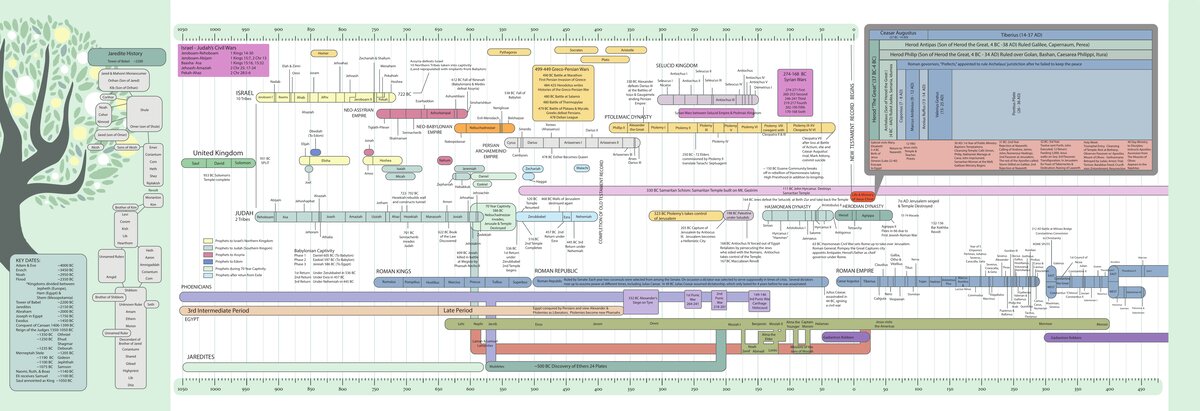
Tap to expand
Old Testament Timeline
From Creation through the Persian Period — tap the image to zoom, or download the full PDF.
Tap anywhere to close · Pinch to zoom