| Church Manuals | |
| Come Follow Me Manual — Week 32 | View |
| Scripture Helps: Old Testament | View |
| OT Seminary Teacher Manual | View |
| OT Institute Manual (Gen–2Sam) | View |
| Pearl of Great Price Manual | View |
| Scripture Reference | |
| Bible Dictionary | View |
| Topical Guide | View |
| Guide to the Scriptures | View |
| Church Media & Library | |
| Gospel for Kids (YouTube) | View |
| Bible Videos | View |
| Church Magazines | View |
| Gospel Library | View |
Week 32
For Such a Time as This
Esther 1–10
August 3–9, 2026
5-Minute Overview
Week 32 is a lesson in hidden providence — faith for the seasons when God is silent. Esther teaches that the God who is never named is never absent: He governs through 'coincidences' too precise to be chance, positions His people 'for such a time as this,' and turns the designs of the wicked back upon their own heads — 'it was turned to the contrary' (9:1). The study guide traces four Hebrew words — pur (the lot), et (the appointed time), haphak (the great reversal), and malkuth (kingdom) — and reads the rabbis' beloved Megillah, in which even the hidden name of God is heard inside the name Esther. The deliverance is remembered forever in the feast of Purim, so a rescue with no visible miracle would never be forgotten.
Weekly Resources: Week 32
Esther (1–10) — Overview
“For Such a Time as This”
Official Church Resources
OFFICIAL CHURCH RESOURCES▶
CHURCH MEDIA FOR FAMILIES▶
▶ Video Commentary
VIDEO COMMENTARY (11 videos)
▼






Specialized Audiences
WOMEN’S PERSPECTIVES (2 videos)
▶

FAMILY & CHILDREN’S RESOURCES (3 videos)
▶

Reference & Study Materials
BIBLE PROJECT VIDEOS THIS WEEK (13 videos)
▶
Book overview + theme & word study videos relevant to this week’s reading.






ACADEMIC & SCHOLARLY SITES▶
MAPS & BIBLICAL LOCATIONS▶
First, a Word About Where We Are
▶︎
Last week was a homecoming. When the Persian king Cyrus let the exiles go, the Jews who wanted to return went back to Jerusalem to rebuild the temple. This week is about the ones who stayed.
Not everyone went home. Many Jews had been living in Persia for generations, in cities far from Jerusalem, and they remained there — a scattered people (the word for this is the diaspora, "the scattering") living under a foreign king. Esther is their story.
Here is a detail worth holding onto: Esther takes place during the very same years as Ezra and Nehemiah. The king the book calls Ahasuerus is almost certainly Xerxes, who ruled Persia in between the kings those two books describe. So at the same moment last week's Jews were laying stones in Jerusalem, this week's Jews were surviving in a pagan royal court a thousand miles to the east — the same people, the same era, at opposite ends of the empire.
That difference is the whole point. The Jews back in Jerusalem had a temple, a homeland, and prophets. The Jews in Persia had none of that. They were a small, hidden minority in someone else's kingdom — no temple, no prophet, and, as we'll see, no God who ever speaks or acts out in the open. Esther asks a question the returning exiles didn't have to face the same way: How does a covenant people survive when God seems completely absent?
A Letter to Fellow Students
▶︎
Esther is the strangest book in the Old Testament, and one of the most quietly powerful — because of what it never says.
Across ten chapters of palace intrigue, deadly danger, and a last-minute rescue, the name of God is never mentioned once. No prayer is answered. No prophet speaks. No sea parts. In a Bible where God is usually the loudest voice on the page, He goes completely silent for an entire book. That silence isn't an accident — it's the whole design. And once you notice it, you can't stop noticing it. You start reading the story listening for a voice that never comes.
And yet an unseen hand is clearly arranging everything. Watch the "coincidences" pile up. A queen is removed, leaving the throne empty — before anyone knows a crisis is coming. A young Jewish orphan named Esther, raised by her cousin Mordecai, is chosen as the new queen, and she keeps her Jewish identity secret. Mordecai happens to overhear a plot to kill the king, reports it, and it gets written into the royal records — and forgotten. Then the villain arrives: Haman, so enraged that Mordecai won't bow to him that he decides to destroy every Jew in the empire. To pick the day, he casts pur — a lot, like rolling dice (3:7). A whole people's survival now hangs on one man's wounded pride and the roll of a die.
Then comes the turning point: Mordecai's message to Esther — "who knoweth whether thou art come to the kingdom for such a time as this?" (4:14) — and her answer, "if I perish, I perish" (4:16). She risks her life to approach the king, and he receives her. From there the story turns, through a chain of events too precise to be luck: one night the king "could not sleep" (6:1), so the forgotten record of Mordecai's loyalty is read aloud — at the exact moment Haman arrives to ask for Mordecai's execution. The gallows Haman built for Mordecai becomes his own (7:10). And on the very day the enemies of the Jews expected to destroy them, "it was turned to the contrary" (9:1).
The book that never names God is, start to finish, a testimony that He is running everything — most powerfully when He seems most hidden. That's what we'll sit with this week.
What's in This Week's Materials
▶︎
In the Study Guide
▶︎
The Study Guide reads the whole book and fills in its world:
- The historical context places Esther in the Persian court of Xerxes, in the royal city of Susa, and carefully separates what the book itself says from later history.
- The key passages walk through the book's five great moments — "for such a time as this," "if I perish," the sleepless night, the great reversal, and the festival of Purim — with verified quotes from general conference (Presidents Monson, Faust, and Eyring; Elder Bednar; Sister Camille Johnson).
- The word studies trace four Hebrew words — pur (lot), et (time), haphak (turn, reverse), and malkuth (kingdom) — and what the ancient Greek and Latin translations kept and lost.
- The Jewish Perspective brings in the Jewish teachers, because Esther is their book above all — the scroll (called the Megillah) read aloud every year at the festival of Purim. Several sections below draw on that tradition.
To Explore Further
▶︎
A few companion pieces go deeper on this week's themes:
- Purim — The Feast of Lots — the Jewish festival that grew out of Esther's story, and what its joy and its customs can teach Latter-day Saints about God's hidden deliverance.
- Purim: Hidden Providence, Unlikely Deliverance — how the festival illuminates God's providence and covenant faithfulness, with ties to Psalm 22 and the Passover.
- Seven Sermons from the Cross — the Savior's words from the cross, including "My God, my God, why hast thou forsaken me?" — the very Psalm 22 that Jewish tradition places on Esther's lips.
The God Who Is Never Named
▶︎
Here is what most of us read right past, because we're so used to a Bible where God is always speaking: in Esther, He isn't. Not once. There is no "and the Lord said," no answered prayer, no angel, no prophet, no miracle. The most religious moment in the book is a three-day fast (4:16) — and even there, the text pointedly never says anyone prayed or that God answered. For one whole book of scripture, heaven is quiet.
You could read that as a book where God is absent. And the whole art of Esther is to make you feel that absence — and then make it impossible to believe.
Because look at the "coincidences" side by side. A king, in a drunken rage, removes his queen — years before a Jewish girl will need that empty throne. That girl's cousin happens to overhear an assassination plot, and the record is filed away and forgotten — until the one night, years later, when the king can't sleep and asks for old records to be read, and those are the pages that come up, at the exact hour Haman is walking in to demand that cousin's death. A villain builds a gallows tall enough to be seen across the city — and dies on it himself. A lot is rolled to pick a random day for genocide, and that random day becomes the day of rescue. Any one of these is a coincidence. All of them in a row, all pointing the same direction, are something else.
That is the message of the book: hidden providence. God is completely in control — but He works through means so ordinary they look, from the inside, like luck. He isn't in the whirlwind or the fire here. He is in the king's insomnia. He is in the forgotten file. He is in the timing of a footstep at a door. The book leaves His name out so that you'll do the one thing that teaches you to see Him: look at the whole pattern and draw the conclusion yourself.
The Jewish teachers, who love this book, saw that hiddenness written into its very language. (These teachers are called the rabbis, and their collected discussions, written down over centuries, are called the Talmud.) They asked a playful question: where might the story of Esther be hidden in the earlier books of the Bible? Their answer is unforgettable. In the book of Deuteronomy, God warns that if His people turn away, "I will surely hide (in Hebrew, haster astir) my face" (Deuteronomy 31:18). And the name Esther sounds almost exactly like the Hebrew word astir, "I will hide." So the book of the hidden God is heard, they said, right inside God's promise to hide His face — a phrase they called hester panim, "the hiding of the face" (Talmud, Chullin 139b). For a book about a God who hides, they found the whole thing hidden in plain sight.
Here is why this matters for you and me. Most of us don't live in the book of Exodus, with its pillars of fire and parted seas. We live in the book of Esther. Most days we don't hear a voice from heaven or watch a miracle. We face real trouble with no visible answer — and we're tempted to conclude God is absent. Esther says: no. The silence is not absence. "Verily thou art a God that hidest thyself, O God of Israel, the Saviour" (Isaiah 45:15) — the God who hides His face is not the missing God but the saving one, working the whole time behind events you'll only recognize when you look back. The rabbis put it as a rule: God "does not strike at the Jewish people unless He has already created a remedy for them beforehand" (Talmud, Megillah 13b). Read Esther and you'll see it — the queen was already crowned (chapter 2) before the villain even hatched his plot (chapter 3). The cure was in place before the wound.
You can't see God's hand while you're inside the moment. You can only see it when you turn around and look at the whole shape of things. Esther is a book-length invitation to turn around and look.
A Parable Heard, Not Written
▶︎
Read as a kind of parable, the book opens with two queens, and the contrast between them says a lot.
The first is Vashti. Her name is Persian and means "beautiful," or "most desirable." She is the queen the king shows off — summoned to appear "to shew the people and the princes her beauty" (1:11). And she refuses to come. "Vashti refused to come at the king's commandment" (1:12), and the crown is taken from her.
In her place comes a hidden Jewish girl with two names: Esther, and her Hebrew name Hadassah, which means "myrtle," a small evergreen tree (2:7). That's a hopeful name. The prophet Isaiah uses the myrtle as a picture of God restoring His people: "instead of the brier shall come up the myrtle tree… for an everlasting sign that shall not be cut off" (Isaiah 55:13; see also Isaiah 41:19). And there's a gentle wordplay a Hebrew ear would catch: Hadassah sounds like chadashah, the Hebrew word for "new." It's the kind of echo you hear rather than read — fitting for a book that says so much without saying it out loud. One queen was desired and would not answer the king's call; the other was hidden, and became a sign of new life.
That movement — an old order making way for a new one — runs all through scripture, and it is a story of renewal, not rejection. God promised His people "a new covenant" (Jeremiah 31:31), which was fulfilled in Jesus Christ. He points us beyond the old Jerusalem to a "new Jerusalem, coming down from God out of heaven" (Revelation 21:2) — the holy city that latter-day revelation places at the center of the last-days gathering of Israel (Ether 13:3–10). Again and again, what has grown old is not thrown away but made new — the myrtle rising up where the brier once stood, life that "shall not be cut off."
And this is not only about covenants and cities. It is about us. Most of us know what it is for an old life to end and a new one to begin. Sometimes the change comes from our own mistakes, or someone else's; sometimes it is simply circumstance — a divorce, a death, a move, the loss of a job or a place we loved. In those seasons we can feel cut off: from God, from the person we used to be, from people we love. It is a kind of personal diaspora, a scattering of our own. Esther's story is written for exactly those moments. It quietly promises that letting go of the old is often how we take hold of the new — and that the God who seems most absent is often most at work, already preparing, out of sight, the ground on which we will rebuild and begin again.
The Jewish festival of Purim, which celebrates Esther's story, keeps that theme of things not being what they seem. It's a joyful holiday of costumes and masks — a fitting way to remember a book in which God's people live in disguise, their queen hiding her very identity (2:10), surviving in a court full of foreign gods and rival powers where God is never once named.
And that's a picture of our world, too. In the last days, God's covenant people again live in a place where heaven can seem silent, surrounded by many competing voices and loyalties. Esther's story asks us the same question it asked her: when the King calls, will we be too comfortable to answer — or will we rise "for such a time as this"? Are we listening?
"For Such a Time as This"
▶︎
The most famous line in Esther is also the most misused, so let's read it slowly. When Mordecai learns of the plan to destroy the Jews, he sends word that Esther must go to the king and plead for her people. She hesitates — and for good reason: approaching the king uninvited could get her killed (4:11). Mordecai's answer is the heart of the whole book:
"For if thou altogether holdest thy peace at this time, then shall there enlargement and deliverance arise to the Jews from another place; but thou and thy father's house shall be destroyed: and who knoweth whether thou art come to the kingdom for such a time as this?" (4:14)
Notice what he does not say. He does not say, "It all depends on you." Just the opposite: rescue "will arise… from another place" — with or without her. God's purpose is certain. Esther is not holding up the universe. And yet — in the same breath — "who knoweth whether thou art come to the kingdom for such a time as this?" Her position is not an accident. She has been placed, on purpose, exactly where the crisis will be decided. If she refuses the moment, she loses it (and dies anyway).
This is the book turning down two easy mistakes at once. It rejects giving up — "nothing I do matters; God will handle it." And it rejects self-reliance — "it all rests on me." It holds both truths together: God's purpose is sure, and your courage is still required. God arranges the moment; you still have to walk into the room.
That's why the verse has become shorthand for a real principle. President Monson applied it straight to us: "you are some of our Heavenly Father's strongest children, and He has saved you to come to the earth 'for such a time as this'" (May You Have Courage, April 2009). President Faust told the women of the Church the same: "I believe your spirits may have been reserved for these latter days; that you, like Esther, have come to earth 'for such a time as this'" (The Virtues of Righteous Daughters of God, April 2003). This isn't flattery — it's responsibility. If God places people on purpose, then your place is an assignment, and the courage it asks of you is the reason you're there.
So the question Esther leaves us with isn't "are you important?" It's sharper: Where has God placed you — and what is that placement asking of you right now?
"If I Perish, I Perish"
▶︎
God sets the stage. But courage still has to step onto it. And Esther's courage is worth a close look, because of what it's made of.
"…so will I go in unto the king, which is not according to the law: and if I perish, I perish." (4:16)
She has no guarantee. The king may welcome her or he may not, and nothing promises which. She doesn't know how it ends. What she does decide is how she'll face it — and her decision has three parts. Fasting: she calls the whole community to fast with her for three days. Faith: she acts without knowing the outcome. And surrender: "if I perish, I perish" — she hands the ending to God. That's the opposite of both shrinking back and self-confidence. She neither runs away nor trusts in her own cleverness. She turns herself over, and walks in.
President Monson summed it up: "Esther had gathered her courage and would stand firm and immovable for that which was right… Esther, through fasting, faith, and courage, had saved a nation." Sister Camille Johnson described the same surrender as letting God write the story: "Esther is another beautiful example of letting God prevail. Rather than sticking with a cautious narrative of self-preservation, she exercised faith, turning herself completely over to the Lord" (Invite Christ to Author Your Story, October 2021). And Johnson named the hard part: Esther "was willing to let the Savior write her story even though, through the lens of mortality, the ending may have been tragic." That is what "if I perish, I perish" means. It isn't confidence that everything will work out. It's the willingness to do the right thing and let God hold the outcome — the same faith three young men showed before another royal death sentence: "our God whom we serve is able to deliver us… But if not… we will not serve thy gods" (Daniel 3:17–18).
There's a deeper pattern here, too. Someone who steps between a doomed people and the throne, willing to die so they can live, is a figure the Old Testament keeps reaching toward — and it points forward to Jesus Christ, who fulfilled it. In offering her life for her people, as the Interpreter Foundation's study aid puts it, Esther "becomes a type of Jesus Christ" — an early picture of the Savior, "willing to die to save her people." Centuries later, President Lorenzo Snow told the covenant people the same could be asked of them: "It may become necessary in the future… for some of the Saints to act the part of Esther" — to "sacrifice anything and everything… for the purpose of working out the deliverance" of God's people (Journal of Discourses 23:290).
It Was Turned to the Contrary
▶︎
Then everything flips — and it flips completely. The whole book is built on reversal, and it says so in its own words: "it was turned to the contrary" (9:1). The Hebrew phrase there is venahafoch hu, "and it was turned around," and it became the Jewish nickname for the entire story — the great turnaround (a Jewish commentary called Esther Rabbah 10 calls it a miracle "the like of which has never been performed").
Look at how complete the reversal is. Haman builds a towering gallows for Mordecai — and dies on it himself (7:10). The lot cast to destroy the Jews ends up marking the day of their rescue. The decree of death is answered by a decree of life. "The month which was turned unto them from sorrow to joy" (9:22). And the book explains exactly how: the king ordered that Haman's "wicked device, which he devised against the Jews, should return upon his own head" (9:25). That's not just a satisfying ending. It's a law scripture teaches everywhere — "Whoso diggeth a pit shall fall therein" (Proverbs 26:27); "His mischief shall return upon his own head" (Psalm 7:16), the very phrase Esther uses of Haman. The trap the wicked set for the righteous tends to snap shut on the one who set it: in the end, the wicked dig their own pit. When someone sets out to deliberately plot against God and His people, He will often simply let them go — giving them, as the saying goes, enough rope to hang themselves. Haman spent the whole book building the very gallows he would die on. The Book of Mormon says the same — Nephi saw "that great pit… shall be filled by those who digged it" (1 Nephi 14:3) — and the Prophet Joseph Smith, writing from Liberty Jail while his own enemies seemed to be winning, turned Esther's reversal into a promise: "the Lord so ordered that Haman was hanged upon his own gallows. So shall it come to pass with poor Haman in the last days" (Personal Writings of Joseph Smith, p. 375).
But notice one crucial thing, or you'll misread the book: Esther and Mordecai never build the gallows. They dig no pit and take no revenge. The reversal is done to Haman, not by them. That's what keeps it God's justice instead of human payback. The righteous simply do what's right — Esther risks her life, Mordecai won't bow — and leave the turning around to God. The lesson of venahafoch hu is not that we get to repay evil; it's that we don't have to. "Thou hast turned for me my mourning into dancing" (Psalm 30:11); "ye thought evil against me; but God meant it unto good" (Genesis 50:20). The God who hides is the God who turns things around — quietly, completely, and right on time.
When History Rhymes
▶︎
Haman is not just any villain — the book gives him a family line, and it matters. It calls him "the Agagite" (3:1), meaning he descended from Agag, king of the Amalekites. The Amalekites were an ancient enemy of Israel. Centuries earlier, God had told King Saul to defeat them completely, and Saul disobeyed and spared their king (1 Samuel 15:8–9). "To obey is better than sacrifice," the prophet Samuel warned him (1 Samuel 15:22), and Saul lost his throne over that disobedience. Now, generations later, a descendant of the enemy Saul let live has risen to power in Persia and is trying to destroy every Jew in the empire. The lesson is sobering: a disobedience left unfinished doesn't simply disappear. It can wait, and come back.
There's a strange detail near the end of the book. After Haman is already dead, Esther asks the king to let Haman's ten sons be hanged the next day as well (9:13–14). Why ask to hang men who are already dead? The Jewish teachers — who count Esther as one of Israel's prophetesses (in the Talmud, Megillah 14a) — read her request as a kind of prophecy: that this same pattern would return one day. And in a way that startled people, it seemed to. On October 16, 1946, ten Nazi leaders were hanged for their crimes after the Nuremberg war-crimes trials. One of them, a man named Julius Streicher, reportedly shouted from the gallows, "Purimfest 1946!" — naming the very festival that celebrates Haman's downfall (TheTorah.com studies the connection; Newsweek reported his words). The point is not that Esther predicted World War II. The point is something scripture teaches better than any other book: history moves in patterns, and the evil a person plots against God's people has a way of returning on his own head. Learning to see the pattern is part of learning to trust God.
And there's one more echo, the most tender of all. In her most frightened moment, Jewish tradition places the words of Psalm 22 on Esther's lips: "My God, my God, why hast thou forsaken me?" It was a psalm many Jewish mothers taught their children, and some Jewish communities still read it on the fast day before Purim. Those are the exact words the Savior speaks from the cross (Matthew 27:46). Both Esther and Jesus stand alone, feeling abandoned, between a doomed people and death — and both are heard. This is part of why Esther points us toward Christ: like Him, she was willing to die to save her people, and both pray the very same prayer. (For more on all of this, see the culture guide Purim — The Feast of Lots, the article Purim: Hidden Providence, and Seven Sermons from the Cross.)
So when we meet our own "Hamans" — an old mistake we never dealt with, or an enemy who seems to hold all the power — Esther shows us what to do. Do your part with courage and covenant faithfulness. Speak the truth. Then let God do what you cannot. Remember: Esther and Mordecai never built the gallows. Haman built his own.
The Feast of Remembering
▶︎
The book ends by building a memory on purpose. Because the day chosen for destruction became the day of rescue, Mordecai and Esther set up an annual festival called Purim — named "after the name of Pur," the lot Haman cast (9:26) — so that "these days should be remembered and kept throughout every generation" (9:28). And it's a wonderfully ordinary way to remember an extraordinary rescue: not a monument, but "feasting and joy, and of sending portions one to another, and gifts to the poor" (9:22).
That fits the book perfectly. Esther has no pillar of fire to point back to, no parted sea — only a string of "coincidences" that, retold every year, become a testimony. And that's the deep lesson of Purim: remembering is how we make the hidden hand visible. You can't see God's providence while you're living through it; you can see it when you look back and tell the story. So the tradition built a festival whose whole purpose is to make people look back once a year and say, out loud, look what God did — even in a story where God is never named.
President Eyring taught the same habit. He described pausing each night to ask himself one question: "Have I seen the hand of God reaching out to touch us or our children or our family today?" And he urged us to "find ways to recognize and remember God's kindness. It will build our testimonies" (O Remember, Remember, October 2007). That's a personal Purim — a way to keep your own quiet rescues from fading. The sacrament is the same instinct at the center of our worship: bread and water taken "in remembrance," so we "always remember him" (Moroni 4:3). A rescue we forget is a rescue half-lost. Esther teaches us to build the memory on purpose.
The Invitation
▶︎
Esther is the book for a silent heaven.
It's the book for everyone who has faced a real crisis with no voice from above and no obvious miracle, and wondered whether God had left the room. Its answer is not that He was gone, but that He was hidden — running every "coincidence," preparing the rescue before the danger, turning the whole thing around at just the right moment. So this week leaves us with a few honest, practical questions:
Can you read your own life the way Esther asks you to read the book — turning around, looking at the whole shape of it, and letting the pile of "coincidences" become a testimony? Where has God placed you "for such a time as this," and what courage is that placement asking of you now? When the frightening decision comes, can you do the right thing and, like Esther, hand the ending to God — "if I perish, I perish"? When someone digs a pit for you, can you leave the turnaround to God instead of building a gallows of your own? And will you build your own "Purim" — some regular habit of remembering — so your quiet rescues are never forgotten?
The name of God is never spoken in Esther. And He is never, for one single moment, absent. "Verily thou art a God that hidest thyself, O God of Israel, the Saviour." He is hidden. He is here. And He has brought you, too, to the kingdom for such a time as this.
Week 32
Esther (1–10) — Overview
"For Such a Time as This"
1. Week 32: Overview
The book of Esther is the strangest book in the Old Testament — and one of its most quietly profound — because of what it never says. Across ten chapters of court intrigue, mortal danger, and last-minute rescue, the name of God is never mentioned once. No prayer is recorded as answered; no prophet speaks; no miracle parts a sea. And yet, from beginning to end, the reader watches an invisible hand arrange every "coincidence" — a Jewish orphan crowned queen just before the crisis, a loyal deed recorded and then forgotten until the exact night it was needed, a king who cannot sleep, a villain who walks into his own trap. Esther is the Bible's masterclass in hidden providence: the God who is never named is never absent.
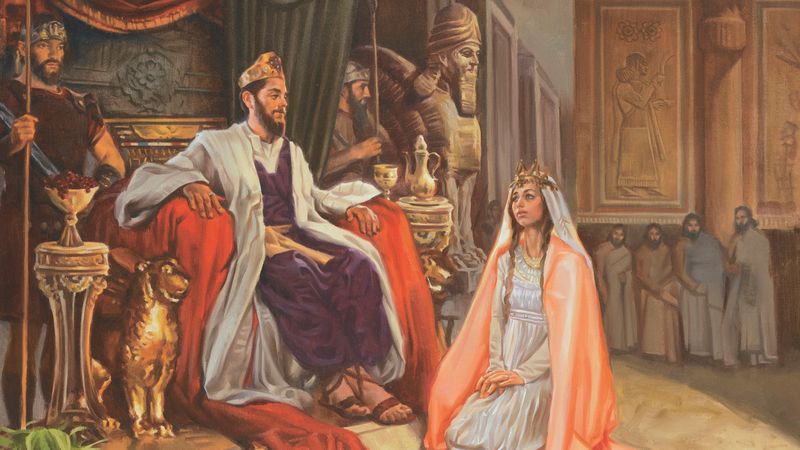
The story unfolds in the Persian court of Ahasuerus, who reigned "from India even unto Ethiopia, over an hundred and seven and twenty provinces" (1:1). When Queen Vashti is deposed, a Jewish girl named Esther (Hadassah), raised by her cousin Mordecai, is chosen as queen — her people kept secret. When the king's favorite, Haman, is enraged that Mordecai will not bow, he plots to destroy every Jew in the empire and casts pur — the lot — to fix the day (3:7). Into that death sentence comes the book's turning point: Mordecai's charge to Esther — "who knoweth whether thou art come to the kingdom for such a time as this?" (4:14) — and her answer, "if I perish, I perish" (4:16).
What follows is a series of reversals so precise they can only be read as designed. Esther risks her life, is received, and springs her trap over two banquets. The gallows Haman built for Mordecai becomes Haman's own (7:10). The decree of doom is answered by a decree of deliverance, and on the very day the Jews' enemies "hoped to have power over them," the text says, "it was turned to the contrary" (9:1). The deliverance is memorialized forever in the feast of Purim. The book that never names God is, from first verse to last, a testimony that He governs history — most powerfully when He seems most hidden.
All ten chapters are assigned this week. Use this table as a map — each block is discussed in the walkthrough below.
| Chapter(s) | Content | Assigned |
|---|---|---|
| Esther 1 | Ahasuerus's feast; Queen Vashti deposed | Yes |
| Esther 2 | Esther crowned queen; her people kept secret; Mordecai uncovers a plot | Yes |
| Esther 3 | **Haman promoted; Mordecai will not bow; the pur cast; the decree against the Jews** | Yes |
| Esther 4 | Mordecai's charge — "for such a time as this"; Esther's "if I perish, I perish"; the fast | Yes |
| Esther 5 | Esther risks the king's court; the golden sceptre; the banquets begin; Haman's gallows | Yes |
| Esther 6 | The sleepless king; Mordecai honored; Haman's humiliation | Yes |
| Esther 7 | Esther exposes Haman; Haman hanged on his own gallows | Yes |
| Esther 8 | Mordecai elevated; the counter-decree; the Jews permitted to defend themselves | Yes |
| Esther 9 | "It was turned to the contrary"; deliverance; Purim instituted | Yes |
| Esther 10 | The greatness of Mordecai | Yes |
Note: The name of God does not appear in the Hebrew book of Esther. (The Greek Septuagint contains later "Additions to Esther" with prayers and God-language, but these are not part of the Hebrew or KJV text and are not this week's reading — see Historical Cultural Context.)
Vashti Deposed (Esther 1) — assigned
The story opens in extravagance: Ahasuerus, ruler of 127 provinces, throws a 180-day display of "the riches of his glorious kingdom" (1:4), capped by a seven-day feast at Susa. On the seventh day, "merry with wine," he summons Queen Vashti to parade her beauty before the court; she refuses. Humiliated, and counseled that her defiance will embolden every wife in the empire, the king deposes her by irrevocable decree (1:19). The vacancy on the throne is the first "accident" the story will use — a queen removed, a place prepared, before anyone knows a crisis is coming.
Esther Becomes Queen (Esther 2) — assigned
In Susa lives Mordecai, a Jew of the Babylonian exile, who has raised his orphaned cousin Hadassah — Esther — "fair and beautiful" (2:7). In the search for a new queen she is taken into the palace and, above all the others, "the king loved Esther… so that he set the royal crown upon her head" (2:17). On Mordecai's instruction she keeps her people secret (2:10, 20). Then a small, easily-missed detail: Mordecai overhears two officials plotting to kill the king, reports it through Esther, and the deed "was written in the book of the chronicles" (2:23) — and promptly forgotten. The reader files it away. So, it turns out, did heaven.
Haman's Plot and the Lot (Esther 3) — assigned
The king promotes Haman above all his princes, and all bow to him — except Mordecai, who will not (3:2). Enraged, and scorning to lay hands on Mordecai alone once he learns he is a Jew, Haman resolves "to destroy all the Jews… throughout the whole kingdom" (3:6). He casts Pur, that is, the lot (3:7), to select the day, and secures a sealed royal decree that on the thirteenth of Adar all Jews — "both young and old, little children and women, in one day" — are to be killed (3:13). The death of an entire people now hangs on a courtier's wounded pride and the fall of a lot.
"For Such a Time as This" (Esther 4) — assigned
Mordecai puts on sackcloth and mourns publicly, and sends the decree to Esther with a plea that she go to the king. Esther hesitates — to approach the king unbidden is death unless he extends his sceptre. Mordecai's reply is the theological center of the book: "Think not with thyself that thou shalt escape… For if thou altogether holdest thy peace at this time, then shall there enlargement and deliverance arise to the Jews from another place… and who knoweth whether thou art come to the kingdom for such a time as this?" (4:13–14). Deliverance will come, Mordecai insists — the only question is whether Esther will be its instrument. Her answer is total: gather the Jews to fast three days, "and so will I go in unto the king, which is not according to the law: and if I perish, I perish" (4:16).
The Banquets and the Sleepless Night (Esther 5–6) — assigned
Esther approaches; the king extends the golden sceptre; she is received (5:2). Rather than blurt out her petition, she invites the king and Haman to a banquet, and then to a second (5:4–8). Haman leaves elated — and, goaded by his wife and friends, builds a gallows fifty cubits high for Mordecai (5:14). That very night "could not the king sleep" (6:1); he calls for the royal chronicles to be read, and hears the forgotten account of Mordecai's loyalty. When Haman arrives to request Mordecai's execution, the king asks him instead how to honor a man the king delights in — and Haman, sure it must be himself, prescribes a lavish public tribute, only to be ordered to lead Mordecai through the city in it (6:6–11). The reversal has begun, engineered by a night's insomnia.
Haman's Fall (Esther 7) — assigned
At the second banquet the king asks Esther's petition, and she at last reveals both her people and their peril: "we are sold, I and my people, to be destroyed" (7:4). When the king demands who dares such a thing, she names him: "The adversary and enemy is this wicked Haman" (7:6). In his rage the king orders Haman hanged — on the very gallows "that he had prepared for Mordecai" (7:10). The trap has closed on the one who set it.
The Reversal and Purim (Esther 8–10) — assigned
Because a Persian decree cannot be revoked (8:8), the king authorizes a counter-decree: the Jews may gather and defend themselves (8:11). Mordecai, now clothed in royal apparel, goes out to a city that "rejoiced and was glad" (8:15). On the appointed day of their destruction the tables turn completely: "in the day that the enemies of the Jews hoped to have power over them, (though it was turned to the contrary, that the Jews had rule over them that hated them)" (9:1). Mordecai and Esther establish the annual feast of Purim — "after the name of Pur" (9:26) — days "of feasting and joy, and of sending portions one to another, and gifts to the poor" (9:22), so the deliverance would never be forgotten. The book closes with Mordecai second only to the king, "seeking the wealth of his people" (10:3).
"Who knoweth whether thou art come to the kingdom for such a time as this?"
"…in the day that the enemies of the Jews hoped to have power over them, (though it was turned to the contrary…)."
Esther teaches faith for the seasons when God is silent. No voice from heaven tells Esther what to do; no miracle guarantees her safety. There is only a series of ordinary events — a beauty contest, a court record, a sleepless night — that, taken together, are too precise to be chance. The book asks its reader to trust that the same hidden hand is at work in their own unremarkable circumstances, and that they, too, may have been placed exactly where they are "for such a time as this." Providence and courage are not rivals here: God arranges the moment, and Esther still has to walk into the throne room.
1. THE THRONE EMPTIED (Esther 1)
   Vashti deposed — a place prepared before the crisis appears
        ↓
2. THE QUEEN AND THE RECORD (Esther 2)
   Esther crowned (people hidden); Mordecai's loyal deed written down and forgotten
        ↓
3. THE PLOT AND THE LOT (Esther 3)
   Haman's decree of genocide; the pur cast for the day
        ↓
4. "FOR SUCH A TIME AS THIS" (Esther 4)
   Mordecai's charge; Esther's "if I perish, I perish"; the fast
        ↓
5. BANQUETS & A SLEEPLESS NIGHT (Esther 5–6)
   Esther's two feasts; Haman's gallows; the king reads the chronicles; Mordecai honored
        ↓
6. THE TRAP CLOSES (Esther 7)
   Haman exposed and hanged on his own gallows
        ↓
7. THE GREAT REVERSAL & PURIM (Esther 8–10)
   Counter-decree; "turned to the contrary"; deliverance memorialized in Purim
- It teaches faith when God seems silent. Esther is the book for every believer who has faced a crisis with no voice from heaven and no visible miracle. Its answer is not that God was absent, but that He was hidden — governing through events that only look like coincidence until you see them whole.
- It shows providence and agency working together. "Deliverance shall arise… from another place," Mordecai says — God's purpose is sure; but Esther must still choose to act, at the risk of her life. The book refuses both fatalism ("nothing I do matters") and self-reliance ("it all depends on me").
- It defines "for such a time as this." The verse has become shorthand for a true principle: that God places people — in a family, a job, a ward, a friendship, a nation — where their particular courage is needed. Position is a stewardship, not an accident.
- It portrays the reversal of the wicked. Haman hanged on his own gallows, the lot of destruction "turned to the contrary" — the book is a sustained picture of God overturning the designs of those who would destroy His people, often by their own devices.
- It commands remembering. Purim exists so that a deliverance would never fade from memory. The impulse to memorialize what God has done — in feasts, in records, in retelling — is one the covenant people have always shared, and one the Restoration renews in its own remembering.
Next file: 02_Historical_Cultural_Context.md
2. Week 32: Historical & Cultural Context
Esther is a story of the Jews who stayed. Last week's reading followed the exiles who went up — home to Jerusalem to rebuild the temple and the wall. But not everyone returned. A large Jewish community remained scattered across the Persian Empire, and Esther is their story: covenant people living far from the promised land, under a foreign crown, keeping (or hiding) their identity in a world that did not share their faith. The book is set in the royal city of Susa during the reign of a Persian king the Hebrew calls Ahasuerus — and it unfolds inside the very century Ezra and Nehemiah cover, in the long gap between the temple's completion and Ezra's arrival. This section fills in that Persian world.
The Hebrew names the king Ahasuerus (אֲחַשְׁוֵרוֹשׁ). He is most commonly identified with Xerxes I of Persia — the Achaemenid king who reigned c. 486–465 BC (World History Encyclopedia, Xerxes I). "Ahasuerus" is the Hebrew rendering of the Old Persian throne name behind the Greek "Xerxes." The identification fits the book's chronology — Xerxes reigned between Darius I (who finished the temple, Ezra 6) and Artaxerxes I (under whom Ezra and Nehemiah came up) — which places Esther's story squarely in the Ezra–Nehemiah era, among the Jews who had not returned.
The king of Esther is drawn as impulsive and easily steered — deposing a queen in a fit of wounded pride (Esther 1), signing away an entire people on a favorite's word (Esther 3), unable to sleep and so stumbling onto the record that saves Mordecai (Esther 6). The book never editorializes about him; it simply lets an all-powerful, unreflective monarch become, again and again, the unwitting instrument of a deliverance he never intends.
Here is a connection almost no one makes when they read Esther — and it changes how you see the whole book. King Ahasuerus is Xerxes, and Xerxes is one of the most famous kings in Western history, for a reason that has nothing to do with the Bible: he led the great Persian invasion of Greece. The battles of that war — Thermopylae (the stand of the 300 Spartans), the burning of Athens, and the sea-battle of Salamis — are the stuff of Western legend, taught in every world-history class. And they happened during the book of Esther.
Watch how the timeline fits. Esther opens with a staggering 180-day display of the empire's wealth and might, held in Xerxes' third year (Esther 1:3). The Greek historian Herodotus (Histories, Books 7–9) describes exactly such a gathering — the war-council where Xerxes rallied his empire to march on Greece. Then Esther's story quietly pauses: four years pass before a Jewish girl becomes queen in the king's seventh year (Esther 2:16). That four-year gap is not empty — it is the war. Xerxes marched west in 480 BC (Thermopylae, Athens burned, then a crushing naval defeat at Salamis) and came home, beaten, in 479 BC — to the very events of Esther 2. The rich, impulsive, easily-swayed king the book portrays is the same Xerxes the Greek historians knew.
The famous battles the book sits between:
- 490 BC — Xerxes' father Darius invades Greece and is stopped at Marathon.
- 480 BC — Xerxes' own invasion: Thermopylae, Athens burned, defeat at Salamis.
- 479 BC — Persia is beaten for good at Plataea; Xerxes returns to the events of Esther.
Why does this matter for a Latter-day Saint? Because it sets the covenant people at the exact hinge of world history. Xerxes' failure in Greece began the slow decline of Persia. A century and a half later, Alexander the Great swept east and destroyed the empire (331–330 BC) — the very empire of Esther — and out of his conquest came the Greek age of language and culture that would shape the world into which Jesus was born. The prophet Daniel, in this same Persian court, foresaw it: a "he goat" charging "from the west" (Daniel 8:5), which the angel names "the king of Grecia" (Daniel 8:21). The small, hidden story of a queen in Susa sits inside the loud story of empires rising and falling — and the same hidden hand governs both.
The story is set in Shushan the palace (Esther 1:2) — Susa, one of the Achaemenid Empire's principal royal cities, in what is now southwestern Iran. An ancient city long predating the Persians, Susa was rebuilt into a grand administrative capital by Darius I, whose great palace and apadana (columned audience hall) stood there; the Persian kings wintered at Susa and summered at the higher, cooler Ecbatana and Persepolis (World History Encyclopedia, Susa). Susa is named in the Bible in Ezra, Nehemiah, and Daniel, but "most notably" in the book of Esther, whose whole drama plays out in its palace, its courts, and its city streets.
The setting matters. Esther's world is not a Jewish world; it is the beating heart of a pagan empire — the throne room, the harem, the king's gate where Mordecai sits. The covenant people are a hidden minority inside it, and the book's tension comes from that fact: a Jewish queen who cannot reveal she is Jewish, in the most exposed and dangerous house in the empire.
The Achaemenid Empire (c. 550–330 BC) was the largest the world had yet seen, stretching, in Esther's own words, "from India even unto Ethiopia" (Esther 1:1). Historically, the empire was organized into a number of large satrapies — great provincial governorships, on the order of twenty, each under a satrap answerable to the king (World History Encyclopedia, Persian Government; Achaemenid Empire).
The book of Esther, however, describes the realm as "an hundred and seven and twenty provinces" (Esther 1:1) — using the Hebrew medinah (מְדִינָה), a smaller administrative district, not the great satrapy.
One of Esther's engines is the irrevocability of Persian law. When Vashti is deposed, it is written "among the laws of the Persians and the Medes, that it be not altered" (Esther 1:19). When Haman's decree of genocide goes out "sealed with the king's ring," the same principle traps the king himself: even after Haman falls, the first decree cannot simply be cancelled — "the writing which is written in the king's name, and sealed with the king's ring, may no man reverse" (Esther 8:8). So the Jews are saved not by revoking the death sentence but by a counter-decree permitting them to defend themselves. The whole plot turns on a law that, once sealed, cannot be unsealed.
The king's signet ring (Esther 3:10; 8:2) is the era's instrument of absolute authority — a seal pressed into clay or wax that made a document the king's own irreversible word. When the king takes the ring from Haman and gives it to Mordecai (8:2), the transfer of the ring is the transfer of power.
Esther's community is the Jewish diaspora — the descendants of those carried into exile who did not return to Judah when Cyrus opened the door. Mordecai is introduced as one "who had been carried away from Jerusalem with the captivity" (Esther 2:6), living in Susa generations into the dispersion. These are Jews fully embedded in the Persian world — Mordecai sits "in the king's gate" (2:19), a place of officialdom; Esther can be taken into the royal house without her origins being known.
That embeddedness is the book's quiet drama. It raises questions the returned community of Ezra–Nehemiah did not face in the same way: How does a covenant people survive when it is a scattered minority, its identity hideable, with no temple, no homeland underfoot, and no visible sign of God? Esther's answer is not a program but a person — a woman placed, providentially, exactly where her people's survival would be decided.
The single most distinctive feature of Esther is a matter of the text itself: the name of God never appears in the Hebrew book of Esther. No divine title, no recorded prayer that is answered in so many words, no prophet, no miracle. The nearest the book comes is Mordecai's oblique certainty that "enlargement and deliverance" will "arise to the Jews from another place" (Esther 4:14) — a deliverance whose source he does not name. The book's entire theology is carried by events: coincidences too precise, and reversals too complete, to be read as chance. This silence is not an accident of transmission; it is the book's art. (It is discussed as the week's central insight in the Overview and traced in the rabbis' reading in Jewish Perspective.)
One thing to keep straight: the Greek Septuagint version of Esther contains six large "Additions to Esther" (labeled A–F) that are not in the Hebrew — including prayers of Mordecai and Esther, and explicit language about God. These Additions are deuterocanonical: they are not part of the Hebrew Bible or the King James Old Testament, and they are not this week's reading. The famous "God is unnamed" feature is a fact about the Hebrew/KJV book; do not read the Greek Additions' God-language back into it.
The book closes by founding a festival. Because the day the lot chose for the Jews' destruction became instead the day of their deliverance, Mordecai and Esther write to establish Purim — "after the name of Pur" (Esther 9:26) — as an annual observance "throughout every generation" (9:28), kept with "feasting and joy, and of sending portions one to another, and gifts to the poor" (9:22). Purim is unusual among biblical feasts: it commemorates not an exodus or a covenant at a mountain but a hidden rescue in a foreign court — a deliverance with no visible miracle at all. The Jewish tradition's rich observance of Purim, and its reading of the whole book, are treated in Jewish Perspective.
| Source | Citation | Link |
|---|---|---|
| World History Encyclopedia — Xerxes I | Xerxes I, r. 486–465 BC; the king most commonly identified with Ahasuerus | worldhistory.org/Xerxes_I |
| World History Encyclopedia — Susa | Susa = Hebrew Shushan; Achaemenid royal city rebuilt by Darius I; setting of Esther | worldhistory.org/susa |
| World History Encyclopedia — Persian Government | Achaemenid administration by satrapies (≈20), each under a satrap | worldhistory.org/Persian_Government |
| World History Encyclopedia — Achaemenid Empire | The empire c. 550–330 BC; "India even unto Ethiopia" scale | worldhistory.org/Achaemenid_Empire |
Next file: 03_Key_Passages_Study.md
3. Week 32: Key Passages Study
The Text
"For if thou altogether holdest thy peace at this time, then shall there enlargement and deliverance arise to the Jews from another place; but thou and thy father's house shall be destroyed: and who knoweth whether thou art come to the kingdom for such a time as this?" (4:14)
The Insight
This is the theological center of the book — and it holds two truths in tension. First, God's purpose is sure: "enlargement and deliverance" will come to the Jews, "from another place," whether Esther acts or not. The deliverance does not depend on her. Second, her calling is real: she has been brought "to the kingdom" — placed, at real cost, exactly where the crisis will be decided — and if she refuses the moment, she forfeits it (and perishes anyway). Mordecai names no divine agent; he simply assumes one. Behind the beauty contest and the palace politics stands a Providence that positions people. The verse has become shorthand for a principle: that God places His children — in a family, a calling, a friendship, a nation — where their particular courage is needed, and that position is a stewardship, not an accident.
Latter-day Saint Connections
- President Thomas S. Monson, "May You Have Courage" (April 2009) — retelling Esther, he applies her moment to us: "But you are some of our Heavenly Father's strongest children, and He has saved you to come to the earth 'for such a time as this.'"
- President James E. Faust, "The Virtues of Righteous Daughters of God" (April 2003): "These are challenging times. I believe your spirits may have been reserved for these latter days; that you, like Esther, have come to earth 'for such a time as this.'"
- Scripture: "For behold, this is my work and my glory — to bring to pass the immortality and eternal life of man" (Moses 1:39) — the God who has a purpose in history is the God who has a purpose in placing you. Cf. Acts 17:26, that God "hath determined the times before appointed, and the bounds of their habitation."
Study Questions
- Mordecai says deliverance will come "from another place" regardless — yet still urges Esther to act. How does the book hold providence and personal responsibility together without collapsing one into the other?
- Where has God placed you — in what family, calling, or circumstance — "for such a time as this"? What courage might that placement be asking of you?
The Text
"Go, gather together all the Jews that are present in Shushan, and fast ye for me, and neither eat nor drink three days, night or day: I also and my maidens will fast likewise; and so will I go in unto the king, which is not according to the law: and if I perish, I perish." (4:16)
The Insight
Esther's answer is the courage that providence still requires. Nothing guarantees her safety — to approach the king unbidden is death unless he extends the golden sceptre (4:11). She does not know how it will end; she only decides how she will meet it. Notice what her decision is made of: fasting (three days, the whole community with her), faith (she acts without a promise of the outcome), and surrender ("if I perish, I perish" — she gives the ending to God). It is the opposite of both fatalism and self-reliance: she neither shrinks back nor trusts her own cleverness. She turns herself over and walks in.
And there is a pattern in that surrender worth naming. An intercessor who stands between a condemned people and a king's wrath, willing to die so they can live, is a figure the Old Testament reaches toward again and again — and it points forward. As the Interpreter Foundation's study aid observes, in offering her life for her people Esther "becomes a type of Jesus Christ, willing to die to save her people" (Come, Follow Me… Study Aid, Jonn Claybaugh, Interpreter Foundation, OT 2022).
Latter-day Saint Connections
- President Monson, "May You Have Courage" (April 2009): "She declared, 'I [will] go in unto the king, which is not according to the law: and if I perish, I perish.' Esther had gathered her courage and would stand firm and immovable for that which was right." He concludes: "Esther, through fasting, faith, and courage, had saved a nation."
- Sister Camille N. Johnson, "Invite Christ to Author Your Story" (October 2021): "Esther is another beautiful example of letting God prevail. Rather than sticking with a cautious narrative of self-preservation, she exercised faith, turning herself completely over to the Lord." Johnson adds that "Esther was willing to let the Savior write her story even though, through the lens of mortality, the ending may have been tragic."
- President Lorenzo Snow applied Esther's willingness directly to the covenant people in the last days: "It may become necessary in the future… for some of the Saints to act the part of Esther, the queen, and be willing to sacrifice anything and everything that is required of their hands for the purpose of working out the deliverance of the Latter-day Saints" (October 1882 general conference, Journal of Discourses 23:290).
- Scripture: the three faithful young men before another royal death sentence — "our God whom we serve is able to deliver us… But if not… we will not serve thy gods" (Daniel 3:17–18) — the same faith that acts without a guaranteed rescue.
Study Questions
- Esther's courage is built on fasting, faith, and surrender. Which of the three is hardest for you when you face a frightening decision?
- "Turning herself completely over to the Lord" — what does it mean to let God "author your story" when the ending, "through the lens of mortality," might not look like rescue?
The Text
"On that night could not the king sleep, and he commanded to bring the book of records of the chronicles; and they were read before the king." (6:1)
The Insight
This is the hinge of the whole book, and it turns on nothing — a king who simply cannot sleep. Of all the scrolls in the royal archive, the ones read aloud that night happen to be the record of Mordecai's forgotten loyalty (2:21–23). The timing is impossibly precise: Haman is at that very moment building a gallows for Mordecai, and arrives the next morning to request his execution — only to be ordered to honor him instead. Nothing supernatural happens. A man can't sleep; a clerk reads an old page. And yet the reader, having watched the whole book, can no longer call it coincidence. This is Esther's doctrine of hidden providence in a single verse: God governs most powerfully through events that look, from the inside, like ordinary accidents.
Latter-day Saint Connections
- Elder David A. Bednar, "The Tender Mercies of the Lord" (April 2005): "Some may count this experience as simply a nice coincidence, but I testify that the tender mercies of the Lord are real and that they do not occur randomly or merely by coincidence." (Elder Bednar is speaking of his own life, not of Esther — but the principle is exactly the book's.)
- Scripture: "by small and simple things are great things brought to pass" (Alma 37:6); "he counseleth in wisdom, and in justice, and in great mercy, over all his works" (Jacob 4:10). The unseen hand works through the small and the ordinary.
Study Questions
- The rescue in Esther 6 hangs on a sleepless night and a forgotten record. Where, looking back, can you see "coincidences" in your own life that were too precise to be chance?
- Why might God prefer to work through hidden, ordinary means rather than open miracles? What does that ask of our faith?
The Text
"So they hanged Haman on the gallows that he had prepared for Mordecai. Then was the king's wrath pacified." (7:10)
"…in the day that the enemies of the Jews hoped to have power over them, (though it was turned to the contrary, that the Jews had rule over them that hated them;)." (9:1)
The Insight
The book is built on reversal. Haman erects a gallows fifty cubits high for Mordecai and is hanged on it himself. The lot (pur) cast to destroy the Jews names the day of their deliverance. The decree of doom is answered by a decree of rescue. The text states the pattern outright: "it was turned to the contrary" (9:1) — and it even gives the mechanism in its own words: the king "commanded by letters that his wicked device, which he devised against the Jews, should return upon his own head" (9:25). That is not just poetic justice; it is a moral law the whole of scripture teaches — that the trap the wicked set for the righteous tends to close on the trap-setter.
Latter-day Saint Connections
- "Whoso diggeth a pit shall fall therein: and he that rolleth a stone, it will return upon him" (Proverbs 26:27).
- "He made a pit, and digged it, and is fallen into the ditch which he made. His mischief shall return upon his own head" (Psalm 7:15–16) — the very phrase Esther 9:25 uses of Haman.
- "Be not deceived; God is not mocked: for whatsoever a man soweth, that shall he also reap" (Galatians 6:7).
- Restoration canon: Nephi saw the same image — "that great pit which hath been digged for the destruction of men shall be filled by those who digged it" (1 Nephi 14:3).
- The Prophet Joseph Smith, writing from Liberty Jail, turned Esther's reversal into a promise for the last days: "the Lord so ordered that Haman was hanged upon his own gallows. So shall it come to pass with poor Haman in the last days" (Personal Writings of Joseph Smith, p. 375). (No general conference sermon squarely develops the reversal-of-the-wicked as a theme; the anchor is the scriptural principle above and this prophetic application.)
Study Questions
- Esther 9:25 says Haman's "wicked device… should return upon his own head" — the same image as Psalm 7:16. Why does scripture return so often to the picture of the wicked caught in their own trap?
- The reversal in Esther is deliverance, not vengeance sought by the righteous — Esther and Mordecai never build the gallows. How does the book keep the reversal God's work rather than human revenge?
The Text
"…that they should keep the fourteenth day of the month Adar, and the fifteenth day of the same, yearly, As the days wherein the Jews rested from their enemies, and the month which was turned unto them from sorrow to joy… days of feasting and joy, and of sending portions one to another, and gifts to the poor." (9:21–22)
The Insight
The book ends by building a memory. The deliverance is not left to fade; it is fixed in an annual feast — Purim, "after the name of Pur" (9:26) — so that "these days should be remembered and kept throughout every generation" (9:28). It is a strikingly ordinary way to remember an extraordinary rescue: a shared meal, gifts to friends, gifts to the poor. And it fits the book perfectly. Esther has no pillar of fire to point back to, no parted sea — only a chain of "coincidences" that, retold each year, become a testimony. Remembering is how the hidden hand is made visible: you cannot see the providence while you live it; you can see it when you look back and tell the story.
Latter-day Saint Connections
- President Henry B. Eyring, "O Remember, Remember" (October 2007): "My point is to urge you to find ways to recognize and remember God's kindness. It will build our testimonies." He describes pausing each night to ask, "Have I seen the hand of God reaching out to touch us or our children or our family today?" — and closes, "it brings me joy to remember Him."
- Scripture: the sacrament itself is a feast of remembering — the bread eaten "in remembrance of the body of thy Son… and always remember him" (Moroni 4:3; cf. Luke 22:19, "this do in remembrance of me"); and the recurring Book of Mormon refrain, "O remember, remember" (Helaman 5:9). To remember what God has done is a covenant discipline.
Study Questions
- Purim remembers a rescue that had no visible miracle — only a story of "coincidences." How does retelling God's hand in the past strengthen faith for a silent present?
- President Eyring pauses nightly to ask whether he saw the hand of God that day. What practice of remembering could you build so that your own "Purim" deliverances are not forgotten?
Next file: 04_Word_Studies.md
4. Week 32: Word Studies
The book of Esther is written entirely in Hebrew (unlike Ezra, parts of which are Aramaic). Four words carry its distinctive theology. A pagan casts a lot (pur) to pick a day of death — and the lot's day becomes the day of rescue. A cousin asks whether a queen has come to the throne for a particular time (et). The whole plot turns (haphak) to the contrary. And it all hinges on a woman brought, providentially, to the kingdom (malkuth). Trace these four — lot, time, turn, kingdom — and you trace the book's argument: that a God who is never named governs even the fall of a lot and the timing of a sleepless night. (A fifth word, satar, "to hide," belongs to the rabbis' reading of the book and is treated in Jewish Perspective.)
Note on the Greek: the Septuagint contains Esther, and its renderings are instructive — sometimes it preserves the Hebrew's wordplay, sometimes it loses it entirely (noted per word below). The LXX also has large "Additions" with God-language that are not in the Hebrew; none of the four verses studied here falls inside those Additions.
Root and Form
Pûr (פּוּר) is not a native Hebrew word but a loanword (probably from Akkadian pūru), which is exactly why the book has to explain it: "they cast Pur, that is, the lot" (Esther 3:7). Its plural, pûrîm (פּוּרִים), becomes the name of the feast. The book gives its own etymology — the one time a biblical festival is named, in the text, after a foreign word for a pagan's dice.
Appears
Esther 3:7 — Haman "cast Pur, that is, the lot" to fix the day of the Jews' destruction. Esther 9:24–26 — the book's own naming: Haman "had cast Pur, that is, the lot, to consume them… Wherefore they called these days Purim after the name of Pur."
Meaning
The irony is the whole point. A lot is the instrument of pure chance — Haman lets a rolling die choose which day to murder a people, as if the matter were random. And the day the "random" lot selects turns out to be the day of deliverance. Scripture's answer to the lot is stated flatly elsewhere: "The lot is cast into the lap; but the whole disposing thereof is of the Lord" (Proverbs 16:33). Purim takes its name from a pagan's chance to declare, forever, that there is no such thing as chance where God's people are concerned.
Latter-day Saint Connection
"The lot is cast into the lap; but the whole disposing thereof is of the Lord" (Proverbs 16:33) is Esther's doctrine in a single proverb. Even the apostolic church, choosing a twelfth apostle, "gave forth their lots; and the lot fell upon Matthias" (Acts 1:26) — trusting the Lord to dispose what looked like chance. The Restoration teaches the same confidence: "all things must come to pass in their time" (D&C 64:32); nothing in a disciple's life is finally at the mercy of the dice.
Cross-Language Connections
| Language | Term | Source |
|---|---|---|
| Hebrew | pûr (פּוּר) — "lot" (loanword, prob. Akkadian pūru); plural pûrîm, the feast | BLB H6332 |
| Greek (LXX) | klēros (κλῆρος) — "lot" (LXX Esther 3:7, ebalen klērous, "he cast lots"); the feast is renamed Phrourai (Φρουραὶ), not transliterated as Purim | BLB G2819 |
| Latin (Vulgate) | phur (transliterated), glossed sors "lot" (Vulgate Esther 9:24, misit phur, quod… vertitur in sortem; 9:26, phurim, id est sortium) | Logeion: sors |
| English | lot — an object cast to decide by chance; Purim — the festival, a direct Hebrew loanword | Merriam-Webster · Webster's 1828 · Etymonline |
Note: the Hebrew's self-naming wordplay (pur → Purim) is lost in the Greek — the Septuagint just says "lot" (klēros) and calls the feast Phrourai — but kept in the Latin, which transliterates phur/phurim and glosses each with sors ("lot"). A small window into what translation preserves and drops.
Root and Form
ʿĒt (עֵת) is the Hebrew word for "time" — but not time as mere duration. It is the right time, the appointed or opportune moment: the season for a thing, the hour a matter comes to its point.
Appears
Esther 4:14 — Mordecai's question: "who knoweth whether thou art come to the kingdom for such a time (et) as this?" The whole crisis is framed as a moment Esther has been brought to meet.
Meaning
Mordecai does not ask whether Esther has power, or a plan, or a chance of success. He asks whether this moment is the reason she is where she is. Et names a providential appointment — the conviction that some times are not accidents but assignments. Scripture is full of this sense of time: "To every thing there is a season, and a time to every purpose under the heaven" (Ecclesiastes 3:1); "My times are in thy hand" (Psalm 31:15). Esther's et is the hinge of the book's theology of placement: God arranges not only where His people stand but when.
Latter-day Saint Connection
"My times are in thy hand" (Psalm 31:15) is the trust Esther is being asked to live. The Restoration frames life the same way — that God "hath determined the times before appointed, and the bounds of [our] habitation" (Acts 17:26), and that "all things must come to pass in their time" (D&C 64:32). To believe in et is to believe your moment is not random: that you may have been placed in this family, this calling, this decade, "for such a time as this."
Cross-Language Connections
| Language | Term | Source |
|---|---|---|
| Hebrew | ʿēt (עֵת) — "time, appointed/opportune time, season"; Esther 4:14 lə·ʿēt ("for a time") | BLB H6256 |
| Greek (LXX) | kairos (καιρός) — the decisive, opportune moment (not mere clock-time chronos); LXX Esther 4:14, eis ton kairon touton ("for this time") | BLB G2540 |
| Latin (Vulgate) | tempus (temporis) — "time, occasion"; Vulgate Esther 4:14, in tali tempore ("at such a time") | Logeion: tempus |
| English | time — a fixed or appointed moment; cf. temporal, tempo (from Latin tempus) | Merriam-Webster · Webster's 1828 · Etymonline |
Note: the Septuagint's choice is telling — it renders et with καιρός (kairos), the loaded word for a decisive, God-given moment, rather than χρόνος (chronos), mere elapsed time. "For such a time as this" is, in the Greek, "for this kairos."
Root and Form
Hāp̄aḵ (הָפַךְ) means "to turn over, overturn, reverse" — the verb of a thing flipped to its opposite. In Esther 9:1 it appears in a dramatic form, wə·na·hă·p̄ōḵ (וְנַהֲפוֹךְ), which the Jewish tradition seized on as the very name of the book's theme: venahafoch hu, "and it was reversed."
Appears
Esther 9:1 — "in the day that the enemies of the Jews hoped to have power over them, (though it was turned (haphak) to the contrary, that the Jews had rule over them that hated them)."
Meaning
Haphak is the book in one word. Everything is turned to its opposite: the gallows built for Mordecai holds Haman; the lot cast for slaughter names the day of rescue; the decree of death is answered by a decree of life; "the month which was turned unto them from sorrow to joy" (9:22). The verb does not describe blind fortune's wheel — it describes a moral reversal, the wicked's device made to "return upon his own head" (9:25). It is the same overturning the Psalms sing: "Thou hast turned for me my mourning into dancing" (Psalm 30:11). In Esther, God's hiddenness and God's justice meet in this one verb.
Latter-day Saint Connection
"Thou hast turned for me my mourning into dancing… and girded me with gladness" (Psalm 30:11) is haphak as praise — the confidence that God can reverse any doom. The Restoration holds the same hope: that the Lord will "consecrate thine afflictions for thy gain" (2 Nephi 2:2), turning what was meant for harm into good. Esther's venahafoch hu is the Old Testament's picture of Joseph's word to his brothers made a governing principle: "ye thought evil against me; but God meant it unto good" (Genesis 50:20).
Cross-Language Connections
| Language | Term | Source |
|---|---|---|
| Hebrew | hāp̄aḵ (הָפַךְ) — "to turn, overturn, reverse"; Esther 9:1 Niphal inf. abs. wə·na·hă·p̄ōḵ ("and it was reversed") → the Purim byword venahafoch hu | BLB H2015 |
| Greek (LXX) | (no in-verse rendering — see note); the general LXX equivalent of haphak is strephō / metastrephō (στρέφω / μεταστρέφω, "turn about") | Logeion: μεταστρέφω |
| Latin (Vulgate) | verto (vertere) — "to turn"; Vulgate Esther 9:1, versa vice ("by a reversed turn / the turn having been reversed") | Logeion: verto |
| English | reverse (Latin re- + vertere); overturn; cf. convert, versatile | Merriam-Webster · Webster's 1828 · Etymonline |
Note: strikingly, the Septuagint of Esther 9:1 drops the reversal verb altogether — the Greek says only that the king's letters "were present" and never renders the Hebrew's climactic "it was turned to the contrary." The book's theological centerpiece is invisible in the Greek. The Vulgate, by contrast, captures it vividly as versa vice. (The Hebrew form itself — a Niphal infinitive absolute — is grammatically emphatic, chosen for dramatic weight.)
Root and Form
Malḵûṯ (מַלְכוּת) means "kingdom, royalty, royal power" — from the same root as melek, "king." In a book set entirely in a royal court, it is the air everyone breathes: the king's kingdom, the royal house, the queen's royal estate.
Appears
Esther 4:14 — "who knoweth whether thou art come to the kingdom (malkuth) for such a time as this?" The word frames the whole book: Esther has been brought into the seat of earthly power precisely so she can spend it for her people. (The related idea saturates the book — Vashti's "royal estate" given to another, 1:19; Esther's "royal apparel," 5:1.)
Meaning
Malkuth is, on the surface, human power — the Persian throne, the most powerful court on earth. But Mordecai's question reframes it: Esther's place in the kingdom is not a prize to be guarded but a stewardship to be risked. Earthly royalty, in Esther, exists to be spent — laid on the line for others "for such a time as this." Behind the visible malkuth of Persia stands the invisible reign of the God who put a Jewish orphan on its throne. The disciple learns to read every position of influence the same way: not as a possession, but as a post.
Latter-day Saint Connection
Jesus taught His disciples to "seek ye first the kingdom of God, and his righteousness" (Matthew 6:33) — to hold every earthly malkuth loosely, in service of a greater reign. Behind Persia's throne stands the kingdom Daniel saw in the same era, which "the God of heaven [shall] set up… which shall never be destroyed" (Daniel 2:44). Esther's lesson is that a place in an earthly kingdom is given so it can serve the everlasting one — power held as trust, not treasure.
Cross-Language Connections
| Language | Term | Source |
|---|---|---|
| Hebrew | malḵûṯ (מַלְכוּת) — "kingdom, royalty, reign"; Esther 4:14 lam·mal·ḵûṯ ("to the kingdom/royal position"); root m-l-k, "to be king" | BLB H4438 |
| Greek (LXX) | LXX Esther 4:14 paraphrases with the verb basileuō (βασιλεύω, "to reign/be queen"): ebasileusas ("you came to reign"); the noun equivalent of malkuth is basileia (βασιλεία) | BLB G936 · G932 |
| Latin (Vulgate) | regnum (regni) — "kingdom, royal power"; Vulgate Esther 4:14, ad regnum veneris ("you came to the kingdom") | Logeion: regnum |
| English | kingdom; and via Latin regnum/regalis — royal, regal, reign | Merriam-Webster · Webster's 1828 · Etymonline |
Note: the Septuagint renders the Hebrew noun malkuth with a finite verb at 4:14 — ἐβασίλευσας, "you became queen" — a paraphrase rather than a word-for-word noun. The Vulgate keeps the noun, regnum, aligning more closely with the Hebrew.
Next file: 05_Jewish_Perspective.md
5. Week 32: Jewish Perspective
The rabbis asked where a book that never says "God" could be hinted at in the Torah itself — and their answer is one of the most quoted lines in all of rabbinic literature:
"They also asked Rav Mattana: From where in the Torah can one find an allusion to the events involving Esther? He replied to them that the verse states: '…And I will hide [haster astir] My face on that day for all the evil which they shall have wrought, in that they are turned to other gods' (Deuteronomy 31:17–18)."
— Babylonian Talmud, Chullin 139b (Sefaria, CC BY-NC)
The wordplay is exact. The name Esther (אֶסְתֵּר) sounds like the Hebrew astir (אַסְתִּיר), "I will hide," in the phrase haster astir — "I will surely hide" — of Deuteronomy 31:18. The book of the hidden God is heard, by the rabbis, in God's own promise to hide His face. (This is a Hebrew word study belonging here rather than in Word Studies: satar, סָתַר, "to hide, conceal" — BLB H5641 — in the emphatic doubled form hastēr ʾastîr, "I will surely hide," paired with panim, "face." The rabbinic hester panim, "the hiding of the face," names the very condition the book of Esther dramatizes: God present but unseen. It is a homiletic connection to Esther's hiddenness, not the etymology of the name Esther, which is debated — perhaps Persian "star" or the goddess Ishtar.)
And the same passage goes further: the whole cast of the drama is found hidden in the Torah. Haman is heard in God's question to Adam, "Have you eaten of [ha-min] the tree…?" (Genesis 3:11) — hamin spelled with the same letters as Haman. Mordecai is found in the "flowing myrrh" (mor deror) of Exodus 30:23, which the Aramaic renders mira dakhya — close to "Mordecai." Even Moses is present before his birth, by the numerical value of a word in Genesis 6:3. For a book about a God who hides, the rabbis found the whole story hidden in plain sight, waiting in the earliest pages of scripture.
LDS Connection
The rabbinic hester panim is scripture's own language: "Verily thou art a God that hidest thyself, O God of Israel, the Saviour" (Isaiah 45:15). The God who hides His face is not the absent God but the saving one — hidden and working at once. Latter-day Saints know the same paradox in the veil that "hides" God precisely so that faith can grow; the book of Esther is its Old Testament classroom.
The rabbis debated the queen's two names — Hadassah and Esther — and their reading of "Esther" fits the book perfectly:
"Rabbi Yehuda differs and says: Hadassah was her real name. Why then was she called Esther? Because she concealed [masteret] the truth about herself, as it is stated: 'Esther had not yet made known her kindred nor her people' (Esther 2:20)."
— Babylonian Talmud, Megillah 13a (Sefaria, CC BY-NC)
The same passage preserves other readings: Rabbi Meir held that Esther was her real name and "Hadassah" the title — "on account of the righteous, who are called myrtles [hadassim]" (from Zechariah 1:8). Rabbi Neḥemya connected "Esther" to Istahar, the Persian name for Venus, the morning star. The debate itself is a lesson in the book's central image: a queen whose very name means concealment, hiding her people in the most exposed place in the empire, until the moment came to reveal them.
LDS Connection
Esther's hidden identity — kept until "such a time as this" — is a picture of a truth held in reserve for its right hour. The covenant people have often had to keep their deepest identity quiet in hostile settings, trusting God for the moment of disclosure. The book honors both the hiding and the revealing: there is a season to conceal, and a season, at great risk, to stand up and say who you are.
Perhaps the deepest rabbinic reading of Esther's hidden providence is a single sentence about timing — that God prepares the rescue before the danger even appears:
"As Reish Lakish said: The Holy One, Blessed be He, does not strike at the Jewish people unless He has already created a remedy for them beforehand, as it is stated: 'When I would have healed Israel, then the iniquity of Ephraim was uncovered' (Hosea 7:1)."
— Babylonian Talmud, Megillah 13b (Sefaria, CC BY-NC)
This is the book of Esther in miniature. Before Haman's plot is even conceived, the remedy is already in place: a Jewish queen is on the throne (Esther 2), and Mordecai's loyal deed is already written in the royal record (2:23), waiting for the night it will be needed. The blow of Haman's decree (chapter 3) lands on a rescue God had positioned in chapters 1–2. The rabbis saw in Esther a governing rule of providence — the cure is planted before the wound.
LDS Connection
Reish Lakish's principle is the promise of 1 Corinthians 10:13 — that "God is faithful, who will not suffer you to be tempted above that ye are able; but will with the temptation also make a way to escape." Nephi says it as doctrine: "the Lord giveth no commandments unto the children of men, save he shall prepare a way for them that they may accomplish the thing which he commandeth them" (1 Nephi 3:7). The queen was crowned before the crisis — the way was prepared before it was needed.
Purim's central act is the reading of the scroll — and the law of that reading carries a striking recognition:
"A person is obligated to read the Megilla at night and then to repeat it [lishnota] during the day…"
— Babylonian Talmud, Megillah 4a (Sefaria, CC BY-NC)
And, on the same folio, a ruling that was not universal for other commandments:
"Women are obligated in the reading of the Megilla, as they too were significant partners in that miracle."
— Babylonian Talmud, Megillah 4a (Sefaria, CC BY-NC)
The reasoning is beautiful: because a woman — Esther — was the human instrument of the deliverance, women are fully obligated to hear the story retold. The miracle came through her courage; the memory belongs to her daughters. Purim is a feast in which the decisive human actor is a woman, and the tradition built that fact into its very law of remembrance.
LDS Connection
Esther stands in a line of women through whom God worked deliverance — Miriam, Deborah, Ruth, Esther, Mary — "significant partners" in the story of salvation. The Restoration affirms the same: that God's work advances through the faith and courage of His daughters as much as His sons, and that their part in the miracle is to be remembered, not overlooked. The Latter-day Saint scholar Camille Fronk Olson counts Esther among the women who "significantly influence[d] the world for good" (Women of the Old Testament, cited in Scripture Central, "Why Were Women Important in Ancient Israel?").
The rabbis preserve a remarkable tradition in which Esther herself petitions for her book to become Scripture:
"Esther sent to the Sages: Write me for future generations and canonize my book as part of the Bible."
— Babylonian Talmud, Megillah 7a (Sefaria, CC BY-NC)
The passage goes on to a genuine debate over whether Esther belongs in the canon at all — whether the scroll "renders the hands ritually impure," the rabbinic test for a sacred book. That a book with no divine name in it had to argue its way into Scripture is fitting; and that it succeeded is its own quiet vindication. The tradition concluded that the hidden God of Esther was worth remembering forever.
LDS Connection
Esther's plea — "write me for future generations" — is the impulse behind all scripture-keeping: "these are written, that ye might believe" (John 20:31); "whatsoever things were written aforetime were written for our learning, that we through patience and comfort of the scriptures might have hope" (Romans 15:4). Latter-day Saints, a record-keeping people, recognize the instinct: a deliverance unrecorded is a deliverance half-forgotten.
The midrash on the book's turning point gives Purim its byword:
"'…on the day that the enemies of the Jews had hoped to have power over them and it was reversed [venahafoch hu] for them' (Esther 9:1)… this is the miracle that the Holy one blessed be He performed, the like of which has never been performed."
— Esther Rabbah 10 (Sefaria, CC BY-NC)
Venahafoch hu (וְנַהֲפוֹךְ הוּא) — "and it was reversed" — became the two-word summary of Purim: the day everything turned to its opposite. In Jewish observance the reversal is even acted out, in costumes and masks and merriment, celebrating a rescue in which the powerless were raised and the powerful undone. The midrash calls it a miracle "the like of which has never been performed" — high praise for a deliverance in which, once again, God never appears by name. (The Hebrew verb haphak behind venahafoch is studied in Word Studies.)
LDS Connection
Venahafoch hu is the hope every believer holds under a doom that seems fixed: the God who hides His face is the God who reverses — quietly, completely, and always in time. (The scriptural echoes of that reversal — "mourning into dancing," "God meant it unto good" — are gathered with the haphak word study in Word Studies.)
| Source | Citation | Link |
|---|---|---|
| Babylonian Talmud, Chullin 139b | Esther alluded to in Deut 31:18 (haster astir); Haman/Mordecai/Moses hidden in the Torah | Sefaria |
| Babylonian Talmud, Megillah 13a | "Esther" = masteret, she concealed herself; the Hadassah/Esther name debate | Sefaria |
| Babylonian Talmud, Megillah 13b | Reish Lakish: God creates the remedy before the blow (Hosea 7:1) | Sefaria |
| Babylonian Talmud, Megillah 4a | Obligation to read the Megilla night and day; women "significant partners in that miracle" | Sefaria |
| Babylonian Talmud, Megillah 7a | "Write me for future generations"; the debate over Esther's canonicity | Sefaria |
| Esther Rabbah 10 | Venahafoch hu — the great reversal of Esther 9:1 | Sefaria |
All translations are Sefaria's (William Davidson Talmud; Midrash Rabbah), CC BY-NC — attributed via the links above. The Hebrew word satar (H5641) and its hester panim connection are the rabbinic reading of Esther's hiddenness, not the etymology of the name Esther (which is debated).
Next file: 06_Teaching_Applications.md
6. Week 32: Teaching Applications
- Read it as the drama it is. Assign parts — Ahasuerus, Vashti, Esther, Mordecai, Haman — and read or retell the story across the week. It has a cliffhanger built into nearly every chapter; children will want to know what happens next.
- Play "spot the coincidence." As you read, have the family call out each "lucky" moment: the empty throne, the recorded deed, the sleepless night, Haman arriving at just the wrong time. Then ask: were they coincidences? Let the pile of them make the point.
- "For such a time as this" — at your table. Ask each family member: where has God placed you right now — in our family, your class, your team — where your courage or kindness is needed? Position is a stewardship.
- Keep a family Purim. Esther ends by founding a feast of remembering (9:22). Share a treat, "send portions" (a small gift) to a neighbor, and each tell one time you saw God's quiet help this week.
- Teach the book's silence first. Open by asking the class what is missing from Esther that appears in every other Old Testament book. (Answer: the name of God — no prayer answered aloud, no prophet, no miracle.) Then ask how a book with no God in it became Scripture. That question is the lesson.
- Providence and agency together (4:14). Discuss Mordecai's paradox: deliverance will come "from another place" whether or not Esther acts — yet she must still choose. How does the gospel hold God's sure purpose and our real agency together without collapsing either?
- The reversal (7:10; 9:1). Trace how everything "turns to the contrary." Discuss why scripture returns so often to the wicked caught in their own trap (Proverbs 26:27; Psalm 7:16), and how the book keeps the reversal God's doing rather than human revenge.
- "Brave Queen Esther." Tell the story simply: a girl named Esther becomes queen; a wicked man wants to hurt her people; even though it was scary and dangerous, Esther was brave and went to the king to save them.
- God's helping hand you can't see. Use a hidden-object idea: hide a helper (a hand cutout, a small toy) somewhere in the room and note that even when we can't see it, it's there. God was helping Esther the whole time, even though the story never says His name.
- Being brave for what's right. Esther said, in effect, "I'll do the right thing even if it's hard." Ask the children about a time it was hard to do the right thing, and what helped them be brave.
- Standing alone (Mordecai; Esther). Mordecai wouldn't bow when everyone else did; Esther risked everything to speak up. Discuss the courage to stand alone for what's right when the whole "court" is bowing — and where youth face that today.
- "You have come… for such a time as this." President Monson and President Faust both applied Esther 4:14 directly to today's youth — "He has saved you to come to the earth 'for such a time as this'" (Monson). Discuss: what might God be preparing you for, right where you are?
- Hidden identity, revealed at the right time. Esther hid that she was one of God's covenant people until the moment came to stand up. Discuss the courage of eventually being known for what you believe — and how to carry your identity in settings that don't share it.
- The theology of the hidden God. Explore Esther as scripture's fullest treatment of hidden providence: God governing entirely through "natural" causes and "coincidence." Compare with Joseph's "ye thought evil… but God meant it unto good" (Genesis 50:20) and the rabbinic reading that God "does not strike… unless He has already created a remedy… beforehand" (Megillah 13b).
- The text and its versions. Discuss why God is unnamed in the Hebrew, and the Greek "Additions to Esther" (prayers, God-language) that are not in the Hebrew/KJV canon — a case study in canon, translation, and what the silence is meant to teach.
- Providence without determinism. Use 4:14 to discuss how the book affirms God's sure purpose while insisting on genuine, costly human choice — and how that differs from fatalism.
- Courage to speak (4:16). Esther had to approach a dangerous "king" uninvited, not knowing the outcome — "if I perish, I perish." Missionary work asks a smaller version of the same courage: to open your mouth when you don't know how it will be received.
- God prepares the way before you. The remedy was in place before the crisis (a queen crowned, a deed recorded). Missionaries can trust the same: "the Lord… prepare[s] a way" (1 Nephi 3:7) and "with the temptation also make[s] a way to escape" (1 Corinthians 10:13) — the doors are often opened before we arrive.
- "For such a time as this." A mission is a providential placement — this companionship, this area, these people, this moment. Discuss reading an assignment as a stewardship rather than an accident.
- Read your own life for the hidden hand. Take President Eyring's nightly question — "Have I seen the hand of God reaching out to touch us… today?" ("O Remember, Remember," Oct 2007) — and keep it for a week. Esther's providence is only visible in hindsight; so is yours.
- Name your placement. Prayerfully ask where you have been brought "for such a time as this," and what courage that placement is asking of you now.
- Build a "Purim." Esther's deliverance was memorialized so it would never be forgotten. Start a record — a line a day — of the quiet "coincidences" of God's kindness, so your own rescues are remembered.
Next file: 07_Study_Questions.md
7. Week 32: Study Questions
- The book opens with a deposed queen and an open place on the throne — long before anyone knows a crisis is coming. Looking back over your own life, can you see a "vacancy" that was quietly prepared before you knew you would need it?
- Vashti is removed by a law that "altereth not" (1:19). How does the theme of irreversible decrees set up the danger — and the drama — of the rest of the book?
- Esther keeps her people secret at Mordecai's charge (2:10, 20). When is concealing your identity wisdom, and when is it fear? How do you tell the difference?
- Mordecai's loyal deed is recorded and then forgotten (2:21–23) — until exactly the right night. What "forgotten" kindnesses or preparations in your life turned out to matter later?
- Haman casts pur — the lot — to choose a day of destruction, treating the matter as pure chance (3:7). How does "The lot is cast into the lap; but the whole disposing thereof is of the Lord" (Proverbs 16:33) answer him?
- Haman's genocidal rage begins with one man who would not bow. What does the book suggest about how small offenses to pride can grow into great evils?
- Mordecai insists deliverance will come "from another place" whether Esther acts or not — and yet urges her to act (4:14). How do you hold God's sure purpose and your own real responsibility together?
- "If I perish, I perish" (4:16). Esther acts without a promised outcome, backed by fasting and surrender. What decision are you facing that would ask that same kind of courage?
- Where has God placed you "for such a time as this"? What might that placement be asking of you right now?
- The turning point is a king who simply cannot sleep (6:1). Why do you think God so often works through ordinary, hidden means rather than open miracles? What does that ask of your faith?
- Esther waits, and invites the king to two banquets rather than blurting out her petition. What do her patience and timing teach about acting wisely, not just bravely?
- Haman is hanged on the gallows he built for Mordecai (7:10); his "wicked device" returns "upon his own head" (9:25). Why does scripture return again and again to the picture of the wicked caught in their own trap?
- Esther and Mordecai never build a gallows or seek revenge — the reversal is done to Haman, not by them. How does the book keep the great reversal God's work rather than human vengeance?
- The rescue is memorialized in a feast of "feasting and joy, and of sending portions one to another, and gifts to the poor" (9:22). Why is remembering — retelling what God has done — so important to lasting faith?
- President Eyring pauses each night to ask, "Have I seen the hand of God reaching out to touch us… today?" What practice could help you remember your own quiet deliverances?
- God is never named in Esther. Did reading a book of hidden providence change how you notice God in your own "unremarkable" circumstances?
- The rabbis heard the whole story hidden in the Torah — even the name Esther in God's promise to "hide My face" (Deuteronomy 31:18; Chullin 139b). What does it mean that the God who hides is also the God who saves?
- If you had to teach the book of Esther to someone in one sentence, what would you say it is about?
Next file: ../02_Weekly_Insights/
Purim — The Feast of Lots
A joyful Jewish festival celebrating God's hidden deliverance through Esther and Mordechai — with surprising connections to Latter-day Saint themes.
Purim: Hidden Providence, Unlikely Deliverance
How the Jewish festival of Purim illuminates themes of divine providence, covenant faithfulness, and deliverance through unlikely channels — with connections to Psalm 22 and the Passover.
The Achaemenid Empire: Persia and the Return Coming Soon
A deep-dive cultural guide to the Persian (Achaemenid) Empire — Cyrus and the decree of return, the rebuilding of the temple and Jerusalem, the world of Esther, and the faith of the Persian kings. Essential background for Ezra, Nehemiah, Esther, Haggai, Zechariah, and Daniel.
Understanding Your Old Testament: How Four Traditions Organize the Same Scriptures
The Jewish Tanakh, the Protestant Old Testament, the Catholic Bible, and the Latter-day Saint canon — same ancient texts, different arrangements, different stories. A guide to what you're holding when you open the scriptures.
The Thirteen Rules — How Ancient Rabbis Read Scripture (and Why It Matters for Latter-day Saints)
Rabbi Ishmael's thirteen hermeneutical principles — the rules Jesus used, Paul built his theology with, and Book of Mormon prophets employed without naming them.
Explore Our Hebrew Language Journey →
Lessons, interactive charts, and tools for learning biblical Hebrew
Tap to expand
Old Testament Timeline
From Creation through the Persian Period — tap the image to zoom, or download the full PDF.
Tap anywhere to close · Pinch to zoom