| Church Manuals | |
| Come Follow Me Manual — Week 28 | View |
| Scripture Helps: Old Testament | View |
| OT Seminary Teacher Manual | View |
| OT Institute Manual (Gen–2Sam) | View |
| Pearl of Great Price Manual | View |
| Scripture Reference | |
| Bible Dictionary | View |
| Topical Guide | View |
| Guide to the Scriptures | View |
| Church Media & Library | |
| Gospel for Kids (YouTube) | View |
| Bible Videos | View |
| Church Magazines | View |
| Gospel Library | View |
Week 28
There Is a Prophet in Israel
2 Kings 2–7
July 6–12, 2026
5-Minute Overview
Week 28 traces Elisha's ministry as a rehearsal of the Messiah's: healing lepers, raising the dead, multiplying bread, and feeding enemies. The study guide foregrounds prophetic succession and the 'double portion' as birthright rather than power, faith as the preparation of empty vessels, the offense of simple obedience in Naaman's story, the unseen armies disclosed at Dothan, and mercy as a strategy stronger than the sword.
Official Church Resources
OFFICIAL CHURCH RESOURCES▶
CHURCH MEDIA FOR FAMILIES▶
▶ Video Commentary
VIDEO COMMENTARY (11 videos)
▼







Specialized Audiences
WOMEN’S PERSPECTIVES (1 videos)
▶
FAMILY & CHILDREN’S RESOURCES (4 videos)
▶


Reference & Study Materials
BIBLE PROJECT VIDEOS THIS WEEK (13 videos)
▶
Book overview + theme & word study videos relevant to this week’s reading.







ACADEMIC & SCHOLARLY SITES▶
MAPS & BIBLICAL LOCATIONS▶
A Letter to Fellow Students
▶︎
This week begins with a departure and never stops giving.
Elijah walks his last miles with a stubborn companion. Three times he tells Elisha, "Tarry here, I pray thee" (2 Kings 2:2, 4, 6), and three times Elisha refuses: "As the Lord liveth, and as thy soul liveth, I will not leave thee." It is not clinginess; it is a proving. Only after the third refusal does Elijah ask the question that turns the whole chapter: "Ask what I shall do for thee, before I be taken away from thee" (2:9). Elisha's answer is easy to misread. "Let a double portion of thy spirit be upon me" sounds like a request for twice the power. It is not. Pi shnayim (פִּי שְׁנַיִם) is inheritance language, lifted straight from the law of the firstborn (Deuteronomy 21:17). Elisha is not asking to be greater than his master. He is asking to be recognized as the heir — the authorized continuation of the prophetic line.
Then the chariot of fire and the whirlwind, and the mantle — the adderet (אַדֶּרֶת) — falls. Elijah does not hand it across; it comes down. Elisha picks it up, strikes the Jordan, and cries, "Where is the Lord God of Elijah?" (2:14). The water parts. The same miracle that opened the succession confirms it, and the sons of the prophets say what everyone can now see: "The spirit of Elijah doth rest on Elisha" (2:15).
What follows is one of the richest catalogues of mercy in all of scripture. A widow drowning in debt pours oil into every borrowed jar until the jars run out. A childless woman in Shunem receives a son, loses him, and receives him back from death. Poisoned stew is healed; a hundred men are fed from twenty loaves; an iron axe head floats. A foreign general is cleansed of leprosy by washing seven times in an unimpressive river. An army of fire is disclosed on a hillside to a terrified servant. Captured enemies are fed a feast and sent home in peace. And a starving city is saved overnight by four lepers who decide that good news cannot be hoarded.
Read together, these miracles are not a grab-bag of wonders. They are a portrait. Elisha heals lepers, raises the dead, multiplies bread, and feeds his enemies — centuries before Jesus does the same things in the same land. Jesus even names him: "Many lepers were in Israel in the time of Eliseus the prophet; and none of them was cleansed, saving Naaman the Syrian" (Luke 4:27). Elisha's ministry is a rehearsal of the Messiah's.
That may be the week in miniature: God's work does not stop when a prophet is taken; the mantle falls to the next hand. And the God behind the mantle keeps meeting people exactly where they are — in the debt, the grief, the pride, the fear, the famine — with a provision shaped to the size of the container they are willing to bring.
What's in This Week's Materials
▶︎
In the Study Guide
▶︎
The Study Guide walks the whole arc from ascension to abundance:
- Elijah's translation and Elisha's succession — the threefold testing, the falling mantle, the parted Jordan, and the community's recognition of the new prophet.
- The double portion — pi shnayim as birthright and inheritance, not amplification; why Elisha is the spiritual firstborn rather than the "greater" prophet.
- Moab's rebellion and water in the desert (ch. 3) — Elisha, a minstrel, and water that the Moabites mistake for blood; the Mesha Stele as Moab's own account of the same events.
- The miracles of provision (ch. 4) — the widow's oil, the Shunammite's son and his raising, the poisoned stew, and the multiplied loaves.
- Naaman and Gehazi (ch. 5) — the foreign general who learns humility, set in deliberate contrast with the servant who trades sacred power for silver.
- Chariots of fire at Dothan (ch. 6) — the floating axe head, the invisible army disclosed, and the feast that turns enemies into peace.
- The famine's end (ch. 7) — four lepers, an abandoned Syrian camp, and a mocking officer who sees the abundance but does not eat.
The word studies name the week's vocabulary: adderet (אַדֶּרֶת, mantle / glory-garment), pi shnayim (פִּי שְׁנַיִם, the firstborn's double share), tzara'at (צָרַעַת, ritual skin affliction), kelim (כֵּלִים, vessels), paqach (פָּקַח, to open the eyes), and chesed (חֶסֶד, loyal covenant love).
A companion supplement, "The Hidden King," reassembles the saga that unfolds just past this week's reading — Jehu's revolution, Athaliah's grab for the throne of David, and the secret rescue of the boy-king Joash (2 Kings 9–12; 2 Chronicles 22–24). Its pieces are scattered across two books, and it is easy to miss entirely; the supplement puts them back in order.
The Solomon's Temple Field Guide
▶︎
A new field guide to Solomon's Temple is also available this week in the Culture section. It walks the first temple from the courtyard altar and the great bronze sea, up between the pillars Jachin and Boaz, through the gold-carved Holy Place, to the cube of the Holy of Holies where two great cherubim overshadowed the ark — every measurement drawn from 1 Kings 6–8 and 2 Chronicles 3–4 and checked against the text.
It belongs with this week's reading in more than date. Elisha ministers in a land oriented around that house, and the vision at Dothan reaches straight into it: the sus va-rekhev esh (סוּס וָרֶכֶב אֵשׁ), the "horses and chariots of fire" that ring the mountain, are the same throne-chariot borne by the cherubim enthroned in the temple's inner room — the merkavah (מֶרְכָּבָה) that David's pattern names "the chariot of the cherubims" (1 Chronicles 28:18). When the servant's eyes are opened, what he sees is temple imagery breaking into the open field. The field guide is the place to walk that sanctuary slowly.
In the Resources Tab
▶︎
The video resources this week converge around a few major themes:
- Scripture Insights — reads the whole block as restoration as God's signature. The names carry the theology: Eliyahu, "My God is Yahweh," and Elisha, "My God is salvation." The Jordan crossing echoes creation and the Red Sea — God bringing order out of chaos — and the miracles deliberately foreshadow Christ's ministry in the same region.
- Teaching With Power — centers on the mantle: when a servant of God is released or passes on, the authority does not leave the earth with the person. It also handles the hard scene of the youths and the bears carefully, noting that "little children" better renders as young men, and treating it as a warning about how we speak of the Lord's anointed.
- Lynne Hilton Wilson / Scripture Central ("Miraculous Old Testament Women") — gives the widow and the Shunammite their due as agents, not scenery. The widow's miracle was "limited solely by their diligence and preparation"; the Shunammite is introduced independently, with wealth and autonomy rare for a woman of her time, and her tenacity — refusing to settle for Gehazi's staff — models trust in the prophet himself.
- BibleProject (1–2 Kings overview) — frames the monarchy as a single tragic arc from Solomon to exile, with Elijah and Elisha as the covenant watchdogs who confront kings for idolatry and injustice, and a narrative that ends on "a glimmer of hope" for the line of David.
The Double Portion Is a Birthright, Not a Boast
▶︎
The most common sermon on 2 Kings 2 gets Elisha's request slightly wrong, and the mistake matters.
If "double portion" means "twice the power," we are left with awkward questions. Was Elisha greater than Elijah? Did he receive more of God's Spirit than his master? The Hebrew closes those questions before they open. Pi shnayim is a legal phrase, and it appears only twice in the whole Hebrew Bible — here, and in Deuteronomy 21:17, where the firstborn son receives the double share that marks him as the primary heir. In a family of two sons, the estate divides into three parts: the firstborn gets two, the younger gets one. The firstborn never receives "double the total." He receives the heir's portion.
So Elisha is not asking to be amplified. He is asking to be positioned — recognized as Elijah's spiritual firstborn, the authorized continuation of the line. And a birthright, in Israel, was never only privilege. The firstborn carried the family: he cared for aging parents, he led, he answered for the household's honor. The double portion meant double responsibility. Elisha's ministry was longer and harder than Elijah's, not more glorious.
This reframes how we read our own place in God's covenant family. When a patriarchal blessing declares lineage — "you are of the house of Ephraim" — it is speaking the same inheritance language. Ephraim holds the birthright among the tribes (1 Chronicles 5:1–2; Jeremiah 31:9), and that birthright is a commission to serve, not a claim to be better. The mantle falls to those willing to carry it.
The Miracle Stops When the Jars Run Out
▶︎
The story of the widow's oil hides its most important sentence in a small domestic exchange.
She has nothing but a single pot of oil and two sons about to be seized for her dead husband's debts. Elisha tells her to borrow vessels — kelim (כֵּלִים) — from every neighbor, "not a few" (4:3), shut the door, and pour. The oil flows and flows. And then: "When the vessels were full… she said unto her son, Bring me yet a vessel. And he said unto her, There is not a vessel more. And the oil stayed" (4:6).
The oil did not stop because heaven ran dry. It stopped because the widow ran out of jars. The size of the miracle was set by the size of her preparation. She had borrowed a finite number of containers, and the miracle filled exactly that many — no more, no fewer.
This is one of the quiet governing principles of Elisha's whole ministry, and of the life of faith. The widow who borrows more vessels receives more oil. Naaman who actually enters the Jordan receives healing. The Shunammite who builds the room before the prophet arrives receives the guest — and, eventually, the son. In each case human action comes first and shapes what God pours out. Our preparation is not a hoop God makes us jump through; it is the container He fills.
And the vessels had to be empty. "Borrow… empty vessels," Elisha says (4:3). A full jar cannot receive new oil. The self-sufficient heart, the life that needs nothing, receives nothing — not because grace is withheld but because there is no room for it. Emptiness before God is not weakness. It is capacity. The only real question the miracle asks is the one it asked the widow: how many jars did you bring?
Wash and Be Clean: The Offense of Simplicity
▶︎
Naaman almost missed his healing because it was too easy.
He was a great man — commander of the Syrian army, honorable, valiant — and he was a leper. He arrived at Elisha's door with letters from a king, ten talents of silver, six thousand pieces of gold, and ten changes of raiment (5:5). He had come to purchase a miracle, performed with appropriate ceremony. Instead, Elisha did not even come outside. A messenger relayed the instruction: wash seven times in the Jordan.
Naaman was furious, and his fury is worth understanding, because it is ours. "Behold, I thought, He will surely come out to me, and stand, and call on the name of the Lord his God, and strike his hand over the place" (5:11). He had scripted the miracle in advance. He knew what divine power was supposed to look like, and it did not look like a muddy river and a bar of nothing. "Are not Abana and Pharpar, rivers of Damascus, better than all the waters of Israel?" (5:12). They genuinely were cleaner and larger. But the healing was never in the water. It was in the obedience.
His servants save him with a piece of logic the rabbis call kal va-chomer (קַל וָחֹמֶר) — arguing from the harder to the easier: "if the prophet had bid thee do some great thing, wouldest thou not have done it? how much rather then, when he saith to thee, Wash, and be clean?" (5:13). The obstacle was not the difficulty of the task. It was its simplicity. And when he finally went down and washed, "his flesh came again like unto the flesh of a little child" (5:14) — not just healed, but made new, a rebirth enacted through water and obedience.
How often do we resist God's counsel for exactly Naaman's reason — because it seems too ordinary to match the size of our problem? Read your scriptures. Say your prayers. Keep the covenant you already made. Forgive the person. Wash in the river you were given. The power was never in the spectacle.
Fear Not: The Mountain Was Already Full
▶︎
At Dothan, a servant wakes to find the city ringed by the Syrian army and panics: "Alas, my master! how shall we do?" (6:15). His terror is not irrational. His observation is accurate — the army really is there. His conclusion is simply based on incomplete information.
Elisha answers with one of the most quoted lines in the Old Testament: "Fear not: for they that be with us are more than they that be with them" (6:16). Then he prays — and notice what he does not pray for. Not deliverance. Not the enemy's destruction. He prays, "Lord, I pray thee, open his eyes, that he may see" (6:17). Paqach (פָּקַח) — a word used almost only of opening eyes. And the servant sees: "the mountain was full of horses and chariots of fire round about Elisha."
The chariots did not arrive when Elisha prayed. They were disclosed. They had been there the whole time; the prayer only removed the barrier between the servant and the reality. Those fiery chariots belong to a larger vision that runs through scripture — the throne-chariot borne by the cherubim of Ezekiel's visions and enthroned over the ark in Solomon's temple, which David's pattern calls "the chariot of the cherubims" (1 Chronicles 28:18). The God of hosts is surrounded by armies of fire, and they encircle His people whether or not His people can see them.
The visible world is not the whole world. And so the prayer we most need is often not "Lord, save me" but "Lord, open my eyes." The same chapter proves how much depends on where you stand when your eyes open: Elisha prays again, and the Syrians' eyes are opened — to find themselves captured inside Samaria (6:20). One opening brings comfort, the other exposure. Seeing clearly is mercy or judgment depending entirely on whose side you are on.
Feed Them: Mercy as Strategy
▶︎
When the blinded Syrian army stands helpless inside Samaria, the king of Israel can hardly contain himself: "My father, shall I smite them? shall I smite them?" (6:21). The repetition gives away his eagerness. Here is a whole enemy army, delivered, defenseless.
Elisha's answer is one of the most radical verses in the Old Testament: "Thou shalt not smite them… set bread and water before them, that they may eat and drink, and go to their master" (6:22). Not scraps — the Hebrew implies a full banquet. Feed your enemies a feast and send them home. The result is recorded with almost startling economy: "So the bands of Syria came no more into the land of Israel" (6:23).
Mercy accomplished what the sword could not. This was not softness, and it was not naïveté. It happened in the middle of a real war, with real enemies who had real intentions to do harm. The decision to feed rather than kill transformed a pattern of raiding into peace. It is the Sermon on the Mount enacted centuries before it was preached — "love your enemies" (Matthew 5:44), "if thine enemy hunger, feed him" (Romans 12:20).
And the week keeps this mercy strangely democratic. When Samaria is finally saved from famine, God uses four lepers to do it — outcasts sitting at the gate because they have nowhere else to be, reasoning, "Why sit we here until we die?" (7:3). (The Talmud identifies them as Gehazi and his sons — the disgraced becoming the deliverers.) They stumble into the abandoned Syrian camp, eat their fill, and then stop themselves: "We do not well: this day is a day of good tidings, and we hold our peace" (7:9). Even the outcast knows that good news is not meant to be hoarded.
The Invitation
▶︎
Week 28 is a week of containers and open eyes.
It asks whether we will keep pouring — borrowing more jars, expecting more oil — or stop early because we underestimated what God intended to give. It asks whether we will obey the simple, unglamorous command, or hold out for a river more impressive than the Jordan. It asks whether we can trust that the mountain is already full of fire when everything visible says we are outnumbered. And it asks what we will do with an enemy in our power, and with good news in our hands.
The prophet is taken up, and the work does not stop. The mantle falls to the next hand. And the God behind the mantle is still healing lepers, still raising the dead, still multiplying bread, still feeding His enemies — waiting, as ever, to see how many vessels we are willing to bring.
There is a prophet in Israel.
Weekly Insights — Week 28 | CFM Corner | OT 2026
Sources: Study Guide (Overview, Word Studies, Key Passages, Jewish Perspective), Interpreter Foundation notes, and Week 28 video distillations (Scripture Insights, Teaching With Power, Lynne Hilton Wilson, BibleProject).
Week 28
2 Kings 2-7 — Overview
"There Is a Prophet in Israel"
1. Week 28: Overview
The transition from Elijah to Elisha is one of the most dramatic moments in all of scripture. In 2 Kings 2, Elijah ascends to heaven in a whirlwind, carried by a chariot and horses of fire, while his disciple Elisha watches and cries out, "My father, my father, the chariot of Israel, and the horsemen thereof!" (2 Kings 2:12). This is not merely a farewell -- it is a prophetic succession, confirmed when Elisha picks up Elijah's fallen mantle and strikes the Jordan, which parts before him just as it had parted for his master. The sons of the prophets at Jericho watch from a distance and declare, "The spirit of Elijah doth rest on Elisha" (2:15). The new prophet's first act -- healing the waters of Jericho with salt -- signals that his ministry will be one of restoration and provision.
What follows in chapters 3 through 7 is an extraordinary catalogue of miracles that establishes Elisha as one of the greatest wonder-working prophets in Israel's history. A widow drowning in debt receives oil that multiplies until every borrowed vessel overflows. A wealthy but childless Shunammite woman receives a son through prophetic promise, loses him to sudden death, and watches Elisha raise the boy back to life. Poisoned stew is made safe. A hundred men are fed with twenty loaves. An iron axe head floats on water. Each miracle addresses a specific human crisis -- poverty, childlessness, death, hunger, loss -- and each demonstrates that God's power operates through His prophet to meet His people precisely where they are.
The narrative reaches its most famous episodes in chapters 5 through 7. Naaman, the commander of the Syrian army, comes to Israel seeking healing from leprosy and nearly walks away in rage when Elisha prescribes something as simple as washing seven times in the Jordan. His servants' humble reasoning -- "If the prophet had bid thee do some great thing, wouldest thou not have done it?" (5:13) -- persuades him, and he emerges with flesh like a child's. Then the Syrian army surrounds Dothan to capture Elisha, and the prophet's terrified servant sees an invisible army of horses and chariots of fire filling the mountain. Elisha feeds the captured Syrian soldiers and sends them home in peace. Finally, during a devastating famine in besieged Samaria, four lepers discover that the Syrian camp has been miraculously abandoned, and the city is saved overnight.
This week's reading covers chapters 2 through 7. Chapter 1, which narrates King Ahaziah's death and Elijah calling fire from heaven, is not part of the assigned reading but provides immediate background. Chapters 8 through 17, which cover the aftermath of Elisha's ministry through the fall of the Northern Kingdom, bracket the material on the other side. Tucked within that aftermath (chapters 9-12) is one of the most cinematic -- and most overlooked -- stories in all of Scripture: Jehu's lightning revolution, Athaliah's murderous grab for the throne of David, and the secret rescue of the boy-king Joash. Because its pieces are scattered across Kings and Chronicles, it is easy to miss entirely; the supplement The Hidden King (in the study library) reassembles the whole saga in order. Elisha is widely read as a type of Christ -- healing lepers, raising the dead, multiplying food, feeding enemies -- and his ministry offers some of the most direct prophetic foreshadowings of Jesus' earthly work found anywhere in the Old Testament.
Assigned chapters are in bold. Use this table as a map -- each chapter is discussed in the walkthrough below.
| Chapter | Content | Assigned |
|---|---|---|
| 2 Kings 1 | Ahaziah's illness, messengers to Baal-zebub, fire from heaven | — |
| 2 Kings 2 | Elijah's translation, Elisha's succession, healing waters, bears | Yes |
| 2 Kings 3 | Moab rebellion, water in the desert, Mesha's sacrifice | Yes |
| 2 Kings 4 | Widow's oil, Shunammite's son, poisoned stew, multiplied loaves | Yes |
| 2 Kings 5 | Naaman healed, Gehazi's leprosy | Yes |
| 2 Kings 6 | Floating axe head, chariots of fire, Samaria siege begins | Yes |
| 2 Kings 7 | Famine ends, four lepers, Syrian camp abandoned | Yes |
| 2 Kings 8 | Hazael's rise in Syria; the Shunammite's land restored; Jehoram and Ahaziah of Judah | — |
| 2 Kings 9 | Jehu anointed; Joram and Ahaziah killed; Jezebel's death | — |
| 2 Kings 10 | Jehu purges the house of Ahab and the priests of Baal | — |
| 2 Kings 11 | Athaliah's usurpation; Joash hidden; Jehoiada's counter-coup | — |
| 2 Kings 12 | Joash repairs the temple; his later decline | — |
| 2 Kings 13 | Jehoahaz and Jehoash of Israel; Elisha's death; the reviving bones | — |
| 2 Kings 14 | Amaziah of Judah; Jehoash of Israel; the golden age of Jeroboam II | — |
| 2 Kings 15 | Uzziah; the rapid collapse of the North; Assyria's advance | — |
Ahaziah and Fire from Heaven (2 Kings 1) -- not assigned
King Ahaziah, Ahab's son, falls through a lattice in his upper chamber and sends messengers to inquire of Baal-zebub, the god of Ekron, whether he will recover. Elijah intercepts the messengers and declares that Ahaziah will die because he sought a foreign god instead of the God of Israel. Ahaziah sends three successive companies of fifty soldiers to arrest Elijah; fire from heaven consumes the first two companies entirely. The captain of the third company kneels and pleads for his life, and Elijah accompanies him to deliver the death sentence personally. Ahaziah dies, and because he has no son, his brother Jehoram becomes king. This chapter serves as the final Elijah narrative before his translation in chapter 2 and establishes the theological atmosphere: Israel's kings continue seeking foreign gods, and prophetic authority continues to be the only reliable source of truth.
Elijah's Translation and Elisha's Succession (2 Kings 2) -- assigned
The transfer of prophetic authority from Elijah to Elisha follows a deliberate pattern that resonates through all of scripture. Their very names frame the transition: Eliyahu means "My God is YHWH," while Elisha means "My God is salvation." The successor does not replace the covenant witness of his master; he carries that witness forward into a ministry of rescue and restoration. As Elijah journeys from Gilgal toward the Jordan, he tests his successor's loyalty three times -- at Bethel, Jericho, and the Jordan crossing -- telling him at each stop, "Tarry here, I pray thee" (2:2, 4, 6). Each time Elisha refuses: "As the Lord liveth, and as thy soul liveth, I will not leave thee." The repetition is not redundancy; it is a formal proving. Only after three refusals -- a pattern that echoes Peter's three affirmations of love for Christ (John 21:15-17) and anticipates every covenantal testing in scripture -- does Elijah pose the decisive question: "Ask what I shall do for thee, before I be taken away from thee" (2:9).
Elisha's answer is the theological hinge of the entire chapter: "I pray thee, let a double portion of thy spirit be upon me." The phrase pi shnayim (פִּי שְׁנַיִם) is widely misread as "twice the power." It is not. The Hebrew is inheritance language drawn directly from Deuteronomy 21:17, where the firstborn son receives pi shnayim -- the double share that marks him as the primary heir. It is not a request for amplification but a claim of spiritual birthright: Elisha is asking to be recognized as the firstborn among Elijah's prophetic disciples, the authorized continuation of the prophetic line (see Word Studies, Pi Shnayim for the full legal framework and math). This framework transforms the request from ambition into theology: the successor doesn't merely continue the predecessor's work; he inherits a defined portion that positions him as the authorized continuation of the prophetic line. Every prophet who follows stands in the same inheritance chain.
Elijah's response -- "Thou hast asked a hard thing: nevertheless, if thou see me when I am taken from thee, it shall be so" (2:10) -- makes the inheritance contingent on witnessing. This is not arbitrary: prophetic authority requires prophetic sight. And Elisha does see -- the chariots and horses of fire, the whirlwind, his master ascending. His cry -- "My father, my father, the chariot of Israel, and the horsemen thereof!" (2:12) -- is at once a title of honor, a declaration of loss, and a theological statement: Through the power of the Lord, Elijah, as the prophet, represented Israel's truest defense, more powerful than any military force.
The physical symbol of succession then falls: the adderet (אַדֶּרֶת), the mantle, drops from Elijah's ascending shoulders. Elisha picks it up, returns to the Jordan, strikes the water, and cries, "Where is the Lord God of Elijah?" (2:14). The Jordan parts. The succession is confirmed by the same miracle that opened it. The water crossing also reaches backward: like the Red Sea and Joshua's Jordan crossing, it marks God's power to carve ordered covenant space out of chaos and danger. The sons of the prophets at Jericho witness it and declare, "The spirit of Elijah doth rest on Elisha" (2:15). This is not a private calling -- it is a public validation. The community confirms what the miracle demonstrated.
The pattern echoes the Moses-Joshua succession (the laying on of hands, the crossing of the Jordan under Joshua) and anticipates every subsequent transfer of prophetic authority in God's kingdom. The mantle is not a magical object; it is a visible symbol of an invisible reality -- the transfer of divine authorization from one mortal to the next.
Elisha's first acts under his new authority are acts of healing and judgment. He heals the waters of Jericho with salt (2:19-22), purifying a spring that had caused death and barrenness -- a signal that his ministry will be one of restoration. The incident with the youths from Bethel (2:23-24) is harder: forty-two young men mock the new prophet, and two bears emerge from the woods. The Hebrew ne'arim qetannim (נְעָרִים קְטַנִּים) has been traditionally translated "little children," but the term na'ar in biblical Hebrew can refer to young men of military age (the same word describes David's soldiers). Their taunt -- "Go up, thou bald head" (2:23) -- echoes Elijah's "going up" in the whirlwind and may be a mocking challenge to Elisha's prophetic authority: "Go up like your master did -- disappear." The judgment falls not on children but on those who defy the newly established prophetic office.
For the full passage study of the succession, see Key Passages, Passage 1. For pi shnayim as inheritance language, see Word Studies, Pi Shnayim.
Moab's Rebellion and Water in the Desert (2 Kings 3) -- assigned
With Ahaziah dead and Jehoram on the throne, Mesha king of Moab rebels against Israel's overlordship (3:4-5). The famous Mesha Stele -- discovered in 1868, now in the Louvre -- provides Moab's own account of this period, confirming the biblical narrative from the opposing perspective. Jehoram allies with Jehoshaphat of Judah and the king of Edom for a campaign through the wilderness, but after seven days of marching, the combined armies run out of water. Jehoshaphat -- always the one to ask for a prophet (see 1 Kings 22:7) -- inquires whether there is a prophet of the Lord nearby. Elisha agrees to help, but only for Jehoshaphat's sake: "As the Lord of hosts liveth, before whom I stand, surely, were it not that I regard the presence of Jehoshaphat the king of Judah, I would not look toward thee, nor see thee" (3:14). The rebuke to Jehoram is sharp -- Elisha tells him to go consult the prophets of his father and mother (Ahab and Jezebel's Baal prophets).
Elisha then calls for a minstrel -- music as a vehicle for prophecy -- and prophesies that the valley will be filled with water without wind or rain (3:16-17). The miracle arrives at dawn: water flowing from the direction of Edom fills the ditches. When the Moabites see the sun reflecting on the water, they mistake it for blood and rush forward expecting plunder -- only to be routed (3:22-24). The chapter ends with one of the most disturbing episodes in the Old Testament: Mesha, cornered, sacrifices his eldest son on the city wall (3:27), and "there was great indignation against Israel" -- the allied armies withdraw. The meaning of this "indignation" (qetseph, קֶצֶף) is debated: was it divine wrath at Israel's campaign? Moabite fury galvanized by the sacrifice? The text leaves the ambiguity intact, and the campaign ends without the decisive victory the alliance had sought.
The Miracles of Provision -- Widow's Oil, Shunammite's Son, Poisoned Stew, Multiplied Loaves (2 Kings 4) -- assigned
Chapter 4 is the heart of Elisha's miracle ministry, containing four distinct acts of divine provision that establish a theological pattern running through the rest of the week's reading -- and forward into the Gospels. The women in these narratives are not passive scenery around the prophet's power; the widow gathers vessels, the Shunammite discerns holiness and builds space for it, and both women act before the miracle arrives.
The Widow's Oil (4:1-7). A widow of one of the sons of the prophets comes to Elisha in desperation: her husband has died, leaving debts so severe that the creditor is coming to take her two sons as slaves (debt slavery was legal under ancient Near Eastern law; see Leviticus 25:39-41 for Torah's limits). Elisha asks what she has in the house. "Thine handmaid hath not any thing in the house, save a pot of oil" (4:2). Elisha tells her to borrow vessels -- kelim (כֵּלִים) -- from all her neighbors, "not a few" (4:3), then shut the door and pour.
The oil flows until every vessel is full. Then comes one of the most quietly devastating details in all of scripture: "And it came to pass, when the vessels were full, that she said unto her son, Bring me yet a vessel. And he said unto her, There is not a vessel more. And the oil stayed" (4:6). The miracle's limit was set by what the widow had gathered, not by what God could provide. She had borrowed a finite number of vessels, and the miracle filled exactly that many -- no more, no fewer (see Key Passages, Passage 2 and Word Studies, Kelim for the full treatment). This principle operates throughout Elisha's ministry and throughout all of scripture: the widow who borrows more vessels receives more oil; the Naaman who washes seven times receives healing; the servant whose eyes are opened sees the chariots. Faith is not merely belief -- it is the act of preparing containers for what God intends to pour.
The Shunammite's Son (4:8-37). A wealthy woman in Shunem recognizes Elisha as "a holy man of God" (4:9) and builds a furnished upper room (aliyah, עֲלִיָּה) for his use -- an act of hospitality that becomes the container for her own miracle. When Elisha asks what he can do for her, she wants nothing; but Gehazi, his servant, notes that she has no son and her husband is old. Elisha promises, "About this season, according to the time of life, thou shalt embrace a son" (4:16). The language echoes the angelic promise to Sarah (Genesis 18:10). The son is born, grows, and one day collapses in the field -- "My head, my head!" (4:19) -- and dies on his mother's lap. The Shunammite lays him on Elisha's bed, rides to Mount Carmel, and speaks one of the most piercing lines in the Old Testament: "Did I desire a son of my lord? did I not say, Do not deceive me?" (4:28). Her grief is not passive; it is a theological accusation. She received a gift she never asked for, and now it has been taken away. Elisha comes, stretches himself over the child -- mouth to mouth, eyes to eyes, hands to hands (4:34) -- and the boy revives, sneezing seven times. The raising of the dead prefigures Jesus raising the widow of Nain's son (Luke 7:11-17) and Lazarus (John 11).
Poisoned Stew (4:38-41). During a famine, one of the sons of the prophets gathers wild gourds and shreds them into the communal pot. When they cry "death in the pot" (4:40), Elisha casts in meal and the stew is purified. The miracle is small but theologically consistent: the prophet brings life where there is death, provision where there is lack.
Multiplied Loaves (4:42-44). A man brings twenty barley loaves and fresh ears of grain. Elisha commands, "Give unto the people, that they may eat" (4:42). His servant protests: "What, should I set this before an hundred men?" (4:43). Elisha repeats the command, adding, "they shall eat, and shall leave thereof" (4:43). They eat, and there is bread left over.
Elisha as Type of Christ. The parallels between Elisha's miracles and Jesus' ministry are so numerous and so specific that Elisha is widely read as a type -- a prophetic foreshadowing -- of Christ. (This is an interpretive reading; the Field Guide, Elijah & Elisha, marks where such typology is the reader's inference rather than a claim the text makes outright.) Elisha multiplies food (4:42-44) as Jesus multiplies loaves and fish (Matthew 14:15-21). Elisha raises a dead child (4:32-37) as Jesus raises the widow of Nain's son (Luke 7:11-17) and Lazarus (John 11). Elisha heals a leper (5:1-14) as Jesus heals lepers (Luke 17:12-19). Elisha feeds enemy soldiers (6:22-23) as Jesus commands love for enemies (Matthew 5:44). Elisha provides oil for a widow in debt (4:1-7) as Jesus provides wine at Cana (John 2). Jesus himself references Elisha explicitly: "Many lepers were in Israel in the time of Eliseus the prophet; and none of them was cleansed, saving Naaman the Syrian" (Luke 4:27). Elisha's ministry is a prophetic rehearsal of the Messiah's work -- healing, feeding, raising, and showing mercy -- enacted centuries before the fulfillment arrived. The multiplied loaves scene is particularly striking: the servant's incredulity ("What, should I set this before an hundred men?") mirrors the disciples' protest before the feeding of the five thousand, and the detail that "they did eat, and left thereof" anticipates the twelve baskets of fragments.
For the full passage study of the widow's oil, see Key Passages, Passage 2. For kelim (vessels) as theological metaphor, see Word Studies, Kelim.
Naaman's Healing and Gehazi's Fall (2 Kings 5) -- assigned
Chapter 5 contains two of the most theologically rich character studies in the Old Testament, set against each other in deliberate contrast: the foreign general who learns humility and the Israelite servant who fails to practice it.
Naaman's Journey (5:1-14). Naaman, commander of the Syrian army, is "a great man with his master, and honourable" (5:1) -- but he is a leper. The route to his healing begins with the smallest possible agent: a captive Israelite girl serving Naaman's wife, who says, "Would God my lord were with the prophet that is in Samaria! for he would recover him of his leprosy" (5:3). A slave girl's faith sets in motion a chain that involves two kings, a prophet, and a miracle.
Naaman arrives with letters from the king of Syria, ten talents of silver, six thousand pieces of gold, and ten changes of raiment (5:5) -- he comes prepared to pay for a miracle performed with appropriate spectacle. Instead, Elisha doesn't even come out to meet him, sending a messenger with instructions to wash seven times in the Jordan. Naaman's fury is understandable: "Behold, I thought, He will surely come out to me, and stand, and call on the name of the Lord his God, and strike his hand over the place, and recover the leper" (5:11). He had scripted the miracle in advance, and when God's actual prescription looked nothing like his imagination, he was furious. "Are not Abana and Pharpar, rivers of Damascus, better than all the waters of Israel?" (5:12). The rivers of Damascus were genuinely superior -- cleaner, larger, more beautiful. But the healing was never in the water. It was in the obedience.
His servants' argument is a perfect example of what rabbinic logic calls kal va-chomer (קַל וָחֹמֶר) -- reasoning from the lesser to the greater, or in this case, from the harder to the easier. "My father, if the prophet had bid thee do some great thing, wouldest thou not have done it? how much rather then, when he saith to thee, Wash, and be clean?" (5:13). Rashi's comment on this verse crystallizes the logic: if Naaman would have obeyed a difficult, painful, or spectacular command without hesitation, how much more should he obey a simple one? The obstacle was not the difficulty of the task but its simplicity. The servants -- lower in rank but clearer in perception -- recognized what their master could not: that divine healing is not theater, and the power is in the obedience, not the spectacle.
Naaman descends into the Jordan and washes seven times. "And his flesh came again like unto the flesh of a little child, and he was clean" (5:14). The detail that his flesh became like a child's suggests not merely the removal of disease but a restoration to original state -- a rebirth enacted through water, seven-fold immersion, and obedience. The baptismal typology is unmistakable.
Naaman's Confession and the Dirt (5:15-19). After his healing, Naaman declares, "Now I know that there is no God in all the earth, but in Israel" (5:15). He offers payment; Elisha refuses. Then Naaman makes a remarkable request: two mule-loads of Israelite soil so he can build an altar to the Lord in Syria (5:17). Rashi explains: he understood that the God of Israel was the true God, and he wanted to worship on holy ground even in a foreign land. The dirt is not superstition -- it is theology: the God who healed through particular water in a particular river is worshipped on particular ground. Naaman also asks pardon for one compromise: when he accompanies his master into the house of Rimmon and bows, it is political obligation, not worship (5:18). Elisha's response -- "Go in peace" -- suggests that God accommodates the convert who lives in an imperfect situation.
Gehazi's Fall (5:20-27). Gehazi's trajectory is one of the most complex character arcs in the Old Testament. He begins as Elisha's trusted attendant, present at the Shunammite's crisis, entrusted with the prophet's staff (4:29). But when Naaman departs healed and grateful, Gehazi runs after him to extract payment that Elisha had refused -- two talents of silver and two changes of garments (5:22-24). He fabricates a story about visiting sons of the prophets. When he returns, Elisha confronts him: "Went not mine heart with thee, when the man turned again from his chariot to meet thee?" (5:26). The punishment is devastating: "The leprosy therefore of Naaman shall cleave unto thee, and unto thy seed for ever" (5:27). Gehazi is expelled from Elisha's service, a leper, permanently marked by the disease his master had just healed. The contrast is absolute: Naaman, the foreign enemy, is cleansed because he obeyed; Gehazi, the prophet's own servant, is afflicted because he exploited sacred power for personal gain.
But the story does not end here. In 2 Kings 7:3, four lepers sit at the gate of Samaria during the famine, and the Talmud (Sanhedrin 107b) identifies them as Gehazi and his three sons. These lepers -- the disgraced, the diseased, the outcast -- are the ones who discover the abandoned Syrian camp and bring the good news that saves the city. Sacred power exploited for personal gain becomes personal blemish; but even the blemished can become instruments of deliverance. Gehazi's story does not offer cheap redemption -- the leprosy remains -- but it refuses to declare anyone permanently useless.
For the full passage study of Naaman's healing, see Key Passages, Passage 3. For kal va-chomer as rabbinic logic, see Jewish Perspective. For the Gehazi arc across chapters 4-7, see Key Passages, Passage 4.
Floating Axe Head, Chariots of Fire, and the Feast for the Enemy (2 Kings 6) -- assigned
Chapter 6 moves from the smallest domestic miracle to the largest cosmic revelation to the most radical act of mercy in the entire Elisha cycle -- a narrative arc that builds from the mundane to the transcendent.
The Floating Axe Head (6:1-7). The sons of the prophets are cutting timber by the Jordan when a borrowed iron axe head falls into the water. The man who lost it cries, "Alas, master! for it was borrowed" (6:5). The detail matters -- he cannot replace it, and the loss falls on someone else's generosity. Elisha cuts a stick, throws it in, and the iron floats. The miracle is modest, almost homely. But it reinforces the pattern: no crisis is too small for the God who parted the same river to confirm a prophet's succession. The God of the Jordan is also the God of a borrowed tool.
The Invisible Army at Dothan (6:8-23). The Syrian army surrounds Dothan to capture Elisha, and his servant rises early to discover the city encircled by horses and chariots (6:15). His response is raw terror: "Alas, my master! how shall we do?" Elisha's response is one of the most quoted verses in the Old Testament: "Fear not: for they that be with us are more than they that be with them" (6:16). Then the prophet prays -- not for deliverance, not for the Syrian army to be destroyed, but for his servant's eyes to be opened. "And the Lord opened the eyes of the young man; and he saw: and, behold, the mountain was full of horses and chariots of fire round about Elisha" (6:17).
The unseen army did not arrive when Elisha prayed; it was disclosed. The Hebrew sus va-rekhev esh (סוּס וָרֶכֶב אֵשׁ) echoes the chariot that took Elijah (2:11) and anticipates the merkavah (מֶרְכָּבָה) mysticism of later Jewish tradition. That tradition reaches back to Ezekiel's vision of the four living creatures -- the cherubim -- who bear the throne-chariot of God (Ezekiel 1; 10), and to Israel's ancient confession that the LORD "dwellest between the cherubims" (2 Kings 19:15). At root it is temple imagery: the two great cherubim Solomon set in the Holy of Holies, wings outstretched over the ark (1 Kings 6:23-28), were understood as God's own throne -- and David's temple pattern names them outright, "the chariot of the cherubims, that spread out their wings, and covered the ark of the covenant of the LORD" (1 Chronicles 28:18). Elijah's whirlwind-chariot, the fiery chariots at Dothan, Ezekiel's living creatures, and the golden cherubim of the sanctuary are one vision seen from different angles -- the enthroned presence of the God of hosts, whose armies of fire encircle His prophets and whose throne rests upon the wings of the cherubim. The servant's terror was based on accurate physical observation -- the Syrian army really was surrounding Dothan. But his conclusion was based on incomplete information. Reality included a dimension he could not perceive. The invisible army represents a theological principle that pervades scripture: the visible world is not the whole world. The forces of heaven are real, present, and active, but they operate in a dimension that mortal eyes cannot normally perceive. The prayer we need most is not "Lord, save me" but "Lord, open my eyes" (see Key Passages, Passage 5 and Word Studies, Paqach for the linguistic treatment of "opened eyes").
Elisha then prays for the Syrian soldiers to be struck with blindness (sanverim, סַנְוֵרִים -- a rare word appearing only here and in Genesis 19:11, at Sodom), leads them into Samaria, and prays again for their eyes to be opened. They find themselves surrounded by the Israelite army.
Mercy as Strategy (6:21-23). The king of Israel asks Elisha, "My father, shall I smite them? shall I smite them?" (6:21). The repetition reveals eagerness -- the king sees a chance to slaughter a helpless enemy. Elisha's response is stunning: "Thou shalt not smite them: wouldest thou smite those whom thou hast taken captive with thy sword and with thy bow? set bread and water before them, that they may eat and drink, and go to their master" (6:22). Rashi's comment on kerah (כֵּרָה) notes that the word implies preparing a full banquet, not just offering scraps -- Elisha commanded a feast for the enemy. The result is recorded with elegant simplicity: "So the bands of Syria came no more into the land of Israel" (6:23). Mercy accomplished what military force could not. The enemy, having been captured and then generously fed and released, ceased their raids. This is not naivety or weakness -- it is strategic magnanimity that transforms the relational dynamics between nations. Jesus' command to "love your enemies" (Matthew 5:44) and Paul's instruction to "feed him; for in so doing thou shalt heap coals of fire on his head" (Romans 12:20) stand in direct continuity with Elisha's banquet for the Syrians.
The Siege Begins (6:24-33). But the peace does not last. Ben-hadad of Syria eventually besieges Samaria, and the famine becomes catastrophic: a donkey's head sells for eighty pieces of silver; a quarter-cab of dove's dung for five pieces (6:25). The horror culminates when a woman cries to the king for help -- she and another woman had agreed to eat their children, and the second woman has hidden her son after the first was consumed (6:28-29). The king tears his garments, revealing sackcloth beneath -- he has been secretly mourning even as conditions deteriorated. His response is to blame Elisha: "God do so and more also to me, if the head of Elisha the son of Shaphat shall stand on him this day" (6:31). The chapter ends with the king's messenger arriving at Elisha's door and the prophet declaring that deliverance will come within twenty-four hours.
For the full passage study of the chariots of fire, see Key Passages, Passage 5. For paqach ("to open eyes"), see Word Studies, Paqach.
The Famine's End and the Four Lepers (2 Kings 7) -- assigned
Chapter 7 delivers the resolution that chapter 6 set up, and it arrives through the most unlikely agents imaginable.
Elisha's Prophecy (7:1-2). Elisha declares, "To morrow about this time shall a measure of fine flour be sold for a shekel, and two measures of barley for a shekel, in the gate of Samaria" (7:1). In the middle of famine, with cannibalism in the streets, the prophet announces market prices that would signal abundance. The officer on whose hand the king leaned responds with open mockery: "Behold, if the Lord would make windows in heaven, might this thing be?" (7:2). Elisha's reply is precise and devastating: "Behold, thou shalt see it with thine eyes, but shalt not eat thereof" (7:2). The prophecy is not merely about grain prices -- it is about the relationship between seeing and believing. The officer will witness the fulfillment but will not participate in it.
The Four Lepers (7:3-11). Four lepers sit at the entrance of the gate, reasoning with blunt pragmatism: "Why sit we here until we die?" (7:3). If they enter the city, they die of famine. If they stay, they die of exposure. If they go to the Syrian camp, the worst that can happen is death -- which is already their fate. The logic of the desperate drives them forward. When they arrive at the Syrian camp, they find it abandoned -- "the Lord had made the host of the Syrians to hear a noise of chariots, and a noise of horses, even the noise of a great host" (7:6). The same God who revealed invisible armies at Dothan now projects the sound of invisible armies to scatter a real one. The Syrians fled in panic, leaving tents, horses, donkeys, and provisions.
The Talmud (Sanhedrin 107b) identifies these four lepers as Gehazi and his three sons. If this identification is correct, the arc is extraordinary: Gehazi, who exploited Naaman's healing for personal gain and was struck with the very leprosy Naaman had shed, now stands at the gate of a starving city -- leprous, disgraced, outcast -- and becomes the agent of its salvation. The lepers eat, drink, gather silver, gold, and garments, then stop themselves: "We do not well: this day is a day of good tidings, and we hold our peace" (7:9). Even the disgraced know that good news cannot be hoarded.
Fulfillment (7:12-20). The king suspects a trap, but scouts confirm the camp is truly abandoned. The people rush out and plunder the Syrian provisions. Grain prices drop to exactly what Elisha had prophesied. And the officer who mocked the prophecy is trampled to death in the gate as the crowd surges past him -- "he saw it with his eyes, but did not eat thereof" (7:19-20). The repetition of Elisha's exact words frames the chapter with judicial precision: the one who could see but refused to believe is the mirror image of the servant at Dothan whose eyes were opened to believe what he saw.
The Syrian Shadow -- Hazael's Rise and the Shunammite's Return (2 Kings 8) -- not assigned
Chapter 8 turns from miracle to geopolitics through two linked scenes. First, the Shunammite woman of chapter 4 reappears: warned by Elisha of a coming seven-year famine, she had sojourned among the Philistines, and now returns to find her house and land occupied. In a stroke of providential timing, she reaches the palace at the exact moment Gehazi is recounting to the king "all the great things that Elisha had done" -- including the raising of her own son (8:4-5). The king, hearing the story as its living proof walks through the door, restores her land and all its produce. The God who provides through miracle also provides through timing.
The second scene is darker. Elisha travels to Damascus, where Ben-hadad king of Syria lies ill and sends his officer Hazael to ask whether he will recover. Elisha delivers his answer -- and then fixes Hazael with a stare until the man is ashamed, and weeps (8:11). Asked why, the prophet says he foresees the atrocities Hazael will inflict on Israel: burned strongholds, slaughtered young men, dashed children (8:12). Hazael protests, "is thy servant a dog, that he should do this great thing?" -- yet the next day he smothers his master with a wet cloth and seizes the throne (8:15), discharging the commission God gave Elijah at Horeb to anoint Hazael king over Syria (1 Kings 19:15). This is the prophet who wept over the future: Elisha grieves not for an enemy's death but for the suffering his own foresight reveals. Hazael becomes the rod that will scourge Israel for a generation -- and like the events here, his name is attested outside the Bible: he appears in Assyrian records and is commonly associated by scholars with the Tel Dan "House of David" inscription, though the inscription itself does not name its author. The chapter closes by noting that Judah's kings Jehoram and Ahaziah -- Athaliah's husband and son -- "walked in the way of the kings of Israel," yet "the LORD would not destroy Judah for David his servant's sake, as he promised him to give him alway a light" (8:19). That promise, the lamp of David, is about to be tested to its limit.
Jehu Anointed -- The House of Ahab Falls (2 Kings 9) -- not assigned
With Joram of Israel and Ahaziah of Judah both vulnerable after the Ramoth-gilead campaign, Elisha dispatches a young prophet to anoint Jehu, an army commander, as king over Israel (9:1-10) -- discharging at last the commission first given to Elijah (1 Kings 19:16). Jehu's officers acclaim him with trumpet blasts (9:13), and he drives for Jezreel so furiously that the watchman names him from afar: "he driveth furiously" (9:20). He kills Joram of Israel in the field of Naboth -- the precise ground of Ahab's original crime (9:24-26) -- and runs down Ahaziah of Judah as well (9:27). Then Jezebel, painted and defiant at her upper window, hurls her famous taunt -- "Had Zimri peace, who slew his master?" (9:31) -- before she is thrown down and, exactly as Elijah had prophesied, devoured by dogs (9:33-37; cf. 1 Kings 21:23). This chapter opens the saga reassembled in full in the supplement The Hidden King, which decodes the "Zimri" taunt and traces many of the scattered threads.
The Purge of Baal (2 Kings 10) -- not assigned
Jehu completes the sentence on Ahab's dynasty with ruthless thoroughness. He has the seventy sons of Ahab beheaded (10:1-11), kills forty-two kinsmen of Ahaziah (10:12-14), and recruits Jehonadab son of Rechab -- founder of the ascetic Rechabites -- as a witness to his zeal (10:15-17). Then, by a calculated ruse, he gathers every prophet and worshipper of Baal into Baal's own temple under the pretense of a great sacrifice and slaughters them, reducing the temple to a latrine (10:18-28). For executing this judgment, God promises Jehu's house four generations on the throne -- the longest-lived dynasty in the northern kingdom (10:30). Yet Jehu's reform stops short: he never abandons the golden calves of Jeroboam (10:29-31), and in his days Hazael begins shearing away Israel's territory east of the Jordan (10:32-33). Jehu purged Baal by the sword but left the older idolatry standing -- a partial obedience that prefigures the north's long decline.
Athaliah's Usurpation and the Hidden King (2 Kings 11) -- not assigned
When Athaliah -- Ahab's daughter and Ahaziah's mother -- sees her son dead, she massacres the royal seed of David and seizes the throne of Judah herself (11:1), the only outsider ever to rule the Davidic kingdom. But the infant Joash is stolen from the slaughter by the princess Jehosheba, wife of the high priest Jehoiada, and hidden in the temple for six years (11:2-3). In the seventh year Jehoiada springs a meticulously organized counter-coup -- arming the guards with David's own temple-stored weapons, crowning the boy, and proclaiming him king to the sound of trumpets -- and Athaliah, rushing in, cries "Treason, Treason!" before she is executed (11:12-16). The covenant is renewed, the temple of Baal torn down, and the rightful Davidic king restored. The full saga, with all its cross-references and the genealogy that makes Athaliah's menace intelligible, is compiled in the supplement The Hidden King.
Joash Repairs the Temple (2 Kings 12) -- not assigned
Joash reigns forty years and "did that which was right in the sight of the LORD all the days of Jehoiada the priest" (12:2). His signature act is the repair of the temple: when the priests are slow to fund the work, Jehoiada bores a hole in a chest to collect the people's offerings directly, and the money is paid out to workmen who deal so honestly that no accounting is required (12:4-15). Later, however, the shadow returns -- when Hazael marches toward Jerusalem, Joash strips the temple and palace treasuries to buy him off (12:17-18), and the king is finally assassinated by his own servants (12:20-21). The Chronicler supplies the reason his heart had hardened: after Jehoiada died, Joash turned to idolatry and even ordered the murder of Jehoiada's son Zechariah in the temple court (2 Chronicles 24:17-22; see the supplement The Hidden King for this tragic coda). The rescued king forgot his rescuer.
Elisha's Death and the Reviving Bones (2 Kings 13) -- not assigned
In the north, Jehu's son Jehoahaz reigns over a kingdom ground down by Hazael, until he entreats the LORD, who sends a "saviour" -- yet the calf worship persists (13:1-9). His son Jehoash of Israel then comes weeping to the deathbed of Elisha, crying the very words Elisha had once cried over Elijah: "O my father, my father, the chariot of Israel, and the horsemen thereof" (13:14). Elisha directs the king to shoot "the arrow of the LORD's deliverance," then to strike the ground; when Jehoash strikes only three times and stops, the dying prophet is angry -- he should have struck five or six times to consume Syria completely; now Israel will defeat Syria only three times (13:15-19). The half-hearted gesture earns a half-measure of victory. Elisha then dies -- and even his corpse carries power: a dead man hastily thrown into the prophet's tomb revives the instant he touches Elisha's bones (13:21), the only posthumous resurrection in Scripture. As Elisha had promised, Jehoash recovers three Israelite cities from Syria (13:25).
Amaziah, Jehoash, and the Golden Age of Jeroboam II (2 Kings 14) -- not assigned
Amaziah of Judah does right, but not wholeheartedly. He executes his father's assassins yet spares their children, honoring the Torah's rule that children not die for a parent's sin (14:6; Deuteronomy 24:16), and he crushes Edom in the Valley of Salt (14:7). But victory breeds pride: he provokes Jehoash of Israel, who answers with a withering parable of a thistle that presumed to match a cedar (14:9). The armies meet at Beth-shemesh; Judah is routed, Amaziah captured, a section of Jerusalem's wall torn down, and the temple plundered (14:11-14). Meanwhile in the north, Jeroboam II begins a long and dazzling forty-one-year reign, restoring Israel's borders to their greatest extent since Solomon "according to the word of the LORD... by Jonah the son of Amittai" (14:25). It is a golden age in every outward sense -- and a hollow one: this is the prosperous, complacent, unjust Israel that the prophets Amos and Hosea would soon indict from within. The peak of the north's power was also the eve of its fall.
The Long Twilight -- Uzziah and the Collapse of the North (2 Kings 15) -- not assigned
Chapter 15 is the runway to catastrophe. In Judah, Azariah (Uzziah) reigns fifty-two years and does right, but is struck with leprosy and lives in isolation while his son Jotham governs (15:1-7; the Chronicler attributes the affliction to his usurping the priests' incense, 2 Chronicles 26:16-21). In the north, the house of Jehu reaches its promised fourth generation in Zechariah -- who is murdered after six months (15:8-12), fulfilling 2 Kings 10:30 to the letter -- and the kingdom then dissolves into anarchy. Shallum, Menahem (who buys off Assyria with a thousand talents of silver), Pekahiah, and Pekah seize the throne in rapid succession, most by assassination (15:13-31). Under Pekah, Tiglath-Pileser III of Assyria (called "Pul") annexes Gilead and Galilee and carries their people into exile -- the first great deportation (15:29). By the chapter's end the northern kingdom is a tributary in its death throes and Assyria stands at the gate. This is precisely where next week's reading (2 Kings 16-25) opens: with Ahaz of Judah and the final fall of Samaria.
"And he said, I pray thee, let a double portion of thy spirit be upon me." (2 Kings 2:9)
Elisha's request for a "double portion" (pi shnayim, פִּי שְׁנַיִם) is inheritance language, not multiplication -- a claim of spiritual birthright, not a request for amplification. The prophetic mantle that falls from Elijah's ascending shoulders is not a prize Elisha earned but an inheritance he was destined to receive. Every subsequent miracle in Elisha's ministry flows from this moment of succession -- not from Elisha's personal power, but from the authority that was transferred.
"And his servants came near, and spake unto him, and said, My father, if the prophet had bid thee do some great thing, wouldest thou not have done it? how much rather then, when he saith to thee, Wash, and be clean?" (2 Kings 5:13)
The servants' kal va-chomer (קַל וָחֹמֶר) argument -- reasoning from the harder to the easier -- breaks through Naaman's pride. The obstacle was not the difficulty of the task but its simplicity. This is one of the most practically applicable passages in all of scripture. How often do we resist God's counsel because it seems too ordinary, too simple, too undramatic to address the magnitude of our problem?
"And he answered, Fear not: for they that be with us are more than they that be with them. And Elisha prayed, and said, Lord, I pray thee, open his eyes, that he may see. And the Lord opened the eyes of the young man; and he saw: and, behold, the mountain was full of horses and chariots of fire round about Elisha." (2 Kings 6:16-17)
Elisha's prayer reveals what was already present -- the unseen army did not arrive; it was disclosed (see Key Passages, Passage 5). The servant's terror was based on accurate physical observation -- the Syrian army really was surrounding Dothan. But his conclusion was based on incomplete information. Reality included a dimension he could not perceive. Those chariots of fire belong to a larger biblical vision -- the throne-chariot (merkavah) borne by the cherubim of Ezekiel's vision (Ezekiel 1; 10) and enthroned over the ark in Solomon's temple, which David's pattern names "the chariot of the cherubims" (1 Chronicles 28:18): the God of hosts, whose unseen armies encircle His people. The chariots of fire are the theological answer to every moment when the visible evidence suggests that the forces arrayed against us are overwhelming. The prayer we need most is not "Lord, save me" but "Lord, open my eyes."
- Succession (2 Kings 2:1-18) -- Elijah ascends in the whirlwind; Elisha receives the mantle, splits the Jordan, and is recognized by the prophetic community as the legitimate successor. The new era begins.
- Miracles of Provision (2 Kings 2:19-4:44) -- Elisha heals the waters of Jericho, provides oil for the indebted widow, gives a son to the Shunammite and raises him from death, purifies poisoned stew, and multiplies twenty loaves to feed a hundred. Each miracle targets a specific human crisis and demonstrates that the God of Israel provides through His prophet.
- Naaman's Healing (2 Kings 5:1-27) -- The Syrian general's journey from pride to humility to healing, followed by Gehazi's exploitation and punishment. The chapter crystallizes the tension between human expectation and divine method, and between sacred power and personal greed.
- Chariots of Fire (2 Kings 6:1-23) -- The floating axe head, the invisible army revealed, the Syrians led blind into Samaria, and the great feast that produces peace. The narrative builds from small miracle to cosmic revelation to radical mercy.
- The Famine's End (2 Kings 6:24-7:20) -- The siege of Samaria produces horrific conditions (cannibalism, impossible prices), but Elisha prophesies abundance within twenty-four hours. Four lepers discover the abandoned Syrian camp, and the prophecy is fulfilled exactly. The skeptical officer who doubted the word sees the abundance but dies in the crush -- he saw with his eyes but did not eat (7:19-20). The one who could see but refused to believe is the mirror image of the servant whose eyes were opened to believe what he saw.
- Succession is not interruption. The transition from Elijah to Elisha demonstrates that God's work continues through authorized succession. The mantle falls, the Jordan parts, and the prophetic community recognizes the new voice. Every dispensational transition in scripture follows this pattern: Moses to Joshua, Elijah to Elisha, Peter to the Twelve, Joseph Smith to Brigham Young. The principle is constant: God's kingdom has living leadership, and the authority transfers through visible, recognizable means.
- The scope of divine provision matches the scope of human preparation. The widow's oil halted at the boundary of what she had collected -- not because heaven's supply failed but because her readiness did. Naaman had to actually enter the Jordan. The Shunammite had to build the room before the prophet came to stay. In every miracle, human action precedes and shapes divine response. Our preparation is not a prerequisite God imposes arbitrarily; it is the container into which He pours.
- Simplicity is not the enemy of significance. Naaman wanted spectacle and received instructions to wash. The widow received instructions to pour oil. Elisha put salt in the spring. In each case, the power was not in the method but in the God behind the method. The persistent human tendency to equate complexity with importance -- to assume that great problems require great solutions -- is challenged at every turn by a God who heals through rivers, feeds through scraps, and saves through four lepers.
- The invisible world is the real world. The heavenly host at Dothan predated the servant's awareness of it. Elisha's composure and his servant's panic differed only in the scope of what each man perceived. What we cannot see is not the same as what does not exist. This principle undergirds every act of faith: trusting in realities that are real but not yet visible.
- Mercy is more powerful than punishment. Elisha had every justification for destroying the captured Syrian army. Instead, he fed them a feast and sent them home. The result -- "the bands of Syria came no more" -- demonstrates that mercy can accomplish what violence cannot. This is not a soft principle for comfortable times; it was enacted in the middle of a military conflict, with real enemies who had real intentions to harm. The decision to feed rather than kill transformed an ongoing pattern of raiding into peace. This is the prophetic anticipation of the Sermon on the Mount, enacted centuries before Jesus preached it.
2. Week 28: Historical & Cultural Context
The transfer of authority from one leader to the next was a matter of acute political and religious concern throughout the ancient Near East. In Mesopotamia, royal succession was validated through divine signs -- omens, dreams, and priestly oracles -- that confirmed the new king's legitimacy. In Egypt, the pharaoh's divine authority was believed to pass through coronation rituals that reenacted the ascension of Horus. In Israel, prophetic succession operated differently: it was personal, relational, and publicly enacted. Elijah does not anoint Elisha in a temple ceremony; he throws his mantle over him while Elisha is plowing a field (1 Kings 19:19). The adderet (אַדֶּרֶת), the mantle or cloak, functions as the physical symbol of prophetic authority -- not because the garment possesses inherent power, but because it represents the office and the God who authorized it.
The "sons of the prophets," bnei ha-nevi'im (בְּנֵי הַנְּבִיאִים), appear prominently in 2 Kings 2 as witnesses to the succession. These were not biological sons of prophets but members of prophetic guilds or schools -- communities of men who lived, studied, and prophesied together under the leadership of a recognized master. They appear at Bethel, Jericho, and the Jordan, and they function as the communal body that validates the transfer: "The spirit of Elijah doth rest on Elisha" (2:15). Their role is essential. Prophetic authority in Israel is not self-proclaimed; it is confirmed by the community of prophets and by the performance of signs. Elisha's splitting of the Jordan -- the same miracle Elijah had performed minutes earlier -- served as the visible, public proof that the same divine power now operated through the new prophet. The pattern of prophetic succession in Israel thus combines three elements: divine calling, physical symbol, and communal recognition. (On these prophetic guilds — ben as apprentice, the master–apprentice training behind them, and how that shaped scripture's transmission — see the Field Guide, Elijah & Elisha, "The Sons of the Prophets".)
Elijah's departure from mortality is one of only two cases in the Hebrew Bible where a human being leaves earth without dying. The other is Enoch: "And Enoch walked with God: and he was not; for God took him" (Genesis 5:24). In both cases, the language emphasizes divine initiative -- God "took" them. Elijah is carried by a whirlwind while a chariot and horses of fire separate him from Elisha (2 Kings 2:11). The theological implications are significant: these men were deemed worthy to bypass the universal human experience of death, suggesting that their mortal missions required continuation in another sphere.
Jewish tradition wrestled extensively with the meaning of Elijah's translation. The Talmud (Sukkah 5a) debates whether Elijah entered heaven bodily or was transformed. The tradition that Elijah returns before the Messiah (Malachi 4:5) depends on his continued existence -- he did not die, so he can come back. This is why an empty chair and cup are set for Elijah at Passover: the translated prophet is expected at any moment. In Latter-day Saint theology, translation is a defined state distinct from both mortality and resurrection. Translated beings retain physical bodies that are changed so as not to experience pain or death (3 Nephi 28:7-9, 37-40). The Three Nephites and John the Beloved (D&C 7) are translated beings who continue ministering on earth. Elijah's translation allowed him to return with a body to the Mount of Transfiguration (Matthew 17:3) and to the Kirtland Temple (D&C 110:13-16), where he restored the sealing keys. Had he died and been buried, this physical return in a pre-resurrection era would have been theologically problematic. Translation solved the problem: Elijah needed his body for the work that still remained.
The phrase pi shnayim (פִּי שְׁנַיִם) appears in Elisha's request (2 Kings 2:9) and draws directly from the inheritance law of Deuteronomy 21:17. Elisha's request uses legal language to claim the spiritual firstborn's share -- succession, not amplification (see Word Studies, Pi Shnayim for the full legal framework and Pirkei Rabbi Eliezer's miracle-count tradition).
What matters historically is the social context: inheritance law governed family continuity, and Elisha is mapping that structure onto the prophetic relationship. Elijah's response -- "Thou hast asked a hard thing" (2:10) -- reflects not the impossibility of granting double power but the gravity of declaring a spiritual successor. Rashi comments: "You have asked a difficult thing, for I cannot give more than I have." The double portion is thus both a legal claim and a theological statement: the successor stands in the firstborn's position, bearing the weight of continuity.
The widow's crisis in 2 Kings 4:1 -- "the creditor is come to take unto him my two sons to be bondmen" -- reflects a real and widespread practice in the ancient Near East. When a debtor could not repay, the creditor had the legal right to seize the debtor's children as slaves until the debt was worked off. Mosaic law regulated this practice without eliminating it. Exodus 21:2-6 establishes the seven-year limit: a Hebrew slave serves six years and goes free in the seventh. Leviticus 25:39-43 adds the stipulation that Israelite debt slaves must not be treated harshly -- "thou shalt not rule over him with rigour" -- and must be released in the Jubilee year regardless of when their service began.
The widow identifies her husband as a man who "feared the Lord" (4:1) -- a detail rabbinic tradition seizes on to identify him as Obadiah, Ahab's God-fearing steward who went into debt hiding and feeding the prophets (see Jewish Perspective, Section 3, for the full Midrash Tanchuma tradition and its theology of righteous debt). Whatever his identity, the legal jeopardy is the same: a widow one step from losing her sons to a creditor, and a miracle of oil that must cover the exact amount owed. The historical point is that debt slavery was a real and lawful mechanism, and Elisha's miracle meets it on its own terms -- oil multiplied, then sold, to satisfy a concrete legal debt.
The woman of Shunem (modern Sulam, at the foot of the Hill of Moreh in the Jezreel Valley) is described as "a great woman" (2 Kings 4:8) -- in Hebrew, ishah gedolah (אִשָּׁה גְדוֹלָה), which implies wealth, social standing, and influence, not merely physical stature. She initiates hospitality to Elisha, first by pressing him to eat at her table whenever he passes through, and then by persuading her husband to construct a dedicated room for the prophet. The aliyyah (עֲלִיָּה), the upper room or rooftop chamber, was a common feature of Israelite architecture -- a separate space built on the flat roof, accessible by an external staircase, offering privacy and quiet. The Shunammite furnishes it with a bed, a table, a stool, and a lampstand (4:10) -- the essentials of comfortable living. This is not casual hospitality; it is a deliberate, permanent provision.
The parallel with Abraham and Sarah's hospitality to the three visitors at Mamre (Genesis 18) is unmistakable: a wealthy couple, advanced in years, hosts a divine messenger, and receives the promise of a child. In both cases, the woman's response to the promise includes an element of doubt or fear. Sarah laughs; the Shunammite says, "Nay, my lord, thou man of God, do not lie unto thine handmaid" (4:16) -- which Rashi reads as prophetic foresight that the gift would come with grief. Rabbinic tradition dwells on how she recognized Elisha's holiness in the first place: through quiet domestic observation rather than any vision, its most memorable sign being that no fly ever landed at his table (developed in Jewish Perspective, Section 4). That detail fits the cultural world, where flies were linked with impurity and death -- the Philistine deity of Ekron was Baal-zebub, "Lord of the Flies." The historically notable point is the mode of her discernment: in this society a woman read a guest's character through hospitality and daily attention, not through spectacle.
The condition translated as "leprosy" in English Bibles is tzara'at (צָרַעַת), and modern scholars are virtually unanimous that it is not Hansen's disease (what we now call leprosy). The extensive diagnostic criteria in Leviticus 13-14 describe a range of skin conditions -- discolorations, swellings, scaly patches, raw flesh -- that could include psoriasis, eczema, vitiligo, fungal infections, and other dermatological presentations. Tzara'at could also appear on garments (Leviticus 13:47-59) and on the walls of houses (Leviticus 14:33-53), which confirms that the category was broader than any single disease. The concern was not contagion in the modern medical sense but ritual impurity -- tum'ah (טֻמְאָה) -- which required isolation from the camp and, eventually, an elaborate purification ritual involving two birds, cedar wood, scarlet yarn, and hyssop (Leviticus 14:1-9).
Naaman's tzara'at carried social and military implications beyond the physical. As commander of the Syrian army, his condition would eventually make him unfit for public service and social interaction. The text notes that "he was also a mighty man in valour, but he was a leper" (5:1) -- the conjunction "but" marks the tension between his status and his affliction. In Israelite theology, tzara'at was often understood as a divine punishment for specific sins, particularly lashon hara (לָשׁוֹן הָרָע), evil speech (the paradigm being Miriam's leprosy after speaking against Moses, Numbers 12:10). The rabbis extended this association: Gehazi's leprosy (5:27) was punishment for greed and deceit (the rabbinic reading of his fall is developed in Jewish Perspective, Sections 5-6). The transfer of Naaman's tzara'at to Gehazi -- "The leprosy therefore of Naaman shall cleave unto thee, and unto thy seed for ever" -- operates on the principle that the spiritual condition follows the spiritual reality. Naaman, healed in body and converted in soul, walks away clean; Gehazi, corrupted in soul by exploiting sacred power, receives the external mark of internal disease.
The Aramean kingdom, centered at Damascus, was Israel's most persistent rival and intermittent ally throughout the period of the divided monarchy. Aram and Israel shared a long, disputed border in the Transjordan and the Galilee, and their relationship oscillated between warfare, uneasy truces, and anti-Assyrian alliances. Naaman's title, sar tzeva (שַׂר צְבָא), "commander of the army," indicates that he held the highest military rank below the king. The text adds a remarkable theological note: "by him the Lord had given deliverance unto Syria" (5:1). The God of Israel credits Naaman with being the instrument of Syria's military victories -- against Israel itself. Rashi identifies Naaman as the anonymous archer who drew his bow "at a venture" and mortally wounded King Ahab at Ramoth-gilead (1 Kings 22:34). If this identification is correct, the irony is staggering: the man who killed Israel's king is now healed by Israel's prophet.
The political dynamics of Naaman's visit are complex. He carries a letter from the king of Syria to the king of Israel, requesting that the king heal him (5:6). The Israelite king tears his clothes in distress: "Am I God, to kill and to make alive, that this man doth send unto me to recover a man of his leprosy?" (5:7). He reads the letter as a provocation -- an impossible demand designed to create a pretext for war. Elisha intervenes: "Let him come now to me, and he shall know that there is a prophet in Israel" (5:8). The statement is pointed -- the prophet corrects both the Syrian expectation (that healing comes from kings) and the Israelite king's fear (that the request is a trap). Healing comes from prophets, and prophets serve God, not politics. After his healing, Naaman's request for two mule-loads of Israelite soil (5:17) reflects the ancient belief that gods were tied to their land. Naaman plans to build an altar on Israelite soil in Damascus, creating a portable sacred space for the worship of Israel's God in a foreign capital. He also asks forgiveness in advance for the political necessity of bowing in the temple of Rimmon alongside his king (5:18) -- a pragmatic acknowledgment that his new faith will exist within the constraints of his public role.
Elisha's refusal to accept payment from Naaman after healing him (5:16) establishes a foundational principle about the nature of sacred power: it cannot be bought, sold, or commodified. Naaman arrives laden with treasure -- ten talents of silver, six thousand pieces of gold, ten changes of raiment -- and offers it all to the prophet who healed him. Elisha's refusal is absolute: "As the Lord liveth, before whom I stand, I will receive none" (5:16). The power that healed Naaman belonged to God, not to Elisha, and accepting payment would have implied that the miracle was a transaction rather than a divine act of grace.
Gehazi's violation of this principle is what makes his punishment so severe. He runs after Naaman and fabricates a story -- two sons of the prophets have come, and Elisha needs a talent of silver and two changes of garments for them (5:22). Naaman gladly gives double what was asked (5:23). The problem is not that Gehazi took money; it is that he monetized a miracle. He converted an act of divine grace into a commercial exchange, placing a price tag on God's power. Elisha's rebuke is devastating: "Is it a time to receive money, and to receive garments, and oliveyards, and vineyards, and sheep, and oxen, and menservants, and maidservants?" (5:26). The list extends far beyond what Gehazi actually took -- Elisha is describing the trajectory of the heart that begins to profit from sacred things. The parallel with Simon Magus in Acts 8:18-24 is direct: Simon offers money to the apostles to purchase the power of the Holy Ghost, and Peter's response echoes Elisha's: "Thy money perish with thee, because thou hast thought that the gift of God may be purchased with money" (Acts 8:20). The prophetic economy is a gift economy. Its currency is faith, not silver.
The chariot was the supreme military technology of the ancient Near East from roughly 1700 BCE through the Assyrian period. Egyptian, Hittite, Canaanite, and Aramean armies all depended on chariot forces as their primary strike capability -- the ancient equivalent of tanks or armored cavalry. A chariot force provided speed, elevation (the warrior stood above infantry), and shock value. The Hebrew word rekhev (רֶכֶב) can refer to a single chariot or collectively to a chariot force. When Elisha cries, "My father, my father, the chariot of Israel, and the horsemen thereof!" (2:12), he is using military language to describe a spiritual reality: Elijah was Israel's true military asset, more valuable than any physical army. The prophet's prayers protected the nation more effectively than chariots of iron.
The divine chariots revealed in 2 Kings 6:17 -- "horses and chariots of fire round about Elisha" -- deploy the same imagery at cosmic scale. God's invisible army uses the language of the most powerful military technology available to communicate its strength. The sus va-rekhev esh (סוּס וָרֶכֶב אֵשׁ), "horses and chariots of fire," represent not literal vehicles but the overwhelming military superiority of divine power over human force. In later Judaism, this imagery developed into merkavah (מֶרְכָּבָה) mysticism -- an entire tradition of mystical contemplation centered on the divine chariot-throne described in Ezekiel 1 and Isaiah 6. The chariot became a symbol not merely of divine power but of divine presence, the vehicle by which God moves through creation. The merkavah tradition was considered so dangerous that the Mishnah (Hagigah 2:1) restricted its study to one student at a time, in private, and only if the student was already wise and able to understand independently. The chariots of fire at Dothan are thus a brief lifting of the veil between the visible world and the merkavah reality that surrounds and sustains it.
The siege of Samaria described in 2 Kings 6:24-7:20 represents the extreme consequences of prolonged military encirclement. Ancient siege warfare was a war of attrition: the besieging army surrounded the city, cut off all supply lines, and waited for starvation, disease, or despair to force surrender. The besieging force did not need to breach the walls if it could simply outlast the food supply. The conditions inside besieged Samaria were catastrophic: "a donkey's head was sold for eighty pieces of silver, and the fourth part of a kab of dove's dung for five pieces of silver" (6:25). The donkey was an unclean animal under Mosaic law, and its head was the least desirable part -- yet it commanded an astronomical price. "Dove's dung" may be a euphemism for a type of wild plant or seed pod, or it may be literal -- desperate populations consume whatever is available.
The horror deepens when two women bring their dispute to the king: they had agreed to eat their children, and after one woman's son was consumed, the second woman hid her son (6:28-29). This is the fulfillment of Moses' warning in Deuteronomy 28:53-57 -- that covenant unfaithfulness would result in siege conditions so severe that parents would eat their own children. The king's response -- tearing his clothes to reveal sackcloth underneath (6:30) -- shows that he was already mourning, but his grief turns to rage against Elisha (6:31), blaming the prophet for the disaster rather than the national sins that caused it. The resolution is as sudden as the crisis was prolonged: Elisha prophesies that food prices will return to normal within twenty-four hours (7:1), and four lepers discover that the Syrian army has fled in panic, leaving behind enough provisions to end the famine overnight. The skeptical officer who doubted the prophecy sees its fulfillment but is trampled to death in the gate (7:17-20) -- a grim illustration that seeing divine fulfillment and participating in it are not the same thing.
For readers who want more historical background, these external resources provide accessible context for the political world behind 2 Kings 2-7: Aram-Damascus and Ben-Hadad, Hazael's Syria, Samaria, Moab and the Mesha Stele, and the Neo-Assyrian pressure that shaped Israel's world.
- Aramaeans and Damascus / Aram-Damascus -- background for Syria/Aram, Ben-Hadad, and Naaman's world.
- Qarqar (853 BCE) -- context for Ben-Hadad/Hadad-Ezer, Ahab, and the larger anti-Assyrian coalition.
- Samaria and Kingdom of Israel -- the northern kingdom setting for Elisha's ministry.
- Moab and The Stela of Mesha -- context for 2 Kings 3 and Moab's revolt.
- Tel Dan "House of David" inscription and Wikimedia Commons image/source page -- artifact context for the Aramean claim to have defeated Israel and the "House of David."
- Assyria and The Black Obelisk -- the imperial backdrop and artifact evidence for Jehu's tribute to Shalmaneser III.
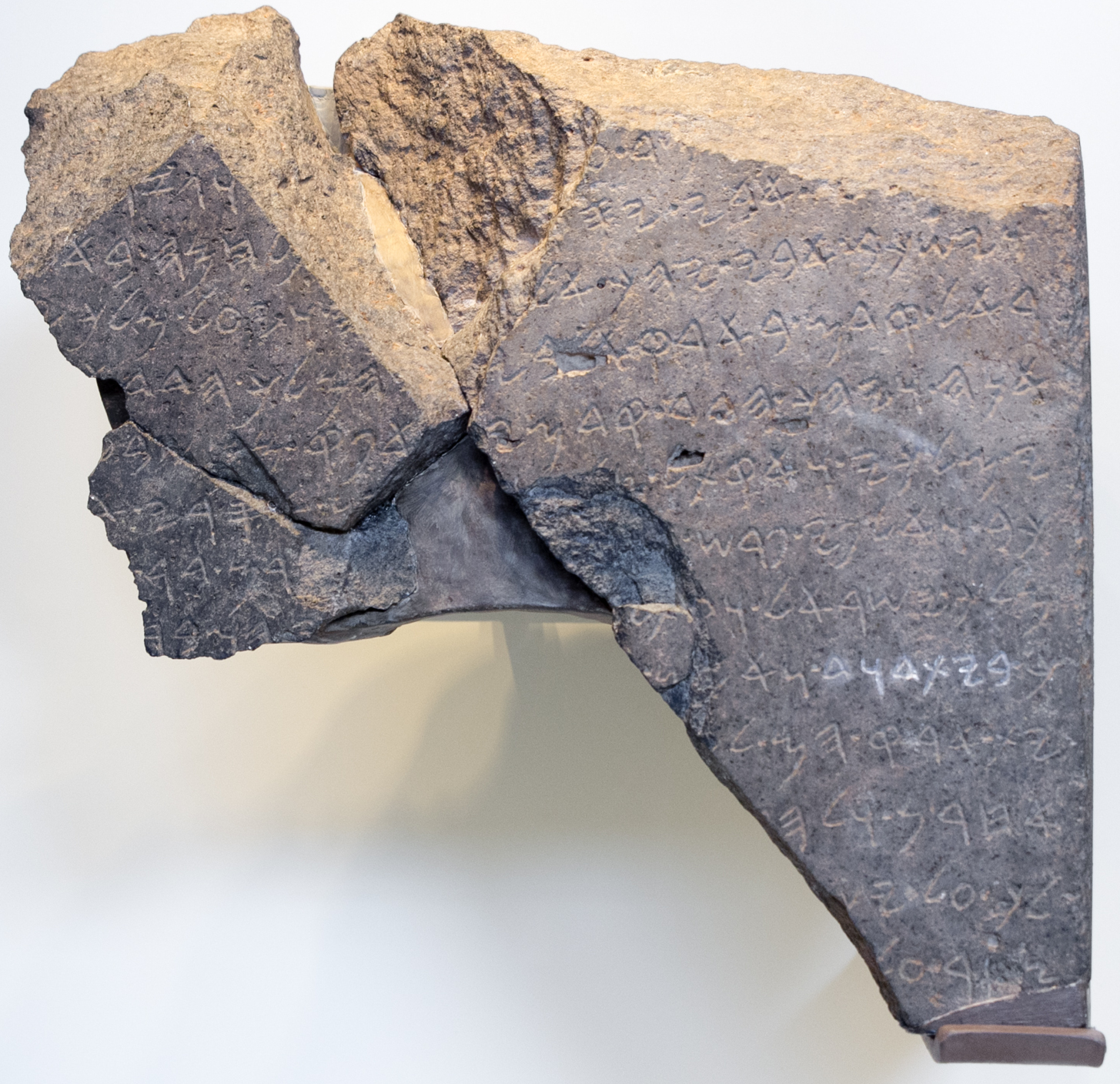
3. Week 28: Key Passages Study
2 Kings 2:9-14
9 And it came to pass, when they were gone over, that Elijah said unto Elisha, Ask what I shall do for thee, before I be taken away from thee. And Elisha said, I pray thee, let a double portion of thy spirit be upon me.
10 And he said, Thou hast asked a hard thing: nevertheless, if thou see me when I am taken from thee, it shall be so unto thee; but if not, it shall not be so.
11 And it came to pass, as they still went on, and talked, that, behold, there appeared a chariot of fire, and horses of fire, and parted them both asunder; and Elijah went up by a whirlwind into heaven.
12 And Elisha saw it, and he cried, My father, my father, the chariot of Israel, and the horsemen thereof. And he saw him no more: and he took hold of his own clothes, and rent them in two pieces.
13 He took up also the mantle of Elijah that fell from him, and went back, and stood by the bank of Jordan;
14 And he took the mantle of Elijah that fell from him, and smote the waters, and said, Where is the Lord God of Elijah? and when he also had smitten the waters, they parted hither and thither: and Elisha went over.
Hebrew Key Terms
- Pi shnayim (פִּי שְׁנַיִם) -- "double portion" or more precisely "mouth of two." This is the legal term from Deuteronomy 21:17 for the firstborn's inheritance share. The firstborn receives two portions out of the total; every other son receives one. Elisha is not asking for twice Elijah's power -- he is claiming the heir's share, the spiritual birthright of the firstborn disciple.
- Adderet (אַדֶּרֶת) -- "mantle" or "cloak." From the root a-d-r (אדר), meaning glory, majesty, or splendor. The same word describes the "Babylonish garment" Achan stole at Jericho (Joshua 7:21). Elijah's adderet was the physical symbol of prophetic authority -- when it fell from his ascending shoulders, it was the transfer of office made visible.
- Ruach (רוּחַ) -- "spirit" or "wind." Elisha asks for a double portion of Elijah's ruach, meaning the divine spirit that empowered Elijah's prophetic ministry. The word's dual meaning -- spirit and wind -- resonates with the whirlwind (se'arah, שְׂעָרָה) that carries Elijah away. The spirit departs in a wind; the spirit descends on the successor.
Commentary with Rashi
Rashi on 2:9 -- "Thou hast asked a hard thing": Rashi explains that Elijah says this because the request lies beyond his personal authority to grant. He cannot give more of the Spirit than he himself possesses. The condition -- "if thou see me when I am taken" -- is not arbitrary but diagnostic: if Elisha has the spiritual capacity to perceive Elijah's translation, that perception itself proves he has already received the double portion. The seeing is the evidence of the receiving.
Rashi on 2:12 -- "My father, my father, the chariot of Israel, and the horsemen thereof": Rashi interprets Elisha's cry as a declaration that Elijah's prayers were more valuable to Israel than armies of chariots and horsemen. The prophet was the nation's true defense. A teacher's intercession accomplishes what military power cannot. The double "my father" expresses the dual relationship: personal mentor and national protector.
Pirkei Rabbi Eliezer -- Rabbinic tradition reads Elisha's solo parting of the Jordan as the greater miracle -- accomplished on his own merit, where Elijah's crossing had the combined merit of both men -- making it the divine signature that confirmed the succession (developed fully in Jewish Perspective, Section 1).
Modern Prophetic Witness
President Henry B. Eyring taught that "Jesus Christ is the head of the Church" and that He leads it today by revelation through prophets in "The Lord Leads His Church". Elder Neil L. Andersen likewise emphasized in "The Prophet of God" that the Lord, not public ambition or human campaigning, chooses His prophet. These modern witnesses keep the Elijah-Elisha succession from becoming merely an ancient transfer story: the mantle matters because the Lord continues to govern His Church through authorized servants.
LDS Application
The transfer of the prophetic mantle from Elijah to Elisha is the Old Testament's most vivid model of priesthood succession. The Doctrine and Covenants establishes the principle explicitly: "There is never but one on the earth at a time on whom this power and the keys of this priesthood are conferred" (D&C 132:7), and "no one shall be appointed to receive commandments and revelations in this church excepting my servant Joseph Smith, Jun., for he receiveth them even as Moses" (D&C 28:2; see also D&C 43:1-7). The mantle falls to the next authorized servant. The pattern is consistent: the departing prophet does not choose his successor arbitrarily -- God designates, and the community recognizes. When Brigham Young spoke to the Saints after Joseph Smith's martyrdom, witnesses reported that he appeared and sounded like Joseph -- the "mantle" experience that confirmed his succession in the minds of those present. The principle is the same as 2 Kings 2: the community must see the evidence and declare, "The spirit of [the former prophet] doth rest on [the successor]."
Cross-References
- Deuteronomy 21:17 -- The legal provision for the firstborn's double portion
- D&C 110:13-16 -- Elijah's return to the Kirtland Temple to restore the sealing keys
- D&C 43:1-7 -- The principle of authorized prophetic succession
- Numbers 27:18-23 -- Moses lays hands on Joshua; parallel succession event
- 1 Kings 19:19-21 -- Elijah first casts his mantle on Elisha while plowing
2 Kings 4:1-7
1 Now there cried a certain woman of the wives of the sons of the prophets unto Elisha, saying, Thy servant my husband is dead; and thou knowest that thy servant did fear the Lord: and the creditor is come to take unto him my two sons to be bondmen.
2 And Elisha said unto her, What shall I do for thee? tell me, what hast thou in the house? And she said, Thine handmaid hath not any thing in the house, save a pot of oil.
3 Then he said, Go, borrow thee vessels abroad of all thy neighbours, even empty vessels; borrow not a few.
4 And when thou art come in, thou shalt shut the door upon thee and upon thy sons, and shalt pour out into all those vessels, and thou shalt set aside that which is full.
5 So she went from him, and shut the door upon her and upon her sons, who brought the vessels to her; and she poured out.
6 And it came to pass, when the vessels were full, that she said unto her son, Bring me yet a vessel. And he said unto her, There is not a vessel more. And the oil stayed.
7 Then she came and told the man of God. And he said, Go, sell the oil, and pay thy debt, and live thou and thy children of the rest.
Hebrew Key Terms
- Shemen (שֶׁמֶן) -- "oil." Olive oil was the most essential commodity in ancient Israelite life: fuel for lamps, base for medicine, ingredient in cooking, element in anointing rituals. A pot of oil was the absolute minimum of household provision -- she had almost nothing, but she had the one substance most associated with divine blessing and consecration.
- Kelim (כֵּלִים) -- "vessels" or "containers." From the root k-l-y (כלי), meaning to contain, to complete, or to bring to an end. The vessels are the limiting factor in the miracle: the oil fills exactly as many containers as the widow prepared. The word also means "instruments" or "weapons" in other contexts -- vessels are tools of purpose, and their number determines the scope of what can be accomplished.
- Chov (חוֹב) -- "debt." The creditor (nosheh, נוֹשֶׁה) had the legal right to seize the widow's sons as bond-servants until the debt was satisfied. The miracle addresses a specific, quantifiable problem: the oil must be enough, when sold, to cover the exact amount owed.
Commentary with Rashi
Rashi on 4:1 -- "Thy servant my husband": rabbinic tradition identifies the dead husband as Obadiah, whose debts were incurred hiding and feeding the prophets -- so this is not random poverty but the cost of faithful service to God (the full tradition and its theology are in Jewish Perspective, Section 3).
Rashi on 4:6 -- "And the oil stayed": Rashi notes the precision -- the oil stopped (ceased flowing) when the vessels were exhausted. It did not taper off gradually; it halted at the exact boundary of the widow's preparation. The miracle's scope was determined not by God's capacity (which is infinite) but by human preparation (which was finite). If she had borrowed more vessels, she would have received more oil.
Rashi on 4:7 -- "Live thou and thy children of the rest": Rashi interprets chiriy ("live") with extraordinary expansiveness: "live from it until the resurrection of the dead." The oil provided not merely immediate relief but permanent provision. The miracle was not a stopgap; it was abundance.
Modern Prophetic Witness
President Dallin H. Oaks taught in "Small and Simple Things" that small, repeated acts of faith invite the Holy Ghost and bring about great spiritual growth over time. Elder O. Vincent Haleck's "The Heart of the Widow" adds a modern consecration frame: the widow's heart gives from want, trusting that the Lord will fill what is lacking. Together, these talks balance the rabbinic reading with a Restoration application: the borrowed vessels are not only ancient containers but a pattern for steady, costly, faithful preparation.
LDS Application
The widow's oil teaches a principle that appears throughout Latter-day Saint scripture: divine blessings fill the containers we prepare, and no further. "What doth it profit a man if a gift is bestowed upon him, and he receive not the gift? Behold, he rejoices not in that which is given unto him, neither rejoices in him who is the giver of the gift" (D&C 88:33). The instruction to "borrow not a few" is the prophetic equivalent of Moroni's promise in Ether 12:6: "ye receive no witness until after the trial of your faith." The widow had to act in faith -- borrowing vessels before seeing any oil flow -- and the scope of her faith-driven preparation determined the scope of God's miraculous provision. This is the economy of faith: God does not force blessings into spaces we have not prepared. The number of vessels equals the volume of oil. Our prayers, our covenants, our temple attendance, our scripture study -- these are the vessels we bring, and God fills every one we offer.
Cross-References
- Mark 6:35-44 -- Jesus feeds the five thousand (multiplication of provision)
- Alma 34:28 -- "If ye turn away the needy, and the naked, and visit not the sick and afflicted, and impart of your substance... your prayer is vain"
- D&C 88:33 -- The gift not received profits nothing
- 1 Kings 17:8-16 -- Elijah and the widow of Zarephath (flour and oil that do not fail)
- D&C 104:15-18 -- "It is my purpose to provide for my saints... but it must needs be done in mine own way"
2 Kings 4:8-10, 32-37
8 And it fell on a day, that Elisha passed to Shunem, where was a great woman; and she constrained him to eat bread. And so it was, that as oft as he passed by, he turned in thither to eat bread.
9 And she said unto her husband, Behold now, I perceive that this is an holy man of God, which passeth by us continually.
10 Let us make a little chamber, I pray thee, on the wall; and let us set for him there a bed, and a table, and a stool, and a candlestick: and it shall be, when he cometh to us, that he shall turn in thither.
32 And when Elisha was come into the house, behold, the child was dead, and laid upon his bed.
33 He went in therefore, and shut the door upon them twain, and prayed unto the Lord.
34 And he went up, and lay upon the child, and put his mouth upon his mouth, and his eyes upon his eyes, and his hands upon his hands: and he stretched himself upon the child; and the flesh of the child waxed warm.
35 Then he returned, and walked in the house to and fro; and went up, and stretched himself upon him: and the child sneezed seven times, and the child opened his eyes.
36 And he called Gehazi, and said, Call this Shunammite. So he called her. And when she was come in unto him, he said, Take up thy son.
37 Then she went in, and fell at his feet, and bowed herself to the ground, and took up her son, and went out.
Hebrew Key Terms
- Ish Elohim kadosh (אִישׁ אֱלֹהִים קָדוֹשׁ) -- "holy man of God." The Shunammite's designation of Elisha. The word kadosh (קָדוֹשׁ, holy) implies separation -- set apart from the ordinary, consecrated to divine purpose. She perceived this through daily observation, not revelation.
- Aliyyah (עֲלִיָּה) -- "upper room." A rooftop chamber built above the main house, accessible by external stairs, providing privacy and quiet. The same word describes the upper room where the Last Supper was held (Mark 14:15, Luke 22:12 in the Septuagint and later tradition). The aliyyah was the place of sacred encounter.
- Vayigorhar (וַיִּגְהַר) -- "he stretched himself" or "he bent over." The physical posture of Elisha over the dead child -- mouth to mouth, eyes to eyes, hands to hands -- mirrors Elijah's similar act with the widow of Zarephath's son (1 Kings 17:21). The prophet's body becomes the conduit through which life returns.
Commentary with Rashi
Rashi on 4:9 -- "I perceive that this is an holy man of God": the Talmud (Berakhot 10b) asks how she knew, and answers with signs of domestic sanctity -- most famously, that no fly ever landed at his table. Her discernment came through attentive hospitality, not vision (unpacked in Jewish Perspective, Section 4).
Rashi on 4:16 -- "Do not lie unto thine handmaid": Rashi interprets her plea as fear born of foresight. She did not want the joy of a child only to endure the grief of losing him. Her words "do not deceive me" suggest that she perceived (or feared) the trajectory: the gift would bring the grief. Her faith was not simple excitement but a complex reckoning with the cost of divine blessing.
Rashi on 4:35 -- "The child sneezed seven times": The Zohar identifies this child as the future prophet Habakkuk, deriving the name from the root chabak (חבק), "to embrace" -- Elisha's physical embrace of the boy restored his life. Seven sneezes represent the return of the seven breaths (or the soul's complete return through seven stages). The resurrected child became a prophet who would one day write, "The just shall live by his faith" (Habakkuk 2:4) -- a man who literally lived by faith, having been raised from death by it.
Modern Prophetic Witness
Elder Jeffrey R. Holland's "Like a Broken Vessel" speaks directly to faithful people who face suffering that does not resolve quickly or neatly. His counsel to keep faith, seek help, and trust in the Savior's sustaining love gives a modern pastoral frame for the Shunammite's grief: her faith does not deny the child's death, and Restoration discipleship does not require pretending that pain is simple. President Henry B. Eyring's "Mountains to Climb" also reinforces the pattern that trials can become sanctifying when met with trust in God.
LDS Application
The Shunammite's story speaks to the experience of tested faith -- receiving a divine blessing and then watching it die. She built the room. She received the son. She buried him on the prophet's bed and set out to find Elisha, saying only, "It is well" (4:26). Her faith was not naive optimism but determined pursuit of the source of the blessing. Alma 14:11 addresses the same tension from a different angle: "The Lord receiveth them up unto himself, in glory." Sometimes God permits the loss because the restoration is the greater miracle. The Shunammite's son died and was raised -- and if the Zohar is correct, he became Habakkuk, the prophet of faith. The loss was real; the restoration was real; and the trajectory extended beyond anything the mother could have foreseen in the moment of grief.
Cross-References
- Luke 7:11-17 -- Jesus raises the widow of Nain's son
- John 11:1-44 -- Jesus raises Lazarus
- 1 Kings 17:17-24 -- Elijah raises the widow of Zarephath's son
- Alma 14:11 -- "The Lord receiveth them up unto himself, in glory"
- Habakkuk 2:4 -- "The just shall live by his faith"
2 Kings 5:10-14
10 And Elisha sent a messenger unto him, saying, Go and wash in Jordan seven times, and thy flesh shall come again to thee, and thou shalt be clean.
11 But Naaman was wroth, and went away, and said, Behold, I thought, He will surely come out to me, and stand, and call on the name of the Lord his God, and strike his hand over the place, and recover the leper.
12 Are not Abana and Pharpar, rivers of Damascus, better than all the waters of Israel? may I not wash in them, and be clean? So he turned and went away in a rage.
13 And his servants came near, and spake unto him, and said, My father, if the prophet had bid thee do some great thing, wouldest thou not have done it? how much rather then, when he saith to thee, Wash, and be clean?
14 Then went he down, and dipped himself seven times in Jordan, according to the saying of the man of God: and his flesh came again like unto the flesh of a little child, and he was clean.
Hebrew Key Terms
- Rachatztah (רָחַצְתָּ) -- "wash" or "immerse yourself." The root r-ch-tz (רחץ) refers specifically to washing the body (as distinct from kabes, כבס, washing garments). The seven immersions in the Jordan parallel the purification rituals of Leviticus, where the number seven consistently represents completeness and covenant fulfillment.
- Tzara'at (צָרַעַת) -- "leprosy" or "skin disease." The broad category of ritual skin impurity described in Leviticus 13-14. Naaman's tzara'at was severe enough to threaten his career and social standing, but not so debilitating as to prevent him from commanding armies and traveling to foreign nations.
- Na'ar katan (נַעַר קָטָן) -- "little child." After his seventh immersion, Naaman's flesh became "like the flesh of a little child" -- not merely healed but renewed. The language suggests regeneration, not just restoration. He emerged from the Jordan with skin that was not merely clean but new, as if he had been born again through the water.
Commentary with Rashi
Rashi on 5:11 -- "Behold, I thought": Naaman had pre-scripted the miracle. He expected the prophet to come out personally, stand before him, invoke God's name dramatically, wave his hand over the affected area, and heal him. Every element of his expectation involved spectacle, personal attention, and visible divine action. Instead, Elisha didn't even come to the door. The gap between Naaman's expectation and God's actual method is the distance between human religion (dramatic, impressive, centered on the worshipper) and divine grace (simple, humbling, centered on obedience).
Rashi on 5:13 -- "If the prophet had bid thee do some great thing": Rashi identifies this as kal va-chomer (קַל וָחֹמֶר), the rabbinic argument from the greater to the lesser (or in this case, from the harder to the easier). The servants' logic is flawless: if Naaman would have obeyed a painful, dangerous, or spectacular command without hesitation, how much more readily should he obey a simple one? The difficulty was not in the doing but in the simplicity. Pride resists what is easy because ease feels unworthy of the problem's magnitude.
Rashi on 5:14 -- "According to the saying of the man of God": Rashi emphasizes that Naaman obeyed exactly -- seven times, in the Jordan specifically, without modification or substitution. The obedience was precise. The Abana and Pharpar were genuinely superior rivers, but the power was never in the water. It was in the obedience to the prophet's specific instruction. The healing came at the seventh immersion -- had Naaman quit after six, the result would have been nothing.
Modern Prophetic Witness
President Dallin H. Oaks explicitly connects the brass serpent and Naaman-like simplicity in "Small and Simple Things", warning that the easiness of a commanded task does not make it unimportant. President Thomas S. Monson's "Obedience Brings Blessings" supplies the same Restoration principle in direct form: blessings follow obedience to God's commands, even when the instruction appears ordinary. Naaman's healing is therefore not only about ancient ritual washing; it is about the modern covenant discipline of trusting prophetic direction when the way seems too simple.
LDS Application
The parallels between Naaman's sevenfold immersion and baptism by immersion are unmistakable and have been recognized by Latter-day Saint teachers for generations. Both involve complete submersion in water. Both require obedience to a prophet's instruction. Both produce spiritual renewal -- Naaman emerged with flesh "like a little child," echoing the Savior's teaching that one must "become as little children" (Matthew 18:3) to enter the kingdom. And both involve overcoming the natural mind's resistance to simplicity. "We know that it is by grace that we are saved, after all we can do" (2 Nephi 25:23) -- but "all we can do" sometimes looks as simple as walking into a river. The grace is not earned by the complexity of the act; it is accessed through the humility of obeying. Naaman's story is also a profound lesson on the universality of God's love: the Syrian general, a Gentile and an enemy of Israel, received healing from Israel's God. Jesus cited this explicitly in his Nazareth sermon (Luke 4:27) to demonstrate that God's mercy extends beyond ethnic and national boundaries.
Cross-References
- Luke 4:27 -- "Many lepers were in Israel in the time of Eliseus the prophet; and none of them was cleansed, saving Naaman the Syrian"
- 1 Corinthians 1:27 -- "God hath chosen the foolish things of the world to confound the wise"
- 2 Nephi 25:23 -- "By grace that we are saved, after all we can do"
- Mosiah 3:19 -- "The natural man is an enemy to God... and becometh as a child"
- Leviticus 14:1-9 -- The purification ritual for healed tzara'at
2 Kings 6:15-17
15 And when the servant of the man of God was risen early, and gone forth, behold, an host compassed the city both with horses and chariots. And his servant said unto him, Alas, my master! how shall we do?
16 And he answered, Fear not: for they that be with us are more than they that be with them.
17 And Elisha prayed, and said, Lord, I pray thee, open his eyes, that he may see. And the Lord opened the eyes of the young man; and he saw: and, behold, the mountain was full of horses and chariots of fire round about Elisha.
Hebrew Key Terms
- Sus va-rekhev esh (סוּס וָרֶכֶב אֵשׁ) -- "horses and chariots of fire." The same phrase describes the heavenly escort that carried Elijah (2:11) and the angelic army now revealed at Dothan. Fire (esh, אֵשׁ) in Hebrew signifies divine presence -- the burning bush, the pillar of fire, the fire on Sinai. Chariots of fire are the military expression of God's active, protective presence.
- Paqach (פָּקַח) -- "to open (eyes)." The root p-q-ch (פקח) is used specifically for opening eyes that were closed or unable to see. It appears here for the servant's eyes being opened to see the heavenly army (6:17) and then for the Syrians' eyes being opened after their blindness is removed (6:20). The same root appears in Isaiah 42:7, where the Messiah's mission includes opening blind eyes. Seeing the invisible world is a gift, not an achievement.
- Al tira (אַל תִּירָא) -- "fear not." The standard formula of divine reassurance throughout the Hebrew Bible, from Genesis to the Prophets. It appears in angelic annunciations (Genesis 15:1, Luke 1:30), military contexts (Deuteronomy 20:1), and prophetic encounters (Isaiah 41:10). Elisha uses it here to establish the same framework: divine presence eliminates the rational basis for fear.
Commentary with Rashi
Rashi on 6:16 -- "They that be with us are more": Rashi explains simply: "to help us." The divine army was not ornamental; it was functional, present for the specific purpose of protecting the prophet. Elisha's calm was not bravery in the face of danger -- it was accurate perception of the situation. He was not outnumbered. His servant was simply miscounting because he could not see all the forces present.
Rashi on 6:17 -- "Open his eyes, that he may see": The prayer was for perception, not protection. Elisha did not ask God to send reinforcements; the reinforcements were already deployed. He asked God to let his servant see what was already true. The distinction is crucial: the chariots of fire were not conjured by the prayer; they were revealed by it. The invisible world does not depend on human perception for its existence -- it exists whether we see it or not.
Rashi on 6:18 -- The "blindness" that struck the Syrians was not physical blindness but sanverim (סַנְוֵרִים), a confusion of recognition -- they could see but could not identify what they saw. Rashi distinguishes this from total blindness: the Syrians followed Elisha into Samaria because they could walk and see the road; they simply could not recognize the prophet or the city. This is a different kind of blindness -- the blindness of seeing without understanding, which is arguably more dangerous than seeing nothing at all.
Modern Prophetic Witness
Elder W. Craig Zwick's "Lord, Wilt Thou Cause That My Eyes May Be Opened" gives a direct modern bridge to Elisha's prayer: disciples often need enlarged perception more than changed circumstances. Elder Jeffrey R. Holland's "The Ministry of Angels" adds the angelic dimension, testifying that heavenly help is real even when unseen. President Russell M. Nelson's "Revelation for the Church, Revelation for Our Lives" grounds the same principle in personal revelation: modern disciples must learn to receive the Spirit's guidance if they are to see truly.
LDS Application
Elder Jeffrey R. Holland's teaching resonates directly with this passage: "Some blessings come soon, some come late, and some don't come until heaven; but for those who embrace the gospel of Jesus Christ, they come" ("An High Priest of Good Things to Come," October 1999 General Conference). The chariots of fire at Dothan are the visual proof that God's blessings and protections are present even when invisible. The Doctrine and Covenants echoes the principle: "I will go before your face. I will be on your right hand and on your left, and my Spirit shall be in your hearts, and mine angels round about you, to bear you up" (D&C 84:88). The promise is not that angels will come if we ask; it is that they are already there. The prayer we need is not "Lord, protect me" but "Lord, help me see the protection that is already surrounding me." This does not guarantee that every trial will be averted -- Elisha himself was targeted by the Syrians, and many prophets suffered -- but it does guarantee that no mortal force operates unopposed by divine power.
Cross-References
- Psalm 34:7 -- "The angel of the Lord encampeth round about them that fear him, and delivereth them"
- Hebrews 1:14 -- "Are they not all ministering spirits, sent forth to minister for them who shall be heirs of salvation?"
- D&C 84:88 -- "I will go before your face... mine angels round about you, to bear you up"
- 2 Kings 2:11 -- Elijah taken by a chariot and horses of fire
- Isaiah 42:7 -- The Messiah opens blind eyes
2 Kings 6:21-23
21 And the king of Israel said unto Elisha, when he saw them, My father, shall I smite them? shall I smite them?
22 And he answered, Thou shalt not smite them: wouldest thou smite those whom thou hast taken captive with thy sword and with thy bow? set bread and water before them, that they may eat and drink, and go to their master.
23 And he prepared great provision for them: and when they had eaten and drunk, he sent them away, and they went to their master. So the bands of Syria came no more into the land of Israel.
Hebrew Key Terms
- Kerah (כֵּרָה) -- "he prepared a feast" or "he prepared great provision." Rashi emphasizes that this word implies a full banquet -- a kerah gedolah, a great feast -- not merely scraps or rations. The king of Israel prepared a proper meal for the enemy soldiers who had come to capture his prophet. The word carries connotations of honor and generosity extended to guests, not prisoners.
- Gedudei (גְּדוּדֵי) -- "bands" or "raiding parties." From the root g-d-d (גדד), meaning to cut or to form a troop. These were not a formal army but raiding parties -- smaller military units that crossed the border to plunder, kidnap, and destabilize. The result of the feast -- "the bands of Syria came no more" -- means that the practice of cross-border raiding ceased entirely. A single act of mercy ended a pattern of violence.
- Nakah (נָכָה) -- "to smite" or "to strike down." The king's eager repetition -- "shall I smite them? shall I smite them?" -- reveals both his excitement at having a helpless enemy and his deference to Elisha's authority. He asks permission twice, expecting (and hoping for) affirmation. Elisha's refusal redirects the entire moral framework of the encounter.
Commentary with Rashi
Rashi on 6:22 -- "Wouldest thou smite those whom thou hast taken captive with thy sword and with thy bow?": Rashi reads this as a kal va-chomer argument: "You do not kill even your own captives taken in battle -- how much less should you kill these, whom you did not capture by your own power but whom God delivered to you." The captives were God's prisoners, not the king's, and killing God's captives would be presumption. The argument moves from military ethics (don't kill POWs) to theological principle (don't dispose of what God has delivered).
Rashi on 6:23 -- Kerah gedolah: Rashi emphasizes the scale of the feast. This was not token hospitality but lavish provision -- the kind of meal you prepare for honored guests, not defeated enemies. The extravagance was the point. The Syrian soldiers returned to their king having been captured by a miraculous power they could not resist and then fed better than they would have been at home. The result was not gratitude (the text does not describe their feelings) but cessation of hostility: "the bands of Syria came no more." Mercy produced a strategic outcome that military force had never achieved.
Modern Prophetic Witness
President Dallin H. Oaks's "Love Your Enemies" is the most direct modern conference anchor for this passage. He teaches that the Savior's command to love enemies applies in personal, civic, and political conflict, and that disciples must rise above anger and hatred. President Russell M. Nelson's repeated call to peacemaking, including "Peacemakers Needed", carries the same principle forward: covenant discipleship requires active peacemaking, not merely the absence of retaliation.
LDS Application
Jesus' command in the Sermon on the Mount -- "Love your enemies, bless them that curse you, do good to them that hate you, and pray for them which despitefully use you, and persecute you" (Matthew 5:44) -- and its Book of Mormon parallel in 3 Nephi 12:44 are not merely ethical aspirations. They are prophetically grounded in narrative precedent. Elisha enacted "love your enemies" centuries before Jesus preached it, and the result was measurable: peace. The principle is not naivety; it is strategy rooted in the character of God. Paul quotes Proverbs when he writes, "If thine enemy hunger, feed him; if he thirst, give him drink: for in so doing thou shalt heap coals of fire on his head" (Romans 12:20, citing Proverbs 25:21-22). The "coals of fire" are not revenge but transformation -- the overwhelming force of undeserved generosity that changes the relational dynamics permanently. In family life, in ward councils, in political disagreements, and in personal conflicts, the Elisha principle applies: feeding the enemy is not weakness. It is the exercise of power that produces lasting peace instead of temporary victory.
Cross-References
- Matthew 5:44 -- "Love your enemies"
- 3 Nephi 12:44 -- Book of Mormon parallel to the Sermon on the Mount
- Romans 12:20 -- "If thine enemy hunger, feed him"
- Proverbs 25:21-22 -- "If thine enemy be hungry, give him bread to eat"
- Luke 6:27-36 -- "Do good to them which hate you"
4. Week 28: Word Studies
Root
Aleph-Dalet-Resh (אדר). The root carries meanings of glory, majesty, splendor, and magnificence. The adjective adir (אַדִּיר) means "mighty" or "majestic" -- "How excellent (adir) is thy name in all the earth!" (Psalm 8:1). The adderet is not just a garment but a garment that signifies glory -- the external expression of internal authority.
Appears
2 Kings 2:8 -- Elijah rolls up his adderet and strikes the Jordan, which parts. 2 Kings 2:13 -- Elisha picks up the adderet that fell from Elijah. 2 Kings 2:14 -- Elisha strikes the Jordan with the same adderet and it parts again. The mantle appears three times in rapid succession: used by the predecessor, inherited by the successor, and validated by repetition of the miracle.
Meaning
The adderet was a cloak or outer garment, likely made of animal skin or coarse woven fabric. It was the distinctive garment of the prophet -- John the Baptist's camel-hair garment (Matthew 3:4) stands in direct continuity with Elijah's adderet. But the word carries weight beyond its material referent. The same word appears in Joshua 7:21, where Achan confesses to stealing "a goodly Babylonish garment" (adderet Shinar) -- an adderet of foreign splendor that contrasted with the austere adderet of the prophet. The prophetic mantle was not beautiful in the worldly sense; its glory was the glory of divine authorization, not human craftsmanship.
Deeper Context
The falling of Elijah's adderet is the most visible moment of prophetic succession in the Old Testament. Elijah does not hand it to Elisha; it falls from his ascending body as he is taken into heaven. The passive nature of the transfer is significant: the mantle is not given by human decision but released by divine action. Elisha does not grab it from Elijah's shoulders; he picks it up from the ground after his master has departed. The authority comes down, not across. In later Jewish tradition, the adderet became a metaphor for any transfer of spiritual authority -- "receiving the mantle" entered both Hebrew and English as an idiom for succession.
Theological Significance
- Authority is transferable. The adderet demonstrates that prophetic authority does not die with the prophet. It falls from one and is taken up by another. God's work is not interrupted by mortality; it is sustained through succession.
- The symbol validates the reality. Elisha's possession of the adderet did not make him a prophet -- God had already called him (1 Kings 19:16). But the adderet made the calling visible to the community. The sons of the prophets recognized the transfer because they could see the garment and its effect (the parting of the Jordan). Sacred symbols serve as evidence of invisible realities.
- Glory is defined by service, not splendor. The root a-d-r means glory, but the adderet was a rough cloak, not a royal robe. Prophetic glory is not the glory of the palace but the glory of the wilderness -- austere, functional, and dedicated to God's purposes rather than human admiration.
LDS Application
The concept of "the mantle of the prophet" is deeply embedded in Latter-day Saint discourse. When Brigham Young addressed the Saints after Joseph Smith's martyrdom, witnesses reported that his voice and appearance resembled Joseph's -- the "mantle experience" that confirmed succession. The principle is the same as 2 Kings 2: the adderet falls to the authorized successor, and the community witnesses the transfer through visible signs. Temple garments in LDS practice carry a similar principle -- sacred clothing that symbolizes covenants and divine authorization, worn not for display but for consecration.
Cross-Language Connections
| Language | Term | Source |
|---|---|---|
| Hebrew | adderet (אַדֶּרֶת) — mantle, cloak, glory-garment; from the root a-d-r (אדר), majesty/splendor | BLB H155 |
| Greek (LXX) | mēlōtē (μηλωτή) — sheepskin; used in Hebrews 11:37 for prophetic garments | Logeion: mēlōtē |
| Latin (Vulgate) | pallium — cloak, covering; root behind English "pall" | Logeion: pallium |
| English | mantle — covering, cloak; now also a metaphor for inherited office or responsibility | Webster's 1828 · Merriam-Webster · Etymonline |
Root
Peh (פֶּה, mouth/opening) + shnayim (שְׁנַיִם, two). Literally "mouth of two" or "opening of two." The phrase is a technical legal term used in inheritance law to denote the firstborn's share, which is calculated as two portions out of the total number of portions distributed.
Appears
Deuteronomy 21:17 -- "He shall acknowledge him... by giving him a pi shnayim of all that he hath." 2 Kings 2:9 -- "Let a pi shnayim of thy spirit be upon me." The phrase appears only twice in the Hebrew Bible, and both occurrences are in the context of inheritance -- the legal provision and its prophetic application.
Meaning
In a family of two sons, the estate is divided into three portions: the firstborn receives two, the other son receives one. In a family of three sons, four portions: the firstborn gets two, each other son gets one. The firstborn never receives "double the total" -- he receives double any single brother's share, which is mathematically different. When Elisha asks for pi shnayim of Elijah's spirit, he is asking for the heir's share -- the portion that identifies him as the firstborn disciple, the primary successor. He is not asking to be twice as powerful as Elijah; he is asking to be recognized as Elijah's spiritual firstborn.
Deeper Context
The distinction between "double portion" and "twice as much" has been consistently misunderstood in popular readings. Many sermons and devotional books treat Elisha's request as asking for twice Elijah's power, producing theological problems: Was Elisha greater than Elijah? Did he receive more of God's Spirit? The legal framework resolves these problems entirely. Elisha received the heir's share -- the portion that designates succession, not superiority. The Pirkei Rabbi Eliezer tradition counts Elijah's miracles at eight and Elisha's at sixteen, which maintains the mathematical ratio of the double portion. But the significance is genealogical, not quantitative: Elisha is the spiritual firstborn, the one who continues the prophetic line with full authorization.
Theological Significance
- Spiritual inheritance follows family law. God's kingdom uses the language and structures of family inheritance to describe prophetic succession. The Spirit is not distributed randomly but according to a pattern of firstborn rights and designated heirs.
- The request is about identity, not magnitude. Elisha is not asking for more power; he is asking for a specific relationship -- firstborn son to spiritual father. The double portion identifies who he is, not how strong he is.
- The birthright carries responsibility, not just privilege. The firstborn's double share came with the obligation to lead the family, care for the parents in old age, and maintain the family's honor. Elisha's double portion meant not twice the glory but twice the responsibility -- a longer, harder ministry than Elijah's.
LDS Application
The patriarchal blessing in Latter-day Saint practice echoes the birthright declaration. When a patriarch declares lineage ("You are of the house of Ephraim"), he is using inheritance language to position the individual within God's covenant family. Ephraim holds the birthright among the tribes (1 Chronicles 5:1-2; Jeremiah 31:9), and Latter-day Saints understand their Ephraimite lineage as a statement of responsibility and mission, not superiority. The pi shnayim framework clarifies this: the birthright is about being positioned for service, not elevated above others.
Cross-Language Connections
| Language | Term | Source |
|---|---|---|
| Hebrew | pi shnayim (פִּי שְׁנַיִם) — literally "mouth/opening of two"; inheritance-law phrase for the firstborn's double share | BLB H6310 · BLB H8147 |
| Greek (LXX) | dyo merē (δύο μέρη) — "two parts"; translates the inheritance sense while losing the "mouth" idiom | Logeion: dyo · Logeion: meros |
| Latin (Vulgate) | duplex / duae partes — double, twofold, two parts | Logeion: duplex · Logeion: pars |
| English | double portion — two shares; common English phrase, though often misread as "twice the total" | Merriam-Webster: double · Webster's 1828: double · Etymonline: portion |
Root
Tsade-Resh-Ayin (צרע). The root's precise etymology is debated; it may be related to striking or afflicting. The noun tzara'at describes a category of skin conditions that rendered a person ritually impure (tamei, טָמֵא) and required isolation from the community.
Appears
2 Kings 5:1 -- Naaman "was a leper" (metzora, מְצֹרָע -- one afflicted with tzara'at). 2 Kings 5:3 -- "Would God my lord were with the prophet that is in Samaria! for he would recover him of his leprosy (tzara'at)." 2 Kings 5:27 -- "The leprosy (tzara'at) therefore of Naaman shall cleave unto thee, and unto thy seed for ever."
Meaning
Tzara'at is emphatically not Hansen's disease (modern leprosy). The diagnostic criteria in Leviticus 13 describe conditions involving white or reddish skin patches, raw flesh, hair color changes, and spreading or non-spreading discolorations. These symptoms match a range of dermatological conditions -- psoriasis, vitiligo, eczema, fungal infections -- none of which correspond to the nerve damage and tissue destruction of Hansen's disease. Furthermore, tzara'at could appear on garments (Leviticus 13:47-59) and house walls (Leviticus 14:33-53), which no bacterial infection can do. The category is fundamentally about ritual impurity, not medical pathology.
Deeper Context
The rabbis developed an extensive theological framework around tzara'at, connecting it primarily to the sin of lashon hara (לָשׁוֹן הָרָע), evil speech or slander. The paradigmatic case is Miriam, struck with tzara'at after speaking against Moses (Numbers 12:10). The Talmud (Arachin 15b-16a) lists seven sins that cause tzara'at: evil speech, bloodshed, false oaths, sexual immorality, pride, theft, and stinginess. In Naaman's case, the tzara'at is not explicitly connected to any sin -- he is described as "a great man" and "a mighty man in valour" (5:1). But when tzara'at transfers to Gehazi (5:27), it is explicitly connected to greed and deceit. The disease follows the spiritual reality: Naaman's external affliction does not reflect internal corruption (and is therefore healable); Gehazi's external affliction reflects internal corruption (and is therefore permanent).
Theological Significance
- External condition may or may not reflect internal reality. Naaman was leprous but righteous; Gehazi was clean but corrupt. The transfer of tzara'at from one to the other restores the alignment between exterior and interior -- the healed man walks away clean in both body and soul; the corrupted man walks away bearing the visible mark of his spiritual disease.
- Ritual impurity is about separation, not sin. The metzora was excluded from the camp not because he was a sinner but because his condition created ritual impurity that was incompatible with the holiness of communal worship. The purification rituals of Leviticus 14 restored communion, not innocence.
- Healing comes through the prophet, not the priest. Under Mosaic law, the priest diagnoses tzara'at and administers the purification ritual (Leviticus 13-14). But the actual healing -- the restoration of clean flesh -- comes through the prophet. Elisha heals what the priest can only certify. This distinction anticipates Christ, who both heals and fulfills the law.
LDS Application
The tzara'at framework offers a profound lens for understanding sin and repentance. Sin is not merely a legal violation but a condition that separates -- from community, from covenant, from God's presence. The metzora lived "outside the camp" (Leviticus 13:46), and the sinner experiences a similar exile from spiritual communion. Repentance is the purification process that restores access to the community and the temple. The Atonement of Jesus Christ functions as the ultimate purification ritual: "Though your sins be as scarlet, they shall be as white as snow" (Isaiah 1:18). Naaman's flesh became "like the flesh of a little child" (5:14) -- the same radical renewal that the Atonement produces in the soul.
Cross-Language Connections
| Language | Term | Source |
|---|---|---|
| Hebrew | tzara'at (צָרַעַת) — ritual skin affliction/impurity; not identical with Hansen's disease | BLB H6883 |
| Greek (LXX) | lepra (λέπρα) — scaly condition; root of English "leprosy" | BLB G3014 · Logeion: lepra |
| Latin (Vulgate) | lepra — leprosy/scaly disease; borrowed from Greek | Logeion: lepra |
| English | leprosy — traditional English rendering; misleading if narrowed to modern Hansen's disease | Webster's 1828 · Merriam-Webster · Etymonline |
Root
Kaf-Lamed-Yod (כלי). The root encompasses meanings of containing, completing, and bringing to an end. The noun keli (singular) means a vessel, container, instrument, weapon, or utensil -- anything that holds or accomplishes a purpose. The plural kelim is one of the most versatile words in Biblical Hebrew.
Appears
2 Kings 4:3 -- "Go, borrow thee vessels (kelim) abroad of all thy neighbours, even empty vessels (kelim rekim); borrow not a few." 2 Kings 4:4 -- "Thou shalt pour out into all those vessels (kelim)." 2 Kings 4:6 -- "There is not a vessel (keli) more. And the oil stayed."
Meaning
In the context of the widow's oil, kelim refers specifically to containers capable of holding olive oil -- jars, jugs, flasks, or pots. The instruction to "borrow not a few" (al tam'iti, אַל תַּמְעִיטִי, "do not make them few") is a direct challenge to borrow as many as possible. The kelim function as the physical expression of the widow's faith: each vessel she borrows represents an expectation that God will fill it. The number of kelim determines the volume of oil. When the kelim run out, the oil stops -- not because God's power is exhausted but because the widow's preparation has reached its limit.
Deeper Context
The word kelim carries enormous theological weight beyond its physical meaning. In 2 Timothy 2:20-21, Paul uses the vessel imagery directly: "In a great house there are not only vessels (skeuē in Greek, translating kelim) of gold and of silver, but also of wood and of earth; and some to honour, and some to dishonour." The human being is a keli -- a vessel designed to be filled with divine purpose. The widow's borrowed vessels are an enacted parable: the miracle exists in potential, waiting to be poured out, but it requires a container. An unfilled vessel is a missed blessing, not because God withheld it but because no one brought a jar. The instruction to bring "empty" vessels (kelim rekim) is equally significant: the vessels must be empty to be filled. Full vessels cannot receive new oil. The spiritual application is immediate: only the emptied heart can receive grace.
Theological Significance
- Human preparation determines divine provision. The oil fills exactly the number of vessels prepared. God does not override human agency; He fills the space that human faith creates.
- Emptiness is prerequisite. The vessels must be rekim -- empty. The full vessel, the self-sufficient heart, the life that needs nothing, receives nothing. Emptiness before God is not weakness; it is capacity.
- The vessel's purpose is to be filled. A keli that is never filled has failed its purpose. The root k-l-y suggests completion -- a vessel fulfills its purpose (takhlit, תַּכְלִית) when it contains what it was designed to hold. Humans fulfill their purpose when they are filled with the Spirit they were created to contain.
LDS Application
King Benjamin's teaching captures the kelim principle: "If ye should serve him who has created you from the beginning, and is preserving you from day to day, by lending you breath... I say, if ye should serve him with all your whole souls yet ye would be unprofitable servants" (Mosiah 2:21). The vessel never produces the oil; it only receives and holds it. The widow did not create the oil through her effort; she created the space for God's oil through her preparation. Similarly, the Doctrine and Covenants teaches: "For what doth it profit a man if a gift is bestowed upon him, and he receive not the gift?" (D&C 88:33). The gift exists. The oil is available. The only question is whether we bring the vessels.
Cross-Language Connections
| Language | Term | Source |
|---|---|---|
| Hebrew | kelim (כֵּלִים) — vessels, containers, tools, instruments; plural of keli | BLB H3627 |
| Greek (LXX) | skeuē (σκεύη) — vessels, implements, instruments; same word family Paul uses for vessels of honor/dishonor | BLB G4632 · Logeion: skeuos |
| Latin (Vulgate) | vasa — vessels, containers; root of English "vase" | Logeion: vas |
| English | vessel — container, utensil, ship; religious metaphor for a person prepared to receive or carry something | Webster's 1828 · Merriam-Webster · Etymonline |
Root
Peh-Qof-Chet (פקח). The root means to open, specifically to open the eyes. It is distinguished from patach (פָּתַח), which means to open in a general sense (doors, gates, mouths). Paqach is reserved almost exclusively for the opening of eyes -- physical, spiritual, or both.
Appears
2 Kings 6:17 -- "Lord, I pray thee, open (paqach) his eyes, that he may see." 2 Kings 6:20 -- "Lord, open (paqach) the eyes of these men, that they may see." Isaiah 42:7 -- "To open (paqoch) the blind eyes." Genesis 21:19 -- "And God opened (vayifqach) her eyes, and she saw a well of water."
Meaning
The word paqach describes the removal of a barrier to perception. The eyes are not created or repaired; they are opened -- implying that they were already present but unable to function. In 2 Kings 6:17, the servant had physical eyes that worked perfectly; what was opened was his capacity to see the spiritual dimension. In 6:20, the Syrians had experienced sanverim (confusion of recognition), and paqach restored their ability to identify where they were. Both uses describe the restoration of a faculty that was impeded, not the creation of a new one.
Deeper Context
The double use of paqach in 2 Kings 6 -- first to open the servant's eyes to see the chariots of fire (6:17), then to open the Syrians' eyes to see that they were inside Samaria (6:20) -- creates a deliberate contrast. Both openings are acts of God; both restore accurate perception. But one reveals protection and the other reveals vulnerability. The servant sees that he is safe; the Syrians see that they are captured. The same divine action -- opening eyes -- produces opposite emotional responses depending on the spiritual position of the one who sees. This ambiguity is central to the word's theological function: seeing clearly is not always comforting. It depends entirely on where you stand.
Theological Significance
- Spiritual sight is a divine gift, not a human achievement. The servant could not open his own eyes to see the chariots of fire. Elisha could not open them either -- he prayed, and God opened them. Perception of the invisible world is always a gift, never a technique.
- The invisible world is already present. The chariots of fire did not appear when the servant's eyes were opened; they were revealed. They had been there before the prayer and remained there after it. Paqach does not create reality; it removes the barrier between the observer and reality.
- Seeing can be mercy or judgment. The servant's opened eyes brought comfort; the Syrians' opened eyes brought the realization of captivity. What changes is not the act of seeing but the position of the seer. Those who stand with God see protection; those who stand against Him see exposure.
LDS Application
Moroni's promise in Moroni 10:4-5 operates on the paqach principle: "And when ye shall receive these things, I would exhort you that ye would ask God, the Eternal Father, in the name of Christ, if these things are not true; and if ye shall ask with a sincere heart, with real intent, having faith in Christ, he will manifest the truth of it unto you, by the power of the Holy Ghost." The truth is already present in the Book of Mormon before the reader prays. The prayer does not create the truth; it opens the eyes to perceive it. Similarly, the temple endowment is described as a process of receiving "further light and knowledge" -- not new information created for the occasion but existing truth made accessible through covenant. The veil is not a wall; it is a barrier to perception, and ordinances function as the prayer that says, "Lord, open their eyes, that they may see."
Cross-Language Connections
| Language | Term | Source |
|---|---|---|
| Hebrew | paqach (פָּקַח) — to open, especially to open the eyes | BLB H6491 |
| Greek (LXX) | anoigō (ἀνοίγω) — to open; generic "open," losing some of the eye-specific Hebrew nuance | BLB G455 · Logeion: anoigō |
| Latin (Vulgate) | aperire — to open, uncover; root of English "aperture" | Logeion: aperio |
| English | open — to uncover, make accessible, or enable perception | Webster's 1828 · Merriam-Webster · Etymonline |
Root
Chet-Samekh-Dalet (חסד). The root encompasses loyalty, kindness, devotion, and faithfulness -- always within a relational framework. Chesed is not generic niceness; it is the loyal love that operates within a covenant relationship, the faithfulness of a party who keeps their commitments even when the other party cannot reciprocate or has failed to uphold their end.
Appears
While the word chesed does not appear explicitly in 2 Kings 2-7, the concept pervades every miracle Elisha performs. Each act of prophetic provision -- the widow's oil, the Shunammite's son, Naaman's healing, the feeding of the Syrian army -- is an expression of God's chesed toward His people through His prophet. The continuation from Week 25's word study is intentional: chesed is the theological atmosphere in which Elisha's ministry breathes.
Meaning
Chesed is the love that does not quit. It is the mother who feeds her children when there is no food (the widow's oil). It is the host who builds a room for the traveling prophet (the Shunammite). It is the God who heals the enemy general (Naaman). It is the prophet who feeds the captured soldiers (the Syrian feast). In every case, chesed operates toward those who cannot repay, reciprocate, or demand it. The widow had nothing; the Shunammite could not produce a child; Naaman was an enemy; the Syrian soldiers were prisoners. Chesed flows downhill, from the one who has to the one who needs, without expectation of return.
Deeper Context
Elisha's refusal of Naaman's payment (5:16) is one of the most important theological moments in the narrative, precisely because it distinguishes chesed from transaction. Naaman arrived with ten talents of silver, six thousand pieces of gold, and ten changes of raiment. He expected to pay for his healing, because in every other religious system he knew, divine favor was purchased through offerings, sacrifices, and gifts to priests. Elisha's absolute refusal -- "As the Lord liveth, before whom I stand, I will receive none" -- declares that God's chesed is not for sale. It cannot be bought because it is not a commodity; it is the expression of God's character. Gehazi's attempt to monetize the miracle (5:20-27) violates the chesed economy by converting grace into commerce, and his punishment -- receiving Naaman's leprosy -- is the external expression of what happens internally when chesed is treated as a transaction.
Theological Significance
- **God's chesed operates through human instruments.** Elisha does not heal by his own power; he heals as God's agent. Every miracle is God's chesed delivered through prophetic hands. The prophet is the vessel (keli) through which divine loyal love reaches those in need.
- **God's chesed cannot be commodified.** Elisha refuses payment because chesed is a gift, not a service. The moment sacred power is bought or sold, it ceases to be chesed and becomes commerce. Gehazi's punishment illustrates the principle: exploiting grace corrupts the exploiter.
- **God's chesed extends beyond Israel.** Naaman's healing demonstrates that divine loyal love is not restricted to the covenant community. The Syrian general -- a Gentile, an enemy, the man who killed Israel's king -- receives healing. Chesed is rooted in God's character, not in the recipient's nationality or merit.
LDS Application
The Book of Mormon captures chesed in Nephi's declaration: "He doeth not anything save it be for the benefit of the world; for he loveth the world" (2 Nephi 26:24). God's chesed is universal in scope even when it operates through particular covenants. The temple ordinances -- available to all through proxy work -- are the institutional expression of chesed: grace extended to those who cannot act for themselves, without expectation of return. The bishop's storehouse, the fast offering system, and the ministering program are all chesed structures: covenant members providing for those in need within and beyond the covenant community, not as transaction but as faithful expression of divine loyal love.
Cross-Language Connections
| Language | Term | Source |
|---|---|---|
| Hebrew | chesed (חֶסֶד) — loyal love, covenant faithfulness, steadfast mercy | BLB H2617 |
| Greek (LXX) | eleos (ἔλεος) — mercy, compassion; captures mercy but not always the covenant-loyalty dimension | BLB G1656 · Logeion: eleos |
| Latin (Vulgate) | misericordia — mercy, compassion; literally a heart moved by misery | Logeion: misericordia |
| English | lovingkindness, steadfast love, loyal love — English uses multiple renderings because no single word captures the Hebrew range | Webster's 1828: loving-kindness · Merriam-Webster: steadfast · Etymonline: mercy |
5. Week 28: Jewish Perspective
The Elisha narratives in 2 Kings 2-7 received extraordinary attention from the rabbis of the Talmud and Midrash, who saw in these chapters not merely historical accounts of miracles but deep theological explorations of prophetic authority, the ethics of sacred power, and the paradox of divine mercy. Elisha's miracles are among the most frequently discussed in rabbinic literature, and the interpretive traditions surrounding them illuminate dimensions of the text that are invisible without their commentary. The following six sections draw from Talmudic, Midrashic, and classical rabbinic sources to reveal what these ancient Jewish interpreters found in Elisha's ministry -- and why their insights speak with remarkable directness to Latter-day Saint theology and practice.
When Elisha struck the Jordan with Elijah's mantle and the waters parted, Pirkei de-Rabbi Eliezer — an early rabbinic narrative work (c. 8th century) retelling biblical history with expansive midrashic commentary — identifies this in chapter 33 as a greater miracle than Elijah's identical act moments earlier. The reasoning is precise: when Elijah struck the Jordan (2:8), two righteous men were present -- Elijah and Elisha -- and the combined merit (zekhut, זְכוּת) of both contributed to the miracle. But when Elisha struck the Jordan alone (2:14), only one righteous man was present, and the waters parted for his merit alone. A miracle accomplished by the merit of one is greater than a miracle accomplished by the merit of two.
This rabbinic insight reframes the succession narrative entirely. The question is not whether Elisha received a "double portion" of power but whether the succession was legitimate -- whether God's authority truly rested on the new prophet. The solo miracle answered that question definitively. Elisha's splitting of the Jordan was the divine signature on his prophetic commission. The sons of the prophets who watched from a distance (2:15) understood immediately: "The spirit of Elijah doth rest on Elisha." The miracle was not theatrical; it was juridical -- a legal confirmation of succession performed by the highest court.
The tradition adds a further layer: Elisha's cry at the Jordan -- "Where is the Lord God of Elijah?" (Ayeh Hashem Elohei Eliyahu, אַיֵּה ה' אֱלֹהֵי אֵלִיָּהוּ) -- was not a question born of doubt but an invocation born of faith. He was not asking where God was; he was calling upon the same God who had empowered Elijah to now empower him. The question-form was a prayer-form: "Let the God of Elijah be here, now, in me."
LDS Connection
The principle of prophetic succession through visible, community-confirmed signs is foundational to Latter-day Saint ecclesiology. The Doctrine and Covenants establishes that "there is never but one on the earth at a time on whom this power and the keys of this priesthood are conferred" (D&C 132:7), and D&C 43:1-7 stipulates that the successor is "appointed by the voice of the church" and by the departing prophet's designation. When the mantle falls, the community must see and confirm. The Pirkei de-Rabbi Eliezer's emphasis on the greater miracle accomplished alone speaks to a truth every new prophet faces: the successor must demonstrate, through his own ministry, that the same divine power operates through him independently. The mantle falls from Elijah, but the Jordan parts for Elisha.
Rashi (Rabbi Shlomo Yitzchaki, 1040–1105), the most widely studied medieval commentator on the Bible and Talmud, identifies the healing of Jericho's waters as a "miracle within a miracle" (nes betokh nes). When Elisha heals the poisoned waters of Jericho, he does so with salt -- throwing a "new cruse" of salt into the spring and declaring, "I have healed these waters; there shall not be from thence any more death or barren land" (2:21). Salt, which by nature makes water undrinkable and kills vegetation, is used as the agent of healing. The thing that should have made the water worse made it better. The means contradicts the end, and yet the end is accomplished.
This is not the first time God uses contradiction as method. At Marah (Exodus 15:23-25), Moses was instructed to throw a tree into bitter water to make it sweet -- wood does not naturally purify water, and the tree may itself have been bitter (Rashi on Exodus 15:25 cites this tradition). The pattern is deliberate: God does not merely override natural law; He inverts it. The agent of harm becomes the agent of healing. The salt that should poison instead purifies. The tree that is bitter makes bitter water sweet. The cross that should be the instrument of ultimate shame becomes the instrument of ultimate glory.
Rashi's insight reveals a theology of divine method that runs through the entire biblical narrative. God does not simply solve problems; He solves them in ways that display His sovereignty over the very forces that created the problem. The salt does not bypass the poison -- it transforms the poison. The healing is more astonishing because of the means, not despite them.
LDS Connection
The Atonement of Jesus Christ is the supreme "miracle within a miracle." Death -- the ultimate enemy, the final consequence of the Fall -- is conquered through death. Christ does not bypass mortality; He enters it, experiences it to its fullest extent (including the spiritual death of Gethsemane and the physical death of Golgotha), and transforms it from within. "O death, where is thy sting? O grave, where is thy victory?" (1 Corinthians 15:55). The cross, the Roman instrument of shame and execution, becomes the central symbol of salvation. The salt heals the water. The tree sweetens the bitter spring. Death destroys death. God's methods are consistently paradoxical because they demonstrate that no force in creation operates beyond His sovereignty -- even the forces that seem most opposed to Him serve His purposes when He redirects them.
Midrash Tanchuma — a collection of rabbinic homilies on the Torah (c. 5th–9th century) — (parashat Toldot) identifies the anonymous widow of 2 Kings 4:1 as the wife of Obadiah, Ahab's steward who "feared the Lord greatly" and hid one hundred prophets in caves during Jezebel's persecution, feeding them bread and water (1 Kings 18:3-4). The rabbis reason backwards from the text: the widow says her husband "feared the Lord" (4:1), and the only person in the preceding narrative explicitly described as fearing the Lord greatly is Obadiah (1 Kings 18:3). The creditor, according to the Midrash, was King Jehoram -- Ahab's son, who inherited the debt.
The theological problem the Midrash addresses is acute: why should a righteous man's family suffer financial ruin? If Obadiah served God by saving the prophets, why did his obedience produce poverty? The Midrash's answer is not evasion but confrontation: righteous action can create genuine temporal hardship. Obadiah did what God required, and it cost him everything. The cost did not indicate divine displeasure; it indicated the real price of faithfulness in a hostile world. Feeding one hundred prophets in secret during a famine required enormous resources, and Obadiah borrowed those resources knowing he might never repay them.
But the Midrash does not stop at the problem; it provides the resolution. God's miraculous provision through Elisha -- the oil that fills every vessel -- is not a random act of charity but a direct divine response to a specific righteous debt. God is settling the account. The oil covers not merely the creditor's demand but provides enough for the widow and her sons to "live... of the rest" (4:7). The one who sacrificed everything to save God's prophets receives back, through God's prophet, more than was lost.
LDS Connection
The law of consecration in Latter-day Saint theology operates on precisely this principle. "It is my purpose to provide for my saints, for all things are mine. But it must needs be done in mine own way" (D&C 104:15-16). Obadiah consecrated his resources to save the prophets -- not because God commanded him specifically, but because the situation demanded it and his faith made the response inevitable. The temporal cost was real. The debt was real. His widow's grief was real. But God's resolution was also real, and it exceeded the original sacrifice. The fast offering system, the bishop's storehouse, and the principle of caring for the poor are all institutional expressions of the same theology: those who sacrifice for God's purposes will be provided for by God's means, in God's timing. The timing may not align with human expectation -- Obadiah died before the resolution came -- but the provision is certain.
The Talmud (Berakhot 10b) — Tractate Berakhot, which addresses prayer and blessings — asks how the Shunammite woman knew that Elisha was a "holy man of God" (4:9). Several answers are proposed. Rabbi Yose bar Chanina says: she never saw a fly at his table -- a sign that his sanctity extended to his physical environment. Another opinion: the sheet on his bed was always clean, showing no sign of seminal emission -- his holiness was total, extending even to involuntary bodily processes. A third view: she placed a piece of parchment with God's name under his pillow, and it was never defiled -- the divine name recognized his holiness.
What unites these explanations is their domestic context. The Shunammite did not perceive Elisha's holiness through visions, prophecies, or miraculous signs. She perceived it through daily observation: how clean his table was, the condition of his linens, the atmosphere of the room after he left. The Talmud derives a broad principle from this: women's spiritual discernment operates through hospitality and daily observation, not exclusively through spectacular revelation. The Shunammite's perception was as valid as any prophetic vision -- and arguably more practical, because it was grounded in the accumulated evidence of ordinary life.
The rabbis note that the Shunammite not only perceived Elisha's holiness but acted on her perception: she proposed building the aliyyah (upper room), she furnished it, and she established a permanent pattern of hospitality. Her perception led to provision, which led to relationship, which led to the prophetic promise of a son. The trajectory from observation to action to blessing is a model of how spiritual discernment is meant to function -- not as passive awareness but as active response.
LDS Connection
Relief Society in The Church of Jesus Christ of Latter-day Saints is built on precisely the kind of spiritual discernment the Talmud attributes to the Shunammite. The visiting teaching program (now ministering) was founded on the principle that women perceive needs through personal, domestic, relational observation -- noticing what is missing, what has changed, what needs attention in another person's life. Relief Society presidents are set apart with a specific promise of discernment -- the ability to perceive spiritual and temporal needs that may not be visible to others. This is the Shunammite's gift, institutionalized. She saw the prophet's holiness in the absence of flies; a ministering sister sees a family's crisis in the absence of a child at church, in the quality of the food at a dinner, in the tone of a voice on the phone. The Talmud validates this kind of perception as genuine spiritual awareness -- not lesser than prophetic vision, but different in method and equally reliable in result.
When Gehazi decides to pursue Naaman for payment, the text records his internal monologue: "Behold, my master hath spared Naaman this Syrian, in not receiving at his hands that which he brought: but, as the Lord liveth, I will run after him, and take me'umah from him" (5:20). The word me'umah (מְאוּמָה) means "something" -- Gehazi says he will take "something" from Naaman. But Rashi observes that in the text, the word is spelled mumah (מוּמָה) -- without the aleph. The defective spelling transforms the word: mumah (מוּמָה) means "blemish" or "flaw." What Gehazi said was "something"; what the text encodes is "blemish."
This is one of the most remarkable examples of rabbinic drash (interpretive reading) in the commentarial tradition. The consonantal text of the Hebrew Bible is fixed, but the presence or absence of a single letter can shift the meaning entirely. The missing aleph is not a scribal error; it is prophetic encoding. Gehazi thought he was taking a gift; the text reveals he was taking a curse. The "something" he pursued became the "blemish" he received. Naaman's tzara'at -- the very disease that had been healed -- transferred to Gehazi and his descendants permanently (5:27). The defective spelling prophetically anticipates the punishment before it is narrated.
The principle Rashi derives extends beyond the specific case: dishonesty corrupts from the inside, and the corruption inscribes itself even into the language used to describe it. The text itself bears the scar of Gehazi's greed. The missing aleph is a wound in the word, just as the leprosy is a wound in the body -- both are the external marks of internal corruption that chose to commodify what was sacred.
LDS Connection
The Doctrine and Covenants articulates the same principle with devastating clarity: "When we undertake to cover our sins, or to gratify our pride, our vain ambition, or to exercise control or dominion or compulsion upon the souls of the children of men, in any degree of unrighteousness, behold, the heavens withdraw themselves; the Spirit of the Lord is grieved; and when it is withdrawn, Amen to the priesthood or the authority of that man" (D&C 121:37). Gehazi's sin was not merely greed; it was the attempt to exercise sacred authority for personal gain -- to use the prophetic relationship as leverage for material profit. The result was not merely punishment but permanent loss of standing: the leprosy marked him as someone who had been near the sacred and had exploited it. The "missing aleph" in his life was the spiritual authority that had been present and was now gone, leaving only a blemish where a letter should have been. The warning is direct: sacred trust, once violated, leaves a permanent mark. The consequences may eventually serve redemptive purposes (as Gehazi's story shows in chapter 7), but the wound in the word does not disappear.
The Talmud (Sanhedrin 107b) — Tractate Sanhedrin, which addresses courts, governance, and capital cases — identifies the "four leprous men" who sat at the gate of Samaria during the famine (2 Kings 7:3) as Gehazi and his three sons. This identification transforms the narrative dramatically. The man who exploited Naaman's healing for personal profit -- who was punished with Naaman's own leprosy -- is now the instrument through which besieged Samaria is saved.
The four lepers reason among themselves: "Why sit we here until we die?" (7:3). If they enter the city, they die of famine. If they stay at the gate, they die. They might as well go to the Syrian camp -- if the Syrians kill them, they were going to die anyway; if the Syrians spare them, they live. The logic is the logic of the desperate, and it produces the most significant discovery of the entire narrative: the Syrian camp is empty. God has caused the Syrians to hear the noise of a great army (7:6), and they have fled in terror, leaving behind food, silver, gold, and garments. The four lepers eat and drink, hide treasure, and then their conscience strikes: "We do not well: this day is a day of good tidings, and we hold our peace: if we tarry till the morning light, some mischief will come upon us" (7:9). They go to the city and report the good news, and Samaria is saved.
The irony, if the Talmudic identification is correct, is staggering. Gehazi -- expelled from the prophet's service, marked with permanent leprosy, an object lesson in the misuse of sacred power -- becomes the bearer of good news (mevaser, מְבַשֵּׂר) that delivers an entire city from starvation. His disgrace did not eliminate his usefulness; it redirected it. The man who took "something" (me'umah / mumah) from Naaman now gives everything to Samaria. The leprosy remains -- the rabbis do not suggest he was healed -- but the leper becomes the savior. Disgrace does not equal disqualification, though the consequences of sin persist even through redemption.
LDS Connection
Alma the Younger's testimony speaks directly to Gehazi's trajectory: "I have repented of my sins, and have been redeemed of the Lord; behold I am born of the Spirit. And the Lord God hath sent me forth to declare unto this people... Yea, and from that time even until now, I have labored without ceasing, that I might bring souls unto repentance; that I might bring them to taste of the exceeding joy of which I did taste" (Alma 36:24-26). Alma had persecuted the Church; Gehazi had exploited sacred power. Both became instruments of deliverance after their fall. The parallel is not exact -- Alma was healed; Gehazi remained leprous -- and the difference matters. In Latter-day Saint theology, full repentance through the Atonement can cleanse the stain entirely ("though your sins be as scarlet, they shall be as white as snow"). But in Gehazi's pre-Atonement narrative, the consequences persist even as usefulness returns. This speaks to a painful but honest reality: past sin does not preclude future service, but some consequences remain as permanent markers of what was lost. The leper can bear good news, but he bears it as a leper. Grace does not always erase consequence, even as it redirects purpose.
6. Week 28: Teaching Applications
The Powerful General Who Had to Do Something Simple
Scripture: 2 Kings 5:1-14
Story: Tell the children about Naaman, a very powerful general -- the strongest soldier in the whole country of Syria. He had fancy clothes, lots of money, and many soldiers who followed his orders. But Naaman had a terrible skin disease called leprosy, and nothing could make it better. A little girl who worked in his house told his wife, "There's a prophet in Israel who can heal him!" So Naaman traveled a long way to find the prophet Elisha. He brought wagons full of gold and silver and beautiful clothes to pay for his healing.
But when he got to Elisha's house, Elisha didn't even come outside! He sent a servant to tell Naaman, "Go wash in the Jordan River seven times." Naaman was SO angry. He said, "I thought the prophet would come out and wave his hands and do something amazing! The rivers back home are better than this little river!" He almost went home without being healed.
But his servants said, "If the prophet had told you to do something really hard, wouldn't you have done it? This is easy -- just try it!" So Naaman went to the Jordan River and dipped in the water -- one, two, three, four, five, six, seven times. And when he came up the seventh time, his skin was perfectly clean, like a little child's skin!
Discussion:
- Why was Naaman angry at first? (He wanted something big and impressive.)
- What happened when he obeyed the simple instruction? (He was healed!)
- Heavenly Father sometimes asks us to do simple things -- like praying, reading scriptures, being kind. Are those things too simple to matter?
Activity: Fill a basin or large bowl with water. Talk about how baptism works the same way -- it looks simple (just going into water), but God uses that simple act to do something amazing. Let each child dip a toy or small object in the water and talk about how God uses simple things to do great miracles.
Song: "When I Am Baptized" (Children's Songbook, 103)
Treat: River-themed snack -- blue Jell-O cups with gummy fish, or blue-frosted cookies shaped like rivers.
The Widow's Oil -- How Many Vessels Did You Bring?
Scripture: 2 Kings 4:1-7
Story: A widow came to Elisha, crying. Her husband had died, and he owed a lot of money. The creditor was coming to take her two sons as slaves to pay the debt. She had nothing left in her whole house except one small jar of oil. Elisha told her to do something strange: "Go to all your neighbors and borrow every empty jar, pot, and container you can find. Don't just get a few -- get as many as you can!" Then he told her to go home, shut the door, and start pouring oil from her one small jar into all the borrowed containers.
She started pouring. The first container filled up. Then the second. Then the third. The oil kept coming! Container after container filled up with oil. She kept pouring and pouring. Finally she said to her son, "Bring me another jar!" And her son said, "There aren't any more." And the oil stopped.
Think about that: the oil stopped when she had no more jars to fill. God still had plenty of oil to give -- but there was nowhere left to put it!
Discussion:
- What would have happened if the widow had borrowed twice as many vessels? (She would have gotten twice as much oil.)
- What would have happened if she had only borrowed two or three? (She would have gotten only that much.)
- The jars ran out before the oil did. What does that teach us about how God gives blessings?
- What are the "vessels" we prepare so God can fill them? (Prayer, scripture study, temple attendance, service, keeping commandments, being obedient.)
- What happens when we stop preparing vessels?
Activity: Set out a pitcher full of water (representing God's blessings) and a collection of cups of different sizes. Have each family member choose how many cups to put on the table. Pour water into the cups until they're all full. When the cups are gone, the water stops -- but the pitcher still has water left. The pouring stopped because the cups stopped, not because the pitcher was empty.
Discussion after activity: The pitcher is God's love and blessings -- it never runs out. But we determine how much we receive by how many "cups" we bring. More preparation = more capacity = more blessing.
Challenge: This week, each family member identifies one new "vessel" they can add to their life -- one new habit of preparation (daily scripture reading, nightly prayer, an act of service) that creates more space for God to fill.
Chariots of Fire -- What Aren't You Seeing?
Scripture: 2 Kings 6:15-17
Setup: Read the passage aloud. The Syrian army has surrounded the city of Dothan to capture Elisha. His servant wakes up early, goes outside, and sees the army everywhere -- horses, chariots, soldiers on every side. He panics: "Alas, my master! how shall we do?"
Elisha's response is calm: "Fear not: for they that be with us are more than they that be with them." Then he prays -- but notice what he prays for. He doesn't pray for God to destroy the army. He doesn't pray for an escape route. He prays: "Lord, open his eyes, that he may see."
The servant's eyes are opened, and he sees that the mountain is full of horses and chariots of fire -- an angelic army surrounding Elisha, far outnumbering the Syrians.
Key insight: The heavenly army preceded the servant's awareness of it. Elisha's prayer did not summon reinforcements -- it removed a barrier to sight. The danger was real, but the protection was more real (see Key Passages, Passage 5 for the full passage study).
Discussion:
- The servant's fear was based on accurate observation -- the Syrian army really was there. But his conclusion was wrong because he was missing information. When have you made a conclusion based on incomplete information?
- Elisha was calm because he could see what his servant couldn't. What does it take to see the "chariots of fire" in your life -- the evidence that God is already present and already protecting you?
- The servant didn't pray for himself -- Elisha prayed for him. Who has been an "Elisha" in your life -- someone who helped you see God's help when you couldn't see it yourself?
- The invisible army didn't prevent the Syrian army from surrounding the city. God's protection doesn't always mean the absence of threat. What does it mean?
- What spiritual reality might you not be seeing right now?
Challenge: Every day this week, write down one way you saw God's protection, guidance, or presence that you almost missed. At the end of the week, look at the list and ask: Were the chariots of fire there the whole time?
Closing testimony: The promise that "some blessings come soon, some come late, and some don't come until heaven" (Elder Holland) underscores the lesson -- see Key Passages, Passage 5 for the full application. The chariots of fire are real. The question is not whether they're there but whether we can see them.
"If the Prophet Had Bid Thee Do Some Great Thing"
Focus Scripture: 2 Kings 5:10-14
Opening Question: Has God ever asked you to do something that felt too simple to solve your problem?
Teaching Flow:
- The Setup: Naaman arrives with a letter from the king of Syria, ten talents of silver, six thousand pieces of gold, and ten changes of raiment. He has the resources to purchase any healing in the world. He expects spectacle: "I thought, He will surely come out to me, and stand, and call on the name of the Lord his God, and strike his hand over the place, and recover the leper" (5:11). He has pre-scripted the miracle.
- The Gap: Elisha doesn't even come to the door. He sends a messenger with seven words: "Go and wash in Jordan seven times" (5:10). Naaman rages: "Are not Abana and Pharpar, rivers of Damascus, better than all the waters of Israel?" (5:12). He's not wrong -- the Damascus rivers were genuinely superior. But the power was never in the water.
- The Logic: The servants use kal va-chomer reasoning (from the harder to the easier): "If the prophet had bid thee do some great thing, wouldest thou not have done it? how much rather then, when he saith to thee, Wash, and be clean?" (5:13). If you'd obey a hard command, why resist an easy one?
- The Result: Naaman washes seven times, and his flesh becomes like a little child's. Not merely healed -- renewed.
Class Discussion:
- Where in your life do you resist God's counsel because it seems too simple for the size of your problem?
- Daily prayer, scripture study, Sabbath observance, temple attendance -- are these the "Jordan River" of our lives? Simple acts that we sometimes dismiss because they don't seem dramatic enough?
- The power was never in the water. It was in the obedience. Where is the power in our ordinances?
Closing: God consistently works through the simple: bread and water for the sacrament, immersion in water for baptism, oil on the head for a blessing. The simplicity is not the weakness -- it's the point. Naaman wanted the miracle to match his expectations; God wanted the miracle to match His methods. Humility is the willingness to accept God's prescription instead of writing your own.
"There Is Not a Vessel More"
Focus Scripture: 2 Kings 4:1-7
Opening Question: If you could bring any number of containers to God and He would fill every one, how many would you bring?
Teaching Flow:
- The Crisis: A widow faces the loss of her children to debt slavery. She has nothing except a pot of oil.
- The Instruction: Elisha tells her to borrow vessels -- not just a few, but as many as she can get. He does not tell her how much oil she will receive. He tells her to prepare the maximum number of containers and then start pouring.
- The Miracle: The oil flows continuously until every vessel is full. Then: "There is not a vessel more. And the oil stayed" (4:6). The supply outlasted the containers.
- The Principle: When the last vessel was full, the oil stopped -- not because heaven ran dry but because the widow's readiness had reached its boundary. If she had borrowed a thousand vessels, she would have received a thousand vessels' worth of oil.
Class Discussion:
- What are the "vessels" in our spiritual lives? (Covenants, ordinances, daily habits of discipleship, acts of service, seeking knowledge, temple attendance.)
- What happens when we "borrow not a few" -- when we prepare generously for God's blessings?
- What happens when we stop bringing vessels?
- D&C 88:33: "What doth it profit a man if a gift is bestowed upon him, and he receive not the gift?" The oil was available. The only limit was the widow's preparation.
- Is there an area of your life where you've stopped bringing vessels -- where you've settled for fewer containers than God is willing to fill?
Closing: The oil is always available. The ceiling on the miracle was the widow's collection of jars, not the Lord's willingness to pour. The question is not "How much will God give?" but "How much room have we made?"
"Set Bread and Water Before Them"
Focus Scripture: 2 Kings 6:21-23
Opening Question: If your worst enemy was completely in your power -- helpless, unable to fight back -- what would you do?
Teaching Flow:
- The Context: The Syrian army has been sent to capture Elisha. Through a miracle, Elisha has led them blind into Samaria, the Israelite capital. They are completely helpless -- surrounded, disoriented, at the mercy of the Israelite king.
- The King's Question: "My father, shall I smite them? shall I smite them?" (6:21). The repetition reveals eagerness. He sees a chance to slaughter a helpless enemy.
- Elisha's Response: "Thou shalt not smite them... set bread and water before them, that they may eat and drink, and go to their master" (6:22). Not just spare them -- feed them. Not just rations -- a full feast (kerah gedolah). Prepare a banquet for the enemy.
- The Result: "So the bands of Syria came no more into the land of Israel" (6:23). One act of radical mercy ended a pattern of ongoing military raids. The enemy, having been captured and then lavishly fed, ceased their hostility entirely.
Class Discussion:
- Why did Elisha command a feast instead of just releasing them? What's the difference between sparing an enemy and honoring an enemy?
- The result was peace. Mercy accomplished what military force had never achieved. Where in your life has generosity to an opponent accomplished what confrontation could not?
- Jesus taught "Love your enemies" (Matthew 5:44) centuries after Elisha demonstrated it. Is this principle practical or naive? How does 2 Kings 6:23 answer that question?
- In family conflicts, ward disagreements, workplace tensions, political divisions -- what does it look like to "set bread and water before them"?
- Romans 12:20: "If thine enemy hunger, feed him." Paul quotes Proverbs. Elisha enacted it. Jesus preached it. Is the principle consistent across scripture?
Closing: Mercy is not weakness. Elisha was not naive -- he had just led a blinded army into the heart of enemy territory. He operated from a position of absolute power, and from that position he chose generosity. The result was not temporary truce but lasting peace: "the bands of Syria came no more." The meal changed the relationship. Sometimes the most powerful thing you can do for an enemy is feed them.
Monday: The Translation and the Succession
Read: 2 Kings 2:1-18
Focus: Elijah's departure and Elisha's confirmation as successor. Note the three-fold test (Gilgal, Bethel, Jericho), the request for the double portion, the chariot of fire, the falling mantle, and the sons of the prophets' recognition.
Ponder: What does prophetic succession look like in my own life? Who has passed a "mantle" to me, and to whom am I passing one?
Tuesday: Healing Waters and the Widow's Oil
Read: 2 Kings 2:19-25 and 4:1-7
Focus: Salt heals the water (a miracle within a miracle). The widow's oil fills every vessel and stops when the vessels run out. Note the connection between preparation and provision.
Ponder: How many "vessels" am I bringing to God? Where have I limited divine provision by limiting my preparation?
Wednesday: The Shunammite Woman
Read: 2 Kings 4:8-37
Focus: Hospitality leads to promise, promise leads to fulfillment, fulfillment leads to loss, and loss leads to resurrection. The Shunammite perceives, provides, receives, grieves, and trusts.
Ponder: When has a blessing from God been followed by a test of that very blessing? How did I respond?
Thursday: Naaman the Leper
Read: 2 Kings 5:1-19
Focus: The little maid's testimony, Naaman's expectation vs. God's method, the servants' kal va-chomer argument, the sevenfold immersion, the flesh like a child's, the request for Israelite soil.
Ponder: Where am I resisting God's instructions because they seem too simple? What "Jordan River" am I refusing to enter?
Friday: Gehazi's Fall and Redemption
Read: 2 Kings 5:20-27 and 7:3-16
Focus: Gehazi exploits the miracle, receives Naaman's leprosy. Then in chapter 7, four lepers (identified by the rabbis as Gehazi and his sons; see Jewish Perspective, Section 6) discover the abandoned Syrian camp and save Samaria. The disgraced servant becomes the instrument of deliverance.
Ponder: Does past failure disqualify from future service? What does Gehazi's story teach about consequence and usefulness?
Saturday: Chariots of Fire and Feeding Enemies
Read: 2 Kings 6:1-23
Focus: The floating axe head, the invisible army revealed, the Syrians led blind into Samaria, and the great feast that produces peace. From small miracle to cosmic revelation to radical mercy.
Ponder: What am I not seeing? Where in my life might mercy accomplish what confrontation has not?
Sunday: The Famine and Its End
Read: 2 Kings 6:24-7:20
Focus: The siege of Samaria, the horrific famine, Elisha's prophecy of abundance, the four lepers' discovery, the skeptical officer who saw but did not eat. The one who could see but refused to believe is the mirror image of the servant whose eyes were opened to believe.
Ponder: Do I believe God's promises of abundance even when current circumstances suggest scarcity? Am I willing to trust the prophet's word against the visible evidence?
7. Week 28: Study Questions
- Elijah tried three times to leave Elisha behind -- "Tarry here, I pray thee" at Gilgal, Bethel, and Jericho (2:2, 4, 6). Rashi reads this as humility: the departing prophet did not want his disciple to witness the honor of his departure. When has a mentor tried to downplay what you could receive from them -- and what happened when you stayed anyway?
- Elisha's request for pi shnayim (פִּי שְׁנַיִם) is an inheritance claim, not a request for amplified power (see Word Studies, Pi Shnayim). How does understanding this as birthright rather than multiplication change the meaning of Elisha's request? Is he asking for more power or for a specific role?
- Elisha cried, "My father, my father, the chariot of Israel, and the horsemen thereof!" (2:12). Rashi interprets this to mean that a teacher's prayers are worth more to a nation than armies of chariots. Who has been your "chariot of Israel" -- the person whose faith and prayers protected you more than any visible force?
- Elisha healed the poisoned waters of Jericho by throwing salt into the spring (2:21). Rashi calls this a "miracle within a miracle" -- salt, which should make water worse, made it better (see Jewish Perspective, Section 2). When has God used something in your life that should have made things worse to make them better? What is the theology behind using the agent of harm as the agent of healing?
- The "youths" who mocked Elisha at Bethel said, "Go up, thou bald head" (2:23). Rashi and Sotah 46b suggest they were not children but young men of the city, and their mockery had economic motivation: Elisha's healing of the water destroyed their livelihood (they had been selling purified water to travelers). When has a righteous change created economic losers? How do we navigate the tension between doing what is right and the legitimate losses that others suffer as a result?
- The oil halted the instant the last jar was full (4:6) -- the boundary of the miracle was the boundary of what the widow had gathered (see Key Passages, Passage 2). How does your preparation -- in prayer, study, covenants, service -- limit or expand what God can give you? What "vessels" could you still borrow?
- The Shunammite woman knew Elisha was "an holy man of God" because no fly landed at his table (Berakhot 10b; see Jewish Perspective, Section 4). She perceived his holiness through small, domestic details -- not visions or miracles. What small signs have revealed to you the true character of a person? How does daily observation function as a form of spiritual discernment?
- When Elisha promised the Shunammite a son, she said, "Nay, my lord, thou man of God, do not lie unto thine handmaid" (4:16). Rashi suggests she feared receiving a child only to bury him -- and she was right: the boy died before being raised. How does her fear-within-faith speak to your own experience of receiving blessings that come with unexpected costs?
- Elisha sent Gehazi ahead with his staff to lay on the child's face, but nothing happened (4:31). Rashi says Gehazi failed because he boasted about the miracle along the way, treating sacred power as spectacle. Why does sacred power require discretion? What happens when we turn spiritual experiences into performances?
- The Zohar identifies the boy raised from death as the future prophet Habakkuk, deriving the name from chabak (חבק, "to embrace") -- Elisha's physical embrace that restored life. How does knowing the rest of someone's story -- that a dead boy became a prophet who wrote "the just shall live by his faith" (Habakkuk 2:4) -- change how you read the miracle?
- Elisha told the widow to "shut the door upon thee and upon thy sons" before pouring (4:4). The miracle happened behind closed doors, in private, unseen by anyone outside the family. Why might God require privacy for certain blessings? When have your most significant spiritual experiences happened in hidden, private moments rather than public ones?
- Rashi identifies Naaman as the anonymous archer who drew his bow "at a venture" and killed King Ahab at Ramoth-gilead (1 Kings 22:34). The man who killed Israel's king was healed by Israel's prophet. God healed the instrument of His own judgment. What does this reveal about the scope of divine mercy? Is there anyone beyond God's willingness to heal?
- Naaman expected Elisha to "come out to me, and stand, and call on the name of the Lord his God, and strike his hand over the place, and recover the leper" (5:11). He had pre-scripted the miracle in precise detail. Where do you pre-script how God should answer your prayers? What happens when God's actual method looks nothing like your expectation?
- The servants' argument in 5:13 is a kal va-chomer (קַל וָחֹמֶר) -- reasoning from the harder to the easier: "If the prophet had bid thee do some great thing, wouldest thou not have done it? how much rather then, when he saith to thee, Wash, and be clean?" When has the simplicity of a commandment or an instruction been its own obstacle for you? Why is it sometimes harder to obey a simple instruction than a demanding one?
- After his healing, Naaman asked for two mule-loads of Israelite soil so he could build an altar to the Lord in Syria (5:17). Rashi explains that he understood the God of Israel to be the true God and wanted to worship on holy ground even in a foreign capital. What does it mean to carry sacred ground into secular territory? How do you bring the holy into your everyday environment?
- Rashi notes that the word me'umah ("something") in 5:20 is spelled without the aleph, making it mumah ("blemish") -- the defective spelling prophetically encoding Gehazi's punishment: what he took became his blemish (see Jewish Perspective, Section 5). How does dishonesty create permanent blemish even when the act seems small? Where does the text of your own life bear the marks of choices you thought were minor?
- Elisha's prayer in 6:17 was for sight, not for safety (see Key Passages, Passage 5 and Word Studies, Paqach). What is the difference between asking God to change your circumstances and asking Him to change your perception of your circumstances? Which prayer do you need more?
- The "blindness" that struck the Syrians was not physical blindness but sanverim (סַנְוֵרִים) -- a confusion of recognition (Rashi on 6:18). They could see the road, walk, and follow Elisha, but they could not recognize the prophet or the city they were entering. Where in your life do you see without understanding? What are you looking at but failing to recognize?
- Rashi on 6:18 notes that Elisha used God's name to open eyes (6:17) but did not use God's name to close them (6:18). The opening was attributed to God directly; the closing was performed by other means. Why might God's name be associated with mercy (opening blind eyes) but not with punishment (inflicting blindness)? What does this distinction reveal about God's character?
- The king of Israel asked eagerly, "Shall I smite them? Shall I smite them?" (6:21) -- repeating the question because he wanted the answer to be yes. Elisha commanded a feast instead (6:22). When have you been eager to exercise power over someone who was in your power? What would it look like to "prepare a feast" instead?
- The result of feeding the enemy: "the bands of Syria came no more into the land of Israel" (6:23). One act of radical generosity ended a pattern of ongoing military raids. When has generosity to an opponent accomplished what confrontation could not -- in your family, your workplace, your ward, or your community?
- The four lepers who saved Samaria were Gehazi and his sons (Sanhedrin 107b; see Jewish Perspective, Section 6). The man who was punished with leprosy for exploiting sacred power became the instrument of a city's deliverance. What does it mean that the disgraced servant became the bearer of good news? Does disgrace permanently disqualify a person from serving God?
- The four lepers initially hoarded the treasure they found in the Syrian camp, then stopped: "We do not well: this day is a day of good tidings, and we hold our peace" (7:9). When have you experienced something good and been tempted to keep it to yourself? What prompted you to share it?
- Elisha's miracles closely parallel Jesus' ministry: multiplying food (4:42-44 / Matthew 14:15-21), raising the dead (4:32-37 / Luke 7:11-17), healing leprosy (5:1-14 / Luke 17:12-19), feeding enemies (6:22-23 / Matthew 5:44). Is Elisha a "type of Christ"? If so, what distinguishes a type from the fulfillment? What could Elisha do that Christ also did, and what could Christ do that Elisha could not?
- Compare Gehazi's trajectory -- trusted servant, greedy exploiter, leper, and finally deliverer of good news -- with Judas Iscariot's trajectory -- trusted disciple, greedy betrayer, and final despair. Both served close to a great master; both fell through greed. Where do their stories diverge? Why does Gehazi's story offer redemption while Judas' does not?
- Elijah was taken to heaven in a chariot of fire; Elisha stayed on earth for fifty more years of quiet, grinding ministry -- healing water, multiplying oil, raising children, feeding enemies, enduring sieges. Which calling is harder -- the spectacular departure or the long, faithful service? Which do you think you would choose, and which do you think God would choose for you?
- The widow's oil, Naaman's washing, and the Shunammite's son all require human action before divine power operates. The widow borrows vessels. Naaman enters the Jordan. The Shunammite builds the room, then pursues the prophet after her son dies. In no case does God act without human participation. What does this consistent pattern teach about the relationship between agency and grace? Does God ever act without requiring something from us first?
- Elisha refused payment from Naaman (5:16), and Gehazi was punished for taking it (5:27). But in other biblical narratives, prophets accept gifts (Abraham receives gifts from Pharaoh, Genesis 12:16; Samuel receives bread and a gift from Saul's servant, 1 Samuel 9:7-8). What makes Elisha's refusal different? When is accepting a gift appropriate, and when does it corrupt the relationship between sacred power and those who receive its benefits?
Verse 1: 2 Kings 2:9
"And it came to pass, when they were gone over, that Elijah said unto Elisha, Ask what I shall do for thee, before I be taken away from thee. And Elisha said, I pray thee, let a double portion of thy spirit be upon me."
Why memorize this: The moment of succession -- the disciple claims the birthright. The pi shnayim is not ambition but inheritance, and understanding this verse in its legal context transforms how we read every miracle that follows.
Verse 2: 2 Kings 5:13
"And his servants came near, and spake unto him, and said, My father, if the prophet had bid thee do some great thing, wouldest thou not have done it? how much rather then, when he saith to thee, Wash, and be clean?"
Why memorize this: The kal va-chomer that broke through a general's pride. This is the argument for simple obedience -- the logic that applies every time we resist God's counsel because it seems too ordinary for the magnitude of our problem.
Verse 3: 2 Kings 6:16
"And he answered, Fear not: for they that be with us are more than they that be with them."
Why memorize this: The prophet's calm in the face of overwhelming visible threat. This verse is the theological answer to every moment when the evidence suggests we are outnumbered: the invisible world is the real world, and the forces of heaven are already deployed.
The Hidden King: Jehu, Athaliah, and the Rescue of David's Line
The cinematic saga just past this week's reading — Jehu's coup, Athaliah's grab for the throne of David, and the infant Joash hidden six years in the temple (2 Kings 9–12; 2 Chronicles 22–24) — reassembled in order from pieces scattered across two books.
Solomon's Temple: A Field Guide
Walk the first temple from the courtyard altar and the great bronze sea, between the pillars Jachin and Boaz, through the gold-carved Holy Place, to the cube of the Holy of Holies — sacred space, covenant pattern, and the house where God's glory came to dwell. Every measurement drawn from 1 Kings 6–8 and 2 Chronicles 3–4.
Explore Our Hebrew Language Journey →
Lessons, interactive charts, and tools for learning biblical Hebrew
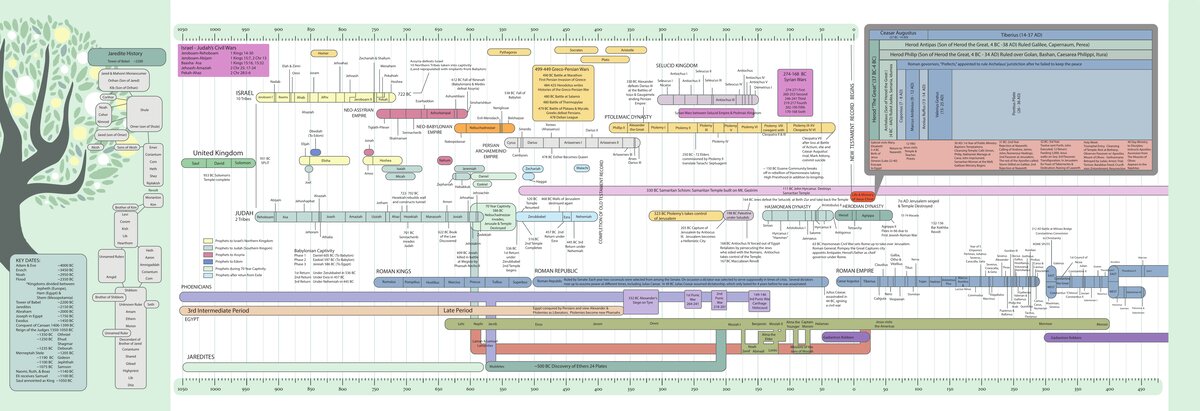
Tap to expand
Old Testament Timeline
From Creation through the Persian Period — tap the image to zoom, or download the full PDF.
Tap anywhere to close · Pinch to zoom