| Church Manuals | |
| Come Follow Me Manual — Week 27 | View |
| Scripture Helps: Old Testament | View |
| OT Seminary Teacher Manual | View |
| OT Institute Manual (Gen–2Sam) | View |
| Pearl of Great Price Manual | View |
| Scripture Reference | |
| Bible Dictionary | View |
| Topical Guide | View |
| Guide to the Scriptures | View |
| Church Media & Library | |
| Gospel for Kids (YouTube) | View |
| Bible Videos | View |
| Church Magazines | View |
| Gospel Library | View |
Week 27
If the Lord Be God, Follow Him
1 Kings 12–13; 17–22
June 29–July 5, 2026
5-Minute Overview
Week 27 traces Israel's divided kingdom from Rehoboam and Jeroboam through Elijah, Ahab, Jezebel, Naboth, and Micaiah. The study guide foregrounds counterfeit worship, prophetic authority, Baal's failed claim over storm and rain, the God who answers by fire and then speaks in silence, land as covenant inheritance, and the cost of telling the truth when every official voice says otherwise.
Official Church Resources
OFFICIAL CHURCH RESOURCES▶
CHURCH MEDIA FOR FAMILIES▶
▶ Video Commentary
VIDEO COMMENTARY (8 videos)
▼




Specialized Audiences
WOMEN’S PERSPECTIVES (2 videos)
▶

FAMILY & CHILDREN’S RESOURCES (2 videos)
▶

Reference & Study Materials
BIBLE PROJECT VIDEOS THIS WEEK (13 videos)
▶
Book overview + theme & word study videos relevant to this week’s reading.




ACADEMIC & SCHOLARLY SITES▶
MAPS & BIBLICAL LOCATIONS▶
A Letter to Fellow Students
▶︎
This week begins with a kingdom tearing in two.
Rehoboam stands at Shechem, the covenant place where Israel once chose the Lord, and receives the simplest counsel a king could receive: serve the people, lighten the burden, speak good words, and they will serve you forever. Instead, he chooses the voice that flatters power. "My father made your yoke heavy," he says, "and I will add to your yoke" (1 Kings 12:14). A king who should have become a servant becomes a threat, and ten tribes walk away.
Jeroboam then faces a different fear. If the people keep going to Jerusalem to worship, their hearts may return to David's house. So he builds a religion of convenience: golden calves at Dan and Bethel, priests of his own choosing, a feast calendar shifted just enough to feel familiar. He does not abolish worship. He makes a substitute for it. That is what makes his sin so durable. The most dangerous idolatry is often not the worship that looks obviously foreign, but the imitation that asks less of us while promising the same blessing.
Into that divided world comes a prophet whose very name is a sermon: Eliyahu (אֵלִיָּהוּ), "My God is Yahweh." Elijah appears with no origin story and no apology, announcing drought in the land of Baal. If Baal is lord of storm and rain, let him send rain. He cannot. At Carmel, Elijah forces the question Israel has avoided: "How long halt ye between two opinions? if the LORD be God, follow him: but if Baal, then follow him" (1 Kings 18:21). The people answer him not a word. Their silence is the diagnosis.
But the story refuses to end with spectacle. Fire falls, the people shout, rain returns — and then Elijah runs into the wilderness and asks to die. God feeds him before He teaches him. Then, at Horeb, God sends wind, earthquake, and fire, but the Lord is not in any of them. After the fire comes a qol demamah daqqah (קוֹל דְּמָמָה דַקָּה): a voice of thin silence, the still small voice. The prophet who called down fire had to learn that God can speak in fire, but He often chooses to speak in quiet.
That may be the week in miniature: choose the Lord when the world offers easier substitutes; trust Him before the jar is full; listen for Him after the fire is gone. The God who answers by fire is also the God who whispers in silence. Both are mercy.
Video Lesson: Israel's Request for a King
▶︎
This video lesson was created for last week's reading, but it still belongs with this week's study. Week 27 shows the long-term consequences of Israel's request for a king: the kingdom fractures, royal fear reshapes worship, and the narrative keeps pressing us toward the only King who can rule without taking, corrupting, or dividing.
What's in This Week's Materials
▶︎
In the Study Guide
▶︎
The Study Guide walks the whole arc from fracture to fire to silence:
- Rehoboam's failed leadership — the king who rejected elder counsel and chose domination instead of service.
- Jeroboam's counterfeit worship — golden calves, replacement priests, and an alternate feast calendar that made idolatry look familiar.
- The man of God from Judah — a true messenger destroyed after trusting a secondhand religious claim over God's direct command.
- The Elijah cycle — drought, ravens, Zarephath, resurrection, Carmel, Horeb, Elisha, Naboth, Micaiah, and Ahab's death.
- The widow of Zarephath — a Gentile woman in Baal's territory who gave her last meal before seeing the miracle.
- Mount Carmel — the contest that exposes Baal's silence and Israel's indecision.
- The still small voice — God teaching Elijah that revelation is not always loud, dramatic, or externally impressive.
- Naboth's vineyard — land as nachalah (נַחֲלָה), ancestral inheritance held as covenant trust rather than mere private property.
- Micaiah against four hundred prophets — the lonely courage of telling the truth when consensus has become a court performance.
The word studies focus on the vocabulary that names the week: Eliyahu (אֵלִיָּהוּ, "My God is Yahweh"), Ba'al (בַּעַל, lord/master/husband), qol demamah daqqah (קוֹל דְּמָמָה דַקָּה, "a still small voice"), esh (אֵשׁ, fire), nachalah (נַחֲלָה, inheritance), and navi (נָבִיא, prophet).
Coming Later
▶︎
Two companion pieces are still in progress and will be added after the main weekly materials are ready:
- Field Guide material — background support and visual/cultural orientation.
- Deuteronomic History material — the larger interpretive frame for Joshua, Judges, Samuel, and Kings.
These companion pieces will be very useful, but they are taking longer than I anticipated. Rather than cutting corners or delaying this week’s Study Guide, I’ve decided to release them in batches. They are supplementary resources, not required for this week’s lesson, but I think they will add helpful depth when they are ready. Watch for those updates soon; the core lesson is complete and can stand on its own.
In the Resources Tab
▶︎
The video resources from this week converge around several major themes:
- Follow Him / Lili Anderson — Elijah's question is ultimately a loyalty question: where do we stand when faith is no longer culturally convenient? The discussion also treats Elijah's despair with unusual tenderness: spiritual power does not prevent human collapse, and God often answers collapse first with food, rest, and continued presence.
- John Hilton III / Finding Christ — Rehoboam and Jeroboam show two forms of fear-based leadership: refusing wise counsel and manufacturing religious substitutes to keep control.
- Talking Scripture — Jeroboam's sin becomes a recurring pattern in Kings: a counterfeit system can outlive its founder and become the institutional default.
- Don't Miss This / Teaching With Power — the widow's first cake and Carmel's divided altar both ask the same practical question: what does it look like to put God first before the outcome is visible?
- Grounded / Our Mothers Knew It — Elijah is sent into a divided world as a unifier, calling Israel back to covenant identity when kings have fractured both worship and society.
- Unshaken — the Elijah stories hold together judgment and tenderness: sealing the heavens, feeding the prophet, sustaining the widow, confronting Baal, and recommissioning a prophet who thought he was alone.
- BibleProject — 2 Samuel and 1–2 Kings frame the monarchy as a tragic arc: Israel wants a king, the kings fail, exile follows, and the hope narrows toward the true King who can carry the covenant faithfully.
"How Long Halt Ye?": The Mercy of a Clear Choice
▶︎
Elijah's question on Carmel is sharper than it first sounds. He does not ask Israel to stop being irreligious. They are very religious. They have altars, prophets, sacrifices, ritual intensity, and national worship. The problem is not the absence of devotion; it is divided devotion. They are trying to keep YHWH and Baal both available.
The Hebrew word behind "halt" suggests branching or limping between divided paths. The image is not a person walking straight in the wrong direction, but a person unable to walk straight at all. Elijah's rebuke is not merely "choose the right God." It is also "stop pretending you can avoid choosing."
That is why the people's silence matters. "The people answered him not a word" (1 Kings 18:21). Silence can look neutral, but in this story it is spiritually revealing. When the question is covenant loyalty, not answering is already an answer.
There is mercy in being forced to choose. Ambiguity can feel gentle because it delays the cost, but it also delays the healing. Elijah gives Israel the dignity of a real decision: if Baal is god, follow him. If the Lord is God, follow Him. Do not keep building a life that requires both altars.
The Widow's Last Cake
▶︎
Before fire falls on Carmel, a quieter miracle happens in a poor woman's kitchen.
The widow of Zarephath has enough flour and oil for one final meal. Elijah asks her to feed him first. It is a difficult passage because the request feels almost unbearable: give before you can prove the promise, act before the jar is full, trust before the evidence arrives.
But that is the order of the miracle. The barrel of meal does not waste after she obeys. The cruse of oil does not fail after she gives. Faith is not the emotional result of abundance; it is the covenant act that opens a life to God's provision.
The location matters. Zarephath is in Sidon, Jezebel's homeland, Baal's territory. The God of Israel sustains a Gentile widow in the land where Baal should have had power. Jesus will later remember her in Nazareth as a witness that God's mercy is never trapped inside the borders people draw around it (Luke 4:25–26).
The widow's story is not sentimental. Her son still dies. Elijah still has to stretch himself over the child and plead for life. But even there, the story becomes the Bible's first resurrection narrative. The kitchen that began with a last meal becomes a place where death itself is answered.
Fire, Then Silence
▶︎
It would be easy for Carmel to become the whole lesson.
Fire falls from heaven. The sacrifice, wood, stones, dust, and water are consumed. The people fall on their faces and cry, "The LORD, he is the God" (1 Kings 18:39). It is decisive, public, undeniable.
But God does not leave Elijah at Carmel. He takes him to Horeb, the mountain of Moses, and teaches him another language. Wind comes, but the Lord is not in the wind. Earthquake comes, but the Lord is not in the earthquake. Fire comes, but the Lord is not in the fire. Then comes the voice of thin silence.
This is not a contradiction. Carmel and Horeb answer different needs. The crowd needed fire because they had forgotten who God was. Elijah needed silence because he had forgotten he was not alone.
God can speak in ways that shake mountains. He can also speak in ways that require a soul to become still enough to notice. The mistake is deciding that one mode is the only real one. A person who only trusts fire may miss the whisper. A person who only expects whisper may forget that God can still answer with power.
The mature lesson is to receive both.
Naboth's Vineyard and the Cost of Covenant Inheritance
▶︎
Naboth's refusal to sell his vineyard is one of the clearest places where modern assumptions can mislead us. Ahab sees land as an asset. Naboth sees it as nachalah — ancestral inheritance, a covenant trust received from God and held for future generations.
"The LORD forbid it me," Naboth says, "that I should give the inheritance of my fathers unto thee" (1 Kings 21:3). He is not being difficult. He is obeying a theology of land in which Israel belongs to God, and family inheritance cannot simply be absorbed by royal appetite.
Jezebel understands power differently. She forges letters, invokes Ahab's seal, hires false witnesses, and turns the legal system into an instrument of murder. The vineyard becomes a test of whether covenant law can survive royal convenience.
Elijah's question to Ahab is devastating: "Hast thou killed, and also taken possession?" (1 Kings 21:19). Six words hold the whole crime. The king who wanted a garden has violated inheritance, law, life, and truth.
And still, when Ahab humbles himself, God notices. Judgment is deferred. Not erased, but deferred. Even Ahab's partial repentance matters. That should sober us and soften us at the same time: no one is beyond God's notice, but consequences are not imaginary.
One True Voice Against Four Hundred
▶︎
The week ends with another kind of Carmel: not fire against Baal, but truth against consensus.
Ahab has four hundred prophets telling him to go to war. Their message is unanimous, confident, and useful to the king. Jehoshaphat still asks whether there is "a prophet of the LORD besides" (1 Kings 22:7). Micaiah comes, and Ahab admits the real issue before the prophet ever speaks: "I hate him; for he doth not prophesy good concerning me, but evil" (1 Kings 22:8).
That is the danger of court religion. It learns what the king wants to hear and calls it prophecy.
Micaiah tells the truth anyway. Israel will be scattered like sheep without a shepherd. The campaign will end in death. Ahab disguises himself, but a random arrow finds the joint in his armor. A disguise can fool soldiers. It cannot outrun the word of the Lord.
This final scene brings the week's prophetic thread together. The man of God from Judah, Elijah, Obadiah's hidden prophets, the sons of the prophets, the false prophets of Baal, the four hundred court prophets, and Micaiah all force the same question: how do we recognize God's word when many voices claim to speak it?
The answer is not volume, numbers, office, confidence, or convenience. The true word may be lonely. It may be costly. It may be the one voice the king hates. But it will not bend itself to protect our illusions.
The Invitation
▶︎
Week 27 asks for a choice.
Not a dramatic one only. Not merely a Carmel-sized declaration. It asks for the smaller choices that reveal what altar we are actually building: whose counsel we seek, what fears govern our decisions, whether we give God the first cake or the leftovers, whether we listen after the fire has passed, whether we treat inheritance as stewardship, and whether we prefer true prophecy to comfortable agreement.
The Lord is God. Follow Him.
Weekly Insights — Week 27 | CFM Corner | OT 2026
Sources: Study Guide draft, word studies, teaching applications, Interpreter Foundation notes, and Week 27 video distillations. Field Guide and Deuteronomic History companion materials are deferred for later addition.
Week 27
1 Kings 12–13; 17–22 — Overview
"If the Lord Be God, Follow Him"
1. Week 27: Overview
The reading this week spans two of the most dramatic arcs in the Old Testament, separated by three unassigned chapters that serve as a bridge of escalating apostasy. The first arc (chapters 12–13) narrates the fracture of Solomon's united monarchy into two kingdoms. Rehoboam, Solomon's son, rejects the counsel of the elders who served his father and instead follows the advice of his young peers — promising Israel heavier burdens, not lighter ones. The northern tribes secede under Jeroboam, who immediately constructs a counterfeit religion: golden calves at Dan and Bethel, non-Levitical priests, and an alternative feast calendar shifted by one month. The echo of Exodus 32 — Aaron's golden calf at Sinai — is unmistakable and deliberate. Into this crisis steps an unnamed man of God from Judah, who prophesies against Jeroboam's altar by name three hundred years in advance, naming a king — Josiah — who will one day desecrate that very altar. The man of God performs his sign, refuses the king's hospitality, and is then deceived by an old prophet who lies to him in God's name. The consequences are fatal, and the story raises questions about prophetic authority, obedience, and the danger of trusting human voices over direct divine instruction.
The second arc (chapters 17–22) introduces Elijah the Tishbite, arguably the most dramatic prophet in all of Scripture. He appears with no genealogy, no call narrative, no preparation — simply announcing drought: "As the LORD God of Israel liveth, before whom I stand, there shall not be dew nor rain these years, but according to my word" (17:1). The drought is not merely meteorological but theological: rain was Baal's domain, and Ahab has married Jezebel, princess of Sidon, importing Tyrian Baal worship into Israel. By shutting the heavens, Elijah declares that YHWH — not Baal — controls the rain. The prophet is sustained first by ravens at the brook Cherith, then by a Gentile widow in Zarephath — Baal's own territory — whose flour and oil never run out because she trusted the word of God over the evidence of her pantry. Elijah raises her dead son, the first resurrection narrative in the Bible.
The conflict escalates to Mount Carmel — one of the great set-piece confrontations in all of literature. Elijah stands alone against 450 prophets of Baal and 400 prophets of Asherah, challenging them to a contest: two altars, two bulls, no fire — and "the God that answereth by fire, let him be God" (18:24). Baal's prophets cry, dance, cut themselves, and prophesy for hours. Nothing happens. Elijah rebuilds the altar of YHWH with twelve stones — one for each tribe, affirming the nation's unity even in its division — drenches the sacrifice with water three times, and prays a single prayer. Fire falls from heaven, consuming the sacrifice, the wood, the stones, the dust, and the water in the trench. The people fall on their faces: Hashem hu ha-Elohim — "The LORD, He is the God" (18:39). But the triumph is followed immediately by collapse. Jezebel threatens Elijah's life, and the prophet who just called fire from heaven runs into the wilderness, sits under a broom tree, and asks to die. God feeds him, sends him on a forty-day journey to Horeb — Mount Sinai — and there, in the cave where Moses once stood, shows him wind, earthquake, and fire. But the LORD is not in any of them. He speaks instead in a qol demamah daqqah — a still small voice, a voice of thin silence — and recommissions the prophet.
The arc concludes with Naboth's vineyard (chapter 21), a story of judicial murder over a piece of land that Naboth refuses to sell because it is his nachalat avot — his ancestral inheritance, covenantally entrusted to his family by God. Jezebel forges letters, hires false witnesses, and has Naboth stoned. Elijah confronts Ahab: "In the place where dogs licked the blood of Naboth shall dogs lick thy blood, even thine" (21:19). Even so, when Ahab humbles himself — tearing his clothes, fasting, walking barefoot — God defers the judgment to his son's generation. Chapter 22 brings Ahab's end: the prophet Micaiah ben (son of) Imlah, outnumbered by four hundred court prophets who promise victory, delivers God's actual word — Israel scattered on the mountains like sheep without a shepherd — and Ahab dies at Ramoth-gilead, his blood licked by dogs at the pool of Samaria, in fulfillment of the word the LORD spoke through Elijah.
For accredited encyclopedic, archaeological, and museum sources on the people, places, kingdoms, and artifacts in this week's reading — Ahab, Omri, Jezebel, Samaria, Tel Dan, the Mesha Stele, the Black Obelisk, and more — see [[02_Historical_Cultural_Context#Sources & Further Reading|Sources & Further Reading]].
Assigned chapters are in bold. Use this table as a map — each chapter is discussed in the walkthrough below.
| Chapter | Content | Assigned |
|---|---|---|
| 1 Kings 12 | The kingdom divides; Rehoboam's folly; Jeroboam's golden calves | Yes |
| 1 Kings 13 | Man of God from Judah; the old prophet's deception | Yes |
| 1 Kings 14 | Ahijah's prophecy against Jeroboam; Jeroboam's son dies; Rehoboam's reign and death | — |
| 1 Kings 15 | Abijam and Asa in Judah; Nadab and Baasha in Israel | — |
| 1 Kings 16 | Elah, Zimri, Omri, and Ahab; Omri builds Samaria; Ahab marries Jezebel | — |
| 1 Kings 17 | Elijah and the drought; ravens at Cherith; widow of Zarephath | Yes |
| 1 Kings 18 | Obadiah hides prophets; Mount Carmel contest; fire from heaven; rain returns | Yes |
| 1 Kings 19 | Jezebel's threat; Elijah flees to Horeb; the still small voice; call of Elisha | Yes |
| 1 Kings 20 | Ben-hadad's siege; two battles; Ahab's misplaced mercy | Yes |
| 1 Kings 21 | Naboth's vineyard; Jezebel's judicial murder; Elijah's judgment; Ahab's repentance | Yes |
| 1 Kings 22 | Micaiah's true prophecy; Ahab's death at Ramoth-gilead | Yes |
The Kingdom Divides — Rehoboam's Folly and Jeroboam's Counter-Religion (1 Kings 12) — assigned
Rehoboam went to Shechem — the covenant site where Joshua had renewed Israel's commitment to YHWH — to be crowned. The northern tribes asked for relief from Solomon's forced labor. The elders who had served Solomon counseled gentleness. But Rehoboam's young advisors told him to assert dominance: "My little finger shall be thicker than my father's loins... my father chastised you with whips, but I will chastise you with scorpions" (12:10–11). The Hebrew aqrabbim (עַקְרַבִּים, scorpions) refers to barbed whips — implements of torture. Rehoboam chose intimidation over service, and ten tribes walked away. The division that God had prophesied through Ahijah (11:29–39) came to pass — not through revolution but through a young king's arrogance. The lesson is embedded in the structure: leadership that serves produces loyalty; leadership that dominates produces fracture.
Jeroboam's political problem was theological: if the northern tribes continued going to Jerusalem's temple for the three pilgrimage feasts, their loyalty would drift back to the Davidic dynasty. His solution was a counterfeit worship system designed to look just enough like the real thing: golden calves at Dan and Bethel, with the declaration "Behold thy gods, O Israel, which brought thee up out of the land of Egypt" (12:28) — the exact words Aaron used at Sinai (Exodus 32:4). Non-Levitical priests, a feast in the eighth month to rival the seventh-month Feast of Tabernacles, and high places throughout the land. Jeroboam did not abolish worship; he redirected it. The most dangerous idolatry is not the kind that looks alien but the kind that looks familiar.
The Man of God from Judah — Prophetic Authority and Deception (1 Kings 13) — assigned
An unnamed prophet from Judah arrives at Bethel and prophesies against Jeroboam's altar: "O altar, altar, thus saith the LORD; Behold, a child shall be born unto the house of David, Josiah by name" (13:2). He names a king three centuries before his birth. Jeroboam stretches out his hand to seize the prophet, and the hand stiffens — Rashi notes (on 13:4) that God avenged the prophet's honor, not the altar's idolatry: the hand froze because it was raised against God's messenger, not because of the golden calf. The man of God refuses the king's invitation but is then deceived by an old prophet who claims an angel told him to bring the man of God home to eat. The old prophet lied. The man of God obeyed the lie instead of the direct command he had received from God — and a lion killed him on the road. The story is a warning: even a true prophet can be destroyed by trusting a human voice over God's direct word.
Ahijah's Prophecy Against Jeroboam; Jeroboam's Son Dies; Rehoboam's Decline (1 Kings 14) — not assigned
Chapter 14 opens with Jeroboam's son Abijah falling ill. Jeroboam sends his wife in disguise to the prophet Ahijah at Shiloh — the same prophet who had torn his garment into twelve pieces to prophesy the kingdom's division (11:29–31). But Ahijah, now blind, is warned by God and sees through the disguise. His oracle is devastating: God will uproot Jeroboam's house "as a man taketh away dung" (14:10). The child dies the moment his mother crosses the threshold — the only member of Jeroboam's family to receive a proper burial, because "in him there is found some good thing toward the LORD" (14:13). The second half of the chapter turns to Judah under Rehoboam, who also descends into idolatry: high places, pillars, asherim (אֲשֵׁרִים, sacred poles), and male cult prostitutes (qedeshim, קְדֵשִׁים). Pharaoh Shishak (Sheshonq I) invades Jerusalem and carries off the treasures of the temple — the gold Solomon had lavished on God's house, now funding an Egyptian treasury. Rehoboam replaces the gold shields with bronze. The descent from gold to bronze is the chapter's silent metaphor.
Abijam, Asa, Nadab, and Baasha — Judah's Reform and Israel's Cycle (1 Kings 15) — not assigned
Chapter 15 covers Abijam's brief and wicked reign in Judah (three years), then the long and largely faithful reign of Asa (forty-one years), who removes the cult prostitutes, deposes his own grandmother Maacah from the position of queen mother for making an asherah (אֲשֵׁרָה) idol, and institutes reforms — though the high places remain. In the north, Jeroboam's son Nadab reigns two years before being assassinated by Baasha, who then exterminates Jeroboam's entire house — fulfilling Ahijah's prophecy from chapter 14. Baasha reigns twenty-four years but walks "in the way of Jeroboam," perpetuating the golden calf system.
The Northern Kingdom's Collapse — Elah, Zimri, Omri, and the Rise of Ahab (1 Kings 16) — not assigned
Chapter 16 accelerates the northern kingdom's collapse into near-anarchy. Baasha's son Elah reigns two years before being assassinated by his chariot commander Zimri — while drunk at a party. Zimri reigns exactly seven days before the army elevates Omri, who besieges the capital. Zimri sets the palace on fire around himself and dies in the flames. Omri prevails, builds the new capital at Shomron (שֹׁמְרוֹן, Samaria) — a site chosen for its defensive strength and commercial position — and establishes the dynasty that will dominate the northern kingdom for decades. But the chapter's final act is the most consequential: "Ahab the son of Omri did evil in the sight of the LORD above all that were before him" (16:30). Ahab marries Jezebel, daughter of Ethbaal king of the Sidonians, and builds a temple for Baal in Samaria. This is not merely personal sin — it is state-sponsored importation of a foreign cult. The chapter closes with Hiel of Bethel rebuilding Jericho at the cost of his sons' lives, fulfilling Joshua's ancient curse (Joshua 6:26). This detail matters because Sanhedrin 113a places Elijah's drought declaration at Hiel's funeral — making Hiel's death the catalyst for the entire Elijah cycle that follows.
These three chapters demonstrate a pattern: the northern kingdom cycles through kings at an accelerating pace, each one described as walking "in the way of Jeroboam" — meaning each one maintained the counterfeit religion of the golden calves. The system Jeroboam created outlasted Jeroboam. It became the institutional default. By the time Ahab adds Baal worship on top of the calf system, Israel has two layers of apostasy: the structural idolatry Jeroboam built and the personal paganism Ahab imported. Elijah confronts both.
Elijah and the Drought — The Sealing of Heaven and the Widow of Zarephath (1 Kings 17) — assigned
Elijah appears without introduction, without lineage, and seals the heavens: no rain until he says so. The Hebrew atzar (עָצַר) means "to restrain, shut up, close." The Talmud (Sanhedrin 113a) records that Elijah made this declaration at the funeral of Hiel of Bethel, who had rebuilt Jericho in defiance of Joshua's curse and lost his sons as a result. Ahab argued that if Joshua's lesser curse worked, surely Moses' greater warning — "He will shut up the heaven, that there be no rain" (Deuteronomy 11:17) — could not apply to him, since he was worse than Moses' generation and there was still rain. Elijah answered with the drought: the curse applies. The sealing power that shuts heaven appears in Latter-day Saint theology through Elijah's own key, restored in the Kirtland Temple (D&C 110:13–16) and exercised by Nephi son of Helaman (Helaman 10:6–7).
God sends Elijah first to the brook Cherith, where ravens bring him bread and flesh morning and evening (17:6). When the brook dries up, God sends him not to an Israelite home but to a Gentile widow in Zarephath of Sidon — Jezebel's homeland, Baal's territory. Rashi on 17:9 explains that the divine command was issued in the heavenly retinue — the widow herself did not know she had been chosen (see Historical & Cultural Context, Section 7 for the full teaching). Her faith was entirely voluntary. She was asked to give her last meal — the final handful of qemach (קֶמַח, flour) and the last drops of shemen (שֶׁמֶן, oil) — to a stranger before feeding herself and her son. She had every reason to refuse. The promise was absurd: an inexhaustible pantry, sustained by the word of a foreign prophet, in a land that worshipped a different god. But she "went and did according to the saying of Elijah" (17:15). Faith preceded evidence. The miracle began only after the widow committed her last resources — provision followed faith, not the reverse. The order matters.
Jesus cited her as proof that God's grace transcends ethnic and geographic boundaries: "Many widows were in Israel in the days of Elias... but unto none of them was Elias sent, save unto Sarepta, a city of Sidon, unto a woman that was a widow" (Luke 4:25–26). Elijah then raises her dead son — the first resurrection narrative in the Bible — and the widow declares: "Now by this I know that thou art a man of God, and that the word of the LORD in thy mouth is truth" (17:24).
Mount Carmel — The God Who Answers by Fire (1 Kings 18) — assigned
Chapter 18 opens with Obadiah, Ahab's chief steward — a rare righteous man in a corrupt court — who had hidden a hundred prophets of YHWH in caves, feeding them with bread and water while Jezebel was cutting down every prophet she could find (18:4). Obadiah's quiet faithfulness preserved the prophetic remnant in Israel.
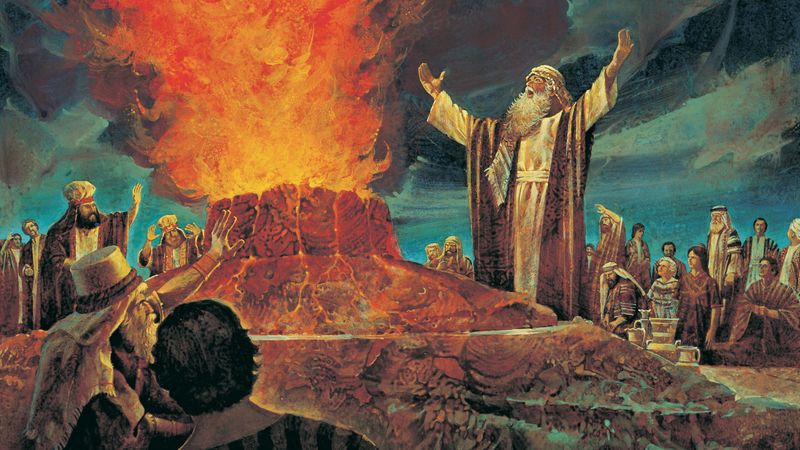
The contest on Carmel is the most dramatic confrontation between true and false worship in the Old Testament. Elijah's challenge to the people is the defining question of the week: "How long halt ye between two opinions? if the Lord be God, follow him: but if Baal, then follow him. And the people answered him not a word" (18:21). The Hebrew se'ippim (סְעִפִּים) means "branching thoughts" — the mind going in two directions simultaneously, like a tree fork. The people were not atheists. They were not committed Baal worshippers. They were undecided. They maintained both altars, hedged both bets, and served whichever god seemed advantageous on a given day. Elijah's rebuke is not against choosing Baal — he offers that as a genuine option — but against the refusal to choose at all. And the people's response? Silence. No answer. The silence itself is the diagnosis. Indecision can be its own form of apostasy.
Elijah stands alone against 450 prophets of Baal and 400 prophets of Asherah, challenging them: two altars, two bulls, no fire — "the God that answereth by fire, let him be God" (18:24). Baal's prophets cry, dance, cut themselves, and prophesy from morning until the time of the evening offering. Nothing happens. Elijah rebuilds the altar of YHWH — Rashi (on 18:30) identifies it as the altar originally built by Saul (1 Samuel 14:35), later destroyed by Baal worshippers. He uses twelve stones, one for each tribe, affirming national unity even in political division. In the later rabbinic legal frame, this raises the question of how Elijah could offer sacrifice outside the Jerusalem Temple; Sanhedrin 89b answers with hora'at sha'ah, a prophetic ruling for the hour. Historically, that centralized-worship assumption should be held with nuance, since many scholars locate full Jerusalem centralization most clearly in Hezekiah's and Josiah's reforms, and earlier Israelite practice appears more complex. The sacrifice is drenched with water three times, and Elijah prays a single prayer. Fire falls from heaven, consuming the sacrifice, the wood, the stones, the dust, and the water in the trench — leaving nothing for human claim. It was God's answer, total and undeniable. The people fall on their faces: Hashem hu ha-Elohim — "The LORD, He is the God" (18:39). Rain returns, ending the drought.
The Still Small Voice — Revelation at Horeb (1 Kings 19) — assigned
After Carmel's triumph, Elijah collapses. Jezebel threatens his life — "So let the gods do to me, and more also, if I make not thy life as the life of one of them by to morrow about this time" (19:2) — and the prophet who just called fire from heaven runs into the wilderness, sits under a broom tree, and asks to die: "It is enough; now, O LORD, take away my life; for I am not better than my fathers" (19:4). God feeds him — an angel brings bread and water twice — and sends him on a forty-day journey to Horeb, Mount Sinai, the mountain of Moses. The forty-day journey parallels Moses' forty days on the mountain.
At Horeb, in the cave where Moses once stood, God sends wind, earthquake, and fire — but the LORD is not in any of them. Then comes the qol demamah daqqah (קוֹל דְּמָמָה דַקָּה) — traditionally "a still small voice," more literally "a voice of thin silence." The Hebrew demamah (דְּמָמָה) means "silence, stillness," and daqqah (דַּקָּה) means "thin, fine, subtle." The paradox is deliberate: a voice made of silence, heard only when everything louder has been stripped away. Rashi explains that the wind, earthquake, and fire were camps of angels, and the demamah was the "voice of quiet praise" — a concept he captures with the Old French rentesment (see Word Studies, Word Study 3 for the full linguistic treatment). The implication is profound: the most powerful revelation is the quietest. God can speak in fire; He chooses to speak in whisper. Elijah, who had commanded spectacle, had to learn to hear silence.
God asks: "What doest thou here, Elijah?" (19:9, 13). Elijah answers with the same complaint before and after the theophany — "I, even I only, am left" (19:10, 14). God corrects him: there are seven thousand in Israel who have not bowed the knee to Baal (19:18). Elijah was not alone. He was never alone. The divine response is both comfort and rebuke: the prophet must see past his own experience to the larger work God is doing. God then recommissions the prophet with three tasks: anoint Hazael as king of Syria, anoint Jehu as king of Israel, and anoint Elisha as his own successor (19:15–16). Elijah finds Elisha plowing with twelve yoke of oxen — a sign of considerable wealth — and casts his mantle upon him (19:19). Elisha slaughters the oxen, burns the plowing equipment, and follows. There is no going back.
Ben-hadad's Siege and Ahab's Misplaced Mercy (1 Kings 20) — assigned
Ben-hadad king of Syria besieges Samaria with a vast coalition and demands Ahab's silver, gold, wives, and children (20:3). Ahab initially submits, but when Ben-hadad escalates — demanding the right to have his servants ransack Ahab's palace at will (20:6) — Ahab refuses. A prophet of YHWH appears (unnamed) and promises victory: "Hast thou seen all this great multitude? behold, I will deliver it into thine hand this day; and thou shalt know that I am the LORD" (20:13). The phrase "thou shalt know that I am the LORD" echoes the Exodus plagues — God is still fighting the same battle of recognition.
Israel defeats Syria twice — once at Samaria and once at Aphek, where the Syrians had presumed that Israel's God was "a god of the hills" who could not fight on the plain (20:23). The second prophet's message is direct: "Because the Syrians have said, The LORD is God of the hills, but he is not God of the valleys, therefore will I deliver all this great multitude into thine hand, and ye shall know that I am the LORD" (20:28). But after the victory, Ahab spares Ben-hadad's life and makes a treaty with him — calling him "my brother" (20:32) — when God had devoted Ben-hadad to destruction (cherem, חֵרֶם). A prophet confronts Ahab: "Because thou hast let go out of thy hand a man whom I appointed to utter destruction, therefore thy life shall go for his life, and thy people for his people" (20:42). Ahab's misplaced mercy toward a defeated enemy mirrors Saul's failure with Agag (1 Samuel 15) — compassion that overrides God's explicit command is not mercy but disobedience.
Naboth's Vineyard — Justice, Land, and Repentance (1 Kings 21) — assigned
Naboth owned a vineyard adjacent to Ahab's palace in Jezreel. Ahab wanted it for a vegetable garden. Naboth refused: "The LORD forbid it me, that I should give the inheritance of my fathers unto thee" (21:3). His refusal was not mere stubbornness — it was Torah obedience. The land of Israel was divided by tribe and family according to divine allotment (Numbers 26:52–56), and the Jubilee laws (Leviticus 25:23–28) ensured that land could not be permanently alienated from its ancestral family. Naboth's nachalat avot (נַחֲלַת אָבוֹת, ancestral inheritance) was a covenant trust, not a commodity.
Jezebel arranged his murder through forged letters, false witnesses, and a rigged trial (21:8–14) — a systematic violation of Torah law at every step. She forged letters in Ahab's name, sealed them with his seal, and sent them to the elders of Naboth's city. The charges — blasphemy against God and king — required two witnesses (Deuteronomy 17:6), and Jezebel provided them, both false. Naboth was stoned to death.
Elijah's judgment on Ahab is direct: "Hast thou killed, and also taken possession?" (21:19). The condensation is devastating — two crimes in six words: murder and theft. "In the place where dogs licked the blood of Naboth shall dogs lick thy blood, even thine" (21:19). But when Ahab tears his clothes and walks barefoot in sackcloth, God tells Elijah: "Seest thou how Ahab humbleth himself before me? Because he humbleth himself before me, I will not bring the evil in his days" (21:29). Rashi notes that even partial, imperfect repentance moved God to defer judgment. The door of mercy does not close while breath remains — but deferred is not cancelled.
Micaiah's True Prophecy and Ahab's Death at Ramoth-gilead (1 Kings 22) — assigned
Three years after the treaty with Ben-hadad, Ahab enlists Jehoshaphat king of Judah for a joint campaign to retake Ramoth-gilead from Syria. Four hundred prophets — court prophets, men who serve the king's interests — unanimously promise victory: "Go up; for the Lord shall deliver it into the hand of the king" (22:6). But Jehoshaphat asks the revealing question: "Is there not here a prophet of the LORD besides, that we might enquire of him?" (22:7).
Enter Micaiah ben Imlah. Ahab despises him: "I hate him; for he doth not prophesy good concerning me, but evil" (22:8). Micaiah initially echoes the four hundred — "Go, and prosper" (22:15) — with enough irony that Ahab himself demands the truth. The truth is a vision: "I saw all Israel scattered upon the hills, as sheep that have not a shepherd" (22:17). Micaiah then reveals a scene from the divine council — God asking who will entice Ahab to go to Ramoth-gilead to his death. A spirit volunteers: "I will go forth, and I will be a lying spirit in the mouth of all his prophets" (22:22). The Talmud (Sanhedrin 89a) identifies this spirit as the spirit of Naboth — the murdered man returning as an instrument of divine justice. Micaiah is struck and imprisoned. The four hundred continue their unanimous, confident, wrong prophecy.
Ahab disguises himself for battle, but a random archer draws his bow "at a venture" (22:34) — without aiming at anyone in particular — and the arrow finds the joint in Ahab's armor. He bleeds out slowly in his chariot through the day, propped up to maintain morale, and dies at evening. His blood is washed from the chariot at the pool of Samaria, "and the dogs licked up his blood... according unto the word of the LORD which he spake" (22:38). The prophet's word, spoken by Elijah in chapter 21, arrives exactly. A disguise could not outrun a prophecy.
"How long halt ye between two opinions? if the Lord be God, follow him: but if Baal, then follow him. And the people answered him not a word." (1 Kings 18:21)
"And after the earthquake a fire; but the Lord was not in the fire: and after the fire a still small voice." (1 Kings 19:12)
"The barrel of meal shall not waste, neither shall the cruse of oil fail, until the day that the Lord sendeth rain upon the earth." (1 Kings 17:14)
Three defining moments, three modes of faith. Elijah's challenge on Carmel exposes the most common spiritual failure — not choosing wrong but refusing to choose at all. The silence of the people is the diagnosis: indecision is its own form of apostasy. At Horeb, the prophet who commanded fire must learn to hear silence — God's preferred mode of communication is not spectacle but whisper, intimate and earned by stillness. And in Zarephath, a Gentile widow gives her last meal before seeing any miracle — faith precedes evidence, provision follows commitment, and the order matters.
- The Fracture (ch. 12) — A young king's arrogance shatters the united monarchy. Jeroboam builds a counterfeit religion to keep the northern tribes from Jerusalem. The division is political; the damage is spiritual.
- The Warning (ch. 13) — God sends an unnamed prophet to denounce Jeroboam's altar and a named king (Josiah) is prophesied three centuries early. But even the prophet himself is destroyed when he trusts a human voice over God's direct command. The chapter is a case study in prophetic authority and the danger of substituting secondhand instruction for firsthand revelation.
- The Bridge (chs. 14–16) — Sixty years of accelerating apostasy: Jeroboam's dynasty falls, Judah descends from gold shields to bronze, the northern kingdom cycles through assassinations and coups, and Ahab marries Jezebel, importing Baal worship into the state. The counterfeit religion Jeroboam built becomes the institutional default. By the time Elijah arrives, Israel has two layers of idolatry.
- The Confrontation (chs. 17–18) — Elijah seals the heavens, is sustained by ravens and a Gentile widow, and then forces the defining question of the Old Testament on Mount Carmel: "If the LORD be God, follow him; but if Baal, then follow him." Fire falls. Rain returns. The drought was not punishment — it was proof.
- The Silence (ch. 19) — Elijah's collapse after Carmel leads him to Sinai, where God bypasses spectacle and speaks in whispered silence. The prophet who commanded fire must learn to hear stillness. God's preferred mode of communication is not dramatic — it is intimate.
- The Reckoning (chs. 20–22) — Ahab's wars, Naboth's murder, Elijah's judgment, Ahab's barefoot repentance, Micaiah's lonely truth against four hundred false prophets, and Ahab's death in battle. Justice is delayed by repentance but not cancelled. Even partial humility moves God, but the consequences of systemic evil eventually arrive.
- The question has not changed. Elijah's challenge — "How long halt ye between two opinions?" — is not an ancient question with an ancient audience. Every generation faces the same fork: committed faith or comfortable syncretism. The silence of the people on Carmel is the sound of every person who has postponed a spiritual decision indefinitely.
- God speaks quietly. In a culture saturated with noise, spectacle, and content, the still small voice is the most countercultural idea in scripture. God can speak in fire — He did, on Carmel. But He chooses to speak in whispered silence, and that choice tells us something about the kind of relationship He wants: intimate, attentive, and earned by stillness.
- Faith precedes evidence. The widow of Zarephath gave her last meal before she saw the miracle. God's supply began only after her sacrifice, not before it. This is the consistent biblical pattern — Nachshon wading into the Red Sea, the priests stepping into the Jordan, Moroni writing about faith as "things which are hoped for and not seen" (Ether 12:6). God rewards the act, not the certainty.
- Land, law, and justice are inseparable. Naboth's refusal to sell his vineyard was not stubbornness — it was Torah obedience. Jezebel's judicial murder was not merely a crime against one man — it was a systematic violation of divine law governing property, witnesses, courts, and the covenant relationship between God, land, and family. When governments override covenant obligations, prophets respond.
- Repentance is never too late — but consequences are not erased. Ahab, who did "evil in the sight of the LORD above all that were before him" (16:30), humbled himself after Elijah's judgment — and God noticed. Even partial, barefoot, sackcloth repentance from the worst king in Israel's history moved God to defer punishment. The door of mercy does not close while breath remains. But deferred is not cancelled; the judgment fell on the next generation. Repentance changes the person; it does not always change the history.
2. Week 27: Historical & Cultural Context
Solomon's death fractures the united monarchy and sets in motion a chain of events that will ultimately destroy the northern kingdom entirely. This week's reading spans roughly seventy years — from the assembly at Shechem (c. 930 BC) through Ahab's death at Ramoth-gilead (c. 853 BC). The cultural world behind these chapters involves Canaanite kingship models, Phoenician Baal worship, prophetic guilds, land-tenure law, the geography of sacred mountains, and the theology of fire and silence. Understanding these contexts transforms the narrative from a political chronicle into a theological argument about what it means to worship the living God in a culture that offers compelling alternatives.
The fracture of Israel begins not with a battle but with a negotiation. After Solomon's death, the northern tribes gather at Shechem — the most covenantally loaded site in Israel, where Abraham received the first promise (Genesis 12:6–7), where Jacob buried foreign idols (Genesis 35:4), and where Joshua renewed the covenant (Joshua 24). The choice of Shechem signals that the northern tribes consider this a covenant question, not merely a political one.
Their grievance is concrete: Solomon's mas (מַס, forced labor) had conscripted Israelites to build the temple, the palace complex, and fortification cities (1 Kings 5:13–14; 9:15–22). The Hebrew mas is the same word used for the labor gangs Pharaoh imposed on Israel in Egypt (Exodus 1:11). The irony is sharp — the king who built God's house did so using the same system God delivered Israel from. The northern tribes ask Rehoboam for relief. The elders counsel gentleness: "If thou wilt be a servant unto this people this day... they will be thy servants for ever" (12:7). The word eved (עֶבֶד, servant) appears on both sides of the equation — true kingship is mutual service.
Rehoboam rejects the elders and follows his young advisors, who counsel intimidation: "My father chastised you with whips (shotim, שׁוֹטִים), but I will chastise you with scorpions (aqrabbim, עַקְרַבִּים)" (12:11). The aqrabbim were barbed whips — instruments of punishment, not governance. The response is immediate: "What portion have we in David?... to your tents, O Israel!" (12:16). The phrase "to your tents" is the ancient battle cry of secession — a declaration that the covenant between north and south is dissolved. Rehoboam sends his tax collector Adoram to reassert authority; the people stone him to death. The king flees to Jerusalem.
The division fulfills the prophecy Ahijah gave Jeroboam (11:29–39), but the text makes clear that the immediate cause was human folly, not divine determinism. God allowed what Rehoboam's arrogance caused. Rehoboam's choice demonstrated a principle that runs through all of Israel's history: when rulers prioritize control over service, the result is division. As the Doctrine and Covenants puts it: "No power or influence can or ought to be maintained by virtue of the priesthood, only by persuasion, by long-suffering, by gentleness and meekness, and by love unfeigned" (D&C 121:41).
Jeroboam's political problem was theological. If the northern tribes continued making the three annual pilgrimage festivals — Passover, Shavuot (Weeks), and Sukkot (Tabernacles) — to Solomon's temple in Jerusalem, their loyalty would inevitably drift back to the Davidic dynasty. His solution was a comprehensive counterfeit worship system designed to replicate enough of the authentic experience to satisfy religious impulse while redirecting allegiance away from Jerusalem.
He set up golden calves at Dan (the northern border) and Bethel (the southern border, just north of Jerusalem), bracketing his kingdom with idolatrous shrines. His declaration — "Behold thy gods, O Israel, which brought thee up out of the land of Egypt" (12:28) — reproduces Aaron's exact words at Sinai (Exodus 32:4). The echo is too precise to be accidental; the text wants readers to hear the repetition and shudder. Jeroboam likely intended the calves as pedestals for YHWH — the same way the cherubim in the temple served as God's throne — but the distinction between a pedestal for God and a representation of a god was too subtle for popular worship. Within a generation, the calves became the gods.
He appointed non-Levitical priests "of the lowest of the people" (12:31) — anyone who wanted to serve could serve, regardless of lineage or calling. He shifted the autumn festival from the seventh month (Tishrei, the month of Sukkot as commanded in Leviticus 23:34) to the eighth month, "which he had devised of his own heart" (12:33). Every element of authentic worship was present — altar, priests, festivals, sacrifice — but every element was altered just enough to be under Jeroboam's control rather than God's. The system did not abolish worship; it redirected it. And that is precisely what made it so dangerous and so durable. The phrase "the sins of Jeroboam who made Israel to sin" appears over twenty times in Kings as the defining label for every subsequent northern king. The system he created outlasted his dynasty by two centuries.
Chapter 13 is one of the strangest and most disturbing narratives in the Old Testament. An unnamed man of God from Judah arrives at Bethel and prophesies against Jeroboam's altar, naming a future king — Josiah — who will desecrate that altar and burn human bones on it (13:2). The prophecy is confirmed by a sign: the altar splits and the ashes pour out (13:5). When Jeroboam stretches out his hand to order the prophet seized, the hand stiffens and cannot be withdrawn. Rashi (on 13:4) notes a telling detail: God avenged the prophet's honor — the hand froze because it was raised against God's messenger — but did not avenge the altar's idolatry. The distinction is instructive: attacking a prophet is treated as more immediately dangerous than building a golden calf.
The man of God restores Jeroboam's hand through prayer but refuses the king's invitation to eat and drink, having been commanded by God: "Eat no bread, nor drink water, nor turn again by the same way that thou camest" (13:9). He obeys — until he is intercepted by an old prophet from Bethel who claims: "I am a prophet also as thou art; and an angel spake unto me by the word of the LORD, saying, Bring him back with thee into thine house, that he may eat bread and drink water. But he lied unto him" (13:18). The text is blunt: "he lied."
The man of God obeys the old prophet instead of God's direct command. A lion kills him on the road but does not eat him or harm the donkey — the lion is an instrument of divine justice, not a random predator. The old prophet buries the man of God and requests to be buried in the same tomb, believing the prophecy against Bethel will indeed come true. The story is fulfilled in 2 Kings 23:15–18, when Josiah does exactly what was prophesied — three hundred years later.
The narrative raises questions that Jewish and Christian commentators have wrestled with for millennia: Why was the man of God punished for obeying a lie he had no way to detect? The answer most commentators reach is that he did have a way — he had God's direct command. When a human voice contradicts a divine command, the divine command takes precedence, regardless of the human voice's credentials. The story is a warning not about the weakness of the deceived but about the priority of direct revelation over secondhand authority.
The word Ba'al (בַּעַל) simply means "lord, master, husband" — an ordinary Hebrew word applied to the primary deity of the Canaanite and Phoenician pantheons. Baal Hadad was the storm god: lord of rain, thunder, lightning, and agricultural fertility. In the Ugaritic texts (discovered at Ras Shamra in modern Syria, dating to the 14th–13th centuries BC), Baal defeats the sea god Yam and the death god Mot, and is enthroned on Mount Zaphon as king of the gods. His cult was the dominant religious system in the Levant for centuries.
Jezebel's marriage to Ahab was a political alliance between the Omride dynasty and Phoenicia. The Bible calls her father Ethbaal "king of the Zidonians" (1 Kings 16:31), and Jezebel is remembered as a Sidonian princess; extrabiblical tradition (Josephus, drawing on the Tyrian historian Menander) identifies Ethbaal more precisely as Ithobaal I, king of Tyre — "Sidonians" functioning in this era as a broad label for the Phoenicians, whose preeminent trading cities were Tyre and Sidon. But Jezebel was not a passive consort; she was a zealous evangelist for Tyrian Baal worship. She imported 450 prophets of Baal and 400 prophets of Asherah (18:19), systematically murdered YHWH's prophets (18:4), and used royal authority to install Baal worship as the state religion. The crisis was not that individual Israelites sometimes consulted Baal — that syncretism had existed for generations. The crisis was that the state itself now promoted Baal as the official god of Israel, with institutional backing, funded clergy, and a temple in the capital (16:32).
The brilliance of Elijah's contest on Mount Carmel lies in the choice of battlefield. Rain was Baal's domain. Lightning was Baal's weapon. A mountain overlooking the sea was Baal's territory. By challenging Baal's prophets to call down fire — Baal's signature act — Elijah was not fighting on neutral ground but on ground where Baal should have had every advantage. The contest was designed to be maximally humiliating: if Baal could not answer with fire on his own mountain, in his own weather domain, through his own prophets, then Baal was nothing. The silence from Baal's altar was not just failure — it was categorical disproof on his own terms.
Mount Carmel (Karmel, כַּרְמֶל) means "vineyard of God" or "garden land" — the name itself testifies to the ridge's extraordinary fertility. The Carmel range is a limestone ridge running roughly 24 kilometers from the Mediterranean coast near modern Haifa southeast toward the Jezreel Valley. It rises to approximately 550 meters at its highest point and captures moisture from Mediterranean winds, making it one of the most consistently green and well-watered areas in all of Israel — a sharp contrast to the arid hills further inland.
Carmel sat on a boundary — politically between Israel and Phoenicia, religiously between YHWH worship and Baal worship, geographically between the coastal plain and the interior highlands. The ridge had been a site of worship for multiple cultures long before Israel arrived. Egyptian records mention it; Thutmose III listed it among his conquests. The location's significance for the Elijah narrative is precise: a boundary mountain, sacred to multiple traditions, overlooking the sea from which Baal's rain supposedly came, covered with the vineyards and vegetation that Baal's fertility supposedly produced. Every element of the setting argued for Baal. Elijah chose this ground deliberately.
Archaeological surveys have identified ancient altar sites on Carmel, consistent with the biblical reference to "the altar of the LORD that was broken down" (18:30). The Carmelite religious order, founded in the 12th century AD, established its first monastery on Carmel precisely because of the Elijah tradition. The el-Muhraqa ("the burning") site on the southeastern end of the ridge has been identified since at least the medieval period as the traditional location of the contest. From this spot, one can see the Jezreel Valley to the east and the Mediterranean to the west — the "small cloud... like a man's hand" rising "out of the sea" (18:44) would have been visible from exactly this vantage point.
Elijah's drought declaration employs the Hebrew verb atzar (עָצַר) — "to restrain, shut up, close, hold back." When Elijah says "there shall not be dew nor rain these years, but according to my word" (17:1), he is exercising what Latter-day Saints recognize as the sealing power: the authority to bind on earth what is bound in heaven, to shut the heavens or open them according to prophetic commission.
The Talmud (Sanhedrin 113a) provides the backstory: Elijah made this declaration at the funeral of Hiel of Bethel, who had rebuilt Jericho in defiance of Joshua's curse (Joshua 6:26) and lost two sons as a result. Ahab was present and argued that if Joshua's "lesser" curse worked but Moses' "greater" warning about drought (Deuteronomy 11:17) had not, then surely God would not enforce the covenant consequences. Elijah's response was the drought itself — proof that Moses' warning was not idle. The drought lasted three and a half years (Luke 4:25; James 5:17), during which Israel's entire agricultural economy collapsed, streams dried up, and famine gripped the land. Rain was Baal's portfolio; its absence was Baal's refutation.
The sealing power that Elijah exercised reappears at critical junctures in scripture. Nephi son of Helaman received it directly from God: "I will make thee mighty in word and in deed, in faith and in works; yea, even that all things shall be done unto thee according to thy word... if ye shall say unto this temple it shall be rent in twain, it shall be done" (Helaman 10:5–7). In the Kirtland Temple, Elijah himself appeared to Joseph Smith and Oliver Cowdery to restore "the keys of this dispensation" — specifically the sealing authority (D&C 110:13–16). The connection is not metaphorical: the same prophet who sealed the heavens over ancient Israel restored the sealing keys in the latter days. Every temple ordinance performed under the sealing authority traces its commission back to Elijah.
Zarephath (Tsarfat, צָרְפַת) was a Phoenician coastal town between Tyre and Sidon — deep in Baal's territory, in the heart of Jezebel's homeland. God did not send Elijah to an Israelite community, to a faithful remnant in Judah, or to any location within the covenant boundaries. He sent His premier prophet to a Gentile widow in the most unlikely location imaginable. The irony is deliberate: the God whom Jezebel was working to eradicate from Israel was being worshipped — and was sustaining life — in Jezebel's own country, through a woman who had never entered Israel's covenant.
Rashi (on 17:9) explains the phrase "I have commanded a widow woman there to sustain thee" as meaning God had issued this command in His heavenly retinue — among the angels and ministering spirits. The widow herself had received no prior revelation. She did not know she had been chosen. Her faith was entirely voluntary, tested in real time: a foreign prophet appeared at the city gate and asked for her last handful of flour and her last drops of oil — the final meal she intended to share with her son before they died of starvation (17:12). Her response — "went and did according to the saying of Elijah" (17:15) — is one of the most quietly heroic acts in the Old Testament. She gave everything she had on the strength of a stranger's promise.
Jesus cited this woman specifically when challenged in the synagogue at Nazareth: "Many widows were in Israel in the days of Elias, when the heaven was shut up three years and six months, when great famine was throughout all the land; but unto none of them was Elias sent, save unto Sarepta, a city of Sidon, unto a woman that was a widow" (Luke 4:25–26). The point was explosive: God bypassed every Israelite widow and sent His prophet to a Gentile. The response was equally revealing — the congregation tried to throw Jesus off a cliff (Luke 4:28–29). The idea that God's grace transcends ethnic and covenantal boundaries has always been more threatening than comfortable, both in Elijah's day and in Christ's.
Who was she? A note on the rabbinic traditions. Jewish tradition was not content to leave the widow anonymous, and the best-attested identification is that she was the mother of the prophet Jonah (Jonah ben Amittai) — meaning the son Elijah raises from the dead (17:17–24) grew up to be Jonah. Pirkei de-Rabbi Eliezer (ch. 33) records this view, and it is echoed in later aggadah and by Rashi; the reasoning is that Jonah's prophetic life began with the life-breath Elijah restored to him, and the tradition explains her Gentile status by noting that Jonah, as a prophet of priestly descent, could be revived by Elijah without the concern of touching a corpse from within the covenant. This is the only well-supported identification of the Zarephath widow herself, and it is worth noting that it reinforces rather than undercuts the Gentile-widow theme that Jesus draws out.
A separate caution guards against a common conflation: the Zarephath widow (1 Kings 17, sustained by Elijah, the flour and oil) is not the same woman as the widow of 2 Kings 4:1–7 (sustained by Elisha, the multiplied jar of oil), whose husband was "one of the sons of the prophets" who had died leaving her in debt. It is that second widow — Elisha's — whom Targum Jonathan, Rashi, and Josephus identify as the wife of Obadiah, Ahab's God-fearing steward who hid a hundred of the LORD's prophets from Jezebel and went into debt borrowing money to feed them (1 Kings 18:4, 13). The two stories are easy to merge — both feature a destitute widow whose meager flour or oil never runs out at a prophet's word — but they are distinct women in distinct narratives. There is no source identifying the Zarephath widow as the wife of a prophet or priest slain under Ahab; that thread belongs to Obadiah's widow in the Elisha cycle.
The journey from Beer-sheba to Horeb took forty days and forty nights (19:8) — the same duration Moses spent on this mountain receiving the Torah (Exodus 24:18), the same duration the spies explored Canaan (Numbers 13:25), the same duration of the flood rains (Genesis 7:12). The number is not geographic (the physical distance doesn't require forty days) but theological: Elijah is making a Moses journey to the Moses mountain, and the narrator wants readers to hear the parallel.
At Horeb, Elijah lodges in "the cave" (19:9) — the definite article suggests a specific, known cave. Jewish tradition identifies it with the "cleft of the rock" (niqrat ha-tsur, נִקְרַת הַצּוּר) where God placed Moses and covered him with His hand while His glory passed by (Exodus 33:22). Elijah stands where Moses stood — and receives a theophany that deliberately echoes and contrasts with Moses' experience. Both prophets encountered God on Sinai. Both were hidden in rock. But Moses saw God's back and heard His name proclaimed (Exodus 34:5–7); Elijah experienced wind, earthquake, and fire — and was told God was not in any of them.
The contrast is the point. Moses received the law through dramatic manifestation — thunder, lightning, trumpet blast, the mountain smoking (Exodus 19:16–18). Elijah, who had just experienced the most dramatic miracle in the Old Testament (fire from heaven), was now taught that God's normative mode of communication is not spectacle but whisper. The qol demamah daqqah (קוֹל דְּמָמָה דַקָּה) — "still small voice" — is literally "voice of thin silence." The paradox is intentional: a voice made of stillness, a sound that can only be heard when all other sounds stop. Rashi captures this quality using the Old French rentesment (see Word Studies, Word Study 3 for the full analysis of this term and its implications).
The theological implication runs deep: God demonstrated that He could speak in fire (Carmel proved it), but He chose to speak in silence (Horeb revealed it). Dramatic revelation is real but exceptional. Quiet revelation is normative. Elijah, who needed to learn this, was recommissioned through the quiet voice and sent back to work — anointing kings and prophets, not waiting for more fire.
Naboth's refusal to sell his vineyard is not a personal preference but a covenant obligation rooted in Torah land law. The land of Israel was divided among the tribes and families by divine allotment (Numbers 26:52–56), and the foundational principle was stated explicitly: "The land shall not be sold for ever: for the land is mine; for ye are strangers and sojourners with me" (Leviticus 25:23). Families were stewards of their nachalat avot (נַחֲלַת אָבוֹת, ancestral inheritance), not owners. The Jubilee legislation (Leviticus 25:8–17, 25–28) ensured that even if a family was forced by poverty to sell land use, the property reverted to the original family every fifty years. No transaction could permanently sever a family from its covenant allotment.
When Ahab asked Naboth for his vineyard — offering either a better vineyard or money — Naboth's response invoked divine law: "The LORD forbid it me, that I should give the inheritance of my fathers unto thee" (21:3). The phrase chalilah li me-YHWH (חָלִילָה לִּי מֵיהוָה, "the LORD forbid it me") is an oath formula: Naboth was not saying "I'd rather not" but "God Himself prevents me." The land was not his to sell.
Jezebel's response reveals her Phoenician background, where the king's word was absolute law. She forged letters in Ahab's name, arranged a public assembly, hired two false witnesses (bnei beliya'al, בְּנֵי בְלִיַּעַל — "sons of worthlessness") to accuse Naboth of cursing God and the king, and had him stoned to death (21:8–14). Every element of her scheme violated Torah law: the king had no authority to seize ancestral property; false testimony was prohibited by the ninth commandment (Exodus 20:16) and required the death of the false witnesses themselves (Deuteronomy 19:18–19); judicial murder was an abomination. Jezebel used Israel's own legal system — public assembly, witnesses, capital charges — as a weapon, corrupting Torah procedure to accomplish a Torah violation.
Elijah's confrontation with Ahab — "Hast thou killed, and also taken possession?" (21:19) — echoes God's confrontation with Cain: "What hast thou done?" (Genesis 4:10). The prophet declares that dogs will lick Ahab's blood in the same place they licked Naboth's, and that Jezebel will be eaten by dogs at the wall of Jezreel. Both prophecies are fulfilled precisely (22:38; 2 Kings 9:35–36).
In chapter 22, Ahab wants to retake Ramoth-gilead from Syria and invites Jehoshaphat of Judah to join him. Four hundred court prophets promise victory: "Go up; for the Lord shall deliver it into the hand of the king" (22:6). Jehoshaphat, uneasy, asks: "Is there not here a prophet of the LORD besides, that we might enquire of him?" (22:7). Ahab reluctantly summons Micaiah ben Imlah, admitting: "I hate him; for he doth not prophesy good concerning me, but evil" (22:8).
Micaiah's vision opens a window into the heavenly throne room: "I saw the LORD sitting on his throne, and all the host of heaven standing by him on his right hand and on his left" (22:19). God asks who will entice Ahab to go to Ramoth-gilead and fall. A spirit volunteers: "I will be a lying spirit in the mouth of all his prophets" (22:22). God permits it: "Go forth, and do so" (22:22). The Talmud (Sanhedrin 89a) identifies this spirit as the spirit of Naboth — the murdered man, returning from death to become the instrument of his murderer's destruction. The poetic justice is precise: Ahab used false witnesses to murder Naboth; now a spirit of falsehood will lead Ahab to his own death.
This heavenly court scene has significant parallels elsewhere in scripture. In Job 1–2, the satan (הַשָּׂטָן, "the adversary") presents himself among the bnei Elohim ("sons of God") before God's throne and receives permission to test Job. In Isaiah 6, Isaiah sees the Lord on His throne surrounded by seraphim and hears the divine council deliberate. In Zechariah 3, Joshua the high priest stands before the angel of the LORD while the satan accuses him. In each case, the heavenly court is depicted as a deliberative body where decisions about earthly events are made — not unilaterally by God, but through a process that includes agents, advocates, and adversaries.
The Joseph Smith Translation makes a significant change to 22:22: instead of God commanding the lying spirit to go, the JST reads that the LORD said, "Thou shalt not persuade him" — rejecting the idea that God directly commissions deception. This clarification aligns with the broader Restoration theology that God cannot lie (Ether 3:12) and does not author deception, even when He permits consequences to unfold. The JST preserves the heavenly court imagery while protecting God's moral character — a hermeneutical move that resonates with the Book of Mormon's insistence that "God is not the author of confusion" (compare 1 Corinthians 14:33 and D&C 10:25–27).
The historical figures, places, and events in this week's reading are unusually well-anchored in archaeology and the extrabiblical record — Ahab, Omri, Jehu, Hazael, and Shishak all appear in contemporary inscriptions. The links below point to accredited encyclopedic, scholarly, and museum sources for readers who want to go deeper. (Britannica, the British Museum, and the Louvre may show a momentary "checking your browser" screen before loading; this is normal bot protection, not a broken link.)
Kings, Queens & Prophets
- Rehoboam — Jewish Encyclopedia
- Jeroboam I — Jewish Encyclopedia
- Omri & the Omride dynasty — Bible Odyssey (SBL): The House of Omri · Jewish Encyclopedia — the Assyrians called the northern kingdom Bit-Humri, "the House of Omri."
- Ahab — Jewish Encyclopedia · Jewish Virtual Library
- Jezebel — World History Encyclopedia · Biblical Archaeology Society: How Bad Was Jezebel?
- Ethbaal / Ithobaal I (Jezebel's father, king of Tyre) — Biblical Archaeology Society: The House of Tyre
- Ben-hadad (king of Aram-Damascus) — Jewish Encyclopedia
- Hazael (king of Aram-Damascus) — Jewish Encyclopedia · TheTorah.com: Hazael Subjugates Israel — attested in the Tel Dan Stele.
- Jehu (anointed in 1 Kings 19:16) — Biblical Archaeology Society: The Kurkh Monolith and Black Obelisk · World History Encyclopedia: The Black Obelisk — the earliest known image of an Israelite king.
- Shishak / Sheshonq I — Biblical Archaeology Society: Did Pharaoh Sheshonq Attack Jerusalem? · World History Encyclopedia: Third Intermediate Period of Egypt
- Josiah (prophesied by name in 1 Kings 13:2) — Jewish Encyclopedia · Jewish Virtual Library
- Elijah — Jewish Encyclopedia · Jewish Virtual Library
- Elisha — Jewish Encyclopedia · Jewish Virtual Library
Places & Archaeological Sites
- Shechem (Tell Balata) — Encyclopaedia Britannica · Jewish Virtual Library
- Dan / Tel Dan (Jeroboam's golden-calf shrine) — Bible Odyssey (SBL): The Sanctuaries at Dan and Bethel · Biblical Archaeology Society: The Renewed Excavations at Tel Dan
- Bethel — Bible Odyssey (SBL) · Encyclopaedia Britannica
- Samaria (Sebastia / Shomron, Omri's capital) — Bible Odyssey (SBL) · Jewish Virtual Library
- Mount Carmel (and el-Muhraqa, the traditional contest site) — Encyclopaedia Britannica · Jewish Virtual Library
- Zarephath / Sarepta — Bible Odyssey (SBL)
- Jezreel (Naboth's vineyard; Ahab's second capital) — Bible Odyssey (SBL) · Biblical Archaeology Society: Naboth's Vineyard Unearthed at Tel Jezreel?
- Jericho (Tell es-Sultan; rebuilt by Hiel, 1 Kings 16:34) — Encyclopaedia Britannica · World History Encyclopedia: Early Jericho
- Ramoth-gilead (where Ahab fell) — Jewish Virtual Library · Jewish Encyclopedia
- Tyre — Encyclopaedia Britannica · World History Encyclopedia · Livius.org
- Sidon — Encyclopaedia Britannica · World History Encyclopedia · Livius.org
- Mount Sinai / Horeb — Encyclopaedia Britannica · World History Encyclopedia
Inscriptions & Artifacts — The Extrabiblical Record
- Mesha Stele / Moabite Stone (c. 840 BC; names Omri and the "House of Omri," and the earliest extrabiblical mention of YHWH) — Louvre: official collection catalog · World History Encyclopedia
- Kurkh Monolith of Shalmaneser III (853 BC; its Battle of Qarqar account names "Ahab the Israelite" — the first extrabiblical reference to a king of Israel) — British Museum: object record · World History Encyclopedia
- Black Obelisk of Shalmaneser III (c. 841 BC; depicts "Jehu, son of Omri" bowing in tribute) — British Museum: object record · Encyclopaedia Britannica
- Tel Dan Stele (9th c. BC Aramaic inscription boasting of victory over the kings of Israel and Judah; the "House of David" reference) — Biblical Archaeology Society · World History Encyclopedia
- The Jezebel Seal (an ornate Phoenician-style seal possibly belonging to Ahab's queen; attribution debated) — Biblical Archaeology Society: Fit for a Queen
- The Bubastite Portal at Karnak (Sheshonq I's relief recording his Levant campaign; cf. 1 Kings 14:25–26) — Biblical Archaeology Society: Shishak's Campaign
- The Ugaritic Texts / Ras Shamra Tablets (the Baal Cycle — the primary source for Baal Hadad mythology behind 1 Kings 18) — World History Encyclopedia: Baal
- The Battle of Qarqar (853 BC; places Ahab in datable secular history) — Encyclopaedia Britannica: Karkar · World History Encyclopedia
Religion, Culture & Context
- Baal / Baal Hadad (the Canaanite storm god) — Encyclopaedia Britannica: Baal · Encyclopaedia Britannica: Hadad · World History Encyclopedia
- Asherah (the goddess and the cult object) — Encyclopaedia Britannica · Bible Odyssey (SBL): What Is an Asherah? · Biblical Archaeology Society: Asherah and the Asherim
- Canaanite religion — Encyclopaedia Britannica
- Phoenicia & the Phoenicians (Tyre, Sidon, and Jezebel's homeland) — World History Encyclopedia · Encyclopaedia Britannica · The Met: The Phoenicians (1500–300 B.C.)
- The Divided Monarchy (Israel & Judah after Solomon) — Bible Odyssey (SBL): The Divided Monarchy · Bible Odyssey (SBL): Kingdom of Israel · Jewish Virtual Library: The Two Kingdoms
- Jubilee & Israelite land-tenure law (Leviticus 25; why Naboth would not sell) — Jewish Encyclopedia: Sabbatical Year and Jubilee
- Yom Kippur & the Ne'ilah service (where "The LORD, He is the God" is recited sevenfold) — Jewish Virtual Library: Ne'ilah · Encyclopaedia Britannica: Neilah · My Jewish Learning: Neilah Service
- The Deuteronomistic History (the scholarly term for the Joshua–Kings narrative) — Bible Odyssey (SBL)
3. Week 27: Key Passages Study
The Text
"And king Rehoboam consulted with the old men, that stood before Solomon his father while he yet lived, and said, How do ye advise that I may answer this people? And they spake unto him, saying, If thou wilt be a servant unto this people this day, and wilt serve them, and answer them, and speak good words to them, then they will be thy servants for ever. But he forsook the counsel of the old men, which they had given him, and consulted with the young men that were grown up with him, and which stood before him... And the young men that were grown up with him spake unto him, saying, Thus shalt thou speak unto this people... My little finger shall be thicker than my father's loins. And now whereas my father did lade you with a heavy yoke, I will add to your yoke: my father hath chastised you with whips, but I will chastise you with scorpions."
Key Hebrew
- ol (עֹל) — "yoke" — the wooden beam placed across the neck of oxen for plowing; metaphor for subjugation, heavy governance, imposed burden. The word appears in both the people's complaint and Rehoboam's threat — the same yoke, but Rehoboam promises to make it heavier.
- shotim (שׁוֹטִים) — "whips" — instruments of punishment and coercion; Solomon's method of enforcing forced labor.
- aqrabbim (עַקְרַבִּים) — "scorpions" — barbed whips with metal tips designed to tear flesh; the young advisors escalate from punishment to torture. The word literally means "scorpions" — the barbs resembled the stinger of the arachnid.
Commentary
The elders' advice contains a principle that runs through all of scripture: true authority is exercised through service. "If thou wilt be a servant (eved, עֶבֶד) unto this people this day, and wilt serve them (ta'avdem, תַּעַבְדֵם)... then they will be thy servants (avadim, עֲבָדִים) for ever" (12:7). The same root avad (עבד) — serve, work, worship — appears three times. The elders are not describing weakness; they are describing the mechanism of legitimate authority. Service creates loyalty that coercion cannot sustain.
Rehoboam's choice of the young men's counsel is not presented as a difficult decision corrupted by bad advice — the text frames it as the rejection of wisdom for ego. The young men had "grown up with him" (12:8) — they shared his privilege, his isolation, and his assumptions about power. They had never governed; they had only been governed. Their advice reflects the perspective of people who have experienced authority only from the comfortable side.
Rashi notes that the phrase "my little finger shall be thicker than my father's loins" is deliberately crude — a boast about physical dominance that reduces kingship to intimidation. The escalation from whips to scorpions moves the language from governance to torture. Within three verses, Rehoboam has transformed the question from "How shall I lead?" to "How shall I dominate?" — and the answer cost him ten tribes.
LDS Application
The Doctrine and Covenants addresses this exact dynamic: "No power or influence can or ought to be maintained by virtue of the priesthood, only by persuasion, by long-suffering, by gentleness and meekness, and by love unfeigned" (D&C 121:41). Rehoboam attempted to maintain influence through compulsion — "by virtue of" his inherited position — and lost everything. King Benjamin understood what Rehoboam rejected: "I have not commanded you to come up hither that ye should fear me, or that ye should think that I of myself am more than a mortal man. But I am like as yourselves... I have been suffered to spend my days in your service" (Mosiah 2:10–12).
Cross-References
- D&C 121:39–42 — "We have learned by sad experience that it is the nature and disposition of almost all men..."
- Mosiah 2:17 — "When ye are in the service of your fellow beings ye are only in the service of your God"
- Matthew 20:26–27 — "Whosoever will be great among you, let him be your minister... and whosoever will be chief among you, let him be your servant" (KJV minister = Gr. diakonos; servant = Gr. doulos, bondservant/slave — the passage escalates toward lowest service)
- Proverbs 15:1 — "A soft answer turneth away wrath"
The Text
"And the word of the LORD came unto him, saying, Arise, get thee to Zarephath, which belongeth to Zidon, and dwell there: behold, I have commanded a widow woman there to sustain thee. So he arose and went to Zarephath. And when he came to the gate of the city, behold, the widow woman was there gathering of sticks: and he called to her, and said, Fetch me, I pray thee, a little water in a vessel, that I may drink. And as she was going to fetch it, he called to her, and said, Bring me, I pray thee, a morsel of bread in thine hand. And she said, As the LORD thy God liveth, I have not a cake, but an handful of meal in a barrel, and a little oil in a cruse: and, behold, I am gathering two sticks, that I may go in and dress it for me and my son, that we may eat it, and die. And Elijah said unto her, Fear not; go and do as thou hast said: but make me thereof a little cake first, and bring it unto me, and after make for thee and for thy son. For thus saith the LORD God of Israel, The barrel of meal shall not waste, neither shall the cruse of oil fail, until the day that the LORD sendeth rain upon the earth. And she went and did according to the saying of Elijah: and she, and he, and her house, did eat many days. And the barrel of meal wasted not, neither did the cruse of oil fail, according to the word of the LORD, which he spake by Elijah."
Key Hebrew
- qemach (קֶמַח) — "flour, meal" — ground grain; the most basic food staple of the ancient Near East. Her flour supply was the difference between life and starvation.
- shemen (שֶׁמֶן) — "oil" — olive oil, used for cooking, lighting, anointing, and medicine. Combined with flour, it represents the irreducible minimum of sustenance.
- tsappachat (צַפַּחַת) — "flask, cruse" — a small oil container, typically ceramic. The word appears only here and in 1 Samuel 26:11–12 (Saul's water flask). The diminutive vessel emphasizes how little she had.
- kad (כַּד) — "barrel, jar" — the flour container. The word also appears for Rebekah's water jar at the well (Genesis 24:14). Simple, domestic, humble.
Commentary
Rashi on 17:9 explains that the divine command was issued in God's heavenly retinue — the widow herself had no foreknowledge of her role (see Historical & Cultural Context, Section 7 for the full treatment). She was not expecting Elijah. She was not prepared to host a prophet. She was gathering two sticks — just enough to cook one final meal. The Hebrew shnayim etsim (שְׁנַיִם עֵצִים, "two sticks") emphasizes the destitution: not a bundle, not an armload — two sticks. She had calculated her remaining resources down to the stick.
Elijah's request is breathtaking in its audacity: "Make me thereof a little cake first" (17:13). Not "share with me" or "give me what you can spare" — "make mine first." The order of operations is the theological point. The widow had to give before she could receive. The barrel did not fill before she poured from it; it refilled because she poured from it. Faith was the precondition of provision, not its result.
The woman's oath formula — "As the LORD thy God liveth" (17:12) — is striking. She says "thy God," not "my God." She recognizes YHWH but does not yet claim Him as her own. She is a Gentile in Baal's territory, acknowledging Israel's God without belonging to Israel's covenant. By the chapter's end — after the flour holds, the oil persists, and Elijah raises her dead son — she makes a different declaration: "Now by this I know that thou art a man of God, and that the word of the LORD in thy mouth is truth" (17:24). She has moved from "thy God" to recognizing the word of the LORD as truth. The miracle earned not just survival but conviction.
LDS Application
Nephi's response to an impossible assignment mirrors the widow's faith: "I will go and do the things which the Lord hath commanded, for I know that the Lord giveth no commandments unto the children of men, save he shall prepare a way for them" (1 Nephi 3:7). Both acted before they could see the provision. Jesus cited this widow specifically (Luke 4:25–26) as proof that God's grace crosses every boundary — ethnic, geographic, and covenantal. Tithing operates on the widow's principle: give first, trust the barrel.
Cross-References
- 1 Nephi 3:7 — "I will go and do"
- Luke 4:25–26 — Jesus cites the widow at Nazareth
- Malachi 3:10 — "Prove me now herewith... if I will not open you the windows of heaven"
- Mark 12:41–44 — The widow's mites: giving from poverty, not abundance
The Text
"And Elijah came unto all the people, and said, How long halt ye between two opinions? if the LORD be God, follow him: but if Baal, then follow him. And the people answered him not a word."
Key Hebrew
- se'ippim (סְעִפִּים) — "opinions, thoughts, branches" — from the root sa'af (סעף), to divide, branch off. Rashi explains this as "branching thoughts" — the mind divided, trying to go two directions at once, like a tree fork. The word appears nowhere else in the Bible in this form; it was coined for this moment. The people were not choosing Baal — they were refusing to choose at all, maintaining both options, keeping both altars active, serving whichever god seemed expedient on a given day.
- pasach (פֹּסְחִים) — "halt, limp, pass over" — the word translated "halt" is the same root as Pesach (פֶּסַח, Passover). The connection is profound: at Passover, God "passed over" (pasach) the Israelite homes marked with blood. Here, the people are "limping" (posechim) between two positions — unable to commit, hobbling spiritually. The word links spiritual indecision to physical disability: trying to walk on two paths simultaneously produces a limp.
Commentary
Rashi's reading is penetrating: the people were not idolaters in the committed sense. They hadn't abandoned YHWH for Baal. They maintained both. They covered their bets, worshipping at YHWH's altar when it seemed advantageous and at Baal's when it seemed profitable. The Hebrew se'ippim describes not a choice between two gods but the refusal to make a choice at all — the mind branching, forking, never committing. Elijah's rebuke targets not the Baal worshippers (they at least have the courage of their convictions) but the undecided. He even offers Baal as a legitimate option: "if Baal, then follow him." The sin is not choosing wrongly — it is refusing to choose.
"And the people answered him not a word." The silence is the most damning response possible. They did not defend Baal. They did not affirm YHWH. They simply stood mute — the sound of spiritual paralysis, the noise of a generation that has made indecision its permanent address. The silence of the crowd on Carmel is the sound of every person who has postponed a spiritual decision indefinitely, waiting for more evidence, better timing, lower cost, or someone else to go first.
The contest that follows is designed to break the silence. Elijah doesn't argue — he demonstrates. "The God that answereth by fire, let him be God" (18:24). If words won't move the undecided, perhaps fire will. And it does: "The LORD, he is the God; the LORD, he is the God" (18:39). But one wonders how long the declaration lasted. Within chapters, Israel is back to the same fork.
LDS Application
The Book of Revelation addresses the same sin with different imagery: "I know thy works, that thou art neither cold nor hot: I would thou wert cold or hot. So then because thou art lukewarm, and neither cold nor hot, I will spue thee out of my mouth" (Revelation 3:15–16). Lukewarmness — Laodicean Christianity — is Elijah's se'ippim in New Testament clothing. Joshua said it before Elijah: "Choose you this day whom ye will serve" (Joshua 24:15). The prophetic tradition is consistent: God respects an honest no more than a perpetual maybe.
Cross-References
- Joshua 24:15 — "Choose you this day whom ye will serve"
- Revelation 3:15–16 — "Neither cold nor hot"
- 2 Nephi 10:23 — "Ye are free to act for yourselves — to choose the way of everlasting death or the way of eternal life"
- Matthew 6:24 — "No man can serve two masters"
The Text
"And it came to pass at the time of the offering of the evening sacrifice, that Elijah the prophet came near, and said, LORD God of Abraham, Isaac, and of Israel, let it be known this day that thou art God in Israel, and that I am thy servant, and that I have done all these things at thy word. Hear me, O LORD, hear me, that this people may know that thou art the LORD God, and that thou hast turned their heart back again. Then the fire of the LORD fell, and consumed the burnt sacrifice, and the wood, and the stones, and the dust, and licked up the water that was in the trench. And when all the people saw it, they fell on their faces: and they said, The LORD, he is the God; the LORD, he is the God."
Key Hebrew
- esh YHWH (אֵשׁ יהוה) — "fire of the LORD" — not ordinary fire but divine fire, fire that consumes not only the sacrifice but the wood, the stones, the dust, and the water. Nothing remains. This is cherem in reverse — instead of humans devoting things to God by destruction, God reaches down and claims the offering Himself.
- Hashem hu ha-Elohim (יהוה הוּא הָאֱלֹהִים) — "the LORD, He is the God" — the people's climactic confession. This phrase is repeated twice for emphasis and becomes the final declaration on Yom Kippur in Jewish liturgy: at the end of Ne'ilah (the closing service), the congregation cries Hashem hu ha-Elohim seven times. The Yom Kippur connection links Carmel's fire to the Day of Atonement's annual reckoning.
Commentary
Rashi (on 18:36) reads Elijah's prayer — "at thy word I have done all these things" (u-vidvarekha asiti, וּבִדְבָרְךָ עָשִׂיתִי) — as a declaration of prophetic authority to override Torah law. In the later centralized-worship framework, sacrifice belongs at the tabernacle/temple (Deuteronomy 12:5–14), so Elijah's offering on Carmel becomes the proof text for the principle that a prophet may temporarily override a Torah commandment — but only at God's explicit instruction. The Talmud (Sanhedrin 89b) uses this episode exactly that way. Historically, however, this should be held with care: many scholars argue that full Jerusalem centralization is most clearly a Hezekian/Josianic reform ideal, and earlier Israelite practice appears to have included multiple local sanctuaries. For Latter-day Saint readers, the Book of Mormon's righteous temple-building outside Jerusalem adds another reason not to flatten the question. The rabbinic legal reading is valuable, but it may reflect a later theological lens placed over Elijah's earlier setting.
Rashi (on 18:37) draws attention to Elijah's doubled plea: "Hear me, O LORD, hear me" (aneni YHWH aneni). The Talmud (Berakhot 9b) interprets the two "hear me" petitions as two separate requests: the first for fire to fall, the second for rain to return. Elijah asks for both in one prayer — the fire to prove God's identity and the rain to end the people's suffering. The fire falls immediately (v. 38); the rain follows after Elijah prays again on the mountain's summit (vv. 42–45). God answered both petitions, but on different timelines — the fire was instant and public; the rain was delayed and required further prayer.
Rashi also notes (on 18:30) that the altar Elijah rebuilt was originally built by Saul (1 Samuel 14:35) and later destroyed by Baal worshippers during Jezebel's campaign against YHWH worship. By rebuilding it with twelve stones — "according to the number of the tribes of the sons of Jacob, unto whom the word of the LORD came, saying, Israel shall be thy name" (18:31) — Elijah affirmed that despite the political division, Israel remained one people under one God. The twelve stones on Carmel echo Joshua's twelve stones at Gilgal: both assert national covenant unity at moments of crisis.
LDS Application
The principle that prophetic authority can temporarily override standing practice resonates deeply with Latter-day Saint theology, where continuing revelation allows the Lord to adjust, suspend, or modify previous instructions through living prophets. The Word of Wisdom, the extension of priesthood and temple blessings, and changes to temple ordinances all operate on the principle Elijah demonstrated on Carmel: God's word through a living prophet takes priority over previous instruction when God declares the change.
Cross-References
- Sanhedrin 89b — Prophetic authority to override Torah law
- Berakhot 9b — The doubled "hear me" as fire + rain
- Leviticus 9:24 — Fire from the LORD consumed the first tabernacle offering
- 2 Chronicles 7:1 — Fire from heaven consumed Solomon's temple dedication offering
- 3 Nephi 9:19–20 — Christ abolishes animal sacrifice after His Atonement: "a broken heart and a contrite spirit"
The Text
"And he said, Go forth, and stand upon the mount before the LORD. And, behold, the LORD passed by, and a great and strong wind rent the mountains, and brake in pieces the rocks before the LORD; but the LORD was not in the wind: and after the wind an earthquake; but the LORD was not in the earthquake: And after the earthquake a fire; but the LORD was not in the fire: and after the fire a still small voice."
Key Hebrew
- ruach gedolah ve-chazaq (רוּחַ גְּדוֹלָה וְחָזָק) — "a great and strong wind" — the Hebrew ruach means both "wind" and "spirit." A great spirit tears the mountains — but the LORD is not in it.
- ra'ash (רַעַשׁ) — "earthquake" — the earth itself convulses. The root carries the sense of violent shaking, trembling, commotion.
- esh (אֵשׁ) — "fire" — the same word used for the fire that fell on Carmel. God was "in" the fire on Carmel (it was His fire); here, God is explicitly "not in the fire." Same element, different meaning. Carmel's fire was proof; Horeb's fire was preamble.
- qol demamah daqqah (קוֹל דְּמָמָה דַקָּה) — "a still small voice" — more literally, "a voice of thin silence." Three Hebrew words that create an oxymoron: qol (voice, sound) + demamah (silence, stillness) + daqqah (thin, fine, crushed). A sound made of silence. A voice that is heard precisely because it is almost inaudible. The paradox is the theology: God's preferred mode of communication is not the spectacular but the subtle.
Commentary
Rashi, drawing on the Targum, explains the wind, earthquake, and fire as camps of angels — each one a manifestation of heavenly power. The demamah that follows is "the voice of quiet praise" — the sound of angels worshipping in stillness rather than in spectacle. Rashi's Old French rentesment captures the paradox precisely (see Word Studies, Word Study 3 for the full linguistic analysis). The qol demamah daqqah is the sound that remains when everything louder has been stripped away.
The narrative structure is deliberate: wind, earthquake, fire — a crescendo of power — and then... nothing. Or rather, not nothing but the opposite of everything that preceded it. The still small voice is defined by what it is not. It is not loud. It is not dramatic. It is not visible. It can only be heard in silence, which means it can only be heard by someone who is still enough to listen. Elijah, who had just called fire from heaven on Carmel — the most dramatic miracle in the Old Testament — had to learn that God's normative speech is whispered, not shouted.
The theological contrast with Carmel is the point. God proved His identity through fire on Carmel because the people needed fire to believe. At Horeb, God revealed His character through silence because Elijah needed silence to hear. The mode of communication matches the need of the audience: spectacle for the crowd, stillness for the prophet. Both are real; but Horeb reveals which one God prefers.
The 3 Nephi 11 parallel is striking: when the risen Christ speaks to the Nephites, His voice is "not a harsh voice, neither was it a loud voice; nevertheless, and notwithstanding it being a small voice it did pierce them that did hear to the center" (3 Nephi 11:3). The people heard it three times before they understood it — not because it was unclear, but because they weren't yet listening with the right part of themselves. The still small voice requires tuning, not volume.
LDS Application
The LDS scriptural tradition of the still small voice — from D&C 85:6 through Helaman 5:30 to 3 Nephi 11:3 — is developed fully in Word Studies, Word Study 3. President Boyd K. Packer taught: "The Spirit does not get our attention by shouting or shaking us with a heavy hand. Rather it whispers. It caresses so gently that if we are preoccupied we may not feel it at all" ("The Candle of the Lord," Ensign, January 1983).
Cross-References
- D&C 85:6 — "The still small voice, which whispereth through and pierceth all things"
- Helaman 5:30 — "A still voice of perfect mildness, as if it had been a whisper"
- 3 Nephi 11:3–7 — The voice of Christ: "a small voice" that pierced to the center
- Exodus 33:22 — God places Moses in the cleft of the rock on this same mountain
- 1 Kings 19:9 — Elijah in "the cave" (definite article: Moses' cave)
The Text
"And it came to pass after these things, that Naboth the Jezreelite had a vineyard, which was in Jezreel, hard by the palace of Ahab king of Samaria. And Ahab spake unto Naboth, saying, Give me thy vineyard, that I may have it for a garden of herbs, because it is near unto my house: and I will give thee for it a better vineyard than it; or, if it seem good to thee, I will give thee the worth of it in money. And Naboth said to Ahab, The LORD forbid it me, that I should give the inheritance of my fathers unto thee. And Ahab came into his house heavy and displeased... And he laid him down upon his bed, and turned away his face, and would eat no bread."
"And the word of the LORD came to Elijah the Tishbite, saying, Arise, go down to meet Ahab king of Israel, which is in Samaria: behold, he is in the vineyard of Naboth, whither he is gone down to possess it. And thou shalt speak unto him, saying, Thus saith the LORD, Hast thou killed, and also taken possession? And thou shalt speak unto him, saying, Thus saith the LORD, In the place where dogs licked the blood of Naboth shall dogs lick thy blood, even thine."
Key Hebrew
- nachalat avot (נַחֲלַת אָבוֹת) — "ancestral inheritance" — the covenant allotment of land that belonged to a family by divine grant, not by purchase. Naboth's vineyard was not his property in the modern sense; it was a trust held on behalf of God and his descendants. The Jubilee legislation (Leviticus 25:23–28) ensured this land could never be permanently sold.
- kerem (כֶּרֶם) — "vineyard" — one of the most symbolically loaded images in the Old Testament. Isaiah uses the vineyard as a metaphor for Israel itself: "The vineyard of the LORD of hosts is the house of Israel" (Isaiah 5:7). Naboth's vineyard is not just a piece of property — it is, symbolically, Israel. When Ahab seizes it through murder, he is enacting in miniature what he has done to the nation: taking what belongs to God and claiming it as his own.
- chalilah li me-YHWH (חָלִילָה לִּי מֵיהוָה) — "the LORD forbid it me" — an oath formula invoking God's name. Naboth is not declining a business offer; he is declaring that God Himself prevents the transaction. The land is under divine covenant, and no king's desire can override God's grant.
Commentary
Ahab's response to Naboth's refusal reveals his character: he goes home, lies on his bed, turns his face to the wall, and refuses to eat (21:4). He sulks like a child denied a toy, not like a king denied a request. The contrast between Naboth's courageous covenant obedience and Ahab's petulant pouting is the narrative's moral verdict before any judgment is pronounced. Naboth stands on principle at the cost of his life; Ahab pouts at the cost of his dignity.
Jezebel's intervention — "Dost thou now govern the kingdom of Israel? Arise, and eat bread, and let thine heart be merry: I will give thee the vineyard of Naboth" (21:7) — exposes the cultural clash between Israelite and Phoenician models of kingship. In Phoenicia, the king's word was law; property rights existed at the king's pleasure. In Israel, the king was subject to Torah; even a king could not override divine land law. Jezebel's contempt for Naboth's rights is not personal cruelty but cultural assumption: in her world, a king who cannot seize a vineyard is not governing.
Rashi (on 21:29) draws attention to Ahab's response after Elijah's judgment: "He rent his clothes, and put sackcloth upon his flesh, and fasted, and lay in sackcloth, and went softly" (21:27). The phrase "went softly" (halakh at, הָלַךְ אַט) implies walking barefoot — a sign of mourning and humility. God's response is remarkable: "Seest thou how Ahab humbleth himself before me? Because he humbleth himself before me, I will not bring the evil in his days, but in his son's days will I bring the evil upon his house" (21:29). Even this wicked king's partial, imperfect repentance moved God to defer judgment. The Talmud uses this episode to teach that the gates of repentance never fully close — if Ahab could find mercy, anyone can.
LDS Application
The principle that governments must respect sacred obligations — including property rights rooted in covenant — resonates with D&C 134:2: "We believe that no government can exist in peace, except such laws are framed and held inviolate as will secure to each individual the free exercise of conscience, the right and control of property." Isaiah's warning against land accumulation echoes Naboth's story: "Woe unto them that join house to house, that lay field to field, till there be no place, that they may be placed alone in the midst of the earth!" (Isaiah 5:8). When covenant obligations about land, property, and inheritance are overridden by power, prophets respond.
Cross-References
- Leviticus 25:23 — "The land shall not be sold for ever: for the land is mine"
- D&C 134:2 — Government must secure the right and control of property
- Isaiah 5:7–8 — The vineyard of the LORD is the house of Israel; woe to land-grabbers
- Alma 36:17–21 — Alma's repentance: even the worst sinner can find mercy
- Isaiah 1:18 — "Though your sins be as scarlet, they shall be as white as snow"
4. Week 27: Word Studies
Root: el (אֵל, God/mighty one) + yahu (יָהוּ, shortened form of YHWH)
Meaning
Eliyahu is a theophoric name — a name that carries God's name within it. The construction is a complete theological sentence: eli ("my God") + yahu ("is Yahweh"). In a kingdom where Ahab has built a temple for Baal and Jezebel has imported Phoenician priests, a prophet appears whose very name is the counter-argument. He does not need to preach a sermon; he only needs to introduce himself. "My God is Yahweh" — spoken in a court that worships Ba'al — is both confession and confrontation in two syllables.
Deeper Context
The name Elijah is a mirror-image of the crisis it confronts. The theological question of 1 Kings 17–22 is: Who is God? Is it YHWH or Ba'al? Elijah's name answers the question before the contest on Carmel even begins. Every time his name is spoken — by Obadiah, by Ahab, by Jezebel, by the widow of Zarephath — the answer is pronounced: "My God is Yahweh." The name is a walking sermon, a theological claim that the prophet embodies before he argues.
Elijah appears in the text with no genealogy, no call narrative, no preparation. He is simply "Elijah the Tishbite, who was of the inhabitants of Gilead" (17:1). The absence of background is itself a statement: Elijah's authority comes not from lineage or institutional credentials but from his relationship with God. He stands "before" YHWH (lifnei YHWH, לִפְנֵי יהוה) — the language of a royal attendant standing in the presence of the king. Elijah is not a freelance prophet; he is a member of the divine court.
Theological Significance
- The name is the message — in a culture of Baal worship, simply introducing yourself as "My God is Yahweh" is an act of prophetic confrontation.
- No genealogy, no credentials — Elijah's authority derives from standing in God's presence, not from institutional pedigree. This pattern recurs in prophetic callings throughout scripture.
- The name that returns — Malachi prophesied Elijah's return before "the great and dreadful day of the LORD" (Malachi 4:5). The name that once confronted Baal worship now carries eschatological weight: the return of Elijah signals the final restoration of all things.
LDS Application
Elijah returned in the Kirtland Temple on April 3, 1836, appearing to Joseph Smith and Oliver Cowdery "to turn the hearts of the fathers to the children, and the children to the fathers, lest the whole earth be smitten with a curse" (D&C 110:15). The sealing keys he restored are exercised in every temple ordinance. The prophet whose name means "My God is Yahweh" became the prophet whose keys bind families eternally. Every sealed marriage, every baptism for the dead, every family sealed across generations operates under the authority that bears Elijah's name.
Cross-Language Connections
| Language | Term | Source |
|---|---|---|
| Hebrew | Eliyahu (אֵלִיָּהוּ) — "My God is Yahweh," from el (אֵל), God + yahu (יָהוּ), shortened theophoric form of YHWH | BLB H452 |
| Greek (LXX) | Ηλίας (Elias) — Hellenized form; in NT, Elijah at the Transfiguration (Matt 17:3) and the eschatological forerunner (Matt 11:14) | BLB G2243 |
| Latin (Vulgate) | Elias — directly from Greek; the Latin tradition preserves the Greek rather than the Hebrew form | Logeion: Elias |
| English | Elijah — from Hebrew via English Bible tradition; Elias used in KJV NT (distinguishing the NT Greek form from the OT Hebrew form, though they refer to the same prophet) | Webster's 1828 · Merriam-Webster · Etymonline |
Root: ba'al (בעל, to own, possess, be master of, marry)
Appears: 1 Kings 16:31–32; 18:18, 19, 21, 22, 25, 26, 40; 19:18; 22:53
Meaning
Ba'al is one of the most common words in Hebrew — it simply means "lord, owner, master, husband." A homeowner is a ba'al bayit (בַּעַל בַּיִת, master of the house). A married woman's husband is her ba'al. The word is ordinary, domestic, unremarkable. But when applied to the storm deity of the Canaanite pantheon — Baal Hadad, the rider of the clouds, the lord of rain and thunder — the word creates a theological crisis: Israel is calling another god "Lord" using the same language they use for human authority and for YHWH Himself.
Deeper Context
The Ugaritic texts from Ras Shamra (14th–13th centuries BC) reveal Baal Hadad as the central deity of the Canaanite pantheon — son of El (the high god) or Dagan (the grain god), enthroned on Mount Zaphon after defeating Yam (Sea) and Mot (Death). Hadad is the god's personal name, while Ba'al ("lord") is his title; the name derives from a Semitic root hdd meaning "to thunder, crash, roar" — essentially "the Thunderer" — and he is the same storm deity the Akkadians and Arameans called Adad. The title and name together, "Baal Hadad," mean "the Lord, the Thunderer." His portfolio was rain, fertility, storm, and agricultural abundance. In an agrarian society, the god who controlled rain controlled survival. This is why the drought in 1 Kings 17 is not merely punishment — it is a direct challenge to Baal's claimed jurisdiction. If Baal is the storm god, let him send rain. He cannot.
The horror of the Baal crisis in 1 Kings is not that Israel worshipped a strange god with strange rituals. It is that Baal worship looked enough like YHWH worship to seem compatible: altars, priests, sacrifices, festivals, prayers for rain. The syncretism was comfortable precisely because the forms were similar. The most dangerous idolatry is not the kind that looks alien but the kind that looks familiar — close enough to the truth to pass for it, different enough to lead somewhere else entirely.
Theological Significance
- An ordinary word made idolatrous — the crisis is not exotic but domestic: calling another god "lord" using everyday language normalizes the substitution.
- The contest on Baal's own terms — Elijah challenged Baal on his home ground (Carmel), in his domain (fire/storm), through his prophets (450 of them). Baal's silence was not incidental but categorical.
- The 7,000 who never bowed — God tells Elijah "I have left me seven thousand in Israel, all the knees which have not bowed unto Baal" (19:18). A remnant always exists, even when the prophet cannot see them.
LDS Application
The Ba'al crisis parallels any situation where the forms of worship remain intact but the object of devotion has shifted. When career, status, comfort, or cultural approval receive the loyalty, sacrifice, and emotional investment that belong to God, the dynamic is the same: calling something else "lord" while maintaining the outward forms of covenant life. The question is not whether modern believers bow to carved idols but whether anything else has functionally become ba'al — the master, the lord, the first priority.
Cross-Language Connections
| Language | Term | Source |
|---|---|---|
| Hebrew | ba'al (בַּעַל) — "lord, master, owner, husband," from root b-'-l (בעל), to possess, own, marry; applied to the Canaanite storm deity Baal Hadad | BLB H1168 |
| Greek (LXX) | Βάαλ (Baal) — transliterated; also ἡ Βάαλ (with feminine article in LXX, treating the name as a shameful thing — bosheth, shame); NT: Romans 11:4 ("I have reserved... seven thousand men, who have not bowed the knee to Baal") | BLB G896 |
| Latin (Vulgate) | Baal — transliterated; the Latin tradition treats the name as a foreign loanword rather than translating its meaning ("dominus") | Logeion: Baal |
| English | Baal — transliterated through Latin/Greek from Hebrew; in English, the word has become a generic term for any false god or idol; the ordinary meaning "lord/master" is lost in translation | Webster's 1828 · Merriam-Webster · Etymonline |
Root: qol (קול, voice/sound) + damam (דמם, to be silent/still) + daq (דקק, to be thin/fine/crushed)
Appears: 1 Kings 19:12
Meaning
This three-word phrase is one of the most famous in all of scripture, yet it is built on paradox. Qol means voice or sound — something audible. Demamah means silence, stillness — the absence of sound. Daqqah means thin, fine, subtle, crushed — something almost imperceptible. Together they form an oxymoron that is itself the theology: a voice made of silence. A sound heard only in the absence of louder sounds. A presence so subtle that it can only be perceived by someone who has stopped listening for everything else.
Deeper Context
The Septuagint (LXX) translates the phrase as φωνὴ αὔρας λεπτῆς (phōnē auras leptēs) — "a voice of a delicate breeze." The Greek interpreters heard the paradox and resolved it toward the physical: not silence but a whisper of air. The Latin Vulgate renders it sibilus aurae tenuis — "a whistling of a thin breeze," further domesticating the paradox into a natural phenomenon. But the Hebrew resists domestication. Demamah is not "breeze" — it is silence. The word appears in Psalm 107:29, where God stills the storm: "He maketh the storm a calm (demamah), so that the waves thereof are still." Demamah is what remains when the storm stops. The still small voice is not a quiet sound — it is the sound of quiet itself.
Rashi explains the qol demamah daqqah using the Old French word rentesment — an echo, a reverberating resonance, the last vibration of a sound fading into nothing. The image is not of a whisper competing with noise but of the final residue of sound after all noise has ceased — the hum that lingers when the room goes silent. This is profoundly different from merely "quiet." It suggests that the divine voice is always present, always speaking, but can only be heard when everything louder is stripped away.
Theological Significance
- God's preferred mode is quiet — Carmel proved God can speak in fire; Horeb revealed God prefers to speak in silence. The normative channel of revelation is subtle, not spectacular.
- The paradox is the message — a voice of thin silence teaches that God's communication operates outside the categories of loud/soft. It is a different kind of hearing altogether — interior, attentive, requiring stillness.
- Context determines the mode — God used fire for the crowd on Carmel (who needed proof) and silence for the prophet at Horeb (who needed direction). The audience determines the method.
LDS Application
The Doctrine and Covenants uses remarkably similar language: "Yea, thus saith the still small voice, which whispereth through and pierceth all things" (D&C 85:6). The Book of Mormon describes the same voice speaking to Nephi and Lehi in prison: "A still voice of perfect mildness, as if it had been a whisper, and it did pierce even to the very soul" (Helaman 5:30). The 3 Nephi 11 account adds the crucial detail: the people heard the voice three times before they understood it — "it was not a harsh voice, neither was it a loud voice; nevertheless, and notwithstanding it being a small voice it did pierce them that did hear to the center" (3 Nephi 11:3). The voice did not get louder; the people learned to listen differently.
Cross-Language Connections
| Language | Term | Source |
|---|---|---|
| Hebrew | qol demamah daqqah (קוֹל דְּמָמָה דַקָּה) — "a voice of thin silence": qol (קוֹל), voice/sound · demamah (דְּמָמָה), silence/stillness, from damam (דמם), to be silent · daqqah (דַּקָּה), thin/fine/subtle, from daq (דקק), to crush fine | BLB H6963 · BLB H1827 · BLB H1851 |
| Greek (LXX) | φωνὴ αὔρας λεπτῆς (phōnē auras leptēs) — "voice of a delicate breeze"; resolves the paradox toward the physical: αὔρα (aura), breeze + λεπτός (leptos), thin/fine | BLB G5456 |
| Latin (Vulgate) | sibilus aurae tenuis — "whistling of a thin breeze"; sibilus (whistling/hissing), aura (breeze/air), tenuis (thin/fine); Latin follows Greek in domesticating the paradox | Logeion: sibilus · Logeion: aura · Logeion: tenuis |
| English | still small voice — KJV rendering that has become proverbial; "still" (from OE stille, quiet/motionless) + "small" (from OE smael, narrow/slender) + "voice"; the English phrase is gentler and less paradoxical than the Hebrew, which is literally "voice of silence-thinness" | Webster's 1828 · Merriam-Webster · Etymonline |
Root: aleph-shin (אש, fire)
Appears: 1 Kings 18:23, 24, 25, 38; 19:12; 2 Kings 1:10, 12, 14; 2:11
Meaning
Esh is fire — elemental, primal, and theologically dual. Fire at Carmel is proof: esh YHWH (אֵשׁ יהוה, fire of the LORD) falls from heaven and consumes everything, demonstrating God's identity and power. Fire at Horeb is preamble: "after the earthquake a fire; but the LORD was not in the fire" (19:12). The same element carries opposite theological weight in the span of two chapters. At Carmel, fire reveals God. At Horeb, fire is explicitly emptied of God. The word is identical; the meaning is determined entirely by context and divine intention.
Deeper Context
Fire is the most frequent theophanic element in the Old Testament. God appears to Moses in a burning bush that is not consumed (Exodus 3:2). God leads Israel as a pillar of fire by night (Exodus 13:21). Fire from the LORD consumes the first offering at the tabernacle dedication (Leviticus 9:24) and the offering at Solomon's temple dedication (2 Chronicles 7:1). Nadab and Abihu offer "strange fire" (esh zarah, אֵשׁ זָרָה) and are consumed by fire from the LORD (Leviticus 10:1–2). Fire on Carmel fits this pattern — divine fire claiming the offering.
But Horeb disrupts the pattern. If Carmel established that God answers by fire, Horeb teaches that God is not defined by fire. The same prophet receives both revelations within days of each other. The implication is that no single mode of divine communication — however spectacular — exhausts God's repertoire. Fire is a tool, not an identity. God uses fire when fire serves the purpose; He uses silence when silence serves a different purpose. Neither is more "real" than the other, but Horeb reveals which one is normative.
Elijah's own departure from the world involves fire: "There appeared a chariot of fire, and horses of fire, and parted them both asunder; and Elijah went up by a whirlwind into heaven" (2 Kings 2:11). The prophet who called fire, who was taught that God was not in the fire, who confronted the fire-god Baal, ultimately left the world surrounded by fire. The element that defined his ministry carried him out of mortality.
Fire and Light — Esh and Or
Fire and light are bound together at the most basic level: fire is what produces light. Hebrew keeps the two ideas in separate roots — esh (אֵשׁ, fire) and or (אוֹר, light) — yet the connection surfaces inside the vocabulary itself. The root behind or (light), '-w-r (אור), also yields ur (אוּר), "flame, fire": Isaiah declares of God "whose fire (ur) is in Zion, and his furnace in Jerusalem" (Isaiah 31:9), and the same root gives Urim (אוּרִים), the "lights" of the Urim and Thummim. So while esh and or are distinct words, light and flame grow from one stem — light is fire-born, and fire is light-bearing. The phenomenon confirms the philology: the pillar of fire "gave them light" (Exodus 13:21), the burning bush blazed with light yet was not consumed (Exodus 3:2), the menorah produced or by burning oil, and the heavenly luminaries of Genesis 1 are called me'orot (מְאֹרֹת, "light-bearers," 1:14–16) — fires hung in the sky to give light. Fire reveals because fire shines.
Scripture therefore names God both ways. He is "a consuming fire" (Deuteronomy 4:24; Hebrews 12:29) and He is light: "The LORD is my light (ori) and my salvation" (Psalm 27:1); "God is light, and in him is no darkness at all" (1 John 1:5). When Jesus says "I am the light of the world: he that followeth me shall not walk in darkness, but shall have the light of life" (John 8:12), He is claiming this divine identity — and He says it at the Feast of Tabernacles, in the temple, where four enormous golden lampstands were kindled each night of the festival to flood the Court of the Women and the whole city with light (Mishnah Sukkah 5:2–4). Standing beside those blazing fires, Jesus declares that He, not the lamps, is the true light. The fire on Carmel that revealed who God is and the lamps of Tabernacles that lit the night point to the same reality: the fire of God's presence exists to give light, and that light, John tells us, is Christ (John 1:4–9).
Theological Significance
- Same element, opposite meaning — fire at Carmel proves God's identity; fire at Horeb is explicitly declared empty of God. Context, not the element itself, determines theological significance.
- Fire as divine claim — when esh YHWH falls, it consumes the offering completely. Nothing remains for human use. Fire is how God says "this is Mine."
- The danger of reducing God to one mode — if Elijah concluded after Carmel that God always speaks through fire, Horeb corrected him. God's communication is varied, contextual, and adapted to the audience.
- Fire gives light, and the light is Christ — fire's purpose is illumination. God is named both "consuming fire" and "light" (Deuteronomy 4:24; 1 John 1:5), and Jesus claims that light as His own name: "I am the light of the world" (John 8:12). The fire God sends to reveal Himself shines so that the world may see.
LDS Application
The baptism of fire and the Holy Ghost (3 Nephi 12:1–2) employs the same dual symbolism: fire purifies (burning away sin, as on Carmel) and fire illuminates (the still burning of testimony, like the bush that was not consumed). The sacrament prayers invoke remembrance "always" — the perpetual, quiet burn of covenant faithfulness rather than the spectacular blaze of dramatic conversion. Both are real; the quiet burn sustains longer. And the light Christ embodies, He asks His disciples to reflect: "Ye are the light of the world" (Matthew 5:14); "Therefore, hold up your light that it may shine unto the world. Behold I am the light which ye shall hold up" (3 Nephi 18:24). The beloved children's song "This Little Light of Mine" puts the same charge in its simplest words — "This little light of mine, I'm gonna let it shine... hide it under a bushel? No!" — echoing Jesus' image of the candle that is not hidden under a bushel but set on a candlestick, "and it giveth light unto all that are in the house" (Matthew 5:15–16). Christ is the light; the Saints carry the flame that bears it.
The Glorified Christ — Fire, Menorah, and the Tree of Life
The fire-and-light imagery culminates in how the glorified Christ Himself is described. In the Kirtland Temple vision, "his eyes were as a flame of fire... and his countenance shone above the brightness of the sun," with "under his feet... a paved work of pure gold, in color like amber" (D&C 110:2–3) — the glowing amber-fire of Ezekiel's throne (Ezekiel 1:27; 8:2). The fuller form of the image is John's: the risen Lord stands "in the midst of the seven golden candlesticks" — seven menorahs — with "his eyes... as a flame of fire; and his feet like unto fine brass, as if they burned in a furnace" (Revelation 1:13–15; cf. 2:18), an image Daniel had already seen: "his eyes as lamps of fire... his feet like in colour to polished brass" (Daniel 10:6). Christ is portrayed as a being of fire and furnace-bright metal, standing among the lamp-trees.
That setting unlocks a layered symbolism. The menorah was never a plain lampstand: God commanded it built as a stylized almond tree — shaft, branches, and "bowls made like unto almonds, with a knop and a flower" (Exodus 25:31–40) — a tree of light that burns without being consumed. In form and function it deliberately echoes the burning bush (Exodus 3:2), the seneh that blazed yet was not destroyed, and the tree of life (Genesis 2:9; Revelation 2:7; 22:2), the tree at the center of Eden whose fruit gives life. Lehi's dream draws the same lines: the tree of life is "the love of God," its fruit "most white" and radiant, and the tree is shown to Nephi alongside the condescension of the Son of God (1 Nephi 8:10–11; 11:8–25). Tree, lamp, bush, and Christ converge — the burning tree that gives light without being consumed, the menorah that images it in gold, the tree of life that bears it as fruit, and the glorified Lord with eyes of flame and feet of furnace-bright brass who stands among the lampstands as the reality they all foreshadow. The fire of God's presence (esh) becomes light (or), the light takes the form of a living tree, and the tree is Christ.
Cross-Language Connections
| Language | Term | Source |
|---|---|---|
| Hebrew | esh (אֵשׁ) — "fire," from the root '-sh (אש); related to ishsheh (אִשֶּׁה), "fire offering" — the sacrificial system is built on fire | BLB H784 |
| Greek (LXX) | πῦρ (pyr) — "fire"; gives English "pyro-," "pyre"; in NT, the Holy Spirit descends as "tongues of fire" (glossai pyros) at Pentecost (Acts 2:3) — fire as divine presence, echoing Carmel | BLB G4442 |
| Latin (Vulgate) | ignis — "fire"; gives English "ignite," "ignition"; Latin ignis sacer (sacred fire) parallels Hebrew esh YHWH | Logeion: ignis |
| English | fire — from Old English fȳr, from Proto-Germanic fuir, ultimately from PIE pehwr (same root as Greek pyr and Latin purus, "pure") — the etymological link between fire and purity is ancient and cross-cultural | Webster's 1828 · Merriam-Webster · Etymonline |
Root: nachal (נחל, to inherit, take possession, receive as a heritage)
Appears: 1 Kings 21:3, 4; Numbers 26:53–56; 36:7–9; Leviticus 25:23
Meaning
Nachalah is the central concept behind Naboth's refusal to sell his vineyard — and behind much of Israel's land theology. The word means "inheritance, possession, heritage, ancestral portion" — but not in the modern sense of property ownership. A nachalah is a covenant trust: land granted by God to a family as part of the national allotment, held in stewardship, and protected by Jubilee legislation from permanent alienation. When Naboth says "The LORD forbid it me, that I should give the inheritance (nachalat) of my fathers" (21:3), he is not expressing personal preference but invoking divine law.
Deeper Context
The foundational verse for Israelite land theology is Leviticus 25:23: "The land shall not be sold for ever: for the land is mine; for ye are strangers and sojourners with me." God is the ultimate landowner; families are tenants and stewards. The nachalah system ensured that no family could be permanently dispossessed — even if poverty forced a temporary sale, the Jubilee year (every fifty years) restored the land to its original family (Leviticus 25:8–17). This was not socialism or redistribution — it was theological stewardship: the land belongs to God, and God assigned it to specific families as a permanent trust.
Naboth's vineyard was not just Naboth's property; it was his fathers' trust — a piece of the divine allotment that connected his family to the covenant grant Joshua had distributed (Joshua 13–21). Selling it to the king would have severed his family from the covenant inheritance that defined their identity in Israel. His refusal was an act of covenant faithfulness, not stubbornness.
The word nachalah also appears in theological contexts beyond land: "The LORD is the portion of mine inheritance (nachalati) and of my cup" (Psalm 16:5). God Himself is described as the nachalah of the Levites, who received no tribal land allotment because "the LORD God of Israel was their inheritance" (Joshua 13:33). The concept stretches from physical land to spiritual relationship: God gives nachalah to families, and God is the nachalah of those who serve Him.
Theological Significance
- Stewardship, not ownership — nachalah redefines property as covenant trust. You don't own the land; you steward it for God and your descendants.
- Identity rooted in inheritance — to lose your nachalah was to lose your place in the covenant. Naboth's refusal was a refusal to surrender his family's identity, not merely their real estate.
- Jubilee as systemic justice — the nachalah system, protected by Jubilee, prevented the permanent concentration of land in the hands of the powerful. Ahab's seizure of Naboth's vineyard violated this principle categorically.
LDS Application
The concept of consecration in Latter-day Saint theology mirrors the nachalah principle: stewardship of resources that ultimately belong to God. The law of consecration (D&C 42:30–39) envisions property held as a trust, not an absolute right — exactly the framework Naboth invoked. Temple covenants include the consecration of "everything with which the Lord has blessed you, or with which he may bless you" — an acknowledgment that all possessions are nachalah, held in trust for God's purposes.
Cross-Language Connections
| Language | Term | Source |
|---|---|---|
| Hebrew | nachalah (נַחֲלָה) — "inheritance, ancestral portion," from root n-ch-l (נחל), to inherit, take possession; nachalat avot (נַחֲלַת אָבוֹת), "inheritance of the fathers" — covenantal land grant held in perpetual family trust | BLB H5159 |
| Greek (LXX) | κληρονομία (klēronomia) — "inheritance, heritage"; from κλῆρος (klēros), "lot" (the means of allotment) + νόμος (nomos), "law"; the inheritance is distributed by lot and governed by law | BLB G2817 |
| Latin (Vulgate) | hereditas — "inheritance, estate"; from heres (heir); gives English "heritage," "hereditary," "inherit"; Latin emphasizes the lineage aspect — what passes from parent to child | Logeion: hereditas |
| English | inheritance — from Old French enheritance, from enheriter (to make heir), from Latin inhereditare; the English word emphasizes what is received, while the Hebrew nachalah emphasizes what is entrusted — a subtle but significant difference | Webster's 1828 · Merriam-Webster · Etymonline |
Root: nava (נבא, to prophesy, speak as a prophet); possibly related to Akkadian nabu (to call, announce)
Meaning
Navi means "prophet" — one who speaks for God, who is called to deliver God's message to God's people. The word may derive from the Akkadian nabu ("to call, announce"), suggesting the prophet is one who has been called and who calls out. The passive sense is essential: a navi does not choose to prophesy; he is called, summoned, commissioned. The initiative belongs to God, not the prophet.
Deeper Context
This week's reading features more prophets per chapter than any other section of the Old Testament. The density is remarkable:
- The man of God from Judah (ch. 13) — unnamed, sent to prophesy against Jeroboam's altar
- The old prophet of Bethel (ch. 13) — resident in the north, who lies to the man of God and then delivers genuine prophecy over his corpse
- Elijah the Tishbite (chs. 17–21) — the premier prophet of the northern kingdom
- Obadiah (ch. 18) — Ahab's palace steward, who hid a hundred prophets in caves and sustained them with bread and water
- The hundred hidden prophets (18:4) — anonymous YHWH prophets preserved by Obadiah during Jezebel's purge
- 450 prophets of Baal (18:19) — maintained by Jezebel, who "eat at Jezebel's table"
- 400 prophets of Asherah (18:19) — often overlooked, also maintained by the crown
- Elisha (19:19–21) — called by Elijah; inherits the prophetic mantle
- An unnamed prophet (20:13) — delivers God's war instructions to Ahab
- A "son of the prophets" (20:35) — member of a prophetic guild who enacts a parable
- 400 court prophets (22:6) — who tell Ahab what he wants to hear
- Micaiah ben Imlah (22:8–28) — the lone dissenter who delivers God's actual word
This extraordinary concentration raises the question: what makes a prophet true? The old prophet of Bethel was a genuine navi who lied. The 400 court prophets used prophetic language and forms but delivered false messages. Micaiah stood alone against institutional consensus and was right. The text forces readers to distinguish between prophetic form (the office, the language, the rituals) and prophetic truth (the actual word of God). Having the title navi does not guarantee truthfulness. Being outnumbered does not indicate error.
Theological Significance
- Prophetic density — this week's reading contains more prophets (true, false, named, unnamed, institutional, independent) than any other comparable passage in the Old Testament. The sheer number forces the question of discernment.
- Lone truth vs. institutional consensus — Micaiah's one voice against four hundred institutionally sanctioned prophets establishes the principle that truth is not determined by majority vote or institutional backing.
- The prophet is called, not self-appointed — navi carries the passive sense of being summoned. Elijah does not choose his mission; he stands "before" God and delivers what God says.
LDS Application
The Latter-day Saint belief in continuing revelation through living prophets operates on the navi principle: the prophet is called, not self-appointed, and speaks God's words, not his own. The challenge of discernment in 1 Kings — distinguishing true prophets from false — is addressed through the institutional structure of common consent, the confirming witness of the Holy Ghost, and the standard of scriptural consistency (D&C 28:2–7; Moroni 10:5). The 9th Article of Faith affirms both past and future prophecy: "We believe all that God has revealed, all that He does now reveal, and we believe that He will yet reveal many great and important things."
Cross-Language Connections
| Language | Term | Source |
|---|---|---|
| Hebrew | navi (נָבִיא) — "prophet," from root n-b-' (נבא), to prophesy; possibly from Akkadian nabu, to call/announce; the navi is the "called one" who "calls out" God's message | BLB H5030 |
| Greek (LXX) | προφήτης (prophētēs) — "one who speaks forth"; from πρό (pro), "before/forth" + φημί (phēmi), "to speak"; emphasis shifts from "called by God" (Hebrew) to "speaks before/on behalf of" (Greek) — a subtle but significant reframing | BLB G4396 |
| Latin (Vulgate) | propheta — from Greek; in Latin ecclesiastical use, expanded to include "one who predicts the future," narrowing the Hebrew meaning (which emphasizes speaking for God, not predicting) | Logeion: propheta |
| English | prophet — from Old French prophete, from Latin propheta, from Greek prophētēs; in English, "prophet" primarily connotes prediction (foretelling the future), while the Hebrew navi primarily connotes proclamation (speaking God's word in the present) — the English connotation is narrower than the Hebrew | Webster's 1828 · Merriam-Webster · Etymonline |
5. Week 27: Jewish Perspective
The Elijah cycle is one of the most richly commented sections of the Tanakh in rabbinic literature. The Talmud — the vast compilation of rabbinic law, debate, and storytelling completed c. 500 CE — along with Midrash and medieval commentators return to these chapters again and again — not only because of their dramatic power but because they raise questions that Jewish theology considers foundational: What gives a prophet authority? Can prophetic law override Torah? How does God communicate with the individual soul? What happens to the cry of the innocent after injustice? And what does it mean that even the worst human being is capable of repentance that moves God?
The six teachings below draw primarily from the Babylonian Talmud (Tractate Sanhedrin, which addresses courts, governance, and capital cases; and Tractate Berakhot, which addresses prayer and blessings), Rashi's commentary on Kings (Rashi — Rabbi Shlomo Yitzchaki, 1040–1105 — the most widely studied medieval commentator on the Bible and Talmud), and the Targum Jonathan, the ancient Aramaic translation-paraphrase of the Prophets (c. 1st–2nd century CE). Each one opens a window into how Jewish tradition reads these narratives — and each one connects to Latter-day Saint theology in ways that illuminate both traditions.
The Teaching
The Talmud (Sanhedrin 113a) provides the backstory that the biblical text omits. Elijah declared the drought not in Ahab's throne room or at a public assembly but at the funeral of Hiel of Bethel — the man who rebuilt Jericho in defiance of Joshua's curse and lost his firstborn son Abiram when he laid the foundation and his youngest son Segub when he set up the gates (1 Kings 16:34; Joshua 6:26). Joshua's curse, spoken five hundred years earlier, had been fulfilled to the letter.
Ahab was present at the funeral and drew a theological conclusion: Joshua's "lesser" curse worked, but Moses' "greater" warning — "He will shut up the heaven, that there be no rain" (Deuteronomy 11:17) — had apparently not been enforced. If God did not execute the major covenant threat, perhaps it was empty. Perhaps Israel could worship Baal alongside YHWH without consequences. Elijah's response was immediate and devastating: "As the LORD God of Israel liveth, before whom I stand, there shall not be dew nor rain these years, but according to my word" (17:1). The drought was not punishment for a specific sin — it was a theological argument. If Ahab believed Moses' warning was toothless, Elijah would demonstrate otherwise.
The Talmud adds a remarkable detail: God initially rebuked Elijah for sealing the heavens, because the drought would cause suffering to innocents alongside the guilty. But God honored Elijah's declaration because it was made in defense of divine covenant integrity. The key to the heavens was given to Elijah — and only Elijah could release it. This is the atzar (עָצַר, to restrain, shut up) — the sealing power that binds heaven and earth.
LDS Connection
The sealing power that Elijah exercised over the rain is the same authority restored in the Kirtland Temple. On April 3, 1836, Elijah appeared to Joseph Smith and Oliver Cowdery and committed "the keys of this dispensation" (D&C 110:13–16) — the power to seal on earth and have it sealed in heaven. Nephi son of Helaman received the same power: "I will make thee mighty in word and in deed... yea, even that all things shall be done unto thee according to thy word" (Helaman 10:5–7). Nephi used this power to seal the heavens against rain — the same act Elijah performed — and to seal and loose at God's command. The Talmud's insistence that Elijah held the "key" to the rain parallels the Restoration's teaching that specific keys govern specific domains of divine authority, and those keys are entrusted to specific individuals.
The Teaching
When the man of God from Judah prophesied against Jeroboam's altar at Bethel, Jeroboam stretched out his hand and commanded: "Lay hold on him!" (13:4). Immediately the hand stiffened — vattiyash (וַתִּיבַשׁ, "it dried up") — and could not be withdrawn. Rashi draws attention to a striking asymmetry: God intervened to punish the hand raised against the prophet but did not intervene to stop the golden calf worship itself. The altar stood. The calves remained. The counterfeit religion continued. But the hand raised against God's messenger was immediately paralyzed.
Rashi's reading implies a hierarchy of divine response: God is more immediately protective of His messengers than of His own honor. The golden calves could persist for a time — God would address that through prophets, consequences, and ultimately exile. But a direct assault on a prophet activated immediate divine defense. This principle appears throughout prophetic literature: touching God's anointed triggers swift consequences, while God often allows idolatry to persist as He works through longer processes of warning, patience, and correction.
The Midrash adds that after Elijah prayed for Jeroboam's hand to be restored, the king offered hospitality and gifts. The man of God refused both — not because hospitality was wrong but because God had specifically commanded him to eat nothing and drink nothing in Bethel. The command was a symbolic act: refusing sustenance in Bethel was a refusal to legitimize Bethel's false worship by participating in its hospitality. Eating at someone's table implied fellowship; the man of God could offer no fellowship to a center of idolatry.
LDS Connection
The Doctrine and Covenants echoes this principle with sobering directness: "Cursed are all those that shall lift up the heel against mine anointed... and cry they have sinned when they have not sinned... but have done that which was meet in mine eyes" (D&C 121:16–17). The section continues: "Wo unto them; because they have offended my little ones they shall be severed from the ordinances of mine house" (D&C 121:19). The Lord takes attacks on His servants personally — not because prophets are above criticism, but because they are under commission, and opposing the commission opposes the Commissioner. The stiffened hand of Jeroboam is a physical manifestation of the principle D&C 121 articulates theologically.
The Teaching
Rashi (on 18:30) identifies the "altar of the LORD that was broken down" on Mount Carmel as the altar originally built by King Saul (1 Samuel 14:35). Saul built it during the Philistine wars; after the division of the kingdom, Baal worshippers destroyed it as part of Jezebel's campaign to eliminate YHWH worship from the north. Elijah rebuilt this specific altar — connecting his act to the history of Israel's first king and asserting continuity between past and present worship of YHWH.
For Rashi and the Talmud, the rebuilding raised a severe legal problem: the Torah restricts sacrifice to the central sanctuary — first the tabernacle, then the temple in Jerusalem (Deuteronomy 12:5–14). Read through that later legal framework, Elijah's sacrifice on Carmel becomes the classic case of a prophet temporarily overriding a Torah commandment when the situation demands it and when God explicitly authorizes it. The keyword is "temporarily" (hora'at sha'ah, הוֹרָאַת שָׁעָה — a ruling for the hour). In this rabbinic reading, Elijah was not abolishing the centralized worship law; he was suspending it for a specific moment of crisis at God's explicit instruction.
That legal reading is powerful, but it also needs historical caution. Many scholars argue that fully centralized worship in Jerusalem became a governing reform ideal most clearly under Hezekiah and especially Josiah, and that earlier Israelite and Judahite worship included multiple local sanctuaries and temples. The Book of Mormon also assumes righteous temple-building outside Jerusalem (for example, Nephi's temple in 2 Nephi 5:16), which makes Latter-day Saint readers especially alert to the possibility that the later Deuteronomic/Josianic centralization lens may not describe the whole worship landscape of Elijah's own day. On that reading, Rashi and Sanhedrin 89b may be giving a later legal-theological interpretation of Carmel rather than a simple description of ninth-century practice.
Rashi (on 18:36) reads Elijah's prayer — "at Your word I have done all these things" (u-vidvarekha asiti) — as Elijah publicly declaring the source of his authority: "It was at Your direct command that I suspended Torah law and offered sacrifice outside the Temple." The prayer is not just petition; it is a legal defense in the rabbinic frame. Historically, it may also be read as Elijah grounding the entire Carmel contest — altar, sacrifice, fire, and rain — in direct divine command rather than in royal, local, or popular religious authority.
The Talmud limits this principle carefully: a prophet cannot permanently abrogate Torah law; only God through a prophet can temporarily suspend it for a specific purpose; and the suspension must be publicly declared as such. The principle is not a loophole — it is a safety valve for extraordinary circumstances where rigid adherence to a rule would undermine the very purpose the rule was meant to serve.
LDS Connection
The principle of hora'at sha'ah — a prophetic ruling for the hour that temporarily overrides standing law — resonates with Latter-day Saint theology of continuing revelation even if the historical setting of Carmel was more complex than the later rabbinic legal frame assumes. The Word of Wisdom was originally "not by commandment or constraint" (D&C 89:2) and later became a commandment. The restriction of priesthood and temple blessings was a standing policy until 1978, when it was reversed through prophetic revelation. Changes to temple ordinances, adjustments to missionary age requirements, and the shift from a three-hour to a two-hour Sunday meeting block all show the same broad Restoration conviction: God may direct His people differently in different moments through living prophetic authority. The comparison does not require us to prove that Elijah's altar functioned as a technical violation in the ninth century BC; it simply shows why the rabbinic reading is so suggestive for Latter-day Saints. God is not bound by a previous administrative form when He chooses to speak a new word through a living prophet.
The Teaching
Rashi's commentary on the qol demamah daqqah (קוֹל דְּמָמָה דַקָּה) — the still small voice at Horeb — draws on the Targum Yonason and adds interpretive layers that transform the passage from narrative to theology. Rashi explains that the wind, earthquake, and fire that preceded the voice were "camps of angels" — machanot mal'akhim (מַחֲנוֹת מַלְאָכִים) — each manifestation a host of heavenly beings demonstrating divine power through natural phenomena.
The demamah (דְּמָמָה, silence/stillness) that follows is, in Rashi's reading, not empty silence but the "voice of quiet praise" — the sound of angels worshipping in stillness rather than in spectacle. Rashi uses the Old French word rentesment to capture the quality: a reverberating echo, the final lingering vibration of a sound as it fades into stillness. The qol demamah daqqah is not the absence of sound but the presence of sound at its most refined — the voice emerging from silence, like the last note of a chord sustaining after the instrument has stopped.
The Targum Yonason renders the phrase as "a voice of those praising in silence" — qal d'mashbechin b'chashay — identifying the still small voice not as God's own voice but as the voice of creatures worshipping God in perfect quietness. The implication is layered: God's presence is recognized not by noise but by the quality of worship it inspires. The wind, earthquake, and fire demonstrate power; the demamah demonstrates intimacy. Both are real, but only the quiet one carries God's presence.
This reading transforms Elijah's experience from "God spoke quietly" to "God's presence was recognized by the quality of silence it created." The distinction matters: God's voice is not small because God is small. It is quiet because quiet is the environment where relationship — rather than demonstration — occurs. Carmel was a demonstration for a crowd. Horeb was a relationship with a prophet.
LDS Connection
The LDS scriptural tradition of the still small voice — from D&C 85:6 through Helaman 5:30 to 3 Nephi 11:3 — is traced in Word Studies, Word Study 3. President Boyd K. Packer captured the practical dimension: "The Spirit does not get our attention by shouting or shaking us with a heavy hand. Rather it whispers. It caresses so gently that if we are preoccupied we may not feel it at all... Occasionally it will press just firmly enough for us to pay heed. But most of the time, if we do not heed the gentle feeling, the Spirit will withdraw and wait until we come seeking and listening" ("The Candle of the Lord," Ensign, January 1983). What Rashi's rentesment and the Targum's "praising in silence" add to this picture is the insight that the divine voice is always present — it does not arrive; it is uncovered when louder things are stripped away.
The Teaching
In 1 Kings 22:19–23, the prophet Micaiah describes a scene in the heavenly court: God asks who will entice Ahab to go to Ramoth-gilead and fall in battle. Various spirits offer suggestions. Then one spirit comes forward: "I will go forth, and I will be a lying spirit in the mouth of all his prophets" (22:22). God permits it: "Go forth, and do so."
The Talmud (Sanhedrin 89a) identifies this spirit as the spirit of Naboth — the man whose vineyard Ahab coveted and whom Jezebel had murdered through forged letters, false witnesses, and a rigged trial (chapter 21). Naboth's spirit, the spirit of the innocent victim, volunteered to become the instrument of divine justice against his own murderer. The symmetry is precise and devastating: Ahab used false witnesses to destroy Naboth; now a spirit of falsehood — Naboth's own spirit — will destroy Ahab. The weapon Ahab used against the innocent is turned against Ahab himself.
The rabbinic identification adds a dimension the plain text does not supply: justice has a memory. The cry of innocent blood does not dissipate. Abel's blood "cried from the ground" (Genesis 4:10); Naboth's spirit returned from death to ensure that the violence done to him was answered. In Jewish thought, the heavenly court is not an impersonal tribunal but a place where victims have standing — where the spirits of the wronged can petition, volunteer, and participate in the restoration of justice.
The Talmud further notes that the lying spirit was permitted but not commanded — God said "Go forth," granting permission without authoring deception. The distinction matters in rabbinic ethics: God allows the consequences of Ahab's own choices to unfold through agents who have their own reasons for acting. Justice is served, but God's hands remain clean. The system is self-correcting: the violence Ahab introduced into the moral order returns to him through the very channels he created.
LDS Connection
The Joseph Smith Translation of 1 Kings 22:22 makes a significant change: instead of God telling the lying spirit "Go forth, and do so," the JST reads "Thou shalt not persuade him." This clarification protects God's moral character — aligning with the Book of Mormon's teaching that God "cannot walk in crooked paths; neither doth he vary from that which he hath said" (Alma 7:20) and with the Doctrine and Covenants' warning that Satan "stirreth up the hearts of men to contention" (D&C 10:25–27). The JST preserves the heavenly court imagery and the Talmud's insight that justice has memory and victims have standing, while clarifying that God does not commission deception, even when He permits consequences to unfold.
The Teaching
After Elijah delivers God's judgment — "In the place where dogs licked the blood of Naboth shall dogs lick thy blood" (21:19) — Ahab does something unexpected. The text reports: "He rent his clothes, and put sackcloth upon his flesh, and fasted, and lay in sackcloth, and went softly" (21:27). Rashi explains "went softly" (halakh at, הָלַךְ אַט) as walking barefoot — removing his royal sandals as a sign of mourning, humiliation, and penitence. The king who had seized a dead man's vineyard walked through his own palace without shoes.
God's response is the most remarkable statement in the chapter — and one of the most remarkable in the entire Deuteronomistic History: "Seest thou how Ahab humbleth himself before me? Because he humbleth himself before me, I will not bring the evil in his days, but in his son's days will I bring the evil upon his house" (21:29). The God who declared judgment through Elijah now defers that judgment because a wicked king took off his shoes and fasted.
Rashi and subsequent commentators wrestle with this: Was Ahab's repentance genuine? It was certainly partial — he did not return the vineyard, he did not punish Jezebel, he did not dismantle the Baal worship system. But he mourned. He fasted. He walked barefoot. And God counted it. The rabbis draw a principle from this: if even Ahab's imperfect, incomplete, barefoot-and-sackcloth repentance was sufficient to move God, then no one is beyond the reach of teshuvah (תְּשׁוּבָה, repentance/return). The gates of repentance are never fully closed. Even the king who "sold himself to work wickedness in the sight of the LORD, whom Jezebel his wife stirred up" (21:25) — even that king could take one step back toward God, and God would notice.
The Midrash notes that Ahab's repentance, though it deferred temporal judgment, did not cancel the judgment entirely. The consequences fell on his son Joram, whose blood was shed in Naboth's vineyard (2 Kings 9:24–26). Repentance changes the person; it does not always erase the consequences of the sin for the broader community. But the person is changed — and that change matters to God, even when it is incomplete.
LDS Connection
Alma's experience parallels Ahab's — in reverse. Alma, who had been among the "vilest of sinners" (Mosiah 28:4), experienced a repentance so complete that he could say: "I was harrowed up by the memory of my many sins... I cried within my heart: O Jesus, thou Son of God, have mercy on me... And now, behold, when I thought this, I could remember my pains no more" (Alma 36:17–19). If Ahab's partial repentance moved God to defer judgment, Alma's total repentance moved God to transform his heart entirely. The principle scales: every step toward God counts, whether it is a barefoot king's shuffle or a broken sinner's cry. "Though your sins be as scarlet, they shall be as white as snow; though they be red like crimson, they shall be as wool" (Isaiah 1:18). The door of mercy does not close to the truly penitent.
- The drought was a theological argument — Elijah sealed the heavens to prove Moses' covenant warning was not empty; the key to the rain was given to the prophet who declared the drought.
- God avenges the prophet before the altar — Jeroboam's hand froze for attacking the messenger, not for building the golden calf; God protects His servants with immediate urgency.
- Prophetic authority can override law temporarily — Rashi and Sanhedrin 89b read Elijah's sacrifice on Carmel through the later centralized-worship framework: a prophet may suspend a standing law as hora'at sha'ah (a ruling for the hour) under divine authorization. Historically, the point should be held with caution because Elijah's period may have included a more complex sanctuary landscape before Josiah's reforms.
- The still small voice is quiet praise — Rashi's rentesment describes the last echo of sound fading into silence; God's preferred presence is recognized by the quality of stillness it creates.
- Naboth's spirit returned as the instrument of justice — the murdered man volunteered to deceive his murderer's prophets; violence introduced into the moral order returns through its own channels.
- Even Ahab's partial repentance moved God — barefoot, sackcloth, fasting — incomplete, imperfect, and insufficient by any standard — yet God noticed, and judgment was deferred. The gates of repentance never fully close.
6. Week 27: Teaching Applications
For Young Children (Ages 3–7)
Focus: God always provides for those who trust Him.
Story: There was a woman who lived far away from Israel, and she was very, very poor. She had a little boy, and they only had enough flour and oil for one last meal. She was going to make one small cake, and then they would have nothing left to eat. But God sent a prophet named Elijah to her door. Elijah said, "Make me a little cake first, and then make one for you and your son." That was a hard thing to ask! But the woman trusted God and shared what she had. And do you know what happened? The flour in her jar never ran out, and the oil in her bottle never went empty! Every day, there was enough for another meal. God kept filling it up because she trusted Him.
Activity: Fill a small jar with flour or sand. Scoop some out, then "refill" it. Talk about how God keeps providing for us — food, love, family, the gospel. Each family member names one thing God has given them this week.
Song: "I Know My Father Lives" (CS 5) or "My Heavenly Father Loves Me" (CS 228)
For Older Children (Ages 8–11)
Focus: Choosing God — stop "halting between two opinions."
Read: 1 Kings 18:21 — "How long halt ye between two opinions? if the Lord be God, follow him: but if Baal, then follow him."
Discussion:
- The people of Israel were trying to worship God and Baal at the same time. They wanted to keep their options open. What are some "two opinions" kids your age might try to balance — things the world says are important and things God says are important?
- When Elijah asked the people to choose, "the people answered him not a word" (18:21). Why do you think they stayed silent? Is it sometimes easier to not choose than to choose?
- What happened when Elijah called fire down from heaven? The people finally said, "The Lord, he is the God!" (18:39). What helps you know that God is real?
Activity: "Choose This Day" — Fold a piece of paper in half. On one side, draw or write things the world says will make you happy. On the other side, draw or write things God says lead to real happiness. Compare the two sides. Which side do you want to build your life on?
For Youth/Teens
Focus: Hearing the still small voice — God usually speaks quietly.
Read: 1 Kings 19:11–12
Discussion:
- Elijah had just called fire from heaven on Mount Carmel — the most dramatic miracle in the Old Testament. Then he ran for his life, collapsed under a tree, and asked to die (19:4). How can someone go from a spiritual high to total despair so quickly? Have you experienced anything like that?
- At Horeb, God sent wind, earthquake, and fire — but "the Lord was not in" any of them. Then came "a still small voice." Why would God choose the quietest possible method to communicate with His greatest prophet?
- When have you felt the still small voice? What was the setting? Were you busy or quiet? What did it feel like — a thought, a feeling, a sense of peace?
Challenge: For seven days, spend 10 minutes in complete silence — no phone, no music, no talking. Sit still and listen. At the end of each session, write down any impressions, thoughts, or feelings that came. At the end of the week, review your notes. Did God speak in the silence?
Lesson Approach 1: "How Long Halt Ye?" — The Sin of Indecision
Read: 1 Kings 18:21
Key Point: The Hebrew se'ippim (סְעִפִּים) means "branching thoughts" — the people weren't atheists or even committed idolaters; they were undecided. Elijah's rebuke is not against choosing Baal but against refusing to choose at all. The silence that follows reveals that indecision can be its own form of apostasy.
Discussion:
- The people tried to worship both God and Baal — hedging their spiritual bets. Where do modern believers attempt the same thing — keeping one foot in the covenant and one foot in the world?
- Elijah says, "If the Lord be God, follow him: but if Baal, then follow him." He actually offers Baal as a legitimate option. Why? What does this tell us about the nature of genuine faith versus coerced belief?
- The people "answered him not a word." What does spiritual silence look like in our wards, families, and personal lives? When is not choosing itself a choice?
Lesson Approach 2: The Widow of Zarephath — Faith Before Evidence
Read: 1 Kings 17:8–16
Key Point: The widow fed Elijah before seeing the miracle. She gave her last meal to a stranger on the strength of a promise: "The barrel of meal shall not waste, neither shall the cruse of oil fail" (17:14). Faith was the precondition of provision, not its result. Rashi on 17:9 explains that the divine command was issued in the heavenly retinue — the widow acted without any prior revelation (see Historical & Cultural Context, Section 7 for the full teaching).
Discussion:
- Elijah asked the widow to feed him first — before making food for herself and her son. Why does God sometimes ask us to sacrifice before showing us the blessing?
- The widow was a Gentile from Baal's territory (Zarephath of Sidon). Jesus cited her as proof that faith transcends ethnic and geographic boundaries (Luke 4:25–26). What does this tell us about who God considers "His people"?
- She "went and did according to the saying of Elijah" (17:15). Where in your life is God asking you to "go and do" before you can see how it will work out?
Lesson Approach 3: Fire on Carmel vs. the Still Small Voice — Two Modes of Divine Communication
Read: 1 Kings 18:36–39 and 19:11–12
Key Point: On Carmel, God answered with spectacular fire that consumed the sacrifice, the wood, the stones, the dust, and the water. At Horeb, God bypassed wind, earthquake, and fire, and spoke in a qol demamah daqqah — "a still small voice." Both are legitimate modes of divine communication, but Horeb reveals the normative mode. God can speak in fire; He prefers to speak in whispers.
Discussion:
- Why would God demonstrate His power so dramatically on Carmel, then immediately teach Elijah that His preferred mode is quiet? What was Elijah supposed to learn from the contrast?
- President Boyd K. Packer taught: "The Spirit does not get our attention by shouting or shaking us with a heavy hand. Rather it whispers" ("The Candle of the Lord," Ensign, January 1983). How does this shape your expectations about personal revelation?
- The people on Carmel needed fire to believe (18:39). Elijah at Horeb needed silence to hear. What determines which mode of communication God uses with a particular person or audience?
| Day | Reading | Focus Question |
|---|---|---|
| Monday | 1 Kings 12 | Rehoboam chose the young men's counsel over the elders'. Whose counsel do you seek when making hard decisions — and why? |
| Tuesday | 1 Kings 13 | The man of God was killed for obeying a false prophet instead of God's direct command. How do you distinguish between human advice and God's actual word? |
| Wednesday | 1 Kings 17 | The widow of Zarephath gave her last meal to Elijah on faith. What is God asking you to give before you can see the outcome? |
| Thursday | 1 Kings 18 | "How long halt ye between two opinions?" — What decision have you been postponing that God is asking you to make? |
| Friday | 1 Kings 19 | God spoke to Elijah in a still small voice, not in the wind or fire. Spend 10 minutes in silence today. What do you hear? |
| Saturday | 1 Kings 21 | Naboth refused to sell his ancestral land, and Jezebel had him murdered. When has standing on principle cost you something — and was it worth it? |
| Sunday | 1 Kings 22 | Micaiah told the truth when 400 prophets lied. What does it cost to be the lone truthful voice? |
7. Week 27: Study Questions
- The elders counseled Rehoboam to be a "servant" to the people (12:7). The young men counseled him to assert dominance (12:11). What does this contrast teach about the nature of leadership? How does Doctrine and Covenants 121:39–42 illuminate the choice Rehoboam faced?
- Jeroboam created golden calves at Dan and Beth-el specifically to prevent people from returning to the Temple in Jerusalem (12:27–28). When have you seen religious practice motivated by political control rather than genuine worship?
- Rashi on 12:30 notes that people pilgrimaged all the way to Dan — "the end of the boundary of the land" — to worship the golden calf. The human appetite for worship cannot be suppressed, only misdirected. Where do you see this principle at work in modern culture?
- Rashi on 13:4: God punished Jeroboam for attacking the prophet (his hand stiffened) but not for offering incense to golden calves. Why does God defend the honor of His servants more zealously than His own honor?
- After his hand was healed, Jeroboam said "your God" — not "my God" (Rashi on 13:6). The miracle did not produce repentance. Why do miracles so often fail to produce lasting faith? What does produce lasting faith?
- The man of God from Judah was killed for obeying the old prophet's lie instead of God's direct command (13:18–24). What does this teach about the hierarchy between a prophet's word and God's direct instruction? How do you apply this to situations where human authority and personal revelation appear to conflict?
- Rashi on 17:1 (Sanhedrin 113a): Ahab challenged Elijah at Hiel's funeral — "If Joshua's curse was fulfilled but Moses' drought-curse wasn't, maybe Torah's threats are empty." Elijah immediately sealed the heavens. Is Elijah's response — proving Moses right by imposing suffering on all Israel — righteous zeal or excessive?
- Elijah asked the widow to feed him first, before herself and her son (17:13). "Blessings come after the trial of our faith." Where has this principle operated in your life — a sacrifice God asked for before the blessing appeared?
- Rashi on 17:9: God commanded "in My retinue" that a widow would sustain Elijah — she didn't know she had been chosen. How does this change the way you understand moments when a stranger's need intersects with your life? Could you be someone's "widow of Zarephath" without knowing it?
- Jesus cited the widow of Zarephath in Luke 4:25–26 as evidence that God's grace crossed ethnic boundaries when Israel refused it. What does it say about God's character that He sent His prophet to a Gentile woman in Baal's own territory?
- Elijah raised the widow's son by stretching himself over the dead child — mouth to mouth, eyes to eyes (17:21; cf. 2 Kings 4:34). What does this physical intercession model about the personal cost of spiritual ministry?
- The Hebrew se'ippim (18:21) means "branching thoughts" (Rashi) — the people were not atheists or committed Baal-worshippers but indecisive. "The people answered him not a word." When is silence — the refusal to choose — itself a form of apostasy?
- Elijah rebuilt an altar on Carmel that Rashi identifies as Saul's ancient altar (18:30), destroyed by Israel's kings. Why does the act of restoration — reconnecting with the past — matter in the context of spiritual renewal?
- Rashi on 18:36 reads Elijah's words, "At Your word have I done this," through the later centralized-worship framework: offering on a private altar was forbidden, but God commanded this exception (Sanhedrin 89b). How does that rabbinic principle of hora'at sha'ah illuminate continuing revelation — and how does the possibility of earlier local sanctuaries or Book of Mormon temple-building outside Jerusalem complicate a simple reading of Carmel as "lawbreaking"?
- "Answer me, Lord, answer me" (18:37) — Rashi: answer with fire, answer with rain. The rabbis add: "Answer me so they don't say it's sorcery" (Berakhot 9b). Why did Elijah need the sign to be undeniably divine? When do we need that kind of clarity?
- After defeating Baal's prophets, Elijah ran before Ahab's chariot — ruach gevurah (a spirit of strength) — out of respect for royalty (Rashi on 18:46). He had just humiliated Ahab's religion. Why honor the man's office when you've just destroyed his theology?
- "The Lord, he is the God; the Lord, he is the God" (18:39). This declaration is recited at the conclusion of the Ne'ilah service on Yom Kippur — the holiest moment of the Jewish year. Why would the words spoken on Mount Carmel become the final words of the Day of Atonement?
- Elijah asks God to take his life: "It is enough" (rav, 19:4). Rashi (via Targum): "My long life is enough — until when will I be troubled like this?" God responds with food, sleep, and a companion (Elisha). What does God's response to prophetic burnout teach us about how to care for those in spiritual or emotional crisis?
- Elijah traveled roughly 400 miles on one meal of angel-provided bread and water (19:8). The forty-day journey to Horeb explicitly parallels Moses' forty days on Sinai. What is the significance of Elijah retracing Moses' steps?
- Wind, earthquake, fire — "the Lord was not in" any of them. Then qol demamah daqqah (קוֹל דְּמָמָה דַקָּה) — a still small voice. Rashi: "a voice of those praising quietly" / "a voice coming out of silence." How is this different from pure silence? What is the difference between the absence of sound and the presence of quiet?
- Elijah laments, "I, even I only, am left" (19:10). God reveals that 7,000 in Israel have not bowed to Baal (19:18). When have you felt completely alone in your faith — and then discovered you weren't? What did that discovery change?
- At Sinai, God was in the fire and earthquake (Exodus 19:16–18). At Horeb/Sinai, God was not in the fire or earthquake but in the still small voice. What has changed? Has God changed, or has the mode of communication evolved?
- Naboth refused to sell his vineyard: "The Lord forbid that I should give the nachalat avot (inheritance of my fathers) unto thee" (21:3). In Torah law, the land belongs to God; families are stewards (Leviticus 25:23). What modern principles of stewardship — over land, resources, or heritage — does Naboth's refusal illuminate?
- Jezebel orchestrated Naboth's murder through false witnesses and a sham trial (21:8–14). How does the corruption of a legal system differ from straightforward violence? Why is judicial murder worse than assassination?
- After Elijah pronounced doom, Ahab repented — tearing his clothes, putting on sackcloth, fasting, and walking barefoot (21:27). God deferred judgment to the next generation (21:29). What does it mean that even Ahab's partial, imperfect repentance moved God? What hope does this offer to those who feel their repentance is insufficient?
- Rashi on 22:21 (Sanhedrin 89a): the spirit that volunteered to deceive Ahab's prophets was Naboth's spirit — the innocent man Ahab had murdered. What does it mean for the victim to become the instrument of divine justice? How does this reshape your understanding of how God brings accountability?
- The JST changes 1 Kings 22 so that God "found" a lying spirit rather than "putting" one there. Why does this distinction matter theologically? What does it preserve about God's character?
- Micaiah stood alone against 400 prophets who told Ahab what he wanted to hear (22:13–14). "What the Lord saith unto me, that will I speak." What does it cost to be the lone truthful voice when everyone around you is saying something different?
- Compare the fire on Mount Carmel (chapter 18) with the still small voice at Horeb (chapter 19). Are these two different modes of the same God? What determines which mode God uses — the audience, the prophet's need, or the message?
- Elijah sealed the heavens (ch 17), called fire from heaven (ch 18), heard the still small voice (ch 19), confronted Ahab over injustice (ch 21), and was vindicated by Ahab's death (ch 22). What portrait of a prophet emerges from these chapters? Is this what prophetic ministry always looks like?
- The kingdom divided because Rehoboam chose domination over service (ch 12). Jeroboam created counterfeit religion to maintain political control (12:26–33). Ahab married Jezebel and imported Baal worship (16:31). Trace the line from political failure to religious apostasy. How does bad leadership create idolatry?
- The widow of Zarephath was a Gentile who trusted God; Jeroboam was an Israelite who created golden calves. Ahab was king of Israel but worshipped Baal; Obadiah served Ahab but secretly hid 100 prophets (18:4). What do these contrasts suggest about the relationship between position and faithfulness?
- Elijah asked to die (19:4), yet was later taken to heaven without dying (2 Kings 2:11). He was "not better than his fathers," yet God chose him to restore the sealing keys in the last dispensation (D&C 110:13–16). How does this trajectory — from despair to translation to restoration — shape your understanding of God's long-term plans for His servants?
1 Kings 18:21 — "And Elijah came unto all the people, and said, How long halt ye between two opinions? if the Lord be God, follow him: but if Baal, then follow him. And the people answered him not a word."
1 Kings 19:12 — "And after the earthquake a fire; but the Lord was not in the fire: and after the fire a still small voice."
1 Kings 18:39 — "And when all the people saw it, they fell on their faces: and they said, The Lord, he is the God; the Lord, he is the God."
Explore Our Hebrew Language Journey →
Lessons, interactive charts, and tools for learning biblical Hebrew
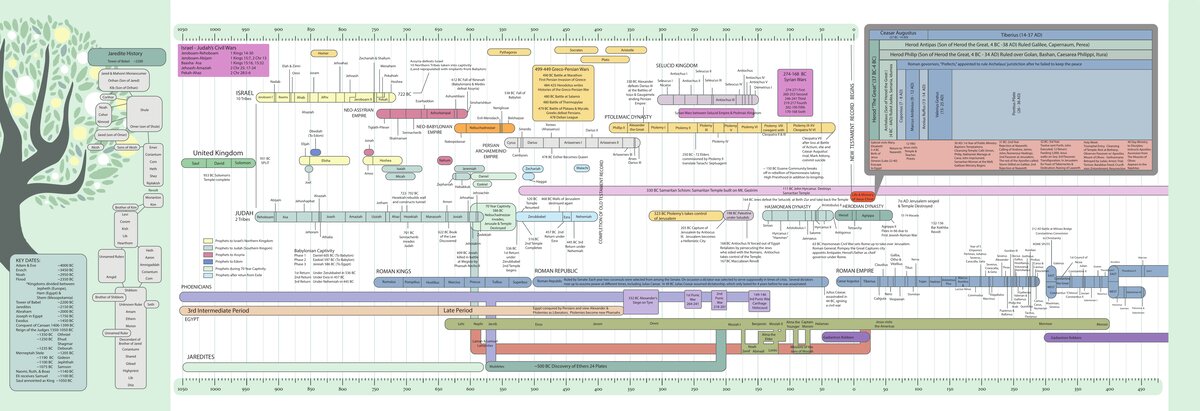
Tap to expand
Old Testament Timeline
From Creation through the Persian Period — tap the image to zoom, or download the full PDF.
Tap anywhere to close · Pinch to zoom