| Church Manuals | |
| Come Follow Me Manual — Week 25 | View |
| Scripture Helps: Old Testament | View |
| OT Seminary Teacher Manual | View |
| OT Institute Manual (Gen–2Sam) | View |
| Pearl of Great Price Manual | View |
| Scripture Reference | |
| Bible Dictionary | View |
| Topical Guide | View |
| Guide to the Scriptures | View |
| Church Media & Library | |
| Gospel for Kids (YouTube) | View |
| Bible Videos | View |
| Church Magazines | View |
| Gospel Library | View |

Week 25
Thy Throne Shall Be Established Forever
1 Samuel 17–18; 24–26; 2 Samuel 5–7
June 15–21, 2026
5-Minute Overview
Week 25 traces David's arc from Goliath through the fugitive years to the Davidic Covenant. The study guide covers Goliath as Mycenaean single combat (with Khirbet Qeiyafa archaeology), the Nephi/Goliath Septuagint allusion (McGuire), Jonathan's covenant and the Waters of Mormon 'knit' parallel, Abigail's prophetic intercession, Samuel's death and the witch of Endor, Jerusalem's etymology (Yir'eh-Shalem), the bayit reversal, and the Magen David liturgical tradition. Eight word studies including David ('beloved,' gematria 14) and Yerushalayim. Four companion articles: The King We Asked For, Wrestling with David, David's Choir, and The Thirteen Rules.
Weekly Resources: Week 25
1 Samuel 17–18; 24–26; 2 Samuel 5–7 — Overview
“Thy Throne Shall Be Established Forever”
Official Church Resources
OFFICIAL CHURCH RESOURCES▶
CHURCH MEDIA FOR FAMILIES▶
▶ Video Commentary
VIDEO COMMENTARY (12 videos)
▼



Specialized Audiences
WOMEN’S PERSPECTIVES (2 videos)
▶

FAMILY & CHILDREN’S RESOURCES (4 videos)
▶


Reference & Study Materials

BIBLE PROJECT VIDEOS THIS WEEK (12 videos)
▶
Book overview + theme & word study videos relevant to this week’s reading.






ACADEMIC & SCHOLARLY SITES▶
MAPS & BIBLICAL LOCATIONS▶
A Letter to Fellow Students
▶︎
David's name means "beloved." It comes from the Hebrew root dod (דּוֹד), the same word used thirty-three times in the Song of Songs for "my beloved" — matching, by some counts, the thirty-three years he reigned in Jerusalem. His name is also a number: dalet (4) + vav (6) + dalet (4) = 14. Matthew structured the genealogy of Jesus into three sets of fourteen generations — embedding David's name numerically into the very architecture of the Messianic line.
The man who carries that name walks across two decades of scripture this week — from the valley of Elah to the throne room in Jerusalem — and he does it by refusing every shortcut. He could have killed Saul in the cave. He could have killed Saul again in the camp. He could have slaughtered Nabal's household. He could have seized the throne the day Saul died. He did none of it. The man whose name means "beloved" spent a decade proving he could be trusted with power by refusing to take it.
And then God gave him everything. Not just the throne — a covenant. "Thy house and thy kingdom shall be established for ever before thee: thy throne shall be established for ever" (2 Samuel 7:16). David offered to build God a house. God reversed the word and gave David a dynasty. The Hebrew word bayit (בַּיִת) means both "building" and "family line," and the entire Davidic Covenant turns on that double meaning. David offered cedar; God returned a bloodline that would run to Bethlehem and beyond.
This week's reading is not just the story of a king. It is the foundation upon which every New Testament claim about Jesus rests. Without 2 Samuel 7, there is no "Son of David." Without David's patience in the wilderness, there is no model for trusting God between the promise and the fulfillment. And without the beloved shepherd who danced before the Ark in a linen ephod, there is no picture of what worship looks like when a king subordinates his status to God's presence.
What's in This Week's Materials
▶︎
In the Study Guide
▶︎
The Overview walks through the complete narrative chronologically — from Goliath through the fugitive years, the two encounters with Saul, Abigail's intercession, Saul's death, David's rise to the full throne, the conquest of Jerusalem, the Ark procession, and the Davidic Covenant. Unassigned chapters are filled so the gaps make sense. Key highlights:
- The Valley of Elah — archaeological confirmation at Khirbet Qeiyafa (zero pig bones, two-gate city matching Sha'arayim, radiocarbon to ~1000 BC)
- Nephi and Goliath — Benjamin McGuire's identification of ~30 shared plot points between David/Goliath and Nephi/Laban, following the Septuagint text tradition Joseph Smith could not have accessed
- The company of prophets at Gibeah (1 Samuel 10:5-6) — four instruments named in Hebrew, music as prophetic infrastructure, and the Kohathite lineage from Moses to David
- Samuel's death (1 Samuel 25:1) — the one verse that ends an era and sets the stage for Endor
- The witch of Endor — expanded with Sanhedrin 107a, Pirkei de-Rabbi Eliezer, and the LDS spirit-world framework
- Jerusalem's etymology — Yiru-Shalem, the place where God sees and peace dwells (Genesis Rabbah 56:10)
- The Davidic Covenant — the bayit reversal, the Magen David liturgical formula, and the father-son covenant language
Eight word studies: brit (covenant), mashiach (anointed one), bayit (house/dynasty), nefesh (soul), kisei (throne), chesed (covenant faithfulness), David (beloved — with gematria 14 and Matthew's genealogy), and Yerushalayim (Jerusalem — full etymology, dual-city theology, ancient attestations from Egyptian Execration Texts through the Tel Dan Stele).
Articles
▶︎
This week has an unusually rich set of companion articles. Each one explores a dimension of David's story that the study guide introduces but cannot fully develop:
- The King We Asked For — How Israel moved from Moses' theocracy to David's throne, why the Book of Mormon runs the same history in reverse, and how both patterns point to Christ. Includes the three-kings/three-temptations framework: Saul fell to pride, David to appetite, Solomon to worldly power — and Christ overcame all three in the wilderness. (Weeks 23-25)
- David's Choir — How a shepherd organized the music of heaven. The Kohathite soldier-musicians, the 24 rotating divisions, the daily Psalms matching the creation week, the Hebrew vocabulary of song (shir, mizmor, tehillah, hallel, qinah), the poetic forms (parallelism, chiasm, acrostic, spiral), and why the Temple choir was the Temple's sound system in a world without amplification. Includes the ruach/pneuma/spiritus connection: spirit, breath, and music are the same reality at different registers. (Weeks 24-25)
- Wrestling with David — An honest reckoning with the king, the good and the bad, the women in his story, and the mercy that remembers Uriah by name. We trace the arc from Michal (loved, then discarded) through Abigail (the woman who could reason with him) to Bathsheba (the woman unfairly vilified). The arc we follow names the power dynamic directly and unapologetically, surfacing important details that most readers miss in D&C 132:39: the verse does not only say David "fell from his exaltation" — it says "I gave them unto another," referring to his wives. This is significant, merciful, and empowering, God freed these women. Their eternal destiny was not chained to the man who abused them in mortality. The agency David denied them in in life, God restored to them in the eternities. This article details how readers can hold place for appreciating David's accomplishments while simultaneously acknowledging his failures. (Content note: discusses sexual violence and abuse of power.) (Weeks 25-26)
- The Thirteen Rules — Rabbi Ishmael's thirteen hermeneutical principles — the rules Jesus used to argue with the Pharisees, Paul built Romans on, and Book of Mormon prophets employed without naming them. Includes kal va-chomer (how much more so), gezerah shavah (verbal analogy), and Rule 13 (two contradictory texts resolved by a third — the hermeneutical structure of the Restoration itself). (Week 25)
In the Resources Tab
▶︎
Video highlights from the 22+ videos compiled this week:
- Dr. Mike Madsen (Follow Him) — Abigail as a type of Christ: she "took upon herself" Nabal's offense, providing sustenance and interceding for the household. The language of intercession applied directly to the Atonement.
- Lynne Hilton Wilson (Scripture Central) — David's mother sent to Moab for protection (1 Samuel 22:3-4) because of the Ruth/Moabite genetic connection. Nabal's refusal as a breach of ANE hospitality customs, potentially treasonous.
- Scripture Insights (Halverson & Harris) — the Nephi/Goliath Septuagint evidence; the na'ar reanalysis; the Valley of Elah archaeology.
- John Hilton III (Finding Christ) — the battle belongs to the LORD; David's declaration as missionary language, not military language.
The Patience Between Promise and Fulfillment
▶︎
Between Samuel's anointing (1 Samuel 16) and the throne at Hebron (2 Samuel 5), David spent roughly a decade as a fugitive. He gathered four hundred men "in distress, in debt, and discontented." He lived in caves. He feigned madness before a Philistine king. He was hunted across the Judean wilderness by the man whose throne he was destined to inherit. And twice — in the cave at En-gedi and the camp at Ziph — he had the power to end the pursuit and refused.
The Psalms born from this period (34, 57, 63, 142) give voice to every believer who has waited for God's promises to materialize while circumstances suggest God has forgotten. "I cried unto the LORD with my voice... I poured out my complaint before him; I shewed before him my trouble. When my spirit was overwhelmed within me, then thou knewest my path" (Psalm 142:1-3).
David's patience was not passive. It was the most active form of trust — the discipline of refusing to seize what God had promised to give. Every calling has a wilderness between the anointing and the throne. The question this week asks is not whether the promise is real. It is whether you will wait for God's timing to deliver it — or whether you will reach for it yourself and lose the very thing that qualifies you to receive it.
Weekly Insights — Week 25 | CFM Corner | OT 2026
1 Samuel 17–18; 24–26; 2 Samuel 5–7
Sources: Study Guide (8 word studies, chronological walkthrough), Video Summaries (22+ videos), companion articles (The King We Asked For, Wrestling with David, David's Choir, The Thirteen Rules)
Week 25
1 Samuel 17–18; 24–26; 2 Samuel 5–7 — Overview
"Thy Throne Shall Be Established Forever"
1. Week 25: Overview
This week's reading traces one of the greatest arcs in all of scripture: a shepherd boy who slays a giant, flees a mad king, refuses to seize the throne by violence, and finally receives from God a covenant that will echo through every page of the New Testament. The chapters span roughly two decades of David's life — from his battlefield debut against Goliath to the night when God promises him an eternal dynasty — and they reveal the qualities that made David not just a king but the standard against which every subsequent king of Israel would be measured.
But the reading assignment leaps across those two decades in pieces — Goliath and Jonathan (17-18), then a jump over six chapters of flight and pursuit to the cave at En-gedi (24), Abigail (25), and Ziph (26), then another jump over five chapters of war and transition to David's coronation and covenant (2 Samuel 5-7). The gaps contain some of the most dramatic material in the Old Testament. What follows walks through the entire narrative chronologically, with assigned chapters receiving full treatment and unassigned chapters filling the gaps so the arc makes sense.
Before diving into the narrative, it helps to understand what you are reading. The books of Samuel — which we read as "1 Samuel" and "2 Samuel" — were originally a single scroll called Sefer Shmuel (סֵפֶר שְׁמוּאֵל). The division into two books happened when the Hebrew text was translated into Greek (the Septuagint, 3rd-2nd century BC): Greek with its vowels required nearly twice the scroll length of Hebrew consonantal text, so the translators split it. The Septuagint went further — it combined Samuel and Kings into a single four-part work called Basileiōn (Βασιλειῶν, "Kingdoms" or "Reigns"), since the narrative arc runs continuously from Samuel's birth through the fall of Jerusalem. Jerome's Latin Vulgate kept the four-book division but renamed them 1-4 Kings. The Protestant Reformation restored the names 1-2 Samuel and 1-2 Kings to align with the Hebrew tradition.
The canonical placement differs between traditions, and the difference matters:
- Jewish Tanakh: Samuel sits in Nevi'im Rishonim (נְבִיאִים רִאשׁוֹנִים, the Former Prophets), alongside Joshua, Judges, and Kings. This classification means the book is understood as prophetic literature — not neutral history but a theological interpretation of events, written by prophets who saw God's hand in the rise and fall of kings. The Talmud (Bava Batra 14b-15a) attributes authorship to Samuel himself for the early chapters, with the prophets Gad and Nathan completing the work after Samuel's death (1 Samuel 25). This means every narrative choice — what to include, what to emphasize, what to omit — is understood as prophetically guided.
- Protestant and Latter-day Saint Bibles: Samuel is placed in the "Historical Books" section — a classification inherited from Jerome's Vulgate ordering. This strips the explicit prophetic framing and treats the books as records of events rather than prophetic interpretation.
- Catholic Bibles: Follow the same "Historical Books" ordering on this point.
The Jewish classification is worth taking seriously. When you read David sparing Saul, or Uzzah's death at the Ark, or Nathan's oracle of the Davidic Covenant, you are not reading a historian's account — you are reading a prophet's account. The author is not simply recording what happened; he is revealing what it means. This is the same distinction we noted in Week 22 when Judges was classified as prophecy rather than history (see the Week 22 Overview, "Prophecy, Not History"). The books of Samuel continue that prophetic tradition. For a fuller treatment of how four traditions organize the same scriptures, see Understanding Your Old Testament.
Assigned chapters are in bold. Use this table as a map — each chapter is discussed in the walkthrough below.
| Chapter | Content | Assigned |
|---|---|---|
| 1 Samuel 17 | David and Goliath | Yes |
| 1 Samuel 18 | Jonathan's covenant; women's song; Saul's jealousy; David marries Michal | Yes |
| 1 Samuel 19 | Saul's attempts to kill David; Michal helps David escape; David flees to Samuel | — |
| 1 Samuel 20 | David and Jonathan's farewell; the arrow signal | — |
| 1 Samuel 21 | David at Nob; the showbread; David feigns madness before Achish at Gath | — |
| 1 Samuel 22 | David at Adullam; Saul massacres the priests of Nob | — |
| 1 Samuel 23 | David saves Keilah; Saul pursues David in the wilderness of Ziph | — |
| 1 Samuel 24 | David spares Saul in the cave at En-gedi | Yes |
| 1 Samuel 25 | Nabal's insult; Abigail's intercession; Nabal dies; David marries Abigail | Yes |
| 1 Samuel 26 | David spares Saul again in the wilderness of Ziph | Yes |
| 1 Samuel 27 | David among the Philistines; Achish of Gath | — |
| 1 Samuel 28 | Saul and the witch of Endor | — |
| 1 Samuel 29 | Philistine lords reject David before the battle | — |
| 1 Samuel 30 | David rescues Ziklag from the Amalekites | — |
| 1 Samuel 31 | Battle of Gilboa; death of Saul and Jonathan | — |
| 2 Samuel 1 | David mourns Saul and Jonathan; the Song of the Bow | — |
| 2 Samuel 2 | David anointed king of Judah at Hebron; Abner and Ishbosheth | — |
| 2 Samuel 3 | Abner defects to David; Joab kills Abner | — |
| 2 Samuel 4 | Ishbosheth murdered; David executes the assassins | — |
| 2 Samuel 5 | David anointed king of all Israel; conquest of Jerusalem | Yes |
| 2 Samuel 6 | The Ark brought to Jerusalem; Uzzah; David dances; Michal's contempt | Yes |
| 2 Samuel 7 | The Davidic Covenant; Nathan's oracle; David's prayer | Yes |
David and Goliath — Theological Confidence Against the Visible (1 Samuel 17) — assigned
David's confrontation with Goliath is not a story about physical courage. Every soldier in Israel's camp could see the giant — nine and a half feet tall in the Masoretic Text, six and a half in the Septuagint and Dead Sea Scrolls. David's advantage was not that he couldn't see the giant but that he could see past the giant to the God behind the armies.
Goliath's challenge was not random taunting — it was a formal institution of Mycenaean warfare known as representative single combat: one champion fights for each army, the outcome binding on both sides (see Historical Cultural Context, Section 6 for the Aegean warrior-champion tradition and the Homer parallels). Israel had no champion class and no tradition of representative combat. Saul, the tallest man in Israel (9:2), should have been the obvious candidate — but he was "dismayed, and greatly afraid" (17:11).
David's declaration (17:45-47) is theological, not military: "I come to thee in the name of the Lord of Hosts." He names Goliath's three weapons — sword, spear, javelin — then counters with a single phrase: be-shem YHWH Tzeva'ot ("in the name of the Lord of Hosts"). Three weapons against one Name. The Name wins. The Talmud (Sotah 42b) notes that Goliath's forty-day challenge (17:16) paralleled Moses' forty days on Sinai — the giant's defiance was a counter-liturgy opposing Torah itself. Every day Israel failed to respond, the blasphemy deepened.
The sling was a shepherd's tool, not a champion's weapon. David broke every rule of the warrior-champion institution — and that was precisely God's point. "The LORD saveth not with sword and spear: for the battle is the LORD's" (17:47). Rashi on 17:49 adds that Goliath should have fallen backward (struck on the forehead), but God arranged for him to fall forward so David would not have to walk the extra distance to cut off his head. Providence extends to the physics of the fall.
The Valley of Elah — Archaeological Confirmation. The battle's location has been confirmed by excavations at Khirbet Qeiyafa, on the ridge overlooking the Elah Valley. Yosef Garfinkel (Hebrew University) and Saar Ganor (Israel Antiquities Authority) uncovered a fortified city with two gates — a unique feature matching the Hebrew name Sha'arayim (שַׁעֲרַיִם, "two gates"), the city mentioned in the pursuit narrative of 1 Samuel 17:52. Among tens of thousands of animal bones found at the site, zero were pig — indicating kosher dietary observance and confirming an Israelite (not Canaanite or Philistine) settlement. Olive pits were radiocarbon-dated to approximately 1000 BC, placing the site squarely in David's era (Garfinkel and Ganor, "Khirbet Qeiyafa: Sha'arayim," Journal of Hebrew Scriptures 8, 2008; see also Khirbet Qeiyafa Vol. 1: Excavation Report 2007-2008, Israel Exploration Society, 2009). The archaeology places an Israelite military outpost exactly where the text says the battle occurred, in exactly the time period the text describes.
The Book of Mormon Connection — Nephi and Goliath. Benjamin L. McGuire identified approximately thirty shared plot points between David's defeat of Goliath and Nephi's slaying of Laban — making it one of the most extensive literary allusions in the Book of Mormon ("Nephi and Goliath: A Case Study of Literary Allusion in the Book of Mormon," Journal of Book of Mormon Studies 18, no. 1, 2009, 16-31). Both protagonists are youngest sons. Both face an armored enemy alone. Both refuse conventional weapons. Both take the enemy's sword after the victory. Both are initially doubted by their own people. Crucially, McGuire demonstrates that Nephi's version follows the Septuagint (Greek Old Testament, c. 3rd century BC) text tradition in key details, not the Masoretic text that underlies the King James Version. This means the Book of Mormon's David/Goliath allusions align with a text tradition Joseph Smith could not have accessed — the LXX was not available in English in 1829. The parallel extends beyond plot: David fought Goliath so "all the earth may know that there is a God in Israel" (17:46); Nephi slew Laban so "a nation should not dwindle and perish in unbelief" (1 Nephi 4:13). Both acts of divinely sanctioned violence serve the preservation of God's covenant community.
Three Kings, Three Temptations. The Davidic arc stretching from this week through the next two (Weeks 25-27) introduces three kings — Saul, David, and Solomon — each of whom falls to a different form of temptation. Saul fell to pride (trusting his own judgment over God's command). David will fall to lust of the flesh (Bathsheba, Week 26). Solomon will fall to worldliness and political compromise (foreign wives, foreign gods, Week 27). These three failures map onto the three temptations of Christ in Matthew 4: pride ("throw yourself from the temple"), appetite ("command these stones to be bread"), and worldly power ("all these kingdoms I will give thee"). Christ overcame all three where the kings of Israel failed at each. The "King of Kings" is not merely a title of rank — it is a statement of moral victory over the very temptations that brought down every human king who preceded Him.
For the full passage study, see Key Passages (1 Samuel 17:45-47). For the Goliath story in its Mycenaean military context, see Historical Cultural Context, Section 6.
Jonathan's Covenant and Saul's Jealousy (1 Samuel 18) — assigned
When Jonathan gives David his robe (me'il, מְעִיל), armor, sword, bow, and belt (18:4), the act is not merely friendship — it is a formal surrender of royal claims. These were the insignia of the crown prince. In giving them, Jonathan acknowledged what his father could not: that God had chosen David. The Hebrew says Jonathan's soul was "bound" (niqshrah, נִקְשְׁרָה) to David's (18:1) — from the root qashar (קָשַׁר), to bind, to knit together. This is covenant language of the deepest kind. The same word appears at one of the most significant covenantal moments in the Book of Mormon: at the Waters of Mormon, those who are baptized by Alma commit to "be knit together in unity and in love one towards another" (Mosiah 18:21). In both cases, the binding occurs when individuals transfer their loyalty from a fallen king (Saul / King Noah) to God's chosen leader. Jonathan's covenant with David and the covenant at the Waters of Mormon are structurally identical: both involve choosing God's anointed over the current political authority, at great personal risk. Jonathan, the son of the rejected king, voluntarily embraces the successor, making their covenant one of the most selfless acts in scripture. There is no parallel in the ancient Near East for a crown prince voluntarily surrendering his succession to a shepherd.
But triumph and threat arrive together. The women's antiphonal song — "Saul has slain his thousands, and David his ten thousands" (18:7) — triggers Saul's jealous rage. From this point forward, Saul's pursuit of David will dominate the narrative. David marries Michal, Saul's daughter, after a bride-price of a hundred Philistine foreskins — Saul's hope was that the Philistines would kill David in the attempt (18:25). Even the marriage is a trap.
Saul's Attempts and David's Flight (1 Samuel 19) — not assigned
Saul's murderous intent becomes explicit. He hurls a spear at David while David plays the lyre (19:10) — the very music that once soothed Saul's torment now provokes his violence. Michal helps David escape through a window and places a household idol (teraphim, תְּרָפִים) in his bed as a decoy (19:13). David flees to Samuel at Ramah, where Saul sends three groups of messengers — and each group is overcome by the spirit of prophecy (19:20-21). Finally Saul himself comes and is seized by the spirit, stripping off his garments and prophesying all day and night (19:24). The question resurfaces: "Is Saul also among the prophets?"
David and Jonathan's Farewell (1 Samuel 20) — not assigned
The farewell between David and Jonathan is one of the most emotional scenes in scripture. Jonathan devises the arrow signal to communicate Saul's intent (20:18-23), and when Saul's rage at the feast confirms the danger, the two friends weep together: "they kissed one another, and wept one with another, until David exceeded" (20:41). Jonathan's final words — "Go in peace, for we have both sworn in the name of the Lord" (20:42) — seal their covenant. They will meet only once more before Jonathan's death on Mount Gilboa.
David as Fugitive — Nob, Gath, Adullam, Keilah, Ziph (1 Samuel 21-23) — not assigned
Chapter 21 — David arrives at Nob and receives the showbread (lechem ha-panim, לֶחֶם הַפָּנִים) from Ahimelech the priest, a scene Jesus will later cite to justify his disciples' gleaning on the Sabbath (Matthew 12:3-4). David also takes the sword of Goliath, which had been stored "behind the ephod" at the sanctuary (21:9) — alongside the Urim and Thummim. The detail matters: sacred weapons were kept in sacred space, near the instruments of divine consultation. Book of Mormon readers will recognize the pattern — the Nephite royal articles (the sword of Laban, the Urim and Thummim/interpreters, the Liahona, the plates, and the breastplate) were stored together and passed as a unit from prophet to prophet (Mosiah 1:16; Alma 37:1-5). The sword of Goliath at Nob and the sword of Laban in Nephite hands serve the same function: a consecrated weapon preserved as evidence of God's deliverance, stored alongside the instruments of revelation. David then flees to the Philistine city of Gath, where he feigns madness before King Achish, scratching on doors and letting saliva run down his beard (21:13). Psalm 34 was composed in connection with this episode.
Chapter 22 — David gathers his band of fugitives in the cave of Adullam — "every one that was in distress, and every one that was in debt, and every one that was discontented" (22:2), about four hundred men. This band will become the nucleus of David's future army. A detail easily missed: David sends his parents to the king of Moab for safekeeping (22:3-4) — "Let my father and my mother, I pray thee, come forth, and be with you, till I know what God will do for me." Why Moab? Because David's great-grandmother was Ruth the Moabite. The genetic connection to Moab that the Talmud identifies as David's "flaw" (see Historical Cultural Context, Section 9 and the Jacob 5 discussion) here becomes a practical advantage: David has kinship ties across the border. The outsider ancestry that made him vulnerable to political criticism also gave him a refuge no pure-blooded Israelite would have had. Meanwhile, Doeg the Edomite reports David's visit to Nob, and Saul orders the massacre of eighty-five priests (22:18). Only Abiathar escapes to join David, bringing the ephod that will serve as a means of divine consultation.
Chapter 23 — David saves the city of Keilah from the Philistines, but when he inquires of God whether the citizens will hand him over to Saul, the answer is yes (23:12). David flees to the wilderness of Ziph, where Jonathan finds him one last time: "Fear not: for the hand of Saul my father shall not find thee; and thou shalt be king over Israel, and I shall be next unto thee" (23:17). It is their final meeting. The Ziphites betray David's location to Saul, but a Philistine invasion draws Saul away at the critical moment (23:27-28).
These were not wasted years. The wilderness was the furnace that forged David's character. The Psalms born from this period (e.g., Psalms 34, 57, 63, 142) give voice to every believer who has waited for God's promises to materialize while circumstances suggest God has forgotten.
David Spares Saul — The Cave at En-gedi (1 Samuel 24) — assigned
David has Saul at his mercy in a cave. His men urge him to strike. He refuses.
The Hebrew chalilah li me-Hashem (חָלִילָה לִּי מֵה׳, "the Lord forbid me") is not a polite refusal — it is a sacred oath. Saul is meshiach Hashem (מְשִׁיחַ ה׳), the Lord's anointed, and no human hand may cut short what God has appointed. David does not evaluate whether Saul deserves the throne — that is God's jurisdiction.
Even cutting Saul's robe (kanaf, כָּנָף, hem/corner) struck David's conscience: vayakh lev David (וַיַּךְ לֵב דָּוִד, "David's heart smote him"). Rashi notes the narrative is written shelo ke-sidran (out of sequence) because David began speaking about the robe, expressed his regret, then returned to respond to his men. The literary disorder mirrors David's inner conflict. A man who can be king precisely because he refuses to seize kingship — this is the paradox that defines David's character.
This principle — the inviolability of the Lord's anointed — will govern all of Israelite political theology. It is why David later has the Amalekite who claims to have killed Saul executed (2 Samuel 1:16), and why he punishes the assassins of Ishbosheth (2 Samuel 4:12). Power comes from God, not from opportunity.
For the full passage study, see Key Passages (1 Samuel 24:6). For the rabbinic tradition on kelitini (restraint) and its implications for kingship, see Jewish Perspective, Section 3.
Samuel's Death and Abigail's Intercession (1 Samuel 25) — assigned
The chapter opens with a single verse that is easy to miss and devastating in its implications: "And Samuel died; and all the Israelites were gathered together, and lamented him, and buried him in his house at Ramah" (25:1). One verse. That is all the text gives the man who anointed two kings, established the prophetic order, judged Israel for decades, and heard God's voice as a boy in the dark. All Israel gathered to mourn — the national grief testifies to his stature — and then the narrative moves on.
Samuel's death marks the end of an era. He was the last judge and the first prophet of the monarchic period — the bridge between the tribal confederation and the kingdom. With Samuel gone, there is no prophetic voice standing between Saul and his own worst impulses. The man who rebuked Saul at Gilgal and at the Amalek war, who anointed David as Saul's replacement, who wept over Saul's failure (15:35) — that voice is now silent. No one replaced Samuel. Nathan will later emerge as David's prophet (2 Samuel 7, 12), but between Samuel's death and Nathan's appearance, the prophetic office goes dark. This silence is the backdrop for everything that follows: David's wilderness testing, Saul's spiraling madness, and eventually Saul's desperate attempt to summon Samuel's spirit from the dead at Endor (chapter 28). When Saul tells the medium, "Bring me up Samuel" (28:11), he is reaching for the one voice that might still carry God's authority — the voice he ignored when it was alive.
Between the two scenes of sparing Saul stands Abigail, the woman who prevents David from committing murder and losing his moral authority for the throne.
Nabal, whose name means "fool" (25:25), insults David by refusing provisions to the men who protected his flocks. David straps on his sword and sets out with four hundred men to slaughter Nabal's entire household. Abigail rides out to intercept him with food, falls on her face, and delivers one of the most sophisticated theological speeches in the Old Testament.
Her argument is not merely persuasive — it is prophetic. The Talmud (Megillah 14a) counts Abigail among Israel's seven prophetesses. She tells David that the Lord "will certainly make my lord a sure house" (25:28) — prophesying the Davidic dynasty before Nathan does in 2 Samuel 7. Her image of the tzeror ha-chayyim (צְרוֹר הַחַיִּים, "bundle of life") — "the soul of my lord shall be bound in the bundle of life with the LORD thy God" (25:29) — became a permanent fixture in Jewish memorial prayers.
Rashi on 25:31 explains the stakes: if David commits bloodshed now, his future enemies will say "he was a murderer before he was a king." Abigail preserves David's moral authority for the throne by preventing the very act that would have disqualified him from it. David acknowledges she "restrained" him (kelitini, כְּלִיתִנִי, 25:33) — a word whose deeper significance for the concept of kingship is explored in Jewish Perspective, Section 3.
Nabal dies ten days later — "the Lord smote Nabal" (25:38). David marries Abigail. God handled what David nearly took into his own hands.
David Spares Saul Again — The Wilderness of Ziph (1 Samuel 26) — assigned
The second sparing scene mirrors the first but escalates the test. David enters Saul's camp while the entire army sleeps under a divinely imposed deep sleep (tardemah, תַּרְדֵּמָה, 26:12 — the same word used for Adam's sleep in Genesis 2:21 and Abraham's in Genesis 15:12). He takes Saul's spear and water jug as proof but refuses to harm the king.
In 26:10, Rashi notes that David swore "to his inclination" (binding his temptation by oath) and listed three ways Saul might die — God strikes him, his appointed day arrives, or he falls in battle — none of them by David's hand. The patience is not passive; it is the most active form of trust.
The double refusal — cave and camp — establishes the principle beyond doubt. This is not a single moment of restraint but a pattern, a character trait, a theology of power. David will not take by force what God has promised to give.
David Among the Philistines and Saul's Final Days (1 Samuel 27-31) — not assigned
Chapter 27 — David's most morally ambiguous period. He becomes a vassal of Achish, king of Gath, and is given the city of Ziklag. For sixteen months (27:7), David conducts raids against various peoples while telling Achish he is raiding Judah. The deception protects David's position but raises profound questions about the ethics of survival under persecution.
Chapter 28 — The witch of Endor episode is among the most haunting scenes in all of scripture, and it cannot be understood apart from Samuel's death in chapter 25. When Samuel was alive, Saul had access to prophetic guidance — and consistently ignored it. Now Samuel is dead, the prophetic voice is silent, and Saul faces the Philistine army at Gilboa with no one to consult. The text lays out his desperation with brutal clarity: "And when Saul enquired of the LORD, the LORD answered him not, neither by dreams, nor by Urim, nor by prophets" (28:6). Every legitimate channel is closed. God is not speaking. The silence is not accidental — it is the consequence of decades of disobedience. Saul rejected the living prophet's counsel; now the dead prophet's silence is his judgment.
In desperation, Saul — the king who had himself banned mediums and necromancers from Israel (28:3, fulfilling the Torah's prohibition in Deuteronomy 18:10-12) — disguises himself and seeks out a medium at Endor. The irony is savage: the man who enforced the law against necromancy now violates it himself. He asks the woman to "bring me up Samuel" (28:11) — reaching for the one voice that might still carry God's authority.
What happens next is genuinely debated. The woman sees "gods ascending out of the earth" (elohim olim min ha-aretz, אֱלֹהִים עֹלִים מִן הָאָרֶץ, 28:13) and describes an old man wrapped in a robe (me'il, מְעִיל — the same garment Samuel wore in life, 15:27). The figure speaks with Samuel's voice and delivers Samuel's message: "The LORD has departed from thee, and is become thine enemy... the LORD will also deliver Israel with thee into the hand of the Philistines: and tomorrow shalt thou and thy sons be with me" (28:16-19). The prophecy is fulfilled exactly.
Jewish tradition is divided. Rashi, following Pirkei de-Rabbi Eliezer chapter 33, accepts that the woman genuinely raised Samuel's spirit — but notes that the dead can only be summoned within twelve months of their death, and Samuel had died recently enough to qualify. The Rambam (Maimonides), by contrast, considers all necromancy fraudulent. Latter-day Saint theology, with its understanding of the spirit world as a real, organized realm where the righteous continue their work (D&C 138:30, 57), provides a framework for taking the text at face value: Samuel's spirit, still prophetically empowered, delivered God's final word to the king who had spent a lifetime refusing to hear it. The message Samuel delivers from beyond the grave is the same message he delivered in life — obedience matters, consequences are real, and God's patience has limits. Even death did not change what the prophet had to say.
Chapters 29-30 — The Philistine lords refuse to let David march with them against Israel (29:4-5), providentially removing him from the battle that will kill Saul. David returns to find Ziklag burned and his wives captured by Amalekites. He "encouraged himself in the Lord his God" (30:6), inquires of the ephod, pursues the raiders, and recovers everything — a final demonstration of trust in God before the kingship begins.
Chapter 31 — The battle of Mount Gilboa. Saul and three of his sons — including Jonathan — die. Saul, wounded by archers, falls on his own sword to avoid capture (31:4). The Philistines hang the bodies on the walls of Beth-shan. The men of Jabesh-gilead — whom Saul had saved in his finest hour (1 Samuel 11) — retrieve the bodies by night, burn them, and bury the bones under a tamarisk tree. Saul's story ends where it began: with the people he rescued when he was still worthy of the crown.
David's Rise to the Full Throne (2 Samuel 1-4) — not assigned
Chapter 1 — David receives news of Saul's death from an Amalekite who claims to have delivered the final blow. Rather than celebrating, David has the man executed for claiming to have "destroyed the Lord's anointed" (1:16). David's lament — the Song of the Bow (qeshet, קֶשֶׁת) — is one of the most beautiful poems in scripture: "How are the mighty fallen!" (1:19, 25, 27). His tribute to Jonathan — "thy love to me was wonderful, passing the love of women" (1:26) — testifies to the depth of their covenant bond.
A detail often overlooked: David commanded that the children of Judah be taught "the use of the bow" (2 Samuel 1:18). This is not just a cultural footnote — it is a tactical response. Saul and Jonathan were killed by Philistine archers (1 Samuel 31:3). David, the man who knew better than anyone the lethal value of a projectile weapon (he defeated Goliath not hand-to-hand but with a flying stone), immediately trained his people in the very weapon type that had destroyed their king. Grief became strategy. The lament became a training manual.
Chapter 2 — David is anointed king over Judah at Hebron. Ishbosheth, Saul's surviving son, is installed as king over the remaining tribes by Abner, Saul's general. A civil war begins. The two kingdoms coexist for seven and a half years.
Chapter 3 — Abner, offended by Ishbosheth, defects to David's side and begins negotiations to bring all Israel under David's rule. Joab, David's general, kills Abner in revenge for his brother Asahel's death (3:27). David publicly mourns Abner and curses Joab's house — demonstrating again that he does not benefit from the death of his enemies.
Chapter 4 — Two of Ishbosheth's captains assassinate him in his bed and bring his head to David, expecting reward. David responds as he did with the Amalekite: "Wicked men have slain a righteous person in his own house upon his bed... shall I not therefore now require his blood of your hand?" (4:11). He executes the assassins. David rises to power not by eliminating rivals but by punishing those who eliminate them for him.
After Saul's death, David did not immediately claim the full kingdom. He reigned over Judah alone at Hebron for seven and a half years (2 Samuel 5:5) before the remaining tribes came to him. The anointing at Hebron (5:3) was David's third anointing — by Samuel privately (1 Sam 16:13), by Judah (2 Sam 2:4), and now by all Israel. Each anointing expanded his sphere but required patience. God's timing was sequential, not instantaneous.
David King Over All Israel — Conquest of Jerusalem (2 Samuel 5) — assigned
All the tribes of Israel come to David at Hebron and anoint him king over all Israel (5:3). David was thirty when he began to reign and reigned forty years total (5:4).
David conquers Jerusalem — the Jebusite fortress of Zion (metzudat Tziyon, מְצוּדַת צִיּוֹן) — and makes it his capital. The name Yerushalayim (יְרוּשָׁלַיִם) itself encodes the city's theology: "the place where God sees and where peace dwells," combining Abraham's Yir'eh and Melchizedek's Shalem into a single name (see Word Studies, Yerushalayim for the full etymology, the Genesis Rabbah tradition, and the dual-city theology).
The strategic choice was genius: Jerusalem belonged to no tribe (eliminating jealousy), sat on the border between Judah and Benjamin (bridging north and south), was naturally defensible, and carried the ancient Melchizedek connection to priesthood and peace. In making Jerusalem his capital, David created a city that belonged to the king and to God — not to any tribe. It is this neutrality that made it the logical home for the Ark and eventually the Temple.
The Ark to Jerusalem — David's Worship and Uzzah's Warning (2 Samuel 6) — assigned
The transfer of the Ark to Jerusalem is both triumphant and cautionary.
Uzzah's death (6:7) occurs because the Ark was placed on a cart — the Philistine method (1 Sam 6:7) — instead of being carried by Levites on poles as God prescribed (Numbers 4:15). Rashi explains that Uzzah's error was intellectual — he failed to recognize the Ark's self-sustaining power (see Jewish Perspective, Section 4 for the full kal va-chomer argument). Good intentions using the wrong method still carry consequences. The three-month stay at Obed-edom's house (6:11) and the blessings that followed demonstrate the Ark's power to sanctify its environment when approached correctly.
David's dancing redefines worship. When David brings the Ark into Jerusalem, he strips off his royal robes and puts on a linen ephod bad (אֵפוֹד בָּד) — a priestly garment. He dances (mekharkher, מְכַרְכֵּר) with such abandon that his wife Michal despises him from the window (6:16). Her contempt represents the old order's definition of royal dignity: measured, controlled, imposing. David redefines dignity as proximity to God.
When Michal rebukes him — "How glorious was the king of Israel today, who uncovered himself today in the eyes of the handmaids, as one of the rekim [riff-raff]" (6:20) — David replies that he will be even more undignified, "and will be base in mine own sight" (6:22). The king who spared the Lord's anointed now lowers himself before the Lord's Ark. Both acts flow from the same source: reverence for God's sovereignty over human status.
For the full passage study, see Key Passages (2 Samuel 6:14, 21-22). For the rabbinic discussion of Uzzah's error, see Jewish Perspective, Section 4.
The Davidic Covenant — The Promise That Changed Everything (2 Samuel 7) — assigned
David, now settled in his cedar palace, wants to build a house (bayit, בַּיִת) for God — a permanent Temple to replace the Tabernacle. Nathan the prophet initially approves (7:3), but that night God sends Nathan back with a different message. The reversal is one of the most significant moments in the Old Testament.
God's response plays on the word bayit: "Shall you build Me a house? ... The LORD tells you that the LORD will make you a house" (7:5, 11). David offered a building; God returns a dynasty. The bayit wordplay — Temple becomes lineage — is the literary and theological hinge of the entire chapter (see Word Studies, Bayit for the full treatment).
Rashi on 7:4 reveals that God sent Nathan back that same night because David was "too quick" (mahir) — he might hire construction workers before dawn — or "too committed" (nadran) — he might bind himself with an irrevocable vow. Even David's zeal needed divine redirection. Nathan the prophet serves as the template for all prophet-king interaction: he first approves David's plan (7:3) from his own judgment, then receives divine correction overnight (7:4-5), demonstrating that even prophets must wait for God's actual word.
The covenant itself (7:12-16) is the most consequential promise in the Old Testament:
- "I will set up thy seed after thee" — a dynasty, not just a single reign
- "He shall build an house for my name" — Solomon will build the Temple
- "I will be his father, and he shall be my son" — a father-son relationship between God and the king
- "Thy throne shall be established for ever" — the eternal promise
Unlike the conditional Sinai covenant, God's promise to David was irrevocable — failures of individual kings would bring discipline ("I will chasten him with the rod of men," 7:14) but not cancellation. Every New Testament claim that Jesus is the Messiah traces back to this moment: "Son of David" (Matthew 1:1), "He shall reign over the house of Jacob for ever" (Luke 1:33), "Of his kingdom there shall be no end" (Luke 1:33). Without 2 Samuel 7, the Gospels lose their Old Testament anchor.
For the full passage study, see Key Passages (2 Samuel 7:12-16). For the ANE treaty context, see Historical Cultural Context, Section 10. For the rabbinic tradition on David's desire and God's bayit reversal, see Jewish Perspective, Section 5.
"The Lord forbid that I should do this thing unto my master, the Lord's anointed, to stretch forth mine hand against him, seeing he is the anointed of the Lord." (1 Samuel 24:6)
"David danced before the Lord with all his might; and David was girded with a linen ephod." (2 Samuel 6:14)
"And thine house and thy kingdom shall be established for ever before thee: thy throne shall be established for ever." (2 Samuel 7:16)
Three moments, one character: the man who refused to seize power in a cave, who surrendered dignity before the Ark, and who received from God a promise that no human ambition could have achieved. David's restraint, his worship, and his covenant all flow from the same source — a heart oriented toward God rather than toward self. He is not a perfect man. His story will prove that painfully. But he is a man whose heart keeps returning to God, and that is the quality God saw when He looked past seven impressive sons to find a shepherd.
- The Proof (1 Sam 17-18) — David defeats Goliath by faith, earns Jonathan's covenant, and enters Saul's court — only to trigger the king's jealous rage.
- The Flight (1 Sam 19-23) — Hunted through the wilderness, David gathers his band of fugitives, loses Jonathan's daily presence, and learns to survive on nothing but trust.
- The Testing (1 Sam 24-26) — Twice David has the power to end Saul's pursuit and refuses. Abigail prevents him from committing murder. Every temptation to seize power is rejected.
- The Exile (1 Sam 27-31) — David lives among the Philistines, Saul consults a medium, and the battle of Gilboa destroys the old order. Jonathan dies.
- The Waiting (2 Sam 1-4) — David reigns over Judah alone for seven and a half years while civil war grinds on. Patience is not a single act but a sustained practice.
- The Enthronement (2 Sam 5-6) — David becomes king of all Israel, conquers Jerusalem, and brings the Ark to the capital — uniting political and religious authority in one act of ecstatic worship.
- The Covenant (2 Sam 7) — God promises David an eternal dynasty. The shepherd boy who once tended sheep in the fields of Bethlehem now stands at the center of God's plan for all human history.
- The patience principle — David's refusal to harm the Lord's anointed, repeated twice, establishes that God's timing cannot be accelerated by human violence. Every calling has a wilderness between the promise and the fulfillment.
- The covenant of friendship — Jonathan's voluntary surrender of his royal claims to David models selfless love that prioritizes God's will over personal advantage. The most powerful people in scripture are often those who willingly step aside.
- The Davidic Covenant as messianic foundation — Every Christmas narrative, every Palm Sunday proclamation, every New Testament title for Jesus ("Son of David," "King of kings") traces back to 2 Samuel 7:12-16. Without this week's reading, the Gospels lose their connection to the Old Testament foundation.
- Worship as self-emptying — David's dancing before the Ark, in a priestly ephod rather than royal robes, redefines worship as the deliberate surrender of status. Michal's contempt — measuring dignity by social expectations — is a perennial temptation that David's example shatters.
- **The bayit reversal — God takes David's architectural offering and returns it as a dynastic promise (see Word Studies**, Bayit). This pattern — God returning our offerings multiplied — is the grammar of grace that runs through all of scripture and into every temple ordinance.
2. Week 25: Historical & Cultural Context
The narrative arc from David's battlefield debut to his reception of an eternal covenant spans roughly two decades and crosses multiple cultural landscapes — Philistine military culture, Israelite tribal politics, Judean wilderness survival, Jebusite urban fortification, and ancient Near Eastern treaty law. Understanding the material culture, political customs, and theological categories of this world illuminates details that modern readers routinely miss.
Champion Warfare
Goliath is identified as the ish ha-benayim (אִישׁ הַבֵּנַיִם), literally "the man of the between" — a champion who fights in the space between the two armies (1 Samuel 17:4). This practice of representative combat, where the outcome of battle is decided by a single duel, is well attested in the ancient Near East. Egyptian texts describe single combat at Kadesh; the Iliad's duels between Hector and Ajax follow the same logic. The underlying principle is theological: the champion embodies his people's god, and the duel is understood as a contest between divine powers.
Goliath's equipment marks him as a heavily armed warrior of the Aegean type: a bronze helmet (kova nechoshet, כּוֹבַע נְחֹשֶׁת), scale armor (shiryon qasqassim, שִׁרְיוֹן קַשְׂקַשִּׂים — literally "armor of fish-scales"), bronze greaves, and a javelin (kidon, כִּידוֹן) slung between his shoulders (17:5–7). His chanit (חֲנִית, spear) had a shaft "like a weaver's beam," suggesting a thong-looped weapon for powerful overhand throws. Against this massive armament, David brings a sling — one of the most effective ranged weapons in the ancient world, capable of launching stones at speeds exceeding 100 mph. David's choice was not foolish but tactically astute: a slinger's advantage against a heavily armored opponent was range and speed.
The height controversy is worth noting. The Masoretic Text gives Goliath's height as "six cubits and a span" — approximately 9 feet 9 inches. The Septuagint and a Dead Sea Scrolls fragment of 1 Samuel (4QSam-a) read "four cubits and a span" — approximately 6 feet 9 inches. The shorter reading would make Goliath exceptionally tall but humanly plausible, a professional warrior rather than a mythic giant.
Jonathan's Gifts as Royal Transfer
The Hebrew word brit (בְּרִית, covenant) describes Jonathan's bond with David in 1 Samuel 18:3. But this was not a mere friendship pact. Jonathan's gifts — his robe (me'il, מְעִיל), armor, sword (cherev, חֶרֶב), bow (qeshet, קֶשֶׁת), and belt (chagor, חֲגוֹר) — constituted the insignia of the crown prince. In ancient Near Eastern court protocol, transferring one's garments and weapons to another person was a formal act of investiture, similar to the later European practice of dubbing a knight.
Hittite vassal treaties from the 14th–13th centuries BCE describe similar gift exchanges to formalize political alliances. The Amarna Letters (14th century BCE) contain letters from vassal kings to Pharaoh that use the language of "soul-binding" — remarkably similar to the Hebrew description that Jonathan's nefesh (soul) was "bound" to David's (18:1). What distinguishes Jonathan's act is that he initiates it voluntarily, without coercion or conquest. The crown prince recognizes God's choice and surrenders his own claim — an act of self-abnegation with no known ANE parallel.
David's Band in Historical Context
David's wilderness years (roughly 1 Samuel 19–31) follow a pattern attested elsewhere in the ancient Near East: a legitimate heir forced into exile who gathers a band of marginalized followers and eventually returns to claim the throne. The 400 men who joined David at Adullam are described as "everyone who was in distress, in debt, and discontented" (1 Samuel 22:2) — a social cross-section of those failed by the existing political order.
The Judean wilderness provided natural refuge. The En-gedi region features hundreds of caves along the western shore of the Dead Sea, some large enough to shelter groups of several hundred. The "strongholds" (metzadot, מְצָדוֹת) David used were likely the same cliff-face caves and natural fortresses that the Maccabees would use a millennium later and that Jewish rebels occupied during the revolt against Rome in 66–73 CE. The terrain itself — deep wadis, sheer cliffs, sparse water — selected for leaders who could inspire loyalty under extreme privation.
David's protection racket in chapter 25 — providing security for Nabal's shepherds during shearing season and expecting reciprocal hospitality — reflects the patron-client economy of the Judean highlands. This was not extortion; it was the standard social contract between armed bands and agricultural communities in regions where central authority was weak. Nabal's refusal to honor the arrangement was not just rude but a violation of the understood social order.
The Significance of the Kanaf
When David cut the corner (kanaf, כָּנָף) of Saul's robe in the cave at En-gedi (1 Samuel 24:4), he was performing an act with far more weight than modern readers recognize. In ancient Near Eastern culture, the hem of a garment represented the owner's identity and authority. Nuzi tablets (15th century BCE) document legal transactions sealed by pressing one's garment hem into a clay tablet — the hem functioned as a signature. To cut someone's kanaf was symbolically to sever their authority.
The same word kanaf appears in Ruth 3:9, where Ruth asks Boaz to spread his kanaf (skirt/wing) over her — a request for marriage and protection. The garment hem was simultaneously an emblem of power and of covenant obligation. David's cutting of Saul's kanaf thus carried an ambiguous charge: it simultaneously demonstrated that David could have taken Saul's life (and kingdom) but chose not to. David's immediate regret — vayakh lev David (וַיַּךְ לֵב דָּוִד, "David's heart smote him," 24:5) — shows that he understood the symbolic transgression even though he spared Saul's person.
Shearing Season and Hospitality Obligation
Sheep shearing in the Judean highlands was a time of celebration and communal feasting — the biblical equivalent of harvest festival. Nabal's three thousand sheep and one thousand goats (1 Samuel 25:2) mark him as one of the wealthiest men in the region of Maon and Carmel. During shearing, wealthy pastoralists were culturally obligated to share their abundance, especially with those who had provided services.
The name naval (נָבָל) means "fool" or "churl" — a man who is morally senseless. Rashi notes that he was a Calebite (khalivi, from the house of Caleb), though the Ralbag suggests a wordplay: his nature was like a kelev (כֶּלֶב, dog) — snapping and territorial. Abigail's gifts to David — two hundred loaves, two skins of wine, five dressed sheep, five measures of parched grain, a hundred clusters of raisins, and two hundred cakes of figs (25:18) — were precisely calibrated to feed David's band of roughly six hundred men for several days. This was not lavish generosity but proportionate social obligation, and Nabal's refusal was a deliberate insult to the social fabric.
Geography and Political Significance
Hebron (Chevron, חֶבְרוֹן) sits in the Judean hill country at approximately 3,000 feet elevation, making it one of the highest cities in Israel. Its significance predates David by many centuries: Abraham built an altar there (Genesis 13:18), purchased the cave of Machpelah as a burial site (Genesis 23), and the city was later given to Caleb as an inheritance (Joshua 14:13–14). David's choice of Hebron as his first capital was politically shrewd — it was the most important city in his own tribe of Judah, with deep patriarchal associations that conferred legitimacy.
David reigned at Hebron for seven years and six months (2 Samuel 5:5) before the northern tribes invited him to reign over all Israel. This extended period was not a failure of ambition but a demonstration of the patience that characterized David's entire rise. He waited for the northern tribes to come to him rather than conquering them — echoing his refusal to seize kingship from Saul by violence. The anointing at Hebron (5:3) was David's third: first by Samuel privately (1 Sam 16:13), then by Judah (2 Sam 2:4), and now by all Israel. Each anointing expanded his authority, but each required waiting for God's timing.
The Jebusite Fortress and Its Conquest
Jerusalem had been occupied by the Jebusites since at least the Middle Bronze Age. The fortress of Zion (metzudat Tziyon, מְצוּדַת צִיּוֹן, 2 Samuel 5:7) sat on a narrow ridge south of what is now the Temple Mount, protected by deep valleys on three sides — the Kidron to the east, the Tyropoeon (Central) Valley to the west, and the Hinnom to the south. The Jebusites were so confident in their defenses that they taunted David: "Except thou take away the blind and the lame, thou shalt not come in hither" (5:6).
David's conquest reportedly involved the tzinnor (צִנּוֹר, 5:8) — variously translated as water shaft, tunnel, or gutter. Warren's Shaft, discovered in the 19th century, connects the Gihon Spring to the interior of the city and may be the route David's men used to penetrate the defenses. The city's strategic genius was its neutrality: situated on the border between Judah and Benjamin, it belonged to no tribe and thus offended no tribal loyalties. Its possible identification with Salem — where Melchizedek was "king of Salem" and "priest of the most high God" (Genesis 14:18) — gave it priestly as well as royal significance. When Solomon later built the Temple on Mount Moriah, identified by the Chronicler as the site where Abraham was commanded to sacrifice Isaac (2 Chronicles 3:1), Jerusalem became the intersection of every major covenant thread in Israel's history.
The Cart vs. the Levitical Poles
When David first attempts to bring the Ark to Jerusalem, he places it on a new cart (agalah chadashah, עֲגָלָה חֲדָשָׁה, 2 Samuel 6:3) — the same method the Philistines had used when returning the Ark in 1 Samuel 6:7. The Torah, however, prescribes a specific method: the Ark must be carried on poles (baddim, בַּדִּים) by Kohathite Levites, and no one may touch it (Numbers 4:15; 7:9). The use of a cart was a systematic error — well-intentioned but wrong in method.
When the oxen stumbled and Uzzah reached out to steady the Ark, God struck him dead (6:7). Rashi explains that Uzzah's error was intellectual, not merely physical — he failed to recognize the Ark's self-sustaining power, a failure analyzed through the kal va-chomer principle in Jewish Perspective, Section 4. The three-month stay at the house of Obed-edom (6:11), during which the household was abundantly blessed, demonstrated that the Ark's power was not dangerous but sanctifying — when handled according to God's instructions.
David's Sacred Dance Before the Ark
David's mekharkher (מְכַרְכֵּר, dancing/whirling) before the Ark (2 Samuel 6:14) was not informal celebration — it was ritual performance. Ancient Near Eastern kings regularly participated in sacred dances at temple dedications and religious festivals. Mesopotamian texts describe kings performing before divine images with physical abandon as an expression of devotion. The Sumerian king Shulgi boasted of dancing at festivals; Egyptian pharaohs performed ritual runs before Hapi, the Nile god.
What distinguished David was his clothing. He wore an ephod bad (אֵפוֹד בָּד, linen ephod) — a priestly garment, not a royal robe. Rashi notes the connection: Targum Yonatan translates ephod bad as kardut, the same term used for Tamar's garment in 2 Samuel 13:18. By choosing the ephod over the crown, David subordinated his royal identity to his role as worshiper. Michal's contempt (6:16) — she "despised him in her heart" — represents the values of Saul's house, where royal dignity was measured by distance from the common people. David's response (6:21–22) makes the contrast explicit: "It was before the Lord, who chose me before thy father." Worship before God is the highest dignity; the opinion of the court is irrelevant.
Royal Grant vs. Suzerainty Treaty
Ancient Near Eastern scholarship distinguishes two types of covenant: the suzerainty treaty, in which a great king imposes conditions on a vassal (with blessings for obedience and curses for disobedience), and the royal land grant, in which a great king rewards a loyal servant with a permanent, unconditional gift. The Sinai covenant follows the suzerainty pattern — Israel must obey the commandments to receive the blessings. The Davidic Covenant follows the royal grant pattern — God rewards David's faithfulness with a perpetual dynasty.
This distinction explains why 2 Samuel 7:14–15 can promise both discipline and permanence: "If he commit iniquity, I will chasten him with the rod of men, and with the stripes of the children of men: but my mercy shall not depart away from him." Individual kings may be punished, but the covenant itself is irrevocable. This structure parallels Mesopotamian temple-building narratives, where a god instructs a king to build a temple and promises divine favor in return. The twist in 2 Samuel 7 is the reversal: David offers to build the Temple, and God instead builds David's dynasty — the bayit (בַּיִת) wordplay explored fully in Word Studies, Bayit. This reversal creates the theological architecture upon which all subsequent messianic expectation in Judaism and Christianity rests. When the angel Gabriel tells Mary that her son "shall reign over the house of Jacob for ever; and of his kingdom there shall be no end" (Luke 1:33), he is directly invoking 2 Samuel 7:16.
3. Week 25: Key Passages Study
Scripture Text
"Then said David to the Philistine, Thou comest to me with a sword, and with a spear, and with a shield: but I come to thee in the name of the Lord of hosts, the God of the armies of Israel, whom thou hast defied. This day will the Lord deliver thee into mine hand; and I will smite thee, and take thine head from thee; and I will give the carcases of the host of the Philistines this day unto the fowls of the air, and to the wild beasts of the earth; that all the earth may know that there is a God in Israel. And all this assembly shall know that the Lord saveth not with sword and spear: for the battle is the Lord's, and he will give you into our hands."
Hebrew Key Terms
- shem (שֵׁם) — name; in Hebrew thought, the name embodies the essence and authority of the one named
- Hashem Tzeva'ot (ה׳ צְבָאוֹת) — Lord of Hosts; the divine commander of both heavenly and earthly armies
- milchamah (מִלְחָמָה) — war, battle; from lacham (לָחַם), to fight — the same root as lechem (bread), suggesting that warfare and sustenance share the concept of "struggle for survival"
- yeshu'ah (יְשׁוּעָה) — salvation, deliverance; David declares that the Lord "saves" not by human weaponry
Commentary
David's speech is structured as an antithetical declaration: Goliath comes with three weapons (sword, spear, shield); David comes with one name. The Hebrew be-shem Hashem Tzeva'ot (בְּשֵׁם ה׳ צְבָאוֹת, "in the name of the Lord of Hosts") is not a mere invocation — it is a claim of legal representation. David speaks and fights as God's authorized agent. The title Tzeva'ot (Hosts) appears here for the first time in a battlefield context, linking Israel's military campaigns to the cosmic army of God.
The Talmud (Sotah 42b) draws a profound connection: Goliath's forty-day challenge (17:16) mirrors Moses' forty days on Sinai. The giant's daily defiance was a counter-liturgy — each morning and evening blasphemy was a desecration of the times when Israel offered daily sacrifice (tamid). David's response was therefore not merely military but theological: he was answering blasphemy with the Name.
Rashi on 17:49 adds a striking detail: Goliath fell face-forward after being struck on the forehead, though physics would have sent him backward. "He fell forward in order that David should not be troubled to walk the extra distance and cut off his head." Even the direction of Goliath's collapse was arranged by providence — a signature Rashi observation that finds divine attention in the smallest physical detail.
LDS Application
David's declaration — "the battle is the Lord's" — is the Old Testament equivalent of the covenant assurance given in Doctrine and Covenants 105:14: "For behold, I do not require at their hands to fight the battles of Zion; for... I will fight your battles." The sons of Helaman echo David's theology when they trust in the words of their mothers: "We do not doubt our mothers knew it" (Alma 56:47–48). In both cases, faith is not the absence of danger but the presence of trust that redefines the meaning of weaponry. The armor of God (Ephesians 6:10–18; D&C 27:15–18) follows the same logic: spiritual armament outperforms physical preparedness because the battle belongs to the Lord.
Cross-References
- Alma 56:47–48 — The sons of Helaman fight with the confidence their mothers instilled
- D&C 105:14 — "I will fight your battles"
- Ephesians 6:10–18 — The full armor of God
- Psalm 20:7 — "Some trust in chariots, and some in horses: but we will remember the name of the Lord our God"
Scripture Text
"And it came to pass, when he had made an end of speaking unto Saul, that the soul of Jonathan was knit with the soul of David, and Jonathan loved him as his own soul. And Saul took him that day, and would let him go no more home to his father's house. Then Jonathan and David made a covenant, because he loved him as his own soul. And Jonathan stripped himself of the robe that was upon him, and gave it to David, and his garments, even to his sword, and to his bow, and to his girdle."
Hebrew Key Terms
- nefesh (נֶפֶשׁ) — soul, life, self; Jonathan's nefesh was "knit" (niqshrah, נִקְשְׁרָה) to David's
- qashar (קָשַׁר) — to bind, tie, knit together; conveys the idea of permanent fusion
- brit (בְּרִית) — covenant; a formal, binding agreement with theological weight
- me'il (מְעִיל) — the outer robe; specifically the robe of royalty or office
- cherev (חֶרֶב) — sword; qeshet (קֶשֶׁת) — bow; chagor (חֲגוֹר) — belt/girdle
Commentary
The verb niqshrah (was knit/bound) appears only here in this specific context — it conveys a bond so complete that the two souls are fused. The same root qashar appears in Genesis 44:30, where Jacob's soul is "bound up" with Benjamin's — a parent's bond with a child. Jonathan's love for David is described with the same intensity.
Rashi does not comment on these verses — a silence that is itself significant. Rashi's method is to comment only where the plain meaning (peshat) is insufficient. The text's vivid clarity — Jonathan strips himself of his royal robe, armor, sword, bow, and belt and gives them to David — needs no explanation. The crown prince voluntarily relinquishes the symbols of succession to the man God has chosen. This is not a friendship gesture; it is a political-theological act of extraordinary selflessness.
The items Jonathan gives are not random: the me'il (robe) represents royal identity, the cherev (sword) represents military authority, the qeshet (bow) represents the royal weapon par excellence (cf. 2 Samuel 1:18, where David's elegy is called "The Song of the Bow" in honor of Jonathan), and the chagor (belt) represents the binding of authority to the person. Jonathan gives David everything that would identify the wearer as the next king of Israel.
LDS Application
Jonathan's covenant with David is a model of what Latter-day Saints call "consecration" — the willingness to give everything, including one's own privileges and rights, for a higher purpose. Jonathan saw that God's plan for Israel ran through David, and he subordinated his personal claim to that plan. The covenant language of Mosiah 18:8–10 — "willing to bear one another's burdens... to mourn with those that mourn... to stand as witnesses of God" — describes precisely what Jonathan does. He stands with David, mourns with him, bears his burden, and becomes a witness that God's choice trumps dynastic expectation.
Cross-References
- Ruth 1:14 — Ruth "clave" (davqah) to Naomi — the same intensity of devotion
- Mosiah 18:8–10 — The covenant of baptism: bearing burdens, mourning, standing as witnesses
- D&C 121:9 — "Thy friends do stand by thee"
- John 15:13 — "Greater love hath no man than this, that a man lay down his life for his friends"
Scripture Text
"And the men of David said unto him, Behold the day of which the Lord said unto thee, Behold, I will deliver thine enemy into thine hand, that thou mayest do to him as it shall seem good unto thee. Then David arose, and cut off the skirt of Saul's robe privily. And it came to pass afterward, that David's heart smote him, because he had cut off Saul's skirt. And he said unto his men, The Lord forbid that I should do this thing unto my master, the Lord's anointed, to stretch forth mine hand against him, seeing he is the anointed of the Lord. So David stayed his servants with these words, and suffered them not to rise against Saul."
Hebrew Key Terms
- kanaf (כָּנָף) — corner, hem, wing, skirt; the hem of a garment representing identity and authority
- vayakh lev David (וַיַּךְ לֵב דָּוִד) — "David's heart smote him"; the conscience strikes like a physical blow
- meshiach Hashem (מְשִׁיחַ ה׳) — the Lord's anointed; the theological basis for David's restraint
- chalilah (חָלִילָה) — "God forbid"; a sacred oath of refusal
Commentary
Rashi identifies the narration of 24:5–7 as written shelo ke-sidran — out of sequence — mirroring David's inner turmoil as his mind races between the act, the regret, and the response to his men (see Jewish Perspective, Section 2 for the full reading).
The word kanaf carries enormous symbolic weight. In ancient Near Eastern culture, the hem of a garment served as a personal signature — Nuzi tablets show contracts sealed by pressing one's garment hem into clay. To cut someone's kanaf was to symbolically sever their authority. David understood this immediately, and his conscience — lev, the heart that God looks upon (1 Samuel 16:7) — struck him.
Rashi on 24:10 adds another layer: when David addresses Saul, he asks, "Why do you listen to the words of adam [the man, singular]?" — a pointed reference to Doeg the Edomite, the specific slanderer who had turned Saul against David and who had executed the priests of Nob. David's plight is not merely the result of Saul's madness but of a specific human agent of slander.
LDS Application
David's restraint in the cave raises a question every Latter-day Saint eventually faces: What do you do when someone in authority over you is failing — and you can see it clearly?
Saul was genuinely failing. He was paranoid, murderous, and disobedient to God. David could see all of it. He had the opportunity, the justification, and his men's encouragement to end Saul's reign right there in the cave. And he refused — not because Saul was right, but because the calling was God's to give and God's to take away. David's principle was not "Saul is a good king." His principle was "God anointed him, and God will remove him in His own time." The restraint was not naivety about Saul's failures. It was trust in God's authority over the process.
This same principle appears in Restoration scripture. Doctrine and Covenants 121:16-22 pronounces a severe warning on those who "lift up the heel against mine anointed" — but the same section (D&C 121:39-42) also acknowledges that authority holders can and do abuse their callings: "It is the nature and disposition of almost all men, as soon as they get a little authority... to exercise unrighteous dominion." The scriptures hold both realities simultaneously: leaders can fail, and the authority behind their calling belongs to God, not to those who observe the failure.
Elder Boyd K. Packer applied this directly: "The man who will not sustain the bishop of his ward and the president of his stake will not sustain the President of the Church" ("Follow the Brethren," BYU speech, March 23, 1965). But sustaining does not mean pretending failures don't exist. David saw Saul's failures with devastating clarity — he named them aloud to Saul's face (24:11-15). What David refused to do was take the correction into his own hands. He spoke truth, then left the outcome to God. That is the model: honest about the failure, unwilling to usurp God's role in resolving it.
For Latter-day Saints who have watched a leader struggle — a bishop who seems unequal to the calling, a stake president who makes a painful decision, a general leader or authority whose words don't quite land — David's cave is the template. You can see the problem. You may even be right about it. But the question is not whether you can see it. The question is whether you trust God enough to let Him handle what He anointed.
Cross-References
- D&C 121:16–22 — Cursed are those who lift up the heel against the Lord's anointed
- D&C 64:10 — "I, the Lord, will forgive whom I will forgive"
- Psalm 105:15 — "Touch not mine anointed, and do my prophets no harm"
- Matthew 26:52 — "Put up again thy sword... all they that take the sword shall perish with the sword"
Scripture Text
"I pray thee, forgive the trespass of thine handmaid: for the Lord will certainly make my lord a sure house; because my lord fighteth the battles of the Lord, and evil hath not been found in thee all thy days. Yet a man is risen to pursue thee, and to seek thy soul: but the soul of my lord shall be bound in the bundle of life with the Lord thy God; and the souls of thine enemies, them shall he sling out, as out of the middle of a sling. And it shall come to pass, when the Lord shall have done to my lord according to all the good that he hath spoken concerning thee, and shall have appointed thee ruler over Israel; That this shall be no grief unto thee, nor offence of heart unto my lord, either that thou hast shed blood causeless, or that my lord hath avenged himself... And David said to Abigail, Blessed be the Lord God of Israel, which sent thee this day to meet me: And blessed be thy advice, and blessed be thou, which hast kept me this day from coming to blood, and from avenging myself with mine own hand."
Hebrew Key Terms
- tzeror ha-chayyim (צְרוֹר הַחַיִּים) — "the bundle of life"; the righteous bound up with God
- kaf ha-qela (כַּף הַקֶּלַע) — "the pocket of the sling"; the wicked flung away like a stone
- pukah (פּוּקָה) — stumbling block, obstacle; an offense that would haunt David's future reign
- kelitini (כְּלִיתִנִי) — "you restrained me"; from kala (כלא), to hold back
Commentary
To understand why Abigail's speech is considered one of the most theologically sophisticated passages in 1 Samuel, you need to see what she is actually doing — not just calming an angry man, but constructing a prophetic legal argument that operates on multiple levels simultaneously. The Talmud counts her among Israel's seven prophetesses (Megillah 14a: Sarah, Miriam, Deborah, Hannah, Abigail, Huldah, Esther) precisely because her words contain genuine prophetic content — she sees David's future and speaks to it before it exists.
She opens by absorbing the guilt. "Upon me, my lord, upon me, let this iniquity be" (25:24). Before she argues, before she reasons, she places herself between David's wrath and Nabal's household. As Brother Mike Madsen (Follow Him) observes, this is the language of intercession — acting as a mediator to bridge a gap, pleading on behalf of those who cannot plead for themselves. Abigail takes responsibility for a sin she did not commit. This is the Atonement pattern before Gethsemane.
She names the fool honestly. "Let not my lord, I pray thee, regard this man of Belial, even Nabal: for as his name is, so is he; Nabal is his name, and folly is with him" (25:25). Abigail does not defend her husband. She names his character to his face — naval (נָבָל) means fool, and she says it out loud to the man holding a sword. This is not a woman cowering. This is a woman with enough moral authority to tell the truth to power while simultaneously saving lives.
She prophesies David's dynasty. "For the Lord will certainly make my lord a sure house" (25:28). The phrase bayit ne'eman (בַּיִת נֶאֱמָן, "sure/faithful house") is the same language God will use in the Davidic Covenant (2 Samuel 7). Abigail speaks it before Nathan does — she announces the dynasty before the prophet does. This is why the Talmud calls her a prophetess: she didn't just give good advice, she delivered God's word.
She uses David's own weapon as a metaphor. "The soul of my lord shall be bound in the bundle of life with the LORD thy God; and the souls of thine enemies, them shall he sling out, as out of the middle of a sling" (25:29). The kela (קֶלַע) — sling — is David's signature weapon, the one that killed Goliath. Abigail turns it into a cosmic metaphor: God sorts souls the way a sling sorts stones. The righteous are bound tight in the tzeror ha-chayyim (bundle of life); the wicked are flung away. She is telling David, in his own language, that God will handle the sorting — David doesn't need to do it himself.
She names the specific consequence of acting. "That this shall be no grief unto thee, nor offence of heart unto my lord, either that thou hast shed blood causeless" (25:31). This is not vague moral counsel. It is a precise political calculation: if David slaughters Nabal's household, his future enemies will say "he was a murderer before he was a king." Every act of justice David later administers will be undermined by this one act of personal vengeance. Abigail is protecting not just Nabal's household but David's future authority. Lynne Hilton Wilson notes that Nabal's refusal was not merely rude — it was a dangerous breach of ancient Near Eastern hospitality customs, potentially an act of treason against Israel's future king. David's anger was not irrational. But Abigail saw that acting on justified anger would cost more than enduring the insult.
Rashi on 25:31 drives the point home: "Had you done this, you would not be able to open your mouth to reprove anyone in future generations concerning bloodshed." A king who has shed blood for a personal grudge cannot credibly enforce justice against murderers. Abigail saves David not just from sin but from disqualification.
The tzeror ha-chayyim (bundle of life) image became so central to Jewish theology that it is inscribed on tombstones to this day. The abbreviation תנצב״ה (t-n-tz-b-h, "may his/her soul be bound in the bundle of life") is the standard Jewish memorial inscription. Abigail's metaphor — the righteous are bound securely with God while the wicked are flung away like stones from a sling (kela, קֶלַע) — connects David's own weapon (the sling that killed Goliath) to the cosmic principle of divine sorting.
David's acknowledgment — "you restrained me" (kelitini) — reveals that Abigail embodied the very quality David would need on the throne. The rabbinic connection between kelitini and the nature of kingship itself is developed in Jewish Perspective, Section 3.
LDS Application
Abigail as a type of Christ. Sister Kristin M. Yee ("Beauty for Ashes: The Healing Path of Forgiveness," October 2022 General Conference) identified Abigail as a type of Christ. Consider the pattern: Nabal sinned — he insulted David and refused the provisions he owed. The consequences of Nabal's sin were about to fall on his entire household (David was coming with four hundred armed men). Abigail, who had done nothing wrong, stepped between the offender and the consequences. She "took upon herself" Nabal's offense — bringing the provisions Nabal refused, speaking the apology Nabal wouldn't make, absorbing the wrath David was directing at her husband's house. She bore the cost of someone else's sin to prevent destruction. That is the Atonement in miniature. Christ steps between a sinful humanity and the consequences of that sin, bearing what He did not cause, providing what we refused to offer, speaking on our behalf when we have no standing to speak for ourselves.
**The tzeror ha-chayyim and sealing.** Abigail's image of the righteous "bound in the bundle of life with the LORD thy God" (25:29) resonates directly with the Latter-day Saint doctrine of sealing. To be "bound" to God through covenant — sealed to Him and to His people — is to be placed in the tzeror, the bundle that God holds and protects. Those outside the bundle are "flung away like stones from a sling." The image is not just poetic; it is covenantal. Every temple sealing enacts what Abigail described: binding souls to God so securely that even death cannot separate them.
What Abigail teaches about the voice we listen to. David had four hundred men marching with him, all of them ready to kill. Not one of them said "stop." It took one woman, riding alone on a donkey, to say what no one else would. Abigail is the voice of the Spirit in this story — the clear-eyed counsel that arrives at the last possible moment, before the irreversible act. Everyone has an Abigail moment: the friend who tells you the truth you don't want to hear, the prompting that interrupts your momentum, the scripture that catches your eye at exactly the right time. The question is whether you respond like David — "Blessed be thy advice, and blessed be thou, which hast kept me this day from coming to blood" (25:33) — or whether you override the voice and keep marching.
Cross-References
- Proverbs 31:26 — "She openeth her mouth with wisdom; and in her tongue is the law of kindness"
- Genesis 50:20 — "Ye thought evil against me; but God meant it unto good"
- D&C 132:39 — David received wives and concubines "and in nothing did he sin save in the case of Uriah"
- Moroni 7:16-17 — "Every thing which inviteth to do good... is inspired of God" — recognizing the Abigail voice
Scripture Text
"And David danced before the Lord with all his might; and David was girded with a linen ephod. So David and all the house of Israel brought up the ark of the Lord with shouting, and with the sound of the trumpet. And as the ark of the Lord came into the city of David, Michal Saul's daughter looked through a window, and saw king David leaping and dancing before the Lord; and she despised him in her heart."
"Then David returned to bless his household. And Michal the daughter of Saul came out to meet David, and said, How glorious was the king of Israel to day, who uncovered himself to day in the eyes of the handmaids of his servants, as one of the vain fellows shamelessly uncovereth himself! And David said unto Michal, It was before the Lord, which chose me before thy father, and before all his house, to appoint me ruler over the people of the Lord, over Israel: therefore will I play before the Lord. And I will yet be more vile than thus, and will be base in mine own sight."
Hebrew Key Terms
- mekharkher (מְכַרְכֵּר) — dancing, whirling; Rashi glosses: meraked (מְרַקֵּד), "dancing"
- ephod bad (אֵפוֹד בָּד) — linen ephod; a priestly garment, not royal attire
- rekim (רֵקִים) — empty ones, riff-raff, vain fellows; Michal's contemptuous term for the common people
- nivalti (נְבַלְתִּי) — "I will be more vile/base"; David embraces the lowliness Michal despises
Commentary
The tension in this passage operates on multiple levels. David is identified as "David" — the shepherd, the dancer, the worshiper. Michal is identified as "Michal Saul's daughter" (6:16, 20) — her identity is defined by her father's house, the old order of royal propriety that David's ecstatic worship overturns. Rashi defines mekharkher simply as "dancing" and notes that the ephod bad (linen ephod) was a priestly robe, connecting David's attire to that of Tamar, Absalom's sister (2 Sam 13:18), via Targum Yonatan's translation kardut.
When Michal calls David "one of the rekim" (6:20), the Targum translates: "one of the riff-raff." Her contempt is class-based — she measures royal dignity by distance from the common people. David's response cuts to the theological heart: "It was before the Lord, who chose me before thy father." The comparison is devastating. Saul's house valued decorum; David values encounter with God. The text's final note — "Michal the daughter of Saul had no child unto the day of her death" (6:23) — signals the end of Saul's line. The old order of royal propriety dies childless; David's line will produce the Messiah.
LDS Application
David's willingness to appear "base in mine own sight" is a model of the kind of worship that prioritizes God's presence over human opinion. President Howard W. Hunter taught that "true worship involves a 'broken heart and a contrite spirit' (3 Nephi 9:20), not merely outward performances" (Teachings of Presidents of the Church: Howard W. Hunter, Chapter 1). The tension between Michal's contempt and David's abandon mirrors a tension that exists in every congregation: the pull toward respectability versus the pull toward authentic encounter with God. King Benjamin's people fell to the earth and cried "O have mercy, and apply the atoning blood of Christ that we may receive forgiveness" (Mosiah 4:2) — an act of self-abasement that would horrify the Michal temperament but that opened the heavens.
Cross-References
- Psalm 149:3 — "Let them praise his name in the dance"
- Psalm 150:4 — "Praise him with the timbrel and dance"
- 3 Nephi 9:20 — "A broken heart and a contrite spirit"
- Mosiah 4:1–2 — Benjamin's people fall to the earth in worship
Scripture Text
"And when thy days be fulfilled, and thou shalt sleep with thy fathers, I will set up thy seed after thee, which shall proceed out of thy bowels, and I will establish his kingdom. He shall build an house for my name, and I will stablish the throne of his kingdom for ever. I will be his father, and he shall be my son. If he commit iniquity, I will chasten him with the rod of men, and with the stripes of the children of men: But my mercy shall not depart away from him, as I took it from Saul, whom I put away before thee. And thine house and thy kingdom shall be established for ever before thee: thy throne shall be established for ever."
Hebrew Key Terms
- bayit (בַּיִת) — house; the pivot word of the entire chapter: Temple → dynasty
- zera (זֶרַע) — seed, offspring; the promised line through which blessing flows
- kisei (כִּסֵּא) — throne; the seat of royal authority
- 'ad 'olam (עַד עוֹלָם) — forever, unto eternity; appears three times in these five verses
- chesed (חֶסֶד) — covenant faithfulness, loyal love; "my mercy [chesed] shall not depart"
Commentary
The Davidic Covenant in 2 Samuel 7:12–16 is the most consequential theological promise in the Old Testament. Every messianic claim in the New Testament — "Son of David," "King of kings," the angel Gabriel's announcement to Mary (Luke 1:32–33), Jesus' entry into Jerusalem on a donkey (Matthew 21:9), Paul's declaration that Christ was "made of the seed of David according to the flesh" (Romans 1:3) — traces its authority to these five verses.
Rashi on 7:1 shows David's desire to build a house to the Lord was a halakhic deduction from Deuteronomy 12:10 — not a spontaneous impulse but a reasoned conclusion from scripture (see Jewish Perspective, Section 5 for the full rabbinic tradition). Rashi on 7:4 provides two characterizations of David's urgency — mahir (quick to act) and nadran (a vow-maker) — explaining why God sent Nathan that same night (see Jewish Perspective for the full rabbinic tradition with rabbi attributions).
The bayit wordplay drives the entire chapter (see Word Studies, Bayit for the full semantic analysis). In verse 5, God asks: "Shalt thou build me a house (bayit) to dwell in?" By verse 11, the word has shifted meaning entirely: "The Lord tells you that He will make you a house (bayit)." David envisioned cedar and stone; God answered with a bloodline stretching to eternity.
Rashi on 7:14 identifies the "rod of men" as specific historical agents of discipline: Hadad the Edomite and Rezon son of Eliada (1 Kings 11:14, 23), enemies who troubled Solomon. The midrashic layer adds Ashmedai, the demon king who temporarily dethroned Solomon (Gittin 68b). Yet the promise holds: "My chesed shall not depart." The Davidic Covenant is classified as an unconditional royal grant — individual kings may be punished, but the dynasty endures. The word 'ad 'olam (forever) appears three times in verses 13, 16 (twice), hammering the promise of permanence.
LDS Application
The Davidic Covenant is the theological bridge between the Old Testament and the New. When the angel Gabriel tells Mary, "He shall be great, and shall be called the Son of the Highest: and the Lord God shall give unto him the throne of his father David: And he shall reign over the house of Jacob for ever; and of his kingdom there shall be no end" (Luke 1:32–33), he is directly invoking 2 Samuel 7:12–16. The Book of Mormon affirms the Davidic lineage: "The God of our fathers... shall manifest himself unto them in the flesh... and his name shall be Jesus Christ, the Son of God" (2 Nephi 10:3). Every LDS temple stands as a fulfillment of the bayit reversal — we come to build God's house, and He responds by building our eternal families.
Cross-References
- Luke 1:32–33 — Gabriel's announcement to Mary fulfills the Davidic Covenant
- Romans 1:3 — Christ was "made of the seed of David according to the flesh"
- 2 Nephi 10:3 — The God of Israel shall manifest himself in the flesh
- Revelation 22:16 — "I am the root and the offspring of David"
- D&C 132:39 — David's covenant blessings despite personal failure
- Psalm 89:3–4, 28–37 — The Davidic Covenant restated in covenantal poetry
4. Word Studies
Root: b-r-t (ב-ר-ת) — possibly from barah (בָּרָה), to cut, eat, or select
Appears: 1 Samuel 18:3; 20:8; 23:18; 2 Samuel 5:3; 7:12–16 (implied)
Meaning
The word brit (בְּרִית) is the foundational term for covenant in Hebrew, appearing over 280 times in the Old Testament. It denotes a solemn, binding agreement between parties — ranging from political alliances between nations to the most sacred bonds between God and humanity. In this week's reading, brit operates on two levels: horizontally (between Jonathan and David) and vertically (between God and David's dynasty).
Deeper Context
The phrase karat brit (כָּרַת בְּרִית, "to cut a covenant") preserves the memory of the covenant ritual: an animal was cut in two, and the covenant parties passed between the halves (cf. Genesis 15:9–17). The act symbolized the self-imprecation: "May I be as this animal if I break this covenant." Jonathan's covenant with David (18:3) may not have involved animal sacrifice, but the use of the word brit — not merely hesed (kindness) or ahavah (love) — signals that this was a formal, binding, irrevocable pact. When the tribes of Israel come to David at Hebron, they "make a covenant" (vayikhrot... brit, 2 Sam 5:3) — the same language, now extended from personal bond to national compact.
The Davidic Covenant in 2 Samuel 7 is never explicitly called a brit in that chapter — the word does not appear until Psalm 89:3 ("I have made a covenant with my chosen, I have sworn unto David my servant") and 2 Samuel 23:5 ("He hath made with me an everlasting covenant"). Yet the content of 2 Samuel 7 is unmistakably covenantal: unconditional promises, seed (zera), dynasty, and the formula "I will be his father, and he shall be my son" (7:14). The relationship between the implicit covenant of 2 Samuel 7 and the explicit language of later texts shows how Israel's covenant vocabulary grew organically from lived experience.
Theological Significance
- Brit establishes permanence — once cut, a covenant is irrevocable. Jonathan's gifts of royal insignia to David were not loans but permanent transfers within the covenant framework.
- Brit creates relationship — the covenant makes Jonathan and David brothers in a deeper sense than biology. This models the LDS concept of being "covenant people" whose bonds transcend natural kinship.
- The Davidic brit becomes the foundation of messianic hope — the eternal covenant with David's house generates the expectation of an ultimate King who will fulfill the promise of an everlasting throne.
LDS Application
The concept of brit is foundational to Latter-day Saint theology. Temple covenants — baptism, endowment, sealing — follow the same logic: they create irrevocable bonds, define identity, and generate promises that extend into eternity. The "new and everlasting covenant" (D&C 131:2) echoes the Davidic Covenant's structure: God initiates, the human responds, and the relationship is sealed 'ad 'olam (forever).
Cross-Language Connections
| Language | Term | Source |
|---|---|---|
| Hebrew | brit (בְּרִית) — "covenant," from b-r-t (ב-ר-ת), possibly to cut, select | BLB H1285 |
| Greek (LXX) | διαθήκη (diathēkē) — testament, covenant; used for both will/testament and divine covenant | BLB G1242 |
| Latin (Vulgate) | foedus / testamentum — treaty, alliance / will, testament; testamentum gives "Old/New Testament" | Logeion: foedus |
| English | covenant — from Old French covenir, to agree, from Latin convenire, to come together | Merriam-Webster · Etymonline · Webster's 1828 |
Root: m-sh-ch (מ-שׁ-ח) — to smear, anoint with oil
Appears: 1 Samuel 24:6, 10; 26:9, 11, 16, 23; 2 Samuel 5:3
Meaning
The noun mashiach (מָשִׁיחַ) derives from the verb mashach (מָשַׁח), to smear or anoint with oil. In its immediate context, it refers to any person consecrated by anointing — kings, priests, and occasionally prophets. In this week's reading, the term appears primarily in David's refusal to harm Saul: meshiach Hashem (מְשִׁיחַ ה׳), "the Lord's anointed." David uses this phrase six times across chapters 24 and 26, making it the defining theological concept of his rise to power.
Deeper Context
The irony is potent: David is himself an anointed one — Samuel poured oil on his head from a horn (qeren, 1 Sam 16:13). Yet David refuses to harm the man whose anointing preceded his own. The principle is that anointing creates an inviolable status that cannot be revoked by human action, only by God. Even when the Spirit of God has departed from Saul (16:14), his anointing remains theologically binding. This distinction between spiritual empowerment (which can be lost) and covenantal status (which only God can revoke) is one of the most nuanced theological insights in the Old Testament.
The word mashiach eventually generates the title "Messiah" — through Greek Χριστός (Christos, "the Anointed One"), which produces "Christ." Every time David says "the Lord's anointed" in the caves and wildernesses of Judea, he is unknowingly building the vocabulary that will name his greatest descendant.
Theological Significance
- Anointing creates inviolable status — David's principle establishes that God's appointed leaders are under divine protection, regardless of their personal failings.
- The anointed one is God's representative — to harm the mashiach is to challenge God's authority to appoint and remove.
- From political title to eschatological hope — mashiach evolves from a description of any anointed king to the title of the ultimate King, the Messiah, who will fulfill the Davidic Covenant.
LDS Application
Jesus Christ is the ultimate Mashiach — the fulfillment of every anointing in Israel. His title "Christ" is simply the Greek translation of mashiach. The LDS temple endowment includes an anointing ordinance that connects modern Saints to this ancient pattern of consecration. David's reverence for the Lord's anointed resonates with the modern principle of sustaining Church leaders — not as a claim of their perfection but as recognition of God's authority to call and remove His servants.
Cross-Language Connections
| Language | Term | Source |
|---|---|---|
| Hebrew | mashiach (מָשִׁיחַ) — "anointed one," from mashach (מָשַׁח), to anoint with oil | BLB H4899 |
| Greek (LXX) | Χριστός (Christos) — the Anointed One; from χρίω (chriō), to anoint | BLB G5547 |
| Latin (Vulgate) | christus / unctus — anointed; from ungere, to anoint | Logeion: christus |
| English | messiah — from Hebrew mashiach via Aramaic meshicha; Christ from Greek Christos | Merriam-Webster · Etymonline · Webster's 1828 |
Root: b-y-t (ב-י-ת) — to lodge, spend the night
Appears: 2 Samuel 7:1, 2, 5, 6, 7, 11, 13, 16, 18, 19, 25, 26, 27, 29
Meaning
The word bayit (בַּיִת) is among the most common nouns in Hebrew, occurring over 2,000 times. Its basic meaning is "house" — a physical dwelling. But in 2 Samuel 7, bayit operates as a triple entendre: (1) David's cedar palace (7:1–2), (2) the Temple David wants to build for God (7:5), and (3) the dynasty God promises to build for David (7:11, 16). The entire chapter is a meditation on what it means to build a "house" and who builds for whom.
Deeper Context
The theological pivot of 2 Samuel 7 occurs when God reverses David's offer. David looks at his cedar palace and says to Nathan: "I dwell in a house (bayit) of cedar, but the ark of God dwelleth within curtains" (7:2). The implication is clear — David wants to build God a permanent house (Temple). God's response through Nathan redefines the word: "The Lord tells you that He will make you a house (bayit)" (7:11). The same word bayit now means "dynasty" — a lineage, a royal house that will endure forever.
This wordplay is not decorative — it is the theological engine of the passage. David's offer assumes that he can do something for God. God's response asserts that He is the builder, not the recipient. The architectural bayit (Temple) will be built by David's son (7:13); the dynastic bayit (kingdom) is built by God alone.
Theological Significance
- Bayit as Temple — the physical dwelling where God's presence resides, built by Solomon (1 Kings 6).
- Bayit as dynasty — the royal lineage through which God's purposes are accomplished, extending to the Messiah.
- The reversal — God always outgives human offerings. David's gift of a Temple is returned as the gift of an eternal kingdom.
LDS Application
Every Latter-day Saint temple embodies the bayit wordplay. Members come to build God's house, and God responds by building their eternal families through sealing ordinances. The dedicatory prayers of LDS temples consistently echo the Davidic Covenant language: "a house of prayer, a house of learning, a house of glory, a house of order, a house of God" (D&C 88:119). The bayit that matters most is not the building but the family — the "house" that extends into eternity.
Cross-Language Connections
| Language | Term | Source |
|---|---|---|
| Hebrew | bayit (בַּיִת) — "house," from b-y-t (ב-י-ת), to lodge, dwell | BLB H1004 |
| Greek (LXX) | οἶκος (oikos) — house, household, dynasty; gives English "economy" (household management) | BLB G3624 |
| Latin (Vulgate) | domus — house, household, family; gives English "domestic," "domicile" | Logeion: domus |
| English | house — from Old English hūs; dual sense (building + dynasty, as in "House of Windsor") retained from Hebrew/Latin | Merriam-Webster · Etymonline · Webster's 1828 |
Root: n-f-sh (נ-פ-שׁ) — to breathe, rest, be refreshed
Appears: 1 Samuel 18:1, 3; 20:17; 25:29; 2 Samuel 5:8
Meaning
The word nefesh (נֶפֶשׁ) is often translated "soul," but this translation imports Greek philosophical categories that Hebrew does not share. In Hebrew, nefesh is the entire living person — the breathing, desiring, suffering self. It is not a disembodied ghost trapped in a body; it is the whole human being considered as a living entity. When 1 Samuel 18:1 says Jonathan's nefesh was "bound" (niqshrah) to David's nefesh, it means not that their immortal souls mystically connected but that their entire selves — will, desire, loyalty, identity — fused into one.
Deeper Context
The root n-f-sh is related to breathing — the nefesh is the breath-self, the vital force. In Abigail's speech (25:29), she uses nefesh in two contrasting images: "the nefesh of my lord shall be bound in the tzeror ha-chayyim (bundle of life) with the Lord thy God; and the nefesh of thine enemies, them shall he sling out." The righteous self is bound up with God; the wicked self is thrown away. The nefesh language ties this week's reading together: Jonathan's nefesh binds to David's in covenant; David's nefesh is secured by Abigail's prophetic promise; and the whole concept reaches toward the eternal preservation of the self in God's keeping.
Theological Significance
- Nefesh is the whole person — not a disembodied soul but the living, breathing, desiring self.
- The nefesh can be bound in covenant — Jonathan's act shows that covenant creates bonds deeper than biology.
- The tzeror ha-chayyim promise — the ultimate destiny of the righteous nefesh is to be gathered and kept by God.
LDS Application
LDS theology affirms the embodied nature of the soul: "The spirit and the body are the soul of man" (D&C 88:15). The Hebrew nefesh aligns naturally with this teaching — the self is not complete without both spirit and body. Jonathan's nefesh being "bound" to David's also resonates with the sealing power: in LDS theology, the deepest human bonds are sealed by priesthood authority and extend into eternity, creating the kind of permanent fusion that niqshrah describes.
Cross-Language Connections
| Language | Term | Source |
|---|---|---|
| Hebrew | nefesh (נֶפֶשׁ) — "soul, life, self," from n-f-sh (נ-פ-שׁ), to breathe, rest | BLB H5315 |
| Greek (LXX) | ψυχή (psychē) — soul, life; gives English "psyche," "psychology" | BLB G5590 |
| Latin (Vulgate) | anima — soul, breath, life; gives English "animate," "animal" | Logeion: anima |
| English | soul — from Old English sāwol; originally "coming from or belonging to the sea/lake" (debated) | Merriam-Webster · Etymonline · Webster's 1828 |
Root: k-s-' (כ-ס-א) — related to covering, concealing; cognate with Akkadian kussû
Appears: 2 Samuel 3:10; 7:13, 16
Meaning
The word kisei (כִּסֵּא) means "throne" — the seat of royal authority. In 2 Samuel 7, the throne is mentioned twice: "I will establish the throne (kisei) of his kingdom for ever" (7:13) and "thy throne (kisei) shall be established for ever" (7:16). The repetition underscores the permanence of the Davidic dynasty — not merely the reign of one king but the authority of an entire line that will never end.
Deeper Context
In the ancient Near East, the throne was not merely a piece of furniture — it was the physical embodiment of royal legitimacy. Thrones were sacred objects, often placed on raised platforms in throne rooms designed to project divine authority. The Akkadian cognate kussû appears in Mesopotamian texts as the "seat of authority" that the gods bestow on kings. When God promises David that his kisei will endure "forever" ('ad 'olam), He is promising something no human king had ever received: an authority that transcends the life of any individual occupant.
The promise of an eternal kisei generates one of the most powerful questions in all of Israelite theology: if the throne is forever, but kings keep dying, who will ultimately sit on it? This question drives the messianic expectation through the prophets (Isaiah 9:6–7, Jeremiah 23:5, Ezekiel 34:23–24) and into the New Testament, where the angel Gabriel tells Mary: "The Lord God shall give unto him the throne of his father David" (Luke 1:32).
Theological Significance
- The kisei represents legitimate, God-given authority — its permanence signals that God's governance of His people will never end.
- The promise of an eternal throne creates the messianic question — who can sit on a forever-throne?
- Jesus as the ultimate occupant of David's kisei — the fulfillment of 2 Samuel 7:13, 16 in Luke 1:32–33.
LDS Application
The concept of eternal kingship resonates with the LDS doctrine of exaltation, in which the faithful receive "thrones, kingdoms, principalities, and powers" (D&C 132:19). The Davidic kisei is not merely a political institution but a type of the eternal authority that God shares with His covenant children.
Cross-Language Connections
| Language | Term | Source |
|---|---|---|
| Hebrew | kisei (כִּסֵּא) — "throne, seat," from k-s-' (כ-ס-א), related to covering | BLB H3678 |
| Greek (LXX) | θρόνος (thronos) — throne, seat of authority; gives English "throne" | BLB G2362 |
| Latin (Vulgate) | thronus / solium — throne / seat of state; solium also means bathtub (the shape connection) | Logeion: solium |
| English | throne — from Old French trone, from Latin thronus, from Greek thronos, "elevated seat" | Merriam-Webster · Etymonline · Webster's 1828 |
Root: ch-s-d (ח-ס-ד) — loving-kindness, mercy, covenant loyalty
Appears: 1 Samuel 20:14–15; 2 Samuel 7:15; 9:1, 3, 7
Meaning
The word chesed (חֶסֶד) is one of the most important — and most untranslatable — words in the Hebrew Bible. The KJV renders it variously as "mercy," "kindness," "lovingkindness," and "goodness," but none of these captures its full range. Chesed is the loyal love that arises from covenant relationship — the obligation to act with faithfulness, generosity, and compassion toward those with whom one is in covenant, especially when they are vulnerable.
Deeper Context
In this week's reading, chesed appears at two crucial moments. In 1 Samuel 20:14–15, Jonathan asks David to show chesed to him while he lives and to his house after his death: "Thou shalt not only while yet I live show me the chesed of the Lord, that I die not: but also thou shalt not cut off thy chesed from my house for ever." This request will be fulfilled in 2 Samuel 9, when David seeks out Jonathan's son Mephibosheth and restores Saul's lands to him — an extraordinary act of chesed toward the house of a dead rival.
In 2 Samuel 7:15, God promises that His chesed "shall not depart" from David's seed — in direct contrast to what happened with Saul, from whom God's favor was withdrawn. The Davidic Covenant is built on chesed: not on David's merit alone but on God's unshakable commitment to the relationship He has chosen to enter.
Theological Significance
- Chesed is covenant-based love — it flows from obligation, not mere emotion. It is most visible when the recipient is least deserving.
- Chesed defines the character of God — His loyalty to the Davidic Covenant endures even when individual kings fail.
- Chesed is the model for human relationships — David's treatment of Mephibosheth shows what covenant loyalty looks like in practice.
LDS Application
The LDS concept of "charity" as "the pure love of Christ" (Moroni 7:47) is the closest English equivalent of chesed. Both describe a love that is not conditional on the worthiness of the recipient but flows from the character of the giver and the covenant relationship between them. God's chesed toward David's house — maintaining the covenant despite Solomon's failures, the division of the kingdom, and centuries of unfaithful kings — models the divine patience that Latter-day Saints recognize in the Atonement of Jesus Christ.
Cross-Language Connections
| Language | Term | Source |
|---|---|---|
| Hebrew | chesed (חֶסֶד) — "loyal love, covenant faithfulness," from ch-s-d (ח-ס-ד), loving-kindness | BLB H2617 |
| Greek (LXX) | ἔλεος (eleos) — mercy, compassion; gives English "eleemosynary" (charitable) | BLB G1656 |
| Latin (Vulgate) | misericordia — mercy, compassion; from miser (wretched) + cor (heart) — "a heart for the wretched" | Logeion: misericordia |
| English | mercy — from Old French merci, from Latin merces (reward, wages); shifted to mean compassion | Merriam-Webster · Etymonline · Webster's 1828 |
Root: d-v-d (דוד) — to love, to boil (with ardent emotion)
Appears: Over 1,000 times in the Hebrew Bible; the name that defines the monarchy, the messianic hope, and the genealogy of Christ
Meaning
The name David (דָּוִד) derives from the root d-v-d, which carries the sense of ardent, passionate love. The related noun dod (דּוֹד) means both "beloved" and "uncle/paternal kinsman" — the same word, the same root, encoding both affection and family bond. David's name thus carries an inherent double meaning: he is both the beloved one and the near kinsman. For a study guide that has traced the go'el (kinsman-redeemer) from Ruth through Boaz to Christ, this resonance is significant: the king whose name means "beloved kinsman" is the ancestor of the ultimate Kinsman-Redeemer.
The same root saturates the Song of Songs, where dodi (דּוֹדִי, "my beloved") appears thirty-three times — a count Raymond Tournay (Brill Commentary on Song of Songs) considers deliberate, matching the thirty-three years David reigned in Jerusalem. Solomon's birth name was Jedidiah (Yedidyah, יְדִידְיָהּ, "beloved of YHWH," 2 Samuel 12:25), reinforcing the beloved-name cluster around the Davidic dynasty.
The Spelling and the Name in History
David's name is spelled two ways in the Hebrew Bible: dalet-vav-yod-dalet (דָּוִד, three consonants — the standard form in Samuel and Kings) and dalet-vav-yod-yod-dalet (דָּוִיד, four consonants — the fuller form in Chronicles and later texts). The difference is orthographic, not semantic: later scribes increasingly used matres lectionis (vowel letters) to make pronunciation explicit. Both spellings are attested in the Dead Sea Scrolls.
Outside the Bible, the earliest confirmed reference to David appears on the Tel Dan Stele — a 9th-century BC Aramaic inscription discovered at Tel Dan in 1993 by Avraham Biran. The phrase byt dwd (בית דוד, "House of David") confirms that David's name functioned as a dynastic identifier within a century of his death. Prior to this discovery, no extrabiblical source named David or his house.
David = 14 — The Name Encoded in Matthew's Genealogy
The gematria (numerical value) of David's name is significant:
- ד (dalet) = 4
- ו (vav) = 6
- ד (dalet) = 4
- Total = 14
Matthew 1:17 structures Jesus' genealogy into three sets of exactly fourteen generations: "from Abraham to David are fourteen generations; and from David until the carrying away into Babylon are fourteen generations; and from the carrying away into Babylon unto Christ are fourteen generations." The number fourteen is not arbitrary — it is David's name written in numbers. Matthew embeds the name of David into the mathematical structure of the genealogy itself, so that even the counting declares: this entire history pivots on David, and David's line leads to Christ. This is one of the clearest examples of Jewish gematria in the New Testament and is treated as such by virtually all NT commentators (see Danny Zacharias, "Understanding Matthew's Genealogy and His Creative Counting," 2014).
Theological Significance
- The Beloved Son — God calls David "a man after mine own heart" (1 Samuel 13:14). At Jesus' baptism, the Father declares: "This is my beloved Son" (Matthew 3:17). The Greek agapetos ("beloved") is the semantic equivalent of dod/David. Jesus is the true David — the one who fully embodies what the name declares.
- Beloved and Kinsman — The dod root means both beloved and kinsman. Christ is both: the beloved Son of God and the kinsman-redeemer (go'el) of humanity. David's name prophetically encodes both dimensions of who the Messiah would be.
- The name that became a title — "Son of David" is the most common messianic title in the Gospels (Matthew 1:1; 9:27; 12:23; 15:22; 20:30-31; 21:9, 15; 22:42). The blind men, the Canaanite woman, the crowds at Palm Sunday — they all call Jesus by David's name. The beloved's name became the title of the Beloved.
LDS Application
When Latter-day Saints speak of being "beloved" children of God, they are using David's word. The name is not merely historical — it is covenantal vocabulary. Every person who enters the covenant through baptism and receives the declaration "you are my beloved son/daughter" at confirmation is receiving, in a sense, the name of David: beloved, chosen, known. And the genealogy that runs from David to Christ runs forward through the covenant to every person sealed into the family of God. The dod — the beloved kinsman — still redeems.
Cross-Language Connections
| Language | Term | Source |
|---|---|---|
| Hebrew | David (דָּוִד) — "beloved," from d-v-d (דוד), to love; related noun dod (דּוֹד), beloved / uncle / kinsman | BLB H1732 |
| Greek (LXX) | Δαυίδ (Dauid) — transliteration; Matthew 1:17 encodes the gematria value 14 into the genealogy structure | BLB G1138 |
| Latin (Vulgate) | David — transliteration; Jerome preserves the Hebrew name unchanged | — |
| Latin (Vulgate) | David — retained as a proper name; the Vulgate does not translate it but occasionally glosses it as dilectus (beloved) | Logeion: dilectus |
| English | David — from Hebrew via Greek and Latin; universally recognized as meaning "beloved" | Merriam-Webster · Abarim Publications · Webster's 1828 |
Root: Compound — yeru (יְרוּ, debated: "foundation" or "He will see/provide") + shalem (שָׁלֵם, "peace/wholeness")
Appears: 2 Samuel 5:5, 6, 9, 13, 14; 6:10, 12, 15; 7:1 (and ~660 more times across the Hebrew Bible)
Meaning
The name Yerushalayim (יְרוּשָׁלַיִם) is one of the most theologically loaded place-names in all of scripture. It appears over 660 times in the Hebrew Bible — more than any other city — and its etymology encodes the intersection of divine sight, human peace, and eternal covenant.
The name is traditionally parsed as Yeru + Shalem, but which roots underlie Yeru is debated:
- Option 1: From yarah (יָרָה, "to throw, to lay a foundation") — yielding "foundation of peace." This is the more conservative linguistic reading and may reflect the original Canaanite form.
- Option 2: From yir'eh (יִרְאֶה, "He will see / He will provide") — the same word Abraham used to name Mount Moriah after the binding of Isaac: "YHWH Yir'eh — the Lord will see/provide" (Genesis 22:14). This reading makes Jerusalem "the place where God sees" — and it connects the city directly to the Akedah, the covenant of sacrifice at the heart of Abrahamic theology.
The second element, Shalem (שָׁלֵם), connects to shalom (שָׁלוֹם, peace/wholeness/completion) and to Melchizedek's city Salem: "And Melchizedek king of Salem brought forth bread and wine: and he was the priest of the most high God" (Genesis 14:18). Salem is Jerusalem. The city of David is the city of Melchizedek — and the priesthood tradition that predates both Abraham and the Levitical order runs through this ground.
The Rabbinic Tradition — Two Names Become One
Genesis Rabbah 56:10 preserves a remarkable tradition. Abraham called the site Yir'eh — "God will see/provide" — after the binding of Isaac. Shem — identified in Jewish tradition with Melchizedek — had already called it Shalem — "peace." God said: "If I call it Yir'eh as Abraham did, Shem the righteous will complain. If I call it Shalem as Shem did, Abraham the righteous will complain. Therefore I will call it Yeru-Shalem — Yerushalayim — combining both their names." The city's name honors two patriarchs simultaneously: the father of the covenant (Abraham) and the priest of the Most High (Melchizedek/Shem). It is both the place where God sees and the place where peace dwells.
For Latter-day Saints, this dual naming resonates with the Melchizedek Priesthood itself — an order that predates Levi, that Abraham honored, and that Christ fulfilled (Hebrews 7:1-17). The city that bears both names is the city where both priesthood lines converge.
The Dual Ending — Two Jerusalems
The suffix -ayim (יִם-) is a Hebrew dual form — the grammatical marker for pairs (like einayim, eyes; yadayim, hands). Why would a city name carry a dual ending? The rabbis offered several interpretations:
- Upper and lower city — the topographical reality of Jerusalem's two ridges
- Earthly and heavenly Jerusalem — Yerushalayim shel matah (the Jerusalem below) and Yerushalayim shel ma'alah (the Jerusalem above). The Talmud (Ta'anit 5a) teaches that "the Holy One, blessed be He, said: I will not enter the heavenly Jerusalem until I enter the earthly Jerusalem." God's own access to the heavenly city is tied to His presence in the earthly one.
This dual-city theology echoes through the New Testament: "But ye are come unto mount Sion, and unto the city of the living God, the heavenly Jerusalem" (Hebrews 12:22). John's vision closes with "the holy city, new Jerusalem, coming down from God out of heaven" (Revelation 21:2). The Latter-day Saint Article of Faith 10 affirms that "Zion (the New Jerusalem) will be built upon the American continent" and that Christ "will personally reign upon the earth." The city David conquered was always understood to be a shadow of something eternal — and the dual ending in its name encoded that theology from the beginning.
Ancient Attestations
The name appears outside the Bible in some of the oldest known written records:
- Egyptian Execration Texts (19th-18th century BC) — Rusalimum — cursing formulas against enemy cities, showing Jerusalem was known to Egypt centuries before David
- Amarna Letters (14th century BC) — Urusalim — correspondence from Jerusalem's Canaanite ruler Abdi-Heba to Pharaoh Akhenaten, pleading for Egyptian military support. The Akkadian URU- prefix may be a city determinative rather than a phonetic ancestor of Yeru-
- Sennacherib's Prism (701 BC) — records the Assyrian siege of "the city of Judah" under Hezekiah
- Tel Dan Stele (9th century BC) — references byt dwd (House of David), confirming the dynasty that ruled from Jerusalem
The city that David captured was already ancient. Its name was already known across the Near East. What David did was claim it for God's purposes — and what God did in 2 Samuel 7 was promise that the dynasty ruling from that city would last forever.
Theological Significance
- Jerusalem is where God sees — the yir'eh element connects to Genesis 22:14 and the Akedah; the place of supreme sacrifice is the place of supreme provision
- Jerusalem is where peace dwells — the shalem element connects to Melchizedek, to shalom, and to the eschatological vision of universal peace
- Jerusalem exists in two dimensions — the dual -ayim points to earthly and heavenly realities; every act of worship in the earthly city has a heavenly counterpart
- Jerusalem is where covenant converges — Abrahamic covenant, Melchizedek priesthood, Davidic dynasty, and the Atonement of Christ all intersect at this location
LDS Application
Latter-day Saints hold three Jerusalems in their theology: the ancient city where David reigned and Christ atoned, the New Jerusalem to be built on the American continent (D&C 84:2-4; Articles of Faith 1:10), and the heavenly Jerusalem that descends from God (Revelation 21:2). All three carry the same dual name — the place where God sees and where peace dwells. The temple is the architectural embodiment of Jerusalem's name: within its walls, God sees His children (yir'eh) and covenants are made that produce peace (shalem). Every Latter-day Saint temple is, in a sense, a portable Jerusalem.
Cross-Language Connections
| Language | Term | Source |
|---|---|---|
| Hebrew | Yerushalayim (יְרוּשָׁלַיִם) — compound: yeru (foundation / He will see) + shalem (peace/wholeness); dual form -ayim | BLB H3389 |
| Greek (LXX/NT) | Ἱερουσαλήμ (Hierousalēm) — transliteration preserving the Semitic form; also Ἱεροσόλυμα (Hierosolyma), a Hellenized form. Note: the Greek form drops the dual ending | BLB G2419 |
| Akkadian | Urusalim — attested in the Amarna Letters (14th c. BC); uru- may be a Sumerian city determinative | — |
| Egyptian | Rusalimum — attested in Execration Texts (19th-18th c. BC) | — |
| Greek (LXX) | Ἰερουσαλήμ (Ierousalēm) — transliterated directly from Hebrew; the alternate Ἱεροσόλυμα (Hierosolyma) may reflect a folk etymology connecting to ἱερός (hieros, "sacred") | BLB G2419 |
| Greek (LXX) | Ιερουσαλήμ (Ierousalēm) — transliterated directly from Hebrew; the alternate Ιεροσόλυμα (Hierosolyma) may reflect a folk etymology connecting to ἱερός (hieros, "sacred") | BLB G2419 |
| Latin (Vulgate) | Hierusalem / Ierosolyma — from the Greek forms | Logeion: Hierusalem |
| English | Jerusalem — from Latin/Greek; the familiar English form obscures both the dual ending and the yir'eh/shalem compound | Merriam-Webster · Etymonline · Webster's 1828 |
5. Week 25: Jewish Perspective
David's rise from fugitive to king, and from king to covenant recipient, is one of the most extensively discussed narratives in the rabbinic tradition. The rabbis found in David a figure of paradox: a man of war and a man of worship, a king who spared his enemy and a king who would later take another man's wife, a shepherd elevated to the throne and a poet whose words became the liturgical voice of all Israel. What follows are six teachings from the rabbinic tradition that illuminate this week's reading — each with a bridge to Latter-day Saint faith and practice.
The Teaching
When David stands over the sleeping Saul in the wilderness of Ziph, with Abishai urging him to strike, David responds with an oath: "As the Lord lives" (chai Hashem, חַי ה׳, 26:10). Rashi (Rabbi Shlomo Yitzchaki, 1040–1105), the most widely studied medieval commentator on the Bible and Talmud, offers two stunning readings of this oath.
The first: David swore to his yetzer — his evil inclination. He addressed the internal voice urging him to kill Saul and bound it by oath, as a man ties down a restless animal. This practice of swearing to one's temptation is attested among the righteous: Abraham swore that he would not take the spoils of victory after defeating the four kings (Genesis 14:22–23), binding his own desire before it could take root. David recognized that the most dangerous enemy in the cave was not Saul but his own desire for the throne.
The second: David swore to Abishai directly, threatening that if Abishai killed Saul — "this righteous man" (the Talmud — the vast compilation of rabbinic law, debate, and storytelling completed c. 500 CE — characterizes him, striking in its generosity toward Saul) — David would "mingle your blood with his blood." The protector of the Lord's anointed would become the avenger of the Lord's anointed, even against his own soldier.
David then enumerates three ways Saul may die, none of them by David's hand: "The Lord will strike him" (Hashem yigfenu) — God will bring his death prematurely; "or his day will come" (yomo yavo) — the natural appointed time of death; or he will "descend into battle and perish" (26:10). David's trust in God's sovereignty over the timing of death is total. He does not need to act because God's schedule is sufficient.
LDS Connection
The principle of not raising one's hand against the Lord's anointed resonates in Latter-day Saint practice (D&C 121:16–22), where the same deference to divinely authorized callings is taught. This does not demand uncritical agreement with every decision a leader makes — David himself criticized Saul's behavior. It demands trust in God's authority to appoint and remove His servants according to His own timing. The principle is not blind obedience but intelligent deference: disagreement may be real, but the hand must not be raised (see Key Passages, Passage 3 for the Elder Packer application).
The Teaching
Rashi identifies a remarkable literary feature in the cave scene at En-gedi. The narrative of 24:5–7 is written shelo ke-sidran (שֶׁלֹּא כְּסִדְרָן) — "not in chronological order." David cut Saul's robe, then the text says his heart smote him, then he responds to his men. But the chronological sequence should be: his men urged him to strike, he cut the robe instead, his heart smote him, and he told his men "God forbid."
Rashi explains: "Since he began to speak regarding the cutting of the robe, he finished everything concerning it, and he said that he even regretted cutting the robe. Afterwards, he returns to the first subject, responding to his men." The literary disorder is intentional — it mirrors David's psychological state. His mind cannot hold a single thread; it leaps from the act to the regret to the justification and back.
The phrase vayakh lev David (וַיַּךְ לֵב דָּוִד, "David's heart smote him") uses the language of a physical blow. The same verb nakah (נָכָה) describes the striking of enemies in battle. David's conscience is not a gentle whisper — it is a violent internal assault. And what triggered it was not murder but the cutting of a garment hem (kanaf). If David's heart smote him for a symbolic act, how much more would it have tormented him for the ultimate act? The narrative structure reveals a man whose moral sensitivity operates at the level of symbols, not just deeds.
LDS Connection
The principle that symbolic acts carry real weight is foundational to Latter-day Saint temple theology. Covenants made through symbolic gestures — the raising of a hand, the wearing of sacred clothing, the breaking of bread — are not "just" symbolic. They create binding spiritual realities. David's anguish over cutting a garment hem resonates with the reverence that Latter-day Saints bring to sacred clothing and covenant symbols. The kanaf was Saul's robe; David treated it with the gravity of a sacramental object.
The Teaching
The Talmud (Megillah 14a — Tractate Megillah, which discusses the reading of Esther and prophetic authority) lists seven women who held the status of prophetess in Israel: Sarah, Miriam, Deborah, Hannah, Abigail, Huldah, and Esther. Abigail's inclusion is based on her speech to David in 1 Samuel 25:28–31, which contains genuine prophetic content: she foretells David's "sure house" (bayit ne'eman), warns of the pukah (stumbling block) that bloodguilt would create, and invokes the tzeror ha-chayyim (bundle of life) as the destiny of the righteous.
Rashi on 25:31 adds a critical practical insight: "Had you done this, you would not be able to open your mouth to reprove anyone in future generations concerning bloodshed." Abigail's argument is not merely moral — it is political and judicial. A king who has shed blood for a personal grudge cannot credibly enforce the law of murder. She saves David not just from sin but from disqualification — the loss of moral authority that would undermine his entire future reign.
David's response — kelitini (כְּלִיתִנִי, "you restrained me," 25:33) — uses the root kala (כלא), to hold back or contain. This echoes Rashi's earlier definition of kingship as atzar (to restrain, 1 Sam 9:17): the essential function of a ruler is to hold the people back from chaos. Abigail exercised the royal function before David held the royal title. She was, in that moment, the true ruler in the exchange.
LDS Connection
The Christological dimensions of Abigail's intercession — taking upon herself another's sin and providing sustenance — are developed in Key Passages, Passage 3. The tzeror ha-chayyim (bundle of life) image resonates with the LDS concept of being sealed to God through covenants — the righteous are not merely forgiven but bound up with God, gathered into an eternal relationship that death cannot dissolve.
The Teaching
When the oxen stumbled and Uzzah reached out to steady the Ark of the Covenant, God struck him dead (2 Samuel 6:7). The narrative is shocking in its severity — Uzzah's intention was clearly good. What was his sin?
Rashi explains: Uzzah's error was intellectual. He should have reasoned using kal va-chomer (קַל וָחֹמֶר).
**What is kal va-chomer?** It is the most fundamental of the thirteen hermeneutical principles (middot, מִדּוֹת) by which the rabbis interpret Torah — a set of logical rules attributed to Rabbi Ishmael (2nd century CE) that are recited daily in traditional Jewish morning prayers. Kal va-chomer literally means "light and heavy" — if something is true in a lesser ("light") case, it must certainly be true in a greater ("heavy") case. In English, the equivalent is "how much more so" reasoning. In Latin legal tradition, this is called a fortiori ("from the stronger") — but the concept is simpler than the Latin makes it sound.
A everyday example: if a locked safe can protect a diamond, how much more can it protect a penny. If the greater thing is secure, the lesser thing is certainly secure.
Rashi's application to Uzzah: The "light" case — when the Levites carried the Ark across the Jordan (Joshua 3:15-17), the Talmud teaches that the Ark actually carried them (Sotah 35a — Tractate Sotah, which addresses faithfulness but ranges widely into biblical narrative). The Levites' feet did not touch the riverbed because the Ark sustained their weight. The Ark carried the people who were carrying it.
Now the kal va-chomer — the "how much more so": if the Ark can carry the weight of human beings (the greater feat), then it can certainly sustain itself when an ox stumbles (the lesser feat). Uzzah should have reasoned: "The Ark held up the Levites in the Jordan — it doesn't need me to hold it up now." His failure was in treating the divine presence as a fragile object that needed human rescue, rather than recognizing it as the very power that sustains the rescuer.
This reasoning pattern appears throughout scripture, including in the teachings of Jesus. Christ uses kal va-chomer when he says: "If God so clothe the grass of the field, which to day is, and to morrow is cast into the oven, shall he not much more clothe you, O ye of little faith?" (Matthew 6:30). If God provides for grass (the lesser), how much more will He provide for you (the greater). The same logic, the same structure — light to heavy, lesser to greater. Rashi is saying Uzzah should have applied to the Ark the same reasoning Jesus later applied to faith itself.
The deeper issue, which the Chronicler makes explicit (1 Chronicles 15:2, 13), is systemic: the Ark was placed on a cart — the Philistine method used in 1 Samuel 6 — instead of being carried on Levitical poles as God prescribed (Numbers 4:15). Uzzah's individual error was made possible by the community's systemic error. The wrong method created the crisis; Uzzah's well-intentioned intervention made it fatal.
LDS Connection
Elder Neal A. Maxwell observed: "Given the numerous times the Lord had saved Israel and given their own history, surely He knew how to keep the Ark in balance!" (Meek and Lowly [Salt Lake City: Deseret Book, 1987], 15). The principle is directly applicable to the administration of ordinances and sacred practices in the Church. God has prescribed specific methods for sacred acts — baptism by immersion, ordination by the laying on of hands, temple ceremonies conducted according to established patterns. When human improvisation replaces divine prescription, even well-intentioned intervention can dishonor the very thing it seeks to protect. The lesson is not that God is arbitrary but that sacred things require sacred, prescribed, and divinely revealed methods.
The Teaching
This section traces three moves in 2 Samuel 7 — David's reasoning, God's urgency, and God's reversal — each illuminated by Rashi and rabbinic tradition.
David's reasoning — why he wanted to build. David didn't wake up one morning with a spontaneous idea to build a Temple. He reasoned his way to it from scripture. Rashi on 2 Samuel 7:1 shows the logic: Deuteronomy 12:10 says, "When He gives you rest from all your enemies round about... then there shall be a place which the Lord your God shall choose." David noticed that God had just granted him rest from all his enemies (7:1). Deuteronomy said that when rest came, the time for a permanent house of worship would arrive. Rest has come — therefore the time to build has arrived. David read scripture the way a lawyer reads a statute: identify the condition, check whether it's been met, and act. His conclusion was logical, scriptural, and wrong. Not wrong in principle — Solomon would build the Temple — but wrong in timing and assignment. God had a different builder in mind.
God's urgency — why Nathan was sent back that same night. Nathan the prophet initially agreed with David's plan (7:3): "Go, do all that is in thine heart; for the LORD is with thee." This is a remarkable detail — even the prophet got it wrong at first. Nathan spoke from his own judgment, not from revelation. That night, God corrected him and sent him back to David.
Why the rush? The Yalkut Shimoni (a comprehensive medieval anthology of midrashic teachings on the entire Bible, c. 13th century, §143) preserves two explanations, each revealing something about David's character:
- Rabbi Chanina bar Papa said: "The man I am sending you to is a mahir (quick one) — he may hire construction workers by morning, and I will have caused him financial loss." David was so impulsive in his devotion that he might start building before sunrise.
- Rabbi Simon said: "He is a nadran (vow-maker) — he may say, 'I will not eat or drink until I begin construction,' and I will have caused him physical harm." David was so intense that he might bind himself with an unbreakable oath before hearing God's actual instructions.
Both portraits are affectionate, not critical. God knows David — his passion, his impulsiveness, his total commitment. The urgency of the midnight correction is not punishment but protection: God is rushing to redirect David before David's own zeal locks him into the wrong path. This is how God often works with passionate people — not by dampening the fire but by pointing it in the right direction before it burns the wrong thing.
**The bayit reversal — God turns a building into a bloodline.** Here is the theological climax. David says to God, in essence: "Let me build You a bayit" — using the Hebrew word that means both "house" (a physical building) and "household/dynasty" (a family line). David means a Temple. God's response flips the word: "The LORD tells you that He will make you a bayit" (7:11). David offered a building; God returned a dynasty. The same word — bayit — pivots from architecture to lineage in a single verse. David offered cedar and stone; God answered with a royal line that would stretch to eternity.
This is not a rejection of David's offer. It is God doing what God always does: taking what we bring and returning something immeasurably greater. David offered a house for God's name. God gave David a house — a family, a dynasty, a covenant — that would carry God's name forever.
Rashi on 7:9 adds a detail that shows how literally God kept this promise. God said He would make David's name "like the name of great ones." Rashi's comment: "Like the name of the great ones — this is what is said [in prayer]: Magen David." The "great ones" are Abraham, Isaac, and Jacob, whose names anchor the first blessing of the Amidah (the central standing prayer of Jewish daily worship, recited three times daily) with the concluding formula Magen Avraham (מָגֵן אַבְרָהָם, "Shield of Abraham"). Rashi's point is that David received the same liturgical honor: the blessing recited after the Haftarah reading (the prophetic portion read in synagogue each Shabbat) concludes with Magen David (מָגֵן דָּוִד, "Shield of David"):
"Gladden us, Lord our God, with Elijah the prophet Your servant, and with the kingdom of the house of David Your anointed. May he come soon and gladden our hearts... for no stranger shall sit upon his throne, and no others shall inherit his glory... Blessed are You, Lord, Shield of David."
This is the Magen David Rashi is referring to — a prayer formula, not to be confused with the visual symbol of the Star of David. The liturgical phrase is ancient, attested in the Talmud (Pesachim 117b) as an established blessing formula centuries before Rashi's time.
**A note on the name Magen David:** Modern readers may associate Magen David with the six-pointed star (✡) that appears on the Israeli flag and is widely recognized as a Jewish symbol. These are two different things sharing the same name. The prayer formula "Shield of David" is considered among scholars to be genuinely ancient — from the Talmudic period, used as part of the daily liturgy for over fifteen hundred years. The hexagram symbol has a separate and much later history as a designated Jewish communal marker: according to modern scholars its first documented use as a specifically Jewish emblem was in 14th-century Prague, and it became broadly associated with Judaism only in the 19th century through Zionist organizations. Gershom Scholem traced this history in his landmark study "The Curious History of the Six-Pointed Star" (Commentary 8, 1949). The hexagram does appear in Jewish contexts far older than Prague — notably carved into the limestone friezes of the ancient synagogue at Capernaum (4th-5th century CE), alongside pentagonal stars, vine scrolls, and other geometric motifs. Similar hexagrams appear at other ancient synagogues in the Galilee. The question scholars debate is whether these are decorative geometry (common across Roman-era architecture, Jewish and non-Jewish alike) or carry specifically Jewish symbolic meaning. The hexagram also appears in the carpet pages of the Leningrad Codex (1008 CE), though scholars interpret those as decorative patterns reflecting Fatimid Islamic artistic influence rather than Jewish emblems. When scholars say "the Magen David is a modern symbol," they mean the hexagram. The prayer that Rashi references — "Blessed are You, Lord, Shield of David" — has been recited in synagogues since the Talmudic era.
The Kabbalistic tradition offers a complementary lens. Rather than disputing the hexagram's historical chronology, Chabad scholars (see "The Star of David — Kabbalistic Insights", "David's Star, Abraham's Shield", and Rabbi Pinchas Taylor's video "The Star of David Demystified") argue that the theological meaning of the two-triangle form is independently ancient: the upward triangle represents humanity ascending toward God; the downward triangle represents God's governance descending into the world through Malkhut (מַלְכוּת, the sefirah of sovereignty, associated with David). Their overlap represents the divine-human interface — the meeting point of heaven and earth. The Zohar's "three knots" motif (God, Torah, and Israel bound together) is read as the theological foundation beneath the shape. In this reading, the symbol's meaning predates its name, and the hexagram — whenever it was formally adopted — gave visual form to a theology that was already old. Neither Scholem's historical analysis nor the Kabbalistic theological reading need to cancel the other; they operate on different planes. The history of when Jews adopted the shape and the theology of what the shape means are two separate questions, and both have honest answers.
God promised to make David's name great. Three thousand years later, it is still spoken aloud in worship every single day — not as a symbol on a flag, but as a name in a prayer.
LDS Connection
The bayit reversal is the grammar of grace: every offering we make to God is returned multiplied. Joseph Smith wanted to build Zion; God built a dispensation. Every Latter-day Saint temple begins as a human offering — land, labor, tithes — and becomes a vehicle for God to build eternal families through sealing ordinances. The pattern of 2 Samuel 7 recurs in every temple dedication: we bring our bayit (building) to God, and He gives us a bayit (family) that endures forever. Doctrine and Covenants 132:19 promises those who are sealed in the temple "thrones, kingdoms, principalities, and powers" — God's bayit for David, writ large across eternity.
The Teaching
God's promise in 2 Samuel 7:14 is one of the most remarkable verses in the Old Testament because it holds two seemingly opposite ideas in perfect tension:
"I will be his father, and he shall be my son. If he commit iniquity, I will chasten him with the rod of men, and with the stripes of the children of men: But my mercy [chesed] shall not depart away from him, as I took it from Saul, whom I put away before thee." (2 Samuel 7:14-15)
Three things are happening here. Let's take them one at a time.
First: God adopts David's line as His own sons. "I will be his father, and he shall be my son" is not a metaphor — it is a covenant formula establishing a permanent father-son relationship between God and the Davidic kings. Every future king descended from David rules not merely by political appointment but under a covenant of divine guardianship — God commits to treat David's heirs as a father treats his sons. This covenant language becomes the framework through which the New Testament presents Jesus as the promised Davidic heir: when the angel Gabriel tells Mary, "He shall be great, and shall be called the Son of the Highest: and the Lord God shall give unto him the throne of his father David" (Luke 1:32), he is invoking this 2 Samuel 7 covenant — the promise that David's line would always stand in a father-son covenant relationship with God. Jesus fulfills that dynastic promise as the heir who never breaks covenant, the Son who never requires the "rod of men."
Second: disobedience will be punished, but through human agents, not divine abandonment. "The rod of men and the stripes of the children of men" means that when David's descendants sin, God will discipline them — but He will use human instruments, not supernatural annihilation. The punishment stays within the realm of ordinary human experience: political enemies, military defeats, national crises.
Rashi identifies the specific agents God had in mind. When Solomon later disobeyed — marrying foreign wives, tolerating their gods, overtaxing the people — God raised up Hadad the Edomite and Rezon son of Eliada (1 Kings 11:14, 23) as adversaries who troubled Solomon's reign. These were real political enemies, not divine lightning bolts. God disciplined Solomon through the normal mechanisms of geopolitics — the same way any king might face consequences for bad governance. The "rod of men" was a rod wielded by men.
The midrashic tradition adds a more dramatic layer. The Talmud (Gittin 68b) tells a story — and this is midrash, not historical claim — in which Ashmedai (אַשְׁמְדַאי), the king of the demons, temporarily dethroned Solomon and ruled in his place. The Yalkut Shimoni (§146) connects this to the phrase "children of Adam" (bnei adam, בְּנֵי אָדָם) in the verse, reading it as a reference to beings born during a rabbinic tradition that Adam was separated from Eve for 130 years after the expulsion from Eden. In this reading, "the stripes of the children of Adam" refers to spiritual adversaries — beings that exist because of the original fracture in creation. This is midrashic imagination, not doctrine — but it illustrates how seriously the rabbis took the verse's warning. Even the king who built God's Temple could lose his throne if he broke covenant.
Third — and this is the crucial part: the punishment has a boundary, but the covenant does not. "But my chesed shall not depart from him, as I took it from Saul." The contrast with Saul is explicit and devastating. When Saul disobeyed, God's favor departed permanently. The Spirit left. The dynasty ended. Samuel mourned and never saw Saul again. But David's line is different. God says: I will discipline your sons when they fail — real discipline, with real consequences — but I will never do to them what I did to Saul. The covenant is irrevocable. Individual kings may be punished; the dynasty endures.
This is the theological architecture that holds the entire monarchy together. Good kings (Hezekiah, Josiah) and terrible kings (Manasseh, Ahaz) sit on the same throne. The kingdom splits, the northern tribes are exiled, Jerusalem itself is destroyed, the Temple burns, and Judah goes into Babylonian captivity. Through all of it, the Davidic line survives — battered, diminished, sometimes barely visible, but never extinguished. Because God promised: "My chesed shall not depart." When the angel Gabriel tells Mary that her son "shall reign over the house of Jacob for ever; and of his kingdom there shall be no end" (Luke 1:33), he is invoking this verse. The covenant God made with David in 2 Samuel 7:14-15 is the reason there is a Christmas story at all.
LDS Connection
Doctrine and Covenants 95:1 captures the same theology: "Verily, thus saith the Lord unto you whom I love, and whom I love I also chasten that their sins may be forgiven, for with the chastisement I prepare a way for their deliverance." The LDS understanding of divine discipline is remedial, not punitive — God corrects in order to restore, not to destroy. The unconditional nature of God's covenant with David mirrors the promise in D&C 82:10: "I, the Lord, am bound when ye do what I say." Even when individual faithfulness wavers, the covenant framework remains intact, awaiting the penitent's return. This is not license for disobedience — Solomon's enemies were real — but it is assurance that God's commitment to His covenant children outlasts their worst moments.
6. Week 25: Teaching Applications
For Young Children (Ages 3–7)
Focus: David was brave because he trusted God.
Story: There was a big, scary giant named Goliath. He was so tall — taller than any person you've ever seen! Every day, Goliath yelled at the Israelite army and said mean things about God. All the soldiers were too scared to fight him. But there was a young shepherd boy named David. David wasn't big or strong like a soldier. He didn't have a sword or armor. But David knew something the soldiers had forgotten: God was stronger than any giant. David said, "I come in the name of the Lord!" He picked up five smooth stones from a stream, put one in his sling, and — whoosh! — the stone hit Goliath right on the forehead, and the giant fell down. David won because he trusted God, not because he was big.
Activity: Go outside and find five smooth stones. Bring them inside and write (or help your child write) one thing on each stone that helps your family be brave: Prayer, Scripture, Temple, Family, Jesus. Put them in a small bag or jar as your family's "courage kit."
Song: "Dare to Do Right" (CS 158) or "Nephi's Courage" (CS 120)
For Older Children (Ages 8–11)
Focus: Being a true friend — Jonathan's covenant with David.
Read: 1 Samuel 18:1–4
Discussion:
- Jonathan was the prince — he was supposed to be the next king! But he gave David his robe, sword, and bow. Why would someone give away something that important?
- Have you ever had to be happy for a friend who got something you wanted? How did it feel?
- Jonathan's friendship with David wasn't just being nice — it was a covenant, a sacred promise. What makes a friendship more than just hanging out together?
Activity: "Covenant Friendship Bracelets" — Make two matching bracelets. Give one to a friend or sibling as a promise to support each other. Talk about what you're promising: to be loyal, to stand up for each other, to tell the truth.
For Youth/Teens
Focus: Trusting God's timing — David spares Saul instead of seizing power.
Read: 1 Samuel 24:4–7 and 26:9–11
Discussion:
- David had two chances to kill Saul and take the throne. His men told him God was delivering his enemy to him. Why didn't David take the opportunity?
- David said he couldn't "stretch forth mine hand against the Lord's anointed." What does this principle look like in our lives — respecting people in positions of authority even when we disagree with them?
- David waited roughly ten years between being anointed and actually becoming king. What are you waiting for right now that feels like it's taking too long? How does David's example change the way you think about that wait?
Challenge: Identify one situation this week where you're tempted to "force" an outcome — to take a shortcut, push someone aside, or rush God's timing. Write it down. Each morning, read 1 Samuel 26:10 — "The Lord shall smite him; or his day shall come to die; or he shall descend into battle, and perish" — and choose to trust God's schedule instead of your own.
Lesson Approach 1: The Lord's Anointed — Patience, Trust, and Sustaining Leaders
Read: 1 Samuel 24:4–7; 26:9–11
Key Point: David's refusal to harm Saul was not political calculation — it was theological conviction. The Lord's anointed (meshiach Hashem) is inviolable, regardless of personal behavior, because God's authority to appoint and remove is absolute.
Discussion:
- David's men interpreted the opportunity to kill Saul as divine providence — "the day of which the Lord said." How do we distinguish between genuine divine opportunity and our own desire dressed in spiritual language?
- David's heart "smote him" even for cutting Saul's robe. What does it say about David that his conscience was triggered by a symbolic act, not just by major transgressions?
- In what situations are Latter-day Saints tempted to "lift up the heel against the Lord's anointed" (D&C 121:16)? How does David's example — disagreeing with Saul's behavior while still respecting his anointed status — inform the way we navigate disagreements with Church leaders?
Lesson Approach 2: The Davidic Covenant — "Thy Throne Shall Be Established Forever"
Read: 2 Samuel 7:1–16
Key Point: The bayit (בַּיִת) wordplay in 2 Samuel 7 transforms David's architectural offer into God's dynastic promise (see Word Studies, Bayit). The eternal throne promised here becomes the foundation of every messianic claim in the New Testament.
Discussion:
- Rashi shows David's desire to build was a halakhic deduction from Deuteronomy 12:10 (see Jewish Perspective, Section 5). What does this tell us about how David read scripture?
- God sent Nathan back that same night to stop David because David was "too quick" (Rashi). When has your own zeal for a good cause needed divine redirection? How do you distinguish between righteous urgency and premature action?
- Unlike the conditional Sinai covenant, God's promise to David was irrevocable — failures of individual kings would bring discipline but not cancellation (see Historical Cultural Context, Section 10). How does this shape your understanding of God's covenants with us? Is faithfulness irrelevant if the covenant is irrevocable?
Lesson Approach 3: Wholehearted Worship — David Dances, Michal Despises
Read: 2 Samuel 6:14–16, 20–22
Key Point: David stripped off his royal robes and danced before the Ark in a priestly linen ephod. Michal, "Saul's daughter," despised him for it. The passage presents two definitions of dignity: Michal's (measured by social decorum) and David's (measured by proximity to God).
Discussion:
- David said, "It was before the Lord, who chose me before thy father." How does this response redefine what it means to be "dignified" in worship?
- David declared he would "be more vile than thus, and will be base in mine own sight" (6:22). What does it look like in a modern Latter-day Saint context to be "base in our own sight" before God — to worship without concern for how we appear to others?
- Michal is called "Saul's daughter" twice in this passage, never "David's wife." She "had no child unto the day of her death" (6:23). What does the narrative suggest about the spiritual consequences of contempt for authentic worship?
| Day | Reading | Focus Question |
|---|---|---|
| Monday | 1 Samuel 17 | David declares "the battle is the Lord's" (17:47). What battle in your life right now needs to be turned over to God? |
| Tuesday | 1 Samuel 18 | Jonathan gives David his robe, sword, and bow (18:4). What are you willing to surrender for someone else's calling? |
| Wednesday | 1 Samuel 24 | David's heart smites him for cutting Saul's robe (24:5). When has your conscience been sensitive to a small wrong that others would have overlooked? |
| Thursday | 1 Samuel 25 | Abigail says David's soul will be "bound in the bundle of life" (25:29). What does it mean for your soul to be bound up with God? |
| Friday | 1 Samuel 26 | David lists three ways Saul may die — all of them God's business, not his (26:10). Where are you trying to control an outcome that belongs to God? |
| Saturday | 2 Samuel 5–6 | David dances before the Ark "with all his might" (6:14). What would wholehearted worship look like in your life this week? |
| Sunday | 2 Samuel 7 | God says, "I will make you a house" (7:11). How has God returned your offerings to Him multiplied? |
7. Week 25: Study Questions
- David says, "I come to thee in the name of the Lord of hosts" (17:45). The Talmud (Sotah 42b) notes that Goliath's forty-day challenge paralleled Moses' forty days on Sinai — a "counter-liturgy" against Torah. How does this parallel deepen your understanding of what David was actually fighting against?
- David rejected Saul's armor — "I cannot go with these; for I have not proved them" (17:39). When have you been offered someone else's approach to a challenge God gave specifically to you? What did you learn by using your own "sling and stones"?
- David says, "The Lord that delivered me out of the paw of the lion, and out of the paw of the bear, he will deliver me out of the hand of this Philistine" (17:37). How did David's private spiritual history prepare him for his public moment? What private experiences are preparing you for a moment you haven't faced yet?
- "The soul of Jonathan was knit with the soul of David" (18:1). The Hebrew niqshrah (was bound) describes a bond so complete the two selves are fused. What distinguishes this kind of covenant friendship from ordinary friendship? What would it cost to offer someone that level of loyalty?
- Jonathan gives David his robe, sword, bow, and belt (18:4) — the insignia of the crown prince. This is not friendship but formal surrender of succession. Why would Jonathan voluntarily give up his claim to the throne? What does this tell us about how Jonathan read God's will?
- The women's song — "Saul has slain his thousands, and David his ten thousands" (18:7) — triggers Saul's jealous rage. How does comparison destroy gratitude? When have you seen public praise of one person become a stumbling block for another?
- David's men interpret the opportunity as God-given: "Behold the day of which the Lord said unto thee" (24:4). How do we distinguish between genuine divine openings and situations where we project our desires onto God's voice?
- David cut Saul's robe (kanaf), and "his heart smote him" (vayakh lev David, 24:5). In ancient Near Eastern culture, the hem of a garment represented identity and authority. Why would David feel guilty about cutting a piece of fabric when he spared the man's life?
- Rashi identifies the narrative of 24:5–7 as written shelo ke-sidran — out of chronological sequence. The literary disorder mirrors David's psychological turmoil. What does it tell us about the biblical writers' craft that they use narrative structure to convey emotional states?
- David tells Saul, "Why do you listen to the words of adam [the man]?" (24:10). Rashi identifies this as a reference to Doeg the Edomite, the specific slanderer. How does identifying the human source of slander change the way David frames the conflict with Saul?
- David calls Saul "my father" (24:11) after Saul has tried to kill him multiple times. What does it cost to extend honor to someone who has treated you as an enemy? Where does this principle break down — or does it?
- Nabal's name means "fool" (naval, נָבָל). Rashi says he was a Calebite — from the noble house of Caleb — but the Ralbag suggests his character was like a dog (kelev): snapping and territorial. How does Nabal's story illustrate the gap between lineage and character?
- Abigail tells David that his soul will be "bound in the bundle of life" (tzeror ha-chayyim, צְרוֹר הַחַיִּים) with God, but his enemies' souls will be "slung out, as from the middle of a sling" (25:29). The sling image connects to David's own weapon against Goliath. What does it mean that the same instrument — a sling — can represent both victory and judgment?
- Abigail warns David that shedding blood for personal vengeance would become a pukah — a stumbling block (25:31). Rashi adds: he could never credibly judge bloodshed as king. When has restraint in a moment of anger preserved your future authority or credibility?
- David says Abigail "restrained" him (kelitini, 25:33) — a word that Rashi connects to the very definition of kingship (see Jewish Perspective, Section 3). What does it mean that Abigail embodied the ruler's essential quality before David held the office? How does this illuminate the role of women in Israel's theological history?
- The Talmud (Megillah 14a) counts Abigail among Israel's seven prophetesses. Her speech contains prophetic content about David's future kingship (25:28–31). How does recognizing Abigail as a prophetess change your reading of this chapter?
- Rashi on 26:10 says David swore either "to his inclination" (binding his temptation by oath) or "to Abishai" (threatening to kill him if he killed Saul). What does it reveal about David's inner life that he had to take an oath against his own desire to kill Saul? Is the fight against temptation itself praiseworthy, or only the victory?
- David lists three ways Saul may die: God strikes him, his natural day comes, or he falls in battle (26:10). All three are God's domain, not David's. How does this enumeration reveal David's theology of death and sovereignty?
- The deep sleep (tardemah, תַּרְדֵּמָה) that fell on Saul's camp (26:12) is the same word used for Adam's sleep (Genesis 2:21) and Abraham's (Genesis 15:12). What does this linguistic connection suggest about God's role in creating the opportunity David refused to exploit?
- David takes Saul's spear and water jug as evidence (26:12). Like the cut robe in chapter 24, these items serve as "silent witnesses" to David's restraint. What is the relationship between evidence of innocence and the refusal to take vengeance?
- David reigned at Hebron for seven and a half years before being anointed king of all Israel (5:5). Why did God's plan require this extended partial kingship? What does David's patience during this period model for believers who hold part of a promise but not all of it?
- Uzzah reached out to steady the Ark when the oxen stumbled, and God struck him dead (6:7). Rashi identifies this as an intellectual failure — Uzzah should have recognized the Ark's self-sustaining power (see Jewish Perspective, Section 4 for the full argument). How does this change the way you think about sacred objects, ordinances, or institutions? When do we treat the divine as fragile?
- David wore a linen ephod bad (priestly garment) instead of royal robes while dancing before the Ark (6:14). What does it mean for a king to choose priestly attire? What does David's clothing choice say about how he understood his relationship to God versus his relationship to the people?
- Michal "despised him in her heart" (6:16) and called David "one of the rekim [riff-raff]" (6:20). She is identified as "Saul's daughter," not "David's wife." How does Michal's perspective represent the old order of royal propriety that David's worship overturns?
- David says he will "be more vile than thus, and will be base in mine own sight" (6:22). What does self-abasement before God look like in practice — not as performance but as genuine surrender of status?
- Rashi shows David's desire to build was a halakhic deduction from Deuteronomy 12:10 (see Jewish Perspective, Section 5). What does it mean to read scripture the way David did — as a legal text with actionable implications for the present moment?
- Nathan initially approved David's plan: "Do all that is in thine heart" (7:3). That night, God corrected Nathan. What does this teach about the distinction between prophetic approval and prophetic revelation? Can a prophet be sincere and still be wrong?
- Rashi on 7:4 says God rushed Nathan to David that same night because David was "too quick" (mahir) — he might hire workers immediately. When has your zeal for a righteous project outrun God's actual instructions? How do you tell the difference between holy urgency and premature action?
- The bayit wordplay transforms God's conversation with David from architecture to lineage (see Word Studies, Bayit). How does this shift shape your understanding of what God values most — buildings or families?
- God promises, "I will be his father, and he shall be my son" (7:14). This father-son language is the theological basis for calling Jesus "Son of God." How does knowing the Old Testament origin of this title deepen your understanding of what it means?
- "My mercy (chesed) shall not depart from him, as I took it from Saul" (7:15). The Davidic Covenant is unconditional — discipline is real, but the covenant endures. How does this structure (unconditional framework with conditional blessings) shape your understanding of God's covenants with you?
- Compare David's two encounters with Saul: the cave at En-gedi (chapter 24) and the camp in the wilderness of Ziph (chapter 26). What is similar? What has changed? Does David's restraint grow easier or harder with repetition?
- Abigail restrains David from murder (chapter 25); Michal despises David for worship (chapter 6). Both are women confronting the future king. How do their attitudes reveal contrasting visions of what kingship should look like?
- From David's anointing by Samuel (1 Samuel 16) to his anointing over all Israel (2 Samuel 5), approximately fifteen years pass. What qualities was the wilderness developing in David that the palace could not have produced? What do the Psalms born from this period (34, 57, 63, 142) reveal about what David learned in the waiting?
- The Davidic Covenant (2 Samuel 7:12–16) is the foundation of every New Testament messianic claim. Read Luke 1:32–33 alongside 2 Samuel 7:12–16. How does the angel Gabriel's announcement to Mary fulfill — and transcend — the original promise to David?
1 Samuel 17:45 — "Then said David to the Philistine, Thou comest to me with a sword, and with a spear, and with a shield: but I come to thee in the name of the Lord of hosts, the God of the armies of Israel, whom thou hast defied."
1 Samuel 24:6 — "The Lord forbid that I should do this thing unto my master, the Lord's anointed, to stretch forth mine hand against him, seeing he is the anointed of the Lord."
2 Samuel 7:16 — "And thine house and thy kingdom shall be established for ever before thee: thy throne shall be established for ever."
The King We Asked For
How Israel moved from Moses' theocracy to David's throne, why the Book of Mormon runs the same history in reverse, and how both patterns point to Christ.
David's Choir
How a shepherd organized the music of heaven — the Kohathite tradition, the 24 divisions, Hebrew song vocabulary, and why the Temple choir sang the creation narrative every week.
Wrestling with David
An honest reckoning with the king, the women in his story, and the mercy that remembers Uriah by name.
The Thirteen Rules
Rabbi Ishmael's hermeneutical principles — the rules Jesus used, Paul built Romans on, and Book of Mormon prophets employed without naming them.
The Land of Canaan and Its Peoples
Essential background for understanding the Philistines, the Mycenaean warrior-champion tradition, and the geopolitical world David navigated.
Explore Our Hebrew Language Journey →
Lessons, interactive charts, and tools for learning biblical Hebrew
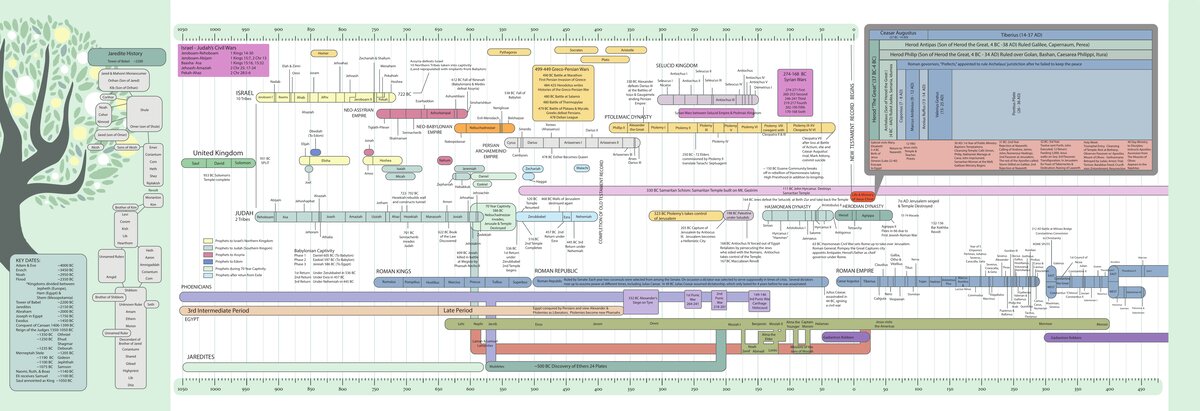
Tap to expand
Old Testament Timeline
From Creation through the Persian Period — tap the image to zoom, or download the full PDF.
Tap anywhere to close · Pinch to zoom