| Church Manuals | |
| Come Follow Me Manual — Week 22 | View |
| Scripture Helps: Old Testament | View |
| OT Seminary Teacher Manual | View |
| OT Institute Manual (Gen–2Sam) | View |
| Pearl of Great Price Manual | View |
| Scripture Reference | |
| Bible Dictionary | View |
| Topical Guide | View |
| Guide to the Scriptures | View |
| Church Media & Library | |
| Gospel for Kids (YouTube) | View |
| Bible Videos | View |
| Church Magazines | View |
| Gospel Library | View |
Week 22
The Lord Raised Up Judges
Judges 2–4; 6–8; 13–16
May 25–31, 2026
5-Minute Overview
Week 22 covers Israel's pride cycle through Judges — twelve judges across seven generations in a spiral of covenant betrayal and divine mercy. The study guide explores the prophetic classification of Judges as Nevi'im Rishonim, the seven-and-twelve structural signature, Deborah as prophetess-judge-commander, Gideon's shofars as both tactical and liturgical Sinai invocations, the Nazarite vow and its connection to Christ, the Nazir/Nazareth etymological distinction, Manoah's wife and the pattern of women receiving revelation first, and the Song of Deborah within the Ten Songs tradition.
Official Church Resources
OFFICIAL CHURCH RESOURCES▶
CHURCH MEDIA FOR FAMILIES▶
▶ Video Commentary
VIDEO COMMENTARY (12 videos)
▼






Specialized Audiences
WOMEN’S PERSPECTIVES (2 videos)
▶


FAMILY & CHILDREN’S RESOURCES (7 videos)
▶




Reference & Study Materials
BIBLE PROJECT VIDEOS THIS WEEK (13 videos)
▶
Book overview + theme & word study videos relevant to this week’s reading.








ACADEMIC & SCHOLARLY SITES▶
MAPS & BIBLICAL LOCATIONS▶
A Letter to Fellow Students
▶︎
Seven times. Seven times the narrator records the same verdict: "The children of Israel did evil in the sight of the LORD."
Not an evil — the evil. The Hebrew ha-ra (הָרַע) carries the definite article. This is not a vague accusation of wrongdoing. It is the specific evil — the one Moses spent the last forty years warning about, the one Joshua made them swear against at Shechem, the covenant violation so predictable that Moses composed a song about it before it happened (Deuteronomy 31:19–22). When the narrator writes ha-ra, he is pointing back to a prophecy and saying: this is that.
And that matters more than most of us realize. Because Judges is not classified as history in the Jewish canon. It is classified as prophecy — Nevi'im Rishonim (נְבִיאִים רִאשׁוֹנִים), the Former Prophets. This is not an ancient history textbook recording what once happened. It is a prophetic text revealing what always happens when a covenant people forgets God. Moses prophesied it. Joshua and Judges fulfilled it. And the pattern did not stop at Judges.
The poster below maps what we are reading this week — and what it means beyond this week.
The Pattern: From Moses' Prophecy to the Silence of God
▶︎
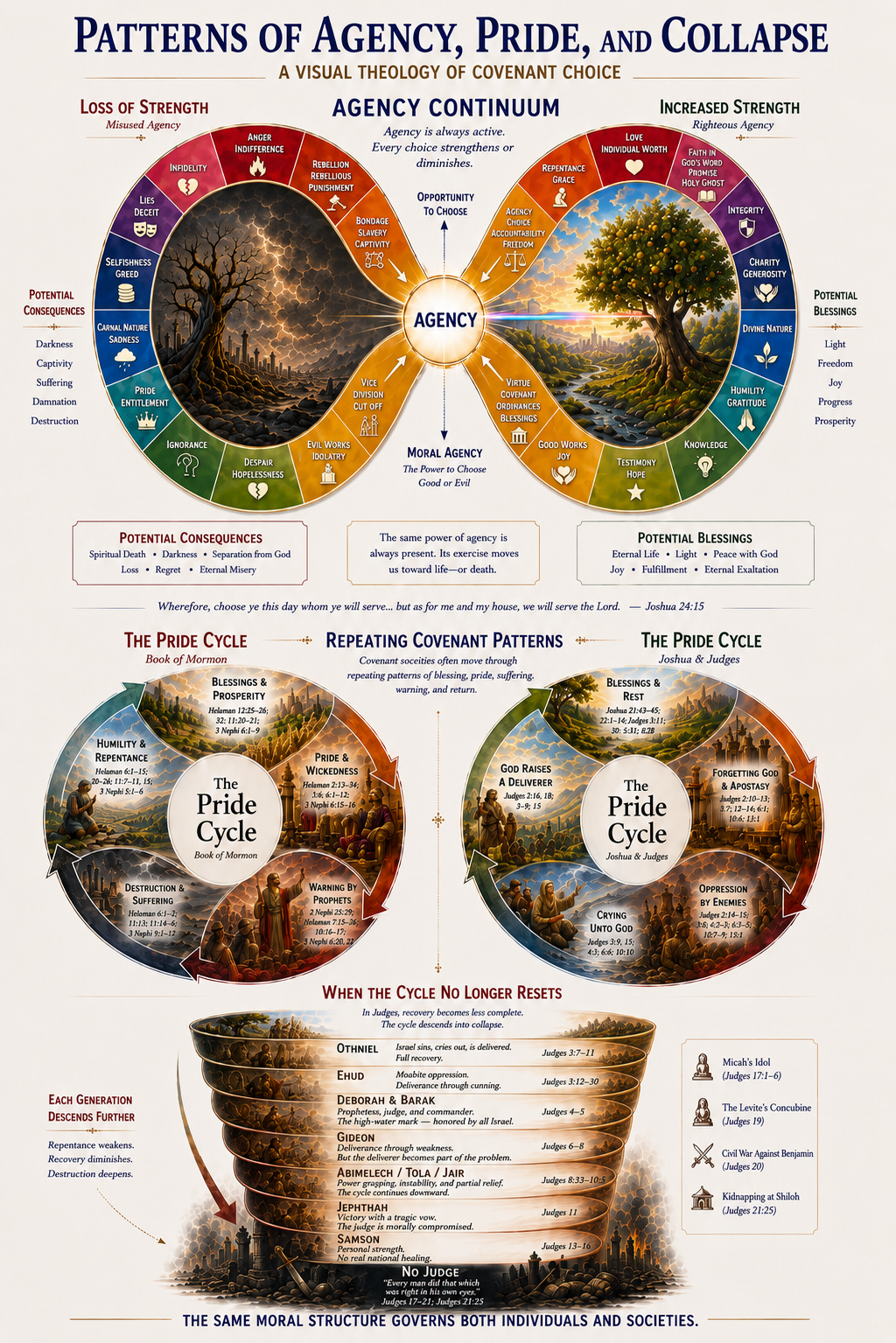
This image captures the entire arc of what Judges teaches. Study it carefully, because it is not just about ancient Israel — it is about every covenant community and every covenant individual.
Moses Saw It Coming
▶︎
In Deuteronomy 31, Moses is dying. He knows what will happen:
"For I know that after my death ye will utterly corrupt yourselves, and turn aside from the way which I have commanded you; and evil will befall you in the latter days; because ye will do evil in the sight of the LORD, to provoke him to anger through the work of your hands." (Deuteronomy 31:29)
This is not a guess. It is a prophecy — and Judges is its fulfillment, seven times over. Each cycle follows the same pattern: Israel is faithful → they grow comfortable → they forget the God who delivered them → they adopt the gods of their neighbors → oppression comes → they cry out → God raises a deliverer → peace returns → they forget again. The cycle doesn't reset to neutral. It degenerates. Each round sinks lower than the last.
Seven Cycles, Seven Dispensations
▶︎
The number seven is not incidental. Seven cycles of apostasy in Judges mirror the seven dispensations of human history — Adam, Enoch, Noah, Abraham, Moses, Christ, the Restoration — each opening with covenant light and ending in apostasy. The pattern is the same at every scale: God reveals, humanity receives, prosperity follows, pride enters, the covenant frays, darkness descends, and God intervenes again. Seven is the number of completion in Hebrew thought, structured into the fabric of creation itself — six days of labor, one of rest. The seven cycles of Judges are the creation week inverted: seven rounds of escalating chaos, and then silence.
And the silence is devastating. After Samson — the last judge — no deliverer comes. Chapters 17–21 record Israel's moral collapse with no prophetic voice, no divine intervention, and no rescue. "In those days there was no king in Israel: every man did that which was right in his own eyes" (Judges 21:25). The cycle has exhausted itself. God's silence is the seventh-day judgment — not rest, but the absence of rescue.
No Human King Could Fix This
▶︎
The refrain "there was no king in Israel" seems to argue for monarchy. But the irony runs deeper. Israel already had a King — God Himself. When they eventually demanded a human king "like all the nations" (1 Samuel 8:5), God told Samuel: "they have rejected me, that I should not reign over them" (1 Samuel 8:7). The desire for a human king was not the solution to the Judges cycle — it was the same apostasy in its final form. Gideon understood this when he refused the crown: "I will not rule over you, neither shall my son rule over you: the LORD shall rule over you" (Judges 8:23).
But God, in His mercy, worked through the flawed institution Israel demanded. The line of kings eventually produced David — mortal, flawed, but a type and ancestor of the Messiah. Seven cycles of apostasy led to a king, and that king's line led to the King. The pattern of seven ends, as it always does in Hebrew thought, with a new beginning — the eighth day, the day of new creation. Jesus Christ is the only One who can permanently break what Judges reveals about the human condition. The seventh Millennial day is the Sabbath of the dispensational week: the promised rest, the return to Eden, through the restoration of all things.
As John Hilton III framed it in his Finding Christ video: "Judges ends with everyone doing what is right in their own eyes. The gospel ends with everyone kneeling before Jesus Christ. The question each of us needs to ask is: today, will I do what is right in my own eyes, or will I fall on my knees before the Savior?"
What's in This Week's Materials
▶︎
The Reading: Judges 2–4; 6–8; 13–16
▶︎
Twelve chapters spanning the full arc of the judges period — from the cycle's introduction through its most famous figures. If you read nothing else, read these three passages:
- Judges 2:11–19 — The thesis statement. The entire pride cycle laid out in nine verses, including the devastating conclusion: "they returned, and corrupted themselves more than their fathers."
- Judges 7:2–22 — Gideon's 300. God reduces the army to an impossible number, arms them with shofars and torches instead of swords, and fights the battle Himself.
- Judges 16:17–21 — Samson's fall. The covenant symbol cut, the Spirit departed, and the most haunting verse in the book: "he wist not that the LORD was departed from him."
In the Study Guide
▶︎
Eight word studies trace the key Hebrew vocabulary: shofet (judge/deliverer — not a courtroom judge), ba'al (lord/master/husband — the word Israel's God and Israel's idol share), nazir (set apart — the Nazarite vow and its connection to Christ), nevi'ah (prophetess), ephod (priestly garment turned idol), cherev (sword — the invisible weapon of God), shibboleth (the word that cost 42,000 lives), and yashar be'einav (right in his own eyes — the refrain of collapse).
The Historical Cultural Context traces each judge in full narrative detail — including Jephthah's tragic vow, the shofar chain from Sinai to Jericho to Gideon, and the Nazir/Nazareth etymological distinction. The Jewish Perspective explores the Song of Deborah within the Ten Songs tradition, Gideon's fleece as legitimate confirmation versus sign-seeking, and the progressive reduction of Gideon's army as a theological principle.
In Charts and Articles
▶︎
The Canaan Cultural Field Guide is essential background for this week — particularly Section 04: Ugarit and Canaanite Religion and Section 07: Israel Among the Nations. The Baal Cycle myths recovered from Ugarit reveal exactly what Israel was tempted by — a storm god who died and rose annually, whose worship included sexual rites and feasting. Understanding Canaanite religion makes Judges' repeated phrase "went a whoring after Baalim" concrete rather than abstract. These were not foreign ideas — Canaanite religion shared vocabulary, ritual forms, and even divine names with Israelite worship. The temptation was not that it was obviously wrong but that it was familiar.
Also this week: "Music and the Spirit of Prophecy" connects the Song of Deborah to the broader biblical pattern of music as a vehicle for prophetic experience, and "The Voice at the Mountain" traces the shofar from Sinai through Gideon's battle to the eschatological trumpet of the last day.
In the Resources Tab
▶︎
Video highlights worth your time:
- Dr. Lori Denning (Follow Him) brings her PhD dissertation on the women of the Samson story — including the observation that "spiritual experiences aren't a vaccine for spiritual decay" and the Hebrew irony stack in the Ehud story
- John Hilton III (Finding Christ) on the "true and better Samson" Christological typology and the connection between Judges 21:25 and Korihor's antichrist philosophy in the Book of Mormon
- Lynne Hilton Wilson (Scripture Central) on Deborah's triple title and the pattern of women as first witnesses in salvation history
- Scripture Gems on the eshet lapidot wordplay — "woman of fire/torches" — and how Deborah's name, Barak's name (lightning), and the storm imagery of the battle form a unified literary pattern
- Thumb Follow Me — a children's animated retelling of Deborah that directly addresses the question "I thought prophets were only men?" with Scripture-grounded clarity
Deborah: The High-Water Mark
▶︎
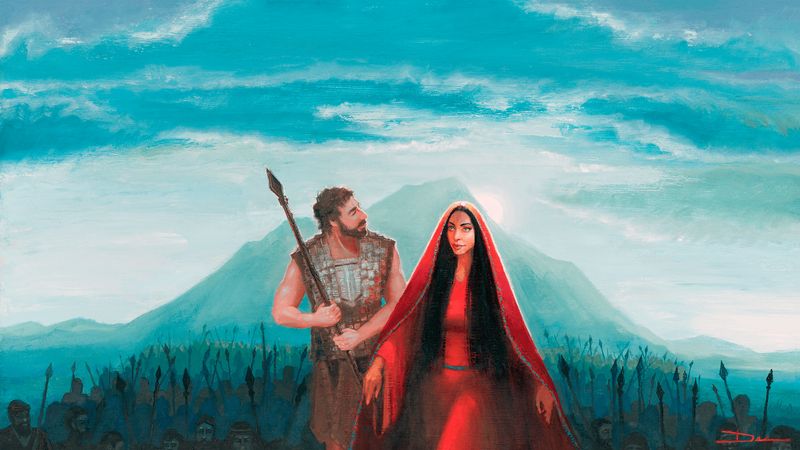
Deborah holds three simultaneous titles that no other woman in scripture matches: nevi'ah (נְבִיאָה — prophetess), shofetet (שׁוֹפֶטֶת — judge), and eshet lapidot (אֵשֶׁת לַפִּידוֹת — "woman of torches"). She is already judging Israel when the story opens. People come to her. She doesn't seek office — she is simply recognized. When she relays God's command for Barak to lead ten thousand against Sisera's nine hundred iron chariots, Barak's response — "If thou wilt go with me, then I will go" — is not cowardice. He wants the prophetic presence of God beside him in battle. As Dr. Lori Denning noted: "Barak wanted the prophet there. That's not weakness — that's theology."
Deborah prophesies that the glory of the victory would belong to a woman. It is fulfilled doubly — by Deborah who directed the battle, and by Jael, a Kenite woman outside the covenant community, who killed Sisera with a tent peg. Both are celebrated by name in the Song of Deborah, the oldest known poem in the Hebrew Bible (Judges 5). Jael is called "blessed above women" (5:24) — the same phrase later applied to Mary, the mother of Jesus (Luke 1:42).
But Deborah's significance extends beyond her own story. She represents the last moment in the book of Judges when women are honored. After Deborah, the trajectory reverses with devastating clarity:
- Deborah — honored as prophetess, judge, and commander
- Jephthah's daughter — sacrificed to her father's rash vow, her name never recorded
- The Levite's concubine — silenced, abandoned, dismembered, and mailed to the twelve tribes as a political message
- The daughters of Shiloh — kidnapped to provide wives for the surviving Benjamites
By Ruth and Naomi, women without husbands have no legal standing at all. The treatment of women across Judges functions as the clearest barometer of Israel's social and spiritual collapse. When a society honors its women, it is near God. When it objectifies, silences, and disposes of them, it has departed from Him — whether it notices or not.
Gideon's Shofars: The Sound of the Covenant
▶︎
God gave Gideon 300 men against 135,000 Midianites. He armed them with shofarot (שׁוֹפָרוֹת — ram's horn trumpets), clay pitchers, and torches hidden inside the pitchers. No swords. No arrows. No weapons of war at all.
Rashi sees something extraordinary in this: the shofars and fire were carried l'hazkir z'khut matan Torah — "to invoke the merit of the giving of the Torah" (Rashi on Judges 7:16). At Sinai there were shofar blasts and fire (Exodus 19:16–18). At Jericho, shofars brought down walls (Joshua 6). At Gideon's battle, shofars, fire, and a proclamation. The chain is liturgical, not military. Israel's true weapon is the covenant, and the shofar is the sound of that covenant being invoked.
But the shofar was also real tactical communication — the ancient world's field radio. Three hundred shofars sounding simultaneously from positions surrounding the Midianite camp would have been immediately recognizable as the sound of a massive, coordinated army executing a planned attack. The Midianites could not see how many soldiers stood behind those horns in the darkness. They heard what sounded like an overwhelming force, panicked, and turned their swords on each other.
The tactical and the liturgical work together. God uses real instruments with real function to accomplish a victory that is unmistakably His. The battle cry captures the theology: cherev la-YHWH u-le-Gideon (חֶרֶב לַיהוָה וּלְגִדְעוֹן) — "The sword of the LORD, and of Gideon." God's name first. The 300 never drew a blade.
And then Gideon builds a golden ephod from the spoils (8:24–27). The man who began by tearing down his father's idol ends by building one of his own. As one study guide discussion asks: what "golden ephods" do we risk creating from our own victories — turning God's gifts into our objects of worship?
Samson: The Nazarite Who Broke Every Vow
▶︎
The Nazarite vow (Numbers 6) was one of the most intense forms of personal consecration available in ancient Israel — voluntary separation unto God, marked by three restrictions: no grape products, no contact with the dead, no cutting the hair. Most Nazarite vows were temporary — thirty days minimum, with a completion ceremony at the Temple. But Samson was consecrated from the womb by angelic command. Lifelong. Set apart before birth.
And he systematically violated every restriction. He touched a lion's carcass (contact with the dead), ate honey from it, threw a drinking feast (mishteh, from the root "to drink" — almost certainly involving wine), and finally allowed Delilah to cut his hair. Each violation escalated. Each one further frayed the covenant that was the source of his strength. His power was never in his muscles — it was in his consecration. When the last visible symbol of that covenant was cut, the Spirit departed. And then the most haunting verse in the book: "He wist not that the LORD was departed from him" (16:20).
The loss of spiritual sensitivity — not the loss of strength — is the real tragedy. Samson didn't feel the Spirit leave. He had become so accustomed to operating on his own terms that he couldn't distinguish between God's power and his own assumptions.
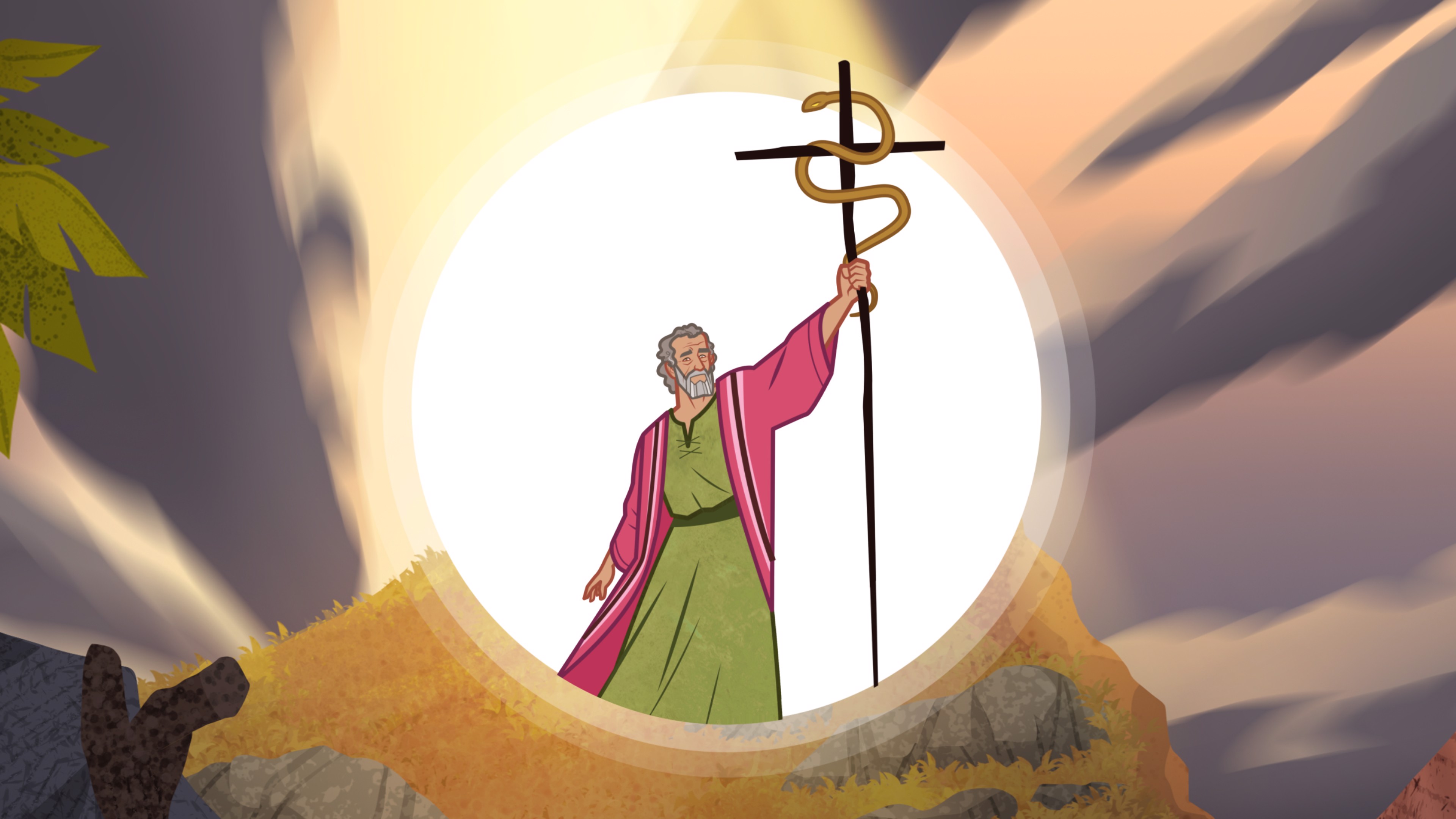
Yet the Nazarite concept points forward. Christ is the true Nazir — set apart from before birth, consecrated to God's service, who never broke the covenant where Samson failed at every point. And the word Nazir (נָזִיר, with a zayin) is distinct from Nazareth (נָצְרַת, with a tsade), which derives from netser (נֵצֶר) — "branch," the messianic title of Isaiah 11:1. Matthew 2:23 deliberately plays on both sounds: Jesus is both the true Nazir (the consecrated one) and the netser (the Branch from Jesse's root). The Greek ear, hearing "Nazarene," would catch both echoes at once.
The Question Judges Asks
▶︎
Every cycle in Judges ends the same way — with a deliverer who cannot permanently deliver. Every judge fades, fails, or dies, and the people return to the pattern. Seven rounds. Twelve judges. And then silence.
The book forces a question it refuses to answer: Who can break this cycle?
Not Deborah, though she is the wisest. Not Gideon, though God fought his battle. Not Samson, though he had the most extraordinary gifts. Not any human king — Israel had God as their King and rejected Him anyway.
Peter asked the same question in a different form: "Lord, how oft shall my brother sin against me, and I forgive him? till seven times?" And Jesus answered: "I say not unto thee, Until seven times: but, Until seventy times seven" (Matthew 18:21–22). Seven cycles of apostasy in Judges. Seventy times seven in Christ's answer. The divine mercy does not run out at seven — it extends beyond what any human accounting can track.
Judges is the lived preface to that conversation. It is the demonstration — across three centuries and twelve deliverers — that the cycle of human failure cannot be broken by human effort, human strength, or human kingship. It can only be broken by the One who forgives seventy times seven, who is both the true Nazir and the true King, who does not build golden ephods from His victories but lays down His life to end the cycle once and for all.
The pattern leads from Moses' prophecy through seven rounds of failure to a silence that only one voice can fill. And that voice, when it finally comes, speaks to a boy sleeping in the Tabernacle at Shiloh: "Samuel, Samuel" (1 Samuel 3:10). The cycle begins again — but this time, it is heading somewhere.
Weekly Insights — Week 22 | CFM Corner | OT 2026
Sources: Study Guide, Canaan Cultural Field Guide, Video Summaries (15 videos)
Week 22
Judges 2–4; 6–8; 13–16 — Overview
"The Lord Raised Up Judges"
1. Week 22: Overview
After Joshua's death, Israel enters its darkest period. The book of Judges records a relentless cycle: Israel abandons God → God allows oppression → Israel cries out → God raises a judge/deliverer → peace returns → Israel abandons God again. The cycle doesn't improve — it degenerates. Each round is worse than the last. Across approximately 300 years, God raises at least twelve judges across seven generations — each one a deliverer, none of them permanent. The numbers themselves carry prophetic weight: seven is used as a number signifying completion as observed with sacred time (creation days, Sabbath, feast days), and twelve is often used in a similar way, also used to represent a number representing a priesthood covenant community (tribes, breastplate stones, apostles). Twelve judges in seven generations is not arbitrary, it is teaching us something. It mirrors the structural signature that runs through all of scripture — and in Judges we observe this cycle in regression, what happens when a covenant community turns away from God, and what does that destructive cycle look like?
In Judges we observe the following phrase seven times:
vaya’asu b’nei Yisra’el et ha-ra b’einei YHWH (וַיַּעֲשׂוּ בְנֵי יִשְׂרָאֵל אֶת הָרַע בְּעֵינֵי יְהוָה) — "And the children of Israel did evil in the sight of the LORD"
It appears at these seven trigger points in Judges:
1. 3:7 → Othniel cycle
2. 3:12 → Ehud cycle
3. 4:1 → Deborah cycle
4. 6:1 → Gideon cycle
5. 8:33-34 → Abimelech/Tola/Jair cycle
6. 10:6 → Jephthah cycle
7. 13:1 → Samson cycle
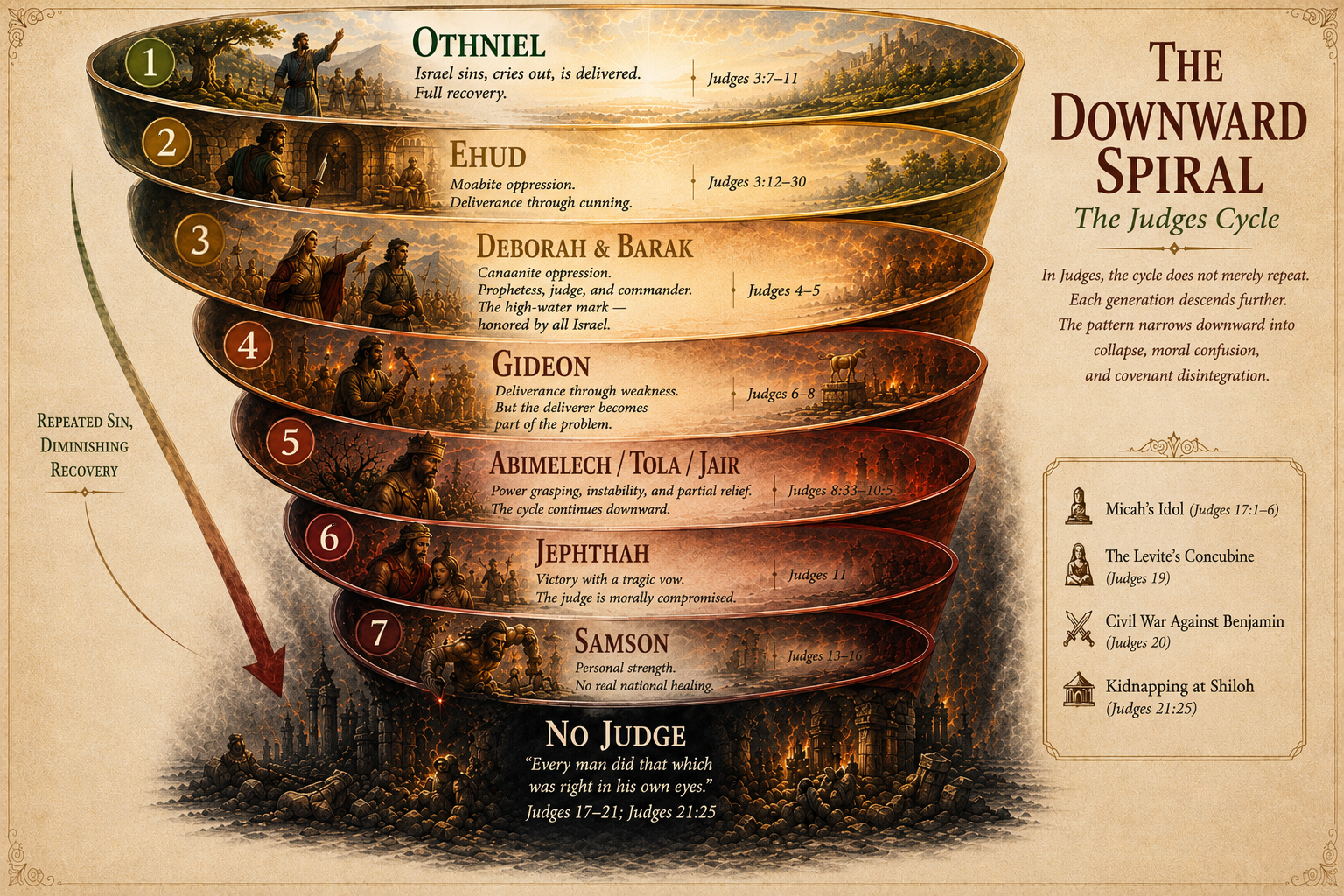
The definite article on _ha-ra_ (הָרַע — "THE evil") is significant — it's not just any wrongdoing, it's _the_ specific evil: covenant violation, serving other gods, exactly what Moses and Joshua warned Israel against. Each instance triggers the same pattern: apostasy → oppression → crying out → deliverance, and each cycle degenerates further than the last. This is the same pattern we observe in the Book of Mormon, with the pride cycle. As we see above, each cycle is linked with a specific judge, who acts as a type of mediator, mercifully sent to help Israel recalibrate, which they struggle to do. With each turn f the dial, they descend further and further into apostasy.
Othniel (3:9-11) — Caleb's nephew, the model judge. The Spirit of the LORD comes upon him, he delivers Israel from Cushan-rishathaim of Mesopotamia, and the land rests forty years. He is the template — and every judge after him falls short of it.
Ehud (3:12-30) — a left-handed Benjamite who assassinates Eglon king of Moab with a concealed dagger, exploiting both his left-handedness and Eglon's obesity. Clever, violent, effective — eighty years of peace follow. Shamgar (3:31) gets a single verse: he killed six hundred Philistines with an ox goad. Minimal record, but real deliverance.
Deborah (4-5) — prophetess, judge, and commander whose authority all Israel recognized. She is already serving as judge when the narrative opens — people come to her for judgment under her palm tree. She directs the victory over Sisera's Canaanite army; Jael, a Kenite woman, kills Sisera himself. Both women are celebrated by name in the oldest poem in the Bible. Deborah represents the high-water mark of the book — a society that still honors women's leadership, wisdom, and prophetic authority.
Gideon (6-8) — a terrified farmer hiding wheat from Midianite raiders when God calls him "mighty man of valor." God strips his army from 32,000 to 300 so Israel can't claim credit for the victory. Gideon rightly refuses kingship: "the LORD shall rule over you" (8:23). But he then builds a golden ephod from the spoils — and all Israel worships it. His trajectory captures the book's arc in miniature: a man who starts by destroying false worship and ends by creating it.
Tola (10:1-2) — twenty-three years. Jair (10:3-5) — twenty-two years, thirty sons riding thirty donkeys governing thirty cities. These "minor judges" stabilize the generations between the major crises, but Jair's accumulating sons and donkeys signal growing dynastic ambition.
Jephthah (11-12) — son of a prostitute, expelled by his own family, a bandit leader who becomes Israel's deliverer against Ammon. He delivers a sophisticated diplomatic argument before fighting — and then makes a rash vow that costs his daughter's life. Two men's pride (Jephthah's and the High Priest's) prevented the consultation that could have saved her. After Jephthah: Ibzan (seven years), Elon (ten years), Abdon (eight years) — more minor judges, more accumulating sons and donkeys.
Samson (13-16) — the Nazarite with supernatural strength and fatal weakness, consecrated before birth, who systematically breaks every vow. His strength was never in his muscles; it was in his covenant. When the last symbol of that covenant was cut, the Spirit left — "and he wist not that the LORD was departed from him" (16:20). His greatest victory — pulling down the temple of Dagon — was also his death.
After Samson, no more judges are raised. Chapters 17-21 record Israel's moral collapse with no deliverer, no prophetic voice, and no divine intervention. "Every man did that which was right in his own eyes." The cycle has exhausted itself. God's silence is the final judgment.
"In those days there was no king in Israel: every man did that which was right in his own eyes." (Judges 21:25)
This refrain bookends the period of the judges. Without covenant leadership, Israel defaults to moral autonomy — "right in his own eyes." The phrase isn't freedom; it's chaos. The judges are God's emergency interventions in a nation that keeps turning away. But Judges is more than history — the Jewish canon classifies it as prophecy (Nevi'im Rishonim, the Former Prophets). Moses prophesied in Deuteronomy 31 that Israel would forsake the covenant. Joshua and Judges are the fulfillment — and the seven cycles of apostasy that unfold here mirror a pattern that runs from creation, through the seven dispensations of man, and into the Millennium (the seventh day, the period of rest). Judges is more than history; it is prophecy.
The questions Judges raises are uncomfortable — they are supposed to be: What happens when God's people have the covenant and forsake it? How many times does the cycle repeat? How many times does the Lord extend mercy? This is the heart of the exchange between Jesus and Peter in Matthew 18:21-22. Peter asks, "Lord, how oft shall my brother sin against me, and I forgive him? till seven times?" — and Jesus answers, "I say not unto thee, Until seven times: but, Until seventy times seven." Seven cycles of apostasy in Judges. Seven times seventy in Christ's answer. The pattern of divine mercy does not run out at seven — it extends beyond what any human accounting can track. Judges is the preface for that conversation: the lived demonstration of a God who keeps sending deliverers to a people who keep turning away.
1. The Cycle of Apostasy
The pattern repeats with devastating predictability: faithfulness → forgetfulness → foreign gods → oppression → crying out → deliverance → repeat (2:11-19). The cycle doesn't stay flat — it spirals downward. Each generation sinks lower. By the end of Judges, Israel's behavior is indistinguishable from the Canaanites they were supposed to displace.
2. Deborah — Honored Leader, Prophetic Voice
Deborah is prophetess, judge, and military commander — holding three significant titles simultaneously, a combination unmatched by any other female figure in scripture. It is important to recognize that Deborah does not appear as a substitute for absent male leadership, a common misconception. She is already judging Israel when the narrative opens (4:4-5). All Israel respects her and comes to her. When she relays God's command, Barak insists on her presence because of her exceptional wisdom and strength — a testament to her authority. Deborah does not usurp power from Barak; she helps him recognize it, and gives him the courage to rise to the task. But Deborah also pointedly teaches the power of righteous women. She prophesies that Israel's victory would come through faithful women: Deborah, who directed the armies, and Jael, who finished the mission — strategically defeating Sisera not by brute force but through wit and calculated hospitality (4:17-21). Both are celebrated by name. Deborah's honored status represents the high-water mark for women in Judges — a standard against which the book's subsequent degradation of women becomes devastatingly clear.
3. Gideon — God Shrinks the Army
Midianite raiders had devastated Israel for seven years — destroying crops and livestock until the people hid in caves and dens (6:2-4). God's angel finds Gideon secretly threshing wheat in a winepress — a low, concealed place — and greets him with loaded irony: "The LORD is with thee, thou mighty man of valor" (6:12). Gideon doesn't feel mighty. He feels abandoned: "If the LORD be with us, why then is all this befallen us?" (6:13). God doesn't answer the question — He gives a commission.
God then reduces Gideon's army from 32,000 to 300 — explicitly "lest Israel vaunt themselves against me, saying, Mine own hand hath saved me" (7:2). The first cut removed the afraid (22,000 left voluntarily). The second used the water-lapping test: those who stayed alert while drinking were kept; those who knelt casually were sent home. God selected for vigilance, not numbers. Three hundred against 135,000 Midianites — the victory was intentionally designed to be impossible by human standards so no one could claim credit.
The "weapons" God chose are as significant as the army He shrank. The 300 carried shofarot (ram's horn trumpets), clay pitchers, and torches hidden inside the pitchers — no swords (7:16). This is the same pattern established at Jericho, where shofars brought down walls that no siege engine could breach (Joshua 6). Rashi connects both directly to Sinai: the shofars and fire invoke z'khut matan Torah — "the merit of the giving of the Torah" (Rashi on Judges 7:16). At Sinai there were shofar blasts and fire (Exodus 19:16-18). At Jericho, shofars and a shout. At Gideon's battle, shofars, fire, and a cry. The pattern is liturgical, not military — Israel's true weapon is the covenant, and the shofar is the sound of that covenant being invoked. When the pitchers shattered and the torches blazed out, "the LORD set every man's sword against his fellow" (7:22). The 300 never drew a blade. God fought; Gideon showed up.
The battle cry captures the theology: cherev la-YHWH u-le-Gideon (חֶרֶב לַיהוָה וּלְגִדְעוֹן) — "The sword of the LORD, and of Gideon." God's name first. The "sword" is God's invisible weapon — the human instruments are shofars, light, and faith.
4. Samson — Strength Without Character
Samson is the anti-hero of Judges. The Nazarite vow (Numbers 6) was one of the most intense forms of personal consecration available in ancient Israel — voluntary separation unto God, marked by three restrictions: no grape products, no contact with the dead, no cutting the hair. The vow was typically temporary (thirty days minimum), but Samson was consecrated from the womb — set apart before birth by angelic command, a lifelong Nazarite. He was given supernatural strength, destined for greatness — and he squanders everything, progressively violating each restriction until the last visible symbol of his covenant is cut and the Spirit departs. His story is a study in what happens when extraordinary gifts are paired with minimal character. Yet the Nazarite concept also points forward: Christ is the true Nazir — set apart from before birth, consecrated to God's service, never breaking the covenant where Samson failed at every point. (See Historical Cultural Context, Section 5 for the full Nazarite history and the Nazir/Nazareth connection.)
5. Canaanite Gods — The Competition
Baal (lord/master — storm, fertility, power), Asherah/Ashtoreth (mother goddess, sexuality), and other Canaanite deities offered what YHWH demanded against: visible gods, sexual worship, gluttony (sacrifice and consumption of forbidden animals, frequently paired with intoxication), immediate gratification. Israel's temptation wasn't theological debate — it was practical, temporal, and social: Canaanite religion was easier, more sensual, and more culturally "normal." But the deeper danger was that Canaanite religion was not entirely foreign — it shared vocabulary, ritual forms, and even divine names with Israelite worship. The temptation was not that it was obviously wrong but that it was familiar — close enough to covenant worship that the boundaries blurred. For the full picture — the Canaanite pantheon revealed by the Ugaritic texts, the Baal Cycle mythology, why shared vocabulary made syncretism so dangerous, and the archaeological evidence — see the Canaan Cultural Field Guide: Section 04: Ugarit & Canaanite Religion and Section 03: The Canaanite Peoples.
6. God Uses the Unlikely
Gideon — a fearful farmer hiding in a winepress. Samson — a deeply flawed Nazarite. Jephthah — the son of a prostitute, expelled by his own family. God's pattern in Judges is consistent: He doesn't choose the obvious candidate. The weakness of the vessel makes the power of the deliverance undeniable. Deborah stands apart — not unlikely, but uncontested — demonstrating that God also works through those whose wisdom and authority are already recognized. To modern readers Deborah may seem unlikely precisely because she is a woman, but this says more about our cultural lens than hers. Prior to Deborah's story, women held positions of honor throughout Israel's history: the Matriarchs (Eve, Sarah, Rebekah, Rachel, Leah), the midwives Shiphrah and Puah who defied Pharaoh, Miriam who led Israel along with Moses and Aaron. Deborah's leadership is consistent with that early tradition — she is the continuation of it, not the exception to it. It is after Deborah that women's status collapses: Jephthah's daughter sacrificed to a rash vow, the Levite's concubine silenced and dismembered, the daughters of Shiloh kidnapped. By Ruth and Naomi, women without husbands have no legal standing — valued as less than slaves and beggars, their testimony inadmissible in court. Deborah marks the last moment when Israel's culture still reflected the Torah's honor for women. Everything after her measures the depth of the fall, and residual effects of that persist even today.
7. Prophecy, Not History — The Seven Cycles and the Larger Pattern
The Jewish canon classifies Judges not as a historical book but as prophecy — part of the Nevi'im Rishonim (Former Prophets). Looking at it from this perspective changes everything. Moses prophesied in Deuteronomy 31 that Israel would forsake the covenant; Joshua and Judges are one of many fulfillments of that pattern. The phrase "did evil in the sight of the LORD" appears seven times in Judges, each triggering a cycle of apostasy, oppression, and deliverance — with twelve or more judges serving across these generations. Seven is the number of completion in Hebrew thought, eight is associated with new beginnings. This is outlined in the structure of creation itself. This patter reoccurs over and over again, the seven cycles mirror the seven dispensations of man (Adam, Enoch, Noah, Abraham, Moses, Christ, the Restoration), each dispensation opening with covenant and ending in apostasy.
No human judge — and no human king — could break this cycle. Israel had a King (God Himself), and when they eventually demanded a human one, God called it a rejection of Him (1 Samuel 8:7). But ironically, there is a lesson in this as well, the pattern eventually points to David, a mortal and flawed proto-type and ancestor of the Messiah, Jesus Christ. This is significant on many levels. Not only does this pattern of seven lead us to a king, it takes us back to to new beginning, a new day. Jesus Christ is our King of Kings, He is the only One who can truly offer a new beginning, the only One who can permanently resolve what Judges reveals about the human condition. The seventh Millennial day represents the Sabbath of the dispensational week: the day of rest, a return to the beginning, through the restoration of all things.
| Chapter | Content | Assigned |
|---|---|---|
| Judges 1 | Incomplete conquest — tribe after tribe fails to drive out Canaanites | — |
| Judges 2 | The cycle introduced — apostasy, oppression, deliverance, repeat | Yes |
| Judges 3 | First judges: Othniel, Ehud, Shamgar | Yes |
| Judges 4 | Deborah and Barak defeat Sisera; Jael kills Sisera | Yes |
| Judges 5 | The Song of Deborah — archaic victory hymn, tribal roll call | — |
| Judges 6 | Gideon's call; the fleece; tearing down Baal's altar | Yes |
| Judges 7 | Army reduced to 300; victory over Midianites | Yes |
| Judges 8 | Gideon's golden ephod — begins well, ends badly | Yes |
| Judges 9 | Abimelech's failed kingship; Jotham's fable of the trees | — |
| Judges 10 | Minor judges Tola and Jair; renewed apostasy, God's sarcasm | — |
| Judges 11 | Jephthah's diplomacy and tragic vow | — |
| Judges 12 | Shibboleth at the Jordan fords; minor judges Ibzan, Elon, Abdon | — |
| Judges 13 | Samson's birth — Nazarite from the womb; angel announces | Yes |
| Judges 14 | Samson's exploits — lion, riddle, Timnite wife | Yes |
| Judges 15 | Foxes, jawbone of a donkey, miraculous water | Yes |
| Judges 16 | Delilah, the haircut, blindness, pulling down the temple | Yes |
| Judges 17 | Micah's private shrine — idolatry dressed in YHWH's name | — |
| Judges 18 | Danite migration — stolen gods, conquered Laish | — |
| Judges 19 | The Levite's concubine — Israel's darkest chapter | — |
| Judges 20 | Civil war against Benjamin — near-extinction of a tribe | — |
| Judges 21 | Desperate solutions; "every man did right in his own eyes" | — |
- Joshua: "Choose you this day" — Israel chooses the LORD
- Judges 2: The generation that knew Joshua dies; the next doesn't know God
- The Cycle: Each judge delivers, but each period between judges sinks lower
- Deborah: A prophetess and judge honored by all Israel — the high-water mark before the decline
- Gideon: God proves He doesn't need an army — 300 is enough
- Samson: Maximum potential, minimum character — the cycle personified
- "Every man did right in his own eyes": The book ends in moral chaos
The arc of Judges is intentionally bleak. Israel already had a King — God Himself — but each generation forgot Him. When Israel eventually demands a human king "like all the nations" (1 Samuel 8:5), God tells Samuel: "they have rejected me, that I should not reign over them" (8:7). The desire for a human king was not the solution to the Judges cycle — it was the same apostasy in a new form, reminding us that the only One who can break the cycle is the Messiah.
- The cycle is ours: Faithfulness → comfort → forgetfulness → crisis → crying out → rescue. We live this cycle in miniature every week, every month.
- God uses unlikely people: The consistent pattern — not the strong, the qualified, or the willing, but the available and the faithful.
- Strength without character destroys: Samson proves that gifts without integrity lead to ruin. Spiritual power without spiritual discipline is dangerous.
- The arc of women's status: Deborah is honored as prophetess, judge, and commander; Jael is celebrated as a heroine. By the end of Judges, women are objectified, silenced, and disposed of. By Ruth, they have no legal standing at all. The treatment of women across Judges is the clearest barometer of Israel's social and spiritual collapse.
- The competition is real: Baal and Asherah offered visible, sensual, easy religion. Our "Baals" look different but function the same way.
When the Midianites were raiding Israel's food supply, Gideon was secretly threshing wheat in a winepress — a low, hidden place — to keep it from being stolen (Judges 6:11). He wasn't on a battlefield; he was trying to survive. That's when God's angel appeared and called him "mighty man of valor" (6:12). Gideon didn't feel like a warrior — he felt like a failure. Yet God saw what Gideon couldn't see in himself, and raised him to deliver Israel with only 300 men against an army of 135,000 (7:7).
But Gideon's story doesn't end there. After the victory, he collected gold earrings from the spoil and made a golden ephod — a priestly garment used for seeking God's guidance (8:24-27). What started as a memorial to God's victory became an idlic object of worship: "all Israel went thither a whoring after it: which thing became a snare unto Gideon, and to his house." He began his journey by tearing down his father's idol and ended it by building one of his own.
Where is God seeing strength in you that you can't see in yourself? And what "golden ephod" might we be creating from our own victories — turning God's gifts into our idols?
The Come Follow Me manual assigns Judges 2–4; 6–8; 13–16, covering the apostasy cycle, Deborah, Gideon, and Samson. But eleven chapters go unread — and they contain some of the most theologically provocative material in the Old Testament: the incomplete conquest that seeded all subsequent failure, the oldest political fable in world literature, a rash vow that cost a father his only daughter, the word shibboleth entering the English language at a river ford, religion reduced to a transaction with a hired Levite, and the moral abyss of chapters 19–21 where Israel becomes indistinguishable from the Canaanites it was supposed to displace. Skipping these chapters flattens the book into three hero stories; reading them reveals a civilization in freefall — a people who had God as their King and rejected Him anyway.
Assigned chapters are marked in bold. Assigned chapters receive a brief orientation — where they sit in the arc, key verse, and a pointer to where full treatment lives (Key Passages, Word Studies, Jewish Perspective). Non-assigned chapters receive substantive prose so the gaps are not blank.
The Incomplete Conquest (Judges 1) — not assigned
After Joshua's death, the tribes attempt to take their allotted territories individually rather than as a unified nation. The chapter opens promisingly: Judah and Simeon partner together, take Jerusalem briefly, conquer Hebron and Debir, and push into the southern territories. But the momentum dies quickly. Verse 19 delivers one of the most theologically charged lines in the book: "the LORD was with Judah; and he drave out the inhabitants of the mountain; but could not drive out the inhabitants of the valley, because they had chariots of iron." God was with Judah — and yet they couldn't defeat iron chariots. The problem wasn't divine insufficiency; it was human faith failing at the technological barrier. God had already defeated walls at Jericho and armies at Gibeon, but Israel couldn't trust Him against iron.
From verse 21 onward, the chapter becomes a litany of failure. Benjamin did not drive out the Jebusites from Jerusalem. Manasseh did not drive out Beth-shean or Taanach. Ephraim did not drive out the Gezerites. Zebulun did not drive out Kitron or Nahalol. Asher did not drive out Acco or Sidon. Naphtali did not drive out Beth-shemesh. Dan was pushed into the hill country entirely. The repetition is relentless and deliberate — the narrator is building the case for everything that follows. Rashi says plainly: "Scripture censures them, as they began betraying the Holy One, blessed is He, Who commanded them: 'Oust all those dwelling in the land.'"
This chapter is the seedbed of the entire book. Every cycle of apostasy, every Baal altar, every intermarriage with Canaanite peoples grows from the soil of incomplete obedience in chapter 1. The pattern resonates with President Nelson's emphasis on the covenant path: you can't walk half the path and expect full blessings. Partial obedience, over time, produces full apostasy.
The Cycle Defined and the First Judges (Judges 2–3) — assigned
Chapter 2 (assigned) — The angel of the LORD confronts Israel at Bochim for failing to tear down Canaanite altars, and the people weep (hence the name Bochim, "weepers"). Then the thesis statement of the entire book unfolds in 2:11-19: faithfulness → forgetfulness → foreign gods → oppression → crying out → deliverance → repeat — but worse each time. "They returned and corrupted themselves more than their fathers." The cycle doesn't reset; it degenerates. For full treatment, see Key Passages (2:11-19) and Jewish Perspective (the cycle as theology).
Chapter 3 (assigned) — The first three judges appear in rapid succession. Othniel (3:9-11), Caleb's nephew, is the model judge: the Spirit comes upon him, he delivers Israel, and the land rests forty years. He's the template against which every subsequent judge will be measured — and found wanting. Ehud (3:12-30) is cleverer and darker: a left-handed Benjamite who assassinates Eglon king of Moab with a concealed dagger, exploiting both his left-handedness (unexpected in a weapon hand) and Eglon's obesity (the blade vanishes into the fat). The narrative is vivid, almost comic, and deliberately subversive — God's deliverer is a sneaky assassin. Shamgar (3:31) gets a single verse: he killed six hundred Philistines with an ox goad. The brevity itself makes a point — the deliverance was real even when the record is sparse.
Deborah and Barak (Judges 4) — assigned
Chapter 4 (assigned) — Deborah, one of seven prophetesses recognized by the Talmud, holds three simultaneous titles: nevi'ah (נְבִיאָה, prophetess), shofetet (שׁוֹפֶטֶת, judge), and eshet lapidot (אֵשֶׁת לַפִּידוֹת, "woman of torches"). She is already serving as Israel's judge when the narrative opens — the people come to her for judgment under her palm tree. When she relays God's command for Barak to lead ten thousand against Sisera's nine hundred iron chariots, he insists on her presence — a reflection of respect, not a commentary on male absence or weakness. She prophesies that God will deliver Sisera into a woman's hand. The prophecy is fulfilled doubly: Deborah directs the victory, and Jael, a Kenite woman, drives a tent peg through Sisera's temple. Both women are celebrated — Deborah by the victory hymn that bears her name, Jael as "blessed above women" (5:24). This honored status stands in stark contrast to the treatment of women later in the book, making Deborah's narrative the high-water mark of a society that still recognizes women's leadership, wisdom, and prophetic authority. For full treatment, see Key Passages (4:8-9), Word Studies (nevi'ah), and Jewish Perspective (the seven prophetesses).
The Song of Deborah (Judges 5) — not assigned
Chapter 5 is one of the oldest poems in the Hebrew Bible — linguistic analysis dates its archaic grammar and vocabulary to the twelfth century BC, placing it alongside the Song of the Sea (Exodus 15) as among the earliest strata of biblical literature. It is not a narrative retelling of chapter 4 but a liturgical victory hymn, composed in parallelism, dramatic imagery, and shifting perspectives.
The poem opens with cosmic participation: "LORD, when thou wentest out of Seir, when thou marchedst out of the field of Edom, the earth trembled, and the heavens dropped, the clouds also dropped water" (5:4). Creation itself fights for God's people. "The stars in their courses fought against Sisera" (5:20) — the battle is not merely military but cosmological. And the Kishon River, swollen by storm, sweeps away Sisera's army: "the river of Kishon swept them away, that ancient river" (5:21). The iron chariots that terrified Israel in chapter 1 are mired in mud and rendered useless. What Israel's faith couldn't overcome, God's creation defeated.
The tribal roll call (5:14-18) is unique in Scripture — tribes are publicly praised and publicly shamed by name for their response to the crisis. Ephraim, Benjamin, Machir (Manasseh), Zebulun, Issachar, and Naphtali are honored for marching to war. Reuben is shamed for agonizing without acting: "Among the divisions of Reuben there were great searchings of heart" — they debated while others bled. Dan is called out for staying with their ships. Asher sat on the coast. Gilead stayed beyond the Jordan. The message is pointed: communal crisis demands communal response. Those who argue while others fight earn prophetic contempt.
The poem's most haunting passage comes at the end: Sisera's mother looks through the lattice, wondering why his chariot delays (5:28-30). Her ladies-in-waiting reassure her — he must be dividing spoil, "a damsel or two for every man." The Hebrew racham (רַחַם) translated "damsel" literally means "womb" — the women are objectified, described as body parts, property to be distributed. The irony is devastating: she imagines her son triumphant while we know he lies dead at a woman's feet. The poem exposes the Canaanite view of women even as it contrasts Israels view of women (at that time,) in celebration — Deborah and Jael — who defeated the entire Canaanite army.
Gideon: Call, Fleece, and Victory (Judges 6–7) — assigned
Chapter 6 (assigned) — Midianite raiders have devastated Israel for seven years — "like grasshoppers for multitude" (6:5), destroying crops and livestock. God's angel finds Gideon hiding in a winepress, threshing wheat in secret, and greets him with loaded irony: "The LORD is with thee, thou mighty man of valour" (6:12). Gideon's first assignment: tear down his father's Baal altar and its accompanying Asherah pole. He obeys — but does it at night because he fears his father's household (6:27). When the townspeople discover the destroyed altar and demand Gideon's death, his father Joash defends him with a taunt that becomes Gideon's new name — Jerubbaal (יְרֻבַּעַל, "let Baal contend"): "If he be a god, let him plead for himself, because one hath cast down his altar" (6:31). If Baal is real, he should be able to defend himself. That Baal does nothing is the theological proof that he is nothing.
Then comes the fleece (6:36-40). Gideon has already received his commission from the angel, but he asks for two confirming signs: first, wet fleece on dry ground; then dry fleece on wet ground. God grants both. The narrative doesn't condemn Gideon for this — these are confirmations of a command already given, not substitutes for faith. The distinction matters: seeking a sign to replace faith is condemned throughout scripture, but seeking confirmation of a commission already received has precedent (cf. Exodus 4:1-9, where God gives Moses three signs to confirm his calling). For full treatment, see Historical Cultural Context (Gideon section), Key Passages (7:2-7), and Word Studies (ba'al).
Chapter 7 (assigned) — God reduces the army from 32,000 to 300 — explicitly "lest Israel vaunt themselves against me, saying, Mine own hand hath saved me." The battle cry — cherev la-YHWH u-le-Gideon (חֶרֶב לַיהוָה וּלְגִדְעוֹן, "the sword of the LORD and of Gideon") — puts God's name first. The 300 carry torches, clay pitchers, and shofars — not swords. The weapons are light, sound, and surprise. For full treatment, see Key Passages (7:2-7) and Word Studies (cherev).
Gideon's Decline and the Golden Ephod (Judges 8) — assigned
Chapter 8 (assigned) — The aftermath of Gideon's victory reveals the man beneath the miracle. He pursues the Midianite kings Zebah and Zalmunna across the Jordan, punishes the towns of Succoth and Penuel for refusing supplies, and executes the kings personally — avenging his brothers. Israel offers him hereditary kingship. His refusal sounds noble: "I will not rule over you... the LORD shall rule over you" (8:23). But his very next act is to collect gold earrings from the spoil and fashion a golden ephod (אֵפוֹד) — a priestly garment used for seeking divine guidance. He places it in his hometown of Ophrah, and "all Israel went thither a whoring after it: which thing became a snare unto Gideon, and to his house" (8:27). The man who began by tearing down a Baal altar ends by building an idol in a different form. For full treatment, see Key Passages (8:22-27) and Word Studies (ephod).
Abimelech and Jotham's Fable (Judges 9) — not assigned
Chapter 9 is Israel's first experiment with hereditary monarchy — and it ends in massacre, civil war, and an ignominious death by millstone. Abimelech, Gideon's son by a Shechemite concubine, persuades the men of Shechem to fund his bid for power. With seventy pieces of silver from Baal-berith's temple, he hires mercenaries and murders seventy of his brothers on a single stone. Only Jotham, the youngest, escapes.
From the summit of Mount Gerizim — the mountain of blessing — Jotham delivers the oldest known political fable in world literature (9:7-15). The trees seek a king. The olive tree refuses: "Should I leave my fatness, wherewith by me they honour God and man?" The fig tree refuses: "Should I forsake my sweetness, and my good fruit?" The vine refuses: "Should I leave my wine, which cheereth God and man?" Only the thornbush accepts — and its offer is laced with threat: "Come and put your trust in my shadow; and if not, let fire come out of the bramble, and devour the cedars of Lebanon." Rashi identifies the olive as Othniel, the fig as Deborah, the vine as Gideon — worthy leaders too productive to seek power. The thornbush is Abimelech: producing nothing, providing no real shade, eager to rule.
The fable's teaching is timeless: worthy leaders don't grasp for authority; they're too busy being fruitful. Only the worthless bramble — the leader who produces nothing of value — eagerly seizes power. And the bramble's fire comes true: Abimelech burns the tower of Shechem, killing about a thousand people inside. Then, besieging the tower of Thebez, a woman drops a millstone on his head, cracking his skull. His dying command to his armor-bearer — "Draw thy sword, and slay me, that men say not of me, A woman slew him" (9:54) — echoes Sisera's death at Jael's hand and reveals the honor culture's obsession: he'd rather die by his servant's sword than have history record his death at a woman's hand.
For Latter-day Saints, Jotham's fable challenges any leader who seeks power for its own sake. D&C 121:39 warns that "it is the nature and disposition of almost all men, as soon as they get a little authority... they will immediately begin to exercise unrighteous dominion." The productive trees (olive, fig, vine) serve quietly; the thornbush craves title and authority.
Minor Judges, God's Sarcasm, and Jephthah's Vow (Judges 10–12) — not assigned
Chapter 10 opens with two minor judges — Tola (23 years, from Shamir) and Jair (22 years, thirty sons riding thirty donkeys controlling thirty cities). The donkeys signal wealth and dynastic ambition; the judges are becoming more king-like even before monarchy arrives. Then comes Israel's most comprehensive idolatry: they serve the Baals, the Ashtaroth, and the gods of Aram, Sidon, Moab, Ammon, and Philistia — seven false god-systems simultaneously. God's response is devastating sarcasm: "Go and cry unto the gods which ye have chosen; let them deliver you" (10:14). But when Israel finally puts away the foreign gods, "his soul was grieved for the misery of Israel" (10:16). The Hebrew qatsar (קָצַר) here conveys that God's patience was shortened — He could no longer endure their suffering. Divine grief, not just divine anger.
Chapter 11 introduces Jephthah — son of a prostitute (zonah, the same word used for Rahab), expelled by his half-brothers, a bandit leader in the land of Tob. When Ammon attacks, the very elders who expelled him come begging for help. Before fighting, Jephthah sends messengers with a sophisticated legal argument about land rights, citing three hundred years of Israelite occupation (11:12-28). This is no illiterate outlaw — he's historically literate and diplomatically shrewd.
Then the rash vow: "Whatsoever cometh forth of the doors of my house to meet me, when I return in peace... shall surely be the LORD's, and I will offer it up for a burnt offering" (11:30-31). His daughter — his only child — comes out dancing with timbrels. Jephthah tears his clothes. Her response is extraordinary in its selfless dignity: "My father, if thou hast opened thy mouth unto the LORD, do to me according to that which hath proceeded out of thy mouth" (11:36). She asks only for two months to "bewail her virginity" on the mountains. Then "he did with her according to his vow."
Rashi explains the tragedy was preventable: Jephthah could have been released from his vow by consulting Phinehas the High Priest, since a human being cannot be designated as an offering. But Jephthah refused to go to Phinehas — "I am the supreme commander; should I go to him?" And Phinehas refused to come — "He requires my services; should I go to him?" Both men's pride killed the girl. The Talmud (Ta'anit 4a) lists Jephthah's vow among three rash vows in Scripture. The lesson is pointed: the danger of making rash promises to God without understanding the cost, and the deeper danger of pride preventing you from seeking the counsel that could resolve the problem.
Chapter 12 contains the shibboleth (שִׁבֹּלֶת) episode. The Ephraimites confront Jephthah for not including them in the Ammonite war (as they'd confronted Gideon in 8:1). Civil war follows. The Gileadites seize the Jordan fords and test fleeing Ephraimites: "Say shibboleth." The Ephraimite dialect lacked the shin sound — they could only say sibboleth. Forty-two thousand Ephraimites died for a single consonant. The word shibboleth (meaning "ear of grain" or "flowing stream") has entered English as a term for any identity marker or password that distinguishes insiders from outsiders — one of the few Hebrew words to become a common English noun.
The chapter closes with three minor judges: Ibzan (seven years, thirty sons and thirty daughters), Elon (ten years), and Abdon (eight years, forty sons and thirty grandsons riding seventy donkeys). The accumulating sons, daughters, and donkeys signal growing dynastic power — the judges are evolving toward monarchy even without the title.
Samson: Birth and Exploits (Judges 13–15) — assigned
Chapter 13 (assigned) — The angel of the LORD appears to Manoah's wife (unnamed in the text) and announces that her son will be a nazir (נָזִיר, "Nazarite, one set apart") from the womb. The Nazarite restrictions — no grape products, no dead bodies, no haircut — are established before birth. Manoah asks the angel's name and receives the mysterious answer: "Why askest thou thus after my name, seeing it is peli (פֶּלִאי — wonderful, incomprehensible)?" — the same root used in Isaiah 9:6 for the Messiah's title "Wonderful." For full treatment, see Word Studies (nazir) and Jewish Perspective (Samson section).
Chapter 14 (assigned) — Samson's first recorded words: "I have seen a woman in Timnath... get her for me" (14:2). The Talmud says Samson "went after his eyes" — the flaw that defines his entire narrative. He kills a lion with bare hands, finds honey in the carcass later (first Nazarite violation — contact with a dead body), attends a mishteh (מִשְׁתֶּה, "drinking feast" — second Nazarite violation), and poses a riddle that leads to his wife's betrayal and the slaughter of thirty Philistines. For full treatment, see Jewish Perspective (measure-for-measure).
Chapter 15 (assigned) — Samson ties three hundred foxes tail-to-tail with torches and burns Philistine grain fields. The Philistines retaliate by burning his wife and father-in-law. Samson retaliates with "a great slaughter." Then, bound and delivered to the Philistines by his own people, the Spirit comes upon him: he breaks his ropes and kills a thousand men with the jawbone of a donkey. Afterward, dying of thirst, he cries out and God opens a spring — the only moment in Samson's story where need produces genuine dependence on God rather than self-reliance.
Samson's Fall and Final Act (Judges 16) — assigned
Chapter 16 (assigned) — Delilah receives 1,100 shekels of silver from each of the five Philistine lords (5,500 total — the same amount Micah's mother "consecrates" in chapter 17, linking the stories). Three times Samson lies about his strength's source; the fourth time "he told her all his heart." The hair is cut. "He wist not that the LORD was departed from him" — the most devastating sentence in the book. Blinded, enslaved, grinding grain in a Philistine prison, his hair begins to regrow. At the Dagon temple, he prays his first recorded prayer: "O Lord GOD, remember me, I pray thee, and strengthen me, I pray thee, only this once." He pulls down the pillars. "The dead which he slew at his death were more than they which he slew in his life." His greatest act of faith and his death are the same moment — the only judge whose deliverance required his own life. For full treatment, see Key Passages (16:17, 20 and 16:28-30), Word Studies (nazir), and Jewish Perspective (teshuvah and Samson's final prayer).
Micah's Idols and the Danite Migration (Judges 17–18) — not assigned
The book's final five chapters shift from the judge narratives to two "appendix" stories that illustrate the moral collapse the judges couldn't prevent. Chronologically these events may have occurred earlier, but the narrator places them here as a theological coda — showing where the cycle ultimately leads.
Chapter 17 — A man named Micah from Ephraim steals eleven hundred shekels of silver from his mother, then confesses. She "consecrates" the silver to the LORD — and uses it to commission a graven image and a molten image (17:3-4). The syncretism is stunning: she invokes YHWH's name while paying for idols. Micah sets up a private shrine — bet elohim (בֵּית אֱלֹהִים, "house of gods") — complete with an ephod, teraphim (household gods), and installs one of his sons as priest. Later he hires a wandering Levite from Bethlehem as his personal priest, paying ten shekels per year plus room and board. His satisfaction is transactional: "Now know I that the LORD will do me good, seeing I have a Levite to my priest" (17:13). He treats the Levite like a good-luck charm. Religion has become a commodity.
Chapter 18 — The tribe of Dan, unable to hold their coastal allotment (1:34), sends spies north. They pass through Micah's house, recognize the Levite, and consult him. Later, six hundred armed Danites return, steal Micah's idol, ephod, and teraphim, and recruit his Levite — who happily upgrades from one man's private priest to an entire tribe's. Micah pursues but is outnumbered: "Ye have taken away my gods... and the priest, and ye are gone away: and what have I more?" (18:24). The pathos is real but also absurd — gods that can be stolen aren't gods.
The Danites conquer Laish — "a people that were at quiet and secure" (18:27), a peaceful city with no alliances — rename it Dan, and set up Micah's graven image there. The chapter's final verse identifies the Levite: "Jonathan, the son of Gershom, the son of Manasseh" — but rabbinic tradition reads Moshe (Moses) instead of Menashe (Manasseh), suggesting the Levite was Moses' own grandson. The suspended nun in the original text supposedly protects Moses' honor while preserving the historical fact that even the greatest prophet's lineage doesn't guarantee faithfulness.
For Latter-day Saints, these chapters expose the danger of transactional religion — treating ordinances, callings, or outward observance as guarantees of divine favor rather than expressions of genuine covenant relationship. And the portable stolen gods versus the immovable God of the covenant illustrate a fundamental truth: anything you can carry away from God isn't God.
The Levite's Concubine and the Benjamite War (Judges 19–21) — not assigned
These final chapters contain the darkest material in the Old Testament. The narrator includes them not to shock but to indict — this is where "every man did that which was right in his own eyes" ultimately leads.
Chapter 19 — A Levite from Ephraim travels to retrieve his concubine (pilegesh, פִּילֶגֶשׁ — a secondary wife with fewer legal rights) from her father's house in Bethlehem. On the return journey, they stop in Gibeah, a Benjamite city. An old man takes them in. That night, the men of Gibeah surround the house demanding the Levite be sent out "that we may know him" (19:22) — echoing the Sodom narrative of Genesis 19 almost verbatim. The deliberate parallel is the theological point: Israel has become what it was supposed to displace. The host offers his daughter and the concubine instead. The Levite sends out his concubine. She is gang-raped through the night and found dead — or dying — at the doorstep in the morning. The Levite cuts her body into twelve pieces and sends them to all the tribes. The narrator's comment: "There was no such deed done nor seen from the day that the children of Israel came up out of the land of Egypt unto this day" (19:30).
The concubine never speaks in the entire narrative. She is retrieved, handed over, abused, killed, and dismembered. The text's refusal to give her a voice is itself the indictment — this is what happens when "every man does what is right in his own eyes." The vulnerable have no voice.
Chapter 20 — All Israel assembles — four hundred thousand armed men — and demands Benjamin hand over the perpetrators. Benjamin refuses and fields 26,700 soldiers plus 700 left-handed slingers who could "sling stones at an hair breadth, and not miss" (20:16). Israel inquires of God before each battle. They lose the first two engagements — forty thousand Israelite casualties. On the third day, God says "Go up; for to morrow I will deliver them" (20:28). Benjamin is routed: 25,100 fall. The surviving six hundred flee to the rock of Rimmon. Israel burns every Benjamite city.
Chapter 21 — Now Israel realizes they've nearly exterminated an entire tribe. They had sworn at Mizpah not to give daughters to Benjamin. Their solutions are morally grotesque: they destroy Jabesh-gilead (which hadn't joined the assembly) and take four hundred virgins for the surviving Benjamites. The remaining two hundred men are told to hide in the vineyards during a feast at Shiloh and seize the dancing women — sanctioned kidnapping to preserve the tribe.
The book's final verse is its thesis: "In those days there was no king in Israel: every man did that which was right in his own eyes" (21:25). The moral spiral is complete. From Joshua 24 ("choose you this day whom ye will serve") to Judges 21 ("every man did right in his own eyes"), Israel has gone from covenant commitment to moral anarchy. God's silence in these final chapters is the narrative's sharpest point — unlike earlier in the book where He raises deliverers, here there is no judge, no deliverer, no prophetic voice. The absence of God from the story is the story.
The near-extinction of Benjamin carries hidden significance: this is the tribe of Saul (Israel's first king) and Paul (apostle to the Gentiles). The preservation of Benjamin — even through morally compromised means — kept the messianic and apostolic lines alive. For Latter-day Saints, the Sodom-Gibeah parallel warns that covenant people are not immune to the worst behaviors of the cultures around them. And the concubine's story raises the prophetic concern for the voiceless and vulnerable — "the poor and the needy" who appear throughout the Book of Mormon as the measure of a society's righteousness.
Revised: May 12, 2026
2. Week 22: Historical and Cultural Context
Joshua is dead. The elders who knew Joshua are dead. And "there arose another generation after them, which knew not the LORD, nor yet the works which he had done for Israel" (2:10). The book of Judges covers approximately 300 years of tribal confederation — before Israel had a king, before the Temple, before Jerusalem was the capital. It is the most chaotic, violent, and morally complex period in Israel's history. The refrain says it all: "Every man did that which was right in his own eyes."
The Canonical Divide
Christian Bibles classify Joshua and Judges as "Historical Books" — grouped alongside Ruth, Samuel, Kings, and Chronicles as records of what happened. The Jewish canon sees them very differently. In the Tanakh, Joshua and Judges belong to Nevi'im Rishonim (נְבִיאִים רִאשׁוֹנִים — the Former Prophets), placed alongside Samuel and Kings. They are not history; they are prophecy. This is not a technicality of library classification — it fundamentally changes how you read the text.
When you read Judges as history, you see a collection of hero stories — Deborah's victory, Gideon's 300, Samson's strength and fall — set against a backdrop of national chaos. Interesting, inspiring, occasionally horrifying, but ultimately a record of events. When you read Judges as prophecy, you see something far more deliberate: a pattern being revealed, a thesis being argued, a prophetic lens through which to understand Israel's recurring relationship with God across all of time.
Moses Prophesied This
The prophetic reading doesn't begin in Judges — it begins in Deuteronomy. In chapters 31-32, Moses delivers a devastating prophecy: Israel will forsake the covenant. "For I know that after my death ye will utterly corrupt yourselves, and turn aside from the way which I have commanded you; and evil will befall you in the latter days" (Deuteronomy 31:29). God commands Moses to write the Song of Moses (Ha'azinu, Deuteronomy 32) as a witness — a prophetic poem that predicts apostasy, judgment, and eventual restoration before any of it happens.
Joshua then records the initial fulfillment: Israel enters the land, conquers under covenant obedience, and Joshua himself leads a covenant renewal at Shechem with the charge "choose you this day whom ye will serve" (Joshua 24:15). But Joshua also warns: "If ye forsake the LORD, and serve strange gods, then he will turn and do you hurt" (24:20). The stage is set. Moses prophesied the fall; Joshua delivered the warning; Judges records the fulfillment — cycle after cycle after cycle.
This is why the Jewish canon places these books among the Prophets. They are not merely recording what happened. They are demonstrating that what Moses prophesied came true — and that the pattern has prophetic significance far beyond the period of the judges.
The Cycles and the Judges — A Prophetic Pattern
The phrase "the children of Israel did evil in the sight of the LORD" (vaya'asu b'nei Yisra'el et ha-ra b'einei YHWH) appears seven times in Judges, each initiating a cycle of apostasy, oppression, and deliverance. But the book records more than seven judges — at least twelve serve across these cycles, with some generations overlapping. The cycles represent generations; the judges represent God's repeated interventions within them:
| Cycle | "Did Evil" | Oppressor | Judge(s) | Rest |
|---|---|---|---|---|
| 1 | 3:7 | Cushan-rishathaim (Mesopotamia) | Othniel | 40 years |
| 2 | 3:12 | Eglon / Moab | Ehud; also Shamgar (3:31, Philistines) | 80 years |
| 3 | 4:1 | Jabin / Sisera (Canaan) | Deborah & Barak | 40 years |
| 4 | 6:1 | Midian | Gideon (Jerubbaal) | 40 years |
| 5 | 8:33-34 | Internal collapse (Abimelech's tyranny) | Tola (23 yrs), Jair (22 yrs) | 45 years |
| 6 | 10:6 | Ammon | Jephthah (6 yrs); then Ibzan (7 yrs), Elon (10 yrs), Abdon (8 yrs) | 31 years |
| 7 | 13:1 | Philistines | Samson | 20 years |
The "minor judges" (Shamgar, Tola, Jair, Ibzan, Elon, Abdon) receive only a verse or two each, but their presence is significant: some generations needed more than one deliverer. The accumulating sons, daughters, and donkeys of the later minor judges (Jair had thirty sons riding thirty donkeys; Ibzan had thirty sons and thirty daughters; Abdon had forty sons and thirty grandsons riding seventy donkeys) signal growing dynastic ambition — the judges are evolving toward the very kingship model God had not sanctioned.
Seven and Twelve — The Structural Signature
The numbers themselves are significant. Twelve judges across seven generations is not a coincidence — it is the same structural pairing that runs through all of scripture. Seven is the number of completion — sheva (שֶׁבַע) shares its root with shavu'a (שָׁבוּעַ, week) and resonates with Shabbat (שַׁבָּת, Sabbath). Seven days of creation, seven feast days, seven cycles of apostasy. Twelve is the number of covenant organization — twelve tribes of Israel, twelve stones on the High Priest's breastplate, twelve stones set up at the Jordan crossing (Joshua 4), twelve apostles called by Christ. Seven marks sacred time; twelve marks covenant community. Together they form the architecture of God's dealings with His people: a covenant community (twelve) moving through sacred time (seven).
In Judges, twelve judges serve across seven generations — the full covenant community's worth of deliverers, exhausted across a complete cycle of time. And it is not enough. Seven cycles of apostasy represent a complete falling away, a total covenantal failure played out one generation at a time. After the seventh cycle, the book collapses into the moral chaos of chapters 17-21 — no judge raised, no deliverer sent, "every man did that which was right in his own eyes." The narrative has exhausted its pattern. Twelve judges could not save a people who kept turning away. Israel has fully become what Moses prophesied they would become.
The Creation Pattern and the Dispensations
The seven-fold cycle in Judges mirrors a pattern that runs through the entire scriptural record. In Genesis, creation unfolds across seven days: six days of work and forming, then the seventh — the Sabbath, the day of rest, completion, and return to God's presence. This pattern is not only cosmological; it is covenantal. It repeats across the dispensations:
| Dispensation | Head | Pattern |
|---|---|---|
| 1 | Adam | Covenant given → Fall → consequence |
| 2 | Enoch | Restoration → righteousness → Zion taken |
| 3 | Noah | Covenant renewed → flood → new beginning |
| 4 | Abraham | Covenant of land and seed → Egypt |
| 5 | Moses | Covenant at Sinai → apostasy cycles (Judges) |
| 6 | Christ's mortal ministry | New covenant → apostasy → Great Apostasy |
| 7 | Joseph Smith & the Restoration | Covenant restored → gathering → preparation |
| — | The Millennium | The Sabbath — the King returns |
Each dispensation begins with a restoration of covenant and ends with some form of falling away. Each judge in the book of Judges enacts this same pattern in miniature — raised up by God, empowering a generation, followed by apostasy when the judge dies. The judge cycles are not just Israelite history; they are a type of the entire human story, played out in compressed form across 300 years.
"No King in Israel" — The Irony of the Refrain
The refrain "there was no king in Israel" (17:6; 18:1; 19:1; 21:25) is often read as the narrator arguing for monarchy — as if the book's message is "Israel needs a human king." But this misreads the text. Israel already had a King. Gideon understood this: "I will not rule over you, neither shall my son rule over you: the LORD shall rule over you" (8:23). God was their King. The judges were His appointed deliverers — temporary by design, because the permanent sovereign was God Himself.
When Israel eventually demands a human king in 1 Samuel 8, God's response is blunt: "They have not rejected thee, but they have rejected me, that I should not reign over them" (1 Samuel 8:7). The desire for a king "like all the nations" was not progress — it was apostasy. It was the same pattern that runs through Judges: Israel wanting to be like the Canaanites rather than trusting the covenant God who had delivered them repeatedly.
The refrain "no king in Israel" is therefore deeply ironic. The narrator is not saying Israel needed a king. He is saying Israel had stopped recognizing the King they already had. "Every man did that which was right in his own eyes" — not in the eyes of the LORD. The problem was never the absence of a human ruler; it was the rejection of the divine one.
The Pattern Points to the Messiah
Yet the prophetic pattern still runs deeper. David, for all his flaws — and they were severe — received the covenant promise: "thy throne shall be established for ever" (2 Samuel 7:16). David was not the solution to the Judges cycle; his own kingdom fractured, his descendants failed, and the cycle continued across centuries. But David served as a type — a flawed, mortal foreshadowing of the one true King who would break the cycle permanently.
The ultimate resolution is not any human king but the Messiah — Jesus Christ, the Mashiach (מָשִׁיחַ). The Millennium represents the Sabbath of the dispensational week: the seventh day, the day of rest, the return to God's presence. Just as the Sabbath returns to the beginning — back to the garden, back to the home key — the Millennium is the restoration of all things, the completion of the pattern that Judges shows in its earliest, most painful iteration. The cycle of apostasy that no human judge or king could break is broken only by the One who is both King and Priest, both Judge and Deliverer, permanently.
Reading Judges as prophecy rather than history opens this entire typological structure. The cycles are not just "what happened in Canaan." They are a witness — exactly as Moses said they would be — of the human pattern of covenant-making and covenant-breaking that only Jesus Christ can finally resolve.
The Pride Cycle in Judges: unchecked (left), each generation sinks lower — vs. the cycle narrowed through focus on the Savior (right), where repentance shortens the fall and leads toward eternal life. From the Canaan Cultural Field Guide.
For a deeper exploration of how the pride cycle, agency, and covenant patterns operate across Judges and the broader scriptural record, see the Canaan Cultural Field Guide — particularly Section 07: Israel Among the Nations and Section 10: Patterns of Agency, Pride, and Collapse.
The Pattern
The cycle repeats with mechanical precision:
- Faithfulness — the judge leads; Israel serves God
- The judge dies — leadership vacuum
- Apostasy — "did evil in the sight of the LORD, and served Baalim"
- Oppression — God "sold them" to surrounding enemies
- Crying out — Israel repents (at least outwardly)
- Deliverance — God raises a shofet (judge/deliverer)
- Peace — "the land had rest" for a generation
- Repeat — but worse each time
Downward Spiral
The cycle doesn't stay flat — it degenerates. Othniel (3:9-11) is a model judge. Ehud is clever but violent. Deborah is a prophetess and judge of recognized, uncontested authority — the high-water mark of the book. Gideon starts well but ends with an ephod-idol. Jephthah makes a rash vow. Samson is a moral disaster who nonetheless serves God's purposes. By chapters 17-21, Israel is indistinguishable from the Canaanites.
Baal (בַּעַל — "Lord/Master")
The chief male deity of Canaan — god of storms, rain, fertility, and agricultural abundance. For a farming society, Baal's promises were directly practical: worship me and your crops grow. Archaeological evidence (Ugaritic texts from Ras Shamra) reveals Baal mythology: he dies and rises annually with the seasons, his worship includes ritual drama, and his cult sites were on hilltops ("high places").
Ashtoreth / Asherah (אֲשֵׁרָה / עַשְׁתָּרוֹת)
The female counterpart — goddess of fertility, sexuality, and warfare. Asherah was sometimes represented by a sacred pole or tree planted near an altar. The KJV translates asherah as "grove" — obscuring that it refers to a goddess and her cultic symbol. Worship included sexual rituals, exploitation, and, in some forms, child sacrifice.
Why Israel Was Tempted
Canaanite religion offered what YHWH worship condemned:
- Visible gods — images you could see and touch (vs. invisible YHWH)
- Sexual worship — fertility rituals involving temple prostitution (vs. YHWH's sexual ethics)
- Priestcraft & Sorcery — reading signs and omens, using social, religious, and political position for gain and manipulation. (vs. humble, honest, and sincere devotion to God and His will)
- Immediate results —perceived rain for crops, children for families, political and economic advantage (vs. covenant obedience requiring faith)
- Cultural normalcy — everyone around them worshipped this way
The temptation wasn't philosophical — it was practical, sensual, and the "norm." Israel didn't debate polytheism; they simply chased what felt easier.
For the full picture — the Canaanite pantheon revealed by the Ugaritic texts (El, Baal, Asherah, Anat, Mot, Dagon), the Baal Cycle mythology, shared vocabulary between Canaanite and Israelite religion, and the scholarly debate on sacred prostitution — see the Canaan Cultural Field Guide, Section 04: Ugarit & Canaanite Religion.
Her Titles
Deborah holds three titles simultaneously: nevi'ah (נְבִיאָה — prophetess), shofetet (שׁוֹפֶטֶת — judge), and eshet lapidot (אֵשֶׁת לַפִּידוֹת — "woman of torches/wicks"). Rashi interprets lapidot as "she fashioned wicks for the sanctuary" — connecting her to Tabernacle service. No other figure in Judges holds all three titles. No other figure in Scripture — male or female — combines the prophetic, judicial, and military roles the way Deborah does.
A Leader in Her Own Right
Deborah was not a last resort, compensating for the failures of men. The text presents her as already functioning as judge when the narrative opens (4:4-5) — "the children of Israel came up to her for judgment." She held court "under the palm tree of Deborah between Ramah and Beth-el in mount Ephraim." People sought her out. Her authority was established, recognized, and uncontested. This is consistent with the Torah's broader tradition of honoring strong women: Sarah who directed Abraham's household, Miriam who was a prophetess and leader at Sinai, the daughters of Zelophehad who argued their inheritance rights before Moses and won. Deborah doesn't appear despite Israelite tradition — she appears within it, exercising a kind of leadership that the Torah had always made space for.
Barak and the Prophecy
When Deborah relays God's command for Barak to lead 10,000 against Sisera's 900 iron chariots, he refuses to go without her: "If thou wilt go with me, then I will go: but if thou wilt not go with me, then I will not go" (4:8). Barak's request reveals how widely her authority was recognized and respected — the military commander of the northern tribes would not go to war without the prophetess. Deborah agrees but delivers a prophecy: "the journey that thou takest shall not be for thine honour; for the LORD shall sell Sisera into the hand of a woman" (4:9). This is not a rebuke of Barak for needing a woman's help — it is a prophetic declaration that God will direct the victory through women, because that is how God has chosen to act.
Two Women Win the War
The prophecy is fulfilled doubly: Deborah directs the battle, and Jael (a Kenite woman) kills Sisera by driving a tent peg through his temple while he sleeps (4:21). Deborah and Jael are honored figures — the Song of Deborah (chapter 5) celebrates them by name, and the victory hymn calls Jael "blessed above women" (5:24). These women are not anomalies to be explained away; they are the narrative's heroes.
The Song of Deborah (Chapter 5)
One of the oldest poems in the Bible — scholars date it to the 12th century BC based on linguistic analysis. It's a victory hymn praising God and the tribes that fought, while shaming those that didn't: "Why abodest thou among the sheepfolds?" (5:16).
Deborah as the High-Water Mark
Deborah's story is critical to the arc of Judges because she represents the beginning of the book's trajectory — and the status of women across Judges is one of the clearest indicators of Israel's social and spiritual decline. In the early chapters, Deborah is a prophetess, judge, and commander honored by her entire community. Jael is celebrated as a national heroine. But as the book progresses, women's status erodes with devastating consistency: Jephthah's daughter becomes a sacrifice to her father's rash vow, with no male leader willing to intervene (chapter 11). The Levite's concubine is handed to a mob, raped to death, and dismembered — and never speaks a single word in the narrative (chapter 19). The women of Jabesh-gilead are massacred or seized as war prizes, and the daughters of Shiloh are kidnapped from a festival (chapters 20-21). From Deborah, whom all Israel sought for judgment, to an unnamed concubine who has no voice at all — the decline is the book's thesis. And by the time we reach Ruth and Naomi, women have been stripped of social standing entirely: without husbands, they have no legal status, no inheritance rights, and their testimony would not even be accepted in court. The health of any society is measured by how it treats its most vulnerable. Judges charts Israel's failure of that test with unflinching precision.
The Call (6:11-16)
The angel finds Gideon hiding in a winepress, threshing wheat to conceal it from Midianite raiders. The greeting is loaded with irony: "The LORD is with thee, thou mighty man of valour" (6:12). Gideon doesn't feel like a warrior. He feels abandoned: "If the LORD be with us, why then is all this befallen us?" (6:13). God doesn't answer the question — He gives a commission: "Go in this thy might, and thou shalt save Israel."
Jerubbaal (6:25-32)
Gideon's first assignment: tear down his father's Baal altar and Asherah pole. He does it at night "because he feared his father's household" (6:27). When the townspeople demand his death, his father defends him: "If Baal is a god, let him plead for himself" — hence the name Jerubbaal (יְרֻבַּעַל — "let Baal contend").
The Fleece (6:36-40)
Gideon asks for two signs: wet fleece on dry ground, then dry fleece on wet ground. The narrative doesn't condemn this — but Elder Oaks taught that "the viewing of signs or miracles is not a secure foundation for conversion" and that "seeking a miracle to convert someone is improper sign seeking" ("Miracles," Ensign, June 2001). Gideon already had his commission; the fleece confirmed what God had already said.
The 300 (7:1-8)
God reduces the army from 32,000 to 10,000 (anyone afraid may leave) to 300 (the water-lapping test). The explicit reason: "lest Israel vaunt themselves against me, saying, Mine own hand hath saved me" (7:2). God made the army impossibly small so the victory was unmistakably His.
The Shofars, the Pitchers, and the Light (7:16-22)
Gideon's 300 carried three things into battle: shofarot (שׁוֹפָרוֹת — ram's horn trumpets), kadim (כַּדִּים — clay pitchers), and lappidim (לַפִּידִים — torches hidden inside the pitchers). No swords. The battle cry — cherev la-YHWH u-le-Gideon (חֶרֶב לַיהוָה וּלְגִדְעוֹן) — proclaimed "the sword of the LORD, and of Gideon," but no one held a sword. The actual warfare was God's: "the LORD set every man's sword against his fellow" (7:22). The human instruments were liturgical; the divine intervention was military.
Rashi connects these "weapons" directly to Sinai: the shofars and torches invoke z'khut matan Torah — "the merit of the giving of the Torah" (Rashi on Judges 7:16). At Sinai, there were shofar blasts (Exodus 19:16, 19) and fire (Exodus 19:18; 20:18). By wielding shofars and fire, Gideon's men were reenacting the Sinai theophany — declaring that Israel's true weapon is the covenant itself. The same pattern appeared at Jericho, where shofars brought down walls that no army could breach (Joshua 6). From Sinai to Jericho to Gideon, the shofar carries the same meaning: God fights for Israel when Israel trusts the covenant rather than its own military power. (See the CFM Corner article The Voice at the Mountain for the full treatment of the shofar and Israel's sacred instruments to learn more about the use of music for liturgical and military purpose.)
The pitchers concealing the torches carry their own symbolism. The light was hidden inside earthen vessels — and had to be revealed by breaking them. At the moment the pitchers shattered, and the trumpets sounded the light blazed out and the enemy panicked, assuming they had been surrounded by Israel's legendary forces. Torah-light concealed within fragile clay, released only when the vessel breaks — a pattern that resonates across scripture and that Paul would later echo: "We have this treasure in earthen vessels, that the excellency of the power may be of God, and not of us" (2 Corinthians 4:7). The connection is also linguistic: lappidot (torches/flames) is the same word used in Deborah's title — eshet lappidot — linking these two narratives through the imagery of divine light and fire carried by human hands and hearts.
The Golden Ephod (8:24-27)
After the victory, Gideon requests gold earrings from the spoil and makes an ephod — a priestly garment used for seeking divine guidance, possibly similar to the breastplate of righteousness. This is not in and of itself a bad thing, but it is when it is used incorrectly and without proper authority. The text is blunt: "all Israel went thither a whoring after it: which thing became a snare unto Gideon, and to his house" (8:27). Gideon turned a military victory into a religious artifact that became an idol. He began by tearing down Baal's altar and ended by building a rival to the Tabernacle.
The Nazarite Vow — History and Significance
The Nazarite vow (nezer, נֵזֶר — "consecration, crown") is established in Numbers 6:1-21 as a voluntary act of deep personal consecration to God. The word nazir (נָזִיר) comes from the root n-z-r (נ-ז-ר), meaning "to separate, set apart." Any Israelite — man or woman — could take the vow (Numbers 6:2), which carried three specific restrictions:
- No grapevine products (6:3-4) — wine, vinegar, grapes, raisins, or anything "from seeds to skin." Total abstention from the fruit of the vine.
- No cutting the hair (6:5) — "No razor shall touch their head... the consecration (nezer) of God is upon their head." The uncut hair was the visible crown of the vow.
- No contact with the dead (6:6-7) — not even for father, mother, brother, or sister. This restriction paralleled and even exceeded the High Priest's (Leviticus 21:11).
The vow was typically temporary — the Mishnah (Nazir 1:3) sets thirty days as the standard minimum — and concluded with an elaborate ceremony at the Tabernacle (later the Temple): burnt, sin, and peace offerings, plus the Nazarite shaving the consecrated hair and placing it on the fire under the peace offering (Numbers 6:13-20). Only then could the Nazarite drink wine again. The vow required the Temple for completion — which is why the practice effectively ceased after 70 AD.
This Nazarite pattern of abstention-until-completion casts striking light on Christ's words at the Last Supper: "I say unto you, I will not drink henceforth of this fruit of the vine, until that day when I drink it new with you in my Father's kingdom" (Matthew 26:29). The language echoes the Nazarite structure — abstention from the fruit of the vine during the period of consecration, with wine restored only at the completion of the mission. Christ's mission — His atoning sacrifice, death, and resurrection — was the ultimate act of consecration, the vow that no human Nazarite could fulfill. The promise to drink wine "new" in the Father's kingdom points to the completion ceremony that no earthly temple could host: the final offering, made once for all, with the covenant fully and permanently satisfied at His return.
Rashi (on Numbers 6:2) explains why the Torah places the Nazarite passage immediately after the Sotah (suspected adulteress, Numbers 5): "One who has seen a Sotah in her disgrace should abstain from wine, because wine leads to immorality." The proximity is pedagogical — witnessing moral collapse should inspire consecration.
Two biblical figures are Nazarites from the womb — set apart before birth by divine command rather than personal choice: Samson (Judges 13:5) and Samuel (1 Samuel 1:11, where Hannah's vow uses Nazarite language; the LXX explicitly adds "he shall drink no wine or strong drink"). Both are consecrated for life, not for thirty days. Amos 2:11-12 treats Nazarites as a class God raised alongside prophets — and condemns Israel for forcing them to break their vows: "I raised up some of your youths to be Nazarites... but you made the Nazarites drink wine."
Samson: The Anti-Nazarite
Samson was dedicated as a Nazarite before birth — the angel's instructions to his mother are explicit (13:4-5). Yet Samson systematically violated every restriction: he ate honey from a lion's carcass (14:8-9 — contact with a dead body), attended a mishteh (14:10 — a drinking feast; the Hebrew word specifically implies wine), and finally allowed Delilah to cut his hair (16:19). He broke the vows progressively, each violation making the next easier, until the last visible marker of his consecration was gone. The Nazarite vow was designed to produce holiness through separation; Samson became the anti-example — consecrated from birth, gifted beyond any contemporary, and unfaithful to every commitment.
Nazir and Nazareth — A Theological Resonance
The word nazir (נָזִיר, with a zayin, ז) and the town name Natzeret / Nazareth (נָצְרַת, with a tsade, צ) come from different Hebrew roots and are etymologically distinct. Nazir derives from n-z-r (to separate/consecrate); Nazareth likely derives from netser (נֵצֶר — "branch, shoot"), the word Isaiah uses in his messianic prophecy: "There shall come forth a rod out of the stem of Jesse, and a Branch (netser) shall grow out of his roots" (Isaiah 11:1). Some scholars connect it instead to natsar (נָצַר — "to watch, guard"), suggesting a watchtower settlement.
Yet the phonetic similarity — nazir, Natzeret, Nazarene — would not have been lost on Hebrew-speaking audiences. Matthew 2:23 exploits this resonance directly: "He came and dwelt in a city called Nazareth: that it might be fulfilled which was spoken by the prophets, He shall be called a Nazarene." No Old Testament verse says this in those exact words. Matthew appears to be weaving multiple threads: Jesus dwelling in Natzeret (from netser, the messianic Branch of Isaiah 11:1), while simultaneously evoking the nazir — the one consecrated, set apart for God from birth. In Greek, both map to the same letter (zeta, ζ), collapsing the Hebrew distinction entirely.
The early church was called "the sect of the Nazarenes" (Nazoraion, Acts 24:5) — a term that carried both geographic and theological weight. Christ is the true Nazir — set apart from before birth, consecrated to God's service, never breaking the covenant — where Samson failed at every point. He is also the netser — the Branch from Jesse's stump, the shoot that grows from what appeared to be dead wood. The two roots, distinct in Hebrew, converge in the person of Jesus Christ.
Manoah's Wife — God Speaks to His Daughters First
Before Samson's failures, the narrative gives us one of the most quietly powerful accounts of a woman receiving divine revelation in all of scripture. The angel of the LORD appears to Manoah's wife — unnamed in the text, identified only as Samson's mother — and announces the Nazarite birth (13:3-5). He does not appear to Manoah. He comes to her first.
When she tells her husband, Manoah prays for the angel to return — and God sends the angel back to his wife again (13:9). She then goes to find Manoah to include him: "the woman made haste, and ran, and showed her husband" (13:10). Wilson notes that this speaks to her effort to make her husband a full spiritual partner — she does not hoard the revelation but immediately shares it. Yet the angel's response to Manoah is pointed: "Of all that I said unto the woman let her beware... all that I commanded her let her observe" (13:13). The instruction was given to her. The angel directs Manoah back to his wife's witness rather than repeating it independently.
Manoah does not realize he has been speaking with an angel — he offers the visitor a meal. It is only when the angel ascends in the flame of the altar (13:20) that Manoah understands and panics: "We shall surely die, because we have seen God" (13:22). His wife, spiritually discerning from the beginning, calms him with flawless theological reasoning: "If the LORD were pleased to kill us, he would not have received a burnt offering and a meat offering at our hands, neither would he have showed us all these things" (13:23). She is the spiritually mature partner in this account — she recognizes the angel first, interprets the experience correctly, and steadies her husband's faith.
When Manoah asks the angel's name, the answer carries messianic weight: "Why askest thou thus after my name, seeing it is peli (פֶּלִאי — wonderful, incomprehensible)?" (13:18). This is the same root used in Isaiah 9:6 for one of the Messiah's titles: "and his name shall be called Wonderful (Pele, פֶּלֶא)." The angel who announces the Nazarite birth identifies himself with the language reserved for the coming Messiah. This was no ordinary messenger.
Manoah's wife belongs to a pattern that runs through all of scripture — women who receive revelation first, often before the men around them:
- Eve — the first to understand the necessity of the Fall and to act upon it (Genesis 3:6; 2 Nephi 2:18-25; Moses 5:11)
- Hagar — the first woman visited by an angel at a well, receiving the promise that secured Ishmael's future and, through his descendants, the geography of the covenant land (Genesis 16:7-13). The well itself — Beer-lahai-roi (בְּאֵר לַחַי רֹאִי, "the well of the Living One who sees me," Genesis 16:14) — becomes a covenant landmark. This is the same region where Abraham later disputes water rights with Abimelech and establishes the covenant at Beer-sheba (בְּאֵר שֶׁבַע, "well of the oath/seven," Genesis 21:25-31). Wells in scripture are never just water sources — they are covenant sites, places of divine encounter and binding agreement. Hagar's well, Abraham's well at Beer-sheba, Jacob's well where he meets Rachel (Genesis 29:1-12), Moses' well where he meets Zipporah (Exodus 2:15-21), and the well where Jesus reveals His identity to the Samaritan woman (John 4) — the pattern is consistent: wells are where God's covenant purposes are revealed, and women are frequently at the center of those encounters
- Rebekah — the first to receive divine instruction that Jacob, not Esau, should lead the covenant community (Genesis 25:22-23)
- Manoah's wife — the angel appears to her first, returns to her a second time, and directs Manoah back to her testimony
- The Samaritan woman at the well — the first person to whom Jesus explicitly revealed His identity as the Messiah: "I that speak unto thee am he" (John 4:26)
- Mary Magdalene — the first witness of the resurrected Lord (John 20:11-18)
Women's authority to receive revelation — and frequently to receive it first — is not an anomaly to be explained away. It is a biblical pattern, attested from Genesis to John. In the context of Judges, where women's social status deteriorates with each generation, the account of Manoah's wife is a prophetic counterpoint: even as Israel's culture degrades the status of women, God continues to speak to His daughters, honors their spiritual discernment, and trusts them with the announcements that shape covenant history. (See also Lynne Hilton Wilson's treatment of the women of Judges in her Handmaidens, Harems and Heroines series on Scripture Central, it is excellent.)
The Spirit Comes and Goes
"The Spirit of the LORD came mightily upon him" (14:6, 19; 15:14) — empowering supernatural feats. But the Spirit's empowerment didn't guarantee moral worthiness. Ann M. Dibb (Second Counselor, Young Women General Presidency, 2008-2013) noted: Samson "looked more to the world's temptations than to God's direction" ("I Believe in Being Honest and True," April 2009 General Conference). His gifts and his character were catastrophically misaligned.
Hair as Symbol, Not Source
Judges 16:17: "If I be shaven, then my strength will go from me." The hair wasn't magic — it was the last visible symbol of his Nazarite covenant. Rashi (via Sotah 9b): "One instinctively recognizes the truth" — Delilah knew this time Samson had told the truth because his whole demeanor changed. When the symbol was cut, the covenant was fully broken: "he wist not that the LORD was departed from him" (16:20).
The Final Act (16:23-31)
Blinded, enslaved, grinding grain in a Philistine prison — Samson's hair begins to regrow (16:22). At the Dagon temple celebration, he prays his last prayer: "O Lord GOD, remember me... strengthen me, I pray thee, only this once" (16:28). He pulls down the pillars, killing more Philistines in his death than in his life. The man who wasted every gift God gave him finds his purpose only in the act of dying — a final, devastating illustration of what the Judges cycle does to those caught inside it.
Not a Courtroom Judge
The Hebrew shofet (שׁוֹפֵט) in Judges doesn't mean what "judge" means in English. These figures were charismatic military-political leaders raised up by God for specific crises. They judged disputes (Deborah did this under her palm tree), but their primary function was deliverance — saving Israel from oppressors through God-empowered action.
Temporary, Not Dynastic
Judges didn't establish dynasties (Gideon explicitly refused kingship: "I will not rule over you... the LORD shall rule over you" — 8:23). Their authority was personal and temporary — born from crisis, validated by victory, and gone when they died. This made every generational transition dangerous.
!The Peoples and Cities of Canaan — the seven nations, major highways, and surrounding peoples
The peoples and cities of Canaan before the Israelite settlement. City locations based on Aharoni, Rainey & Notley, and Mazar. From the Canaan Cultural Field Guide, Section 03.
The Pattern of Partial Obedience
Judges 1 reads like a military after-action report — but one that documents failure, not success. After Joshua's death, the tribes attempt to secure their allotments individually. Judah and Simeon cooperate initially and take Hebron, Debir, and portions of the south. But from verse 19 onward, tribe after tribe fails to displace the Canaanite inhabitants: Benjamin (Jerusalem), Manasseh (Beth-shean, Taanach, Dor, Ibleam, Megiddo), Ephraim (Gezer), Zebulun (Kitron, Nahalol), Asher (Acco, Sidon, Ahlab), Naphtali (Beth-shemesh, Beth-anath), and Dan (pushed into the hill country entirely).
The Iron Chariot Problem
The critical verse is 1:19: "the LORD was with Judah... but could not drive out the inhabitants of the valley, because they had chariots of iron." The theological tension is deliberate: God was with them, yet iron chariots stopped them. The iron wasn't stronger than God — Israel's faith failed at the point of technological disparity. God had already defeated Jericho's walls by liturgical obedience (Joshua 6) and Gibeon's armies with hailstones (Joshua 10). Iron chariots required the same faith — and Israel didn't have it.
Cultural Context
Iron technology was a Philistine and Canaanite advantage throughout the Judges period. 1 Samuel 13:19-22 later notes that Israel had no blacksmiths — the Philistines controlled metalworking as a military monopoly. Israel's technological inferiority was real, but the narrator's point is theological: God had already defeated impossible odds repeatedly. The problem was never the chariots.
For the full picture of the seven nations — their city-state system, social structure, archaeological evidence, and what happened to them — see the Canaan Cultural Field Guide, Section 03: The Canaanite Peoples.
Linguistic Dating
The Song of Deborah (chapter 5) is considered one of the oldest compositions in the Hebrew Bible. Its archaic grammar, unusual vocabulary, and poetic forms date it to the twelfth century BC — possibly within a generation of the events it describes. Scholars classify it alongside the Song of the Sea (Exodus 15) and the Blessing of Moses (Deuteronomy 33) as among the earliest strata of biblical Hebrew.
Music as Prophetic Act
The Song of Deborah is not merely a poem — it is a shirah (שִׁירָה), a sacred song, and it continues the tradition of music as a vehicle for divine revelation that runs through all of Israel's history. The Mekhilta (DeRabbi Yishmael 15.1) counts ten great songs (eser shirot) in Scripture — the Song of Deborah is number six in this list, placed between Joshua's song at Gibeon and David's psalm of deliverance:
- The Song in Egypt (Isaiah 30:29)
- The Song at the Sea — Moses and Miriam (Exodus 15)
- The Song at the Well (Numbers 21:17)
- The Song of Moses (Deuteronomy 32)
- Joshua's Song at Gibeon (Joshua 10:12)
- The Song of Deborah and Barak (Judges 5)
- David's Song (2 Samuel 22)
- Solomon's Song at the Temple dedication
- Jehoshaphat's Song (2 Chronicles 20:21)
- The Future Song — "Sing to the LORD a new song" (Isaiah 42:10)
All ten share the same pattern: sacred song as the proper human response to divine deliverance. When Miriam took up her timbrel at the Sea, she was acting as a prophetess (Exodus 15:20). When Deborah sings, she is acting in the same prophetic tradition — the nevi'ah whose voice carries the Spirit's witness of what God has done. Music in ancient Israel was not entertainment or mere celebration; it was prophetic technology — a vehicle through which the Spirit of the LORD communicated through human voices. (See the CFM Corner article Music and the Spirit of Prophecy for the full treatment of this tradition from Miriam through the Temple.)
Shabbat Shirah — The Sabbath of Song
Jewish liturgical tradition pairs the Song of Deborah with the Song of the Sea as a haftarah reading. The Song of Deborah (Judges 4:4-5:31 in Ashkenazi tradition; 5:1-31 in Sephardi) is read on the Sabbath of Parashat Beshalach (Exodus 13:17-17:16) — the Torah portion containing the crossing of the Red Sea and Miriam's song. This Shabbat is known as Shabbat Shirah (שַׁבָּת שִׁירָה — the Sabbath of Song), one of the special Sabbaths of the Jewish calendar. The pairing is deliberate: two great victory songs, both led by prophetesses, both celebrating divine deliverance through water (the Sea, the Kishon River), both demonstrating that sacred music is the covenantal response to God's saving acts.
Cosmic Warfare
The poem presents the battle not as a merely human conflict but as a cosmic event. The earth trembles, the heavens drop water, mountains melt (5:4-5). "The stars in their courses fought against Sisera" (5:20) — creation itself participates in God's deliverance. The Kishon River floods and sweeps away Sisera's forces (5:21), turning his iron chariots — Israel's technological nightmare since chapter 1 — into deathtraps. What Israel's faith couldn't overcome on the ground, God's creation defeated from the sky and the riverbed.
The Tribal Accountability System
The roll call of tribes (5:14-18) functions as a communal accountability mechanism with no parallel elsewhere in Scripture. Tribes that fought are praised; tribes that didn't are shamed by name. Reuben receives the most pointed criticism: "Among the divisions of Reuben there were great searchings of heart" (5:15-16) — they agonized and debated but never showed up. Dan "remained in ships." Asher "sat still at the coast." The poem establishes a principle: when the covenant community faces crisis, neutrality is not an option. Deliberation without action is a form of betrayal.
Sisera's Mother — The Poem's Devastating Irony
The closing vignette (5:28-30) shows Sisera's mother peering through the window, wondering why his chariot is late. Her ladies reassure her: he's dividing the spoil — "a racham or two for every man." The word racham (רַחַם) means "womb" — the women captured in war are reduced to a body part. The audience knows Sisera is dead at a woman's feet. The juxtaposition exposes Canaanite culture's dehumanization of women at the very moment two women (Deborah and Jael) have defeated its entire military apparatus.
Political Context
After Gideon refused the crown (8:23), his son Abimelech seized what his father declined. The name Avimelekh (אֲבִימֶלֶךְ) means "my father is king" — suggesting dynastic ambition was embedded in his identity from birth. He was born to Gideon's Shechemite concubine, giving him ties to both Israelite and Canaanite power structures. His power base was Shechem — the same city where Abraham received God's first land promise (Genesis 12:6-7) and where Joshua led the covenant renewal (Joshua 24). Sacred geography corrupted by political violence.
The Fable as Political Philosophy
Jotham's fable (9:7-15) is not merely a story — it is the oldest known political allegory in world literature. Its argument: productive members of society (olive, fig, vine) don't seek power because they're already fruitful. Only the thornbush — which produces no fruit, provides no real shade, and is a fire hazard — eagerly accepts the crown. The fable's closing threat is prophetic: "let fire come out of the bramble, and devour the cedars of Lebanon." Abimelech literally fulfills this by burning the tower of Shechem, killing approximately one thousand people.
The Millstone — Reversal Pattern
Abimelech's death at the hand of an unnamed woman who drops a millstone on his head (9:53) participates in a recurring pattern: the powerful brought low by the overlooked. Sisera fell to Jael; Abimelech falls to an anonymous woman with a grinding stone. His dying command — "Draw thy sword, and slay me, that men say not of me, A woman slew him" (9:54) — reveals the culture's honor code: death at a woman's hand was considered ultimate shame. The text preserves the very fact Abimelech tried to erase.
Social Background
Jephthah was the son of a zonah (זוֹנָה — prostitute; the same word applied to Rahab in Joshua 2). His legitimate half-brothers expelled him from the family inheritance: "Thou shalt not inherit in our father's house; for thou art the son of a strange woman" (11:2). He fled to the land of Tob and became a bandit leader — gathering "vain men" (11:3) around him, essentially a mercenary captain. His social status mirrors David's later experience at Adullam (1 Samuel 22:1-2): an outcast who builds loyalty among the marginalized.
The Diplomatic Speech
Jephthah's message to the Ammonite king (11:12-28) is one of the most sophisticated legal arguments in the Old Testament. He cites three hundred years of uncontested Israelite occupation, distinguishes between lands taken from Sihon (an Amorite, not an Ammonite), invokes the divine right of territorial allocation ("Wilt not thou possess that which Chemosh thy god giveth thee? So whomsoever the LORD our God shall drive out from before us, them will we possess" — 11:24), and challenges Ammon to explain why they waited three centuries to press their claim. The argument demonstrates legal sophistication, historical literacy, and diplomatic skill that defy his outlaw background.
The Vow and Its Aftermath
Before marching against Ammon, Jephthah makes a vow to the LORD: "Whatsoever cometh forth of the doors of my house to meet me, when I return in peace from the children of Ammon, shall surely be the LORD's, and I will offer it up for a burnt offering" (11:30-31). The vow is reckless — he is pledging a living sacrifice from his own household without knowing who or what will greet him. God grants the victory. And when Jephthah returns home, his daughter — his only child — comes out to meet him "with timbrels and with dances" (11:34). The celebration turns to horror: "when he saw her, he rent his clothes, and said, Alas, my daughter! thou hast brought me very low... for I have opened my mouth unto the LORD, and I cannot go back" (11:35).
The Torah explicitly prohibited human sacrifice (Leviticus 18:21; 20:2-5; Deuteronomy 12:31; 18:10). Rashi and the Talmud (Ta'anit 4a) are clear: Jephthah's vow was rash, his daughter's death was preventable, and the High Priest Phinehas could have annulled the vow — a human being cannot be designated as a burnt offering under the law. The tragedy became permanent because two men's pride prevented the consultation that would have saved her life. Jephthah refused to go to Phinehas: "I am the supreme commander; should I go to him?" And Phinehas refused to come to Jephthah: "He requires my services; should I go to him?" The Talmud assigns guilt to both: "the Divine Presence departed from Pinchas" and "Jephthah was afflicted with ulcerations." A girl died because neither man would humble himself.
The daughter's response (11:36-37) is one of the most selfless speeches in Scripture: "My father, if thou hast opened thy mouth unto the LORD, do to me according to that which hath proceeded out of thy mouth." She accepts her father's vow without protest, asking only for two months to "bewail her virginity" on the mountains — to mourn what she will never have: children, marriage, a future. Then "he did with her according to his vow" (11:39). She is never named. An annual commemoration followed: "the daughters of Israel went yearly to lament the daughter of Jephthah" (11:40) — four days each year, a ritual of communal mourning for a preventable death. In the arc of women's declining status through Judges, Jephthah's daughter marks a devastating turn — a woman sacrificed not by Israel's enemies but by her own father's pride, and horrifically, in the name of Yahweh, with the religious establishment unwilling to intervene.
The Linguistic Test
After Jephthah defeats Ammon, the Ephraimites attack him for not including them (the same complaint they made to Gideon in 8:1). Civil war follows. The Gileadites seize the Jordan fords and devise a phonetic test: "Say shibboleth" (שִׁבֹּלֶת). The Ephraimite dialect lacked the shin consonant — they could only produce sibboleth. Forty-two thousand Ephraimites died because of a single phoneme.
Dialect Geography in Ancient Israel
The episode provides rare evidence of dialectal variation within ancient Hebrew. The tribes were not linguistically uniform; regional pronunciation differences existed even within a small territory. Modern linguistic parallels include the "r"-dropping tests that distinguished regional American English dialects during wartime, or the Dutch use of Scheveningen as a shibboleth to identify German spies in World War II.
The Word's English Legacy
Shibboleth is one of the few Hebrew words to enter common English usage. It now means any distinguishing practice, custom, pronunciation, or belief that identifies membership in a group — a password, a litmus test, an identity marker. The word's journey from a Jordan ford in the twelfth century BC to modern English dictionaries demonstrates the enduring power of the story's core insight: identity is often betrayed by details too small to fake.
Micah's Syncretism (Chapter 17)
Micah's private religion represents the book's most damning portrait of Israelite worship gone wrong. He steals from his mother, confesses, receives the silver back "consecrated to the LORD" — which she uses to commission graven and molten images. He builds a private shrine with an ephod and teraphim (household gods) and hires a Levite as his personal priest. Every element is individually recognizable as Israelite religious practice — YHWH's name, Levitical priesthood, an ephod — yet the total system is pure idolatry. The syncretism is not confused; it is deliberate: Micah believes he can worship YHWH through graven images, with a hired priest, in a private shrine, and that this arrangement will secure divine favor. The narrator's refrain is the verdict: "In those days there was no king in Israel, but every man did that which was right in his own eyes" (17:6).
The Danite Migration (Chapter 18)
Dan's inability to hold their coastal allotment (1:34) leads them north. They conquer Laish — described as "a people that were at quiet and secure" (18:7), isolated, with no alliances — and rename it Dan. The contrast is deliberate: instead of fighting the Canaanites God told them to displace, they attacked an undefended, peaceful city. They also stole Micah's entire religious apparatus — gods, ephod, teraphim, and priest — wholesale. The Levite's willingness to upgrade from one man's priest to a tribe's priest reveals priesthood as career advancement rather than sacred calling.
The Gibeah Outrage (Chapter 19) — The Sodom Parallel
The verbal parallels between Judges 19 and Genesis 19 (Sodom) are too precise to be accidental: strangers arrive at evening, an old man offers hospitality, the men of the city surround the house demanding sexual access to the male guest, the host offers women instead. The narrator is making a theological argument: Israel has become Sodom. The nation set apart to be "a kingdom of priests and a holy nation" (Exodus 19:6) now commits the identical sins that caused God to destroy the cities of the plain. The covenant has not merely been broken; it has been inverted.
The Benjamite War and Its Aftermath (Chapters 20–21)
The near-destruction of Benjamin and the grotesque "solutions" (massacre of Jabesh-gilead, kidnapping at Shiloh) demonstrate that even Israel's attempt to punish wickedness produces more wickedness. Violence begets violence. The "justice" is as morally compromised as the crime it punishes. God's silence throughout these chapters — no judge raised, no prophetic voice, no deliverance — is the harshest judgment in the book. When God stops intervening, the result is not freedom but horror.
- Prophecy, not just history — Jewish canon classifies Judges as Nevi'im Rishonim (Former Prophets); the cycles fulfill Moses' prophecy in Deuteronomy 31
- Twelve judges, seven generations — the numbers mirror the structural signature of scripture (twelve tribes, twelve apostles; seven days, seven feasts); even a full complement of deliverers cannot break the cycle
- God was already their King — the refrain "no king in Israel" is ironic; Gideon rightly said "the LORD shall rule over you" (8:23); Israel's later demand for a human king was a rejection of God (1 Samuel 8:7)
- The pattern points to the Messiah — no human judge or king could permanently resolve the cycle; only Jesus Christ breaks it
- Deborah is the high-water mark — prophetess, judge, commander; her honored status and the celebration of Jael contrast sharply with the degradation of women later in the book, charting Israel's social collapse
- Canaanite religion was practically tempting — visible gods, sexual worship, agricultural guarantees vs. invisible YHWH who demands covenant faithfulness
- God made Gideon's army impossibly small — 300 against 135,000 so no one could claim "my hand saved me"
- Gideon started well and ended badly — from destroying false worship to creating it with the golden ephod
- Samson is covenant potential wasted — maximum gifts, minimum character; the Spirit empowers but doesn't override agency
- The incomplete conquest seeded everything — partial obedience in chapter 1 produced full apostasy by chapter 21
- Rash vows and pride kills — Jephthah's daughter needlessly died because two men refused to humble themselves
- Israel became Sodom — the Gibeah narrative deliberately parallels Genesis 19; the covenant people became what they were meant to displace
- God's silence is the final judgment — in chapters 17–21, no judge is raised, no deliverer sent; divine absence is the indictment
Revised: May 22, 2026
3. Week 22: Key Passages Study
The Text
"And the children of Israel did evil in the sight of the LORD, and served Baalim... And the anger of the LORD was hot against Israel, and he delivered them into the hands of spoilers... And when the LORD raised them up judges, then the LORD was with the judge, and delivered them... And it came to pass, when the judge was dead, that they returned, and corrupted themselves more than their fathers."
Key Hebrew
- vaya'asu... ha-ra (וַיַּעֲשׂוּ... הָרַע) — "they did the evil" — definite article: THE evil, the specific covenant violation
- shoftim (שׁוֹפְטִים) — "judges" — deliverers, saviors, not courtroom arbiters
What It Meant in Context
This passage is the thesis statement of the entire book. Every subsequent story is a specific instance of this cycle. Notice the downward trajectory: "they returned, and corrupted themselves MORE than their fathers." The cycle doesn't reset — it degrades.
Christ-Centered Reading
Every shofet prefigures Christ: raised by God, empowered by the Spirit, delivering a people who can't save themselves. But every human judge is temporary; Christ is the permanent Deliverer. The cycle ends only when the true Judge comes.
Application
The cycle is painfully recognizable: faithfulness → comfort → forgetfulness → crisis → desperate prayer → rescue → comfort → forgetfulness again. Where are you in the cycle right now?
The Text
"And Barak said unto her, If thou wilt go with me, then I will go: but if thou wilt not go with me, then I will not go. And she said, I will surely go with thee: notwithstanding the journey that thou takest shall not be for thine honour; for the LORD shall sell Sisera into the hand of a woman."
Key Hebrew
- efes (אֵפֶס) — "notwithstanding" — a strong adversative; "however, be warned"
- tif'artekha (תִפְאַרְתְּךָ) — "your honour/glory" — the military glory Barak will forfeit
What It Meant in Context
Deborah is already established as prophetess, judge, and the voice of God's command — all Israel comes to her for judgment (4:4-5). When she relays God's battle orders, Barak's insistence on her presence reflects the weight of her authority: the commander of ten thousand won't march without the prophetess. Deborah responds not with frustration but with prophecy: the decisive blow will come through a woman's hand. The prophecy is fulfilled doubly — Deborah directs the battle and Jael kills Sisera. This is not a story about men failing and women filling in. It is a story about God choosing to deliver Israel through women who are honored for it — Deborah by name in the victory hymn, Jael as "blessed above women" (5:24). That these women are celebrated rather than marginalized places this narrative early in the book's arc: Israel still recognizes and honors the leadership of women. That recognition will erode catastrophically as the book progresses.
Christ-Centered Reading
God works through those He calls — and His call has never been limited by gender. Sarah, Miriam, Deborah, Hannah, Mary, the women at the tomb — the pattern is consistent across both testaments. Christ honored women as witnesses, disciples, and the first proclaimers of His resurrection. Deborah's story is not an exception to the rule; it is a long, and established pattern.
Application
Deborah didn't wait for someone else to lead — she was already leading when the story opens. What gifts and callings are you already exercising? Are you waiting for permission that God has already given?
The Text
"And the LORD said unto Gideon, The people that are with thee are too many for me to give the Midianites into their hands, lest Israel vaunt themselves against me, saying, Mine own hand hath saved me."
Key Hebrew
- rav ha-am (רַב הָעָם) — "the people are too many" — not too few, too MANY
- yadi hoshi'ah li (יָדִי הוֹשִׁיעָה לִּי) — "my hand saved me" — the self-credit God refuses to allow
What It Meant in Context
God's military strategy is the opposite of human logic: reduce the army from 32,000 to 300. The explicit purpose: prevent Israel from taking credit. If 32,000 won, Israel would say "our army was strong." If 300 win against 135,000 Midianites — there's only one explanation. The victory had to be impossible so God alone received the glory.
Christ-Centered Reading
Paul: "God hath chosen the weak things of the world to confound the things which are mighty" (1 Cor 1:27). Christ's own power was perfected in weakness (2 Cor 12:9). The pattern is consistent: God's strength is displayed through human insufficiency.
Application
Where are you trying to win with 32,000 when God wants to work with your 300? What would it look like to stop trusting your resources and trust God's power instead?
The Text
"He told her all his heart, and said unto her, There hath not come a razor upon mine head; for I have been a Nazarite unto God from my mother's womb... And she said, The Philistines be upon thee, Samson. And he awoke out of his sleep, and said, I will go out as at other times before, and shake myself. And he wist not that the LORD was departed from him."
Key Hebrew
- nazir Elohim (נָזִיר אֱלֹהִים) — "a Nazarite of God" — set apart, consecrated from birth
- ve-hu lo yada ki YHWH sar me-alav (וְהוּא לֹא יָדַע כִּי יְהוָה סָר מֵעָלָיו) — "and he did not know that the LORD had departed from him" — the most devastating sentence in Judges
What It Meant in Context
The hair wasn't the source of Samson's strength — it was the last remaining symbol of his Nazarite covenant. He had already broken the other two prohibitions (dead body, wine). When the hair was cut, the final visible sign was gone, and "the LORD departed." The most terrifying detail: "he wist not" — he didn't even realize God had left. He reached for power and found an empty space.
Christ-Centered Reading
Christ is the true Nazir — set apart from birth, consecrated to God's service, never breaking the covenant. Where Samson failed at every point, Christ succeeded.
Application
"He wist not that the LORD was departed from him." Is there any more frightening sentence in Scripture? The gradual erosion of spiritual sensitivity — breaking small commitments until you don't notice the Spirit's absence. Where might we all be in this progression without realizing it?
The Text
"Then the men of Israel said unto Gideon, Rule thou over us... And Gideon said unto them, I will not rule over you... the LORD shall rule over you. And Gideon made an ephod thereof, and put it in his city... and all Israel went thither a whoring after it: which thing became a snare unto Gideon, and to his house."
Key Hebrew
- ephod (אֵפוֹד) — a priestly garment; in this context, likely a cultic object for seeking divine guidance
- moqesh (מוֹקֵשׁ) — "snare" — a trap, a stumbling block
What It Meant in Context
Gideon's refusal of kingship sounds humble — but his very next act is to create a religious artifact that rivals the Tabernacle. He built what he'd just torn down (Baal's altar) in a different form. The golden ephod became a focal point of worship — "all Israel went thither a whoring after it." He started his career by destroying an idol and ended it by creating one.
Christ-Centered Reading
Even legitimate spiritual tools become idols when disconnected from God's authorized structure. The ephod was a real priestly instrument — but Gideon wasn't a priest, and his city wasn't the Tabernacle. Good things in wrong hands become snares.
Application
What "golden ephods" have you built from genuine spiritual victories? Awards, callings, reputations, spiritual experiences — a cautionary tale of how any of these can become things we worship rather than the God who gave them.
The Text
"And Samson called unto the LORD, and said, O Lord GOD, remember me, I pray thee, and strengthen me, I pray thee, only this once, O God, that I may be at once avenged of the Philistines for my two eyes... And Samson said, Let me die with the Philistines. And he bowed himself with all his might; and the house fell."
Key Hebrew
- zakhreini (זָכְרֵנִי) — "remember me" — the cry of covenant loyalty; asking God to recall His commitment
- ha-pa'am ha-zot (הַפַּעַם הַזֹּאת) — "only this once" — Samson's last request
What It Meant in Context
Blinded, humiliated, enslaved, standing between the pillars of Dagon's temple — Samson prays for the first recorded time. His motivation is mixed ("avenged for my two eyes" — personal vengeance), yet God answers. The temple of Dagon collapses; "the dead which he slew at his death were more than they which he slew in his life." It's simultaneously heroic and tragic — his greatest victory is inseparable from his own destruction.
Christ-Centered Reading
Christ also died destroying the enemy's stronghold — but voluntarily, not in defeat. Samson's death faintly echoes the Atonement (dying to destroy the adversary's power) while inverting it (Christ rose; Samson didn't). The shadow is real but imperfect.
Application
Samson's prayer came at rock bottom — blind, enslaved, humiliated. Yet God still answered. It's never too late to pray. Even "remember me" — the simplest, most desperate prayer — is enough.
Revised: May 22, 2026
4. Week 22: Word Studies
Root: shafat (שׁפט) — to judge, govern, deliver, vindicate
Appears: Judges 2:16, 18; 3:10; 4:4; and throughout
Meaning
In the book of Judges, shofet doesn't mean a courtroom magistrate. These figures are charismatic military-political deliverers raised by God for specific crises. They "judge" in the broadest sense: they vindicate, rescue, govern, and restore. Deborah is the only one shown actually adjudicating disputes (4:5).
Theological Significance
- God raises judges — they don't self-appoint; divine initiative creates them
- Temporary authority — each judge serves one crisis; no dynasty, no succession
- The need for a permanent shofet — the cycle's repetition creates longing for a lasting deliverer
LDS Application
Every shofet prefigures Christ — the ultimate Judge, Deliverer, and Vindicator. But where human judges die and the cycle restarts, Christ's deliverance is permanent.
Cross-Language Connections
| Language | Term | Source |
|---|---|---|
| Hebrew | shofet (שׁוֹפֵט) — "judge, deliverer," from sh-f-t (שׁ-פ-ט), to judge, govern, vindicate | BLB H8199 |
| Greek (LXX) | κριτής (kritēs) — judge, one who decides; related to κρίνω (krinō), to judge, separate | BLB G2923 |
| Latin (Vulgate) | iudex — judge, magistrate; from ius (law/right) + dicere (to say) | Logeion: iudex |
| English | judge — from Old French jugier, from Latin iudicare; one who pronounces law | Merriam-Webster · Etymonline |
Root: ba'al (בעל) — to own, master, marry, rule
Appears: Judges 2:11, 13; 3:7; 6:25, 28, 30-32; 8:33; and throughout
Meaning
Ba'al simply means "lord," "master," or "owner" — the same word is used for a husband or a landowner. As a divine title, it referred to the chief Canaanite storm/fertility god. The plural form Be'alim (בְּעָלִים) appears frequently in Judges, suggesting local manifestations — each region had its own "ba'al."
Deeper Context
The conflict isn't just theological — it's linguistic. YHWH is also Israel's "Lord" and "Master." When Israelites called on "ba'al," they weren't necessarily consciously rejecting YHWH — they were blending, syncretizing, hedging. Hosea 2:16 prophesies a day when Israel will call God "Ishi" (my husband) instead of "Ba'ali" (my master) — purging even the word from the relationship.
Theological Significance
- Syncretism, not pure apostasy — Israel often tried to worship BOTH YHWH and Baal
- The word itself is contested — same term for legitimate authority and false deity
- Gideon's name Jerubbaal means "let Baal contend" — a taunt: if Baal is real, let him fight his own battles
LDS Application
Our "ba'als" don't have names from ancient Canaan — they're called career, comfort, approval, technology, entertainment. The danger isn't dramatic idol worship; it's quiet syncretism: serving God AND something else.
Cross-Language Connections
| Language | Term | Source |
|---|---|---|
| Hebrew | ba'al (בַּעַל) — "lord, master, owner, husband," from b-'-l (ב-ע-ל), to own, marry, rule | BLB H1168 |
| Greek (LXX) | Βάαλ (Baal) — transliterated, not translated; also κύριος (kyrios), lord | BLB G896 |
| Latin (Vulgate) | Baal — transliterated; the Latin dominus (lord/master) covers the semantic range | Logeion: dominus |
| English | Baal — directly borrowed from Hebrew via Latin/Greek; used in English since the 14th century as a term for false gods | Merriam-Webster · Etymonline |
Root: nazar (נזר) — to separate, consecrate, abstain
Appears: Judges 13:5, 7; 16:17; Numbers 6:1-21
Meaning
A nazir is literally "a separated one" — someone consecrated to God through specific vows. The Nazarite restrictions (Numbers 6) include: no grape products, no contact with dead bodies, no haircut. The vow could be temporary (self-imposed for a set period) or permanent (imposed by God before birth, as with Samson and Samuel).
Deeper Context
Samson is the great Nazarite failure: he ate honey from a lion's carcass (dead body contact), attended a drinking feast (mishteh = feast with wine), and allowed his hair to be cut. He violated all three prohibitions progressively — each violation taking him further from his consecration. The hair was the last visible marker; its loss made the internal apostasy external.
Theological Significance
- Separation as identity — the nazir's restrictions aren't punishment but identity markers
- Progressive violation — Samson didn't fall all at once; each boundary crossed made the next easier
- The hair was a symbol, not the source — Samson's strength came from God's Spirit, channeled through covenant faithfulness; the hair signified the covenant, not the power
LDS Application
Temple covenants function similarly to Nazarite vows — specific commitments that mark consecrated identity. Progressive compromise with any covenant eventually erodes the whole. And like Samson, we can reach for spiritual power and find it gone — "he wist not that the LORD was departed."
Cross-Language Connections
| Language | Term | Source |
|---|---|---|
| Hebrew | nazir (נָזִיר) — "one set apart, consecrated one," from n-z-r (נ-ז-ר), to separate, dedicate | BLB H5139 |
| Greek (LXX) | ναζιραῖος (naziraios) — Nazarite, consecrated one; transliterated from Hebrew | BLB G3480 |
| Latin (Vulgate) | nazaraeus — transliterated from Hebrew/Greek; Latin consecratus (consecrated) covers the meaning | Logeion: consecratus |
| English | Nazarite — from Hebrew via Latin; one consecrated by vow; distinct from Nazarene (of Nazareth) | Merriam-Webster · Etymonline |
Root: nava' (נבא) — to announce, prophesy
Appears: Judges 4:4; Exodus 15:20 (Miriam); 2 Kings 22:14 (Huldah)
Meaning
Nevi'ah is the feminine form of navi (prophet). Deborah is called nevi'ah — "a woman who has received a testimony of Jesus and enjoys the spirit of revelation" (Scripture Helps definition). She is one of seven women identified as prophetesses in the Hebrew Bible: Sarah, Miriam, Deborah, Hannah, Abigail, Huldah, and Esther.
Deeper Context
Rashi on Judges 4:4 focuses on Deborah's epithet "wife of Lapidot" — interpreting lapidot as "torches/wicks" and explaining "she fashioned wicks for the sanctuary." This connects her to Temple service — she wasn't just a political leader but a sacred minister.
Theological Significance
- Prophetic gifts are not gender-restricted — the Hebrew Bible names multiple prophetesses
- Deborah held three roles simultaneously — prophetess, judge, military commander
- Her authority was recognized, not contested — Israel came to her for judgment; Barak wouldn't go without her
LDS Application
Women in the Latter-day Saint tradition exercise spiritual gifts, receive revelation, and serve in authoritative capacities — ward, stake, and general leadership. Deborah's example demonstrates that God's prophetic Spirit works through women as well as men.
Cross-Language Connections
| Language | Term | Source |
|---|---|---|
| Hebrew | nevi'ah (נְבִיאָה) — "prophetess," feminine of navi (נָבִיא), from n-b-a (נ-ב-א), to announce, prophesy | BLB H5031 |
| Greek (LXX) | προφῆτις (prophētis) — prophetess; feminine of προφήτης (prophētēs), one who speaks forth | BLB G4398 |
| Latin (Vulgate) | prophetissa — prophetess; from Greek prophētis; pro- (before/forth) + phēmi (to speak) | Logeion: prophetissa |
| English | prophetess — from Old French prophetesse, from Latin/Greek; one who speaks by divine inspiration | Merriam-Webster · Etymonline |
Root: afad (אפד) — to gird, bind on
Appears: Judges 8:27; Exodus 28:4-30; 1 Samuel 23:9-12
Meaning
The ephod was originally a priestly garment — part of the High Priest's vestments (Exodus 28). It was associated with the Urim and Thummim and used for seeking divine guidance. In Judges 8:27, Gideon makes a golden ephod from spoils of war — and it becomes an object of worship.
Theological Significance
- Legitimate tool becomes idol — the ephod was a real priestly instrument, but Gideon wasn't a priest and his city wasn't the Tabernacle
- Victory becomes snare — the gold from a God-given victory was refashioned into a trap
- Pattern for all spiritual gifts — any legitimate spiritual tool can become the object of worship rather than a means of worship
LDS Application
Callings, blessings, spiritual experiences, even scripture study — any of these can become the thing we worship rather than the God they point to. Gideon's ephod warns against turning God's gifts into substitutes for God Himself.
Cross-Language Connections
| Language | Term | Source |
|---|---|---|
| Hebrew | ephod (אֵפוֹד) — "priestly garment," from a-f-d (א-פ-ד), to gird, bind on | BLB H646 |
| Greek (LXX) | ἐφούδ (ephoud) — transliterated from Hebrew; also rendered ἐπωμίς (epōmis), shoulder-piece | BLB G2066 |
| Latin (Vulgate) | ephod / superhumerale — transliterated or "shoulder garment"; super- (over) + humerale (of the shoulder) | Logeion: superhumerale |
| English | ephod — directly borrowed from Hebrew; a priestly vestment worn over the robe; entered English through biblical translation | Merriam-Webster · Etymonline |
Root: charav (חרב) — to destroy, lay waste; also to be dry/desolate
Appears: Judges 7:18, 20 — "The sword of the LORD and of Gideon"
Meaning
Cherev is the standard Hebrew word for sword. In Gideon's battle cry — cherev la-YHWH u-le-Gideon (חֶרֶב לַיהוָה וּלְגִדְעוֹן) — the word order matters: the LORD's sword first, Gideon's name second. The victory belongs to God; Gideon is the instrument.
Deeper Context
The irony: Gideon's 300 men didn't even carry swords. They carried shofars (trumpets), torches, and clay pitchers. The "sword of the LORD" was invisible — wielded by God, not by Gideon's army. The physical battle equipment was deliberately non-military.
Theological Significance
- God's name first — in every spiritual battle, the authority is God's
- Invisible weapons — light, sound, and surprise defeated an army; the real weapon was obedience
- The human instrument is named — Gideon isn't erased; he's included, but in second position
LDS Application
"The sword of the LORD and of Gideon" models every covenant partnership: God's power + human willingness. We're named in the battle, but always in second position.
Cross-Language Connections
| Language | Term | Source |
|---|---|---|
| Hebrew | cherev (חֶרֶב) — "sword," from ch-r-v (ח-ר-ב), to destroy, lay waste; also to be dry/desolate | BLB H2719 |
| Greek (LXX) | ῥομφαία (rhomphaia) — large sword, broadsword; also μάχαιρα (machaira), short sword/dagger | BLB G4501 |
| Latin (Vulgate) | gladius — sword; from Proto-Italic kladios; root of English "gladiator" | Logeion: gladius |
| English | sword — from Old English sweord; Proto-Germanic swerdan; cognate with Old High German swert | Merriam-Webster · Etymonline |
Root: shaval (שׁבל) — to flow; related to shibbolet, an ear of grain or a stream in flood
Appears: Judges 12:6
Meaning
Shibboleth means either "ear of grain" (as in a head of wheat) or "flowing stream" — the connection between the two meanings is the image of something that flows or hangs down. At the Jordan fords, Jephthah's Gileadites used the word as a phonetic test: Ephraimite dialect lacked the shin (שׁ) consonant, producing sibboleth instead. Forty-two thousand Ephraimites died because of a single sound.
Deeper Context
The episode provides rare evidence of dialectal variation within ancient Hebrew — the tribes were not linguistically uniform. The Ephraimite inability to produce shin suggests a regional phonological difference, possibly related to their geographic isolation west of the Jordan. The test's cruelty lies in its simplicity: identity reduced to a single consonant, with no appeal and no second chance.
Shibboleth is one of the few Hebrew words to enter common English as a standard dictionary term. It now means any distinguishing practice, pronunciation, custom, or belief that identifies group membership — a password, a litmus test, an identity marker. Its journey from a twelfth-century BC river ford to modern English demonstrates the story's enduring insight: identity is often betrayed by details too small to fake.
Theological Significance
- Identity markers cut both ways — they protect insiders and exclude outsiders, sometimes with lethal consequences
- Dialect as destiny — what you can't change about yourself (accent, background, origin) can become the basis for judgment
- The danger of civil war — Israelite killing Israelite over a pronunciation; covenant community tearing itself apart
LDS Application
Covenant markers — baptism, temple worthiness, Sabbath observance, the Word of Wisdom — function as spiritual "shibboleths" that declare identity. The shibboleth story warns about both sides: these markers matter (they declare who we are), but they can also become instruments of exclusion when the community turns inward. The test at the Jordan was Israelite against Israelite — the most dangerous shibboleth is the one used against your own people.
Cross-Language Connections
| Language | Term | Source |
|---|---|---|
| Hebrew | shibboleth (שִׁבֹּלֶת) — "ear of grain" or "flowing stream," from sh-b-l (שׁ-ב-ל), to flow | BLB H7641 |
| Greek (LXX) | στάχυς (stachys) — ear of grain, head of wheat; also σύνθημα (synthēma), password/watchword | BLB G4719 |
| Latin (Vulgate) | scibboleth — transliterated from Hebrew; Latin spica (ear of grain) covers the literal meaning | Logeion: spica |
| English | shibboleth — directly from Hebrew; a word or custom whose use distinguishes insiders from outsiders; in English since the 17th century | Merriam-Webster · Etymonline |
Root: yashar (ישׁר) — to be straight, upright, right
Appears: Judges 17:6; 21:25 (the book's refrain and thesis)
Meaning
The phrase yashar be'einav — literally "straight in his eyes" — is the theological verdict on the entire Judges period. The word yashar (יָשָׁר) is positive in every other context: it means straight, upright, just, righteous. It names the collection of heroic songs called the Book of Yashar (Joshua 10:13; 2 Samuel 1:18). Israel itself is called Yeshurun (יְשֻׁרוּן), "the upright one" (Deuteronomy 32:15; 33:5, 26). But the qualifying phrase be'einav — "in his own eyes" — inverts the word entirely. Subjective yashar is not uprightness but autonomy. What is "straight" to one person may be chaos to the community.
Deeper Context
The phrase contrasts with the book's recurring formula be'einei YHWH (בְּעֵינֵי יְהוָה — "in the eyes of the LORD"). Throughout Judges, Israel does "the evil in the eyes of the LORD" (2:11; 3:7, 12; 4:1; 6:1; 10:6; 13:1). The fundamental question of the book is whose eyes determine what is right: God's or yours. When the answer is "mine," the result is chapters 17–21: stolen gods, hired priests, gang rape, tribal genocide, and sanctioned kidnapping — all done by people who believed they were acting rightly.
Theological Significance
- Moral autonomy ≠ moral freedom — the absence of external authority doesn't produce liberty; it produces the darkest chapters in the book
- "Right" requires a standard — yashar without a referent (God's law, covenant, prophetic authority) becomes meaningless
- The book's structure is the argument — by ending with this refrain after the horrors of chapters 19–21, the narrator exposes the futility of moral autonomy. Israel already had a King — God Himself — but had stopped looking to Him. The pattern points not to any human king (whose demand God would later call a rejection of Himself — 1 Samuel 8:7) but to the Messiah, the only One who can permanently restore what "right in his own eyes" destroyed
LDS Application
The phrase challenges the modern assumption that sincerity equals righteousness — that if you genuinely believe something is right, it must be. Judges demonstrates the opposite: sincere people doing what seemed right to them produced the worst atrocities in Israel's history. The Restoration's insistence on prophetic authority, priesthood order, and covenant structure directly addresses the Judges problem. Without God's framework, individual moral intuition — however sincere — spirals toward disaster.
Cross-Language Connections
| Language | Term | Source |
|---|---|---|
| Hebrew | yashar (יָשָׁר) — "straight, upright, right," from y-sh-r (י-שׁ-ר), to be straight, to go right | BLB H3477 |
| Greek (LXX) | εὐθής (euthēs) — straight, direct; also ἀρεστός (arestos), pleasing; LXX renders the phrase τὸ εὐθὲς ἐνώπιον αὐτοῦ | BLB G2117 |
| Latin (Vulgate) | rectum — straight, right, proper; from regere (to rule, guide); the phrase renders as quod sibi rectum videbatur | Logeion: rectus |
| English | right — from Old English riht, from Proto-Germanic rehtaz (straight, just); cognate with Latin rectus | Merriam-Webster · Etymonline |
Revised: May 12, 2026
5. Week 22: Jewish Perspective
The book of Judges is uncomfortable reading for any faith tradition. Israel's cycle of apostasy is relentless, the violence is graphic, and the heroes are deeply flawed. Jewish tradition doesn't flinch from this discomfort — instead, it uses Judges to explore hard questions about leadership, human nature, and how God works through broken people. Deborah, Gideon, and Samson have all generated rich rabbinic commentary precisely because they resist simple categorization.
One framing note that shapes everything else: the Jewish canon does not classify Judges as a "historical book." It belongs to the Nevi'im Rishonim (נְבִיאִים רִאשׁוֹנִים — the Former Prophets), alongside Joshua, Samuel, and Kings. This means Jewish tradition reads Judges as prophetic literature — not merely recording what happened but revealing a pattern with prophetic significance. The seven cycles of apostasy are not random history; they are a deliberate witness to the human condition, fulfilling what Moses prophesied in Deuteronomy 31: "ye will utterly corrupt yourselves, and turn aside from the way." The rabbis read Judges as a prophetic case study, not an archive.
The Teaching
The Talmud (Sanhedrin 102a) treats the Judges cycle not as random history but as deliberate pedagogy. Each iteration teaches the same lesson with increasing urgency: human nature bends toward apostasy without sustained prophetic leadership. The cycle's downward spiral — each generation worse than the last — demonstrates that no human deliverer could permanently solve the problem. God was already Israel's King; the tragedy of Judges is not the absence of a king but the rejection of the one they had.
Midrash Rabbah notes that the phrase "and the children of Israel did evil" (וַיַּעֲשׂוּ בְנֵי יִשְׂרָאֵל הָרַע) appears seven times in Judges — the number of completeness. Israel's sin was thorough, systematic, and total.
LDS Resonance
The Book of Mormon presents an identical cycle (prosperity → pride → wickedness → destruction → humility → prosperity) across multiple civilizations. Mormon explicitly identifies this as a pattern: "thus we see" — the historian forces the reader to recognize the repetition. Both traditions insist: the cycle isn't someone else's problem. It's yours.
The seven-fold pattern runs deeper still. Seven cycles in Judges mirror seven dispensations — Adam, Enoch, Noah, Abraham, Moses, Christ, the Restoration — each beginning with covenant and ending in apostasy. The number seven (sheva, שֶׁבַע) signals completion in Hebrew thought; seven cycles of "did evil" represent a total covenantal failure. No human judge or king could break this pattern — and when Israel demanded a human king, God said they had rejected Him (1 Samuel 8:7). The pattern points beyond any earthly ruler to the Messiah, Jesus Christ — the Millennium as the Sabbath rest where the cycle is finally broken, not by a mortal deliverer but by the One who is both God and King.
The Teaching
The Talmud (Megillah 14a) lists seven women as prophetesses: Sarah, Miriam, Deborah, Hannah, Abigail, Huldah, and Esther. Deborah's inclusion is uncontested — she holds the dual titles of nevi'ah (prophetess) and shofetet (judge), a combination no other woman in Scripture shares.
Rashi on "Wife of Lapidot"
Rashi interprets the epithet eshet lapidot (אֵשֶׁת לַפִּידוֹת — "woman of torches") to mean she fashioned wicks for the Tabernacle sanctuary. This connects her leadership to sacred service — she wasn't merely a political figure but a woman whose spiritual life was rooted in Tabernacle devotion.
The Song of Deborah — Prophecy, Music, and the Ten Songs
The Song of Deborah (chapter 5) is not merely ancient poetry — it is one of the ten great songs (eser shirot) of Scripture enumerated by the Mekhilta (DeRabbi Yishmael 15.1). In this tradition, sacred song is the covenantal response to divine deliverance, and Deborah's song stands sixth in a sequence that stretches from the Song at the Sea (Exodus 15) to the Future Song of final redemption (Isaiah 42:10). Each song marks a moment when God intervened and His people responded in prophetic music. The Song of Deborah continues the tradition Miriam established at the Sea: the nevi'ah (prophetess) leading Israel's worship through song as an act of the Spirit.
Jewish liturgical tradition pairs the Song of Deborah with the Song of the Sea as the haftarah for Shabbat Shirah (the Sabbath of Song) — read alongside Parashat Beshalach (Exodus 13:17-17:16). The pairing is deliberate: two prophetesses, two victories through water, two songs of divine deliverance.
The Talmud (Pesachim 66b) preserves a striking tradition about the Song itself: when Deborah declared "until I, Deborah, arose, I arose a mother in Israel" (5:7), the Holy Spirit momentarily departed because of the self-praise. The proof: the very next verse calls "Awake, awake, Deborah; awake, awake, utter a song" (5:12) — she needed to be roused because her prophetic spirit had withdrawn. Rashi confirms: nistalka heimena ruach hakodesh — "the Divine spirit departed from her." Even within a divinely inspired song, a moment of self-glorification interrupted the prophetic flow. The lesson is pointed: prophetic gifts are real but not unconditional.
LDS Resonance
Deborah demonstrates that prophetic gifts operate regardless of gender. Her triple role (prophetess, judge, commander) prefigures the broader Restoration principle that women receive and exercise spiritual gifts, including revelation, leadership, and prophecy.
Deborah's honored status also marks the high-water mark for women in Judges — and one of the book's most important prophetic indicators. In the Torah, strong women hold positions of honor: Sarah, Miriam, the daughters of Zelophehad. Deborah continues that tradition. But as Judges progresses, women's status erodes with devastating consistency — from Deborah the honored judge, to Jephthah's daughter sacrificed to a rash vow, to the Levite's concubine who is silenced, violated, and dismembered. By Ruth, women have been stripped of legal standing entirely. The treatment of women across this arc is the clearest barometer of Israel's social and spiritual collapse — and a prophetic warning that the health of any society is measured by how it treats its most vulnerable.
The Teaching
Gideon's fleece request (6:36-40) generates interesting rabbinic discussion. The Talmud doesn't condemn Gideon for asking for signs — but later tradition distinguished between legitimate confirmation (Gideon already had his commission) and sign-seeking that replaces faith. Elder Oaks taught that "the viewing of signs or miracles is not a secure foundation for conversion" and that "seeking a miracle to convert someone is improper sign seeking" ("Miracles," Ensign, June 2001). This framing captures the rabbinic nuance precisely.
Jerubbaal — "Let Baal Contend"
After Gideon destroys his father's Baal altar, the townspeople want him dead. His father Joash makes the argument that becomes Gideon's nickname: "If [Baal] be a god, let him plead for himself" (6:31) — yarev bo ha-ba'al (יָרֶב בּוֹ הַבַּעַל). The name Jerubbaal (יְרֻבַּעַל) means "let Baal contend/plead." It's a theological taunt: a real god should be able to defend himself. That Baal does nothing proves he's nothing.
The 300 — God Refuses Human Credit
Jewish commentators note the progressive reduction: 32,000 → 10,000 → 300. The first cut removed the afraid (22,000 left voluntarily). The second cut used the water-lapping test — those who stayed alert while drinking (lapping from the hand) vs. those who knelt and drank casually. God selected for vigilance, not numbers.
The theological principle is explicit: "lest Israel vaunt themselves against me" (7:2). Rashi and other commentators connect this to the broader biblical pattern: God chooses the weak to confound the strong (cf. David vs. Goliath, Moses' speech impediment, Jeremiah's youth).
The Shofars and the Fire — Invoking Sinai
Rashi on Judges 7:16 offers a remarkable interpretation of Gideon's unconventional weapons: the shofars and torches were carried l'hazkir z'khut matan Torah — "to invoke the merit of the giving of the Torah." At Sinai there were shofar blasts (Exodus 19:16, 19) and fire (Exodus 19:18). By wielding shofars and fire, the 300 men were symbolically reenacting the Sinai revelation — declaring that the covenant itself was Israel's weapon.
But the shofar also carried real tactical weight. In a world without radios or signal flags visible at night, Israel used distinct shofar blast patterns to communicate across distances — signaling camp movements, assembly, advance, and retreat (Numbers 10:1-10 codifies the silver trumpet signals for exactly these purposes). Three hundred shofars sounding simultaneously from positions surrounding the Midianite camp would have been immediately recognizable to any military force in the region as the sound of a large, coordinated army executing a planned attack. The Midianites could not see how many soldiers stood behind those horns in the darkness — they heard what sounded like an overwhelming force and panicked. The tactical and the liturgical work together: the shofar communicates real military coordination to the enemy while simultaneously invoking God's covenantal presence for Israel. God used a real instrument with real strategic function to accomplish a victory that was unmistakably His.
This connects Gideon's battle to a chain that runs from Sinai through Jericho (Joshua 6, where shofars brought down walls) and forward through all of Israel's sacred history. The Mishnah (Rosh Hashanah 3:3) makes the principle explicit when it compares the shofar's efficacy to Moses' raised hands during the Amalek battle: "As long as the Jewish people turned their eyes upward and subjected their hearts to their Father in Heaven, they prevailed." The shofar works by faith — but it also works by sound, and God uses both.
The battle cry — "the sword of the LORD, and of Gideon" — is especially significant because no one carried a sword. The only "weapons" were shofars, pitchers, and torches. The "sword" is God's invisible weapon, wielded when "the LORD set every man's sword against his fellow" (7:22).
LDS Resonance
D&C 1:19: "The weak things of the world shall come forth and break down the mighty." The 300-man principle is a Restoration principle: God deliberately works through insufficient humans and instruments so His power is unmistakable.
The Teaching
Jewish tradition is deeply ambivalent about Samson. The Talmud (Sotah 9b-10a) contains extended discussion:
On his motivation: "Samson went after his eyes" (Sotah 9b) — his downfall was appetite, specifically sexual desire. His first words in Scripture are "I have seen a woman" (14:2). The rabbis saw this as the defining flaw: a man of extraordinary divine gifting who was ruled by what he looked at.
On measure-for-measure (middah k'neged middah): Because Samson "went after his eyes," his punishment was losing them — the Philistines blinded him. Jewish tradition reads this as precise divine justice: the organ of sin became the organ of punishment.
On Delilah recognizing truth: Rashi (via Sotah 9b) on 16:18: "One instinctively recognizes the truth." Delilah knew Samson had finally told the truth because his entire demeanor shifted. After three lies, the fourth attempt carried a different weight.
Samson as Anti-Type of the Nazarite
The Nazarite vow was meant to produce holiness through separation. Samson became the anti-example: consecrated from birth, gifted beyond any contemporary, and systematically unfaithful to every commitment. Ann M. Dibb: "He looked more to the world's temptations than to God's direction, making choices because they 'pleaseth him well' rather than for righteousness."
The Final Prayer
Samson's prayer in 16:28 — "remember me... strengthen me only this once" — is the first recorded prayer in his story. Despite a lifetime of squandered potential, God answered. The Talmud treats this as evidence of teshuvah (repentance) — imperfect, mixed with vengeance, but real. Even Samson's last act is simultaneously heroic and flawed.
LDS Resonance
Samson proves that spiritual gifts don't guarantee spiritual character. The Spirit empowers but doesn't override agency. His story is a warning to anyone who assumes that callings, gifts, or positions substitute for personal holiness. But his final prayer also demonstrates that it's never too late to turn — God hears "remember me" even from someone who has broken every covenant.
The Teaching
The refrain "every man did that which was right in his own eyes" (17:6; 21:25) is the book's theological judgment. The Hebrew phrase b'einav (בְּעֵינָיו — "in his eyes") contrasts with the book's recurring b'einei YHWH (בְּעֵינֵי יְהוָה — "in the eyes of the LORD"). The fundamental choice throughout Judges is whose eyes determine what's right: yours or God's.
Jewish tradition reads this not as freedom but as chaos. Without Torah-rooted authority, autonomous moral judgment produces the very horrors that close the book (chapters 19-21 — the Levite's concubine, the tribal war). "Right in his own eyes" sounds like liberty but delivers atrocity.
LDS Resonance
Moral autonomy untethered from covenant produces exactly what Judges depicts: each person becoming their own standard, with no external authority to correct or constrain. The Restoration's insistence on prophetic authority, priesthood order, and covenant structure directly addresses the Judges problem: without God's framework, human "freedom" degenerates.
- The cycle is deliberate theology — seven iterations of "did evil" = complete apostasy; the repetition is the point
- Deborah is uncontested — prophetess, judge, Tabernacle wick-maker; her authority was recognized without apology
- Gideon's signs confirmed, not created, faith — legitimate after commission was given
- Jerubbaal is a theological taunt — a real god defends himself; Baal's silence proves his nonexistence
- God selects for vigilance, not numbers — 300 alert men > 32,000 complacent ones
- Samson "went after his eyes" — measure-for-measure: the organ of sin became the organ of punishment
- Even Samson can pray — "remember me" at rock bottom is still enough; God hears imperfect teshuvah
- "Right in his own eyes" = chaos, not freedom — moral autonomy without covenant authority produces atrocity
6. Week 22: Teaching Applications
For Young Children (Ages 3–7)
Focus: God helped Gideon with only 300 soldiers
Story: "There were so many bad guys — thousands and thousands! Gideon only had 300 men. But God said, 'That's enough.' They didn't fight with swords — they blew trumpets and held up torches, and the bad guys got so confused they ran away! God won the battle."
Activity: Give everyone a flashlight (torch) and a noisemaker (trumpet). Turn off the lights. On the count of three, turn on flashlights and make noise together! "Gideon's army won with light and sound — because God was fighting for them."
Song: "Dare to Do Right" (CS 158)
For Older Children (Ages 8–11)
Focus: Deborah — a leader everyone trusted
Read: Judges 4:4-9 (simplified)
Discussion:
- Deborah was a prophet AND a judge AND a leader — all at the same time. People came to her from all over Israel for help. What does that tell you about her?
- Barak was a military commander, but he wouldn't go to battle without Deborah. What does that tell you about how much people respected her?
- What are things you're already good at that you could use to help others?
Activity: Make a "strengths list" — write down three things you're already good at that could help someone. Beside each, write: "God gave me this."
For Youth/Teens
Focus: Samson — gifts without character
Read: Judges 16:17, 20
Discussion:
- Samson had more spiritual gifts than almost anyone — but he kept breaking his covenants. One at a time. What can we learn from his pattern of progressive compromise?
- "He wist not that the LORD was departed from him" (16:20). What's scarier — losing God's Spirit or not even noticing?
- How do you keep spiritual sensitivity sharp so you notice when the Spirit is withdrawing?
Challenge: This week, identify one covenant commitment you've been drifting on. Recommit before it becomes a pattern.
Lesson Approach 1: The Cycle — Where Are You?
Draw the cycle on the board: Faithfulness → Comfort → Forgetfulness → Crisis → Crying Out → Deliverance → Repeat
Discussion:
- Where in this cycle are you personally right now? As a ward? As a community?
- The cycle degenerates — each round is worse. What breaks the cycle? (Answer: permanent covenant faithfulness — what the judges couldn't provide but Christ can)
- "Every man did right in his own eyes." Where do you see this operating today?
Lesson Approach 2: God's 300-Man Principle
Read: Judges 7:2-7
Key Point: God reduced the army so Israel couldn't claim credit. The victory had to be clearly divine.
Discussion:
- Where have you tried to solve a spiritual problem with worldly resources — more money, more effort, more human solutions — when God wanted to work with less?
- "Lest Israel vaunt themselves against me, saying, Mine own hand hath saved me." When have you taken credit for what God did?
- What would it look like to go to battle with your "300" — trusting God's sufficiency instead of your own strength?
Lesson Approach 3: Golden Ephods — When Victories Become Idols
Read: Judges 8:22-27
Discussion:
- Gideon started by tearing down a Baal altar and ended by building a golden ephod. How does a victory become an idol?
- What "golden ephods" do Latter-day Saints risk building? (Past callings, spiritual experiences, missionary stories, family traditions that become the object of worship instead of pointers to God)
- How do you celebrate what God has done without worshiping the celebration?
| Day | Reading | Journal Prompt |
|---|---|---|
| Monday | Judges 2:11-19 | "Where am I in the cycle right now?" |
| Tuesday | Judges 4:1-16 | "Where has God asked me to lead when others wouldn't?" |
| Wednesday | Judges 6:11-24 | "God called Gideon 'mighty man of valor' while he was hiding. What is God seeing in me that I can't see?" |
| Thursday | Judges 7:1-22 | "Where am I relying on my 32,000 instead of trusting God's 300?" |
| Friday | Judges 8:22-27 | "What victories have I turned into idols?" |
| Saturday | Judges 13:1-7; 16:17-20 | "What covenant commitments am I drifting on — one compromise at a time?" |
| Sunday | Judges 16:28-30 | "Is there any area where I need to pray 'remember me' — even from rock bottom?" |
- The cycle is yours — not ancient history; faithfulness → comfort → forgetfulness → crisis is the human pattern
- God works through all kinds of leaders — Deborah, an honored prophetess and judge; Gideon, a frightened farmer; Samson, a flawed Nazarite. The recognized and the unlikely alike
- Less is more — 300 > 32,000 when God is the one fighting; human insufficiency displays divine power
- Victories become idols — Gideon's ephod warns against worshiping the gift instead of the Giver
- Progressive compromise kills — Samson broke his vows one at a time; each small breach made the next easier
- "He wist not" — the most terrifying spiritual condition: losing God's presence without noticing
- Rock-bottom prayers still work — "Remember me" at the end is still enough
7. Week 22: Study Questions
- Map the cycle from Judges 2:11-19: faithfulness → forgetfulness → apostasy → oppression → crying out → deliverance → repeat. Where does it start, and what triggers each phase?
- "There arose another generation after them, which knew not the LORD" (2:10). How does a generation that saw miracles raise children who don't know God? What breaks the chain of covenant memory?
- The cycle degenerates — each iteration is worse. Why doesn't repeated deliverance produce lasting faithfulness?
- Deborah holds three titles: prophetess, judge, and "wife of Lapidot" (Rashi: wick-maker for the sanctuary). How do these three identities work together?
- Barak insists on Deborah's presence before going to battle (4:8). What does his request reveal about how her authority was perceived in Israel? How does this compare with how women's status erodes later in the book? (See the Week Overview sections on Jephthah's daughter [ch. 11] and the Levite's concubine [ch. 19] for the arc of decline.)
- Deborah warns that the glory will go to a woman (4:9). The prophecy is fulfilled through both Deborah and Jael. What does this double fulfillment teach about how God works?
- The Song of Deborah (ch. 5) praises some tribes and shames others for not showing up. What's the difference between debating and fighting — between "great searchings of heart" (5:16) and actually entering the battle?
- God calls Gideon "mighty man of valor" while he's hiding in a winepress (6:12). How does God's perception of us differ from our self-perception? Where is God seeing potential in you that you can't see?
- Gideon's first assignment was to tear down his father's Baal altar (6:25-27). He did it at night "because he feared." Is nighttime obedience still obedience? Does motive matter when the act is faithful?
- The fleece test (6:36-40): legitimate confirmation or sign-seeking? Where is the line between seeking reassurance and demanding proof?
- God reduced the army from 32,000 to 300. The stated reason: "lest Israel vaunt themselves against me" (7:2). Why does God care about who gets credit? How does this principle apply to your life?
- "The sword of the LORD, and of Gideon" (7:20) — God's name first, then Gideon's. What does this word order teach about the partnership between divine power and human agency?
- Gideon refused the crown (8:23) but built a golden ephod (8:27). How did he go from tearing down an idol to building one? What's the trajectory from victory to idolatry?
- Samson was consecrated as a Nazarite before birth (13:5). He had three restrictions: no grape products, no dead bodies, no haircut. He eventually broke all three. What's the pattern of progressive covenant violation?
- "The Spirit of the LORD came mightily upon him" (14:6, 19; 15:14) — yet Samson's personal behavior was consistently ungodly. Can someone be Spirit-empowered and morally compromised at the same time? What does that teach about spiritual gifts vs. spiritual character?
- Samson's first recorded words: "I have seen a woman" (14:2). The Talmud: "Samson went after his eyes." His punishment: blinding. What does this "measure for measure" teach about the connection between our desires and our consequences?
- "He wist not that the LORD was departed from him" (16:20). What is more frightening: losing God's Spirit, or losing it without realizing? What are the warning signs of spiritual numbness?
- Samson's final prayer (16:28) is his first recorded prayer. Despite a lifetime of covenant violation, God answered. What does this teach about the reach of God's mercy — even for the deeply compromised?
- "The dead which he slew at his death were more than they which he slew in his life" (16:30). Is Samson's death heroic, tragic, or both? Can a flawed life have a meaningful ending?
- Why was Baal worship so tempting? What did it offer that YHWH worship didn't (visible gods, sexual rituals, agricultural guarantees)? What are the modern equivalents?
- Gideon's father Joash defended his son: "If Baal be a god, let him plead for himself" (6:31). This became the name Jerubbaal — "let Baal contend." What's the theological power of this argument?
- Compare Deborah, Gideon, and Samson as leaders. What did each do well? Where did each fail? What pattern emerges about God's choice of instruments?
- "Every man did that which was right in his own eyes" (17:6; 21:25). What's the difference between moral autonomy and genuine freedom? Why does the book present "right in his own eyes" as a disaster rather than a virtue?
- The judges are all temporary — they deliver but don't establish lasting change. Gideon rightly said "the LORD shall rule over you" (8:23), yet Israel later demanded a human king, which God called a rejection of Himself (1 Samuel 8:7). If no human judge or king could break the cycle, what does the pattern ultimately point to? Why is only the Messiah sufficient?
- Samson's hair was the symbol of his covenant, not the source of his power. What symbols of covenant do we carry — and what happens when we treat the symbol as the source?
- Where are you in the Judges cycle right now: faithfulness, comfort, forgetfulness, crisis, or crying out?
- Gideon was hiding. Samson was chasing. Deborah was judging. Which response to difficulty most resembles yours?
- What "golden ephod" have you built from a past spiritual victory?
- What covenant commitment are you drifting on — one small compromise at a time?
- What specific action will you take this week because of what you studied?
Primary Level:
"The LORD is with thee, thou mighty man of valour." (Judges 6:12)
Youth Level:
"The people that are with thee are too many for me... lest Israel vaunt themselves against me, saying, Mine own hand hath saved me." (Judges 7:2)
Adult Level:
"And he wist not that the LORD was departed from him." (Judges 16:20)
30 questions — 3 on the cycle, 4 on Deborah, 6 on Gideon, 6 on Samson, 2 on Canaanite religion, 4 cross-cutting, 5 personal reflection — plus 3 memorization options.
Previous File: 06_Teaching_Applications.md
The Land of Canaan and Its Peoples
A deep-dive cultural guide to the peoples, geography, religion, and archaeology of Canaan — essential background for understanding Israel's story from Joshua through Judges and beyond.
Music and the Spirit of Prophecy
When Miriam took up her timbrel after crossing the Red Sea, she wasn't simply leading a celebration — she was acting in her role as a prophetess. The Song of Deborah continues this tradition.
The Voice at the Mountain
An exploration of the Hebrew terms for biblical instruments — from the divine shofar at Sinai to Gideon's three hundred. How Israel's encounter with God's voice shaped a musical tradition.
Understanding Your Old Testament
How four traditions organize the same scriptures — the Jewish Tanakh, the Protestant Old Testament, the Catholic Bible, and the Latter-day Saint canon. Charts, timelines, and why it matters.
Explore Our Hebrew Language Journey →
Lessons, interactive charts, and tools for learning biblical Hebrew
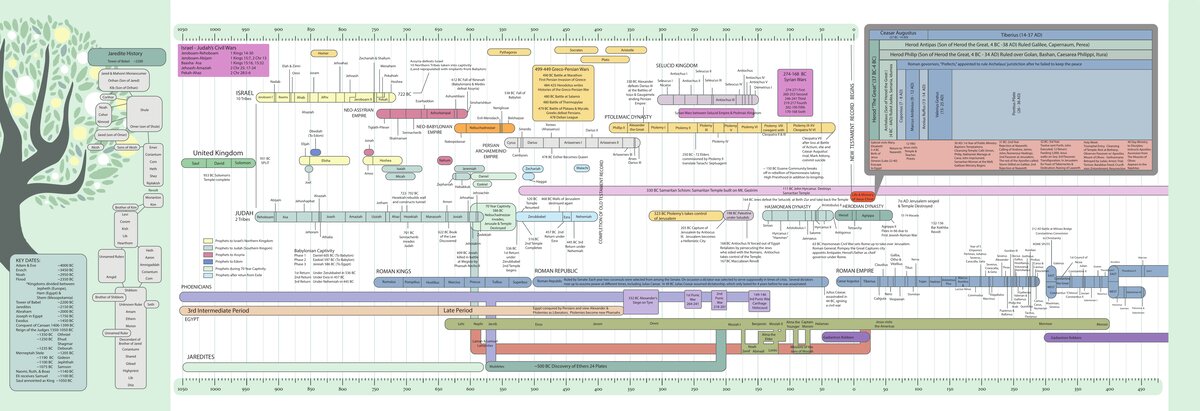
Tap to expand
Old Testament Timeline
From Creation through the Persian Period — tap the image to zoom, or download the full PDF.
Tap anywhere to close · Pinch to zoom