| Church Manuals | |
| Come Follow Me Manual | View |
| Scripture Helps | View |
| OT Seminary Teacher Manual | View |
| OT Institute Manual | View |
| Pearl of Great Price Manual | View |
| Scripture Reference | |
| Bible Dictionary | View |
| Topical Guide | View |
| Guide to the Scriptures | View |
| Church Media | |
| Gospel for Kids | View |
| Bible Videos | View |
| Church Publications & Library | |
| Church Magazines | View |
| Gospel Library | View |
Week 19
Rebel Not Ye against the Lord, Neither Fear
Numbers 11–14; 20–24; 27
May 4–10, 2026
5-Minute Overview
Week 19 follows Israel through the wilderness at its most revealing moments. Complaints escalate into rebellion, a generation loses the promised land, Moses himself fails at the rock, and yet God still provides healing through the lifted serpent and blessing through Balaam's mouth. The study guide and weekly materials for this lesson focus on unbelief, intercession, Christ as the one lifted up, and the way covenant inheritance passes forward.
Weekly Resources: Week 19
Numbers 11–14; 20–24; 27
May 4–10
“Rebel not ye against the Lord, neither fear ye the people of the land.”
— Numbers 14:9
Official Church Resources
OFFICIAL CHURCH RESOURCES
▶
CHURCH MEDIA FOR FAMILIES▶
Video Commentary




Specialized Audiences
Women's Perspectives
▼

Family & Children's Resources
▼


Reference & Study Materials

Numbers 11–14; 20–24; 27
Weekly videos, articles, and study helps from Scripture Central scholars

Numbers 11–14; 20–24; 27
Study and Teaching Helps from Interpreter Foundation
Bible Project
1 Video This Week
BIBLE PROJECT VIDEOS THIS WEEK (1 video)
▶

ACADEMIC & SCHOLARLY SITES (Homepages)
▼
MAPS & BIBLICAL LOCATIONS
▶
A Letter to Fellow Students
▶︎
The Tabernacle is built. The glory has filled it. The sacrificial system is in place. The camp is arranged in perfect formation — twelve tribes surrounding the dwelling of God, the Levites standing guard, the Priestly Benediction hovering over them like a shield. Everything in the first ten chapters of Numbers says God has prepared this people. Everything from chapter 11 forward asks will they act like it?
They don't. Within verses, they are complaining about the food. Within chapters, they are begging to go back to Egypt. And by chapter 14, standing on the very border of the land God swore to give them, they choose fear over faith — and sentence themselves to die in the wilderness.
But here is the thing that makes Numbers more than a catalog of failures: God doesn't quit. Not once. He judges — fiercely — but He also provides. Quail for the ungrateful. Water from rock for the rebellious. A bronze serpent for the bitten. And on the hills above a terrified camp, He puts a blessing in the mouth of a hired pagan diviner who came to curse. While Israel is murmuring below, God is defending them from above. They can't see it, but the reader can.
The Hebrew title for this book is Bemidbar (בְּמִדְבַּר) — "In the Wilderness." Not "Numbers." The censuses frame the story, but the wilderness is the story. And the wilderness is where most of us actually live — somewhere between the covenant we made and the promised land we haven't reached yet. The question Numbers asks is the question we all face: Will you trust the God who dwells among you when the road is long, the food is plain, and the giants look bigger than the promise?
BibleProject's overview of Numbers helps frame the arc. The book is not a random string of disaster stories — it is a carefully designed journey narrative moving through four stages: preparation at Sinai, testing in Paran, transition through the wilderness, and blessing and inheritance on the plains of Moab. This week's reading draws from each stage, hitting the dramatic peaks across nearly forty years. What emerges is the story of a covenant people moving from ordered holiness around the Tabernacle to crisis, judgment, preservation, and finally the transfer of inheritance to a new generation.
But the wilderness doesn't end with death. By the close of this week's reading, five sisters have claimed their father's land inheritance, Moses has laid both hands on Joshua to pass the mission forward, and a prophecy has been spoken that a Star will rise out of Jacob. The failures are real — but so is the future.
What's in This Week's Materials
▶︎
The Reading: Numbers 11–14; 20–24; 27
▶︎
This week covers ten chapters spanning nearly forty years — and the stories may be less familiar than last week's Exodus material. Here is what happens, in order:
Chapters 11–14: The Murmuring Spiral. Israel has barely left Sinai when the complaints begin. First they grumble about food, longing for Egypt's fish and cucumbers while dismissing God's daily manna (11:4–6). Then Miriam and Aaron challenge Moses' authority and God rebukes them sharply (ch. 12). Then comes the catastrophe: twelve spies scout Canaan, ten return terrified — "we were in our own sight as grasshoppers" — and only Joshua and Caleb trust God's promise (13:30–33). The people choose fear, and God condemns the entire generation to die in the wilderness — forty years of wandering, one year for each day the spies scouted (14:34).
Chapters 20–24: The New Generation's Tests. Nearly four decades later, the new generation faces its own trials. Miriam dies. The people thirst, and God tells Moses to speak to a rock to bring water — but Moses strikes it twice and takes the credit: "Must we fetch you water?" That public failure costs him entry to the promised land (20:10–12). Aaron also dies. Then fiery serpents attack the camp, and God tells Moses to make a bronze serpent and lift it on a pole — everyone who looks at it lives (21:8–9). Jesus later chose this as His own metaphor for the crucifixion (John 3:14). Finally, Balak king of Moab hires a pagan diviner named Balaam to curse Israel. God intervenes: Balaam's donkey sees an angel the "seer" cannot, and three attempts to curse produce blessing instead — including a messianic prophecy: "There shall come a Star out of Jacob" (24:17).
Chapter 27: Inheritance and Succession. Five daughters of a man named Zelophehad stand before Moses and the entire congregation to claim their dead father's inheritance — and God affirms them: "The daughters of Zelophehad speak right" (27:7). Their petition creates permanent law. Then Moses, told he will not enter the land, lays both hands on Joshua to commission him as his successor — the foundational act of ordination by laying on of hands (27:18–23).
In the Study Guide
▶︎
The study guide unpacks this week's major episodes in depth. Key Passages walks through nine pivotal texts — from the manna complaint to Joshua's commission — with Hebrew, context, and Christ-centered readings for each. Word Studies explores eight terms that anchor the week's theology, including the nachash/nechoshet wordplay behind the bronze serpent, the tzur vs. sela distinction between the two water-from-rock episodes, and nachalah — the inheritance Zelophehad's daughters fought to claim. The Jewish Perspective section draws on Rashi, Maimonides, the Mishnah, and the Talmud to illuminate why these stories have generated so many centuries of commentary — and what that commentary reveals.
New This Week: The Tabernacle Field Guide
▶︎
We are excited to introduce the Tabernacle Field Guide — a new interactive exploration of the ancient sanctuary that Israel carried through the wilderness. The Tabernacle is the backdrop for everything that happens in Numbers: the murmuring happens in its shadow, the sacrifices happen at its altar, the priestly authority that passes from Aaron to Eleazar is defined by its rituals. The bronze serpent in this week's reading is cast from the same metal as the brazen altar in the Tabernacle's courtyard. The laying on of hands that commissions Joshua uses the same gesture the sacrificial system already taught Israel — hands pressed on the head, transferring what one bears onto another.
The Field Guide walks through every zone, every furnishing, and every priestly garment with interactive maps, Hebrew term studies, and deeper dives into the symbolism. But here is why it matters beyond ancient history: the Tabernacle is the foundation for the modern temple. The progression from outer courtyard to Holy Place to Most Holy Place — moving from the world into God's presence through stages of covenant, sacrifice, and consecration — is the same pattern Latter-day Saint temples follow today. The priestly clothing, the washings, the anointings, the veil, the presence of God in the innermost room — these are not coincidences. They are continuations.
In researching the Field Guide, I kept finding connections I wished I had understood earlier — things that would have answered questions I carried for years about why the temple is structured the way it is, why the ordinances take the form they do, and what the symbols mean. The Tabernacle doesn't just explain an ancient tent. It illuminates the living temple today. If you've ever sat in a temple session wondering why — why this sequence, why these symbols, why this language — the Tabernacle is where those answers begin.
The World Behind the Stories
▶︎
The study guide's Historical Cultural Context section goes deeper into the ancient world this week's events take place in — and the connections may surprise you.
The "giants" the spies feared were real. The Nephilim — the "fallen ones" — and the Anakim were warrior populations occupying fortified cities like Hazor (nearly 200 acres), Megiddo (guarding the strategic Carmel pass), and Hebron. Canaan sat at the crossroads of the ancient world's great powers: Egypt to the south, the Hittite Empire to the north, Mesopotamia to the east. Whoever held Canaan held the trade routes that sustained three continents.
And the world was about to collapse. Between roughly 1250 and 1150 BCE, every major civilization in the eastern Mediterranean fell apart — what scholars call the Bronze Age Collapse. Drought, earthquakes, trade network failure, internal rebellions, and a mysterious wave of migrating peoples the Egyptians called the "Sea Peoples" combined into a perfect storm that toppled empires. The Hittite Empire vanished. The Mycenaean palace system disintegrated. Ugarit was destroyed and never rebuilt.
Here is what may surprise you: this is the same event Homer poeticized. The traditional date for the fall of Troy is around 1184 BCE — squarely within the collapse. The Mycenaean kingdoms Homer describes in the Iliad — Mycenae "rich in gold," Pylos, Tiryns — are the same centers that fell. The Odyssey reads like a travelogue of the post-collapse Mediterranean: Odysseus wanders for ten years, unable to return home, because the world he left no longer exists. And the displaced populations from this Aegean collapse? Many pushed south and east. One group — the Peleset — settled along the coast of Canaan and became the Philistines. Goliath of Gath was likely their descendant.
The spies looked at Canaan and saw an impossible fortress. They could not have known that within a generation, the entire power structure they feared would cease to exist — creating the precise vacuum into which Israel, under Joshua, would move. The full story, with maps, is in the study guide.
In the Resources Tab
▶︎
Video highlights worth your time:
- Bible Project — Book of Numbers overview, framing the four-stage journey from Sinai preparation through Moab blessing
- Teaching With Power — reframes the murmuring stories as lessons in perspective and gratitude
- Messages of Christ — Tabernacle symbolism and the significance of God's dwelling among His people
The Nostalgia Trap: Six Foods and a Forgotten Slavery
▶︎
Numbers 11:4–6 is one of the most psychologically revealing passages in all of scripture:
"We remember the fish, which we did eat in Egypt freely; the cucumbers, and the melons, and the leeks, and the onions, and the garlick: But now our soul is dried away: there is nothing at all, beside this manna, before our eyes."
Six specific foods. Vivid sensory detail. Not a single word about the slavery. About the bricks without straw. About the baby boys drowned in the Nile. Memory selects what desire dictates. They remember Egypt's menu and forget its chains.
The Hebrew word for "freely" is chinnam (חִנָּם) — and the irony cuts: the fish was free? They were slaves. Nothing they had in Egypt was free. It cost them everything. But distance romanticizes even bondage when the present demands faith.
And the present — manna. God's daily provision, calibrated to teach trust. One day's supply at a time. Cannot be stored. Cannot be hoarded. Cannot be earned by extra effort. Manna demanded daily dependence on God, and daily dependence felt like vulnerability, and vulnerability felt like weakness. They wanted self-sufficiency. They wanted Egypt's menu — even at Egypt's price.
The Interpreter Foundation study aid presses the typological point: "Their rejection of manna can be considered symbolic of rejecting Christ, the Bread of Life" (cf. John 6:35, 48–51). Jesus made the connection explicit: "I am the bread of life: he that cometh to me shall never hunger." Manna was not just food — it was a daily encounter with the God who sustains. Rejecting manna was rejecting that relationship.
The rabbinic tradition (Yoma 75a) adds an interesting dimension: it claims that manna was miraculously adaptable, tasting like whatever the eater desired. If this tradition is accurate, the complaint was not about flavor at all. It was about control. Egypt's food was earned by labor — degrading labor, but at least predictable. Manna came on God's terms. And some people would rather be slaves with a wider menu than free, relying on God's providence and boundaries.
We know this pattern. We have all romanticized some Egypt — some past habit, some old relationship, some comfortable rut, a taste of something forbidden — while forgetting or ignoring the cost that comes with it. The manna is always plainer than the fantasy. But the manna is real, and it comes every morning. The fantasy is selective memory dressed up as desire.
Grasshoppers and Giants: The Sin of the Spies
▶︎
Twelve spies enter Canaan. Forty days of reconnaissance. Same land, same data, same fortified cities, same giant inhabitants, same abundant produce. And then the split — not over facts, but over faith:
Caleb: "Let us go up at once, and possess it; for yakhol nukhal — we are well able to overcome it" (Num 13:30). The Hebrew doubles the verb — emphatic, absolute confidence.
The ten: "We be not able to go up against the people; for they are stronger than we... and we were in our own sight as grasshoppers" (Num 13:31, 33).
Rashi (on 13:27) identifies the rhetorical technique the ten spies used — and it is disturbingly effective: "No fabricated statement in which one does not say at least some true words at first can in the end be maintained." In other words, the best lies start with facts. The spies opened with verifiable truth: yes, the land flows with milk and honey; yes, the cities are fortified; yes, the inhabitants are large. They built credibility with accurate intelligence — and then drew a faithless conclusion: "We be not able." They never lied about the land. They lied about God's ability to deliver on His promise. And because the facts were real, the fear felt reasonable. This is the most dangerous kind of deception: accurate data interpreted without God in the equation.
Notice what the ten said: "We were in our own sight as grasshoppers." Not "God has abandoned us." Not "the promise is false." Something subtler. They measured themselves against the giants instead of measuring the giants against God. The faithless report was not a lie about the land. It was a lie about the equation. They left God out of the calculation and then reported the math honestly.
The consequence was staggering. The Talmud (Ta'anit 29a) teaches that the night Israel wept over the spies' report was the 9th of Av — Tisha B'Av. God declared: "You wept without cause; I will establish this as a night of weeping for generations." Both the First Temple (586 BC) and Second Temple (70 CE) were later destroyed on that same date. In Jewish tradition, the sin of the spies is not a footnote — it is the original catastrophe from which centuries of exile and destruction flow. Faithlessness generated the very grief it feared.
And the name matters: Moses had renamed Hoshea to Joshua — Yehoshua (יְהוֹשֻׁעַ), "Jehovah is salvation." The same name later given to Jesus (Greek Iesous, from Hebrew Yehoshua). The man who entered the promised land carried the name of the One who opens the celestial kingdom. The promised land was never just geography. It was always about what "Jehovah is salvation" means.
The Rock, the Credit, and the Cost
▶︎
Nearly forty years pass between chapters 14 and 20. Miriam dies (20:1). Water disappears. And God gives Moses a simple instruction: "Speak ye unto the rock before their eyes" (20:8).
Moses struck it. Twice. And said: "Hear now, ye rebels; must we fetch you water out of this rock?" (20:10).
Three failures in one act. Wrong method — striking when told to speak. Wrong credit — "must we fetch" instead of acknowledging God. Wrong tone — "ye rebels" replacing instruction with anger.
Rashi identifies the core loss: had Moses spoken to the rock, the people would have reasoned — "if an inanimate rock obeys God's word without being struck, how much more should we?" The teaching moment was destroyed by Moses' frustration. And Rashi draws a critical distinction: Moses had expressed doubt privately before (Num 11:22) and was forgiven. But this happened "before all Israel" — public failure to sanctify God's name demands public consequence.
Maimonides added a different angle: the sin was anger. A prophet's anger misrepresents God's character. When Moses raged at the people, they inferred that God was enraged. That distortion, from a prophet, was intolerable. Ramban objected to every standard explanation and said the matter is "a great secret among the secrets of the Torah" — the text deliberately obscures it.
Paul identifies the rock explicitly: "That Rock was Christ" (1 Cor 10:4). And the Hebrew adds a layer the English misses: the rock at Horeb (Exodus 17) was tzur (צוּר); the rock at Kadesh (Numbers 20) was sela (סֶלַע) — a different word for a different kind of rock. Different rock, different instruction. God told Moses to strike the tzur; He told Moses to speak to the sela. Christ was struck once — crucified once. He does not need to be struck again. Moses' error carries Christological weight he never intended.
Aaron also dies in this chapter (20:22–29). Both founding leaders fall in the same chapter. The old guard is passing. And the question becomes: who carries it forward?
Look and Live: The Bronze Serpent
▶︎
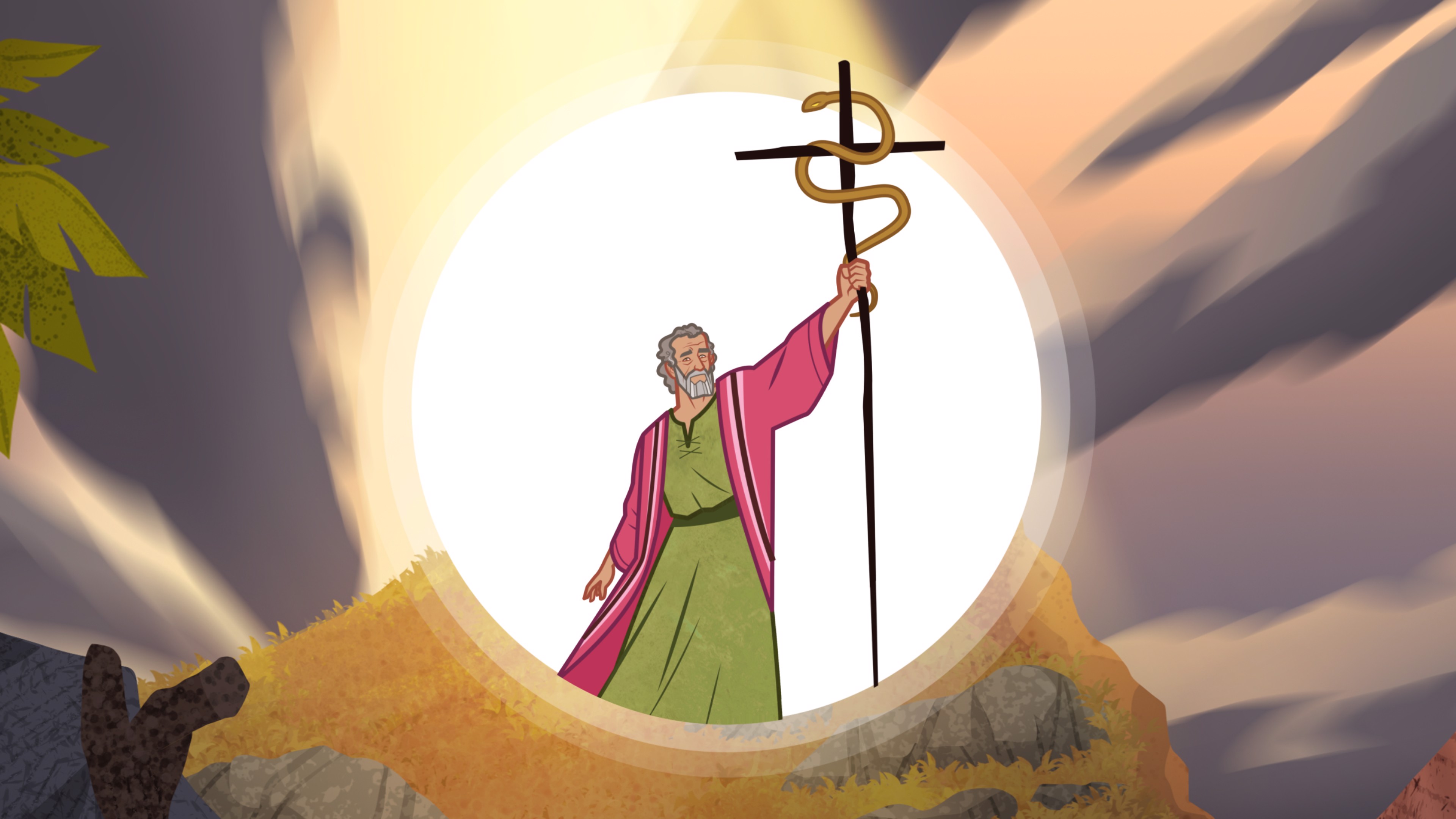
Fiery serpents attack. People are bitten and dying. God tells Moses to make a serpent and set it on a pole — everyone who looks at it will live (Num 21:8–9).
The Hebrew wordplay is deliberate and layered. The text calls the serpents nachash saraf (נָחָשׁ שָׂרָף) — "fiery serpents." Saraf comes from the root meaning "to burn" — the venom burned like fire. God tells Moses to make a saraf and set it on a pole. (Side note: saraph is where we get the word seraphim.) Moses chose to cast it in nechoshet (נְחֹשֶׁת) — bronze, the metal whose name echoes nachash (serpent). Rashi explains: "one term fitting the other term." He explains that Moses wasn't told what material to use. He employed linguistic reasoning, choosing a medium whose name contained the creature it represented. The cure contains the wound's own name.
And the material itself carries meaning. Bronze was the metal of the Tabernacle's outer courtyard — the brazen altar where sacrifices burned, the brazen laver where priests washed. It was the metal associated with fire, with sacrifice, with the first point of approach to God. A bronze serpent is a fiery serpent rendered in the metal of fire — the burning venom answered by the burning altar's metal, cast in the form of the curse and lifted up as the cure.
The serpent was placed on a nes (נֵס) — a pole. But nes also means "banner" or "sign." The serpent was a standard lifted for all to see.
And the Mishnah (Rosh Hashanah 3:8) asks the question that strips away every magical or idyllic reading:
"Did the serpent kill, or did the serpent preserve life?"
Answer: "When Israel turned their eyes upward and subjected their hearts to their Father in Heaven, they were healed, but if not, they rotted."
The serpent had no power. The looking did. The Mishnah draws a direct parallel: Moses' raised hands during the Amalekite battle (Ex 17:11) worked the same way — the hands didn't fight; the heavenward gaze did.
And the tragic reality: many refused. Nephi records that they perished "because of the simpleness of the way, or the easiness of it" (1 Nephi 17:41). Alma adds: "they did not believe that it would heal them" (Alma 33:20). People died not because the cure was hard but because it was too easy. They wanted something more dramatic, more complex, more self-involving — and they perished for it.
Jesus chose this as His self-portrait:
"As Moses lifted up the serpent in the wilderness, even so must the Son of man be lifted up: that whosoever believeth in him should not perish, but have eternal life." (John 3:14–15)
Jesus is the ultimate nes — lifted on the cross, His banner, His atonement, raised for all to see. And the thread runs all the way back to Eden. In the Garden, God cursed the serpent: "Upon thy belly shalt thou go, and dust shalt thou eat all the days of thy life" — and then spoke the first promise of redemption in all of scripture: "I will put enmity between thee and the woman, and between thy seed and her seed; it shall bruise thy head, and thou shalt bruise his heel" (Gen 3:14–15).
The serpent struck at the heel. The seed of the woman would crush the head. And here in Numbers 21, the pattern is acted out in bronze: a serpent — the very form of the curse — is lifted up, and those who look at it are healed. The cure takes the shape of the wound. Christ was "made sin for us, who knew no sin" (2 Cor 5:21). He took the serpent's form to become the poison's cure — the promise made in Eden, depicted on a pole in the wilderness, and fulfilled on a cross outside Jerusalem. And all He asks is: look.
The Prophet Who Fell: Balaam's Blessing and Betrayal
▶︎
Balak, king of Moab, hires the diviner Balaam to curse Israel. What follows is one of the most layered stories in the Old Testament — and one of the most uncomfortable.
The irony of the scene is devastating. Balaam — the man famous for seeing the invisible — cannot see the angel blocking his path. His donkey can. Three times the donkey turns aside; three times Balaam strikes her. The great seer is blinder than his animal.
And Rashi catches the wordplay hidden in the donkey's rebuke. She says Balaam struck her "these three times" — shalosh regalim (שָׁלֹשׁ רְגָלִים). That is the exact phrase used for the three pilgrimage festivals: Passover, Shavuot, Sukkot. God's message through the donkey: "You seek to root out a nation that celebrates three festivals annually?!"
Three times Balak positions Balaam to curse. Three times God forces blessing instead. The fourth oracle delivers one of Scripture's great messianic prophecies:
"There shall come a Star out of Jacob, and a Sceptre shall rise out of Israel" (Num 24:17).
Rashi identifies the star with King David. The Targum Onkelos renders it explicitly: "A king shall arise from Jacob, and the Messiah shall be anointed from Israel." Later, Rabbi Akiva — one of the greatest Talmudic sages — applied the verse to the rebel leader Shimon bar Kosiba during the revolt against Rome (132–135 CE), renaming him Bar Kokhba, "Son of the Star." The revolt failed catastrophically. Bar Kokhba was retroactively renamed Bar Koziba — "Son of the Lie." The star prophecy endured; the false identification didn't.
Christians see the fulfillment in Jesus Christ — the star that appeared at His birth (Matt 2:2), "the root and the offspring of David, and the bright and morning star" (Rev 22:16). The Sceptre that rises out of Israel is the King whose kingdom has no end. The Book of Mormon adds a second witness: Samuel the Lamanite prophesied "a new star" at Christ's birth (Hel 14:5), and it appeared precisely as promised (3 Ne 1:21). That the original prophecy came through Balaam — a compromised pagan diviner — only underscores the point: God's messianic plan cannot be thwarted by human corruption. The Star rises regardless.
BibleProject highlights the literary irony that makes this section sing: while Israel is panicking and murmuring down in the camp, God is defending and blessing them from the hills above — even through a compromised prophet. Israel cannot see it. But it is happening.
And then comes the fall. Balaam could not curse Israel, so he did something worse: he taught Balak how to corrupt them from within. Numbers 31:16 reveals that Balaam counseled Moabite women to seduce Israelite men into idolatry at Baal-Peor. What prophecy couldn't destroy, strategy did. The New Testament remembers him as a warning three separate times: "the way of Balaam... who loved the wages of unrighteousness" (2 Pet 2:15); "the error of Balaam" (Jude 1:11); "the doctrine of Balaam, who taught Balak to cast a stumblingblock" (Rev 2:14).
The Mishnah (Avot 5:19) puts it with surgical precision: "Whosoever has these three things is of the disciples of Abraham: a generous eye, a humble spirit, and a modest soul. But whosoever has these three things is of the disciples of Balaam: an evil eye, a proud spirit, and a greedy soul."
Balaam is the prototype of the spiritually gifted person who sells out. He had God's words in his mouth and the world's desires in his heart. Spiritual gifts without spiritual integrity are worse than no gifts at all.
Five Sisters Who Changed the Law
▶︎
The reading ends where it should — not with punishment but with promise. Two acts of transfer close the week, and both point forward.
First, five daughters — Mahlah, Noah, Hoglah, Milcah, and Tirzah — stand before Moses, Eleazar the priest, the princes, and the entire congregation to claim their dead father's nachalah (נַחֲלָה, inheritance). Zelophehad had died in the wilderness "in his own sin" without sons. Under existing law, his name and his land-portion would simply vanish.
To understand why this mattered, you need to know what was at stake. When Israel entered Canaan, each family would receive a portion of land — their nachalah — tied permanently to their family name. This was not just real estate. It was covenant identity. Your inheritance was your family's place in the promised land, your stake in God's promise to Abraham. Lose the inheritance, and your family line is erased from Israel's future. Zelophehad's daughters had no brothers. Without a change in the law, their father's name, his land, and his family's place in Israel would disappear as if they had never existed.
The Talmud (Bava Batra 119b) reveals how strategically the sisters built their case. They timed their petition to coincide with Moses' teaching on levirate marriage — the law that when a man dies without sons, his brother must marry the widow to raise up an heir in the dead man's name (Deut 25:5–6). The daughters exposed a logical gap: if daughters don't count as heirs, then their mother should be subject to levirate marriage — but that would contradict other inheritance principles. The existing system had an inconsistency, and these five women found it. Rashi calls them chakmaniyyot (wise women), darshaniyyot (skilled interpreters), and tzidkaniyyot (righteous women).
God's answer was direct: "The daughters of Zelophehad speak right" — ken banot Tzelofchad dovrot (Num 27:7). The doubled verb naton titten ("you shall surely give") granted them their father's inheritance. And the ruling became permanent statute — chukat mishpat — for all Israel.
Rashi's most striking comment: "This passage was fit to be written through Moses, but the daughters of Zelophehad merited that it be written through them." Their eyes "perceived what Moses' eyes did not perceive."
The Sifrei (Numbers 133) preserves the daughters' theological argument: "God's compassion differs from human compassion. Flesh-and-blood creatures have greater compassion for males than for females. But the One who spoke and the world came into being is not like that. His mercy extends to all." And Rabbi Nathan drew a devastating comparison that ties the beginning of this week's reading to its end: "The strength of the women was greater than the strength of the men. The men said, 'Let us appoint a leader and return to Egypt.' The women said, 'Give us a possession.'" The men he is quoting are the Israelites in chapter 14 — the generation that heard the spies' faithless report and chose to abandon the promised land entirely. The women are Zelophehad's daughters in chapter 27 — who not only refused to abandon the land but demanded their family's share of it. The men of that generation rejected their inheritance. The women of the next generation claimed theirs.
This is not a footnote. Women's advocacy triggered a new understanding of divine law and character. Righteous petition produced additional revelation. The law of God was waiting for the right question — and five sisters asked it.
Sun and Moon: Joshua's Commission
▶︎
Then Moses, told he will not enter the land, asks God to appoint a successor. God tells him to lay one hand (yad'kha, singular) on Joshua. Moses lays both — yadav, plural — "with a generous eye, more and more than what he was commanded" (Rashi on 27:23). He made Joshua "like a full and heaped-up vessel," filling him abundantly with wisdom.
This is the foundational act of semikah (סְמִיכָה) — ordination by laying on of hands. The word comes from the root samakh (ס-מ-כ), meaning "to lean upon, to support." It is not a symbolic wave or a distant gesture. It is physical — the one with authority literally presses his weight into the one being commissioned. Something real passes through contact.
The gesture was not new. Israel had already seen semikah in the sacrificial system. Before an animal was offered at the brazen altar, the worshiper laid his hands on the animal's head (Lev 1:4). The same verb — samakh. The same physical pressing. In the sacrifice, the act transferred the sins and identity of the person onto the animal that would bear them. On the Day of Atonement, the High Priest laid both hands on the head of the scapegoat and confessed over it "all the iniquities of the children of Israel" (Lev 16:21) — transferring the people's sins onto the goat before it was sent into the wilderness. The hands-on-the-head gesture was the established mechanism for transfer: sin onto a sacrifice, authority onto a successor. What Moses does with Joshua in Numbers 27 uses the same physical language the Tabernacle had already taught Israel — but here, instead of sin, it is God's glory and authority that flow through the hands.
The Talmud (Sanhedrin 13b) traces an unbroken chain of semikah from this moment — Moses to Joshua — through the elders, the judges, and all subsequent rabbinic ordination. Hands on heads, authority flowing forward, generation after generation.
This is the same pattern Latter-day Saints practice today. Every priesthood ordination, every setting apart, every blessing of the sick, every confirmation, every father's blessing — hands placed on the head, authority invoked by name, power flowing from God through commissioned servants. The fifth Article of Faith states it directly: "called of God, by prophecy, and by the laying on of hands by those who are in authority." That article of faith describes what Moses did in Numbers 27. When an elder places his hands on the head of someone who is sick and says "by the authority of the Melchizedek Priesthood," he is participating in a pattern that began here — in a wilderness, before the whole congregation, with Moses' hands on Joshua's head.
And notice: the act was public. God told Moses to set Joshua "before Eleazar the priest, and before all the congregation, and give him a charge in their sight" (Num 27:19). Authority was not transferred in private. The people witnessed it. They sustained it by seeing it. This mirrors the Latter-day Saint practice of sustaining — raising hands before the congregation to publicly acknowledge who has been called and set apart.
God said to put "mei-hod'kha" ("of your glory") upon Joshua — not kol hod'kha ("all your glory"). Partial transfer. The Talmud (Bava Batra 75a) captured it memorably: "The face of Moses was like the face of the sun; the face of Joshua was like the face of the moon." The elders of that generation reportedly sighed. But the moon is not a failure. It carries real light — derived from the source, yes, but real. Every bishop, every stake president, every prophet who has followed another carries reflected light. The authority is genuine. The source is God. And each generation receives it through the same physical act Moses performed here.
And Moses was told to charge Joshua soberly: "Know that they are tarchanim (troublesome), that they are sarvanim (obstinate). Accept your office on condition that you take all this upon yourself" (Rashi on 27:19). Leadership of God's people is not status. It is shepherding a stiff-necked flock through a wilderness. And it requires a generous eye — giving more than commanded, investing more than required, trusting God to multiply what you pour out.
The transition from Moses to Joshua carries its own typological weight. Moses — the Law. Joshua — Salvation. The same name as Jesus (Yehoshua, "Jehovah is salvation"). The Law brings you to the border of the promised land; Salvation leads you in.
This Week's Invitation
▶︎
As you read Numbers 11–14; 20–24; 27 this week, let these passages ask their questions:
Check your menu. What "Egyptian food" are you romanticizing? What past life, past habit, past relationship do you remember with selective fondness — forgetting the slavery it contained? Manna is plain but it is daily and it is certain. Sometimes God's provision doesn't match our cravings, and that's the test we face in our wildernesses.
Measure differently. When you face a fortified city — an impossible diagnosis, an overwhelming calling, a relationship that seems beyond repair — are you counting like the ten or like Caleb and Joshua? "We are well able" is not self-confidence. It is God-confidence. The question was never "are we big enough?" but "is God big enough?"
Just look. The bronze serpent healed everyone who looked — but many refused "because of the simpleness of the way." What simple thing has God asked of you that you've resisted because it seems too easy, too ordinary, or too obvious? A prayer. A sacrament. A conversation you keep postponing. The cure is already lifted up. All He asks is: look.
Guard the gift. Balaam could hear God's voice and speak God's words. Yet his heart was for hire. Spiritual gifts without spiritual integrity are worse than no gifts at all. Ask honestly: Am I using what God has given me to draw closer to Him — or to get something for myself?
Claim your inheritance. Zelophehad's daughters didn't wait for someone to offer. They stood up, stated their case, and God said they were right. What spiritual inheritance have you failed to claim because you assumed it wasn't for you? Sometimes the law of God is waiting for the right question.
Invest generously. Moses laid both hands on Joshua when God commanded only one. "A generous eye." Every parent, every teacher, every leader has someone who comes after them. Don't ration wisdom. Don't hoard authority. Pour it out. Trust God to multiply what you give.
The wilderness is long. The manna is plain. The giants look bigger than the promise. But the Star is rising, the inheritance is being claimed, and the hands are being laid. God's plan moves forward — through murmuring, through failure, through compromised prophets and flawed leaders — because His covenant does not depend on our perfection. It depends on His.
Week 19 Study Guide | CFM Corner | OT 2026
Week 19
Numbers 11–14; 20–24; 27 — Overview
"Rebel Not Ye against the Lord, Neither Fear"
1. Week 19: Overview
The Hebrew name for this book is Bemidbar (בְּמִדְבַּר) — "In the Wilderness." It's taken from the opening verse: "And the LORD spoke unto Moses in the wilderness of Sinai." The English title "Numbers" comes from the Greek Arithmoi and the Latin Numeri, reflecting the two censuses that bookend the narrative (chapters 1 and 26). But the Hebrew name is the truer one. This is a book about counting, yes, God number's His people — but more importantly, it is a book about what happens to a covenant people when they are tested in the wilderness. The census frames the story; the wilderness is the story.
Bemidbar spans nearly forty years — from the foot of Sinai to the edge of the promised land. This week's assigned reading (chapters 11-14; 20-24; 27) hits the major narrative peaks, but the chapters in between carry critical connective tissue. Here is the full arc so that nothing is lost.
BibleProject's overview is helpful here because it highlights the book's large-scale movement: Sinai preparation, Paran testing, wilderness transition, and Moab blessing and inheritance. That literary frame explains why this week's reading feels like a series of dramatic peaks. We are not jumping between random episodes. We are watching a covenant people move from ordered holiness around the Tabernacle to crisis, judgment, preservation, and finally the transfer of inheritance to a new generation.
The Setup (Chapters 1-10) — not assigned
Bemidbar opens with a census, a camp arrangement (each tribe assigned a specific position around the Tabernacle), Levite duties, the Nazirite vow, and the Priestly Benediction — the oldest surviving biblical text, found on 7th-century BC silver scrolls (6:24-26). By chapter 10, Israel finally sets out from Sinai: organized, consecrated, equipped. Everything in chapters 1-10 says God has prepared this people. Everything from chapter 11 forward asks will they act like it?
The Murmuring Spiral (Chapters 11-14) — assigned
They don't. Five complaint episodes escalate in rapid succession. Israel craves Egyptian food and dismisses manna — remembering Egypt's "fish" and "cucumbers" while conveniently forgetting its slavery (11:4-6). The seventy elders receive the Spirit to help Moses bear the burden (11:16-17, 24-29). Miriam and Aaron challenge Moses' authority — "Hath the LORD indeed spoken only by Moses?" — and God draws a sharp line: Moses is unique, "faithful in all mine house," spoken to "mouth to mouth" (12:6-8). Miriam is struck with leprosy; Aaron is spared, likely because the priestly system depends on him.
Then comes the catastrophe. Twelve spies scout Canaan for forty days. Ten return with a report designed to paralyze: the cities are fortified, the inhabitants are giants, "we were in our own sight as grasshoppers" (13:33). Only Joshua and Caleb dissent: "We are well able to overcome it" (13:30). The people choose fear. God condemns the entire generation to die in the wilderness — forty years of wandering, one year for each day the spies scouted. Only Joshua and Caleb will enter the land.
The Lost Generation (Chapters 15-19) — not assigned
The reading jumps from the spies' disaster (ch. 14) to Moses at the rock (ch. 20), skipping nearly 38 years compressed into five chapters. But these chapters matter:
Chapter 15 introduces the tzitzit commandment — fringes on garments as a wearable reminder of the commandments (15:37-41). The same chapter records the execution of a man caught gathering sticks on the Sabbath (15:32-36). Rashi identifies this man as Zelophehad — the father whose five daughters petition for their inheritance in chapter 27. If Rashi is right, the daughters' case is directly linked to this moment: their father died for a known sin, yet they were still deemed righteous.
Chapter 16 brings the most dramatic rebellion in the Torah. Korah, a Levite, along with Dathan, Abiram, and 250 leaders, challenges Moses and Aaron: "All the congregation are holy... why then do you exalt yourselves?" (16:3). The earth opens and swallows the rebels alive; fire consumes the 250 who offered unauthorized incense. The murmuring pattern has now escalated from complaining about food (ch. 11) to questioning the prophet (ch. 12) to rejecting God's promises (ch. 13-14) to attempting to overthrow God's chosen leadership entirely.
Chapter 17 resolves the authority question. Each tribe places a rod in the Tabernacle; Aaron's rod alone sprouts, buds, blossoms, and produces almonds overnight (17:8). The budding rod is kept inside the Ark as permanent proof of whom God has chosen. The almond tree (shaqed) connects to Jeremiah 1:11-12, where God says "I am watching" (shoqed) — a wordplay linking Aaron's priesthood to God's vigilance.
Chapter 18 establishes that the Levites receive no land inheritance in Canaan: "I am thy part and thine inheritance" (18:20). This sets up the nachalah (inheritance) theme that culminates in chapter 27 — while Levites inherit God Himself, the other tribes inherit land, and Zelophehad's daughters argue their family's portion must not be lost.
Chapter 19 prescribes the red heifer — one of Torah's most mysterious rituals. A completely red cow, never yoked, is slaughtered and burned outside the camp. Its ashes purify anyone who has touched a dead body, yet the ritual makes the preparer unclean. Even Solomon reportedly said, "I have labored to understand the section of the Red Heifer, but it is far from me" (Numbers Rabbah 19:3). The red heifer appears just before chapter 20, where Miriam dies — and Israel immediately needs purification.
The New Generation's Tests (Chapters 20-24) — assigned
The new generation now faces its own trials. Miriam dies (20:1), and Israel immediately thirsts for water. God tells Moses to speak to the rock. Instead, Moses strikes it twice and says, "Must we fetch you water?" — three failures in one act: wrong method, wrong credit, wrong tone (20:10-11). Rashi explains the teaching moment that was lost: had Moses spoken, Israel would have learned that "if an inanimate rock obeys God's word, how much more should we?" Moses' public failure to sanctify God's name costs him entry to the promised land. Aaron also dies on Mount Hor (20:22-29) — both founding leaders fall in the same chapter.
Fiery serpents attack (21:4-9). God tells Moses to make a bronze serpent and set it on a pole: everyone who looks at it lives. The Hebrew wordplay is deliberate — nachash (serpent) cast in nechoshet (bronze), the cure echoing the wound in its very name. The Mishnah (Rosh Hashanah 3:8) strips away all magical thinking: "Did the serpent kill, or did the serpent preserve life? When Israel turned their eyes upward and subjected their hearts to their Father in Heaven, they were healed." Jesus chose this as His own metaphor for the crucifixion: "As Moses lifted up the serpent in the wilderness, even so must the Son of man be lifted up" (John 3:14). Many Israelites died — not from the venom, but from refusing to look, "because of the simpleness of the way" (1 Nephi 17:41).
Balaam enters (22-24). Balak, king of Moab, hires the pagan diviner to curse Israel. God intervenes: Balaam's donkey sees the angel blocking the road while the "seer" is blind to it. Three times Balaam attempts to curse; three times he blesses instead. His fourth oracle delivers one of Scripture's great messianic prophecies: "There shall come a Star out of Jacob, and a Sceptre shall rise out of Israel" (24:17). Rashi identifies the star with David; later tradition extends it to the Messiah. BibleProject helpfully draws out the irony of this scene: while Israel is panicking and murmuring down in the camp, God is defending and blessing them from the hills above, even through a compromised prophet. Yet Balaam's trajectory remains haunting — the prophet who blessed Israel will soon teach Balak how to destroy them from within.
Balaam's Strategy Succeeds (Chapters 25-26) — not assigned
What Balaam couldn't accomplish through prophecy, he achieved through strategy. Chapter 25 records the sin at Baal-Peor: Moabite and Midianite women seduce Israelite men into sexual immorality and idol worship (25:1-3). Numbers 31:16 later reveals this was Balaam's counsel — the "doctrine of Balaam" referenced in Revelation 2:14. A plague kills 24,000. Phinehas, Aaron's grandson, drives a spear through an Israelite man and a Midianite woman in the act, stopping the plague. God grants Phinehas a "covenant of peace" and "everlasting priesthood" (25:12-13).
Chapter 26 conducts a second census — counting the new generation, the children of those condemned after the spies' report. The old generation has died in the wilderness, exactly as God decreed (14:29). This census determines land-allotment shares for the coming conquest, and it is during this process that Zelophehad's daughters realize their father's name will be erased if daughters cannot inherit — setting up their petition in chapter 27.
Inheritance and Succession (Chapter 27) — assigned
Two pivotal acts of transfer close the week's reading. First, Zelophehad's five daughters — Mahlah, Noah, Hoglah, Milcah, and Tirzah — stand before Moses, Eleazar, the princes, and the entire congregation to claim their dead father's nachalah. God affirms them directly: "The daughters of Zelophehad speak right" (27:7). Rashi says they were chakmaniyyot (wise women) whose "eyes perceived what Moses' eyes did not perceive." Their petition doesn't just win a ruling — it creates permanent statute (chukat mishpat) for all Israel. Women's advocacy triggered new divine law.
Then Moses, told he will not enter the land, asks God to appoint a successor. God commands him to lay one hand on Joshua. Moses lays both — "with a generous eye," more than commanded — making Joshua "like a full and heaped-up vessel" (Rashi). "The face of Moses was like the sun; the face of Joshua was like the moon" (Bava Batra 75a). The inheritance and the mission pass forward. The wilderness generation gives way to the one that will cross the Jordan.
What Follows (Chapters 28-36) — not assigned
The remainder of Numbers covers the festival offering calendar (28-29), laws of vows (30), the war against Midian in which Balaam is killed — his story ending not with prophecy but with a sword (31:8), the Transjordan settlement of Reuben, Gad, and half-Manasseh (32), a retrospective of Israel's 42 journey-stages from Egypt to the plains of Moab (33), the boundaries of the promised land and cities of refuge (34-35), and a restriction on Zelophehad's daughters requiring inheriting daughters to marry within their own tribe to prevent land transfer between tribes — the daughters comply (36:10-12). Chapter 36 is the epilogue to the daughters' story in chapter 27.
"And as Moses lifted up the serpent in the wilderness, even so must the Son of man be lifted up: That whosoever believeth in him should not perish, but have eternal life." (John 3:14-15)
The bronze serpent is the week's pivot point. A nation dying of snakebite is healed not by medicine, magic, or merit — but by looking. That's it. Look and live. Yet many refused "because of the simpleness of the way" (1 Nephi 17:41). The Mishnah asks the right question: "Did the serpent kill, or did the serpent give life?" Answer: "When Israel turned their eyes upward and subjected their hearts to their Father in Heaven, they were healed." The serpent was never the point. The looking was.
1. The Murmuring Cycle
Five distinct complaint episodes in chapters 11-14, each escalating in severity and consequence. The pattern: perceived absence of God → demand for visible alternatives → compromised leadership → judgment. Israel doesn't just complain — they rewrite history, remembering Egypt's "fish" and "melons" while forgetting its slavery (Num 11:5-6).
2. The Sin of the Spies
The ten spies didn't lie about the land's challenges — they lied about God's ability to overcome them. Rashi: "No fabricated statement can be maintained without some truth at first." They mixed accurate intelligence with faithless conclusions. The sin wasn't bad reconnaissance; it was unbelief dressed as realism (Num 13:27-33).
3. Moses the Intercessor — Again
When God threatens to destroy Israel and start over with Moses alone (Num 14:12), Moses refuses the offer and intercedes — just as he did after the golden calf. His prayer in 14:13-19 appeals to God's reputation and character, not Israel's merit. Moses keeps choosing his flawed people over personal glory.
4. Moses at the Rock — The Cost of Public Sin
God told Moses to speak to the rock. Moses struck it twice and said "Must we fetch you water?" (Num 20:10-11). Rashi: had Moses spoken, the people would have reasoned — "if a rock obeys God's word, how much more should we?" The lesson was lost because Moses made it about himself. The consequence seems disproportionate until you realize: public leaders bear public accountability (Num 20:12).
5. Look and Live
The bronze serpent (nachash nechoshet — a Hebrew wordplay) is one of the Old Testament's most powerful Christ-types. Jesus Himself makes the connection explicit in John 3:14-15. The Mishnah clarifies: the serpent had no power — healing came from looking heavenward. Many died not from the venom but from refusing to look — "because of the simpleness of the way" (Num 21:4-9).
6. Balaam — The Prophet Who Fell
Balaam could hear God's voice and pronounce true prophecy — yet his heart was for hire. His donkey saw what the "seer" couldn't. He blessed Israel because he had no choice, but later taught Balak how to corrupt them from within (Rev 2:14). Spiritual gifts without spiritual integrity are worse than no gifts at all (Num 22-24).
7. Zelophehad's Daughters — Women Who Changed the Law
Five sisters stood before the full assembly and demanded their father's nachalah (inheritance). God affirmed them: "The daughters of Zelophehad speak right." Rashi: "Their eyes perceived what Moses' eyes did not perceive." Their petition didn't just win a ruling — it created permanent statute for all Israel. Women's advocacy triggered divine revelation (Num 27:1-11).
8. Joshua's Commission — The Transfer of Authority
Moses laid both hands on Joshua before the congregation — more than God commanded (one hand), given with "a generous eye." Rashi: "The face of Moses was like the sun; the face of Joshua was like the moon" (Bava Batra 75a). Authority transfers; the mission continues. This is the foundational model for priesthood ordination by laying on of hands (Num 27:12-23).
| Chapter | Content | Assigned |
|---|---|---|
| Numbers 1-10 | Census, camp arrangement, Levite duties, Nazirite vow, Priestly Benediction, departure from Sinai | — |
| Numbers 11 | Complaining about manna; fire consumes; quail and plague; seventy elders receive Spirit | Yes |
| Numbers 12 | Miriam and Aaron challenge Moses; Miriam struck with leprosy | Yes |
| Numbers 13 | Twelve spies sent to Canaan; ten return with faithless report | Yes |
| Numbers 14 | People rebel; Moses intercedes; generation condemned to wilderness | Yes |
| Numbers 15 | Sabbath-breaker (Rashi: Zelophehad); tzitzit commandment | — |
| Numbers 16 | Korah's rebellion; earth swallows rebels; fire consumes 250 | — |
| Numbers 17 | Aaron's rod buds, blossoms, and produces almonds | — |
| Numbers 18 | Priestly and Levitical portions; "I am thy inheritance" | — |
| Numbers 19 | Red heifer purification ritual | — |
| Numbers 20 | Miriam dies; water from the rock; Moses barred from promised land; Aaron dies | Yes |
| Numbers 21 | Fiery serpents; bronze serpent raised; military victories | Yes |
| Numbers 22 | Balak hires Balaam; the talking donkey; angel blocks the road | Yes |
| Numbers 23-24 | Balaam blesses Israel three times; "Star out of Jacob" prophecy | Yes |
| Numbers 25 | Sin at Baal-Peor (Balaam's strategy); Phinehas's covenant of peace | — |
| Numbers 26 | Second census; new generation counted; land-allotment determined | — |
| Numbers 27 | Zelophehad's daughters claim inheritance; Joshua commissioned as Moses' successor | Yes |
| Numbers 28-36 | Festival calendar, vows, Midian war (Balaam killed), Transjordan settlement, cities of refuge, daughters' marriage restriction | — |
- Covenant Given (Week 18): "All that the LORD hath said will we do"
- Covenant Broken (Week 20): Golden calf, tablets shattered
- God Moves In (Week 21): Tabernacle built, glory fills it, sacrificial system established
- Testing the Relationship (This Week): Does Israel trust the God who dwells among them?
- Answer: Not yet. Murmuring, faithless spies, Moses' failure, fiery serpents
- But God doesn't quit: Bronze serpent provides healing; Balaam forced to bless; the Star prophecy points forward to Christ
- Transfer and Hope (This Week closes): Zelophehad's daughters claim their inheritance; Joshua is commissioned; the future belongs to those who trust God's promises
The arc reveals: God's presence among His people doesn't prevent testing — it transforms it. Every failure is met with judgment AND mercy. Every serpent comes with a cure. And when Moses' season ends, the inheritance and the mission pass forward.
- We see our own patterns: The murmuring cycle isn't ancient history — it's the cycle of complaint, ingratitude, and selective memory we all live
- We see the cost of unbelief: The spies' sin wasn't cowardice — it was unbelief disguised as prudence. "We can't" when God says "you can" is the deepest form of rebellion
- We see Christ lifted up: The bronze serpent is Jesus' own chosen metaphor for His crucifixion (John 3:14). Look and live.
- We see prophetic integrity: Balaam proves that having God's words in your mouth means nothing if you have the world's desires in your heart
- We see hope: Even in Israel's worst generation, God sends the Star prophecy — the Messiah is coming, regardless of human failure
- We see women's voices honored: Zelophehad's daughters prove that righteous petition changes divine law — "their eyes perceived what Moses' eyes did not"
- We see succession: Joshua's commission establishes that God's work continues through new hands, even when the greatest prophet steps aside
The bronze serpent healed everyone who looked — but many refused "because of the simpleness of the way." What simple thing has God asked of you that you've resisted because it seems too easy, too ordinary, or too obvious? And what would it mean to just... look?
2. Week 19: Historical and Cultural Context
The Tabernacle is built, God's glory fills it, and the sacrificial system is in place. Israel has everything it needs: divine presence, priestly access, covenant identity. Now comes the test: Will they trust the God who dwells among them? Numbers 11–14 catalogs five escalating episodes of complaint, culminating in a national crisis of faith at Canaan's border. After a nearly forty-year gap, Numbers 20–24 shows the new generation facing similar trials — water from rock, fiery serpents, and a hired pagan prophet — before chapter 27 closes with an act of inheritance and succession.
The Weekly Insights article covers each of these episodes in depth. This file focuses on what the text does not say outright — the historical world behind the stories: who actually lived in Canaan, why the spies' fear was historically grounded even if their faith was weak, and what was happening across the ancient Near East during this period.
The assigned reading jumps between chapter blocks, skipping significant material. The table below includes the full arc of Numbers so nothing is lost. Bold rows are assigned this week; regular rows fill in the gaps.
| Chapters | Event | Key Takeaway |
|---|---|---|
| 1–4 | Census and camp arrangement around the Tabernacle | God organizes Israel by tribe, with His dwelling at the center — order before testing |
| 5–6 | Purity laws, Nazirite vow, Priestly Benediction (6:24–26) | The oldest surviving biblical text (found on 7th-c. BC silver scrolls); holiness legislation before the march |
| 7–10 | Tabernacle dedication offerings; silver trumpets; Israel departs Sinai | Everything says "God has prepared this people" — everything after asks "will they act like it?" |
| 11:1–3 | General complaint; fire from God | The murmuring spiral begins |
| 11:4–34 | Craving Egyptian food; quail and plague | Selective memory — remembering Egypt's menu, forgetting its slavery |
| 12 | Miriam and Aaron challenge Moses | God distinguishes Moses' unique prophetic role |
| 13–14 | Twelve spies; ten return faithless | Entire generation condemned; 40 years in the wilderness |
| 15 | Sabbath-breaker executed; tzitzit (fringes) commanded | Rashi identifies the Sabbath-breaker as Zelophehad — the father whose daughters petition in ch. 27 |
| 16 | Korah's rebellion — earth swallows rebels; fire consumes 250 | The murmuring escalates from complaining about food to overthrowing God's chosen leadership |
| 17 | Aaron's rod buds, blossoms, and produces almonds overnight | God settles the authority question; Aaron becomes the High Priest, his rod is kept in the Ark as permanent proof |
| 18 | Levites receive no land: "I am thy part and thine inheritance" | Sets up the nachalah (inheritance) theme that culminates in ch. 27 |
| 19 | Red heifer — purification from contact with the dead | One of Torah's most mysterious rituals; appears just before Miriam's death in ch. 20 |
| 20:1–13 | Miriam dies; Moses strikes the rock | Public failure to sanctify God's name costs Moses entry to the land |
| 20:22–29 | Aaron dies on Mount Hor | Both founding leaders fall in the same chapter |
| 21:4–9 | Fiery serpents; bronze serpent on a pole | Look and live — Jesus' own metaphor for the crucifixion (John 3:14) |
| 22–24 | Balaam hired to curse Israel; forced to bless | "A Star out of Jacob" — messianic prophecy from a pagan diviner |
| 25 | Sin at Baal-Peor — Balaam's strategy succeeds from within | What prophecy couldn't destroy, sexual immorality and idolatry did; 24,000 die in the plague |
| 26 | Second census — the new generation counted | The old generation has died as God decreed; land allotments determined for the conquest |
| 27:1–11 | Zelophehad's daughters claim inheritance | Women's advocacy creates permanent Torah law |
| 27:12–23 | Joshua commissioned as Moses' successor | The foundational act of ordination by laying on of hands |
| 28–29 | Festival offering calendar | *The rhythm of sacred time that will govern life in the promised land. (See https://www.cfmcorner.com/culture/jewish/moedim/) |
| 30 | Laws of vows | Words carry binding force — a theme that echoes Balaam's oracles |
| 31 | War against Midian; Balaam killed | The prophet who blessed Israel dies by the sword — his story ends not with prophecy but with judgment |
| 32 | Reuben, Gad, and half-Manasseh settle east of the Jordan | Transjordan settlement — negotiated with conditions |
| 33 | Retrospective: 42 journey-stages from Egypt to Moab | The full wilderness itinerary — every camp remembered |
| 34–35 | Boundaries of the promised land; cities of refuge | God maps the inheritance before they cross the Jordan |
| 36 | Zelophehad's daughters must marry within their tribe | Epilogue to ch. 27 — land stays within the tribal inheritance; the daughters comply |
For full commentary on the assigned episodes, see the Weekly Insights and Key Passages files.
The Biblical Report
When the ten spies return from scouting Canaan, they report: "We saw the Nephilim — the sons of Anak, who come from the Nephilim — and we were in our own sight as grasshoppers" (Num 13:33). This is the only use of the word Nephilim outside of Genesis 6:4, where it describes mysterious beings present "in those days, and also after that."
The Hebrew Nephilim (נְפִילִים) derives from the root nafal (נפל), "to fall." They are literally the "fallen ones" — though what that means is debated. Were they descended from those who "fell" from divine favor? Were they giants who "fell upon" others in violence? Were they simply renowned warriors whose name carried an aura of dread? The text does not explain — it assumes the reader already knows the reputation.
The Anakim
The spies specifically identify the Nephilim as "sons of Anak" (bnei Anak, בְּנֵי עֲנָק). The Anakim were a population group associated with the hill country around Hebron (Num 13:22) and other fortified cities. Deuteronomy 2:10–11 calls them "a people great and tall" and compares them to the Rephaim — another group of formidable inhabitants mentioned across several biblical texts. Joshua 11:21–22 records that Joshua later drove the Anakim from the hill country, but "in Gaza, in Gath, and in Ashdod, there remained" some — notably, Gath is later home to Goliath (1 Sam 17:4).
Whether "giants" refers to literal exceptional stature, a warrior aristocracy with an outsized reputation, or a cultural memory of an earlier, powerful population is uncertain. What is clear from the text is that the Anakim were a real group, occupying real fortified cities, and their military reputation was well established. The spies' fear was not fabricated — the inhabitants of Canaan were formidable. Their sin was not in describing the challenge but in concluding that God could not meet it.
Why Canaan Mattered
Canaan occupied one of the most strategically important corridors in the ancient world. Situated between Egypt to the south, the Hittite Empire to the north, Mesopotamia to the east, and the Mediterranean Sea to the west, it controlled the land bridge connecting Africa, Asia, and the trade routes that sustained all three continents' major civilizations. Whoever held Canaan held the crossroads.
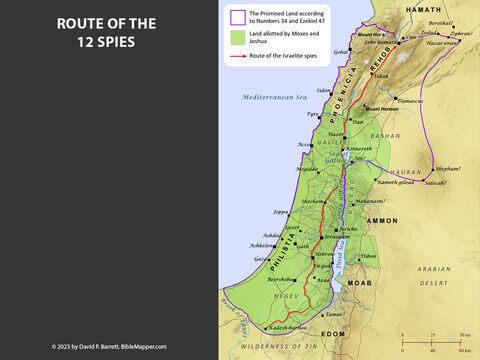
Map: Route of the 12 Spies (Numbers 13). Map by David P. Barrett / Biblemapper.com. Source: FreeBibleImages.org (CC BY-NC 4.0).
The Political Landscape (c. 1550–1200 BCE)
During the Late Bronze Age, Canaan was not a unified kingdom. It was a patchwork of independent city-states — Hazor, Megiddo, Gezer, Lachish, Shechem, Jerusalem, Jericho — each governed by its own ruler. These city-states were nominally under Egyptian control. Egypt's New Kingdom pharaohs, particularly Thutmose III (r. 1458–1425 BCE) and later Ramesses II (r. 1279–1213 BCE), maintained garrisons, extracted tribute, and treated Canaan as a buffer zone against northern powers.
The Amarna Letters (c. 1350 BCE) — diplomatic correspondence found in Egypt — reveal this world in vivid detail. Canaanite city-state rulers wrote to Pharaoh begging for military support against rivals, raiding neighbors, and complaining about a group called the Habiru (a term whose relationship to "Hebrew" remains debated). The picture is one of chronic instability: local kings jockeying for position, unable to mount serious resistance without Egyptian backing, yet never fully controlled by Egypt either.
The Fortified Cities
The spies were not exaggerating about the fortifications. Late Bronze Age Canaan had walled cities with massive earthwork ramparts, some built during the earlier Hyksos period (c. 1650–1550 BCE). Hazor, the largest Canaanite city, covered nearly 200 acres. Megiddo guarded the pass through the Carmel range — one of the most fought-over strategic positions in all of ancient military history. Lachish and Gezer were major strongholds. These were not villages. They were military installations with generations of defensive investment.
When the spies reported "cities great and fenced up to heaven" (Deut 1:28), they were describing real Bronze Age fortifications that had withstood centuries of warfare.
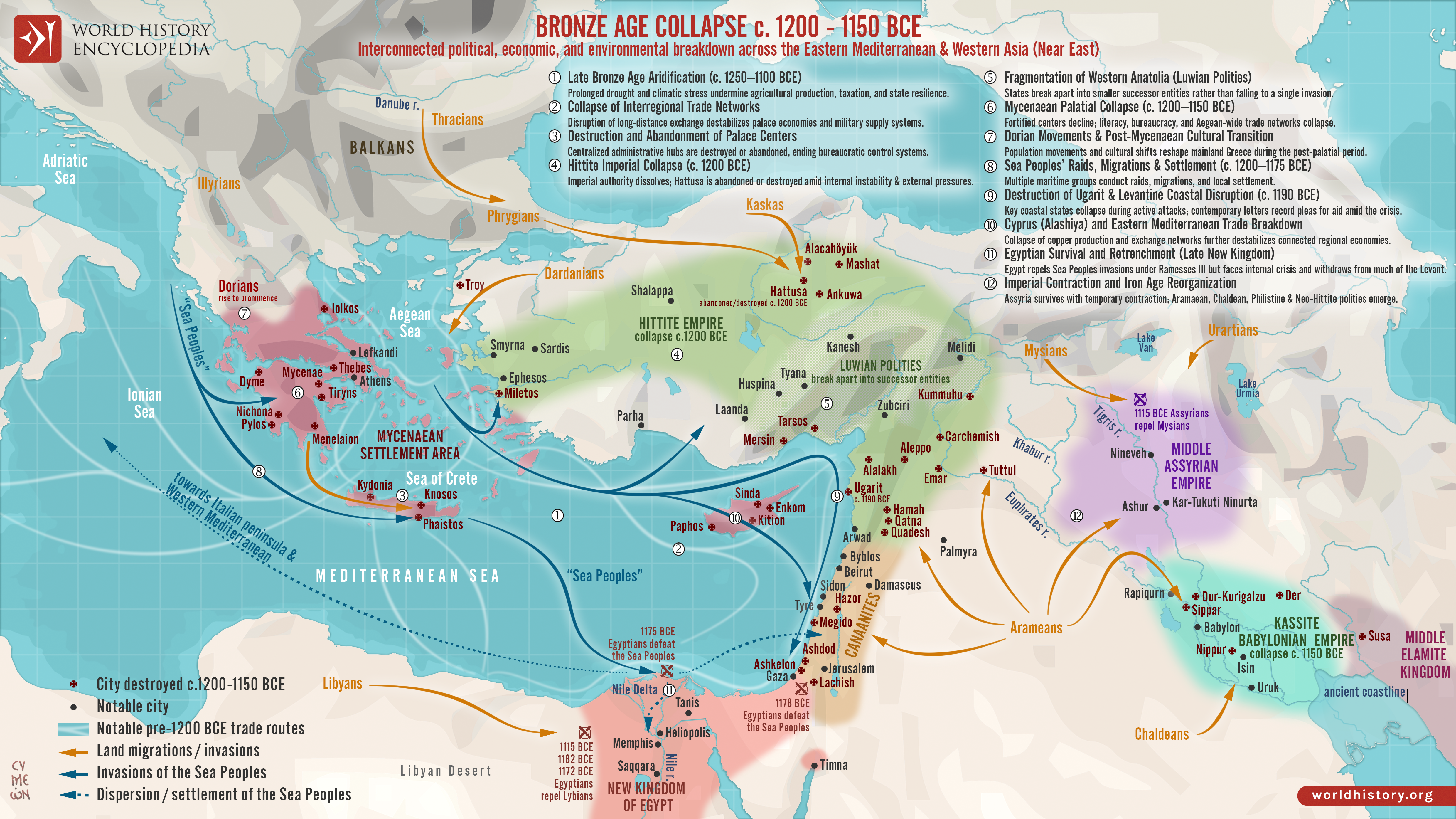
Map: The Late Bronze Age Collapse c. 1200–1150 BCE. Map by Simeon Netchev / World History Encyclopedia (CC BY-NC-ND). Must display unmodified.
What Happened
Between approximately 1250 and 1150 BCE, the interconnected civilization system of the eastern Mediterranean collapsed. The event was catastrophic and, in some regions, total. Scholars sometimes use 1177 BCE as a convenient shorthand — the year Ramesses III of Egypt fought a massive battle against invaders known as the "Sea Peoples" — but the collapse was a process spanning decades, not a single event.
Eric Cline's influential analysis (1177 B.C.: The Year Civilization Collapsed) describes a "perfect storm" of simultaneous pressures that overwhelmed the ancient world's ability to recover from any single one before the next struck.
The Causes — A Perfect Storm
Climate change and drought. Evidence from the Soreq Cave in Israel records a 150,000-year precipitation history showing an unprecedented rainfall decline through 1150 BCE. A "mega-drought" lasting from roughly 1200 to 850 BCE caused widespread crop failures across the Mediterranean. Sea surface temperatures dropped, reducing evaporation and rainfall in a cascading cycle.
Earthquakes. Scholars have documented 47 sites across the eastern Mediterranean destroyed within a 50-year window. Whether each was caused by earthquakes, invasion, or internal revolt is debated case by case — but the scale of simultaneous destruction suggests seismic activity played a role.
Trade network collapse. The Late Bronze Age ran on interconnected trade. The "Club of Great Powers" — Egypt, the Hittite Empire, Assyria, Babylonia, and Mitanni — maintained diplomatic and commercial ties that sustained all of them. Tin (essential for bronze production) came from Afghanistan and Cornwall. Copper came from Cyprus. Ivory came from Egypt and Nubia. When piracy, warfare, and displacement disrupted these networks, economies that depended on trade for essential materials could not sustain themselves. The Uluburun shipwreck (14th century BCE), discovered off the Turkish coast, carried copper, tin, ivory, glass, and luxury goods from at least seven civilizations in a single cargo — a snapshot of how deeply interconnected this world was, and how devastating its disruption would be.
Internal rebellions. As food grew scarce, social structures cracked. Under Ramesses III (r. 1186–1155 BCE), the tomb-builders at Deir el-Medina conducted what may be the first recorded labor strike in history when they went unpaid. Tomb robbing spiked as desperate workers sold stolen goods for food. The Canaanite city of Hazor — the largest in the region — appears to have been destroyed by internal uprising rather than external invasion.
The Sea Peoples. And then came the migrations.
Who Were the Sea Peoples?
Egyptian records name several groups — the Sherden, Sheklesh, Lukka, Tursha, Akawasha, Peleset, Tjeker, Denyen, and Weshesh — who attacked Mediterranean coastal regions between approximately 1276 and 1178 BCE. The term "Sea Peoples" is modern (coined by French Egyptologist Gaston Maspero around 1881); the Egyptian texts say only that they came "from the sea" or "from the islands."
Their origins remain one of the great unsolved questions of ancient history. Proposed homelands include the Aegean, Anatolia (modern Turkey), the western Mediterranean, and the Black Sea region. What is clear is that these were not just raiding parties. Egyptian inscriptions depict them traveling with wives, children, and ox-carts — entire populations on the move. They were migrants, not merely pirates.
The most likely scenario connects the Sea Peoples to the cascading collapse of Aegean and Anatolian civilizations. When the Mycenaean palace system disintegrated (c. 1200–1100 BCE) and the Hittite Empire fell (Hattusa was sacked and burned around 1190 BCE), displaced populations pushed southward and eastward along the Mediterranean coast, destroying or absorbing what they encountered. Ugarit — one of the wealthiest trading ports in the Levant — was destroyed around 1190 BCE and never rebuilt. The last letter found in the ruins is from a desperate king requesting military aid that never came.
The Aegean Connection — Minoans, Mycenaeans, and the Domino Effect
To understand why entire populations were migrating through the eastern Mediterranean, you need to look further west.
The Minoans (c. 2700–1450 BCE) had built the first major maritime trading civilization in the Aegean, based on Crete. Their trade networks linked Egypt, the Levant, Anatolia, and the western Mediterranean. Their palace complexes at Knossos were unfortified — suggesting they relied on naval dominance rather than walls. When the Minoan civilization declined (likely weakened by the catastrophic eruption of Thera around 1600 BCE and subsequent disruption), a power vacuum opened.
The Mycenaeans (c. 1600–1100 BCE) — mainland Greeks from centers like Mycenae, Tiryns, and Pylos — filled that vacuum. They were more militaristic than the Minoans: their palaces featured massive "Cyclopean walls" up to 13 meters high and 8 meters thick, their art depicted warriors and chariots, and their economy was built on both trade and conquest. Mycenaean pottery has been found in Egypt, Mesopotamia, the Levant, Anatolia, and Sicily — evidence of trade networks spanning the entire Mediterranean.
When the Mycenaean palace system collapsed around 1200–1100 BCE — from some combination of drought, earthquake, internal revolt, and disrupted trade — the displaced populations had to go somewhere. Many went east and south. They became part of the wave the Egyptians called the "Sea Peoples."
Troy, Homer, and the Same Collapse
Readers familiar with Greek literature may not realize they already know this story from another angle. The traditional date for the fall of Troy is around 1184 BCE — squarely within the Bronze Age Collapse window. Troy sat at the northwestern edge of the Aegean, controlling the straits between the Mediterranean and the Black Sea — a critical choke point for trade. A Mycenaean coalition attacking Troy fits the pattern of Late Bronze Age powers fighting over trade routes as the system destabilized. You can see Troy marked on the map above, near the Dardanelles, right in the path of the collapse.
Homer's Iliad and Odyssey are almost certainly literary memories of this period. The kingdoms Homer describes — Mycenae "rich in gold," Pylos, Tiryns, Ithaca — are the same palatial centers that collapsed (item 6 on the map). The massive walls, the chariot warfare, the bronze weapons, the interconnected kingdoms sending ships to a common military cause — Homer is describing the Mycenaean world at the moment of its destruction.
And the aftermath Homer describes is telling. Odysseus wanders the Mediterranean for ten years, unable to return home, finding kingdoms destroyed or transformed. The world he left no longer exists when he tries to go back to it. That is the post-collapse Mediterranean — familiar coastlines, unfamiliar powers, old alliances dissolved, new peoples in old places.
These are not separate ancient histories. They are the same event seen from different shores. The displacement that Homer poeticized as the aftermath of Troy is the same displacement that put the Philistines in Gaza, Gath, and Ashkelon — where they became the neighbors and enemies of Israel. The Trojan War and the Israelite conquest of Canaan belong to the same generation of upheaval.
What This Means for Numbers 13
When the spies scouted Canaan, they were looking at a land that sat at the intersection of all these forces. The "giants" in the fortified cities were the inheritors of centuries of military investment by local kings, Egyptian-backed garrisons, and trading wealth. The walls were real. The warriors were real. The strategic significance of the land was not a figment of frightened imaginations.
And what the spies could not have known was that within a generation, the entire power structure of the ancient Near East would collapse. Egypt would retreat. The Hittites would vanish. The trade networks would fail. The fortified cities would burn. The very world the spies feared would cease to exist — creating the precise power vacuum into which Israel, under Joshua, would eventually move.
God's promise was not naive. It was prophetic. The spies measured the present and despaired. God measured the future and said: "We are well able."
One group of Sea Peoples deserves special attention: the Peleset, widely identified with the biblical Philistines.
After Ramesses III defeated the Sea Peoples confederation in battles at the Nile Delta (c. 1178 BCE), survivors settled along the southern coast of Canaan — precisely the region the Bible assigns to the Philistines. They established five major cities: Gaza, Ashkelon, Ashdod, Ekron, and Gath.
Archaeological evidence confirms their Aegean origins. Philistine pottery closely resembles Mycenaean styles. Their architectural forms include the megaron — a large hall type characteristic of Greek palace culture, not native to Canaan. Cemetery excavations reveal mixed genetic profiles: local Semitic traits alongside European gene pools, consistent with a migrating population that intermarried with the local Canaanite population over time.
The Philistines brought military technology that gave them a significant advantage: iron weapons and tools. First Samuel 13:19–22 records that "there was no smith found throughout all the land of Israel" — the Philistines controlled ironworking as a military monopoly.
Critically, the Bible locates the surviving Anakim — the "giants" the spies feared — in Philistine territory. Joshua 11:22 says that after Joshua's campaigns, Anakim remained "in Gaza, in Gath, and in Ashdod." Goliath, the most famous biblical giant, came from Gath (1 Sam 17:4). Whether the Anakim were an earlier indigenous population absorbed into Philistine society, or whether the Philistines' own Aegean warrior culture merged with local traditions about formidable inhabitants, the textual connection is clear: the "giants" and the "sea peoples" ended up in the same cities.
The bronze serpent (nachash nechoshet) that Moses lifted on a pole (Num 21:8–9) did not exist in a cultural vacuum. Serpent symbolism was pervasive across the ancient Near East:
Egypt. The uraeus — the rearing cobra on Pharaoh's crown — symbolized divine authority and protection. Serpent staffs appeared in Egyptian art held by gods including Thoth and Heka. Aaron's staff becoming a serpent before Pharaoh (Ex 7:10–12) would have spoken directly to Egyptian cultural assumptions about serpent power.
Mesopotamia. Entwined serpents on poles appeared from Sumerian times onward. A vessel belonging to King Gudea of Lagash (21st century BCE) depicts two snakes wrapped around a pole, associated with the god Ningishzida ("Lord of the Good Tree") — a striking visual parallel to the Nehushtan, over a thousand years before Moses.
Canaan. Ugaritic texts describe sorcerers who fought alongside serpents to protect people from snakebites and scorpion stings. Serpent imagery was embedded in Canaanite religious practice.
The Israelites would have recognized the bronze serpent within this broader cultural landscape — which is precisely why it later became a problem. By King Hezekiah's reign (c. 715–687 BCE), the Nehushtan had become "a pagan cult object" (2 Kings 18:4). Hezekiah destroyed it during his reforms, dismissing it as merely "a piece of bronze" (nechushtan). The instrument God created for healing had become an idol — a reminder that symbols intended to point toward God can become substitutes for God when the looking stops.
Balaam son of Beor is not only a biblical character. In 1967, archaeologists discovered a plaster inscription at Deir Alla in the Jordan Valley (modern Jordan), dating to approximately 840–760 BCE. The text begins: "The account of Balaam son of Beor, who was a seer of the gods." It describes Balaam receiving a night vision from divine beings — remarkably parallel to the biblical account.
The Deir Alla inscription confirms that Balaam was remembered as a real prophetic figure in the broader Transjordanian region, not just in Israelite tradition. His reputation as a seer whose words carried power was not a biblical invention — it was a regional tradition preserved in non-Israelite sources.
This matters for the Numbers narrative: when Balak hired Balaam, he was hiring the most reputable diviner available. The biblical author is not inventing a straw man. He is showing that even the best the pagan world had to offer — a prophet whose fame extended across the region — could not override God's covenant purpose.
The commission of Joshua (Num 27:18–23) — with the laying on of hands (semikah) before the congregation — has no precise parallel in surviving ancient Near Eastern texts. Royal succession in Egypt, Mesopotamia, and the Hittite Empire typically involved enthronement ceremonies, divine oracles, and sometimes co-regency, but the physical act of one leader pressing his hands upon the head of his successor as a transfer of authority appears to be distinctively Israelite.
This makes the scene historically significant: it establishes a pattern — authority flowing through physical human contact, publicly witnessed, before God — that would become the foundation of both rabbinic ordination (semikah, traced back to this moment in Sanhedrin 13b) and Christian ordination by laying on of hands. The gesture Moses performed in Numbers 27 created a chain of transmission that persists in both traditions to this day.
The stories in this week's reading take place against a backdrop of extraordinary historical upheaval. The Canaan the spies scouted was a land of fortified city-states, contested by empires, sitting at the crossroads of the ancient world's trade networks. The "giants" they feared were real warrior populations with real military reputations. And the entire power structure of the Late Bronze Age was, within a generation, about to collapse — creating the very conditions that would allow Israel to enter the land.
The spies measured what they could see and concluded it was impossible. God saw what they could not: a world about to change. The wilderness was not a delay. It was preparation — for a people, and for a moment.
- World History Encyclopedia: Bronze Age Collapse, Sea Peoples, Canaan, Philistines, Hittites, Mycenaean Civilization, Nehushtan (CC BY-NC-SA 4.0)
- Eric H. Cline, 1177 B.C.: The Year Civilization Collapsed (Princeton University Press, 2014; revised ed. 2021)
- Deir Alla inscription: discovered 1967 by H.J. Franken; published by J. Hoftijzer and G. van der Kooij, Aramaic Texts from Deir Alla (1976)
Revised: May 6, 2026
3. Week 19: Key Passages Study
The Text
"And the mixt multitude that was among them fell a lusting: and the children of Israel also wept again, and said, Who shall give us flesh to eat? We remember the fish, which we did eat in Egypt freely; the cucumbers, and the melons, and the leeks, and the onions, and the garlick: But now our soul is dried away."
Key Hebrew
- hit'avvu ta'avah (הִתְאַוּוּ תַּאֲוָה) — "lusted a lust" — emphatic doubling, craving at the deepest level
- chinnam (חִנָּם) — "freely" — the fish was free? They were slaves. The word exposes the delusion.
What It Meant in Context
Israel's menu nostalgia is psychologically revealing. They catalog six specific foods from Egypt with vivid sensory detail — yet never mention the slavery, the forced labor, the infant killings. Memory selects what desire dictates. Manna, God's daily provision, is dismissed as inadequate compared to a slave diet romanticized by distance.
Christ-Centered Reading
Manna is explicitly connected to Christ: "I am the bread of life" (John 6:35). Rejecting manna = rejecting Christ's daily sustenance in favor of the world's menu. The "mixt multitude" (erev rav) who initiated the craving represents outside influence pulling covenant people away from God's provision.
Application
What "Egyptian food" do you romanticize? What past life, past habit, past relationship do you remember with selective fondness — forgetting the slavery it contained? Manna was plain but it was enough. It was daily but it was certain. Sometimes God's provision doesn't match our cravings, and that's the test.
The Text
"And Caleb stilled the people before Moses, and said, Let us go up at once, and possess it; for we are well able to overcome it. But the men that went up with him said, We be not able to go up against the people; for they are stronger than we... and we were in our own sight as grasshoppers."
Key Hebrew
- yakhol nukhal (יָכוֹל נוּכַל) — "we are well able" — emphatic doubling, absolute confidence
- ka-chagavim (כַּחֲגָבִים) — "as grasshoppers" — self-diminishment before God has spoken
What It Meant in Context
Both groups saw the same land. Same fortified cities, same giant inhabitants, same abundant produce. The difference was entirely theological: the ten measured Israel against the Anakim; Joshua and Caleb measured the Anakim against God. Rashi: the spies' strategy was to begin with verifiable truth — "it does flow with milk and honey" — to build credibility for their faithless conclusion. Accurate data + faithless interpretation = the most dangerous deception.
Christ-Centered Reading
Joshua (Yehoshua = "Jehovah is salvation") carries Christ's own name. He enters the land; the faithless don't. The one who trusts God's power leads into the promise. The ones who trust their own sight die in the wilderness.
Application
When you face a "fortified city" in your life — an impossible diagnosis, an overwhelming calling, a relationship that seems beyond repair — do you count like the ten or like Caleb? "We are well able" isn't self-confidence. It's God-confidence. The question was never "are we big enough?" but "is God big enough?"
The Text
"And Moses said unto the LORD... Now if thou shalt kill all this people as one man, then the nations which have heard the fame of thee will speak, saying, Because the LORD was not able to bring this people into the land which he sware unto them... And now, I beseech thee, let the power of my Lord be great, according as thou hast spoken, saying, The LORD is longsuffering, and of great mercy."
Key Hebrew
- erekh appayim (אֶרֶךְ אַפַּיִם) — "longsuffering" — literally "long of nose/anger," slow to anger
- rav-chesed (רַב־חֶסֶד) — "of great mercy" — abundant in covenantal love
What It Meant in Context
Moses does something remarkable: he argues God's case FOR Israel using God's own self-revelation from Exodus 34:6-7. He essentially says: "You told us who You are. Be that now." He appeals not to Israel's merit (they have none) but to God's character and reputation. This is the same intercession pattern from Exodus 32 — Moses choosing his people over personal glory again.
Christ-Centered Reading
Moses prefigures Christ the Mediator. Like Christ, Moses stands between a holy God and a sinful people, advocating not on the basis of human worthiness but divine mercy. "Father, forgive them" echoes Moses' wilderness prayer.
Application
Do you pray for others by appealing to God's character rather than their merit? Moses didn't argue that Israel deserved mercy — he argued that God IS mercy. That changes how we intercede.
The Text
"And Moses and Aaron gathered the congregation together before the rock, and he said unto them, Hear now, ye rebels; must we fetch you water out of this rock? And Moses lifted up his hand, and with his rod smote the rock twice: and the water came out abundantly."
Key Hebrew
- ha-morim (הַמֹּרִים) — "ye rebels" — from root מרה (marah), to rebel, resist
- hamin ha-sela hazeh notzi (הֲמִן הַסֶּלַע הַזֶּה נוֹצִיא) — "shall we bring out from this rock" — we, not God
What It Meant in Context
Three failures converge: wrong method (striking vs. speaking), wrong credit ("must we fetch"), wrong tone ("ye rebels"). Rashi identifies the core issue: had Moses spoken, Israel would have learned that even a rock obeys God's word — "how much more should we?" The teaching moment was destroyed by Moses' frustration.
Rashi also notes the public/private distinction: Moses expressed doubt privately before (Num 11:22) and wasn't punished. But this happened "before all Israel" — public failure to sanctify God's name demands public consequence.
Christ-Centered Reading
Paul identifies the rock as Christ (1 Cor 10:4). The first time, at Horeb, God told Moses to strike the rock (Ex 17:6) — Christ struck once, crucified once. The second time, God said speak — Christ doesn't need to be struck again. Moses' error carries unintended Christological weight.
Application
Leaders bear heavier accountability for public actions. But the deeper lesson is about credit: "Must we fetch you water?" When God works through us and we claim the credit, we fail to sanctify His name — even if the water still flows.
The Text
"And the LORD said unto Moses, Make thee a fiery serpent, and set it upon a pole: and it shall come to pass, that every one that is bitten, when he looketh upon it, shall live. And Moses made a serpent of brass, and put it upon a pole."
Key Hebrew
- nachash nechoshet (נָחָשׁ נְחֹשֶׁת) — "serpent of bronze/brass" — deliberate wordplay between "serpent" and "bronze"
- nes (נֵס) — "pole" — also means "banner" or "sign" — the serpent was a signal, a standard
What It Meant in Context
Rashi explains the wordplay: God said nachash (serpent); Moses chose nechoshet (bronze) — "one term fitting the other term." He wasn't told the material; he derived it from the sound of the word. The serpent was placed on a nes — a banner/standard — visible to the entire camp.
The Mishnah (Rosh Hashanah 3:8) asks the essential question and gives the essential answer: "Did the serpent kill or give life? When Israel turned their eyes upward and subjected their hearts to their Father in Heaven, they were healed, but if not, they rotted." The parallel: Moses' raised hands during the Amalekite battle worked the same way — not the hands, but the heavenward gaze.
Christ-Centered Reading
Jesus chose this as His self-portrait: "As Moses lifted up the serpent in the wilderness, even so must the Son of man be lifted up" (John 3:14). The cross is the ultimate nes — the banner lifted for all to see. Helaman 8:14-15: "as many as should look upon the Son of God with faith... might live, even unto that life which is eternal."
Application
Alma 33:20: "they did not believe that it would heal them." 1 Nephi 17:41: they perished "because of the simpleness of the way." The cure was free, available, and visible — but it required the one thing pride resists: looking outside yourself for salvation. What simple invitation from God are you overcomplicating or ignoring?
The Text
"And the LORD opened the mouth of the ass, and she said unto Balaam, What have I done unto thee, that thou hast smitten me these three times?... Then the LORD opened the eyes of Balaam, and he saw the angel of the LORD standing in the way."
Key Hebrew
- shalosh regalim (שָׁלֹשׁ רְגָלִים) — "three times" — identical to the phrase for the three pilgrimage festivals
- vayegal YHWH et einei Bil'am (וַיְגַל יְהוָה אֶת עֵינֵי בִלְעָם) — "and the LORD uncovered Balaam's eyes"
What It Meant in Context
Rashi catches the wordplay: shalosh regalim (three times / three festivals). God's message through the donkey: "You seek to root out a nation that celebrates three festivals annually?!" The irony is layered: the great seer cannot see what his donkey perceives. The professional diviner needs God to "uncover his eyes." Balaam's spiritual blindness is exposed by an animal's physical sight.
Christ-Centered Reading
God can use the humblest instrument — even a donkey — to deliver His message. The "wise" are confounded; the "foolish" things of the world reveal truth (1 Cor 1:27). Balaam's pretensions of prophetic authority dissolve before a talking animal.
Application
Are you Balaam — so focused on your agenda that you can't see the angel blocking your path? And are you striking the very things (people, circumstances, inconveniences) that are actually trying to save you?
The Text
"I shall see him, but not now: I shall behold him, but not nigh: there shall come a Star out of Jacob, and a Sceptre shall rise out of Israel."
Key Hebrew
- kokhav mi-Ya'akov (כּוֹכָב מִיַּעֲקֹב) — "a Star out of Jacob" — messianic imagery
- shevet (שֵׁבֶט) — "sceptre" — also means rod, staff, tribe — royal authority
What It Meant in Context
Rashi identifies this with King David: "a king will arise from Jacob." But the language transcends any single monarch: "I shall see him, but not now... not nigh" — this is future, distant, ultimate. The star and sceptre became primary messianic symbols in Jewish tradition. Rabbi Akiva applied it to Bar Kokhba ("Son of the Star"), declaring him the Messiah during the revolt of 132-135 CE. The revolt's catastrophic failure discredited that identification but not the prophecy itself.
Christ-Centered Reading
The star prophecy finds its fulfillment in Christ — the Star that appeared at His birth (Matt 2:2), the "root and the offspring of David, the bright and morning star" (Rev 22:16). That the prophecy comes through Balaam — a pagan diviner — demonstrates that God's messianic plan cannot be thwarted by human corruption.
Application
The Star prophecy emerges from the darkest period of Israel's history — faithless spies, condemned generation, flawed prophet. Yet here, through the mouth of a compromised man, comes one of Scripture's most luminous promises. God's plan for you doesn't depend on perfect circumstances or perfect people. The Star rises regardless.
The Text
"Why should the name of our father be done away from among his family, because he hath no son? Give unto us therefore a possession among the brethren of our father... And the LORD spake unto Moses, saying, The daughters of Zelophehad speak right: thou shalt surely cause the inheritance of their father to pass unto them."
Key Hebrew
- nachalah (נַחֲלָה): "inheritance, possession" — from a root suggesting something flowing down through generations, like a river (nachal)
- ken... dovrot (כֵּן... דֹּבְרֹת): "speak right" — God uses the present participle, affirming not just the claim but the manner of speaking
What It Meant in Context
The daughters timed their petition brilliantly. Bava Batra 119b reveals they approached during Moses's teaching on levirate marriage, exposing a logical gap: if daughters don't count as heirs, the mother should require yibum. Rashi calls them chakmaniyyot (wise), darshaniyyot (skilled interpreters), tzidkaniyyot (righteous). Most strikingly, Rashi says this passage "was fit to be written through Moses, but the daughters of Zelophehad merited that it be written through them" — their eyes "perceived what Moses' eyes did not perceive."
Christ-Centered Reading
The daughters' claim to nachalah foreshadows the gospel's promise that all — male and female — are "heirs of God, and joint-heirs with Christ" (Romans 8:17). Their standing before the full assembly and receiving God's direct affirmation models the covenant relationship where every person has standing before God.
Application
What inheritance — spiritual, vocational, relational — have you failed to claim because you assumed it wasn't for you? The daughters didn't wait for someone to offer. They stood up, stated their case, and God said they were right. Sometimes the law of God is waiting for the right question.
The Text
"Take thee Joshua the son of Nun, a man in whom is the spirit, and lay thine hand upon him... And thou shalt put some of thine honour upon him... And he laid his hands upon him, and gave him a charge, as the LORD commanded."
Key Hebrew
- semikah (סְמִיכָה): "laying on, leaning upon" — from samakh (ס-מ-כ), to lean, support, rely on. The physical act that became the foundation of all rabbinic ordination.
- hod (הוֹד): "glory, splendor, radiance" — God said mei-hod'kha ("of your glory"), not kol hod'kha ("all your glory"). Partial transfer.
- ruach (רוּחַ): "spirit" — Joshua is "a man in whom is ruach," divine spirit enabling inspired leadership.
What It Meant in Context
God commanded one hand; Moses gave both — "with a generous eye," making Joshua "a full and heaped-up vessel" (Rashi). The rabbinic tradition captured the transition memorably: "The face of Moses was like the sun; the face of Joshua was like the moon" (Bava Batra 75a). Joshua received reflected authority — real, but derived. Moses was also told to charge Joshua soberly: "Know that they are troublesome, that they are obstinate. Accept your office on condition that you take all this upon yourself."
Christ-Centered Reading
Joshua (Yehoshua, "Jehovah is salvation") bears Christ's own name and receives authority through the laying on of hands — the same pattern Christ would use to commission His apostles. The transfer from Moses (the Law) to Joshua (Salvation) prefigures the transition from the law of Moses to the gospel of Christ.
Application
Moses poured more into Joshua than was required. That's the model for any leader, parent, or mentor: invest generously in your successor. Don't hoard authority or ration wisdom. "A generous eye" means giving people more than the minimum — and trusting God to fill what you can't.
4. Week 19: Word Studies
Root: נחשׁ (nachash, serpent) + נחשׁת (nechoshet, bronze/copper)
Appears: Numbers 21:9; 2 Kings 18:4
Meaning
Two words from closely related roots creating deliberate wordplay. Nachash (serpent) and nechoshet (bronze/copper) share the consonants נ-ח-שׁ. Rashi explains that God commanded a nachash; Moses chose nechoshet — "one term fitting the other term." The material choice came from linguistic reasoning, not explicit instruction.
Deeper Context
The wordplay runs deeper than surface punning. In Hebrew thought, naming reveals essence. By casting the serpent in a substance that echoes its name, Moses created an object where the word for the wound (nachash) and the word for the cure (nechoshet) are linguistically inseparable. The cure contains the wound's own name — just as Christ was "made sin for us, who knew no sin" (2 Cor 5:21).
The serpent was later named Nehushtan (נְחֻשְׁתָּן) and venerated as an idol until King Hezekiah destroyed it (2 Kings 18:4) — a reminder that symbols intended to point to God can become idols themselves.
Theological Significance
- The cure resembles the wound: Looking at a serpent heals serpent bites — counterintuitive, even offensive
- Language reveals theology: The Hebrew wordplay encodes the principle that redemption comes through the very form of the affliction
- Christ made in the "likeness of sinful flesh" (Rom 8:3) — He took the form of the wound to become the cure
LDS Application
The brazen serpent is Christ's own chosen metaphor for the Atonement (John 3:14). We are healed by looking at the One who was "lifted up" — even though looking at suffering is difficult, even offensive. The simplicity of the invitation — just look — is precisely what pride resists.
Root: רגל (ragal, to go on foot, to spy out, to walk about)
Related: רֶגֶל (regel, foot); רָגִיל (ragil, accustomed/regular)
Appears: Numbers 13:2 (implied), 21:32; Deuteronomy 1:24
Meaning
The word meraglim comes from the root meaning "to go on foot" — to walk through, to scout. The spies were literally "footmen," people sent to walk the land and report what their feet found. The term is neutral — it implies investigation, not deceit. The sin wasn't in the spying but in the interpreting.
Deeper Context
Jewish tradition treats the sin of the spies (chet ha-meraglim / חֵטְא הַמְרַגְּלִים) as one of the most catastrophic moments in Israel's history. The Talmud (Ta'anit 29a) teaches that the night Israel wept over the spies' report was the 9th of Av (Tisha B'Av) — and God declared: "You wept without cause; I will establish this as a night of weeping for generations." Both Temples were later destroyed on this same date.
Theological Significance
- Walking ≠ seeing: They walked the land but didn't see God's promise in it
- Report vs. interpretation: The facts were accurate; the faith was absent
- Weeping without cause became weeping with cause — faithlessness generates the very grief it fears
LDS Application
We are all sent to "spy out" our mortal promised land — assessing challenges, evaluating obstacles. The question is whether we report like the ten ("we can't") or like Caleb ("we are well able"). Same data, opposite faith.
Root: Uncertain; possibly related to כבב (kavav, to burn/glow)
Appears: Numbers 24:17; Genesis 1:16; 15:5; 37:9
Meaning
Kokhav is the common Hebrew word for star. In Balaam's prophecy ("there shall come a Star out of Jacob"), it functions as a royal/messianic metaphor — a luminary arising from Israel's lineage.
Deeper Context
Stars in Hebrew thought carry multiple associations:
- Abrahamic promise: "Look now toward heaven, and tell the stars... so shall thy seed be" (Gen 15:5) — descendants as numerous as stars
- Joseph's dream: Sun, moon, and eleven stars (Gen 37:9) — family authority
- Balaam's prophecy: A single rising star — a king, a deliverer
Rabbi Akiva applied Numbers 24:17 to Shimon bar Kosiba, renaming him Bar Kokhba ("Son of the Star") and declaring him the Messiah during the revolt of 132-135 CE. After the revolt's catastrophic failure, his name was changed to Bar Koziba ("Son of the Lie"). The star endured as messianic symbol; the false identification didn't.
Theological Significance
- Light in darkness: Stars are only visible at night — the messianic promise comes during Israel's darkest period
- Guidance: Stars navigate — the Messiah guides God's people home
- Not now, but coming: Balaam sees the star "but not nigh" — fulfillment is certain but distant
LDS Application
The star at Christ's birth (Matt 2:2) and Christ as "the bright and morning star" (Rev 22:16) fulfill Balaam's prophecy. Samuel the Lamanite's prophecy of a new star (Helaman 14:5) adds a Book of Mormon layer. The star rises regardless of human failure.
Root: סלע (sala', to be lofty, a crag)
Distinct from: צוּר (tzur, rock — used in Ex 17:6 for the first water-from-rock episode)
Appears: Numbers 20:8, 10, 11
Meaning
Sela refers to a large cliff or crag — a massive rock formation, not a small stone. In Numbers 20, God tells Moses to speak to the sela. In the earlier Exodus 17 episode, the word used was tzur (a different kind of rock). Some commentators note the shift: the first rock (tzur) was struck; the second rock (sela) was to be spoken to. Different rock, different instruction.
Deeper Context
Paul identifies the rock as Christ: "That Rock was Christ" (1 Cor 10:4). If the rock is Christ, then the first striking (Exodus 17) corresponds to the one-time sacrifice on the cross. The second time, God says speak — Christ doesn't need to be struck again. Moses' error in striking the sela carries unintended Christological weight: re-striking what was already struck is theologically redundant.
Theological Significance
- Words have power: God told Moses to speak — the spoken word, not physical force, was to bring water from rock
- Christ struck once: "By his own blood he entered in once into the holy place, having obtained eternal redemption" (Heb 9:12)
- Different season, different method: What worked at Horeb wasn't appropriate at Kadesh — God's instructions change even when the miracle is the same
LDS Application
We sometimes try to force spiritual results through old methods when God is calling for new approaches. Speaking to the rock requires more faith than striking it — words without a visible mechanism demand trust in God's word alone.
Root: Possibly צוץ (tzutz, to blossom, to bloom)
Appears: Numbers 15:38-39
Meaning
Tzitzit are the fringes or tassels commanded to be worn on the corners of garments. The word may relate to "blossoming" — something that extends outward, visible and decorative. Jewish tradition holds that the tzitzit contain knots and windings totaling 613 — representing the 613 commandments of the Torah.
Deeper Context
Numbers 15:39: "That ye may remember, and do all my commandments, and be holy unto your God." The tzitzit were a wearable covenant reminder — holiness worn on the body, visible in daily life. They served the same function as the Tabernacle in miniature: making the invisible (covenant commitment) visible (physical garment).
The woman who touched the "hem" of Jesus' garment (Matt 9:20) likely touched His tzitzit — reaching for the visible symbol of covenant holiness and finding healing in it.
Theological Significance
- Physical reminders of spiritual commitments: God uses tangible objects to anchor invisible truths
- Holiness is visible: Tzitzit were outward — covenant identity is meant to be seen, not hidden
- 613 as totality: Every commandment represented in the garment — complete obedience worn daily
LDS Application
The temple garment serves a parallel function: a wearable covenant reminder, holiness carried on the body through daily life. Like tzitzit, it makes invisible commitment physically present.
Components: בְּרָכָה (berakhah, blessing) + כֹּהֲנִים (kohanim, priests)
Appears: Numbers 6:24-26
Meaning
The Priestly Benediction is the oldest biblical text ever discovered archaeologically — found on silver scrolls at Ketef Hinnom dating to the 7th century BC. Its three lines follow an ascending pattern of intensity:
"The LORD bless thee and keep thee" (6:24)
"The LORD make his face shine upon thee, and be gracious unto thee" (6:25)
"The LORD lift up his countenance upon thee, and give thee peace" (6:26)
Deeper Context
The Hebrew builds from 3 words → 5 words → 7 words in the three lines, creating a poetic crescendo. The progression moves from protection (keep) to illumination (shine) to wholeness (peace / שָׁלוֹם shalom). Shalom — the final word — means not merely absence of conflict but completeness, wholeness, well-being.
Theological Significance
- God's face: The repeated imagery of God's face shining, being lifted — the opposite of God hiding His face (judgment)
- Priestly function: The priests don't bless by their own power — they invoke God's name (6:27: "they shall put my name upon the children of Israel; and I will bless them")
- Ascending structure: Blessing → Grace → Peace — each line builds toward shalom
LDS Application
Priesthood blessings in the LDS tradition follow the same pattern: the officiant speaks, but the blessing comes from God. The principle that priests "put my name upon the children of Israel" resonates with baptism, confirmation, and temple ordinances — placing God's name upon His people.
Root: נ-ח-ל (nachal, to inherit, to receive as a possession)
Related: nachal (נַחַל) — stream, wadi (something that flows down)
Appears: Numbers 27:7-11; 36:2-9; Deuteronomy 4:21; Psalm 16:6
Meaning
Nachalah is far more than property. It denotes a covenantal portion — land and identity flowing down through generations like a stream (nachal) flows through a valley. To lose one's nachalah is to be erased from the covenant community. This is why Zelophehad's daughters' petition was so urgent: without an inheritance ruling, their father's name — and their family's place in the promised land — would disappear.
Deeper Context
The Sifrei (Numbers 133) records the daughters' theological argument: "God's compassion differs from human compassion. Flesh-and-blood creatures have greater compassion for males than for females. But the One who spoke and the world came into being is not like that — His mercy extends to all." They grounded their legal petition in God's character, not mere pragmatism.
Theological Significance
- Inheritance = covenant identity: Nachalah ties a family to the land, the land to the promise, and the promise to God
- Women as heirs: The ruling in 27:8-11 permanently expanded inheritance law — daughters inherit when there are no sons
- Flowing down: The etymological connection to nachal (stream) suggests inheritance is not static possession but living transmission
LDS Application
The Latter-day Saint concept of celestial inheritance parallels nachalah — not mere property but eternal identity and standing in God's covenant. D&C 132:19-20 describes sealed couples receiving "thrones, kingdoms, principalities, and powers" — inheritance language applied equally to husband and wife. Zelophehad's daughters model claiming one's full covenant portion.
Root: ס-מ-כ (samakh, to lean upon, to support, to rely on)
Related: somekh (סוֹמֵךְ) — supporter; masmikh — one who ordains
Appears: Numbers 27:18, 23; Deuteronomy 34:9; Leviticus 1:4
Meaning
Semikah is the physical act of leaning one's hands on another — transferring weight, substance, and authority. It first appears in the sacrificial system (Leviticus 1:4 — the worshiper lays hands on the offering's head), but Numbers 27:23 is its foundational use for leadership succession. The literal sense is "leaning" — the authority-giver presses his weight/substance into the recipient.
Deeper Context
God told Moses to lay one hand (yad'kha, singular). Moses laid both (yadav, plural). Rashi: Moses acted "with a generous eye, more and more than he was commanded." He made Joshua "like a full and heaped-up vessel." The distinction between one hand commanded and two hands given became a key rabbinic teaching about generous transmission of authority. Classical semikah required a court of three judges, at least one of whom himself possessed semikah — creating an unbroken chain back to Moses (Sanhedrin 13b).
Theological Significance
- Physical contact transmits authority: Not magic, but embodied commissioning — God's design involves human touch
- Generosity in succession: Moses modeled giving more than required to his successor
- Sun and moon: "The face of Moses was like the sun; the face of Joshua was like the moon" (Bava Batra 75a) — each generation receives real but derived authority
- Chain of authority: Semikah established an unbroken succession principle that persists in both Judaism and Christianity
LDS Application
The fifth Article of Faith — "called of God, by prophecy, and by the laying on of hands by those who are in authority" — directly echoes Numbers 27. Priesthood ordination, setting apart for callings, blessing the sick, and confirmation all use the same physical pattern Moses established: hands on the head, authority flowing from God through commissioned servants. Moses' "generous eye" models how leaders should invest in those they call.
5. Week 19: Jewish Perspective
The book of Numbers contains some of Israel's most painful failures — and some of rabbinic literature's most searching commentary on why. The sin of the spies, Moses at the rock, the bronze serpent, and Balaam's strange trajectory from prophet to traitor have all generated centuries of Jewish reflection. The questions these chapters raise are not ancient curiosities — they are the questions every faith community faces: Why do we complain when we've been blessed? Why do leaders fail? How does a simple cure heal a mortal wound? And what happens when spiritual gifts outpace spiritual character?
The Teaching
The Talmud (Ta'anit 29a) makes a startling claim: the night Israel wept over the spies' report was the 9th of Av (Tisha B'Av). God declared: "You wept without cause; I will establish this as a night of weeping for generations." Both the First Temple (586 BC) and Second Temple (70 CE) were later destroyed on this same date. In Jewish tradition, the sin of the spies is not a minor failure of nerve — it is the original catastrophe from which centuries of exile and destruction flow.
Rashi's Analysis
Rashi on Numbers 13:27 identifies the spies' technique: "No fabricated statement in which one does not say at least some true words at first can in the end be maintained." The spies reported accurately — the land really did flow with milk and honey, the cities really were fortified, the inhabitants really were large. Then they drew a faithless conclusion: "We be not able." The sin wasn't lying about the facts; it was lying about God's ability to overcome them.
What Was the Actual Sin?
Rabbinic tradition identifies several layers:
- Lashon hara (evil speech): Speaking evil about the land God had promised — slandering God's gift
- Lack of faith: Measuring God's power by human standards
- Contagion: Their fear infected the entire nation — one faithless report undid years of miracles
- Preferring slavery to risk: The people preferred the certainty of Egypt's bondage to the uncertainty of God's promise
LDS Resonance
The spies' sin maps to any moment when accurate assessment of difficulty becomes an excuse to abandon God's direction. Faithful leaders don't deny challenges — Caleb acknowledged the fortified cities — but they refuse to measure challenges without including God in the equation. "We are well able" is not self-delusion; it's covenant confidence.
The Teaching
The severity of Moses' punishment — barred from the promised land for one act of frustration — has troubled commentators for millennia. Rashi offers three explanations:
- Lack of faith: "Because ye believed me not" — Moses' trust faltered
- Failed sanctification: Had Moses spoken to the rock, the people would have reasoned: "If an inanimate rock obeys God's word, how much more should we?" The teaching moment was destroyed.
- Public nature: Moses had expressed doubt privately before (Num 11:22: "Shall the sheep and oxen be slaughtered?") and was forgiven. But this happened "before all Israel" — public failure to sanctify God's name demands public consequence "because of the Hallowing of the Divine Name."
Maimonides' View
Maimonides identified Moses' sin as anger — "Hear now, ye rebels" — rather than the striking itself. A prophet's anger misrepresents God's character. When Moses raged, the people inferred that God was enraged. This was a distortion of God's nature, and from a prophet, that distortion is intolerable.
Ramban's Disagreement
Ramban objected to every standard explanation and argued the text deliberately obscures the exact sin, noting: "The matter is indeed a great secret among the secrets of the Torah." He suggested the sin was saying "Must we fetch you water" — implying Moses and Aaron were the source rather than God.
LDS Resonance
The public/private distinction is powerful for covenant people. God may work patiently with private struggles but holds leaders to higher public accountability — not because leaders are more valuable, but because their public actions shape how others perceive God. Every priesthood holder acting "in the name of Jesus Christ" bears this responsibility.
The Teaching
The Mishnah asks the definitive question: "Did the serpent kill, or did the serpent preserve life?"
The answer strips away all magical thinking: "When Israel turned their eyes upward and subjected their hearts to their Father in Heaven, they were healed, but if not, they rotted."
The Mishnah then draws a direct parallel to Moses' hands during the Amalekite battle (Exodus 17:11): "Did Moses' hands make war or break war? Rather, when Israel looked upward and subjected their hearts to their Father in Heaven, they prevailed; if not, they fell."
Rashi's Wordplay
Rashi on Numbers 21:9 explains Moses' material choice: God said nachash (serpent); Moses made it from nechoshet (bronze) — "one term fitting the other term" (Genesis Rabbah 31:8). The linguistic reasoning connected the cure to the wound at the level of the word itself.
Later Destruction
The bronze serpent was eventually venerated as an idol. King Hezekiah destroyed it (2 Kings 18:4), calling it "Nehushtan" — reducing it from symbol to mere "bronze thing." This is the fate of every symbol that becomes an object of worship rather than a pointer to God.
LDS Resonance
The Mishnah's teaching maps directly to Alma 33:19-22: "If ye could be healed by merely casting about your eyes that ye might be healed, would ye not behold quickly?" The answer reveals the human heart: many would rather die than accept a cure that doesn't validate their own effort. The brass serpent teaches that salvation is received, not earned — and that receiving is harder for pride than earning.
The Teaching
Balaam occupies one of the most ambiguous positions in Jewish tradition. The Talmud (Sanhedrin 106a) describes him as one of three non-Jewish prophets (along with Job and Jethro). He clearly receives divine communication (Num 22:9, 12, 20). Yet he is also called a "soothsayer" (Joshua 13:22) and is ultimately remembered as a villain.
The Three Festivals Wordplay
Rashi on Numbers 22:28 catches a crucial wordplay. The donkey says Balaam struck her "these three times" — שָׁלֹשׁ רְגָלִים (shalosh regalim) — the identical phrase used for Israel's three pilgrimage festivals (Passover, Shavuot, Sukkot). God's message through the donkey: "You seek to root out a nation that celebrates three festivals annually?!"
The donkey's words contained more theological insight than Balaam's professional pronouncements.
The Irony of Blindness
The scene's central irony: the professional seer is blind; the donkey sees. Balaam strikes the animal three times for turning aside — not realizing the donkey is saving his life. The great diviner cannot perceive what a beast perceives. Spiritual reputation and spiritual perception are not the same thing.
Balaam's Trajectory
Jewish tradition traces a devastating arc:
- Begins: hearing God's voice, pronouncing true blessings
- Middle: repeatedly trying to find a way around God's command to bless Israel
- End: teaching Balak how to corrupt Israel through sexual immorality and idolatry (Num 31:16; Rev 2:14)
The Mishnah (Avot 5:19) contrasts Abraham's disciples (generous eye, humble spirit, modest soul) with Balaam's disciples (evil eye, proud spirit, greedy soul).
LDS Resonance
Balaam is the prototype of the person with genuine spiritual gifts who sells out. He proves that hearing God's voice, prophesying truth, and even pronouncing blessings are insufficient if the heart is for hire. The "doctrine of Balaam" (Rev 2:14) — teaching people to stumble — describes anyone who uses spiritual authority to lead others toward compromise.
The Teaching
Numbers 24:17 — "There shall come a Star out of Jacob, and a Sceptre shall rise out of Israel" — became one of Judaism's primary messianic proof-texts.
Rashi identifies the "star" with King David, anchoring the prophecy historically. But the Targum Onkelos (ancient Aramaic translation) renders it: "A king shall arise from Jacob, and the Messiah shall be anointed from Israel." The messianic reading was standard in Second Temple Judaism.
Bar Kokhba — The False Star
The most dramatic application came when Rabbi Akiva — one of the greatest Talmudic sages — applied Numbers 24:17 to the rebel leader Shimon bar Kosiba during the revolt against Rome (132-135 CE). Akiva renamed him "Bar Kokhba" (Son of the Star), declaring him the Messiah. The revolt failed catastrophically. Jerusalem was destroyed again. Akiva was martyred. Bar Kokhba was retroactively renamed "Bar Koziba" (Son of the Lie).
The episode demonstrates both the power and danger of messianic expectation: the prophecy was genuine; the identification was premature.
LDS Resonance
Latter-day Saints identify the "Star out of Jacob" with Jesus Christ — the star at His birth (Matt 2:2), the "bright and morning star" (Rev 22:16). Samuel the Lamanite's prophecy of a new star at Christ's birth (Helaman 14:5) adds a Book of Mormon witness. That this prophecy came through Balaam — a compromised pagan — demonstrates that God's messianic plan cannot be thwarted by human corruption.
The Teaching
Numbers 12 records Miriam and Aaron challenging Moses' unique prophetic status: "Hath the LORD indeed spoken only by Moses?" God's response is sharp: ordinary prophets receive visions and dreams, but "My servant Moses is not so, who is faithful in all mine house. With him will I speak mouth to mouth" (12:6-8).
Miriam was struck with leprosy; Aaron was not. Rabbinic tradition offers several explanations:
- Miriam initiated the complaint (her name appears first)
- Aaron was needed to officiate as High Priest — striking him would disrupt the sacrificial system
- Aaron immediately repented, while Miriam's repentance required the physical discipline of leprosy
The "Cushite Wife" Question
The surface complaint was about Moses' "Cushite wife" — but the real issue was authority. Commentators debate whether "Cushite" referred to Zipporah (a Midianite), a second wife, or was used metaphorically (meaning "beautiful" or "distinctive"). The Talmud (Mo'ed Katan 16b) suggests "Cushite" was a compliment — as a Cushite stands out among others, Moses stood out among prophets.
LDS Resonance
The episode establishes a principle central to Latter-day Saint theology: personal revelation is real and vital, but it doesn't override prophetic authority. President Oaks' "two lines of communication" — personal and priesthood — both operate, but they don't contradict each other.
The Teaching
Rabbinic tradition sees Israel's complaint about manna not just as ingratitude but as theological rebellion. The Talmud (Yoma 75a) describes manna as miraculously adaptable — tasting like whatever the eater desired. If this is true, the complaint wasn't about flavor but about control. Manna came on God's terms: daily, measured, un-storable (except before Sabbath). It required trust. Egypt's food, by contrast, was earned by labor — degrading labor, but at least predictable.
The deeper complaint: Israel wanted self-sufficiency. Manna demanded daily dependence on God. That dependence felt like vulnerability, and vulnerability felt like weakness.
LDS Resonance
The sacrament operates on the same principle as manna: weekly, not stored up, requiring return. You can't stockpile grace for future use. The spiritual life requires regular, humble return to the source — and the temptation is always to find something more self-sufficient.
The Teaching
The petition of Zelophehad's daughters (Numbers 27:1-11) is one of the most celebrated legal cases in rabbinic literature. Bava Batra 119b characterizes the five sisters with four attributes: chokhmah (wisdom), drash (exegetical skill), tzedek (righteousness), and impeccable timing.
Their timing was strategic: they approached during Moses's teaching on levirate marriage, constructing a logical trap. If daughters don't count as offspring for inheritance, then their mother should require yibum (levirate marriage) — exposing an inconsistency in the system. Rashi concludes: "This indicates they were chakmaniyyot — wise women."
The Sifrei's Remarkable Teaching
The Sifrei (Numbers 133) preserves a bold theological argument the daughters made: "God's compassion differs from human compassion. Flesh-and-blood creatures have greater compassion for males than for females. But the One who spoke and the world came into being is not like that. Rather, His mercy extends to all, to the males and to the females." They cited Psalm 145:9 ("The Lord is good to all") as their prooftext.
Rabbi Nathan added: "The strength of the women was greater than the strength of the men. The men said, 'Let us appoint a leader and return to Egypt' (Num 14:4). The women said, 'Give us a possession among our father's brethren' (Num 27:4)." The men rejected the land; the women embraced it.
The Principle of Merit
Rashi on 27:5 preserves a key teaching: "This passage was fit to be written through Moses, but the daughters of Zelophehad merited (zakhu) that it be written through them." The principle: zakhin al yedei zakai — "merit is brought about through the meritorious." God routes revelation through the people whose righteousness earns it.
LDS Resonance
Women's spiritual perception triggering new divine law is a pattern that resonates throughout Restoration history. Emma Smith's questions prompted D&C 25 and D&C 89. The Relief Society was organized as a divinely directed institution, not a social club. The principle that "their eyes perceived what Moses' eyes did not" invites Latter-day Saints to recognize that revelation often comes in response to righteous advocacy — and that gender does not limit who can prompt it.
The Teaching
The commission of Joshua (Numbers 27:18-23) established semikah (ordination by laying on of hands) as the mechanism for leadership succession. The Talmud (Sanhedrin 13b) traces all rabbinic ordination back to this moment — an unbroken chain of hands placed on heads, authority flowing from Moses through the generations.
"A Generous Eye"
Rashi on 27:23 notes that God commanded Moses to lay one hand (singular: yad'kha in v. 18), but Moses laid both hands (plural: yadav in v. 23). Moses acted b'ayin yafah — "with a generous eye" — giving "more and more than what he was commanded." He made Joshua "like a full and heaped-up vessel," filling him abundantly with wisdom.
Sun and Moon
The most famous rabbinic comment on succession comes from Bava Batra 75a: "The face of Moses was like the face of the sun; the face of Joshua was like the face of the moon." The elders of that generation reportedly sighed: "Woe to us for that shame! Woe to us for that reproach!" They felt the diminishment. Yet the moon is not a failure — it carries real light, derived from the source. This became the foundational metaphor for prophetic succession in Judaism.
The Charge
Rashi on 27:19 preserves Moses' sober warning to Joshua: "Know that they are tarchanim (troublesome), that they are sarvanim (obstinate). Accept your office on condition that you take all this upon yourself." Leadership of God's people is not glory — it is shepherd work with a stiff-necked flock.
LDS Resonance
The pattern of public commissioning before the congregation — "set him before Eleazar the priest, and before all the congregation" (27:22) — mirrors the Latter-day Saint practice of sustaining new leaders. The authority is real; the process is visible. The "generous eye" of Moses models every priesthood leader's responsibility to invest fully in those they call — not rationing authority but pouring it out, trusting God to multiply it.
- The spies' sin echoes through history — Tisha B'Av, the date of weeping, became the date of Temple destruction. Faithlessness generates the very catastrophe it fears.
- Moses' punishment fits the principle of public accountability — Private doubt is forgiven; public failure to sanctify God's name is not, especially from leaders.
- The bronze serpent teaches that looking is harder than doing — The Mishnah strips away all magical thinking: healing came from looking heavenward, not from the object.
- Balaam proves gifts don't guarantee character — He heard God, blessed Israel, and sold them out. Spiritual access without integrity is worse than no access.
- The Star endures — Bar Kokhba fell, but the prophecy didn't. God's messianic plan survives every false identification and every human failure.
- Prophetic authority is unique — Miriam and Aaron learned that personal revelation doesn't override the prophet's singular role.
- Manna required trust — The complaint wasn't about food; it was about control. Dependence on God feels like weakness to the natural man.
- Women's advocacy creates law — Zelophehad's daughters "perceived what Moses' eyes did not." Merit routes revelation through the meritorious.
- Succession diminishes — and that's okay — Sun to moon is not failure; it is the nature of derived authority. Each generation carries real light.
6. Week 19: Teaching Applications
For Young Children (Ages 3–7)
Focus: Look and Live
Story: "The people in the wilderness were bitten by snakes and they were very sick. God told Moses to make a special snake out of shiny metal and put it up high on a pole. Everyone who looked at it got better! Some people didn't want to look — they thought it was too easy. But the people who looked were healed."
Object Lesson: Hold up a picture of Jesus. "Just like the people had to look at the snake on the pole to get better, we look to Jesus to feel better when we're sad, scared, or when we've made mistakes."
Song: "I Know That My Savior Loves Me" (Primary songbook)
For Older Children (Ages 8–11)
Focus: The two reports
Read: Numbers 13:30-33 (simplified)
Discussion:
- Twelve men saw the same land. Ten said "we can't." Two said "we can." What made the difference?
- The ten said "we were like grasshoppers." Is that how God sees us?
- When have you faced something that felt too hard — and did it anyway?
Activity: Draw two pictures of the same challenge — one from the "ten spies" perspective and one from Caleb's. What changes when you include God in the picture?
For Youth/Teens
Focus: Balaam — gifted but compromised
Read: Numbers 22:21-35 (the donkey), then Numbers 31:16 and Revelation 2:14 (Balaam's fall)
Discussion:
- Balaam could hear God's voice. He prophesied truth. He blessed Israel. Yet he's remembered as a villain. How is that possible?
- The donkey saw the angel; the "seer" couldn't. What blinds us to spiritual dangers we should see?
- Have you ever had a talent or position that you were tempted to use for the wrong reasons?
Challenge: Identify one gift or ability you have. Ask: "Am I using this to draw closer to God or to get something for myself?"
Lesson Approach 1: Look and Live
Opening Question: "What simple thing has God asked of you that you've resisted because it seemed too easy?"
Read: Numbers 21:8-9; John 3:14-15; Alma 33:19-22
Key Insight: The Mishnah (Rosh Hashanah 3:8) asks: "Did the serpent kill or give life?" Answer: "When Israel turned their eyes upward and subjected their hearts to their Father in Heaven, they were healed." The serpent was never the point — the looking was.
Discussion:
- Many died not from the venom but from refusing to look. What makes simple obedience so hard?
- 1 Nephi 17:41: they perished "because of the simpleness of the way." What "simple" things do we resist? (Daily prayer, scripture, sacrament, forgiving someone)
- Jesus chose the bronze serpent as His metaphor for the cross. What does that tell us about how salvation works?
Lesson Approach 2: The Spies' Report and Faithful Interpretation
Read: Numbers 13:27-33; 14:6-9
Key Point: Rashi: "No fabricated statement can be maintained without some truth at first." The spies didn't lie about the land — they lied about God's ability. Accurate data + faithless interpretation = the most dangerous deception.
Discussion:
- Both groups saw the same evidence. What made Caleb and Joshua different?
- When do we let accurate assessment of difficulty become an excuse to abandon God's direction?
- The consequence was forty years of wandering. How does faithlessness delay our own progress?
Lesson Approach 3: Moses at the Rock — Public Accountability
Read: Numbers 20:7-12
Rashi's insight: Had Moses spoken, the people would have learned: "If a rock obeys God's word, how much more should we?" The lesson was lost.
Discussion:
- Moses was told to speak. He struck. He said "must we." Three failures in one act. Which was worst?
- Rashi: private doubt was forgiven; public failure was not. Why does public leadership carry higher accountability?
- The water still flowed — the miracle happened despite Moses' failure. What does that teach about God's mercy even in the midst of consequence?
Lesson Approach 4: Zelophehad's Daughters — Claiming Your Inheritance
Read: Numbers 27:1-7
Key Point: Five women stood before the entire assembly and said, "Give us a possession." God told Moses: "They speak right." Rashi: "Their eyes perceived what Moses' eyes did not perceive." Women's righteous advocacy created new, permanent law.
Discussion:
- The daughters timed their case, built a logical argument, and stood before the full leadership. What does this teach about how to bring concerns before God and His servants?
- The Sifrei says: "The strength of the women was greater than the men — the men wanted to return to Egypt; the women wanted a possession in the land." What does this contrast reveal?
- What nachalah (inheritance) — spiritual, vocational, relational — have you failed to claim because you assumed it wasn't for you?
Junior Primary (Ages 3–7)
Visual: Picture of a snake on a pole
Story: "When the people looked at the shiny snake, they got better. It wasn't the snake that healed them — it was looking UP to Heavenly Father."
Song: "He Sent His Son" (CS 34)
Senior Primary (Ages 8–11)
Focus: Caleb and Joshua — courageous faith
Read: Numbers 14:6-9
Discussion: Only 2 out of 12 trusted God. That's lonely! Have you ever been the only one who wanted to do the right thing?
Activity: Write a "faith report" about a challenge you're facing — but include God's power in your assessment.
| Day | Reading | Journal Prompt |
|---|---|---|
| Monday | Numbers 11:1-15 | "What am I complaining about that God has actually provided?" |
| Tuesday | Numbers 13:25-14:10 | "Where am I measuring challenges without including God?" |
| Wednesday | Numbers 14:11-24 | "How do I intercede for others — by their merit or God's character?" |
| Thursday | Numbers 20:1-13 | "Where have I taken credit for what God did through me?" |
| Friday | Numbers 21:4-9 | "What simple invitation from God am I resisting?" |
| Saturday | Numbers 22:21-35; 24:15-19 | "What 'donkeys' am I striking instead of listening to? The Star rises regardless." |
| Sunday | Numbers 27:1-11, 18-23 | "What inheritance am I failing to claim? Who am I pouring into with a 'generous eye'?" |
- Murmuring rewrites history — We remember Egypt's food and forget its slavery; nostalgia for bondage is spiritually dangerous
- Accurate data + faithless interpretation = the spies' sin — The issue was never the giants; it was whether God was bigger
- Public leaders bear public accountability — Moses' private doubt was forgiven; his public failure was not
- Look and live — The bronze serpent's cure was free, visible, and simple — and many died refusing it
- Gifts without integrity are dangerous — Balaam proves that prophetic access without prophetic character leads to destruction
- The Star rises regardless — God's messianic plan cannot be stopped by human failure
- Claim your inheritance — Zelophehad's daughters prove that righteous advocacy before God works — "their eyes perceived what Moses' eyes did not"
- Pour generously into successors — Moses gave Joshua both hands when God required one — "a generous eye" is the model for every mentor and leader
7. Week 19: Study Questions
Factual / Observational
- What specific foods did Israel crave from Egypt? (Num 11:5) What did they say about manna? (11:6)
- Moses wished "that all the LORD's people were prophets" (11:29). What did he mean — and what did he NOT mean?
- What was Miriam and Aaron's stated complaint against Moses? (12:1) What was the real issue? (12:2)
- How did God distinguish Moses from other prophets? (12:6-8)
Analytical
- Israel remembered Egypt's "fish" and "cucumbers" but not its slavery. Why does nostalgia for bondage persist? Where do you see this pattern in modern life?
- Miriam was punished; Aaron was not. Rabbinic tradition suggests Aaron was needed as High Priest. What does this suggest about how God weighs individual consequence against communal need?
Factual / Observational
- How many spies were sent? How long did they scout? What did they bring back as evidence? (13:23-25)
- What did the ten spies say vs. what did Caleb and Joshua say? (13:30-33; 14:6-9)
- What was God's proposed response, and how did Moses intercede? (14:11-19)
- What was the consequence for the faithless generation? (14:29-35) What about Joshua and Caleb?
Analytical
- Rashi: the spies began with truth to make their false conclusion credible. How does this principle — truth mixed with faithlessness — operate in our own thinking?
- The Talmud connects the night of weeping (9th of Av) to both Temple destructions. What does this suggest about the long-term consequences of communal faithlessness?
- Moses renamed Hoshea to Joshua ("Jehovah is salvation") — the same name later given to Jesus. What theological weight does this carry?
Application
- When you face a "fortified city" in your life, do you count like the ten or like Caleb? What would "we are well able" look like in your current situation?
Factual / Observational
- What did God tell Moses to do? (20:8) What did Moses actually do? (20:10-11)
- What three things did Moses do wrong in this episode? (Wrong method, wrong credit, wrong tone)
- What was the consequence? (20:12)
Analytical
- Rashi: had Moses spoken, the people would have learned "if a rock obeys God's word, how much more should we?" What teaching moment was lost?
- The IF study aid suggests Moses' punishment may be a textual error, pointing to Alma 45:19 and D&C 84:23-27. How do these alternate readings change the picture?
- Paul calls the rock "Christ" (1 Cor 10:4). The first rock was struck (Ex 17); the second was to be spoken to. What Christological significance might this distinction carry?
Application
- "Must we fetch you water?" — Where have you taken credit for what God did through you? What does it look like to give proper credit?
Factual / Observational
- What caused the serpent plague? (21:4-5) What was the cure? (21:8-9)
- Explain the Hebrew wordplay: nachash (serpent) / nechoshet (bronze). How did Rashi explain Moses' material choice?
- What does the Mishnah (Rosh Hashanah 3:8) say about the serpent's power?
Analytical
- Jesus chose the bronze serpent as His metaphor for the crucifixion (John 3:14-15). Walk through the parallel: What is the venom? What is the pole? What does "looking" mean?
- 1 Nephi 17:41: many died "because of the simpleness of the way." Why does simplicity offend pride?
- Hezekiah later destroyed the bronze serpent because it had become an idol (2 Kings 18:4). What does this warn about how we treat symbols of salvation?
Application
- What simple invitation from God are you currently overcomplicating or ignoring? What would it mean to just... look?
Factual / Observational
- Who was Balaam? What was his reputation? (22:6)
- What did Balaam's donkey see that Balaam couldn't? (22:22-27) What is the irony of this?
- Rashi: the donkey's "three times" (shalosh regalim) is the phrase for three pilgrimage festivals. What was God saying through this wordplay?
- What did Balaam prophesy in Numbers 24:17? How did Rashi interpret "Star out of Jacob"?
Analytical
- Balaam blessed Israel in chapters 23-24 but later taught Balak how to corrupt them (31:16; Rev 2:14). How do you reconcile genuine prophetic gifts with moral failure?
- Rabbi Akiva applied the "star" prophecy to Bar Kokhba — and it ended in catastrophe. What does this teach about the danger of premature messianic identification?
- The New Testament remembers Balaam three different ways: "the way of Balaam" (2 Peter 2:15), "the error of Balaam" (Jude 1:11), "the doctrine of Balaam" (Rev 2:14). What distinction does each phrase capture?
Application
- Are you Balaam — spiritually gifted but secretly for hire? Is there any area where you're using a spiritual gift for personal advantage rather than God's purposes?
- Balaam struck his donkey three times for turning aside. What "donkeys" in your life — inconveniences, obstacles, redirections — might actually be trying to save you?
Factual / Observational
- Who were Zelophehad's five daughters? What did they ask for, and before whom did they stand? (27:1-4)
- How did God respond to their petition? (27:7) What permanent law resulted? (27:8-11)
- What did God command Moses to do with Joshua? (27:18) What did Moses actually do? (27:23) What was the difference?
Analytical
- Rashi says the daughters were chakmaniyyot (wise), darshaniyyot (skilled interpreters), and tzidkaniyyot (righteous). How did they demonstrate each quality in their petition?
- Rashi: "This passage was fit to be written through Moses, but the daughters of Zelophehad merited that it be written through them." What does the principle of "merit routes revelation through the meritorious" mean for how God delivers truth?
- The Sifrei says: "The strength of the women was greater than the men — the men wanted to return to Egypt; the women wanted a possession in the land." How does this contrast deepen our understanding of faith and faithlessness in Numbers?
- "The face of Moses was like the sun; the face of Joshua was like the moon" (Bava Batra 75a). What does this teach about prophetic succession — is diminishment failure or design?
- God said one hand; Moses gave both — "with a generous eye." What does this model for how we invest in those who will follow us?
Application
- What nachalah (inheritance) — spiritual, vocational, familial — have you failed to claim because you assumed it wasn't for you? What would it look like to "stand before the congregation" and ask?
- Who in your life needs you to pour into them with "a generous eye"? Are you holding back authority, knowledge, or trust that you should be giving freely?
- Five episodes of complaint in Numbers 11-14, each escalating. What pattern do you see in your own complaint cycles? How do you break the pattern before it reaches crisis?
- Moses intercedes for Israel in Numbers 14 using the same strategy as Exodus 32 — appealing to God's character, not Israel's merit. How should this shape the way we pray for others?
- The bronze serpent and Balaam's star are both symbols that point beyond themselves. How do religious symbols function in your life — as pointers to God, or as ends in themselves?
- This week contains two "looking" passages: looking at the serpent (healing) and the spies looking at the land (despair). What determines whether looking produces faith or fear?
- Numbers 27 connects inheritance (daughters) and succession (Joshua) back to back. What is the thematic link? Why does the chapter move from claiming what's owed to commissioning what's next?
- Which episode challenged you most this week: the murmuring, the spies, Moses at the rock, the serpent, Balaam, or the daughters' petition? Why?
- The people remembered Egypt's food and forgot its slavery. What past "Egypt" do you romanticize?
- "Because of the simpleness of the way" — what simple obedience have you been resisting?
- The Star rises out of Jacob through the mouth of a compromised prophet. What does that tell you about God's ability to work through imperfect circumstances?
- Zelophehad's daughters "perceived what Moses' eyes did not." When has someone outside the expected channel brought you spiritual insight?
- What specific action will you take this week because of what you studied?
Primary Level:
"Let us go up at once, and possess it; for we are well able to overcome it." (Numbers 13:30)
Youth Level:
"As Moses lifted up the serpent in the wilderness, even so must the Son of man be lifted up." (John 3:14)
Adult Level:
"There shall come a Star out of Jacob, and a Sceptre shall rise out of Israel." (Numbers 24:17)
58 questions total — 6 on Numbers 11-12, 8 on Numbers 13-14, 7 on Numbers 20, 7 on Numbers 21, 9 on Numbers 22-24, 10 on Numbers 27, 5 cross-cutting, 6 personal reflection — plus 3 memorization options.
Previous File: 06_Teaching_Applications.md
Tabernacle Field Guide
A field guide to the sanctuary world Israel carried with them in the wilderness, useful for understanding camp arrangement, sacred space, and the larger setting behind Numbers.
Priestly Clothing and Breastplate Study
Explore the priestly and sanctuary symbolism that still frames Israel's wilderness testing and covenant life.
Explore Our Hebrew Language Journey →
Lessons, interactive charts, and tools for learning biblical Hebrew
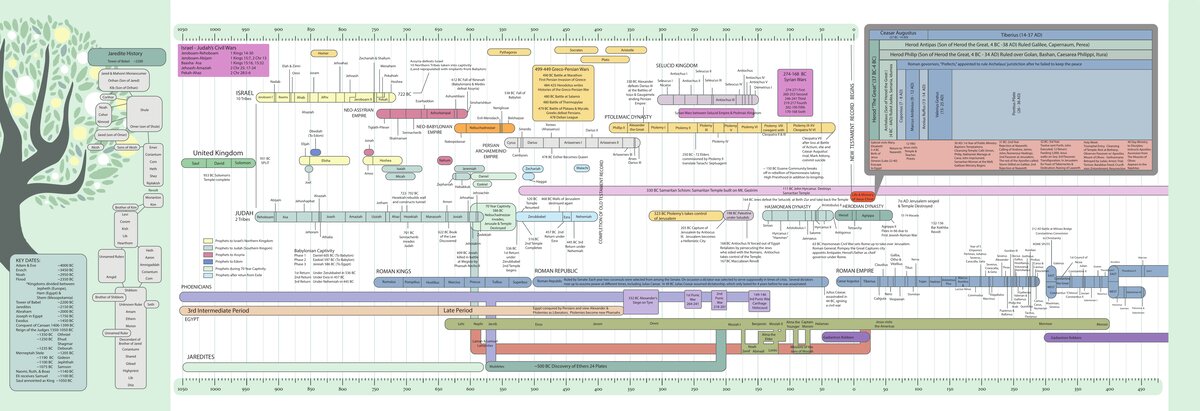
Tap to expand
Old Testament Timeline
From Creation through the Persian Period — tap the image to zoom, or download the full PDF.
Tap anywhere to close · Pinch to zoom