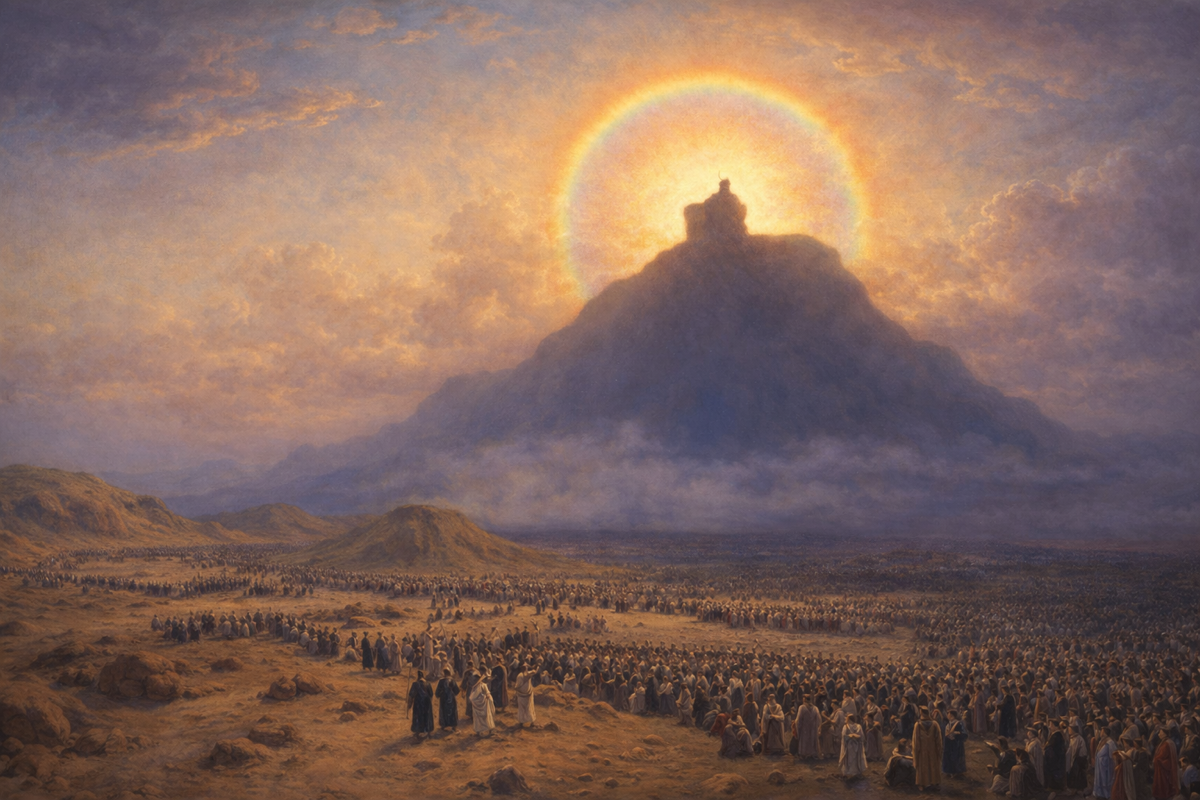
When God descended on Mount Sinai, the Torah tells us, He did not come in silence. He came in thunder, in trumpet, in a voice that shook the earth. And the people who stood at that mountain would build an entire tradition of sacred music in response to what they heard.
This article examines the Hebrew terms for every musical instrument referenced in scripture — what they were made of, how they sounded, what they meant — and traces how the Sinai encounter transformed Israel from a people who heard God’s voice into a people who were taught to imitate it — that they might learn to respond through sound. It is a companion to last week’s article on Music and the Spirit of Prophecy, which explored Miriam’s timbrel and the prophetic function of music. Where that article traced human sound ascending toward God, this one begins with divine sound descending toward humanity — and follows that echo through the instruments named in scripture, from Jubal’s lyre to the bells on the High Priest’s robe.
Estimated reading time: 25 minutes | Includes audio and video demonstrations
In This Article
- The Sound at the Mountain
- Qol: The Word That Means Both Voice and Thunder
- They Saw the Voices
- Before Sinai: Music from the Beginning
- The Instruments of Israel
- Wind: Shofar | Chatsotsrah | Ugav | Halil
- Stringed: Kinnor | Nevel
- Percussion: Tof | Metsiltayim | Mena’an’im | Pa’amon
- What Was Excluded — and Why
- Music as Prophetic Technology
- From Sinai to the Temple: Psalm 150 and the Full Orchestra
- The Sound Returns: Pentecost and the Last Trump
The Sound at the Mountain
“And it came to pass on the third day in the morning, that there were thunders and lightnings, and a thick cloud upon the mount, and the voice of the trumpet exceeding loud; so that all the people that was in the camp trembled.” (Exodus 19:16)
The Sinai theophany is the most sonically dense passage in the Torah. In the space of four verses, the text records thunder, lightning, a thick cloud, a trumpet blast of supernatural intensity, smoke, fire, earthquake, and the voice of God Himself. And then this extraordinary detail:
“And when the voice of the trumpet sounded long, and waxed louder and louder, Moses spake, and God answered him by a voice.” (Exodus 19:19)
The text tells us that no human is blowing this trumpet. It grows louder on its own — a sustained, intensifying blast from no visible source. And then, over the top of this cosmic sound, a conversation: Moses speaks, and God answers by a voice. The Hebrew text presents this as literal audible sound heard by an entire nation.
According to the biblical narrative, this moment changed everything. Israel would spend the next thousand years developing instruments, training musicians, and building a temple worship system — all in response to what they heard on this mountain.
Qol: The Word That Means Both Voice and Thunder
The Hebrew word that dominates the Sinai narrative is qol (קוֹל) — and it means both “voice” and “thunder.” The same word. When Exodus 19:16 says “there were thunders,” the Hebrew reads qolot — literally “voices.” And when Exodus 19:19 says God answered Moses “by a voice,” it uses the same word: b’qol.
This is unlikely to be an accident of vocabulary. The text seems to be telling us something theological: for those at Sinai, the thunder and God’s voice were one and the same. The people could not distinguish between the sky breaking apart and God speaking. In the biblical account, the natural and the supernatural were fused in a single sonic event.
The word qol appears over 500 times in the Old Testament. It is the sound of God walking in the garden (Genesis 3:8), the sound of Abel’s blood crying from the ground (Genesis 4:10), the “still small voice” that came to Elijah after the earthquake and fire (1 Kings 19:12). It is the medium through which God communicates — and the medium through which Israel would learn to communicate back.
They Saw the Voices
“And all the people saw the thunderings, and the lightnings, and the noise of the trumpet, and the mountain smoking.” (Exodus 20:18)
The Hebrew here uses a visual verb — ro’im (רֹאִים, “seeing”) — for an auditory event. The people saw the thunderings. The people saw the sound of the trumpet.
The early rabbinic commentary (Mekhilta de-Rabbi Ishmael on Exodus 20:18) seizes on this: “They saw what is normally heard, and they heard what is normally seen.” The rabbis understood this to mean the Sinai revelation was so overwhelming that the senses crossed. Sound became visible. Light became audible. The boundaries between perception and reality dissolved in the presence of the living God.
This synesthetic description suggests something about the nature of divine communication. Scripture presents God’s word as more than information delivered through one channel — it is a total experience, felt in the body, seen with the eyes, heard in the bones. The rabbis taught that this is why Torah was given in the wilderness, in the open, under the sky — because no building, no single sense, no single language could contain what God was saying.
The midrash extends this further:
“The voice went forth and was divided into seventy languages, so that all nations heard it.” (Exodus Rabbah 5:9)
“The voice went forth according to each person’s capacity — elders heard according to their strength, young men according to theirs, children, women, and Moses each heard according to their capacity.” (Exodus Rabbah 29:9)
In this rabbinic reading, God’s voice at Sinai was both universal (all languages) and personal (each according to capacity) — one voice, infinitely adapted.
Before Sinai: Music from the Beginning
Music did not begin at Sinai. The first musician recorded in scripture appears in Genesis:
“And his brother’s name was Jubal: he was the father of all such as handle the kinnor and ugav.” (Genesis 4:21)
Jubal, son of Lamech, is credited as the ancestor of all stringed (kinnor) and wind (ugav) instrument players. Music is presented as one of the foundational human arts, alongside agriculture (Jabal) and metalwork (Tubal-cain) — all in the line of Cain. Instruments existed long before Israel existed.
But Sinai transformed their purpose. Before the mountain, music was a human art — beautiful, expressive, but horizontal. After the mountain, the biblical narrative presents music as a response to revelation. Israel had heard the voice of God, and from that moment forward, their instruments would be tuned to answer it.
Miriam’s timbrel at the Red Sea (Exodus 15:20) — explored in our companion article, Music and the Spirit of Prophecy — bridges these two moments. She played after deliverance but before Sinai. Her prophetic music anticipated what the mountain would confirm: that sound is a medium of covenant.
The Instruments of Israel
1 / 10 — Shofar (שׁוֹפָר) — Ram's Horn
Click image to jump to section | Use arrows to browse
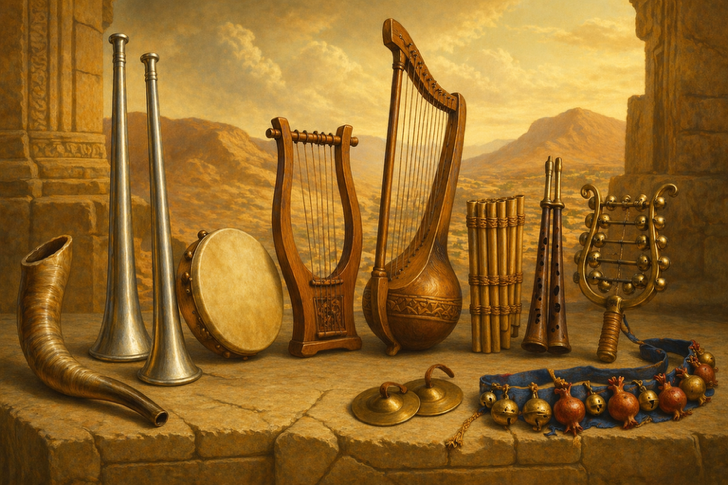
What follows is a survey of every named musical instrument in the Hebrew Bible, examined through its Hebrew term, physical construction, scriptural role, and theological significance. These instruments fall into three families that the ancient world universally recognized:
- Wind instruments (aerophone): shofar, chatsotsrah, ugav, halil
- Stringed instruments (chordophone): kinnor, nevel
- Percussion (idiophone/membranophone): tof, metsiltayim, mena’an’im, pa’amon
Wind Instruments
The Shofar — Ram's Horn
Hebrew: שׁוֹפָר (shofar)
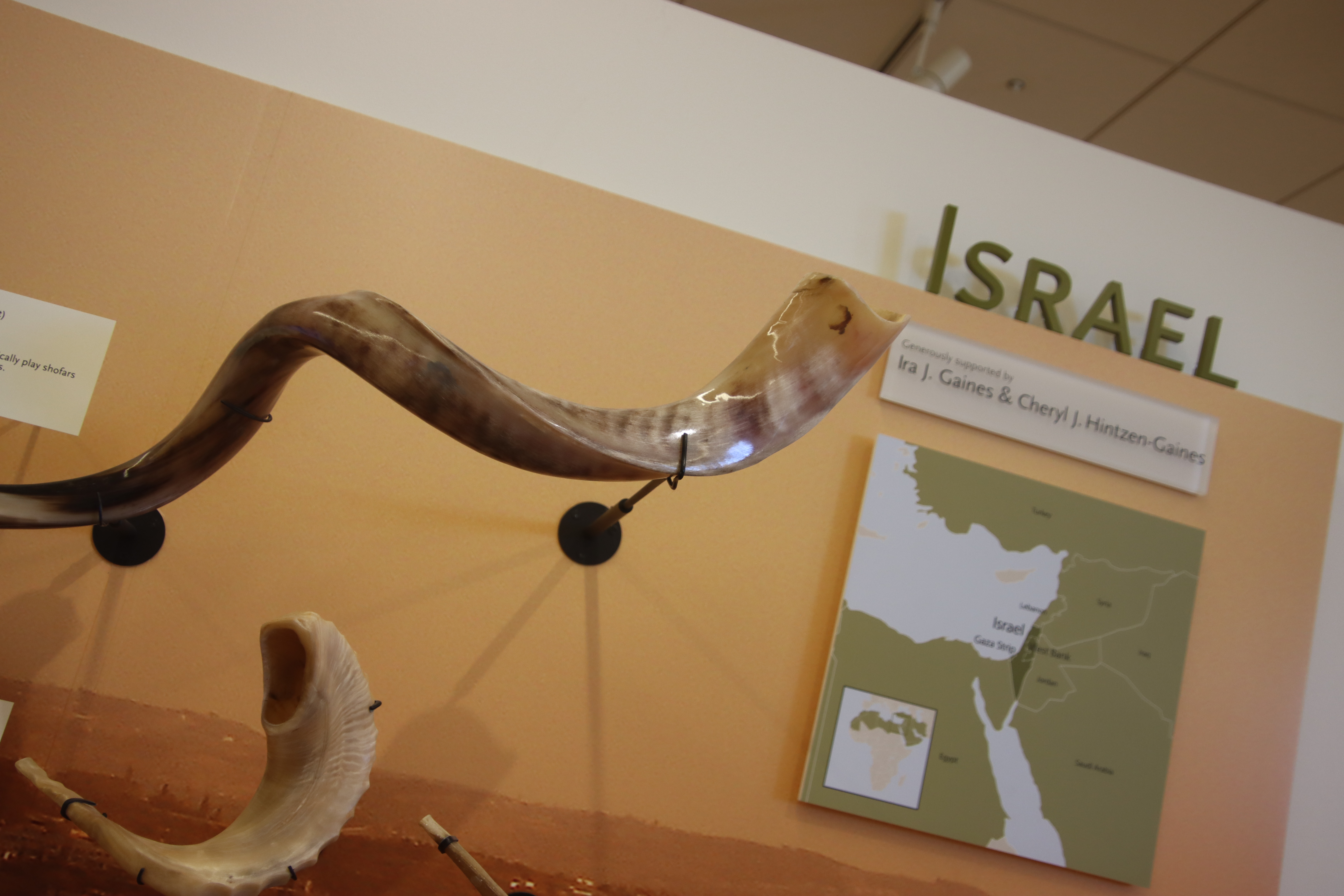
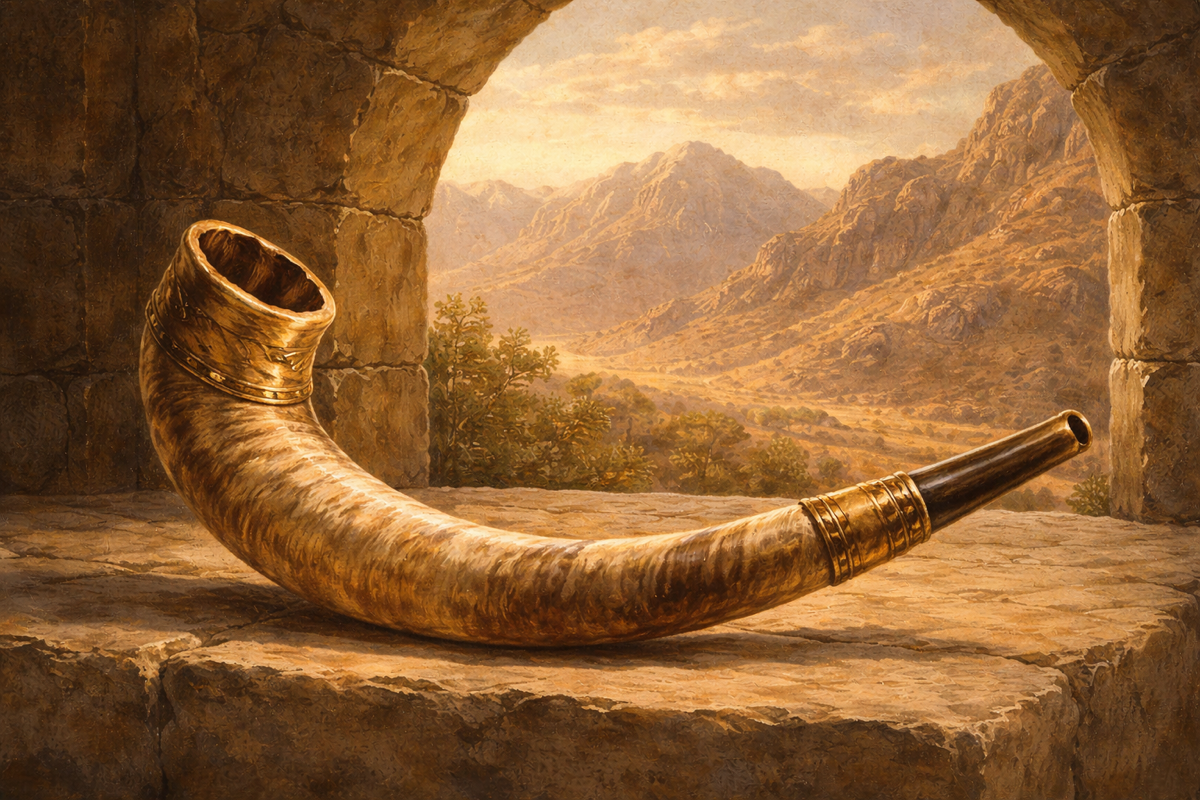
What it is: The shofar is a natural horn, most commonly from a ram (ayil), though horns of other kosher animals (ibex, antelope, kudu) are also used. Unlike crafted instruments, the shofar receives almost no human modification — the horn is hollowed, sometimes heated and shaped slightly, but it remains fundamentally an animal horn. It has no finger holes, no mouthpiece, no keys. The player shapes the sound entirely with the lips and breath.
This raw, unrefined quality is theologically significant. The shofar is the most “natural” of all instruments — the least shaped by human craft. According to the text, it is the instrument through which God announced His presence at Sinai.
It may also be significant that the shofar is specifically a ram’s horn. The ram appears at a pivotal moment in scripture: caught in the thicket on Mount Moriah, provided by God as a substitute for Isaac (Genesis 22:13). Jewish tradition connects the two — the ram of the Akedah (the binding of Isaac) and the shofar of Sinai — seeing in the ram’s horn an echo of that earlier sacrifice, a reminder of the covenant God made with Abraham on the very mountain where the Temple would one day stand. Every blast of the shofar may carry within it the memory of the ram who took Isaac’s place — a type of the Savior Himself.
The sound: The shofar produces a limited range of sounds, classified in Jewish tradition into three calls:
- Tekiah — a single sustained blast
- Shevarim — three medium wailing blasts
- Teruah — nine rapid staccato blasts
These are not melodies. They are signals — calls to attention, alarm, repentance, and assembly.
In scripture:
- Sinai — the divine shofar “sounded long, and waxed louder and louder” (Exodus 19:19). No human hand held it.
- Jericho — seven priests blew seven shofars for seven days; on the seventh day the walls fell (Joshua 6:4)
- Rosh Hashanah — the “day of blowing” (Numbers 29:1); the shofar calls Israel to repentance
- Jubilee — the shofar proclaimed liberty throughout the land every fiftieth year (Leviticus 25:9-10)
- The Second Coming — “the Lord himself shall descend from heaven with a shout, with the voice of the archangel, and with the trump of God” (1 Thessalonians 4:16)
From the Talmud: The rabbis taught that a cow’s horn may never serve as a shofar — “a prosecutor cannot become an advocate” (Rosh Hashanah 26a). Because the Golden Calf was made from the people’s gold to resemble a young bull, no horn from a cow may plead for Israel’s mercy. Sound carries the memory of what it was.
The Talmud also identifies the teruah blast — the rapid, broken cry of the shofar — with the weeping of Sisera’s mother, who looked through her window and wailed for a son who would never return (Judges 5:28; Rosh Hashanah 33b). The shofar’s broken sound channels the most primal human grief — a mother’s cry. And the blast-pattern itself — tekiah (sustained), teruah (broken), tekiah (sustained) — enacts a theology of restoration: wholeness, brokenness, wholeness restored.
Perhaps most remarkably, the Talmud declares that because the shofar is sounded “for remembrance” before God, it has the legal status of being inside the Holy of Holies — even though the instrument physically remains outside (Rosh Hashanah 26a). In this rabbinic understanding, sound transcends space — the shofar’s vibration penetrates the most sacred enclosure on earth.
The arc: The shofar that sounded at Sinai is the same instrument that will sound at the end of days. From the first covenant to the last gathering, the ram’s horn marks the moments when God breaks into human history.
The Chatsotsrah — Silver Trumpet
Hebrew: חֲצוֹצְרָה (chatsotsrah)
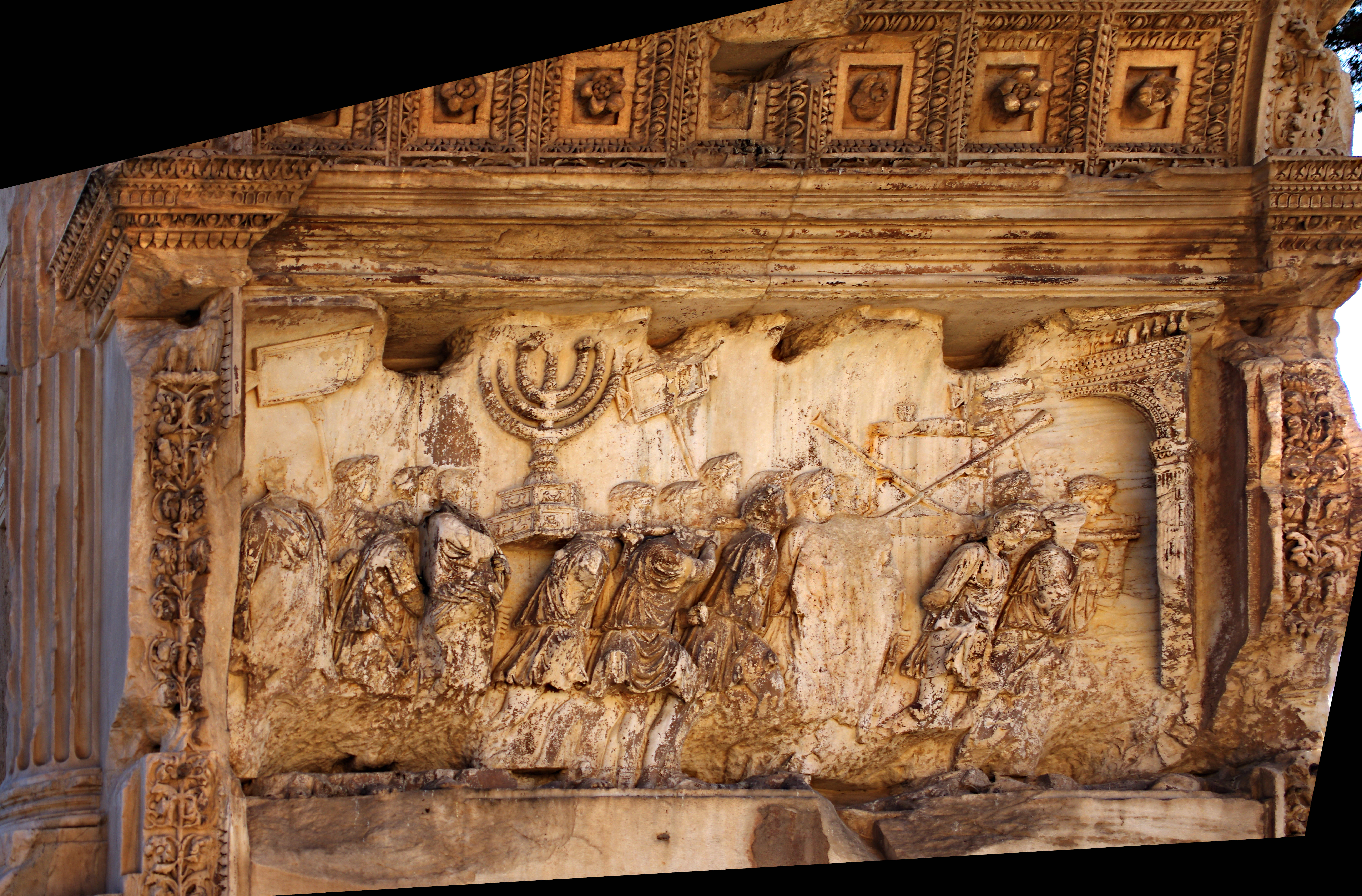
What it is: Unlike the natural shofar, the chatsotsrah was a crafted instrument — a long, straight trumpet made of hammered silver. God commanded Moses to make exactly two of them:
“Make thee two trumpets of silver; of a whole piece shalt thou make them: that thou mayest use them for the calling of the assembly, and for the journeying of the camps.” (Numbers 10:2)
The specification “of a whole piece” (miqshah) means each trumpet was hammered from a single sheet of silver — no joints, no welds, no seams. The same word describes the construction of the golden lampstand (menorah) in Exodus 25:31. These were sacred instruments, crafted to the same standard as tabernacle furniture.
The distinction: The shofar is a natural instrument that God Himself sounded at Sinai. The chatsotsrah is a crafted instrument that God commanded humans to make. Together they represent both sides of divine-human communication: God speaks (shofar), and humanity responds with instruments of their own making (chatsotsrah) — but even the human instruments are made according to God’s design.
In scripture:
- Assembly and march — different trumpet calls signaled different actions: one trumpet gathered leaders, two gathered the congregation, alarm blasts set camps in motion (Numbers 10:1-10). This established the foundation for using music as organized communication. Certain rhythms and cadences carried specific meaning — a vocabulary of sound. It is worth noting that the Levites, the song leaders of the Temple, also served as captains of the guard (1 Chronicles 9:26-27). Their training in music equipped them to develop and execute a sophisticated system of communication across the massive Israelite camps. We see this leadership structure preserved in the Psalms, where dozens of psalms are attributed to “the chief musician” (lamnatseach) — a title that speaks to both musical direction and organized command (e.g., Psalm 4, Psalm 6, Psalm 12).
- War — blown before battle as a plea for God to remember His people (Numbers 10:9). The trumpets served both symbolic and practical purposes on the battlefield — functioning as a kind of ancient signal code, with distinct calls directing troop movements and coordinating strategy. This gave Israel a significant tactical advantage. And notably, every time the Ark of the Covenant was carried — whether in battle or in procession — music is specifically mentioned alongside it (Joshua 6:4; 2 Samuel 6:5; 1 Chronicles 15:28). The sound protected the Ark by organizing the people around it, and it signaled God’s presence in their midst.
- Temple worship — played by priests during sacrifices and at feasts (2 Chronicles 5:12-13). Music was also how the priests taught Torah. In a world without printing presses, where books and manuscripts were rare and costly, most Israelites learned the scriptures through song. Setting words to melody aids memory and retention — the same principle at work when Primary children learn gospel truths through singing time. And in a world without microphones, music served as amplification: the coordinated voices and instruments of the Levitical choir could carry the words of God across the temple courts to thousands of gathered worshippers.
In the Temple: The Talmud establishes a precise numerical framework for the daily Temple trumpets: no fewer than twenty-one blasts per day (3 for the opening of the gates, 9 for the morning offering, 9 for the afternoon offering), and no more than forty-eight on any single day (Arakhin 10a). The daily minimum of 21 = 3 × 7 — the number of creation perfected through sacred sound.
At the dedication of Solomon’s Temple, the number reached its maximum: 120 priests sounding silver trumpets in unison (2 Chronicles 5:12; Arakhin 13b). 120 = 12 × 10 — the cosmic structure of Israel (twelve tribes) multiplied by divine completeness (ten).
The tractate Tamid preserves the exact choreography: two priests stood at the marble table with two silver trumpets and sounded tekiah-teruah-tekiah. At that signal, the Levites began their psalm. At each section-break in the psalm, another trumpet blast; at each blast, the people prostrated themselves (Tamid 33b). Libation, cloth-wave, cymbal, song, trumpet, prostration — every movement in the Temple was orchestrated through sound.
Historical note: The most famous depiction of the chatsotsrah appears on the Arch of Titus in Rome (81 CE), shown in the image above. The relief shows Roman soldiers carrying the temple vessels — including two long, straight silver trumpets — in triumphal procession after the destruction of Jerusalem in 70 CE. It is one of the few surviving visual records of an actual biblical instrument.
The Ugav — Pipe
Hebrew: עוּגָב (ugav)
What it is: The ugav is one of the most ancient instruments mentioned in scripture — attributed to Jubal alongside the kinnor in Genesis 4:21. The exact identification is debated, but it most likely refers to a simple reed pipe or panpipe — a wind instrument made from hollowed reeds of varying lengths bound together, or a single reed with finger holes.
The ugav appears only four times in the Old Testament, always in contexts of general music-making rather than formal worship. It seems to represent the pastoral, folk tradition of music — the instrument of shepherds and common people rather than Levitical professionals.
In scripture:
- Jubal — “father of all such as handle the kinnor and ugav” (Genesis 4:21)
- Job — “They take the tof and kinnor, and rejoice at the sound of the ugav” (Job 21:12)
- Psalm 150 — “Praise him with stringed instruments and the ugav” (Psalm 150:4)
The Halil — Flute
Hebrew: חָלִיל (halil)
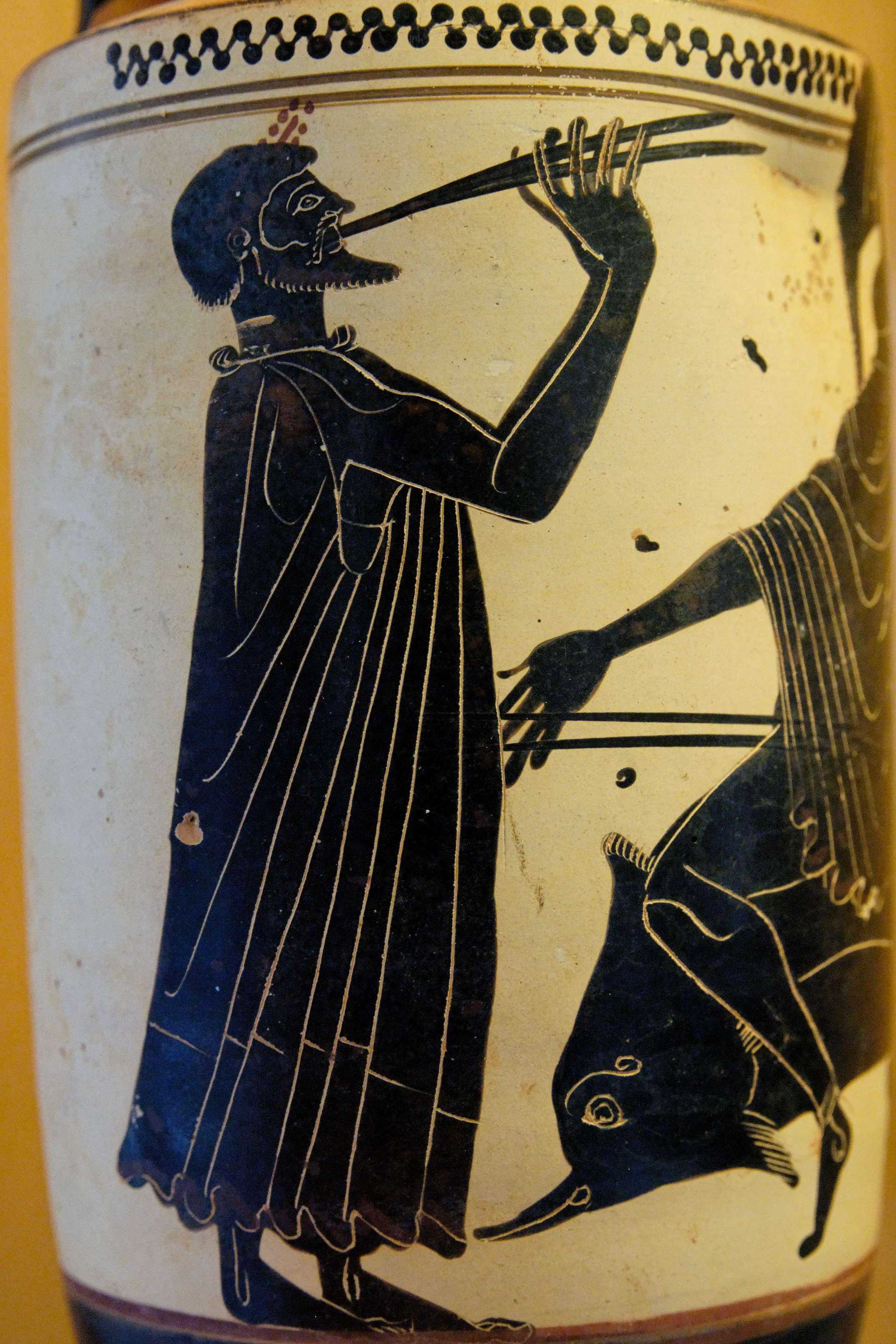
What it is: The halil derives from the root chalal (חלל, “to bore, to pierce”), describing how the instrument was made: a tube bored through wood, bone, or reed. It was most likely a double-pipe instrument (similar to the Greek aulos) — two parallel reed pipes played simultaneously, capable of producing a haunting, penetrating sound with overtones.
The halil was associated with both intense joy and deep mourning — its piercing tone suited both contexts. It appears in celebrations, coronations, and funeral laments.
In scripture:
- Solomon’s coronation — “And all the people came up after him, and the people piped with halilim, and rejoiced with great joy, so that the earth rent with the sound of them” (1 Kings 1:40)
- Pilgrimage — played during the ascent to Jerusalem for feasts (Isaiah 30:29)
- Mourning — Jesus found “the minstrels” (flute players) at Jairus’s house (Matthew 9:23)
In the Temple: The Talmud specifies that the Temple maintained no fewer than two flutes and no more than twelve. These flutes were played on just twelve specific days per year — the days when worshippers recited the full Hallel (Arakhin 10a). The number twelve governed both how many flutes could play and when they played, tying the instrument directly to the liturgical calendar.
The parable of the gold-plated flute: The Talmud preserves a remarkable story about one of these Temple flutes. It was smooth, thin, and made of simple reed — and it had been in the Temple since the days of Moses. At some point, a king ordered the flute plated with gold, presumably to honor it. But once the gold was applied, the flute’s sound was no longer pleasant. When they removed the plating, its original tone returned (Arakhin 10b).
The Talmud pairs this with two similar stories: a copper cymbal that lost its sound after being repaired by Alexandrian craftsmen, and the Siloam pool whose flow decreased when its opening was widened by royal command. The lesson the Talmud draws is consistent across all three: the original design, given by God, resists human “improvement.” Simplicity preserved what embellishment destroyed.
Stringed Instruments
The Kinnor — Lyre
Hebrew: כִּנּוֹר (kinnor)
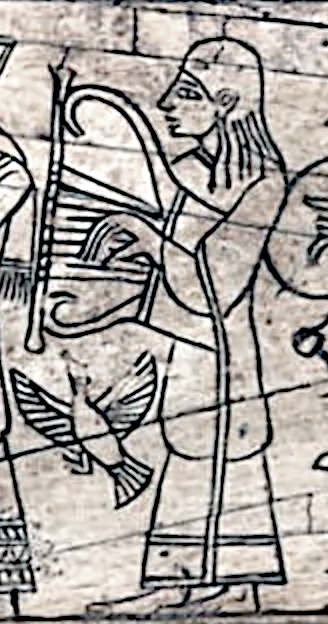
What it is: The kinnor is a portable stringed instrument — a lyre, not a harp (despite the KJV translation). It consisted of a wooden frame (often of cypress or sandalwood) with strings stretched between two arms connected by a crossbar. The strings were made from animal gut. The player held the instrument against the body and plucked the strings with both hands or with a plectrum.
The kinnor was the premier instrument of ancient Israel. It was the instrument of David, the instrument of the Levitical temple musicians, and the instrument the exiles hung on the willows of Babylon when they could no longer sing the Lord’s song (Psalm 137:2).
Archaeological evidence from the ancient Near East, including a famous ivory carving from Megiddo (c. 1350-1150 BCE), depicts a lyre player in a procession — likely close to what the Israelite kinnor looked like.
In scripture:
- Jubal — the first kinnor player (Genesis 4:21)
- David before Saul — “David took a kinnor, and played with his hand: so Saul was refreshed, and was well, and the evil spirit departed from him” (1 Samuel 16:23)
- Prophetic bands — “a company of prophets… with a psaltery, and a timbrel, and a pipe, and a kinnor” (1 Samuel 10:5)
- Temple dedication — played by Levitical musicians when the glory of the Lord filled the temple (2 Chronicles 5:12)
- Exile — “We hanged our kinnors upon the willows… How shall we sing the LORD’s song in a strange land?” (Psalm 137:2-4)
The harp’s strings and the ages of the world: The Talmud records a remarkable teaching about the kinnor’s strings: the Temple harp had seven strings; in the Messianic age it will have eight; in the World-to-Come, ten (Arakhin 13b). Rabbi Yehuda derives each from Scripture — seven from “In Your presence is fullness (sova / seven) of joy” (Psalm 16:11); eight from “On the eighth” (Psalm 12:1); ten from “With an instrument of ten strings” (Psalm 92:4).
The progression 7 → 8 → 10 maps the unfolding of cosmic history: Creation (seven days), Messianic redemption (eight — transcending the natural order), and the World-to-Come (ten — divine completeness). The instrument itself measures the ages of the world. As more strings are added, the music grows richer — the song of redemption will be fuller than anything the Temple ever heard.
The wind-played harp: The Zohar preserves a mystical tradition about David’s kinnor: it was played not only by human hands but by the cosmic north wind itself. “King David rose and praised the Holy King. He was studying Torah at the moment when the north wind rose and touched the strings of his harp, so that it made music” (Zohar, Yitro). The wind, the harp, and David each sang different parts of a unified cosmic hymn. The kinnor becomes a receiver — tuned to catch the ruach (wind/spirit/breath) and transform it into praise.
Theological note: The kinnor is the instrument of both healing and lament. David played it to drive away Saul’s tormenting spirit; the exiles hung it in silence when they could not worship. It represents the full range of the human response to God — from ecstatic praise to grief too deep for song.
The Nevel — Harp
Hebrew: נֵבֶל (nevel)
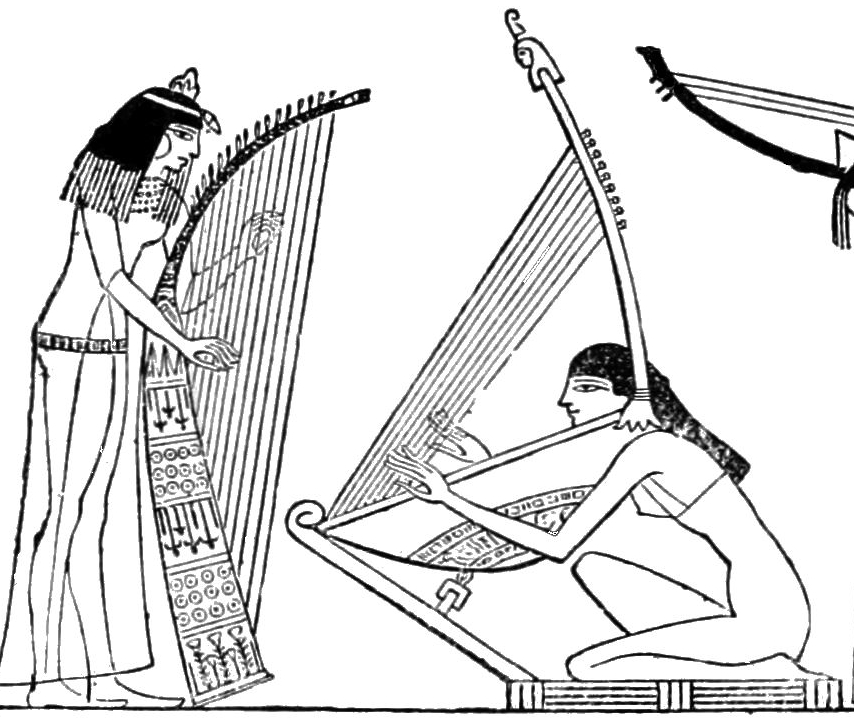
What it is: The nevel was larger than the kinnor, with more strings and a deeper, more resonant tone. The term likely refers to a vertical angular harp — an instrument where the strings run at an angle from a resonating body to a curved neck. The word nevel also means “skin bottle” or “jar,” suggesting the instrument may have had a bulbous resonating chamber resembling a wineskin.
Where the kinnor was portable and personal (David carried his), the nevel was more suited to formal worship settings. It required greater skill and was associated with the trained Levitical musicians.
In scripture:
- Prophetic bands — listed alongside the kinnor, tof, and halil (1 Samuel 10:5)
- Levitical musicians — appointed to “prophesy with harps, with psalteries, and with cymbals” (1 Chronicles 25:1)
- Psalm 150 — “Praise him with the psaltery and harp” (Psalm 150:3)
- Revelation — the heavenly elders hold harps of God (Revelation 15:2)
In the Temple ensemble: The Talmud specifies that the minimum Temple ensemble included no fewer than two nevels and no more than six (Arakhin 10a). The full minimum Levitical platform required twelve musicians: nine kinnors, two nevels, and one cymbal (Arakhin 13b). The nevel’s deeper, more resonant voice provided the harmonic foundation beneath the kinnor’s melody — a bass register anchoring the sacred sound.
Percussion
The Tof — Timbrel
Hebrew: תֹּף (tof)
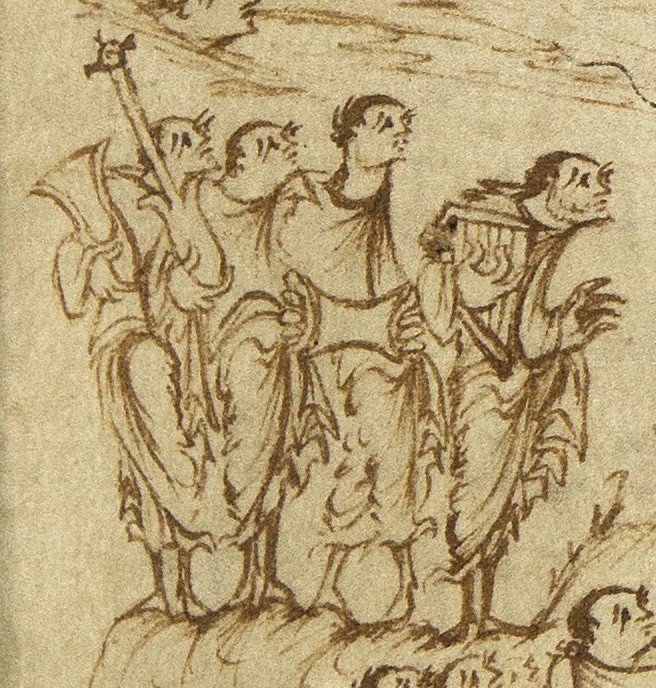
What it is: A small, handheld frame drum — a wooden or bone hoop with an animal skin stretched over one side. Unlike modern tambourines, the ancient tof probably did not have metal jingles (those are a later development). It was played by striking with the hand, producing a sharp, rhythmic beat.
The tof was characteristically played by women in ancient Israel — particularly in celebrations of military victory and religious festivals. It was portable, requiring no specialized training, and its percussive rhythm could organize large groups in communal dance and song.
In scripture:
- Miriam — “took a timbrel in her hand; and all the women went out after her with timbrels and with dances” (Exodus 15:20)
- Jephthah’s daughter — came out to meet her father “with timbrels and with dances” (Judges 11:34)
- David’s procession — played when the Ark was brought to Jerusalem (2 Samuel 6:5)
- Psalm 150 — “Praise him with the timbrel and dance” (Psalm 150:4)
Connection to Miriam article: The tof is the instrument that links this article to its companion. Miriam’s timbrel at the Red Sea was the first recorded act of musical worship after the Exodus — and it was prophetic, not merely celebratory. See Music and the Spirit of Prophecy for the full treatment.
The Metsiltayim — Cymbals
Hebrew: מְצִלְתַּיִם (metsiltayim)
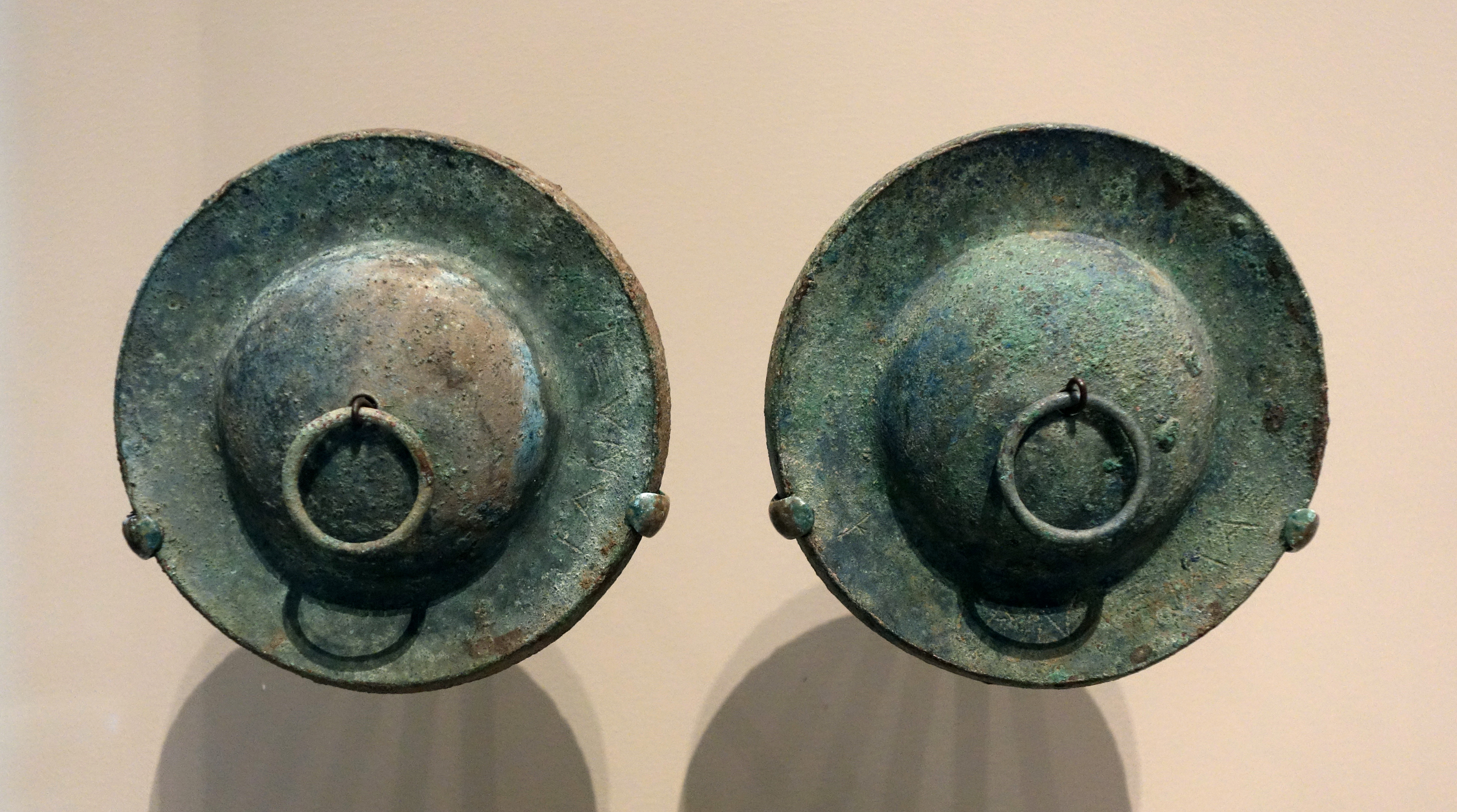
What it is: Bronze cymbals, always mentioned in the dual form (-ayim) — they come in pairs. Archaeological finds from the Levant show two types: smaller “finger cymbals” (3-4 inches, held between thumb and finger) and larger “clash cymbals” (held in each hand and struck together). The Hebrew root tsalal means “to tinkle, to ring, to clang.”
Cymbals were exclusively instruments of formal worship — they do not appear in secular or folk contexts. They were played only by Levitical musicians and only in the temple or in processions connected to the Ark.
In scripture:
- Levitical worship — “Asaph made a sound with cymbals” (1 Chronicles 16:5)
- Prophetic function — Levites were appointed “to prophesy with harps, psalteries, and cymbals” (1 Chronicles 25:1)
- Temple dedication — part of the ensemble when the glory of the Lord filled Solomon’s temple (2 Chronicles 5:12-13)
- Psalm 150 — “Praise him upon the loud cymbals: praise him upon the high sounding cymbals” (Psalm 150:5)
In the Temple: The Talmud specifies that the cymbal was played alone — only one pair, never more — and only one Levite played it (Arakhin 13b). The tractate Tamid names him: ben Arza, whose cymbal strike was the signal that initiated the entire Levitical song (Tamid 33b). One man, one instrument, one strike — and the song of the Temple began. The cymbal was not part of the melody; it was the trigger. The starting gun of sacred sound.
The Talmud also records that the Temple cymbal was once damaged and repaired by Alexandrian craftsmen — but after the repair, its sound was no longer pleasant. They removed the foreign material, and the sound returned to what it had been (Arakhin 10b). Like the gold-plated flute, the original could not be improved.
Paul’s echo: “Though I speak with the tongues of men and of angels, and have not charity, I am become as sounding brass, or a tinkling cymbal” (1 Corinthians 13:1). Paul uses the cymbal — an instrument of temple worship — as his metaphor for form without substance. Even the most sacred instrument becomes noise without love.
The Mena'an'im — Sistra
Hebrew: מְנַעַנְעִים (mena’an’im)
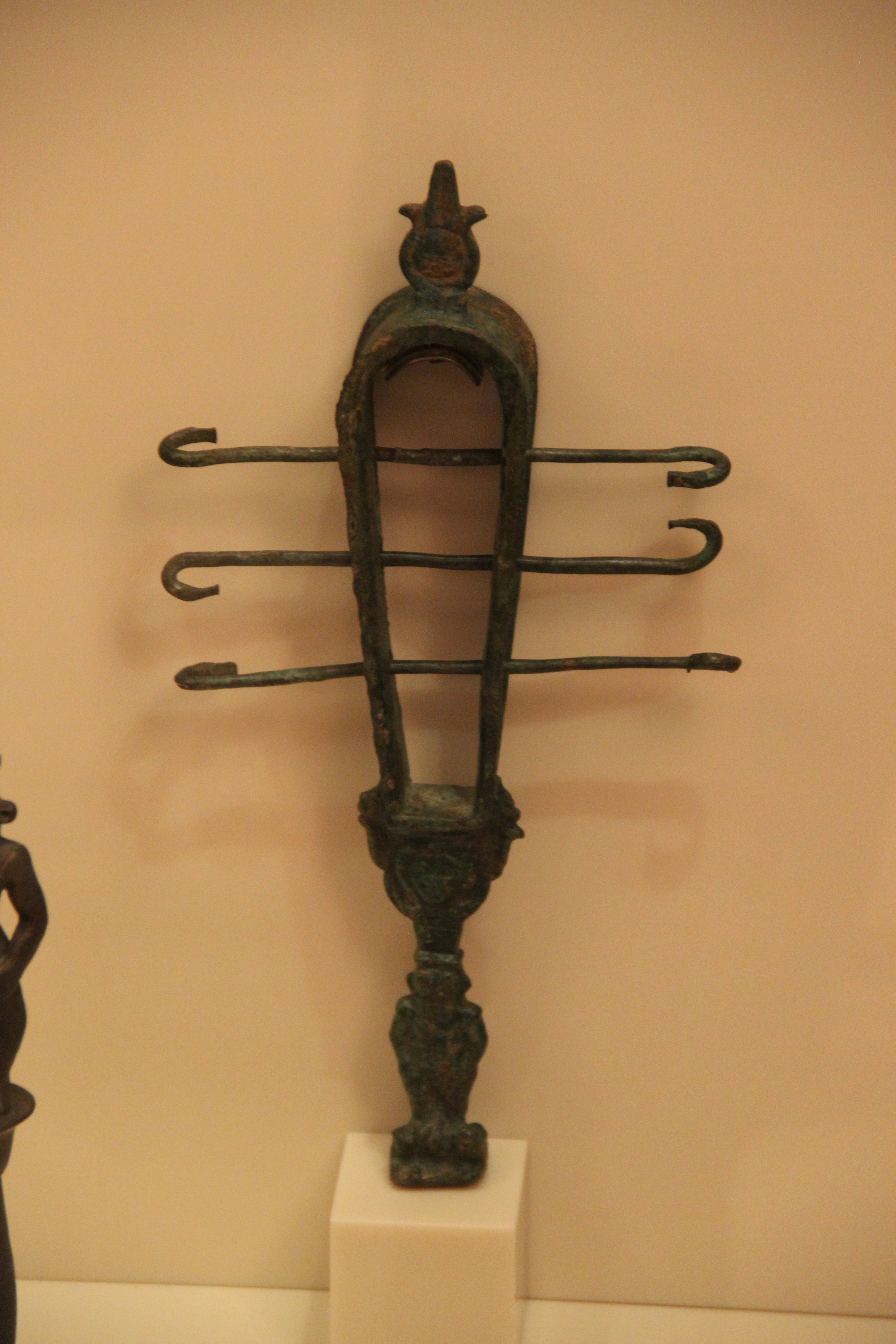
What it is: The mena’an’im appears only once in scripture (2 Samuel 6:5). The term derives from the root nua (נוע, “to shake, to wave”) and most likely refers to a sistrum — a U-shaped metal frame with crossbars threaded through metal discs that rattle when shaken. The Egyptian sistrum is well-documented archaeologically and was widely used throughout the ancient Near East.
The sistrum’s shaking, rattling sound was associated with joyful celebration and, in Egyptian religion, with driving away evil. Its appearance in David’s Ark procession suggests Israel adopted and repurposed the instrument for YHWH worship.
The Pa'amon — Bells of the High Priest
Hebrew: פַּעֲמוֹן (pa’amon)
What it is: Small golden bells attached to the hem of the High Priest’s robe, alternating with embroidered pomegranates:
“A golden bell and a pomegranate, a golden bell and a pomegranate, upon the hem of the robe round about. And it shall be upon Aaron to minister: and his sound shall be heard when he goeth in unto the holy place before the LORD, and when he cometh out, that he die not.” (Exodus 28:34-35)
The pa’amon is the only instrument that is worn rather than played. It is the only instrument that sounds involuntarily — the High Priest does not choose to ring the bells; they ring simply because he is moving. And the text gives an extraordinary reason for their presence: “that he die not.”
Theological significance: The bells serve as an audible signal that the priest is alive and moving within the Holy Place. The congregation outside cannot see the High Priest once he enters — they can only hear him. Sound becomes the evidence of life, the assurance that the mediator is still interceding.
The alternation of bells and pomegranates — sound and silence, gold and embroidery — creates a rhythm in the priest’s very garment. Every step produces a pattern. The High Priest’s movement through the sacred space is, quite literally, music.
The pairing may carry an even deeper echo. Pomegranates, with their burst of seeds radiating from a central point, have long been associated with the image of lightning. If the pomegranates evoke lightning and the bells evoke thunder, then the hem of the High Priest’s robe reenacts the Sinai theophany itself — the same combination of qolot (thunderings) and beraqim (lightnings) that shook the mountain in Exodus 19:16. Each time the High Priest enters the Holy Place, his garment carries the memory of Sinai into the sacred space.
What Was Excluded — and Why
Not every instrument entered the Temple. The Talmud records two revealing exclusions:
The hydraulic organ (hirdolim) — Despite producing a pleasant sound, the hydraulic organ was banned from the Temple “because its sound disrupts the melody” (Arakhin 10b). A sound that is individually beautiful but overwhelms the harmonic balance of the ensemble was excluded. The Temple required integration, not volume. Sacred worship is not a solo performance.
The magreifa — This mysterious Temple instrument had ten holes, each producing ten types of tone — one hundred tones in total (or one thousand, according to a baraita that the Talmud notes “exaggerates”; Arakhin 10b–11a). The number ten as a generative principle: ten openings producing exponential tonal variety. Whether the magreifa was a percussion instrument, a primitive organ, or something else entirely remains debated — but its numerical symbolism is unmistakable.
These details reveal a theology of sound: the Temple was not seeking the loudest or most impressive instruments. It was seeking harmonic integrity — the right instruments in the right proportions, calibrated to produce a unified sacred sound.
Music as Prophetic Technology
The connection between music and prophecy is not incidental in scripture. It is structural. Three key passages establish that music functioned as a vehicle for the Spirit of God:
1 Samuel 10:5 — Samuel tells Saul he will meet “a company of prophets coming down from the high place with a psaltery [nevel], and a timbrel [tof], and a pipe [halil], and a harp [kinnor], before them; and they shall prophesy.” The prophetic band travels with their instruments. Music and prophecy are inseparable activities.
1 Chronicles 25:1 — David and the commanders of the army set apart Levites “who should prophesy with harps, with psalteries, and with cymbals.” The verb is explicit: they prophesied with instruments. Music was not accompaniment to prophecy; it was the medium of prophecy.
2 Kings 3:15 — When Elisha needed to prophesy, he called for a musician: “But now bring me a minstrel. And it came to pass, when the minstrel played, that the hand of the LORD came upon him.” The music created the conditions for revelation.
The Talmud enshrines this understanding in law. The rabbis asked: “From where is it derived that the primary requirement of song in the Temple applies by Torah law?” Their answer: “He shall serve with the name of the LORD his God” (Deuteronomy 18:7) — “What service is performed with the Name? This is song” (Arakhin 11a). Song is not accompaniment to the service. Song is the service — the way of serving “with the Name.” The Talmud marshals at least eight separate biblical proofs for this principle.
And the timing is precise: songs of praise were recited only over the wine libation — the moment liquid flowed onto the altar was the moment song began (Arakhin 11a; Judges 9:13). Sound and substance flow together.
These passages suggest that ancient Israel understood something about sound worth recovering: in scripture, music is not merely aesthetic. It serves as a vehicle for the Spirit — a means by which the human soul opens to divine communication. The instruments described in this article were not entertainment. They were, in the biblical understanding, prophetic tools — designed and deployed to create the conditions in which God’s voice could be heard.
From Sinai to the Temple: Psalm 150 and the Full Orchestra
Psalm 150 is the final psalm — the crescendo of the entire Psalter. It is also a catalogue of the instruments we have surveyed:
Praise him with the sound of the trumpet (shofar) Praise him with the psaltery (nevel) and harp (kinnor) Praise him with the timbrel (tof) and dance Praise him with stringed instruments and organs (ugav) Praise him upon the loud cymbals (metsiltayim) Praise him upon the high sounding cymbals (metsiltayim)
Every family of instrument is represented: wind, string, percussion. Every register: loud and soft, high and low. The psalm does not specify what to play — it specifies that everything should play. The entire created order of sound is summoned to praise.
The Talmud records what this catalogue looked like in practice. During the Water-Drawing Celebration (Simchat Beit HaShoevah) at the Feast of Tabernacles — the most joyous event in the Temple year — Levites stood on the fifteen stairs descending from the Israelites’ courtyard to the Women’s Courtyard, “with harps, lyres, cymbals, trumpets, and instruments without number” (Sukkah 51b). The fifteen stairs correspond to the fifteen Songs of Ascent (Psalms 120–134) — each stair a psalm, each psalm a step. Architecture and music unified in sacred geometry. “One who did not see the Celebration of the Water-Drawing,” the Mishna declares, “never saw celebration in his days” (Sukkah 51a).
And then the final verse: “Let every thing that hath breath praise the LORD.” The instruments fall away. In the end, the only instrument that matters is the one God gave every human being: breath. The ruach — the same word for spirit, wind, and breath — that God breathed into Adam is the ultimate instrument of praise.
But even Psalm 150’s call to total praise has its counterpoint. The Talmud asks: why is Hallel not recited on Rosh Hashanah? The ministering angels themselves posed the question. God’s answer: “Is it possible that the King sits on the throne of judgment, with the books of life and death open before Him, and Israel would sing before Me?” (Arakhin 10b). The silence of Rosh Hashanah is as theologically significant as the full orchestra of Sukkot. There are moments when the only appropriate sound is the shofar’s raw cry — and the silence that follows.
The journey from Sinai to Psalm 150 is the journey from hearing God’s voice to answering it with everything we have.
The Song Interrupted
The Talmud records that when the Temple was destroyed, the Levites were standing on their platform singing Psalm 94:23: “He brought upon them their own iniquity, and He will cut them off in their own evil” — but they did not manage to finish the verse. They never reached the words “the LORD our God will cut them off” before the enemy overwhelmed them (Arakhin 11b).
According to the Talmud, the cosmic song was interrupted mid-verse. The harmony of creation, sustained daily through the Temple’s carefully calibrated orchestra, was broken. The unfinished sentence hangs in the air — a verse waiting for its completion, a song waiting to be resumed.
The Sound Returns: Pentecost and the Last Trump
The Sinai soundscape does not end in the Old Testament. It returns — twice.
Pentecost (Acts 2)
“And suddenly there came a sound from heaven as of a rushing mighty wind, and it filled all the house where they were sitting. And there appeared unto them cloven tongues like as of fire, and it sat upon each of them.” (Acts 2:2-3)
Wind. Fire. Sound from heaven. The elements of Sinai — and still on a mountain. The apostles were gathered on Mount Moriah, the Temple Mount, the “mountain of the LORD.” What was given on stone tablets at Sinai is now given on hearts of flesh at Pentecost, but the setting echoes: God speaks from a mountain, with fire and sound. The medium has changed (external law becomes internal Spirit), but the sonic signature is identical. God still announces His presence with sound.
And then the apostles speak in every language — recalling the midrashic tradition that God’s voice at Sinai divided into seventy languages so all nations could hear.
The Last Trump
“For the Lord himself shall descend from heaven with a shout, with the voice of the archangel, and with the trump of God.” (1 Thessalonians 4:16)
“In a moment, in the twinkling of an eye, at the last trump: for the trumpet shall sound, and the dead shall be raised incorruptible.” (1 Corinthians 15:52)
Scripture teaches that the shofar that sounded at Sinai — that grew louder and louder with no human hand — will sound again. The first trump gathered Israel at the mountain. The last trump, Paul writes, will gather all of God’s children from every nation, kindred, tongue, and people.
From the first note at Sinai to the last note at the Second Coming, scripture presents a God who speaks in sound. And when His covenant people lift their voices in worship — whether with the silver trumpets of the temple or the hymns we sing on Sunday morning — they join a tradition that began when an entire nation heard a voice from the mountain and answered: “All that the LORD hath spoken we will do” (Exodus 19:8).
The Hebrew word for praise — hallel (הלל) — carries a double meaning: “to praise” and “to shine, to radiate light.” It is the root of tehillim, the Hebrew name for the book of Psalms — literally, “praises” or “radiances.” To praise God is to shine. The word itself suggests that human song, offered upward, returns as light — a crown of radiance on the head of the singer.
Perhaps this is why the Lord told Emma Smith: “For my soul delighteth in the song of the heart; yea, the song of the righteous is a prayer unto me, and it shall be answered with a blessing upon their heads” (D&C 25:12). The promise given to Emma echoes the promise given at Sinai: respond to God’s voice, and His radiance will rest upon you. The song that ascends in praise returns as a crown of light — hallel becoming halo. From the mountain to the hymnal, the covenant of sound endures.
For Your Study
Reflection Questions
The shofar’s tekiah-teruah-tekiah pattern enacts wholeness, brokenness, and restoration. Where do you see that pattern in your own life or in the plan of salvation?
The Talmud teaches that the gold-plated flute lost its sound — the original design could not be improved. What might this teach us about how God works with us?
The High Priest’s bells announced that the mediator was still alive and interceding. How does this connect to Christ’s role as our High Priest (Hebrews 7:25)?
The Lord told Emma Smith that “the song of the righteous is a prayer unto me” (D&C 25:12). How has music served as prayer in your own worship?
Of the ten instruments surveyed in this article, which one’s story speaks most to you — and why?
Continue Exploring
Miriam's timbrel and the prophetic function of music in ancient Israel.
From Sinai to Pentecost — the feast that remembers the giving of the Torah.
How Hebrew says "I am the LORD your God" without a verb — and why it matters.
Week 17 Study Guide | CFM Corner | OT 2026