Understanding Your Old Testament
How four traditions organize the same scriptures — and why it matters for your study
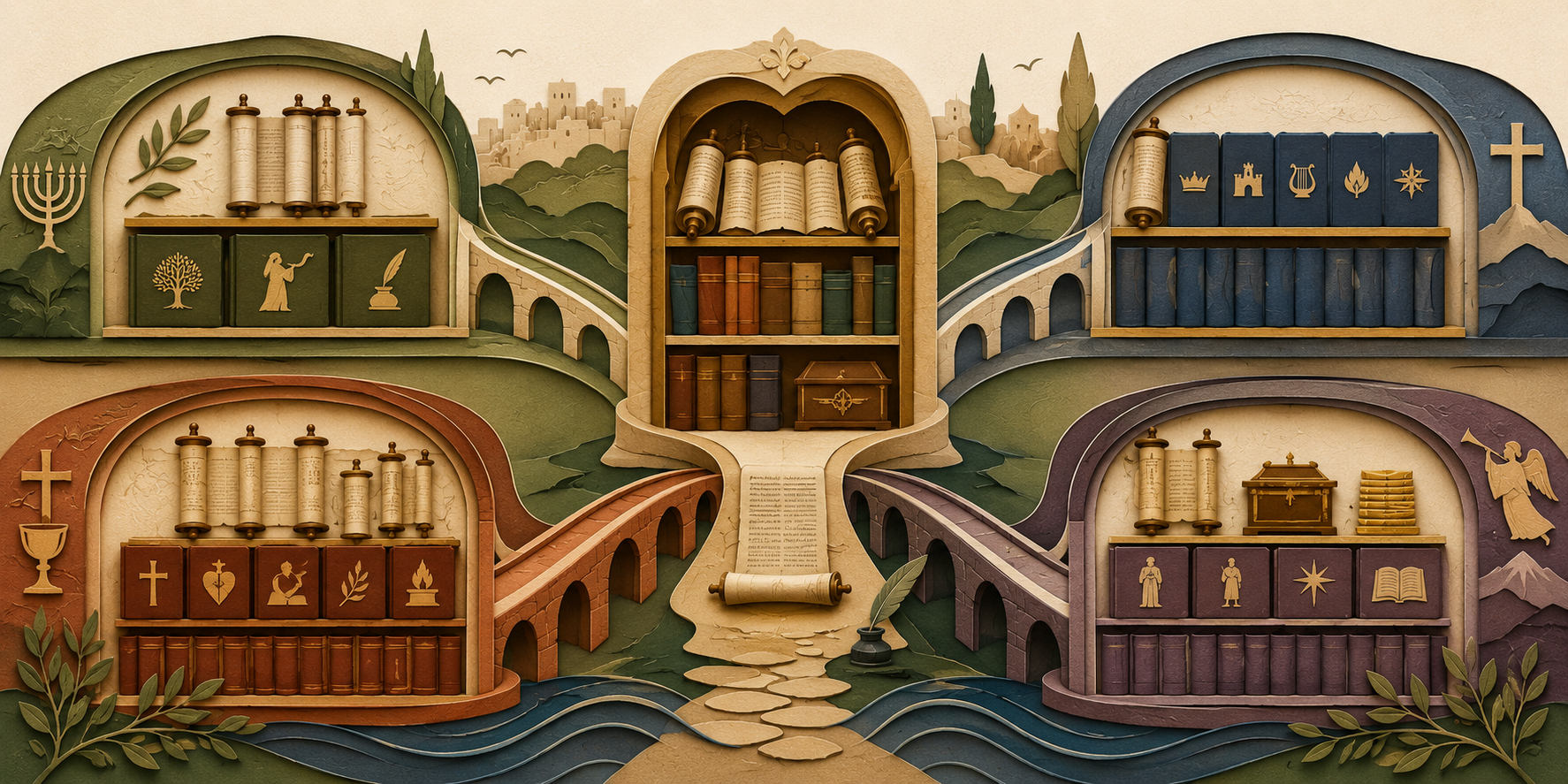
The book you hold when you open the Old Testament is not a single document. It is a library — assembled, arranged, and bounded differently by different communities of faith over thousands of years. The same ancient texts appear in the Jewish Tanakh, the Protestant Old Testament, the Catholic Bible, and the Latter-day Saint canon — but they are organized differently, counted differently, and in some cases supplemented differently. Understanding these arrangements is not an exercise in trivia. It changes how you read the story, what you expect it to say, and where you look for its meaning.
The Jewish Tanakh: A Library in Three Rooms
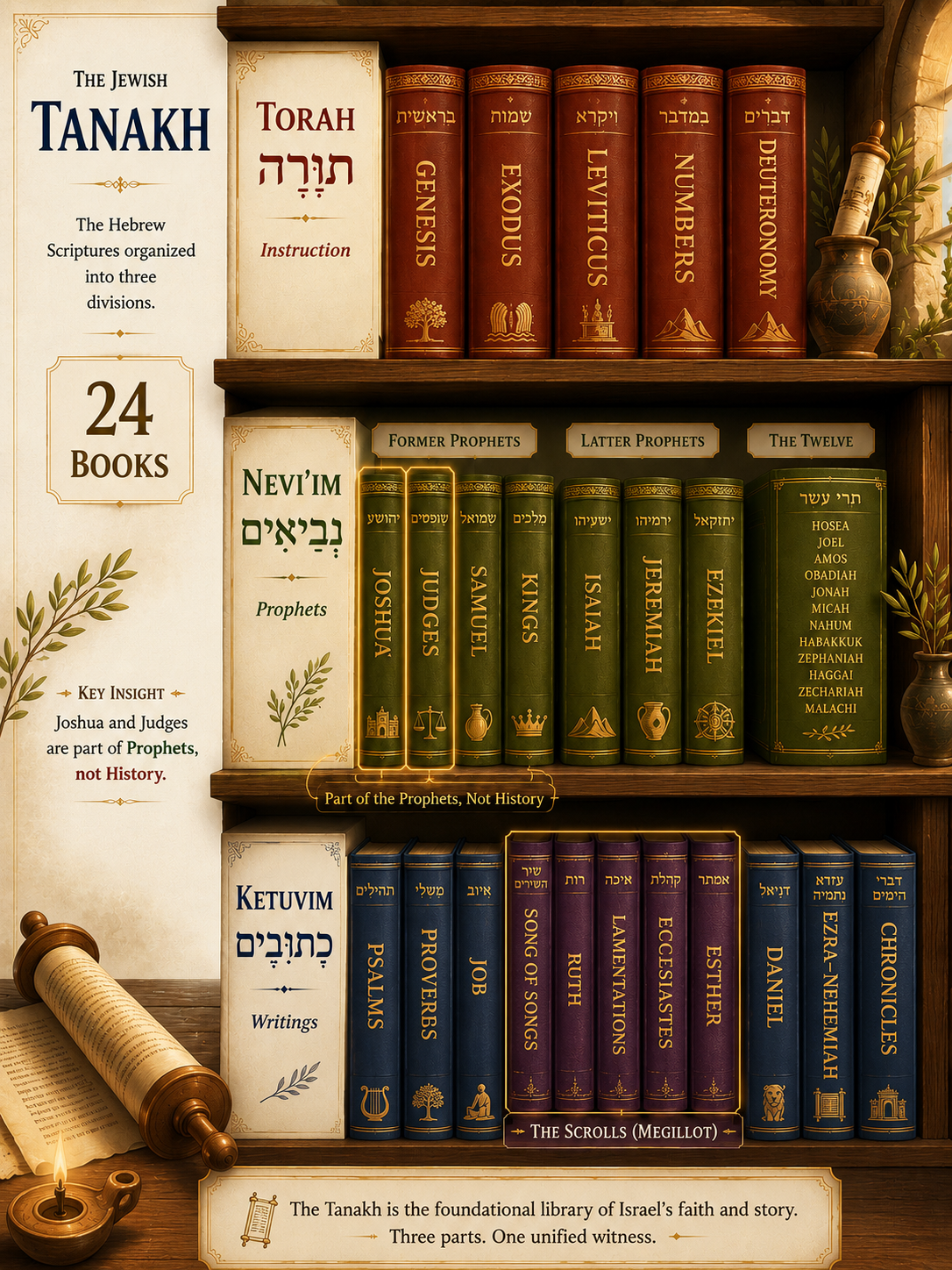
The Hebrew Bible is called the Tanakh (תַּנַ"ךְ) — an acronym formed from the first letters of its three divisions. Think of it as a library with three rooms, each serving a distinct purpose:
| Division | Hebrew | Meaning | Books |
|---|---|---|---|
| Torah | תּוֹרָה | “Instruction” or “Teaching” | Genesis, Exodus, Leviticus, Numbers, Deuteronomy |
| Nevi’im | נְבִיאִים | “Prophets” | Former Prophets: Joshua, Judges, Samuel, Kings Latter Prophets: Isaiah, Jeremiah, Ezekiel, the Twelve |
| Ketuvim | כְּתוּבִים | “Writings” | Psalms, Proverbs, Job, Song of Songs, Ruth, Lamentations, Ecclesiastes, Esther, Daniel, Ezra-Nehemiah, Chronicles |
Total: 24 books by Jewish counting (which combines Samuel, Kings, Chronicles, and Ezra-Nehemiah into single books, and counts the Twelve Minor Prophets as one book).
Why This Arrangement Matters
Two features of the Tanakh’s structure deserve special attention:
Joshua and Judges are classified as prophetic literature, not history. The Jewish tradition places these books in Nevi’im (“Prophets”) — alongside Isaiah, Jeremiah, and Ezekiel. This is not an accident. The Talmud identifies their authors as prophets (Bava Batra 14b–15a) and treats the conquest and Judges narratives as theological interpretation of events, not neutral reportage. When we read Joshua and Judges this way, every editorial choice — what is included, what is omitted, how events are framed — becomes an act of prophetic commentary.
The Tanakh ends with an invitation, not a warning. The last book in the Jewish canon is 2 Chronicles — specifically Cyrus’s decree: “Who is there among you of all his people? The LORD his God be with him, and let him go up” (2 Chronicles 36:23). The final word of the Hebrew Bible is vaya’al (וְיַעַל) — “and let him go up.” The Jewish canon closes with a call to return, to rebuild, to ascend to Jerusalem. Compare this to the Christian arrangement, which ends with Malachi’s warning — a very different emotional and theological conclusion.
The Protestant Old Testament: Same Content, Different Architecture
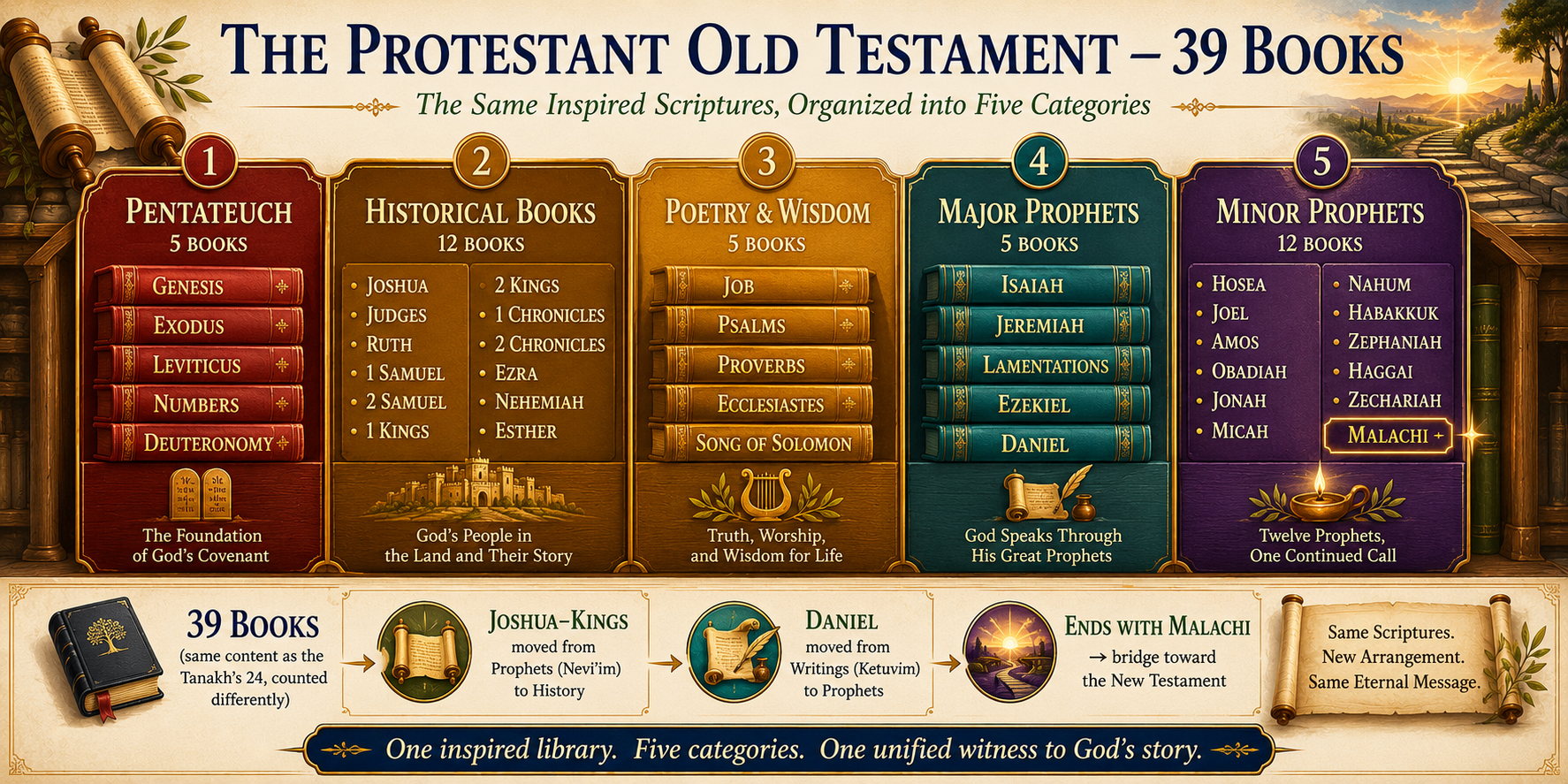
The Protestant tradition (including the King James Version used by Latter-day Saints) contains the same textual content as the Tanakh but reorganizes it into a four-part structure that tells a different story:
| Category | Count | Books |
|---|---|---|
| Pentateuch (Law) | 5 | Genesis, Exodus, Leviticus, Numbers, Deuteronomy |
| Historical Books | 12 | Joshua, Judges, Ruth, 1–2 Samuel, 1–2 Kings, 1–2 Chronicles, Ezra, Nehemiah, Esther |
| Poetry & Wisdom | 5 | Job, Psalms, Proverbs, Ecclesiastes, Song of Solomon |
| Major Prophets | 5 | Isaiah, Jeremiah, Lamentations, Ezekiel, Daniel |
| Minor Prophets | 12 | Hosea, Joel, Amos, Obadiah, Jonah, Micah, Nahum, Habakkuk, Zephaniah, Haggai, Zechariah, Malachi |
Total: 39 books (the same content as the Tanakh’s 24, split and counted differently).
The Key Differences
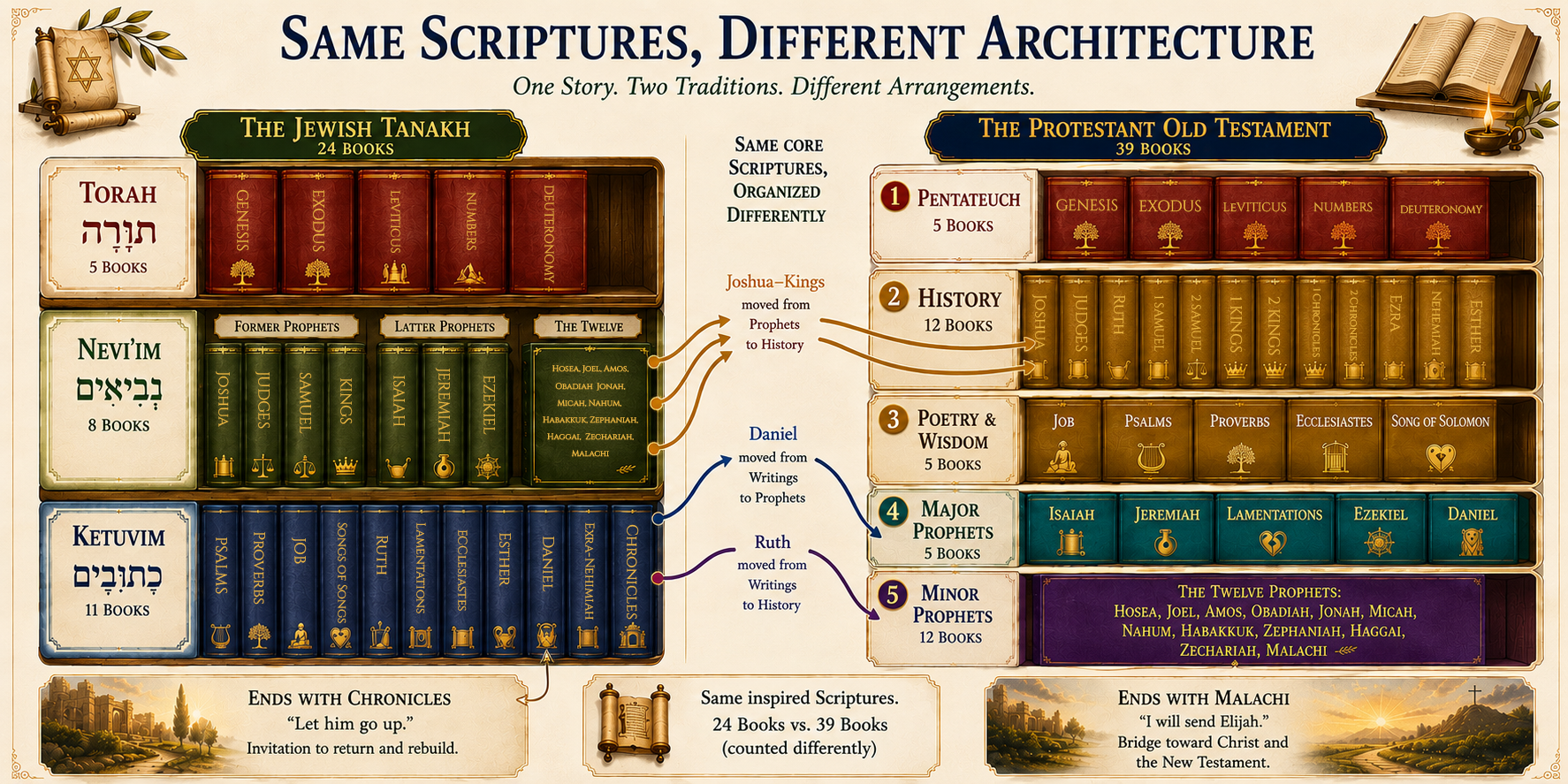
Joshua and Judges become “history,” not “prophecy.” The Protestant arrangement pulls the Former Prophets out of the prophetic section and reclassifies them as “Historical Books.” This is not wrong — they do contain history — but it subtly shifts how we read them. A book classified as “prophecy” invites us to ask: what is God saying through these events? A book classified as “history” invites us to ask: what happened? Both questions are valid. But the Jewish arrangement reminds us that the first question was the original one.
Daniel moves from “Writings” to “Prophets.” In the Tanakh, Daniel is in the Ketuvim (Writings), not among the prophets. The Christian tradition reclassified it as a prophetic book — largely because of its messianic and apocalyptic content. This reclassification reflects a theological judgment about the book’s primary purpose.
The Protestant OT ends with Malachi. The final verses are a prophecy of Elijah’s return: “Behold, I will send you Elijah the prophet before the coming of the great and dreadful day of the LORD” (Malachi 4:5–6). This creates a deliberate bridge to the New Testament, where John the Baptist comes “in the spirit and power of Elias” (Luke 1:17). The Christian arrangement turns the Old Testament into a story that points forward — to a Messiah who is coming. For Latter-day Saints, this verse also points to Elijah’s appearance in the Kirtland Temple on April 3, 1836 (D&C 110:13–16).
The Catholic and Orthodox Old Testament: The Wider Library
The Catholic and Eastern Orthodox traditions include additional books not found in the Protestant or Jewish canons — books written during the intertestamental period (roughly 300 BC – 100 AD). These were part of the Septuagint (LXX) — the Greek translation of the Hebrew scriptures produced in Alexandria, Egypt, around 250–150 BC — and were widely used by Greek-speaking Jews and early Christians.
| Book | Content | Why It Matters |
|---|---|---|
| Tobit | A story of faithfulness in exile | Illustrates Jewish piety during the Assyrian period |
| Judith | A Jewish heroine saves her people | Echoes of Deborah and Jael from Judges |
| Wisdom of Solomon | Philosophical wisdom literature | Bridges Hebrew wisdom and Greek philosophy |
| Sirach (Ecclesiasticus) | Practical wisdom and ethics | One of the most quoted books in rabbinic literature |
| Baruch | Attributed to Jeremiah’s scribe | Exilic theology and prayer |
| 1–2 Maccabees | The Maccabean revolt (167–160 BC) | The historical basis for Hanukkah; the intertestamental period bridging Malachi to Matthew |
| Additions to Esther & Daniel | Extended versions of these books | Prayers, songs, and narrative expansions in the Greek tradition |
Catholics call these deuterocanonical (“second canon”); Protestants call them Apocrypha (“hidden things”). The Eastern Orthodox canon includes additional texts beyond even the Catholic list. The Reformation’s return to the Hebrew Tanakh as the basis for the OT is what produced the Protestant 39-book canon — and by extension, the Latter-day Saint Old Testament.
The Latter-day Saint Old Testament: Restoration, Not Rearrangement
Latter-day Saints use the King James Version — the Protestant 39-book arrangement. But the LDS approach to the Old Testament is unique among Christian traditions: rather than debating which ancient books belong in the canon, the Restoration adds new revelation that illuminates the existing text.
| Supplement | What It Adds |
|---|---|
| Book of Moses (Pearl of Great Price) | Restored creation account, Enoch’s vision, expanded Genesis 1–8 with material not in any other tradition. Restores the covenant context that was lost from the biblical text. |
| Book of Abraham (Pearl of Great Price) | Abraham’s astronomical education in Ur, the pre-mortal council, the plan of salvation. Provides context for Abraham’s covenant unavailable anywhere else — including his Chaldean training in the base-60 mathematics and observational astronomy documented in Section 02 of the Canaan guide. |
| Joseph Smith Translation (JST) | Hundreds of inspired corrections and expansions throughout the OT text, published in KJV footnotes and the appendix. Not a new translation from Hebrew but a revelatory restoration of meaning. |
| Book of Mormon | Contains extensive commentary on OT events. The brass plates — a pre-exilic Israelite record taken from Jerusalem in 600 BC — may have contained material not preserved in any surviving manuscript tradition. Nephi’s interpretation of the Canaanite conquest (1 Nephi 17:32–38) is the most direct theological commentary on Joshua in any scripture. |
The Book of Moses does not replace Genesis — it restores what was lost from it. The Book of Abraham does not replace the patriarchal narratives — it expands them. The JST does not create a new Bible — it clarifies the one we have. This is restoration, not rearrangement.
On the Apocrypha and Interpolation: Doctrine and Covenants 91 offers the Lord’s own guidance: “There are many things contained therein that are true … but many things contained therein that are not true, which are interpolations by the hands of men.” Joseph was instructed that it was not needful to translate the Apocrypha at that time, but this guidance was given: “Whoso readeth it, let him understand, for the Spirit manifesteth truth” (D&C 91:1–6).
The word interpolation is key. It means the insertion of material by later hands — additions, edits, and reframings that reflect the political, theological, and cultural agendas of the people who transmitted the text. And the Apocrypha is not the only place this happened. Every ancient text passed through the hands of scribes, editors, and communities. Some had clear biases. Some made intentional changes. Some may not have recognized their own personal biases. Some were merely doing the best they could, trying to accurately represent the nuances of the languages — and even in the best of circumstances, things are bound to get lost in translation. These were people with convictions, loyalties, and conflicts — and those realities shaped what was preserved, what was altered, what was added, and what was left out.
This is precisely why understanding the historical and political context of scripture matters so much. The intertestamental period alone saw the rise and fall of Greek and Roman control over Judea, the Maccabean revolt, the fracturing of Judaism into competing sects (Pharisees, Sadducees, Essenes, Zealots), and intense debates over which texts were authoritative and why. These were not academic disagreements — they were life-and-death political struggles that determined what survived and what didn’t. Reading scripture without understanding these forces is like reading a legal document without knowing who wrote it or what they stood to gain. This is why the cultural field guides and historical context sections we provide alongside the Come, Follow Me lessons are not optional enrichment — they are essential tools for reading scripture honestly, discerning interpolation from inspiration, and hearing the original voice beneath the layers of transmission.
The Timeline: How It All Came Together
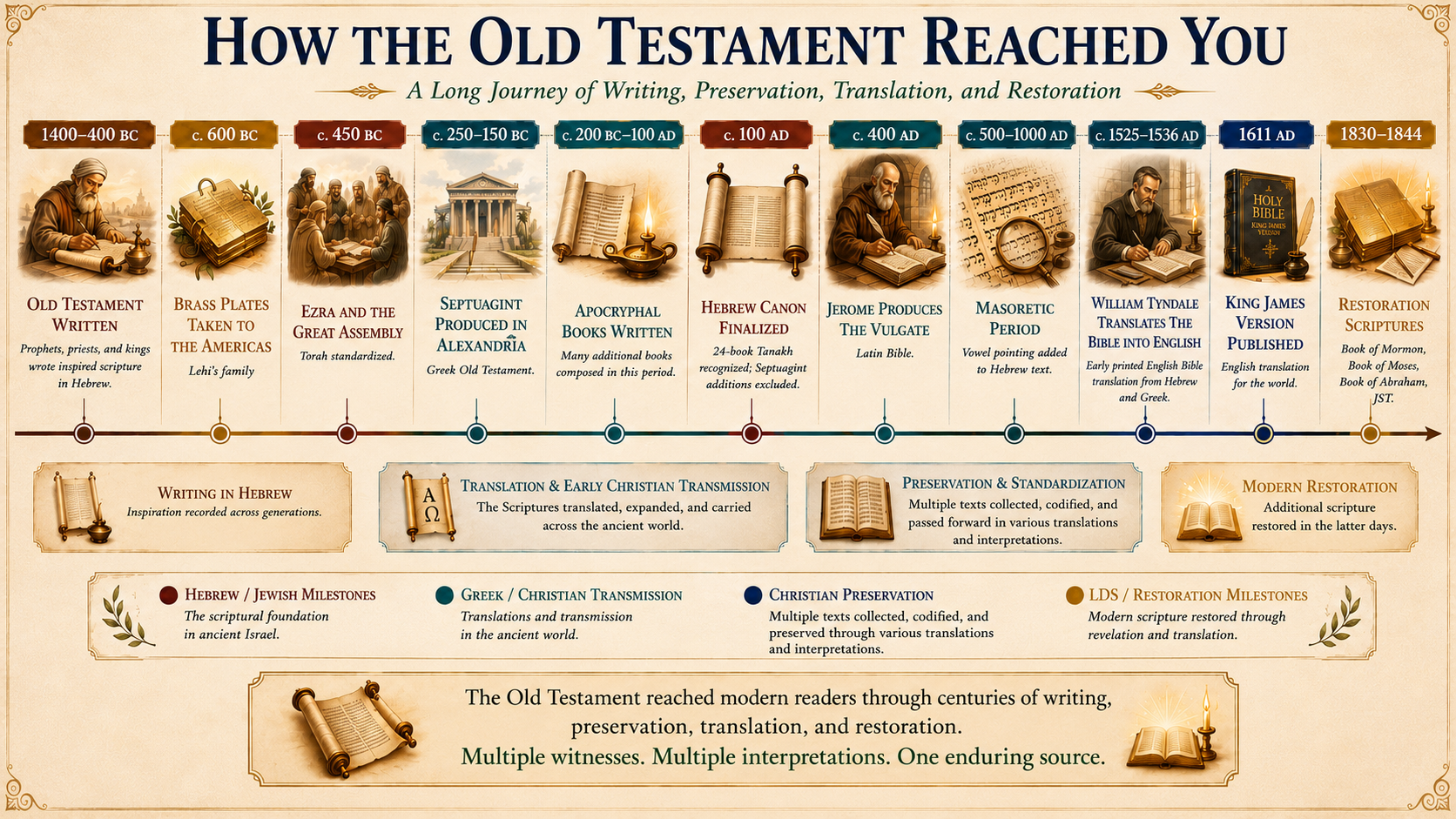
The scriptures we read today did not arrive as a finished product. They were written, collected, edited, translated, debated, and canonized across more than a thousand years:
| Date | Event | Significance |
|---|---|---|
| c. 1400–400 BC | Old Testament written | From the earliest texts (possibly parts of the Torah) through the post-exilic writings (Chronicles, Ezra-Nehemiah) |
| c. 600 BC | Brass plates taken to the Americas | Lehi’s family carries a pre-exilic Israelite record that may preserve material not in any surviving manuscript tradition |
| c. 450 BC | Ezra and the “Great Assembly” | Traditional beginning of the formal canonization process; standardization of the Torah text |
| c. 250–150 BC | Septuagint (LXX) produced | Greek translation made in Alexandria for Greek-speaking Jews; includes the deuterocanonical books; becomes the Bible of the early Church |
| c. 200 BC – 100 AD | Apocryphal/deuterocanonical books written | Tobit, Judith, Wisdom, Sirach, Maccabees, etc. |
| c. 100 AD | Hebrew canon finalized | Jewish scholars standardize the 24-book Tanakh; Septuagint additions excluded from the Hebrew text |
| c. 400 AD | Jerome produces the Vulgate | Latin translation from Hebrew and Greek; becomes the standard Bible of Western Christianity for a thousand years |
| c. 500–1000 AD | Masoretic period | Jewish scholars add vowel pointing (niqqud) to the consonantal Hebrew text, preserving pronunciation and reading traditions |
| 1611 AD | King James Version published | English translation from the Masoretic Hebrew and Greek texts; becomes the standard LDS Bible |
| 1830–1844 | Restoration scriptures produced | Book of Mormon (1830), Book of Moses (1830–31), Book of Abraham (1835–42), Joseph Smith Translation (ongoing 1830–44) |
What This Means for Your Study
As we move into Joshua and the historical books, understanding these structural differences helps in practical ways:
- When Jewish commentators read Joshua as “prophecy” rather than “history,” they are not being eccentric — they are reading it in its original canonical context. The conquest narrative is theological interpretation, not battlefield reporting.
- The books we study next (Joshua–Judges) occupy the same position in both traditions — right after Deuteronomy — because both Jewish and Christian editors agreed: this is where the story of the covenant in the land begins.
- The Book of Mormon provides a reading lens that no other tradition has. Nephi’s commentary on the Canaanite conquest (1 Nephi 17:32–38) was written by someone with access to the brass plates — a pre-exilic record that may have contained material not preserved in any surviving manuscript.
- D&C 91 models how to engage the broader tradition: “there are many things contained therein that are true … but they are not all true.” Read with the Spirit. Take what is true. Leave what is not. This is wisdom for reading any ancient text.
Understanding the book you hold — who assembled it, why they arranged it the way they did, and what other traditions preserve — makes you a more careful, more grateful, and more spiritually discerning reader of scripture.
Sources and Further Reading
- Tov, Emanuel, Textual Criticism of the Hebrew Bible (Fortress Press, 3rd ed. 2012) — The standard reference for understanding the transmission of the biblical text.
- McDonald, Lee Martin, The Biblical Canon: Its Origin, Transmission, and Authority (Hendrickson, 3rd ed. 2007) — Comprehensive treatment of how the Jewish and Christian canons were formed.
- Barr, James, Holy Scripture: Canon, Authority, Criticism (Westminster Press, 1983) — Classic treatment of canonical questions.
- Come, Follow Me Manual — “Thoughts for Week 20” — The Church’s brief introduction to the historical books.
- D&C 91 — The Lord’s guidance on the Apocrypha.
- World History Encyclopedia — Septuagint (CC BY-NC-SA 4.0)