When the Lampstand Became a Figure for the Word
This final part turns from the chart itself to the wider tradition of reading the lampstand as a figure for the word. Part 1 introduced the modern classroom chart; Part 2 explained the Hebrew grammar it arranges. Here we follow earlier Jewish and Christian readings of the lampstand, then ask what—if anything—connects that symbolic history to the modern chart.
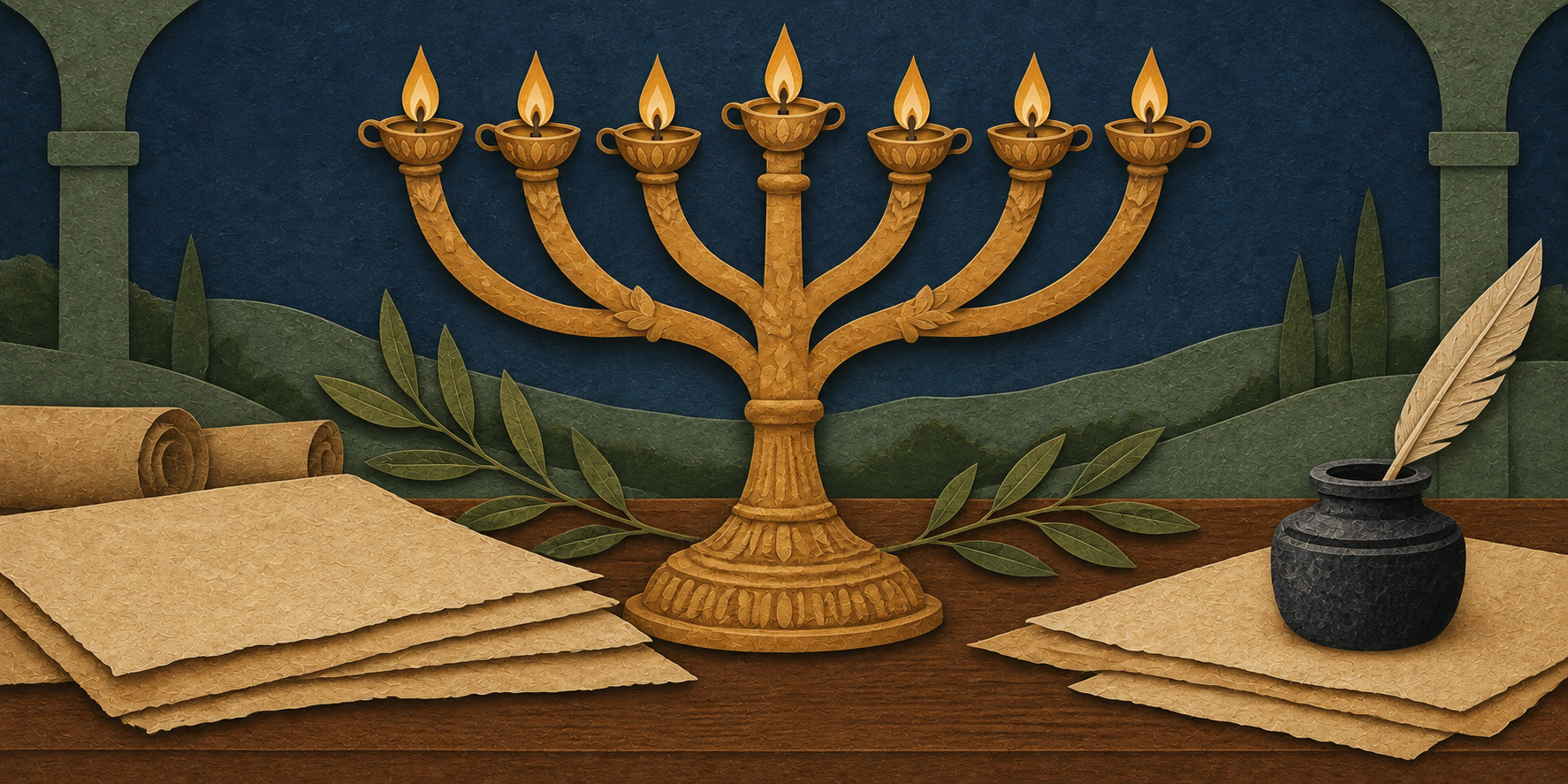
The menorah brings the shape of a living tree into the sanctuary. Fashioned from gold, it has a central stem, six spreading branches, and almond-shaped cups, with seven lamps giving light. Its design joins growth and illumination in one object. Exodus 25:31–37.
That combination connects the menorah with the tree of life and the burning bush. In Eden, the tree of life stands in the garden God prepared for His children. At the burning bush, Moses encounters God speaking from a plant alive with flame, and learns that he stands on holy ground. The menorah gathers these images into the sanctuary: a tree bearing light, directing attention toward God’s life-giving presence.1 Genesis 2:9; Exodus 3:1–6.
The lampstand also belongs to a larger heavenly pattern. God instructed Moses to make the tabernacle and all its furnishings according to what He showed him on Sinai. Hebrews explains that this earthly sanctuary pointed toward heavenly things. Its objects gave visible form to sacred truths, serving the Lord’s stated purpose: “that I may dwell among them.” The lampstand’s light belongs within that invitation to approach God and live in His presence. Exodus 25:8–9, 40; Hebrews 8:5.
This part explores the meanings people have found in the lampstand over many centuries, then considers their connections with the modern chart. Across different periods, records, and communities, recurring patterns connect the lampstand with language, wisdom, and sacred teaching. These similarities may suggest influence, even though the available records do not establish a clear line of descent to the modern chart. The note Comparing symbols and tracing origins explores those shared patterns and their historical connections.
The Menorah as a Figure for the Word
The modern chart organizes Hebrew grammar. A separate interpretive tradition uses the lampstand to speak about the Word, letters, and wisdom, and this part follows selected, documented moments in it.
The earliest explicit lampstand-as-Word interpretation located in this research is Philo of Alexandria, a Jewish interpreter writing in the first century CE. In Who Is the Heir of Divine Things?, Philo considers how God orders creation through balanced pairs, and notices that the lampstand is built the same way: a central shaft with three branches on one side and three on the other. The centre is what separates the two sets. Philo reads that dividing position as the divine Logos.
Logos is the Greek word for a spoken word, and also for reason or an ordering principle — the sense that survives in English words like logic. For Philo it names God’s word as the active thing by which God brings order: the power that speaks creation into arrangement and keeps its parts properly distinguished from one another. So when he looks at a lampstand whose central shaft holds three branches apart from three, he sees the pattern he has been describing all along, worked in gold. The object becomes an illustration of how God orders the world. Philo, sections 215-220.
Philo is a Jewish interpreter of Jewish scripture, reading the tabernacle instructions with the philosophical vocabulary of his own city. He is describing how God orders creation; the claim that the Word became a person belongs to John, and comes later in this part.
A Psalm You Can See
A recurring pattern in Hebrew poetry draws the reader inward toward a central theme and then back outward. The poem moves through a series of ideas, then returns through matching ideas in reverse order. This mirrored arrangement is called a chiasm, after the Greek letter chi (X), whose two strokes cross; a passage arranged this way is chiastic.
Psalm 67 offers a clear example of this poetic pattern. Its mirrored structure can be followed in the words themselves. Later surviving manuscripts make the connection visual by arranging those words in the shape of a menorah. These manuscripts preserve the association, but not its beginnings. Did the poem suggest the arrangement? Did the lampstand provide a framework for studying the poem? Or did readers recognize a meaningful pattern shared by both? The surviving evidence leaves those questions open.
Psalm 67 becomes easier to follow when we see how its beginning and ending answer one another. Its seven verses form five movements:
| Movement | Passage | What happens |
|---|---|---|
| A — Blessing | Verses 1–2 | The people ask God to bless them and shine upon them, so that His saving power becomes known among all nations. |
| B — Praise | Verse 3 | All peoples are invited to praise God. |
| C — The center | Verse 4 | The nations have reason to rejoice: God judges righteously and guides them. |
| B′ — Praise repeated | Verse 5 | The same invitation to praise returns, word for word. |
| A′ — Blessing | Verses 6–7 | The earth yields its harvest, God blesses His people, and the whole earth is drawn toward reverence for Him. |
The opening and closing blessings form the outer frame. The two identical calls to praise form the inner pair. Between them stands the central message: the nations can rejoice because God governs with justice. The poem’s structure helps us hear its purpose—God’s blessing reaches beyond His people to the whole earth.
Blessing, light, knowledge, and growing things meet in seven short verses.
Turn the menorah on its side, as the diagram for this section does, and the seven verses can be read down its stem and branches, one verse to each arm. The colours follow the table: blue for the two blessings, green for the two calls to praise, and gold for the centre.
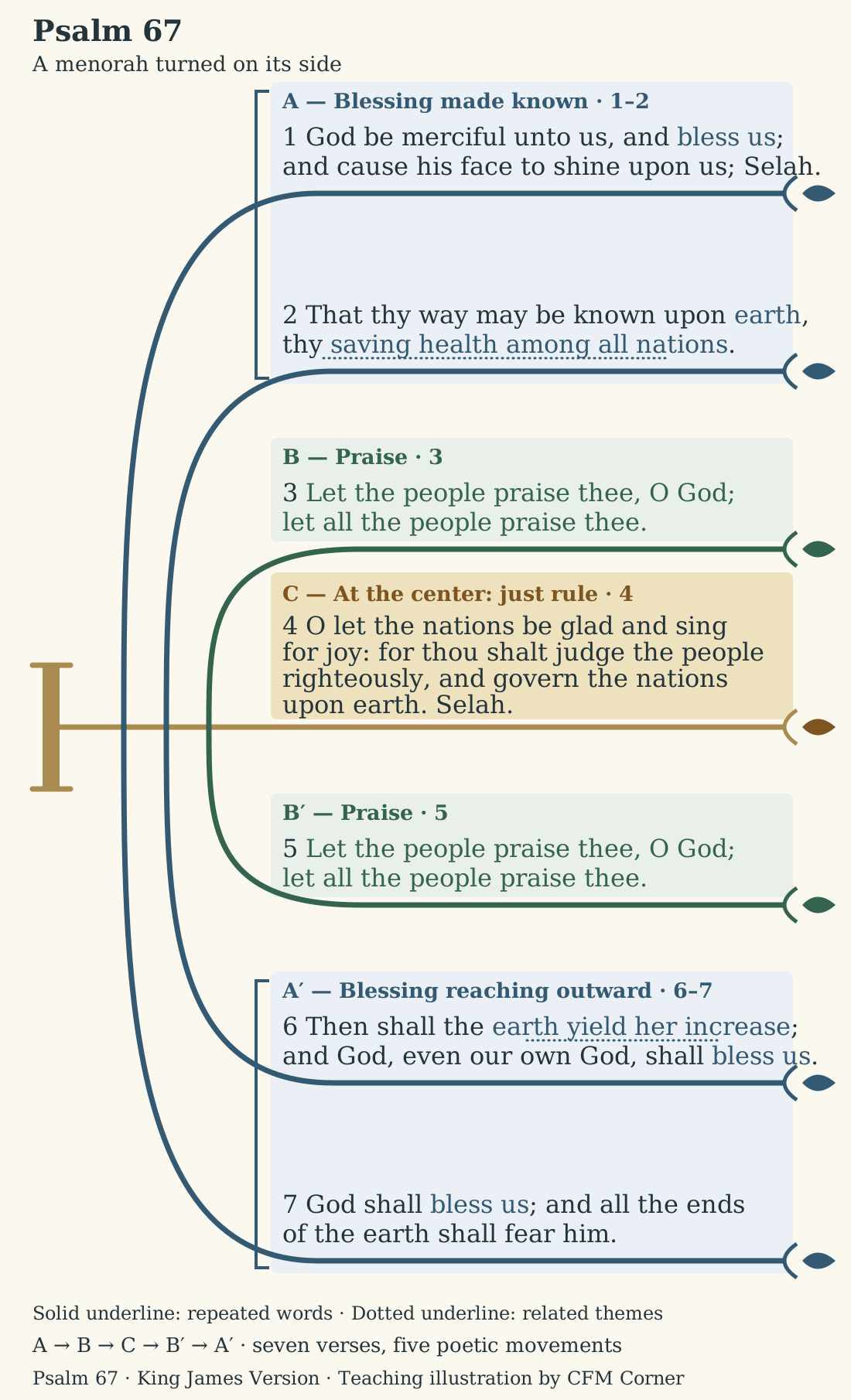
Psalm 67, verses 1–7. Follow the matching colours toward the gold centre, then back outward.
A matches A′, and B matches B′. Solid underlines mark words repeated exactly, such as “bless us,” “earth” and the call to praise. Dotted underlines join two phrases that answer each other in meaning rather than in wording: “saving health among all nations” in verse 2 and “yield her increase” in verse 6. The harvest is one picture of God’s life-giving blessing reaching the whole earth.2
Try reading verses 3 to 5 together, then the whole psalm again. Listen for the repeated praise surrounding the reason for joy, God’s just rule, and for the blessing asked for “us” in the first verse reaching “all the ends of the earth” by the last.
That structure is in the poem’s own words. Much later, those words were set out on the page in the shape of a lampstand. The witnesses that follow show, in different ways, that the psalm and the lampstand had been joined, and they come from Jewish prayer: Abudarham, the first of them, wrote a commentary on the Jewish prayer book.
Three different kinds of evidence belong here. In 1340, Abudarham records that Psalm 67 was already called the Menorah Psalm and links its seven verses with the menorah’s seven branches. A prayer book made in Pisa in 1397 gives us a different kind of evidence: it is a dated example of the psalm written in the shape of a lampstand, showing the practice in use by that date. Abudarham, Post Amidah 43; Sarit Shalev-Eyni, “Jewish Prayerbook,” section II.A.2; David Arnow, Zeramim IV/3 (2020), 9-10.
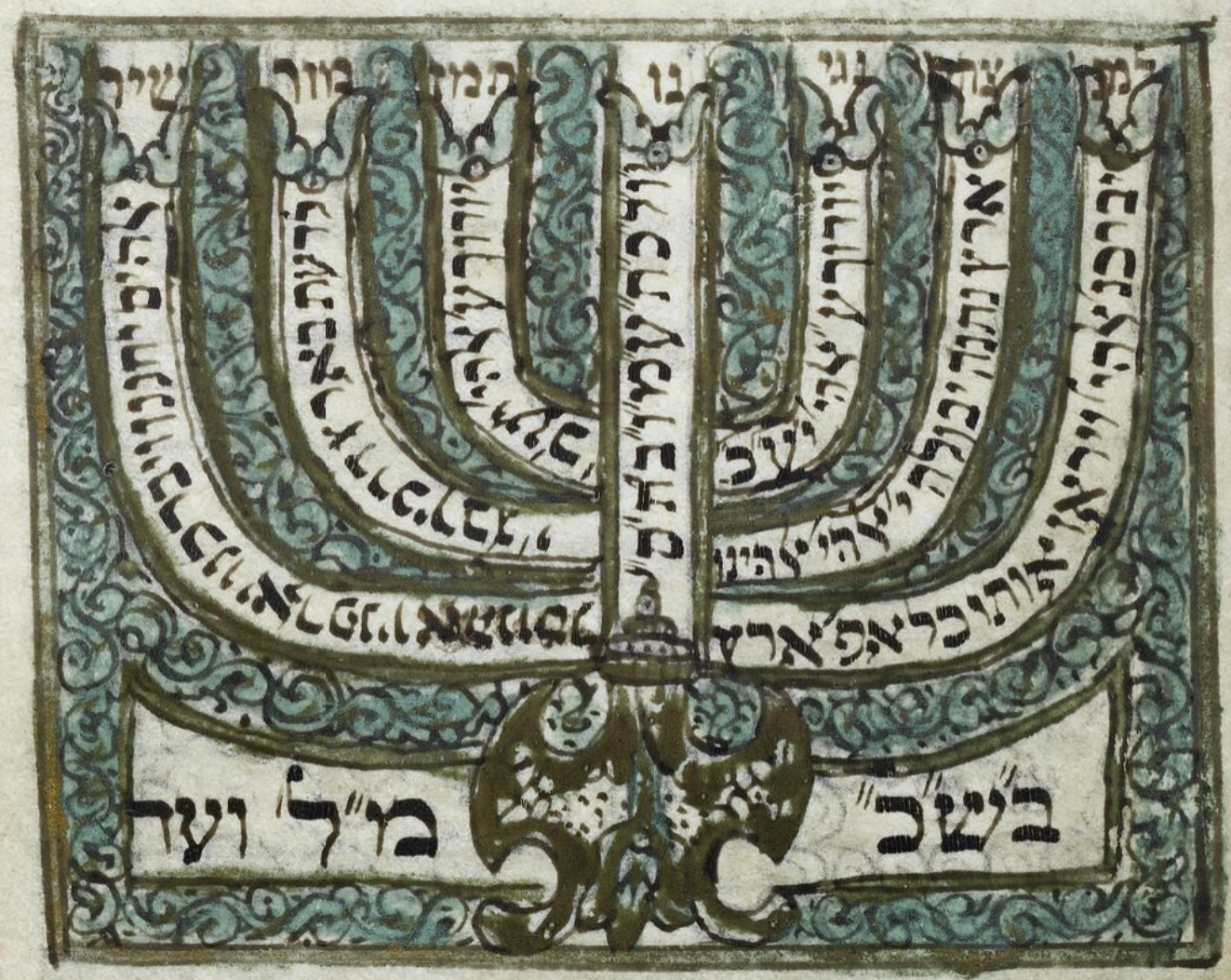
Figure 1 is later still. This 1728 manuscript does not illustrate the Pisa prayer book, but it lets us see the same visual practice: the words themselves form the central shaft and branches of the lampstand. Psalm 67 is associated with the blessing of the new moon. William L. Gross Collection, Ms. 174; image via Wikimedia Commons, marked public domain. Image and credit record.

The words themselves form the lampstand’s shaft and six arms. The psalm is not printed beside a picture of a lampstand; it is the lampstand, and reading the poem traces the object. A prayer for God’s face to shine upon the whole earth takes the shape of the thing that gives light in the sanctuary. Form and content speak together.
Pages like this are documented examples of sacred Hebrew text arranged as a lampstand, to be read and understood. The move they make is simple — put the Hebrew on the branches — and it is the same move the classroom chart makes with the verb patterns, on record here six centuries earlier. It is a devotional and liturgical practice rather than a grammatical one. Why this is the nearest such case located in this research, and why setting it beside the chart is a comparison rather than evidence of descent, are set out in the note Comparing symbols and tracing origins.
The Word in Christian scripture
Psalm 67 brings text and lampstand together visually. The next comparison returns to the term that began this part: Logos. In John’s Gospel, the same Greek word is used differently. Most readers encounter “the Word” in John rather than in Philo, so it is useful to set the two uses alongside one another. For the dates of the two writers, and why setting them side by side is not a claim that one borrowed from the other, see the note Dating Philo and John.
John’s gospel begins by deliberately echoing the first line of Genesis: “In the beginning was the Word, and the Word was with God, and the Word was God” (John 1:1). It then says creation happened through him, and — the detail that matters for a lampstand — that “in him was life; and the life was the light of men,” a light that shines in darkness (John 1:3-5). At verse 14 the Word “was made flesh, and dwelt among us… full of grace and truth.”
Set beside Philo, the overlap and the difference are both clear. Both use Logos for God’s word at work in creation. But the dividing-into-pairs scheme is Philo’s own, and John’s prologue does not use it — what John adds instead is life and light, and then the statement that the Word became flesh and entered human life. Philo does not say that, and reading it back into him would misrepresent a first-century Jewish writer.
The Joseph Smith Translation makes the identification more explicit still, and connects it to something a reader can act on. In JST John 1 the Word is tied to the gospel — the saving message itself — and to the Son; verse 4 joins that gospel to life and to light; and verses 14 and 16 identify the Word made flesh as the Son. JST John 1. Put in ordinary language, it is one claim rather than a list of titles: what God has to say to us came to us in the flesh, and what he says gives life and shows the way. Christ carries the Father’s saving message, and by entering human life he makes God’s grace and truth something people can see.
Doctrine and Covenants 93:8-11 says the same thing in the same vocabulary: Christ is the Word, the messenger of salvation, the light, the Redeemer, the one through whom things were made, and the one who dwelt in the flesh. (Two visions of the glorified Lord, one in Revelation and one at Kirtland, share striking details and differ in instructive ones; they are set side by side in the note Two visions of the glorified Lord.)
The Book of Mormon gives these images a human story. In Lehi’s dream a tree bears fruit “desirable to make one happy”; when he eats it, it fills his soul “with exceedingly great joy,” and at once he wants his family to share it (1 Nephi 8:10–12). A rod of iron runs along the bank of a river to the tree, and when a mist of darkness falls, the travelers who reach the fruit are the ones who catch hold of the rod and cling to it until they arrive (1 Nephi 8:19–24). The dream gives the reader something to desire and a way to reach it.
When Nephi is shown the same tree and asks to know “the interpretation thereof,” the answer comes in an unexpected order (1 Nephi 11:8–11). Instead of a definition, he is shown a virgin in Nazareth, “the mother of the Son of God, after the manner of the flesh,” and then the same woman “bearing a child in her arms” (1 Nephi 11:13–20). Only then does the angel ask, “Knowest thou the meaning of the tree which thy father saw?” Nephi answers that “it is the love of God, which sheddeth itself abroad in the hearts of the children of men” (1 Nephi 11:21–22), and the vision moves straight on to “the Son of God going forth among the children of men” (1 Nephi 11:24). Read in that sequence, the meaning of the tree is given through the coming of the Son: God’s love reaches his children in Christ.
The rod has its own meaning in the vision. It is “the word of God, which led to the fountain of living waters, or to the tree of life,” and the tree is “a representation of the love of God” (1 Nephi 11:25). The two stay distinct: the word is what leads, and love is where it leads. When Nephi’s brothers later ask what the rod means, he tells them it is the word of God, and that whoever would “hearken unto the word of God, and would hold fast unto it” would never perish; then he urges them to “give heed to the word of God and remember to keep his commandments always in all things” (1 Nephi 15:23–25). For a reader, the image becomes an invitation: receive the word, hold to it, and let it lead toward the joy Lehi wanted to share.
Alma brings the growing image inside the person. He compares the word to a seed: given place in the heart and not cast out by unbelief, it swells, enlarges the soul and “beginneth to enlighten my understanding” (Alma 32:28). He even calls what the hearer then tastes light: “whatsoever is light, is good” (Alma 32:35). Nourished “by your faith with great diligence, and with patience,” the word takes root and becomes “a tree springing up unto everlasting life,” whose fruit is “sweet above all that is sweet” (Alma 32:41–43). Then Alma names the word he means: believe in the Son of God, “that he will come to redeem his people, and that he shall suffer and die to atone for their sins; and that he shall rise again from the dead,” and “plant this word in your hearts” (Alma 33:22–23). The seed is the word; faith is how it is nourished; the tree that grows is everlasting life.
Set these images beside the burning bush and the sanctuary lampstand. At “the mountain of God,” Moses hears God speak out of a bush that burns and is not consumed (Exodus 3:1–6). Later, on the mount, he is shown the pattern for the sanctuary and its furnishings, made so that God may “dwell among them” (Exodus 25:8–9, 40), and among them is the flowering gold lampstand with its seven lamps (Exodus 25:31–37). Both scenes set a plant bearing flame in the place of God’s presence.1
The Book of Mormon carries that pairing into the life of the hearer. The word of God leads to the tree that represents God’s love (1 Nephi 11:25), and the word concerning Christ, planted and nourished by faith, grows toward everlasting life, while what the hearer tastes along the way is light (Alma 32:35). The lampstand gives growth and light a form you can picture; these chapters show a person receiving them. That is this article’s comparison; the chapters themselves never name a lampstand.
Revelation gives Christ names that gather these images. It calls the rider “The Word of God” (Revelation 19:13). In a different chapter, its last, the speaker says “I am Alpha and Omega, the beginning and the end, the first and the last” (Revelation 22:13), identifies himself — “I Jesus have sent mine angel” — and calls himself “the root and the offspring of David” (22:16): worth noticing in a series about roots, since the tree image and the Word image land on the same figure.
The same chapter brings the tree and the light together at the end. Beside “a pure river of water of life” stands “the tree of life,” bearing fruit every month, and “the leaves of the tree were for the healing of the nations” — its leaves, not its fruit. In that city no lamp and no sun are needed, “for the Lord God giveth them light” (Revelation 22:1-5).
Taken together, these passages gather the images this series has been tracing — God’s word, seed and fruit, the tree of life, and divine light — and they invite us to receive Christ’s word, let it take root, and live by its light. That is a theological reading, and a different question from where the modern chart came from; the note Comparing symbols and tracing origins explains the difference.
Back to the lampstand itself
We now turn back from the New Testament and the scriptures of the Restoration — the Book of Mormon, the Joseph Smith Translation and the Doctrine and Covenants, which Latter-day Saints receive as scripture — to Jewish readings of the lampstand itself. The witnesses that follow are grouped by what they show rather than by date: a manuscript picture, a teaching about wisdom, and interpretations of letters.
One early visual witness comes first. The First Leningrad Pentateuch, a manuscript of the five books of Moses copied in 929, includes an illuminated representation of the tabernacle furnishings, including the seven-branched menorah: by the tenth century the lampstand had a prominent visual place in a Hebrew manuscript. National Library of Russia, First Leningrad Pentateuch, Evr. II B 17
A rabbinic passage links the lampstand with learning. In Bava Batra 25b:8 — a passage in the Talmud, cited by tractate, folio and section — Rabbi Yitzhak advises that one who wants wisdom should face south when praying, and one who wants wealth should face north. In the temple the menorah stood on the south side and the table of bread on the north, so each request faces the object that stands for it. By the time this teaching was recorded in the Talmud, the lampstand could serve as shorthand for the pursuit of understanding, as the table did for provision.
Letters, Creation, and Abraham: An Earlier Witness
Letters were being used to explain the created world long before Bahya ben Asher, the thirteenth-century commentator who comes next. Dunash ibn Tamim’s commentary on Sefer Yetzirah, the Book of Creation, is conventionally dated 955–956 CE, more than three centuries before Bahya’s commentary. Written in Judaeo-Arabic, which is Arabic written in Hebrew letters, and later translated into Hebrew, it connects the alphabet’s sounds with speech, knowledge of the heavens, and the ordering of creation. The commentary also attributes the book to Abraham and connects him with divine unity and covenant. That is evidence of an Abrahamic tradition received by a tenth-century interpreter, not a securely dated work from Abraham’s lifetime. Dunash, commentary on chapter 1, translated by Jeffrey G. Amshalem.
Bahya, discussed next, brings the lampstand into this discussion of letters and creation; in the passages examined here, Dunash names no lampstand.
Dunash also reports two problems with the text he was explaining: copyists’ errors and the passage of time had damaged its instructions for pairing the letters, which he sets out to repair, and explanatory comments had been mixed in among the words attributed to Abraham. Both concern the text as it was handed down, not the alphabet itself, and they show that these letter schemes were already disputed in the tenth century. The evidence for each is in the note Dunash: two different textual problems; what gaps in a damaged text can and cannot show, and a three-against-three pattern in the text he comments on, are discussed in Comparing symbols and tracing origins.
Bahya: the alphabet on the lampstand
The explicit alphabet-to-menorah comparison comes here in Bahya ben Asher, whose Torah commentary is conventionally dated 1291. Discussing Exodus 25:31 he reads the seven lights as the Torah and seven kinds of wisdom, and — the detail that matters here — he matches the lampstand’s 22 cups to the 22 letters of the Torah, continuing into further correspondences with the world and the human body. Bahya on Exodus 25:31, paragraph 4. These are the almond-shaped cups described at the start, three on each of the six branches and four on the central shaft: twenty-two in all (Exodus 25:33–34).
Here is a medieval interpreter mapping the alphabet onto the menorah. His larger point survives even if you do not follow every correspondence: sacred instruction gives light, and letters are how people get at it. Bahya is telling us what the lampstand meant to him, which is worth having on its own terms and on its own date.
The aleph-and-tav proposal, and what it is
Two threads from this part meet in the next question. Bahya, a Jewish commentator, read meaning into the letters of the Hebrew alphabet; Revelation, a Christian book, has Jesus call himself “Alpha and Omega” (Revelation 22:13), the first and last letters of the Greek alphabet. Some later Christian readers join those two ideas and take a further step of their own, and that step should be described accurately rather than either adopted or brushed aside.
The first verse of Genesis contains a small Hebrew word, et, written with the letters aleph and tav — the first and last letters of the Hebrew alphabet. It appears twice in the verse — once before “the heavens,” and again, with “and” attached to the front of it, before “the earth.” Its job both times is grammatical: it marks what follows as the direct object of the verb, so the reader knows the heavens and the earth are the things being created. English does that job with word order instead and has no separate word for it, which is why et does not show up in an English Bible. Genesis 1:1 interlinear.
Because aleph and tav are the first and last Hebrew letters, some readers see in them a Hebrew counterpart to Revelation’s Alpha and Omega, and read the little word in Genesis 1:1 as a hidden signature of Christ in the act of creation.
A grammatical marker can still attract symbolic readings; medieval Jewish commentators built whole readings on the alphabet, and Bahya, just above, is one of them. But neither John nor the Joseph Smith Translation identifies the Genesis object marker as a title of Christ, and Revelation’s Alpha and Omega are Greek letters in a Greek book, which do not appear in John’s prologue. The aleph-tav reading is a proposed symbolic Christian reading offered by later readers — worth knowing, and worth keeping distinct from what John and the JST actually say.
What Can Be Traced, and What Cannot
Growth and light, then, help explain why the lampstand has proved so natural a figure for sacred words. Philo, reading as a Jewish interpreter, found God’s ordering Word at its centre; the scriptures quoted in this part, in their own words and apart from him, tie the word of God to growth and light. The two readings meet on one object, and that meeting is this article’s comparison: a way of seeing the lampstand, not a line of descent. Whether any actual line connects such readings to the modern chart is the question this section takes up.
So we can now lay the pieces out in order, with dates attached. Each entry is a separate witness rather than a link in a family tree, and what each one does not show is set out in a table in the note Where the dating evidence actually stands.
Established.
- Scripture. The tabernacle lampstand was designed with branches and blossoms, and scripture ties wisdom, instruction, and speech to both trees and light.
- First century: Philo. Philo reads the menorah’s dividing centre as the divine Word.
- Undated here: a rabbinic tradition. A passage in the Talmud associates the menorah with seeking wisdom.
- 929: the First Leningrad Pentateuch. A Hebrew manuscript gives the lampstand a prominent picture.
- 955–956: Dunash’s commentary. It connects letters with creation and records an Abrahamic tradition.
- c. 1160–1235: David Kimhi. Kimhi’s Book of Roots preserves vocabulary shared with trees—roots and trunks—while distinguishing a word’s root from the grammatical patterns built on it. The standard arrangement preserved in his grammar also places related patterns together, such as active Piel and passive Pual. This inherited vocabulary and these paired relationships are what the later chart makes visible.
- Around 1291: Bahya. Bahya explicitly maps the 22 letters of the alphabet onto the menorah’s cups.
- 1340: Abudarham. Abudarham records that Psalm 67 was already being called the Menorah Psalm.
- 1397: the Pisa prayer book. This is a dated manuscript in which the text of a psalm is written in the shape of the lampstand.
- 1728: the manuscript in Figure 1. A later example of the same visual practice.
The medieval grammarians grouped some related forms differently. As Part 2 explains, the standard medieval arrangement has eight patterns, including Po’el, commonly treated in later teaching as a variant of Piel. This is a difference in classification, not a contradiction in the underlying grammar. The modern seven-pattern chart draws on that inherited framework.
What remains open is the history of the visual arrangement: when these patterns were first placed on a menorah. No premodern example has been located in the material examined so far; the earliest dated modern example located comes from 2006. The supporting evidence remains in the note Where the dating evidence actually stands.
What can be said is that the modern chart is intelligible within this heritage rather than arbitrary, and that at least some teachers make the connection explicitly: one Hebrew-instruction provider introduces “The Verb Menorah” by pointing to Torah symbolism and to the very practice of writing Psalm 67 in menorah form, before turning to the sound patterns on the following page. Ulpan-Or, Intermediate-Low Unit 1, page 39. That is evidence of teachers reaching deliberately for the older symbolism, not evidence that the chart descends from it.
That is the answer to the question Part 1 began with — whether the modern chart goes back to ancient sources. Trees and the menorah have been used to explain language and sacred teaching because scripture had already bound growth, light, and speech together, and because interpreters kept finding the lampstand a natural figure for how sacred words work on people. The chart belongs to that long habit in the sense that it does the same kind of thing: it uses a sacred object to make words easier to see and remember, whether or not its makers knew any of these older examples. Its particular line of descent is still a research question, and the gap worth closing runs between the medieval text-menorah and the modern classroom.
The history stops short of saying where the chart came from, and it should be allowed to. The thread this series has been following, from word to tree to light, does not stop there. A lampstand was made to give light to people who had to see in order to work, and a tree to give food to people who had to eat in order to live; scripture ties both to what God says, and the New Testament and Restoration scriptures give that language a person. Whatever proves true about the chart, the habit it belongs to was never really about diagrams. It was about a word you can live on and see by — and that has not been waiting on the research.
Notes
1. The lampstand, the tree of life, and the burning bush
The Church’s “The Menorah,” Ensign, December 2018, describes the association in Jewish tradition between the menorah’s treelike form, the burning bush, and the tree of life, connecting these images with the Lord’s presence. Exodus 25:8–9, 40 places the tabernacle and its furnishings within the pattern God showed Moses; Hebrews 8:5 describes their heavenly significance.
Exodus itself does not say that the bush was the model for the lampstand: chapter 3 describes the bush and God’s call, and chapter 25 says the furnishings followed the pattern shown on the mount without describing what Moses was shown there. The link between bush and lampstand is therefore a reading of the two passages, offered in the spirit of the association the Ensign describes, not a statement found in the text. Likewise, the Book of Mormon chapters cited never mention the lampstand, and a living tree is a different object from a lampstand worked in gold; the comparison concerns the life and light the images hold together.
Return to the opening comparison, or to the comparison with the Book of Mormon.
2. About the Psalm 67 diagram
The diagram is a modern teaching reconstruction of the psalm-as-menorah arrangement shown in the historical illustration in this section. It uses the English King James text and turns the lampstand sideways to make the paired movements easier to follow. The psalm has seven verses as English Bibles number them, counting the psalm apart from its Hebrew heading. Its mirrored movements follow the structural study of the psalm by Talstra and Bosma, “Psalm 67: Blessing, Harvest and History”; pairing verse 2 with verse 6 is this article’s own reading.
The harvest is one picture of God’s life-giving blessing reaching the whole earth; it does not exhaust what the psalm means by saving health.
Return to the diagram explanation.
Comparing symbols and tracing origins
Comparison and descent. Similar symbols do not show that one writer learned from another, or that an earlier writer intended a later meaning; influence is named as such only where it is attested. The article therefore treats the lampstand’s interpretive history as a separate thread from the modern grammar chart, not as a precedent for it. Its gathering of word, seed, tree and light in The Word in Christian scripture is a theological reading offered for consideration, not historical evidence: those passages contain no Hebrew verb patterns and no chart, and are not a source for one. Where the chart came from is answered from dated evidence.
Limits of the witnesses. “Earliest” means earliest located in this research; earlier examples may exist, and this is not a survey of every ancient interpretation. Philo’s passage contains no grammar, no roots and no verb patterns. The psalm written as a lampstand is the nearest documented case located here of Hebrew arranged on a menorah to be read and understood; that it appears six centuries before the classroom chart is a comparison of two practices, not evidence that one produced the other. Philo’s and Bahya’s readings tell us what the lampstand meant to them, not what its makers in Exodus intended.
Dunash. His complaints show that letter schemes were already disputed in the tenth century. Damage can explain why something is missing, but a gap is not evidence that a particular missing thing was ever there. The text he comments on divides seven as three set against three with one mediating between them, the shape of six branches around a centre; that is a structural parallel only, for the passage names no lampstand and no verb patterns.
Return to the opening of this part, to A Psalm You Can See, to The Word in Christian scripture, or to Letters, Creation, and Abraham: An Earlier Witness.
Dating Philo and John
Philo lived approximately 20 BCE–50 CE; his writings belong broadly to the first half of the first century, although the exact year of Who Is the Heir is not established here. Gregory E. Sterling, “Philo of Alexandria”.
John the apostle belongs to Jesus’s first-century ministry, but we do not have a securely recorded birth date. Later testimony preserved by Eusebius places him in Ephesus into the reign of Trajan, which began in AD 98. The Gospel of John is commonly dated approximately AD 90–100, and Revelation in its present form approximately AD 95–96. These are estimated composition dates, not the dates when John first encountered Jesus or when his teaching began. Questions about the books’ authorship and stages of composition are separate from the apostle’s lifetime. Eusebius, Church History 3.23.1–4; introductions to John and Revelation.
Latter-day Saint readers also have Doctrine and Covenants 7:1–3, which describes John’s request to remain and minister. For that reason, a conventional late-first-century death date is not presented here as settled. The comparison in the main text rests only on the narrower point: Philo’s writings precede the usual dates assigned to John’s books by decades, not centuries. It is a comparison of one term in two writers, not evidence that John read Philo or borrowed from him.
Return to The Word in Christian scripture.
Two visions of the glorified Lord
Two accounts describe a similar vision. Revelation 1:12-20 places Christ among seven golden lampstands: his eyes “as a flame of fire,” his hair white as snow, his countenance “as the sun shineth in his strength,” his voice “as the sound of many waters,” and the words “I am the first and the last.” Doctrine and Covenants 110:2-4 records Joseph Smith and Oliver Cowdery seeing the Lord at Kirtland with the same cluster of details — flame-of-fire eyes, hair white as snow, a countenance above the brightness of the sun, a voice like the rushing of great waters, and again “I am the first and the last.”
Two differences are worth keeping, because both are easy to merge by accident. The feet like fine brass belong to Revelation 1:15; what D&C 110:2 describes is the floor — “under his feet was a paved work of pure gold, in color like amber.” And Revelation’s lampstands are seven separate stands, which verse 20 identifies as seven churches. They are not the single lampstand of Exodus 25:31-37, which has one shaft, six branches, and seven lamps on it. Two different objects that each have a seven in them.
Return to The Word in Christian scripture.
Dunash: two different textual problems
This note expands the passage on Dunash in Letters, Creation, and Abraham: An Earlier Witness, above.
Dunash comments on the state of his own text twice, and the two complaints are easy to run together, because both say the same thing about elapsed time and both promise a correction.
The first complaint is about pairing. Dunash reports that the instructions for pairing the letters, joining them two at a time, had been corrupted by copyists’ errors and by the time elapsed, and he sets about repairing them. This pairing complaint concerns how the letters are combined with one another. That is a separate question from what each letter is assigned to stand for, and neither question touches the ordinary order of the alphabet, which was never in dispute.
The second complaint is about commentary. Dunash objects that explanatory material had been mixed in among the words attributed to Abraham, with things added and taken away until the truth was obscured. It is this second complaint that the modern edition takes up. A. Peter Hayman, Sefer Yeṣira, introduction, pp. 1–2.
On the wording of the first complaint. It is summarised above rather than quoted. The English is our own, translated for this project from the Hebrew; it is not the modern edition’s. One word of that Hebrew sentence cannot be read in the only available scan of the printed page, where two machine readings of it differ. It is read here as “all,” an editorial reading supported by the original Arabic text of the commentary, not a reading of the print. That word bears on how much of the pairing material Dunash calls corrupt, not on whether he reports damage at all.
Return to Letters, Creation, and Abraham: An Earlier Witness.
Where the dating evidence actually stands
Part 1 describes the chart and states one caveat. The evidence behind that caveat sits here.
What each earlier witness does not show. The list in What Can Be Traced, and What Cannot gives what each witness supplies. Its limits are these:
| Witness | What it does not show |
|---|---|
| Scripture (Exodus; wisdom, trees and light) | any teaching diagram |
| Philo, first century | any grammar, or a Christian claim |
| The rabbinic tradition (Bava Batra) | a date for the saying, or any connection with letters |
| First Leningrad Pentateuch, 929 | any connection with Psalm 67, letters, or grammar |
| Dunash’s commentary, 955–956 | a menorah or a diagram: its passages concern letters and creation, not seven verb patterns |
| David Kimhi, c. 1160–1235 | a chart |
| Bahya, around 1291 | what the craftsman in Exodus intended, or anything about verb patterns |
| Abudarham, 1340 | a page laid out in the lampstand’s shape |
| Pisa prayer book, 1397 | when the practice began |
| Figure 1 manuscript, 1728 | anything about the Pisa prayer book, which it does not illustrate |
None of these is the located ancestor of the seven-binyan chart. No such diagram by Kimhi or Ben-Yehuda has been located in this research. The chart may well be older than the evidence located here; the older evidence has simply not turned up. An absent search result is not proof that something did not exist, any more than it is proof that it did.
Mazal Cohen-Weidenfeld’s Poalei Binyan, a 344-page Hebrew course on the verb (first edition 2000), keeps two teaching devices side by side without combining them. Its title means “Verbs of the Binyan,” a pun the cover plays on: po‘alei binyan in everyday Hebrew means construction workers, and the cover shows builders and scaffolding in the street. A tree draws the root כ־ת־ב as a trunk with its derived words along the branches — katav, “wrote,” michtav, “letter,” ketovet, “address,” hitkatvut, “correspondence,” ketivah, “writing” — under the heading “here is a ’tree’ of the root K–T–B”; a full paradigm table sets the seven patterns out in seven columns. The book shows a tree for a root’s family in use in a mainstream Hebrew textbook by 2000, not a combined menorah arrangement. (Cohen-Weidenfeld, Poalei Binyan: A Book for Learning the Verb, Part A: The Binyanim, illustrated by Michel Kishka, Jerusalem: Rechelim, first edition 2000, ISBN 965-90318-0-7; paradigm table at p. 336.)
The earliest dated example located of the seven patterns on a menorah is Serge Frydman’s Conjuguer sans peine en hébreu (“Conjugating in Hebrew without difficulty”), a course for the ORT secondary school in Villiers-le-Bel, France, dated October 2006 (Tishri 5767). It sets the seven patterns out in seven columns with Hitpael in the centre, the active Paal, Piel and Hiphil on one side and the three the course labels passive, Niphal, Pual and Hophal, on the other, and calls the arrangement a menorah. Serge Frydman, Conjuguer sans peine en hébreu. That shows the arrangement in use by October 2006, not who devised it, how widely it was used, or that it descends from anything older. The arrangement appears again in Rose and Uval’s sample page and in a 2011 teaching sheet whose title says it outright: “The Seven Benyamin for Hebrew Verbs, in the Menorah Form” (the sheet’s own spelling of binyanim). Nothing located so far shows when or by whom the tree and the grid were first brought together.
Rose and Uval’s evidence comes in four kinds: a bibliographic record dated 2006 for A Step by Step Guide to Modern Hebrew; a reader testimony dated 20 November 2007 describing the book as starting with a menorah diagram showing the seven verb groups; a second, undated testimony on the same page describing the diagram as explaining the relationship between active and passive verbs; and an online sample page whose PDF metadata carries 2008. None of these establishes that this exact arrangement was published in 2006, or how widely it circulated. Neither testimony names an edition, and we have not inspected a physical 2006 edition. For the Rose and Uval book itself, the earliest firmly dated description found so far is the testimony of 20 November 2007.
The most recent witness located is different in kind. A 2024 study in Applied Psycholinguistics carries in its appendix a figure labelled a “Binyanim Menora,” whose caption describes active and passive groupings across the branches and describes the diagram as one used in teaching. Laure and Armon-Lotem, 2024, Appendix A. We have the caption and the image link; we have not inspected the figure itself, so nothing is claimed here about how that diagram is laid out. The study is the authors’ peer-reviewed report of the arrangement in use, which is real evidence and theirs, not ours; we have not observed such a classroom independently, and it shows neither how common the practice is nor where it began.
Return to What Can Be Traced, and What Cannot.
Trees in the Wider Ancient World
Israel’s neighbours also made stylised trees, and the comparison places the imagery in a wider setting without explaining the menorah’s origin.
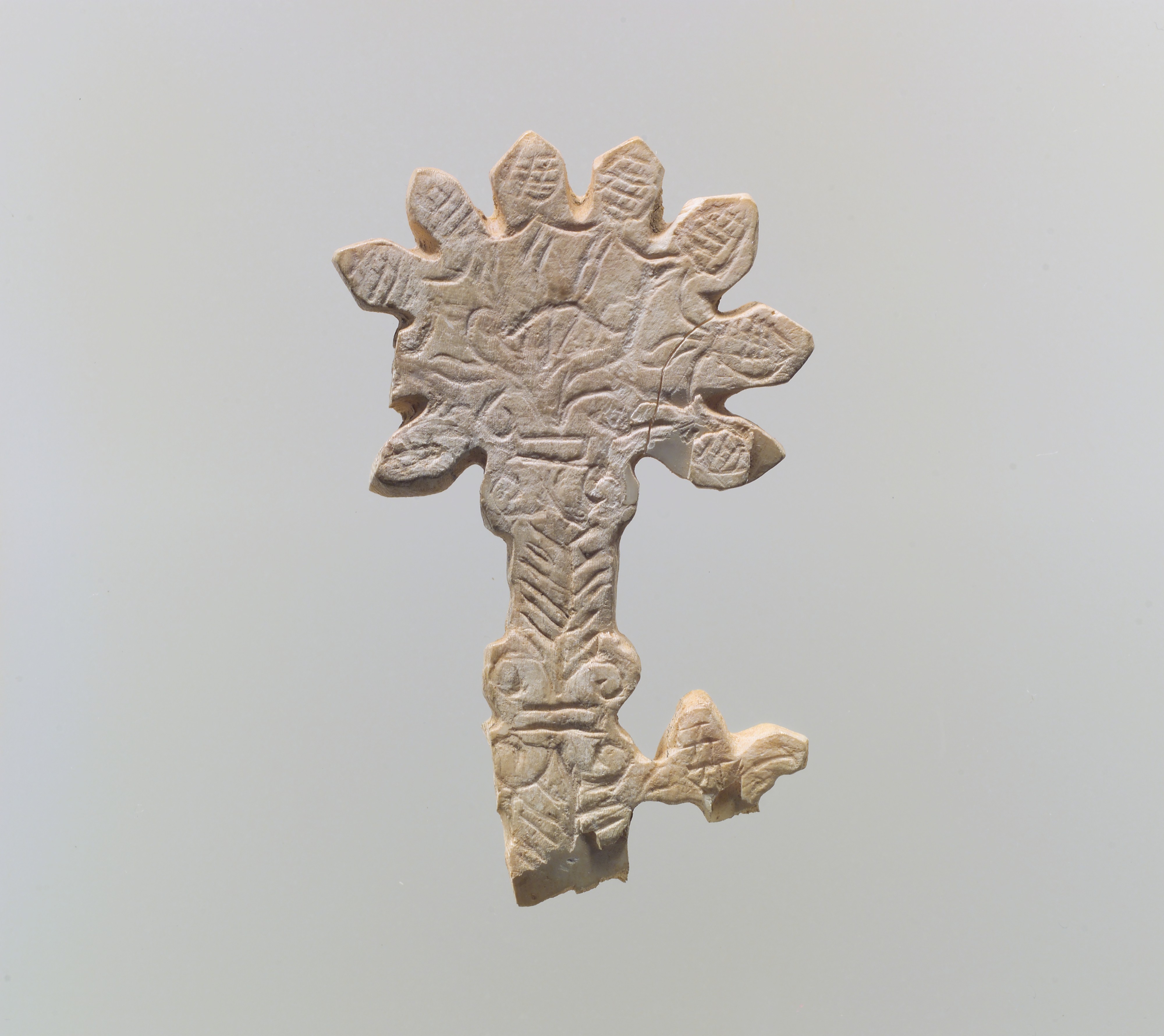
Figure 2. Assyrian tree-shaped shell plaque, ca. ninth-eighth century BCE, Nimrud. The Metropolitan Museum of Art, Rogers Fund, 1958, accession 58.31.22. Public-domain image. A comparative example of ancient plant imagery, not a menorah. Object record.
The plaque is an ancient Near Eastern object made in the form of a branching tree, from roughly Isaiah’s period. It does not show that an Assyrian design became Israel’s lampstand, and it certainly does not show that either object encoded a grammatical system. Similarity is not transmission.
Sources
Scripture. Psalm 67; Genesis 1:1; Genesis 2:9; Exodus 3:1–6; Exodus 25:8–9, 40; Exodus 25:31–37; John 1:1–14; Joseph Smith Translation, John 1; Hebrews 8:5; Revelation 1:12–20; 19:13; 22:1–5, 13, 16; 1 Nephi 8:10–12, 19–24; 11:8–25, including 11:21–25; 15:23–24, 23–25; Alma 32:28–42, 41–43; 33:22–23; Doctrine and Covenants 7:1–3; 93:8–11; 110:2–4.
Works cited.
- Philo of Alexandria, Who Is the Heir of Divine Things? 215–220.
- National Library of Russia, First Leningrad Pentateuch, Evr. II B 17.
- Eep Talstra and Rudi Bosma, “Psalm 67: Blessing, Harvest and History: A Proposal for Exegetical Methodology.”
- Babylonian Talmud, Bava Batra 25b:8.
- Bahya ben Asher, Torah commentary, Exodus 25:31:4.
- Abudarham, Weekday Prayers, Post Amidah 43.
- Sarit Shalev-Eyni, “Gebetbuch, jüdisch” [Jewish Prayerbook], RDK Labor, 2014, section II.A.2.
- David Arnow, “Jacob’s Hope for Salvation: The Extraordinary Career of Genesis 49:18,” Zeramim IV/3, Spring–Summer 2020.
- Michael Rose and Ezri Uval, A Step by Step Guide to Modern Hebrew, 2006; editor Yechiel Kara.
- Lon T. Cherryholmes, The Seven Benyamin for Hebrew Verbs, in the Menorah Form, Yesodey Yeshiva, © 2011 Zion CS.
- Yael Laure and Sharon Armon-Lotem, “Linear and nonlinear processing of Hebrew templatic words: the role of metalinguistic awareness,” Applied Psycholinguistics 45 (2024), 666–694.
- Ulpan-Or, Intermediate-Low Unit 1, pages 39–41.
- Dunash ibn Tamim, commentary on Sefer Yetzirah, chapter 1 (selections), translated by Jeffrey G. Amshalem, Posen Library.
- A. Peter Hayman, Sefer Yeṣira: Edition, Translation and Text-Critical Commentary, Mohr Siebeck, 2004, introduction, pp. 1–2.
- Mazal Cohen-Weidenfeld, Poalei Binyan: A Book for Learning the Verb, Part A: The Binyanim, Jerusalem: Rechelim, first edition 2000.
- Serge Frydman, Conjuguer sans peine en hébreu, Lycée ORT Villiers-le-Bel, October 2006.
- Gregory E. Sterling, “Philo of Alexandria,” Oxford Bibliographies in Classics, 2015.
- Eusebius, Church History 3.23.1–4.
- United States Conference of Catholic Bishops, introductions to the Gospel of John and to Revelation, New American Bible.
- Bible Hub, Genesis 1:1 interlinear.
- The Church of Jesus Christ of Latter-day Saints, “The Menorah,” Ensign, December 2018.
Works available online are linked where they are cited in the text; the two print books, Rose and Uval’s guide and Cohen-Weidenfeld’s course, are identified by their publication details. Every scripture passage is linked in the list above.