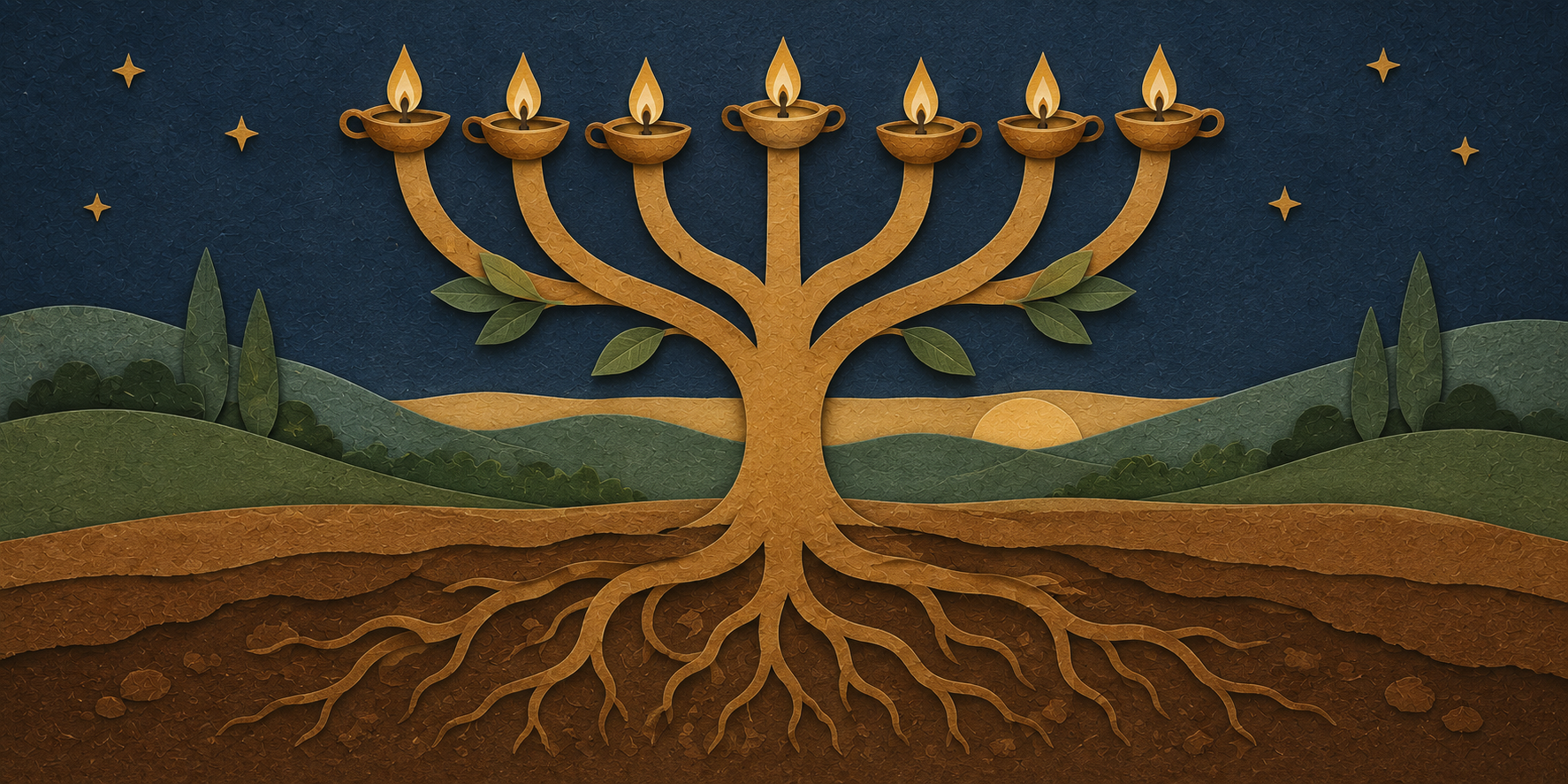
Roots, Branches, and Light

Most of us know what it is to read a verse we have read many times and suddenly find it lit up, as though it had grown since we last looked. Scripture has language for that experience. It presents what God teaches as something alive and light-giving, and the New Testament and Restoration scriptures give that language a person: Christ is the Word, the life, and the light. This short series begins somewhere unexpected where growth, light and word meet: a Hebrew classroom.
- Part 1 reviews the verbal system as it is often taught in modern Hebrew classrooms and considers the history of that chart.
- Part 2 sets out the grammar of roots and patterns that organize the chart and shape Hebrew words.
- Part 3 follows older traditions that use symbolic images for teaching and devotional reading, including the lampstand as a figure for the word.
The Question
Walk into a Hebrew classroom and you may find the verb system taught on a picture of the seven-branched lampstand from the tabernacle. In this chart, Hebrew’s seven principal verb patterns are arranged along the branches of a menorah. Each branch represents a binyan, literally a “building” or “structure”; the plural is binyanim. Each pattern has a characteristic arrangement of vowels and consonants that gives it a recognizable shape and sound.
Hebrew words are built from a root—a shoresh, the Hebrew word for “root” (plural shorashim). These roots usually consist of three consonants associated with a family of meanings. Different patterns can change how that meaning is expressed. The root connects the words; the pattern helps distinguish their roles.
These roles are connected to recurring sound patterns and usually follow predictable paradigms. The binyanim–menorah chart is a practical model that does two halves of one job: it shows which patterns exist and what each one tends to do, while also making their relationships visible by showing where each pattern stands within the larger system.
For English speakers this may well seem a strange thing to do. We do not usually think of grammar as a religious subject, and we would not equate a lampstand with a filing system. Yet Hebrew teachers keep reaching for it, and students remember it. The impulse behind that — using the lampstand to talk about sacred words — turns out to be a very old one. Using it to teach grammar patterns is the part we cannot yet reliably date, and whether this modern version of the chart goes back to older traditions is one of the questions this series explores.
That question has a three-part answer, and the parts are worth separating, because they usually arrive run together:
- Scripture itself ties living growth, light, and speech into one bundle of images. A tree gives life; a lamp gives light; instruction does both. “Thy word is a lamp unto my feet, and a light unto my path” (Psalm 119:105). Nephi is shown a rod of iron that is “the word of God,” and it leads to the tree that represents the love of God (1 Nephi 11:21–25; 15:23–24). That is scriptural, and it is old — and the wisdom writers frequently use these types of metaphors about speech itself, including written symbols, the Alpha and Omega, jot and tittle, logos, the Word made flesh.
- Hebrew grammar really is organised around roots and patterns — a structure that invites a branching picture. Hebrew calls roots shorashim and stems geza’im. Medieval Jewish grammarians such as David Kimhi analysed roots and patterns long before modern teaching charts.
- Later interpreters connected the lampstand specifically with words and letters, and eventually with whole texts written in the shape of a menorah. That is the soil in which a grammar diagram makes sense.
None of these strands, by itself, shows that teachers were already arranging the seven verb patterns on a menorah. We have not yet identified an earlier established version of the chart or a documented account of how its design developed. An older connection is possible, but the surviving record remains allusive.
One thing to say before we start, because it is why the trail is worth following. These images are not merely decoration. Scripture keeps insisting that what God teaches is alive and that it gives light—a tree you can eat from, a lamp you can see by. Scripture may be set down in letters—in law, in Torah, and in written witness—yet it is the Spirit of the living God that writes its meaning upon the heart and gives it life, meaning, and purpose. The letter without the Spirit cannot give life; nor does the Spirit negate the word. Together, the word and the Spirit become a living witness, able to communicate what the writing was given to say.
That gives the verbal chart a suggestive analogy. A Hebrew root is conventionally represented by its consonants; the vowel pattern brings it into a particular spoken form, giving the word grammatical shape and direction. Hebrew ruach and Greek pneuma can both mean breath as well as spirit. The point is not that vowels are a secret code for the Spirit. Rather, breath gives voice to what the letters hold. In the same way, the Spirit does not replace the written word but makes it living in the hearer. The chart lets us see, on a small linguistic scale, how a single root takes form as a word that can be heard, understood, and communicated.
None of this makes the chart ancient, nor does it turn Hebrew grammar into a hidden doctrine. It does, however, help explain why the image can carry more than decorative force. The chart itself is a small and late teaching device, standing at the far end of a long habit of using trees and lamps to speak about God’s word. The question is how, if at all, it came to occupy that place.
The seven principal verb patterns—the binyanim—are normally named Paal, Niphal, Piel, Pual, Hiphil, Hophal, and Hitpael. One naming point is worth having, because you will meet both terms: the first pattern is called Paal on Modern Hebrew charts and Qal in most English-language grammars of biblical Hebrew. They are the same pattern. These names give a first look at the seven patterns. Part 2 explores how a root takes different forms through the L–M–D example.
These patterns help us recognize whether someone performs an action, receives it, causes it to happen, acts on themselves, or acts on another person who acts on them in return. Grammarians call these relationships active, passive, causative, reflexive, and reciprocal. These are useful tendencies, not automatic translations: the particular word and its context still matter.
Within each binyan, further changes mark who is involved: I, you, he, she, we, or they, with distinctions of singular and plural and, in many forms, grammatical gender. Other forms express commands, requests, or an infinitive such as “to learn.” The chart brings these patterns together so readers can begin recognizing relationships instead of memorizing each form in isolation. “Hebrew for the Rest of Us,” the Hebrew appendix to Mounce’s Greek for the Rest of Us (PDF page 3).
You do not need to read Hebrew to follow the examples. Part 2 begins with one word family and its English meanings, showing how the patterns work. The interactive model offers further examples—including forms drawn from biblical passages—and lets you explore how these patterns appear in scripture.
Why a Lampstand
Once the patterns are in view, the lampstand is more than decoration. Its centre stem and matched branches offer a memorable way to arrange seven forms rather than list them in a row.
The names and relationships in the chart are older than the chart itself. Early medieval works associated with Ḥayyūj and Ibn Janāḥ are among our earliest surviving written witnesses to this root-and-pattern system, though they do not tell us when the tradition began. The system may well have circulated orally long before it was written down. David Kimhi (c. 1160–1235) gathered and recorded this learning in Mikhlol (“The Compendium”) and Sefer ha-Shorashim (“Book of Roots”). His works carried the tradition forward for centuries; Eliezer Ben-Yehuda still cites Kimhi in his dictionary.
The pattern names come from forms of the model root פ־ע־ל. The menorah chart did not create the system. It gave the system a visual arrangement that makes its relationships easier to see and remember.
In this layout, Hitpael stands on the centre stem; Hiphil and Hophal face one another on the inner branches, then Piel and Pual, with Paal and Niphal on the outermost branches. The arrangement makes these relationships easier to see and remember.
What remains undocumented is the step of placing this inherited system onto the seven branches of a menorah. The earliest dated example we have located is Serge Frydman’s 2006 Hebrew course. It shows the chart in use, not where its design began. The arrangement also appears in an undated Israeli Ministry of Education adult-education handout, is described in connection with Michael Rose and Ezri Uval’s A Step by Step Guide to Modern Hebrew (2006), and is the explicit subject of Lon T. Cherryholmes’s 2011 handout, The Seven Benyamin for Hebrew Verbs, in the Menorah Form. Together, these witnesses show the chart’s circulation as a teaching device; they do not yet recover its origin.
The patterns are regular enough for this to be a useful teaching layout, but not every root occurs in every binyan, and the branch pairings describe common relationships rather than fixed rules.
The Lampstand Was a Plant Before It Was a Diagram
One reason a lampstand lends itself to this at all is that the original was built to look like something growing.
Read the instructions in Exodus 25:31-37 and count the botanical vocabulary. Six branches come out of a central shaft. There are cups shaped like almond blossoms, with knops and flowers, repeated down each branch. The material is gold, and the vocabulary is botanical from beginning to end.
The biblical description of the lampstand is unmistakably botanical, with almond cups, calyxes, and blossoms. That has led many interpreters to see a stylized flowering tree, and some scholars have explored its relationship to broader sacred-tree and Tree-of-Life imagery. Daniel C. Peterson, for example, notes Leon Yarden’s proposal that the menorah represents a stylized almond tree; other writers, including Jeffrey Bradshaw, have considered whether it may evoke an oil-bearing tree of life or mercy. These are serious interpretive proposals, but Exodus itself does not call the lampstand the Tree of Life, and scholars continue to disagree about how directly its form derives from sacred-tree symbolism. Cornelis Houtman, “Menorah,” sections 6.1-6.3.
The link between lampstand and living tree becomes explicit in a prophetic vision. In Zechariah 4:2-3, the prophet sees a golden lampstand with seven lamps and two olive trees standing beside it. When he asks about the trees and their branches, he describes the branches emptying their oil through two golden pipes. The angel calls the two trees the “two anointed ones” who stand by the Lord in verse 14. Trees, sacred light, and the oil that sustains the lamps stand in one picture.
The sequence may also recall Nephi’s vision of the tree of life: a heavenly messenger shows sacred images, invites questions, and gradually unfolds their meaning (1 Nephi 11:2, 10, 21-25). The resemblance lies both in the symbolism and in a familiar way prophetic visions unfold. It is not evidence that Nephi was drawing on Zechariah, whose ministry came after Lehi’s departure from Jerusalem. Both visions, however, place divine instruction in a temple-centered world where sacred images invite interpretation.
The vision speaks to people rebuilding the temple in Jerusalem. Zerubbabel, the governor of Judah, is helping lead that work (Haggai 1:14). Through Zechariah, God promises that Zerubbabel, who laid the temple’s foundation, will also finish it (Zechariah 4:9).
The words “Not by might, nor by power, but by my spirit” explain how: the work depends on God’s Spirit, not human strength alone (Zechariah 4:6). In that setting, the oil flowing from the trees to the lampstand becomes an image of God’s sustaining help. Together, tree, oil, and lampstand encourage the builders: they are not being asked to complete the work on their own.
Wisdom That Grows and Gives Light
The same cluster of images turns up in Israel’s wisdom writing, and there it is applied directly to speech.
Wisdom is called a tree of life to those who take hold of her. A healing tongue is also called a tree of life. A commandment is a lamp, and instruction is light. Proverbs 3:18, Proverbs 15:4, Proverbs 6:23.
These three sayings are not unrelated compliments or pieces of advice. Together they make one claim in two figures: instruction and healing speech do the work both of a tree and of a lamp. They sustain life and show the way forward. Within the larger scriptural pattern, that illuminated path is the covenant path that leads back into God’s presence. Once that connection is in place, a lampstand shaped like a tree is not an odd object at all. It casts two metaphors for the same life-giving divine instruction in gold.
Isaiah: When Words Stop Telling the Truth
Isaiah takes that equation and shows what it looks like when it fails.
In Isaiah 5:20 people call evil good and good evil. This is a failure of language before it is anything else: the words still work, but they have been turned around, so speech now hides conduct instead of describing it. Four verses later the prophet reaches for the tree: a root goes rotten and a blossom blows away like dust, and he ties that decay directly to a people who have rejected the Lord’s instruction and word. The image and the diagnosis are the same image and diagnosis we just met in Proverbs, run in reverse. Teaching should have been a tree; this tree is dying.
In the next chapter Isaiah sees the Lord, the train of his robe filling the temple, and what he says about himself is about his mouth: he is a man of unclean lips among a people of unclean lips. A coal from the altar touches his mouth, his guilt is taken away, and he is sent. Isaiah 6:5-9. This is not a lesson about pronunciation. It is cleansing and commissioning — the mouth that could not be trusted is made fit to carry a message.
Then the tree comes back alive. Isaiah 11:1 puts a shoot out of the stock of Jesse and a branch out of his roots, and the ruler who grows there judges by righteousness rather than by what his eyes see and his ears hear — his speech belongs to that righteous judgment. By chapter 12 a whole people is speaking again, their speech raised into song, and what they do with their mouths is thanksgiving, proclamation, and praise.
Read in sequence, those chapters move from speech that conceals, to a mouth made clean, to new growth from a cut stump, to a people singing. That is a real pattern in the text, and it is worth saying plainly what kind of claim it is: it is a reading of how the chapters sit together. It is not a hidden etymology, and nothing here is evidence of an ancient classroom chart. Isaiah does not need a buried code to make the link between living things and truthful speech land.
Isaiah 29:13 names the danger directly: the people honour God with their mouths while their hearts remain far from Him, and their reverence has become “a precept of men.” The problem is not teaching itself, but human tradition standing in for living devotion and reshaping how God’s word is received.
Scripture also looks forward to language restored to its divine purpose. Adam’s faithful posterity wrote by inspiration in a language described as “pure and undefiled” (Moses 6:5–7), and Zephaniah promises a day when the Lord will turn the peoples to a pure language so that they may call upon His name and serve Him together (Zephaniah 3:9).
The modern revival of Hebrew may be understood as resonant with the Restoration’s broader recovery of access to Israel’s textual and covenantal heritage. That is not proof that Hebrew is Adam’s language, or that modern Hebrew simply reproduces biblical Hebrew unchanged. It does mean that renewed Hebrew learning has helped readers and scholars attend more closely to ancient sources, including shades of grammar and vocabulary that translations cannot always carry across. Nephi warns of “plain and precious” things being taken away from the biblical record (1 Nephi 13:26–29); Alma teaches that “by small and simple things are great things brought to pass” (Alma 37:6). Perhaps the patient work of recovering linguistic context is one small way ancient promises continue to bear fruit.
Translation is an essential gift, but every translation makes choices, and distinctions can be softened or lost across languages, centuries, and cultures. That is why learning these skills is so rewarding: they help us listen more carefully to the scriptures’ ancient voices.
When the Word Takes Root
Two Book of Mormon passages bring the word-and-tree relationship into a person’s life. They belong here as scriptural comparisons, rather than as links in the history of the grammar diagram.
Lehi dreams of a tree whose fruit brings joy, and of an iron rod that guides people toward it. Nephi then sees the tree in his own vision, where an angel shows him the mother and birth of the Son of God. When asked what the tree means, Nephi identifies it with God’s love. He identifies the rod as the word of God, leading to the tree that represents God’s love. The symbols work together but do different things: the word guides a person toward what the tree offers. 1 Nephi 8:10–12, 19–24; 11:13–25. Nephi makes the practical connection explicit when he urges his brothers to hold to God’s word. 1 Nephi 15:23–25.
In Alma 32:28-42 Alma asks his listeners to compare the word to a seed. What is planted is the word; faith is what the hearer exercises in receiving and nourishing it. As it grows he describes it swelling and enlightening the understanding, and then he turns to the care the tree needs if it is going to root and bear fruit.
The botanical language makes something abstract into something you can picture doing. The hearer does not merely recognise a promising idea. They give it room, attend to it, and find out what it is by watching it grow. Alma’s next chapter identifies the teaching he wants them to receive: faith in the Son of God and his redeeming work. Alma 33:22–23. Nephi pictures the word guiding a person to the tree; Alma pictures the received word growing into a tree. Both join God’s word with life-giving fruit without making the two images identical.
Optional reflection: the letter Nun
This section is an optional reflection. It is not part of the argument of this article, and nothing else here depends on it.
The early form of Nun (נ) is visually suggestive of a seed sending up a shoot.

Its name is associated with fish and, in Klein’s etymological discussion, with related words for sprouting, increase, and offspring. Whatever the original sign represented, these overlapping images made nun a natural symbol of continuing life in later Jewish interpretation. That gives it a modest resonance with Alma’s planted word: growth that is nourished and brought to fruit.
End of the optional reflection.
Restraint of that kind makes the whole study more useful, not less. We do not have to prove that every tree, lamp, letter, and verb pattern encodes one secret system. We can notice where scripture puts them together, watch what later readers did with that, and ask what it helps us see in the passage in front of us.
For Isaiah, that returns to the mouth touched by the coal: will speech conceal what is wrong, or be made fit to carry the Lord’s word? For Nephi, it asks whether we will follow that word toward God’s love. For Alma, it returns to the seed: will the word be given room to live?
Those are questions a reader can act on now, while the history of the diagram goes on being traced.
Part 2 sets the chart aside and shows how Hebrew actually builds words from roots and patterns — the grammar the chart is trying to teach.
Sources
Scripture. Psalm 119:105 · 1 Nephi 11:21–25; 15:23–25 · Exodus 25:31–37 · Zechariah 4:1–14 · Proverbs 3:18; 15:4; 6:23 · Isaiah 5:20, 24; 6:5–9, 13; 11:1–4; 12 · Alma 32:28–42, together with the further passages cited in the text above.
Works cited.
- Cornelis Houtman, “Menorah — Lampstand,” Semantics of Ancient Hebrew Database, 2013, updated 2025, sections 6.1–6.3.
- Michael Rose and Ezri Uval, A Step by Step Guide to Modern Hebrew, 2006; editor Yechiel Kara.