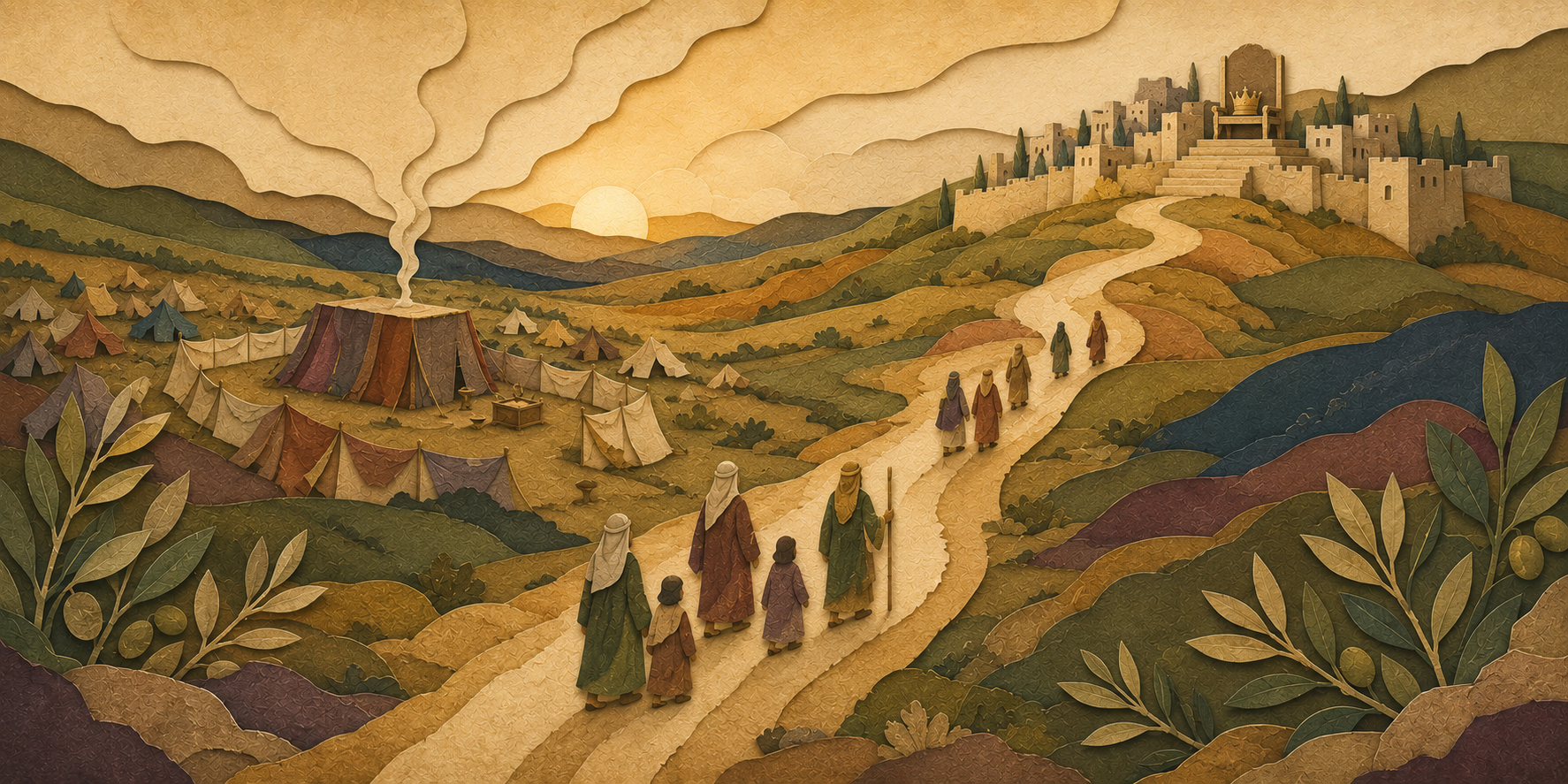
A government that was supposed to have no king
Before Israel ever had a throne, it had an architecture. When Jethro counseled Moses in the wilderness, the result was a system of distributed authority — capable men set as judges “over thousands, and rulers of hundreds, rulers of fifties, and rulers of tens” (Exodus 18:21). Authority ran in many hands, close to the people, and it answered upward to God Himself. The Lord was the King. Israel was to be “a kingdom of priests, and an holy nation” (Exodus 19:6) — a whole people in covenant, not a populace beneath a crown.
It is worth naming what that system did. It gave. It gave manna in the morning. It gave each family a permanent inheritance in the land. It gave deliverers — judges raised up by the Spirit in the hour of need — rather than a standing army and a dynasty. Power was decentralized; the priesthood was, by design, distinct from civil governance (though in practice figures like Moses and Samuel bridged both); and at the Jubilee the land itself came home to the families it had been given to. This is the shape of the Kingdom of God: God reigning directly, and a people organized to receive.
The prophecy Moses left behind
Moses knew it would not hold. Long before there was a king to fail, he wrote the warning down — and, remarkably, he wrote down the very words Israel would one day use: “I will set a king over me, like as all the nations that are about me” (Deuteronomy 17:14). Moses did not forbid a king outright. Instead he drew three boundary lines around any future throne. A king must not multiply horses for himself — and must not “cause the people to return to Egypt” to get them. He must not multiply wives, “that his heart turn not away.” He must not greatly multiply silver and gold (Deuteronomy 17:16–17). And he must write out a copy of the law and read it all his days, “that his heart be not lifted up above his brethren” (17:18–20).
Hold those three lines in mind — horses, wives, gold. The history of the kings is, in large part, the history of those three lines being crossed.
The spiral of the judges
What Moses foresaw arrived slowly, generation by generation. The book of Judges is not a random sequence of heroes; it is a cycle that loosens with every turn — Israel forgets, falls, cries out, is delivered, and forgets again, each loop lower than the last.
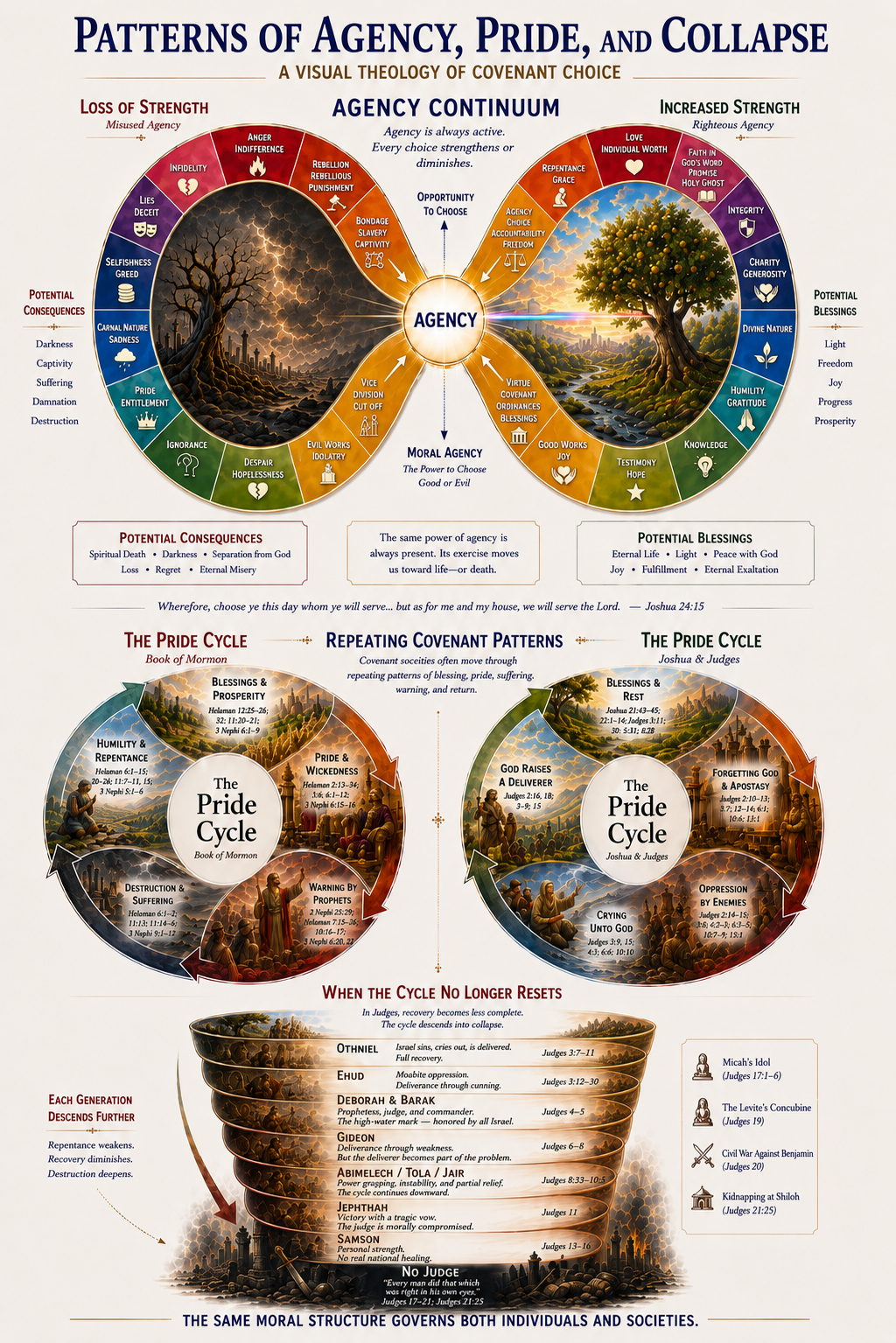 Patterns of Agency, Pride, and Collapse — from the Canaan Cultural Field Guide. Click to enlarge.
By the end of Judges the system meant to need no king has nearly dissolved: “every man did that which was right in his own eyes” (Judges 21:25). The theocracy is still in place on paper. In the hearts of the people it is already gone.
Two women, and the foundation they laid
It is no accident that the bridge from the judges to the kings runs through two women.
Ruth — a Moabite widow who chooses covenant over comfort — is rescued by Boaz, her go’el (גֹּאֵל, kinsman-redeemer), the relative with both the right and the willingness to buy back what was lost (Ruth 4). The book closes on a genealogy that lands, deliberately, on David. The redeemer-pattern is already being taught before the kingdom exists.
Hannah — barren, grieving, praying so fervently the priest mistakes her for drunk — is given a son she gives back to God: Samuel, the prophet who will anoint Israel’s first two kings. And before there is a throne, before there is an anointed king, Hannah sings of one: “he shall give strength unto his king, and exalt the horn of his anointed” (1 Samuel 2:10). She names the Anointed before there is anyone to anoint. The matriarchs are already pointing past the kings to a King.
“They have rejected me”
Then the request comes. Israel’s elders ask Samuel for a king “to judge us like all the nations” (1 Samuel 8:5). It stings Samuel personally — but the Lord reframes it: “they have not rejected thee, but they have rejected me, that I should not reign over them” (1 Samuel 8:7). The demand to be “like all the nations” is, at its root, a vote against the very thing that made Israel unlike the nations: a people whose King was God.
Samuel warns them exactly how a king will operate. He calls it the mishpat hammelek (מִשְׁפַּט הַמֶּלֶךְ) — the manner of the king (1 Samuel 8:9, 11). Read his speech and one verb keeps returning: he will take. He will take your sons and your daughters. He will take your fields and your vineyards. He will take a tenth of everything (1 Samuel 8:11–17). There, in a single word, is the structural contrast with everything Moses built. God’s system gives — manna, inheritance, deliverance. The king’s system takes — conscription, taxation, a throne that consolidates what a covenant had distributed.
And the Lord — astonishingly — grants the request anyway. He honors a choice He has just called a rejection of Himself. Keep that grace in view; it matters for where this ends.
Two perspectives on kingship — both true
Here the Old Testament and the Book of Mormon seem, at first, to disagree.
The Old Testament and Jewish tradition love David. He is “a man after [God’s] own heart” (1 Samuel 13:14), the standard every later king is measured against, the recipient of the covenant of an everlasting throne (2 Samuel 7). Out of David grows the whole hope of a coming Messiah.
The Book of Mormon is far more wary of kingship as an institution — and it reads almost like a vindication of Samuel’s warning. King Benjamin is the deliberate anti-pattern to 1 Samuel 8: a king who serves, who labors with his own hands so as not to burden his people with taxes (Mosiah 2:14). And Mosiah finally dismantles monarchy altogether, teaching that “because all men are not just it is not expedient that ye should have a king” (Mosiah 29:16), warning how a wicked king “trampleth under his feet the commandments of God” (Mosiah 29:21–23). Israel moved from judges to a king; the Nephites move from a king to judges — the same arc, run in reverse. (The systems are not identical — Nephite judges were elected by popular voice, Mosiah 29:25–26, while Israelite judges were Spirit-raised deliverers — but the directional pattern is unmistakable.)
These are not really contradictions. The Old Testament preserves the hope — an eternal throne. The Book of Mormon preserves the warning — that no merely human king is safe. Both resolve in the same place: the only reconciliation is a King who is perfectly just. Which is to say — only one King qualifies.
Three kings, three failures, three temptations
Israel’s three great kings each rose, and each fell — and remarkably, each fell to a different one of the exact boundaries Moses drew in Deuteronomy 17:16–17.
Moses said the king must not multiply horses — the instruments of military power — “nor cause the people to return to Egypt” to get them. Moses said the king must not multiply wives, “that his heart turn not away.” And the king must not greatly multiply silver and gold.
Horses. Wives. Gold. Three boundaries. Three kings. Three falls.
Saul fell to horses — the multiplication of military power and the seizure of authority that was not his. He built an army of 330,000 for the Ammonite war (1 Samuel 11:8), then couldn’t wait for Samuel and offered a sacrifice that was not his to offer — seizing priestly authority in a military crisis (1 Samuel 13:8–14). He spared what God told him to destroy because “I feared the people, and obeyed their voice” (1 Samuel 15:24) — the crowd controlled the commander. He built himself a monument (15:12). Samuel’s verdict: “rebellion is as the sin of witchcraft, and stubbornness is as iniquity and idolatry” (15:23). Saul’s sin was the multiplication of human power — military force, popular approval, self-authorized priesthood — in defiance of the Lord’s explicit instructions.
David fell to wives — the multiplication of women that turned his heart. It was not just Bathsheba; it was the pattern. Michal, Ahinoam, Abigail, Maacah, Haggith, Abital, Eglah — and then more in Jerusalem (2 Samuel 5:13). The heart that God looked upon (1 Samuel 16:7) was turned, exactly as Moses warned, by not only the multiplication of wives, but how he treated and discarded them. The Bathsheba episode (2 Samuel 11) was the catastrophic climax of a trajectory Moses had prophesied centuries earlier.
Solomon fell to gold and silver — and then, having crossed that line, crossed the other two as well. He multiplied gold until “silver was nothing accounted of in the days of Solomon” (1 Kings 10:21). He imported horses from Egypt — the very thing Moses said would “cause the people to return to Egypt” (1 Kings 10:28–29; cf. Deuteronomy 17:16). And he took seven hundred wives and three hundred concubines who “turned away his heart after other gods” (1 Kings 11:3–4). Solomon is the only king who violated all three of Moses’ boundary lines by name. He is the full embodiment of what the mishpat hammelek (מִשְׁפַּט הַמֶּלֶךְ) was designed to prevent.
Now set these beside the wilderness. President David O. McKay taught that Satan’s temptations broadly fall into three categories — appetite, pride, and worldly power — drawn from the pattern of Christ’s wilderness temptations in Matthew 4 (see Teachings of Presidents of the Church: David O. McKay, Chapter 9: “Overcoming Temptation”). When we lay McKay’s categories alongside both Moses’ boundaries and the three kings, a triple alignment emerges:
| Moses’ boundary (Deut 17) | The temptation in the wilderness | The king who fell to it |
|---|---|---|
| Do not multiply horses (military power, self-authorized authority) | Pride: Cast yourself from the temple — presuming on position and divine protection | Saul |
| Do not multiply wives (“that his heart turn not away”) | Appetite: Turn stones to bread — appetite of the flesh | David |
| Do not multiply gold and silver | Worldly Power: All the kingdoms of the world — wealth and power | Solomon |
This is the heart of it: Christ in the wilderness passed all three tests, demonstrating his worthiness as the true King, passing the exact test each earthly king failed — the same tests Moses prophesied would bring the kings down. And He answers every temptation by quoting Deuteronomy — “man shall not live by bread alone” (Deut. 8:3), “thou shalt not tempt the Lord” (Deut. 6:16), “him only shalt thou serve” (Deut. 6:13). He is the King of Deuteronomy 17 made flesh: the One with the law written on His heart, whose heart is not lifted up, incorruptible. Where Saul seized power, David caved to his carnal appetites, and Solomon hoarded wealth — Christ refused all of these. Moses drew the lines. The kings crossed them. Christ held them.
How both patterns point to Christ
So we are left with two government structures, and they do not compete — they converge.
Moses’ theocracy shows us what God’s reign looks like. God as King among a Kingdom of Priests, the Zion pattern. The Spirit-anointed judges (as fallible as they were) represent types of deliverers, foreshadowing the types of redemption that Christ as the Messiah would perform. “A kingdom of priests” prefigures the body of Christ, in which every member has a seat, gift, and a role. The law points to its fulfiller.
Davidic kingship gives us the royal lineage and typology — even though it begins as a concession. The word mashiach (מָשִׁיחַ) simply means anointed one, so every anointed king is described as a small messiah pointing to the Great Messiah. The shepherd-king prefigures the Good Shepherd. The covenant of an eternal throne (2 Samuel 7) is fulfilled in the Son of David “of [whose] kingdom there shall be no end” (Luke 1:32–33). And the kings’ very failures are woven in as part of the broader pattern: each fallen king and judge is a foil, proving by their collapse the need for a King and Judge who will not fall.
Here is the grace at the center of the whole story. Israel asked for a king as an act of rejecting God — and God let them have it. Then He took that institution, born of rejection, and made its throne the seat of the Redeemer. The kingship that began by pushing God away becomes the very means by which God-as-King returns to reign. He worked through the concession. He always does.
This is why the Old Testament is so much more than a chronicle of ancient politics. It teaches patterns. The theocracy and the throne are two halves of one revelation — one showing the reign we were made for, the other supplying the lineage of the One who would restore it — and both, read together, point unmistakably to Christ: the perfectly just King the Book of Mormon could trust, and the Son of David the Old Testament longed for, at last recognized as the same person.
Sources and Citations
Biblical Sources
- Exodus 18:21 — Jethro’s distributed authority system (rulers of thousands, hundreds, fifties, tens)
- Exodus 19:6 — “a kingdom of priests, and an holy nation”
- Deuteronomy 17:14-20 — the mishpat hammelek: Moses’ three boundary lines for kingship (horses, wives, gold)
- Judges 21:25 — “every man did that which was right in his own eyes”
- Ruth 4 — Boaz as go’el (kinsman-redeemer); genealogy ending at David
- 1 Samuel 2:10 — Hannah prophesies “his king” and “his anointed” before any king exists
- 1 Samuel 8:5-17 — Israel’s demand; God’s response (“they have rejected me”); Samuel’s mishpat hammelek warning
- 1 Samuel 13:14 — “a man after [God’s] own heart”
- 2 Samuel 7:12-16 — the Davidic Covenant: eternal throne, father-son relationship
- 1 Kings 10-11 — Solomon violates all three of Moses’ boundary lines
- Matthew 4:1-11 — the three temptations of Christ
- Luke 1:32-33 — Gabriel’s announcement to Mary fulfilling the Davidic Covenant
Book of Mormon Sources
- Mosiah 2:14 — King Benjamin labors with his own hands, refuses to burden his people
- Mosiah 29:16, 21-23 — Mosiah dismantles monarchy; the warning against wicked kings
Latter-day Saint Sources
- Teachings of Presidents of the Church: David O. McKay, Chapter 9: “Overcoming Temptation” — three categories of temptation (appetite, pride, worldly power)
Cross-References
- Patterns of Agency, Pride, and Collapse poster — the pride-cycle graphic (Week 22)
- Wrestling with David — companion article on David’s failures and the women in his story
- Week 22 Study Guide — the seven cycles of Judges as prophetic pattern
- Week 23 Study Guide — Ruth as kinsman-redeemer typology
- Week 24 Study Guide — Saul’s kingship, anointing, and rejection
- Week 25 Study Guide — David’s rise, the Davidic Covenant, Jerusalem