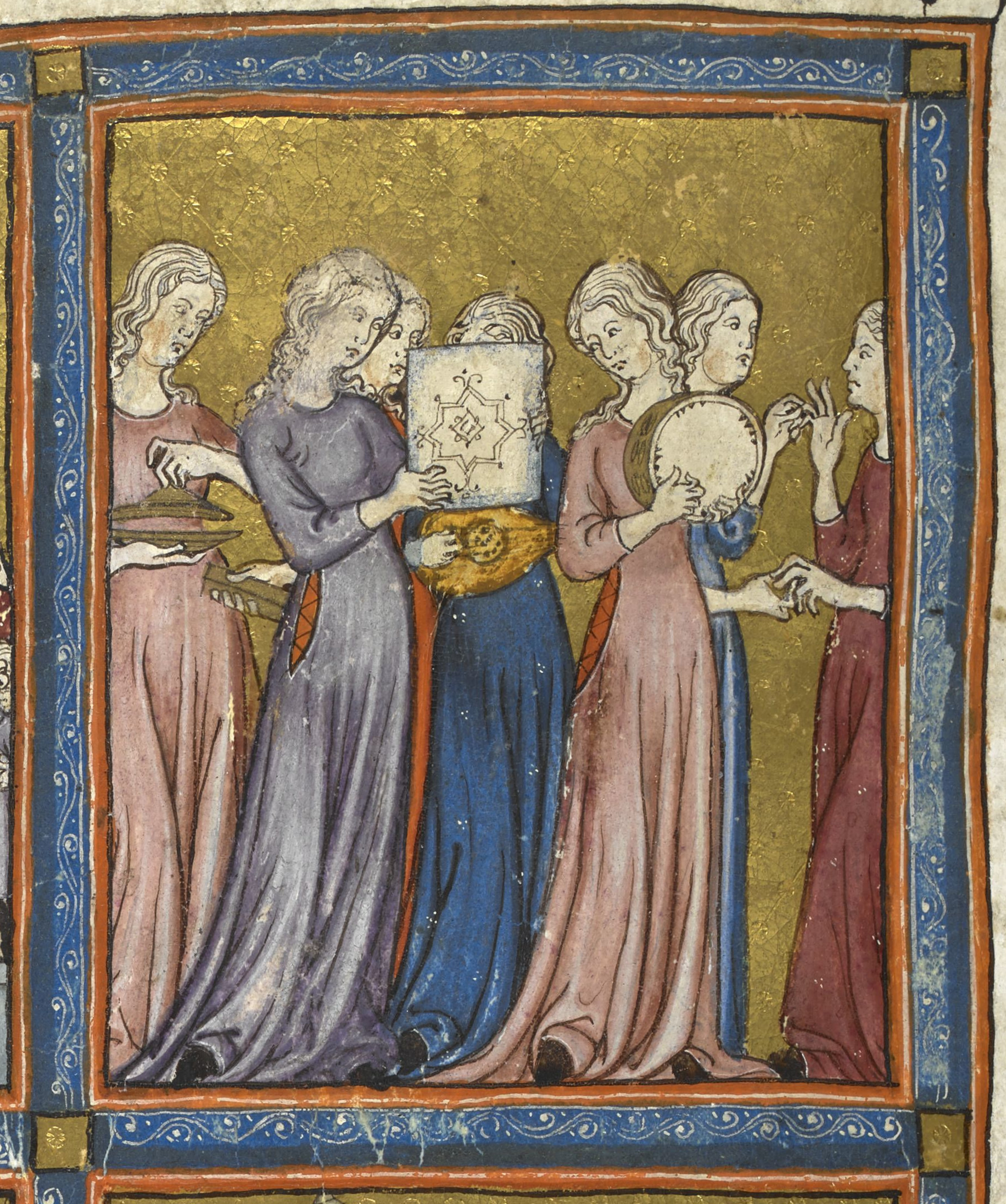
When Miriam took up her timbrel after crossing the Red Sea, she wasn’t simply leading a celebration — she was acting in her role as a prophetess, participating in a sacred tradition that connected music with divine revelation. The scriptures reveal a consistent pattern: music served as a vehicle for the Spirit of the Lord, facilitating prophecy, healing, and communion with God.
This week’s reading (Exodus 14–17) contains the first recorded instance of musical worship after the Exodus. Understanding the prophetic function of music enriches our appreciation of what happened at the shores of the sea and illuminates a tradition that would shape Israelite worship for centuries.
In This Article
- Miriam: Prophetess and Musical Leader
- The Song of Moses: Music as Priesthood Duty
- The Schools of the Prophets: Music as Prophetic Training
- David: Therapeutic and Temple Music
- Elisha and the Minstrel
- Temple Dedication: Music and Divine Presence
- The Early Church: Continuing the Pattern
- Understanding the Connection
- Application
Miriam: Prophetess and Musical Leader
The Scene at the Sea
“And Miriam the prophetess, the sister of Aaron, took a timbrel in her hand; and all the women went out after her with timbrels and with dances. And Miriam answered them, Sing ye to the LORD, for he hath triumphed gloriously; the horse and his rider hath he thrown into the sea.” (Exodus 15:20-21)
Miriam is explicitly called n’vi’ah (נְבִיאָה)—“prophetess”—making her the first woman in scripture to bear this title. Her musical leadership was not merely celebratory but prophetic in nature. The connection between her prophetic role and her musical leadership reflects an understanding that would persist throughout Israelite history: music was a conduit for divine communication.
The Timbrel and Women’s Musical Tradition
The scene of Miriam leading the women reflects a well-documented tradition of women’s musical leadership in ancient Israel and the broader Ancient Near East. This was not an isolated incident but part of a recognized performance genre.
The Victory-Song Tradition
The instrument Miriam played—the tof (תֹּף), a frame drum or timbrel—was primarily associated with women’s musical expression in ancient Israel. The tof combined with song and dance formed what scholars call the “women’s victory-song tradition”—a specific performance genre celebrating military deliverance.
This pattern appears repeatedly in scripture:
- Miriam at the Red Sea (Exodus 15:20-21)
- Jephthah’s daughter greeting her father’s return from battle (Judges 11:34)
- The women of Israel celebrating David’s victory over Goliath: “The women came out of all cities of Israel, singing and dancing, to meet king Saul, with tabrets [תֻּפִּים, tuppim], with joy, and with instruments of musick” (1 Samuel 18:6)
- Deborah and Barak singing together after defeating Sisera (Judges 5)
Archaeological Evidence
Figurines throughout the Ancient Near East depict women dancing, singing, and playing frame drums—precisely matching the Exodus 15:20-21 description. These artifacts confirm that women held a recognized role as musical celebrants of divine deliverance, not merely as background participants.
Miriam’s Prophetic Authority
The prophet Micah preserves a remarkable tradition about Miriam’s status:
“For I brought thee up out of the land of Egypt, and redeemed thee out of the house of servants; and I sent before thee Moses, Aaron, and Miriam.” (Micah 6:4)
God sent three leaders—not two. Miriam stands alongside Moses and Aaron as representing God before the people. Her musical leadership was not secondary to her brothers’ roles but an essential expression of prophetic authority.
The combination of elements in Exodus 15:20-21—prophetic title, musical instrument, leadership of a responsive chorus, and sacred dance—establishes a template for understanding how music functioned in Israelite worship.
Further Reading
| Article | Source | Focus |
|---|---|---|
| Miriam’s Song of the Sea: A Women’s Victory Performance | TheTorah.com | Women’s victory-song tradition |
| Miriam: Bible | Jewish Women’s Archive | Comprehensive scholarly article |
| Miriam’s Song and the Role of Music in Prayer | Jewish Theological Seminary | Liturgical significance |
| The Mystery of Miriam’s Song | Chabad.org | Rabbinic perspectives |
| Miriam’s Song and the Persistence of Music in Dark Times | The Lehrhaus | Music as resilience and hope |
Video: Lynne Hilton Wilson explores the significance of Miriam’s song in What is the “Song of the Sea”? (Book of Mormon Central)
The Song of Moses: Music as Priesthood Duty
A Song to Remember the Covenant
Before Israel entered the Promised Land, God gave Moses a final commission:
“Now therefore write ye this song for you, and teach it the children of Israel: put it in their mouths, that this song may be a witness for me against the children of Israel.” (Deuteronomy 31:19)
This song—preserved in Deuteronomy 32 and known in Hebrew as הַאֲזִינוּ (Ha’azinu, “Give ear”)—was not merely poetry. It was a prophetic witness of the Oath and Covenant of the Priesthood, designed to remain in Israel’s collective memory as testimony of covenant faithfulness and the consequences of apostasy.
The Keepers of the Song
Moses entrusted this sacred song to specific guardians:
“And it came to pass, when Moses had made an end of writing the words of this law in a book, until they were finished, that Moses commanded the Levites, which bare the ark of the covenant of the LORD, saying, Take this book of the law, and put it in the side of the ark of the covenant of the LORD your God, that it may be there for a witness against thee.” (Deuteronomy 31:24-26)
The Levites who carried the Ark were specifically the Kohathites (קְהָתִי). According to Numbers 4:4-15, the Kohathite clan bore responsibility for the most sacred objects—the Ark, the table, the lampstand, the altars, and the vessels of the sanctuary. They alone carried these holy things, covered and on poles, whenever Israel moved.
Thus, the guardians of God’s physical presence (the Ark) were also the guardians of God’s prophetic song. Music and sacred space were united in the same Levitical responsibility.
From Ark-Bearers to Song-Leaders
This connection between the Kohathites, the Ark, and sacred music continued through the generations. When David organized the Temple worship, he did not invent the association—he formalized what Moses had established.
The chief of David’s three master musicians was Heman (הֵימָן). First Chronicles 6:33-38 traces Heman’s genealogy: he was a descendant of Kohath through the line of Korah, Izhar, and ultimately Samuel the prophet. The Kohathite who once carried the Ark now led Israel in prophetic song.
This was not coincidence. David recognized that those entrusted with bearing the symbol of God’s presence were the natural choice to create the musical atmosphere that invited that presence. The Kohathites had been set apart for sacred proximity; music was an extension of that sacred duty.
Music as Priesthood Responsibility
The pattern is significant: music in Israel was never merely aesthetic or optional. It was a priesthood function, assigned to specific Levitical families with the same seriousness as carrying the Ark itself. When the Kohathite musicians “prophesied with harps” (1 Chronicles 25:1), they were fulfilling a responsibility that stretched back to Moses’ final charge at the edge of the Promised Land.
The Song of Moses was to be a witness. The Kohathites were its guardians. And when David organized temple worship, he drew from the same family lines that had borne the Ark through the wilderness—those who knew, by generational calling, the weight of standing in God’s presence.
The Schools of the Prophets: Music as Prophetic Training
Saul Encounters the Prophets
One of the most striking examples of music’s connection to prophecy appears in the story of Saul’s anointing:
“After that thou shalt come to the hill of God, where is the garrison of the Philistines: and it shall come to pass, when thou art come thither to the city, that thou shalt meet a company of prophets coming down from the high place with a psaltery, and a tabret, and a pipe, and a harp, before them; and they shall prophesy: And the Spirit of the LORD will come upon thee, and thou shalt prophesy with them, and shalt be turned into another man.” (1 Samuel 10:5-6)
The Prophetic Ensemble
The prophets’ instrumental ensemble included:
| Hebrew | Instrument | Description |
|---|---|---|
| נֵבֶל (nevel) | Psaltery/Large Harp | Multi-stringed instrument, likely 10-12 strings |
| תֹּף (tof) | Timbrel/Frame Drum | Rhythm instrument, same as Miriam’s |
| חָלִיל (chalil) | Pipe/Flute | Wind instrument, associated with joy and mourning |
| כִּנּוֹר (kinnor) | Harp/Lyre | Smaller stringed instrument, David’s instrument |
Hear these instruments: Musician and composer Michael Levy has dedicated his career to recreating the sounds of the biblical כִּנּוֹר (kinnor) and נֵבֶל (nevel) on replica ancient lyres. His albums King David’s Lyre: Echoes of Ancient Israel and Lyre of the Levites offer evocations of the Temple music once played by Levitical musicians. For the חָלִיל (chalil), my good friend Yannis Pantazis has made the restoration of similar ancient instruments in the Greek tradition his life’s work. His handcrafted flutes offer a window into how these ancient pipes may have sounded when the company of prophets descended from the high place.
Yannis Pantazis performs on a handcrafted ancient flute
This wasn’t random musical accompaniment—it was a deliberate practice. The prophets came with their instruments, suggesting music was integral to their prophetic function.
Institutional Musical Education
The phrase “company of prophets” (chevel n’vi’im, חֶבֶל נְבִיאִים) indicates an organized group. Later references to “sons of the prophets” under Elijah and Elisha (2 Kings 2:3, 5, 7, 15; 4:1, 38; 6:1) suggest formal schools where prophetic gifts were cultivated. Music appears to have been central to this training.
The existence of these schools demonstrates that Israel recognized a teachable connection between musical practice and spiritual receptivity. Music wasn’t merely decorative—it was understood as a discipline that could prepare the heart and mind for divine communication.
David: Therapeutic and Temple Music
Music for Healing
David’s earliest appearance at Saul’s court came through his musical reputation:
“And it came to pass, when the evil spirit from God was upon Saul, that David took an harp, and played with his hand: so Saul was refreshed, and was well, and the evil spirit departed from him.” (1 Samuel 16:23)
This represents the first documented instance of music therapy in scripture. David’s playing didn’t merely distract Saul—it brought genuine relief and restoration. The text treats music as having real spiritual efficacy.
David’s Musical Organization
When David became king, he institutionalized what he had experienced personally. His organization of Temple music was comprehensive:
- 4,000 Levites appointed as musicians (1 Chronicles 23:5)
- 288 skilled musicians organized into 24 courses (1 Chronicles 25:7)
- Three chief musicians: Heman, Asaph, and Jeduthun (Ethan)
- Specific families assigned specific instruments and duties
As discussed above, David placed Heman the Kohathite—a descendant of Samuel and, further back, of Korah and Kohath—at the head of the musical organization. Heman’s family had carried the Ark; now they led the song. Asaph (a Gershonite) stood at Heman’s right hand, and Ethan/Jeduthun (a Merarite) at his left (1 Chronicles 6:31-48). All three divisions of Levi participated, but the Kohathites—the Ark-bearers—held the central position.
The Language of Prophetic Music
First Chronicles 25:1 describes the Levitical musicians’ work using explicitly prophetic language:
“Moreover David and the captains of the host separated to the service of the sons of Asaph, and of Heman, and of Jeduthun, who should prophesy with harps, with psalteries, and with cymbals.”
The Hebrew verb here (נָבָא, naba’) is the same root used for prophetic utterance throughout the Old Testament—and the same root from which Miriam’s title נְבִיאָה (n’vi’ah, prophetess) derives. When Miriam took up her timbrel at the sea, she was called n’vi’ah; when the Kohathite musicians played in the Temple, they naba’ (prophesied). The linguistic connection is deliberate: music and prophecy share the same Hebrew root because they served the same spiritual function. Music was not background—it was prophecy.
Elisha and the Minstrel
Prophecy on Demand
Perhaps the most direct statement of music’s prophetic function appears in Elisha’s ministry:
“But now bring me a minstrel. And it came to pass, when the minstrel played, that the hand of the LORD came upon him.” (2 Kings 3:15)
The context is significant. Three kings—Jehoram of Israel, Jehoshaphat of Judah, and the king of Edom—needed divine guidance. Elisha, initially reluctant to help the apostate northern king, agreed for Jehoshaphat’s sake. But to receive the word, Elisha required music.
This wasn’t superstition or magical thinking. Elisha understood that music could create the conditions for prophetic reception. When the minstrel played, “the hand of the LORD came upon him”—and he delivered the word that saved the allied armies.
Temple Dedication: Music and Divine Presence
Solomon’s Dedication
The climax of David’s musical vision came at the dedication of Solomon’s Temple:
“It came even to pass, as the trumpeters and singers were as one, to make one sound to be heard in praising and thanking the LORD; and when they lifted up their voice with the trumpets and cymbals and instruments of musick, and praised the LORD, saying, For he is good; for his mercy endureth for ever: that then the house was filled with a cloud, even the house of the LORD; so that the priests could not stand to minister by reason of the cloud: for the glory of the LORD had filled the house of God.” (2 Chronicles 5:13-14)
The text is careful to note that the musicians performed “as one” (k’echad, כְּאֶחָד)—in perfect unity. This unified sound became the occasion for divine manifestation. The cloud that filled the Temple was the visible presence of God’s glory (kavod, כָּבוֹד), the same glory that had led Israel through the wilderness as a pillar of cloud and fire.
The Early Church: Continuing the Pattern
Paul’s Instructions to the Corinthians
The apostle Paul understood that the ancient connection between music and the Spirit continued in Christian worship. Writing to the Corinthians about spiritual gifts, he described a worship practice that integrated singing with prophetic experience:
“What is it then? I will pray with the spirit, and I will pray with the understanding also: I will sing with the spirit, and I will sing with the understanding also.” (1 Corinthians 14:15)
Paul’s phrase “sing with the spirit” (ψαλῶ τῷ πνεύματι, psalo to pneumati) uses the same Greek root (pneuma) we noted earlier—the breath-spirit that animates both music and revelation. For Paul, Spirit-filled singing was not merely emotional expression but a form of spiritual communication parallel to prayer and prophecy.
Worship as Prophetic Assembly
Paul’s description of early Christian gatherings reveals how fully music remained integrated with revelation:
“How is it then, brethren? when ye come together, every one of you hath a psalm, hath a doctrine, hath a tongue, hath a revelation, hath an interpretation. Let all things be done unto edifying.” (1 Corinthians 14:26)
Notice the sequence: psalm, doctrine, tongue, revelation, interpretation. Psalms—sacred songs—stood alongside prophecy and revelation as expected elements of Christian worship. The pattern established by Miriam, formalized by David, and demonstrated at Solomon’s Temple continued in the apostolic church.
Psalms, Hymns, and Spiritual Songs
Paul reinforced this teaching in his letters to other congregations:
“Speaking to yourselves in psalms and hymns and spiritual songs, singing and making melody in your heart to the Lord.” (Ephesians 5:19)
“Let the word of Christ dwell in you richly in all wisdom; teaching and admonishing one another in psalms and hymns and spiritual songs, singing with grace in your hearts to the Lord.” (Colossians 3:16)
The three categories—psalms (ψαλμοῖς), hymns (ὕμνοις), and spiritual songs (ᾠδαῖς πνευματικαῖς)—suggest a rich musical tradition in early Christianity. Significantly, Paul describes this singing as “teaching and admonishing”—music served a didactic and prophetic function, not merely an aesthetic one.
The early Church, then, did not invent a new relationship between music and the Spirit. They inherited and continued what Israel had known since Miriam first lifted her timbrel at the sea.
Understanding the Connection
Why Music?
Scripture doesn’t explain the specific mechanisms by which music facilitates spiritual experience, but it consistently demonstrates the connection. Several observations emerge:
1. Music engages the whole person. Unlike purely intellectual activity, music involves body (rhythm, breath, physical performance), emotion (affective response), and mind (pattern recognition, memory, attention) simultaneously.
2. Music creates unity. The Temple dedication emphasizes that the musicians performed “as one.” Corporate worship through music aligns hearts and minds, creating the spiritual unity that invites divine presence.
3. Music requires surrender. Both performing and receiving music involve a degree of letting go—releasing control and becoming receptive. This posture mirrors the receptivity required for revelation.
4. Music transcends language. While words communicate propositional truth, music can communicate what words cannot. This may be why prophets used music to access revelation that exceeded ordinary rational processes.
Latter-day Saint Perspective
The Doctrine and Covenants affirms music’s sacred function in a revelation given specifically to Emma Smith:
“For my soul delighteth in the song of the heart; yea, the song of the righteous is a prayer unto me, and it shall be answered with a blessing upon their heads.” (D&C 25:12)
Emma was called to compile the Church’s first hymnbook (D&C 25:11)—a sacred responsibility that echoes Miriam’s role as Israel’s first recorded worship leader through song. The Lord called Emma “an elect lady” (v. 3), and the section concludes with a promise extending to all who receive it: “this is my voice unto all” (v. 16).
Women and Priesthood Patterns
President Russell M. Nelson has specifically directed women to study this revelation in connection with their roles in God’s work:
“I entreat you to study prayerfully all the truths you can find about priesthood power. … I would simply invite you, if you have not already done so, to begin your study with Doctrine and Covenants section 25, given through the Prophet Joseph Smith to his wife Emma.” — President Russell M. Nelson, “Spiritual Treasures,” October 2019 General Conference
President Nelson’s invitation suggests that D&C 25 contains keys for understanding women’s spiritual authority—keys that may illuminate patterns present in ancient Israel but obscured through centuries of drift and apostasy. When Miriam stood at the sea as n’vi’ah (prophetess), leading Israel in covenant song alongside her brothers Moses and Aaron (Micah 6:4), she exercised a form of spiritual leadership that the Restoration begins to reveal.
The Lord Himself prophesied this pattern of loss and recovery when He gave Israel the Song of Moses. That song would serve as a witness precisely because the covenant truths it preserved would be forgotten:
“For I know that after my death [Moses] ye will utterly corrupt yourselves, and turn aside from the way which I have commanded you; and evil will befall you in the latter days.” (Deuteronomy 31:29)
Yet the song would remain—“not forgotten out of the mouths of their seed” (Deuteronomy 31:21). Ancient wisdom, lost but never entirely erased was prophesied to return as His witness at the last day.
President Boyd K. Packer taught: “Music can be used to exalt and inspire or to carry into the mind thoughts that can make one unclean. Choose good music. … Some music is destructive. … Other music is spiritually very nourishing” (Reverence Invites Revelation, October 1991 General Conference).
Music as the Language of the Spirit
The connection between music and the Spirit may be embedded in language itself. The Hebrew רוּחַ (ruach) means both “breath” and “spirit”—the same word describes the wind moving over the waters at creation (Genesis 1:2) and the Spirit of God resting upon prophets. The Greek πνεῦμα (pneuma) carries the same dual meaning: the breath that fills the lungs and the Spirit that fills the soul. It is no coincidence that medieval scribes called their musical notations neumes—signs of breath made visible on the page.
Music, at its most fundamental, is shaped breath. The voice requires breath; wind instruments transform breath into melody; even stringed instruments respond to the rhythmic breathing of the musician and the acoustical wave patterns of the air that carries the sound. When we sing or play, we offer our very breath—our ruach, our pneuma—as a holy offering.
The biblical pattern of music and prophecy suggests that sacred music does more than accompany worship—it participates in creating the conditions where the Spirit can teach, comfort, and reveal. Music is a language of the Spirit, a form of prayer, a song of the heart that the Lord gladly receives and specifically requests. And the ancient patterns of women’s prophetic musical leadership may hold forgotten wisdom and truths still waiting to be fully understood and appreciated.
Application
As we read about Miriam’s song at the sea, we can reflect on:
The prophetic dimension of sacred music. When we sing hymns or listen to sacred music, we participate in a tradition stretching back to Miriam and beyond.
Music as preparation for revelation. Like Elisha calling for a minstrel, we might consider how music can prepare our hearts to receive spiritual impressions.
The unity music creates. The Temple musicians performed “as one.” Congregational singing can unite a ward or family in ways that prepare hearts for the Spirit.
Personal practice. David’s skill on the harp developed through years of practice. Cultivating musical ability—whether performing or listening thoughtfully—can deepen our spiritual capacity.
Conclusion
From Miriam’s timbrel at the Red Sea to the Song of Moses at the border of the Promised Land, from the Kohathite Ark-bearers to the Levitical choirs in Solomon’s Temple, scripture consistently portrays music as more than entertainment or aesthetic pleasure. Music served as a vehicle for prophecy, a preparation for revelation, a priesthood responsibility, and a means of inviting divine presence.
When Israel crossed the sea and Miriam led the women in song, she wasn’t simply expressing joy at their deliverance. She was exercising her prophetic gift through the medium that Israel would use for centuries to commune with God. Moses would later teach a song to serve as covenant witness; the Kohathites would guard both Ark and song; David would formalize what had always been true—that those who draw near to God’s presence do so through sacred music.
Understanding this enriches our reading of Exodus 15 and invites us to consider the spiritual potential of sacred music in our own lives.
CFM Corner Study Library | Week 16: Exodus 14–17