Introduction
David is remembered as a warrior, a king, and the ancestor of the Messiah. But before he was any of those things, he was a musician. He entered Saul’s court not as a soldier but as a menagen (מְנַגֵּן, player) — the man whose lyre could drive away the king’s torment (1 Samuel 16:23). He composed the Psalms that still form the backbone of Jewish and Christian worship three thousand years later. And between the battlefield and the throne, he did something no one before him had attempted: he built an institution. David took the informal, spontaneous tradition of prophetic music — Miriam’s timbrel at the sea, the company of prophets at Gibeah, Deborah’s victory hymn — and organized it into a permanent liturgical system with professional musicians, rotating divisions, designated instruments, a chief director, and a theological mandate that music was not decoration but prophecy.
This article traces that transformation — from what the biblical text explicitly says, to what tradition and archaeology add, to why it matters for anyone who has ever sung a hymn in worship.
Part 1: What the Biblical Text Actually Says
The primary source for David’s musical organization is 1 Chronicles, not 1-2 Samuel. Samuel tells the story of David the warrior and king; Chronicles retells the same events but adds extensive detail about David’s liturgical preparations that Samuel omits entirely. This difference is significant — the Chronicler, writing after the exile, was concerned with the Temple and its worship in a way the author of Samuel was not. Both accounts are scripture, but they have different emphases.
The Ark Procession — Where It All Began (1 Chronicles 15:16-24)
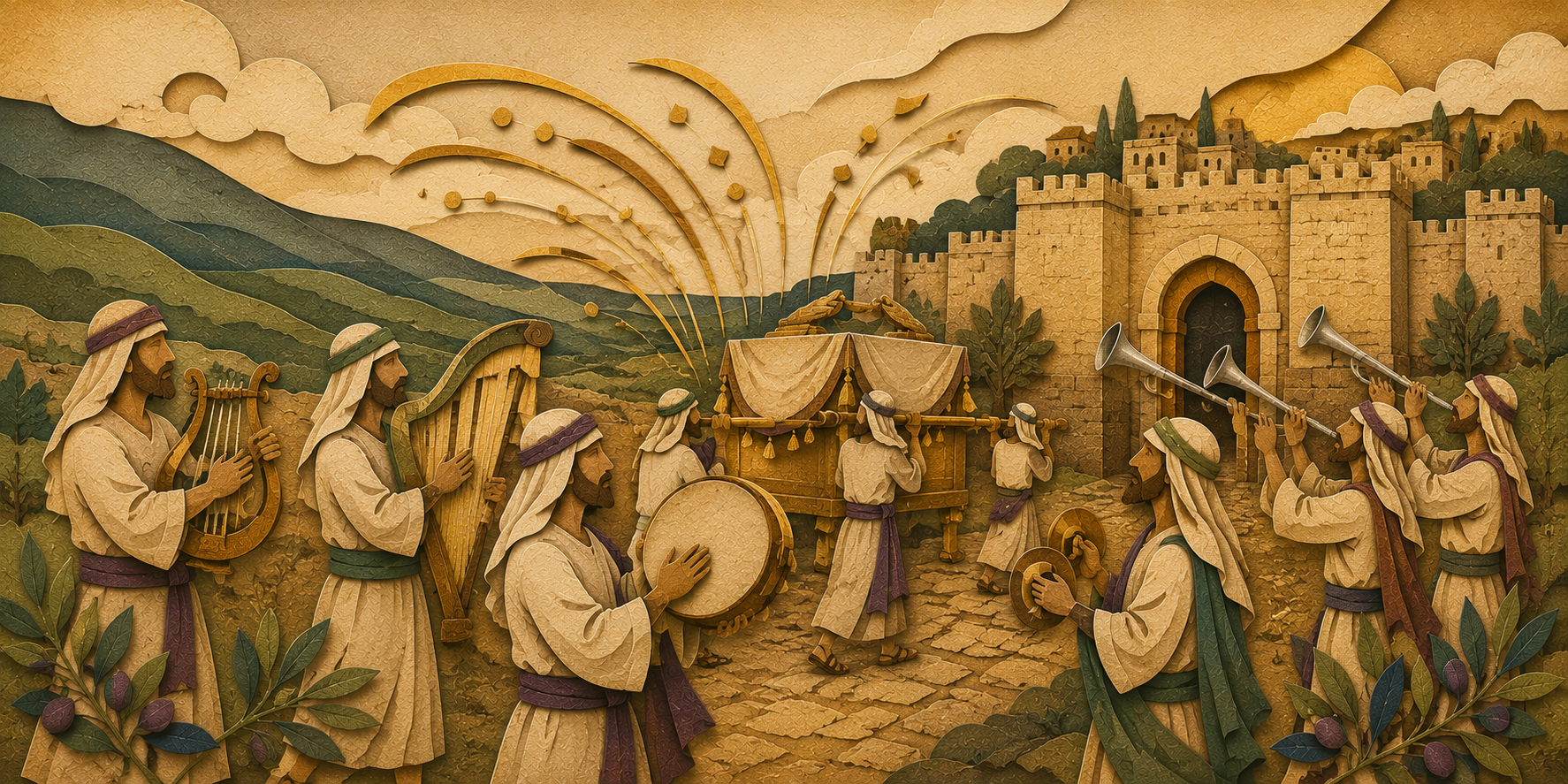
When David brought the Ark to Jerusalem (the event described in 2 Samuel 6), Chronicles adds a detail Samuel does not mention: David “spake to the chief of the Levites to appoint their brethren to be the singers with instruments of musick, psalteries and harps and cymbals, sounding, by lifting up the voice with joy” (1 Chronicles 15:16). This was not spontaneous celebration — it was organized worship. David appointed specific Levites by name:
- Heman son of Joel — the lead singer
- Asaph son of Berechiah — second in rank
- Ethan (Jeduthun) son of Kushaiah — third
All three were Kohathites — members of the Levitical clan of Kohath, and this is not incidental. The Kohathites had been set apart for sacred musical and liturgical duties long before David. Moses assigned the Kohathites the most sacred responsibility among the Levitical clans: carrying the Ark of the Covenant itself, along with the table of showbread, the lampstand, the altars, and the holy vessels (Numbers 4:4-15). They were the ones who bore God’s presence on their shoulders. Moses also appointed Levites — and the Kohathites specifically — to recite the Song of Moses (Shirat Ha’azinu, Deuteronomy 32) on the feast days, ensuring that the prophetic song God commanded Moses to write (Deuteronomy 31:19) would be preserved and performed in perpetuity.
David did not invent a new institution. He expanded a Mosaic one. The same clan that carried the Ark and sang the Song of Moses under the wilderness Tabernacle became, under David, the professional Temple musicians who prophesied with harps, psalteries, and cymbals. The Kohathite lineage runs directly from the shoulders that bore the Ark across the Jordan to the voices that sang before it in Jerusalem. Heman’s genealogy in 1 Chronicles 6:33-38 traces his line through Samuel all the way back to Kohath son of Levi — making explicit that David’s chief musician descended from the very clan Moses consecrated for this work.
These three became the founders of the Temple music institution. Their descendants would serve for centuries.
The Permanent Appointment (1 Chronicles 16:4-7)
After the Ark was settled in Jerusalem, David made the musical worship permanent: “He appointed certain of the Levites to minister before the ark of the LORD, and to record, and to thank and praise the LORD God of Israel” (16:4). The verbs are significant: lehazkir (לְהַזְכִּיר, to invoke/record), lehodot (לְהוֹדוֹת, to give thanks), and lehallel (לְהַלֵּל, to praise). These are not casual activities — they are liturgical functions assigned to specific people as a permanent duty.
The Full Organization — 4,000 Musicians (1 Chronicles 23:1-6)
Near the end of David’s life, he organized all 38,000 Levites into divisions. Of these, 4,000 were designated specifically as musicians: “four thousand praised the LORD with the instruments which I made, said David, to praise therewith” (23:5). David didn’t just appoint musicians — he made instruments for them. The text credits David as an instrument-maker, a claim echoed by the prophet Amos, who references those who “invent instruments of musick, like David” (Amos 6:5).
The 24 Divisions — Music as Prophecy (1 Chronicles 25:1-31)
This is the key chapter. David organized the musicians into 24 rotating divisions — the same number as the priestly courses (1 Chronicles 24). Music and sacrifice were structurally paired: when the priests served, the musicians served alongside them.
The opening verse makes an extraordinary claim: “David and the captains of the host separated to the service of the sons of Asaph, and of Heman, and of Jeduthun, who should prophesy with harps, with psalteries, and with cymbals” (25:1). The Hebrew word is hannibbe’im (הַנִּבְּאִים) — from naba (נָבָא), the same root used for prophetic speech. The text does not say they “played” or “performed” or “sang.” It says they prophesied. Music, in this institutional framework, was classified as prophetic activity.
The 24 divisions totaled 288 musicians: “the number of them, with their brethren that were instructed in the songs of the LORD, even all that were cunning, was two hundred fourscore and eight” (25:7). Each division had 12 members (288 ÷ 24 = 12 — the number of the tribes). The rotation ensured continuous worship — someone was always singing before the Ark.
The Temple Dedication — The Glory Falls (2 Chronicles 5:12-14)
When Solomon’s Temple was dedicated, the musical system David built reached its climax:
“Also the Levites which were the singers, all of them of Asaph, of Heman, of Jeduthun, with their sons and their brethren, being arrayed in white linen, having cymbals and psalteries and harps, stood at the east end of the altar, and with them an hundred and twenty priests sounding with trumpets: It came even to pass, as the trumpeters and singers were as one, to make one sound to be heard in praising and thanking the LORD… that then the house was filled with a cloud, even the house of the LORD; So that the priests could not stand to minister by reason of the cloud: for the glory of the LORD had filled the house of God.” (2 Chronicles 5:12-14)
The glory of God descended when the musicians and trumpeters became “as one” — ke-echad (כְּאֶחָד). Unity of sound preceded the manifestation of divine presence. The 120 trumpeters plus the Levitical choir, performing in the system David had designed, created the acoustic environment in which God chose to appear.
Part 2: The Three Chief Musicians
Asaph — The Seer-Singer
Asaph is the most prominent of the three. Twelve Psalms bear his name (50, 73-83), and his descendants served as Temple musicians through the exile and return — Ezra 2:41 lists “the singers: the children of Asaph, an hundred twenty and eight” among those who returned from Babylon. That means the Asaphite musical tradition survived the destruction of the Temple and the seventy-year exile intact. The family kept singing even when there was no Temple to sing in.
2 Chronicles 29:30 calls Asaph a “seer” (choze, חֹזֶה) — the same title used for prophets. His Psalms are among the most theologically daring in the Psalter: Psalm 73 wrestles with why the wicked prosper; Psalm 82 envisions God judging the divine council.
Heman — The King’s Seer
Heman is called “the king’s seer in the words of God” (1 Chronicles 25:5) — a title that explicitly combines prophetic and musical functions. He was a grandson of Samuel the prophet (1 Chronicles 6:33), giving him a direct prophetic lineage. He had fourteen sons and three daughters, “all these were under the hands of their father for song in the house of the LORD” (25:6). His is the largest musical family in the biblical record.
Psalm 88 is attributed to Heman — and it is the darkest psalm in the entire Psalter, ending with no resolution: “Lover and friend hast thou put far from me, and mine acquaintance into darkness” (88:18). The king’s seer did not only sing praise. He sang the truth of suffering.
Jeduthun (Ethan) — The Praiser
Jeduthun appears in the superscriptions of Psalms 39, 62, and 77. His name may derive from yadah (יָדָה, to praise/give thanks). He served as the third division head and his descendants continued after the exile (Nehemiah 11:17). The name Jeduthun itself became a musical term — “upon Jeduthun” in Psalm superscriptions may indicate a specific melodic tradition or performance style associated with his family.
Part 3: Music as Military and Protective Function
Singers Before the Army
One of the most extraordinary military episodes in the Old Testament occurs in 2 Chronicles 20:21-22. Jehoshaphat, facing a coalition of Moab, Ammon, and Mount Seir, “appointed singers unto the LORD… that should praise the beauty of holiness, as they went out before the army.” Singers went ahead of the soldiers. And “when they began to sing and to praise, the LORD set ambushments against the children of Ammon, Moab, and mount Seir… and they were smitten.” The enemies turned on each other. Israel didn’t fight — they sang.
This is not an isolated incident. The pattern runs through scripture:
- Jericho (Joshua 6) — shofars and a shout brought down the walls
- Gideon (Judges 7) — shofars and torches, no swords
- Jehoshaphat (2 Chronicles 20) — singers before the army
- The Ark processions — always accompanied by music
The consistent principle: God’s warfare operates through faithful worship and obedience, not through conventional weapons. The musicians were not entertainers marching with the troops — they were the front line.
Gatekeepers and Singers — The Kohathite Soldier-Musicians
1 Chronicles 9:17-33 describes the Levitical gatekeepers who guarded the Tabernacle and later the Temple. These roles overlapped with the singers: some Levites served both functions. This dual role — musician and guard — was not an administrative convenience. It was a continuation of the Kohathite military tradition.
The Kohathites were the Levitical clan charged with physically carrying and protecting the Ark of the Covenant (Numbers 4:4-15). They were not passive porters — they were the Ark’s military escort, responsible for its security in transit and in camp. When the Tabernacle moved, the Kohathites bore the most sacred objects on their shoulders, surrounded by the other Levitical clans and the tribal armies. Their duty was simultaneously liturgical and defensive: they carried God’s presence and they defended it.
The gatekeepers of the Temple inherited this function. The gates were not merely physical checkpoints — they were the boundary between sacred and profane space, the threshold between the world and God’s presence. Guarding that boundary was a Kohathite responsibility from Sinai onward. That the same Levites who stood guard also sang is not coincidental — it reflects a world in which worship and protection were the same act.
And there was a practical dimension that modern readers easily miss. In a world without radios, telephones, or electronic communication, musical signals were the primary means of long-distance tactical communication. Numbers 10:1-10 codifies this: distinct trumpet cadences signaled assembly, departure, advance, retreat, alarm, and celebration. Different blast patterns (teqi’ah, תְּקִיעָה — a sustained blast; teru’ah, תְּרוּעָה — a series of short blasts) communicated different commands across distances that voice could not carry. Levitical musicians positioned at strategic points around the camp or the Temple complex functioned like a signal corps — relaying warnings of danger, directing movement, coordinating shifts. The shofar blasts at Jericho (Joshua 6), Gideon’s three hundred shofars surrounding the Midianite camp (Judges 7), and the silver trumpets of Numbers 10 all operated on this principle: musical cadences worked like a code, and trained musicians stationed at key positions could communicate across an entire army or an entire city. The Levitical gatekeepers who sang at the Temple gates were the descendants of the Kohathite soldier-musicians who guarded the Ark in the wilderness — and their instruments served the same dual function: worship that ascended to God and signals that organized and protected His people. The trumpet blast in battle was not merely a signal to the soldiers — “ye shall be remembered before the LORD your God, and ye shall be saved from your enemies” (Numbers 10:9) — it was a signal to God Himself. What Moses established with two silver trumpets and a clan of Kohathite guardians, David expanded into a full orchestral and choral institution. The foundation was Mosaic; the architecture was Davidic; the purpose was the same from Sinai to Solomon’s Temple.
Part 4: How to Recognize a Song in Scripture — The Hebrew Vocabulary
Not every song in the Bible announces itself as a song. Some are labeled; many are embedded in narrative without a title. Knowing the Hebrew terminology helps readers spot the music even when the English translation obscures it.
But before we look at the vocabulary, we need to address something fundamental: Hebrew poetry does not work the way modern English poetry does. When most English speakers think of poetry, they think of rhyming words and rhythmic meter — Shakespeare’s iambic pentameter, Frost’s rhyme schemes, the cadence of a nursery rhyme. Hebrew poetry has almost none of this. There is no end-rhyme. There is no consistent syllabic meter (though stress patterns matter in some forms, like the qinah lament). If you are looking for what “sounds like poetry” in English, you will miss almost everything.
Hebrew poetry works through parallelism — the art of saying something twice (or more) in related but different ways. The repetition is not redundancy; it is the structure. The second line deepens, contrasts, or completes the first. Robert Alter, whose The Art of Biblical Poetry (Basic Books, 1985) remains the foundational study, calls this “a dynamic process… whereby the second line generates a focusing or intensification or shift of the first.”
The Major Forms of Hebrew Poetic Structure
Synonymous Parallelism — the second line restates the first in different words, deepening the meaning:
“The heavens declare the glory of God; and the firmament sheweth his handywork.” (Psalm 19:1)
Both lines say “creation reveals God” — but the second line moves from the general (heavens) to the specific (firmament), and from declaring (verbal) to showing (visual). The parallel isn’t flat repetition; it’s amplification.
Antithetic Parallelism — the second line contrasts with the first, illuminating by opposition:
“For the LORD knoweth the way of the righteous: but the way of the ungodly shall perish.” (Psalm 1:6)
The contrast between “knoweth” and “perish,” between “righteous” and “ungodly,” creates the meaning. You understand each line more fully because of the other.
Synthetic (Staircase) Parallelism — each line builds on the previous, adding a new element like ascending steps:
“Ascribe unto the LORD, O ye mighty, ascribe unto the LORD glory and strength. Ascribe unto the LORD the glory due unto his name; worship the LORD in the beauty of holiness.” (Psalm 29:1-2)
The repetition of “ascribe unto the LORD” creates a staircase effect — each repetition adds something new (glory, strength, the glory due His name) until the final step shifts from ascribing to worshipping. The form enacts the content: the psalm is ascending.
Chiastic Structure — lines are arranged in a mirror pattern (A-B-C-B’-A’), with the most important idea at the center:
A — “I will praise thee, O LORD, with my whole heart” (Psalm 9:1a) B — “I will shew forth all thy marvellous works” (9:1b) C — “I will be glad and rejoice in thee” (9:2a) B’ — “I will sing praise to thy name” (9:2b) A’ — “O thou most High” (9:2c)
The outer layers (A/A’) frame the psalm with praise and God’s identity. The inner layers (B/B’) describe the response (showing works / singing praise). The center (C) is the heart: personal gladness in God. Chiasm is not decorative — it tells you where the theological center of gravity is. John Welch’s landmark study “Chiasmus in the Book of Mormon” (BYU Studies 10:1, 1969) demonstrated that this same Hebrew structural form appears extensively in the Book of Mormon, consistent with authors writing in a Hebraic literary tradition.
Acrostic Structure — each line or stanza begins with successive letters of the Hebrew alphabet:
Psalm 119 is the most famous example: 176 verses organized into 22 stanzas of 8 verses each, one stanza for each letter of the Hebrew aleph-bet. Every verse in the aleph stanza begins with aleph; every verse in the bet stanza begins with bet; and so on through tav. Lamentations chapters 1-4 are also acrostics. Psalm 34 (composed by David after feigning madness at Gath — 1 Samuel 21) is an acrostic. The acrostic form served as a memory aid, a teaching device, and a theological statement: the psalm encompasses the entirety of the alphabet, symbolizing completeness — everything from aleph to tav (the Hebrew equivalent of “from A to Z”) is covered under this truth.
Inclusio (Envelope Structure) — a passage opens and closes with the same word or phrase, creating a literary frame:
“O LORD our Lord, how excellent is thy name in all the earth!” (Psalm 8:1) [… the body of the psalm …] “O LORD our Lord, how excellent is thy name in all the earth!” (Psalm 8:9)
Everything between the matching lines is held within the frame. The repeated phrase tells you the psalm’s governing theme, and the closure signals literary completeness.
Spiral (Ascending) Structure — each cycle revisits the same theme but at a higher level, like a spiral staircase that passes over the same point on each floor but at increasing elevation:
The Shir HaMa’alot (שִׁיר הַמַּעֲלוֹת, “Song of Ascents”) — Psalms 120-134 — are the definitive example. These fifteen psalms were sung by pilgrims ascending to Jerusalem for the three annual festivals, and tradition holds they correspond to the fifteen steps between the Court of Women and the Court of Israel in the Temple. Each psalm revisits the themes of trust, deliverance, and Zion — but each one climbs higher. Psalm 120 begins in distress (“In my distress I cried unto the LORD”). Psalm 121 lifts the eyes to the hills. Psalm 122 arrives at Jerusalem’s gates. Psalm 124 reflects on past deliverance. Psalm 127 invokes God as the builder of the house. Psalm 130 cries from the depths. Psalm 134 — the summit — blesses the LORD from the sanctuary itself. The same themes spiral upward through the sequence, each pass higher than the last, until the pilgrim stands in God’s presence.
The Song of Moses (Shirat Ha’azinu, Deuteronomy 32) exhibits spiral structure at the verse level: the poem cycles through God’s faithfulness → Israel’s rebellion → consequences → God’s ultimate vindication, revisiting each theme with increasing intensity. The first cycle is historical (what God did for Israel). The second is accusatory (what Israel did in response). The third is prophetic (what God will do in the end). The spiral doesn’t flatten into repetition — it tightens, each revolution pressing harder toward the final resolution.
Many of the great covenant songs — including Hannah’s Song (1 Samuel 2, with its escalating reversals) and portions of Isaiah’s servant songs — employ this spiral form: the same theological truth revisited at progressive depths, each pass revealing more than the last. The spiral is the poetic form of covenant itself: God returns to His people again and again, each time from a deeper place, each time with more at stake.
Poetry, Music, and the Oral World — Why the Distinction Barely Exists
Modern readers naturally ask: is this poetry or music? Where does spoken verse end and song begin? For the ancient world, the question barely makes sense — because almost no one visually read scripture. They heard it audibly.
The Torah scrolls were rare, expensive, hand-copied on specially prepared parchment, and housed in sacred spaces — first the Tabernacle, later synagogues. A community would be fortunate to have a single scroll. Most Israelites never held one in their hands. The text of scripture entered their lives through the ear, not the eye: through public reading, chanted recitation, and sung performance at festivals, Sabbaths, and synagogue gatherings.
This changes everything about how we understand biblical “poetry.” There was no silent reading audience. Every psalm, every prophecy, every law was composed to be recited aloud* —projected across courtyards, carried through crowds, sustained in memory without a written copy to consult. The poetic structures we’ve described — parallelism, chiasm, acrostic, spiral — are not literary decorations for readers. They are memory technology. Parallelism gives you the same idea twice so you catch it even if you missed the first line. Chiasm puts the most important idea at the center where it’s hardest to forget. Acrostics attach each stanza to a letter of the alphabet so you can reconstruct the sequence from memory. The spiral returns to the same theme repeatedly so it accumulates in your mind over time.
In a world without microphones, amplification, or printed texts, music and chant served a function we barely think about: acoustic projection. A speaking voice carries perhaps fifty feet in an open courtyard. A chanting voice — sustained, pitched, rhythmically structured — carries much further. A trained choir singing in unison carries further still. The Levitical musicians were not performing for aesthetic enjoyment. They were the Temple’s sound system. Their chant carried the words of Torah across the courts to thousands of worshippers who could not see the scroll, could not read the text, and had no other way to receive the content except through their ears.
This is why the distinction between “poetry” and “music” in the Hebrew Bible is so thin as to be almost nonexistent. The Hebrew word shir means both “song” and “poem.” The superscription mizmor means “a psalm played on strings” — the text and the music are a single unit. The Psalms were never meant to be read silently from a page. They were composed, performed, and transmitted as living sound — chanted by Levites, sung by pilgrims, recited by families at Passover, carried in memory through exile and return.
When you read a Psalm silently from your printed Bible, you are doing something its author never imagined. You are seeing what was meant to be heard. The poetic structures — the parallelism, the rhythm, the repetition — are the residue of a living voice. They are the fingerprints of a world where scripture was sound before it was text, and where the line between speaking God’s word and singing God’s word did not exist.
Why This Matters for Reading Scripture
When you encounter poetic parallelism in your Bible — and it appears not only in Psalms but throughout the prophets, in wisdom literature, in Hannah’s Song, in Mary’s Magnificat, in large portions of the Book of Mormon — you are reading the oldest continuous literary tradition in the Western world. These forms predate Homer. They predate Greek drama. They are the way Hebrew-speaking peoples organized sacred truth for memorization, recitation, and worship for over three thousand years.
If you read a Psalm and think “this is repetitive,” you are reading it with English ears. Read it with Hebrew eyes — and Hebrew ears: the second line is not repeating the first. It is completing it. And it was never meant to be read at all. It was meant to be sung.
The Core Terms
| Hebrew | Transliteration | Meaning | Greek (LXX) | Latin (Vulgate) | KJV English | How to Spot It |
|---|---|---|---|---|---|---|
| שִׁיר | shir | song (generic) | ᾠδή (ode) — song, ode | canticum — song, chant | “song” | “Song” in the title or introduction |
| שִׁירָה | shirah | song (fem. — the grand, epic ode) | ᾠδή (ode) — same word as shir | canticum — same as shir | “song” (same as shir) | Context: follows a major deliverance; the whole text is a poetic unit |
| מִזְמוֹר | mizmor | psalm with instruments (from zamar, to pluck strings) | ψαλμός (psalmos) — a song sung to plucked strings | psalmus — from the Greek | “A Psalm of…” | “A Psalm of David/Asaph” in the heading |
| תְּהִלָּה | tehillah | praise-song (root of Tehillim, the Hebrew title of Psalms) | αἴνεσις (ainesis) — praise; also ὕμνος (hymnos) — hymn | laus — praise; hymnus — hymn | “praise” | Psalm 145 heading: “David’s Psalm of praise” |
| הַלֵּל | hallel | praise-shout (root of halleluyah) | ἁλληλουϊά (hallelouia) — transliterated directly from Hebrew | alleluia — transliterated through Greek | “Praise the LORD” / “Hallelujah” | “Hallelujah” / “Praise ye the LORD” opening or closing |
| קִינָה | qinah | dirge, funeral lament | θρῆνος (threnos) — lamentation, dirge | lamentatio — lamentation; gives English “lamentation” | “lamentation” | “Lamentation” in heading; 3+2 stress meter (three beats of weeping, two of sobs) |
| מָשָׁל | mashal | proverb, parable, taunt-song, oracle | παραβολή (parabole) — parable, comparison; gives English “parable” | proverbium — proverb; parabola — parable | “proverb,” “parable” | Balaam’s oracles (Numbers 23-24); “byword” |
Notice the translation chain: Hebrew mizmor became Greek psalmos became Latin psalmus became English “psalm.” Hebrew tehillah became Greek hymnos became Latin hymnus became English “hymn.” Hebrew shir became Greek ode became Latin canticum became English “song/canticle/chant.” These are not different categories invented by different cultures — they are the same musical categories carried through Hebrew, Greek, and Latin into the worship vocabulary we still use today. When Paul instructs believers to worship with “psalms, hymns, and spiritual songs” (Ephesians 5:19; Colossians 3:16), he is prescribing mizmor, tehillah, and shir — the full range of Davidic Temple worship — for churches that had never seen the Temple.
The word “hallelujah” deserves special attention: it was never translated. Hebrew halleluyah (הַלְלוּיָהּ) was transliterated into Greek as hallelouia, into Latin as alleluia, and into English as “hallelujah” — the same sounds, the same word, carried unchanged across three thousand years and four languages. It is arguably the oldest continuously spoken word in human worship.
Psalm Superscription Terms
| Hebrew | Transliteration | Meaning | KJV Translation | Psalms |
|---|---|---|---|---|
| מַשְׂכִּיל | maskil | contemplative/instructive psalm (from sakal, to be wise) | “Maschil” | 32, 42, 44-45, 52-55, 74, 78, 88-89, 142 |
| מִכְתָּם | miktam | debated: “golden psalm” or “covering/atoning psalm” | “Michtam” | 16, 56-60 |
| שִׁגָּיוֹן | shiggaion | wild, passionate ode (from shagah, to reel) | “Shiggaion” | Psalm 7; Habakkuk 3:1 |
Performance Direction Terms
| Hebrew | Transliteration | Meaning | KJV Translation | Frequency |
|---|---|---|---|---|
| לַמְנַצֵּחַ | lamnatseach | “to the director/overseer” | “To the chief Musician” | 55 Psalm headings |
| נְגִינוֹת | neginot | “on stringed instruments” | “Neginoth” / “stringed instruments” | Pss 4, 6, 54-55, 61, 67, 76; Hab 3:19 |
| סֶלָה | selah | musical interlude/pause; possibly “lift up” | “Selah” (untranslated) | 71 times in Psalms; 3 in Habakkuk 3 |
The Shir/Shirah Distinction
Both translate as “song” in English, hiding an important difference. The masculine shir is the everyday, generic term — it appears 78 times. The feminine shirah is reserved for the grand, epic odes — the once-in-history songs that mark a cosmic turning point:
- Shirat HaYam — the Song of the Sea (Exodus 15)
- Shirat Devorah — the Song of Deborah (Judges 5)
- Shirat Ha’azinu — the Song of Moses (Deuteronomy 32)
- Shirat Hannah — Hannah’s Song (1 Samuel 2, by some readings)
A rabbinic tradition holds that the feminine form shirah signals a song that is followed by further distress — like a woman who gives birth and then faces the challenges of raising the child. The messianic era will bring a shir chadash (שִׁיר חָדָשׁ) — a “new song” in the masculine form — the song that will finally not be followed by suffering (see Psalm 96:1; Isaiah 42:10; Revelation 5:9).
The Greek Bridge — Paul’s Three Categories
In Ephesians 5:19 and Colossians 3:16, Paul instructs believers to worship with “psalms, hymns, and spiritual songs.” These three Greek terms map directly to the Hebrew Psalm classifications:
| Greek | Paul’s term | Hebrew equivalent |
|---|---|---|
| ψαλμός psalmos | “psalm” | מִזְמוֹר mizmor — instrumental psalm |
| ὕμνος hymnos | “hymn” | תְּהִלָּה tehillah — praise-song |
| ᾠδή ode | “song” | שִׁיר shir — song |
Paul was not listing three random synonyms. He was prescribing the full range of Hebrew worship categories — instrumental psalms, praise hymns, and songs — for Gentile churches that had never seen a Temple. The Davidic system, mediated through Greek vocabulary, shaped the worship of every church that read Paul’s letters.
Songs Hidden in Narrative — How to Find Them
Several important songs in the Old Testament carry no formal musical label but are recognized by scholars through poetic structure, archaic grammar, or narrative introduction:
| Passage | Common Name | Clue That It’s a Song |
|---|---|---|
| Genesis 49:1-27 | Blessing of Jacob | Sustained parallelism, archaic Hebrew forms |
| Numbers 21:17-18 | Song of the Well | Introduced: “Then Israel sang this song” |
| Deuteronomy 32:1-43 | Song of Moses / Ha’azinu | God commands: “write this song” (31:19); called shir in 31:30 |
| Deuteronomy 33:1-29 | Blessing of Moses | Poetic form; no musical label |
| 2 Samuel 1:19-27 | Song of the Bow | Introduced as qinah (lament); taught to Judah |
| Isaiah 5:1-7 | Song of the Vineyard | Introduced: “Let me sing… a song of my beloved” (shir) |
| Habakkuk 3:1-19 | Habakkuk’s Prayer | Labeled tefillah (prayer) but contains shigyonot, neginot, selah — fully structured as a psalm |
| Lamentations 1-4 | — | Written in qinah meter (3+2 stress pattern); each chapter is an acrostic |
How to spot an unlabeled song in English: Watch for the shift from prose to poetic parallelism — when the text suddenly becomes rhythmic, with paired lines saying the same thing in two different ways, you are almost certainly reading a song even if the heading doesn’t say so. In printed Hebrew Bibles (BHS), these passages are formatted in stichometric (line-by-line) layout rather than block prose.
Part 5: The Theology of Temple Music — Why Song in Sacred Space?
Music as the Medium of the Spirit
The biblical evidence is consistent: music opens the channel for prophetic experience. The pattern runs from Miriam’s timbrel (Exodus 15:20) through the prophets at Gibeah who prophesied with instruments (1 Samuel 10:5) to Elisha’s call for a musician before prophesying (2 Kings 3:15: “when the minstrel played, the hand of the LORD came upon him”) to the Levitical musicians who “prophesied with harps” (1 Chronicles 25:1). David’s institutional system formalized what had always been true informally: music is not accompaniment to worship. Music IS an essential form of worship — the acoustic environment in which the Spirit operates.
The linguistic connections run deeper than most readers realize. In Hebrew, the word for spirit is ruach (רוּחַ) — which also means wind, breath, the moving air that carries sound. When the Spirit “came upon” the prophets at Gibeah (1 Samuel 10:6), the same word describes both the divine presence and the breath that powered their instruments. In Greek, the word for spirit is pneuma (πνεῦμα) — breath, wind, the animating force of life. This is the same root that gives us neuma (νεῦμα), the ancestor of the medieval Latin neume — the earliest form of Western musical notation, the marks that indicated how a chanted melody should rise and fall. The musical note itself, in the Western tradition, traces its name back to the Greek word for breath and spirit. And in Latin, spiritus means both the Holy Spirit and the act of breathing — inspirare (“to breathe into”) gives us “inspiration,” which we use for both divine revelation and artistic creation without distinguishing between them.
The ancient languages are telling us something the modern mind has separated: spirit, breath, wind, and music are not four different things. They are the same reality experienced at different registers. When the Levitical choir sang, they were literally breathing the Spirit into sound. When the congregation heard, they were receiving the breath of God’s message through their ears. The Hebrew ruach, the Greek pneuma, and the Latin spiritus all collapse the distinction between the Holy Spirit’s presence and the physical act of voiced worship. Music is not just a metaphor for spiritual experience. It is frequently the medium through which the Spirit moves — because spirit IS breath, and breath IS sound, and sound shaped by covenant purpose IS worship.
Song as the Counterpart to Sacrifice
In the Temple, music and sacrifice happened simultaneously. The Levitical choir sang while the priests offered the daily tamid (תָּמִיד, continual offering). The Mishnah (Tamid 7:4) records specific Psalms assigned to each day of the week:
| Day | Psalm | Theme |
|---|---|---|
| Sunday | Psalm 24 | “The earth is the LORD’s” — creation day 1 |
| Monday | Psalm 48 | “Great is the LORD” — separation of waters, day 2 |
| Tuesday | Psalm 82 | “God standeth in the congregation” — dry land appears, day 3 |
| Wednesday | Psalm 94 | “O LORD God, to whom vengeance belongeth” — sun/moon/stars, day 4 |
| Thursday | Psalm 81 | “Sing aloud unto God” — sea creatures and birds, day 5 |
| Friday | Psalm 93 | “The LORD reigneth” — creation of man, day 6 |
| Sabbath | Psalm 92 | “It is a good thing to give thanks unto the LORD” — rest, day 7 |
Each daily Psalm matched the corresponding day of creation — the Temple choir sang the creation narrative every week in seven movements. The sound of worship mirrored the structure of the cosmos. Every week was a musical re-creation of the world.
The Creation Parallel — Ancient Temple and Modern Temple
The connection between music and creation is not merely liturgical — it is cosmological. Job 38:7 describes the creation itself as accompanied by music: “When the morning stars sang together, and all the sons of God shouted for joy.” The universe was born in song. The Temple choir, by singing the creation Psalms daily, was participating in an ongoing act of cosmic praise that began before the earth was formed.
For Latter-day Saints, this parallel carries special weight. The creation narrative is central to modern temple worship — participants walk through the days of creation as a foundational element of the endowment experience. What the ancient Israelite Temple did through music — rehearsing the creation week daily, moving worshippers through the seven days from the earth’s formation to the Sabbath rest — the Latter-day Saint temple does through ordinance. The medium differs; the theological structure is the same. In both traditions, entering sacred space means entering the creation story. In both, the worshipper is placed inside the narrative of how the world was made and why it was made — and in both, the journey moves from creation toward covenant, from the forming of the world toward the forming of a relationship between God and His children.
The seven daily Psalms were not background music. They were the liturgical architecture that told worshippers where they stood in the cosmic week. Sunday’s Psalm 24 — “The earth is the LORD’s, and the fulness thereof” — established God’s ownership of creation. Friday’s Psalm 93 — “The LORD reigneth, he is clothed with majesty” — declared God’s sovereignty over the completed world. And the Sabbath’s Psalm 92 — “It is a good thing to give thanks unto the LORD” — brought the worshipper to rest, gratitude, and the completion of the cycle. Then on Sunday, it began again. The Temple was a perpetual-motion creation machine, and the Levitical choir was its engine.
The Talmud (Rosh Hashanah 31a) explains the connection explicitly: “Why was this Psalm said on this day?” The Gemara provides a reason for each day’s assignment, linking the Psalm’s content to the corresponding creative act. This was not arbitrary liturgical scheduling — it was deliberate theological mapping. The rabbis understood the weekly Psalm cycle as a re-enactment of creation, and they understood the Temple as the place where that re-enactment happened.
When Latter-day Saints walk through the creation narrative in the temple, they are doing what Israelite worshippers did when they heard the Levitical choir sing Psalm 24 on Sunday morning. The continuity is not coincidental. The creation story belongs in sacred space because sacred space is the re-creation — the place where God forms and covenants with His people, just as He formed and blessed the world.
Part 6: What Comes from Tradition — Edersheim, Mishnah, and the Second Temple
Alfred Edersheim (The Temple: Its Ministry and Services, 1874; modern reprint Hendrickson Publishers, 1995) provides the most accessible English-language description of Second Temple music practices. Drawing from the Mishnah and Talmud, he details:
- The minimum choir size: 12 Levites, no maximum (Mishnah Arakhin 2:6)
- Training period: 5 years of musical training before service; minimum age 30 (some traditions say 25)
- Instruments in the Temple: nevel (harp, 9-string minimum), kinnor (lyre, no fewer than 2 and no more than 6), metziltayim (cymbals, only one pair, played by the choir director to mark the beginning of each section), and chatzotzrot (silver trumpets, minimum 2, maximum 120)
- Instruments NOT permitted: The chalil (flute/pipe) was played on only 12 specified days per year; the ugav (organ/pipe instrument) was considered too secular for regular Temple use
- The moment of silence: Before the priestly blessing (Birkat Kohanim), all music ceased. The silence was itself a liturgical element — the space in which God’s name was spoken
The Hallel (Psalms 113-118) was sung at Passover, Shavuot, and Sukkot — the three pilgrimage festivals. Edersheim and others claim that this is the hymn Jesus and His disciples sang before Gethsemane: “And when they had sung an hymn, they went out into the mount of Olives” (Matthew 26:30). The “hymn” was almost certainly Psalms 115-118 — the second half of the Hallel. Jesus walked to His death singing David’s Psalms.
Part 7: Latter-day Saint Connections
“The Song of the Righteous Is a Prayer unto Me”
Doctrine and Covenants 25:12 makes the same claim as 1 Chronicles 25:1 — music is not separate from spiritual communication but identical to it: “For my soul delighteth in the song of the heart; yea, the song of the righteous is a prayer unto me, and it shall be answered with a blessing upon their heads.” The Davidic principle — that music is prophecy — runs directly into Restoration theology.
The Hymn Before Gethsemane
When Jesus sang the Hallel with His disciples before walking to the Garden, He was participating in the worship system David had designed a thousand years earlier. The Psalms He sang (likely 115-118) were composed or compiled under David’s direction, performed by David’s musical descendants, and organized into the festival liturgy David’s system created. The Last Supper was likely a Passover seder. The hymn was part of the seder. The seder included the Hallel. The Hallel was David’s. Jesus carried David’s music to the cross.
And the music did not stop at Gethsemane. From the cross itself, Jesus spoke seven times — and His words were saturated with the Psalms. “My God, my God, why hast thou forsaken me?” (Matthew 27:46) is the opening line of Psalm 22, a psalm attributed to David. “Father, into thy hands I commend my spirit” (Luke 23:46) echoes Psalm 31:5, also attributed to David. “I thirst” (John 19:28) fulfills Psalm 69:21. Even in His final hours, the words on Christ’s lips were David’s words — the psalms He had sung since childhood, the same liturgical tradition He had participated in at every Passover, Shavuot, and Sukkot of His life. The man dying on the cross was praying in the musical language of the man who had danced before the Ark. For a deeper exploration of how each of Christ’s seven statements from the cross connects to the Psalms and the prophets, see Seven Sermons from the Cross.
Temple Worship and Music
Latter-day Saint temples include music as a component of worship — from the Kirtland Temple dedication, where the congregation sang William W. Phelps’ “The Spirit of God” (D&C 109 records the dedicatory prayer; the hymn preceded it), to modern temple dedications. The pattern of music preceding the manifestation of divine presence (2 Chronicles 5:12-14) is alive in Restoration practice.
The New Song
Revelation 5:9 describes the heavenly chorus singing “a new song” (ode kainen, ᾠδὴν καινήν) — language drawn from Psalm 96:1 and Isaiah 42:10. The Hebrew shir chadash (שִׁיר חָדָשׁ, “new song”) is masculine — the rabbinic tradition that distinguishes shir (masculine, followed by joy) from shirah (feminine, followed by distress) sees the messianic “new song” as the final song, the one that will not be followed by suffering. D&C 84:98-102 describes the redeemed singing a “new song” that includes the declaration: “The Lord hath brought again Zion… the Lord hath redeemed his people.” David organized the music of the earthly Temple. Christ will conduct the music of the eternal one.
Cross-References
- Music and the Spirit of Prophecy — the scriptural chain from Miriam through Elisha to the Levitical musicians
- The Voice at the Mountain — the shofar tradition from Sinai through Gideon to the eschatological trumpet
- Week 22 Study Guide — Gideon’s shofars as liturgical Sinai invocation
- Week 24 Study Guide — the company of prophets with instruments (1 Samuel 10:5); David’s lyre in Saul’s court
- Week 25 Study Guide — David’s conquest of Jerusalem and the Ark procession
Sources and Citations
Jewish Primary Sources (Talmud, Mishnah, Midrash)
- Mishnah Tamid 7:4 — the daily Psalm assignments for each day of the week, linked to the creation narrative
- Mishnah Arakhin 2:3-6 — the minimum choir size (12 Levites), age requirements, training period, and permitted instruments
- Rosh Hashanah 31a — the Talmudic explanation linking each day’s Psalm to its corresponding day of creation
- Pesachim 117b — the Magen David liturgical blessing formula and the Hallel recitation
- Pirkei Avot 1:1 — the chain of prophetic transmission (Moses → Joshua → Elders → Judges → Prophets)
Biblical Sources — David’s Musical Organization
- 1 Chronicles 6:31-48 — David’s appointment of singers after the Ark rested
- 1 Chronicles 6:33-38 — Heman’s genealogy traced through Samuel to Kohath
- 1 Chronicles 15:16-24 — Levites appointed as musicians for the Ark procession
- 1 Chronicles 16:4-7 — permanent Levitical musical appointment (lehazkir, lehodot, lehallel)
- 1 Chronicles 23:1-6 — 38,000 Levites organized; 4,000 designated as musicians
- 1 Chronicles 25:1-31 — the 24 divisions of 288 musicians who “prophesied” with instruments
- 2 Chronicles 5:12-14 — Temple dedication: musicians become “as one,” glory of the LORD fills the house
- 2 Chronicles 20:21-22 — Jehoshaphat’s singers before the army
- 2 Chronicles 29:25-30 — Hezekiah restores David’s musical orders
- Numbers 4:4-15 — the Kohathite responsibility for carrying the Ark and holy vessels
- Numbers 10:1-10 — silver trumpets: assembly, advance, alarm, festival signals
- Deuteronomy 31:19; 32:1-43 — the Song of Moses (Ha’azinu), commanded by God, assigned for feast-day recitation
Biblical Sources — Key Psalms and Songs Referenced
- Psalms 24, 48, 82, 94, 81, 93, 92 — the daily Temple Psalm cycle (Mishnah Tamid 7:4)
- Psalms 113-118 — the Hallel, sung at Passover, Shavuot, and Sukkot
- Psalms 120-134 — the Shir HaMa’alot (Songs of Ascents), pilgrimage psalms
- Psalm 119 — acrostic: 22 stanzas × 8 verses, one per Hebrew letter
- Psalm 22; 31:5; 69:21 — Davidic psalms spoken by Christ from the cross
- Psalm 88 — attributed to Heman, the darkest psalm in the Psalter
- Psalm 50, 73-83 — attributed to Asaph
- Psalm 96:1; Isaiah 42:10; Revelation 5:9 — the shir chadash (new song)
- Job 38:7 — “the morning stars sang together” at creation
Latter-day Saint Scripture
- D&C 25:12 — “the song of the righteous is a prayer unto me”
- D&C 84:98-102 — the redeemed singing a “new song”
- D&C 109 — Kirtland Temple dedicatory prayer (preceded by “The Spirit of God”)
Modern Scholarship
- Alfred Edersheim, The Temple: Its Ministry and Services (1874; modern reprint Hendrickson Publishers, 1995) — Second Temple musical practices, daily service, instruments, choir organization
- Robert Alter, The Art of Biblical Poetry (Basic Books, 1985) — the foundational study of Hebrew parallelism and poetic structure
- John W. Welch, “Chiasmus in the Book of Mormon,” BYU Studies 10, no. 1 (1969): 69-84 — establishing chiastic structure in the Book of Mormon
- Gershom Scholem, “The Curious History of the Six-Pointed Star,” Commentary 8 (1949) — the history of the hexagram symbol vs. the liturgical Magen David
- John Curtis Franklin — on David’s kinnor as a prophetic instrument and the “revelatory duet” (cited in Week 24 Historical Cultural Context)
Draft | CFM Corner Study Library | For review before Hugo deployment