In This Article
- Overview
- Spring Feast Timeline
- Biblical Foundation
- The First Shavuot: Sinai
- Pentecost (Acts 2)
- The Law, the Higher Law, and the Blessing
- Four Mountains: A Temple Progression
- The Bountiful Visit as Shavuot
- Wheat Harvest in Restoration Scripture
- The Book of Ruth
- Traditional Shavuot Foods
- Family Shavuot Activities
- From Stone to Flesh
- Modern Observance & LDS Resonance
Overview
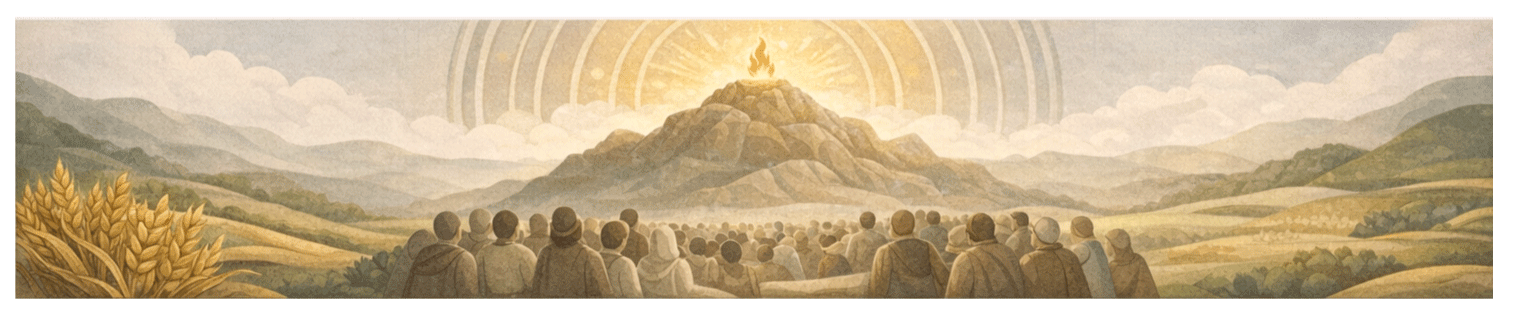
Shavuot (שָׁבֻעוֹת, “Weeks”) is the fourth of the seven biblical feasts — and the one that bridges the spring and summer seasons. It falls exactly fifty days after Bikkurim (Firstfruits), completing the Counting of the Omer. In Greek it became Pentecost (πεντηκοστή, “fiftieth”). While the Torah describes it as a harvest festival, Jewish tradition identifies it as the anniversary of the most transformative event in Israelite history: the giving of the Torah at Mount Sinai.
For Latter-day Saints, Shavuot holds layers of significance that extend far beyond ancient Israel. The same God who descended on Sinai in fire and smoke ascended a mountain in Galilee to deliver the Sermon on the Mount, then descended in a white robe to the temple at Bountiful. At each station, He gave covenant instruction to His people. And each time, the pattern deepened — from enforced distance to invited touch, from law on stone to law on hearts, from terror to Hosanna.
This article traces that progression: from the original Shavuot at Sinai, through the New Testament Pentecost, to the Sermon on the Mount and the Sermon at the Temple in 3 Nephi — revealing a single divine pattern of covenant-giving that culminates in the presence of the risen Christ.
The Spring Feast Timeline
14 Nisan: Passover
Lamb slain at twilight • Christ crucified
15 Nisan: Unleavened Bread
High Sabbath • Christ in tomb
16 Nisan: Firstfruits
Christ rises • Barley sheaf waved

+50 Days: SHAVUOT
Torah given • Spirit descends • Wheat harvest
The gap between Bikkurim and Shavuot is not empty time. It is the Counting of the Omer — forty-nine days of deliberate, numbered anticipation. Israel counted each day between the first harvest and the full harvest, between resurrection and revelation, between deliverance and covenant.
“And ye shall count unto you from the morrow after the sabbath, from the day that ye brought the sheaf of the wave offering; seven sabbaths shall be complete: Even unto the morrow after the seventh sabbath shall ye number fifty days; and ye shall offer a new meat offering unto the LORD.” (Leviticus 23:15-16)
The Biblical Foundation
The Names of the Feast
| Name | Hebrew / Greek | Meaning | Reference |
|---|---|---|---|
| Feast of Weeks | שָׁבֻעוֹת (Shavuot) | Seven weeks after Firstfruits | Deuteronomy 16:10 |
| Feast of Harvest | חַג הַקָּצִיר (Chag HaKatzir) | Celebrates the wheat harvest | Exodus 23:16 |
| Pentecost | πεντηκοστή (Pentekoste) | “Fiftieth” — the Greek name | Acts 2:1 |
Unlike Passover and Sukkot, Shavuot has no specific date in the Torah — only a count. It is defined entirely by its relationship to what came before. You cannot observe Shavuot without first counting from Passover. The feast is, by design, a destination reached through sustained anticipation.
The Pilgrimage Requirement
Shavuot is one of the three pilgrimage festivals (shalosh regalim) when every Israelite male was commanded to appear before the Lord at the Temple:
“Three times in a year shall all thy males appear before the LORD thy God in the place which he shall choose; in the feast of unleavened bread, and in the feast of weeks, and in the feast of tabernacles” (Deuteronomy 16:16)
This is why Jerusalem was packed with “devout men, out of every nation under heaven” on the day of Pentecost in Acts 2:5 — they were there for Shavuot.
The Two Loaves
The two loaves have been interpreted as representing:
- Israel and the nations (both invited into covenant)
- The Written Torah and the Oral Torah
- The Old Covenant and the New Covenant
The First Shavuot: Sinai
The First Shavuot: Sinai
The Timing
| Event | Date | Source |
|---|---|---|
| Exodus from Egypt | 15 Nisan (Passover) | Exodus 12:41 |
| Arrival at Sinai | 1 Sivan (“the third month”) | Exodus 19:1 |
| Three days of sanctification | 3-5 Sivan | Exodus 19:10-11 |
| God descends on Sinai | 6 Sivan = Shavuot | Talmud, Shabbat 86b |
Fifty days from Passover to Sinai. The same count that defines Shavuot in Leviticus 23 matches the narrative timeline in Exodus 19. The harvest festival and the covenant-giving converge on the same date.
What Happened at Sinai
“There were thunders and lightnings, and a thick cloud upon the mount, and the voice of the trumpet exceeding loud; so that all the people that was in the camp trembled… mount Sinai was altogether on a smoke, because the LORD descended upon it in fire” (Exodus 19:16-18)
Three features define the Sinai encounter:
Enforced distance. Boundaries were set around the mountain. “Whosoever toucheth the mount shall be surely put to death” (Exodus 19:12). The holiness of God required maximum separation.
Mediated communication. Moses alone ascended as the designated mediator. The people heard God’s voice but could not bear it: “Let not God speak with us, lest we die” (Exodus 20:19). They retreated further, and Moses stood between them and God.
- Law on stone. The covenant was inscribed on tablets — external, objective, unchangeable. The people received commandments written by God’s finger on dead rock.
The final image of Sinai is distance: “The people stood afar off, and Moses drew near unto the thick darkness where God was” (Exodus 20:21). One man close; the whole nation far away.
The Rabbinic Shavuot Traditions
Tikkun Leil Shavuot — All-Night Torah Study
The Voice in Seventy Languages
God Offered Torah to All Nations
Reading the Book of Ruth
Greenery, Dairy, and Other Customs
Dairy foods: Traditional Shavuot meals feature dairy dishes. Multiple explanations exist: Israel had not yet received the kosher laws and so could not prepare meat properly; or the Torah is compared to "milk and honey" (Song of Solomon 4:11); or the two dairy meals plus one meat meal equal the three-day sanctification period.
The New Testament Shavuot: Pentecost (Acts 2)
The New Testament Shavuot: Pentecost (Acts 2)
Fifty days after Christ’s resurrection — on the very day of Shavuot — the Holy Spirit descended on the assembled disciples in Jerusalem.
“And when the day of Pentecost was fully come, they were all with one accord in one place. And suddenly there came a sound from heaven as of a rushing mighty wind, and it filled all the house where they were sitting. And there appeared unto them cloven tongues like as of fire, and it sat upon each of them. And they were all filled with the Holy Ghost, and began to speak with other tongues, as the Spirit gave them utterance.” (Acts 2:1-4)
| Sinai (Exodus 19-20) | Pentecost (Acts 2) |
|---|---|
| Fire descends on the mountain | Tongues of fire descend on each person |
| Voice divided into 70 languages (Exodus Rabbah 5:9) | Disciples speak in every language (Acts 2:4-11) |
| Law written on stone tablets | Law written on hearts by the Spirit (Jeremiah 31:33) |
| Moses mediates between God and people | The Spirit indwells each believer directly |
| Israel formed as covenant nation | The Church formed as covenant community |
| "The people stood afar off" (Exodus 20:18) | "They were all with one accord in one place" (Acts 2:1) |
| Boundaries enforce distance from God | The Spirit removes the veil — God dwells within |
The Law, the Higher Law, and the Blessing
The Law, the Higher Law, and the Blessing
The Two Sets of Tablets: Same Words, Different Capacity
The Joseph Smith Translation of Exodus 34 reveals something the world has missed. When God commanded Moses to hew a second set of tablets, He said:
“Hew thee two other tables of stone like unto the first, and I will write upon them also the words of the law, according as they were written at the first on the tables which thou brakest; but it shall not be according to the first, for I will take away the priesthood out of their midst; therefore, my holy order and the ordinances thereof shall not go before them; for my presence shall not go up in their midst, lest I destroy them.” (JST Exodus 34:1)
“But I will give unto them the law as at the first, but it shall be after the law of a carnal commandment; for I have sworn in my wrath that they shall not enter into my presence, into my rest, in the days of their pilgrimage.” (JST Exodus 34:2)
The difference between the “lower law” and the “higher law” is not in the written text alone. It is in the interpretation — and the interpretation depends on one’s understanding of the priesthood, the ordinances, the patterns outlined in the Plan of Salvation, and the presence of God’s authorized servants. Without this, man is left to their own devices to interpret the text, and thus we get a list of “Thou shalt not’s.” But there is so much more.
This may be part of the reason why Christ said in the Sermon on the Mount:
“Except your righteousness shall exceed the righteousness of the scribes and Pharisees, ye shall in no case enter into the kingdom of heaven.” (Matthew 5:20)
The Pharisees read the same Torah. They kept the letter meticulously. But they could not see past the prohibition to the transformation — because the higher priesthood and its ordinances had been lost. Christ, as the Lawgiver Himself, now reopened what had been sealed. His “but I say unto you” statements are not new laws — they are the original depth of the law restored. He is reading the same tablets Moses brought down, but reading them with the eyes of the Holy Order.
Three Layers of the Law: Telestial, Terrestrial, Celestial
Every commandment, then, contains three layers — and every layer carries an inherent blessing:
The Telestial Layer (The Prohibition): “Thou shalt not…” — the base law that restrains the hand. This is the law of carnal commandments, the minimum standard. Obedience at this level keeps society from collapse. It is the law as the Pharisees understood it.
The Terrestrial Layer (The Transformation): “But I say unto you…” — the higher law that transforms the heart. Christ moves from the act to the intent, from the hand to the motive. Anger, not just murder. Lust, not just adultery. This level purifies the inner person.
The Celestial Layer (The Covenant Action): “Be ye therefore perfect…” — the fullness of the law, which is not merely avoiding evil or even purifying the heart, but actively pursuing the opposite virtue. Reconcile with your brother. Love your enemies. Offer your gifts at the altar. This is consecration — the complete embrace of the Atonement, which qualifies us for the celestial kingdom and the presence of God.
“There is a law, irrevocably decreed in heaven before the foundations of this world, upon which all blessings are predicated — And when we obtain any blessing from God, it is by obedience to that law upon which it is predicated.” (D&C 130:20-21)
Click any commandment to explore its three layers and inherent blessing:
The Governing Principle
The words on the second tablets were identical to the first. The law never changed. What changed was Israel’s capacity to read it — because the priesthood, the ordinances, and the prophet were taken from their midst. The movement from telestial to terrestrial to celestial is not a movement from one law to another. It is the movement from reading the surface to reading the depth — from the letter that kills to the Spirit that gives life (2 Corinthians 3:6).
At the telestial level, the commandments restrain the hand. At the terrestrial level, they transform the heart. At the celestial level, they consecrate the whole person — and qualify us for the presence of God. This is what the Sermon on the Mount restores: not a new law, but the original depth of the law, read through the eyes of the Holy Order.
“I, the Lord, am bound when ye do what I say; but when ye do not what I say, ye have no promise.” (D&C 82:10)
“Consider on the blessed and happy state of those that keep the commandments of God. For behold, they are blessed in all things, both temporal and spiritual; and if they hold out faithful to the end they are received into heaven, that thereby they may dwell with God in a state of never-ending happiness.” (Mosiah 2:41)
The Mountain of the Lord: A Temple Progression
The Mountain of the Lord: A Temple Progression
“And it shall come to pass in the last days, that the mountain of the LORD’s house shall be established in the top of the mountains, and shall be exalted above the hills; and all nations shall flow unto it.” (Isaiah 2:2)
Mountain and temple are synonymous. John W. Welch, in The Sermon at the Temple and the Sermon on the Mount (FARMS, 1990), argued that the Sermon on the Mount is a temple text — a structured progression through the stages of approaching, covenanting with, and entering God’s presence. He identified 25 temple-related stages in Matthew, doubled to approximately 50 at the temple in Bountiful.
Four Mountains, One Progression
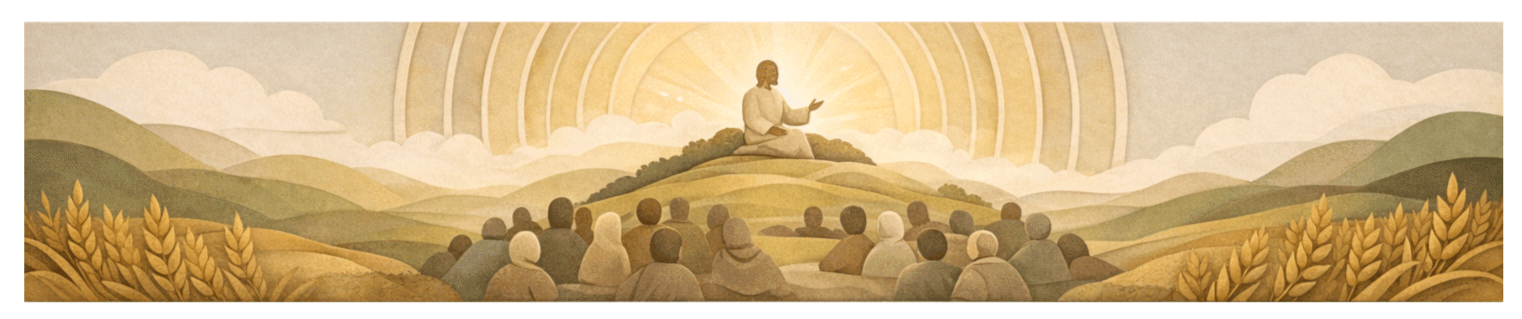
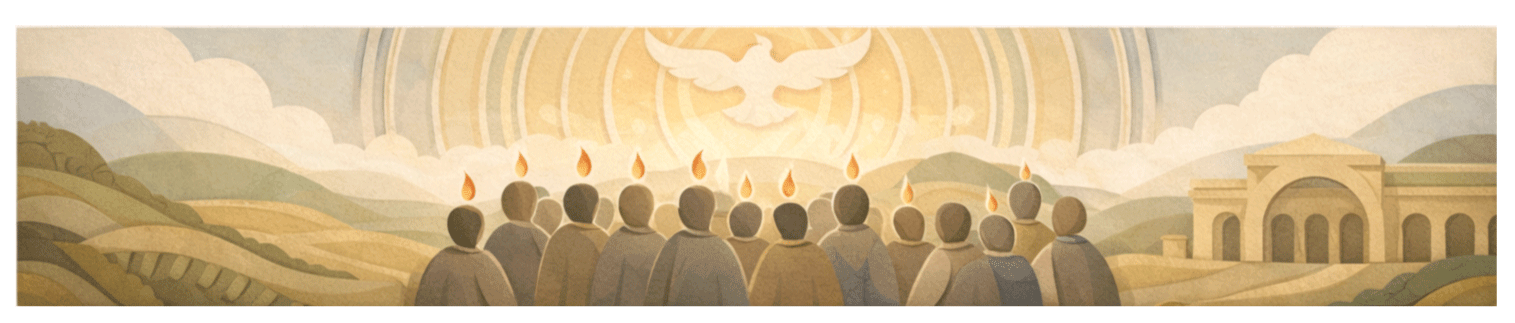
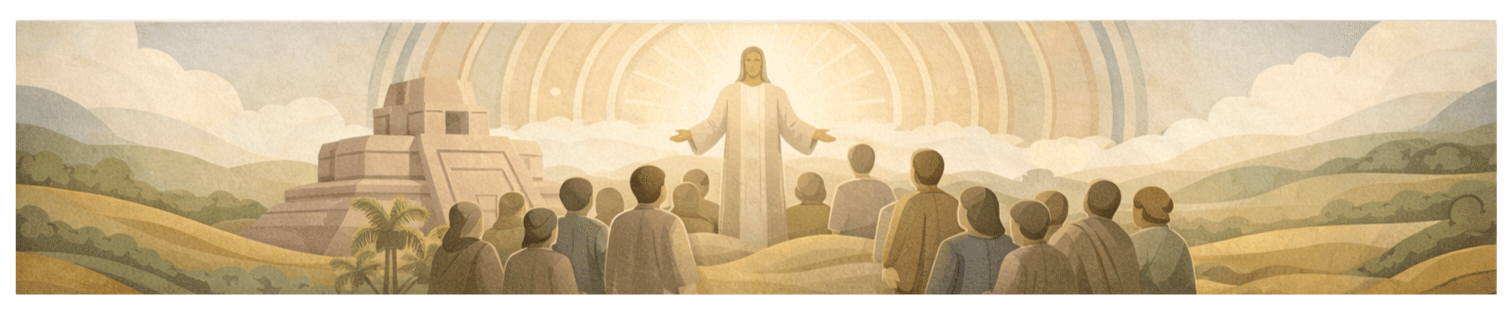
The Escalating Proximity
| Feature | Sinai | Galilee | Jerusalem (Pentecost) | Bountiful |
|---|---|---|---|---|
| God's approach | Descends in fire/smoke | Jesus ascends mountain | Spirit descends as wind and fire | Christ descends in white robe, stands among them |
| Touch | Death for touching the mount | No command | Tongues of fire sit on each person | "Come forth... feel the prints" |
| People's response | Fell back; stood afar off | Astonished | "With one accord in one place" | Fell down; rose; worshipped |
| Contact with God | Moses only | No record of touch | Spirit indwells each believer | One by one, ALL touched Him |
| Intermediary | Moses (essential) | None (Jesus teaches directly) | None — the Spirit is direct | None; multitude comes directly |
| Law written on | Stone tablets | Interpreted from within | Hearts (Jeremiah 31:33) | Fulfilled in Christ's person |
| Fulfillment | Law given (to be fulfilled) | "Till all be fulfilled" (future) | Spirit empowers obedience | "In me it hath all been fulfilled" (past) |
| Perfection standard | N/A | "Your Father in heaven" (5:48) | N/A | "Even as I, or your Father" (12:48) |
| Covenant ordinance | Follows in Exodus 24 | No immediate ordinance | Baptism of 3,000 (Acts 2:41) | Baptism established immediately |
The Beatitudes, Psalm 119, and Temple Entry
The word we translate as “blessed” carries a rich linguistic history across four languages:
| Language | Term | Connection |
|---|---|---|
| Hebrew | אַשְׁרֵי (ashrei) | The original — an exclamation recognizing a person in covenant motion |
| Greek | μακάριοι (makarioi) | The New Testament rendering — used in Matthew 5 and 3 Nephi 12 |
| Latin | beati | The Vulgate translation — root of “Beatitudes” |
| English | blessed | From Old English blēdsian, from Proto-Germanic *blōdisōną — “to hallow with blood” |
The Hebrew ashrei is not passive contentment. It is active recognition: “How blessed is the one who walks!” It describes a person already in covenant motion — walking, keeping, doing. This is the word that opens both the Beatitudes and Psalm 119.
The Psalm 119 Connection
When Christ delivered the Beatitudes, He was not inventing a new literary form. He was drawing directly from Psalm 119 — the longest chapter in the Bible and the great Torah psalm. The connections are structural, not just thematic:
The doubled ashrei opening: Psalm 119 opens with ashrei declared twice before a single commandment is given:
“Blessed [ashrei] are the undefiled in the way, who walk in the law of the LORD. Blessed [ashrei] are they that keep his testimonies, and that seek him with the whole heart.” (Psalm 119:1-2)
Two declarations of blessedness, then the Torah instruction begins. No other psalm opens with ashrei doubled.
The eight-verse acrostic structure: Psalm 119 is an acrostic poem of 22 stanzas (one for each letter of the Hebrew alphabet), with eight verses per stanza. This octave structure represents a complete cycle of reflection and contemplation on the law — eight lines of meditation on Torah for each letter, 176 verses total. The number eight in Hebrew thought signifies completion and new beginning (circumcision on the eighth day, the octave in music that completes the scale and begins again).
The Beatitudes as octave: Christ delivers eight Beatitudes in the Sermon on the Mount (Matthew 5:3-10) — the same octave pattern as Psalm 119’s stanzas. This is not coincidence. Christ is structuring His teaching on the Torah psalm’s own architecture: a complete cycle of covenant blessedness, each one building on the last, culminating in the promise of the kingdom of heaven.
The Bountiful Doubling
At Bountiful, Christ mirrors the Psalm 119 pattern with even greater precision. Before the formal Beatitudes begin, He opens with two preliminary blessings — exactly as Psalm 119 opens with ashrei doubled:
“Blessed are ye if ye shall give heed unto the words of these twelve whom I have chosen” (3 Nephi 12:1)
“And again, more blessed are they who shall believe in your words” (3 Nephi 12:2)
Then the Beatitudes proper begin at 3 Nephi 12:3. The doubled ashrei opening of Psalm 119 — the great Torah psalm — reappears at the temple in Bountiful, where the resurrected Christ delivers the fulfilled Torah to His covenant people. The Lawgiver is quoting His own psalm.
The Side-by-Side: Psalm 119, the Sermon on the Mount, and the Sermon at the Temple
Click any row to expand the full verse text. Gold highlighting marks every occurrence of ashrei / “blessed.”
Blessed are the undefiled in the way, who walk in the law of the LORD.
Blessed are they that keep his testimonies, and that seek him with the whole heart.
The Bountiful Visit as Shavuot
The Bountiful Visit as Shavuot
The Nephites and the Law of Moses
The Book of Mormon is explicit: the Nephites observed the Law of Moses throughout their history:
“And we did observe to keep the judgments, and the statutes, and the commandments of the Lord in all things, according to the law of Moses.” (2 Nephi 5:10)
“They observed to keep the law of Moses and the sabbath day holy unto the Lord.” (Jarom 1:5)
“They did keep the law of Moses; for it was expedient that they should keep the law of Moses as yet, for it was not all fulfilled. But notwithstanding the law of Moses, they did look forward to the coming of Christ, considering that the law of Moses was a type of his coming.” (Alma 25:15)
Even shortly before Christ’s coming, the text confirms ongoing observance: some preached “that it was no more expedient to observe the law of Moses. Now in this thing they did err, having not understood the scriptures” (3 Nephi 1:24).
The Typological Pattern
If the Nephites kept the Law of Moses — including the three pilgrimage festivals — then the faithful among them would have been gathered at the temple for Shavuot in the weeks following Passover season. The destruction in 3 Nephi 8 occurred “in the thirty and fourth year, in the first month, on the fourth day of the month” (3 Nephi 8:5) — Passover season. Fifty days later would place Shavuot squarely in the window when the multitude was gathered “round about the temple” at Bountiful (3 Nephi 11:1).
On the other side of the world, the apostles were gathered at the temple in Jerusalem for the same feast — Pentecost — when the Spirit descended in Acts 2.
| Pattern | Old Testament | New Testament | Book of Mormon |
|---|---|---|---|
| Deliverance | Passover / Red Sea | Christ's death and resurrection | Three days of darkness; destruction of the wicked |
| Waiting period | 50 days (Omer count) | 50 days (Acts 1:3) | Darkness lifts; the faithful gather at the temple — likely for Shavuot |
| Covenant event | Torah given at Sinai | Holy Spirit at Pentecost | Christ appears at Bountiful; teaches; baptizes |
| Fire | Fire on the mountain | Tongues of fire on each person | 3 Nephi 19:14 — "encircled about as if it were by fire" |
| Result | Israel formed as covenant nation | Church formed as covenant community | Nephite covenant community renewed |
What the Resurrected Christ Changed
Fulfillment Tense
Matthew 5:18: "...till all be fulfilled" — future
3 Nephi 12:18: "...in me it hath all been fulfilled" — past
Perfection Standard
Matthew 5:48: "...even as your Father"
3 Nephi 12:48: "...even as I, or your Father" — Christ adds Himself
The Lord's Prayer
Matthew 6:10: "Thy kingdom come."
3 Nephi 13:10: "Thy kingdom come" is absent — the kingdom is already present
Antithesis Formula
Matthew 5:21: "Ye have heard..."
3 Nephi 12:21: "...and it is also written before you" — adapted for a written-law people
Filled with the Spirit
Matthew 5:6: "...they shall be filled"
3 Nephi 12:6: "...filled with the Holy Ghost" — the Pentecostal gift named
The Wheat Harvest in Restoration Scripture
The Wheat Harvest in Restoration Scripture
Shavuot is the wheat harvest. And the imagery of wheat, sheaves, sickles, and garners saturates Restoration scripture.
“The Field Is White Already to Harvest”
“Behold, the field is white already to harvest; therefore, whoso desireth to reap, let him thrust in his sickle with his might, and reap while the day lasts, that he may treasure up for his soul everlasting salvation in the kingdom of God.” (D&C 4:4; repeated in D&C 6:3, 11:3, 12:3, 14:3, 33:3, 7)
This language comes from Christ Himself at Jacob’s well (John 4:35). At Shavuot, the wheat fields were indeed white and ripe. When the Lord uses this language in the Doctrine and Covenants, He is invoking the Shavuot harvest as the image for missionary gathering.
Ammon and the Sheaves
“Behold, the field was ripe, and blessed are ye, for ye did thrust in the sickle, and did reap with your might, yea, all the day long did ye labor; and behold the number of your sheaves! And they shall be gathered into the garners, that they are not wasted.” (Alma 26:5)
“But behold, they are in the hands of the Lord of the harvest, and they are his; and he will raise them up at the last day.” (Alma 26:7)
Laden with Sheaves
“Thrust in your sickle with all your soul, and your sins are forgiven you, and you shall be laden with sheaves upon your back, for the laborer is worthy of his hire.” (D&C 31:5)
At Shavuot, Israelite farmers literally carried sheaves of wheat to the Temple as offerings. The image of a missionary laden with sheaves — souls gathered to Christ — mirrors the Shavuot pilgrim arriving at the House of the Lord.
The Pattern
White Fields
"The field is white already to harvest" (D&C 4:4) — echoing Shavuot's ripe wheat fields
Thrust in Sickles
Missionaries called to "thrust in your sickle" (D&C 31:5) — the harvest laborers
Sheaves to Garners
Converts gathered to Zion and temples — the Shavuot ingathering
Two Leavened Loaves
A people not yet perfected, offered to God — covenant is for the willing
Wheat from Tares
"Gather out the wheat" (D&C 86:7) — the final separation at harvest
Covenant Renewal
The gathering culminates in temple covenants — Shavuot's covenant pattern
The Book of Ruth: A Shavuot Story
The Book of Ruth: A Shavuot Story
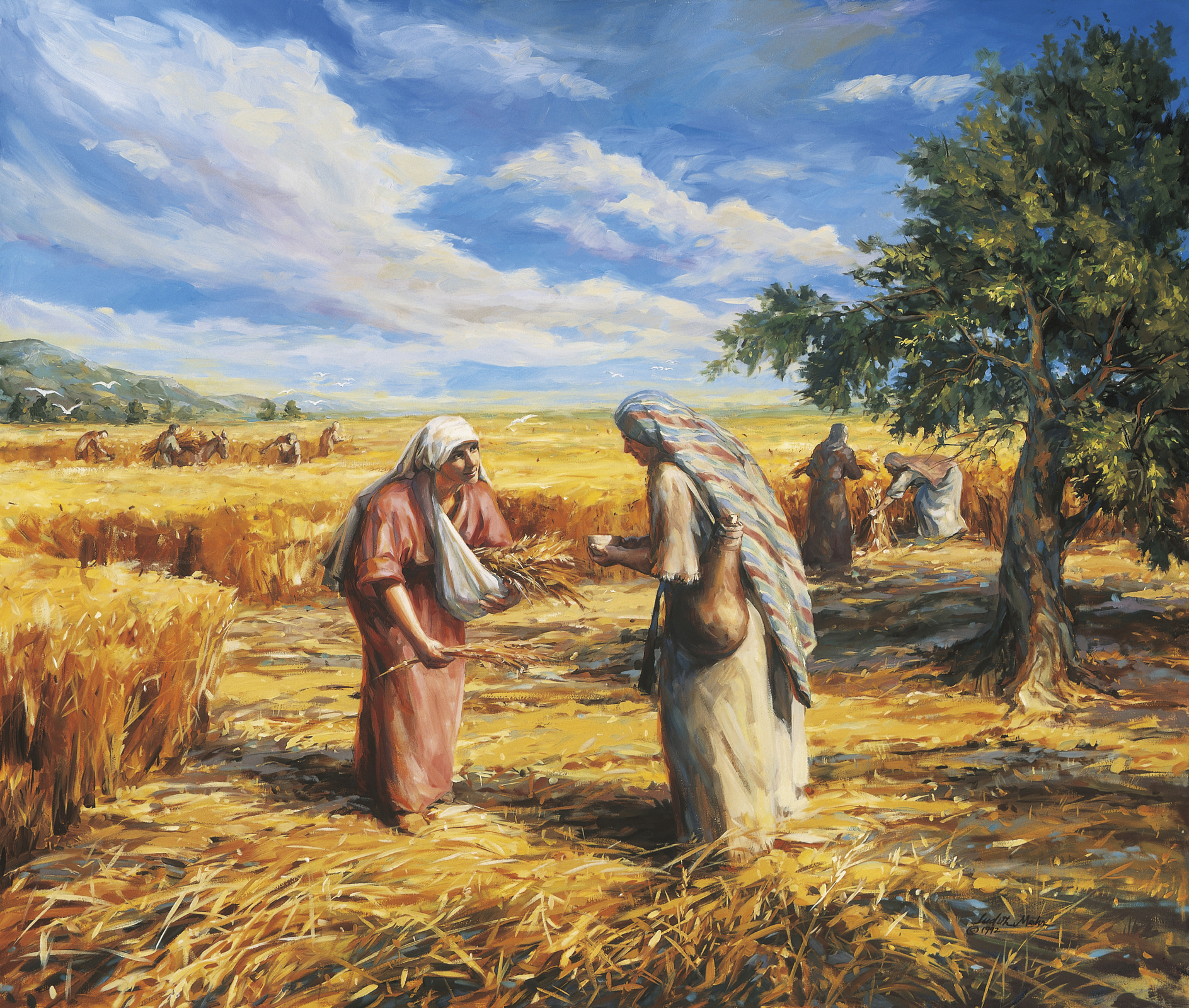
The Book of Ruth is read aloud in synagogues on Shavuot. Of all the books that could accompany the giving of the Torah, the rabbis chose this short story of a Moabite widow gleaning in a barley field. The reasons run deeper than tradition.
Why Ruth on Shavuot?
The Harvest Setting
Ruth arrives in Bethlehem "at the beginning of the barley harvest" (Ruth 1:22) and gleans "until the barley harvest and the wheat harvest were finished" (Ruth 2:23). Her story spans exactly the Omer count — from Bikkurim (barley firstfruits) to Shavuot (wheat harvest). The agricultural calendar of the feasts is the calendar of Ruth's redemption.
Voluntary Covenant
At Sinai, all Israel declared: "All that the LORD hath spoken we will do" (Exodus 19:8). Ruth — a Moabite with no obligation to Israel's God — made her own Sinai declaration: "Thy people shall be my people, and thy God my God" (Ruth 1:16). Reading Ruth on Shavuot reminds Israel that covenant is not inherited by blood alone — it is chosen.
The Convert's Pattern
Jewish tradition considers Ruth the model convert. The rabbis see in her words to Naomi a systematic acceptance of every dimension of covenant life — people, God, land, law, and even burial among God's people (Ruth 1:16-17). Shavuot is the feast of receiving Torah; Ruth is the story of choosing Torah.
The Davidic Line
Ruth's son Obed was "the father of Jesse, father of David" (Ruth 4:17). A Moabite widow who chose covenant became the great-grandmother of Israel's greatest king — and an ancestress of Christ (Matthew 1:5). Reading Ruth on Shavuot proclaims that the harvest of Torah includes the nations.
Ruth’s Declaration and Israel’s at Sinai
Ruth’s words to Naomi follow a structure that echoes the covenant pattern at Sinai:
| Ruth's Declaration (Ruth 1:16-17) | Covenant Element | Israel at Sinai |
|---|---|---|
| "Whither thou goest, I will go" | Journey — following God's direction | Israel followed the pillar of cloud and fire |
| "Where thou lodgest, I will lodge" | Dwelling — sharing the covenant community | Israel camped together at Sinai's base |
| "Thy people shall be my people" | Identity — joining the covenant nation | "Ye shall be unto me a kingdom of priests" (Exodus 19:6) |
| "Thy God my God" | Worship — accepting the God of Israel | "I am the LORD thy God" (Exodus 20:2) |
| "Where thou diest, will I die, and there will I be buried" | Permanence — covenant unto death | "All that the LORD hath spoken we will do" (Exodus 19:8) |
Gleaning, Gathering, and Hesed
Ruth’s story is built on the Torah’s gleaning laws. Leviticus commands: “When ye reap the harvest of your land, thou shalt not wholly reap the corners of thy field, neither shalt thou gather the gleanings of thy harvest… thou shalt leave them for the poor and stranger” (Leviticus 19:9-10). Ruth — both poor and stranger — becomes the living embodiment of the Torah’s provision. When Boaz tells his reapers to leave extra grain for her (Ruth 2:15-16), the law moves from text to act.
The word that threads through Ruth is חֶסֶד (hesed) — covenant faithfulness, loyal love, lovingkindness. Naomi speaks it over Ruth and Orpah: “The LORD deal kindly [hesed] with you, as ye have dealt with the dead, and with me” (Ruth 1:8). Boaz recognizes it in Ruth: “Blessed be thou of the LORD, my daughter: for thou hast shewed more kindness [hesed] in the latter end than at the beginning” (Ruth 3:10). Hesed is the covenant virtue — the quality that makes Torah livable. Ruth doesn’t just accept Torah; she embodies its deepest principle.
Under His Wings
When Boaz first blesses Ruth, he uses a striking image:
“The LORD recompense thy work, and a full reward be given thee of the LORD God of Israel, under whose wings thou art come to trust.” (Ruth 2:12)
The Hebrew word for “wings” here is כָּנָף (kanaph). When Ruth later goes to the threshing floor and asks Boaz to redeem her, she uses the same word: “Spread therefore thy skirt [kanaph] over thine handmaid; for thou art a near kinsman” (Ruth 3:9). The wing of divine protection and the garment of the redeemer are the same word. Boaz’s act of redemption becomes an enactment of God’s covenant shelter. The imagery carries into the Psalms — “How excellent is thy lovingkindness, O God! therefore the children of men put their trust under the shadow of thy wings [kanaph]” (Psalm 36:7) — and into Christ’s own lament over Jerusalem: “How often would I have gathered thy children together, even as a hen gathereth her chickens under her wings” (Matthew 23:37).
Traditional Shavuot Foods
Traditional Shavuot Foods
Dairy dishes are the hallmark of the Shavuot table. Multiple traditions explain why: before receiving the Torah at Sinai, Israel was not yet bound by the laws of kashrut, including ritual slaughter, so they could not prepare meat; Solomon compared the Torah to milk — “Honey and milk are under thy tongue” (Song of Solomon 4:11); and the Hebrew word for milk (חָלָב, chalav) has the numerical value of 40, representing Moses’ 40 days on Sinai.
Traditionally, meat is served at the evening meal and dairy is served for the daytime meal or a morning kiddush. The recipes below represent traditions from Jewish communities around the world.
Ashkenazi Traditions

Classic Cheesecake
The quintessential Shavuot dessert. Rich and creamy, made with farmer's cheese or cream cheese on a graham cracker crust. Some families top with fresh strawberries or blueberries; others serve it plain. A symbol of the "land flowing with milk and honey." Every Jewish family has their grandmother's recipe — and insists it is the only correct one.
Recipe: Tori Avey's New York Cheesecake · Photo: Tori Avey

Cheese Blintzes
Thin crepes filled with sweetened ricotta or farmer's cheese, folded envelope-style and pan-fried until golden. Often served with sour cream, fresh berries, or a dusting of powdered sugar. A Shavuot morning tradition. The crepe batter is simple — the art is in the folding and the frying.
Recipe: Tori Avey's Cheese Blintzes · Photo: Tori Avey
Noodle Kugel
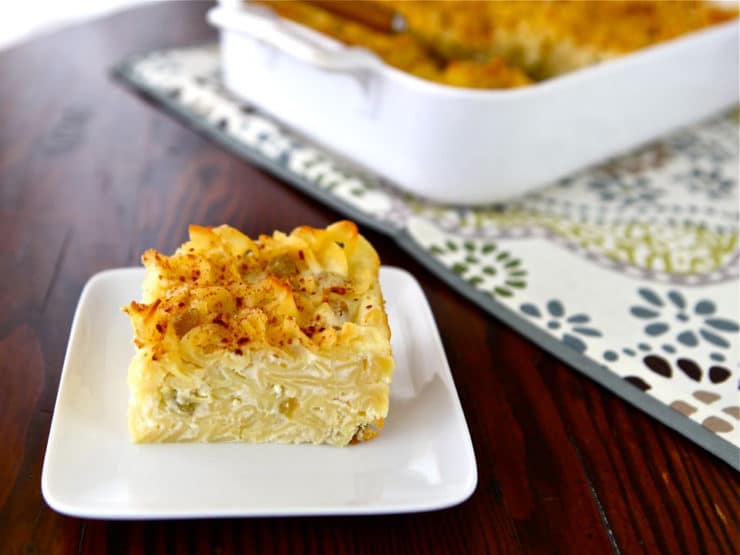
A sweet baked noodle pudding with cottage cheese or cream cheese, eggs, cinnamon, and raisins. Golden and custardy, served warm or at room temperature. Some add a cornflake topping for crunch. The ultimate Shavuot comfort food — and equally at home on a Sabbath table.
Recipe: Tori Avey's Sweet Noodle Kugel · Photo: Tori Avey
Cheese Kreplach
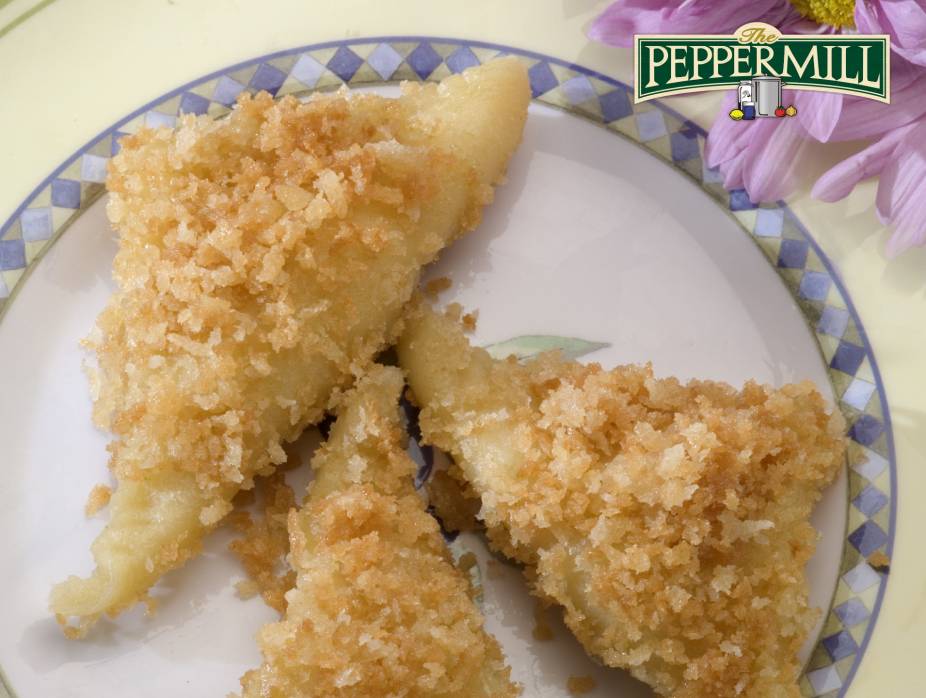
Small dumplings (similar to ravioli) filled with sweetened cheese, boiled and then sometimes fried. The Ashkenazi answer to filled pasta — typically served in butter or with sour cream. A labor of love that brings multiple generations into the kitchen together.
Recipe: Kosher.com's Cheese Kreplach · Photo: Kosher.com
Sephardic and Middle Eastern Traditions
Cheese Bourekas
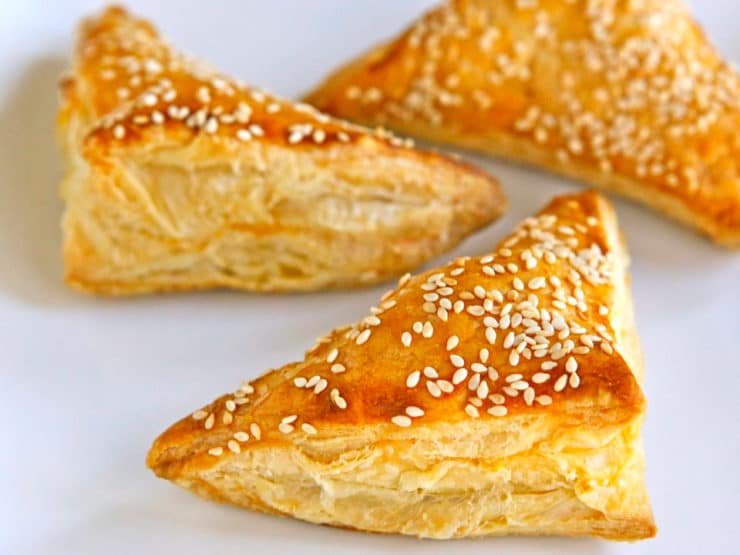
Flaky pastry pockets filled with feta, kashkaval, or a blend of cheeses. A Sephardic tradition from Turkey, Greece, and the Balkans. Shaped as triangles to represent the three patriarchs — or, some say, the three-peaked Mount Sinai. Serve warm with hard-boiled eggs and fresh tomatoes.
Recipe: Tori Avey's Cheese Bourekas · Photo: Tori Avey
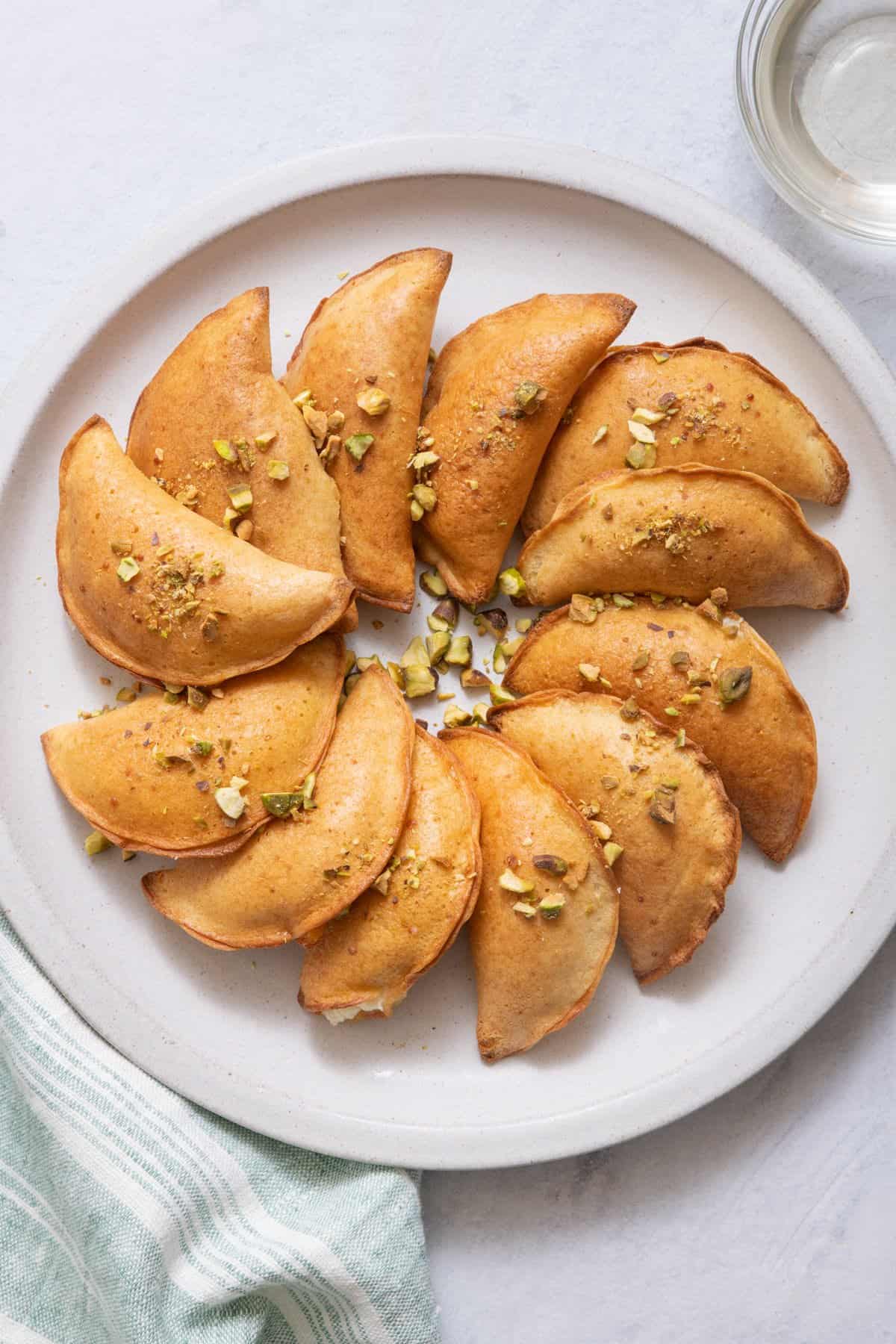
Atayef (Cheese Pancakes)
Small, spongy pancakes folded around a sweet cheese filling, then deep-fried and soaked in rosewater or orange blossom syrup. Popular among Syrian and Lebanese Jewish communities. The contrast between the crispy shell and warm cheese interior is extraordinary.
Recipe: My Jewish Learning's Atayef · Photo: Feel Good Foodie
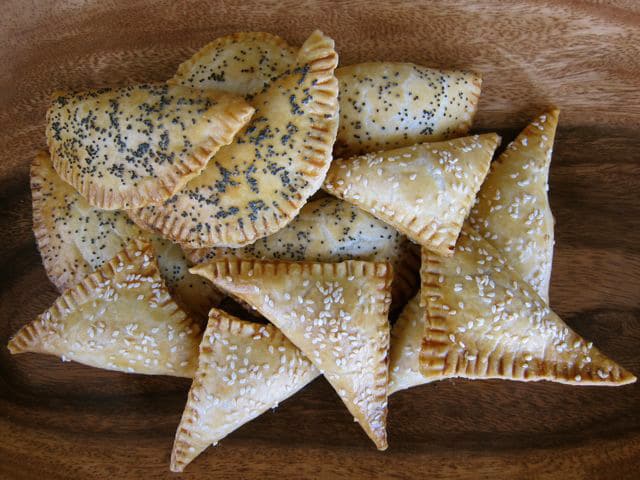
Cheese Sambusak
Half-moon pastries filled with cheese (often *jibneh* or feta), pinched closed with a decorative rope edge. An Iraqi and Syrian Jewish specialty. The dough is tender and slightly flaky, the filling tangy and warm. Often served as a Shavuot appetizer.
Recipe: Tori Avey's Cheese Sambusak · Photo: Tori Avey
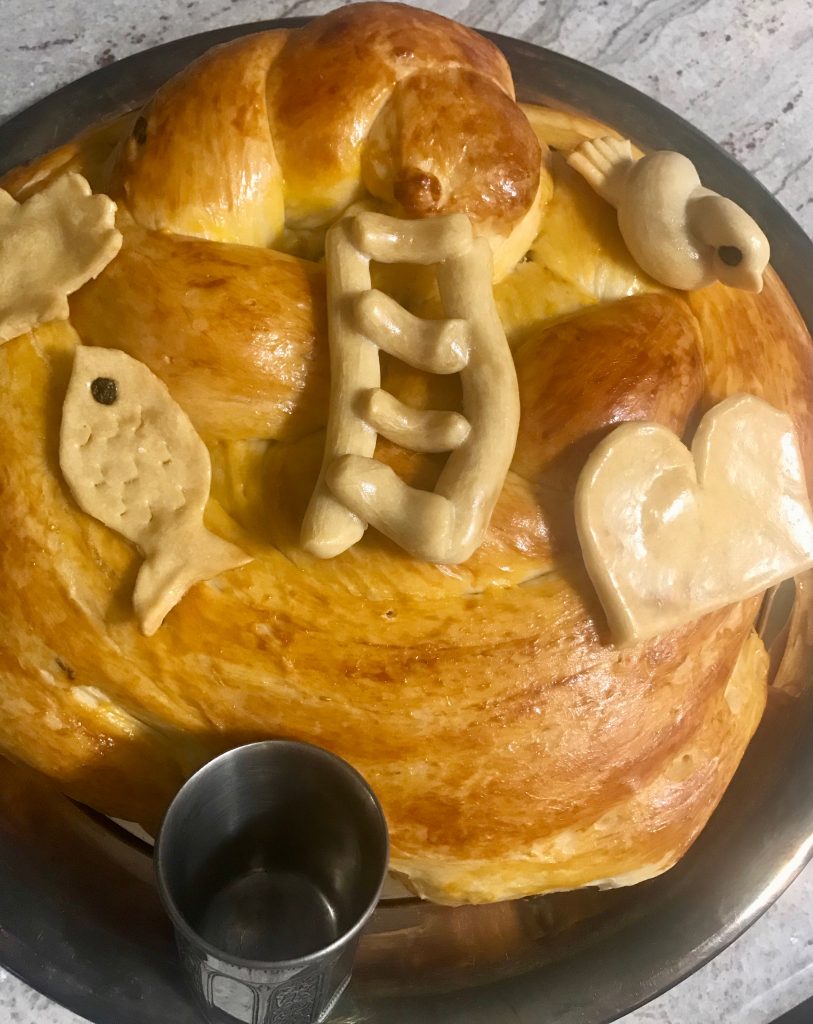
Siete Cielos (Seven Heavens Bread)
A stunning bread from the Tunisian and Moroccan Jewish tradition. The seven layers of dough represent the seven heavens God traversed to deliver the Torah to Moses. A central ball of dough depicts Mount Sinai, with seven ascending ropes around it. A labor-intensive showpiece that embodies the joy of receiving Torah.
Other Shavuot Traditions
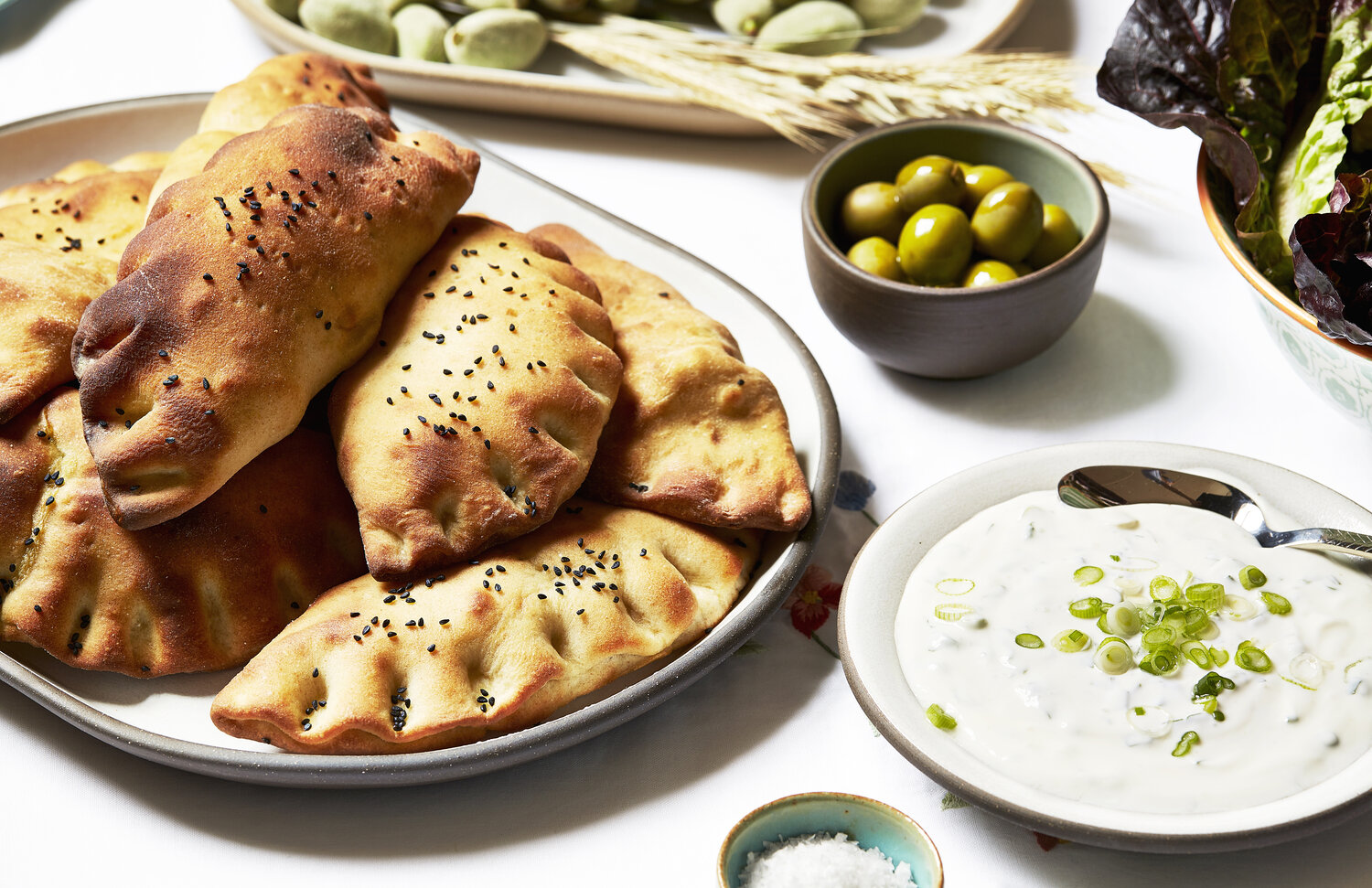
Kadeh (Kurdish Cheese Bread)
A flatbread stuffed with soft cheese, baked until golden and slightly crispy. Kurdish Jewish families serve this as a centerpiece of the Shavuot dairy meal, often alongside a tangy yogurt sauce called *zizik*. Simple ingredients, deeply satisfying.
Recipe: Jewish Food Society's Kadeh · Photo: Jewish Food Society

Sütlaç (Rice Pudding)
Creamy rice pudding baked until the top forms a golden skin, then decorated with cinnamon in intricate patterns. A Turkish and Sephardic tradition. Some families draw the Ten Commandments tablets or Mount Sinai in the cinnamon — edible art that teaches Torah.
Recipe: Jewish Food Society's Sütlaç · Photo: Jake Cohen / Jewish Food Society

Kahi (Buttered Pastry)
An Iraqi Jewish specialty: thin sheets of dough layered with generous amounts of butter, fried until golden, then drenched in sugar syrup. Traditionally served for breakfast on Shavuot morning with *qei'mar* (clotted cream). Rich, flaky, and unapologetically indulgent.
Recipe: Jewish Food Society's Kahi · Photo: Jewish Food Society
A Note on Dairy
Not all communities observe the dairy custom. Yemenite Jews, for example, do not eat dairy on Shavuot. The tradition, while widespread, is a custom (*minhag*) rather than a commandment — a beautiful example of how communities develop unique expressions of the same celebration. What unites every Shavuot table is not the menu but the joy of receiving Torah.
Family Shavuot: Bringing the Feast Home
Family Shavuot: Bringing the Feast Home
You don’t have to be Jewish to let Shavuot shape your family’s worship. The themes of this feast — covenant, Torah, harvest, and the movement from distance to presence — are already woven through Latter-day Saint life. Here are ways to bring them to the surface.
1. A Family Tikkun: All-Night (or Late-Night) Scripture Study
The Jewish practice of Tikkun Leil Shavuot — staying awake all night to study Torah — grew from a midrash that Israel overslept the morning God came to give the law, and Moses had to wake them (Talmud, Shabbat 86b). To show they would not oversleep again, Jews stay up studying.
2. Read the Book of Ruth Together
Ruth is the Shavuot book — read aloud in synagogues every year on this feast. It is short enough (four chapters) to read in a single sitting, and the story is vivid enough for all ages.
3. Cook a Shavuot Dairy Meal
Dairy dishes are the tradition of the Shavuot table — and making them together is the tradition within the tradition. Kurdish women gathered around a fire to cook kadeh; Ashkenazi grandmothers passed down cheesecake recipes; Moroccan families built seven-layer siete cielos bread together.
4. The Four Mountains — A Family Home Evening Lesson
The Four Mountains progression (Sinai → Galilee → Jerusalem → Bountiful) tells the story of how God draws closer to His people across scripture. This makes a natural family lesson.
- Sinai: "Touch the mountain and die" — God is near but terrifying (Exodus 19:12)
- Galilee: Jesus sits and teaches — the crowd is astonished, not afraid (Matthew 5:1-2)
- Jerusalem (Pentecost): The Spirit comes inside each person — no mountain needed (Acts 2:1-4)
- Bountiful: "Come forth unto me, that ye may feel" — every person touches the risen Christ (3 Nephi 11:14-15)
5. Decorate with Greenery and Wheat
Jewish families adorn their homes and synagogues with flowers and plants on Shavuot, representing Mount Sinai blooming when God descended. Wheat and barley sheaves recall the harvest.
Putting It All Together
These activities work individually, but they also build into a full Shavuot evening:
- Decorate the table with greenery and wheat
- Cook a dairy dish together
- Read Ruth aloud during or after dinner
- Discuss the Four Mountains or the three layers of a commandment
- Stay up late studying scripture together — showing God you won’t oversleep when He comes to speak
From Stone to Flesh: The Arc of Shavuot
Sinai: God writes His law on stone and delivers it through a mediator. The people cannot bear His presence. They stand afar off.
The Sermon on the Mount: The Lawgiver Himself sits among the people and interprets His own law. Distance is reduced. Fear becomes astonishment. But fulfillment remains future — the law is still operative, the kingdom still anticipated.
Pentecost (Acts 2): The Spirit descends and writes the law on hearts. No mediator, no tablets, no mountain. God dwells within each person. The promise of Jeremiah 31:33 is realized.
Bountiful: The resurrected Christ descends, stands among His people, and invites every single one to touch Him. The law is fulfilled. The kingdom is present. The veil is gone. Where Sinai said “touch the mountain and die,” the risen Lord says “come forth unto me, that ye may feel.”
This is the arc of Shavuot: from stone to flesh, from distance to embrace, from “let not God speak with us, lest we die” to “Hosanna! Blessed be the name of the Most High God.”
Modern Observance & Latter-day Saint Resonance
Modern Observance
Jewish Practice Today
- Tikkun Leil Shavuot — All-night Torah study sessions
- Reading the Ten Commandments — Congregations stand during the chanting of the Decalogue
- Reading the Book of Ruth — A story of voluntary covenant acceptance
- Decorating with flowers and greenery — Representing Sinai blooming
- Dairy meals — Cheesecake, blintzes, and other dairy dishes
- Confirmation ceremonies — In Reform Judaism, Shavuot is the day for confirming young people
Latter-day Saint Resonance
Abinadi’s Shavuot Discourse
One of the most striking Shavuot echoes in the Book of Mormon may be hiding in plain sight. When Abinadi appeared before King Noah and his priests, he challenged them: “Ye have said that ye teach the law of Moses. And what know ye concerning the law of Moses?” (Mosiah 12:31). Then he did something remarkable — he recited the entire Ten Commandments from Exodus 20, beginning with the preamble:
“I am the Lord thy God, who hath brought thee out of the land of Egypt, out of the house of bondage. Thou shalt have no other God before me.” (Mosiah 12:34-35; see full Decalogue in Mosiah 13:12-24)
The public reading of the Ten Commandments is the central liturgical act of Shavuot. Synagogues read the Decalogue during Shavuot morning services, with the congregation standing. If Noah’s people claimed to observe the Law of Moses — which they did (Mosiah 12:28) — and if Abinadi’s appearance coincided with a festival season when the Decalogue was being publicly read or taught, his discourse would fit the pattern of a Shavuot confrontation: a prophet standing before corrupt priests who claim to teach Torah, reciting the very commandments they have broken, and calling them to account for the covenant they have violated.
Abinadi then moved beyond the letter of the law to its deeper meaning — teaching that the commandments point to Christ, that “God himself should come down among the children of men, and take upon him the form of man” (Mosiah 13:34). Like Christ in the Sermon on the Mount, Abinadi read the same tablets but revealed the deeper covenant layer — the layer the priests of Noah could not see.
Temple, Sacrament, and Restoration
Temple worship follows the Sinai-to-Bountiful progression. We prepare (sanctification), receive instruction (covenant law), make covenants (the stipulations), and are promised entry into God’s presence. The temple is the mountain of the Lord.
The sacrament renews covenant weekly — a personal Shavuot rhythm. We recommit to the covenant every Sabbath, taking upon ourselves the name of Christ.
Scripture study mirrors Tikkun Leil Shavuot. Daily engagement with God’s word is the Latter-day Saint version of staying awake for Torah.
The Restoration and the Feast Days. Several key Restoration events fall on specific Israelite feast days — a pattern that may reflect divine intentionality in the timing of the Restoration:
| Restoration Event | Gregorian Date | Hebrew Calendar | Feast Day |
|---|---|---|---|
| Moroni delivers the gold plates | September 22, 1827 | 1 Tishrei 5588 | Yom Teruah (Feast of Trumpets) — the day the shofar sounds to announce the coming of the King. An angel, often depicted with a trumpet, delivers the record that will restore the covenant. |
| Kirtland Temple dedicated | March 27, 1836 | 14 Nisan 5596 | Eve of Passover — the dedication of the Lord’s house begins on the very evening Israel prepares the Paschal lamb. |
| Elijah, Moses, and Elias appear (D&C 110) | April 3, 1836 | 21 Nisan 5596 | Last day of Passover (also Easter Sunday) — Elijah returns to the Temple on the feast when Jews open the door for him at every Seder. He restores the sealing keys (D&C 110:13-16), fulfilling Malachi 4:5-6. |
The D&C 110 / Passover correlation is documented in Stephen D. Ricks, “The Appearance of Elijah and Moses in the Kirtland Temple and the Jewish Passover,” BYU Studies 23, no. 4 (1983): 483-486. The Elijah connection is particularly striking: for centuries, Jews have poured a cup for Elijah and opened the door at every Passover Seder, anticipating his return. On Passover 1836, Elijah came — not to a Seder table, but to a temple — and restored the keys that turn the hearts of the fathers to the children.
The Melchizedek Priesthood restoration (May-June 1829) falls in the same general window as Shavuot 5589 (June 3-4, 1829) — the feast of covenant-giving — but the exact date is not established historically, so this correlation remains suggestive rather than confirmed.
Reflection Questions
An Invitation
Shavuot reminds us that deliverance is only the beginning. God did not free Israel from Egypt simply to wander. He freed them for covenant — for relationship, for instruction, for the privilege of ascending His mountain and hearing His voice.
The four mountains remind us where the story ends: not at a distance, not through a mediator, not in terror — but face to face, hand to wound, one by one.
"Arise and come forth unto me, that ye may thrust your hands into my side, and also that ye may feel the prints of the nails in my hands and in my feet, that ye may know that I am the God of Israel."
From stone to flesh. From distance to embrace. Come forth.
Sources & Additional Resources
Jewish Sources
- Talmud, Shabbat 86b — Shavuot timing
- Exodus Rabbah 5:9 — Voice in 70 languages
- Sifre Deuteronomy 343 — Torah offered to all nations
- Shavuot 101 — My Jewish Learning
Scholarly Sources
- John W. Welch, The Sermon at the Temple and the Sermon on the Mount (FARMS, 1990)
- KnoWhy 203 — Temple elements at Bountiful
- Krister Stendahl, "The Sermon on the Mount and Third Nephi," in Reflections on Mormonism, ed. Truman G. Madsen (BYU Religious Studies Center, 1978) — 3 Nephi as Pentecost
Part of our series on Jewish festivals and their fulfillment in Christ.