Root Word
בָּרַךְ (barak) — to bless, to kneel, to give thanks
Action
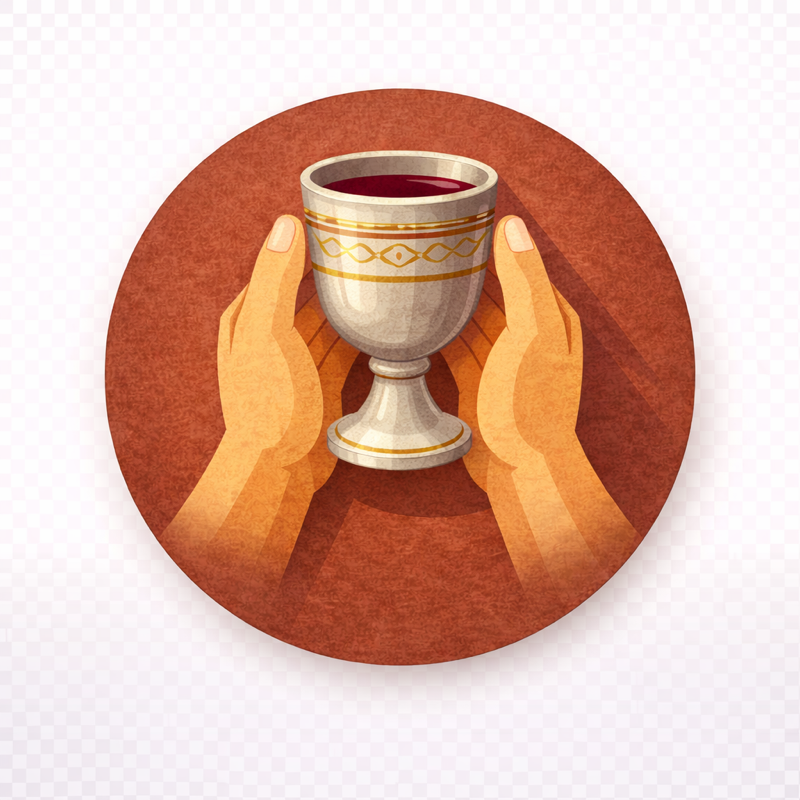
Give thanks for the meal and lift the third cup — known as the Cup of Redemption.
“I will redeem you…” — Exodus 6:6
The Third Cup: The Cup of Redemption
This is traditionally understood as the cup that Jesus blessed at the Last Supper, when He said:
“This cup is the new covenant in my blood, which is shed for you.” — Luke 22:20
Meaning and Symbolism
Barech is the blessing after the meal — one of the most distinctive practices in Jewish tradition. While modern Christians typically bless food before eating, the Torah commands the opposite: “When thou hast eaten and art full, then thou shalt bless the LORD thy God” (Deuteronomy 8:10). This practice, called Birkat Hamazon (Grace After Meals), remains central to Jewish liturgy today.
The third cup is called the Cup of Redemption, representing God’s promise: “I will redeem you with a stretched-out arm” (Exodus 6:6).
As Jesus lifted this cup, He redefined redemption — not as rescue from Egypt, but as rescue from sin, shame, fear, death, and separation from God.
He would stretch out His arms in Gethsemane and on the cross to make that redemption personal — for you.
In this moment, we do more than remember — we renew our covenant with Christ, gratefully drinking in His promise.
Scripture Connection
“I will redeem you with a stretched-out arm…” — Exodus 6:6
“And now… if ye do this, and have faith in the redemption of Him who created you, ye shall be saved, and your sins washed away.” — Alma 7:16
“Thy sins are forgiven thee.” — Luke 7:48
Shir HaMa'alot — Psalm 132: A Song of Ascents
Psalm 132 celebrates David’s oath to find a habitation for the Lord and God’s answering covenant to establish David’s throne forever. At Barech — the blessing after the meal, with the Cup of Redemption — this psalm resonates with the covenant of eternal promise. The LORD chose Zion; He desires to dwell among His people. The priests are clothed with salvation, and the saints shout for joy.
1 LORD, remember David, and all his afflictions: 2 How he sware unto the LORD, and vowed unto the mighty God of Jacob; 3 Surely I will not come into the tabernacle of my house, nor go up into my bed; 4 I will not give sleep to mine eyes, or slumber to mine eyelids, 5 Until I find out a place for the LORD, an habitation for the mighty God of Jacob. 6 Lo, we heard of it at Ephratah: we found it in the fields of the wood. 7 We will go into his tabernacles: we will worship at his footstool. 8 Arise, O LORD, into thy rest; thou, and the ark of thy strength. 9 Let thy priests be clothed with righteousness; and let thy saints shout for joy. 10 For thy servant David’s sake turn not away the face of thine anointed. 11 The LORD hath sworn in truth unto David; he will not turn from it; Of the fruit of thy body will I set upon thy throne. 12 If thy children will keep my covenant and my testimony that I shall teach them, their children shall also sit upon thy throne for evermore. 13 For the LORD hath chosen Zion; he hath desired it for his habitation. 14 This is my rest for ever: here will I dwell; for I have desired it. 15 I will abundantly bless her provision: I will satisfy her poor with bread. 16 I will also clothe her priests with salvation: and her saints shall shout aloud for joy. 17 There will I make the horn of David to bud: I have ordained a lamp for mine anointed. 18 His enemies will I clothe with shame: but upon himself shall his crown flourish.
The Covenant Pattern
At the Seder Table: The Third Cup is the Cup of Redemption, corresponding to God’s promise: “I will redeem you with a stretched-out arm” (Exodus 6:6–7). The Talmud (Pesachim 64a) records that the Hallel was sung continuously while the Paschal offerings were brought — the sacrificial act and the song of praise inseparable.
At the Seder Table — The Cup of Blessing and the Door for Elijah
After the festive meal, the full Birkat Hamazon (grace after meals) is recited — four blessings covering nourishment, the land, Jerusalem, and God’s goodness. Then the third cup is poured — the Cup of Redemption:
בָּרוּךְ אַתָּה יְיָ, אֱלֹהֵינוּ מֶלֶךְ הָעוֹלָם, בּוֹרֵא פְּרִי הַגָּפֶן.
Blessed are You, LORD our God, King of the Universe, who creates the fruit of the vine.
This cup — “the cup of blessing” — held special importance. The Talmud (Berakhot 51a) lists ten requirements for the kos shel bracha:
- Washing (hadacha) — the inside of the cup
- Rinsing (shetifa) — the outside of the cup
- Undiluted (chai) — “live” wine, not yet mixed with water
- Full (malei) — filled to the brim
- Crowning (itur) — surrounded by disciples, or adorned
- Wrapping (ituf) — the one blessing wraps himself appropriately
- Two hands — receive it with both hands, then hold in the right
- Elevated — raised a handbreadth above the table
- Gazing — fix your eyes upon the cup
- Gifting — send it as a gift to members of the household
Rabbi Yochanan held that only four are essential (washing, rinsing, undiluted, and full), but Edersheim notes these “peculiarities” as “sufficient to show the special value set upon it.”
After the third cup is drunk, a cup of wine is poured in honor of Elijah and the door is opened. The Haggadah prescribes these words:
שְׁפֹךְ חֲמָתְךָ אֶל־הַגּוֹיִם אֲשֶׁר לֹא יְדָעוּךָ וְעַל־מַמְלָכוֹת אֲשֶׁר בְּשִׁמְךָ לֹא קָרָאוּ.
Pour out Your wrath upon the nations that do not know You, and upon the kingdoms that have not called upon Your name.
To this day, a cup is set aside for Elijah at every Seder table — a visible token of Israel’s hope for the coming Redeemer and the forerunner of the Messiah. “It is a remarkable coincidence,” Edersheim notes, “that, in instituting His own Supper, the Lord Jesus connected the symbol, not of judgment, but of His dying love, with this ’third cup.'”
Sources: Pesach Haggadah (Sefaria/Koren); Edersheim, The Temple: Its Ministry and Services, Ch. 12
At the Last Supper: “This cup is the new testament in my blood, which is shed for you” (Luke 22:20). The Cup of Redemption becomes the cup of the new covenant. What had pointed forward for centuries now arrives in the hands of the Messiah Himself. This is the cup from which the sacrament descends.
At the Last Supper — The Cup of Blessing
“This cup is the new testament in my blood, which is shed for you” (Luke 22:20). St. Paul identifies this as “the cup of blessing which we bless” (1 Corinthians 10:16) — the same term used in Jewish writings for the third cup. It was “the cup after supper” (Luke 22:20), following the Aphikomen and the grace after meals.
Edersheim writes that Jesus used “the Aphikomen ‘when He had given thanks’ (after meat), to symbolise His body, and the third cup, or ‘cup of blessing which we bless’ — being ’the cup after supper’ — to symbolise His blood.” The bread and the cup were paired: the hidden bread revealed, the cup of redemption raised — body and blood together sealing the new covenant.
The Four Cups and the Wedding Covenant describes this as the Cup of Redemption, linked to the Hebrew ga’al — from which we get goel, the kinsman redeemer. Christ is our ultimate Goel: He redeems us from slavery, pays the bride price with His own blood, restores our lost inheritance, and takes us as His own in eternal covenant.
Sources: Edersheim, The Temple: Its Ministry and Services, Ch. 12; The Four Cups and the Wedding Covenant
In the Nephite Assembly: The sacrament prayer over the water echoes the same covenant of remembrance: “in remembrance of the blood of thy Son, which was shed for them… that they do always remember him” (Moroni 5:2). The same cup, the same blood, the same covenant of remembrance — carried from Jerusalem to the Americas.
In the Nephite Assembly — Alma 5: The Blessing Withheld
The Nephites knew the practice of blessing God after meals. When Alma visited Amulek’s home, the text preserves the exact Deuteronomic pattern: “Alma ate bread and was filled; and he blessed Amulek and his house, and he gave thanks unto God” (Alma 8:22). First eating, then being filled, then blessing and thanking — the sequence matches Deuteronomy 8:10 precisely. Joseph Smith in 1829 would have had no way of knowing this distinctive Jewish custom, yet it appears in the Book of Mormon exactly as an observant Israelite would practice it.1
But in Alma 5, Alma withholds this blessing from the people of Zarahemla. Their pride and wickedness make them unprepared to receive it. Instead, he presses them with probing questions:
“I say unto you, can ye look up to God at that day with a pure heart and clean hands? I say unto you, can ye look up, having the image of God engraven upon your countenances?” — Alma 5:19
The contrast comes in Alma 7, when Alma addresses the people of Gideon — a faithful community. There he speaks tenderly, prophesies of the coming Savior, and pronounces a blessing upon them. The drastic shift between the two sermons underscores the principle at the heart of Barech: divine blessing is real, but it is contingent upon the heart’s readiness to receive it.
On the Covenant Path Today: President Nelson teaches that the Hebrew word hesed — a unique form of covenantal love — describes “a special kind of love and mercy that God feels for and extends to those who have made a covenant with Him” (“The Everlasting Covenant," 2022). The cup of blessing is the cup of hesed — God’s lovingkindness poured out to those who are His, in every age.
On the Covenant Path — Elijah at the Kirtland Temple
At every Seder table, a cup is poured for Elijah and the door is opened — Israel’s ancient hope that the prophet who was taken up without tasting death would return to herald the Messiah.
On April 3, 1836 — the last day of Passover, and also Easter Sunday — that hope was fulfilled. The prophet Elijah appeared to Joseph Smith and Oliver Cowdery in the Kirtland Temple and declared:
“Behold, the time has fully come, which was spoken of by the mouth of Malachi — testifying that he [Elijah] should be sent, before the great and dreadful day of the Lord come — to turn the hearts of the fathers to the children, and the children to the fathers, lest the whole earth be smitten with a curse.” — D&C 110:14–15
The door that Israel had opened in hope for centuries was answered on Passover. Elijah came — not to a Seder table, but to a temple — restoring the sealing keys that bind families eternally. The cup poured in his honor at every Seder now points to a fulfilled promise.
On the Covenant Path — The Law of Chastity
The third cup is the Cup of Redemption, corresponding to the third promise: “I will redeem you with a stretched-out arm” (Exodus 6:6). The Hebrew concept of the goel — the kinsman redeemer — is central to this cup.
In the book of Ruth, Boaz fulfills the role of goel, redeeming Ruth and taking her under his name and protection:
“I am Ruth thine handmaid: spread therefore thy skirt over thine handmaid; for thou art a near kinsman.” — Ruth 3:9
The Law of Chastity is a covenant of exclusive devotion and fidelity — the promise to belong wholly to the Lord, as Ruth belonged to Boaz, as Israel belongs to God. The Cup of Redemption seals this relationship. As the bride takes the name of the redeemer, so we take upon us the name of Christ.
“I will redeem you… and I will take you to me for a people.” — Exodus 6:6–7
🍷 Drink the Third Cup — The Cup of Redemption
Reflection Questions
- What does it mean to be redeemed of God — not just rescued, but purchased and made new?
- Do I believe in Christ’s power to redeem all parts of me — even the ones I struggle to forgive?
- As I drink this cup, can I feel His promise alive in me: “Thy sins are forgiven thee”?
- What would it look like for me to more fully live as someone who has been redeemed?
- Am I keeping the covenant Christ offered in this cup — to remember Him, to take His name upon me, and to always strive to follow Him?
Angela M. Crowell and John A. Tvedtnes, “The Nephite and Jewish Practice of Blessing God after Eating One’s Fill,” Journal of Book of Mormon Studies 6, no. 2 (1997): 251–54. ↩︎