Root Word
צָפַן (tsaphan) — to hide, treasure, conceal
Action
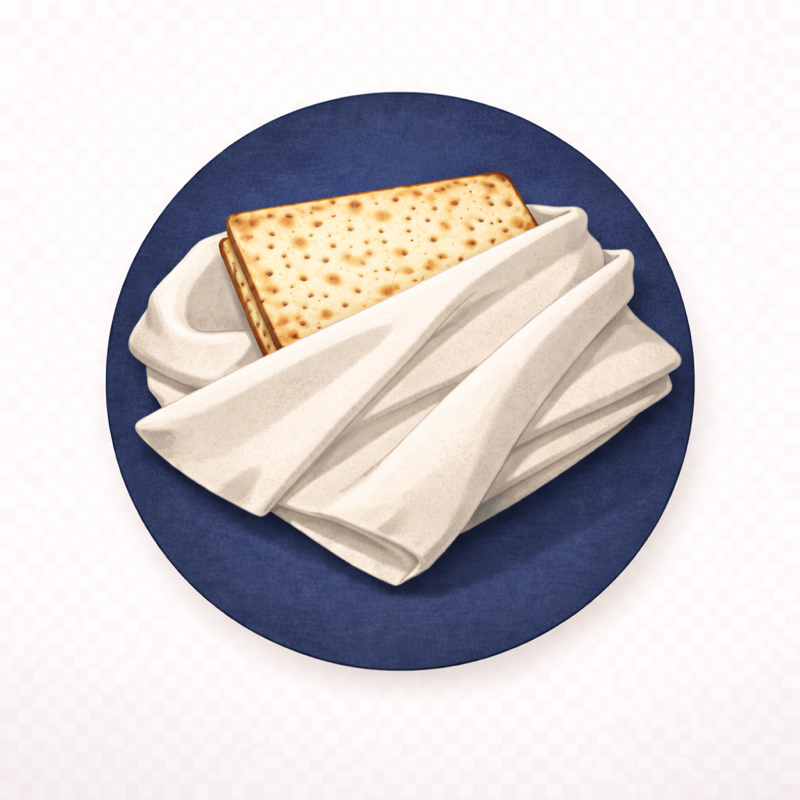
Find and eat the Afikoman — the piece of matzah that was earlier broken and concealed during Yachatz.
Meaning and Symbolism
Earlier in the evening, the middle matzah was broken and the larger half hidden — just as Christ’s body was broken and laid in a borrowed tomb. Now, it is time to search for it, reveal it, and partake.
The Afikoman is often found by children, reminding us of Jesus’ words: “Except ye be converted, and become as little children, ye shall not enter into the kingdom of heaven” (Matthew 18:3).
This moment is a joyful rediscovery — a sacred echo of the Resurrection. As we receive the hidden bread, we symbolically receive Christ into ourselves.
Scripture Connection
“He is not here: for He is risen, as He said.” — Matthew 28:6
“Except ye be converted, and become as little children, ye shall not enter into the kingdom of heaven.” — Matthew 18:3
“Have ye received His image in your countenances?” — Alma 5:14
Shir HaMa'alot — Psalm 131: A Song of Ascents
Psalm 131 is the shortest and most tender of the Songs of Ascents — a psalm of childlike trust, quieted and weaned. At the Tzafun step, the hidden Afikoman is found by the children with joy. This psalm captures the spirit of that moment: humility, simplicity, and trust. The hidden bread is revealed to those who seek with childlike faith, not with haughty hearts or lofty eyes.
1 LORD, my heart is not haughty, nor mine eyes lofty: neither do I exercise myself in great matters, or in things too high for me. 2 Surely I have behaved and quieted myself, as a child that is weaned of his mother: my soul is even as a weaned child. 3 Let Israel hope in the LORD from henceforth and for ever.
The Covenant Pattern
At the Seder Table: The hidden afikomen — the broken piece of matzah concealed during Yachatz — is now found, brought forth, and eaten. What was broken and hidden is revealed and shared. The children search for it with joy. The lost is found.
At the Seder Table — The Aphikomen Revealed
Edersheim records that “since the cessation of the Paschal Sacrifice the Jews conclude the Supper with a piece of unleavened cake, which they call the Aphikomen, or after-dish.” The term itself — from the Greek — may be rendered as “dessert” or “that which comes after.”
The principle was firm: “after the Paschal meal, they had no Aphikomen (after-dish)” — meaning nothing was to be eaten after the lamb. But when the temple sacrifices ceased, the Aphikomen matzah took the place of the lamb as the last morsel tasted. The hidden bread, broken earlier at Yachatz, was now brought forth, revealed, and shared — the final taste on every tongue.
At the Last Supper: The afikomen is widely understood as the last bread shared at the Supper — the bread over which Jesus said, “Do this in remembrance of me” (Luke 22:19). The One who was broken and hidden in the tomb is brought forth in resurrection: “He is not here: for He is risen” (Matthew 28:6).
At the Last Supper — The Institution of the Lord's Supper
When exactly did Jesus institute the Lord’s Supper? Edersheim argues it happened here — at the Aphikomen — not earlier at the Motzi (the blessing of the bread).
His reasoning turns on a small but telling detail: the order of blessing and breaking.
In the traditional Seder, the matzah was broken first, and then thanks was given. Why? Because it was “the bread of poverty, and the poor have not whole cakes, but broken pieces.” You don’t bless a whole loaf when you’re remembering affliction — you break it first, then give thanks over the fragments.
But the Gospels record that Jesus did the opposite. He “first gave thanks and then brake the bread.” This reversal, Edersheim argues, proves “it must have been at a later period of the service” — specifically, at the Aphikomen, when the hidden bread is brought forth after the meal and blessed before being shared.
Edersheim concludes: “The Lord instituted His own Supper, for the first time using the Aphikomen ‘when He had given thanks’ (after meat), to symbolise His body, and the third cup, or ‘cup of blessing which we bless’ (1 Corinthians 10:16) — being ’the cup after supper’ (Luke 22:20) — to symbolise His blood.”
The hidden bread — broken and concealed, now revealed and blessed — became the bread of the new covenant. “The symbolical cord, if the figure may be allowed, had stretched to its goal — the offering up of the Lamb of God.”
In the Nephite Assembly: Alma asks his people to envision the resurrection — the moment when the hidden is revealed: “Do you look forward with an eye of faith, and view this mortal body raised in immortality, and this corruption raised in incorruption, to stand before God to be judged?” (Alma 5:15). And when that day comes, nothing will remain concealed: “Can ye imagine yourselves brought before the tribunal of God… having a remembrance of all your guilt, yea, a perfect remembrance of all your wickedness?” (Alma 5:18). The broken, buried body — like the broken, hidden matzah — will be brought forth. The question is whether we will be found like the afikomen — broken, yes, but redeemed.
In the Nephite Assembly — Alma 5: The Hidden One Revealed
The word tzafun means “hidden” — but at this step, what emerges from hiding is the bread of redemption. Alma presses this very question upon his people — whether they have been cleansed through the blood of the Redeemer:
“I say unto you, can ye look up to God at that day with a pure heart and clean hands? I say unto you, can ye look up, having the image of God engraven upon your countenances?” — Alma 5:19
“There can no man be saved except his garments are washed white; yea, his garments must be purified until they are cleansed from all stain, through the blood of him of whom it has been spoken by our fathers, who should come to redeem his people from their sins.” — Alma 5:21
The Afikoman — broken and hidden at Yachatz — now comes forth from concealment. Christians have long associated this moment with the Resurrection, and Paul describes Christ as “the firstfruits of them that slept” (1 Corinthians 15:20) — hidden in death, revealed in triumph over the grave.
Just as the Afikoman is brought from hiding into the light, our hidden selves will one day stand revealed. Christ’s own blood purifies us from all stain and prepares us to be found worthy at that day.
On the Covenant Path Today: Elder Bednar speaks of “an inner spiritual stillness of the soul that enables us to know and remember that God is our Heavenly Father, we are His children, and Jesus Christ is our Savior” (“Be Still, and Know That I Am God," 2024). What was hidden is revealed — not only at the resurrection, but in the quiet stillness of covenant relationship, where the Lord makes Himself known to those who seek Him.
On the Covenant Path — The Hidden One Found
The Four Cups and the Wedding Covenant describes the Afikomen symbolism: the three matzot represent the Godhead, the middle piece is removed, broken, wrapped in linen, and hidden — to be found later by the children. The broken, hidden bread is Christ: “He was declaring Himself the afikomen — the hidden one who would be found.”
But the Afikomen also represents the scattered body of Christ — His covenant family, broken and dispersed among the nations. D&C 133 echoes this: “And they who are in the north countries shall come in remembrance before the Lord; and their prophets shall hear his voice” (D&C 133:26). The scattered tribes — the broken matzah — will be found and gathered.
At Tzafun, the children search for and find the hidden bread with joy. On the covenant path, we participate in this same gathering — finding those who are lost, gathering scattered Israel, and bringing forth what has been hidden until the appointed time.
Reflection Questions
- What does it mean that Christ was hidden in the tomb — and revealed again in power?
- Have I had moments in my life when God felt hidden? How did I come to see Him again?
- When I receive this bread, can I honestly say I have received His image in my countenance?
- What does it mean to truly treasure Christ — not just believe in Him, but build my life around Him?
- How can I help others — especially children — find the joy of discovering the Savior?