Root Word
כָּרַךְ (karach) — to bind, wrap, encompass
Action
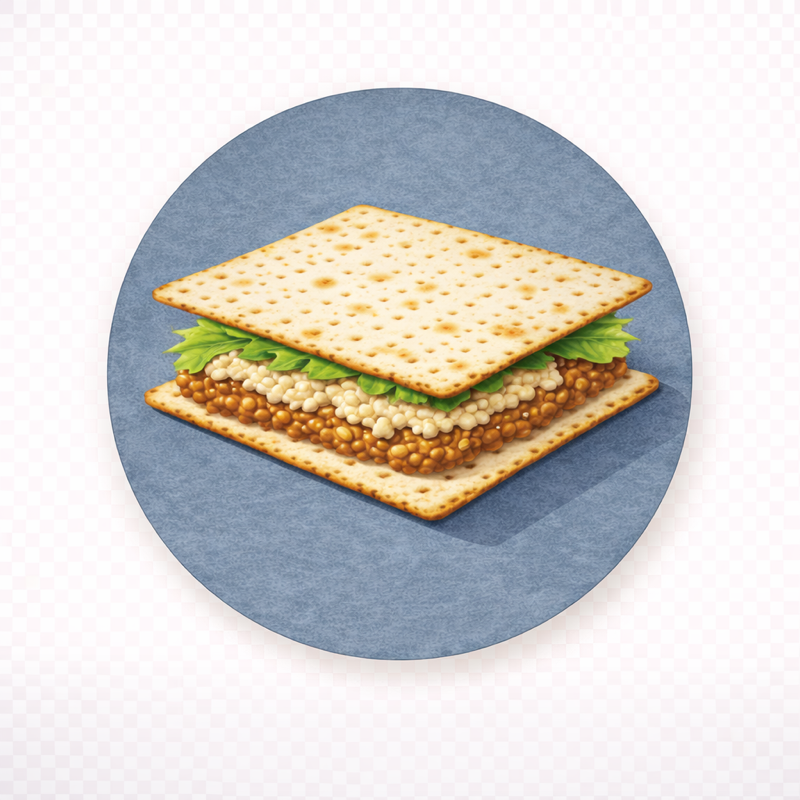
Combine matzah, bitter herbs (maror), and charoset into one bite.
Meaning and Symbolism
This symbolic sandwich is known as the Hillel sandwich, representing the binding together of bitter and sweet.
- The matzah (Bread of Affliction) surrounds…
- The maror (bitterness of slavery and sin)…
- And the charoset (sweetness of hope and redemption).
Korech means “to wrap,” “to bind,” or “to encompass” — and in this step, we experience a taste of life’s complexity: joy and pain, hope and sorrow, sweetness and suffering — all bound together in covenant.
Christ was bound and pierced for us. He encompassed every sorrow and every joy. His bitter crucifixion brought forth the sweetness of eternal life.
This layered bite reminds us that even the bitterness of life can become sacred when we are in covenant with Christ.
Scripture Connection
“He was wounded for our transgressions, he was bruised for our iniquities…” — Isaiah 53:5
“Being in an agony he prayed more earnestly… his sweat was as it were great drops of blood…” — Luke 22:44
Shir HaMa'alot — Psalm 129: A Song of Ascents
Psalm 129 speaks of affliction endured from youth — “The plowers plowed upon my back: they made long their furrows.” Yet the affliction did not prevail. The Lord cut asunder the cords of the wicked. This is the psalm of Korech — the binding together of suffering and redemption. The furrows plowed on Israel’s back echo the stripes of the Savior, and the cords cut asunder recall the bands of death broken at the tomb.
1 Many a time have they afflicted me from my youth, may Israel now say: 2 Many a time have they afflicted me from my youth: yet they have not prevailed against me. 3 The plowers plowed upon my back: they made long their furrows. 4 The LORD is righteous: he hath cut asunder the cords of the wicked. 5 Let them all be confounded and turned back that hate Zion. 6 Let them be as the grass upon the housetops, which withereth afore it groweth up: 7 Wherewith the mower filleth not his hand; nor he that bindeth sheaves his bosom. 8 Neither do they which go by say, The blessing of the LORD be upon you: we bless you in the name of the LORD.
The Covenant Pattern
At the Seder Table: Hillel’s tradition of binding bitter herbs and matzah together in a single bite teaches that sorrow and humility are inseparable companions on the path to redemption. The bitter is not discarded — it is held together with the bread of covenant.
At the Seder Table — The Beginning of the Paschal Supper
Edersheim records that “pieces of the broken cake with ‘bitter herbs’ between them, and ‘dipped’ in the Charoseth, were next handed to each in the company.” This was the Hillel sandwich — and it marked the true beginning of the Paschal Supper: “The unleavened bread with bitter herbs constituted, in reality, the beginning of the Paschal Supper, to which the first part of the service had only served as a kind of introduction.”
Everything before this — the cups, the washing, the telling, the psalms — was preparation. Now the bitter and the bread are bound together and placed in the hand. The meal has begun, and the binding is complete.
At the Last Supper: At the table, Jesus dipped a morsel and gave it to Judas (John 13:26–27) — betrayal and love at the same table. The bitter and the sacred were bound together in a single act. Even in the moment of greatest treachery, Christ’s love encompassed it.
At the Last Supper — The Sop Given to Judas
Edersheim identifies the Korech — the sop of unleavened bread with bitter herbs, dipped in the Charoseth — as “in all probability, ’the sop’ which, in answer to John’s inquiry about the betrayer, the Lord ‘gave’ to Judas” (John 13:25–26; Matthew 26:21; Mark 14:18).
The Korech was normally handed first to the chief guest at the table. From Edersheim’s reconstruction of the seating arrangement, Judas occupied the place of honour at Jesus’ left — “above Him” at the table. This explains how Jesus could hand the sop to Judas without anyone else knowing its significance, and how Judas could whisper “Is it I?” and receive the affirmative answer without the other disciples hearing (Matthew 26:25).
“And after the sop Satan entered into him,” and Judas “went out immediately. And it was night” (John 13:27, 30). The sop that bound the bitter and the sweet in covenant fellowship became the moment of severance. What Hillel had intended as a binding together, Judas turned into a tearing apart.
In the Nephite Assembly: Alma binds these same elements together in a single invitation: “He sendeth an invitation unto all men, for the arms of mercy are extended towards them, and he saith: Repent, and I will receive you. Yea, he saith: Come unto me and ye shall partake of the fruit of the tree of life; yea, ye shall eat and drink of the bread and the waters of life freely” (Alma 5:33–34). Mercy extended (the sweetness), repentance required (the bitter acknowledgment of sin), bread offered (the matzah that binds them) — the korech in a single passage.
In the Nephite Assembly — Alma 5: Good and Evil Bound Together
The Korech binds bitter and sweet, sorrow and hope, in a single bite. Alma holds both realities together throughout his sermon, insisting on the starkness of the contrast:
“For I say unto you that whatsoever is good cometh from God, and whatsoever is evil cometh from the devil.” — Alma 5:40
“And now if ye are not the sheep of the good shepherd, of what fold are ye? Behold, I say unto you, that the devil is your shepherd, and ye are of his fold.” — Alma 5:39
But even as Alma presents this stark contrast, he offers the hope that defines the Korech — the binding, encompassing love of God:
“Behold, he sendeth an invitation unto all men, for the arms of mercy are extended towards them.” — Alma 5:33
The word korech means to wrap, to encompass. The “arms of mercy” — stretched out, encompassing — are the Korech of the Atonement, binding the bitter and the sweet, the sinner and the Savior, in one redeeming embrace.
On the Covenant Path Today: Elder Bednar teaches that “the power of the Savior’s gospel to transform and bless us flows from discerning and applying the interrelatedness of its doctrine, principles, and practices” (“Gather Together in One All Things in Christ," 2018). The bitter and the sweet, the trial and the blessing, the justice and the mercy — they are bound together in one covenant, and the power comes from embracing them as one.
On the Covenant Path — Binding the Covenant Together
The Four Cups and the Wedding Covenant describes the ancient wedding covenant as a binding of two lives — the Bride and the Bridegroom joining everything they have and are. Through sacred ordinances, we enter a covenant relationship with Christ that mirrors a marriage contract: we take upon ourselves His name, we promise fidelity, and He promises to provide, protect, and redeem.
The Korech embodies this binding. The matzah (purity), the maror (suffering), and the charoseth (sweetness of hope) are not experienced separately — they are bound together in one bite, one covenant, one life. On the covenant path, we do not experience redemption apart from affliction, or joy apart from sacrifice. They are inseparable — held together by the covenant that binds us to a Savior who Himself was bound, pierced, and wrapped in linen for our sake.
Reflection Questions
- Why do we eat bitterness and sweetness together? What does this teach me about Christ’s atonement?
- What has the Savior “wrapped” for me — sorrows and joys that He’s used for my growth or healing?
- Am I willing to bind myself to Him, even when life feels hard or unclear?
- In what ways has the sweetness of the gospel helped me carry the bitterness of mortality?
- As I taste this sandwich, what can I remember about Jesus being bound and pierced for my redemption?