Root Word
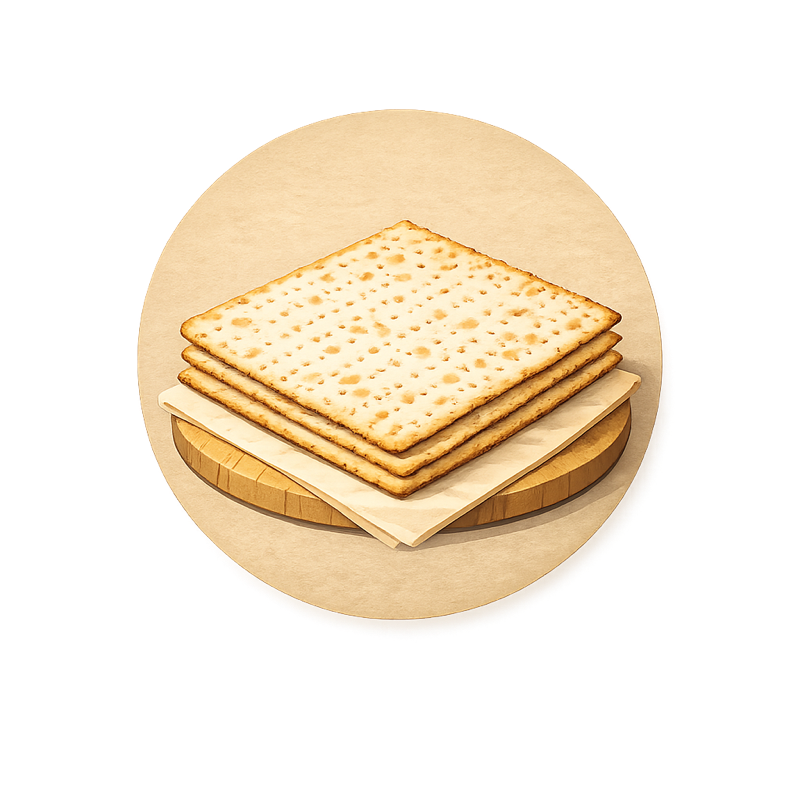
מַצָּה (matzah) — unleavened bread
Note: Though etymologically unrelated, matzah is a homonym of מָצָא (matsa) — “to find.” Ancient teachers often used such word plays for symbolic connections.
Action
Eat a piece of matzah — the unleavened bread.
Meaning and Symbolism
While the Motzi blessing acknowledged God as the source of bread, this step focuses specifically on the matzah itself — the bread of affliction, the bread of freedom.
The Israelites left Egypt in such haste that their dough had no time to rise. The matzah recalls that urgency — but it also teaches us something deeper about the nature of the Messiah.
Leaven (yeast) often represents sin and pride in scripture. The matzah — flat, humble, without leaven — represents a life free from sin. It is the bread of humility and purity.
When Jesus took bread at the Last Supper, He was almost certainly holding matzah — and He said: “This is my body, which is broken for you: this do in remembrance of me” (1 Corinthians 11:24). Every time we partake of the sacrament bread, we echo this ancient Passover moment — remembering the One who was broken, pierced, and given for us.
Scripture Connection
“Take, eat: this is my body, which is broken for you: this do in remembrance of me.” — 1 Corinthians 11:24
Shir HaMa'alot — Psalm 127: A Song of Ascents
Psalm 127 teaches that unless the Lord builds the house, the builders labor in vain. The matzah — flat and unleavened — embodies this truth: self-reliance, pride, and puffing up are futile. True nourishment comes not from our own efforts but from the Lord. The “bread of sorrows” mentioned in the psalm echoes the bread of affliction that is the matzah itself.
The imagery of building carries a deeper resonance. In Egypt, the Israelites were forced to make bricks for Pharaoh’s construction projects (Exodus 1:14; 5:7). At the Seder, the flat matzah symbolically represents those bricks, while the charoset — the sweet paste of apples, nuts, and wine — represents the mortar. Together they recall the bitter labor of bondage. Yet the psalm turns this image on its head: unless the Lord builds the house, all our laboring is in vain. The exodus was not Israel building their way to freedom — it was God delivering them from the brick pits of Egypt.
1 Except the LORD build the house, they labour in vain that build it: except the LORD keep the city, the watchman waketh but in vain. 2 It is vain for you to rise up early, to sit up late, to eat the bread of sorrows: for so he giveth his beloved sleep. 3 Lo, children are an heritage of the LORD: and the fruit of the womb is his reward. 4 As arrows are in the hand of a mighty man; so are children of the youth. 5 Happy is the man that hath his quiver full of them: they shall not be ashamed, but they shall speak with the enemies in the gate.
The Covenant Pattern
At the Seder Table: The matzah is the bread of affliction — flat, humble, without the puffing of leaven. The Midrash (Exodus Rabbah 15) maps each Paschal element to a patriarch: the matzah corresponds to Sarah, whose quick preparation of bread for the visiting angels (Genesis 18:6) exemplifies responsive faith. Humility and obedience, not display.
At the Seder Table — The Paschal Lamb Served Whole
Edersheim describes the careful preparation of the Paschal lamb — every detail carried meaning:
- Roasted whole on a pomegranate wood spit, passing “right through from mouth to vent”
- Never touching the oven — if any part touched, it was cut away, keeping the lamb “undefiled by any contact with foreign matter”
- Not boiled (“sodden”) but roasted with fire — the flesh remaining pure, without the admixture of water
- No bone broken — the lamb served complete, “his head with his legs, and with the purtenance thereof”
- Nothing left over — all consumed by morning; those eating it forming “one family”
Why did this matter? Edersheim explains the profound significance:
“All this was intended to express that it was to be a complete and unbroken sacrifice, on the ground of which there was complete and unbroken fellowship with the God who had passed by the blood-sprinkled doors, and with those who together formed but one family and one body.”
The lamb’s wholeness pointed to Christ — whose bones were not broken on the cross (John 19:36), whose sacrifice was complete and undefiled, and whose body — the Church — is called to be “one bread and one body” (1 Corinthians 10:16–17). The matzah eaten alongside shared this character: unleavened, undefiled, offered in complete integrity.
At the Last Supper: The matzah Jesus held was unleavened — sinless, humble, broken for His disciples. “This is my body which is given for you” (Luke 22:19). The bread He shared was the bread He became: without sin, without pride, offered in full submission to the Father’s will.
At the Last Supper — His Body and the Paschal Sacrifice
Edersheim emphasizes that the Paschal sacrifice was unique — “quite out of the order of all Levitical sacrifices. For it had been instituted and observed before Levitical sacrifices existed; before the Law was given; nay, before the Covenant was ratified by blood.” It belonged to neither the sin-offering nor the peace-offering, but combined them both.
“Just as the priesthood of Christ was a real Old Testament priesthood, yet not after the order of Aaron, but after the earlier, prophetic, and royal order of Melchisedek, so the sacrifice also of Christ was a real Old Testament sacrifice, yet not after the order of Levitical sacrifices, but after that of the earlier prophetic Passover sacrifice, by which Israel had become a royal nation.”
The matzah Jesus blessed and broke was not merely bread — it was the culmination of a sacrificial pattern that predated the Law itself. The Lamb and the Bread were one: sinless, unbroken in fellowship, offered for the whole family.
In the Nephite Assembly: Alma warns against those who are “puffed up in the vain things of the world” (Alma 5:37) — the language of leavened bread, rising with pride. And he warns that “such an one is not found guiltless” (Alma 5:29). Though matzah (unleavened bread) and matsa (to find) are different roots, they sound alike — a homonym that ancient teachers used for poetic connection. The question of matzah becomes twofold: Are you humble/sinless (unleavened)? And when examined, will you be found worthy?
In the Nephite Assembly — Alma 5: Simplicity of Heart and the Puffing of Pride
Matzah is simple — unleavened, flat, humble. It represents a heart free from the puffing of sin and self-reliance. Alma opens this theme with a question that strikes at the very core of matzah’s symbolism — a call for the simplicity and purity of faith:
“Do ye exercise faith in the redemption of him who created you? Do you look forward with an eye of faith?” — Alma 5:15
This is the matzah question: Do you trust in God alone? Is your faith simple, sincere, and undiluted — or has it been leavened with the world’s complications?
Alma then contrasts this purity with the pride of those who have become “puffed up” — leavened, risen with self-importance:
“O ye workers of iniquity; ye that are puffed up in the vain things of the world, ye that have professed to have known the ways of righteousness nevertheless have gone astray, as sheep having no shepherd, notwithstanding a shepherd hath called after you and is still calling after you, but ye will not hearken unto his voice!” — Alma 5:37
“Behold, I say unto you, that the good shepherd doth call you; yea, and in his own name he doth call you, which is the name of Christ.” — Alma 5:38
To be “puffed up” is to be leavened — full of the world’s vanity and self-importance. The matzah invites us to strip away that leaven, return to the simplicity of faith, and listen for the voice of the Good Shepherd calling us by name.
On the Covenant Path Today: President Nelson teaches that overcoming the world means “overcoming the temptation to care more about the things of this world than the things of God” (“Overcome the World and Find Rest," 2022). Stripping away the leaven of worldly pride is the same covenant requirement today as it was at Sinai, at the Last Supper, and at Zarahemla.
On the Covenant Path — Searching for Leaven
The Four Cups and the Wedding Covenant describes the ancient practice of bedikat chametz — the meticulous search of the home to remove every trace of leaven before the Feast of Unleavened Bread. Paul taught the principle: “Know ye not that a little leaven leaveneth the whole lump? Purge out therefore the old leaven, that ye may be a new lump, as ye are unleavened” (1 Corinthians 5:6-7).
This physical cleansing symbolized the spiritual cleansing required of the Bride: removing sin from our lives so we can dwell with a sinless Bridegroom. Christ, the “bread of life” (John 6:35), was without sin — unleavened, pure, uncorrupted. The matzah we eat is a reminder that the covenant path requires ongoing purification — searching our hearts for the hidden leaven of pride, selfishness, and worldliness.
“Are ye stripped of pride? I say unto you, if ye are not ye are not prepared to meet God.” — Alma 5:28
Reflection Questions
- What does it mean that the bread of the Passover — and the sacrament — is unleavened? What “leaven” do I need to remove from my life?
- How does eating the bread of affliction connect me to those who have suffered before me?
- When I partake of the sacrament, am I truly remembering the Savior’s body broken for me?
- Why is it significant that in the sacrament today, we generally use bread that is “risen”? What might this teach us about Christ’s resurrection and our own transformation?