Root Word
יָצָא (yatsa) — to bring forth, to go out
Action
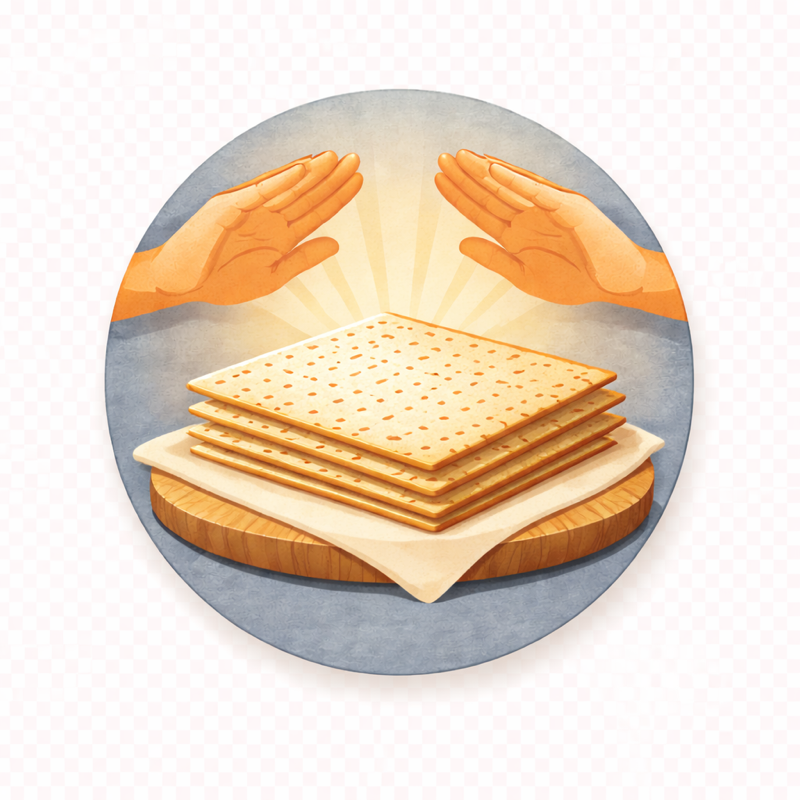
Recite the blessing over the matzah:
“Blessed are You, Lord our God, King of the Universe, who brings forth bread from the earth.”
Meaning and Symbolism
This blessing reminds us that God is the source of all provision — not only physical food, but spiritual sustenance as well. The matzah we hold tonight is more than a reminder of haste; it is a symbol of the Messiah.
Traditionally, matzah is:
- Striped — by the fire of baking
- Pierced — to prevent rising
- Unleavened — without yeast, symbolizing freedom from sin
Each of these attributes reflects Jesus Christ, the Bread of Life — pierced for our transgressions (Isaiah 53:5), striped for our healing (1 Peter 2:24), and without sin (2 Corinthians 5:21). And just as bread is placed in the earth and rises, so too did the Savior.
Scripture Connection
“He was pierced…” — Isaiah 53:5
“By His stripes we are healed.” — 1 Peter 2:24
“He knew no sin…” — 2 Corinthians 5:21
“I am the Bread of Life… He that cometh to me shall never hunger.” — John 6:35
Shir HaMa'alot — Psalm 126: A Song of Ascents
Psalm 126 celebrates the reversal of captivity — mouths filled with laughter, tongues with singing. It speaks of sowing in tears and reaping in joy, of bearing precious seed and returning with sheaves. The Motzi step blesses the bread that God brings forth from the earth — the same God who brings forth joy from weeping, harvest from sowing, and life from the tomb.
1 When the LORD turned again the captivity of Zion, we were like them that dream. 2 Then was our mouth filled with laughter, and our tongue with singing: then said they among the heathen, The LORD hath done great things for them. 3 The LORD hath done great things for us; whereof we are glad. 4 Turn again our captivity, O LORD, as the streams in the south. 5 They that sow in tears shall reap in joy. 6 He that goeth forth and weepeth, bearing precious seed, shall doubtless come again with rejoicing, bringing his sheaves with him.
The Covenant Pattern
At the Seder Table: The blessing hamotzi acknowledges God as the One who “brings forth bread from the earth.” Before the matzah is eaten, it is blessed. Before it is consumed, it is consecrated. The provision comes from God.
At the Seder Table — The Bread of Poverty
The Haggadah instructs the leader to hold all three matzot and recite the Hamotzi — the general bread blessing:
בָּרוּךְ אַתָּה יְיָ, אֱלֹהֵינוּ מֶלֶךְ הָעוֹלָם, הַמּוֹצִיא לֶחֶם מִן הָאָרֶץ.
Blessed are You, LORD our God, King of the Universe, who brings forth bread from the earth.
Edersheim notes a crucial detail: Rabbinical tradition held that the thanksgiving was to follow, not precede, the breaking — “because it was the bread of poverty, and the poor have not whole cakes, but broken pieces.” The matzah is not the bread of kings — it is the bread of the poor, the humble, the afflicted. The provision is divine, even when the bread is broken.
Sources: Pesach Haggadah (Sefaria/Koren); Edersheim, The Temple: Its Ministry and Services, Ch. 12
At the Last Supper: “Jesus took bread, and blessed it” (Matthew 26:26). He gave thanks for the Father’s provision — and then transformed it. The bread that God brings forth from the earth becomes the body that God brings forth from the tomb.
At the Last Supper — The Bread Blessed
“Jesus took bread, and blessed it” (Matthew 26:26). At this point in the Seder, the Motzi blessing was the customary thanksgiving over bread — acknowledging God as the One who brings forth bread from the earth. Jesus spoke the same words that every head of household had spoken for centuries.
But the bread He held was already marked for a greater purpose. The matzah at this table was striped by fire, pierced to prevent rising, and unleavened — pure. The bread that God brings forth from the earth would become the body that God brings forth from the tomb. The full institution — “This is my body, which is given for you” — would come later at the Aphikomen (Step 12), when the hidden bread was revealed.
Jesus: The Bread of Life
The imagery of bread runs through the entire life and ministry of Jesus:
Born in Bethlehem — The very name means “House of Bread” (בֵּית + לֶחֶם). The Bread of Life was born in the House of Bread.
Multiplied the loaves — Twice Jesus miraculously provided bread for the multitudes: feeding 5,000 with five loaves (Matthew 14:13–21) and feeding 4,000 with seven loaves (Matthew 15:32–39). He blessed, broke, and gave — the same pattern He would follow at the Last Supper.
Declared Himself the Bread — After feeding the 5,000, Jesus taught: “I am the bread of life: he that cometh to me shall never hunger” (John 6:35). He compared Himself to the manna from heaven: “Your fathers did eat manna in the wilderness, and are dead. This is the bread which cometh down from heaven, that a man may eat thereof, and not die. I am the living bread which came down from heaven: if any man eat of this bread, he shall live for ever” (John 6:49–51).
At this table, the One who is the Bread blessed the bread that would become the symbol of His body, broken for us.
In the Nephite Assembly: Alma uses the exact motzi “bring forth” language: “Yea, come unto me and bring forth works of righteousness” (Alma 5:35). The invitation is to bring forth fruit in response to what God has brought forth. And there is a warning: “whosoever bringeth forth not good fruit, or whosoever doeth not the works of righteousness, the same have cause to wail and mourn” (Alma 5:36). Divine provision demands a response.
In the Nephite Assembly — Alma 5: Bring Forth Works of Righteousness
The Motzi blessing acknowledges God as the one who brings forth bread from the earth. The Hebrew root yatsa — to bring forth, to go out — carries a sense of active production. Alma uses this same language to call his people to action:
“Yea, come unto me and bring forth works of righteousness.” — Alma 5:35
“For behold, the time is at hand that whosoever bringeth forth not good fruit, or whosoever doeth not the works of righteousness, the same have cause to wail and mourn.” — Alma 5:36
Just as God brings forth bread from the earth, we are called to bring forth the fruit of our lives — works of righteousness that testify of the covenant within us.
On the Covenant Path Today: Elder Bednar describes how “every time we faithfully receive, review, remember, and renew sacred covenants, our spiritual anchors are secured ever more firmly and steadfastly to the ‘rock’ of Jesus Christ” (“Be Still, and Know That I Am God," 2024). The bread is blessed and given again each Sabbath — the same provision, the same pattern, the same God who brings forth bread from the earth.
On the Covenant Path — The Bread of Heaven
The hamotzi blessing acknowledges God as the One who “brings forth bread from the earth.” In the wilderness, God sustained Israel with manna — bread from heaven — that appeared fresh each morning and could not be hoarded for the next day. The provision required daily trust.
On the covenant path, we receive the same lesson: spiritual sustenance comes not once, but continually. The sacrament bread is offered every Sabbath. The scriptures are opened every day. The manna must be gathered fresh. As the Lord promised Israel through the wilderness and the Saints through the plains: “I will go before your face. I will be on your right hand and on your left, and my Spirit shall be in your hearts, and mine angels round about you, to bear you up” (D&C 136:22).
The Bridegroom provides for His Bride — not once, but daily, faithfully, from the earth and from heaven.
Reflection Questions
- What does it mean to call Christ the “Bread of Life”? How does He feed my spirit today?
- The matzah is pierced, striped, and humble — how do these features point to Jesus and His sacrifice?
- Just as the Israelites gathered manna daily, how can I gather spiritual nourishment each day through prayer, scripture, and the sacrament?
- When I bless and break bread — at this table or during the sacrament — how can I more intentionally remember the One who was broken for me?
- What small or humble “manna” has the Lord provided in my life this year? Have I seen His hand in the ordinary?