Root Word
רָחַץ (rachatz) — to wash (Feminine form, reflecting inward sanctification)
Action
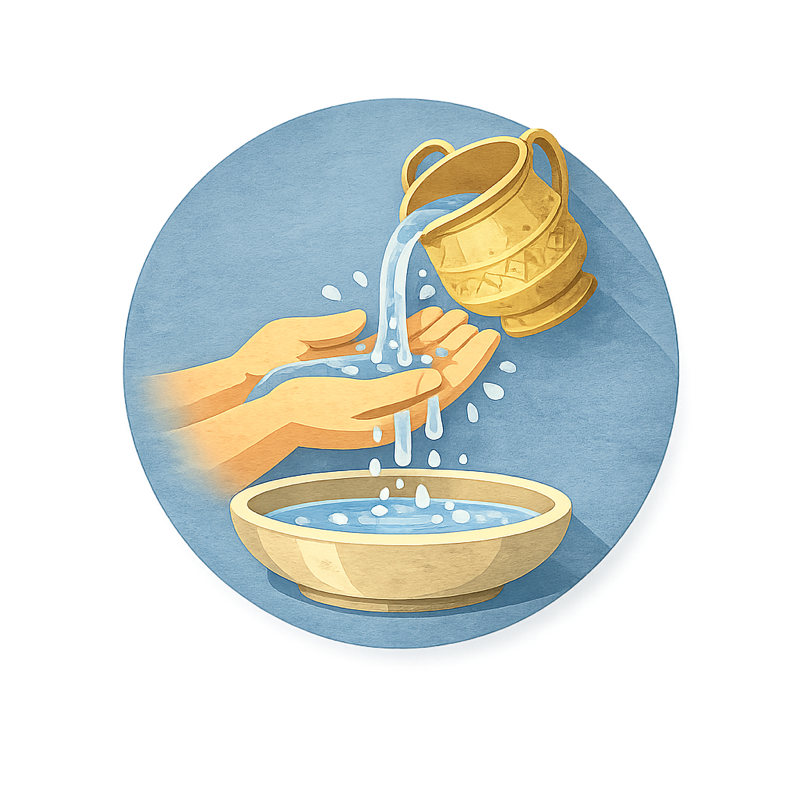
Wash hands a second time — this time with a blessing.
“Blessed are You, Lord our God, King of the universe, who has sanctified us by His commandments and commanded us concerning the washing of hands.”
Meaning and Symbolism
The first washing (Urchatz) symbolized baptism — an outer act of obedience and covenant. This second washing (Rachtzah) points to the inner transformation — a sanctification of the heart and soul. It is a preparation for sacred communion, symbolic of being born of the Spirit and cleansed from within.
It mirrors the pattern of baptism followed by confirmation, where we not only begin our covenant walk but are filled with the Holy Ghost, who purifies us in ongoing renewal.
Jesus Washed Their Feet
At this deeper stage of the meal, Jesus Himself knelt to wash the feet of His disciples (John 13:4–5). This was no longer about outward preparation — it was an act of love, humility, cleansing, and sacred intimacy. Peter resisted at first, but Jesus responded: “If I wash thee not, thou hast no part with me” (John 13:8).
Here, Christ was teaching us to submit to His sanctifying grace, and to do likewise in serving one another.
Scripture Connection
“Jesus… rose from supper, laid aside his garments; and took a towel, and girded himself. After that he poureth water into a basin, and began to wash the disciples’ feet…” — John 13:4–5
“If I wash thee not, thou hast no part with me.” — John 13:8
“Have ye been spiritually born of God?” — Alma 5:14
“Except a man be born of water and of the Spirit, he cannot enter into the kingdom of God.” — John 3:5
Shir HaMa'alot — Psalm 125: A Song of Ascents
Psalm 125 speaks of the security of those who trust in the Lord — as unshakeable as Mount Zion, surrounded by mountains of protection. Rachtzah, the second washing, consecrates us for sacred communion. This psalm assures us that the Lord surrounds His people as the mountains surround Jerusalem — those who are washed and sanctified are held in His care.
1 They that trust in the LORD shall be as mount Zion, which cannot be removed, but abideth for ever. 2 As the mountains are round about Jerusalem, so the LORD is round about his people from henceforth even for ever. 3 For the rod of the wicked shall not rest upon the lot of the righteous; lest the righteous put forth their hands unto iniquity. 4 Do good, O LORD, unto those that be good, and to them that are upright in their hearts. 5 As for such as turn aside unto their crooked ways, the LORD shall lead them forth with the workers of iniquity: but peace shall be upon Israel.
The Covenant Pattern
At the Seder Table: This second washing comes after the Maggid — after the story of deliverance has been told. It is deeper than the first. A blessing is now spoken. The participant is preparing not just for the meal, but for sacred communion with God.
At the Seder Table — The Second Washing
The Haggadah instructs all participants to wash their hands, and this time the full blessing is recited:
בָּרוּךְ אַתָּה יְיָ, אֱלֹהֵינוּ מֶלֶךְ הָעוֹלָם, אֲשֶׁר קִדְּשָׁנוּ בְמִצְוֹתָיו וְצִוָּנוּ עַל נְטִילַת יָדַיִם.
Blessed are You, LORD our God, King of the Universe, who has made us holy through His commandments, and has commanded us about washing hands.
Unlike Urchatz (Step 2), where hands were washed silently, this washing includes the full al netilat yadayim blessing — marking the transition from telling to eating, from narrative to sacred action. The story has been told. The plagues recounted. The deliverance celebrated. Now the hands are consecrated for the sacred meal itself.
Sources: Pesach Haggadah (Sefaria/Koren); Edersheim, The Temple: Its Ministry and Services, Ch. 12
At the Last Supper: Jesus washes His disciples’ feet (John 13:4–5), transforming this moment of consecration into an unforgettable lesson. “He that is washed needeth not save to wash his feet, but is clean every whit” (John 13:10). The initial cleansing of baptism is not enough — a deeper purification, reaching the most intimate and humble parts of us, is required.
At the Last Supper — The Washing of Feet
Scholars have debated the timing of Jesus’ foot-washing. Edersheim argues it occurred early in the evening, noting that John 13:2 should read “when supper had come” rather than “supper being ended.” However, when we recognize the context of baptism and temple tradition, the later placement at Rachtzah makes profound sense.
The disciples had already been baptized — they had passed through the first washing. Jesus acknowledged this: “He that is washed needeth not save to wash his feet, but is clean every whit” (John 13:10). The Greek louō (full bath) versus niptō (partial washing) makes the distinction clear. The disciples did not need another baptism; they needed the deeper, consecrating washing that prepares one to enter sacred space.
This pattern echoes the ancient temple, where the priests, the sons of Aaron, were first washed at the door of the tabernacle (Exodus 29:4) and then underwent further washings and anointings before officiating in sacred ordinances (Exodus 40:12–13). The washing of the feet represents this second consecration — not only an initiation, but preparation for sacred service and sacred communion.
Peter’s resistance — and then his eager overcorrection (“not my feet only, but also my hands and my head!”) — makes sense in this context. Jesus responded: “If I wash thee not, thou hast no part with me” (John 13:8). And then: “If I then, your Lord and Master, have washed your feet; ye also ought to wash one another’s feet” (John 13:14).
In the Nephite Assembly: Alma presses his people: “Can ye look up to God at that day with a pure heart and clean hands?” (Alma 5:19). The initial baptism (Urchatz) opened the covenant. But ongoing purification — the Rachtzah — is what sustains it.
In the Nephite Assembly — Alma 5: Garments Washed White
Rachtzah is the deeper washing — the purification that goes beyond the initial baptism. Alma uses the language of washing directly, pressing his people to examine whether this second, deeper cleansing has taken place:
“I say unto you, ye will know at that day that ye cannot be saved; for there can no man be saved except his garments are washed white; yea, his garments must be purified until they are cleansed from all stain, through the blood of him of whom it has been spoken by our fathers, who should come to redeem his people from their sins.” — Alma 5:21
“Could ye say, if ye were called to die at this time, within yourselves, that ye have been sufficiently humble? That your garments have been cleansed and made white through the blood of Christ, who will come to redeem his people from their sins?” — Alma 5:27
This IS the Rachtzah — garments washed, purified, cleansed from all stain through the blood of the Redeemer. The priestly washing described in Exodus 29:4 — “thou shalt bring them unto the door of the tabernacle… and shalt wash them with water” — finds its spiritual parallel here. Alma’s people have already been baptized (Urchatz). Now they must be washed again, more deeply, through the sanctifying blood of Christ.
The consequence of this deeper washing is the song: “If ye have experienced a change of heart, and if ye have felt to sing the song of redeeming love, I would ask, can ye feel so now?” (Alma 5:26). The song of redeeming love is what follows the second washing — not a one-time event but a continuous renewal.
On the Covenant Path Today: Elder Bednar teaches that “by the sanctifying power of the Holy Ghost as our constant companion, we can always retain a remission of our sins” (“Always Retain a Remission of Your Sins," 2016). The second washing is the ongoing work of sanctification — the covenant renewed each week through the sacrament, each day through repentance, each moment we turn to the Lord.
On the Covenant Path — The Bride Makes Herself Ready
The Four Cups and the Wedding Covenant describes the Feast of Unleavened Bread as representing the sanctification of the Bride. Having been redeemed by the blood of the Lamb (Passover), she must now purge out the leaven — removing sin from her life to become worthy of her Bridegroom.
This second washing at Rachtzah mirrors the ancient practice of bedikat chametz — the meticulous search of the home to remove every trace of leaven before the feast. Leaven represents sin — something that spreads, puffs up, and corrupts the whole. The Bride makes herself ready by searching her heart for hidden sin and responding with urgency to the call to leave Babylon.
“But as he which hath called you is holy, so be ye holy in all manner of conversation.” — 1 Peter 1:15
The second washing is not merely about removing outward impurity — it is about becoming holy, set apart, consecrated. A Bride made ready for her King.
Reflection Questions
- Why do we wash again now? How is this different from the first time?
- What does it mean to be spiritually born — not just cleansed outwardly, but renewed inwardly?
- Have I felt my heart change through Christ’s sanctifying love?
- How do baptism and the Holy Ghost continue to transform and cleanse me?
- What ritual washings or sacred practices in my life invite me to prepare inwardly?
- Jesus knelt to wash His disciples’ feet. What does this teach me about His character, and how I should treat others?
- Am I willing to let Christ cleanse the hardest, most hidden parts of my heart?
- How do I prepare myself for sacred experiences like the sacrament, temple worship, or personal revelation?
- What kind of cleansing do I need most right now — external, internal, or both?