Root Word
רָחַץ (rachatz) — to wash, bathe
Action
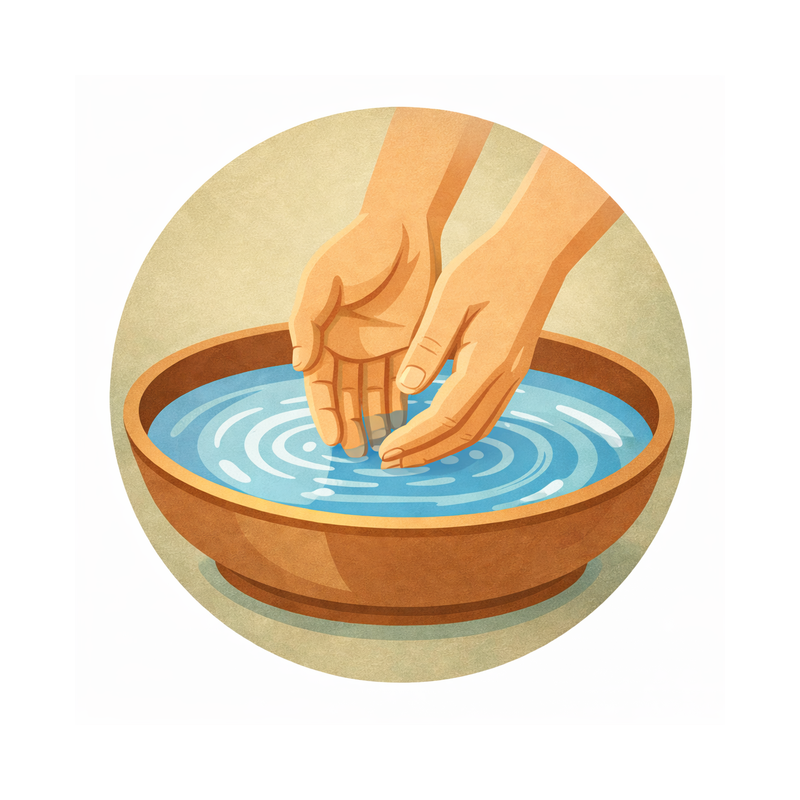
Wash hands — no blessing is recited at this stage.
Meaning and Symbolism
Urchatz is a symbolic act of initial cleansing — an outward preparation before partaking of sacred things. It mirrors the waters of baptism, representing repentance, rebirth, and our first step into the covenant path.
Just as the Israelites passed through the Red Sea to begin their journey toward freedom, we pass through the waters of baptism to begin our journey toward Christ.
Scripture Connection
“Must be cleansed from all sin…” — Alma 5:21
“Except a man be born of water… he cannot enter into the kingdom of God.” — John 3:5
Shir HaMa'alot — Psalm 121: A Song of Ascents
The second Song of Ascents is the pilgrim’s assurance — the Lord who watches over Israel neither slumbers nor sleeps. As Urchatz washes the hands in preparation for the sacred, this psalm reminds us that the Lord preserves our going out and our coming in. The initial washing is an act of trust: we place ourselves in His hands.
1 I will lift up mine eyes unto the hills, from whence cometh my help. 2 My help cometh from the LORD, which made heaven and earth. 3 He will not suffer thy foot to be moved: he that keepeth thee will not slumber. 4 Behold, he that keepeth Israel shall neither slumber nor sleep. 5 The LORD is thy keeper: the LORD is thy shade upon thy right hand. 6 The sun shall not smite thee by day, nor the moon by night. 7 The LORD shall preserve thee from all evil: he shall preserve thy soul. 8 The LORD shall preserve thy going out and thy coming in from this time forth, and even for evermore.
The Covenant Pattern
At the Seder Table: The hands are washed silently — no blessing is spoken. This first washing is preparation, not completion. It readies the participant to handle the sacred herbs that follow.
At the Seder Table — The First Washing
The Haggadah instructs simply:
נוטלים את הידים ואין מברכים “עַל נְטִילַת יָדַיִּם”
Hands are washed without reciting the blessing for hand-washing.
This brevity is deliberate — no blessing is spoken. The washing is preparatory, not consecrating. It readies the participant to handle the sacred herbs that follow. Edersheim notes that two kinds of washing were prescribed by tradition — “dipping” and “pouring” — and at the Paschal Supper, the hands were to be “dipped” in water.
Sources: Pesach Haggadah (Sefaria/Koren); Edersheim, The Temple: Its Ministry and Services, Ch. 12
At the Last Supper: The traditional Seder includes two washings: Urchatz (first washing, no blessing) and Rachtzah (second washing, with blessing). If Jesus followed this pattern, the first washing would have occurred here. At some point during the meal, Jesus transformed the ritual into something extraordinary — washing His disciples’ feet. The full significance of this act is explored at Rachtzah.
At the Last Supper — Born of Water
While the Gospels do not explicitly describe the hand-washing rituals at the Last Supper, they provide solid grounding for the symbolism of the first washing. Jesus Himself was baptized by John in the Jordan (Matthew 3:13–17), and His disciples would have entered the covenant through the same waters. To Nicodemus, Jesus taught plainly: “Except a man be born of water and of the Spirit, he cannot enter into the kingdom of God” (John 3:5).
The disciples gathered at that table had already passed through this first washing — they had been born of water. Whatever hand-washing ritual occurred that evening, it pointed back to that foundational covenant act.
In the Nephite Assembly: Alma’s father “baptized his brethren in the waters of Mormon” (Alma 5:3). The first act of entering Alma’s covenant community was washing — water as the gate into the covenant. Alma reminds his people they must be “cleansed from all sin” (Alma 5:21).
In the Nephite Assembly — Alma 5: The Waters of Mormon
Urchatz — the first washing — finds its echo in the opening verses of Alma’s sermon. Having just established his consecration (Kadesh), Alma immediately turns to the act of washing:
“Yea, and he did baptize his brethren in the waters of Mormon.” — Alma 5:3
The sequence mirrors the Seder exactly: first sanctification, then washing. Alma’s father established the covenant community not with a sermon but with an act of immersion — a washing that marked the boundary between the old life and the new. The waters of Mormon were the Nephite Urchatz — the preparatory step that readied a people to receive the sacred things that would follow.
The baptismal covenant itself — recorded in Mosiah 18 — describes the promises made at that first washing:
“As ye are desirous to come into the fold of God, and to be called his people, and are willing to bear one another’s burdens, that they may be light; yea, and are willing to mourn with those that mourn; yea, and comfort those that stand in need of comfort, and to stand as witnesses of God at all times and in all things, and in all places that ye may be in, even until death… that ye may have eternal life — what have you against being baptized in the name of the Lord?” — Mosiah 18:8–10
This is the covenant of the first washing: to bear burdens, to mourn with the mourning, to comfort, and to witness. Alma’s question becomes pointed: “Have ye sufficiently retained in remembrance his mercy and long-suffering towards them?” (Alma 5:6). We renew this baptismal covenant every time we partake of the sacrament — the prayer itself echoing this same principle: “that they may always remember him and have his Spirit to be with them” (Moroni 4:3). The first washing is not merely an initiation — it is a commitment to remember and to act upon that remembrance throughout life.
On the Covenant Path Today: Elder Bednar teaches that “the ordinances of baptism by immersion, the laying on of hands for the gift of the Holy Ghost, and the sacrament are not isolated and discrete events; rather, they are elements in an interrelated and additive pattern of redemptive progress” (“Always Retain a Remission of Your Sins," 2016). The first washing is the beginning of the covenant journey — not the whole of it.
On the Covenant Path — Entering the Covenant
The first washing at the Seder table is a preparatory act — making oneself ready to handle sacred things. On the covenant path, baptism serves this same purpose: it is the gate through which we enter.
The Four Cups and the Wedding Covenant describes the gospel covenant in the language of an ancient marriage: through sacred ordinances — baptism, confirmation, temple covenants — we enter into a covenant relationship with Christ that mirrors a marriage contract. We take upon ourselves His name, just as a bride takes her husband’s name. We promise fidelity to Him alone. He promises to provide, protect, and redeem us.
“Except a man be born of water and of the Spirit, he cannot enter into the kingdom of God.” — John 3:5
The first washing is the beginning — not the end — of the covenant journey. It opens the door to everything that follows.
Reflection Questions
- What does this simple act of washing teach me about spiritual readiness — preparing to receive sacred things?
- At my baptism, I covenanted to bear burdens, mourn with those who mourn, comfort those in need, and stand as a witness. How am I living these promises today?
- Alma asked: “Have ye sufficiently retained in remembrance?” When I partake of the sacrament each week, what am I actively remembering?
- The sacrament prayer promises that if I “always remember him,” I may “always have his Spirit.” How does remembrance invite the Spirit into my life?
- How can I more fully embrace the cleansing gift of repentance — not as a one-time event, but as an ongoing renewal?