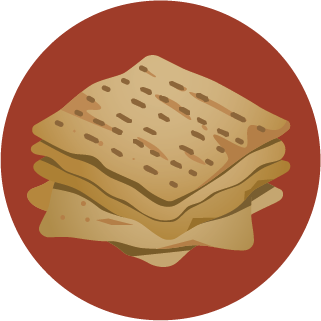
Chag HaMatzot: The Feast of Unleavened Bread
Seven days of separation, humility, and holy haste
Most people know about Passover. Fewer realize that Passover is technically one night—the evening of the 14th of Nisan, when the lambs were slaughtered and their blood applied to the doorposts.
What follows is a distinct seven-day festival: Chag HaMatzot, the Feast of Unleavened Bread.
“In the fourteenth day of the first month at even is the LORD’s passover. And on the fifteenth day of the same month is the feast of unleavened bread unto the LORD: seven days ye must eat unleavened bread.” (Leviticus 23:5-6)
This is the clearest biblical distinction: Pesach is the sacrifice on the 14th; Chag HaMatzot is the week-long observance beginning on the 15th. Over time the two festivals merged in common usage, but the biblical text keeps them separate—and that distinction matters.
The Spring Feast Timeline

14 Nisan: Passover
Lamb slain at twilight • Blood applied
15-21 Nisan: MATZOT
Seven days • No leaven

16/Sunday: Firstfruits
Christ rises • Barley sheaf waved

+50 Days: Pentecost
Spirit descends • Omer count ends
The Biblical Foundation
The Command
The Torah commands in multiple places:
“Seven days shall ye eat unleavened bread; even the first day ye shall put away leaven out of your houses: for whosoever eateth leavened bread from the first day until the seventh day, that soul shall be cut off from Israel.” (Exodus 12:15)
“And ye shall observe the feast of unleavened bread; for in this selfsame day have I brought your armies out of the land of Egypt.” (Exodus 12:17)
“Seven days shall there be no leaven found in your houses… Ye shall eat nothing leavened; in all your habitations shall ye eat unleavened bread.” (Exodus 12:19-20)
Why Unleavened?
The immediate reason was haste:
“And they baked unleavened cakes of the dough which they brought forth out of Egypt, for it was not leavened; because they were thrust out of Egypt, and could not tarry, neither had they prepared for themselves any victual.” (Exodus 12:39)
The Israelites did not plan simplicity. They were expelled before the dough could rise.
Teaching the Children
The feast is explicitly pedagogical—designed to teach the next generation:
“And thou shalt shew thy son in that day, saying, This is done because of that which the LORD did unto me when I came forth out of Egypt. And it shall be for a sign unto thee upon thine hand, and for a memorial between thine eyes, that the LORD’s law may be in thy mouth.” (Exodus 13:8-9)
The matzah itself becomes a visible sign and memorial—not just a food, but a teacher.
Lechem Oni: The Bread of Affliction
The most direct scriptural interpretation of matzah comes from Deuteronomy:
“Thou shalt eat no leavened bread with it; seven days shalt thou eat unleavened bread therewith, even the bread of affliction; for thou camest forth out of the land of Egypt in haste: that thou mayest remember the day when thou camest forth out of the land of Egypt all the days of thy life.” (Deuteronomy 16:3)
Hebrew: לֶחֶם עֹנִי (lechem oni) — literally “bread of poverty” or “bread of affliction.”
Dual meaning:
- Bread of affliction — reminding us of slavery, suffering, poverty
- Bread over which many things are recited — עֹנִי (oni) can also relate to “answer” or “respond,” forming the basis for the Seder’s Maggid section where the Haggadah is told over matzah
The Paradox of Matzah
Matzah is simultaneously:
- Slave bread — what they ate in bondage
- Freedom bread — what they ate leaving Egypt
This duality is intentional. The same food marks both suffering and deliverance, teaching that redemption does not erase memory of affliction, but transforms it.
What Matzah Is
- Flour and water only
- Baked in under 18 minutes
- No time to rise
- Flat, simple, unadorned
What Matzah Represents
- Haste of departure
- Humility before God
- Trust in divine provision
- Separation from Egypt
Bedikat Chametz: The Search for Leaven
Why Leaven Must Be Removed
The Primary Scriptural Reason: Haste
The Israelites left Egypt so quickly they could not wait for dough to rise. The unleavened bread is a permanent reminder of that urgency.
The Rabbinic/Mystical Reason: Humility vs. Pride
In Jewish tradition, leaven (חָמֵץ / chametz) came to represent something deeper:
“In Jewish tradition, chametz came to represent arrogance, pride, and puffed-up-ness. In the Talmud, the yeast in the dough is described as what prevents us from doing God’s will, as our selfish impulses are kneaded all through us like yeast in dough, and it’s hard to separate them out.” — The Symbolism of Chametz, Sefaria
| Chametz (Leaven) | Matzah (Unleavened) |
|---|---|
| Rises, puffs up | Remains flat |
| Takes time to ferment | Made quickly |
| Represents ego, self-inflation | Represents humility |
| Must be removed | Must be eaten |
The Ritual Search
The process of creating a chametz-free environment reaches its climax the night before Passover with bedikat chametz — the formal search for leaven.
The Search
- Time: Night before Passover, after dark
- Tools: Beeswax candle, feather, wooden spoon, paper bag
- Preparation: Ten pieces of bread hidden throughout the house
- Method: Search by candlelight in every room
- Collection: Sweep chametz into bag with feather
The Nullification
"All leaven and anything leavened that is in my possession, which I have neither seen nor removed, and about which I am unaware, shall be considered nullified and ownerless as the dust of the earth."
Morning: The collected chametz is burned. A second nullification is recited.
The Spiritual Dimension
For observant Jews, chametz removal is not spring cleaning—it is a rigorous spiritual discipline involving:
- Weeks of preparation
- Deep cleaning of every surface
- Formal search by candlelight
- Legal nullification of any missed chametz
- Complete abstention from leavened products for seven (or eight) days
The labor is intentional. Leaven represents what “puffs us up”—ego, self-reliance, spiritual impurity. Removing it is an act of humility and trust in God alone.
The Seven-Day Journey
Biblical Structure
The Torah prescribes a week-long observance with two holy convocations:
| Day | Date | Observance |
|---|---|---|
| Day 1 | 15 Nisan | Holy convocation, no servile work |
| Days 2-6 | 16-20 Nisan | Unleavened bread eaten daily, offerings made by fire |
| Day 7 | 21 Nisan | Holy convocation, solemn assembly, no servile work |
“In the first day ye shall have an holy convocation: ye shall do no servile work therein. But ye shall offer an offering made by fire unto the LORD seven days: in the seventh day is an holy convocation: ye shall do no servile work therein.” (Leviticus 23:7-8)
Why Seven Days?
One night of deliverance becomes a week of transformed identity. The extended observance ensures that the lesson is embedded in daily life, not merely commemorated in a single evening.
For seven days:
- Every meal reminds of redemption
- Every absence of leaven proclaims separation from bondage
- Every piece of matzah teaches dependence on God
In the diaspora, eight days are observed—adding an extra day at both the beginning and end due to calendar uncertainties in ancient times.
Connection to the Omer Count
Chag HaMatzot begins the 50-day count toward Shavuot (Pentecost). The Feast of Firstfruits (בִּכּוּרִים / Bikkurim) occurs during Matzot week, and from that day the סְפִירַת הָעֹמֶר (sefirat ha’omer), the counting of the omer, begins:
“And ye shall count unto you from the morrow after the sabbath, from the day that ye brought the sheaf of the wave offering; seven sabbaths shall be complete.” (Leviticus 23:15)
The journey from Egypt to Sinai is liturgically reenacted every year: Passover (deliverance) → Matzot (separation) → Firstfruits (resurrection) → Pentecost (covenant and Spirit).
What Christians Have Seen
While Chag HaMatzot belongs to Israel and has held meaning for Jews for over three thousand years, Christians have also found deep resonance in its symbols—particularly through Paul’s teaching.
Paul on Leaven
The apostle Paul explicitly connects the Passover/Matzot observance to Christian spiritual practice:
“Know ye not that a little leaven leaveneth the whole lump? Purge out therefore the old leaven, that ye may be a new lump, as ye are unleavened. For even Christ our passover is sacrificed for us: Therefore let us keep the feast, not with old leaven, neither with the leaven of malice and wickedness; but with the unleavened bread of sincerity and truth.” (1 Corinthians 5:6-8)
Paul’s instruction echoes the ancient command: remove the old leaven, live unleavened lives—not in terms of bread, but in terms of character.
The Old Leaven
"Malice and wickedness" — the puffed-up qualities that corrupt from within
The Unleavened Life
"Sincerity and truth" — the flat, simple, honest qualities of discipleship
Alma’s Warning Against Being “Puffed Up”
The Book of Mormon echoes this leaven imagery. In Alma’s great sermon to the church at Zarahemla, he asks piercing questions about spiritual readiness—and repeatedly warns against being “puffed up”:
“Behold, are ye stripped of pride? I say unto you, if ye are not ye are not prepared to meet God.” (Alma 5:28)
“O ye workers of iniquity; ye that are puffed up in the vain things of the world…” (Alma 5:37)
Alma’s language of being “puffed up” mirrors precisely what leaven does to dough—and what pride does to the soul. To be “stripped of pride” is to undergo bedikat chametz of the heart: searching out and removing the leaven that inflates us beyond our true measure.
See Gordon C. Thomasson and John W. Welch, “The Sons of the Passover,” in Reexploring the Book of Mormon (FARMS, 1992), and Scripture Central, “KnoWhy #420: Were Nephite Prophets Familiar with the Passover Tradition?”
Christ as Bread of Life
Jesus declared Himself the bread that gives eternal life:
“I am the bread of life: he that cometh to me shall never hunger; and he that believeth on me shall never thirst.” (John 6:35)
The bread Jesus broke at the Last Supper was matzah—unleavened bread. When He said “This is my body,” He held in His hands the bread of haste, humility, and separation from corruption. The One who knew no sin became the bread of life for all who would partake.
Latter-day Saint Connection
Interestingly, the sacrament bread in Latter-day Saint practice is typically leavened—ordinary bread, risen with yeast. Perhaps this carries its own symbolism: while matzah recalls the bread of affliction and the haste of deliverance, risen bread may remind us that Christ Himself has risen. The bread of the sacrament points not only backward to the cross but forward to the empty tomb.
The preparation for the sacrament, however, should still mirror chametz removal—purging what is unworthy, preparing heart and mind to remember and to renew our covenants with God.
Pesach vs. Chag HaMatzot
Understanding the distinction helps us see what each festival emphasizes:
Pesach (Passover)
Date: 14th of Nisan (one night)
Primary focus: The sacrifice of the lamb
Key action: Applying blood to doorposts
Symbolism: God "passing over" Israelite homes, sparing the firstborn
Theme: Deliverance through blood
Chag HaMatzot (Unleavened Bread)
Date: 15th-21st of Nisan (seven days)
Primary focus: Eating unleavened bread
Key action: Removing all leaven from the home
Symbolism: Haste of departure, humility, separation from Egypt
Theme: Transformation through separation
Why they’re linked: The Passover sacrifice was eaten with unleavened bread and bitter herbs (Exodus 12:8). The night of Passover is the beginning of the week of unleavened bread.
Why the distinction matters:
- Passover emphasizes deliverance (blood, sacrifice, God’s protection)
- Chag HaMatzot emphasizes transformation (leaving the old life, purging pride, trusting God’s provision)
It is not enough to be delivered from bondage. We must also be transformed by that deliverance.
Reflection Questions
Conclusion
Chag HaMatzot is about separation—from Egypt, from bondage, from pride. For seven days, Israel lived without the "puffed up" quality of leavened bread, remembering that they left in haste, trusting God alone for provision.
"Seven days shalt thou eat unleavened bread therewith, even the bread of affliction; for thou camest forth out of the land of Egypt in haste."
The bread of affliction became the bread of freedom.
May our separation from pride become our transformation into humility.
Additional Resources
Jewish Sources
- What Is Passover (Pesach)? — Chabad
- What Is Matzah? — Chabad
- Bedikat Chametz — Chabad
- The Symbolism of Chametz — Sefaria
- Rules for Passover — My Jewish Learning
Part of our series on Jewish festivals and their fulfillment in Christ.