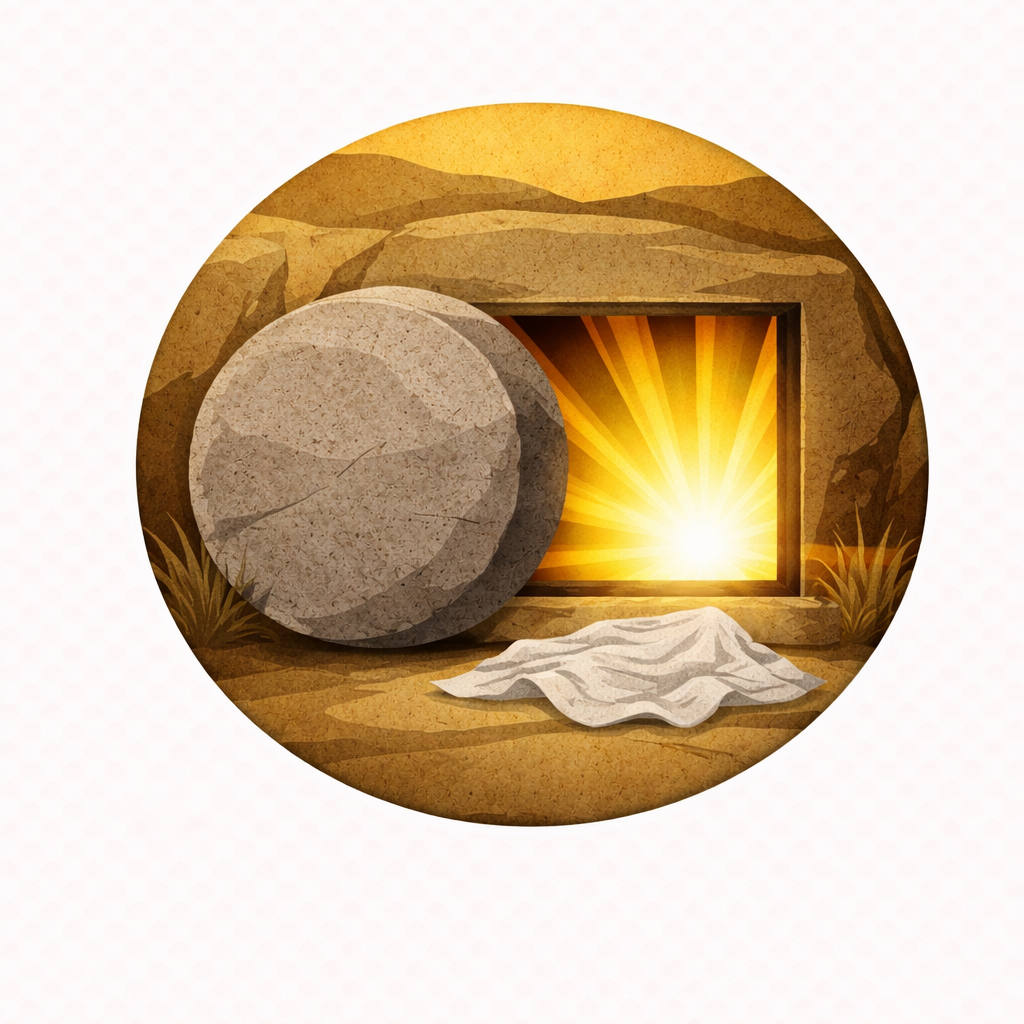
The Day
Date: Sunday, 17 Nisan (March/April) — The First Day of the Week
Location: Joseph’s tomb, Jerusalem, Emmaus
Key Events:
- Earthquake; angels roll away the stone
- Women discover the empty tomb
- Mary Magdalene sees the risen Lord
- Peter and John run to the tomb
- Jesus appears to two disciples on the road to Emmaus
- Jesus appears to the gathered disciples
Scripture Harmony
Click any event below to read the full narrative.
▶ Earthquake, angels open tomb——
The earth shook. Matthew alone records this earthquake and describes an angel descending from heaven, rolling back the stone, and sitting upon it. His appearance was like lightning, his clothing white as snow. The Roman guards — elite soldiers stationed there specifically to prevent any tampering with the tomb — “became as dead men,” paralyzed with terror.
This detail is significant: the chief priests had remembered Jesus’ prediction that He would rise on the third day and asked Pilate for guards to secure the tomb. They feared the disciples might steal the body and claim a resurrection. Pilate gave them a guard unit and told them to make the tomb “as sure as ye can.” They sealed the stone and posted soldiers. All their precautions proved useless against the power of God.
▶ Women find empty tomb—
It was still dark when the women set out — “very early in the morning,” Mark says, “at the rising of the sun.” Mary Magdalene, Mary the mother of James, Salome, Joanna, and possibly others carried the spices they had prepared. Their mission was simple: complete the burial rites that had been cut short by the Sabbath.
Jewish burial custom required bodies to be washed, anointed with fragrant spices, and wrapped in linen cloths. Joseph of Arimathea and Nicodemus had done a hasty burial on Friday evening before the Sabbath began at sunset, wrapping Jesus in linen with about seventy-five pounds of myrrh and aloes. But the women wanted to complete the process properly. Their devotion to Jesus extended beyond His death — they came to honor His body even when they believed all hope was lost.
As they walked, they worried: “Who shall roll us away the stone from the door of the sepulchre?” The stone was large — Mark says it was “very great” — and sealed tombs of wealthy families typically required several men to move. These women came expecting nothing miraculous. They came simply to care for someone they loved.
When they arrived, they found the stone already moved. Mary Magdalene, seeing the tomb open and likely assuming the worst — grave robbery was common in the ancient world — ran immediately to tell Peter and John. The other women entered the tomb and found it empty — but not unoccupied. Two angels in dazzling garments stood there.
▶ Angels: "He is risen"—
The angels spoke to the terrified women: “Why seek ye the living among the dead? He is not here, but is risen: remember how he spake unto you when he was yet in Galilee, Saying, The Son of man must be delivered into the hands of sinful men, and be crucified, and the third day rise again.”
This was not new information. Jesus had told them this would happen — multiple times. In Mark 8:31, Mark 9:31, and Mark 10:33–34, Jesus explicitly predicted His death and resurrection. But His followers had not understood. They expected a conquering Messiah, not a suffering one. Now the angels reminded them of what Jesus had said, and finally, “they remembered his words.”
They rushed from the tomb with “fear and great joy” — an unusual combination that perfectly captures the moment. They had witnessed something terrifying and glorious. Death itself had been overcome. They ran to tell the disciples.
▶ Peter and John run to tomb———
Mary Magdalene had found Peter and John: “They have taken away the Lord out of the sepulchre, and we know not where they have laid him.” She still assumed tomb robbery. Peter and John ran to investigate. John’s Gospel provides a detailed account that reads like eyewitness testimony — John, younger or faster, outran Peter but stopped at the entrance. Peter, characteristically impetuous, plunged straight in without hesitation.
What they saw inside was telling. The linen cloths were lying there undisturbed, and the face cloth — the soudarion wrapped around Jesus’ head — was rolled up in a place by itself. This was not the hasty disarray of a tomb robbery. Grave robbers do not unwrap bodies and fold the linens. The deliberate arrangement pointed to something entirely different: Jesus had passed through His burial cloths and left them behind.
John “saw, and believed.” The text says they returned home, “for as yet they knew not the scripture, that he must rise again from the dead.” Their belief was dawning but not yet complete. They had seen evidence of something unprecedented but did not fully understand its meaning.
▶ Mary Magdalene sees the Lord———
Mary Magdalene returned to the tomb after Peter and John left, standing outside and weeping. When she stooped to look inside, she saw two angels seated where Jesus’ body had lain — one at the head, one at the feet. “Woman, why weepest thou?” they asked. She said, “Because they have taken away my Lord, and I know not where they have laid him.”
Turning, she saw a man she assumed was the gardener. The tomb was in a garden, so this was a reasonable assumption. “Sir, if thou have borne him hence, tell me where thou hast laid him, and I will take him away.” Her offer reveals the depth of her devotion — this woman was prepared to carry a man’s body by herself rather than leave Him dishonored.
Jesus said one word: “Mary.”
She knew that voice. “Rabboni!” — Teacher! — she cried, using the Aramaic form that was more personal, more intimate than the common Rabbi. She moved to embrace Him. Jesus responded, “Touch me not” — or more accurately from the Greek, “Stop clinging to me” — “for I am not yet ascended to my Father.” Jesus was not forbidding any contact; He was gently releasing her grip so He could complete His mission. There was still work to do. “But go to my brethren, and say unto them, I ascend unto my Father, and your Father; and to my God, and your God.”
Mary Magdalene became the first witness of the resurrection — the church fathers later called her “apostle to the apostles.” This is theologically profound. In first-century Jewish culture, women’s testimony was not legally accepted in court. Yet God chose a woman — and specifically this woman, whom Jesus had healed of seven demons — to carry the most important news in human history. The resurrection announcement came not to the powerful or the prestigious but to the faithful and the formerly broken.
▶ Officials bribe soldiers————
While the women spread the news of the resurrection, some of the Roman guards went to the chief priests and reported what had happened — the earthquake, the angel, the empty tomb. The religious leaders faced a crisis: the very precautions they had taken to prevent claims of resurrection had now produced multiple Roman witnesses to supernatural events.
Their solution was bribery and lies. They gave the soldiers “large money” and instructed them to say: “His disciples came by night, and stole him away while we slept.” This story had obvious problems — if the soldiers were asleep, how did they know who took the body? And Roman soldiers who slept on watch faced severe punishment, often death. The chief priests promised to intervene with Pilate if the matter came to official attention.
Matthew notes that “this saying is commonly reported among the Jews until this day.” The lie became the official counter-narrative, but its very existence testified to the empty tomb. No one disputed that the tomb was empty — only how it became so.
▶ Road to Emmaus——
Later that Sunday, two disciples walked the seven-mile road from Jerusalem to Emmaus, discussing everything that had happened. Luke names one as Cleopas; the other is unknown (some scholars suggest it may have been Cleopas’s wife). They were processing their grief and confusion aloud.
A stranger joined them and asked what they were talking about. Astonished that anyone in the region could be unaware of the week’s events, they answered: “Art thou only a stranger in Jerusalem, and hast not known the things which are come to pass there in these days?”
They explained everything: Jesus of Nazareth, a prophet mighty in deed and word, had been condemned by the chief priests and crucified by the Romans. “But we trusted that it had been he which should have redeemed Israel.” Their hope was in the past tense — they had believed, but now that belief seemed shattered. Moreover, some women from their group had brought strange news that morning about an empty tomb and visions of angels who said He was alive. But they had not seen Him themselves.
The stranger responded with surprising directness: “O fools, and slow of heart to believe all that the prophets have spoken: Ought not Christ to have suffered these things, and to enter into his glory?” Then, beginning with Moses and working through all the prophets, He explained every scripture concerning Himself — the suffering servant of Isaiah, the smitten shepherd of Zechariah, the Passover lamb, the bronze serpent lifted up in the wilderness, the seed of the woman who would crush the serpent’s head.
This was the first Christian Bible study, taught by Christ Himself.
At Emmaus, they urged Him to stay for the evening meal. He took bread, blessed it, broke it, and gave it to them. “And their eyes were opened, and they knew him; and he vanished out of their sight.”
They recognized Him in the breaking of bread — the same action He had performed at the Last Supper. They said to each other: “Did not our heart burn within us, while he talked with us by the way, and while he opened to us the scriptures?”
Despite the late hour and the seven-mile distance in darkness, they rushed back to Jerusalem immediately.
▶ Jesus appears to disciples—
When Cleopas and his companion arrived at the upper room, they found the eleven gathered behind locked doors — locked “for fear of the Jews,” John explains. The disciples were hiding, terrified that the authorities who had killed their Master would come for them next.
Before the Emmaus disciples could share their news, the others exclaimed: “The Lord is risen indeed, and hath appeared to Simon!” At some point on this first Easter day, Jesus had appeared privately to Peter. This meeting is recorded nowhere in detail — we have no dialogue, no description — but Paul confirms it in 1 Corinthians 15:5 as the first appearance to any of the male apostles. For Peter, who had denied Jesus three times, this private encounter must have been overwhelming.
As they talked excitedly, Jesus Himself suddenly stood among them: “Peace be unto you.” The doors were still locked. He had simply appeared. They were terrified, thinking they saw a ghost — the Greek word is pneuma, a spirit or phantom.
Jesus immediately addressed their fear: “Why are ye troubled? Behold my hands and my feet, that it is I myself: handle me, and see; for a spirit hath not flesh and bones, as ye see me have.” He showed them the nail wounds in His hands and feet and the spear wound in His side. This was no phantom, no hallucination, no grief-induced vision. This was a physical, resurrected body — the same body that had hung on the cross, now transformed and glorified but still tangible, still bearing the marks of crucifixion.
The disciples “believed not for joy.” They were not skeptical doubters; they were overwhelmed with happiness that seemed too good to be true. Jesus asked for food. They gave Him broiled fish and honeycomb, and He ate before them — further proof that this was a real, physical body, not a spirit.
Then He opened their understanding to comprehend the scriptures: “Thus it is written, and thus it behoved Christ to suffer, and to rise from the dead the third day: And that repentance and remission of sins should be preached in his name among all nations, beginning at Jerusalem. And ye are witnesses of these things.”
This was their commission. They were not merely to remember Jesus; they were to bear witness of Him to the entire world.
▶ Thomas believes (8 days later)————
Thomas was absent from this gathering. When the others found him and exclaimed, “We have seen the Lord!” he refused to believe: “Except I shall see in his hands the print of the nails, and put my finger into the print of the nails, and thrust my hand into his side, I will not believe.”
Thomas is often criticized for this doubt, but his skepticism was not unreasonable. He had watched Jesus die. He was being asked to believe something that contradicted everything he knew about how the world worked. The other disciples themselves had not believed until they saw Jesus with their own eyes. Thomas simply asked for the same evidence they had received.
Eight days later, the disciples were gathered again, and this time Thomas was with them. Jesus appeared among them once more: “Peace be unto you.” Then He turned directly to Thomas: “Reach hither thy finger, and behold my hands; and reach hither thy hand, and thrust it into my side: and be not faithless, but believing.”
Jesus knew exactly what Thomas had said. He met Thomas at the point of his doubt and offered exactly the evidence Thomas had demanded.
Thomas answered with the most exalted confession of faith in any of the Gospels: “My Lord and my God.” This was not merely “my master” or “my teacher.” Thomas proclaimed Jesus as Yahweh — God Himself. It was a statement that would have been blasphemy if untrue.
Jesus accepted the confession and added a blessing for all future believers: “Thomas, because thou hast seen me, thou hast believed: blessed are they that have not seen, and yet have believed.”
He Is Risen. The tomb was empty. The grave clothes were folded. The stone was rolled away — not to let Jesus out (a resurrected body does not need doors opened), but to let the world in to see that He was gone.
The women saw it. Peter and John saw it. Mary Magdalene spoke with Him. The Emmaus disciples broke bread with Him. The ten saw Him appear through locked doors. Thomas touched His wounds. Over the following forty days, He would appear to more than five hundred people at once (1 Corinthians 15:6).
This is the cornerstone of Christianity. Without the resurrection, as Paul wrote, “our preaching is vain, and your faith is also vain.” But Christ is risen. Death is conquered. The grave has lost its sting.
He is risen. He is risen indeed.
Word Studies
Risen — ἐγείρω
ἐγείρω (egeirō) — to awaken, raise up, arise
The Greek egeirō implies being awakened from sleep — the perfect metaphor for resurrection. The angel declared: “He is not here: for he is risen, as he said” (Matthew 28:6).
Touch Me Not — μή μου ἅπτου
ἅπτομαι (haptomai) — to fasten oneself to, cling to, touch
When Jesus said to Mary Magdalene “Touch me not” (John 20:17), the Greek suggests “Stop clinging to me” — not a prohibition against touch, but an invitation to release Him for His continuing mission. The resurrected Lord still had sacred work to do.
Resurrection — ἀνάστασις
ἀνάστασις (anastasis) — from ana (up) + histēmi (to stand)
Literally “a standing up” — the Greek conveys physical rising. This was not merely a spiritual continuation but a bodily resurrection. Jesus ate fish with His disciples; Thomas touched His wounds. The resurrection was real, physical, tangible.
📜 Scholar's Note: The Cornerstone of Christianity
Paul stated it plainly: "If Christ be not risen, then is our preaching vain, and your faith is also vain" (1 Corinthians 15:14). The resurrection is not merely an inspiring story — it is the foundation of all Christian hope. Without it, there is no salvation, no eternal life, no victory over death.
Jesus rose on "the first day of the week" — Sunday. This became the Christian day of worship, replacing the Jewish Sabbath. Early Christians called it "the Lord's Day" (Revelation 1:10). Creation began on the first day; new creation began on the first day.
Remarkably, Jesus chose a woman — Mary Magdalene — to be the first witness. In first-century Jewish culture, women's testimony was not legally accepted in court. Yet God chose women to carry the most important news in human history. The church fathers later called Mary "apostle to the apostles."
⛪ Latter-day Saint Connections
Book of Mormon Witness
The Book of Mormon provides additional testimony: "The spirit and the body shall be reunited again in its perfect form; both limb and joint shall be restored to its proper frame" (Alma 11:43). Christ later appeared to the Nephites as a resurrected being, inviting them to feel the wounds in His hands and feet (3 Nephi 11:14–15).
Modern Revelation
Joseph Smith testified of seeing the resurrected Christ: "We beheld the glory of the Son, on the right hand of the Father" (D&C 76:20). The Restoration began with a resurrected Christ appearing to a young prophet — extending the witness of the empty tomb into the modern age.
The Feast of Firstfruits (Bikkurim)
Christ Rose on Bikkurim
The resurrection occurred on 17 Nisan — the very day of the Feast of Firstfruits (Bikkurim) in the Jewish calendar. This was no coincidence. Paul explicitly connects Christ’s resurrection to this feast:
“But now is Christ risen from the dead, and become the firstfruits of them that slept.” (1 Corinthians 15:20)
“But every man in his own order: Christ the firstfruits; afterward they that are Christ’s at his coming.” (1 Corinthians 15:23)
The Wave Sheaf Offering
According to Leviticus 23:10-11, on “the morrow after the sabbath” during Passover week, the priest would:
- Take the first sheaf (omer) of barley from the harvest
- Wave it before the Lord in the Temple
- Offer sacrifices of thanksgiving
No one could eat from the new harvest until this firstfruits offering was made — acknowledging that all increase comes from God.
The Firstborn Connection
The Hebrew word “bikor” (בִּכּוֹר) also means “firstborn” — the one who receives the birthright. Christ is both:
- The Firstfruits of the resurrection harvest
- The Firstborn of the Father, holding all rights and inheritance
This dual meaning resonates throughout scripture, particularly in the gathering and harvest themes of the Book of Mormon and Doctrine & Covenants, where the Lord repeatedly speaks of gathering His elect as a harvest (D&C 33:7, Alma 26:5).
The Prophetic Fulfillment
Just as the high priest was waving the firstfruits sheaf in the Temple that Sunday morning, Christ — our eternal High Priest — was presenting Himself to the Father as the firstfruits of the resurrection. Consider the parallels:
- The Sheaf: A single bundle representing the entire harvest → Christ: The first to rise, guaranteeing our future resurrection
- The Wave Offering: Lifted up before God → The Ascension: Christ presented Himself to the Father (see John 20:17)
- The Promise: After firstfruits, the full harvest would come → Our Hope: “They that are Christ’s at his coming”
The Forty Days and Other Sheep
Christ tarried with His apostles for forty days after His resurrection (Acts 1:3), teaching them and preparing them for their ministry. During this time, He spoke of visiting His “other sheep” that were not of the Jerusalem fold (John 10:16).
The Nephite Gathering at Shavuot
Consider this profound timing: The Nephites experienced catastrophic destruction at Christ’s death — three days of darkness, cities destroyed, the land reshaped (3 Nephi 8). As observant Israelites, they would have:
- Counted the Omer from Bikkurim (Firstfruits/Resurrection) — 49 days
- Gathered at the temple in Bountiful for Shavuot (the 50th day)
- Expected divine manifestation — Shavuot commemorates the giving of the law at Sinai
It is no coincidence that “a great multitude” was gathered at the temple (3 Nephi 11:1). They were likely observing Shavuot — and at that very moment when the apostles in Jerusalem received cloven tongues of fire at Pentecost, the Nephites heard the Father’s voice and received the resurrected Christ!
The harvest had begun in two hemispheres simultaneously.
Reflection Questions
Mary Magdalene was the first witness. What does it mean that Jesus chose her to bear His most important testimony?
The Emmaus disciples walked with Jesus for hours without recognizing Him, yet knew Him instantly “in the breaking of bread.” What might this teach about how Christ reveals Himself?
Thomas doubted, yet Jesus met him where he was. What does this interaction reveal about how Christ responds to honest questions?
Messages of Christ: Resurrection


Additional Resources
Official Church Videos
Study Resources
BYU Academic Sources:
The Resurrection:
- The Resurrection — Comprehensive overview from BYU’s New Testament History, Culture, and Society
- The Resurrection: An Embattled Keystone — Historical and theological defense
- Resurrection: The Ultimate Triumph — The significance of Christ’s rising
- The Atonement and the Resurrection — How these doctrines connect
Women as Witnesses:
- Women Witnesses of the Easter Events — The significance of women as first witnesses
- Testimony of Jesus Christ — Easter witness and testimony
Road to Emmaus:
- Seeing, Knowing, and Recognizing the True Identity of Christ — The Emmaus road encounter analyzed
Scripture Central:
- Why Are the Gospel Accounts of the Resurrection Credible? — Historical reliability of the Easter narratives
- What Does the Book of Mormon Teach Us about the Resurrection? — Additional scriptural witness
- Why Did Christ Appear to Two Disciples on the Road to Emmaus? — Significance of the Emmaus appearance
- 8 Ways the Book of Mormon Enriches Our Understanding of Easter
Greek Study Tools:
- John 20:1–18 Interlinear — Mary Magdalene’s encounter
- Luke 24:1–32 Interlinear — Empty tomb and Emmaus road
- Egeirō (ἐγείρω) — “Rise/Awaken” Lexicon
- Haptomai (ἅπτομαι) — “Touch/Cling” Lexicon