The Day
Date: Tuesday, 12 Nisan (March/April)
Location: Temple Mount and Mount of Olives
Key Events:
- The cursing of the fig tree (the withered fig tree)
- Jesus’ authority questioned by priests
- Parables: Two Sons, Wicked Husbandmen, Wedding Feast
- Confrontations: Tribute to Caesar, Marriage & Resurrection, Great Commandment
- The widow’s mite
- The Olivet Discourse (signs of the Second Coming)
- Parables: Ten Virgins, Talents, Sheep and Goats
Scripture Harmony
Tuesday was Jesus’ longest and most intensive day of public teaching — and His last. Click any event below to read the full narrative.
▶ Fig tree cursed/withered—
Walking from Bethany that morning, the disciples noticed the fig tree Jesus had spoken to the previous day. It had withered completely, dried up from the roots. Peter exclaimed at the sight. Jesus used the moment to teach about faith: “Have faith in God… whosoever shall say unto this mountain, Be thou removed…”
But the fig tree was more than an object lesson about prayer. Mark deliberately structured these events as an “intercalation” — a literary sandwich where one story interprets another. The tree that looked healthy but bore no fruit represented the Temple itself: impressive religious activity, but spiritual barrenness. Just as the fig tree withered under Jesus’ judgment, so too the fruitless Temple would be destroyed within a generation. The disciples would see it with their own eyes in 70 AD.
▶ Authority questioned—
Arriving at the Temple, Jesus was immediately confronted. The chief priests, scribes, and elders demanded: “By what authority doest thou these things? And who gave thee this authority?”
This was a carefully laid trap. If Jesus claimed divine authority openly, they could charge Him with blasphemy — a capital offense. If He claimed merely human authority, they could dismiss Him as just another teacher.
Jesus responded with a counter-question: “The baptism of John, was it from heaven, or of men?” Now the trap closed on them. If they said “from heaven,” He would ask why they didn’t believe John. If they said “from men,” the people would turn on them. They answered: “We cannot tell.”
Jesus replied: “Neither do I tell you by what authority I do these things.” These men weren’t sincerely seeking truth — they were playing politics.
▶ Parable: Two sons——
A father asks his two sons to work in the vineyard. The first son refuses outright — “I will not” — but later repents and goes. The second son answers respectfully — “I go, sir” — but never shows up.
Jesus asked the priests: “Which of the two did the will of his father?” They answered correctly: “The first.”
Then came the sting. The tax collectors and prostitutes were like that first son — they had lived in open rebellion, but when John preached repentance, they believed and changed. The religious leaders were the second son: they said all the right things but refused to listen when God’s messengers came.
“Verily I say unto you, That the publicans and the harlots go into the kingdom of God before you.”
▶ Parable: Wicked husbandmen
Jesus told of a landowner who planted a vineyard and leased it to tenants. Every Jewish listener recognized the imagery — Isaiah 5 described Israel as God’s vineyard. The owner sent servants to collect his share; the tenants beat and killed them. These servants represented the prophets whom Israel’s leaders had persecuted throughout history.
Finally, the owner sent his own son: “They will reverence my son.” But the tenants conspired: “This is the heir; come, let us kill him.” They threw him out and killed him.
The chief priests answered — condemning themselves: “He will miserably destroy those wicked men.” They understood perfectly: Jesus was the Son, they were the wicked tenants plotting murder, and judgment was coming.
▶ Parable: Wedding feast—
A king prepared a wedding feast for his son. The invited guests refused to come; some killed the servants. The king destroyed those murderers and burned their city (fulfilled in 70 AD when Rome destroyed Jerusalem).
Then servants were sent into the highways to invite anyone willing — “both bad and good” — and the wedding was filled. The invitation now extended to all: Jew and Gentile, righteous and sinner.
Yet one man arrived without a wedding garment and was cast out. In ancient custom, wedding garments were often provided by the host. The message: the invitation is free and universal, but acceptance requires transformation. Grace invites us in; grace also transforms us.
▶ Tribute to Caesar
Pharisees and Herodians — normally bitter enemies — united against Jesus with a perfect trap: “Is it lawful to give tribute unto Caesar, or not?” If Jesus said “yes,” He’d alienate the crowds. If “no,” they’d report Him to Rome as a revolutionary.
Jesus asked for a denarius: “Whose is this image and superscription?” — “Caesar’s.”
“Render therefore unto Caesar the things which are Caesar’s; and unto God the things that are God’s.”
The answer was brilliant: give Caesar his coins — they bear his image. But give God what bears His image: human beings. We were created b’tselem Elohim — in the image of God (Genesis 1:27). Caesar claims our coins; God claims our very selves.
▶ Sadducees: Marriage/Resurrection—
Sadducees (who rejected resurrection) posed a puzzle: seven brothers each married the same woman. “In the resurrection, whose wife shall she be?”
Jesus dismantled their assumptions: “Ye do err, not knowing the scriptures, nor the power of God.” Those not married by proper authority become “as the angels of God in heaven.”
Latter-day revelation clarifies this. As D&C 132:15–17 explains, marriages not sealed by priesthood authority end at death. The levirate marriages in their puzzle were performed “until death do you part.” Jesus wasn’t denying eternal marriage — He was explaining that it requires the right authority, which the Sadducees knew nothing about.
Then Jesus proved resurrection from Moses himself: God said “I am” — not “I was” — “the God of Abraham.” “He is not the God of the dead, but of the living.”
▶ Great Commandment
A scribe asked sincerely: “Which is the first commandment of all?” The Torah contained 613 commandments. Which was the foundation?
Jesus quoted the Shema: “Thou shalt love the Lord thy God with all thy heart, and with all thy soul, and with all thy mind, and with all thy strength.” Then He added: “Thou shalt love thy neighbour as thyself.”
The scribe agreed: “To love him with all the heart… and to love his neighbour as himself, is more than all whole burnt offerings and sacrifices.”
Jesus saw that this man understood what the Temple establishment had forgotten: God cares more about the heart than about ritual. He told the scribe: “Thou art not far from the kingdom of God.” Not far — but the King of that kingdom was standing before him.
▶ Pharisees put to silence—
Now Jesus asked them: “What think ye of Christ? Whose son is he?” — “The Son of David.”
“How then doth David in spirit call him Lord?” Jesus quoted Psalm 110:1: “The LORD said unto my Lord, Sit thou on my right hand.”
In Jewish culture, fathers did not call their sons “Lord.” If David called the Messiah “my Lord,” the Messiah must be something more than human — David’s Lord as well as David’s son. Jesus was revealing His divine identity: not just a human king from David’s line, but the pre-existent Lord whom David himself worshipped.
No one could answer Him a word. From that day forward, no one dared ask Him anything more.
▶ Widow's mite—
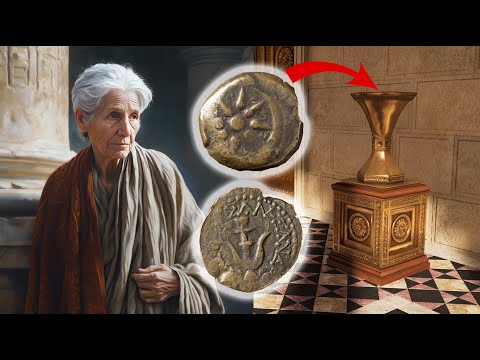
Jesus sat opposite the Temple treasury watching people give. The wealthy cast in large sums with great show. Then came a poor widow with two lepta — the smallest coins in circulation, worth about 1/64 of a day’s wage.
“Verily I say unto you, That this poor widow hath cast more in, than all they which have cast into the treasury: For all they did cast in of their abundance; but she of her want did cast in all that she had, even all her living.”
God measures giving not by the amount, but by the sacrifice. By heaven’s accounting, two tiny coins outweighed all the gold in the treasury.
▶ Denunciation of hypocrisy—
Jesus pronounced seven “woes” against the scribes and Pharisees — funeral laments for those spiritually dead but unaware:
- “Ye shut up the kingdom of heaven against men” — blocking others while refusing to enter themselves.
- “Ye devour widows’ houses” — exploiting the vulnerable while performing public piety.
- “Ye compass sea and land to make one proselyte” — their converts became worse than their teachers.
- “Ye blind guides” — creating loopholes for swearing falsely.
- “Ye pay tithe of mint and anise and cummin” — obsessing over details while ignoring justice, mercy, and faith.
- “Ye make clean the outside of the cup” — outward purity masking inward corruption.
- “Ye are like unto whited sepulchres” — beautiful outside, full of death within.
▶ Jesus' lament over Jerusalem—
After His fierce denunciations, Jesus’ tone shifted from anger to anguish:
“O Jerusalem, Jerusalem, thou that killest the prophets, and stonest them which are sent unto thee, how often would I have gathered thy children together, even as a hen gathereth her chickens under her wings, and ye would not!”
This was not cold condemnation. It was a broken heart. The Lord who had sent prophet after prophet, who now stood among them in person, grieved over their coming destruction — a destruction they chose by rejecting Him.
▶ Olivet Discourse—
As Jesus left the Temple for the last time, a disciple admired Herod’s construction. Jesus replied: “There shall not be left one stone upon another.”
That evening on the Mount of Olives, Peter, James, John, and Andrew asked privately: “When shall these things be?”
What followed was Jesus’ most extensive teaching about the destruction of Jerusalem (fulfilled 70 AD) and signs of His Second Coming. He warned of false messiahs, wars, earthquakes, famines, and persecutions — “the beginning of sorrows.” He described the “abomination of desolation” and cosmic signs preceding His return.
But He also gave warning: “Of that day and that hour knoweth no man, no, not the angels… neither the Son, but the Father.” Therefore: “Watch ye therefore.”
▶ Parable: Ten Virgins——
Ten bridesmaids waited for the bridegroom. Five were wise and brought extra oil; five were foolish and brought none. The bridegroom was delayed until midnight. When the cry came — “Behold, the bridegroom cometh!” — the foolish virgins’ lamps were going out. They asked the wise for oil, but there wasn’t enough to share. While they went to buy more, the door was shut.
“Watch therefore, for ye know neither the day nor the hour.”
The oil represents spiritual preparation that cannot be borrowed at the last minute — personal conversion, accumulated acts of discipleship, the witness of the Holy Ghost. When the Bridegroom comes, we must have our own oil.
▶ Parable: Talents——
A master entrusted servants with enormous wealth: five talents to one, two to another, one to a third. (A talent was about 15 years’ wages.)
The first two invested and doubled their talents. The master said: “Well done, thou good and faithful servant… enter thou into the joy of thy lord.”
The third servant, afraid, buried his talent. He returned it intact expecting praise. Instead, the master called him “wicked and slothful” and cast him into outer darkness.
God entrusts us with gifts to be multiplied, not preserved fearfully. He expects increase, not safety. The faithful servants didn’t just protect what they were given; they put it to work.
▶ Sheep and Goats——
In Jesus’ final parable, the Son of Man separates nations as sheep from goats.
To those on His right: “Come, ye blessed of my Father… For I was an hungred, and ye gave me meat: I was thirsty, and ye gave me drink: I was a stranger, and ye took me in.”
The righteous were puzzled: “Lord, when saw we thee?”
“Inasmuch as ye have done it unto one of the least of these my brethren, ye have done it unto me.”
Those who neglected the hungry, thirsty, stranger, sick, and imprisoned heard: “Inasmuch as ye did it not to one of the least of these, ye did it not to me.”
Christ so identifies with the suffering that serving them is serving Him — and ignoring them is ignoring Him.
▶ Jesus prophesies His crucifixion———
With these parables, Jesus concluded His public teaching ministry. He had answered every challenge, condemned hypocrisy, comforted the faithful, and revealed the criteria for final judgment.
As the day ended, He told His disciples: “Ye know that after two days is the feast of the passover, and the Son of man is betrayed to be crucified.”
Traditional chronology: Tomorrow — Wednesday — there would be silence. Jesus would rest in Bethany while His enemies conspired. The Last Supper would occur Thursday evening, with the crucifixion on Friday.
Alternative chronology: Some scholars, drawing on evidence from the Book of Mormon and the “three days and three nights” prophecy (Matthew 12:40), propose that the Last Supper occurred Wednesday evening, with Jesus arrested that night and crucified Thursday. This would place His death precisely as the Passover lambs were slaughtered and allow a full three days in the tomb before Sunday’s resurrection. (See our Good Friday page for more on this dating question.)
The next time He spoke publicly, it would be before Pilate.
📜 The Olivet Discourse
On Tuesday evening, Jesus sat on the Mount of Olives overlooking the Temple and delivered His most extensive teaching on the signs of His Second Coming. This discourse is preserved in Matthew 24–25, Mark 13, and Luke 21.
Key Themes: Destruction of the Temple (fulfilled 70 AD) • Signs of the times • The abomination of desolation • False Christs and prophets • The gathering of Israel • “As in the days of Noah” • Constant watchfulness
The Great Commandment
When asked which commandment was greatest, Jesus quoted the Shema (Deuteronomy 6:4–5):
"Thou shalt love the Lord thy God with all thy heart, and with all thy soul, and with all thy mind, and with all thy strength."Then He added (Leviticus 19:18): "Thou shalt love thy neighbour as thyself."
Reflection Questions
The fig tree had leaves but no fruit — an image of promise without substance. What might Jesus be teaching about the difference between appearance and reality?
In the parable of the Ten Virgins, what might the “oil” represent, and why couldn’t it be borrowed?
Jesus said that serving “the least of these” is serving Him. What does this reveal about where He chooses to be found?
Videos & Resources
Official Church Videos
Messages of Christ & Bible Project


📜 Scholar's Note: Why Parables?
Jewish scholar Amy-Jill Levine (Vanderbilt Divinity School) argues that Jesus’ parables were designed to provoke, not explain. They don’t offer easy morals — they disturb comfortable assumptions and force listeners to reconsider their values.
The Parable of the Talents, for instance, isn’t simply about “using your abilities.” In its original context, where wealth accumulation was often viewed suspiciously, Jesus’ audience would have been troubled by the master’s praise for aggressive profit-making. The discomfort is the point: the Kingdom operates by different rules than human economies.
Levine writes: “If we hear a parable and think, ‘I really like that. That confirms everything I already believe’ — we’ve probably missed the point.”
Study Resources
Church Resources:
- Joseph Smith—Matthew — Inspired revision of the Olivet Discourse
- Liahona: The Parable of the Ten Virgins
- Spencer W. Kimball on the Ten Virgins — The oil that cannot be borrowed
BYU Academic Sources:
Olivet Discourse & End Times:
- Discipleship in the Olivet Discourse — Gaye Strathearn on Mark 13 and watchfulness
- Revealing Parables: A Call to Action — Amy Easton-Flake on Ten Virgins, Fig Tree, and D&C
- Joseph Smith and Matthew 24 — Kent Jackson on the JST of the Olivet Discourse
Parables & Teaching Methods:
- The Savior’s Questions: Teachings from the Last Week — Rick B. Jorgensen
- Names of the Parables — How parable titles shape interpretation
- Maxwell Institute Podcast: Parables with Amy-Jill Levine — Jewish scholar perspective
- 4 Keys to Understand Parables — BYU professor Gaye Strathearn
Great Commandment & Shema:
- The Great Commandment: Principle or Platitude? — Howard A. Christy on love as action
- Love the Lord Thy God — The Shema in ancient and modern contexts
Scripture Central:
- KnoWhy: The Ten Virgins Offers Direction in Life
- KnoWhy: What Did Jesus Mean About the Talents?
- KnoWhy: The Parable of the Wicked Husbandmen
- KnoWhy: The Meaning of the Widow’s Mite
- Counting to Ten — John W. Welch on symbolic numbers
Greek & Hebrew Study Tools:
- Matthew 24 Interlinear — Olivet Discourse
- Matthew 25 Interlinear — Ten Virgins, Talents, Sheep & Goats
- Matthew 22:34–40 Interlinear — Great Commandment
- Talanton (τάλαντον) — Greek Lexicon
- Kabod (כָּבוֹד) — Hebrew Lexicon — Glory/Weight