The Day
Date: Monday, 11 Nisan (March/April)
Location: The Temple Mount, Court of the Gentiles
Key Events:
- Jesus returns to Jerusalem from Bethany
- Jesus curses the barren fig tree (Mark’s account)
- The cleansing of the Temple
- Overturning tables of moneychangers and merchants
- “My house shall be called a house of prayer”
- The blind and lame come to Him in the Temple
Scripture Harmony
Click any event below to read the full narrative.
▶ Fig tree cursed————
Early Monday morning, Jesus and His disciples left Bethany and began the two-mile walk to Jerusalem. Along the way, Jesus saw a fig tree in full leaf — a promising sight, because in Israel, fig trees produce early fruit (called taqsh or “nodules”) before the main fig harvest. A tree in full leaf should have had this early fruit.
But when He reached the tree, there was nothing but leaves. All show, no substance. Jesus spoke to the tree: “No man eat fruit of thee hereafter for ever.” The disciples heard it, though they didn’t yet understand. By Tuesday morning, they would find the tree withered from the roots.
This was no random act of frustration. Jesus was performing a prophetic sign — an acted parable in the tradition of Isaiah and Jeremiah. The fig tree was a well-known symbol for Israel in prophetic literature: “There will be no grapes on the vine. There will be no figs on the tree, and their leaves will wither” (Jeremiah 8:13).
The tree represented Israel — and specifically the Temple establishment. It looked alive with religious activity, covered in the leaves of ritual observance, but produced no spiritual fruit. What happened to the fig tree would soon happen to the Temple.
▶ Temple cleansed——
Arriving at the Temple Mount, Jesus entered the Court of the Gentiles and found chaos masquerading as religion.
The Temple economy was corrupt: Jewish law required that sacrificial animals be “without blemish.” Pilgrims traveling from distant lands had to purchase them at the Temple, where inspectors conveniently rejected outside animals as unacceptable. Pilgrims had no choice but to buy from Temple-approved merchants at inflated prices. The annual Temple tax couldn’t be paid in Roman coins (which bore Caesar’s image), so foreign currency had to be exchanged for Tyrian shekels — at steep fees.
The beneficiaries: These markets were controlled by the family of Annas, the former high priest and father-in-law of the current high priest Caiaphas. The “Bazaars of Annas” had a monopoly on Temple commerce. One scholar described it bluntly: “This wasn’t a priestly family. This was like a religious mafia.”
The location: All of this commerce took place in the Court of the Gentiles — the only place where non-Jews could worship. The bleating of animals, the clanking of coins, the haggling of merchants filled the one space reserved for the nations to approach Israel’s God.
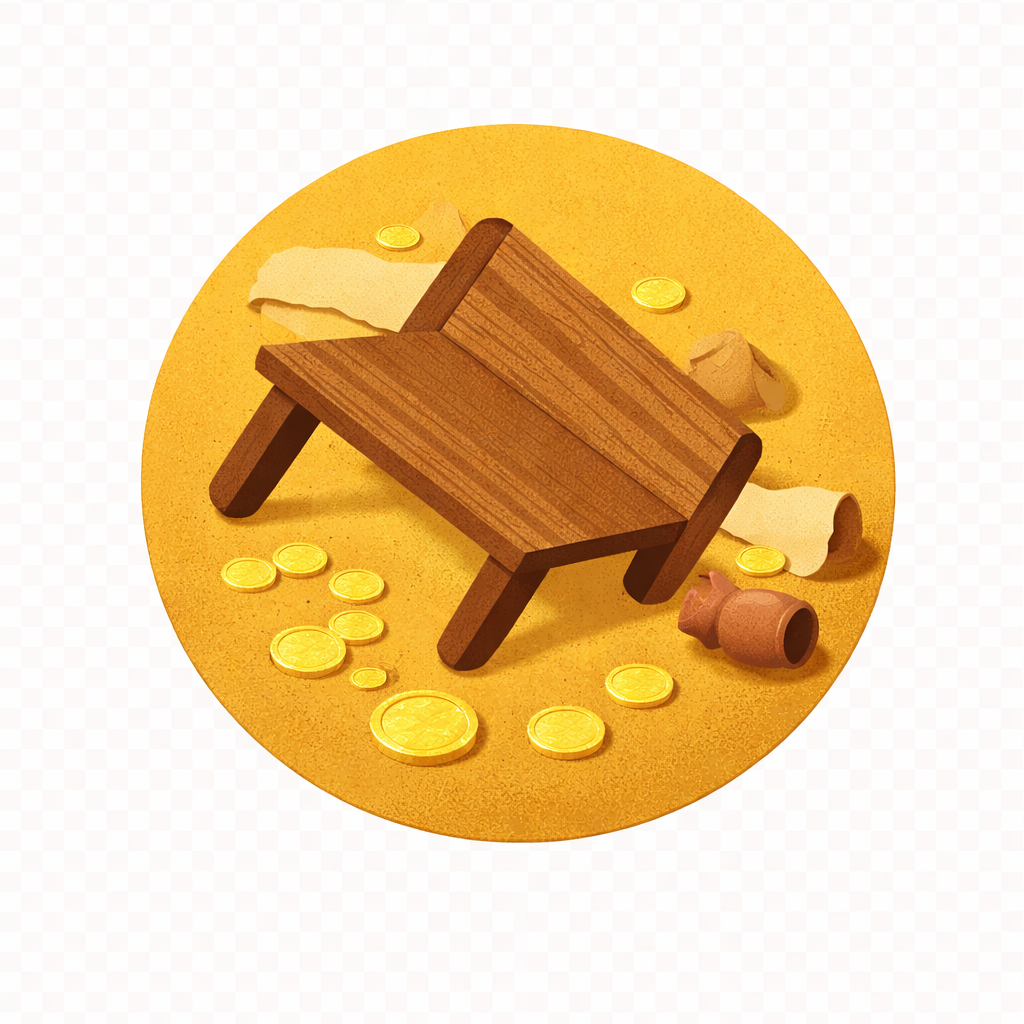
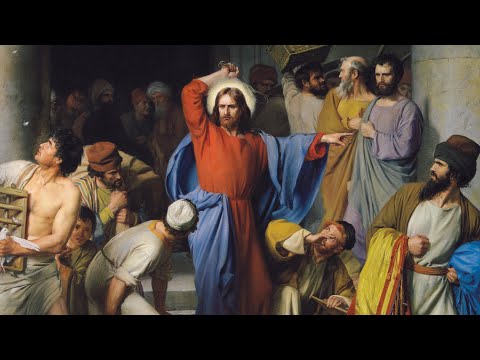
Jesus made a whip of cords and drove them out — animals, merchants, moneychangers alike. Tables overturned. Coins scattered across the pavement. He would not allow anyone to carry merchandise through the Temple courts as a shortcut.
▶ "House of prayer" declaration——
After overturning the tables, Jesus spoke, weaving together two prophets:
“Is it not written, My house shall be called a house of prayer for all nations? But ye have made it a den of thieves.”
The first quotation comes from Isaiah 56:7 — a promise that the Temple would be a place where all peoples, including foreigners and outcasts, could worship. By filling the Court of the Gentiles with commerce, the Temple leadership had effectively barred the nations from approaching God.
The second quotation comes from Jeremiah 7:11 — part of Jeremiah’s fierce “Temple Sermon” in which he warned that the Temple would be destroyed if the people continued to treat it as a safe house while practicing injustice. The word translated “thieves” (lēstēs) doesn’t mean petty pickpockets — it means violent robbers or brigands. Jesus was accusing the Temple leadership of violent exploitation while hiding behind religious respectability.
This was not merely a cleansing. It was a prophetic judgment. And everyone who heard recognized it.
▶ Blind and lame healed————
Yet in the midst of confrontation came compassion. Something remarkable happened after Jesus drove out the merchants:
“And the blind and the lame came to him in the temple; and he healed them.”
This detail, recorded only in Matthew, carries profound significance. According to Jewish tradition based on 2 Samuel 5:8, the blind and the lame were excluded from full Temple participation. The very people marginalized by the Temple system came to Jesus — and He healed them, right there in the Temple courts.
The contrast could not be sharper: the Temple leadership profited from exclusion and exploitation; Jesus welcomed the marginalized and healed the broken. The merchants had made the Temple a place of commerce; Jesus made it a place of healing.
▶ Children cry Hosanna————
Children ran through the colonnade shouting “Hosanna to the Son of David!” — the same Messianic cry the crowds had shouted the day before.
The chief priests and scribes were furious: “Hearest thou what these say?”
They expected Jesus to silence the children. Instead, He quoted Psalm 8:2: “Out of the mouth of babes and sucklings thou hast perfected praise.”
In the original psalm, this verse describes how God has ordained praise from infants to silence His enemies. By applying this passage to Himself, Jesus was making a breathtaking claim: the praise that belongs to God — Yahweh — was rightly directed at Him. The children understood what the scholars refused to see.
▶ Returns to Bethany———
Luke records the chilling response from the religious leaders:
“And the chief priests and the scribes and the chief of the people sought to destroy him, and could not find what they might do: for all the people were very attentive to hear him.”
The Temple cleansing sealed Jesus’ fate. He had publicly humiliated the religious establishment, disrupted their profitable commerce, and claimed divine authority in the process. From this moment, the question was not whether they would move against Him, but when and how.
But they feared the crowds.
As evening fell, Jesus left the city and returned to Bethany. He would return tomorrow for His longest day of teaching — and His last.
📜 Scholar's Note: The "Bazaars of Annas"
The Temple markets were not neutral commerce — they were a monopoly controlled by the high priestly family. Scholar Craig Evans notes that the “Bazaars of Annas” (named for the former high priest) had a stranglehold on Temple trade. Pilgrims had no choice but to exchange currency and purchase animals at inflated prices.
The Talmud itself preserves a cry of protest: “Woe to the house of Annas! Woe to their serpent-like hisses!” (Pesachim 57a). Even Jewish sources remembered this family as exploiters.
When Jesus overturned the tables, He was not just cleansing a sacred space — He was confronting the most powerful family in Judea. This act, more than any other, sealed His fate.
Historical Context
The Temple Economy
The Temple had become central to Judea's economy, especially during Passover:
- Temple Tax: Every adult male Jew paid an annual half-shekel
- Sacrificial Animals: Pilgrims needed unblemished animals
- Money Exchange: Roman coins had to be exchanged for Tyrian shekels
- Monopoly Prices: The high priest's family controlled the market
Annas and Caiaphas
- Annas — appointed high priest by Rome in 6 AD
- Caiaphas — married to Annas's daughter, served 18–36 AD
- The "Bazaars of Annas" were notorious for exploitation
- Five of Annas's sons also served as high priest
"This wasn't a priestly family. This was like a religious mafia."
Theological Significance
The Fig Tree and the Temple: Mark’s “Sandwich”
In Mark’s Gospel, the cursing of the fig tree and the Temple cleansing form a deliberate literary structure called an intercalation (or “Markan sandwich”):
- Monday morning: Jesus curses the fig tree for having no fruit (Mark 11:12–14)
- Monday: Jesus cleanses the Temple (Mark 11:15–19)
- Tuesday morning: Disciples see the fig tree withered (Mark 11:20–21)
Mark uses this technique to show that each event interprets the other. The fig tree had leaves (the appearance of life) but no fruit. Similarly, the Temple had religious activity (the appearance of devotion) but had become spiritually barren — a “den of thieves” rather than a “house of prayer.”
Just as the fruitless fig tree withered under Jesus’ judgment, so too the fruitless Temple system would be destroyed within a generation (70 AD).
Why No Fruit? The Biology of Fig Trees
Middle Eastern fig trees bore two kinds of fruit: nodules came first in spring and were abundant and good to eat. If a tree had lots of nodules, it would produce a large harvest of the second fruit — the fig. But Mark tells us the tree had “nothing but leaves” (Mark 11:13).
Leaves without nodules meant no fig harvest was coming. Something was wrong with this tree on the inside — it looked healthy but was actually barren. This is precisely Jesus’ point about the Temple leadership: they looked religious on the outside but produced no spiritual fruit.
The Fig Tree in Old Testament Prophecy
The fig tree was a powerful symbol of Israel in Hebrew prophetic literature. When the disciples saw the withered tree the next morning, a scripture they had heard growing up would have come rushing back:
“I will take away their harvest, declares the Lord. There will be no grapes on the vine. There will be no figs on the tree, and their leaves will wither. What I have given them will be taken from them.” — Jeremiah 8:13
Other prophetic fig tree passages include:
- Hosea 9:10, 16 — Israel as early figs, now bringing no fruit
- Micah 7:1–6 — “There is no cluster to eat: my soul desired the firstripe fruit”
Jesus didn’t randomly kill a tree — He was enacting prophetic judgment. The fig tree functioned as a physical parable of the Temple’s spiritual condition.
The Court of the Gentiles
Why did Jesus flip tables here specifically? The Court of the Gentiles was the only place where non-Jews could worship God. This outer court was as close as Gentiles could get to the divine presence. During Passover, this space was packed with vendors — historian Josephus records that 255,000 lambs were bought, sold, and sacrificed in one Passover week alone.
The market chaos meant Gentiles were effectively prevented from worshipping. Throughout Mark’s Gospel, Jesus consistently reaches out to Gentiles — the demon-possessed man, the Syrophoenician woman, countless people in Gentile regions. When He saw how the Temple leadership excluded the nations from approaching God, He “flipped out” — literally.
See: Brandon Robbins: Why You Should be CONCERNED that Jesus KILLED a Tree | Grace Communion International | Catholic Answers
Righteous Indignation
Jesus’ cleansing of the Temple was not mere anger — it was prophetic action. Like the prophets of old, He acted out God’s judgment against corruption. The Temple was meant to be the dwelling place of God’s presence, not a marketplace of greed.
Spiritual Purification
The cleansing symbolizes what Christ does in our lives:
“Only once we are purified through His atonement can we then truly enjoy perfect deliverance through Christ our Passover lamb.”
Just as Jesus cleansed His Father’s house, He desires to cleanse our hearts of anything that prevents true worship.
Latter-day Saint Connections
The House of the Lord
President Howard W. Hunter taught that temples should be places of peace and revelation. The Temple cleansing reminds us to examine our own hearts — what “tables” need to be overturned in our lives?
Malachi’s Prophecy
“The Lord, whom ye seek, shall suddenly come to his temple… But who may abide the day of his coming?” — Malachi 3:1–2
Jesus’ sudden arrival at the Temple fulfilled this prophecy — and foreshadows His Second Coming.
Reflection Questions
Jesus called the Temple “my Father’s house.” What does His fierce protection of it reveal about His relationship with the Father?
The Temple was meant to be “a house of prayer for all nations,” but commerce had crowded out worship. What does this teach about keeping sacred spaces sacred?
Jesus overturned tables but then healed the blind and lame who came to Him. What does this combination of actions reveal about His character?
Messages of Christ: Temple Cleansing
Additional Resources
Official Church Videos
- Jesus Cleanses the Temple
- Why You Should be CONCERNED that Jesus KILLED a Tree — Brandon Robbins on the prophetic fig tree
Study Resources
BYU Academic Sources:
Temple Cleansing & Economy:
- The Lamb of God: Unique Aspects of the Passion Narrative — John’s perspective on the Temple cleansing and Passover timing
- The Life of Jesus of Nazareth — Historical context for Jesus’ final week
- The Setting and Sacrament of the Christian Community — Temple economy and sacrificial system
- Jesus’ Action in the Temple — Craig A. Evans on the historical background of the cleansing
The Fig Tree & Prophetic Signs:
- The Fig Tree and the Temple in Mark 11 — Mark’s “sandwich” structure explained
- Why Did Jesus Curse the Fig Tree? — The prophetic symbolism
- Living Among the Fig Trees — Old Testament fig tree symbolism
Jeremiah’s Temple Sermon:
- The Book of Jeremiah — Context for Jesus’ quotation of Jeremiah 7:11
- The Temple in Ancient Israel — Understanding what Jesus was defending
Scripture Central:
- KnoWhy #205: Why Did Jesus Cleanse the Temple?
- KnoWhy #206: Why Did Jesus Curse the Fig Tree?
- KnoWhy #207: Why Was the Temple So Important to Jesus?
- Chart: Jesus at the Temple
Greek & Hebrew Study Tools:
- Matthew 21:12–16 Interlinear — Temple Cleansing
- Mark 11:12–21 Interlinear — Fig Tree & Cleansing
- Jeremiah 7:11 Hebrew Interlinear — “Den of Robbers”
- Isaiah 56:7 Hebrew Interlinear — “House of Prayer for All Nations”
- Lēstēs (λῃστής) — “Robber/Brigand” Lexicon
- Kairos (καιρός) — “Appointed Time” Lexicon