Field Guide
Priestly Clothing
Explore the High Priest’s sacred garments as their own cultural study section.
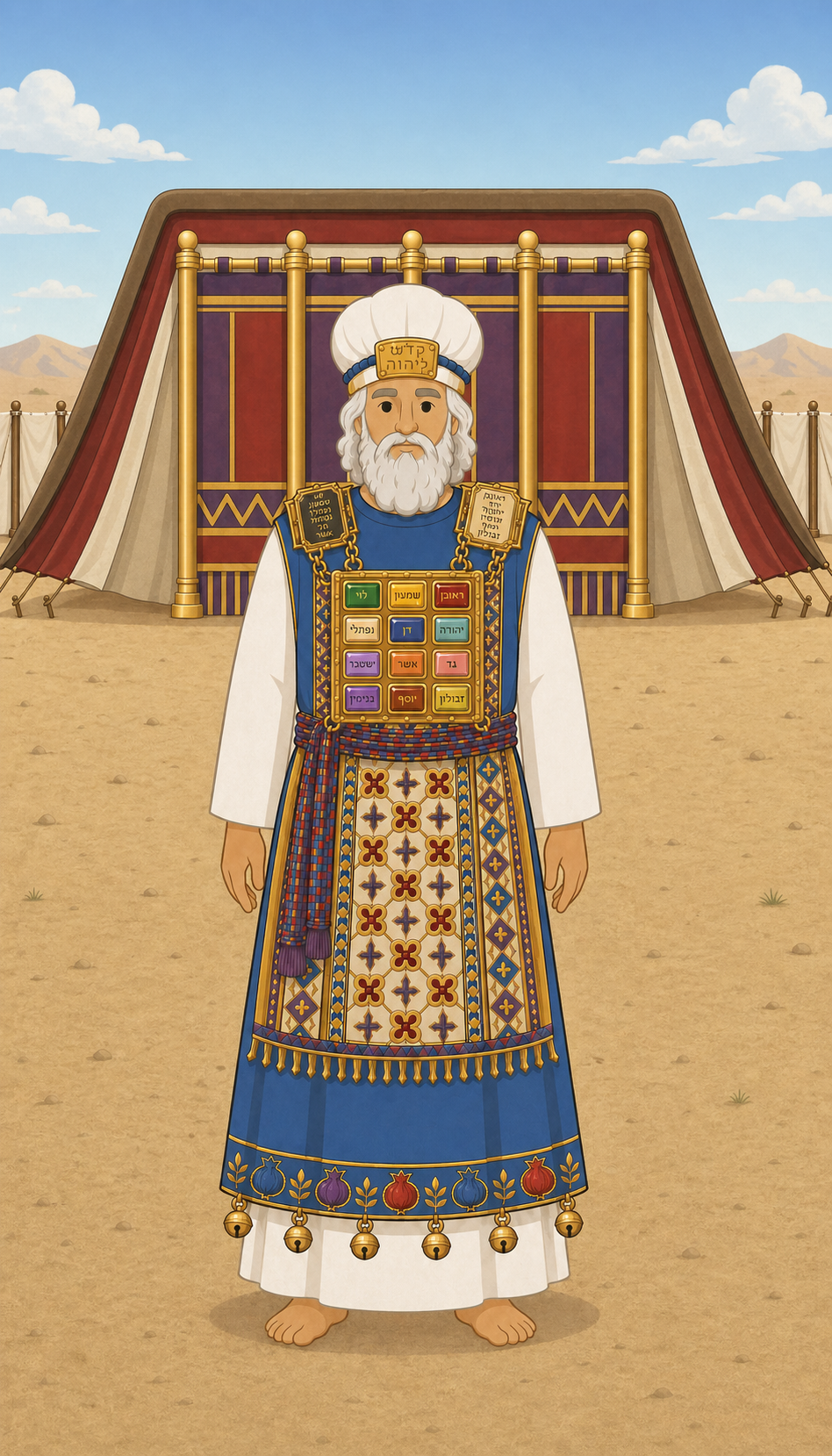
The garments of the High Priest were carefully designed and richly symbolic. They marked sacred service, carried memorial meaning, and visually set the priest apart for ministry in the sanctuary.
God commanded these garments to be made lekhavod uletif’aret (לְכָבוֹד וּלְתִפְאָרֶת) — “for glory and for beauty” (Ex 28:2). They were not merely functional work clothes. Each piece taught theology. The High Priest carried Israel on his shoulders in strength and over his heart in remembrance, bearing the names of the tribes before the Lord as a memorial.
This section treats the clothing as its own study area rather than as a side note to the Tabernacle map. Read it in layers: consecration at the brow, representative bearing at the shoulders and heart, then the garment system that clothed the priest for sacred service.
Watch This Garment
Exodus 28 — The Jewish Priestly Garments
Jesus Christ the Great High Priest
Breastplate Study
The Hebrew Names view reads right to left and follows one traditional birth-order arrangement drawn from Genesis 29 and Exodus 28:17. Other birth-order reconstructions exist, so this image presents one careful reading rather than a settled tribal chart.
Expanded Research
How to Read This Image
The breastplate image you see here is an interpretive reconstruction, not based on a surviving original. No Tabernacle breastplate remains, and the Hebrew stone names in Exodus 28:17-20 do not map neatly onto modern mineralogy. Ancient gem language grouped stones by color and visible qualities such as luster, translucency, and banding, not by chemical composition. A single ancient name could cover several minerals that looked similar.
In the Hebrew Names view, the stones are read right to left and follow one traditional birth-order arrangement. Because Exodus 28:17-21 lists the stones in rows but does not explicitly map each tribe to each position, later interpreters proposed different sequences. This reconstruction follows the birth-order logic commonly drawn from Genesis 29 and the ordered rows of Exodus 28:17, while recognizing that other arrangements exist in later tradition.
What is certain is simpler and stronger: the breastplate held twelve distinct stones arranged in four rows of three, each engraved pituchei chotam (פִּתּוּחֵי חוֹתָם), “like the engravings of a seal” (Ex 28:21). The stones were not interchangeable. Each tribe had its own name, its own place, its own memorial before the Lord.
Why the Stones Are Difficult to Reconstruct
Three problems compound across three thousand years. First, several Hebrew names appear only in the breastplate lists or have no clear modern equivalent. Leshem, nofekh, and shevo do not come with obvious built-in color markers, and some have little or no other biblical usage to clarify them.
Second, the translation traditions do not agree with each other. The Hebrew text was rendered into Greek in the Septuagint, then into Latin in the Vulgate, then into English in versions like the King James Bible. At each stage the identifications drifted. Most notably, bareqet and nofekh appear to have been reversed between the Septuagint and KJV lines. The KJV also calls yahalom “diamond,” but that is almost certainly too late a gemstone category for this setting.
Third, ancient stone names were broader categories than modern gem labels. Sappir referred to lapis lazuli, not modern sapphire. Ancient topazion pointed to a green-golden stone such as peridot, not the amber-yellow topaz of modern jewelry counters. The names survived, but the stones those names pointed to shifted over time.
What Is Strong and What Is Weak
Some identifications carry real weight. Odem is strongly linked to a red stone and is best represented here by carnelian. Sappir is best understood as lapis lazuli. Achlamah is consistently preserved as amethyst across the major traditions.
A middle tier is plausible without being final. Pitdah works well as peridot. Bareqet is shown here as green beryl, following the older green line of interpretation. Shevo is represented by agate, and tarshish by chrysolite, a golden or golden-green stone. Yashfeh as jasper remains a reasonable, though not perfectly fixed, choice.
The weakest positions are presented more cautiously. Nofekh appears here as turquoise: not the traditional translation, but a visually distinct and archaeologically plausible choice in a Sinai-Egypt context. Yahalom appears as rock crystal rather than the impossible KJV “diamond.” Leshem appears as rubellite, one plausible pink-red option among several. Shoham appears as sardonyx, following Josephus, though ancient witnesses also identify it as onyx, beryl, or even emerald.
Why This Image Chose These Stones
This reconstruction follows several principles. Where the evidence is strongest, it follows the consensus anchors: carnelian for odem, lapis lazuli for sappir, amethyst for achlamah. Where the evidence is moderate, it prefers the older translation stream and stones that were genuinely known in the ancient Near East: peridot from the topazion tradition, agate, chrysolite, jasper, and green beryl.
Where the evidence is weak, the image makes one careful choice among several possibilities. Turquoise for nofekh is archaeologically grounded and visually distinct. Rock crystal for yahalom is more plausible than a later “diamond” reading. Rubellite for leshem preserves a pink-red slot that is both interpretively viable and colorfully coherent. Sardonyx for shoham follows Josephus while still acknowledging the broader uncertainty.
Philo also matters here. He emphasizes that the stones differ from one another in color (Life of Moses 2.111). This image honors that ancient observation by preserving visual diversity across the whole breastplate rather than collapsing several stones into repeated hues.
The Covenant-Spectrum Pattern
Step back from the individual mineral questions and look at the breastplate as a whole. Exodus insists on twelve different stones, individually engraved and collectively borne over the priest’s heart. Josephus reads the stones cosmologically, as months or signs; Philo arranges them in seasonal rows. Those readings are later Jewish interpretations, not the plain sense of Exodus, but they show that ancient readers already saw the breastplate as an ordered display of sacred variety.
The wider scriptural world deepens that impression. The rainbow is the covenant sign given to Noah (Gen 9:12-17). Joseph’s dream casts the covenant family in the language of heavenly lights (Gen 37:9-10). Ezekiel and Revelation place precious stones, radiant light, and divine presence together in throne imagery (Ezek 1:28; Rev 4:3; 21:19-20). Read within that larger symbolic world, the breastplate’s diverse stones can be approached as a kind of covenant-bearing spectrum: not because Exodus explicitly says so, but because covenant light, precious stones, and sacred presence repeatedly converge across scripture and later interpretation.
The breastplate was part of the High Priest’s daily ministry of bearing Israel before the Lord. It was not worn into the Holy of Holies on Yom Kippur. On that day the High Priest laid aside the jeweled garments and entered in plain white linen (Lev 16:4). The breastplate is therefore a theology of bearing, not a theology of entering. The connection is not proven. But it is not arbitrary either.
What This Image Does Not Claim
This image does not claim to show the actual biblical breastplate. It offers one careful reconstruction built from the best available evidence, with stronger confidence in some stones than in others.
It does not claim that Exodus itself assigns a specific tribe to each specific stone. Traditional birth-order mappings are well attested, but they are traditional rather than explicit in the text.
It does not resolve every conflict between the Hebrew, Septuagint, Vulgate, KJV, Josephus, and Philo. In some places these sources preserve different possibilities rather than one answer.
And it does not build theology on the weakest identifications. The theological weight of the breastplate rests on what the text makes clear: twelve distinct stones, twelve engraved names, and a covenant people carried over the heart before the Lord.