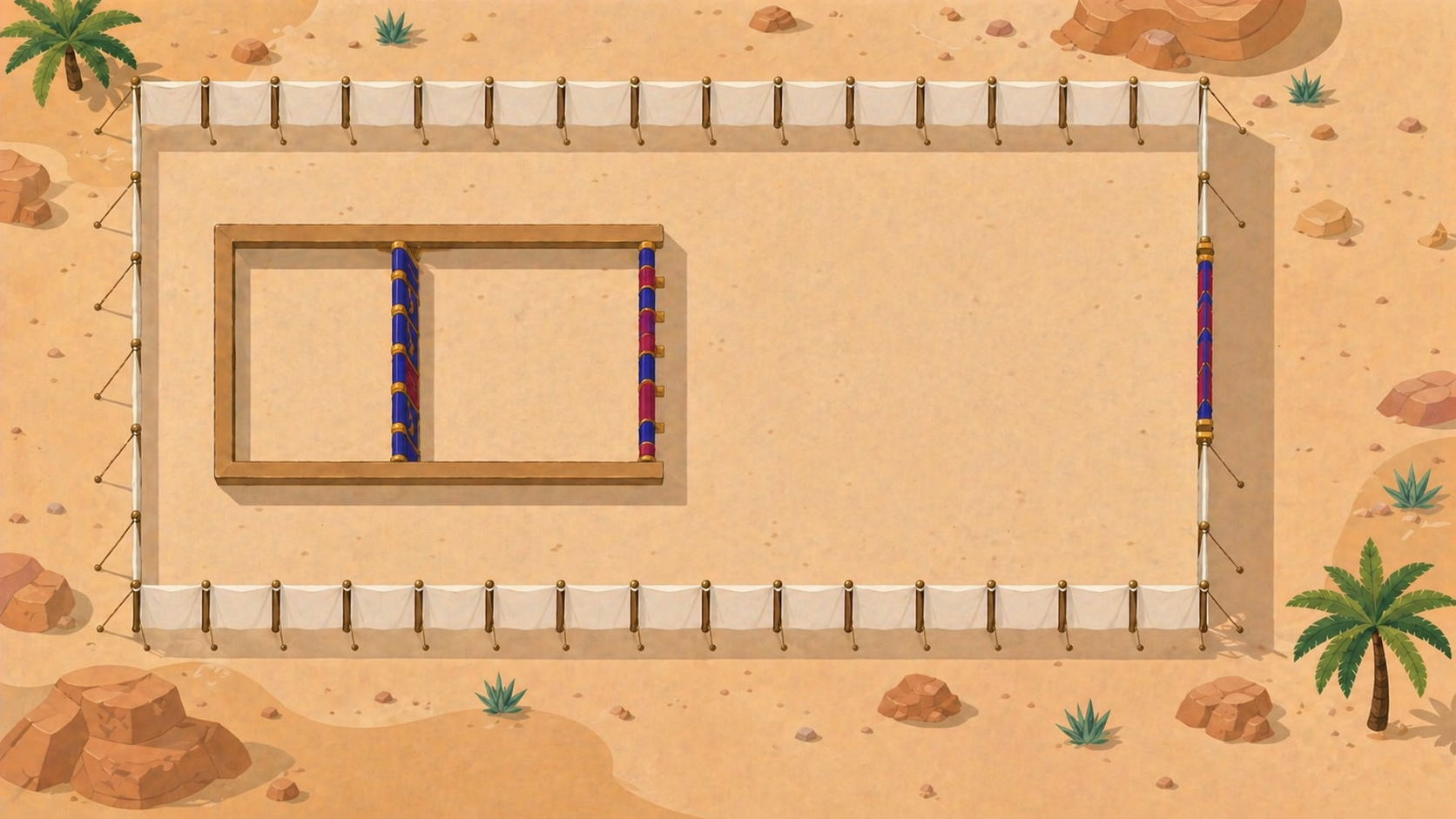
Four Layers Over the Dwelling
The Tabernacle was covered by four distinct layers, listed from innermost to outermost in Exodus 26:1-14.
Layer 1: Fine Linen Curtains with Cherubim
Ten curtains of fine twisted linen (shesh, שֵׁשׁ), with blue, purple, and scarlet yarn, and cherubim woven in by choshev (חֹשֵׁב) — skillful designer work (Ex 26:1-6). Each curtain measured 28 × 4 cubits, joined in sets of five by loops of blue yarn and fifty gold clasps. This was the innermost covering — the embroidered ceiling visible overhead to the priests serving inside the Holy Place.
The cherubim woven into the fabric echoed the cherubim on the Mercy Seat and the cherubim on the inner veil: a continuous heavenly canopy. Looking up from inside the Tabernacle was like looking up into a textile sky populated with angelic beings. The most beautiful layer was the most hidden, seen by the fewest eyes.
Layer 2: Goat Hair Curtains
Eleven curtains of goat hair formed the practical tent layer (Ex 26:7-13). Each measured 30 × 4 cubits — slightly larger than the linen curtains, providing overhang. Joined by loops and fifty bronze clasps. This was the recognizable tent material of nomadic life. God’s dwelling was, at its functional level, a tent like any other tent. The extraordinary glory inside was housed in an ordinary exterior.
Even the clasps follow the metal gradient: gold clasps join the inner linen curtains (Ex 26:6); bronze clasps join the outer goat-hair layer (Ex 26:11). The precious metal is on the inside; the working metal is on the outside.
Layer 3: Ram Skins Dyed Red
Ram skins dyed red formed the third layer (Ex 26:14). No dimensions given. The red dye and the ram skins together evoke sacrifice — a blood-marked covering wrapping the Tabernacle in the imagery of substitutionary offering, protecting what lay inside.
Layer 4: Tachash Skins
The outermost layer — the toughest, most weather-resistant covering — protected against sun, rain, wind, and sand (Ex 26:14). The most sacred space in Israel was shielded by the most rugged exterior.
The identity of the tachash (תַּחַשׁ) is debated:
| Source | Identification |
|---|
| KJV | “Badgers’ skins” — an older English guess |
| Talmud (Shabbat 28b) | A special multicolored animal, single-horned, that existed only during the Tabernacle period |
| Modern scholarship | Dugong (sea cow), dolphin, or high-quality protective hide |
The function is clear even if the species is not: tough, weather-resistant outer protection. The Talmudic tradition — a creature created specifically for the Tabernacle, then withdrawn — is midrashic, not historical. But it captures an important instinct: even the outermost, most utilitarian layer was divinely provided.
The Theological Progression
From inside out, the coverings teach a pattern:
- Innermost — heavenly beauty (linen, cherubim, gold clasps)
- Second — earthly dwelling (goat hair, the common tent)
- Third — sacrificial covering (ram skins dyed red)
- Outermost — rugged protection (tachash skins)
Heaven → earth → sacrifice → protection. The innermost reality is glory. The outermost reality is endurance. The layers between are the created order and the sacrifice that makes the whole structure possible.
The Silver Foundation
The 48 acacia-wood frames stood in silver sockets — adonim (אֲדָנִים), two per board, 96 total (Ex 26:15-25). The silver came from the half-shekel census (Ex 38:25-27): every male Israelite contributed the same amount, rich and poor alike, as a “ransom for his soul” — kofer nafsho (כֹּפֶר נַפְשׁוֹ, Ex 30:12). One hundred talents of silver. One talent per socket.
The Tabernacle literally stood on the collected lives of the people. Every soul in Israel bore the weight of the sanctuary equally. The foundation of God’s house was not constructed from royal wealth or priestly privilege. It was cast from the ransom money of every person in the covenant community.
The Hebrew kesef (כֶּסֶף) means both “silver” and, from its root kasaf (כסף), carries the sense of “longing” or “desire.” The foundation of God’s house is built from the longing and the ransom of His people.
The kesef/longing connection is a linguistic resonance — the Hebrew word carries both meanings, though the text does not draw the connection explicitly.
Silver as Covenant Currency
The silver of the Tabernacle’s foundation was ransom money — kofer nafsho, the price of a soul. But silver carries that meaning far beyond the census. Scripture uses silver as the recurring currency of covenant, betrayal, and redemption — and the thread runs from Genesis to the Gospels.
Joseph was sold for twenty shekels of silver (Gen 37:28). He was a young man, and the price matches the Leviticus 27:5 valuation for a male aged five to twenty — the going rate for a life in that age bracket. The seller was his brother Yehudah (יְהוּדָה) — Judah.
The Law set thirty shekels as the compensation for a slave killed by an ox (Ex 21:32) — the legal minimum value assigned to a human life.
The prophet Zechariah received thirty shekels as his wages for shepherding God’s flock — and God called it, with bitter irony, “the handsome price at which they valued me” (Zech 11:12-13). The amount is an insult: the shepherd of God’s people is paid the price of a dead slave. God told Zechariah to throw the silver “unto the potter” — and he threw it into the house of the LORD (Zech 11:13).
Christ was betrayed for thirty pieces of silver (Matt 26:15). The seller was His disciple Yehudah (יְהוּדָה) — Judas. The same Hebrew name. Matthew explicitly cites Zechariah’s prophecy. When Judas returned the silver, it was thrown into the temple and used to buy a potter’s field (Matt 27:5-7) — echoing Zechariah’s “throw it unto the potter” in precise detail.
| Joseph | Christ |
|---|
| Sold by | Yehudah (Judah) — his brother | Yehudah (Judas) — his disciple |
| Price | 20 shekels — the valuation of a young man (Lev 27:5) | 30 pieces — the compensation for a slave (Ex 21:32) |
| Destination | Descended into Egypt | Descended into death |
| Result | Rose to power and saved his people from famine | Rose from the grave and saved His people from sin |
Both times, a Yehudah sells a deliverer for silver. Both times, the price is the going rate for a life — not a king’s ransom but a slave’s valuation. And both times, the one sold descends before he rises, and the rising saves the very people who sold him.
The Tabernacle’s silver foundation was cast from the ransom of souls — every life valued equally, every half-shekel bearing the weight of God’s dwelling. The silver thread that runs from that foundation through Joseph’s sale, through the slave-price of Exodus 21, through Zechariah’s bitter wage, to the thirty pieces in Judas’s hand, tells a single story: the cost of redemption is measured in silver, and the Redeemer Himself was valued at the price the Law set for a slave.
The Hidden Glory
From outside, the Tabernacle was a tent. Plain skins. Gold-overlaid walls mostly hidden beneath the overhanging coverings. No ornament visible. From inside, the priest looked up at a textile sky woven with cherubim, looked around at walls of glowing gold, and stood in a space lit only by the sacred fire of the Menorah. The beauty was a secret shared only with those who entered.
Isaiah’s description of the Messiah fits the same pattern: “He hath no form nor comeliness; and when we shall see him, there is no beauty that we should desire him” (Isa 53:2). The world saw a carpenter’s son. Those who entered His presence saw “his glory, the glory as of the only begotten of the Father, full of grace and truth” (John 1:14).
Divine glory does not advertise itself. It is discovered by those who enter.
The Hooks That Hold It Together
The Hebrew word for the hooks is vavim (וָוִים) — the plural of vav (וָו). It appears 13 times in the Bible, all in the Tabernacle chapters of Exodus (Ex 26-38). These were small hook-shaped clasps fastened to the pillars, from which the curtains, screens, and veils were hung. Gold hooks held the interior hangings — the inner veil and tent entrance screen. Silver hooks held the courtyard hangings. Even the fasteners follow the metal gradient.
The word vav is also the name of the sixth letter of the Hebrew alphabet — ו — a letter whose shape resembles a hook and whose grammatical function is the conjunctive “and.” The vav joins words to words, clauses to clauses, sentences to sentences. It is the connector of Hebrew. Jewish interpreters have noticed that the physical hooks of the Tabernacle share their name with the letter that holds the Torah’s language together — the small, unseen fastener without which the text and the tent alike would come apart.
Whether this connection is a deliberate design echo or a coincidence of naming, the observation is worth holding: the Tabernacle’s beauty depends on small connectors that no one sees. The curtains are glorious; the hooks are invisible. But without the hooks, the curtains have nowhere to hang.
The Stakes of the Tent
The bronze pegs — yetedot (יְתֵדוֹת) — were driven into the ground, with cords (metarim, מֵיתָרִים) running from the Tabernacle structure and courtyard pillars down to the pegs (Ex 27:19; 35:18; 38:20, 31). They anchored the entire sanctuary to the earth. Bronze — the metal of the outer zone — held the dwelling fast against wind and storm.
Isaiah later reused this tent vocabulary for one of his most expansive visions: “Enlarge the place of thy tent, and let them stretch forth the curtains of thine habitations: spare not, lengthen thy cords, and strengthen thy stakes (yetedot)” (Isa 54:2). The same words — yeri’ot (curtains), metarim (cords), yetedot (stakes) — that described the Tabernacle’s physical structure become the language of Zion’s expansion. The tent of God’s covenant people grows larger, its curtains stretch further, and its stakes are driven deeper.
In Restoration theology, the Doctrine and Covenants draws explicitly on this imagery: “They shall be called stakes, for the curtains or the strength of Zion” (D&C 101:21). The Latter-day Saint use of “stakes” as organizational units of the Church traces directly to Isaiah’s tent language — which itself traces back to the Tabernacle’s bronze pegs. The pegs that once anchored God’s portable dwelling in the wilderness become, in Isaiah’s vision and in Restoration practice, the anchors of a covenant community expanding across the earth.
A Portable Dwelling
The pegs (yetedot, יְתֵדוֹת), cords (metarim, מֵיתָרִים), bars, rings, and hooks (vavim, וָוִים) are not glamorous details, but they matter (Ex 27:19; 35:18). The Tabernacle was a portable structure — assembled, disassembled, and reassembled repeatedly as Israel moved through the wilderness. Every peg and cord maintained the ordered boundary between sacred and ordinary space. The portability was integral to the theology: God’s dwelling moved with His people. He was not fixed to a place. He traveled.