Field Guide
Camp of Israel & Standards
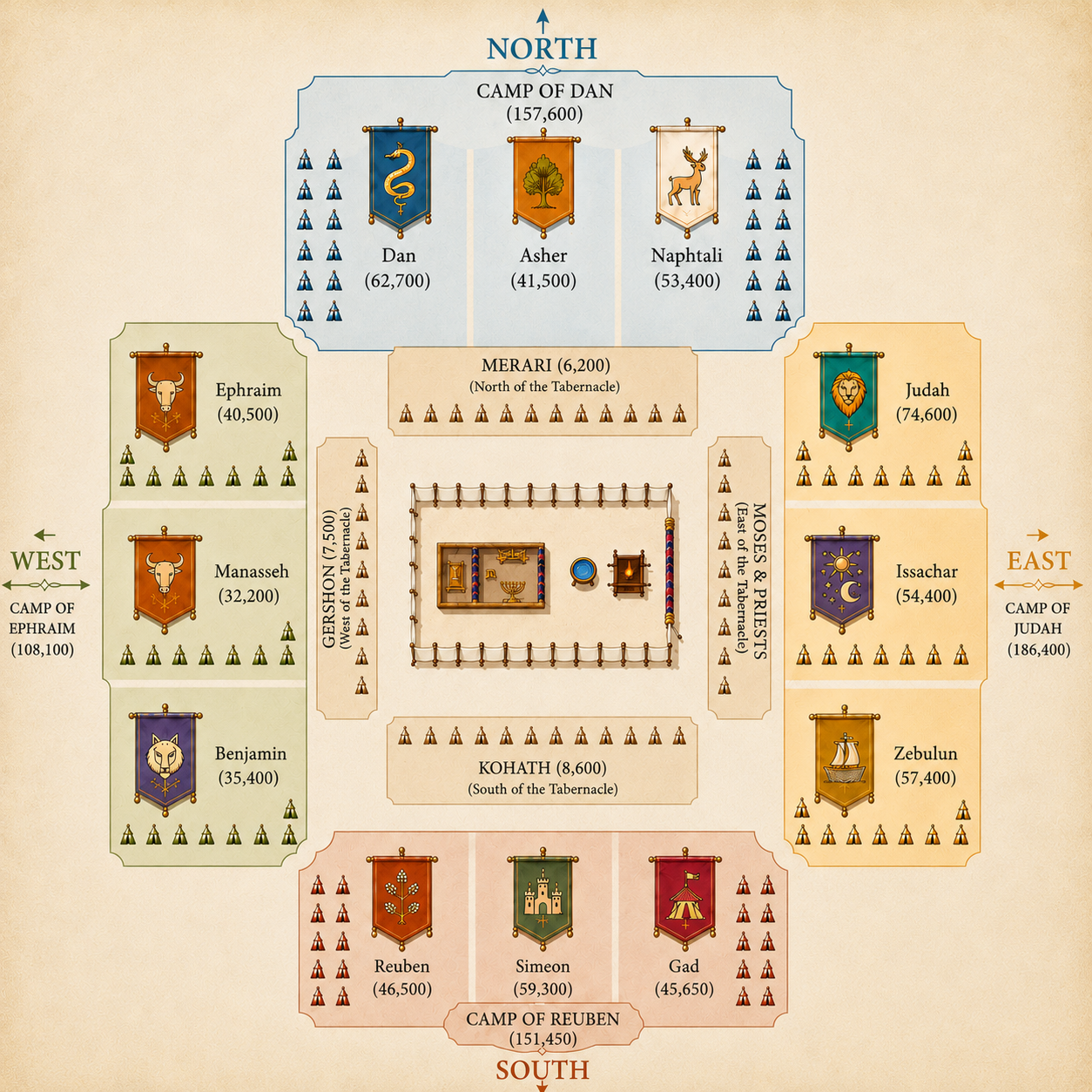
Explore the four tribal camps, the Levite ring around the sanctuary, and the later traditions associated with Israel’s standards. Click any banner to explore that tribe.
"Every man of the children of Israel shall pitch by his own standard"
Introduction
The camp of Israel was not a random sprawl around the wilderness sanctuary. Numbers 2 arranges the tribes in four directional camps around the Tabernacle, while Numbers 3 places the Levites in the inner ring nearest the sacred center. The mishkan stood at the middle of the camp, and Israel’s life was ordered around the presence of God.
The biblical text gives the camp arrangement, census order, and the leading tribe of each side. It also says the tribes camped by their own degel (standard) and ot (sign). What Scripture does not do is describe the colors or emblems of those banners. Those details come from later Jewish tradition, especially midrashic sources. This page keeps those layers distinct: the camp arrangement is biblical; the banner colors and symbols are later interpretive tradition.
Use the Camp Position / Birth Order toggle below the map to view the tribes by their camp arrangement (Numbers 2) or by the narrative birth sequence (Genesis 29–30, 35).
A Note on Camp Position, Banners, and Stones
This field guide draws on multiple layers of source material, and readers should understand which layers are biblical text, which are later Jewish tradition, and where those traditions disagree with each other.
What Scripture Says
Numbers 2 gives the camp arrangement clearly: Judah leads the east, Reuben the south, Ephraim the west, and Dan the north. The Levite clans occupy the inner ring (Numbers 3). The camp positions and marching order are not disputed — they come directly from the biblical text.
Numbers 2:2 also states that each tribe camped by its own degel (דֶּגֶל, "standard") and ot (אוֹת, "sign") of their father's house. But Scripture gives no description of what those standards looked like — no colors, no symbols, no emblems. Everything we associate with the tribal banners comes from later Jewish tradition.
Bamidbar Rabbah 2:7 — The Primary Midrashic Source
The most widely cited source for the tribal banner descriptions is Bamidbar Rabbah (Numbers Rabbah) 2:7, a midrashic collection compiled in its present form around the 12th century (though drawing on much older traditions). This midrash assigns each tribe a banner color that matches its stone on the High Priest's breastplate, and a symbol drawn from the patriarch's blessing or story. This field guide primarily follows this tradition for its banner descriptions.
Targum Pseudo-Jonathan on Numbers 2 — An Alternative Tradition
The Targum Pseudo-Jonathan (an Aramaic paraphrase of the Torah, likely 7th–8th century but incorporating earlier traditions) gives a different system. Key differences include:
- Banner colors: The Targum assigns three colors to each camp standard (matching the three stones in that row of the breastplate), rather than one color per individual tribe as in the Midrash.
- Reuben's symbol: The Targum gives Reuben a stag rather than mandrakes, and adds that Moses altered the original design to avoid recalling the golden calf — implying the original may have been a bull or calf figure.
- Ephraim's symbol: The Targum gives Ephraim a young man rather than the ox of the Midrash Rabbah tradition.
- Stone identifications: The Hebrew names of the breastplate stones (odem, pitdah, bareket, etc.) are notoriously difficult to translate, and different traditions identify them with different modern gemstones. No two scholarly reconstructions fully agree.
Why the Discrepancies?
Several factors account for the differences between traditions:
- The biblical text is deliberately silent on banner details. Later interpreters filled the gap by reasoning backward from Jacob's blessings (Genesis 49), Moses' blessings (Deuteronomy 33), and the breastplate stones (Exodus 28:17–20). Different starting points produced different conclusions.
- The breastplate stone names are ancient and uncertain. The twelve Hebrew stone names in Exodus 28 do not correspond neatly to modern gemological categories. Ancient mineralogy classified stones by color rather than chemical composition, so a single Hebrew term might cover several modern stones — or vice versa.
- The traditions developed over centuries in different Jewish communities (Babylonian, Palestinian, European). Each tradition drew on local knowledge, available texts, and interpretive priorities. The Midrash Rabbah and the Targum were compiled in different times and places, building on overlapping but not identical source material.
- Theological concern shaped some choices. The Targum's note that Reuben's banner was altered to avoid recalling the golden calf reflects a pastoral concern — not a historical report, but a teaching moment embedded in the tradition.
Why the Banner Stones Differ from the Breastplate Study
Readers who have explored the Breastplate Study in this field guide will notice that the stone-to-tribe assignments mentioned in the banner descriptions do not match the breastplate study — and this is intentional.
The breastplate study follows the biblical text of Exodus 28:17–20, which lists twelve stones in four rows of three. Exodus 28:21 says each stone bears a tribal name but does not specify which stone belongs to which tribe. The breastplate reconstruction assigns tribes to stones using the traditional birth-order arrangement — Reuben with odem, Simeon with pitdah, Levi with bareket, and so on — which is the most widely attested rabbinic tradition (found in Targum Pseudo-Jonathan on Exodus 28:17–20 and followed by most medieval commentators). This is a reasonable and well-sourced assignment, but readers should understand it is a traditional assignment, not one the biblical text makes explicit.
The banner descriptions on this page follow Bamidbar Rabbah 2:7, which assigns each tribe a stone and a corresponding banner color. This midrashic system sometimes produces different stone-to-tribe pairings than the birth-order tradition — because the midrash is reasoning from camp position and patriarchal blessings, not from Exodus 28.
In short: the breastplate study assigns stones in birth order (Reuben = odem, Simeon = pitdah, etc.). The Bamidbar Rabbah assigns stones by its own system, which sometimes gives a different stone to the same tribe. The banner artwork in this field guide uses the breastplate stone colors (birth-order tradition), while the text descriptions note what Bamidbar Rabbah says. Both are presented so readers can compare.
Comparison: Birth-Order Stones vs. Bamidbar Rabbah
| Tribe | Breastplate Stone (Birth Order) | Banner Artwork Color | Bamidbar Rabbah Stone | Bamidbar Rabbah Banner Color |
|---|---|---|---|---|
| Reuben | odem | Red | odem | Red |
| Simeon | pitdah | Yellow-green | pitdah | Green |
| Levi | bareket | Emerald green | bareket | White, black, and red (tricolor) |
| Judah | nofekh | Teal | nofekh | Sky blue |
| Dan | sappir | Deep blue | leshem | Sapphire blue |
| Naphtali | yahalom | Cream / pearl | achlamah | Pale wine |
| Gad | leshem | Pink | shevo | Grey (black and white mixed) |
| Asher | shevo | Orange | tarshish | Pearlescent |
| Issachar | achlamah | Purple | sappir | Blackish blue |
| Zebulun | tarshish | Gold | yahalom | White |
| Joseph / Ephraim | shoham | Red-brown | shoham | Deep black |
| Benjamin | yashfeh | Purple | yashfeh | Multicolored (all 12 colors) |
Where both traditions assign the same stone name (Reuben, Simeon, Levi, Judah, Joseph, Benjamin), the differences are in how the stone's color is rendered — because the ancient Hebrew stone names do not map cleanly to modern gemstones. Where the traditions assign different stones entirely (Dan, Naphtali, Gad, Asher, Issachar, Zebulun), the Bamidbar Rabbah is using a system based on camp position and patriarchal blessings rather than birth order.
How This Field Guide Handles the Sources
This guide follows Bamidbar Rabbah 2:7 as the primary tradition for banner colors and symbols, since it is the most widely recognized and frequently cited source. Where the Targum or other sources differ significantly, those differences are noted. The camp positions follow Numbers 2 directly and are not in dispute.
Readers should understand that the banner imagery is interpretive tradition, not scripture. It is rich, memorable, and theologically meaningful — but it represents how later generations of Jewish scholars imagined what the banners looked like, not a description preserved from the wilderness itself. This field guide presents the tradition honestly: appreciating its depth without flattening midrash into the plain sense of Numbers.
A Note on Birth Order
The birth sequence shown in this guide follows the narrative order of Genesis 29:31–30:24 and 35:16–18, which is the most widely recognized tradition. However, Scripture itself presents the sons in multiple arrangements, and ancient sources differ on the exact chronology.
Within the Biblical Text
Genesis 29–30 tells the birth stories sequentially: Leah’s first four sons (Reuben, Simeon, Levi, Judah), then Bilhah’s two (Dan, Naphtali), Zilpah’s two (Gad, Asher), Leah’s final two sons and daughter (Issachar, Zebulun, Dinah), and finally Rachel’s Joseph. Benjamin is born later on the road to Bethlehem (Genesis 35:16–18). This narrative sequence is the standard birth order.
However, the timeline is compressed. Genesis 30:25–26 implies that Joseph’s birth marks the end of Jacob’s second seven-year service period, meaning all eleven sons and Dinah were born within roughly seven years — four mothers bearing twelve children. Some pregnancies must have overlapped. The text does not give calendar dates, so the narrative order may not be strictly chronological.
Genesis 35:23–26 lists the sons grouped by mother rather than by birth order. Genesis 46:8–25 (the migration to Egypt) does the same. 1 Chronicles 2:1–2 gives yet another order — Reuben, Simeon, Levi, Judah, Issachar, Zebulun, Dan, Joseph, Benjamin, Naphtali, Gad, Asher — which clusters Leah’s six sons first, then rearranges the handmaid and Rachel lines differently from the Genesis 30 narrative.
Jubilees 28 — A Year-by-Year Account
The Book of Jubilees (a Second Temple text, c. 2nd century BC, canonical in the Ethiopian Orthodox tradition) provides specific dates for each birth in chapter 28. Its chronology reveals overlapping pregnancies among the four mothers:
- Year 1: Reuben (14 Kislev)
- Year 2: Simeon (21 Tevet)
- Year 3: Levi (1 Tishri)
- Year 4: Judah (15 Sivan)
- Year 5: Dan (9 Elul) and Naphtali (5 Tishri) — born in the same year
- Year 6: Gad (12 Tishri), Asher (2 Shevat), and Issachar (4 Sivan) — three sons born in a single year across three mothers
- Year 7: Zebulun (7 Tishri) and Dinah
Jubilees confirms that the handmaid births and Leah’s later births were concurrent, not sequential. Three mothers — Zilpah, Bilhah, and Leah — each bore a child in the same year during Jacob’s sixth year of service.
Rabbinic Tradition
The Talmud (Megillah 13b) and various midrashic sources discuss the timing of the births, with some traditions noting that the handmaid sons were considered legally the children of Rachel and Leah respectively. The Midrash also observes that Leah’s "ceasing to bear" (Genesis 30:9) was temporary — she resumed after the mandrake episode — which itself implies that Reuben was old enough to be working in the fields (Genesis 30:14), compressing the early births into a shorter window than the narrative pace might suggest.
What This Means
The birth "order" is better understood as a narrative sequence than a strict chronology. Genesis tells the births one at a time for literary and theological reasons — each naming reveals something about the mothers’ faith, rivalry, and relationship with God. The actual births across four mothers in seven years were almost certainly overlapping. This guide follows the Genesis 29–30 narrative order as the primary tradition, while recognizing that the historical chronology was likely more compressed and concurrent than the narrative implies.