Field Guide · Solomon's Temple
Temple Mount Through Time
From Abraham's mountain and Solomon's house to Babylon's fire, Herod's vast platform, Rome's destruction, and the Dome of the Rock that stands there now — walked as a dig-down timeline, with the honest line between what we see and what lies buried.
One ridge of rock has carried more sacred weight than perhaps any other ground on earth — and it has worn many faces. On the same summit Abraham was sent to offer Isaac, David built an altar, Solomon raised the first house of the LORD, Zerubbabel rebuilt it after the exile, Herod clad it in white-and-gold splendor, Rome burned it, and a golden dome has stood for thirteen centuries. One honest line stays bright the whole way down: almost everything a visitor sees on the Temple Mount today is Herodian or later — and Solomon’s actual footprint lies buried beneath it, where no spade can reach. Telling the difference between what still stands, what has been excavated, what survives only as text, and what is held by tradition is the whole discipline here.
So walk it as a dig. The timeline below starts at the surface — what stands there today — and descends through the strata to Solomon’s house and the bedrock at the bottom. The deeper you go, the older the layer; and the colour of each marker tells you what kind of evidence we actually have for it.
Dig down through time — each era is buried beneath the one above it. Tap an era to open it.
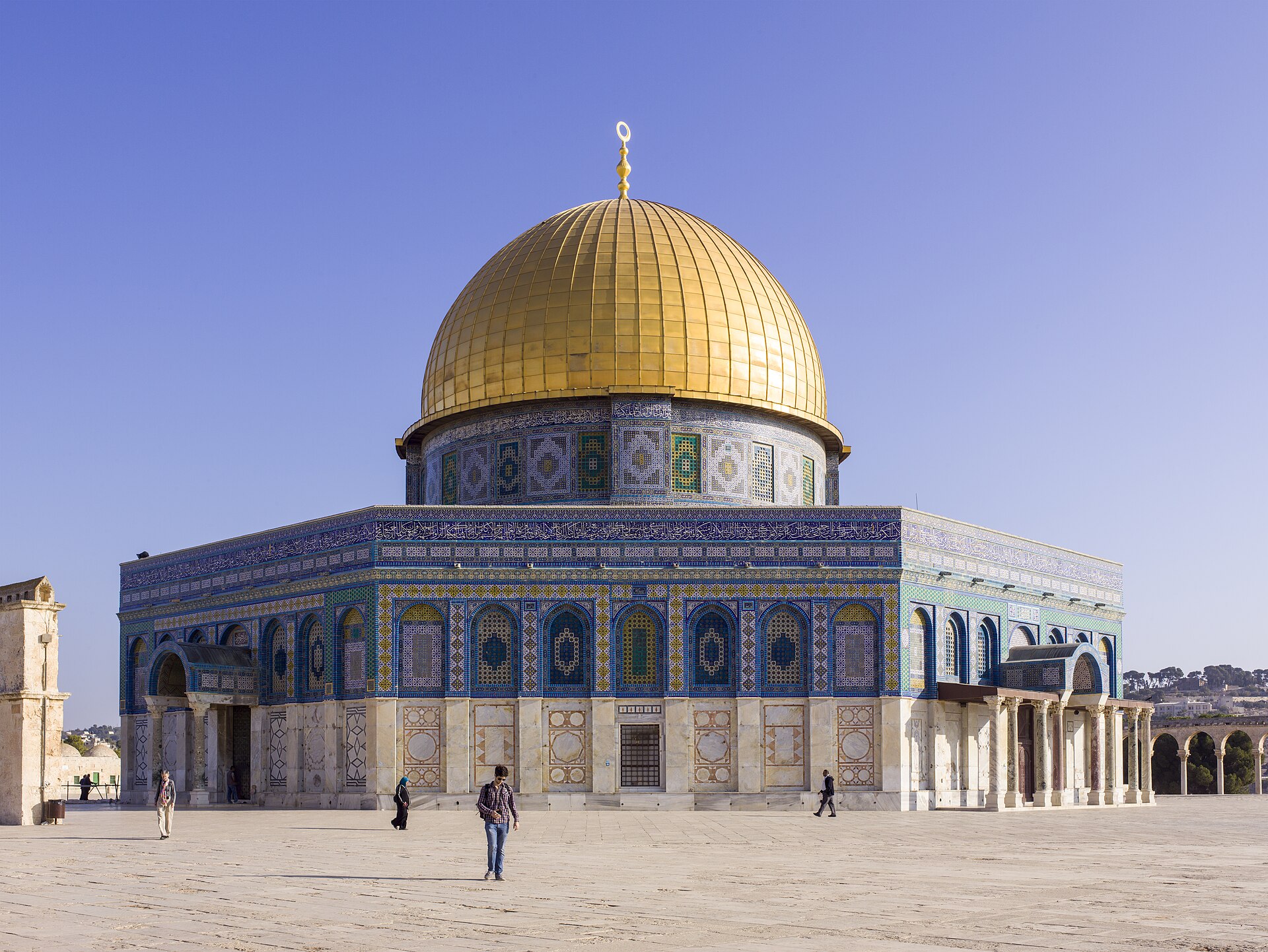
The Dome of the Rock — completed 691/692 AD over the es-Sakhra bedrock — has stood for thirteen centuries. In 691/692 AD the Umayyad caliph Abd al-Malik raised the Dome of the Rock over the bedrock outcrop called es-Sakhra — one of the oldest standing monuments in Islam. The platform today is the Haram al-Sharif, the Noble Sanctuary, holding the Dome of the Rock and al-Aqsa Mosque: an active holy site that cannot be systematically excavated. So almost everything a visitor sees is Herodian or later — and Solomon’s footprint lies buried far beneath.The es-Sakhra bedrock carries layered meaning held by different faiths at once: in rabbinic tradition the Foundation Stone of creation and the site of the Holy of Holies; in Islamic tradition, linked to Muhammad’s Night Journey. The leading reconstruction (after Leen Ritmeyer) places Solomon’s Holy of Holies on or near this stone — but that is inference, offered with respect beside the other traditions, not adjudicated here. “The most High dwelleth not in temples made with hands” (Acts 7:48).- After a second Jewish revolt, the emperor Hadrian refounded the city as Aelia Capitolina (130 AD), with a pagan temple in the area. Constantine had it removed in the fourth century, after which the Mount lay largely derelict through the Byzantine centuries — while Christian devotion moved across the city to the Church of the Holy Sepulchre.Roman Aelia is well attested across Jerusalem — its street grid, inscriptions, and arches — but little can be tied firmly to the Mount itself. Hadrian’s works up here are inferred more than excavated.
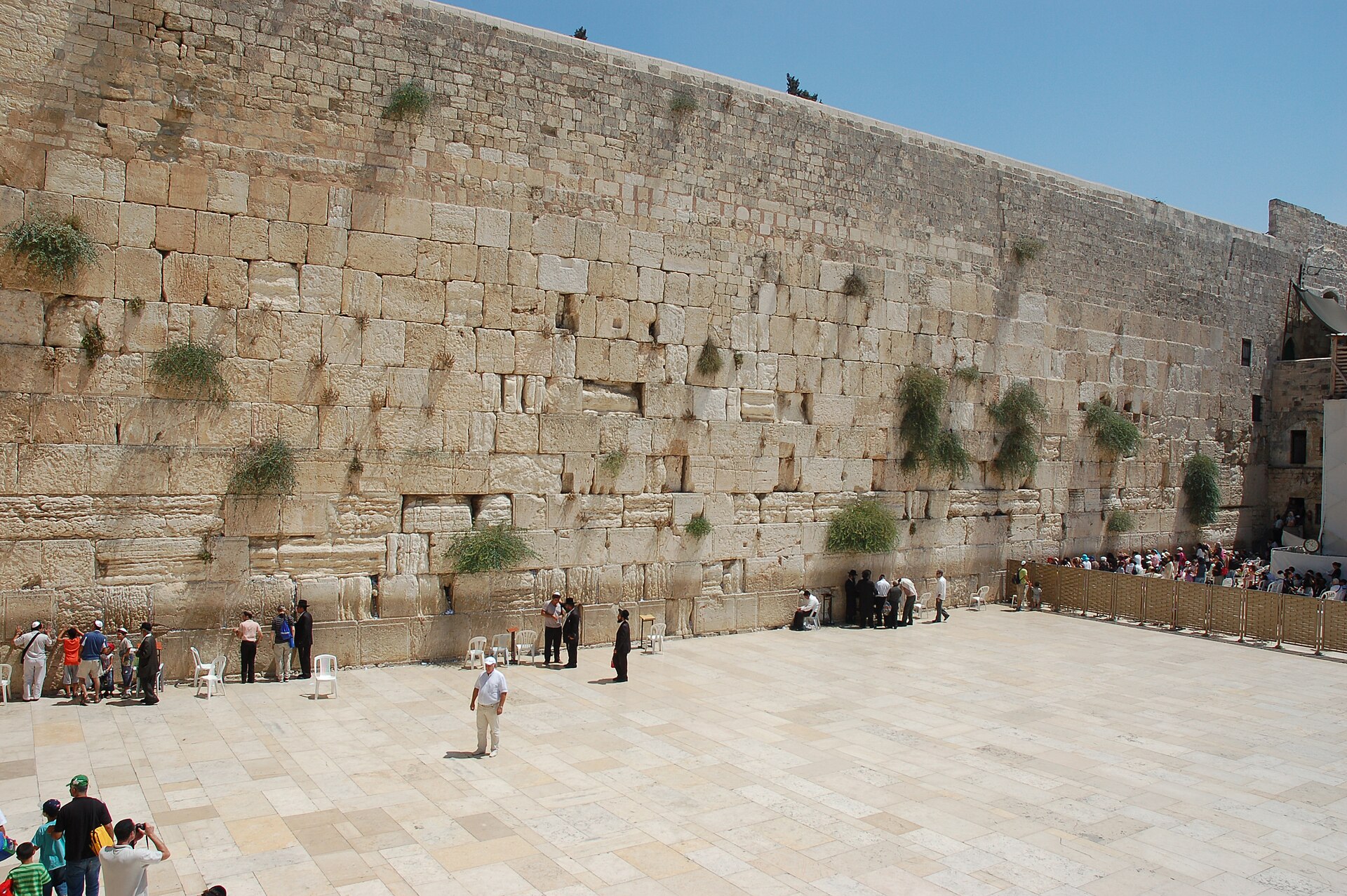
The Western Wall — the surviving Herodian retaining wall, not a wall of the temple building. Photo © David King, CC BY 2.0, via Wikimedia Commons. Jesus, leaving the temple, foretold its end: “There shall not be left here one stone upon another, that shall not be thrown down” (Matthew 24:2; Luke 21:6). In the Jewish–Roman War the prophecy came due: in 70 AD Rome destroyed the temple and the structures on the platform. The toppled Herodian stones still lie where they fell at the southwest corner, beside the paving they cracked.Jesus’ “not one stone” fell on the temple buildings, which were leveled — while the retaining wall (a different structure) partly survived, and stands today as the Western Wall. The standing Wall and the fulfilled prophecy are not in tension once the two structures are told apart. (He also spoke of another temple: “Destroy this temple, and in three days I will raise it up… he spake of the temple of his body,” John 2:19, 21.)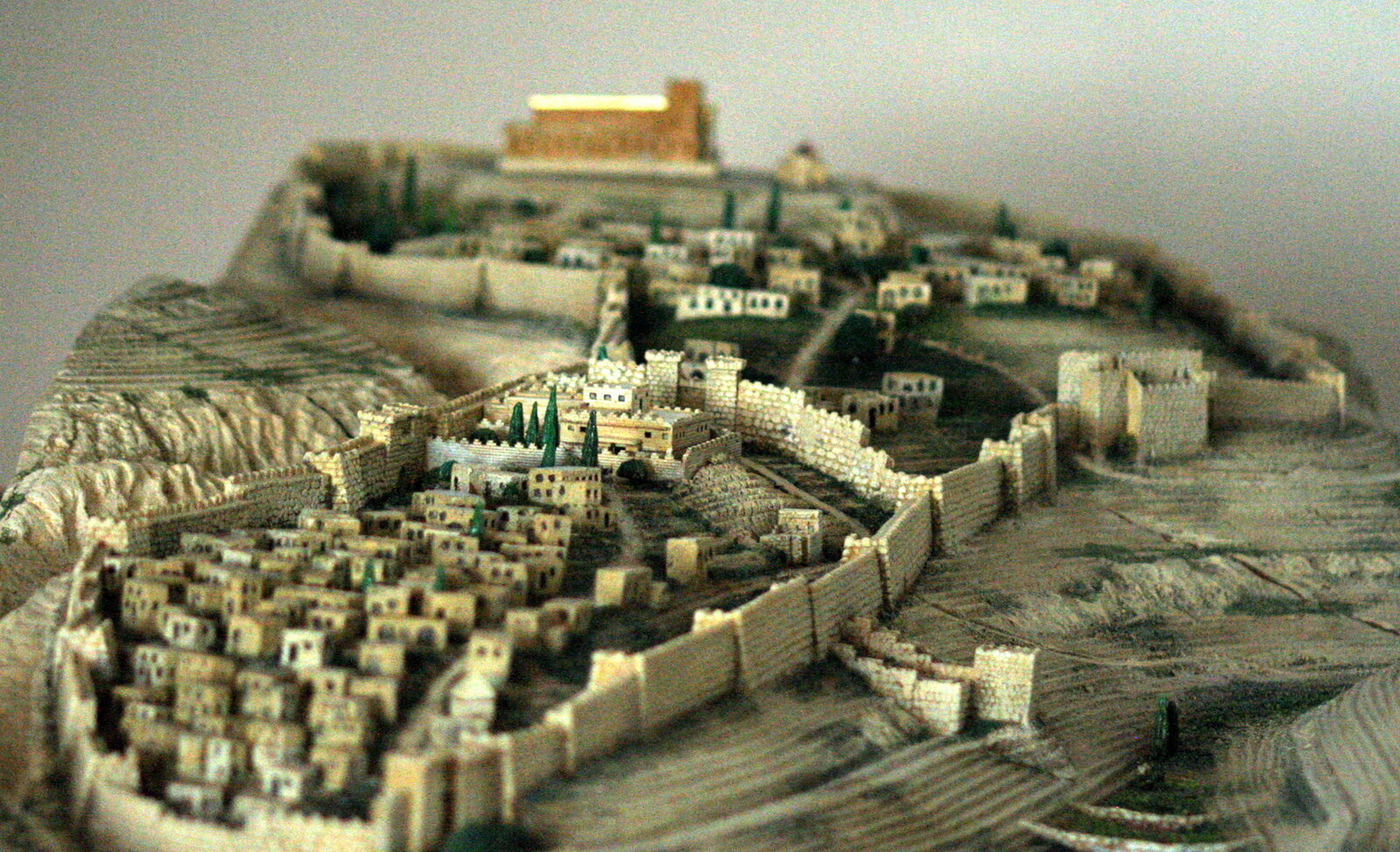
The ridge in model form — the flat summit platform is Herod’s engineering, far larger than Solomon’s buried footprint. Model photograph (see credit). Here is the fact that reorders everything a modern visitor thinks they are seeing. Around 19 BC, Herod the Great launched a colossal rebuild — not a new, third temple, but a top-to-bottom remaking of Zerubbabel’s Second Temple, which had stood five hundred years. He pulled it down and raised it again far grander, employing thousands of workers, on a platform he vastly enlarged to some 36 acres (well over twice Solomon’s), keeping the sacrifices going the whole time. So what people loosely call “Herod’s Temple” is that same Second Temple made magnificent — the house the Gospels simply call “the temple.” The great trapezoidal esplanade that dominates Jerusalem today (roughly 488 m on the west, 470 on the east) is his, and the disciples’ awe at the “goodly stones” (Luke 21:5) and “forty and six years was this temple in building” (John 2:20) belongs to this Herodian marvel, not to Solomon’s.The Western Wall and Robinson’s Arch are Herodian retaining walls that hold up the artificial esplanade — not remains of the Temple building. So “standing where Solomon stood” is mostly standing on Herodian fill, many feet above Solomon’s buried floor. What the cameras photograph is Herod’s stonework; Solomon’s house is below it, out of reach.- Exile did not have the last word. Cyrus of Persia decreed the house rebuilt (2 Chronicles 36:23; Ezra 1:2), and under Zerubbabel and Jeshua the work began (Ezra 3:8). But it was a humbler house than Solomon’s — so much so that the old men “who had seen the first house” wept aloud at the new foundation (Ezra 3:12). It was finished “in the sixth year of… Darius” (Ezra 6:15), about 516 BC. To that humbler house Haggai spoke the promise that “the glory of this latter house shall be greater than of the former” (Haggai 2:9) — a word read as fulfilled five centuries later, when Herod the Great rebuilt this very house into the marvel of the Gospels. Zerubbabel’s temple and “Herod’s temple” are not two buildings but one: the Second Temple, first modest, then made magnificent.Like Solomon’s, nothing of Zerubbabel’s temple has been excavated — it too lies beneath the Herodian platform that later encased and enlarged it. We know it from the text, not the spade.
- Four centuries after Solomon, it ended in flame. In “the nineteenth year of king Nebuchadnezzar,” his captain Nebuzar-adan “burnt the house of the LORD, and the king’s house, and all the houses of Jerusalem” (2 Kings 25:8–9); the vessels and treasures were carried to Babylon (2 Chronicles 36:18–19). The standard date is 587/586 BC.The destruction is vividly attested — not on the Mount, but down the ridge in the City of David: burnt structures, arrowheads, and clay seal-impressions (bullae) bearing the names of Zedekiah’s officials who opposed Jeremiah (Jeremiah 37:3; 38:1). The event is one of the best-dug of the period; the Temple’s own ashes are simply inaccessible beneath later building.
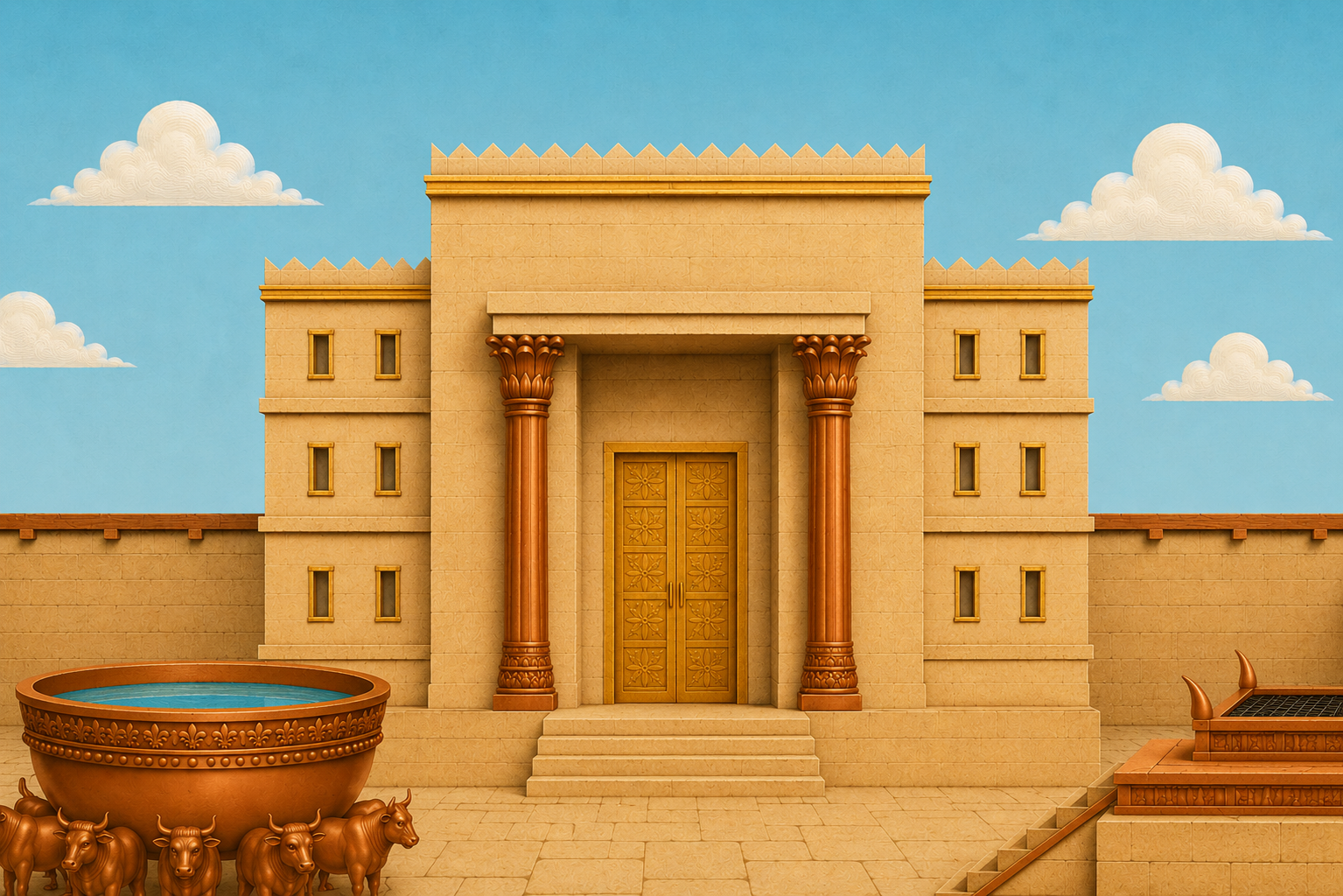
A reconstruction — nothing of this building survives. Original digital reconstruction. Solomon “began to build the house of the LORD… in the fourth year of his reign” (1 Kings 6:1) and finished seven years later, “in the month Bul” (1 Kings 6:38) — roughly 957 BC, a range rather than a fixed point. Cast and carved by the Phoenician craftsman Hiram of Tyre, it stood for nearly four centuries before the fire.Nothing of Solomon’s Temple has ever been excavated. It lies beneath the present platform, which cannot be dug. Every picture of it is inference — from the biblical text (1 Kings 6–7; 2 Chronicles 3–4) and from comparative Iron-Age “long-room” temples (‘Ain Dara and Tell Tayinat in Syria are the closest known parallels). The absence of remains is a fact about access, not about history.- Long before there was a temple, there was a mountain with a memory. The site stacks story upon story on one rock: the land of Moriah where Abraham was sent to offer Isaac and named the place Jehovah-jireh (Genesis 22:2, 14); the threshing floor David bought, where he “built there an altar… and the plague was stayed” (2 Samuel 24:25); and the summit where Solomon raised the house (2 Chronicles 3:1). “Who shall ascend into the hill of the LORD?” (Psalm 24:3) was asked of this hill.The choice of site reads like a theological argument: God meets His people where He has met them before — Abraham’s test, David’s mercy, Solomon’s house, all on one summit. These are matters of scripture and tradition rather than excavation: the bedrock is here, but Abraham’s altar leaves no dig-able trace.
bedrock — es-Sakhra
Latter-day Saint layer — carefully bounded. Latter-day Saints read this mountain alongside the last-days temple prophecies: “the mountain of the LORD’s house shall be established in the top of the mountains… and all nations shall flow unto it” (Isaiah 2:2–3; Micah 4:1); “the Lord, whom ye seek, shall suddenly come to his temple” (Malachi 3:1); Ezekiel’s vision of “the place of my throne… where I will dwell in the midst of the children of Israel for ever” (Ezekiel 43:7).
And Latter-day Saint teaching does look for a temple to rise again in Jerusalem. Alongside the gathering of Judah, it anticipates that the Jewish people will one day rebuild a temple there — a third house after Solomon’s and the Second — and that temples will stand through the millennial reign of Christ. (The Latter-day Saint frame also awaits a separate New Jerusalem, or Zion, “built upon the American continent,” and “the literal gathering of Israel” — Articles of Faith 1:10.) The hope is old and tender: in 1841 the apostle Orson Hyde climbed the Mount of Olives — where Zechariah says the Lord’s “feet shall stand in that day” (Zechariah 14:4) — and dedicated the land for the return of the Jews and the rebuilding of Jerusalem.
But this hope must be held with great care, and a few things must be said plainly. It is not the Latter-day Saint Church that would build that temple — the expectation is that the Jewish people themselves would; the Church raises its own temples across the world and is bound to no single spot. And it does not require that the Dome of the Rock or al-Aqsa Mosque be torn down or displaced: nothing in Latter-day Saint scripture calls for that, and the various schemes that imagine removing the present sanctuaries are not doctrine — some are destructive, and corrosive to the peace and goodwill God asks of His children. We do not know how these promises will be fulfilled. What we trust is that God has a plan; that it will come to pass in His way and His time, in righteousness (His preference should be our goal too — pursued through peace, goodwill, and cooperation, never through violence); and that it is a plan for all His children — Muslim, Jewish, Christian, and every other. These are devotional connections, held in the interpretive frame and kept here as hope read in scripture, plainly labeled as such — not claims about current archaeology, the present site, or any Church program for it.
So the one ridge has held an altar, two temples, a pagan shrine, and a golden dome, and has been fought over for three thousand years — while the house this guide is about lies silent and buried beneath all of it. That is exactly why the discipline matters: knowing what we can see, what we can only reconstruct, and what we believe. Walk the building itself on the interactive floor plan →, or see the references behind it in Sources & Citations →.
For the story of how the kingdom that built this house fractured after Solomon and slid, reign by reign, toward the fire of 586 BC, walk its companion guide: The Divided Kingdom →.