Field Guide · Solomon's Temple
The Furnishings
An interactive walk-through of Solomon's Temple — the court, the sanctuary, and the oracle. Tap each furnishing in order to open what the text says, what the reconstruction infers, what it meant, and how Latter-day Saints read it.
Strip away the cedar and the gold leaf and the Temple was, at heart, a set of teaching objects — a pair of pillars, a giant basin, ten rolling carts, an altar, lampstands, tables, a small golden censer, two towering winged figures over a gilded chest. Every one of them was cast or carved to a pattern, and every one of them was a sermon in metal and wood. To walk from the gates to the oracle — the old word for the innermost room, the Holy of Holies — was to pass these furnishings in order, and the order was the message: bronze before gold, atonement and washing in the open court before the light and bread of the inner house, and all of it before the guarded dark where the covenant rested.
So this page is a walk-through. Below are three scenes — the court, the sanctuary, and the oracle — and each one is clickable. Tap the numbered markers in order, and each furnishing opens its own description: what the text says, what the reconstruction infers, what the symbol carried, and how Latter-day Saints read it.
A word of honesty first: none of it survives. No fragment of Solomon’s Temple furniture has ever been excavated. Everything here is inference — from the biblical measurements themselves, and from the comparative metalwork of the Phoenician world that built it. (The Tyrian master who cast the bronze, and the deep weave of Israel and Phoenicia behind him, have their own page: The Bronze Worker from Tyre →.)
The Court — From the Gates to the Threshold
Enter the court and walk it as a worshipper would: through the bronze gates, past the great altar, by the sea and the lavers, and up to the named pillars at the porch. Tap each numbered marker in turn.
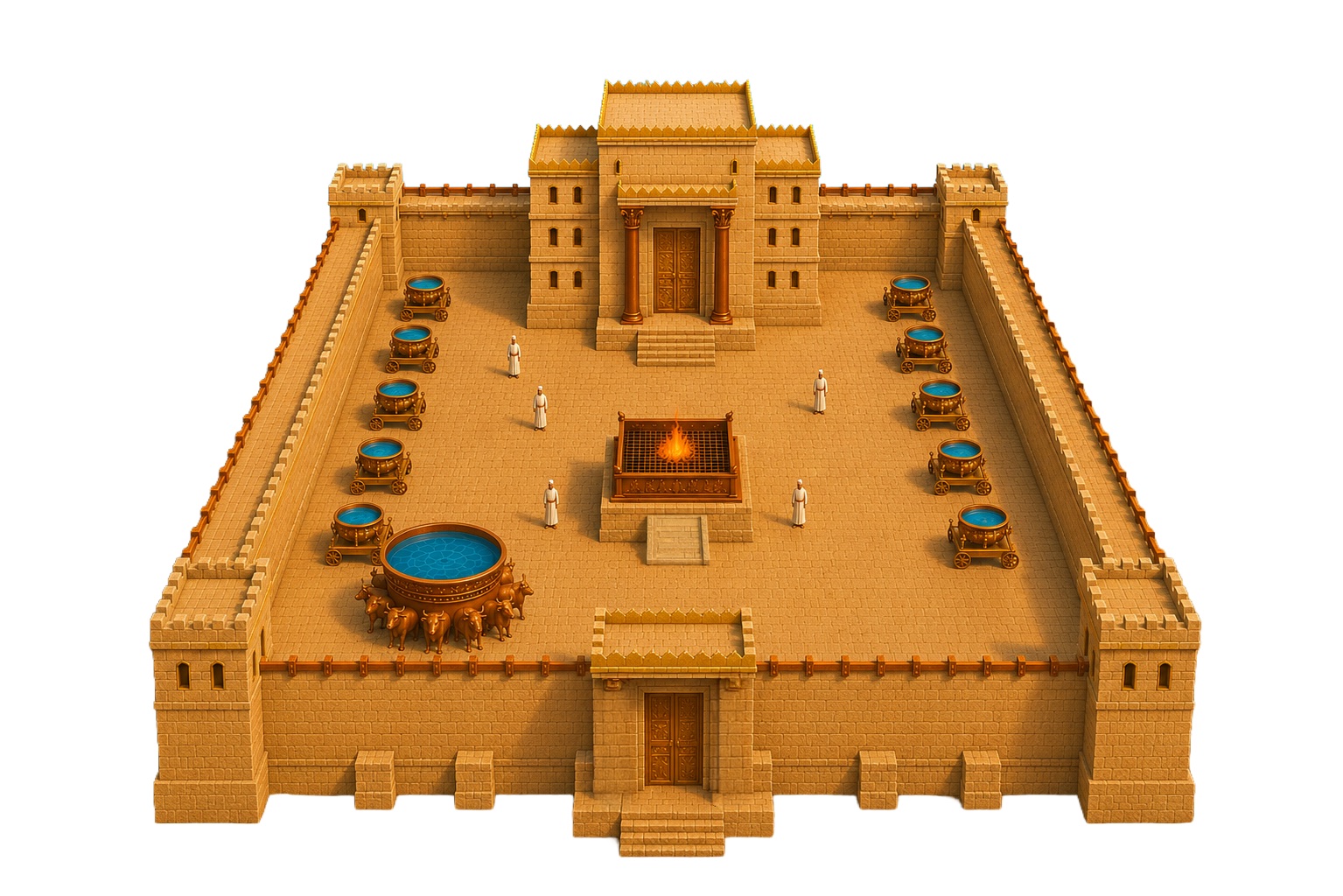
Tap a numbered marker to walk the tour — each stop opens its own description.
1Through the Gates
The walk begins outside the house. A worshipper first entered its courts (חָצֵר) — and even those were bounded by gates: Solomon “made the court of the priests, and the great court, and doors for the court, and overlaid the doors of them with brass” (2 Chronicles 4:9), bronze-plated gates marking the first threshold of holiness. From there the whole approach runs inward as a graded ascent — court, porch, Holy Place, and the oracle (the old word for the innermost room, the Holy of Holies) — each station nearer the presence, and each marked by a deepening of the metal, from bronze in the open court to gold at the heart.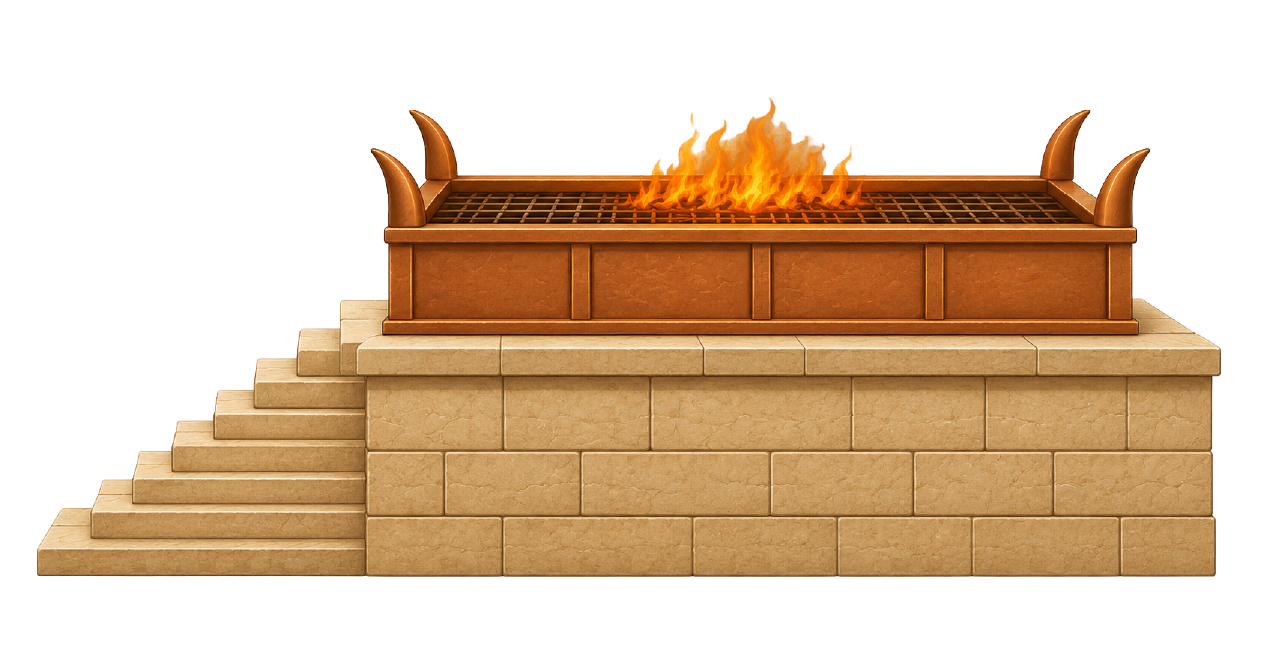
2The Great Bronze Altar
The first thing met on entering the court — and the last station before the house — was the great altar (מִזְבֵּחַ) of burnt offering: “an altar of brass, twenty cubits the length thereof, and twenty cubits the breadth thereof, and ten cubits the height thereof” (2 Chronicles 4:1) — about thirty feet square and fifteen high, far larger than the Tabernacle’s altar.
Even this was not enough on the day of dedication. The offerings were so many that the great altar could not hold them all, so Solomon set apart the open court itself to take the overflow: he “hallow[ed] the middle of the court… because the brasen altar… was too little to receive the burnt offerings” (1 Kings 8:64).
A ramp, not steps. The Law forbade going up to an altar “by steps,” lest the priest’s nakedness be exposed (Exodus 20:26) — so reconstructions give this altar a sloped ramp rather than stairs.
A cross-source note. The altar’s dimensions survive only in Chronicles — 1 Kings details much of Hiram’s bronze work but skips the altar’s measurements. Not a contradiction; a reminder that Kings and Chronicles each preserve what the other omits, and the fullest picture needs both.
It points to Christ — and scripture says so. That the sacrifices were given to point forward to Christ is the canon’s own claim. The New Testament makes the altar’s logic explicit — “without shedding of blood is no remission” (Hebrews 9:22), the law holding “a shadow of good things to come” (Hebrews 10:1) — and the Book of Mormon states it outright: “this is the whole meaning of the law, every whit pointing to that great and last sacrifice; and that great and last sacrifice will be the Son of God” (Alma 34:14). The altar’s spatial sermon — there is no drawing near without atonement — is the text’s own typology. Sacrifice is the gateway.
3The Molten Sea
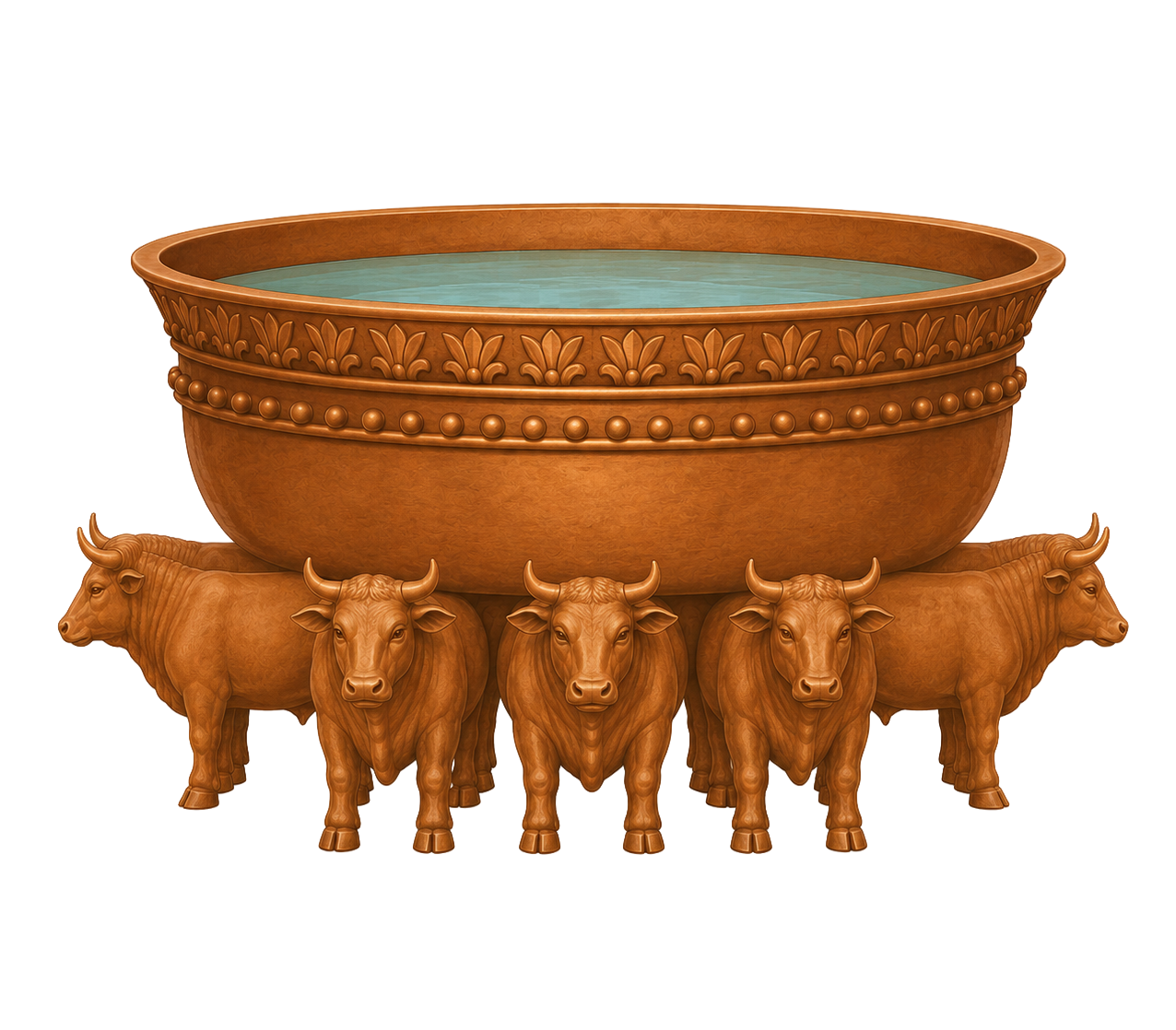
Dominating the court stood the molten sea, the yam mutsaq (יָם מוּצָק), the “cast sea”: a single bronze basin “ten cubits from the one brim to the other… round all about… five cubits the height thereof,” with “a line of thirty cubits” compassing it (1 Kings 7:23) — roughly fifteen feet across, holding more than ten thousand gallons. Its brim was “wrought… with flowers of lilies,” and it rested “upon twelve oxen, three looking toward the north, and three… the west, and three… the south, and three… the east” (1 Kings 7:25–26). Those twelve oxen — four groups of three, facing the compass — recall the twelve tribes of Israel, who camped three to a side, by the four directions, around the Tabernacle (Numbers 2). Chronicles gives the purpose plainly: “the sea was for the priests to wash in” (2 Chronicles 4:6).
A measurement footnote. The thirty-cubit circumference around a ten-cubit diameter is the famous “π ≈ 3” rounding — ancient measurement to the nearest cubit. And the capacity is “two thousand baths” in 1 Kings 7:26 but “three thousand” in 2 Chronicles 4:5 — a known number-tradition difference. We flag both rather than smoothing them over.
Interpretive layer. Much scholarship hears cosmic overtones: the word sea (yam) evokes the primeval deep, so the basin becomes a sign of the LORD’s mastery over the chaos-waters — the Temple as the ordered center of the world. Rich and widely held, but not stated by the text; what the text does say is the sharper thing: this is where the priests washed. Cleansing came before service.
Latter-day Saint layer. The bronze sea on twelve oxen is the recognized type behind Latter-day Saint baptismal fonts, which stand on twelve oxen to this day. Doctrine and Covenants 124 ties the font to the temple and names “your… washings, and your baptisms for the dead… ordained by the ordinance of my holy house” (D&C 124:39). The deepening metals — bronze here in the court, gold within the house — echo the Tabernacle’s fuller bronze → silver → gold progression, which Latter-day Saints read as the telestial, terrestrial, and celestial degrees of glory (D&C 76); the Tabernacle field guide walks that symbolism in detail.
4The Ten Lavers
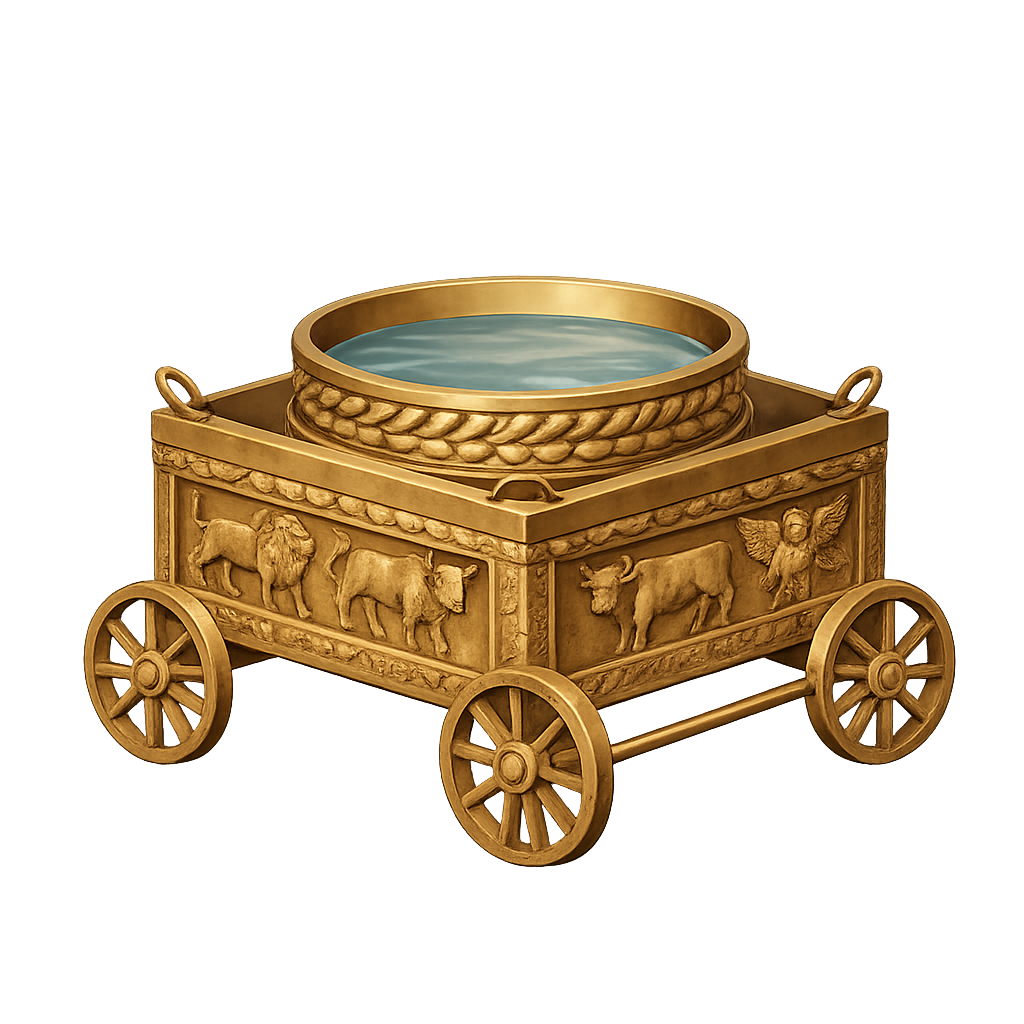
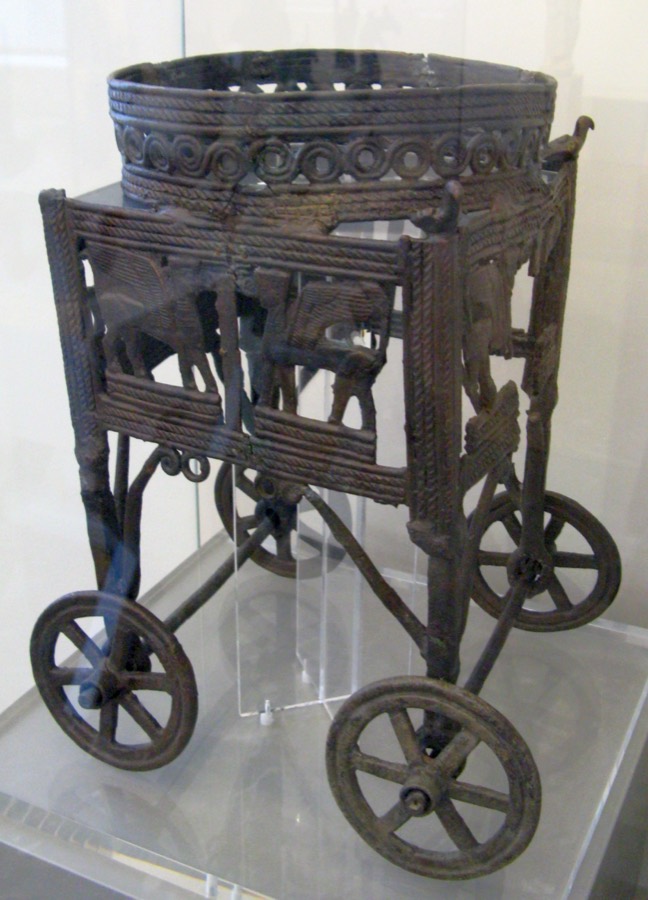
Flanking the sea were ten bronze lavers (כִּיּוֹר) on wheeled bases — carts four cubits square with wheels “like a chariot wheel,” their panels engraved with “lions, oxen, and cherubims” (1 Kings 7:27–37). Five stood on the south side, five on the north (1 Kings 7:39); “such things as they offered for the burnt offering they washed in them” (2 Chronicles 4:6). These stands are the closest archaeological parallel we have to any Temple furnishing: bronze four-wheeled cult-stands from Cyprus (twelfth–tenth centuries BCE) share the same form — a square openwork base on chariot-like wheels, its panels worked with sphinx-like cherubim, animals, and stylized trees. The biblical lavers match them in nearly every respect but size — Solomon’s were far larger. (Most of the Cypriot pieces are unprovenanced finds, so the link is one of type, not a direct one; the stands were catalogued by H.W. Catling, Cypriot Bronzework in the Mycenaean World, 1964, and tied to Solomon’s lavers by V. Hurowitz, Bible Review, 1994.) Where the sea served the priests themselves, the lavers rinsed the offerings.
5At the Threshold: Jachin and Boaz
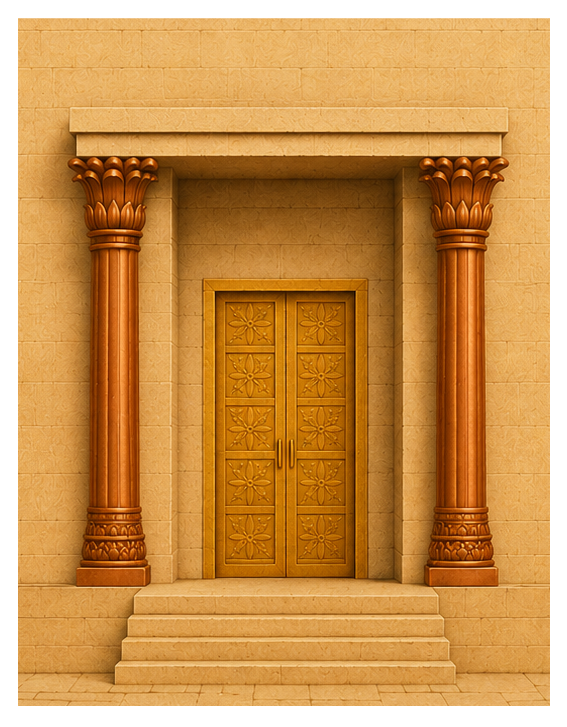
At the very porch of the house stood two great bronze pillars — each eighteen cubits high with a five-cubit capital of “lily work,” netting, wreaths, and rows of pomegranates (1 Kings 7:15–20). They held up no roof; they were monuments, and they were named: “he set up the right pillar, and called the name thereof Jachin (יָכִין)… and… the left pillar, and called the name thereof Boaz (בֹּעַז)” (1 Kings 7:21). Free-standing flanking pillars are a known feature of Syro-Phoenician temple fronts, and lily-and-pomegranate capitals fit Phoenician decorative art.
Interpretive layer. The name-meanings are traditional Hebrew etymology, not spelled out by the text: Jachin ≈ “He establishes,” Boaz ≈ “in him is strength.” Read together they may form a single proclamation — He establishes [it] in strength. Some scholars go further, reading each name as the opening word of a longer dynastic inscription once carved on or near the pillar — Jachin beginning something like “[the LORD] will establish the throne of David for ever,” and Boaz, “in the strength [of the LORD the king rejoices]” — the way a single word can call up a whole saying. (Later Masonic symbolism around the pillars is post-biblical and shouldn’t be read back into Solomon’s porch.) The plain point stands: everyone who entered walked between a declaration that the Lord establishes His house and that in Him is the worshipper’s strength.
And the pillars framed the entrance itself. The front doors (דֶּלֶת) were a double pair sheathed in gold on olive-wood posts, “carved… with cherubims and palm trees and open flowers… covered with gold” (1 Kings 6:33–35) — the same garden of cherubim, palms, and blossoms that ran along the inner walls, worked into the last and most golden threshold before the Holy Place.
The Sanctuary — the Holy Place
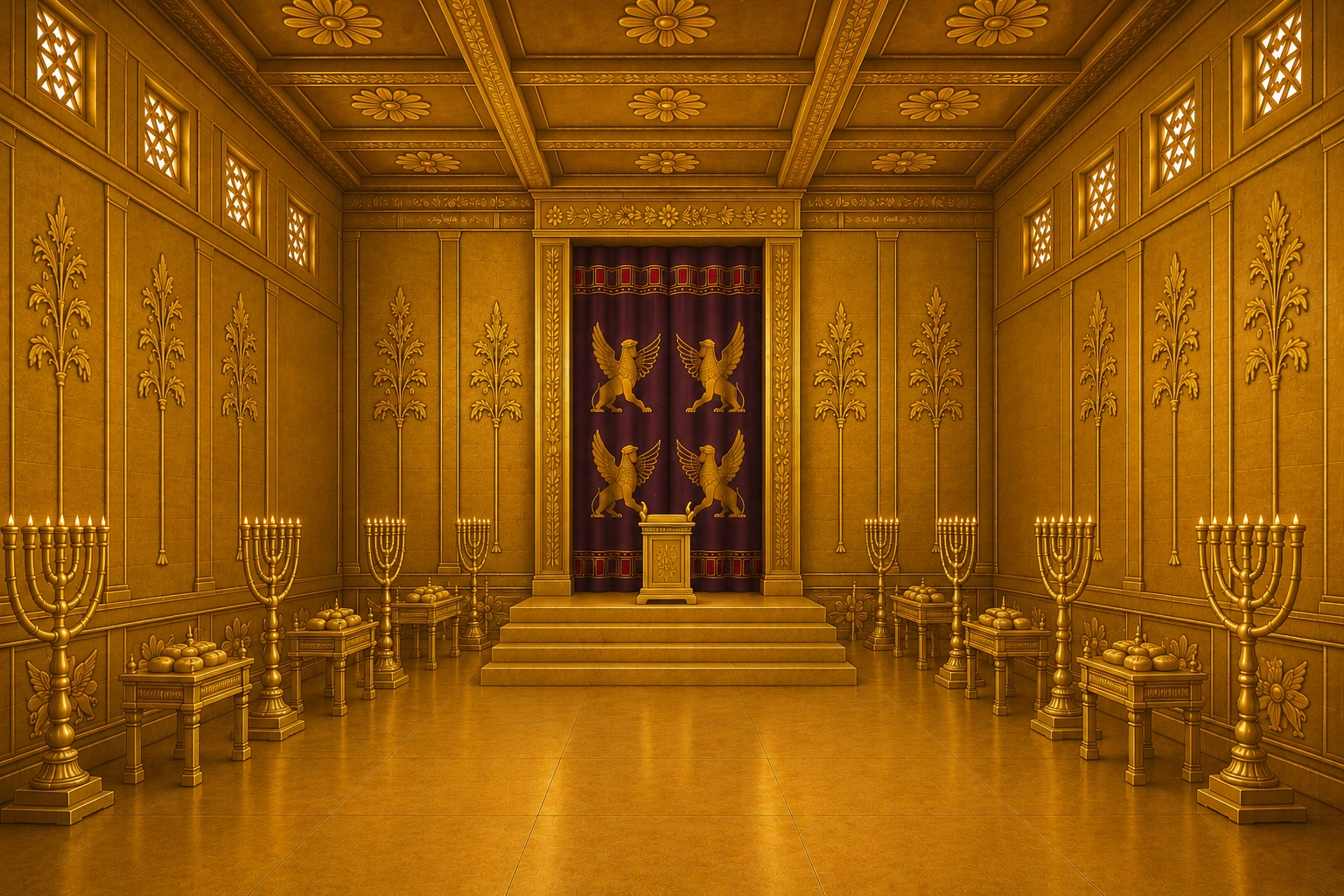
Through the great gold doors lay the Holy Place — a windowless room walled in gold, lit only by lampfire, where the priests served daily. Solomon multiplied the Tabernacle’s single set of furniture into tens: ten lampstands, ten tables, ranked five and five before the oracle (1 Kings 7:48–49; 2 Chronicles 4:7–8). Step inside and explore it.
Tap a numbered marker to walk the tour — each stop opens its own description.
1The Veil
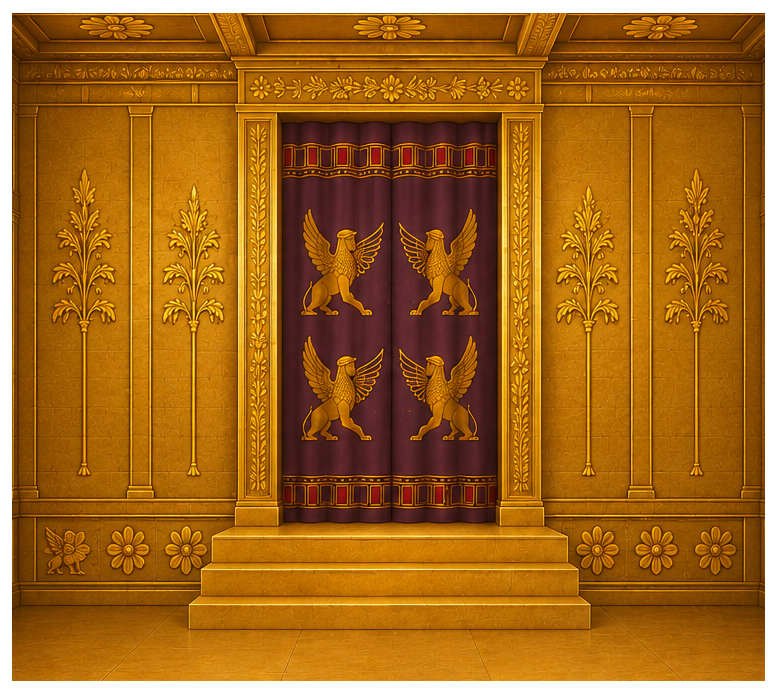
The boundary into the Holy of Holies was both a door and a veil (פָּרֹכֶת). The veil was woven “of blue, and purple, and crimson, and fine linen,” with cherubim worked into it (2 Chronicles 3:14); the olive-wood doors behind it were carved with “cherubims and palm trees and open flowers” and overlaid with gold (1 Kings 6:31–32). The carved cherubim, palms, and flowers continued the garden imagery of the inner walls — Eden worked into the very boundary that barred the way back in. At the crucifixion the veil was “rent in twain from the top to the bottom” (Matthew 27:51): the way opened through Christ.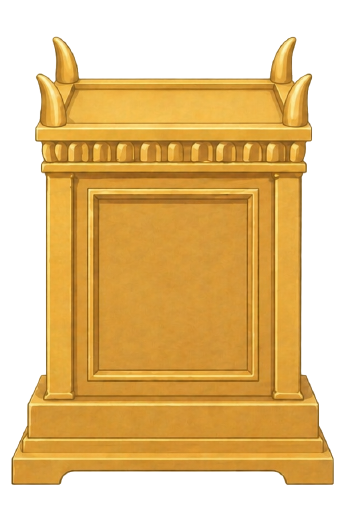
2The Altar of Incense
A small horned altar of cedar overlaid with gold, standing right before the veil — “the whole altar that was by the oracle he overlaid with gold” (1 Kings 6:22). On it the priests burned “a perpetual incense (קְטֹרֶת) before the LORD” morning and evening (Exodus 30:7–8). Small horned incense altars are well attested archaeologically across Iron-Age Judah (Arad, Megiddo). The rising smoke is prayer ascending: “Let my prayer be set forth before thee as incense” (Psalm 141:2), the saints’ prayers rising with incense before the throne (Revelation 8:3–4).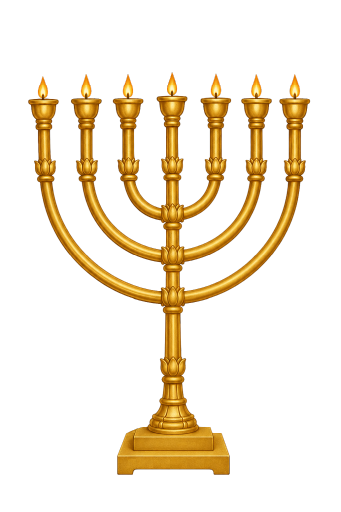
3The Golden Menorah
The golden lampstands (מְנוֹרָה) — “the candlesticks of pure gold, five on the right side, and five on the left, before the oracle” (1 Kings 7:49). Solomon multiplied the Tabernacle’s single seven-branched menorah into ten, each a hammered-gold shaft with six branches bearing almond-shaped cups, knops, and flowers (Exodus 25:31–40). Burning olive oil, they were the only light in the windowless room — and the almond (shaqed (שָׁקֵד)) puns on God “watching” to perform His word (Jeremiah 1:11–12). That perpetual light — the one glow in the darkness of the holy room — became a name for Christ himself, read in the Gospel and the Book of Mormon alike as a figure of the One it pointed toward: “I am the light of the world” (John 8:12); “He is the light and the life of the world” (Mosiah 16:9).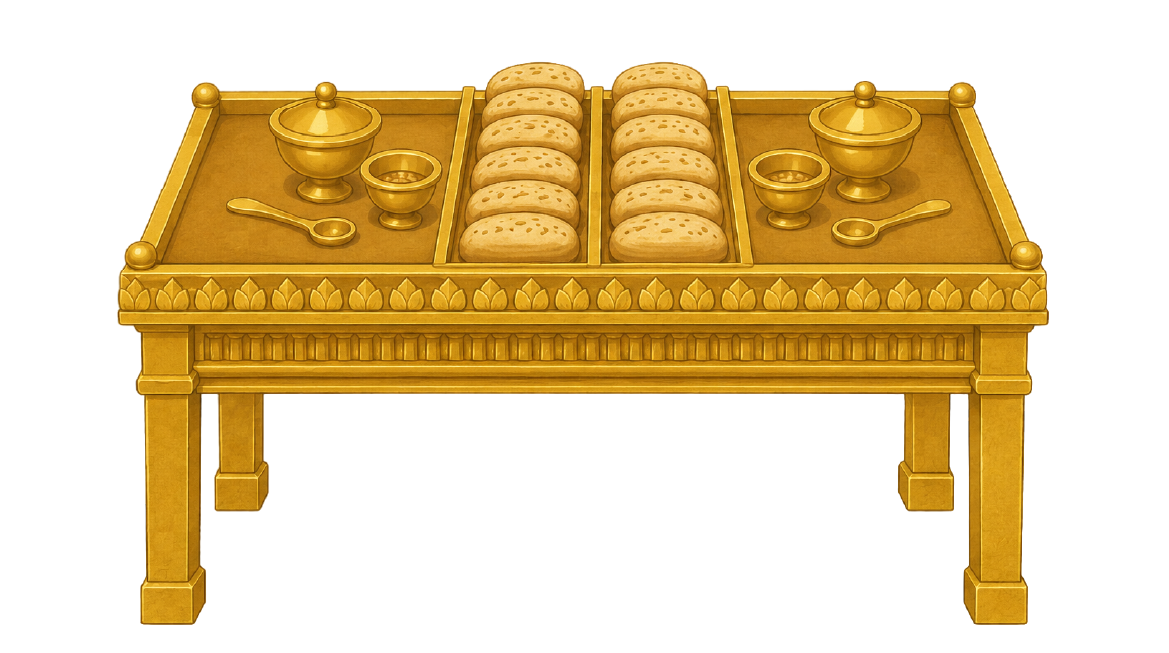
4The Bread of the Presence
The table (שֻׁלְחָן) “whereupon the shewbread was” (1 Kings 7:48) — ten gold tables in all, five and five. The bread itself, lechem ha-panim, the bread “of the face,” was twelve loaves set “two rows, six on a row, upon the pure table before the LORD,” renewed every sabbath and eaten by the priests as “an everlasting covenant” (Leviticus 24:5–8). Twelve loaves: all Israel, tribe by tribe, kept continually before the face of God — and Jesus takes it up directly: “I am the bread of life… the bread that I will give is my flesh” (John 6:35, 51), kept “in remembrance of my body” in the sacrament (3 Nephi 18:7).The Oracle — the Holy of Holies
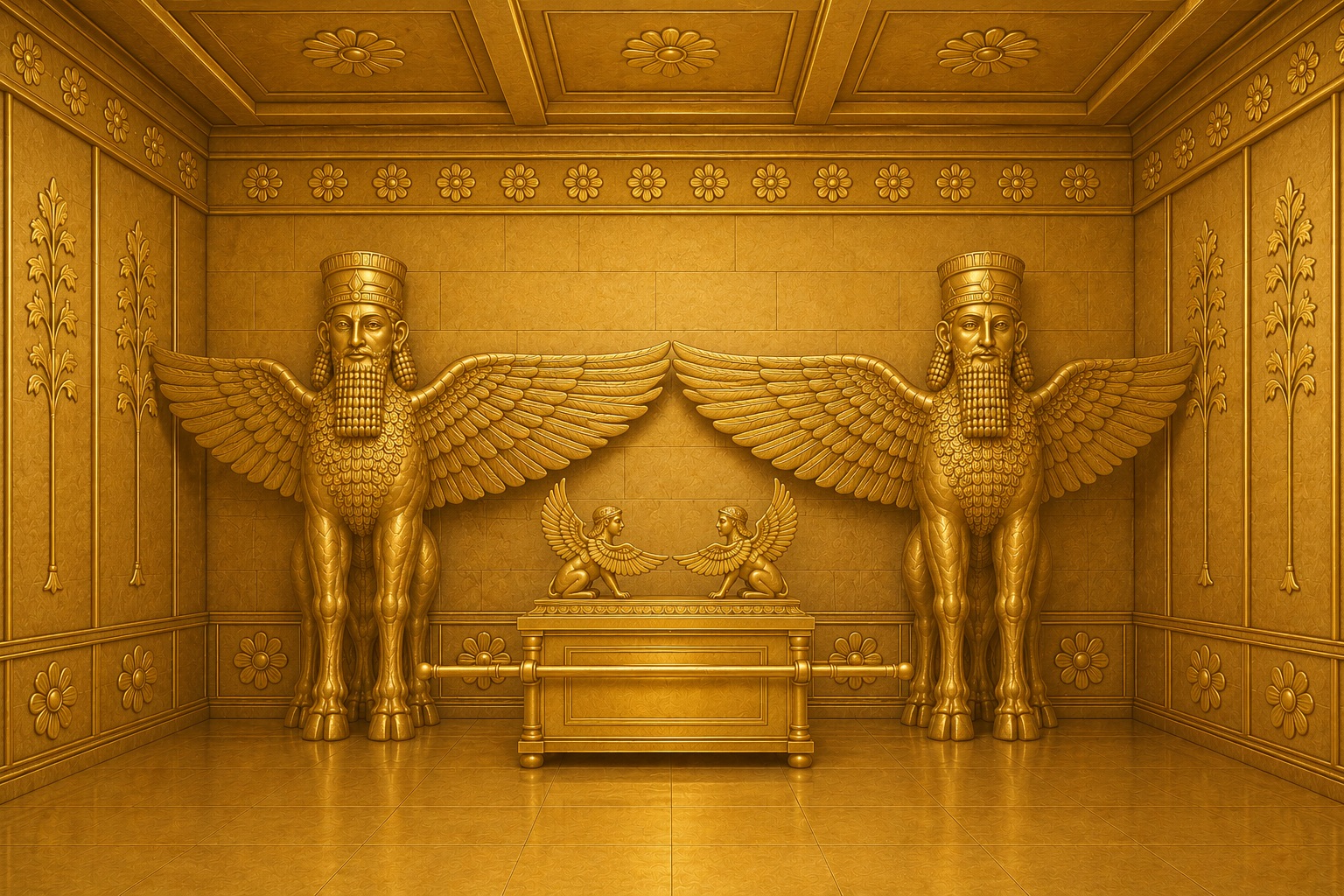
Beyond the veil lay the oracle — the windowless inner cube, entered once a year, where the covenant rested beneath the overshadowing wings of the cherubim. Tap to explore it.
Tap a numbered marker to walk the tour — each stop opens its own description.
1The Great Cherubim
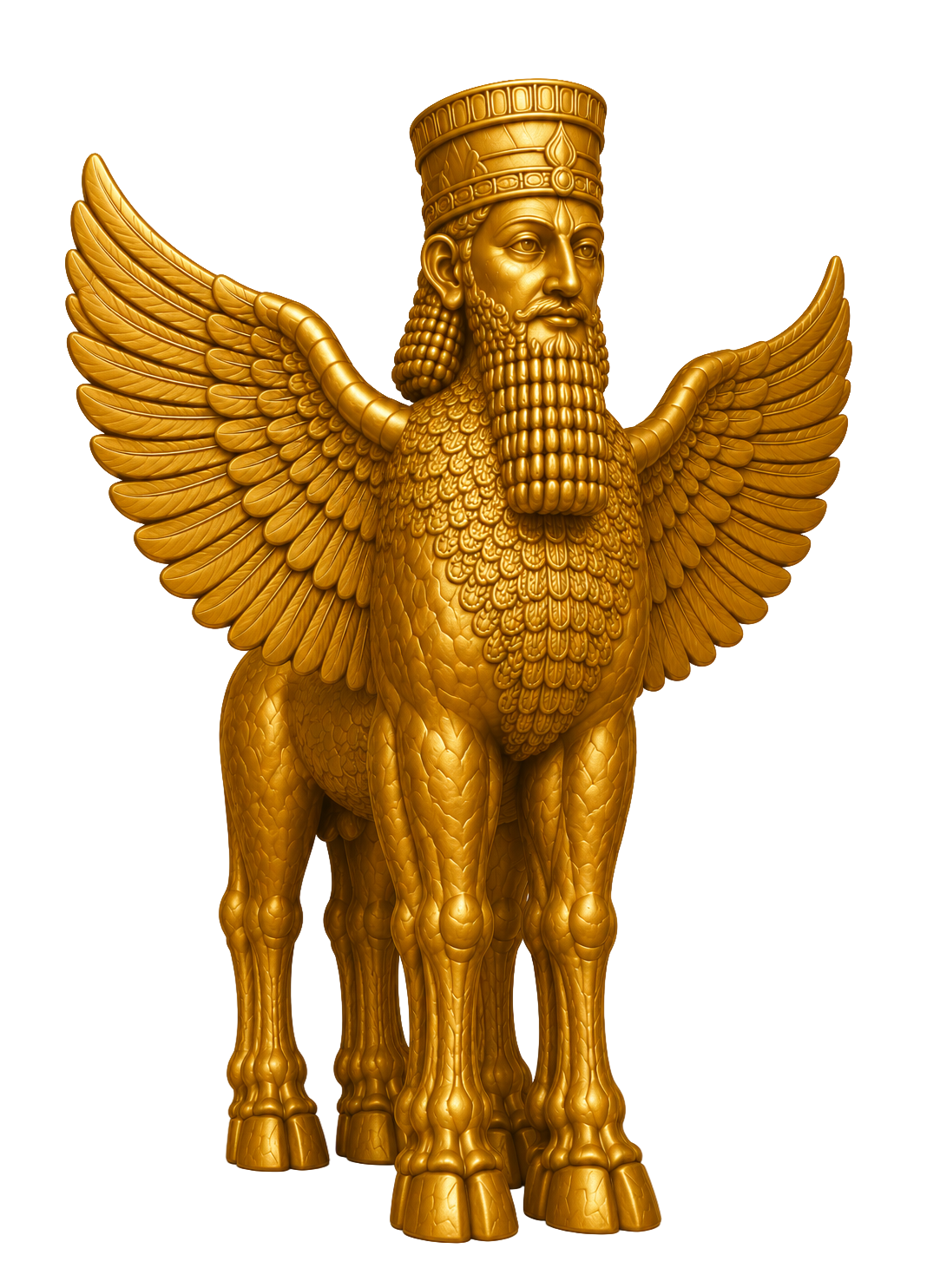
Two guardian cherubim (כְּרוּב) of olive wood overlaid with gold, “each ten cubits high,” their wings stretched so that “the wing of the one touched the one wall, and the wing of the other… touched the other wall; and their wings touched one another in the midst of the house” (1 Kings 6:23–27). Scripture never describes their faces; this reconstruction follows Ezekiel’s four-faced living creatures (Ezekiel 1:10; 10:20) and the winged temple-guardians of the wider ancient Near East — the lamassu, the human-headed winged bulls that flanked Assyrian palace gates. The same cherubim who guarded Eden’s gate “to keep the way of the tree of life” (Genesis 3:24) here overshadow the mercy seat — guardianship turned into nearness.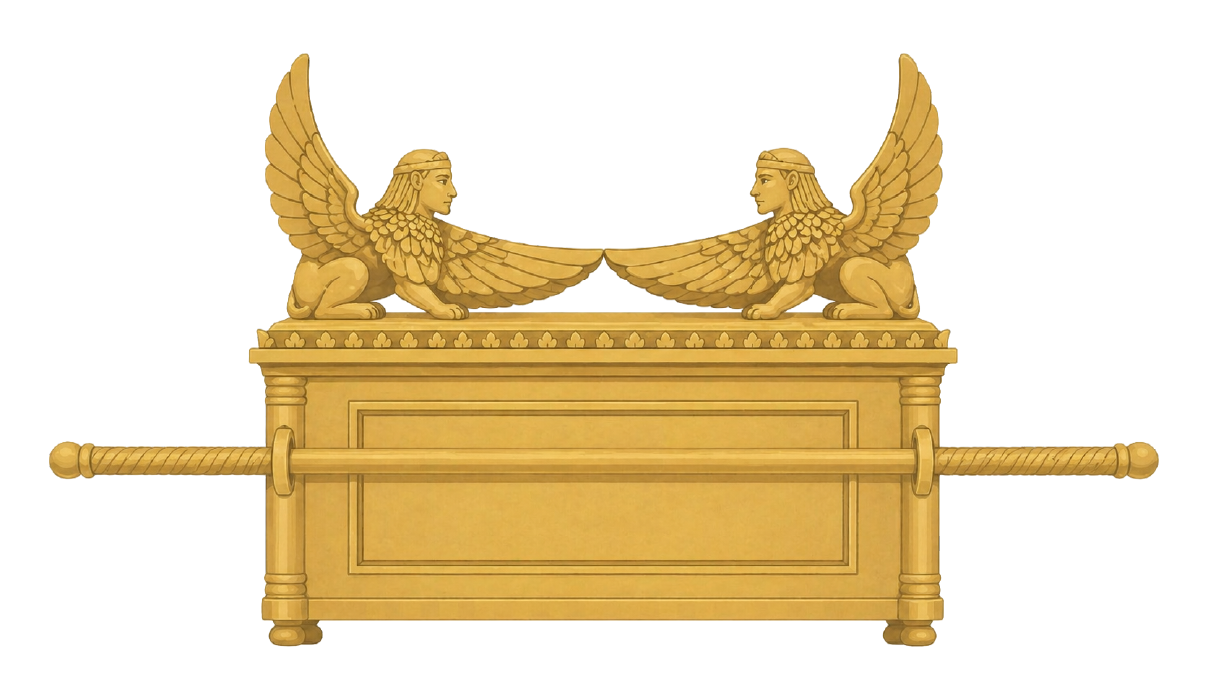
2The Mercy Seat
The ark’s gold lid — the mercy seat (כַּפֹּרֶת) — bore two cherubim of beaten gold facing one another, their wings covering it (Exodus 25:18–20). The name carries the meaning: kapporeth comes from the root k-p-r, “to cover” — and so “to atone” — the very root behind Yom Kippur, the Day of Atonement. And it was on that day that the high priest sprinkled sacrificial blood there, “before the mercy seat” (Leviticus 16:14). The New Testament reads it straight onto Christ: Paul calls Him “a propitiation… in his blood” (Romans 3:25) — and the Greek word there, hilastērion (ἱλαστήριον), is the very term the Greek Old Testament uses for the mercy seat — so that believers may now “come boldly unto the throne of grace” (Hebrews 4:16).3The Ark of the Covenant
The gold-overlaid chest, carried on staves — the ark (אֲרוֹן) “of the covenant of the LORD.” By Solomon’s day it held only “the two tables of stone, which Moses put there at Horeb” (1 Kings 8:9); earlier it had also held the pot of manna and Aaron’s rod (Hebrews 9:4). Set beneath the overshadowing wings, ark and cherubim together formed the throne-seat of the invisible LORD “that dwelleth between the cherubims” (1 Samuel 4:4; Psalm 80:1) — the dark center toward which the whole east-to-west journey ascends.4The Great Cherubim
Two guardian cherubim (כְּרוּב) of olive wood overlaid with gold, “each ten cubits high,” their wings stretched so that “the wing of the one touched the one wall, and the wing of the other… touched the other wall; and their wings touched one another in the midst of the house” (1 Kings 6:23–27). Scripture never describes their faces; this reconstruction follows Ezekiel’s four-faced living creatures (Ezekiel 1:10; 10:20) and the winged temple-guardians of the wider ancient Near East — the lamassu, the human-headed winged bulls that flanked Assyrian palace gates. The same cherubim who guarded Eden’s gate “to keep the way of the tree of life” (Genesis 3:24) here overshadow the mercy seat — guardianship turned into nearness.The deepest of those furnishings, the mercy seat on the ark, is where the whole house arrives at its point — the place the New Testament reads straight onto Christ. Daniel Smith’s Messages of Christ draws that line in full:
▶ Finding Christ in the Ark of the Covenant — video by Messages of Christ (Daniel Smith), used with permission.
Each object, then, was a word in a single sentence the architecture spoke from the gates inward: enter (the bronze court gates), atone (the altar), wash (the sea and lavers), establish and strengthen (the pillars and the gold doors), be lit and fed and heard (the Holy Place), and so come near (the oracle). Walk the plan itself on the interactive floor plan →, or read how the whole house was given to God at the Dedication →.