Field Guide · Solomon's Temple
The Bronze Worker from Tyre
Hiram of Tyre, the Phoenician master who cast the pillars, the molten sea, and the lavers — and the deep weave of Israel and Phoenicia, throne to dye-vat, that raised the house of the LORD.
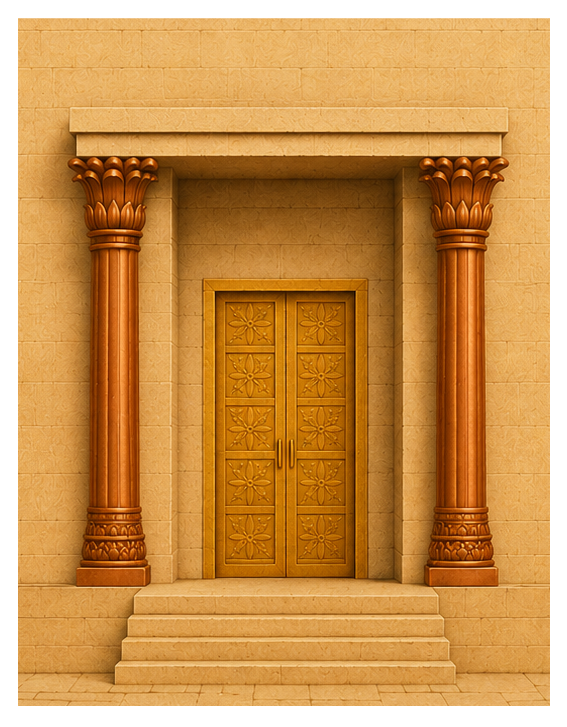
Israel built its holiest house — but it did not build it alone. The great bronze furnishings, the pillars and the sea and the lavers, came from the hands of a Phoenician master, and the partnership behind them reached from the throne all the way down to the dye-vats on the coast. Before walking the furnishings themselves, it is worth meeting the man who cast them, and the two peoples woven together to raise the house of the LORD.
The Bronze Worker from Tyre
The great metal furnishings were not made by Israelite hands. Solomon “sent and fetched Hiram out of Tyre” — a craftsman “filled with wisdom, and understanding, and cunning to work all works in brass” (1 Kings 7:13–14). He cast the pillars, the sea, and the lavers not in Jerusalem but down in the Jordan plain, “in the clay ground between Succoth and Zarthan” (1 Kings 7:46) — open casting-pits in a stretch of the valley where the era’s metalworking clustered.
He came on the strength of an alliance older than Solomon. It began with David, to whom “Hiram king of Tyre” — a different man who happened to share the craftsman’s name — “sent messengers… and cedar trees, and carpenters, and masons” (2 Samuel 5:11). Under Solomon it hardened into a treaty, and Israel leaned on Phoenician skill without apology: “there is not among us any that can skill to hew timber like unto the Sidonians” (1 Kings 5:6). Tyre sent cedar, gold, and master craftsmen; Israel sent wheat and oil, and in time twenty towns of Galilee (1 Kings 9:11). Phoenician hands shaped the stone as well as the bronze — the “stonesquarers” who dressed the foundation blocks were, in the Hebrew, the men of Gebal, Byblos on the Phoenician coast (1 Kings 5:18). Israel raised its holiest house on that partnership.
A biblical pattern. That Tyre — the ancient world’s premier craft city — lent its best metalworker to the house of the LORD echoes a pattern the text itself draws: the Lord raising up skilled, Spirit-endowed hands for His house. So it had been with the Tabernacle, where Bezaleel was “filled… with the spirit of God, in wisdom, and in understanding” to build it (Exodus 31:3). Temple-building is presented as a consecrated, communal labor in which God equips the very workers He calls.
Two Peoples Woven Together
Hiram’s own parentage is a small portrait of how deeply Israel and Phoenicia were braided: an Israelite mother, a Tyrian father. (The two records even differ on her tribe — a widow “of Naphtali” in Kings (1 Kings 7:14), “of the daughters of Dan” in Chronicles (2 Chronicles 2:14) — and this guide reports both rather than forcing them together.) The blending ran from the throne down: Solomon “loved many strange women… [of] the Zidonians” (1 Kings 11:1), and Ahab later married “Jezebel the daughter of Ethbaal king of the Zidonians” (1 Kings 16:31) — and Hiram the craftsman shows that same braiding reaching past the throne to the artisans who actually raised the building.
The weave shows most vividly in a single color. The Temple’s “blue, and purple, and scarlet” (Exodus 35:35) — worked by the Tabernacle’s own Aholiab of Dan (Exodus 38:23) — was Tyrian purple, wrung drop by drop from the murex sea-snail of the Phoenician coast — it took thousands of snails to dye a single robe, which made it the costliest color in the ancient world. The craft was so bound to these people that their Greek name, Phoinikes, may itself mean “the purple-folk” — and though the dye-art is older still, reaching back to the murex-workshops of Bronze-Age Crete, the Phoenicians became its most renowned masters. The thread that colored Israel’s holiest cloth, and later hung in the veil before the oracle, was at its root a Phoenician art.
A bond the rest of scripture never forgets. (history and interpretation) The alliance was real and lasting — it even outlived the first Temple, for when the exiles returned, Tyre and Sidon were hired again for the cedar of the second house (Ezra 3:7). And scripture’s verdict on the city is strikingly double. It condemns her pride, yet Ezekiel’s oracle reaches for Israel’s highest imagery to do it — “the anointed cherub that covereth… upon the holy mountain of God” (Ezekiel 28:14). And the last word on Tyre is not judgment but welcome:
- Jesus held up “Tyre and Sidon” (Matthew 11:21–22) and the widow “of Sarepta, a city of Sidon” (Luke 4:26) to shame Israel’s own unrepentant towns — the Phoenician city, he says, would have repented where Israel did not.
- Isaiah foresaw the merchant city’s wealth turned at last to sacred use: “her merchandise… shall be holiness to the LORD” (Isaiah 23:18).
- The psalmist numbers Tyre among the nations God will one day reckon as “born” in Zion (Psalm 87:4).
A Latter-day Saint thread — a proposal, not fact. The Book of Mormon adds a striking possible footnote. When Jerusalem fell and “Zedekiah, king of Judah, was carried away captive into Babylon,” one royal son escaped the slaughter of his brothers — Mulek, “the son of Zedekiah” (Omni 1:15; Helaman 6:10; 8:21) — and the people he founded, the people of Zarahemla, were “brought by the hand of the Lord across the great waters” (Omni 1:16; Mosiah 25:2). Latter-day Saint scholars — John L. Sorenson (BYU Studies, 1990), Hugh Nibley, and the Scripture Central “Evidence” series — note that the seafarers able to carry a fugitive prince out of the Mediterranean would most plausibly have been Phoenician, the same Tyre-and-Sidon mariners who supplied both Temples. The case is linguistic and circumstantial: the Book of Mormon Onomasticon (BYU) hears the great river Sidon as an echo of the Phoenician port, and notes that Zarahemla — best read as zeraʿ-ḥemlah, “seed of compassion” — also resembles zeraʿ ham-melukah, “royal descendant,” the kingly echo the theory leans on. We flag it for what it is: a suggestive, properly-sourced proposal, not established fact.
With the caster known and the alliance traced, we can walk the furnishings his hands made — bronze in the court, gold within the house — in The Furnishings →.