LDS-Specific Connections
How Egyptian papyri traveled from Thebes to Kirtland — and what Egyptology reveals about the Pearl of Great Price
The connection between ancient Egypt and The Church of Jesus Christ of Latter-day Saints is unique among Christian traditions. No other denomination possesses a canonized text directly associated with Egyptian papyri, includes Egyptian-style illustrations in its scripture, or claims that a modern prophet translated ancient Egyptian documents by divine inspiration.
This section traces the journey of the papyri, introduces the facsimiles, and surveys the work of Latter-day Saint Egyptologists — particularly Kerry Muhlestein — who study the intersection of Egyptian and Abrahamic traditions.
The Journey of the Papyri
The story begins in Ptolemaic Egypt, around 200 BC:
A priest named Hor, who served at the Karnak, Montu, and Khonsu temples in Thebes, was buried with a funerary scroll — a Book of Breathings — that included the illustration now known as Facsimile 1. A woman named Tasherit-Min was buried with a Book of the Dead. A hypocephalus (a disc-shaped funerary object) accompanied one of the burials — this would become Facsimile 2.
Roughly two thousand years later, these papyri were excavated and eventually acquired by an Italian antiquarian named Antonio Lebolo. After Lebolo's death, the papyri and four mummies were shipped from Trieste, Italy, to New York and exhibited across the eastern United States by an agent named Michael Chandler.
On the night of July 3, 1835, Chandler arrived in Kirtland, Ohio. The next morning, Joseph Smith examined the papyri, recognized their significance, and by July 5 had arranged their purchase for $2,400 (roughly $80,000–$85,000 in modern value by CPI adjustment) — a staggering sum during a period when the Saints were already in financial distress from building the Kirtland Temple.
Muhlestein calls this journey miraculous: papyri that traveled from Thebes to Alexandria to Trieste to New York to Kirtland, surviving Mediterranean humidity, Atlantic storms, and American climate variations. As he notes, "It's a miracle truly that they survived environmentally." He connects this to John A. Widtsoe's observation: "Throughout the ages of history, the hand of God has overruled the actions of mankind that nothing is done except as the Lord may use it for the accomplishment of his mighty purposes."
The Translation
Joseph Smith began working with the papyri immediately. His journal records translation activity concentrated in two periods:
- July–November 1835 (Kirtland) — The most intensive period of translation work. By October, Joseph recorded that "the system of astronomy was unfolded" (likely Abraham 3 or Facsimile 2 content). The most concentrated week was November 19–26, with five days of documented translation.
- March 1842 (Nauvoo) — Joseph returned to the project after Brigham Young organized household help to free his time. The first installment (Facsimile 1 + Abraham 1:1–2:18) was published in the Times and Seasons on March 1 (or 4), 1842. The second installment (Facsimile 2 + remaining text) appeared on March 15. Facsimile 3 was published in May.
Joseph promised to publish more of the Book of Abraham but never did. The question of how much text existed beyond what was published remains open.
How Did Joseph Translate?
Muhlestein addresses this directly: "I love trying to figure out how the prophet translated. Although I am not sure he even fully understood how he translated." Joseph himself provided less information about his translation process than anyone else present. Muhlestein speculates that "it may be that Joseph really can't fully describe this himself — there's a part of me that wonders if that's not because it's too hard for him to describe."
Key points Muhlestein emphasizes:
- The common assumption that Joseph translated directly from the text surrounding Facsimile 1 is "a reasonable assumption" but "we often don't realize that it's an assumption."
- The Grammar and Alphabet documents created in 1835 were the work of scribes (primarily W.W. Phelps), not a tool Joseph used for translation.
- "You start out by either assuming Joseph can translate with the help of God or not. You'll come to very different conclusions based on that assumption. But let's be clear, this is a matter of faith."
- "Both are a faith choice. Both have an equal burden of truth. Both are equally objective or lacking in objectivity."
The Three Facsimiles
The Book of Abraham includes three illustrations — facsimiles — reproduced from the Egyptian papyri, each with explanations attributed to Joseph Smith.
Facsimile 1
Egyptian identification: A scene from Hor's Book of Breathings, depicting a figure on a lion couch with another figure standing over it. Egyptologically, this is understood as a scene of ritual preparation or the resurrection of Osiris.
Joseph Smith's explanation: Abraham being offered as a sacrifice by an idolatrous priest (Abraham 1:12), with the angel of the Lord intervening to deliver him.
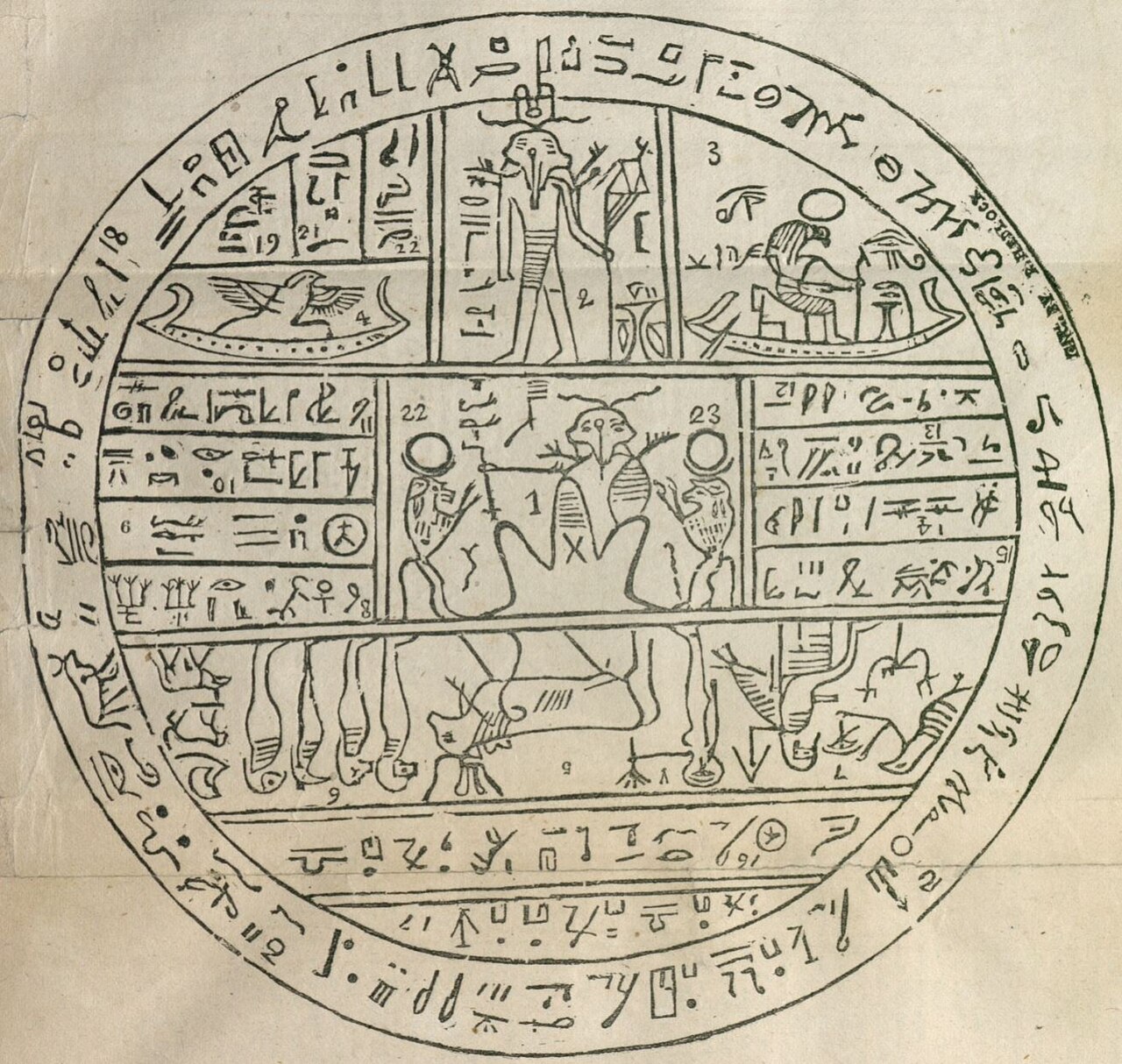
Facsimile 2 as published in the Times and Seasons, March 15, 1842 — a hypocephalus, an Egyptian funerary disc placed under the head of the deceased. PD.
Facsimile 2
Egyptian identification: A hypocephalus (Greek: "under the head") — a disc-shaped funerary object placed under the head of the deceased to provide warmth and light for the afterlife journey. Muhlestein identifies the central figure as typically representing Amun-Ra, "who is at the top of the complicated pantheon... at the center of things."
Joseph Smith's explanation: A representation of celestial cosmology, including Kolob (the star nearest to God's throne), the grand key-words of the Holy Priesthood, and various astronomical and theological concepts.
The Etymology of Kolob: The name has generated significant scholarly discussion, with two competing Semitic etymologies — both linguistically plausible, each pointing in a different direction:
| Theory | Root | Meaning | Stellar Connection |
|---|---|---|---|
| "Heart / Center" | Q-L-B (qalb), related to Q-R-B (qerev) | Heart, center, to be near | Arabic star names: Qalb al-Asad (Regulus, "Heart of the Lion"), Qalb al-Aqrab (Antares, "Heart of the Scorpion") |
| "Dog" | K-L-B (kelev) | Dog | Sirius, the "Dog Star" — brightest star in the night sky; Arabic al-Kalb; Syriac klb = Sirius |
Muhlestein favors the first: Hebrew qerev (with the common Semitic L-R consonant shift) means "the center" or "to be near," which is "exactly what Kolob is. It's the place that's nearest to God and it's at the center of everything." The root appears across multiple ancient languages — Egyptian qꜣb ("interior, midst"), Akkadian qerbum ("inside"), and Arabic qalb ("heart, core"). The pattern of naming the brightest star in a constellation its "heart" (qalb) was standard in Arabic astronomy.
The second theory, proposed as early as 1913 by James E. Homans, connects Kolob to the Semitic root K-L-B (kelev, "dog"), pointing to Sirius — the brightest star in the night sky, known in Arabic as al-Kalb and in Syriac as klb. Sirius held extraordinary significance in ancient Egypt, where it was called Sopdet (Greek: Sothis). Its annual heliacal rising (the first appearance on the eastern horizon just before dawn) signaled the beginning of the Nile flood — the event that sustained all of Egyptian civilization. The Egyptians based their calendar on this star, and the 1,460-year Sothic cycle (the time it took for the calendar to realign with the heliacal rising) was one of the most important astronomical periods in the ancient world.
Neither etymology is conclusive, and how much of Kolob's story remains encoded in these linguistic roots is unknown. What is striking is that both theories connect the name to the most important celestial objects in the ancient world — the "hearts" of the great constellations, or the brightest star in the sky that governed Egypt's entire calendar.
Explore Further: Kolob Etymology & Ancient Astronomy
- BYU Studies — "Kolob, the Governing One" — Comprehensive analysis of both etymologies with Afroasiatic root reconstruction
- Pearl of Great Price Central — "Kolob, The Governing One" — Accessible summary
- BYU Book of Mormon Onomasticon — KOLOB — Linguistic analysis of the name
- RSC — "Encircling Astronomy and the Egyptians: An Approach to Abraham 3"
- Britannica — Sothic Cycle — Sirius and the Egyptian calendar
- Britannica — Sirius — The Dog Star in ancient astronomy
Facsimile 3
Egyptian identification: A throne scene, likely from the same collection as Facsimile 1.
Joseph Smith's explanation: Abraham sitting on Pharaoh's throne, teaching the principles of astronomy to the Egyptian court (cf. Abraham 3:15; Josephus, Antiquities 1.167–168).
The key interpretive principle: Muhlestein stresses that Egyptian symbols were intentionally designed to carry multiple meanings simultaneously. A single image could represent different things depending on context, direction of reading, and the interpreter's frame of reference. Joseph Smith's explanations and Egyptological identifications need not be mutually exclusive — both can be "correct" within their respective interpretive frameworks.
John Gee's research has identified throne scenes in Egyptian art where the figures are specifically labeled as Abraham, Isaac, and Jacob — demonstrating that the association between Abrahamic patriarchs and Egyptian religious imagery was not invented by Joseph Smith but existed independently in the ancient world.
The Cosmic Journey and Temple Parallels
Muhlestein's most striking contribution may be his identification of the cosmic journey motif in Facsimile 2. The hypocephalus, he argues, maps a journey that begins at the center (God/Kolob), moves outward through creation, descends into the underworld, and returns to the divine presence — tracing a figure-eight or infinity pattern.
An audience member at Muhlestein's September 2025 lecture observed: "As you flip around in this and go around, the fixed part that doesn't move is the center... God is central." Muhlestein responded: "We begin and we end with God. That's the beginning, that's the end. We can call it the Alpha and Omega. That is where our journey starts, that is where our journey ends. That's the center of fixed point."
This cosmic journey maps directly onto the structure of Latter-day Saint temple worship:
- Leaving God's presence — The journey begins with separation from the divine
- Receiving knowledge, ordinances, and covenants along the way
- Passing through darkness and trial
- Returning to God's presence in a higher state
Muhlestein connects this to the progressive revelation Joseph Smith received: D&C 76 (degrees of glory), D&C 88 (light and truth determine where one can dwell), the Book of Abraham (degrees of holiness and the need for priesthood ordinances), and the temple endowment (May 4, 1842 — just weeks after publishing the Book of Abraham). The Book of Abraham's publication and the first endowment ceremony occurred within the same two-month window.
Abraham Traditions in Egyptian Texts
One of the most significant findings from modern Egyptology for Latter-day Saint studies is the documented presence of Abraham in Egyptian religious texts from approximately 200 BC to AD 700:
- Abraham is the most frequently mentioned mortal in Egyptian texts from this period (tied with Moses), with Jehovah being the most frequently mentioned figure overall.
- Egyptian texts contain both biblical and extra-biblical Abraham traditions — stories and associations not found in Genesis but circulating independently.
- Abraham and Osiris became interchangeable in some texts: scenes showing Osiris were adapted to show Abraham, Isaac, and Jacob. The formula "rest in the bosom of Abraham" replaced "rest in the presence of Osiris."
- An early Christian Egyptian papyrus calls Abraham "the pupil of the wedjat eye" — and the wedjat eye is connected to the hypocephalus (Facsimile 2). As Muhlestein notes, this means "we have Christian Egyptians associating this kind of drawing with Abraham, which turns out to be the case with all three facsimiles."
- Josephus independently records that Abraham taught astronomy to the Egyptians (Antiquities 1.167–168) — aligning with Abraham 3 and Facsimile 3, though Josephus had no access to the Book of Abraham.
These findings do not "prove" the Book of Abraham in a scientific sense. But they establish that the association between Abraham and Egyptian religious documents — which critics have called absurd — was actually a well-attested phenomenon in the ancient world.
Independent Corroboration
Importantly, the presence of Abraham, Moses, and Jesus in Egyptian texts is not a Latter-day Saint claim — it is documented across mainstream Egyptology, classics, and biblical scholarship:
- The Papyri Graecae Magicae (PGM) — a collection of ~600 spells, hymns, and ritual texts from Greco-Roman Egypt (2nd century BC–5th century AD) — invoke Abraham, Moses, Jesus, YHWH, Michael, and Gabriel alongside Egyptian and Greek deities. These are Egyptian documents, translated and published by Hans Dieter Betz (University of Chicago Press) — the standard reference in the field.
- The Abraham/Osiris swap is recognized in mainstream biblical scholarship. K. Grobel, writing in a non-LDS journal (JSTOR), concluded that "'Abraham' must be a Jewish substitute for the pagan god Osiris." The New Testament Studies journal (Cambridge UP) documents the same Egyptian Setne Khamwas tale that predates Jesus' Parable of Lazarus — with the poor man resting in the "bosom of Osiris" rather than the "bosom of Abraham."
- Jan Assmann's landmark Moses the Egyptian (Harvard University Press, 1997) and From Akhenaten to Moses (Oxford) document how Moses was remembered in Egyptian cultural memory — a major figure in the Egyptian-biblical intersection, treated entirely outside of LDS scholarship.
- The Harvard Theological Review has published on Christian and Jewish names in Egyptian magical texts, documenting how biblical figures were integrated into Egyptian religious practice as a matter of scholarly consensus.
Explore Further: Abraham in Egyptian Texts — Scholarly Sources
Independent (Non-LDS) Scholarship
- Betz — The Greek Magical Papyri in Translation (UChicago Press) — Standard English translation of the PGM; documents Abraham, Moses, Jesus in Egyptian magical texts
- Brill — "The Greco-Egyptian Magical Papyri" — Chapter in Guide to the Study of Ancient Magic
- Brill — "Jewish Magic in the Greek Magical Papyri" — Jewish names and formulas in Egyptian texts
- Grobel — "Abraham's Bosom" (JSTOR) — Abraham as Jewish substitute for Osiris in funerary formulas
- Cambridge — "The Rich Man and Lazarus: The Parable and the Parallels" (New Testament Studies)
- Assmann — Moses the Egyptian (Harvard UP, 1997) — Landmark work on Moses in Egyptian cultural memory
- Assmann — From Akhenaten to Moses (Oxford) — Egyptian religious change and biblical monotheism
- Harvard Theological Review — "Christian Magicians, Jewish Magical Idioms" — Shared magical culture of late antiquity
- JSTOR — "An Invocation of Chrestos in Magic" (PGM XIII.288–95) — Jesus/Christ invoked in Egyptian magical papyrus
- Harvard Theological Review — "The Egyptian Gods in Midrashic Texts"
- Cambridge UP — "The Testament of Abraham" — 1st-century Jewish work of Egyptian origin
- WHE — "The Tales of Prince Setna" — Egyptian predecessor to the Lazarus parable
LDS Scholarship
- BYU Studies — "The Ancient Egyptian View of Abraham" (Muhlestein) — Survey of the Abraham corpus in Egyptian texts
- RSC — "The Egyptian View of Abraham" (Muhlestein)
- BYU Studies — "Abraham and Osiris" (Smoot, Gee, Muhlestein & Thompson, 2022)
- Gee — "Abracadabra, Isaac and Jacob" (1995)
- Gee & Muhlestein — "An Egyptian Context for the Sacrifice of Abraham" (JBMS, 2011)
The Joseph Smith Papyri: What Survives
After Joseph Smith's death, the papyri passed through several hands:
- Lucy Mack Smith displayed the mummies and papyri for income until her death.
- Emma Smith sold them to Abel Combs shortly after Lucy's death.
- Combs sold the two scrolls and two mummies to the St. Louis Museum, which later sold them to a Chicago museum. These were destroyed in the Great Chicago Fire of 1871.
- Combs gave papyrus fragments to his housekeeper Charlotte Weaver, whose daughter Alice Heusser eventually sold them to the Metropolitan Museum of Art in 1947.
- In the 1960s, an Egyptian Coptic scholar named Aziz S. Atiya, working at the Met, recognized the papyri from a copy of the Book of Abraham. Through his friendship with N. Eldon Tanner, the Met donated the papyri to the Church.
The surviving fragments (designated JSP 1–11) include portions of Hor's Book of Breathings (JSP 1, 10, 11) and Tasherit-Min's Book of the Dead (JSP 2–9). The longer scrolls — estimated at approximately 42 feet based on John Gee's mathematical formula for calculating scroll length from visible creases — were lost in the Chicago fire.
What we don't know: The relationship between the surviving fragments and the text of the Book of Abraham remains debated. Were the longer scrolls (now lost) the source of the Book of Abraham text? Was the translation by direct revelation rather than from a specific papyrus passage? Was there additional Abraham material beyond what was published? These questions remain open. Muhlestein emphasizes that certainty on these points is a "matter of faith" in either direction.
Key LDS Scholars and Their Work
| Scholar | Contribution |
|---|---|
| Hugh Nibley | The Message of the Joseph Smith Papyri: An Egyptian Endowment (2nd ed. with Gee & Rhodes); Abraham in Egypt. Pioneer of LDS Egyptological scholarship; identified temple parallels in Egyptian funerary literature. |
| John Gee | An Introduction to the Book of Abraham (2017). Scroll-length calculations, "Book of Fellowship" translation for Book of Breathings, identification of Abraham/Isaac/Jacob in Egyptian throne scenes. |
| Michael Rhodes | Hypocephalus research; updated Nibley's Message of the Joseph Smith Papyri; co-presented with John Welch on numerical sequences in Facsimile 2. |
| Kerry Muhlestein | BYU Egyptologist. Research on Abraham traditions in Egyptian texts (200 BC–AD 700), the cosmic journey in Facsimile 2, symbol literacy, and the historical context of the papyri. September 2025 lecture series providing detailed papyri history and facsimile analysis. |
| Stephen Smoot | "On the Book of the Dead as a Temple Text and Its Implications" (Interpreter). Research on the Book of the Dead's ritual/temple dimensions and their relevance to LDS temple theology. |
Pearl of Great Price Connections
The Book of Abraham, published as part of the Pearl of Great Price, contains material that connects to Egyptian civilization at multiple levels:
- Abraham 1: Abraham in Ur and Egypt; idolatrous priests; human sacrifice; the plain of Olishem; Egyptian gods worshipped in Chaldea. The description of Egyptian religious practices spreading beyond Egypt's borders is historically plausible — Egyptian religious influence extended throughout the Levant during the Middle and New Kingdoms.
- Abraham 2: The Abrahamic covenant; the promise of priesthood and land; Abraham's journey into Egypt. Josephus and other ancient sources independently attest to Abraham's time in Egypt as a period of teaching and cultural exchange.
- Abraham 3: Cosmological revelation — Kolob, the hierarchy of stars, the pre-mortal council. The astronomical knowledge Abraham receives is consistent with the ancient Near Eastern interest in celestial observation that both Mesopotamian and Egyptian civilizations demonstrated.
- The Facsimiles: Three Egyptian illustrations with explanations that engage directly with Egyptian religious imagery while providing a distinct Abrahamic/Latter-day Saint interpretation.
In his September 2025 lecture, Muhlestein displayed a timeline tracing the papyri's improbable journey — from a Theban tomb through Napoleon's invasion of Egypt (which opened the country to European antiquarians), to Lebolo's excavation, to a shipping company in Trieste, to a traveling exhibitor in America who happened to know Heber C. Kimball's cousin, to Kirtland at the precise moment Joseph Smith was there to receive them. Quoting John A. Widtsoe's observation that "the hand of God has overruled the actions of mankind that nothing is done except as the Lord may use it for the accomplishment of his mighty purposes," Muhlestein concluded:
"I think this map tells that story. This is God using everything from the invasion of Egypt by Napoleon to having Chandler know Heber C. Kimball's cousin to get these things to Joseph Smith."
— Kerry Muhlestein, September 2025 lecture on the Book of Abraham
An Ongoing Conversation
The study of the Book of Abraham and its Egyptian context is not a closed case in either direction. Muhlestein acknowledges the limits of current understanding: "We don't understand [hypocephali] very well." Thomas Mekis's doctoral dissertation on hypocephali (ELTE Budapest) (recently translated to English) has advanced the field significantly, and new discoveries continue to refine scholarly understanding.
What is clear is that the Egyptian world from which the Joseph Smith Papyri emerged was one where Abraham traditions circulated widely, where funerary texts encoded cosmic journeys remarkably similar to temple theology, and where religious symbolism operated with a richness and multiplicity that modern readers are only beginning to recover.
For Latter-day Saint scripture students, Egypt is not merely an ancient backdrop. It is the civilization whose priests preserved Abraham's name in their texts, whose scribes created the papyri that would reach a prophet in Ohio, and whose religious traditions — understood in their full complexity — illuminate rather than undermine the claims of the Pearl of Great Price.
Sources Cited in This Section
- Kerry Muhlestein, lecture series on the Book of Abraham, Springville, Utah, September 11–13, 2025. Three sessions covering the papyri journey, translation evidence, Egyptian funerary literature, Facsimile 2 / hypocephalus analysis, and temple connections. See also: Let's Talk About the Book of Abraham (Deseret Book, 2022); "Egyptian Papyri and the Book of Abraham: A Faithful, Egyptological Point of View" in No Weapon Shall Prosper (RSC/Deseret Book, 2011).
- John Gee, An Introduction to the Book of Abraham (RSC/Deseret Book, 2017) — scroll-length calculations, "Book of Fellowship," identification of Abraham/Isaac/Jacob in Egyptian throne scenes.
- Hugh Nibley, The Message of the Joseph Smith Papyri: An Egyptian Endowment, 2nd ed. with John Gee & Michael Rhodes (FARMS, 2005); Abraham in Egypt (FARMS, 2000).
- Stephen O. Smoot, "The Book of the Dead as a Temple Text and the Implications for the Book of Abraham," Interpreter: A Journal of Latter-day Saint Faith and Scholarship 47 (2021): 1–38.
- The Church of Jesus Christ of Latter-day Saints, "Translation and Historicity of the Book of Abraham" (Gospel Topics Essay).
- Thomas Mekis, Hypocephali, doctoral dissertation, ELTE Budapest (Eötvös Loránd University), 2012.
Explore Further: Scholarly Research on the Joseph Smith Papyri
Primary & Institutional Sources
- Joseph Smith Papers — Introduction to Egyptian Papyri, c. 300–100 BC — Authoritative overview of the surviving fragments, their dating, and their identification
- Gospel Topics Essay — Translation and Historicity of the Book of Abraham — Official Church treatment of the translation questions
- Gospel Topics — Book of Abraham — Overview of origins and content
The Papyri & Their Provenance
- BYU Studies — "Joseph Smith and the Lebolo Egyptian Papyri" — The journey from Thebes to Trieste to Kirtland
- BYU Studies — "What Egyptian Papyri Did Joseph Smith Possess?" — Inventory and identification of all known fragments
- RSC — "Historical Overview" — Full provenance narrative from An Introduction to the Book of Abraham
- RSC — "The Contents of the Joseph Smith Papyri" — What each fragment contains (Hor's Book of Breathings, Tasherit-Min's Book of the Dead, Nefer-ir-nebu)
- RSC — "Joseph Smith and the Papyri" — The relationship between the physical documents and the translation
The Book of Breathings & Egyptian Funerary Context
- Maxwell Institute — "The Hor Book of Breathings" — The earliest known manuscript of this funerary text
- BYU Studies — "What Is 'The Book of Breathings'?" — Genre, purpose, and Egyptological context
- RSC — "Egyptian Papyri and the Book of Abraham: Some Questions and Answers"
Interpretation & Historiography
- Interpreter — "Assessing the Joseph Smith Papyri" — Comprehensive historiography of acquisitions, translations, and interpretations
- BYU Studies — "The Relationship between the Book of Abraham and the Joseph Smith Papyri"
- Pearl of Great Price Central — "What Egyptian Papyri Did Joseph Smith Possess?"
BYU Studies, the Religious Studies Center, the Maxwell Institute, and Interpreter are peer-reviewed LDS academic publications. The Joseph Smith Papers is an official Church historical project. Pearl of Great Price Central provides accessible research summaries.
Explore Further: World History Encyclopedia
- Egyptian Book of the Dead
- Egyptian Papyrus
- Abraham, the Patriarch
- Egyptian Hieroglyphs
- Osiris
- The Negative Confession
World History Encyclopedia is a nonprofit, peer-reviewed reference (CC BY-NC-SA 4.0).