Multicultural Networks
The ancient Near East was a web of trade, diplomacy, and cultural exchange — and Egypt sat at its center
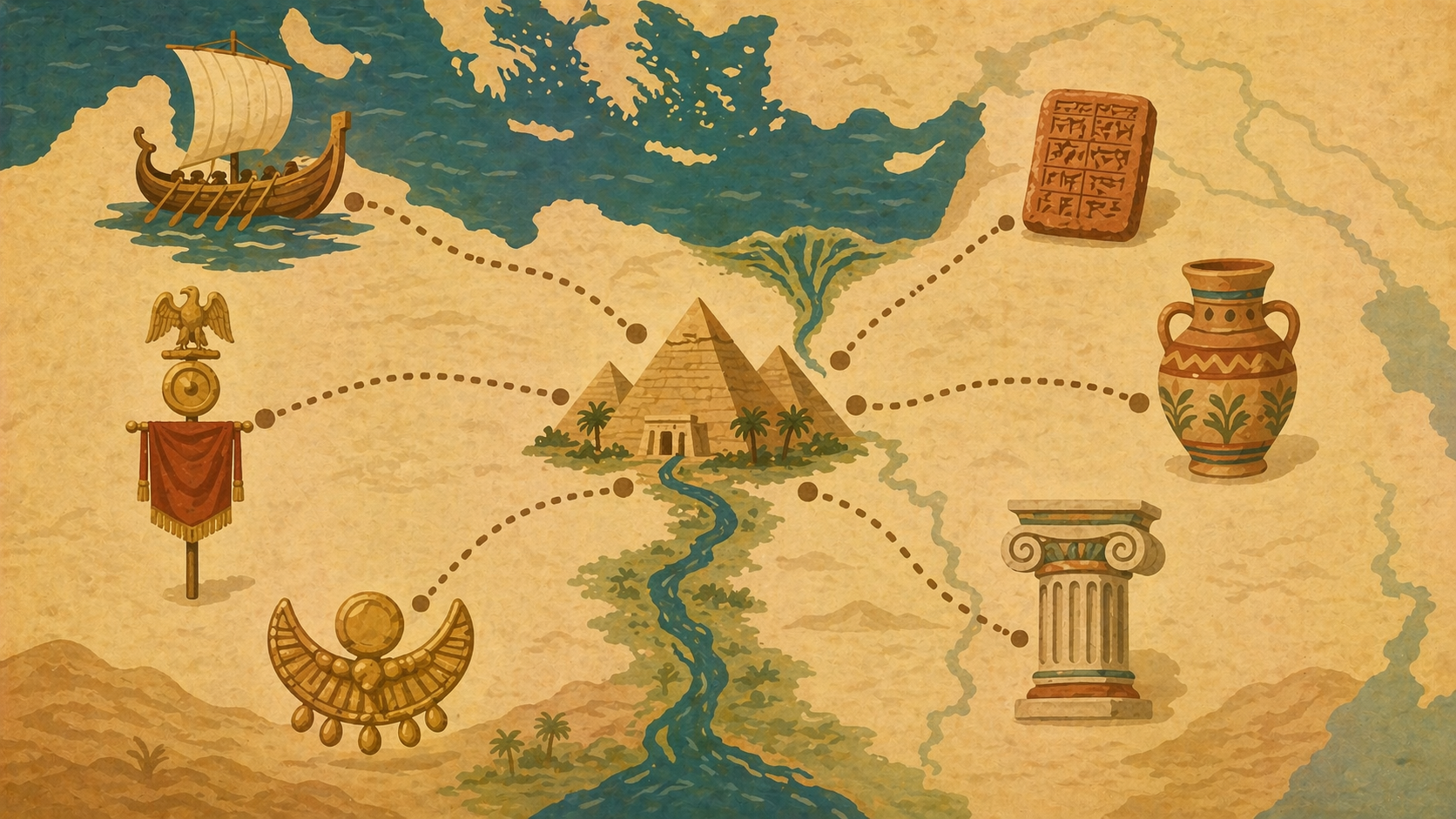
One of the most common misconceptions about the ancient world is that civilizations existed in isolation. The reality was the opposite. Egypt was deeply interconnected with every major civilization in the Mediterranean and Near East through trade, diplomacy, war, immigration, and cultural exchange. Understanding these connections is essential for reading the biblical text, which unfolds in a world where Egyptian, Canaanite, Mesopotamian, Hittite, and eventually Greek and Roman cultures constantly intersected.
Egypt and Canaan: The Closest Neighbors
The relationship between Egypt and Canaan was ancient and continuous. The overland route between them — the Via Maris ("Way of the Sea"), running along the Mediterranean coast through Gaza, Joppa, Megiddo, and onward to Damascus — was one of the most traveled roads in the ancient world.
- Egyptian control: During the New Kingdom, Egypt ruled Canaan as a vassal territory. Egyptian governors, garrisons, and administrative centers dotted the landscape. The Merneptah Stele (c. 1208 BC) — which mentions "Israel" for the first time outside the Bible — was carved in the context of an Egyptian military campaign into Canaan.
- Canaanite migration: Canaanites (including the Hyksos) migrated into the Nile Delta in significant numbers. Egyptian texts document Asiatic servants, laborers, and even high officials of Semitic origin. The Beni Hasan painting shows such a group arriving peacefully.
- Cultural exchange: Egyptian objects appear at Canaanite sites; Canaanite pottery appears in Egypt. The Phoenician alphabet — which became the ancestor of the Greek, Latin, and ultimately modern Western alphabets — was derived from Egyptian hieroglyphic prototypes, simplified through Canaanite scribal innovation.
- Religious interaction: Canaanite gods (Baal, Astarte, Resheph) were adopted into the Egyptian pantheon during the New Kingdom, particularly among soldiers and workers in the Delta. Egyptian religion likewise influenced Canaanite practice.
Biblical context: The patriarchs (Abraham, Isaac, Jacob, Joseph) moved freely between Canaan and Egypt. This was not unusual — Semitic peoples had been making this journey for centuries before the patriarchs, and the cultural exchange between the two regions was deep and continuous. The Israelites did not enter a foreign world when they went to Egypt; they entered a world that already had extensive Semitic connections.
The Amarna Letters: A Window into International Diplomacy
The most vivid evidence of Egypt's international connections comes from the Amarna Letters — an archive of approximately 382 clay tablets discovered at Akhenaten's capital city of Amarna. Dating to roughly 1350–1330 BC, these tablets are diplomatic correspondence written in Akkadian cuneiform (the lingua franca of international diplomacy, much as English is today) between the Egyptian pharaoh and rulers throughout the Near East.
The letters reveal:
- Great Power diplomacy: Egypt corresponded as an equal with Babylonia, Assyria, Mitanni, and the Hittite empire. They exchanged gifts, arranged marriages, and negotiated alliances.
- Vassal relationships: Canaanite city-state rulers wrote as subordinates, begging for Egyptian military assistance against rivals and invaders. These letters paint a picture of Canaan as a fractured, constantly contested landscape — exactly the world the Israelites would later enter.
- The Habiru: Several Amarna Letters mention a troublesome group called the Habiru (or Apiru) causing disruption in Canaan. Whether these Habiru are connected to the biblical "Hebrews" remains one of the most debated questions in biblical archaeology. The term may refer to a social class (outsiders, mercenaries, displaced people) rather than an ethnic group, but the linguistic similarity has generated extensive scholarship.
- Material exchange: The letters document the exchange of gold, lapis lazuli, chariots, horses, textiles, and even physicians between courts. The ancient Near East was a web of trade and mutual dependency.
Egypt and the Hittites: Rivals and Partners
The Hittite Empire of Anatolia (modern Turkey) was Egypt's greatest rival during the New Kingdom. The two empires competed for control of Syria and the Levant — the territory between them that included Canaan.
The climax was the Battle of Kadesh (c. 1274 BC) between Ramesses II and the Hittite king Muwatalli II — the best-documented battle of the ancient world. Both sides claimed victory. The conflict eventually produced the Treaty of Kadesh (c. 1258 BC) — the oldest known peace treaty between sovereign nations, copies of which survive in both Egyptian (on the walls of Karnak) and Hittite (on clay tablets from Hattusa) versions. A reproduction hangs in the United Nations headquarters in New York.
The treaty led to diplomatic marriages and decades of peace. Ramesses II married a Hittite princess, and correspondence between the two courts became cordial. This Egyptian-Hittite detente coincided roughly with the period of the Exodus (on the late-date chronology), meaning the broader geopolitical context of the Israelites' departure was one of relative international stability.
Egypt and Nubia/Kush: The Southern Connection
Egypt's relationship with Nubia (modern Sudan) was among its oldest and most complex:
- Trade: Nubia was Egypt's primary source of gold (the Egyptian word for gold, nub, may be the origin of the name "Nubia"), along with ivory, ebony, incense, exotic animals, and enslaved people.
- Military campaigns: Egyptian pharaohs from the Old Kingdom onward launched campaigns into Nubia. The New Kingdom pharaohs built fortresses along the Nile between the first and fourth cataracts, and Abu Simbel's massive statues were designed partly to overawe the Nubian population.
- The 25th Dynasty: In the 8th–7th centuries BC, the tables turned. Kushite kings from Nubia conquered Egypt and ruled as the 25th Dynasty, worshipping Amun more devoutly than some native Egyptian pharaohs. The Kushite pharaoh Taharqa is the "Tirhakah king of Ethiopia" mentioned in 2 Kings 19:9 and Isaiah 37:9, who marched against the Assyrian king Sennacherib.
- Cultural exchange: Nubian/Kushite civilization adopted Egyptian religious practices, built pyramids (more than 200 at Meroe alone — more than in Egypt itself), and wrote in Egyptian-derived scripts. The Kingdom of Kush survived until c. AD 350, long after the pharaonic tradition had ended in Egypt.
Egypt and Mesopotamia: The Great Powers
Egypt and Mesopotamia were the two great poles of the ancient Near East — and the land of the Bible lay between them. Abraham's journey from Ur in Mesopotamia to Canaan to Egypt traces the arc of this geographic and cultural axis.
- Diplomatic exchange: The Amarna Letters show regular correspondence between Egypt and Babylon. Diplomatic marriages were common — Amenhotep III married a Babylonian princess.
- Literary influence: Egyptian wisdom literature (like the Instruction of Amenemope) shows parallels with Mesopotamian works, and both traditions influenced biblical Proverbs and Ecclesiastes. The creation accounts in Genesis show awareness of both Egyptian (creation by divine speech) and Mesopotamian (Enuma Elish) traditions.
- Competing empires: In the late 7th century BC, the fall of Assyria created a power vacuum that both Egypt and Babylon tried to fill. Pharaoh Necho II marched north to support the remnant of Assyria against rising Babylon; King Josiah of Judah tried to intercept him at Megiddo and was killed (2 Kings 23:29; 2 Chronicles 35:20–24). Babylon ultimately won, conquered Jerusalem, and destroyed the Temple in 586 BC — sending Jeremiah's refugees fleeing to Egypt.
Egypt and the Aegean: Minoans, Mycenaeans, and the Sea Peoples
Egyptian art and texts document contact with Minoan Crete and the broader Aegean world from at least the Middle Kingdom. The Minoans (called Keftiu by the Egyptians) appear in tomb paintings carrying distinctive vessels and wearing characteristic clothing. Trade goods from Crete appear at Egyptian sites, and Egyptian objects appear on Crete. For centuries, the Minoans dominated Mediterranean maritime trade, their powerful navy controlling the sea routes that connected Egypt, the Levant, and the Aegean.
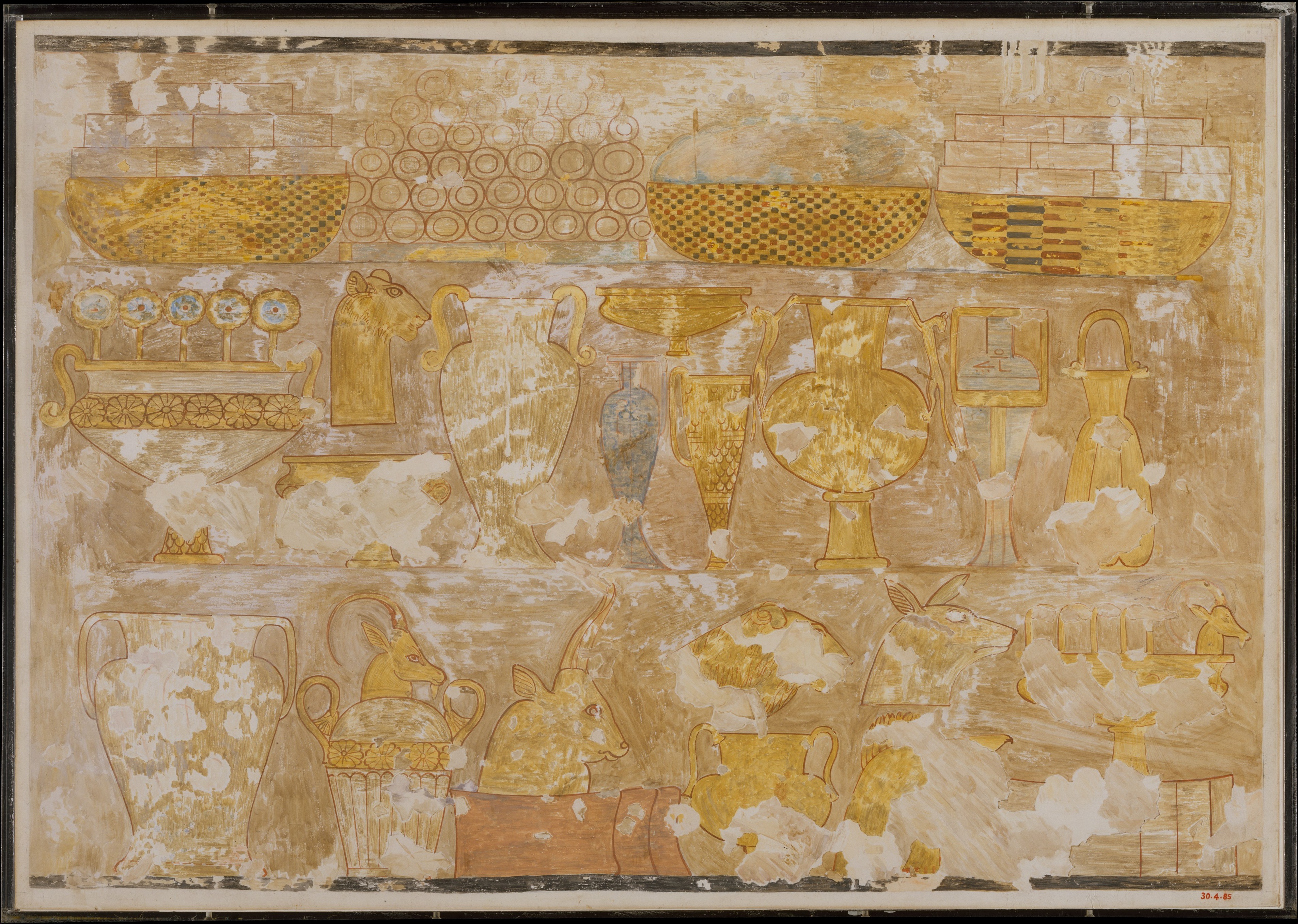
Keftiu (Minoan) tribute bearers carrying distinctive vessels, from the Tomb of Rekhmire at Thebes (c. 1479–1425 BC). The Minoans are shown in their characteristic clothing and hairstyles, bearing gifts that include the bull-headed vessels (rhyta) typical of Minoan craftsmanship. Facsimile by Nina de Garis Davies. Metropolitan Museum of Art, CC0.
The Collapse of Minoan Civilization
Sometime between 1650 and 1550 BC (the exact date is debated), the volcanic eruption of Thera (modern Santorini) — one of the most catastrophic natural disasters in recorded history — devastated the island and generated massive tsunamis that struck the northern coast of Crete. The eruption did not destroy Minoan civilization outright — Knossos and other palaces continued to function, and trade even expanded briefly afterward. But recent network modeling by Knappett, Rivers & Evans (Antiquity, 2011) has shown that the loss of Thera as a critical maritime hub gradually increased transport costs across the Aegean, reducing trade routes over time and fatally weakening the economic network that sustained Minoan power.
Approximately a century later (c. 1450 BC), the mainland Mycenaeans exploited this weakness. They seized control of Knossos, replaced Linear A with their own script (Linear B), and took over the trade routes that had once been dominated by the Minoans. Eventually the Mycenaeans controlled the island of Crete itself. The Minoan civilization — which had been the major merchant hub for much of the ancient world — collapsed under Mycenaean domination, replaced by a hybrid Minoan-Mycenaean culture that lasted until around 1100 BC.
The consequences rippled outward over centuries. The disruption of established trading networks that had maintained stability across the eastern Mediterranean contributed to growing instability throughout the Aegean. Combined with other factors — climate change, drought, internal social upheaval, and the migrations of displaced peoples — this long-term destabilization was among the forces that eventually produced the catastrophic Bronze Age Collapse around 1200 BC.
The "Sea Peoples" and the Bronze Age Collapse
Around 1200 BC, Egyptian records describe attacks by groups they called the "Sea Peoples". Ramesses III repelled their invasion of Egypt (c. 1178 BC, depicted in dramatic reliefs at Medinet Habu) and recorded the names of the groups he defeated: the Peleset, Tjeker, Shekelesh, Denyen, and Weshesh. Earlier pharaohs had encountered others — the Sherden, Lukka, Ekwesh, and Teresh.
These were not a single people. Scholars have tentatively identified them as displaced populations from across the Mediterranean:
| Egyptian Name | Proposed Identification | Probable Origin |
|---|---|---|
| Peleset | Philistines | Crete / Aegean |
| Denyen | Danaans (Homeric Greeks) | Greece |
| Ekwesh | Achaeans (Bronze Age Greeks) | Greece |
| Shekelesh | Siculi | Sicily |
| Sherden | Sardinians | Sardinia |
| Lukka | Lycians | Southwest Anatolia |
| Teresh | Tyrrhenians (proto-Etruscans) | Anatolia / Italy |
The older scholarly view treated the Sea Peoples as coordinated invaders who destroyed civilizations. Current research, particularly Eric Cline's influential 1177 B.C.: The Year Civilization Collapsed (Princeton, 2014/2021), presents a very different picture: the Sea Peoples were a symptom of the collapse, not its cause. They were displaced populations — pushed into motion by the same cascading crises that were destroying the civilizations they encountered.
Cline identifies a "perfect storm" of five converging catastrophes: climate change and prolonged drought, harvest failure and famine, a sequence of devastating earthquakes, internal rebellions against palace economies, and the migrations of displaced peoples. These factors struck in rapid succession between roughly 1225 and 1175 BC. The deeply interconnected Bronze Age trade network — the same system that had made these civilizations wealthy — became the mechanism of their collapse, as the failure of each node stressed others in a cascading domino effect. Notably, inland empires untouched by seafaring raiders (Kassite Babylonia, Elam, Assyria) also declined during this period, confirming that the Sea Peoples alone cannot explain the collapse.
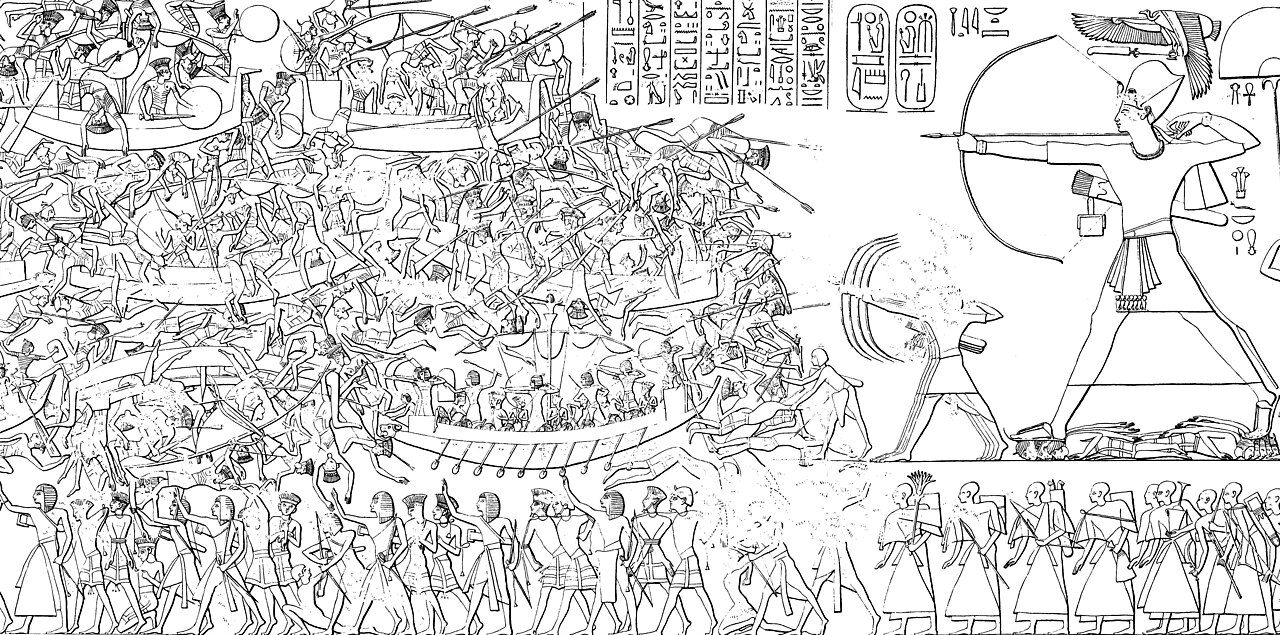
Ramesses III's victory over the Sea Peoples (c. 1178 BC), depicted on the walls of Medinet Habu. Egypt survived; most of the eastern Mediterranean did not. Drawing: Wikimedia Commons, CC-BY-SA 3.0.
Explore Further: The Sea Peoples & the Bronze Age Collapse
- Cline — 1177 B.C.: The Year Civilization Collapsed (Princeton, revised 2021) — Definitive treatment of the systems-collapse theory
- Cline — After 1177 B.C.: The Survival of Civilizations (Princeton, 2024) — What survived and how
- WHE — Interview with Eric Cline — Accessible summary of the "perfect storm" theory
- WHE — Sea Peoples
- WHE — Bronze Age Collapse
- Britannica — Sea People — Named groups and proposed identifications
- JSTOR — "Sea Peoples Up-to-Date" — Academic volume on current research
- Cambridge — "Migration Myths and the End of the Bronze Age" — Critical reassessment of the invasion narrative
What Rose from the Collapse
The Philistines — Israel's persistent adversaries in the books of Judges and Samuel — are widely identified as descendants of the Mycenaean-Cretan world. They were among the Sea Peoples groups (the Egyptian Peleset) who settled on the southern Canaanite coast after being repelled from Egypt. Archaeological evidence from Philistine sites (Ashkelon, Ekron, Gath) shows 13th-century Mycenaean-style pottery, Aegean temple designs, and Mycenaean loom weights in their earliest levels. The Bible itself may preserve this connection: Amos 9:7 and Jeremiah 47:4 associate the Philistines with Caphtor — a name linguistically related to the Egyptian Keftiu, the same word used to describe the Minoan tribute bearers in the tomb paintings above. Both names point to Crete and the Aegean world.
The Greek Dark Age and the Gift of the Alphabet
For the Aegean world, the collapse was catastrophic. Homer's Iliad — the story of the Trojan War — may preserve a cultural memory of the final convulsions of the Mycenaean age, when Greek-speaking warriors besieged and destroyed the Anatolian city of Troy. But the Mycenaeans did not survive their own victories. Within a generation of Troy's fall, the Mycenaean palace system itself collapsed, plunging the Greek world into what scholars call the Greek Dark Age (c. 1100–800 BC).
The losses were staggering. The advanced literacy that the Minoans had developed (Linear A) and that the Mycenaeans had adapted (Linear B) vanished entirely. Monumental architecture ceased. Long-distance trade contracted. Populations declined. For roughly three centuries, the Greek communities appear to have forgotten how to read and write — a stark measure of how thoroughly the Bronze Age Collapse dismantled the civilizations it touched.
It was the Phoenicians who reignited Greek civilization. Having filled the maritime void left by the Minoan and Mycenaean collapse, the Phoenician cities of Tyre, Sidon, and Byblos — which had traded with the Minoans as far back as 1950 BC — re-established long-distance Mediterranean commerce by the 10th century BC, and may have drawn on surviving craft traditions and trade knowledge from the earlier Aegean networks. Around 800 BC, the Greeks adopted the Phoenician alphabet — adding vowels to create the Greek alphabet, the first fully phonetic writing system in history. This single act of cultural transmission ignited the Greek reemergence: Homer's epics were written down, philosophy was born, and the civilization that would produce Plato, Aristotle, and the Septuagint began its extraordinary ascent. Where the Minoans had once dominated, the Phoenicians had stood — and through them, the Greeks rose again.
For Latter-day Saint readers: The Bronze Age Collapse is not merely ancient geopolitics — it is the event that opened the Promised Land. For centuries, Canaan had been under the firm control of Egypt and its network of vassal kings. The Hittites dominated the north. The Mycenaean trade network linked the coasts. As long as these great powers held, no tribal confederation could have taken and held the land.
But when the system collapsed — when Egypt withdrew its garrisons, the Hittite Empire vanished, the coastal cities burned, and the established power structures disintegrated — a power vacuum opened across the very territory God had promised to Abraham's descendants. The Israelites entered Canaan not into a thriving empire but into a fractured landscape of weakened city-states, exactly the conditions in which a covenant people led by Joshua could take possession of the land (Joshua 1:2–4). The timing was not coincidental — it was providential.
Trade Routes: The Arteries of the Ancient World
Three major trade routes connected Egypt to its neighbors and funneled goods, people, and ideas across the ancient Near East:
| Route | Path | Significance |
|---|---|---|
| Via Maris ("Way of the Sea") | Egypt → Gaza → Joppa → Megiddo → Hazor → Damascus | The main coastal route; the road armies marched on and merchants traveled; referenced in Isaiah 9:1 ("the way of the sea") |
| King's Highway | Gulf of Aqaba → Edom → Moab → Ammon → Damascus | The inland route through Transjordan; referenced in Numbers 20:17; the road Moses asked to travel through Edom |
| Incense Route | Southern Arabia (Sheba/Saba) → Petra → Gaza → Egypt/Mediterranean | Carried frankincense, myrrh, and spices from Arabia; made Nabatean Petra wealthy; connected to the Queen of Sheba's visit to Solomon |
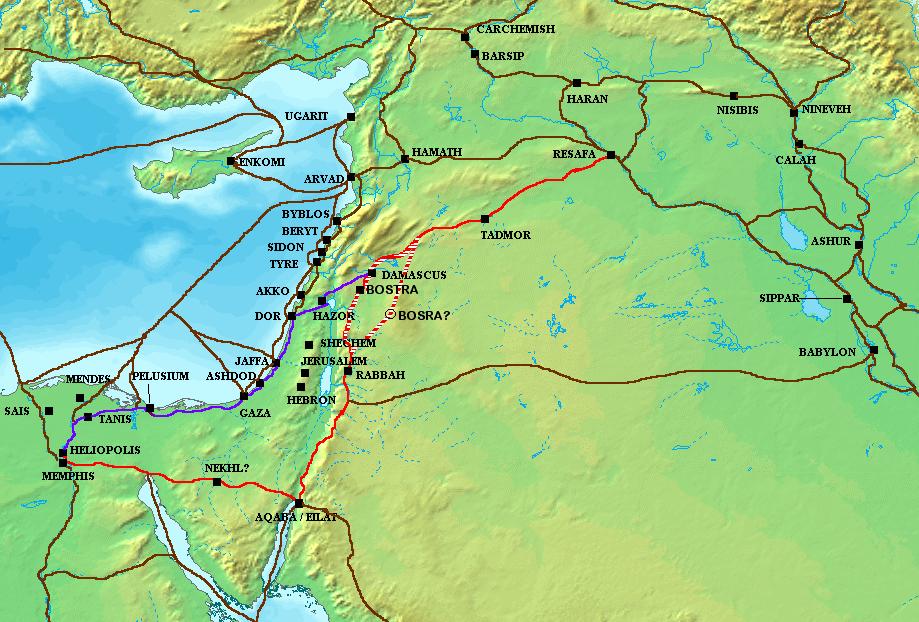
The Via Maris (purple) and King's Highway (red), c. 1300 BC. Israel sat at the intersection of every major route connecting Africa, Asia, and the Mediterranean. Wikimedia Commons, CC BY-SA 3.0.
The land of Israel sat at the intersection of all three routes. This made it strategically crucial — every empire that wanted to control trade between Africa, Asia, and the Mediterranean needed to control Canaan. It also explains why Israel was constantly caught between competing empires: Egypt to the southwest, Mesopotamia to the northeast, and everyone traveling through the middle.
These routes were already ancient when Abraham walked them — the Via Maris dates to the Early Bronze Age (3000+ BC). Centuries later, when the Han Dynasty's envoy Zhang Qian opened overland trade with China around 114 BC, the famous Silk Road did not create a new western network — it extended the existing one. The Silk Road's western terminus was Antioch in the Levant, and goods flowing west from China connected into the same Via Maris, King's Highway, and Incense Route corridors that had been carrying trade for two millennia. The strategic importance of the Levant — and of Israel's position at its crossroads — only intensified as the network grew.
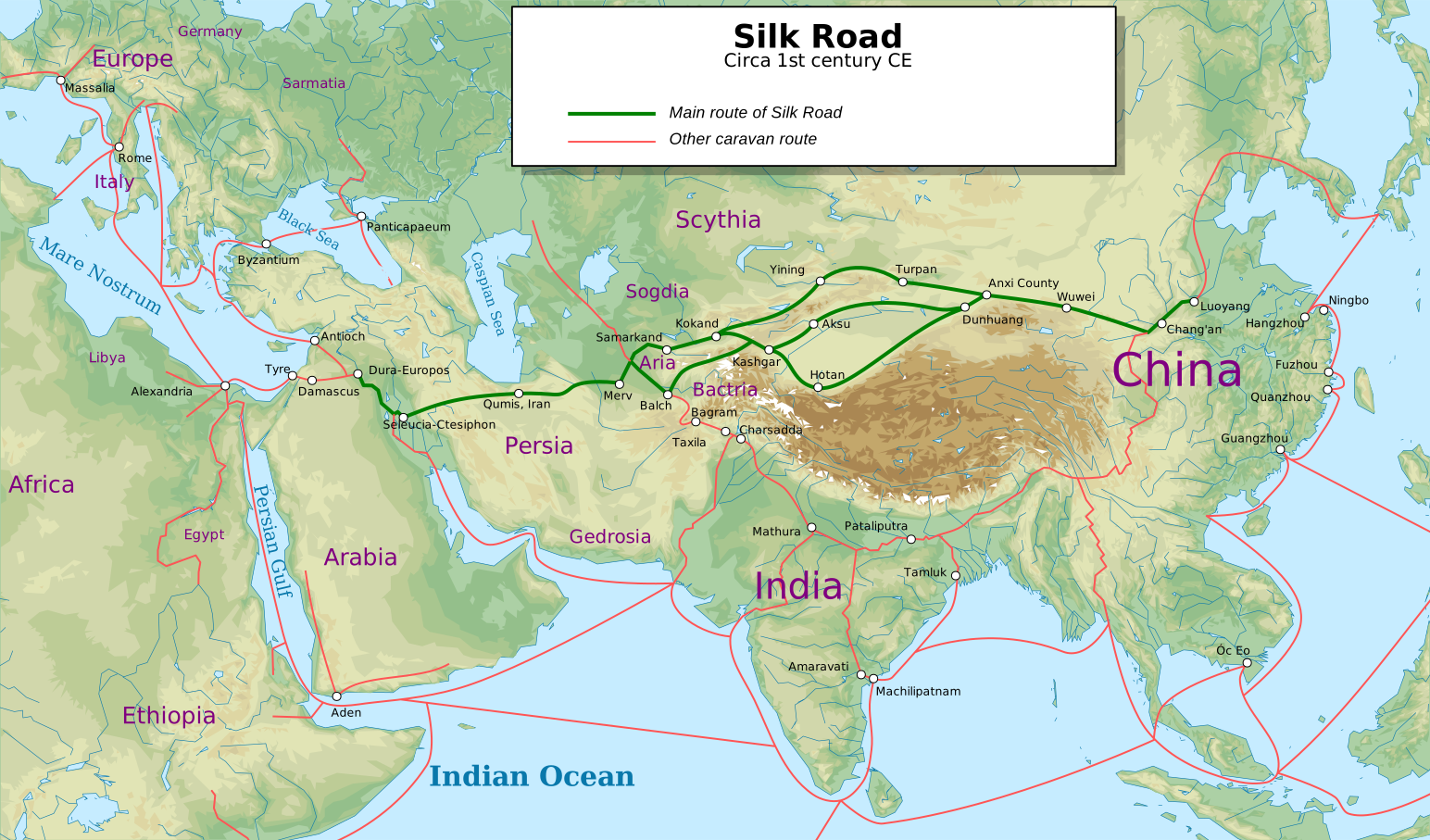
The Silk Road in the 1st century AD. The eastern extension connected into the same Levantine corridors — the Via Maris, King's Highway, and Incense Route — that had been carrying trade since the Bronze Age. Wikimedia Commons, CC BY-SA 3.0.
The covenant land's geography: It is no accident that God placed His covenant people at the crossroads of the ancient world. The land of Israel was not a remote backwater — it was the most strategically important strip of territory in the entire Near East. Every army that marched between Egypt and Mesopotamia passed through it. Every trade caravan between Arabia and the Mediterranean crossed it. The covenant people were placed where they could not avoid encountering the nations — and where the nations could not avoid encountering them.
The Hellenistic and Roman Melting Pot
After Alexander's conquest (332 BC), Egypt became part of a vast multicultural world that stretched from Greece to India. Under the Ptolemies and then the Romans, Alexandria in particular became a city where Egyptian priests, Greek philosophers, Jewish scholars, Persian merchants, Nubian traders, and eventually Christian monks all lived within the same walls.
This multicultural environment produced:
- The Septuagint — Jewish scripture translated into Greek
- Philo's philosophy — Jewish theology expressed in Greek philosophical terms
- Serapis — A deity deliberately designed to bridge Egyptian and Greek religion
- The Isis cult — Egyptian religion adapted for a Mediterranean audience, becoming one of the most popular religious movements in the Roman Empire
- The Joseph Smith Papyri — Egyptian funerary documents created in an era when Egyptian, Greek, and Jewish religious traditions were actively interacting and borrowing from one another
Kerry Muhlestein's observation that Abraham, Moses, and Jehovah appear as the most frequently mentioned biblical figures in Egyptian texts from 200 BC to AD 700 is a direct product of this multicultural environment. The Ptolemaic and Roman periods were an era of unprecedented religious mixing, where Egyptian priests could incorporate Israelite patriarchs into their texts and Jewish thinkers could read Moses through the lens of Plato.
Explore Further: World History Encyclopedia
- Amarna Letters
- Canaan
- Phoenicia
- The Hittites
- Kingdom of Kush
- Minoan Civilization
- Sea Peoples
- Bronze Age Collapse
- Philistines
- Trade in the Phoenician World
World History Encyclopedia is a nonprofit, peer-reviewed reference (CC BY-NC-SA 4.0).
← Previous: Major Sites | Egypt Guide Home | Next: LDS Connections →