Written Records About Egypt
What the ancient historians, philosophers, and scribes tell us — and where their accounts agree and disagree
Our knowledge of ancient Egypt comes from two types of sources: the Egyptians' own records (hieroglyphic inscriptions, papyri, tomb paintings) and the accounts written by outsiders — Greeks, Romans, and Jews who visited, studied, or lived in Egypt. Both types are essential, and both have limitations. The Egyptian records are vast but often propagandistic; the foreign accounts are more analytical but filtered through their authors' biases and agendas.
For biblical scholars and Latter-day Saints, several of these ancient writers are particularly important because they document the intersection of Jewish and Egyptian history.
The Sources at a Glance
| Writer | Date | What They Wrote |
|---|---|---|
| Manetho | c. 280 BC | Egyptian priest; wrote the Aegyptiaca, the foundation of Egyptian dynastic chronology |
| Herodotus | c. 440 BC | Greek historian; Book 2 of the Histories is the earliest extended Greek account of Egypt |
| Diodorus Siculus | c. 60–30 BC | Greek historian; Book 1 of the Bibliotheca Historica covers Egypt extensively |
| Strabo | c. 24 BC (visit) | Greek geographer; Book 17 of the Geography describes Egypt from firsthand observation |
| Philo of Alexandria | c. 20 BC–AD 50 | Jewish philosopher; theological works, plus firsthand accounts of the AD 38 pogrom |
| Josephus | c. AD 37–100 | Jewish historian; Antiquities and Against Apion extensively discuss Egypt and its Jewish communities |
| Book of Jubilees | c. 160–150 BC | Jewish pseudepigraphic work retelling Genesis–Exodus with added details about Egypt |
Manetho — The Egyptian Priest Who Organized History
c. 280 BC
Manetho was an Egyptian priest from Sebennytos in the Nile Delta who wrote a history of Egypt in Greek, the Aegyptiaca, during the reign of Ptolemy II Philadelphus. His work is the foundation of Egyptian chronology — he organized Egypt's rulers into thirty dynasties, a framework that Egyptologists still use today.
The original text is lost. We know Manetho's work only through excerpts preserved by later writers, especially Josephus (Against Apion), the Christian chronographer Eusebius, and the Byzantine historian George Syncellus. These excerpts sometimes contradict each other, making reconstruction difficult.
Manetho's account of the Hyksos (which Josephus quoted extensively in Against Apion) is one of our most important non-biblical sources for the period associated with Joseph and the early Israelite presence in Egypt. He described the Hyksos as foreign invaders who seized Egypt without a battle, destroyed temples, and treated the population cruelly — though modern archaeology has shown this picture was heavily colored by Egyptian nationalist sentiment.
Herodotus — "The Father of History"
c. 484–425 BC
Herodotus of Halicarnassus visited Egypt around 440 BC, during the Persian period. Book 2 of his Histories is devoted entirely to Egypt and remains the earliest extended Greek description of the civilization. He describes the pyramids, the Nile floods, mummification practices, religious festivals, and the daily life of ordinary Egyptians.
Herodotus was sometimes remarkably accurate (his description of mummification matches archaeological evidence closely) and sometimes wildly wrong (he attributed the construction of the pyramids to a single generation of forced labor). He had a Greek's tendency to interpret Egyptian religion through Greek categories, identifying Egyptian gods with Greek equivalents (Amun = Zeus, Osiris = Dionysus, Isis = Demeter).
He also famously declared that "Egypt is the gift of the Nile" — an observation that remains one of the most quoted lines in ancient historiography and captures the fundamental geographic reality that shaped all of Egyptian civilization.
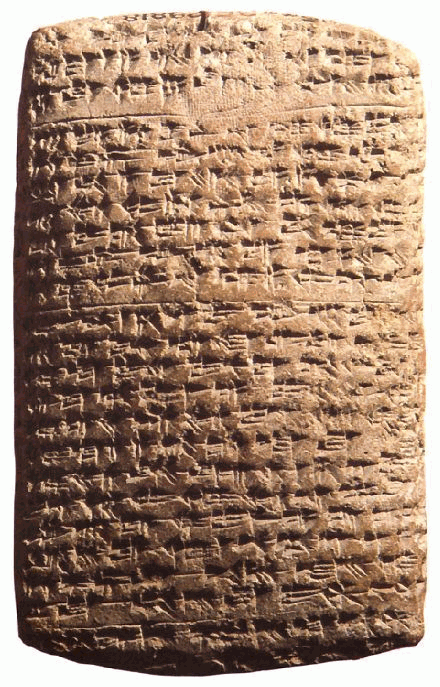
An Amarna Letter — one of 382 cuneiform tablets of diplomatic correspondence between Egypt and the ancient Near Eastern powers, c. 1350–1330 BC. Photo: Wikimedia Commons.
Josephus — The Jewish Historian
c. AD 37–100
Flavius Josephus is indispensable for understanding Jewish life in Egypt. Born in Jerusalem, he survived the Jewish revolt against Rome (AD 66–70) and spent his later years in Rome writing histories under imperial patronage. Two of his works are particularly relevant:
Antiquities of the Jews (c. AD 93–94): A comprehensive history of the Jewish people from creation through the 1st century AD. Josephus's retelling of the biblical narrative adds details and context that the Bible omits, including extensive accounts of:
- Abraham's time in Egypt, where Josephus says Abraham taught the Egyptians arithmetic and astronomy (Antiquities 1.167–168) — a tradition that resonates with Abraham 3 and Facsimile 3
- Joseph's rise to power and the settlement in Goshen
- Moses's education in Egypt and his military campaign against Ethiopia (a tradition not found in the Bible)
- The Onias temple at Leontopolis (Antiquities 13.62–73)
- The Alexandrian Jewish community's civic status
Against Apion (c. AD 96–100): A defense of Judaism against anti-Jewish writers, particularly the Egyptian grammarian Apion. This work preserves extensive quotations from Manetho's Aegyptiaca and provides our best surviving account of the Hyksos period from an Egyptian perspective. Josephus argues that the Hyksos were the Israelites — a claim most modern scholars reject but that illustrates how ancient Jewish writers tried to place their history within the broader Egyptian framework.
For Latter-day Saint readers: Josephus's statement that Abraham taught astronomy to the Egyptians (Antiquities 1.167–168) is remarkable in light of Abraham 3, where Abraham receives knowledge of the stars and is instructed to teach these truths in Egypt. Josephus did not have access to the Book of Abraham, yet he preserves a tradition that aligns with it — suggesting that this tradition about Abraham as an astronomer-teacher in Egypt circulated independently in the ancient Jewish world.
Philo of Alexandria — The Jewish Philosopher
c. 20 BC–AD 50
Philo's theological works are discussed in our Jewish Communities section. Here we note his historical writings, which provide irreplaceable firsthand accounts of Jewish life in Roman Egypt:
- Against Flaccus — A detailed account of the AD 38 pogrom in Alexandria, naming the Roman prefect Aulus Avilius Flaccus as the instigator and describing the violence against Jewish neighborhoods, the desecration of synagogues, and the torture of community leaders.
- Embassy to Gaius — Philo's account of the Jewish delegation he led to Emperor Caligula (AD 40) to protest the persecution. The delegation failed; Caligula dismissed them with mockery. The text reveals the precarious position of even the wealthiest and most connected Jewish leaders under Roman rule.
- On the Life of Moses — A biography of Moses written for a Greek audience, presenting Moses as a philosopher-king and lawgiver in terms that educated Greeks would respect. Philo emphasizes Moses's Egyptian education and his superiority to Egyptian wisdom.
Diodorus Siculus — The Universal Historian
c. 90–30 BC
Diodorus was a Greek historian from Sicily who visited Egypt around 60–56 BC and devoted Book 1 of his Bibliotheca Historica ("Historical Library") to Egypt. He provides detailed accounts of Egyptian customs, religion, geography, and the construction of monuments. His descriptions of the pyramids and the process of mummification supplement and sometimes correct Herodotus.
Diodorus also records that the Egyptians claimed Moses was one of their own — a tradition that reflects the broader ancient debate about whether Jewish wisdom originated in Egypt or vice versa.
Strabo — The Geographer
c. 64 BC–AD 24
Strabo visited Egypt around 24 BC, shortly after the Roman annexation, and his account in Book 17 of the Geography is the most detailed contemporary description of Egypt at the transition from Ptolemaic to Roman rule. He traveled up the Nile as far as Philae and describes:
- Alexandria in its full splendor (the Library, the Mouseion, the harbor)
- The Nile Valley's geography and agriculture
- The condition of temples and monuments in his day
- The population and ethnic composition of various Egyptian cities
Strabo's Egypt is a living civilization rather than an ancient one — he describes the Egypt that the Holy Family would have encountered just a few decades later.
The Book of Jubilees
c. 160–150 BC
The Book of Jubilees is a Jewish pseudepigraphic work that retells the narratives of Genesis and the early chapters of Exodus, dividing history into periods of 49 years ("jubilees"). Written during the Maccabean period, it adds details not found in the biblical text, including:
- Expanded accounts of the patriarchs' time in Egypt
- A calendar system that differs from the later rabbinical calendar
- Additional details about Abraham's knowledge and teachings
- Emphasis on the covenant promises and their fulfillment
Jubilees was highly valued by some Jewish communities (multiple copies were found among the Dead Sea Scrolls) and by the Ethiopian Jewish and Christian traditions, which consider it canonical. It provides a window into how 2nd-century BC Jews understood and elaborated the biblical narratives about Egypt.
Reading These Sources Together
No single ancient source tells the complete story. Each writer had an agenda, a perspective, and limitations:
- Manetho wrote to glorify Egyptian civilization for a Greek audience — his account of the Hyksos reflects Egyptian nationalism more than historical objectivity.
- Herodotus was a curious tourist who sometimes believed his guides' tall tales — but his observations about daily life are often confirmed by archaeology.
- Josephus wrote to defend Judaism before a Roman audience — he sometimes exaggerates Jewish prestige and downplays embarrassing episodes.
- Philo wrote to harmonize Judaism with Greek philosophy — his Moses is as much Plato as patriarch.
- The biblical text itself is theological history — concerned with God's covenant purposes rather than with the kind of detail modern historians expect.
The richest understanding comes from reading all these sources alongside the archaeological record — the inscriptions, papyri, and artifacts that the Egyptians themselves left behind. When the literary sources agree with the archaeological evidence, we can have high confidence. When they disagree, we have to weigh each source carefully.
This is precisely the kind of careful, multi-source approach that Latter-day Saint scholars like Kerry Muhlestein, John Gee, and Hugh Nibley have brought to the study of the Book of Abraham — reading the Joseph Smith Papyri alongside Egyptian funerary literature, Josephus's Abraham traditions, and the broader context of Ptolemaic-era Jewish-Egyptian religious interaction.
Explore Further: World History Encyclopedia
- Flavius Josephus
- Josephus on Christianity
- Herodotus
- Diodorus Siculus
- Plutarch — wrote On Isis and Osiris, a major Greek source on Egyptian religion
- Eusebius on Christianity — preserved Manetho's dynastic chronology
- Amarna Letters
- Ancient Egyptian Literature
- The Admonitions of Ipuwer
- Old Testament Pseudepigrapha
World History Encyclopedia is a nonprofit, peer-reviewed reference (CC BY-NC-SA 4.0).
Explore Further: Primary Texts & Scholarly References
Writers not yet covered by WHE — best available scholarly sources:
- Manetho: Britannica | LacusCurtius (full text fragments)
- Philo of Alexandria: Stanford Encyclopedia of Philosophy | Britannica
- Strabo: Britannica | Livius.org
- Josephus — Antiquities of the Jews: Sefaria (full text) | LacusCurtius
- Josephus — Against Apion: Sefaria (full text) | Livius.org
- Book of Jubilees: Sefaria (full text, bilingual) | Britannica
LacusCurtius (UChicago) hosts Loeb Classical Library translations. Stanford Encyclopedia of Philosophy and Livius.org are peer-reviewed scholarly resources. Sefaria provides open-access Jewish texts with English translations.
← Previous: Egyptian Religion | Egypt Guide Home | Next: Major Sites →