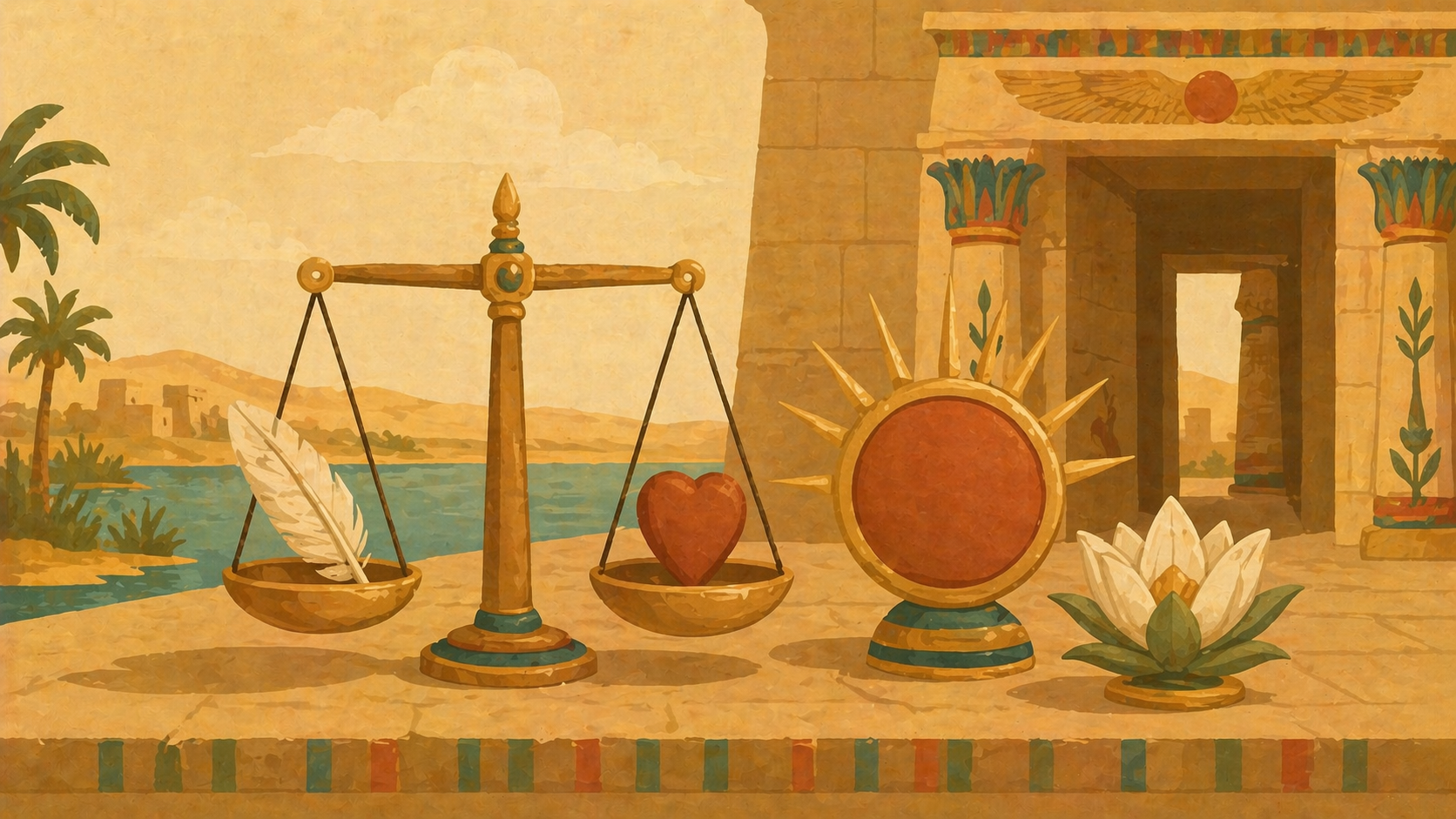
Egyptian Religion & Mythology
Understanding the gods the plagues challenged, the afterlife the Book of the Dead described, and the traditions that preserved Abraham's name for millennia
Egyptian religion was not a monolithic system imposed from above. It was a living, evolving tradition that developed over three thousand years, absorbing local cults, reinterpreting ancient myths, and adapting to new political realities. Yet certain core themes persisted from the Old Kingdom through the Roman period: the centrality of ma'at (cosmic order), the divine kingship of Pharaoh, the hope for eternal life, and the power of ritual to bridge the gap between human and divine.
For Latter-day Saint scripture students, Egyptian religion provides the essential background for understanding the plagues narrative, the Book of Abraham, and the funerary documents that would eventually reach Joseph Smith.
The Major Gods
Egypt had over two thousand named deities — but a smaller group dominated the theological landscape across the centuries. Understanding these gods is essential for reading the Exodus narrative, where each plague targets specific Egyptian religious claims.
| God | Domain | Significance |
|---|---|---|
| Ra (Re) | Sun, creation, kingship | Supreme solar deity; daily journey through sky and underworld symbolized the cycle of death and rebirth |
| Amun | "The Hidden One"; king of the gods | Rose to supremacy at Thebes during the New Kingdom; merged with Ra as Amun-Ra, the chief deity of the Egyptian state |
| Osiris | Underworld, death, resurrection, judgment | Murdered by Set, restored by Isis, became lord of the dead and judge of souls; central to afterlife theology |
| Isis | Magic, motherhood, healing, wisdom | Wife of Osiris, mother of Horus; "Great of Magic"; her cult spread throughout the Mediterranean and persisted into the Christian era |
| Horus | Kingship, sky, protection | Falcon-headed son of Osiris and Isis; the living pharaoh was Horus incarnate; avenged his father by defeating Set |
| Set (Seth) | Chaos, storms, desert, foreigners | Murdered Osiris; represented disorder and violence, but also strength and necessary chaos; sometimes a protector of Ra |
| Thoth | Wisdom, writing, moon, knowledge | Ibis-headed; credited with inventing hieroglyphs; scribe of the gods; recorded the judgment of the dead |
| Anubis | Mummification, death, the afterlife | Jackal-headed; guided souls to the underworld; oversaw mummification and the weighing of the heart |
| Hathor | Love, music, joy, motherhood | Cow-headed or cow-eared; associated with the afterlife as the "Lady of the West" who welcomed the dead |
| Ptah | Creation, craftsmen, the spoken word | Creator god of Memphis; created the world through the power of speech — a striking parallel to Genesis 1 and John 1 |
The plagues connection: When God declares, "Against all the gods of Egypt I will execute judgment" (Exodus 12:12), this is not a figure of speech. Many scholars and commentators have noted that each plague can be read as challenging a specific Egyptian religious claim: the Nile turning to blood (Hapi, the Nile god), frogs (Heqet, the frog-headed fertility goddess), the sun darkened (Ra/Amun-Ra), cattle disease (Hathor/Apis, associated with cattle), boils (Sekhmet, goddess of war and pestilence), and the death of the firstborn (challenging Pharaoh's own divine lineage as the living Horus, son of Ra). While not all scholars accept every specific pairing, the broader pattern — a systematic theological confrontation with the Egyptian religious system — is widely recognized.
Creation Myths
Egypt had multiple creation accounts, each associated with a different city and theological tradition. This multiplicity was not seen as contradictory — Egyptians were comfortable holding multiple perspectives simultaneously, viewing each as illuminating a different aspect of creation:
| Tradition | City | Creator | How Creation Happens |
|---|---|---|---|
| Heliopolitan | On / Heliopolis | Atum (Re-Atum) | Self-generation from the primeval waters; physical emanation of the gods |
| Memphite | Memphis | Ptah | Creation by thought (heart) and speech (tongue) — the divine word |
| Hermopolitan | Khemenu / Hermopolis | Ogdoad (eight deities) | Primordial chaos forces interact to produce the first mound and the sun |
The Heliopolitan Tradition: Atum and the Ennead
In the oldest and most widely attested tradition, Atum (later merged with Ra as Re-Atum) emerged from the primeval waters of Nun and stood on the first mound of land — the ben-ben, the primordial hillock that rose from the waters of chaos. Through his own creative power, he brought forth Shu (air) and Tefnut (moisture), who gave birth to Geb (earth) and Nut (sky), who in turn produced Osiris, Isis, Set, and Nephthys — the nine gods of the Ennead. This cosmogony is preserved in the Pyramid Texts (c. 2400–2300 BC), the oldest religious literature in the world.
The Memphite Tradition: Ptah and the Shabaka Stone
The most intellectually striking Egyptian creation theology comes from Memphis. Ptah, the craftsman god, created the world not through physical emanation or fashioning, but through thought and speech — conceiving creation in his heart (the seat of thought in Egyptian understanding) and bringing it into being through the power of his tongue (the spoken word).
This theology is preserved on the Shabaka Stone (now in the British Museum), a basalt slab inscribed around 710 BC by Pharaoh Shabaka, who claimed to be copying a much older worm-eaten papyrus. The text declares that Ptah "gave birth to the gods" and that "every divine word came into being through what the heart devised and the tongue commanded."
The parallels to the biblical creation account are remarkable:
| Memphite Theology | Biblical Text |
|---|---|
| Ptah conceives creation in his heart and speaks it into existence through his tongue | "And God said, Let there be light: and there was light" (Genesis 1:3) |
| "Every divine word came into being through what the heart devised and the tongue commanded" | "In the beginning was the Word, and the Word was with God, and the Word was God" (John 1:1) |
| Creation by divine speech — thought precedes utterance, utterance produces reality | "And the Gods said among themselves... and they ordered; and it was so" (Abraham 4:7–12) |
For Latter-day Saint readers: The Book of Abraham's creation account (Abraham 4–5) presents creation as an act of organized divine council: "the Gods watched those things which they had ordered until they obeyed" (Abraham 4:18). This language of divine speech producing obedient reality resonates with the Memphite tradition — creation by authoritative word rather than physical fashioning. Both traditions treat the divine word not as metaphor but as the actual mechanism of creation.
The temple creation narrative dramatizes this same pattern: creation unfolds through spoken command, progresses through ordered stages, and culminates in the placement of humanity in a sacred space. The Egyptians would have recognized the structure immediately.
The Hermopolitan Tradition: The Ogdoad
At Hermopolis (Khemenu, "City of Eight"), creation began with eight primordial deities — the Ogdoad — existing before creation in four male-female pairs representing the raw forces of pre-creation chaos:
- Nun / Naunet — the primeval waters (cf. Genesis 1:2, "the deep")
- Heh / Hauhet — infinity, boundlessness
- Kek / Kauket — darkness (cf. Genesis 1:2, "darkness was upon the face of the deep")
- Amun / Amaunet — hiddenness, the unseen
These forces interacted to produce the first mound rising from the waters and the first sunrise — light emerging from darkness over the face of the deep. The verbal parallels with Genesis 1:1–3 are striking, though the theological frameworks differ fundamentally: the Ogdoad are impersonal forces, not a personal Creator.
Explore Further: Egyptian Creation Myths
Primary Texts & Museum Sources
- British Museum — The Shabaka Stone (EA 498) — Official catalog entry with provenance and description
- OMNIKA — Shabaka Stone (Memphite Theology) English translation — Leonard H. Lesko translation
Encyclopedia Sources
- WHE — Ancient Egyptian Mythology — Overview including creation narratives
- Britannica — Great Ennead of Heliopolis
- Britannica — Ogdoad of Hermopolis
- Britannica — Atum — Creator god of Heliopolis
- Britannica — Nun — Personification of primordial waters
- Glencairn Museum — "Ancient Egyptian Creation Myths: From Watery Chaos to Cosmic Egg" — Excellent illustrated overview of all three traditions
Scholarly Articles
- BYU Studia Antiqua — "The Shabaka Stone: An Introduction" — Scholarly analysis of the Memphite Theology
- Bible.org — "Genesis 1–2 in Light of Ancient Egyptian Creation Myths" — Direct parallel analysis
- Bible Odyssey (SBL) — "Egyptian Influences on the Biblical Text"
The Afterlife: Judgment and the Journey Home
Egyptian afterlife theology was not simply about "going to heaven." It was a detailed, dangerous journey through the underworld (Duat) that required knowledge, ritual power, and moral purity to complete. The goal was to reach the Field of Reeds (Aaru) — an idealized version of Egypt where the blessed dead lived eternally in the presence of Osiris.
The Weighing of the Heart
The climax of the afterlife journey was the Hall of Two Truths, where the deceased's heart was weighed on a scale against the feather of Ma'at (truth/justice/cosmic order). Anubis supervised the weighing. Thoth recorded the result. If the heart balanced with the feather, the deceased was declared maa-kheru ("true of voice" or "justified") and admitted to the presence of Osiris. If the heart was heavy with sin, it was devoured by Ammit — a terrifying composite creature (part crocodile, part lion, part hippopotamus) — and the person ceased to exist.
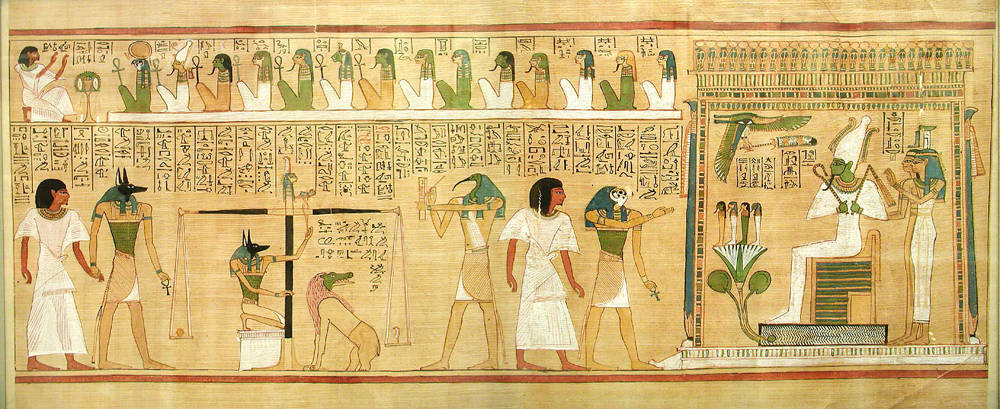
The Judgment of the Dead — from the Papyrus of Hunefer (19th Dynasty, c. 1275 BC). Anubis leads the deceased to the scales, where the heart is weighed against the feather of Ma'at. Thoth records the result. Osiris presides. British Museum. PD.
Before the weighing, the deceased recited the Negative Confession (Book of the Dead, Chapter 125) — a declaration of innocence listing sins they had not committed: "I have not stolen. I have not killed. I have not told lies. I have not committed adultery." This confession, addressed to 42 divine judges, represents one of the earliest codified ethical traditions in human history.
The Cosmic Journey
Kerry Muhlestein describes the Egyptian afterlife as fundamentally a cosmic journey — "a journey that takes place in the cosmos but mirrors what is happening for everybody." The sun's daily cycle became the master metaphor: Ra traveled across the sky by day, descended into the underworld at night, was reborn at dawn, and returned home. Every soul followed the same pattern — leaving the presence of the divine, passing through darkness and danger, and seeking to return to a glorified state.
Muhlestein frames this journey in terms Latter-day Saints will recognize immediately: "We are on a journey where we have left God's presence and we're trying to get back to God's presence but in a higher and a higher state so that we can become one with him because we have become like him." He adds: "We need to say that that's possible because of Christ. That's the gospel in a nutshell. That's the journey that we're on."
The Book of the Dead
Despite its dramatic name, the Book of the Dead is not a single book and is not really about death. The Egyptian name is Reu nu pert em heru — the "Book of Going Forth by Day" — a collection of spells, prayers, hymns, and ritual instructions designed to help the deceased navigate the afterlife and emerge triumphant into eternal life.
What It Actually Is
- Not a canonical text: There was no single, fixed "Book of the Dead." Each copy was assembled from a menu of available spells, tailored to the individual who purchased it. Wealthy patrons got longer, more elaborate versions; others received shorter, standardized selections.
- Written on papyrus scrolls placed in the burial, often in hieratic script (though some prestigious versions used hieroglyphs).
- Developed over time: The tradition began with the Pyramid Texts (Old Kingdom, carved on tomb walls), evolved into the Coffin Texts (Middle Kingdom, painted on coffins), and reached its most elaborate form as the Book of the Dead from the New Kingdom onward.
- Chapter 125 (the weighing of the heart and Negative Confession) appears in most copies and is the best-known section.
- Chapter 162 contains instructions for creating a hypocephalus — the type of object that Facsimile 2 in the Book of Abraham represents.
The Joseph Smith Papyri collection included a Book of the Dead belonging to a woman named Tasherit-Min, along with the Book of Breathings belonging to the priest Hor. Both date to the Ptolemaic period (c. 200 BC).
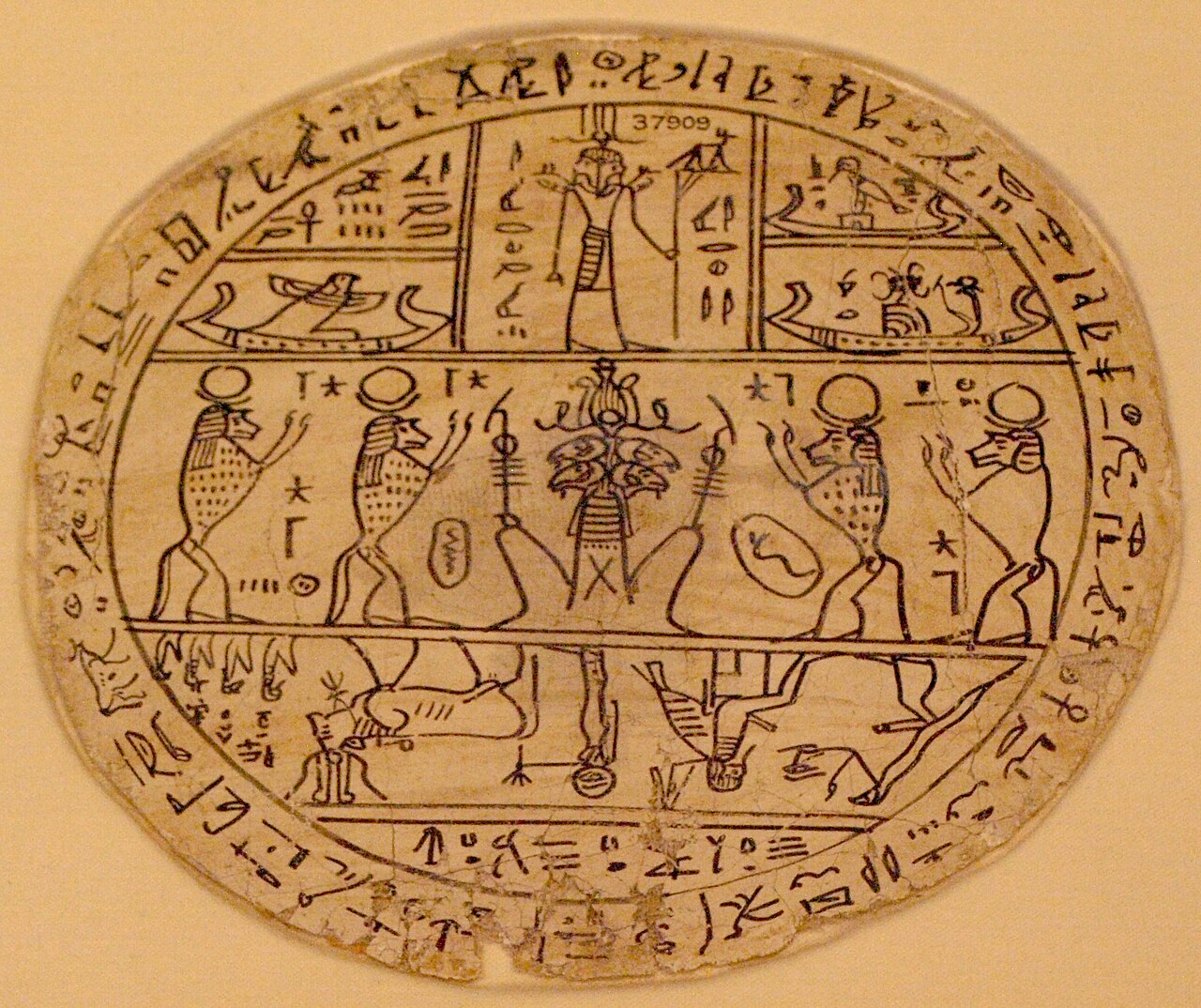
Hypocephalus of Tasheritkhons (Ptolemaic period, c. 305–30 BC), British Museum — the same type of funerary object as Book of Abraham Facsimile 2. Photo: Wikimedia Commons.
The Book of Breathings
The Book of Breathings (Document of Breathing) is a later Egyptian funerary text that emerged alongside — and sometimes replaced — the Book of the Dead. Hor's copy, part of the Joseph Smith Papyri collection, is one of the earliest known examples.
- Purpose: To help the deceased "breathe again" — to receive the breath of life in the afterlife. The text focuses on enabling the deceased to live, breathe, and function in the next world.
- John Gee's alternative translation: Gee has suggested "Book of Fellowship" as a more accurate rendering, emphasizing the text's focus on the deceased's relationship with and acceptance by the gods.
- Instructions: The text specifies that it should be placed "under the head" of the mummy to "illuminate" the deceased — instructions that parallel the purpose of the hypocephalus (Facsimile 2), which was also placed under the head.
- Shorter than the Book of the Dead but sharing similar themes of creation, protection, and journey to the divine presence.
Muhlestein on the parallels: Both the Book of Breathings and the Book of Abraham share themes of protection, creation, and progression to the divine presence. Hor's ritual life as a priest — focused on protection rites, relationship with deity, and progression toward the divine — maps remarkably well onto the themes of Abraham's own narrative: Abraham is protected from the idolatrous priest (Abraham 1), receives covenant promises creating a nation (Abraham 2), and is taught about cosmic creation and the nature of God (Abraham 3).
Biblical Figures in Egyptian Religious Texts
One of the most significant findings from Egyptian studies is that biblical figures appear in Egyptian religious texts from approximately 200 BC to AD 700. Muhlestein's research documents this phenomenon extensively:
- Most mentioned biblical figures in Egyptian texts:
- Jehovah (most mentioned overall)
- Abraham (most mentioned mortal, tied with Moses)
- Moses (tied with Abraham)
- Abraham's appearances include love spells (which make sense given the Sarah story), ritual invocations, and various eclectic uses. Egyptians had access to both biblical stories about Abraham and extra-biblical Abraham traditions that circulated independently.
- Abraham-Osiris equivalence: In some texts, Abraham and Osiris become interchangeable. Scenes that typically depict Osiris sometimes show Abraham, Isaac, and Jacob instead. The spell "May his soul live in the presence of Osiris" is replaced in some versions by "May the rest of his soul be in the bosom of Abraham, Isaac, and Jacob." Muhlestein notes that Jesus used exactly this formulation in the Parable of Lazarus and the Rich Man (Luke 16:22) — "the bosom of Abraham" — echoing an expression that had Egyptian parallels.
- An early Christian Egyptian papyrus calls Abraham "the pupil of the wedjat eye." The wedjat eye is connected to Chapter 162 of the Book of the Dead, which contains instructions for creating a hypocephalus — the very type of object that Facsimile 2 represents. Muhlestein observes: "So here we have Christian Egyptians associating this kind of drawing with Abraham, which turns out to be the case with all three facsimiles."
Why this matters: The presence of Abraham in Egyptian religious texts — centuries before the Joseph Smith Papyri were created — demonstrates that the association between Abraham and Egyptian religious documents is not a modern invention. Egyptian religious culture had a long tradition of incorporating Abrahamic figures into its own framework. Whether this represents borrowed traditions, independent transmission, or something else entirely is debated, but the connection itself is historically documented.
Egyptian Religion and the Exodus
The Exodus narrative makes far more sense when read against the backdrop of Egyptian theology:
Pharaoh's divine status: The pharaoh was not merely a powerful king. He was the living Horus, the son of Ra, the embodiment of ma'at on earth. When Moses demanded that Pharaoh release the Israelites, he was asking a god to submit to a foreign deity. Pharaoh's repeated refusal was not just political stubbornness — it was theological: to yield to YHWH would be to admit that the entire Egyptian religious system was false.
The plagues as theological argument: Each plague systematically dismantled Egyptian religious claims. When the Nile turned to blood, it demonstrated YHWH's power over the source of Egyptian life. When darkness covered the land for three days, it silenced Ra, the sun god. When the firstborn died, it struck at the heart of Pharaoh's divine lineage. The message was not simply "let my people go" but "there is no god besides Me."
The hardening of Pharaoh's heart: The Hebrew verb used varies between chazaq (to strengthen/stiffen) and kaved (to make heavy). The imagery of a "heavy heart" is deeply Egyptian — in the afterlife judgment, a heart heavy with sin was devoured by Ammit. By hardening Pharaoh's heart, the text may be saying that Pharaoh's heart grew heavier and heavier with each act of defiance, echoing the very Egyptian judgment that his own theology proclaimed.
Ma'at: The Foundation of Everything
No concept is more central to Egyptian civilization than ma'at — a word that encompasses truth, justice, cosmic order, balance, and righteousness. Ma'at was both a principle and a goddess, depicted as a woman wearing an ostrich feather (the same feather against which the heart was weighed in the afterlife judgment).
Ma'at governed everything:
- Pharaoh's primary duty was to maintain ma'at — keeping the cosmos in order, the gods satisfied, and society functioning justly.
- Temple rituals were performed to sustain ma'at. Every offering, every hymn, every ritual act performed by the temple's religious specialists was understood as maintaining the cosmic balance.
- Personal ethics were measured against ma'at. The Negative Confession in the Book of the Dead is essentially a declaration that the deceased lived according to ma'at.
- Chaos (isfet) was ma'at's opposite — the constant threat of disorder that could overwhelm the world if the rituals ceased and the gods were neglected.
The concept of ma'at resonates in interesting ways with biblical concepts of righteousness (tsedaqah) and justice (mishpat), though the theological frameworks are different. In Egyptian thought, ma'at was maintained by human ritual action; in biblical thought, righteousness flows from God's character and covenant.
Symbol Literacy and Multiple Meanings
Muhlestein emphasizes a principle that is essential for understanding Egyptian religion: Egyptians loved symbols with multiple meanings, and they intended this multiplicity. A single image could mean one thing in one context and something different in another — and both meanings could be "correct" simultaneously.
This has profound implications for interpreting the facsimiles in the Book of Abraham. Modern readers tend to assume that a symbol should have one meaning — what Muhlestein calls "legalistic" thinking. But Egyptian symbolic practice was precisely the opposite: richness of meaning was the goal, not precision of definition.
Temple walls could be "read" going in with one set of meanings and coming out with another. Pyramid texts meant something ascending and something different descending. This multi-directional, multi-layered approach to symbolism is foreign to modern Western thinking but was natural to the ancient Egyptians.
Muhlestein observes that this same symbolic richness exists in Latter-day Saint temple worship, and that modern struggles with temple symbolism may reflect "symbol illiteracy" — a broader cultural loss of the ability to hold multiple meanings simultaneously.
Egyptian Religion's Legacy
Egyptian religious thought influenced the ancient world far beyond Egypt's borders:
- Greek religion: The Greeks identified Egyptian gods with their own (Osiris = Dionysus, Thoth = Hermes, Amun = Zeus). The cult of Isis spread throughout the Mediterranean and competed with Christianity into the 4th century AD.
- Jewish thought: While direct theological borrowing is debated, the wisdom literature tradition (Proverbs, Ecclesiastes) shows Egyptian literary influence. The Instruction of Amenemope (c. 1100 BC) shares striking parallels with Proverbs 22:17–24:22.
- Christian theology: The death-and-resurrection pattern of Osiris, the mother-and-child imagery of Isis and Horus, and the concept of postmortem judgment all find echoes (though not necessarily origins) in Christian thought. Early Christians in Egypt readily adopted and reinterpreted Egyptian religious motifs.
- The Joseph Smith Papyri: The funerary documents that reached Joseph Smith — a Book of Breathings, a Book of the Dead, and a hypocephalus — were products of this religious tradition at its Ptolemaic stage, when Egyptian, Greek, and Jewish religious ideas were all actively interacting.
"The Egyptians loved symbols with multiple interpretations... We're becoming more and more a symbol illiterate people. We have this legalistic mindset where we think one thing should mean one thing."
— Kerry Muhlestein, "Book of Abraham: Egyptian Funerary Literature and Abraham Traditions," lecture, Springville, Utah, September 12, 2025
Explore Further: World History Encyclopedia
- Ancient Egyptian Religion
- Egyptian Book of the Dead
- Egyptian Gods — The Complete List
- Osiris | Isis | Ra | Amun
- Egyptian Mythology
- The Negative Confession
- Field of Reeds (Aaru)
World History Encyclopedia is a nonprofit, peer-reviewed reference (CC BY-NC-SA 4.0).
Sources Cited in This Section
- Kerry Muhlestein, "Book of Abraham: Egyptian Funerary Literature and Abraham Traditions," lecture, Springville, Utah, September 12, 2025. Muhlestein is a professor of ancient scripture at BYU and a practicing Egyptologist. See also: Let's Talk About the Book of Abraham (Deseret Book, 2022).
- John Gee, An Introduction to the Book of Abraham (RSC/Deseret Book, 2017) — "Book of Fellowship" translation for the Book of Breathings.
- Erik Hornung, The Ancient Egyptian Books of the Afterlife (Cornell, 1999) — standard reference on the Book of the Dead, Coffin Texts, and funerary literature.
- Jan Assmann, The Search for God in Ancient Egypt (Cornell, 2001) — Egyptian theology, creation myths, and the concept of ma'at.
← Previous: The Septuagint | Egypt Guide Home | Next: Written Records →