The Septuagint
The first great translation of scripture — and why it matters far more than most people realize
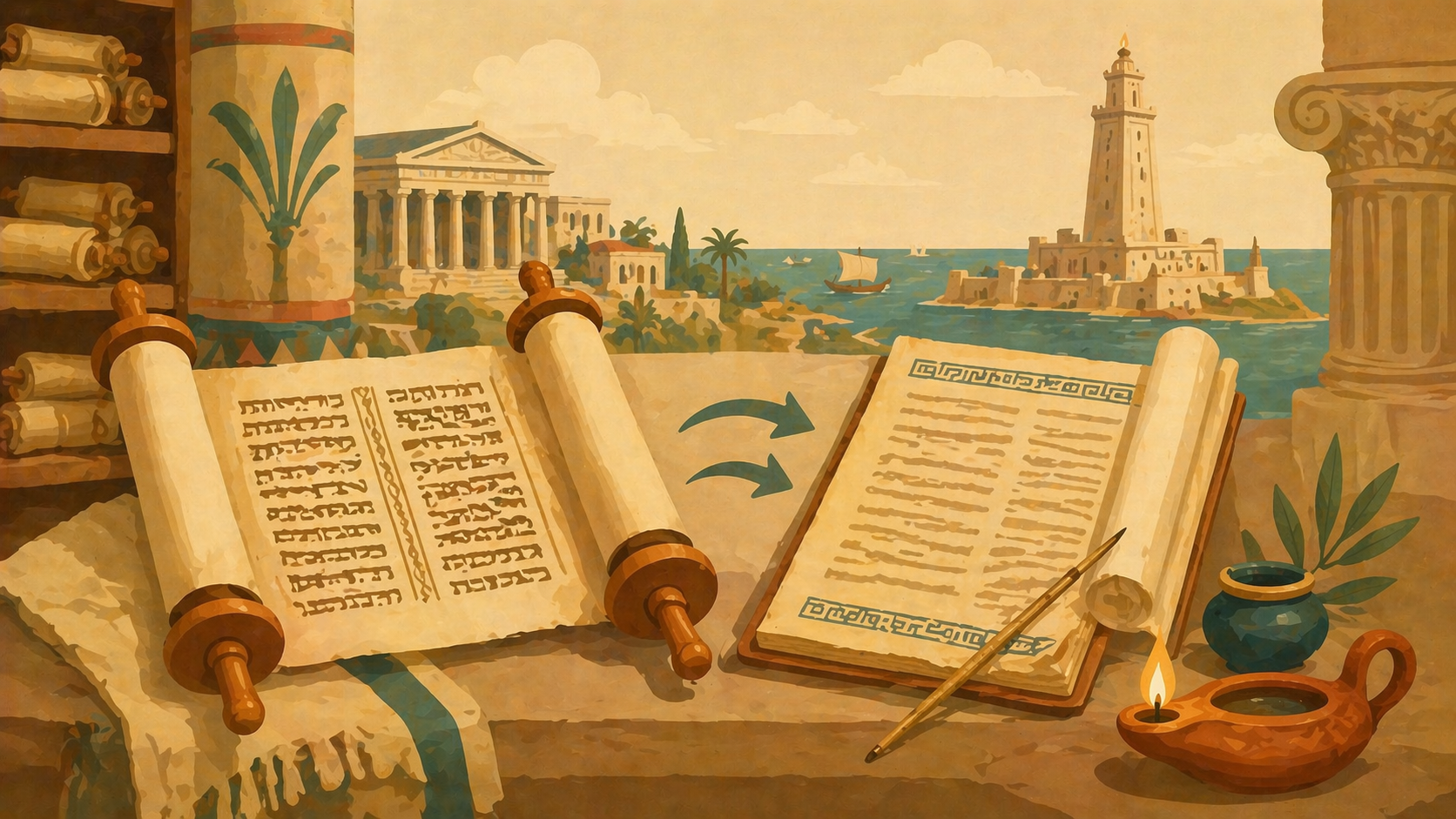
Sometime around 280–250 BC, on the island of Pharos off the coast of Alexandria, a group of Jewish scholars sat down to do something that had never been done before: translate the sacred scriptures of Israel into a foreign language.
The result — the Septuagint (abbreviated LXX) — would become one of the most consequential texts in Western history. It made the God of Israel accessible to the Greek-speaking world. It became the Bible that the apostles quoted. It shaped the theological vocabulary of Christianity. And it raised questions about the nature of translation, inspiration, and the relationship between original and translated scripture that remain relevant to Latter-day Saints today.
The Story: The Letter of Aristeas
The most detailed ancient account of the Septuagint's creation comes from the Letter of Aristeas, a Greek document written in the 2nd century BC (though set in the reign of Ptolemy II Philadelphus, c. 285–246 BC). According to this account:
- Ptolemy II Philadelphus, eager to include Jewish law in the Library of Alexandria, wrote to the high priest in Jerusalem requesting scholars to translate the Torah.
- The high priest sent 72 elders (six from each of the twelve tribes) to Alexandria, along with a magnificent copy of the Torah written in gold lettering.
- The translators were received with honors and feasted for seven days. Ptolemy questioned each scholar and was impressed by their wisdom.
- Working on the island of Pharos, the elders completed the translation in 72 days, "reaching agreement among themselves on each by comparing versions."
- The finished translation was read aloud to the Jewish community, who approved it, and then presented to the king, who marveled at the divine wisdom of the lawgiver Moses.
The name "Septuagint" (from the Latin septuaginta, "seventy") comes from the rounded number of translators, and the abbreviation LXX is simply the Roman numeral for 70. Later traditions embellished the story further — Philo of Alexandria claimed the translators worked independently and yet produced identical translations, demonstrating divine inspiration.
Why seventy? Whether the Letter of Aristeas meant its "72 elders" literally or symbolically, the number 70 carried deep significance in Israelite tradition. Moses was commanded to gather 70 elders of Israel to receive the Spirit and share the burden of leadership (Numbers 11:16–17; see also Exodus 24:1). The great Sanhedrin consisted of 70 (or 71) members. Jesus appointed seventy disciples and sent them out to teach (Luke 10:1 — some manuscripts read "seventy-two," which is itself the exact number of translators in the Aristeas account).
For Latter-day Saint readers, the pattern continues: the Quorum of the Seventy (D&C 107:25–26) serves as a body of witnesses and teachers sent throughout the world — a calling that echoes both Luke's seventy and, further back, the seventy elders who stood with Moses. The Septuagint's very name, then, connects it to a recurring scriptural pattern: God choosing a body of witnesses to carry His word beyond the boundaries of a single community.
Historical assessment: Modern scholars generally view the Letter of Aristeas as a literary work designed to enhance the prestige of the Septuagint among Greek-speaking Jews. The core event — that the Torah was translated into Greek in Alexandria during the reign of Ptolemy II — is widely accepted as historical. The embellishments (72 translators, royal patronage, 72 days) are likely literary elaboration. The translation was probably the work of Alexandrian Jewish scholars over an extended period, motivated by the practical needs of a community that increasingly spoke Greek rather than Hebrew.
Why It Happened: The Linguistic Transformation
The Septuagint was not an intellectual exercise — it was a practical necessity. Under Ptolemaic rule, Greek became the language of power, commerce, and culture in Egypt. Jewish families who had lived in Alexandria for two or three generations increasingly spoke Greek as their first language. Many could no longer read Hebrew fluently.
This created a crisis of religious identity. If you cannot read the Torah in Hebrew, how do you study the law? How do you teach your children? How do you maintain your distinctive identity as a people of the Book when you can no longer read the Book?
The answer was translation. But translating scripture was not a neutral act. It was theologically fraught:
- Could the divine language be translated? Hebrew was not merely a medium for God's word — many Jews believed it was the language in which God had spoken at creation. Could Greek, the language of pagan philosophy and polytheistic mythology, carry the same sacred meaning?
- What happens when concepts don't translate? Hebrew chesed (covenant loyalty, lovingkindness) has no single Greek equivalent. Hebrew torah (instruction, guidance) became Greek nomos (law) — a subtle shift that changed how the entire concept of God's instruction was understood. Hebrew mashiach (anointed one) became Greek christos — the word that would eventually give Christianity its name.
- Is the translation inspired? Philo believed that the translators were guided by divine inspiration, producing a text as authoritative as the Hebrew original. Others disagreed. The rabbis of later centuries would come to view the translation of Torah into Greek as a catastrophe comparable to the making of the golden calf.
What Was Translated
The initial translation (c. 280–250 BC) covered the Torah (the five books of Moses). Over the following two centuries, the remaining books of the Hebrew Bible were translated into Greek, along with additional works that were never part of the Hebrew canon:
| Category | Books |
|---|---|
| Torah / Pentateuch | Genesis, Exodus, Leviticus, Numbers, Deuteronomy |
| Historical books | Joshua, Judges, Ruth, 1–4 Kingdoms (= 1–2 Samuel + 1–2 Kings), 1–2 Chronicles, Ezra–Nehemiah, Esther |
| Poetic / Wisdom | Psalms, Proverbs, Ecclesiastes, Song of Solomon, Job |
| Prophets | Isaiah, Jeremiah, Ezekiel, Daniel, the Twelve Minor Prophets |
| Additional books (not in Hebrew canon) | Tobit, Judith, Wisdom of Solomon, Sirach (Ecclesiasticus), Baruch, 1–4 Maccabees, additions to Esther and Daniel |
These additional books (often called the Apocrypha or Deuterocanonical books) were part of the Septuagint but were not included in the later rabbinical Hebrew canon. Their status has been debated by Christians ever since: Catholics and Orthodox include them in their Old Testament; Protestants and Latter-day Saints do not, though the LDS tradition acknowledges their historical and literary value (see D&C 91).
The Septuagint and the New Testament
The Septuagint was the Bible of the early Christian church. When the New Testament authors quoted the Old Testament, they overwhelmingly quoted from the Greek Septuagint rather than from the Hebrew text. This had significant consequences:
- Isaiah 7:14 — The Hebrew text reads 'almah ("young woman"); the Septuagint translates this as parthenos ("virgin"). Matthew 1:23 quotes the Septuagint version in applying the prophecy to the birth of Christ. This single translation choice has generated centuries of theological debate.
- Psalm 16:10 — Peter's Pentecost sermon (Acts 2:27) quotes the Septuagint's "you will not allow your Holy One to see corruption" (diaphthoran), which he applies to Christ's resurrection. The Hebrew text uses a word (shachat) that can mean either "corruption" or "the pit."
- Theological vocabulary — Greek words like ekklesia (assembly/church), diatheke (covenant/testament), soteria (salvation), and christos (anointed one/Christ) entered Christian usage through the Septuagint. The entire theological vocabulary of Christianity was shaped by how the Septuagint translators chose to render Hebrew concepts in Greek.
The Septuagint also differed from the later standardized Hebrew text (the Masoretic Text) in numerous places — sometimes in word choices, sometimes in entire passages. The Dead Sea Scrolls revealed that some of these differences reflect genuinely older Hebrew text traditions, not simply translation errors. The Septuagint, in other words, sometimes preserves readings that the later Hebrew tradition lost.
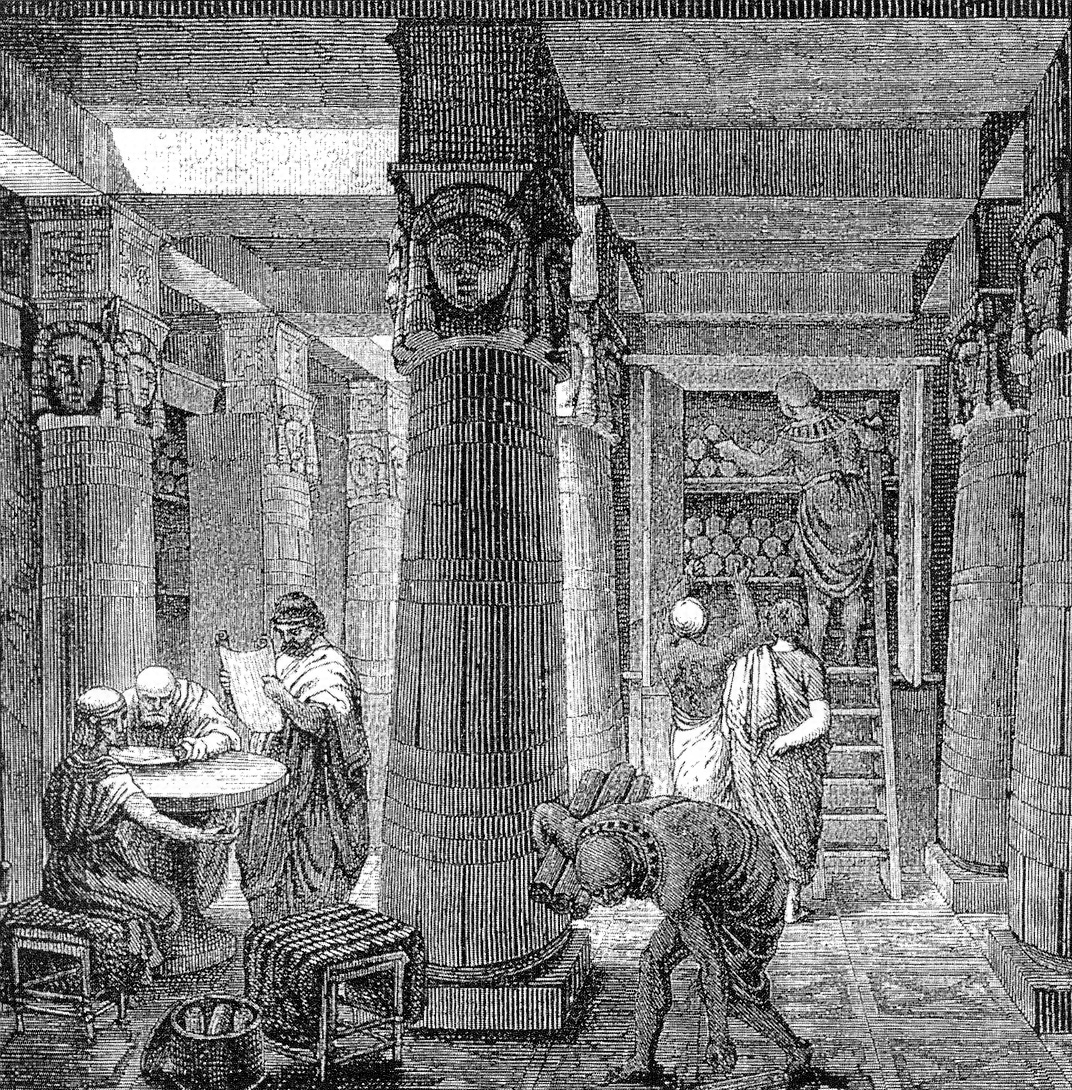
The Great Library of Alexandria — artistic reconstruction by O. Von Corven (19th century). The Library was the intellectual heart of the Hellenistic world and the context in which the Septuagint was produced. PD.
Cultural and Theological Significance
The Septuagint did far more than make Jewish scripture available in Greek. It transformed how the world encountered the God of Israel:
For Greek-speaking Jews: The Septuagint made it possible to remain Jewish while fully participating in Hellenistic culture. It enabled thinkers like Philo to read Moses alongside Plato and find harmony between them. It preserved Jewish identity across generations that no longer spoke Hebrew.
For Greek-speaking Gentiles: The Septuagint opened a window into Jewish monotheism, ethics, and history. The "God-fearers" — Gentiles who were attracted to Jewish monotheism without fully converting — could now read Jewish scripture in their own language. These God-fearers would become some of the earliest converts to Christianity.
For Christianity: The Septuagint provided the theological vocabulary, the prophetic proof-texts, and the scriptural framework that the apostles used to proclaim Christ. Without the Septuagint, Christianity's message could not have spread as rapidly through the Greek-speaking Mediterranean world.
For the rabbis: The translation eventually became a source of concern. By the 2nd century AD, as Christianity increasingly claimed the Septuagint as its own, Jewish scholars produced rival Greek translations (Aquila, Symmachus, Theodotion) that adhered more closely to the Hebrew. A tradition in the Talmud compares the day the Torah was translated into Greek to the day the golden calf was made — a catastrophe disguised as a gift.
The Septuagint and Latter-day Saint Thought
The Septuagint raises questions that are deeply relevant to Latter-day Saints:
Translation and inspiration: The Septuagint demonstrates that translation of scripture is not merely a linguistic act but a theological one. Every translation involves interpretation. The Septuagint translators made choices that shaped how generations understood God's word — just as the King James translators did, and just as Joseph Smith did in his inspired revision of the Bible. The Latter-day Saint understanding that translation can be an act of revelation — that God can work through translators to clarify, restore, and even expand meaning — finds an ancient precedent in how the early Jewish community understood the Septuagint.
Scripture is living: The Septuagint shows that scripture was never a static, frozen text. It was translated, interpreted, expanded, and adapted by communities who believed God continued to speak through it. The addition of books like the Wisdom of Solomon and Sirach reflects a community that believed inspired writing had not ceased. This openness to continuing revelation resonates with the Latter-day Saint belief in an open canon.
Language matters: The shift from Hebrew to Greek changed not just how people read scripture but how they thought about God. When torah became nomos, instruction became law. When ruach (breath, wind, spirit) became pneuma, it picked up Greek philosophical connotations that the Hebrew did not carry. Latter-day Saints who study Hebrew alongside English translations encounter the same phenomenon — the richness and ambiguity of the original that no single translation can fully capture.
"We believe the Bible to be the word of God as far as it is translated correctly."
— Articles of Faith 1:8
This article of faith gains new depth when we understand that the Bible has been translated, retranslated, and transmitted through multiple languages and communities for over two millennia — a process that began on the island of Pharos, when Jewish scholars first attempted to render the words of Moses in the language of Homer.
Explore Further: World History Encyclopedia
World History Encyclopedia is a nonprofit, peer-reviewed reference (CC BY-NC-SA 4.0).
← Previous: Writing Systems | Egypt Guide Home | Next: Egyptian Religion →