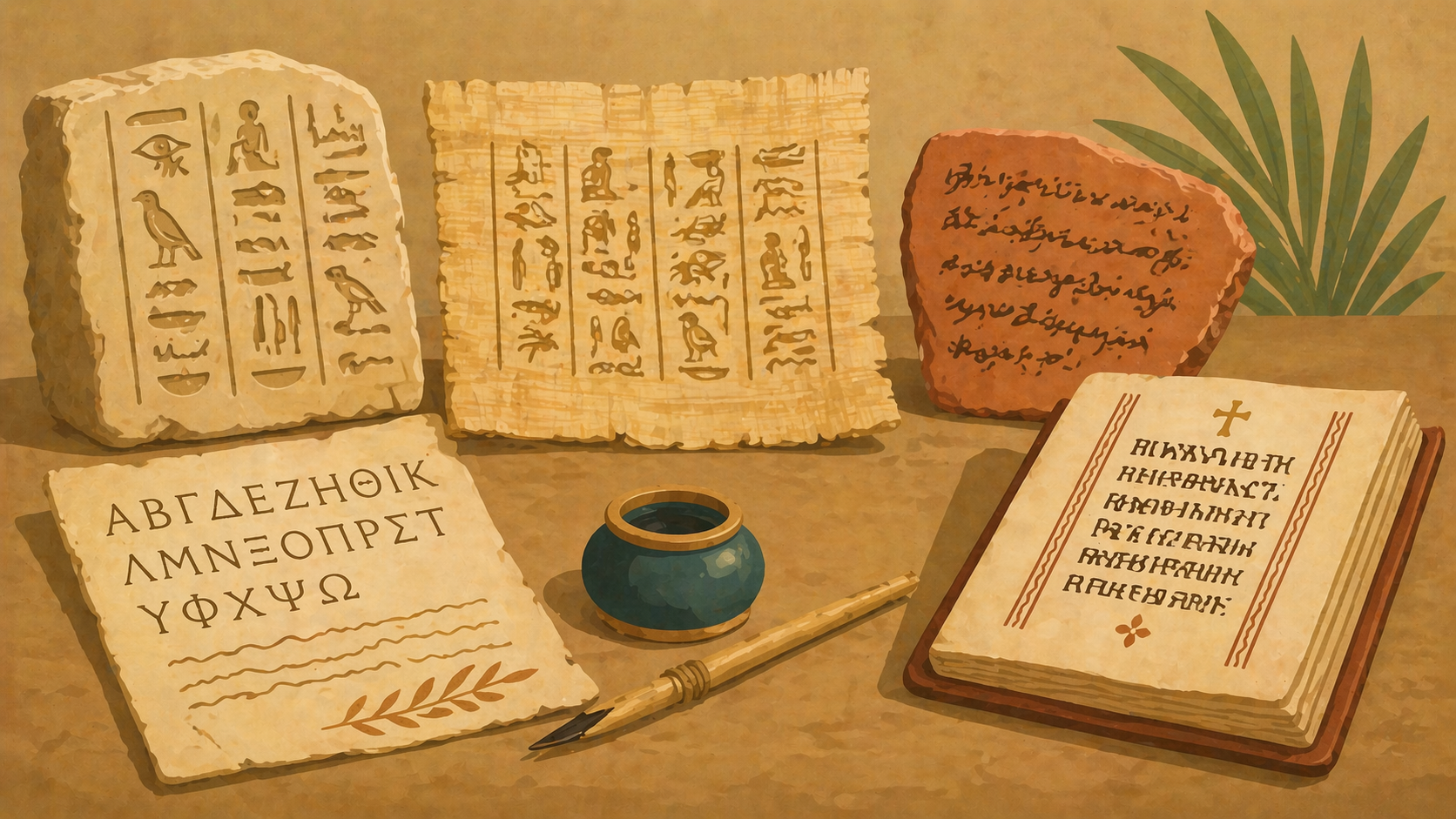
Writing Systems
Hieroglyphs, Hieratic, Demotic, Greek, Coptic — five scripts that tell the story of a civilization's evolution
Egypt was one of the first civilizations to develop writing — and its writing systems evolved dramatically over three thousand years, mirroring changes in politics, religion, and culture. Understanding these scripts is essential for reading Egyptian history, because who was writing, what they were writing, and which script they used tells us as much about their world as the content of the texts themselves.
Overview: Egyptian Writing Systems
| Script | Period of Use | Primary Context |
|---|---|---|
| Hieroglyphs | c. 3200 BC–AD 394 | Monumental inscriptions, temples, tombs, sacred texts |
| Hieratic | c. 2600 BC–3rd century AD | Religious texts, administration, literature, letters |
| Demotic | c. 650 BC–5th century AD | Everyday documents, contracts, stories, administrative texts |
| Greek | 332 BC–7th century AD | Government, commerce, philosophy, elite culture |
| Coptic | c. 2nd century AD–present (liturgical) | Egyptian language in Greek script; Christian texts, liturgy |
Hieroglyphs: The Sacred Carved Writing
c. 3200 BC–AD 394
The word "hieroglyph" comes from the Greek hieroglyphikos — "sacred carved letters." The Egyptians themselves called their script medu netjer, "the words of god," and attributed its invention to Thoth, the ibis-headed god of wisdom and writing.
Hieroglyphs are not simply pictures standing for words. The system combines three types of signs:
- Logograms — signs that represent entire words (like a picture of the sun meaning "sun" or "day")
- Phonograms — signs that represent sounds (one, two, or three consonants)
- Determinatives — unpronounced signs placed at the end of a word to indicate its category of meaning (a seated man for a person's name, a scroll for abstract concepts, etc.)
Hieroglyphs could be written in any direction — left to right, right to left, or top to bottom. You can tell which direction to read by looking at which way the animal and human signs face: they always face toward the beginning of the line.
Muhlestein on directional reading: Kerry Muhlestein emphasizes that Egyptian texts were intentionally designed to be read in multiple directions. Temple walls could be "read" going in one direction with one meaning and coming out with another. Advanced texts could be read in all four directions, yielding different meanings each way. This multi-layered symbolic approach is fundamental to understanding Egyptian religious texts.
As Muhlestein observes, "Egyptians loved symbols with multiple interpretations" — a concept that has profound implications for understanding the facsimiles in the Book of Abraham, where Joseph Smith's explanations and Egyptological interpretations need not be mutually exclusive.
Hieroglyphs were primarily used for monumental purposes — carved into temple walls, tomb chambers, obelisks, and statues. They were the script of eternity, intended to endure forever in stone. The painstaking care required to carve them made them impractical for everyday communication.
The last known hieroglyphic inscription was carved on August 24, AD 394, at the Temple of Isis at Philae in southern Egypt. After that date, the ability to read hieroglyphs was lost — and would remain lost for over 1,400 years.
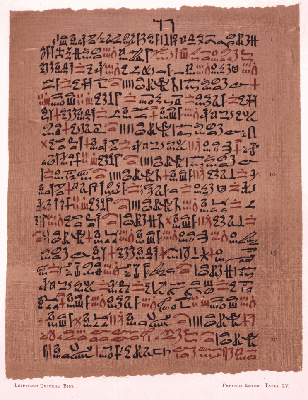
The Ebers Papyrus (18th Dynasty) — a medical text written in hieratic, the cursive everyday script of Egypt. PD Mark 1.0.
Hieratic: The Priestly Cursive
c. 2600 BC–3rd century AD
Hieratic is a cursive form of hieroglyphs, developed for writing with reed pens on papyrus, ostraca (pottery shards), and other surfaces. The name comes from the Greek hieratikos, "priestly," because by the time the Greeks encountered it, hieratic was used primarily for religious texts — though in earlier periods it served every written purpose from literature to tax records.
Hieratic script is to hieroglyphs roughly what cursive handwriting is to printed block letters — faster, more fluid, and increasingly abstracted from the original pictographic forms. A trained scribe could write hieratic far more quickly than hieroglyphs, making it the practical working script of Egyptian civilization for nearly two millennia.
Most Egyptian literary texts — the Story of Sinuhe, the Instructions of Ptahhotep, medical papyri, mathematical texts — were written in hieratic. The Book of the Dead scrolls buried with the dead were typically written in hieratic (or later in hieroglyphic columns designed to look more formal).
The Joseph Smith Papyri and Hieratic Script
The Joseph Smith Papyri include fragments written in hieratic, making this script directly relevant to Latter-day Saint scripture study. The surviving fragments include the Book of Breathings belonging to a priest named Hor, who served at the temples of Karnak, Montu, and Khonsu in Thebes, and a Book of the Dead belonging to a woman named Tasherit-Min. Both date to the Ptolemaic period (c. 200 BC).
Understanding that these are hieratic texts matters for several reasons:
- Hieratic is specialized. Reading hieratic requires training beyond basic hieroglyphic literacy. The cursive forms are so abstracted from the original pictographs that individual signs can be difficult to connect to their hieroglyphic equivalents. In Joseph Smith's day, no one in America — and very few people anywhere — could read hieratic. Champollion's hieroglyphic breakthrough was only thirteen years old when the papyri arrived in Kirtland in 1835, and his work on hieratic was still in its early stages when he died in 1832.
- These are funerary texts, not unique compositions. The Book of Breathings and the Book of the Dead were standard Egyptian funerary literature — formulaic texts prepared by priests to accompany the dead into the afterlife. The Book of Breathings was placed under the mummy's head to guide the deceased through the transformations required for the next life. Hor's copy is one of the earliest known examples of this text type.
- The papyri's journey is itself remarkable. These hieratic scrolls traveled from Thebes to the Italian collector Antonio Lebolo, across the Mediterranean and Atlantic to New York, through a traveling exhibition across the eastern United States, and finally to Kirtland, Ohio in 1835. Papyrus is extremely fragile — the fact that any survived this journey through wildly varying conditions of humidity and temperature is notable.
The relationship between these surviving hieratic fragments and the published text of the Book of Abraham remains an active area of research. The surviving papyri represent only a portion of the original collection — eyewitness accounts describe longer scrolls that were likely destroyed in the Great Chicago Fire of 1871. The fragments that survived had been separately given to a housekeeper and were rediscovered at the Metropolitan Museum of Art in 1947 before being returned to the Church. (For more on the papyri and the scholars who study them, see our LDS-Specific Connections section.)
Demotic: The People's Writing
c. 650 BC–5th century AD
Demotic (from the Greek demotikos, "popular" or "of the people") emerged around 650 BC as a further simplification of hieratic. It was developed during the 26th Dynasty (the Saite Renaissance) and became the dominant script for everyday use in Late Period and Ptolemaic Egypt.
Where hieratic still bears a recognizable relationship to hieroglyphs, demotic is so heavily abbreviated that individual signs are often difficult to connect to their hieroglyphic ancestors. It became the script of legal documents, business contracts, personal letters, and popular literature.
Demotic is one of the three scripts on the Rosetta Stone (196 BC), along with hieroglyphs and Greek. Under the Ptolemies, the trilingual world of Egyptian religion (hieroglyphs), Egyptian daily life (demotic), and Greek administration produced exactly the kind of bilingual/trilingual inscription that would eventually enable decipherment.
Greek: The Language of Power
332 BC–7th century AD
When Alexander the Great conquered Egypt in 332 BC, Greek became the language of government, law, commerce, and elite culture. Under the Ptolemies, advancement in public life required Greek — creating a two-tier linguistic system that lasted for centuries.
Greek did not replace the Egyptian language — native Egyptians continued speaking Egyptian and writing in Demotic. But Greek became the language of power, and for upwardly mobile Egyptians and Jews alike, learning Greek was essential.
The impact on the Jewish community was transformative. Within a few generations, Alexandrian Jews spoke Greek as their primary language. Many could no longer read Hebrew, which created the practical need for the Septuagint — the Greek translation of the Torah commissioned under Ptolemy II Philadelphus (c. 280–250 BC). Greek became the language in which Jews read their own scriptures and debated theology. It was also the language in which the early Christians — many of whom were Jewish — would later write the New Testament.
Coptic: The Last Phase of Egyptian
c. 2nd century AD–present (liturgical)
Coptic is not a new language — it is the Egyptian language written in the Greek alphabet, supplemented by six or seven characters borrowed from Demotic to represent sounds that Greek lacked. The word "Coptic" itself derives from the Arabic qibt, which comes from the Greek Aigyptios ("Egyptian"), which in turn derives from Hwt-ka-Ptah ("House of the Soul of Ptah") — an ancient name for the temple of Ptah at Memphis.
Coptic emerged in the early centuries AD as Christianity spread through Egypt. Christian missionaries needed to reach native Egyptian speakers in a script they could learn more easily than Demotic (which had become increasingly complex). Writing Egyptian in Greek letters made the language accessible to anyone who could read Greek — which, thanks to centuries of Ptolemaic and Roman rule, included a large portion of the population.
Coptic became the primary literary and liturgical language of Egyptian Christianity. The Nag Hammadi Library (discovered in 1945), including the Gospel of Thomas and other early Christian and Gnostic texts, was written in Coptic. The Coptic Orthodox Church — one of the oldest Christian communities in the world — still uses Coptic in its liturgy today, preserving the last living echo of the language spoken by the pharaohs.
The chain of language: From hieroglyphs to hieratic to demotic to Coptic, the Egyptian language evolved continuously for over 4,000 years. It is one of the longest-documented language traditions in human history. The survival of Coptic in the liturgy of the Coptic Church preserved knowledge of Egyptian pronunciation that proved essential to Champollion's decipherment — a spoken tradition stretching back to the age of the pyramids.
The Death of Hieroglyphs
How does one of the world's great writing systems go extinct? Not gradually — by force.
The decline began slowly. As Greek became the language of power under the Ptolemies, fewer Egyptians needed hieroglyphs for daily life. But hieroglyphic and hieratic literacy was never a general skill — it was maintained exclusively within the temple priesthoods, in specialized schools called the per-ankh ("House of Life"). As long as the temples functioned, the chain of knowledge held.
Imperial Suppression
That chain was broken deliberately. In 380 AD, the Edict of Thessalonica declared Nicene Christianity the sole legitimate religion of the Roman Empire. The edicts that followed were devastating to Egyptian temple culture:
- 391 AD — Emperor Theodosius I issued a decree directed specifically to the prefect of Egypt, prohibiting anyone from performing sacrifice or entering a temple for worship (Codex Theodosianus 16.10.11). That same year, Theophilus, Patriarch of Alexandria, personally led the destruction of the Serapeum — the great temple of Serapis, one of the most magnificent religious buildings in the Roman world. The cult statue was axed and dragged through the streets. The library housed within the complex was destroyed.
- 392 AD — A further edict banned all forms of pagan worship, public and private, classifying violations as treason (Codex Theodosianus 16.10.12).
Across Upper Egypt, the pattern was systematic: temples were closed, divine images were defaced — faces and hands chiseled off with deliberate precision — and temple structures were converted into churches. At Dendera, the faces of Hathor were systematically destroyed on columns and reliefs. At Luxor, Christian frescoes were painted directly over pharaonic imagery. At Karnak, the Festival Hall of Thutmose III became a church. Monastic leaders like Shenoute of Atripe (c. 348–465 AD) personally led raids against pagan households and boasted of destroying cult images.
The End of a 3,000-Year Tradition
When the temples were destroyed, the priestly schools went with them. There was no secular institution that taught hieroglyphs — the knowledge existed only within the temple system. Closing the temples did not merely end a religion; it severed the only mechanism for transmitting a writing tradition that had been passed from master to student for three millennia.
The Temple of Isis at Philae, on an island near Aswan, survived longer than any other — protected by a diplomatic treaty with Nubian tribes who worshipped Isis and whose cooperation Rome needed to keep the frontier peaceful. A small priestly community maintained the temple into the 6th century. But around 535–537 AD, the emperor Justinian I sent his general Narses to close Philae for good. The cult statues were confiscated and sent to Constantinople. The remaining priests were arrested. The inner sanctuary was consecrated as the Church of St. Stephen, and crosses were carved over the ancient reliefs.
The last known hieroglyphic inscription was carved at Philae on August 24, AD 394 — a graffito by a priest named Esmet-Akhom, a Second Prophet of Isis. The last known Demotic inscription is also from Philae, dated to August 11, AD 452. After that, silence. The script that had recorded three millennia of civilization became unreadable within a generation.
For Latter-day Saint readers — a striking parallel: The last hieroglyphic inscription at Philae (AD 394) and Moroni's sealing of the gold plates (c. AD 421, per Moroni 10:1) fall within roughly 27 years of each other. In Egypt, the last keeper of a 3,000-year scribal tradition carved his name on a temple wall as imperial edicts silenced the priesthood around him. In the Book of Mormon narrative, the last keeper of a covenant record wandered alone, hiding the plates from those who would destroy them (Mormon 8:4–5). In both cases, ancient records in ancient scripts were rendered unreadable — in Egypt because the people who could read them were silenced, and in the Americas because the record was sealed away. Both would remain silent for over a thousand years.
For the next 1,400 years, the monumental inscriptions of Egypt were mute. Travelers gazed at temple walls covered in beautiful, mysterious signs that no living person could interpret. Medieval scholars speculated that hieroglyphs were mystical symbols encoding hidden wisdom — an assumption that actually hindered decipherment, since it prevented researchers from recognizing that hieroglyphs included phonetic elements.
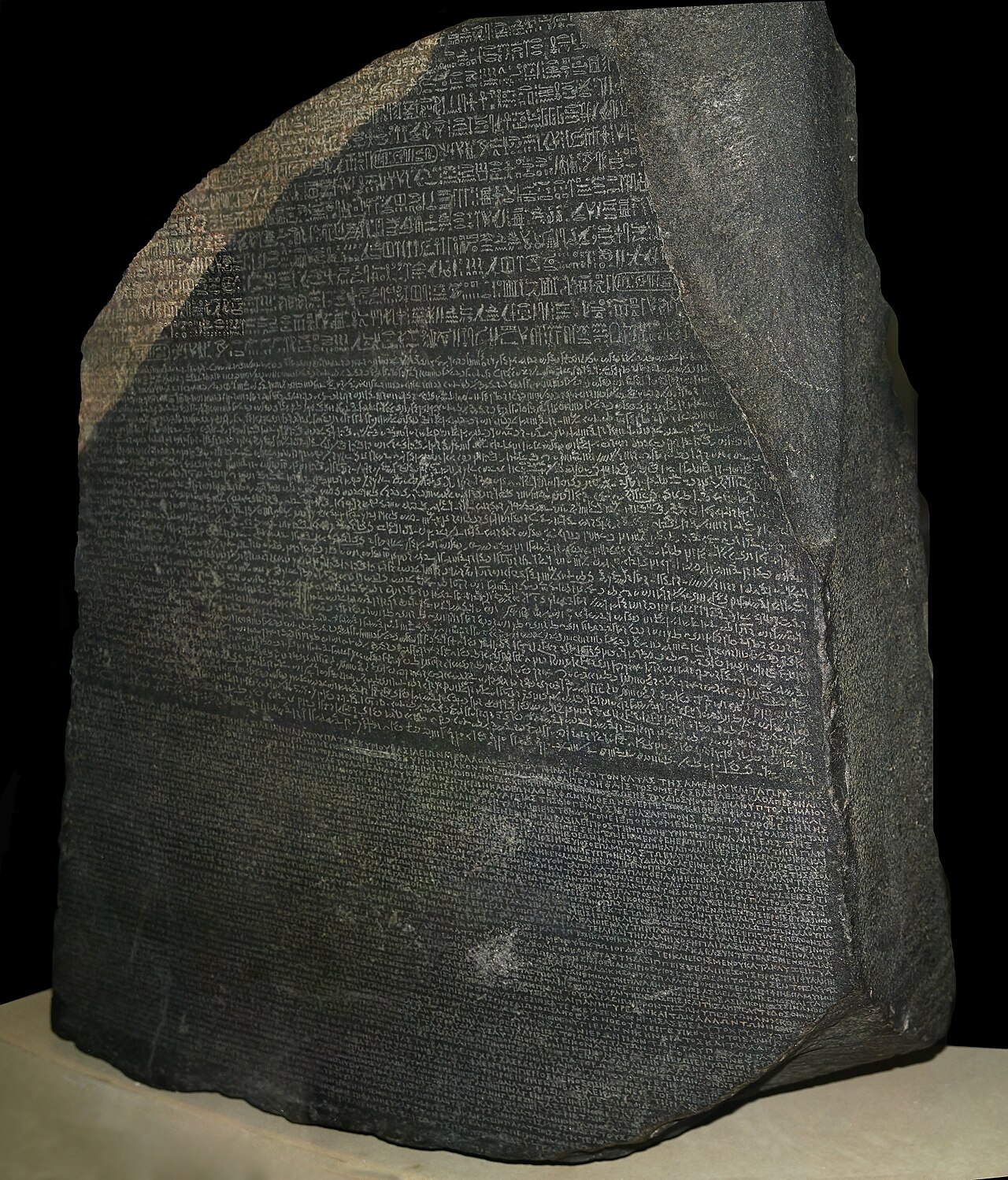
The Rosetta Stone (196 BC) — inscribed in hieroglyphs, Demotic, and Greek. British Museum. CC-BY-SA.
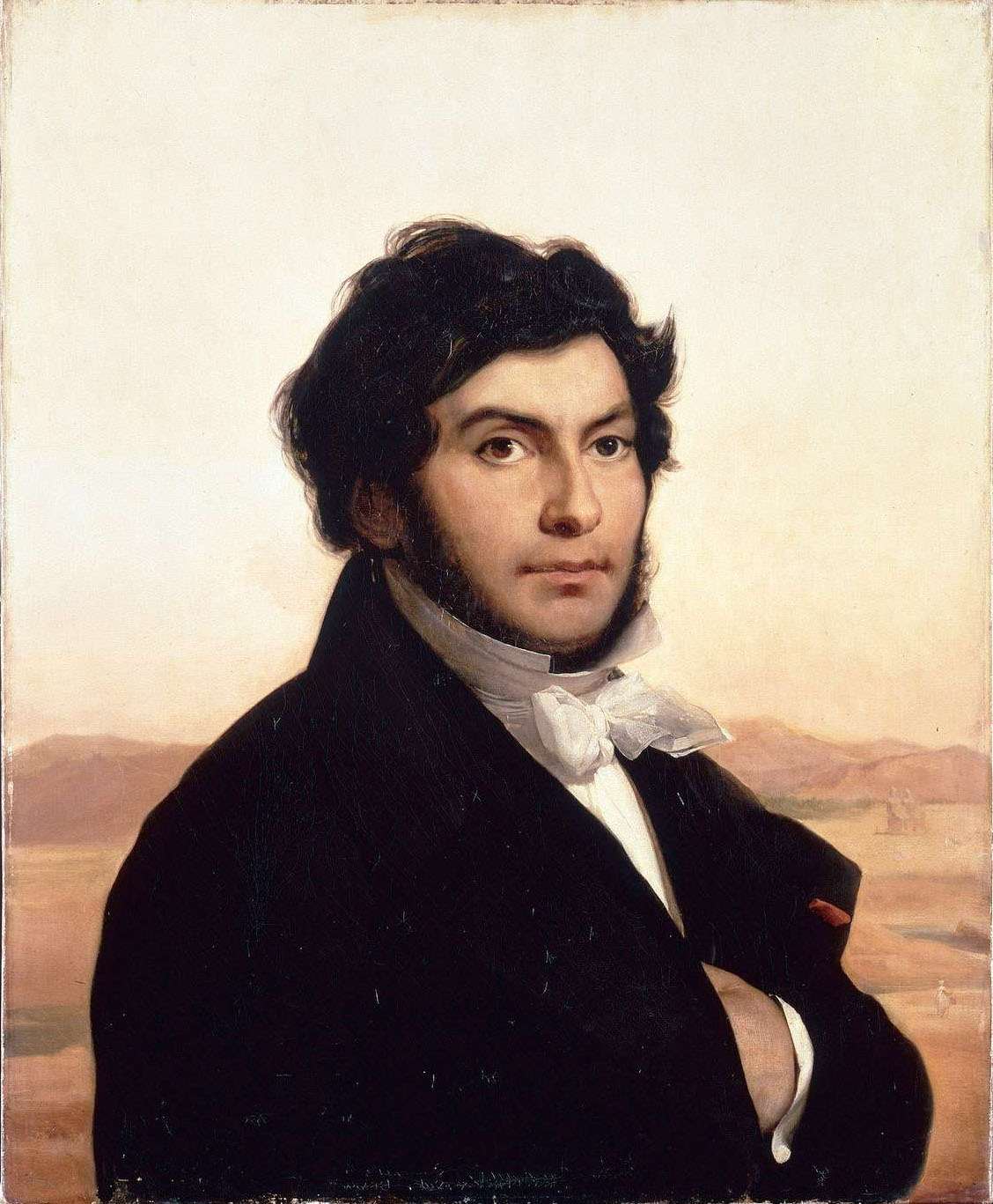
Jean-François Champollion (1790–1832), who cracked the hieroglyphic code in 1822. Portrait by Léon Cogniet, 1831. PD.
The Rosetta Stone and the Recovery of Egyptian
The key to unlocking hieroglyphs was discovered by accident during Napoleon's 1798 expedition to Egypt. A French soldier found a broken stele built into a wall at the town of Rashid (Rosetta) in the Nile Delta. The stone, dating to 196 BC, bore a decree from Ptolemy V inscribed in three scripts:
- Hieroglyphs (the formal, sacred script)
- Demotic (the everyday Egyptian script)
- Greek (the language of the ruling class)
Since scholars could read Greek, they now had a bilingual key. But decipherment was not immediate. The critical breakthrough came from Jean-François Champollion, a French linguist with a gift for languages (he knew Coptic, which proved essential). In 1822, Champollion demonstrated that hieroglyphs were not purely symbolic but included phonetic signs — that the script represented the sounds of the Egyptian language.
Champollion's key insight was recognizing that the hieroglyphic cartouches (oval frames around royal names) spelled out the names of rulers phonetically. By comparing the Greek text's references to "Ptolemy" and "Cleopatra" with the hieroglyphic cartouches, he cracked the code.
The consequences were revolutionary. Within decades, scholars could read texts that had been silent for a millennium and a half. The history of Egypt was suddenly accessible — not from Greek and Roman secondhand accounts, but from the Egyptians themselves. Temple inscriptions, tomb biographies, love poems, medical texts, legal documents, and religious literature all became readable for the first time since late antiquity.
For Latter-day Saint readers: Champollion's decipherment in 1822 is significant for Book of Abraham studies. Joseph Smith acquired the Egyptian papyri in 1835 — just thirteen years after Champollion's breakthrough. Egyptology was in its infancy. No American could read Egyptian; Champollion himself had only begun publishing his grammar when he died in 1832. The scholarly tools to evaluate Joseph Smith's work with the papyri simply did not exist in his lifetime.
Kerry Muhlestein notes that even today, "we don't understand [hypocephali] very well" and that our understanding has improved significantly since Thomas Mekis's 2012 dissertation. The field continues to develop, and claims about what Joseph Smith did or did not understand about Egyptian must be evaluated in light of an evolving scholarly landscape.
Writing Systems and the Biblical World
Egypt's writing systems intersected with biblical history at every turn:
- The patriarchs entered a world that had been literate for over a millennium. Abraham's Egypt had scribes, archives, and a sophisticated literary tradition.
- Moses, raised in Pharaoh's court, would have been trained in Egyptian writing (Acts 7:22: "Moses was learned in all the wisdom of the Egyptians"). Whether this included hieroglyphs, hieratic, or both, Moses was literate in the most advanced writing tradition of his era.
- The Elephantine papyri were written in Aramaic — the administrative language of the Persian Empire — showing how Jewish communities adapted to whatever writing system their rulers used.
- The Septuagint translated Hebrew scripture into Greek — a translation event made necessary by the linguistic transformation that Ptolemaic rule imposed on Jewish communities.
- The New Testament was written in Greek — the language that Hellenistic culture — including Ptolemaic Egypt — had made the lingua franca of the eastern Mediterranean.
- Early Christian texts in Egypt were written in Coptic — the final evolution of the Egyptian language, now serving the religion that had replaced the old gods.
The story of Egyptian writing is, in many ways, the story of how knowledge is preserved, lost, and recovered — a theme that resonates deeply with Latter-day Saint interest in scripture, translation, and the restoration of lost truths.
Explore Further: World History Encyclopedia
- Egyptian Hieroglyphs
- Ancient Egyptian Writing
- Rosetta Stone
- Egyptian Papyrus
- Cuneiform (comparative)
- The Phoenician Alphabet & Language
World History Encyclopedia is a nonprofit, peer-reviewed reference (CC BY-NC-SA 4.0).
← Previous: Jewish Communities | Egypt Guide Home | Next: The Septuagint →