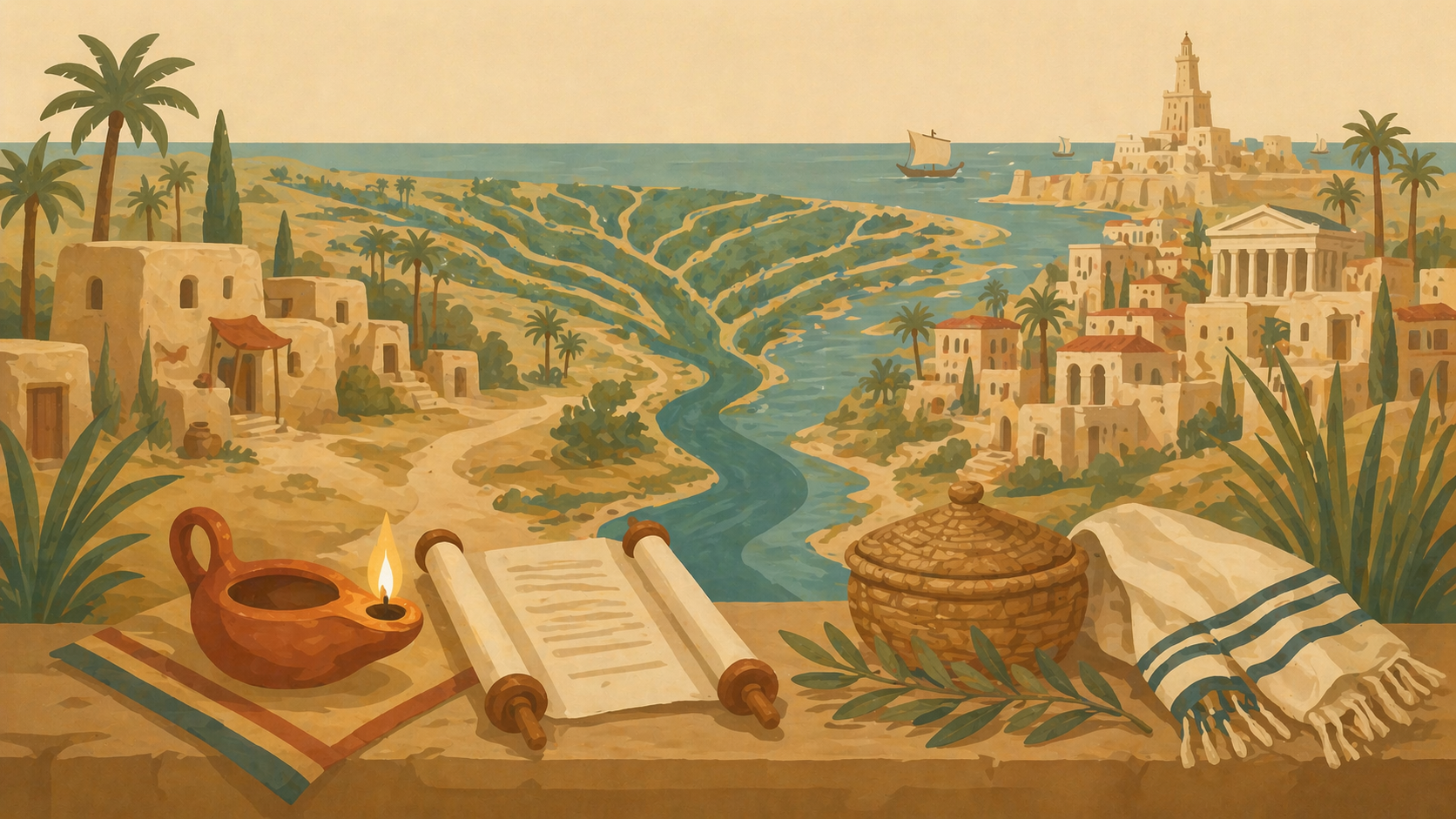
Jewish Communities in Egypt Across Time
Egypt was never just a place Israel passed through — Jews lived there for centuries, sometimes by choice, sometimes by force
The biblical story tends to present Egypt in two modes: the land of bondage (Exodus) and the land of refuge (the Holy Family). But the reality is far richer. Jews lived in Egypt continuously for over a thousand years — from at least the 6th century BC through the Roman period. They built temples, served in armies, produced some of the most important Jewish literature ever written, and constituted one of the largest diaspora communities in the ancient world.
This section traces the Jewish presence in Egypt from the patriarchs to the early Christian era.
Overview: Jewish Communities in Egypt
| Period | Approximate Date | Community / Event |
|---|---|---|
| Post-Flood Origins | Primordial | Egyptus (daughter of Ham) discovers and settles Egypt; her son becomes the first Pharaoh |
| Patriarchal | c. 2000–1850 BC | Abraham's sojourn during famine |
| Hyksos / New Kingdom | c. 1700–1250 BC | Joseph's family in Goshen; Israelite slavery; the Exodus |
| United Monarchy | c. 960 BC | Solomon's Egyptian diplomatic marriage |
| Post-586 BC | 586 BC | Jeremiah's refugees flee to Egypt |
| Persian | 5th century BC | Elephantine military colony (with YHWH temple) |
| Ptolemaic | 3rd–1st century BC | Massive Alexandrian community; Septuagint; Onias temple |
| Roman | 1st century BC–2nd century AD | Holy Family's flight; Philo; pogroms; destruction |
Egypt's Founding — The Book of Abraham Account
Before Abraham ever set foot in Egypt, Latter-day Saint scripture places Noah's own family at the founding of Egyptian civilization. The Book of Abraham records that Egyptus, a daughter of Ham (son of Noah), "discovered the land" of Egypt while it was still under water and afterward settled her sons in it (Abraham 1:23–24). Her eldest son, Pharaoh, established the first government of Egypt, patterning it after the patriarchal order of Ham (Abraham 1:25).
This first Pharaoh is described as "a righteous man" who sought to imitate the priesthood order of the fathers, though he could not claim the priesthood itself because it did not pass through Ham's line (Abraham 1:26–27). The text presents this as a matter of priesthood lineage and succession — not a judgment on the character or worthiness of Egypt's founders.
On the name "Egyptus": In the earliest Kirtland-era manuscripts of the Book of Abraham, Ham's wife is called Zeptah, a name that Latter-day Saint Egyptologists Stephen O. Smoot, John Gee, Kerry Muhlestein, and John S. Thompson have argued plausibly derives from the Egyptian name Siptah ("son of Ptah") — a name attested in Egyptian records from roughly 2000–1800 BC. The name "Egyptus" itself derives from the Greek Aigyptos and may reflect a later scribal updating of the text. (See Smoot et al., "Zeptah and Egyptes," BYU Studies 61, no. 4 [2022].)
This founding account means that the covenant family's connection to Egypt does not begin with Abraham — it begins with Noah's immediate descendants. Egypt's very origins, in this telling, are intertwined with the patriarchal family.
Abraham in Egypt
c. 2000–1850 BC — Genesis 12:10–20; Abraham 1–2
Abraham's sojourn in Egypt during a famine in Canaan (Genesis 12:10–20) is the first encounter between the covenant family and Egypt recorded in Genesis. The biblical account is brief — Abraham enters Egypt, presents Sarah as his sister, a ruler called "Pharaoh" takes her into his house, God sends plagues on the ruler's household, and Abraham is expelled with great wealth. (Whether this "Pharaoh" was the supreme ruler of Egypt or a powerful regional governor is not specified in the text — see our discussion in Who Ruled Egypt.)
The Book of Abraham adds substantial detail: Abraham possessed knowledge of astronomy and the creation that he shared with the Egyptians (Abraham 3:15; Facsimile 3), and his life was endangered by idolatrous priests who practiced human sacrifice (Abraham 1:5–12). These details place Abraham not merely as a visitor to Egypt but as someone who engaged deeply with its intellectual and religious culture.
The Middle Kingdom context fits this encounter well. Egyptian texts from the 12th Dynasty document Asiatic (Semitic) visitors entering Egypt — as traders, as refugees from famine, and as diplomatic contacts. The Beni Hasan tomb painting (c. 1890 BC) shows a group of Semitic people arriving with their families and goods, providing a vivid illustration of exactly the kind of migration Genesis describes.

Detail from the Beni Hasan tomb painting (c. 1890 BC): Semitic visitors arriving in Egypt wearing distinctive multicolored garments. Tomb of Khnumhotep II, 12th Dynasty. PD.
Joseph and the Settlement in Goshen
c. 1700–1550 BC — Genesis 37–50
Joseph's story is the foundation for the Israelite presence in Egypt. Sold into slavery by his brothers, he rose to become vizier — second only to Pharaoh — and administered a grain-storage program that saved Egypt from famine (Genesis 41). He then settled his father Jacob and the entire family in the land of Goshen, in the eastern Nile Delta (Genesis 47:6).
The Hyksos period (c. 1650–1550 BC) overlaps with common datings for Joseph's time in Egypt. The Hyksos were Semitic rulers whose capital at Avaris was located in the same eastern Delta region the Bible identifies as Goshen. Some scholars have suggested that Joseph's rise to power is more easily explained under Semitic kings, though the relationship between the Israelites and the Hyksos remains debated. It is equally possible that Joseph's own position opened doors for the Semitic presence that would later characterize the region. What is clear is that the Israelites were not the Hyksos — most scholars treat them as distinct groups — but as fellow Semitic peoples, the Israelites would have blended naturally into the Semitic-influenced culture of the eastern Delta during this era. (See our Who Ruled Egypt section for more on the Hyksos.)
The settlement in Goshen was intended as a temporary sojourn — Joseph's brothers were shepherds, and the Delta's pastureland suited their livelihood. But the family stayed, grew, and eventually became a population large enough to alarm a subsequent pharaoh who "knew not Joseph" (Exodus 1:8).
Population note: The Bible states that 70 people descended into Egypt with Jacob (Genesis 46:27). By the time of the Exodus, the Israelites had grown into a substantial population — Exodus 12:37 cites 600,000 men on foot, which has generated extensive scholarly debate. Some scholars take this as a literary or symbolic number; others argue for a smaller but still significant population. What is clear is that the Israelites multiplied sufficiently to be perceived as a demographic and security concern by the New Kingdom pharaohs.
The Exodus
c. 1446 or c. 1250 BC — Exodus 1–15
The Exodus is the defining event of Israel's national identity — the moment when an enslaved people became a covenant nation. After generations of forced labor under the New Kingdom pharaohs, Moses confronted Pharaoh with the demand: "Let my people go, that they may serve me" (Exodus 8:1).
The ten plagues systematically challenged Egyptian religious claims. The Nile turning to blood struck at Hapi, the Nile god. Darkness challenged Ra, the sun god. The death of the firstborn struck at Pharaoh's own divine lineage. The Exodus was not merely a political liberation but a theological confrontation: YHWH demonstrating His supremacy over every god of Egypt (Exodus 12:12).
After the Exodus, Egypt remained a shadow presence in Israelite memory — the place they were commanded never to forget (Deuteronomy 5:15), the land to which the prophets warned they should never return (Deuteronomy 17:16), and yet the refuge to which they would repeatedly flee in times of crisis.
Solomon's Egyptian Alliance
c. 960 BC — 1 Kings 3:1; 9:16
Solomon married a daughter of Pharaoh as a diplomatic alliance (1 Kings 3:1), and Pharaoh gave the city of Gezer as her dowry after conquering it (1 Kings 9:16). This was a remarkable diplomatic achievement — Egyptian pharaohs almost never married their daughters to foreign rulers. That a 21st Dynasty pharaoh did so for Solomon indicates either Israel's unusual prestige or Egypt's unusual weakness during this period (likely both).
This alliance represents a reversal of the Exodus relationship: Israel is now Egypt's equal partner, not its slave population.
Jeremiah's Refugees
586 BC — Jeremiah 43–44
When Nebuchadnezzar destroyed Jerusalem and the First Temple in 586 BC, a group of Jewish survivors fled to Egypt, taking the prophet Jeremiah with them against his will (Jeremiah 43:5–7). They settled at Tahpanhes (a frontier city in the eastern Delta) and at Migdol, Memphis, and in the land of Pathros (Upper Egypt) (Jeremiah 44:1).
Jeremiah's warnings to these refugees are striking: he prophesied that they would face the same destruction in Egypt that they had fled in Judah, and he specifically condemned those who were worshipping the "queen of heaven" (likely Ishtar/Astarte, or possibly an Egyptian goddess) — exactly the kind of religious syncretism that would characterize some later Jewish communities in Egypt (Jeremiah 44:15–19).
This post-586 migration may have been one of several waves. Jewish mercenaries may have been serving in the Egyptian military even before Jerusalem's fall — the Elephantine colony (see below) appears to have been established before the destruction of the Temple.
The Jewish Military Colony at Elephantine
5th century BC — Persian Period
One of the most remarkable archaeological discoveries related to Jewish life in Egypt is the collection of Aramaic papyri from Elephantine Island (modern Aswan), at Egypt's southern border near the first cataract of the Nile.
A garrison of Jewish soldiers served there as part of the Persian imperial defense system, guarding Egypt's southern frontier. Their documents — contracts, letters, legal records, and official correspondence — reveal a community that was:
- Religiously observant — They maintained a temple to YHWH on the island, one of only a few Jewish temples known to have existed outside Jerusalem. A letter from the Persian governor instructs them on the proper observance of Passover.
- Syncretistic — Some documents mention other deities alongside YHWH, including Anat-Yahu (Anat of YHWH) and Anat-Bethel. This blending of Yahwistic and Canaanite/Aramean religion is exactly what the pre-exilic prophets had condemned.
- Embattled — Around 410 BC, Egyptian priests of the ram-headed god Khnum destroyed the Jewish temple. The Elephantine Jews wrote desperate letters to both Jerusalem and Samaria requesting help with rebuilding — letters that survive to this day.
- Socially integrated — Their legal documents show property ownership, marriage contracts, and business dealings with both Egyptian and Persian neighbors.
Why this matters: The Elephantine papyri are among the most important extrabiblical witnesses to Jewish life between the Old and New Testaments. They show that Jewish communities outside Judah maintained their identity while also adapting to local cultures — sometimes in ways that Jerusalem authorities would have found deeply troubling.
The fact that these Jews had their own temple raises profound questions about the centralization of worship that Deuteronomy demands. Was the "one place" theology of Deuteronomy 12 already normative? Or did Jewish communities in the diaspora feel authorized to worship YHWH wherever they lived? This tension would resurface with the Onias temple two centuries later.
Explore Further: Elephantine Sources
- Britannica — Elephantine — Geography, history, and the Jewish colony
- WHE — The Passover Papyrus from Elephantine — Image and context of the c. 419 BC letter
- Cook — "The Significance of the Elephantine Papyri for the History of Hebrew Religion" — American Journal of Theology 19:3 (1915), pp. 346–382
- Chadwick — "Sariah in the Elephantine Papyri" — BYU Scholars Archive. The name Sariah from 1 Nephi attested in the Elephantine documents.
- BYU Studies — "Jews in Ancient Egypt"
- BYU Studies — "Prophets, Pagans, and Papyri"
- Livius.org — Elephantine — Primary source access and images
BYU Studies and BYU Scholars Archive are peer-reviewed LDS academic publications. Livius.org hosts classical primary source translations.
The Alexandrian Jewish Community
3rd century BC–2nd century AD — Ptolemaic and Roman Periods
The Jewish community in Alexandria was one of the most important in the ancient world — larger, wealthier, and more culturally influential than any Jewish community outside Jerusalem itself.
Origins and Growth
According to Josephus, Alexander the Great himself settled Jews in Alexandria when he founded the city in 331 BC, granting them equal civic rights with the Greeks (Against Apion 2.35–37). While modern historians debate the details of Josephus's account, it is clear that Jews were present in Alexandria from very early in its history and that Ptolemy I brought additional Jewish settlers (perhaps as prisoners of war from his campaigns in Judea) in the late 4th century BC.
Population and Status
By the 1st century BC, the Alexandrian Jewish community was enormous:
- Population: Philo states that Jews numbered approximately one million in all of Egypt (Against Flaccus 43), though modern scholars consider this an exaggeration and estimate perhaps 150,000–250,000 Jews in Egypt, with the largest concentration in Alexandria.
- Geography: Jews occupied a significant portion of the city — Josephus says two of its five quarters (War 2.488), though this may mean areas of concentration rather than exclusive Jewish districts.
- Governance: The community had its own ethnarch (community leader) and council of elders who administered Jewish law for internal disputes.
- Language: Alexandrian Jews spoke Greek as their primary language. By the 3rd century BC, many could no longer read Hebrew, which was a primary motivation for the Septuagint translation.
Kerry Muhlestein notes that in Ptolemaic Egypt, Jews were the third-largest population group after native Egyptians and Greeks. They were concentrated especially in Alexandria but also had significant communities in Thebes (the greatest concentration outside Alexandria), Edfu, and throughout the Nile Valley.
Cultural Life
Alexandrian Jews occupied a unique position — deeply Jewish in identity but thoroughly Greek in language, education, and philosophical framework. This produced:
- The Septuagint (c. 280–250 BC) — The translation of the Torah into Greek, which made Jewish scripture accessible to the Greek-speaking world and became the Bible of the early Christian church. (See our dedicated section on the Septuagint.)
- Philo of Alexandria (c. 20 BC–AD 50) — The most sophisticated Jewish philosopher of antiquity, who blended Platonic philosophy with Torah interpretation. His concept of the Logos (divine Word/Reason as the mediating principle between God and creation) deeply influenced early Christian theology, particularly the Gospel of John's opening: "In the beginning was the Word" (John 1:1).
- Jewish literature in Greek — Works like the Wisdom of Solomon, 3 Maccabees, and the Letter of Aristeas were produced by Alexandrian Jews writing in Greek for a Greek-educated audience.
Tensions and Violence
The Jewish community's size and civic status generated persistent tension with Alexandria's Greek population. This exploded in AD 38 when the Roman prefect Flaccus allowed (or encouraged) Greek mobs to attack Jewish neighborhoods — desecrating synagogues, confining Jews to a single quarter, and publicly torturing Jewish community leaders. Philo led a delegation to Emperor Caligula to protest but received no justice.
The devastating Jewish revolt of AD 115–117 (the Kitos War) effectively destroyed the Alexandrian Jewish community. Jews throughout Egypt, Cyrenaica, and Cyprus rose against Rome; the Roman suppression was catastrophic. The great synagogue of Alexandria, described by the Talmud as so vast that flags were needed to signal when the congregation should respond "Amen" (Talmud, Sukkah 51b), was destroyed. The community that had flourished for nearly four centuries was effectively annihilated.
The Three Jewish–Roman Wars: A Connected Arc
The destruction of the Alexandrian Jewish community did not happen in isolation. It was the middle chapter of three devastating wars that, within seventy years, transformed Judaism from a temple-centered religion with thriving diaspora communities into the rabbinical tradition we know today.
| War | Dates | What Happened |
|---|---|---|
| The Great Revolt | AD 66–73 | Judea rose against Rome. After a brutal siege, Titus destroyed the Jerusalem Temple in AD 70 — ending sacrificial worship that had continued for over a thousand years. The last holdouts fell at Masada in AD 73. Josephus, who survived the war, wrote the primary account (cf. Matthew 24:2). |
| The Kitos War (Diaspora Revolt) | AD 115–117 | Jewish communities across Egypt, Cyrenaica (Libya), and Cyprus erupted in revolt while Rome was distracted by Trajan's Parthian campaign. The Roman general Marcius Turbo crushed the uprising with devastating force. The Jewish population of Alexandria, Cyrene, and Cyprus was effectively annihilated. Named for Lusius Quietus, who suppressed the Judean phase. |
| The Bar Kokhba Revolt | AD 132–136 | Simon bar Kokhba led a final revolt in Judea, initially recapturing Jerusalem and establishing an independent state. Rabbi Akiva declared him the Messiah. Rome deployed twelve legions to reconquer the province. The aftermath was catastrophic: Hadrian renamed Jerusalem Aelia Capitolina, banned Jews from the city, and renamed the province Syria Palaestina to erase the Jewish connection to the land. |
The arc: In AD 66, Judaism had a functioning Temple, a high priest, a Sanhedrin, and thriving communities from Rome to Egypt to Babylon. By AD 136, the Temple was gone, Jerusalem was a pagan city Jews could not enter, and the great diaspora communities in Egypt and North Africa had been destroyed. Out of this devastation, the rabbis at Yavneh and later Galilee rebuilt Judaism around Torah study, synagogue worship, and prayer — the foundations of the tradition that endures today.
Sources:
Jewish Temples in Egypt
Jews in Egypt built at least two temples to YHWH — at Elephantine and at Leontopolis. While this is sometimes presented as shocking or anomalous, it actually fits within a much broader pattern. Temples and sacrificial worship sites outside Jerusalem were the norm for most of Israelite history, not the exception.
Temples Outside Jerusalem: The Broader Context
The ideal of centralizing all worship in "the place which the Lord your God shall choose" (Deuteronomy 12:5) was a late monarchic development. Most scholars associate its formal promulgation with Josiah's reform in 622 BC (2 Kings 22:8). Before that — and often after — Israelites worshipped YHWH at multiple locations:
| Site | Dates | Details |
|---|---|---|
| Shiloh | c. 1400–1050 BC | Primary tabernacle site for all Israel before the monarchy (Joshua 18:1); destroyed by the Philistines |
| Gibeon | Pre-Solomonic | Housed the Mosaic tabernacle during David's reign while the ark was in Jerusalem (1 Chronicles 16:39); Solomon sacrificed there and received his vision (1 Kings 3:4) |
| Dan & Bethel | c. 930 BC onward | Royal shrines of the Northern Kingdom, established by Jeroboam I (1 Kings 12:28–30); archaeological excavations at Tel Dan have confirmed a large sacred precinct |
| Arad Temple | 10th–6th century BC | Archaeologically confirmed YHWH temple in the Negev, built following the tabernacle's three-part plan; deliberately decommissioned, possibly during Hezekiah's or Josiah's reforms |
| Tel Motza | c. 900–6th century BC | A full-scale temple less than 4 miles from Jerusalem, operating simultaneously with Solomon's Temple; discovered 2012–2013 |
| Mount Gerizim | Mid-5th century–c. 110 BC | Samaritan temple near Shechem; the Samaritans traced their priesthood to Aaron and considered Gerizim, not Jerusalem, the chosen place (John 4:20); destroyed by John Hyrcanus c. 110 BC |
| Elephantine Temple (Egypt) | Before 525–c. 399 BC | YHWH temple on Elephantine Island; destroyed by Egyptian priests of Khnum c. 410 BC; partial rebuilding authorized by the Persian governor |
| Leontopolis / Onias Temple (Egypt) | c. 160 BC–AD 73 | Built by Onias IV, a legitimate Zadokite high priest, in the Nile Delta; closed by Romans after Jerusalem's fall |
The Egyptian temples, then, were not isolated anomalies but part of a long tradition of Israelite worship at multiple sites. What made them distinctive was their distance from the land of Israel and the specific circumstances of their founding.
The Elephantine Temple
The Elephantine temple was already standing when Persia conquered Egypt in 525 BC, meaning it was established during or before the late First Temple period. The community's letters show they wrote to both Jerusalem and Samaria for support, suggesting they recognized both as legitimate authorities — a detail that underscores how fluid the boundaries of "proper" worship remained even in the post-exilic period.
The Onias Temple at Leontopolis
The Onias temple at Leontopolis (also called the "Land of Onias" or Tell el-Yahudiya) was established around 160 BC by Onias IV, a legitimate Zadokite high priest who fled Jerusalem during the political upheaval surrounding the Maccabean revolt. He claimed authorization from the prophecy of Isaiah 19:19: "In that day shall there be an altar to the Lord in the midst of the land of Egypt."
The temple functioned for over two centuries, staffed by legitimate Jewish priests, offering sacrifices according to the law of Moses. It was closed by the Roman general Lupus in AD 73 — just three years after the destruction of the Jerusalem Temple — eliminating the last functioning Jewish sacrificial temple anywhere in the world.
Josephus discusses the Onias temple at length (Antiquities 13.62–73; War 7.420–436), and rabbinical sources debated its legitimacy for generations (Mishnah, Menahot 13:10).
For Latter-day Saint readers: The existence of multiple legitimate temples throughout Israelite history resonates with Restoration theology. Nephi was commanded to build a temple in the New World (2 Nephi 5:16), and the Lord instructed the Saints to build temples in multiple locations. The pattern of God authorizing worship at different sites — from Shiloh to Gibeon to Arad to Elephantine — suggests that centralization in Jerusalem was one chapter in a longer story, not the only authorized model for temple worship.
The Holy Family's Flight to Egypt
c. 5–4 BC — Matthew 2:13–15
After the visit of the Magi, an angel warned Joseph in a dream to take the child Jesus and Mary and flee to Egypt to escape Herod's decree (Matthew 2:13). The family remained in Egypt until Herod's death, fulfilling what Matthew identifies as the prophecy of Hosea 11:1: "Out of Egypt have I called my son."
Matthew's use of this passage is profoundly typological. Hosea 11:1 originally referred to the Exodus — God calling the nation of Israel out of Egypt. Matthew applies it to Christ, making Jesus the embodiment of Israel. The land of bondage becomes the land of refuge; the nation that enslaved Israel now shelters its Redeemer.
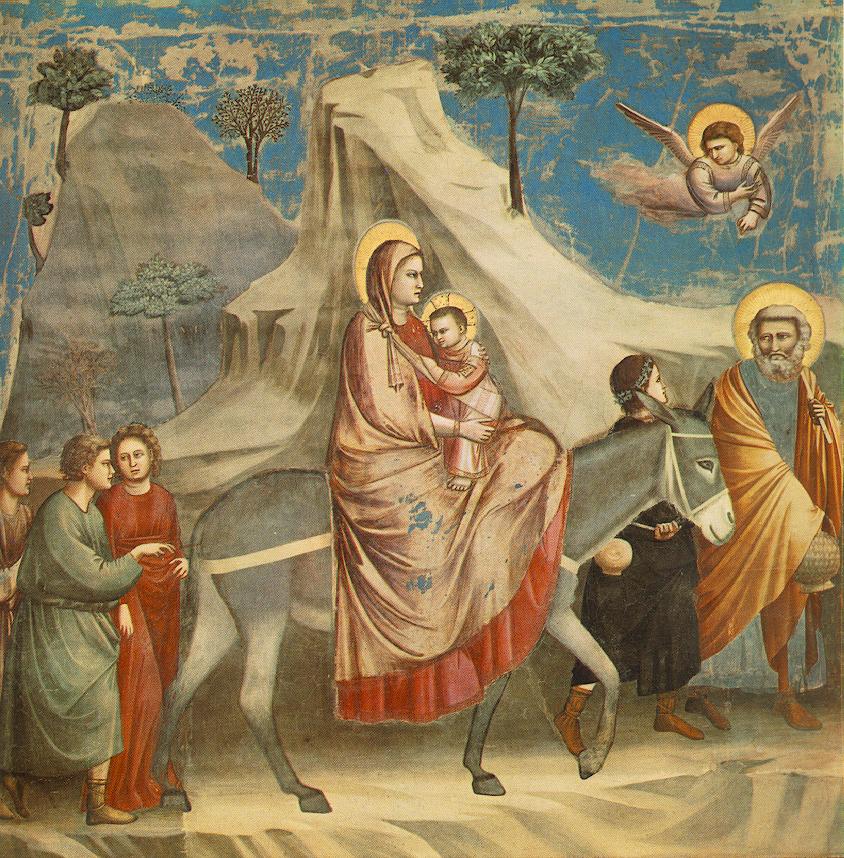
The Flight into Egypt — Giotto, Scrovegni Chapel, Padua, c. 1305. PD.
Coptic Christian tradition preserves extensive traditions about the Holy Family's route through Egypt, identifying sites from the Delta through Cairo to Upper Egypt. The Church of Saints Sergius and Bacchus (Abu Serga) in Old Cairo is built over a crypt traditionally identified as one of the family's resting places.
For Latter-day Saint readers: The Holy Family's flight illustrates a pattern that runs through all of scripture: Egypt as both danger and deliverance, both bondage and refuge. Abraham went there. Joseph's family went there. Jeremiah's refugees went there. And now the infant Messiah goes there. Each time, God uses Egypt — the great civilization of the Nile — as an instrument in His covenant purposes.
Philo of Alexandria
c. 20 BC–AD 50
Philo Judaeus was a contemporary of Jesus and Paul — one of the most important Jewish thinkers in history, yet rarely discussed in Latter-day Saint study. He was born into one of Alexandria's wealthiest Jewish families (his nephew Tiberius Julius Alexander would later become Roman prefect of Egypt) and received the finest Greek education available.
Philo's life work was to show that Jewish scripture and Greek philosophy were compatible — that Moses had anticipated Plato. His writings include:
- Allegorical commentaries on the Torah — Reading Genesis and Exodus through a Platonic philosophical lens
- Philosophical treatises — On the creation, the virtues, divine providence
- Historical/apologetic works — Against Flaccus and Embassy to Gaius, documenting the AD 38 pogrom and the delegation to Caligula
Philo's concept of the Logos — the divine Word or Reason that mediates between God and the material world — would profoundly influence Christian theology. When the Gospel of John opens with "In the beginning was the Word, and the Word was with God, and the Word was God" (John 1:1), it speaks in language that Philo's Alexandrian readers would have immediately recognized.
The End of an Era
The Jewish revolt of AD 115–117 and its brutal suppression effectively ended the great era of Jewish life in Egypt. A community that had thrived for centuries — producing the Septuagint, the wisdom literature, the greatest Jewish philosopher of antiquity, and a vibrant cultural synthesis of Jewish and Greek civilization — was devastated in a matter of years.
But the legacy endured. The Septuagint became the Bible of the early Christian church. Philo's theology shaped Christian thought for centuries. The Elephantine papyri and the Cairo Genizah (discovered centuries later in the Ben Ezra Synagogue in Old Cairo) preserved irreplaceable records of Jewish life.
The Ben Ezra Synagogue still stands today in Coptic Cairo, reopened in August 2023 after a decade-long restoration. Its genizah — a storage room where worn-out sacred texts were deposited rather than destroyed — yielded one of the greatest manuscript discoveries in history. In 1896, the Cambridge scholar Solomon Schechter received permission to examine the room and brought back 193,000 fragments spanning a thousand years of Jewish life: biblical texts, legal documents, personal letters, marriage contracts, business records, and liturgical poetry. The collection revolutionized the study of medieval Jewish, Islamic, and Mediterranean history.
Explore Further: The Cairo Genizah
- Britannica — Cairo Genizah — Overview of the collection and its significance
- Cambridge University Library — Taylor-Schechter Genizah Research Unit — The primary archive holding 193,000 fragments
- Cambridge Digital Library — Cairo Genizah Collection — Digitized manuscripts, freely accessible online
- Jewish Virtual Library — The Cairo Genizah — Detailed history of the discovery
- Jewish Virtual Library — Cairo Jewish History Tour — Includes the Ben Ezra Synagogue and other sites
The Taylor-Schechter Collection at Cambridge is the world's largest single collection of medieval Jewish manuscripts. Additional fragments are held at the Jewish Theological Seminary (New York), the Bodleian Library (Oxford), the John Rylands Library (Manchester), and the national libraries of France and Russia.
And the papyri of Ptolemaic Egypt — including the funerary documents of a priest named Hor and a woman named Tasherit-Min — began a journey that would take them from Thebes to Trieste to Kirtland, Ohio, where they would become part of another chapter in the story of God's dealings with His covenant people. (See our LDS-Specific Connections section for the full story of the Joseph Smith Papyri.)
Explore Further: The Joseph Smith Papyri
- Joseph Smith Papers — Introduction to Egyptian Papyri — Authoritative overview of the surviving fragments
- BYU Studies — "Joseph Smith and the Lebolo Egyptian Papyri" — The journey from Thebes to Kirtland
- Maxwell Institute — "The Hor Book of Breathings" — The earliest known manuscript of this funerary text
- RSC — "The Contents of the Joseph Smith Papyri" — Identification of Hor's and Tasherit-Min's documents
- Gospel Topics Essay — Translation and Historicity of the Book of Abraham
Explore Further: World History Encyclopedia
- Abraham, the Patriarch
- Moses
- Early Judaism
- Passover in the Hebrew Bible
- Herod the Great
- The Ancient Synagogue in Israel & the Diaspora
World History Encyclopedia is a nonprofit, peer-reviewed reference (CC BY-NC-SA 4.0).
← Previous: Who Ruled Egypt | Egypt Guide Home | Next: Writing Systems →