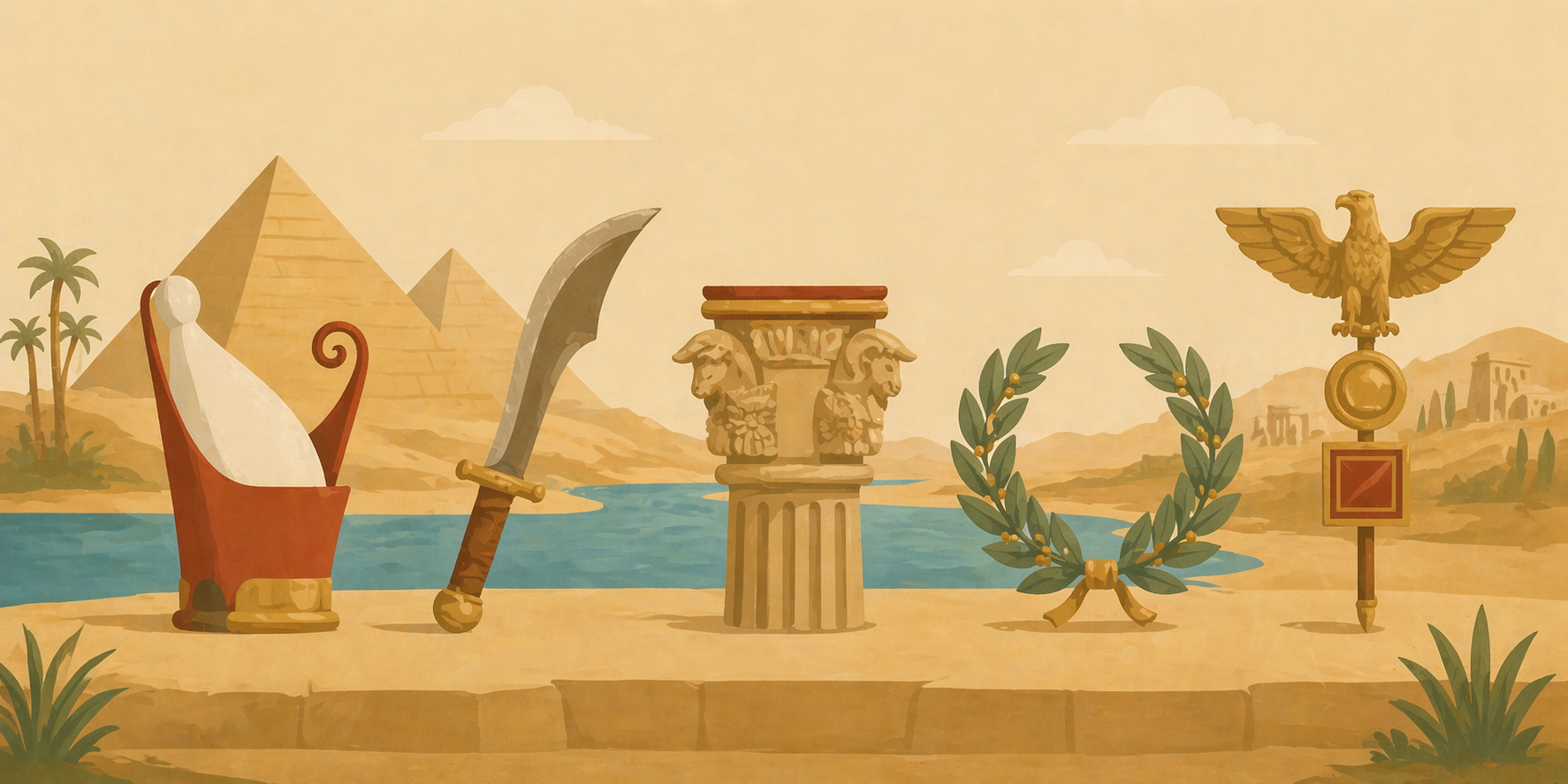
Who Ruled Egypt and When
Six different peoples ruled Egypt during the biblical period — each reshaped its language, culture, and the Jewish communities living there
Egypt was not always ruled by Egyptians. Over its three-thousand-year history, the throne of the pharaohs passed through the hands of native dynasties, Semitic invaders, Libyan and Nubian warriors, Persian emperors, Macedonian Greek kings, and Roman governors. Each transition reshaped the civilization — and each affected the Israelites and Jews who lived alongside the Nile.
This section traces who held power in Egypt and when, with particular attention to how each change in rulership impacted the people of the covenant.
Overview: Rulers of Egypt
| Ruling Power | Approximate Period | Impact on Language & Culture |
|---|---|---|
| Native Egyptian Dynasties | c. 3100–1650 BC | Egyptian language, hieroglyphs, ma'at theology |
| Hyksos (Semitic) | c. 1650–1550 BC | Semitic cultural influence, Canaanite connections |
| Native Egyptian (restored) | c. 1550–1069 BC | Imperial expansion, anti-foreign sentiment |
| Libyan & Nubian Dynasties | c. 1069–664 BC | Cultural continuity under foreign rulers |
| Assyrian (brief) | 671–664 BC | Military occupation; cultural resistance |
| Native Egyptian (restored) | 664–525 BC | Saite Renaissance; archaizing culture |
| Persian Empire | 525–332 BC | Aramaic as administrative language |
| Ptolemaic Greek | 332–30 BC | Greek dominance; bilingual/trilingual culture |
| Roman Empire | 30 BC–AD 641 | Latin administration; Greek persists; Coptic emerges |
Native Egyptian Rule: The Original Dynasties
c. 3100–1650 BC (Old Kingdom through Middle Kingdom)
For nearly fifteen hundred years, Egypt was ruled by native Egyptian dynasties. The pharaoh was not merely a king — he was a god on earth, the living embodiment of Horus and the son of Ra. This divine kingship was the foundation of Egyptian civilization. The entire state apparatus — temples, pyramids, irrigation projects, military campaigns — served to maintain ma'at, the cosmic order that the pharaoh embodied and upheld.
Language: Egyptian, written in hieroglyphs (for monumental inscriptions) and hieratic (for administrative and religious texts on papyrus).
Religion: A complex polytheistic system centered on creation myths, the solar cycle (Ra's daily journey through the sky and underworld), and the Osiris myth (death, judgment, and rebirth). Temples were not places of public worship but houses of the gods, maintained by priestly specialists.
Impact on Abraham: When Abraham entered Egypt (Genesis 12), he encountered this civilization at or near its peak. The ruler Abraham dealt with is called "Pharaoh" in the biblical text, but it is worth noting that the title per-aa ("great house") originally referred to the royal palace as an institution, and during the Middle Kingdom, powerful regional governors (nomarchs) exercised considerable autonomous authority over their provinces. The "Pharaoh" who took Sarah into his household may have been the supreme ruler of all Egypt, or he may have been a powerful regional authority in the Delta — the text does not specify. What is clear is that this ruler wielded enough power that Abraham felt genuine danger: his claim that Sarah was his "sister" (Genesis 12:13) reflects the reality that a ruler of this stature — whether supreme pharaoh or regional governor — could take what he wanted with impunity.
The Book of Abraham adds important context here. Abraham 1:25–27 describes the Pharaonic system itself as an imitation of true governance — the first Pharaoh was "a righteous man" who "established his kingdom and judged his people wisely," yet he was "of that lineage by which he could not have the right of Priesthood" and instead sought to "imitate that order" established by the fathers. This description suggests a political system that consciously modeled itself on an older pattern of patriarchal authority — an insight that resonates with what Egyptologists observe about the pharaonic institution's deep investment in legitimacy through ancient precedent.
The Hyksos: Semitic Rulers of Egypt
c. 1650–1550 BC (Second Intermediate Period)
Around 1650 BC, the Hyksos ("rulers of foreign lands") seized control of the Nile Delta. They were not a sudden barbarian invasion but rather the culmination of gradual Semitic migration into the Delta over generations. By the time they took power, Semitic communities had been living in the eastern Delta for centuries.
The Hyksos established their capital at Avaris (modern Tell el-Dab'a) in the eastern Delta. Archaeological excavations by Manfred Bietak have revealed a settlement that was distinctly Levantine in character — Canaanite-style temples, Syro-Palestinian pottery, donkey burials (a Levantine funerary practice unknown in native Egyptian culture).
The Joseph Connection
The Hyksos period (c. 1650–1550 BC) overlaps with common datings for Joseph's time in Egypt (Genesis 37–50). Several features of the period fit the biblical account, though the connections remain debated:
- Semitic presence in the Delta: Some scholars have suggested that Joseph's rise is more easily explained under Semitic Hyksos rulers, though it is equally possible that Joseph's own position helped open doors for the broader Semitic presence that would characterize the region. What is clear is that the eastern Delta was a Semitic-influenced environment during this era.
- Goshen and Avaris: The region the Bible calls Goshen, where Joseph settled his family (Genesis 47:6), corresponds to the eastern Delta — the same region where the Hyksos capital was located.
- Israelites and Hyksos: Most scholars treat the Israelites and the Hyksos as distinct groups. However, as fellow Semitic peoples, the Israelites would have blended naturally into the Semitic-influenced culture of the eastern Delta during this era.
- The "new king who knew not Joseph": When the native Theban dynasty expelled the Hyksos around 1550 BC, the new rulers would have had reason to distrust the Semitic population remaining in the Delta (Exodus 1:8–14). The transition from Hyksos-era tolerance to native Egyptian suspicion provides one possible context for the shift from Joseph's honored status to Israelite enslavement.
Language impact: The Hyksos brought Semitic loanwords into Egyptian. Some scholars argue that certain Egyptian terms from this period show Canaanite influence. The scribal tradition continued in hieratic, but the Hyksos court likely used both Egyptian and a Semitic language — a bilingual environment that would have served Joseph well.
The New Kingdom: Egypt's Imperial Age
c. 1550–1069 BC (Dynasties 18–20)
The expulsion of the Hyksos by Ahmose I inaugurated Egypt's most powerful era. The trauma of foreign occupation drove the New Kingdom pharaohs to build an empire — conquering deep into Nubia to the south and the Levant to the northeast — to ensure that no foreign power could threaten Egypt again. The result was the greatest concentration of monumental building, military expansion, and cultural achievement in Egyptian history.
Notable Pharaohs of the New Kingdom
Ahmose I (c. 1550–1525 BC, 18th Dynasty) — Founder of the New Kingdom. Expelled the Hyksos from the Delta, reunified Egypt, and launched the imperial expansion that would define the next five centuries. His military campaigns set the template: Egypt would project power outward to prevent any future foreign occupation.
Hatshepsut (c. 1479–1458 BC, 18th Dynasty) — One of the few women to rule Egypt as pharaoh in her own right, not merely as regent. She ruled for over twenty years, overseeing extensive building projects (including her spectacular mortuary temple at Deir el-Bahri near Luxor) and a famous trading expedition to the land of Punt (likely modern Eritrea or Somalia). After her death, her successor Thutmose III systematically erased many of her images and cartouches — though whether this was personal animosity or political necessity remains debated.
Thutmose III (c. 1479–1425 BC, 18th Dynasty) — Often called the "Napoleon of Egypt." Conducted at least seventeen military campaigns into the Levant, creating an Egyptian empire stretching from the fourth cataract of the Nile to the Euphrates River. His victory at the Battle of Megiddo (c. 1457 BC) — one of the earliest battles recorded in detail — is inscribed on the walls of Karnak. Some scholars identify him as the pharaoh of the Exodus (early date) or the pharaoh of the oppression.
Amenhotep III (c. 1390–1352 BC, 18th Dynasty) — Presided over Egypt at the height of its wealth and international prestige. His reign was an era of diplomacy rather than war — the Amarna Letters archive from this period and his son's reign reveals Egypt corresponding as an equal with Babylon, Mitanni, and the Hittites. He built the Colossi of Memnon and a massive mortuary temple (now largely destroyed). Egypt's golden age of art and luxury.
Akhenaten (c. 1353–1336 BC, 18th Dynasty) — The "heretic pharaoh." Attempted to impose exclusive worship of a single deity, the Aten (sun disk), suppressing the traditional temple establishments and moving the capital to a new city at Amarna. His religious revolution is sometimes called the first known experiment in monotheism, though most scholars see fundamental differences between Atenism and Israelite monotheism (Akhenaten worshipped the physical sun disk itself; Israelite monotheism worshipped an invisible, transcendent God). His wife Nefertiti was one of the most powerful women in Egyptian history. After his death, his reforms were systematically reversed and his name erased from official records.
Tutankhamun (c. 1332–1323 BC, 18th Dynasty) — The "boy king" who reversed Akhenaten's religious revolution and restored the traditional gods. Tutankhamun's significance for modern audiences rests primarily on the 1922 discovery of his nearly intact tomb (KV62) by Howard Carter — the most spectacular archaeological find of the 20th century. His golden death mask has become the most recognized symbol of ancient Egypt worldwide. In his own time, he was a minor ruler who died young; in ours, he is Egypt's most famous pharaoh.
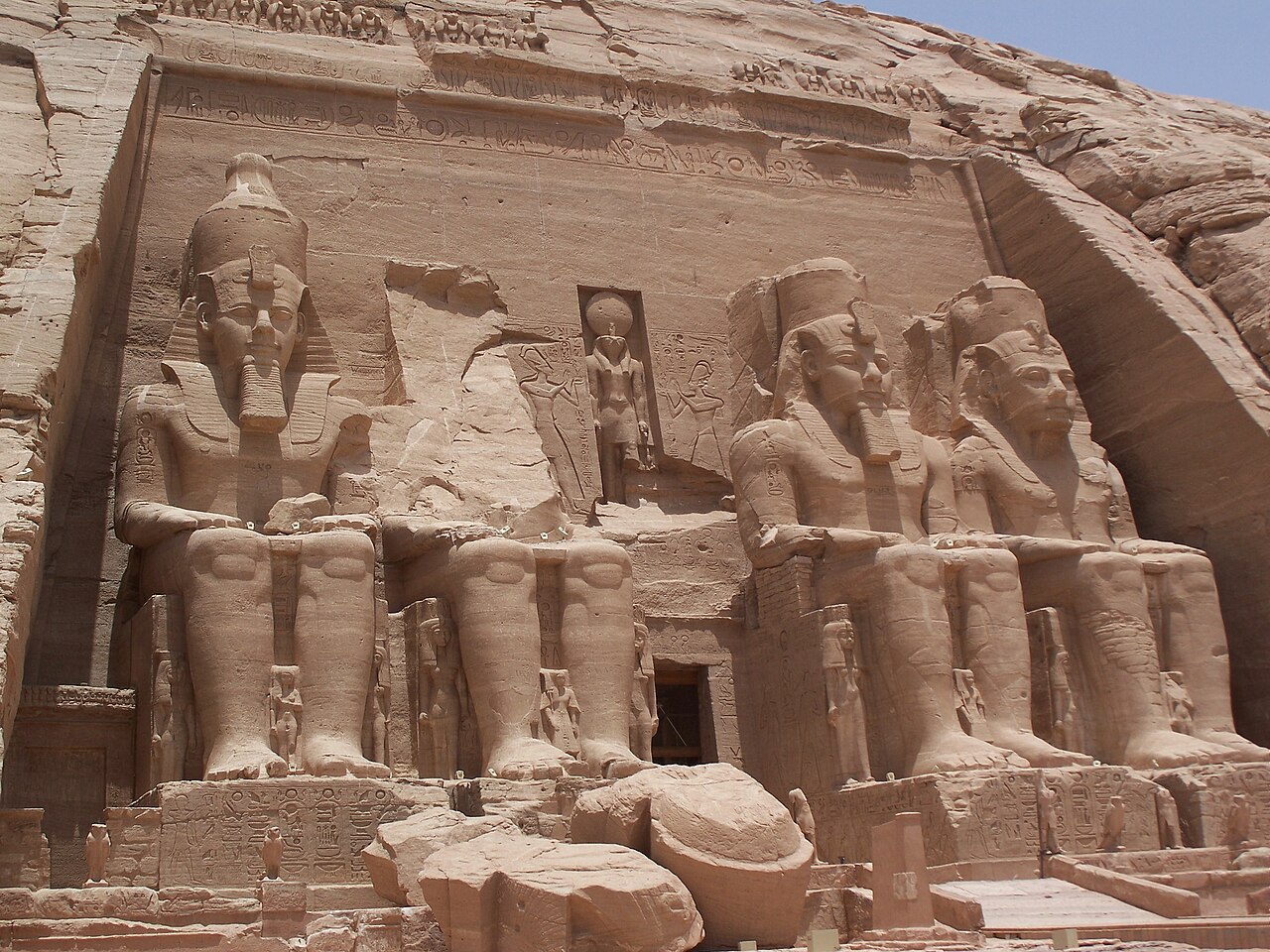
Abu Simbel — Ramesses II's rock-cut temple in southern Nubia, with four colossal seated figures of the pharaoh. Photo: Wikimedia Commons, CC-BY-SA.
Ramesses II ("the Great," c. 1279–1213 BC, 19th Dynasty) — The most commonly proposed pharaoh of the Exodus. Reigned 66 years — one of the longest reigns in history — and was Egypt's most prolific builder. He constructed the great temple at Abu Simbel, the store city of Pi-Ramesses in the eastern Delta (possibly the "Raamses" of Exodus 1:11), additions to Karnak and Luxor, and the Ramesseum mortuary temple. He fought the Hittites at the Battle of Kadesh (c. 1274 BC), which produced the world's first known peace treaty. His massive construction projects required enormous labor forces — providing the clearest historical context for the Israelites' forced labor. His mummy survives in Cairo's National Museum of Egyptian Civilization (NMEC).
Merneptah (c. 1213–1203 BC, 19th Dynasty) — Son of Ramesses II (who outlived many of his own sons). His Merneptah Stele (c. 1208 BC) contains the earliest known reference to "Israel" outside the Bible: "Israel is laid waste and his seed is not." This demonstrates that a people called Israel existed in Canaan by the late 13th century BC — a crucial anchor point for biblical chronology.
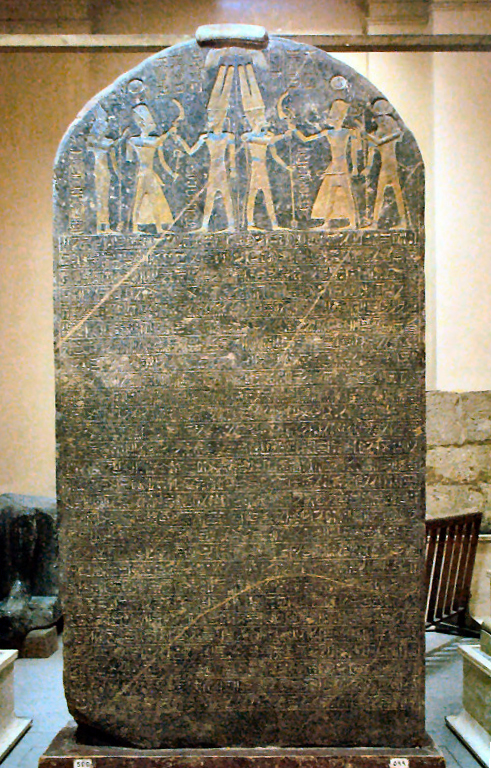
The Merneptah Stele (c. 1208 BC) — the earliest known reference to "Israel" outside the Bible. Cairo, NMEC. Photo: Wikimedia Commons, CC-BY-SA 3.0.
Ramesses III (c. 1186–1155 BC, 20th Dynasty) — The last great warrior pharaoh. Successfully repelled invasions by the Sea Peoples (depicted in dramatic reliefs at Medinet Habu) and Libyan tribes, but Egypt was weakening. His assassination by a harem conspiracy is documented in the Judicial Papyrus of Turin. After his death, the New Kingdom entered a long decline.
Who Was the Pharaoh of the Exodus?
The Bible never names the pharaoh of the Exodus — it simply says "Pharaoh." This has led to two major competing theories:
| Theory | Key Evidence | Proposed Pharaoh |
|---|---|---|
| Early Date c. 1446 BC | 1 Kings 6:1 states Solomon began building the Temple 480 years after the Exodus. Solomon's 4th year is c. 966 BC, placing the Exodus at c. 1446 BC. | Thutmose III (pharaoh of oppression) or Amenhotep II (pharaoh of the Exodus). Amenhotep II's reign shows a sudden decline in military campaigns after c. 1446 — consistent with a national crisis. |
| Late Date c. 1250 BC | Exodus 1:11 names the store cities "Pithom and Raamses" — Pi-Ramesses was built under Ramesses II. The Merneptah Stele (c. 1208 BC) places Israel in Canaan shortly after. | Ramesses II (pharaoh of oppression) or Merneptah (pharaoh of the Exodus). The massive building projects of Ramesses II fit the Exodus description of forced labor. |
Why the Bible doesn't name him: Some scholars suggest the omission is deliberate — by not naming Pharaoh, the text strips him of the immortality that Egyptian rulers craved above all else. In a culture that believed your name must survive for your soul to endure, leaving Pharaoh nameless was the ultimate judgment. Others note that "Pharaoh" functions as a title (like "President" or "King") throughout the Exodus narrative, and that ancient readers may have known which pharaoh was meant.
Latter-day Saints do not have an official position on the Exodus date. Both theories have strengths and weaknesses, and neither is settled among scholars.
Cultural Climate
The New Kingdom was profoundly suspicious of Semitic foreigners — a direct legacy of the Hyksos trauma. This provides the cultural backdrop for Israelite slavery. Pharaoh was not just a political ruler but the guarantor of cosmic order; resistance to his will was not merely political rebellion but cosmic disorder.
The plagues narrative in Exodus directly challenges this ideology. Many scholars and commentators have noted that each plague can be read as targeting a specific aspect of Egyptian religious power — the Nile (associated with Hapi), the sun (Ra), livestock (Hathor/Apis), and ultimately the firstborn (challenging pharaoh's divine lineage). The Exodus is not just a political liberation but a theological confrontation: YHWH vs. the gods of Egypt.
Language impact: The New Kingdom saw the development of Late Egyptian as a literary language. Hieratic remained the primary administrative and religious script. Foreign scribes in Egyptian service used Akkadian cuneiform for international correspondence (the Amarna Letters). This was a multilingual empire.
Libyan and Nubian Dynasties
c. 1069–664 BC (Third Intermediate Period)
After the New Kingdom collapsed, Egypt's throne passed to rulers of Libyan descent (22nd–23rd Dynasties) and then to Nubian/Kushite kings from the south (25th Dynasty). What makes this period remarkable is how thoroughly these foreign rulers adopted Egyptian culture rather than imposing their own.
The Nubian pharaohs of the 25th Dynasty were devoted to the worship of Amun — arguably more devout in their observance of traditional Egyptian religion than some native dynasties had been. They restored temples, revived Old Kingdom artistic styles, and presented themselves as guardians of Egyptian civilization.
Biblical Intersection
Shishak/Sheshonq I (22nd Dynasty, Libyan) invaded Judah around 925 BC, shortly after Solomon's death (1 Kings 14:25–26). His campaign is recorded on the Bubastite Portal at Karnak — one of the rare cases where an Egyptian inscription directly corroborates a biblical account.
The Nubian pharaoh Taharqa (25th Dynasty) is referenced in the Bible as "Tirhakah king of Ethiopia" (2 Kings 19:9; Isaiah 37:9), who marched against the Assyrian king Sennacherib during his siege of Jerusalem in 701 BC.
For Latter-day Saint readers: The pattern of foreign rulers adopting Egyptian religion rather than destroying it illustrates a key insight: Egyptian religious traditions were remarkably resilient and adaptable. This is the same tradition that would later preserve Abraham stories in Egyptian funerary texts — a tradition of absorbing and reinterpreting foreign religious figures that Muhlestein identifies as operating from roughly 200 BC to AD 700.
The Assyrian Conquest
671–664 BC
The Assyrian Empire, which had already conquered the Northern Kingdom of Israel (722 BC) and deported its population, turned its attention to Egypt. Esarhaddon conquered Memphis in 671 BC. His successor Ashurbanipal sacked Thebes in 663 BC — an event so shocking that the prophet Nahum referenced it when predicting Nineveh's own destruction: "Art thou better than populous No [Thebes], that was situate among the rivers?" (Nahum 3:8).
Assyrian rule in Egypt was brief — the logistics of controlling a territory so far from Nineveh proved impossible. By 664 BC, the native Egyptian Psamtik I (26th Dynasty) had reasserted independence, inaugurating the Saite Renaissance.
Biblical note: The Assyrian period is when Judah found itself caught between two empires — Assyria to the northeast and Egypt to the southwest. Isaiah warns repeatedly against trusting in Egyptian alliances: "Woe to them that go down to Egypt for help; and stay on horses, and trust in chariots" (Isaiah 31:1). Egypt was a "broken reed" that would pierce the hand of anyone who leaned on it (Isaiah 36:6).
The Persian Empire
525–332 BC (with interruptions)
Cambyses II, son of Cyrus the Great, conquered Egypt in 525 BC at the Battle of Pelusium. Egypt became a satrapy (province) of the Achaemenid Persian Empire — the same empire that allowed the Jews to return to Jerusalem and rebuild the Temple under Cyrus's decree (Ezra 1:1–4).
Persian rule was administered through a satrap (governor) based in Memphis. The Persians generally respected Egyptian religious institutions — Cambyses's reputation as a temple destroyer appears to be Egyptian propaganda rather than historical reality. However, Egyptian resentment simmered, and several revolts attempted to restore native rule (the 28th–30th Dynasties represent brief periods of Egyptian independence between Persian occupations).
The Elephantine Jewish Colony
The most significant development for biblical history during Persian-ruled Egypt is the Jewish military colony at Elephantine Island (modern Aswan). These Jewish soldiers served as a Persian garrison guarding Egypt's southern border. Their Aramaic documents — letters, contracts, legal records — survive and reveal:
- They maintained a temple to YHWH on Elephantine Island — one of only a handful of Jewish temples known to have existed outside Jerusalem.
- They observed Passover (a letter from the Persian governor instructs them on its proper observance).
- Their temple was destroyed by Egyptian priests of the ram-headed god Khnum around 410 BC, and their desperate letters to Jerusalem and Samaria requesting help with rebuilding survive.
- Some of their religious practices showed syncretistic tendencies — the very mixing of religions that Jeremiah had warned against when he was carried to Egypt after 586 BC.
Language impact: Under Persian rule, Aramaic became the administrative language of the empire, including in Egypt. The Elephantine papyri are written in Aramaic, not Hebrew. This linguistic shift — from Hebrew to Aramaic as the everyday language of Jewish communities — would have profound consequences for Jewish identity and scripture. By the time of Jesus, Aramaic was the common language of Palestinian Jews, and the Aramaic translations of scripture (Targumim) became essential tools for communities that no longer understood Hebrew fluently.
Alexander the Great and the Ptolemaic Dynasty
332–30 BC
In 332 BC, Alexander the Great entered Egypt. He was welcomed — the Egyptians saw him as a liberator from the despised Persians. Alexander visited the Oracle of Amun at Siwa Oasis, where he was reportedly hailed as the "son of Amun" — a recognition that fit both Egyptian royal theology and Alexander's own growing sense of divine mission.
Alexander founded Alexandria on the Mediterranean coast in 331 BC, then left Egypt to continue his conquests eastward. He never returned. After his death in 323 BC, his empire was divided among his generals. Ptolemy I Soter claimed Egypt and founded the Ptolemaic dynasty.
The Ptolemaic Transformation
The Ptolemies transformed Egypt more profoundly than any previous foreign rulers:
Language: Greek became the language of government, law, and elite culture. A two-tier system emerged: Greek-speakers held political and economic power, while Egyptian-speakers (writing in Demotic script) continued their traditions in temples and rural areas. Bilingualism was the norm in cities. The Rosetta Stone (196 BC) — inscribed in hieroglyphic, Demotic, and Greek — is the most famous artifact of this trilingual world.
Religion: The Ptolemies adopted the traditional role of pharaoh, building and maintaining Egyptian temples (including the Temple of Horus at Edfu and the Temple of Isis at Philae). But they also introduced Greek religious practices and created the hybrid deity Serapis — combining features of Osiris and Apis with Greek elements — to unite their Greek and Egyptian subjects.
Culture: Alexandria became the intellectual capital of the Mediterranean world. The Library of Alexandria (the Mouseion) attracted scholars from across the Greek world. The Pharos Lighthouse, one of the Seven Wonders, guided ships into the harbor. Greek philosophy, Egyptian religion, and Jewish theology all intersected in this extraordinary city.
The Jewish Community Under the Ptolemies
The Ptolemaic period saw the dramatic expansion of Jewish life in Egypt:
- Population: By the 1st century BC, Alexandria's Jewish community may have numbered 100,000 or more — occupying their own quarter of the city (two of its five districts) with their own ethnarch (community leader) and council of elders.
- Civic status: Jews had significant civic rights in Alexandria, including the right to live by their own laws. The exact nature of their citizenship status was, however, a source of ongoing tension with the Greek population.
- The Septuagint: Under Ptolemy II Philadelphus (c. 285–246 BC), the Torah was translated into Greek by seventy-two Jewish elders (according to the Letter of Aristeas). This translation — the Septuagint (LXX) — was the first major translation of scripture in history and had far-reaching consequences for both Judaism and Christianity.
- The Onias Temple: Around 160 BC, a Jewish priest named Onias IV built a temple at Leontopolis in the Nile Delta — a rival to the Jerusalem Temple. It functioned for over two centuries until the Romans closed it in AD 73. Josephus discusses it at length (Antiquities 13.62–73; War 7.420–436).
- Military service: Jews served in the Ptolemaic army. Jewish military cleruchies (land grants in exchange for military service) are documented throughout Egypt.
For Latter-day Saint readers: The Ptolemaic period is when the Joseph Smith Papyri were created. The priest Hor, who served at the Karnak, Montu, and Khonsu temples in Thebes around 200 BC, owned the papyrus that includes Facsimile 1 and the Book of Breathings. As Kerry Muhlestein has documented, this was also the beginning of the period (200 BC–AD 700) when biblical figures — especially Abraham, Moses, and Jehovah — appeared most frequently in Egyptian religious texts. The Ptolemaic world was one where Egyptian, Greek, and Jewish religious traditions were actively interacting and borrowing from one another.
Muhlestein notes that Abraham was "the most mentioned mortal" in Egyptian texts from this period, appearing in contexts ranging from love spells to ritual invocations — evidence that Abraham traditions circulated widely in Ptolemaic Egypt, not just within Jewish communities.
Roman Annexation
30 BC–AD 641
The Ptolemaic dynasty ended with Cleopatra VII, the last pharaoh. After her alliance with Mark Antony failed at the Battle of Actium (31 BC), both committed suicide, and Egypt became a personal province of the Roman emperor Augustus. Unlike other Roman provinces, Egypt was governed by a prefect appointed directly by the emperor — senators were forbidden even to visit without permission. Egypt's grain was too strategically important to risk.
Language and Culture
Greek remained the primary language of administration and urban life. Latin was used by the Roman military and imperial bureaucracy but never displaced Greek in Egypt. Demotic Egyptian continued among the native population but was gradually replaced by Coptic — the Egyptian language written in the Greek alphabet with a few additional characters borrowed from Demotic. Coptic would become the language of Egyptian Christianity.
Hieroglyphs survived only in temple contexts, increasingly understood by fewer and fewer temple scholars. The last known hieroglyphic inscription dates to AD 394, carved at the Temple of Isis at Philae. After that, the ancient writing system was lost until the Rosetta Stone enabled its decipherment in the 1820s.
The Jewish Community Under Rome
The Jewish community in Roman Egypt was large, prosperous, and increasingly embattled:
- Philo of Alexandria (c. 20 BC–AD 50) was the most prominent Jewish intellectual of his era — a philosopher who blended Platonic thought with Torah interpretation. His writings influenced early Christian theology (particularly the concept of the Logos, "the Word," which resonates with John 1:1). Philo led a delegation to Emperor Caligula in AD 40 to protest anti-Jewish violence in Alexandria.
- Anti-Jewish violence: The Alexandrian pogroms of AD 38 — Greeks attacking Jewish neighborhoods, desecrating synagogues, confining Jews to a single quarter — were among the first documented anti-Jewish riots in history.
- The Jewish Revolt: During the Kitos War (AD 115–117), Jewish communities across Egypt, Cyrenaica, and Cyprus rose in revolt against Rome. The suppression was devastating — the Alexandrian Jewish community, which had flourished for three centuries, was effectively destroyed.
- The Onias Temple closed: The Romans shut down the Jewish temple at Leontopolis in AD 73, three years after the destruction of the Jerusalem Temple — eliminating the last functioning Jewish temple anywhere in the world.
The Rise of Christianity
Egypt became one of the most important centers of early Christianity:
- Mark the Evangelist traditionally founded the church in Alexandria (c. AD 42). (See WHE: Early Christianity.)
- Clement of Alexandria (c. AD 150–215) and Origen (c. AD 185–253) established Alexandria as a center of Christian theology and biblical interpretation.
- Athanasius of Alexandria (c. AD 296–373) was the great champion of Trinitarian orthodoxy at the Council of Nicaea.
- The Desert Fathers: Egypt gave birth to Christian monasticism. Anthony the Great (c. AD 251–356) and Pachomius (c. AD 292–348) established monastic communities in the Egyptian desert that became the model for monasticism worldwide.
- Nag Hammadi Library: Discovered in 1945 in Upper Egypt, this collection of early Christian and Gnostic texts (including the Gospel of Thomas) was hidden by monks around AD 400, providing an extraordinary window into the diversity of early Christian belief.
Biblical note: The Holy Family's flight to Egypt (Matthew 2:13–15) places the infant Jesus in Roman Egypt. Coptic Christian tradition preserves numerous sites associated with the Holy Family's journey, particularly in the Delta and along the Nile to the south. Egypt, the land of Israel's bondage, becomes the refuge of Israel's Redeemer.
Muhlestein's research shows that during the Roman period, Egyptian religious texts continued to invoke Abraham, Moses, and Jehovah — and that early Christian Egyptian documents also connected Abraham with specifically Egyptian religious imagery, such as the hypocephalus (the "wedjat eye" connection). The religious traditions of Egypt were still actively engaging with Abrahamic figures well into the Christian era.
A Civilization of Continuity Through Change
Perhaps the most remarkable thing about Egypt is how its core cultural identity persisted through every change of rulers. Hyksos kings adopted Egyptian titles. Nubian pharaohs worshipped Amun more devoutly than some native Egyptians. Ptolemaic Greeks built temples in pure Egyptian style. Even the Roman emperors were depicted on temple walls as pharaohs making offerings to Egyptian gods.
This cultural resilience explains why Egyptian religious traditions — including funerary texts, temple rituals, and mythological narratives — continued for millennia. It also explains why those traditions could absorb and reinterpret foreign figures like Abraham. The papyri that eventually reached Joseph Smith were products of this extraordinary cultural continuity — created in a Ptolemaic world that was simultaneously Egyptian, Greek, and Jewish.
"Throughout the ages of history, the hand of God has overruled the actions of mankind that nothing is done except as the Lord may use it for the accomplishment of his mighty purposes."
— John A. Widtsoe, Evidences and Reconciliations (1943), as quoted by Kerry Muhlestein, "Egyptian Papyri and the Book of Abraham"
Explore Further: World History Encyclopedia
- Hyksos
- Ramesses II
- Akhenaten
- Thutmose III
- Ptolemaic Dynasty
- Cleopatra VII
- Achaemenid Empire (Persian)
- Kingdom of Kush
- Sea Peoples
World History Encyclopedia is a nonprofit, peer-reviewed reference (CC BY-NC-SA 4.0).
← Previous: Timeline & Periods | Egypt Guide Home | Next: Jewish Communities →