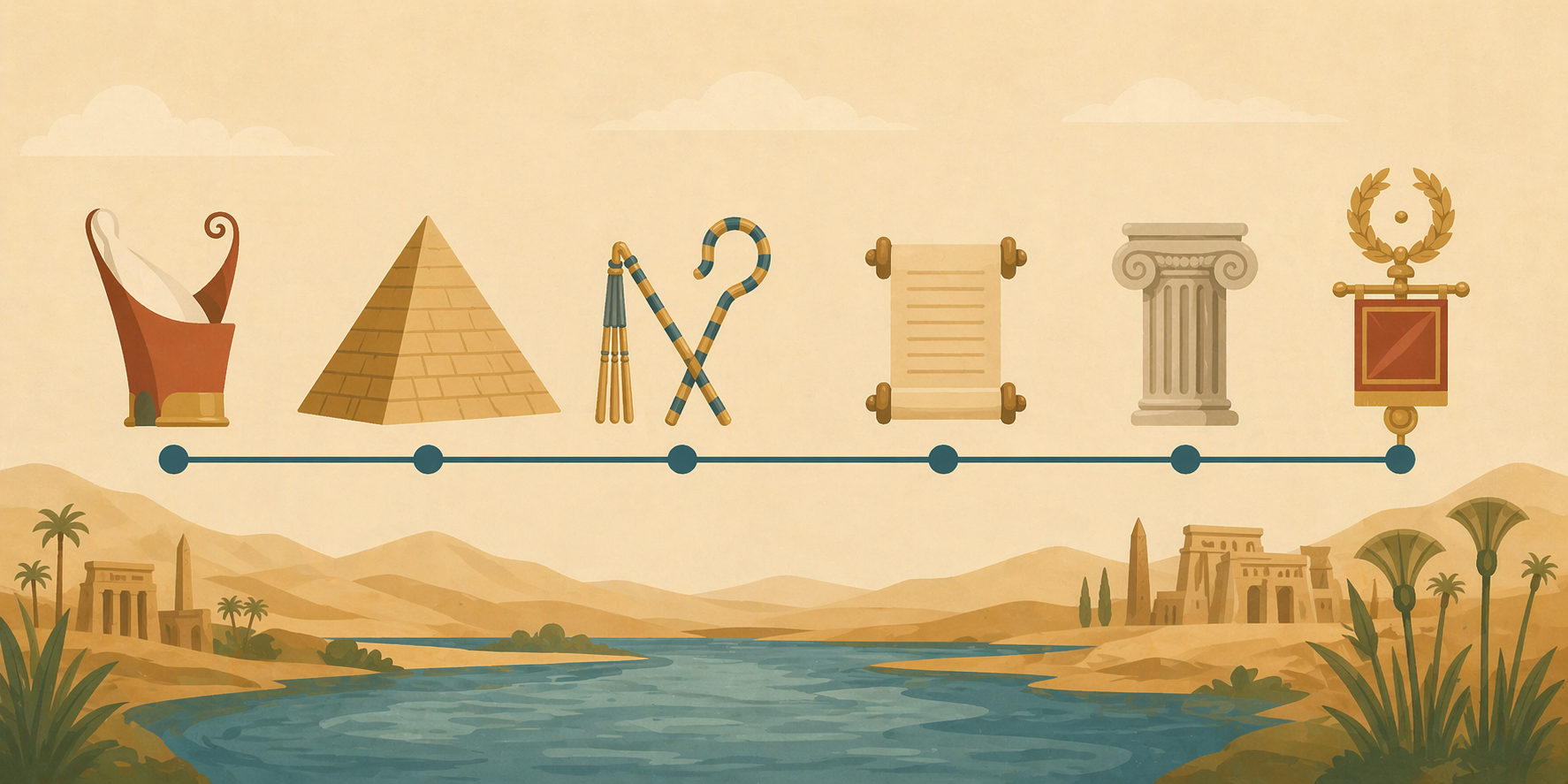
Egyptian Timeline & Periods
Three thousand years of civilization along the Nile — and how it maps to the biblical story
Egypt's recorded history stretches from roughly 3100 BC to the Roman conquest in 30 BC — nearly thirty-one centuries. For comparison, the entire span from Christ to the present is only about two thousand years. The civilization that Moses fled, that sheltered the infant Jesus, and whose papyri would eventually reach Joseph Smith was unimaginably ancient even by biblical standards.
Understanding Egypt's major periods helps place the biblical patriarchs and prophets in their historical context. The table below shows the standard periodization used by Egyptologists, followed by a more detailed look at each era.
Overview: Egyptian Periods at a Glance
| Period | Approximate Dates | Biblical Connection |
|---|---|---|
| Early Dynastic | c. 3100–2686 BC | Pre-Abrahamic |
| Old Kingdom | c. 2686–2181 BC | Pre-Abrahamic (Pyramids of Giza built) |
| First Intermediate Period | c. 2181–2055 BC | Period of fragmentation |
| Middle Kingdom | c. 2055–1650 BC | Abraham's sojourn in Egypt? |
| Second Intermediate / Hyksos | c. 1650–1550 BC | Joseph in Egypt? Hyksos rule |
| New Kingdom | c. 1550–1069 BC | Moses, the Exodus, Israelite slavery |
| Third Intermediate Period | c. 1069–664 BC | Solomon's Egyptian wife; Divided Kingdom |
| Late Period | c. 664–332 BC | Jeremiah flees to Egypt; Elephantine colony; Babylonian Exile |
| Ptolemaic Period | 332–30 BC | Alexander; Septuagint; Maccabees; massive Alexandrian Jewish community |
| Roman Period | 30 BC–AD 641 | Holy Family's flight; Philo; early Christianity; Coptic Church |
The Periods in Detail
Early Dynastic Period (c. 3100–2686 BC)
Dynasties: 1–2 | Capital: Memphis
Egypt's history begins with unification. Around 3100 BC, a ruler traditionally called Narmer (or Menes) united Upper Egypt (the Nile valley, south) and Lower Egypt (the Delta, north) into a single kingdom. This double kingdom would define Egyptian identity for the next three millennia — pharaohs wore the Double Crown combining the White Crown of Upper Egypt and the Red Crown of Lower Egypt.
Writing emerged in this period. The earliest hieroglyphic inscriptions date to around 3200 BC, making Egyptian one of the oldest written languages in the world. Memphis, near the junction of Upper and Lower Egypt (close to modern Cairo), became the capital.
Biblical note: This period predates all biblical chronology. The pyramids had not yet been built. Egypt was already a literate, centralized state centuries before Abraham.
Old Kingdom (c. 2686–2181 BC)
Dynasties: 3–6 | Capital: Memphis
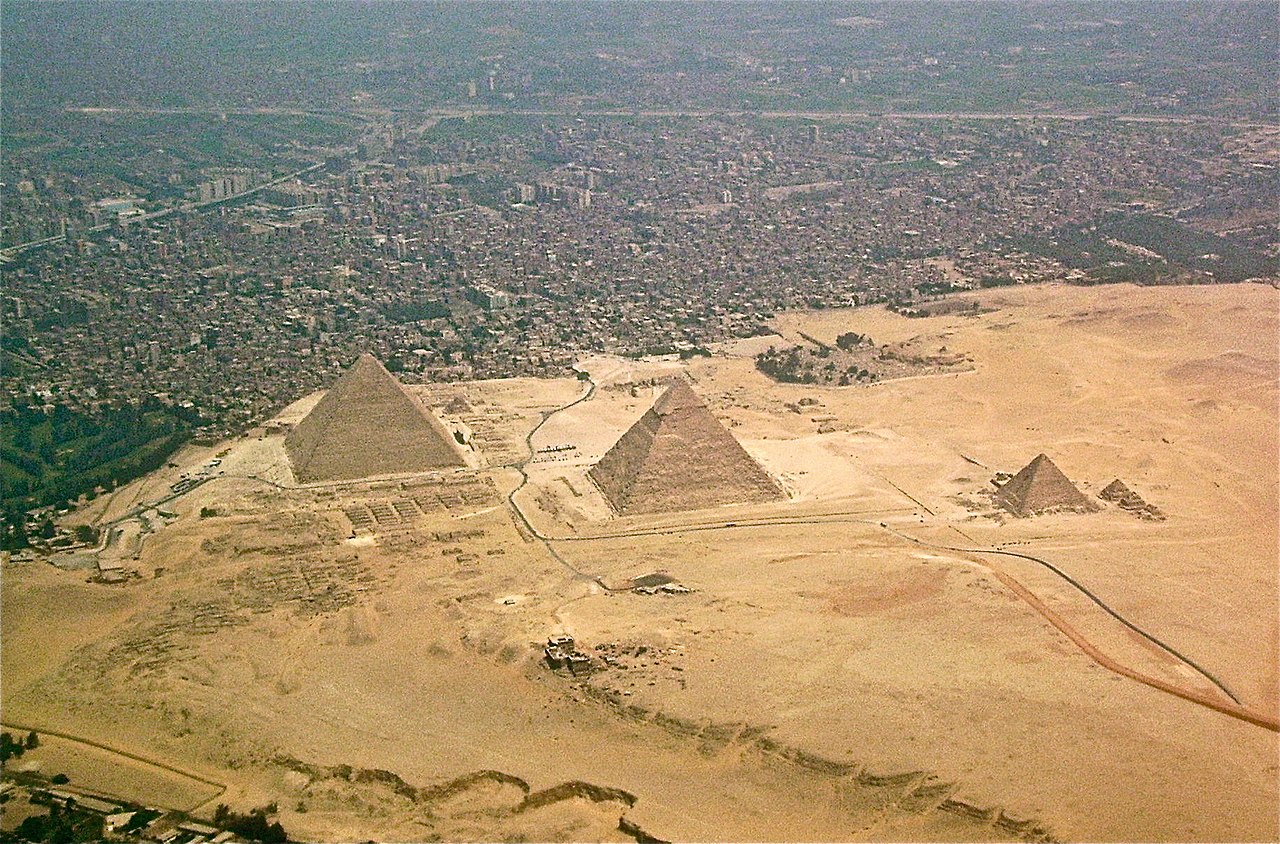
The Pyramids of Giza — built during the 4th Dynasty (c. 2560–2490 BC), they were already over a thousand years old when Abraham entered Egypt. Photo: Wikimedia Commons, CC-BY-SA 2.0.
The "Age of the Pyramids." The Great Pyramid of Giza was built during the Fourth Dynasty (c. 2560 BC) under Pharaoh Khufu — making it roughly a thousand years old by the time Abraham arrived in Egypt. The Old Kingdom produced the Pyramid Texts (the earliest Egyptian religious literature), massive stone architecture, and the first elaborate funerary traditions.
Egyptian religion in this period centered on the sun god Ra, with the pharaoh understood as a divine being — the living Horus, son of Ra. The priestly class wielded enormous institutional power, the bureaucracy was extensive, and the concept of ma'at (cosmic order, truth, justice) governed every level of society.
The Old Kingdom collapsed around 2181 BC, likely due to a combination of drought, famine, and decentralization of power.
Biblical note: When Abraham looked upon the pyramids, they were already ancient. By the New Kingdom, a thousand years later, the Dream Stele of Thutmose IV records that sand had already encroached on the Sphinx. This is the depth of Egyptian history.
First Intermediate Period (c. 2181–2055 BC)
Dynasties: 7–11 (early) | Capitals: Various regional centers
A period of political fragmentation. Central authority collapsed, and Egypt split into competing regional powers. Provincial governors (nomarchs) ruled independently. This was a time of social upheaval, but also literary flowering — some of Egypt's most important wisdom literature dates to this era, including the Dialogue of a Man with His Soul and the Admonitions of Ipuwer.
Reunification came from the south. The rulers of Thebes (modern Luxor) gradually reasserted control, leading to the Middle Kingdom.
Middle Kingdom (c. 2055–1650 BC)
Dynasties: 11 (late)–13 | Capital: Thebes, then Itj-tawy (near the Fayum)
Often called Egypt's "Classical Age." The Middle Kingdom saw a reunified Egypt, expanded trade networks, military campaigns into Nubia and the Levant, and the golden age of Egyptian literature. The Story of Sinuhe — the tale of an Egyptian official who flees to Canaan and eventually returns home — dates to this period and offers a fascinating parallel to Abraham's own journeys.
This is the period in which many scholars place Abraham's sojourn in Egypt (Genesis 12:10–20). The 12th Dynasty pharaohs (c. 1985–1773 BC) maintained strong diplomatic and trade connections with Canaan and the broader Levant. Egyptian texts from this period reference Asiatic (Semitic) peoples entering Egypt — sometimes as traders, sometimes as slaves, sometimes as settlers.
The famous Beni Hasan tomb painting (c. 1890 BC) shows a group of Asiatic people arriving in Egypt with their families and goods — a vivid illustration of the kind of migration Genesis describes.

Procession of Asiatic visitors (the "Aamu") from the tomb of Khnumhotep II at Beni Hasan, c. 1890 BC — the kind of Semitic migration into Egypt that Genesis describes. Via Wikimedia Commons, PD.
Biblical note: Genesis 12 describes Abraham going down to Egypt during a famine. The Middle Kingdom is the period that best fits this narrative — a powerful, centralized Egypt with documented Semitic visitors. The pharaoh Abraham encountered would have ruled from a court that was sophisticated, literate, and accustomed to foreign diplomats and traders.
Second Intermediate Period / Hyksos Rule (c. 1650–1550 BC)
Dynasties: 14–17 | Capital: Avaris (Hyksos) / Thebes (native Egyptian)
A pivotal moment for biblical history. Around 1650 BC, a people the Egyptians called the Hyksos (from the Egyptian heqau khasut, "rulers of foreign lands") seized control of the Nile Delta. The Hyksos were Semitic-speaking people from the Levant — culturally related to the Canaanites and, by extension, to the Israelites.
The Hyksos established their capital at Avaris in the eastern Delta — the same region the Bible identifies as Goshen, where Joseph's family would later settle. They ruled Lower Egypt for about a century while native Egyptian dynasties held Upper Egypt from Thebes.
The Hyksos introduced the horse-drawn chariot, composite bow, and new bronze-working techniques to Egypt. Their expulsion by the Theban pharaoh Ahmose I (c. 1550 BC) inaugurated the New Kingdom and left a deep scar on Egyptian national memory — a lingering suspicion of Semitic foreigners that may echo in the Exodus narrative: "There arose a new king over Egypt, who knew not Joseph" (Exodus 1:8).
Biblical note: The Hyksos period overlaps with common datings for Joseph's time in Egypt. Some scholars have suggested that a Semitic foreigner rising to power is more easily explained under Semitic Hyksos rulers, though the relationship between the Israelites and the Hyksos remains debated. Most scholars treat them as distinct groups, but as fellow Semitic peoples, the Israelites would have blended naturally into the eastern Delta's Semitic-influenced culture. Joseph's family settling in Goshen/Avaris — the Hyksos capital region — fits this geographic context well.
The "new king who knew not Joseph" (Exodus 1:8) may refer to the native Egyptian dynasty that expelled the Hyksos and would have had reason to distrust the Semitic population remaining in the Delta.
New Kingdom (c. 1550–1069 BC)
Dynasties: 18–20 | Capital: Thebes (religious) / Pi-Ramesses (administrative, 19th Dynasty)
Egypt's imperial age and the most likely setting for the Exodus. The New Kingdom produced some of Egypt's most famous pharaohs: Hatshepsut, the female pharaoh who built a massive mortuary temple at Deir el-Bahri; Thutmose III, the "Napoleon of Egypt" who conquered an empire stretching from Nubia to the Euphrates; Akhenaten, who briefly imposed monotheistic worship of the sun disk Aten; Tutankhamun, whose intact tomb became the most famous archaeological discovery of the 20th century; and Ramesses II ("the Great"), who reigned 66 years, built Abu Simbel and Pi-Ramesses, and is the pharaoh most commonly associated with the Exodus.
This was the era of the Valley of the Kings, the great temples at Karnak and Luxor, and the Book of the Dead as standard funerary literature. Egyptian religion reached its most elaborate form, with a complex pantheon, detailed afterlife theology, and massive temple complexes staffed by thousands of ritual specialists.
The 18th Dynasty also produced the Amarna Letters (c. 1350 BC) — diplomatic correspondence between Egyptian pharaohs and rulers throughout the ancient Near East, written in Akkadian cuneiform. These letters reveal a deeply interconnected world of diplomacy, trade, and political intrigue.
Biblical note: Most scholars who accept a historical Exodus place it in this period, either in the 15th century BC (early date, under Thutmose III or Amenhotep II, based on 1 Kings 6:1) or the 13th century BC (late date, under Ramesses II, based on Exodus 1:11's reference to the store cities Pithom and Ramesses).
The New Kingdom's building projects — which required massive labor forces — provide the clearest historical context for the Israelites' forced labor described in Exodus 1. The city of Pi-Ramesses, built in the eastern Delta under Ramesses II, sits in the same region as biblical Goshen.
Third Intermediate Period (c. 1069–664 BC)
Dynasties: 21–25 | Capitals: Tanis (north), Thebes (south)
Egypt fragmented again. Power was divided between pharaohs ruling from the Delta city of Tanis and the high-ranking temple officials of Amun at Thebes. Libyan-descended dynasties (22nd–23rd) took the throne, followed by Nubian/Kushite rulers (25th Dynasty) who controlled Egypt from the south.
This period overlaps with the Israelite monarchy. Pharaoh Shishak (identified with Sheshonq I of the 22nd Dynasty) invaded Judah and sacked Jerusalem in the fifth year of Rehoboam, around 925 BC (1 Kings 14:25–26; 2 Chronicles 12:2–9). An inscription at Karnak records Sheshonq's campaign, listing conquered cities in both Israel and Judah.
Solomon's Egyptian wife (1 Kings 3:1) was likely a daughter of a 21st Dynasty pharaoh — a diplomatic marriage reflecting the era's complex international relationships.
Biblical note: This is the period of the Divided Kingdom (Israel and Judah). Egypt is no longer the dominant superpower — Assyria is rising in the east — but it remains a significant regional player. The prophets Isaiah and Jeremiah repeatedly warn against trusting in Egyptian alliances (Isaiah 30:1–5; 31:1–3; Jeremiah 2:18, 36).
Late Period (c. 664–332 BC)
Dynasties: 26–31 | Capital: Sais (26th Dynasty), then various
Egypt's last centuries of native rule — and its first centuries under foreign empires. The 26th Dynasty (the "Saite Renaissance") briefly restored Egyptian independence and cultural vitality, looking back to Old Kingdom art and texts for inspiration.
But the great empires were closing in. The Assyrians had briefly conquered Egypt under Esarhaddon (671 BC) and Ashurbanipal (664 BC). The Persians under Cambyses II conquered Egypt in 525 BC, making it a province of the Achaemenid Empire. Egypt would be ruled by Persians, with brief intervals of independence, until Alexander arrived in 332 BC.
This is the period of the Jewish community at Elephantine Island (modern Aswan), at Egypt's southern border. A garrison of Jewish soldiers maintained a temple to YHWH on the island — with records in Aramaic that survive to this day, including correspondence about rebuilding their temple after it was destroyed by Egyptian priests of Khnum.
Biblical note: After Nebuchadnezzar destroyed Jerusalem and the First Temple in 586 BC, Jeremiah was taken to Egypt against his will by a group of Jewish refugees (Jeremiah 43:5–7). He prophesied there, warning the refugees against worshipping Egyptian gods (Jeremiah 44).
The Elephantine papyri (5th century BC) reveal a Jewish community that worshipped YHWH but also showed syncretistic tendencies — exactly the kind of divided loyalty Jeremiah warned against. These documents are among the most important extrabiblical witnesses to Jewish life in this period.
Ptolemaic Period (332–30 BC)
Dynasty: Ptolemaic (Macedonian Greek) | Capital: Alexandria
Alexander the Great conquered Egypt in 332 BC. According to Josephus, he was welcomed as a liberator from Persian rule. Alexander founded Alexandria on the Mediterranean coast — a city that would become one of the greatest in the ancient world, home to the famous Library and the Pharos lighthouse.
After Alexander's death in 323 BC, his general Ptolemy I Soter claimed Egypt. The Ptolemaic dynasty ruled for nearly three centuries, and their impact was transformative:
- Language: Greek became the language of government, commerce, and elite culture. Egyptian continued among the native population, but Greek was the path to power.
- Religion: The Ptolemies maintained Egyptian temples and adopted Egyptian royal titles, but Greek religious practices and philosophy also flourished. The god Serapis was created as a deliberate Greek-Egyptian hybrid deity.
- Jewish community: Alexandria developed one of the largest Jewish communities in the ancient world — perhaps 100,000 or more by the 1st century BC. Jews had their own quarter, civic rights, and institutions.
- The Septuagint: Under Ptolemy II Philadelphus (c. 285–246 BC), the Torah was translated into Greek — the first major translation of scripture in history. This translation, called the Septuagint (LXX), would become the Bible of the early Christian church.
The Ptolemaic period also produced the funerary documents that would eventually reach Joseph Smith. The priest Hor, who served at the Karnak, Montu, and Khonsu temples in Thebes around 200 BC, owned the papyrus containing Facsimile 1 and the Book of Breathings. A woman named Tasherit-Min owned the Book of the Dead scroll that was part of the same collection. (See the Church's Gospel Topics essay on the Book of Abraham for further background.)
Biblical note: The Ptolemaic period is the world between the Old and New Testaments. The Maccabean revolt (167–160 BC) was partly a reaction against Hellenistic cultural pressure that the Ptolemaic (and later Seleucid) empires had introduced. Daniel's prophecies about the kingdoms following Alexander (Daniel 8, 11) describe this era.
For Latter-day Saints, this period is also significant as the context for the Joseph Smith Papyri. The Egyptian funerary documents that would travel from Thebes to Kirtland were created during the Ptolemaic era — roughly the same period as the Septuagint translation and the early stages of the Maccabean struggle.
Roman Period (30 BC–AD 641)
Rulers: Roman emperors (via prefects) | Capital: Alexandria
The last Ptolemaic ruler, Cleopatra VII, allied with Roman generals Julius Caesar and Mark Antony. After Antony and Cleopatra's defeat at the Battle of Actium (31 BC) and their suicides in 30 BC, Egypt became a Roman province under Augustus Caesar — the same Augustus whose census decree brought Mary and Joseph to Bethlehem (Luke 2:1).
Roman Egypt was a breadbasket for the empire. The grain ships that sailed from Alexandria to Rome were essential to feeding the capital. Egyptian religion continued alongside Greek and Roman traditions, with major temple construction projects continuing into the 2nd century AD (the Temple of Isis at Philae was one of the last functioning Egyptian temples, closing in the 6th century AD).
The Jewish community in Roman Egypt was enormous but increasingly vulnerable. After the Jewish-Roman wars (AD 66–70 in Judea, AD 115–117 in Egypt/Cyrenaica), the Alexandrian Jewish community was devastated. The Leontopolis temple (the "Onias temple," a rival Jewish temple built around 160 BC) was closed by the Romans in AD 73, shortly after the fall of Jerusalem's Second Temple.
Christianity took deep root in Egypt. Tradition holds that the apostle Mark founded the church in Alexandria. Egypt produced some of the most important early Christian thinkers (Clement of Alexandria, Origen, Athanasius) and the monastic movement (Anthony the Great, Pachomius). The Coptic Church — which preserves Egyptian Christianity to this day — takes its name from the Greek word for Egypt (Aigyptos), which itself derives from an ancient Egyptian name for Memphis.
Biblical note: The Holy Family's flight to Egypt (Matthew 2:13–15) took place under Augustus or the early years of his successors. The text quotes Hosea 11:1: "Out of Egypt have I called my son" — a passage originally about the Exodus, now applied to Christ. Egypt, the land of bondage in the Old Testament, becomes the land of refuge in the New.
Philo of Alexandria (c. 20 BC–AD 50) was a contemporary of Jesus and Paul. His philosophical writings — blending Greek philosophy with Jewish scripture — represent the most sophisticated expression of Alexandrian Judaism and influenced early Christian theology profoundly.
Biblical Chronology Mapped to Egyptian Periods
The following chart shows approximately where key biblical figures and events fall within the Egyptian timeline. Dates for the biblical figures are approximate and based on commonly used scholarly estimates; the patriarchal dates especially involve significant uncertainty.
| Biblical Event / Figure | Approximate Date | Egyptian Period |
|---|---|---|
| Abraham's sojourn in Egypt | c. 2000–1850 BC | Middle Kingdom (12th Dynasty) |
| Joseph as vizier of Egypt | c. 1700–1600 BC | Second Intermediate / Hyksos |
| Israelite slavery in Egypt | c. 1550–1446 or 1250 BC | New Kingdom (18th–19th Dynasty) |
| The Exodus | c. 1446 or c. 1250 BC | New Kingdom (18th or 19th Dynasty) |
| Solomon marries Pharaoh's daughter | c. 960 BC | Third Intermediate (21st Dynasty) |
| Shishak invades Judah | c. 925 BC | Third Intermediate (22nd Dynasty) |
| Jeremiah flees to Egypt | c. 586 BC | Late Period (26th Dynasty) |
| Elephantine Jewish colony | c. 5th century BC | Late Period (Persian rule, 27th Dynasty) |
| Septuagint translated | c. 280–250 BC | Ptolemaic Period |
| Hor's papyrus created (JSP Facsimile 1) | c. 200 BC | Ptolemaic Period |
| Holy Family's flight to Egypt | c. 5–4 BC | Roman Period (Augustus) |
| Philo of Alexandria | c. 20 BC–AD 50 | Roman Period |
Explore Further: World History Encyclopedia
- Old Kingdom of Egypt
- Middle Kingdom of Egypt
- Second Intermediate Period (Hyksos)
- New Kingdom of Egypt
- Third Intermediate Period
- Late Period of Ancient Egypt
- Ptolemaic Dynasty
- Bronze Age Collapse
World History Encyclopedia is a nonprofit, peer-reviewed reference (CC BY-NC-SA 4.0).