Field Guide · The Divided Kingdom
Whose Story Is This?
The history from Kings forward reached its final form generations after the events — edited in and after the Babylonian exile, from a southern, Jerusalem-centered point of view. Knowing whose hands shaped it, and when, changes how we read all of it.
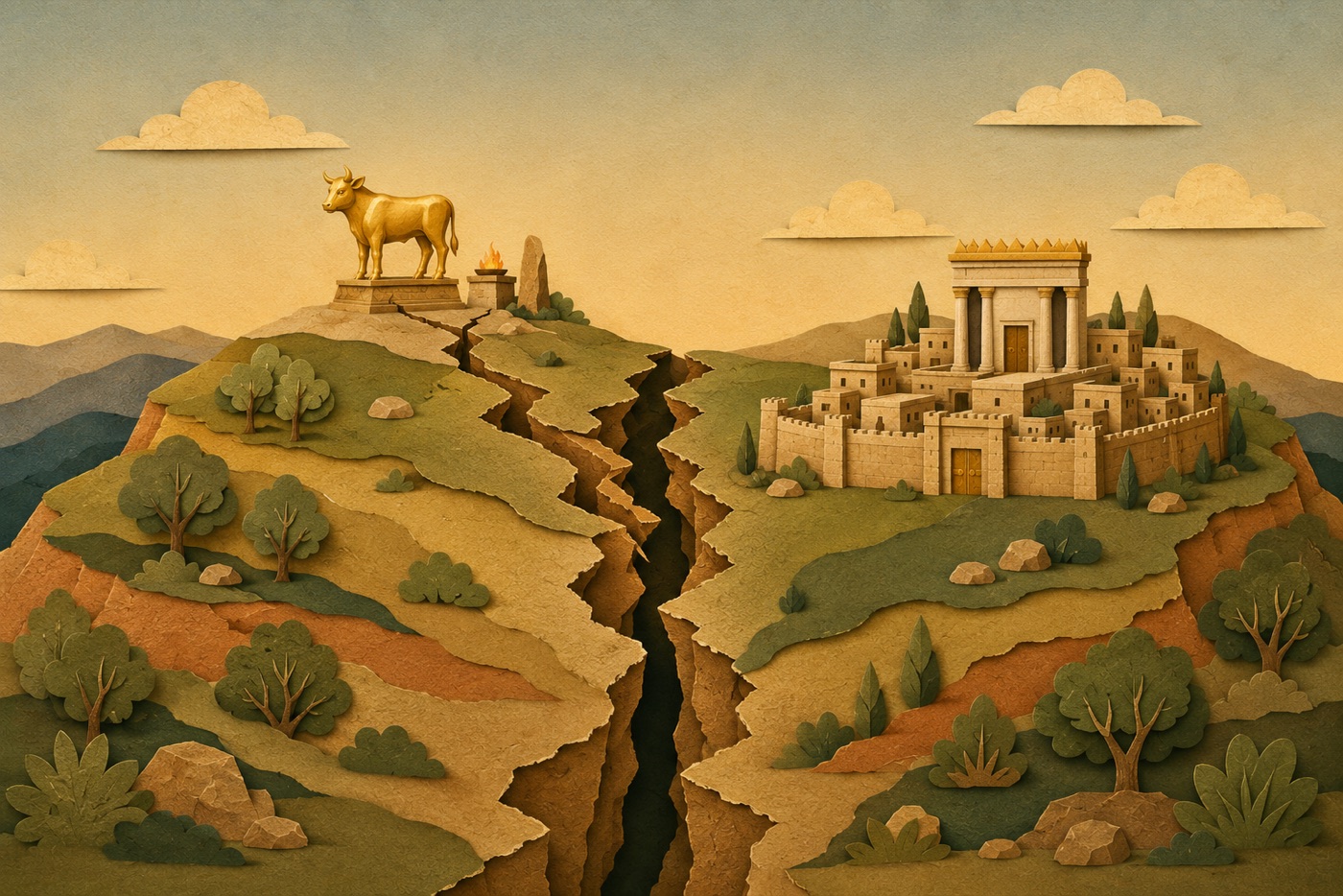
Before the first king and the first battle, one question shapes everything that follows in this guide: whose story is this, and when was it written down? The books of Kings — and much of the Old Testament’s history of the monarchy — did not reach their final form in the moment they describe. They were compiled and edited generations later, in and after the Babylonian exile (Jerusalem fell in 587/586 BC), by writers looking back across the wreckage and asking why. The events are old; the telling is later. And a story told long afterward, by a particular people, for a particular purpose, always carries the fingerprints of the moment that shaped it.
A History Written Looking Backward
Modern scholarship gives the shaping hands a name — the Deuteronomists — and a viewpoint: southern, centered on Jerusalem and its temple, loyal to the house of David. (This is a scholarly reconstruction the guide explores in detail later, not the text’s own plain claim and not a required article of faith — but it is a widely held reading, and a useful one.) Much of what we read from Kings forward was gathered and interpreted through that lens. It does not make the history false. It means the history has a point of view — and knowing the point of view is part of reading honestly.
A Viewpoint, and a Verdict
You can see the viewpoint in the scorecard. King after king is graded by a single repeating line — did he do right or evil in the sight of the LORD — and the grades fall unevenly. Every king of the northern Kingdom of Israel is judged evil: all nineteen, first to last, without exception. In the south, the record is willing to call eight of Judah’s twenty kings righteous. The North produced towering prophets — Elijah and Elisha, who stride through its story — yet not one of its kings earns the text’s blessing.
That lopsided verdict may simply be true: the North really did institutionalize rival worship from the day it broke away. But we have seen elsewhere how a record can be shaped by the concerns and the politics of the people who write it — and an across-the-board condemnation of a rival kingdom, composed by that kingdom’s southern rivals after both had fallen, is worth reading with open eyes. The honest posture is to hold both possibilities at once: the verdict may be earned, and a viewpoint is present. Flattening it either way — into “the North was simply wicked” or into “it was only propaganda” — loses something true.
You can feel that double vision in a single case — flip between the two readings:
The verdict on the northern kings
“Omri wrought evil in the eyes of the LORD, and did worse than all that were before him.” — 1 Kings 16:25
Every last northern king “did evil in the sight of the LORD.” Omri, who “did worse than all before him,” gets barely six verses; the mighty Jeroboam II gets seven. Their reigns are measured by one thing only — did they hold to the sin of Jeroboam? — and all of them did.
By any other measure, several of the northern kings were formidable and highly successful. Omri founded a dynasty so significant that Assyria still called the whole kingdom “the House of Omri” a century after his death; Jeroboam II presided over the North's territorial and economic golden age — the very prosperity Amos and Hosea rebuked. The narrators' brevity isn't ignorance of their power; it's that political success simply isn't what they are grading.
Hold both. The lens is the point. The narrators know these kings were mighty — they just don't care about might. Seeing what they choose to measure (covenant loyalty, not conquest) is the key to reading their verdicts rightly. Deepens, not debunks.
Judged by a Rule That Came Later
The heaviest charge against the North is where it worshipped — Jeroboam’s shrines at Dan and Bethel, and the “high places” the verdicts flag again and again. But here is the detail that reframes the whole scorecard: for most of Israel’s history, worshipping at many places was simply normal — even for the faithful. The patriarchs raised altars up and down the land: Abraham “builded an altar unto the LORD” at Shechem and again beside Bethel (Genesis 12:7–8), and Jacob set up a stone at that same Bethel and named the place Beth-el, “the house of God” (Genesis 28:18–19). Even Elijah, the North’s great champion of the LORD, repaired an altar and offered sacrifice on Mount Carmel. And archaeology agrees: excavators have uncovered a full temple to the LORD at Arad — inside Judah itself — a sanctuary at Tel Motza just a few miles from Jerusalem, and altars and high places at many sites besides. Worship at many places was not a northern aberration; it was the settled practice of Israel and Judah for centuries.
What changed was the drive to centralize all sacrifice at the Jerusalem temple — begun by Hezekiah, who “removed the high places” a century earlier (2 Kings 18:4), reversed under his son Manasseh, and then carried through decisively in Josiah’s reform, around 622 BC. Prompted by a scroll found in the temple — widely identified with Deuteronomy and its command to worship only at “the place which the LORD your God shall choose… to put his name there” (Deuteronomy 12:5) — Josiah tore down the high places, defiled the old altar at Bethel, and made the Jerusalem temple the one lawful place of sacrifice (2 Kings 22–23). Centralized worship became the standard. And it is that standard — Josiah’s, late in the story — by which the Deuteronomists grade every king who came before, including northern kings who had died centuries earlier, when no such rule yet existed.
Scholars have long asked why the change came, and weigh several answers at once: a genuine purifying of worship, as scattered shrines drifted into idolatry; a consolidation of political power around Jerusalem and the throne of David; and the economic gravity of gathering tithes, offerings, and pilgrimage into a single temple. It was likely some of each. For Latter-day Saints there is a pointed wrinkle: the Nephites, who carried the record out of Jerusalem, built their own temple in the New World “after the manner of the temple of Solomon” and worshipped there without a word of rebuke (2 Nephi 5:16; Jacob 1:17) — a reminder that “the place the LORD shall choose” was never meant to confine God to a single address. Centralization was a real and important turn in Israel’s story — but it was a turn, and judging the northern shrines only by it flattens something much older and more tangled.
Faithful framing. None of this asks us to trust scripture less. The Church takes no official position on the Deuteronomistic model, and this guide keeps its layers honest: the biblical text, the scholarly reconstruction of how it was edited, the interpretation we build on top, and the Latter-day Saint frame — each labeled for what it is. The goal is not suspicion but depth — reading with enough awareness of perspective to hear what the story is really doing. Deepens, not debunks.
The high places are the sharpest instance of it — the same practice, read two ways:
The “high places” (bamot)
Jehoshaphat did right — “nevertheless the high places were not taken away.” — 1 Kings 22:43
A standing failure. Again and again a king is praised for doing right, then marked with an asterisk: “nevertheless the high places were not taken away.” To worship the LORD anywhere but the one Jerusalem sanctuary is a compromise no reign fully escapes — until Hezekiah and Josiah finally tear them down.
For most of Israel's history, worship at local high places was simply normal, faithful Yahwism — no one thought it wrong. Samuel sacrificed at one; Solomon worshipped at “the great high place” of Gibeon before the temple was even built. The demand to gather all worship to Jerusalem is Deuteronomy's later reform — and the Deuteronomists judge earlier generations by a rule that did not yet exist in their day.
Hold both. Neither cancels the other. Centralization became the covenant ideal, and the editors apply it consistently — but recognizing that the rule was a later development keeps us from picturing Israel's own ancestors as knowing sinners. Deepens, not debunks.
Why It Matters — the New Testament
This is not an academic footnote, because the fracture never healed. The northern kingdom’s territory became Samaria, and by Jesus’ day the old rivalry had hardened into a wall: “the Jews have no dealings with the Samaritans” (John 4:9). And the mindset of one covenant people despising another is exactly what Jesus goes out of his way to overturn. He makes a Samaritan the hero of his most famous parable (Luke 10:33). He sits at a well and offers living water to a Samaritan woman the respectable would have shunned (John 4). Ten lepers are healed and only one turns back to give thanks — “and he was a Samaritan” (Luke 17:16). The self-assured scorn of the religious insider for the outsider is among the very things Christ condemns most sharply. Learn to see the viewpoint baked into the old verdicts, and you begin to see why He worked so hard to break it.
Why It Matters — the Book of Mormon
The same mentalities run straight through the Book of Mormon. From the first, Laman and Lemuel refuse to credit Lehi’s warning that the city is doomed — they do not believe “that Jerusalem, that great city, could be destroyed according to the words of the prophets” (1 Nephi 2:13). Years later, worn down by the wilderness, they are still defending the home they were made to leave, and they turn it into a verdict of their own: “the people who were in the land of Jerusalem were a righteous people… wherefore, we know that they are a righteous people; and our father hath judged them” (1 Nephi 17:22). Their case is that Jerusalem was faithful and therefore safe — that Lehi had wrongly condemned a righteous people and dragged the family into the desert for nothing. It is a rival verdict — a competing story about who is righteous and who is the rebel, told to defend the ones telling it — and history rendered the opposite judgment: Jerusalem fell to Babylon in 586 BC, exactly as Lehi had warned. And there is a quiet irony underneath: Lehi was of the tribe of Manasseh (1 Nephi 5:14; Alma 10:3) — a tribe of the north, the very branch the Judahite record — the account kept in Judah, the southern kingdom — was inclined to write off. Competing narratives, self-justification, one part of a family casting the other as the rebel: the Deuteronomists’ world and Lehi’s family are nearer than they look.
Reading From Here
So this guide asks one thing as you walk it: read the divided kingdom with open eyes. Honor the text and trust that its verdicts may well be right — and at the same time notice the viewpoint, and extend to the ancient North the same critical sympathy you would want extended to you. That double vision — believing and examining at once — is the whole discipline, and it turns a grim list of failed kings into something that can actually search us. It is precisely the mentality Christ confronted, and precisely the friction that split Lehi’s sons; learning to see it in scripture helps us see it in ourselves.
Start the story: The Split →. Or go straight to the editors’ lens behind these verdicts: The Deuteronomists’ Lens →.