Field Guide · The Divided Kingdom
The Sin of Jeroboam
Two golden calves, a homemade priesthood, and a festival 'devised of his own heart' — Jeroboam built an anti-Temple to keep the north from drifting south, and the book of Kings never stops measuring against it.
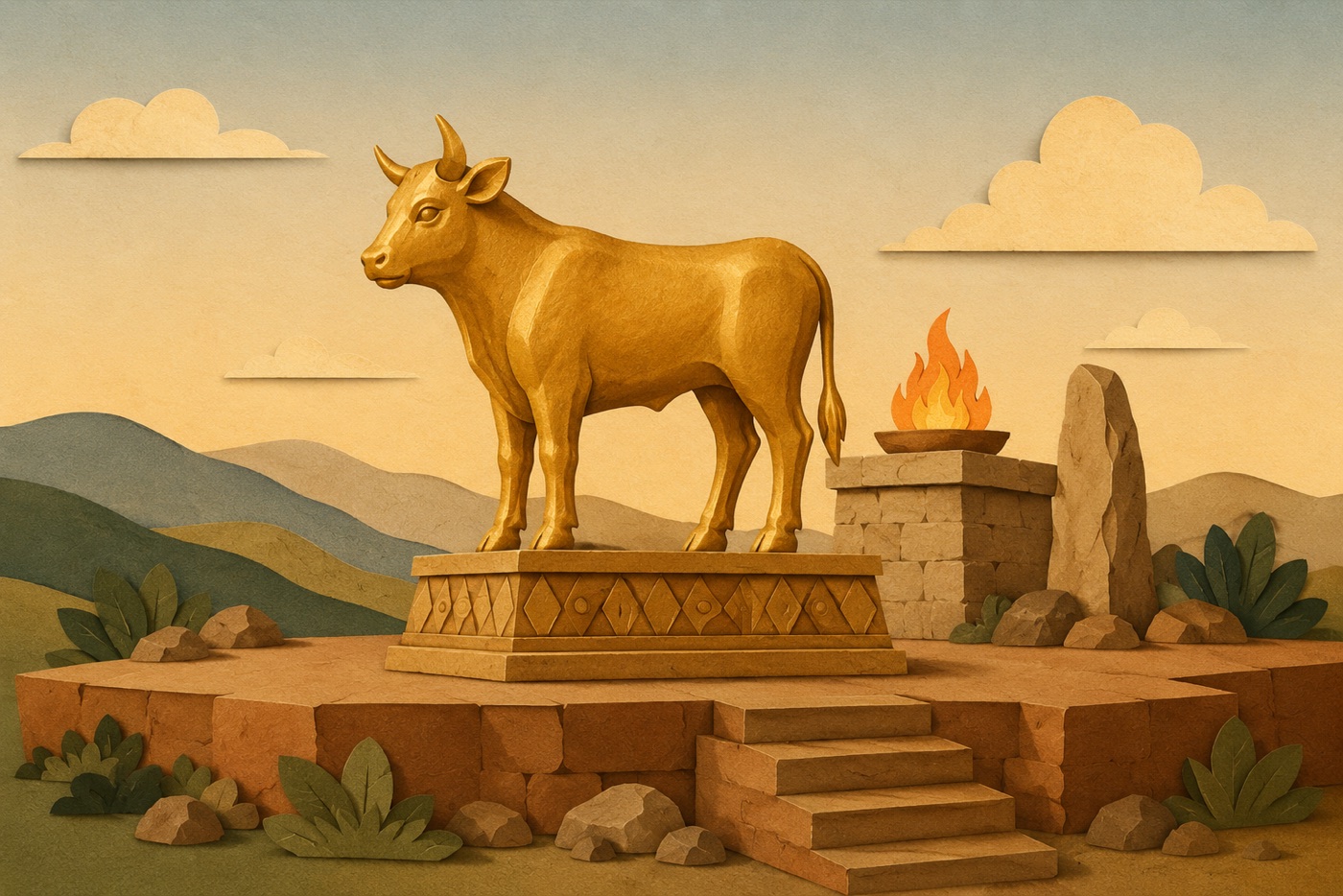
When the kingdom split, Jeroboam faced a problem that was not religious but political: his people still walked south, three times a year, to worship at the Temple in Jerusalem — the capital of his rival. So he built an alternative. Two golden calves, one at Bethel in the south of his territory and one at Dan in the far north, with new sanctuaries, a new priesthood, and a new festival. The narrators of Kings do not treat this as a policy choice. They treat it as the defining wound of the Northern Kingdom — “the sin (חַטָּאת) of Jeroboam” — the standard by which every northern king who follows will be measured and found wanting, all the way to the Assyrian exile.
The Politician’s Calculation
Kings is unusually candid about Jeroboam’s motive — it lets us hear him think: “Now shall the kingdom return to the house of David: if this people go up to do sacrifice in the house of the LORD at Jerusalem, then shall the heart of this people turn again unto their lord, even unto Rehoboam… and they shall kill me” (1 Kings 12:26–27). Pilgrimage to Jerusalem was a centripetal force, pulling hearts back toward the Davidic throne; Jeroboam’s calves are engineered to stop that pull. This is why the Temple guide and this one belong together: the calves are the anti-Temple, built for the express purpose of keeping people away from the centralized worship that Solomon’s house was the heart of.
“Behold Thy Gods, O Israel”
The narrators frame the unveiling with a deliberate, damning echo. Jeroboam says of the calves: “It is too much for you to go up to Jerusalem: behold thy gods, O Israel, which brought thee up out of the land of Egypt” (1 Kings 12:28). Those are almost exactly the words spoken at the foot of Sinai over Aaron’s golden calf: “These be thy gods, O Israel, which brought thee up out of the land of Egypt” (Exodus 32:4). The reader is meant to hear it. By quoting the wilderness apostasy, the text tells us how to read Jeroboam before it argues the case: this is Sinai’s sin, rebuilt as state religion. (That Exodus echo is the text’s own framing — not a modern overlay.)
What Jeroboam Actually Did
The narrative names three concrete innovations, each a break from the centralized covenant order:
- Two calf-shrines at Bethel and Dan (1 Kings 12:28–29) — twin alternative centers replacing the one sanctuary.
- A non-Levitical priesthood — “priests of the lowest of the people, which were not of the sons of Levi” (1 Kings 12:31). The Aaronic monopoly is broken.
- A rival festival “in the eighth month, on the fifteenth day… like unto the feast that is in Judah” — but, the text pointedly adds, “in the month which he had devised of his own heart” (1 Kings 12:32–33). A counterfeit of the seventh-month feast — the very Feast of Tabernacles at which Solomon had dedicated the Temple — shifted by one month and grounded in Jeroboam’s own invention rather than divine command.
He also “made an house of high places (בָּמוֹת)” (1 Kings 12:31) — the local shrines that become a running theme in the book.
Pedestals, Not New Gods?
Here the scholarship deepens the picture. A major reading, associated with Frank Moore Cross (a leading twentieth-century biblical scholar), holds that the golden calves (עֵגֶל) were almost certainly not meant as rival deities. Across the ancient Near East a god was often depicted standing on a bull — the animal a pedestal or mount for an invisible deity, much as the two cherubim over the ark formed an empty throne-seat for the invisible LORD in the Temple’s Holy of Holies. On this reading Jeroboam intended the calves as the platform for Yahweh — the personal covenant name of the God of Israel (written YHWH, rendered “the LORD” in the King James Bible and known to Latter-day Saints as Jehovah) — not a substitute for Him; the North likely thought it was still worshipping the God of the Exodus (the Oxford biblical scholar John Day situates this against the Canaanite bull-imagery of El and Baal).
Why this “deepens, not debunks.” Taking the pedestal reading seriously keeps us from a cartoon of the North as obvious idol-worshippers. They were, very plausibly, sincere Yahwists (worshippers of Yahweh) who accepted a dangerous compromise — a far more sobering and recognizable failure than crude paganism. (This is a strong scholarly hypothesis, not a certainty, and it does not erase the text’s own verdict.)
Why the Text Still Calls It “Sin”
Granting all of that, the Deuteronomists’ verdict is unsparing. Even as a Yahweh-pedestal, the calf collided with the two supreme values of the tradition: the second commandment’s prohibition of cast images (Exodus 20:4), and the principle of one central sanctuary. Add the irregular priesthood and the humanly-devised feast, and the whole apparatus is a worship of convenience and invention. So the refrain begins and never stops: “this thing became a sin” (1 Kings 12:30); “the sins of Jeroboam… who made Israel to sin” (1 Kings 14:16); even reforming Jehu “departed not” from “the golden calves that were in Beth-el, and that were in Dan” (2 Kings 10:29). The book’s own epitaph for the Northern Kingdom runs the line straight from Jeroboam to the deportation: “Jeroboam drave Israel from following the LORD, and made them sin a great sin… until the LORD removed Israel out of his sight… So was Israel carried away” (2 Kings 17:21–23).
The Calf, Two Ways
It all comes down to a single object seen from two angles — the very thing this guide is about. Flip between them:
The golden calves at Dan and Bethel
"Behold thy gods, O Israel, which brought thee up out of the land of Egypt." — 1 Kings 12:28
Idolatry, plain and simple — “the sin of Jeroboam.” Cast-metal images set up as objects of worship, breaking the second commandment; a homemade counterfeit of true religion that the narrators say “became a sin” — and that dooms every northern king who fails to remove it.
The calves may not have been rival gods at all, but pedestals — mounts for the invisible LORD to stand upon, much as the cherubim formed his throne in Jerusalem. Read this way, Jeroboam's shrines were an alternative form of Yahwism that the Judahite, Jerusalem-centered editors branded as idolatry.
Hold both. Both can be held at once. The tradition has principled grounds for its verdict — bull imagery carried Baal's associations, the shrines were unauthorized, and the people openly bowed before them — yet the framing also carries an unmistakable southern tilt. Feeling that tension is exactly what it means to read with the Deuteronomists' lens in view. Deepens, not debunks.
But the Temple Was Full of Images
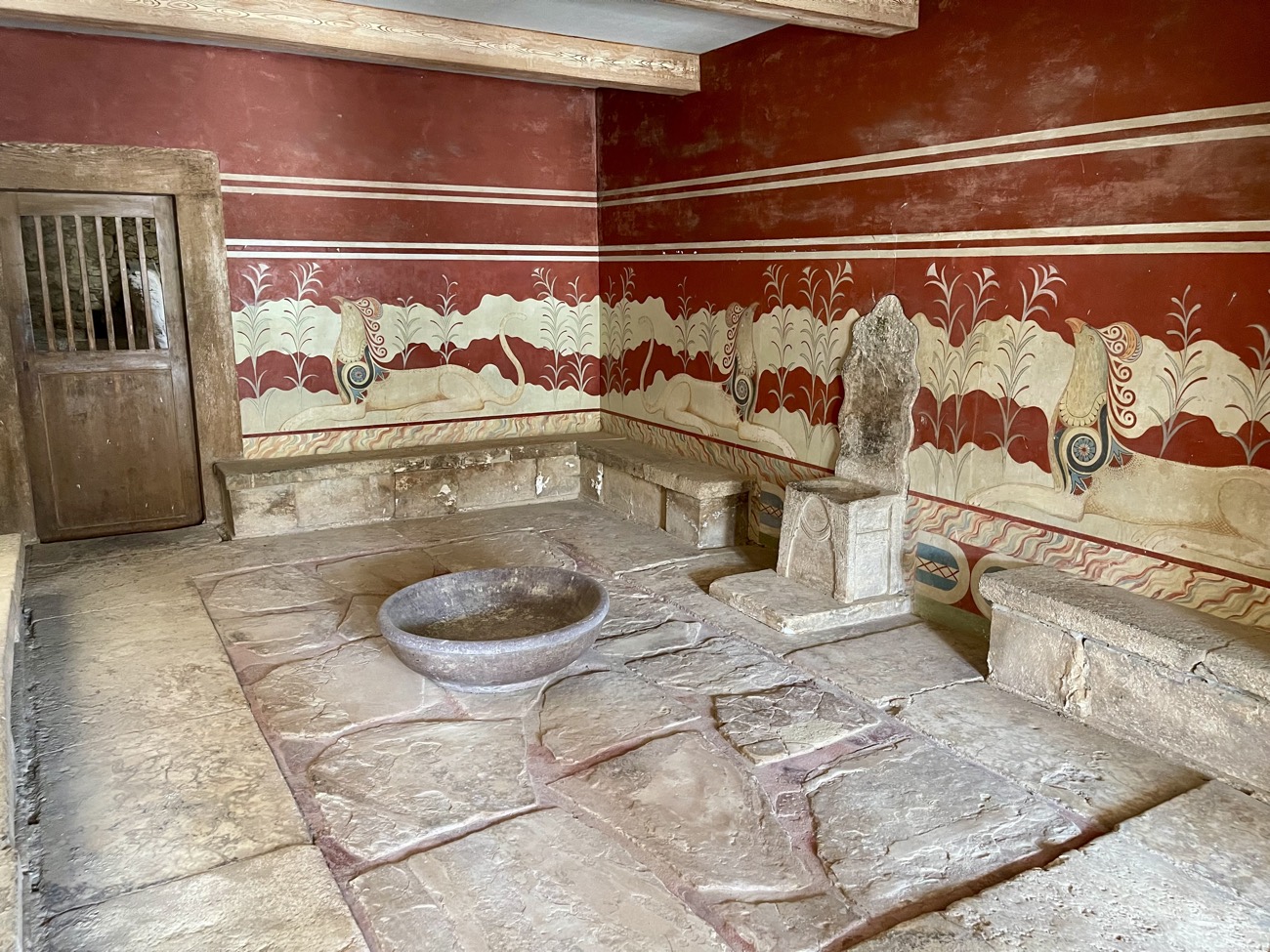
A sharp objection presses back here, and it is worth stating plainly, because it is exactly the tension a careful reader feels. If cast images are the problem, the Jerusalem Temple was full of them — not only the two great cherubim over the ark, but the twelve bronze oxen beneath the molten sea, and lions, palm trees, and pomegranates carved throughout the sanctuary. If the calf is idolatry, why are the cherubim not? The charge of a double standard is fair to raise — and the tradition’s answer turns on how an image is used, not merely that it exists.
The second commandment does not forbid all representation; it forbids the image you “bow down… [to], nor serve” (Exodus 20:4–5) — the object of worship. And the line has to fall on use rather than mere presence, because sacred imagery stood everywhere in plain sight: cherubim were carved across the walls and doors of the sanctuary and woven into the veil (1 Kings 6:29, 32; 2 Chronicles 3:14), and the bronze sea rested on twelve oxen out in the open court (1 Kings 7:25). None of it was hidden. What set that imagery apart from the calves was not concealment but three things:
- Commanded, not devised. The Temple’s imagery was given by revelation, down to the design of the cherubim (Exodus 25:18–22), where the calves were Jeroboam’s own political invention.
- Never venerated. No one bowed to a carved cherub or a bronze ox — while “the people went to worship before” the calf (1 Kings 12:30), the very act the commandment names.
- An empty throne. At the center, the cherubim framed a vacant seat: God enthroned above the ark, unseen and unportrayed — “the LORD God of Israel, which dwellest between the cherubims” (2 Kings 19:15).
A bull, by contrast, is the animal the Canaanite storm-gods are shown riding, and it invites the slide from pedestal for the invisible God into image of the god — collapsing the very distinction the empty throne exists to protect.
It is a coherent defense — and yet it does not fully dissolve the tension. Functionally, the calf and the cherubim are the same idea, and, as the next section notes, the text’s very fury at Bethel may betray how uncomfortably close the two cults (a scholar’s neutral term for systems of worship) really were. The honest reading is a both-and: the tradition has real, principled grounds for the line it draws — and the line runs conveniently between our sanctuary and theirs. (This is the tradition’s own logic and the scholarly reconstruction of it — layers this guide keeps distinct from the plain text and from doctrine.)
The Conversation Is Still Live
Scholars keep working the passage. The Hebrew Bible scholar Koog P. Hong (2023) reads the vilification of Bethel’s calf as a literary strategy of mimetic doubling — portraying one thing as a distorted mirror-image of another: the text paints the calf as a dark twin of Jerusalem’s cherubim, and in doing so betrays Judah’s own anxiety over how similar the two cults really were. In a monograph on Jeroboam’s cult, Wesley I. Toews puts the historical question directly: did Jeroboam introduce novel features, or has prejudiced Judahite reporting obscured a more traditional northern Yahwism? These are scholarly reconstructions, offered as a conversation — not the plain sense of the text, and not doctrine. Underneath them sits a firmer floor: the biblical scholar Mordechai Cogan’s I Kings (Anchor Bible, 2001), the standard critical commentary on these chapters, supplies the careful verse-by-verse groundwork the whole discussion builds on.
A Northern Hymn, in Its Own Words
That sympathy, so far, has been a matter of inference: none of the North’s own hymns and prayers survived in the North itself, so we have had to picture them from the outside. But a startling document from Egypt may let a northern hymn speak in its own voice. It is called Papyrus Amherst 63 — a battered manuscript written in Aramaic (a close cousin of Hebrew) but spelled out in Egyptian letters, an odd combination that scholars only fully cracked in the 1980s. Tucked inside it is a version of Psalm 20 — and it is not quite the Bible’s version. Where the biblical psalm looks for help to Zion (Jerusalem) and to “the LORD,” this older-sounding version looks to Zaphon, a sacred mountain of the north, and prays: “May our Bull be with us. May Bethel answer us tomorrow. Baal-Shamayin shall bless the Lord” — Baal-Shamayin being a northern sky-god.
The biblical scholar William Schniedewind offers a careful explanation. Psalm 20, he suggests, may have started life as a northern hymn, then been carried south to Jerusalem by refugees after the northern kingdom fell — and there quietly rewritten for southern use: Zaphon became Zion, and “our Bull” became simply “the LORD.” The names the Egyptian copy keeps — the Bull, Bethel, and the sky-god Baal-Shamayin — all, he notes, “would fit nicely” into the religious world of the northern kingdom before Samaria was destroyed in 722 BC.
If that reconstruction is right, it is remarkable for this page. Here, plausibly, is Bull-and-Bethel worship in its own devotional voice — not the hostile caricature of the southern editors, but a sincere hymn of trust, prayed by northerners who called on “our Bull” much as Judah called on “the LORD.” It is exactly the earnest, honestly-meant northern worship that the “pedestal” reading above imagines — and, seen from the inside, it makes the North’s “sin” look a great deal like ordinary faith. (This rests on a damaged, difficult text and a scholar’s reconstruction of it — a live conversation, not settled fact.)
Reading the North with Sympathy
The faithful payoff is not contempt for the North but recognition. Jeroboam’s sin is the perennial temptation to engineer worship around our own convenience and security — to relocate the holy where it suits us, to staff it with whoever is willing, to keep the forms of devotion while quietly cutting them loose from their source. Read this way, “the sin of Jeroboam” stops being a far-off northern failure and becomes a mirror.
Next: Elijah & Elisha → — the kingdom with no righteous king was given the two most vivid prophets in the Hebrew Bible. (Back to The Split.)