Field Guide · The Divided Kingdom
The Lady of the Temple
Josiah's reform did not only tear down the northern shrines — it reached into Solomon's own temple and removed the symbol of a goddess. Following the thread of Asherah, the sacred tree, and the divine feminine that the reform swept out — and why it moves Latter-day Saints in particular.
The reform at the heart of this guide reached further than Dan and Bethel. When Josiah purified worship, he reached into Solomon’s own temple and carried out something that had stood there for generations — the asherah (אֲשֵׁרָה), the symbol of a goddess. It is one of the most striking things the Deuteronomists’ world suppressed, and — for reasons that are almost unique to Latter-day Saint theology — one of the most moving.
The Grove in the House of the LORD
Where the King James translators found the word asherah, they wrote “grove,” and it is easy to read right past. But the text is doing something remarkable. A goddess-symbol was inside the temple in Jerusalem. Manasseh “set a graven image of the grove that he had made in the house” (2 Kings 21:7) — the very house of which the LORD had said, “in this house… will I put my name for ever.” Two generations later Josiah “brought out the grove from the house of the LORD… and burned it at the brook Kidron, and stamped it small to powder” (2 Kings 23:6). Even earlier, King Asa had removed his own grandmother Maachah from her position “because she had made an idol in a grove,” burning it at that same Kidron brook (1 Kings 15:13).
Read plainly, this is startling: a stylized sacred tree, tied to a goddess, was part of Jerusalem’s worship — removed, restored, and removed again — until the reform swept it out for good. (This is the biblical text’s own report, not a modern overlay.)
“YHWH and His Asherah”
Archaeology has deepened the picture. At Kuntillet Ajrud (a desert waystation, c. 800 BC) and at Khirbet el-Qom (a Judahite tomb, later 8th century BC), inscriptions bless the reader “by YHWH… and his asherah.” Many scholars take this as evidence that Asherah was widely venerated alongside the LORD in the popular religion of Israel and Judah before the reforms — the archaeological shadow of exactly what Kings keeps trying to purge.
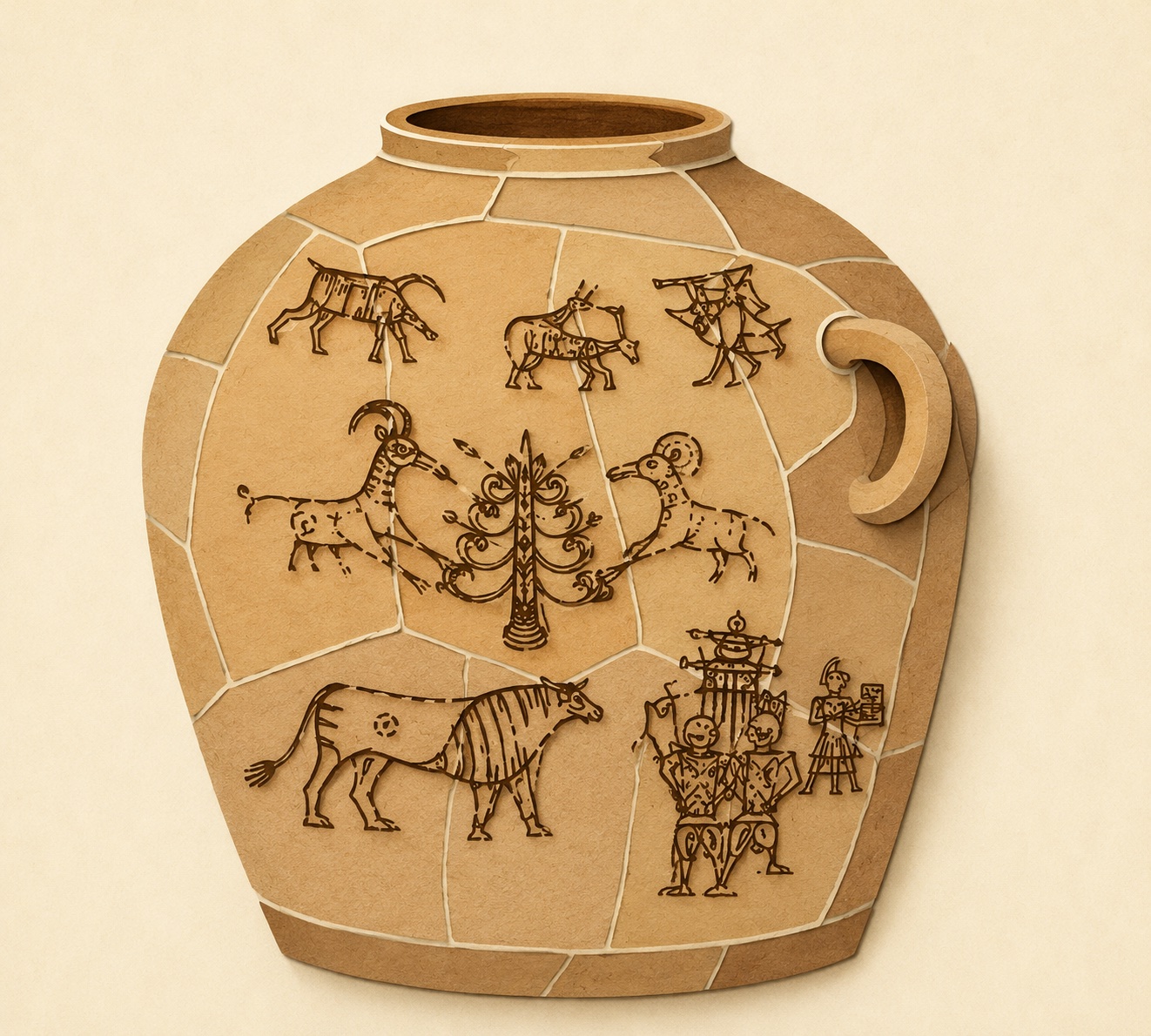
Read with care. The “and his asherah” reading is held by most scholars, but what the word denotes is genuinely debated — the goddess herself, her wooden cult-symbol (a stylized tree), or simply a common noun for a sanctuary object. It does not straightforwardly prove “the LORD had a wife,” and this guide does not claim it does. What it does show is that a feminine, tree-shaped element in Israelite worship was real and widespread — and that the reform set out to end it. (the archaeologist William Dever’s Did God Have a Wife? is the standard archaeological treatment.) Dever goes further, suggesting the seated lyre player painted on the same jar may be the asherah the blessing names — though others read the figure as male, and Pirhiya Beck, the archaeologist who first published the jar, judged the drawings and inscriptions to be separate work, neighbors rather than caption and scene. (Scholarly reconstruction — a live debate, not settled fact and not doctrine.)
A Goddess in Judah’s Own Temple
The inscriptions above show Asherah in the everyday religion of ordinary people. A temple in the southern desert shows her in an official, state-run one. At the fortress of Arad, about fifty miles south of Jerusalem, archaeologists uncovered a small temple of Judah’s own — a walled sanctuary of the LORD, complete with a sacrificial altar and, set in a niche at its heart, upright standing stones (markers of a deity’s presence). The biblical scholar William Schniedewind points out that this temple was shut down near the end of the eighth century BC — the reign of Hezekiah — and lines that closure up with the Bible’s brief note that Hezekiah “removed the high places” and “cut down the groves” (2 Kings 18:4); grove, as this page has shown, is the King James word for the asherah. Put together, they suggest the feminine tree-symbol the reform swept away was not just a Jerusalem oddity, and not just something ordinary people did on the side: it stood inside Judah’s own official sanctuaries, and taking it down was part of pulling all worship into the single temple in Jerusalem. (This dating, and its link to Hezekiah’s reform, are archaeological inferences by scholars — not something the text states outright.)
The Tree, the Lampstand, and Wisdom
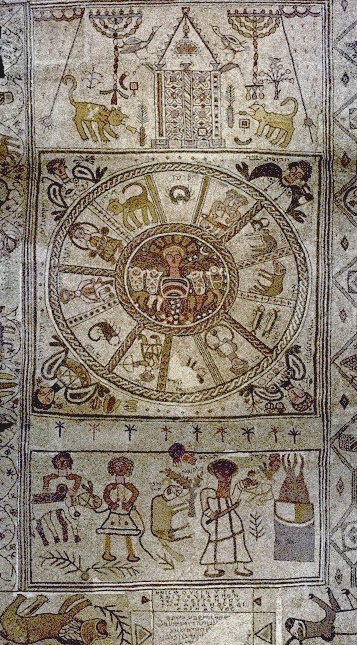
Follow the tree and the temple lights up. The asherah was a stylized tree; and sacred-tree imagery is everywhere in Solomon’s house — cherubim, palm trees, and open flowers carved across its walls and doors (1 Kings 6:29). The menorah itself is a tree of light, worked in almond blossoms and branches. And in the oldest story of all, cherubim are set to guard “the way of the tree of life” (Genesis 3:24) — the same guardian-creatures that overshadow the ark.
The tree carries a feminine figure, too. Israel’s Wisdom — Hebrew Hokmah (חָכְמָה), Greek Sophia (σοφία) (the sophia preserved in philosophy, literally “the love of wisdom”), grammatically feminine in both — is personified as a woman who was with God before creation, “daily his delight” (Proverbs 8:22–30), and of whom it is said, “She is a tree of life to them that lay hold upon her” (Proverbs 3:18). The Latter-day Saint scholar John S. Thompson traces the ancient tree-goddess iconography standing behind these sacred trees and this temple theology. And the pull of the feminine divine was strong enough that, even in exile, Judahites insisted on burning incense to “the queen of heaven” (Jeremiah 44:17) — a devotion the prophets fought, and which the reform had tried to erase.
The Lady the Reform Left Out
The biblical scholar Margaret Barker — already met in this guide — builds her “temple theology” on exactly this thread. She argues that Josiah’s reform suppressed an older temple worship that had held a place for a feminine divine presence: the Lady of the temple, later echoed in the figure of Wisdom and, she proposes, in early Christian devotion to the Mother of the Lord. It is a bold and contested reconstruction. But it names something the text itself keeps circling: a feminine presence in Israel’s worship that the reforming editors worked hard to remove. (Scholarly reconstruction, offered as a reading — not the plain sense of the text and not Church doctrine.)
The Woman, the Tree, and the Serpent
Barker reaches for Mary; the Restoration points just as naturally to Eve. Look at how the ancient goddess was actually drawn — as a stylized tree whose trunk is her body, breasts bared in nurture, often with a serpent in each hand, and lions or ibexes at her sides. It is the Garden’s own triad — a woman, a tree, a serpent — gathered into a single image. (A parallel across a shared symbolic world, not a claim of borrowing.)
And Israel’s first woman is named for exactly that role. “Adam called his wife’s name Eve (חַוָּה), because she was the mother of all living” (Genesis 3:20) — a title the Restoration puts in God’s own mouth: “thus have I, the Lord God, called the first of all women” (Moses 4:26). The name is bound to the very word for life. Where much of Christian history has read her only as the one through whom sin entered, Latter-day Saints honor Eve’s choice as wise and necessary — the mother of all living, standing beside the tree. The recovered Lady, the sacred tree, and the mother of all living converge on a figure the Restoration already exalts. Deepens, not debunks.
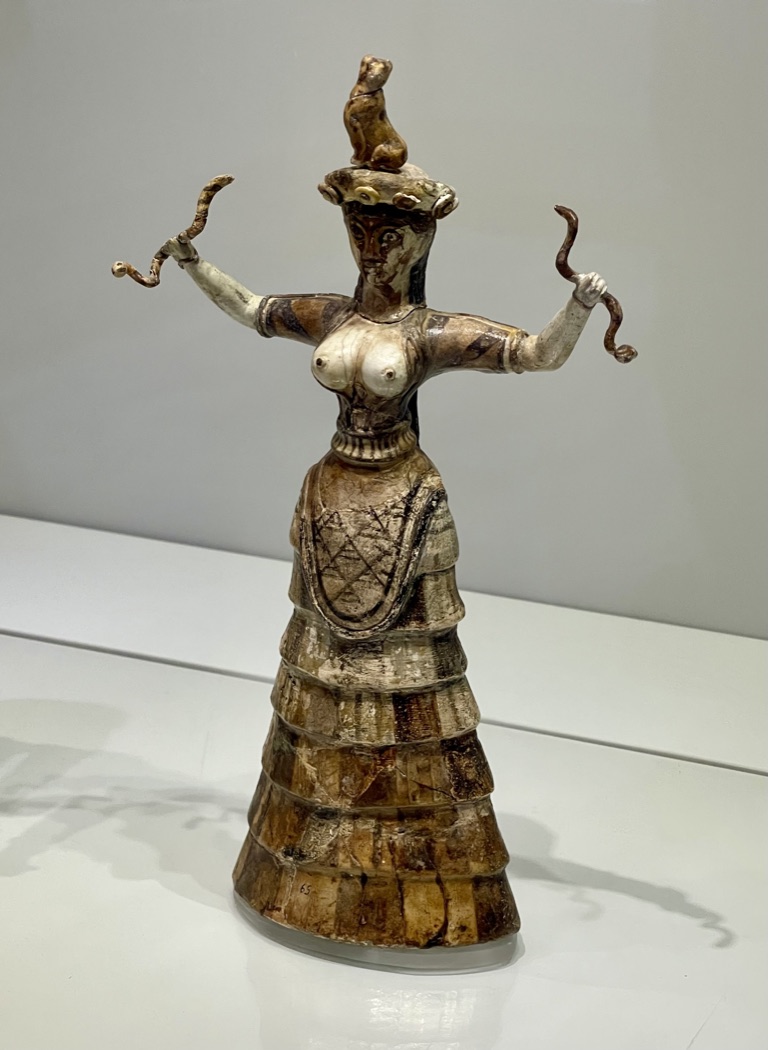
The Greek strand. The type outlived the Bronze Age. Athena — named already in Mycenaean Linear B as a-ta-na potnia, “Lady Athena” — was, many scholars since Martin Nilsson have argued, heir to a Minoan household snake-goddess; she keeps the serpent to the end (the snake at her shield, the snake-child Erichthonius she rears, the serpent-fringed aegis). And the Greeks themselves remembered a debt to Canaan: Europa, for whom the continent is named, was a Phoenician princess of Tyre, and her brother Cadmus carried the alphabet — “Phoenician letters,” Herodotus called them — from Tyre to Thebes, a Phoenician origin modern scholarship confirms. (Cadmus sows a dragon’s teeth and is himself turned to a serpent at the last.) Scholars such as Walter Burkert and M.L. West have mapped how deeply Near Eastern — including Canaanite — myth and letters shaped early Greece. (Parallels and transmission argued by scholars — cultural context, not doctrine.)
Nephi’s Tree
Now set the Book of Mormon beside all of this. Its very first vision turns on a tree. Nephi — an Israelite of about 600 BC, raised in the world these inscriptions come from — asks to understand his father’s dream of a tree, and he is shown “a tree… the beauty thereof was far beyond… all beauty” (1 Nephi 11:8). But the interpretation does not come as a definition; it comes as a woman. “Behold, the virgin whom thou seest is the mother of the Son of God” (1 Nephi 11:18); he sees her “bearing a child in her arms” (11:20); and only then does the angel ask, “Knowest thou the meaning of the tree which thy father saw?” (11:21).
The Latter-day Saint scholar Daniel C. Peterson (“Nephi and His Asherah”) argues this sequence is no accident. In the ancient Near East the sacred tree was the goddess, the divine mother; so to answer “what is the tree?” with “behold the virgin mother” is to speak the old tree-and-Lady grammar exactly — precisely what an Israelite of Lehi’s generation would recognize, and precisely what the Deuteronomists had labored to suppress. Alyson Skabelund Von Feldt, another Latter-day Saint scholar, develops the wider Wisdom-and-divine-feminine thread through the Book of Mormon’s own wisdom teaching. On this reading, Nephi carried out of Jerusalem a symbolic world the reform was in the act of closing down.
Why This Reaches Latter-day Saints
For most of the Christian world, a divine feminine erased from the temple is history. For Latter-day Saints it is something else — because the Restoration affirms what the reform removed: a Mother in Heaven, a divine feminine at the very heart of the family of God (see the hymn “O My Father,” and the Church’s Gospel Topics essay “Mother in Heaven”). To learn that the ancient temple may once have made room for the Lady, and that a later reform swept her out, is to see the shape of a familiar pattern — something true, lost, and restored.
Held rightly, this is not a claim to have proved the doctrine from an inscription, and it is not license to speak beyond what has been revealed — Latter-day Saints are counseled to reverence toward Heavenly Mother, of whom little is revealed and to whom we do not pray. It is, rather, a resonance: the recovered tree, the recovered Lady, the recovered Mother, glimpsed at the far edge of the very history this guide has been reading. Deepens, not debunks.
Faithful framing. Four layers, kept honest. The biblical text: a goddess-symbol stood in the temple and the reform removed it (2 Kings 21:7; 23:6). The archaeology and reconstruction: Asherah beside YHWH in popular religion — real, and genuinely debated in its meaning. The interpretation: Barker’s Lady, Peterson’s and Von Feldt’s readings of the tree and Wisdom — illuminating, contested, not doctrine. The Latter-day Saint frame: Heavenly Mother, affirmed and reverenced, held here as resonance rather than proof. Each is worth having; none should be mistaken for another.
Sources & Further Reading
Archaeology & inscriptions
- Pirhiya Beck, “The Drawings from Horvat Teiman (Kuntillet ‘Ajrud),” Tel Aviv 9 (1982): 3–68 — the foundational publication of the Pithos A drawings (reprinted in her Imagery and Representation, 2002).
- William G. Dever, Did God Have a Wife? Archaeology and Folk Religion in Ancient Israel (Eerdmans, 2005).
Temple theology & the divine feminine
- Margaret Barker, The Mother of the Lord, Volume 1: The Lady in the Temple (T&T Clark, 2012), and The Great Angel: A Study of Israel’s Second God (SPCK, 1992).
- John S. Thompson, “The Lady at the Horizon: Egyptian Tree Goddess Iconography and Sacred Trees in Israelite Scripture and Temple Theology” (Interpreter 38, 2020).
Latter-day Saint scholarship
- Daniel C. Peterson, “Nephi and His Asherah” (Journal of Book of Mormon Studies 9/2, 2000).
- Alyson Skabelund Von Feldt, “Does God Have a Wife?” (FARMS Review 19/1, 2007) — a review essay engaging Dever.
The goddess “type” & the Greek strand
- Kenneth Lapatin, Mysteries of the Snake Goddess (2002), on the contested Minoan reconstruction; Arthur Evans, The Palace of Minos (1921–35).
- Izak Cornelius, The Many Faces of the Goddess (2004); Othmar Keel & Christoph Uehlinger, Gods, Goddesses, and Images of God in Ancient Israel (Fortress, 1998) — on Qudshu and the pillar figurines.
- Martin P. Nilsson, The Minoan-Mycenaean Religion and Its Survival in Greek Religion (2nd ed., 1950), on Athena and the Minoan snake-goddess; Herodotus, Histories 5.58, on Cadmus and the “Phoenician letters.”
- Walter Burkert, The Orientalizing Revolution (Harvard, 1992); M.L. West, The East Face of Helicon (Oxford, 1997).
Latter-day Saint doctrine
- The Church of Jesus Christ of Latter-day Saints, Gospel Topics essay “Mother in Heaven”; and the hymn “O My Father” (Eliza R. Snow).
For the full guide bibliography, see the Sources page.
Next: Reading Faithfully → — what to do with all of it. (Back to The Book of Mormon & Kings.)