Field Guide · The Divided Kingdom
How 1 Kings Was Written
The book of Kings tells you, in its own words, that it was compiled — it names its sources and ends in exile. Ancient tradition and modern scholarship, from opposite directions, point at the same exilic window.
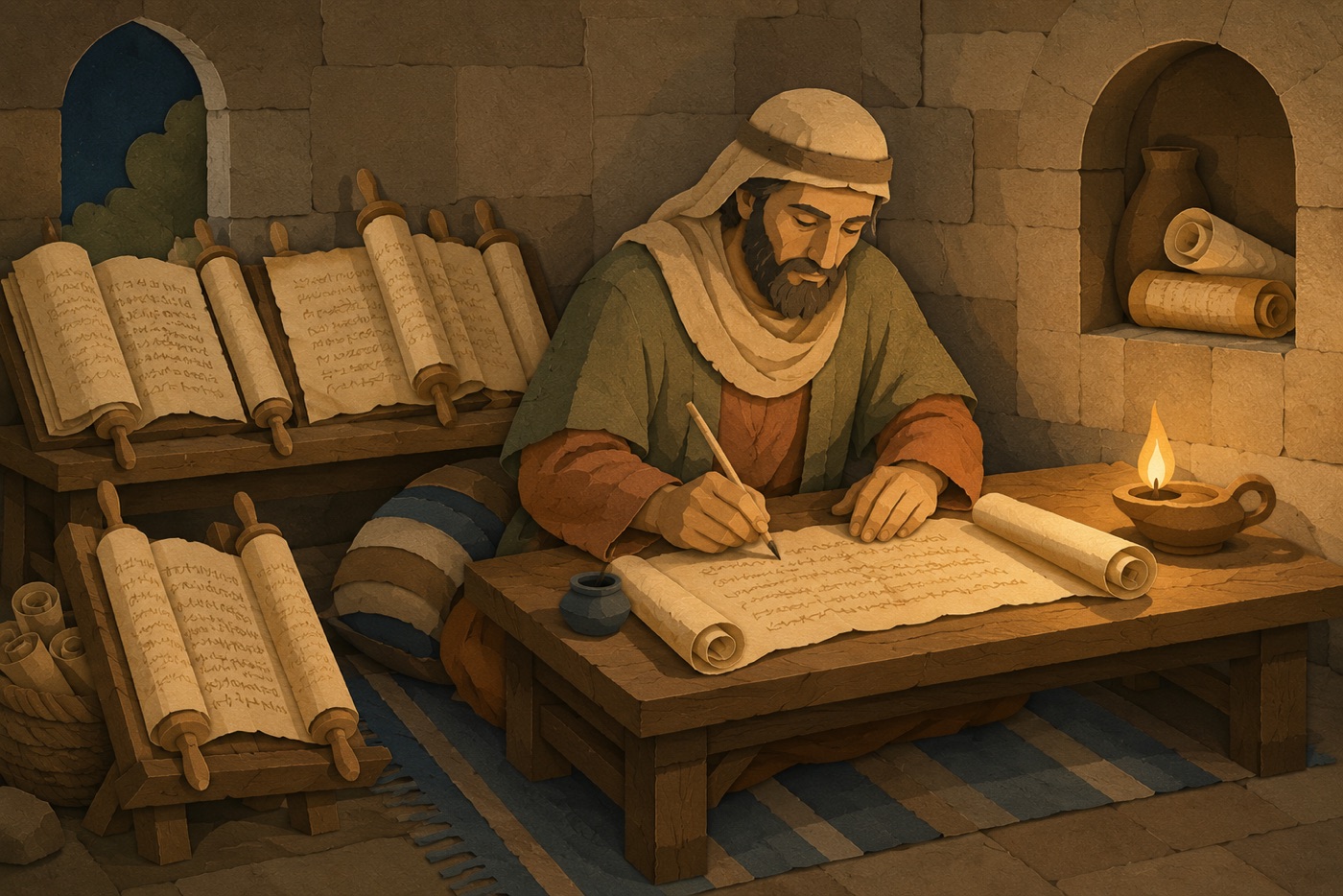
One of the quietly remarkable things about the book of Kings is that it tells you it was compiled. Again and again it pauses to say, in effect, “for the rest of this story, see the records I’m drawing on.” It names its sources. It is, on its own testimony, a worked book — older materials gathered, arranged, and interpreted by a later hand into a single argument. Seeing how and when that happened is not a threat to the text; it is the doorway into the next section, where the timing turns out to matter a great deal for the Book of Mormon.
The Book Cites Its Own Sources
Kings repeatedly points beyond itself to documents it expects its readers could consult:
- “the rest of the acts of Solomon… are they not written in the book of the acts of Solomon?” (1 Kings 11:41)
- “the rest of the acts of Jeroboam… are they not written in the book of the chronicles of the kings of Israel?” (1 Kings 14:19)
- “the rest of the acts of Rehoboam… are they not written in the book of the chronicles of the kings of Judah?” (1 Kings 14:29)
These refrains run through the whole book. They tell us Kings is built on royal annals and prophetic records — court chronicles for both kingdoms, plus the prophetic narratives (Elijah, Elisha, Isaiah). The author is not pretending to write from nowhere; he is openly a compiler and interpreter of earlier sources. (This is the book’s own claim about itself — biblical text, distinct from any modern redaction theory.)
Read Backward from Catastrophe
Where does the compiling stop? The book’s latest fixed point is the release of the exiled king Jehoiachin from a Babylonian prison, “in the seven and thirtieth year of the captivity” (~561 BC), when Evil-merodach “did lift up the head of Jehoiachin king of Judah out of prison” (2 Kings 25:27–30). The story ends not in the land but in exile — which tells you where its authors stood: after the fall of Jerusalem in 586, looking back. The entire history is written backward from the catastrophe, to answer the exile’s question — why? — and to answer it in covenant terms (see The Deuteronomists’ Lens).
The Royal Scribes in Exile
Recent archaeological work can even suggest who those exilic writers were. The biblical scholar William Schniedewind finds a clue in that very ending. Scribes who would close their whole national history on the fate of the king, seating a captive Judahite king at the Babylonian king’s table, were almost certainly the king’s own officials — the exiled royal court. Its members even turn up by name in Babylonian records that list the food rations doled out to the captured royal household: there, right beside the imprisoned King Jehoiachin, are “the Men of Judah.” A history that ends with the king’s daily bread was finished by the king’s own scribes.
And that same circle of scribes, Schniedewind notes, left its mark on two neighboring books. The account of Judah’s fall in 2 Kings 24–25 turns up again, almost word for word, as the final chapter of Jeremiah (chapter 52) — Schniedewind calls it “self-plagiarism,” the writers quietly reusing their own earlier work — and the story of good King Hezekiah in 2 Kings 18–20 is lifted over to cap the first half of Isaiah (chapters 36–39). One community, reusing its own Kings material as bookends, seems to have shaped Kings, Isaiah, and Jeremiah alike — which helps explain why the old tradition in the next section links Kings so tightly to Jeremiah. Their quiet hero is Hezekiah: of all the kings, he is the one these exilic scribes praise most warmly — remembered, on this reading, as the ruler who welcomed in the northern and outlying scribes whose traditions the nation’s collapse had scattered. (This is recent scholarly reconstruction — a model still under discussion, not the plain claim of the text and not Church doctrine.)
The Jeremiah Tradition
Ancient Jewish tradition names a compiler. The Babylonian Talmud states that Jeremiah wrote the book of Kings (and his own book, and Lamentations) — and notes the fittingness, since Kings “ends with destruction” (Babylonian Talmud, Bava Batra 15a). The Hebrew verb katav (כָּתַב), “wrote,” can carry the sense “compiled,” which fits a book that so openly gathers older sources. Whether or not Jeremiah himself is the compiler, the tradition independently locates the compilation in the exilic generation — Jeremiah’s own. (This is rabbinic tradition, and the “compiled” reading is one philological option — present as converging with scholarship, not proving it.)
That same passage is worth following one clause further. A few lines on, it turns to a different writer and a later age: Ezra, it says, wrote his own book and the genealogy of Chronicles “up to his own time,” and Nehemiah completed it (Bava Batra 15a). So the very list that hands Kings to Jeremiah in the exile hands Chronicles to Ezra in the Persian-period return — back in Jerusalem, a century or more later. The rabbis had already sorted the Bible’s two great histories into two different moments: Kings looking back from the ruins of the exile, Chronicles retelling the story from the rebuilt city.
Tradition and Scholarship Converge
This is the striking part. Working from the book’s literary seams — the visible joins where older sources were stitched together — and from its own endpoint, modern scholarship dates the final form of Kings to the Babylonian exile (Martin Noth’s single exilic history; Frank Moore Cross’s later two-edition version, whose second, exile-era edition ends with Jehoiachin’s release). Tradition credits Jeremiah, and the two fit together better than they first appear: the Bible carries Jeremiah down to Egypt (Jeremiah 43), so a Jeremiah-led compilation would be an early layer, while the book’s closing scene — a Judahite king freed in Babylon around 561 BC — reads like a final touch added by the exiles there, after his own generation. Tradition and scholarship end up describing the same book from two ends of one exilic age.
And they line up a second time. Where the Talmud sets Chronicles with Ezra in the Persian-period return, modern scholarship independently dates Chronicles much later than Kings, to that same rebuilt-Jerusalem world. Two histories, two moments — and the rabbis and the critics sort them the same way. For a faithful reader that double convergence is reassuring rather than unsettling: the question “when did these books take their final shape?” has a stable answer.
The bridge ahead. Hold onto that exilic date. The next section asks what it means for the Book of Mormon — whose people left Jerusalem with the brass plates before that compilation was finished. The “deepens, not debunks” payoff of this whole guide turns on the timeline you have just seen.
Next: Did the Book of Mormon Writers Have the Book of Kings? → (Back to The Deuteronomists’ Lens.)